 ICACT20250220 Slide.21
[Big slide for presentation]
[YouTube] |
Chrome Text-to-Speach Click!! |
 |
Appreciate Your Time: Any Questions?
|
|
ICACT20250220 Slide.20
[Big slide for presentation]
[YouTube] |
Chrome Text-to-Speach Click!! |
 |
REFERENCES
|
|
ICACT20250220 Slide.19
[Big slide for presentation]
[YouTube] |
Chrome Text-to-Speach Click!! |
 |
REFERENCES
|
|
ICACT20250220 Slide.18
[Big slide for presentation]
[YouTube] |
Chrome Text-to-Speach Click!! |
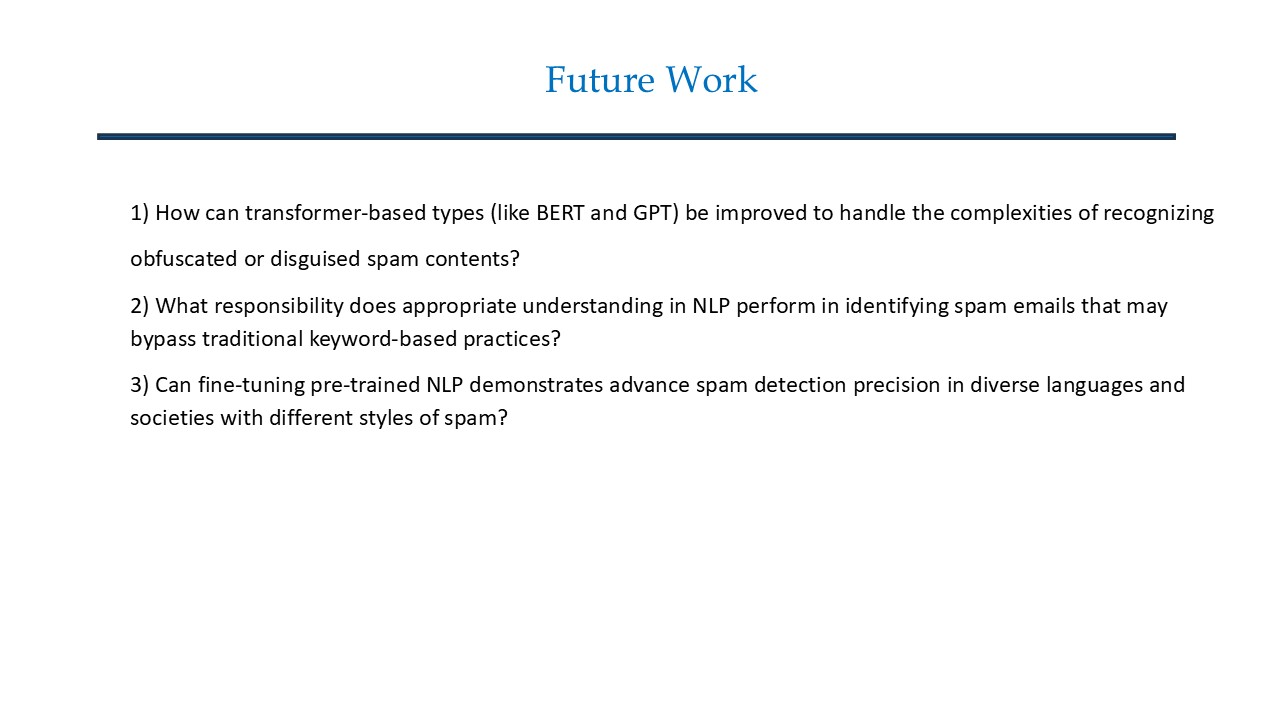 |
1) How can transformer-based types (like BERT and GPT) be improved to handle the complexities of recognizing
obfuscated or disguised spam contents?
2) What responsibility does appropriate understanding in NLP perform in identifying spam emails that may bypass traditional keyword-based practices?
3) Can fine-tuning pre-trained NLP demonstrates advance spam detection precision in diverse languages and societies with different styles of spam?
|
|
ICACT20250220 Slide.17
[Big slide for presentation]
[YouTube] |
Chrome Text-to-Speach Click!! |
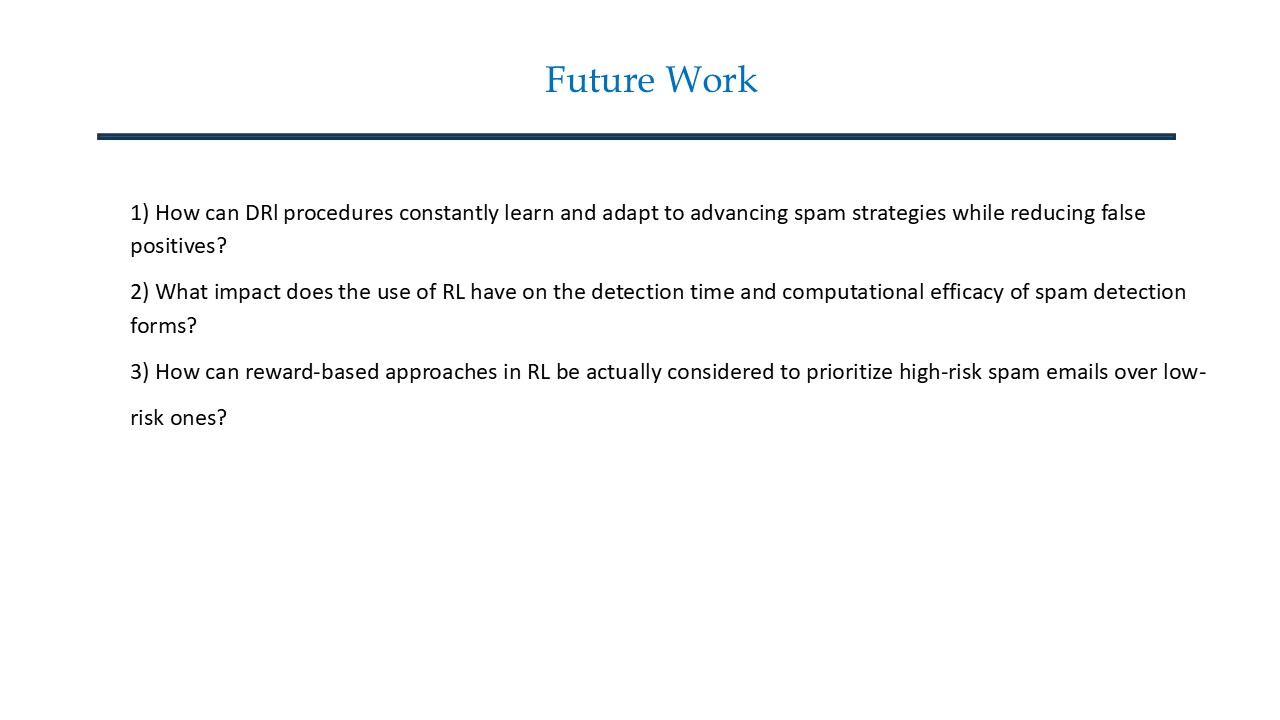 |
1) How can DRl procedures constantly learn and adapt to advancing spam strategies while reducing false positives?
2) What impact does the use of RL have on the detection time and computational efficacy of spam detection forms?
3) How can reward-based approaches in RL be actually considered to prioritize high-risk spam emails over low-
risk ones?
|
|
ICACT20250220 Slide.16
[Big slide for presentation]
[YouTube] |
Chrome Text-to-Speach Click!! |
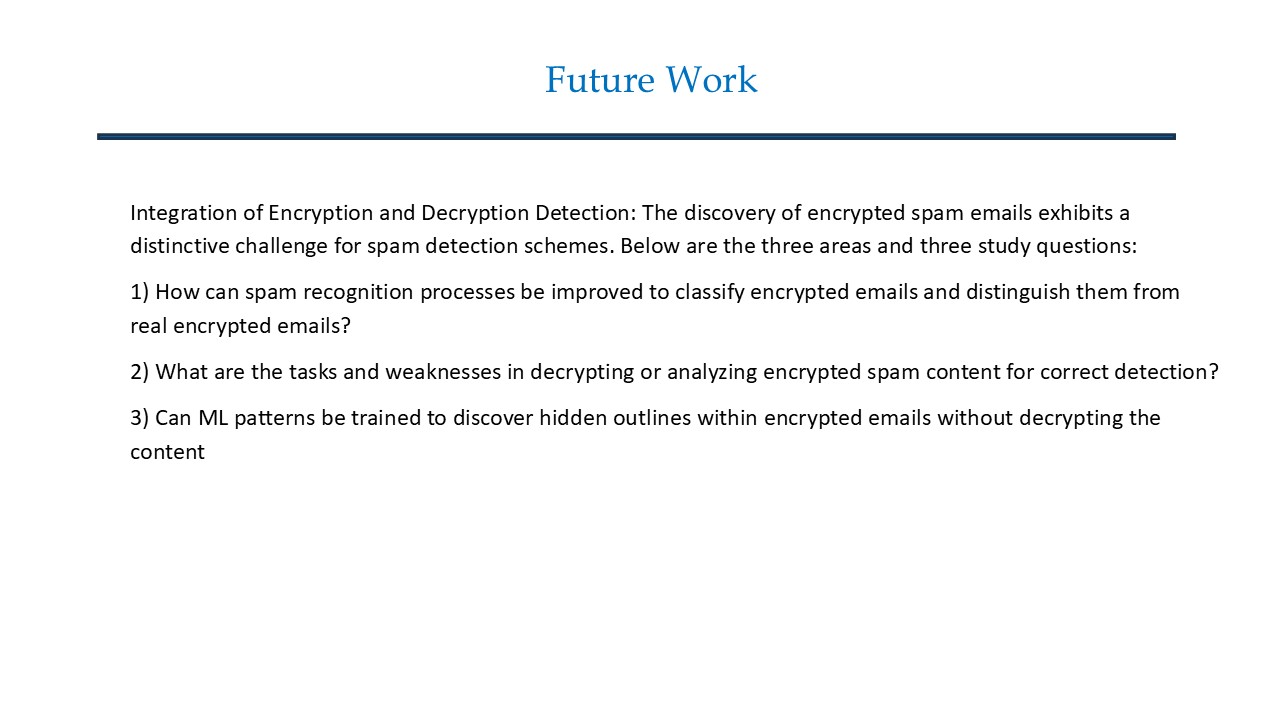 |
Integration of Encryption and Decryption Detection: The discovery of encrypted spam emails exhibits a distinctive challenge for spam detection schemes. Below are the three areas and three study questions:
1) How can spam recognition processes be improved to classify encrypted emails and distinguish them from real encrypted emails?
2) What are the tasks and weaknesses in decrypting or analyzing encrypted spam content for correct detection?
3) Can ML patterns be trained to discover hidden outlines within encrypted emails without decrypting the content
|
|
ICACT20250220 Slide.15
[Big slide for presentation]
[YouTube] |
Chrome Text-to-Speach Click!! |
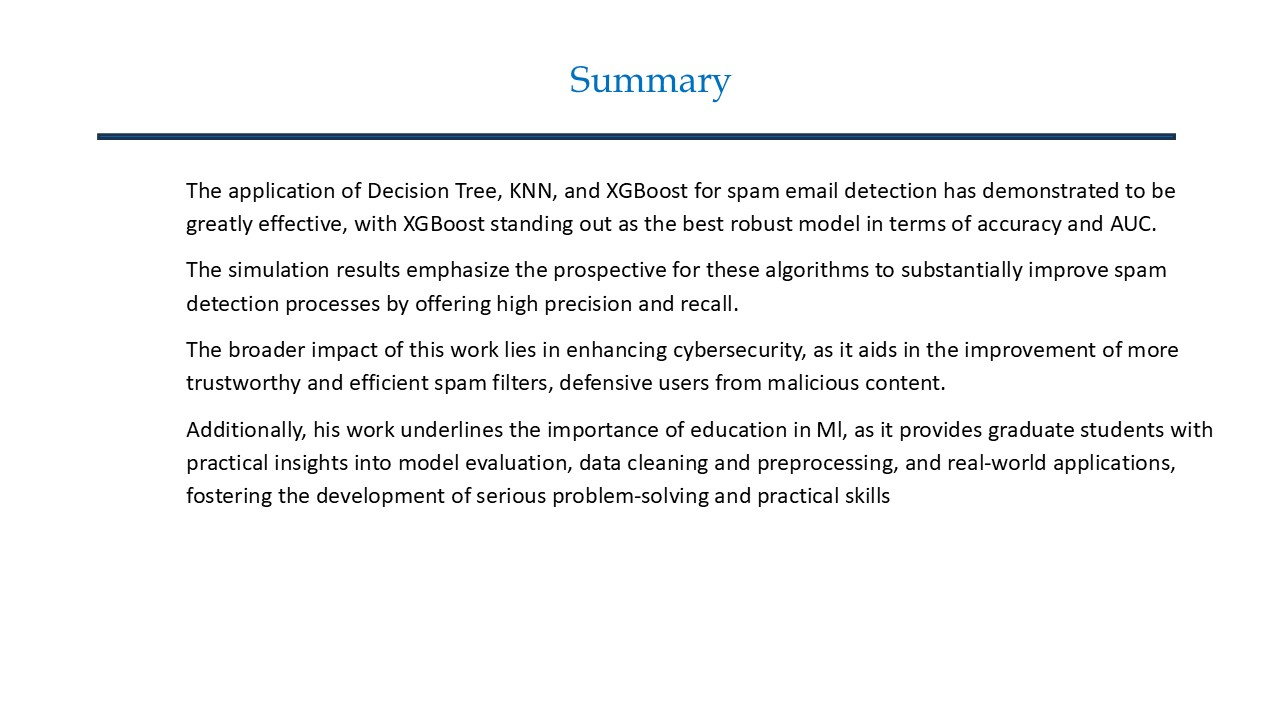 |
The application of Decision Tree, KNN, and XGBoost for spam email detection has demonstrated to be greatly effective, with XGBoost standing out as the best robust model in terms of accuracy and AUC.
The simulation results emphasize the prospective for these algorithms to substantially improve spam detection processes by offering high precision and recall.
The broader impact of this work lies in enhancing cybersecurity, as it aids in the improvement of more trustworthy and efficient spam filters, defensive users from malicious content.
Additionally, his work underlines the importance of education in Ml, as it provides graduate students with practical insights into model evaluation, data cleaning and preprocessing, and real-world applications, fostering the development of serious problem-solving and practical skills
|
|
ICACT20250220 Slide.14
[Big slide for presentation]
[YouTube] |
Chrome Text-to-Speach Click!! |
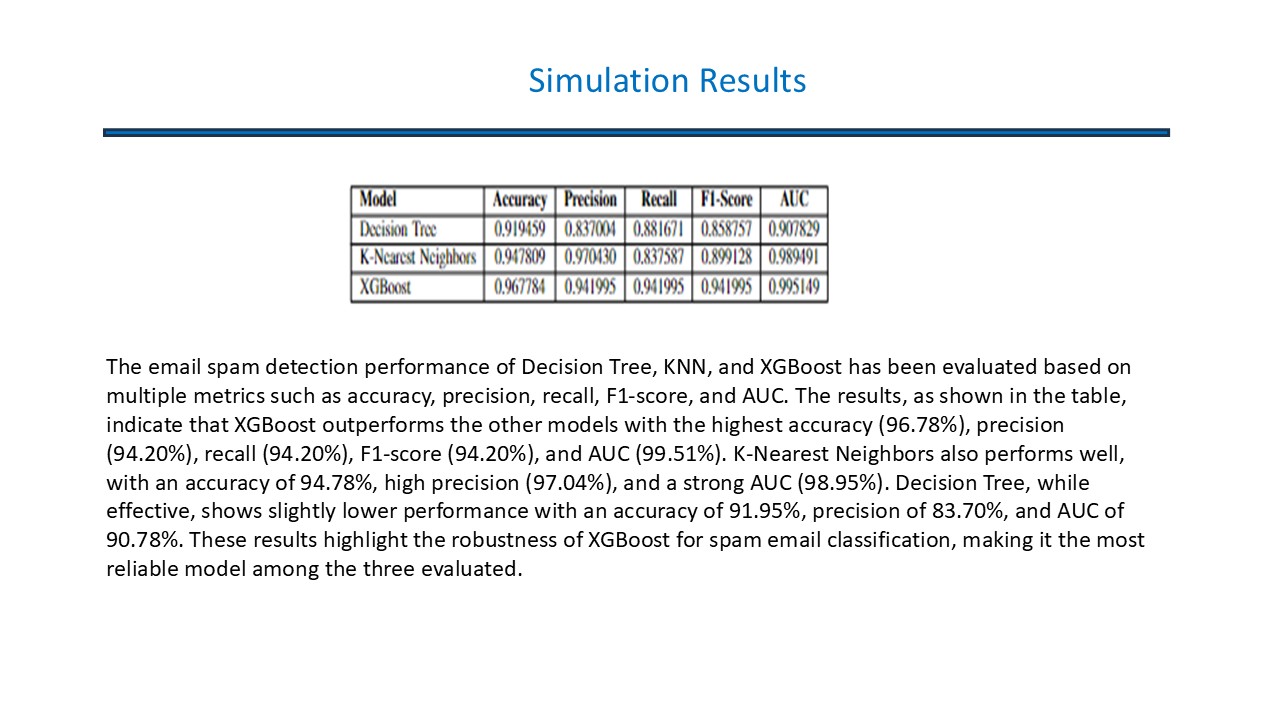 |
The email spam detection performance of Decision Tree, KNN, and XGBoost has been evaluated based on multiple metrics such as accuracy, precision, recall, F1-score, and AUC. The results, as shown in the table, indicate that XGBoost outperforms the other models with the highest accuracy (96.78%), precision (94.20%), recall (94.20%), F1-score (94.20%), and AUC (99.51%). K-Nearest Neighbors also performs well, with an accuracy of 94.78%, high precision (97.04%), and a strong AUC (98.95%). Decision Tree, while effective, shows slightly lower performance with an accuracy of 91.95%, precision of 83.70%, and AUC of 90.78%. These results highlight the robustness of XGBoost for spam email classification, making it the most reliable model among the three evaluated.
|
|
ICACT20250220 Slide.13
[Big slide for presentation]
[YouTube] |
Chrome Text-to-Speach Click!! |
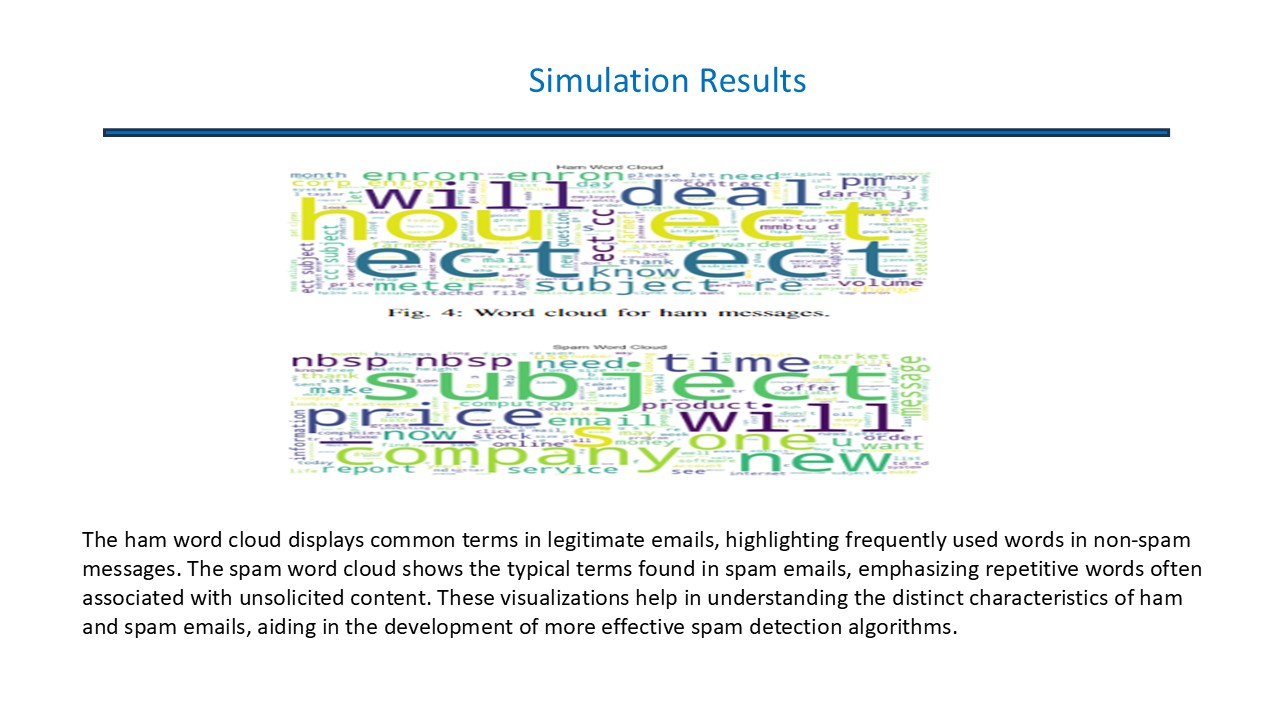 |
The ham word cloud displays common terms in legitimate emails, highlighting frequently used words in non-spam messages. The spam word cloud shows the typical terms found in spam emails, emphasizing repetitive words often associated with unsolicited content. These visualizations help in understanding the distinct characteristics of ham and spam emails, aiding in the development of more effective spam detection algorithms.
|
|
ICACT20250220 Slide.12
[Big slide for presentation]
[YouTube] |
Chrome Text-to-Speach Click!! |
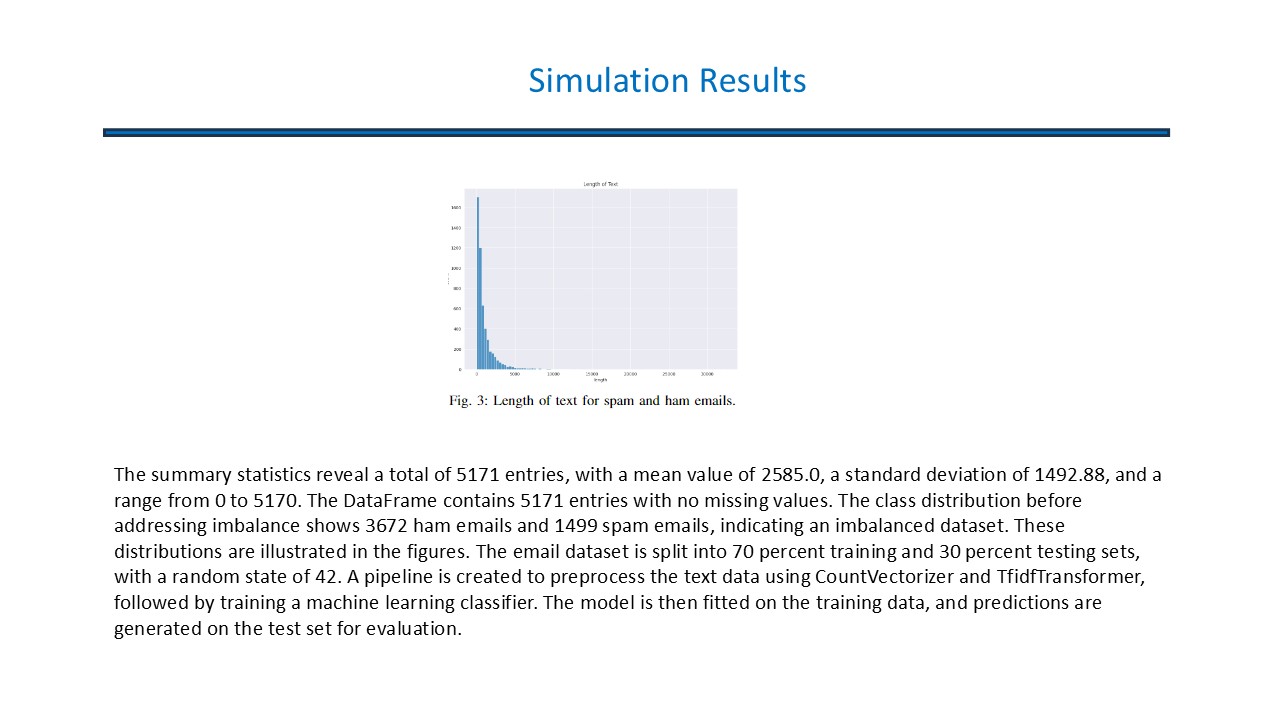 |
The summary statistics reveal a total of 5171 entries, with a mean value of 2585.0, a standard deviation of 1492.88, and a range from 0 to 5170. The DataFrame contains 5171 entries with no missing values. The class distribution before addressing imbalance shows 3672 ham emails and 1499 spam emails, indicating an imbalanced dataset. These distributions are illustrated in the figures. The email dataset is split into 70 percent training and 30 percent testing sets, with a random state of 42. A pipeline is created to preprocess the text data using CountVectorizer and TfidfTransformer, followed by training a machine learning classifier. The model is then fitted on the training data, and predictions are generated on the test set for evaluation.
|
|
ICACT20250220 Slide.11
[Big slide for presentation]
[YouTube] |
Chrome Text-to-Speach Click!! |
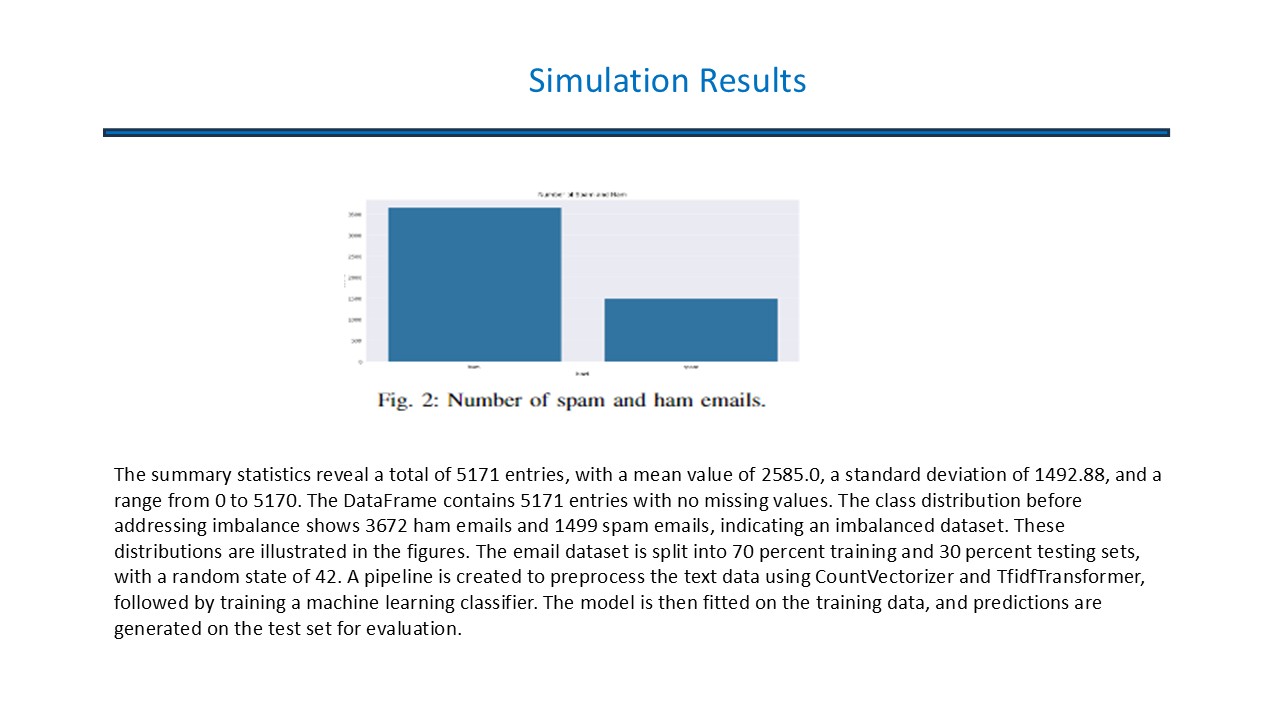 |
The summary statistics reveal a total of 5171 entries, with a mean value of 2585.0, a standard deviation of 1492.88, and a range from 0 to 5170. The DataFrame contains 5171 entries with no missing values. The class distribution before addressing imbalance shows 3672 ham emails and 1499 spam emails, indicating an imbalanced dataset. These distributions are illustrated in the figures. The email dataset is split into 70 percent training and 30 percent testing sets, with a random state of 42. A pipeline is created to preprocess the text data using CountVectorizer and TfidfTransformer, followed by training a machine learning classifier. The model is then fitted on the training data, and predictions are generated on the test set for evaluation.
|
|
ICACT20250220 Slide.10
[Big slide for presentation]
[YouTube] |
Chrome Text-to-Speach Click!! |
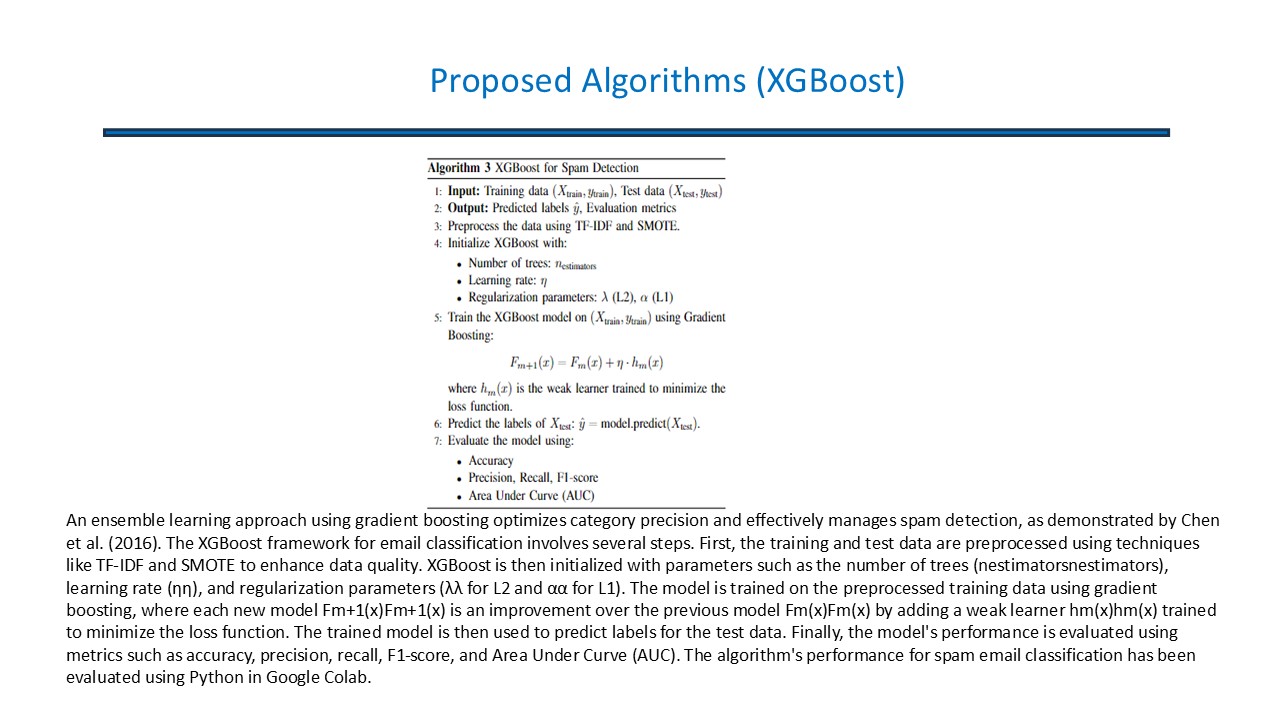 |
An ensemble learning approach using gradient boosting optimizes category precision and effectively manages spam detection, as demonstrated by Chen et al. (2016). The XGBoost framework for email classification involves several steps. First, the training and test data are preprocessed using techniques like TF-IDF and SMOTE to enhance data quality. XGBoost is then initialized with parameters such as the number of trees (nestimatorsnestimators), learning rate (ηη), and regularization parameters (λλ for L2 and αα for L1). The model is trained on the preprocessed training data using gradient boosting, where each new model Fm+1(x)Fm+1(x) is an improvement over the previous model Fm(x)Fm(x) by adding a weak learner hm(x)hm(x) trained to minimize the loss function. The trained model is then used to predict labels for the test data. Finally, the model's performance is evaluated using metrics such as accuracy, precision, recall, F1-score, and Area Under Curve (AUC). The algorithm's performance for spam email classification has been evaluated using Python in Google Colab.
|
|
ICACT20250220 Slide.09
[Big slide for presentation]
[YouTube] |
Chrome Text-to-Speach Click!! |
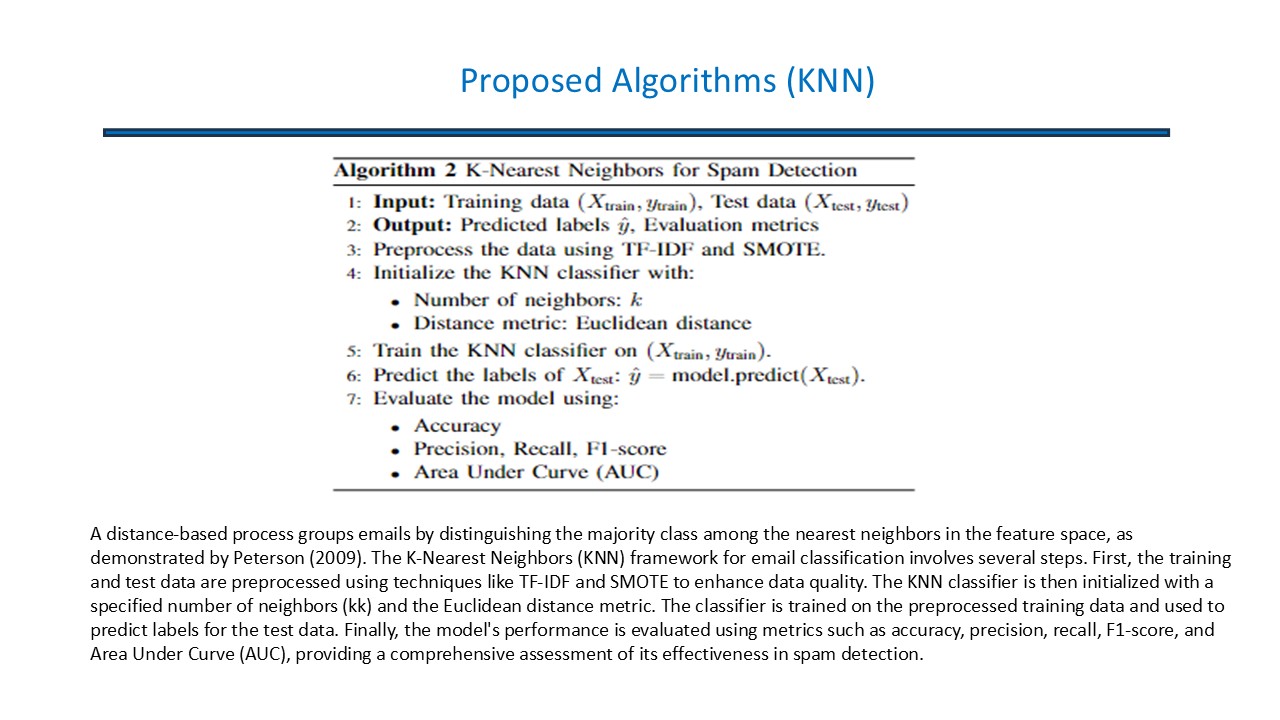 |
A distance-based process groups emails by distinguishing the majority class among the nearest neighbors in the feature space, as demonstrated by Peterson (2009). The K-Nearest Neighbors (KNN) framework for email classification involves several steps. First, the training and test data are preprocessed using techniques like TF-IDF and SMOTE to enhance data quality. The KNN classifier is then initialized with a specified number of neighbors (kk) and the Euclidean distance metric. The classifier is trained on the preprocessed training data and used to predict labels for the test data. Finally, the model's performance is evaluated using metrics such as accuracy, precision, recall, F1-score, and Area Under Curve (AUC), providing a comprehensive assessment of its effectiveness in spam detection.
|
|
ICACT20250220 Slide.08
[Big slide for presentation]
[YouTube] |
Chrome Text-to-Speach Click!! |
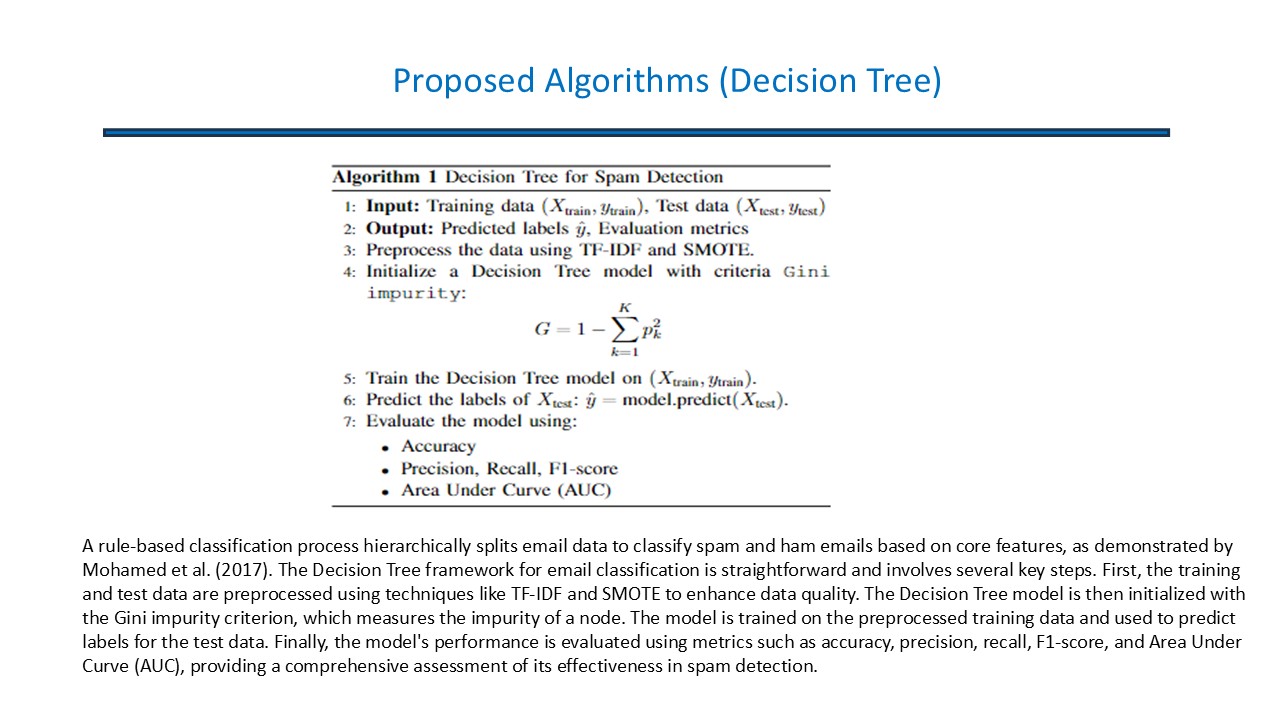 |
A rule-based classification process hierarchically splits email data to classify spam and ham emails based on core features, as demonstrated by Mohamed et al. (2017). The Decision Tree framework for email classification is straightforward and involves several key steps. First, the training and test data are preprocessed using techniques like TF-IDF and SMOTE to enhance data quality. The Decision Tree model is then initialized with the Gini impurity criterion, which measures the impurity of a node. The model is trained on the preprocessed training data and used to predict labels for the test data. Finally, the model's performance is evaluated using metrics such as accuracy, precision, recall, F1-score, and Area Under Curve (AUC), providing a comprehensive assessment of its effectiveness in spam detection.
|
|
ICACT20250220 Slide.07
[Big slide for presentation]
[YouTube] |
Chrome Text-to-Speach Click!! |
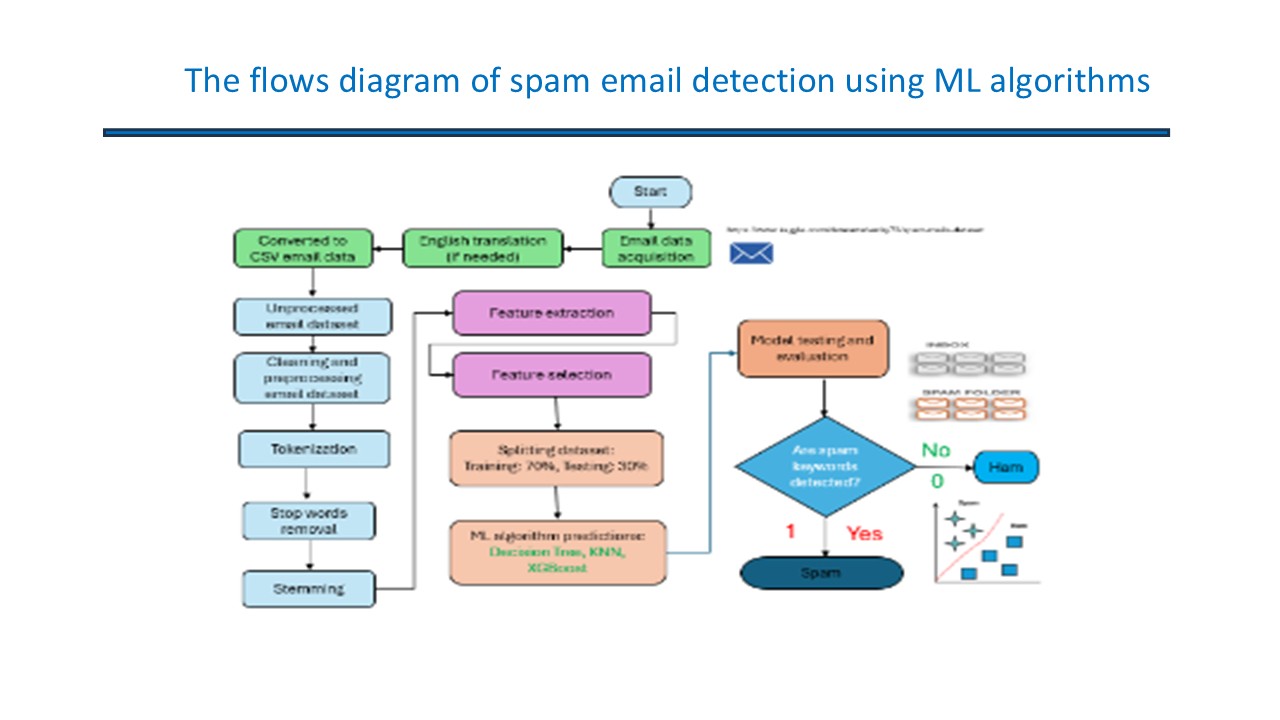 |
The flows diagram of spam email detection using ML algorithms
|
|
ICACT20250220 Slide.06
[Big slide for presentation]
[YouTube] |
Chrome Text-to-Speach Click!! |
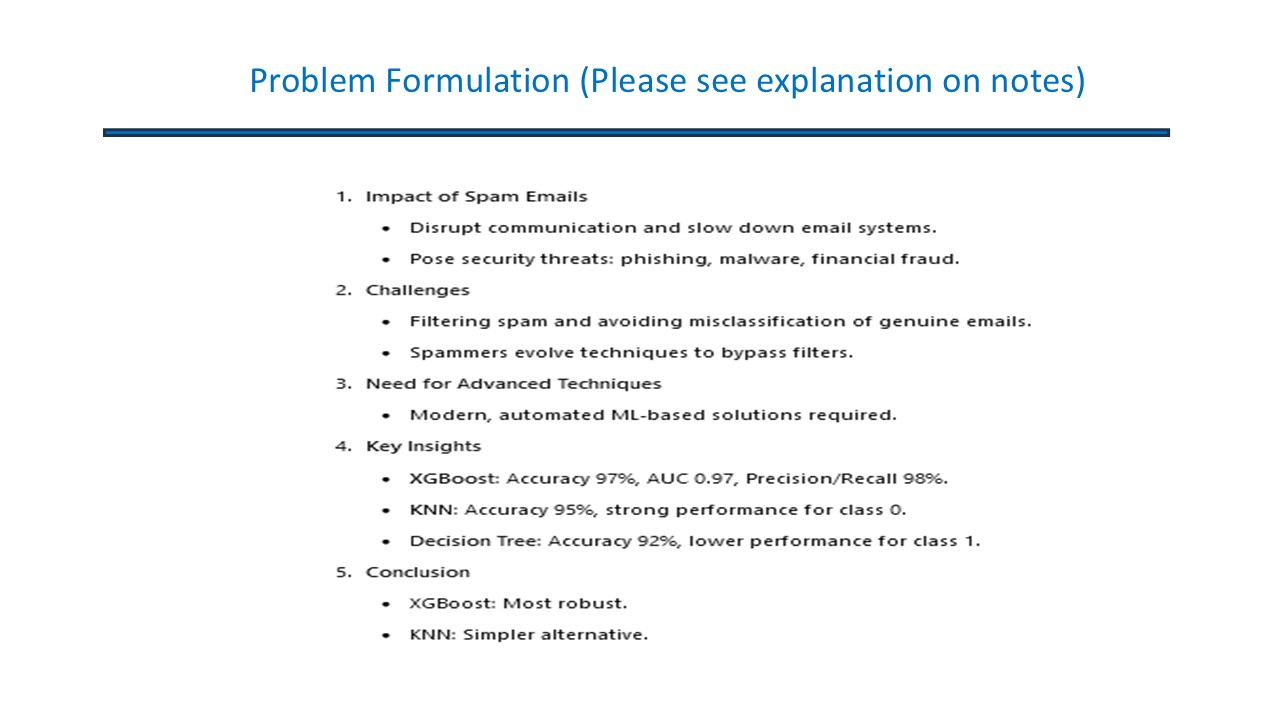 |
The primary challenge in spam email detection is accurately distinguishing between legitimate emails (ham) and unwanted spam, given the evolving tactics of spammers. Current machine learning models, while effective, often struggle with maintaining high accuracy and robustness due to the dynamic nature of spam content and the presence of noisy data. This research aims to address these issues by formulating a problem where the goal is to optimize spam detection algorithms to enhance their performance. Specifically, we focus on evaluating the effectiveness of Decision Tree, KNN, and XGBoost algorithms in classifying emails as spam or ham. The problem is further complicated by the need for efficient preprocessing and feature extraction techniques, such as tokenization, stemming, and stopword removal, to improve model accuracy. By leveraging a dataset from Kaggle, split into training and testing sets, we aim to identify the most robust algorithm that can adapt to changing spam patterns and provide reliable spam detection.
|
|
ICACT20250220 Slide.05
[Big slide for presentation]
[YouTube] |
Chrome Text-to-Speach Click!! |
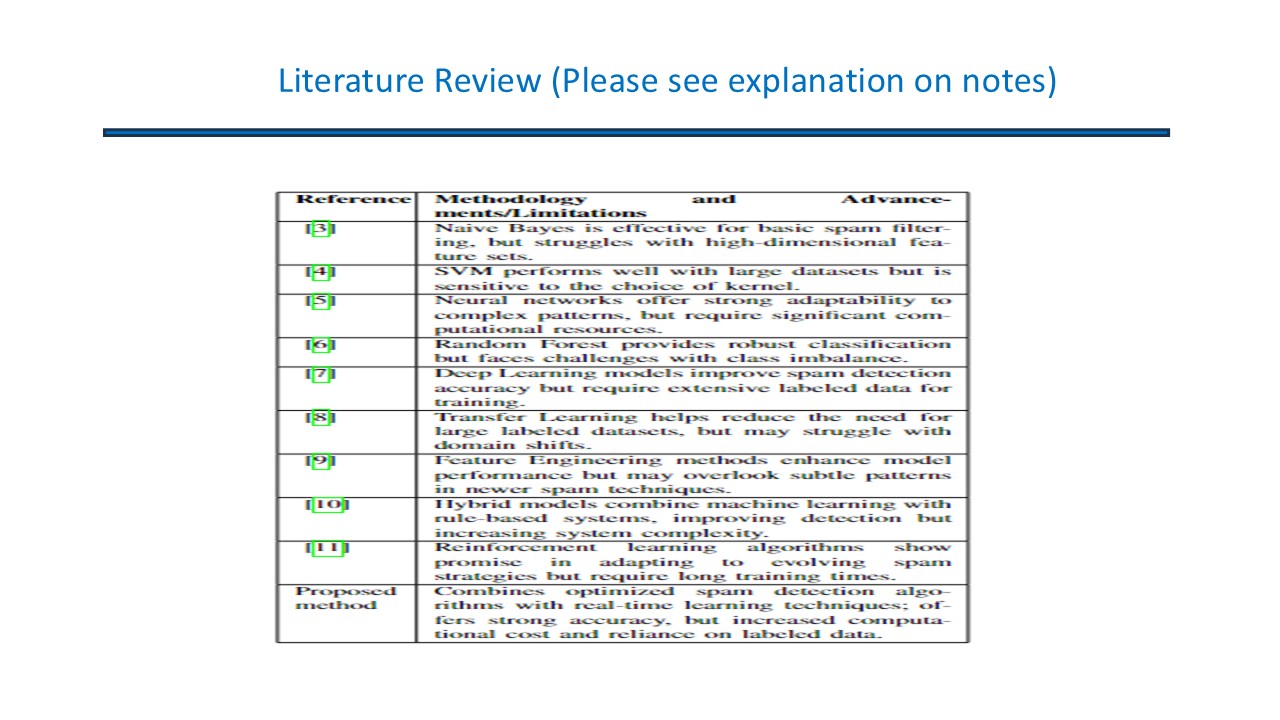 |
The literature on spam email detection and classification highlights the critical role of machine learning algorithms in enhancing email security. Various studies have explored the effectiveness of different algorithms, including Decision Tree, KNN, and XGBoost, in identifying spam emails. Preprocessing and feature extraction techniques, such as tokenization, stemming, and stopword removal, are commonly employed to improve model performance1
. Research indicates that XGBoost often outperforms other models in terms of accuracy and robustness, achieving high precision and recall rates2
. However, challenges remain due to the dynamic nature of spammer strategies and the dataset shift problem, which can degrade model performance over time2
. Future research directions include the application of advanced techniques like deep learning and reinforcement learning to further optimize spam detection and address emerging email threats3
.
|
|
ICACT20250220 Slide.04
[Big slide for presentation]
[YouTube] |
Chrome Text-to-Speach Click!! |
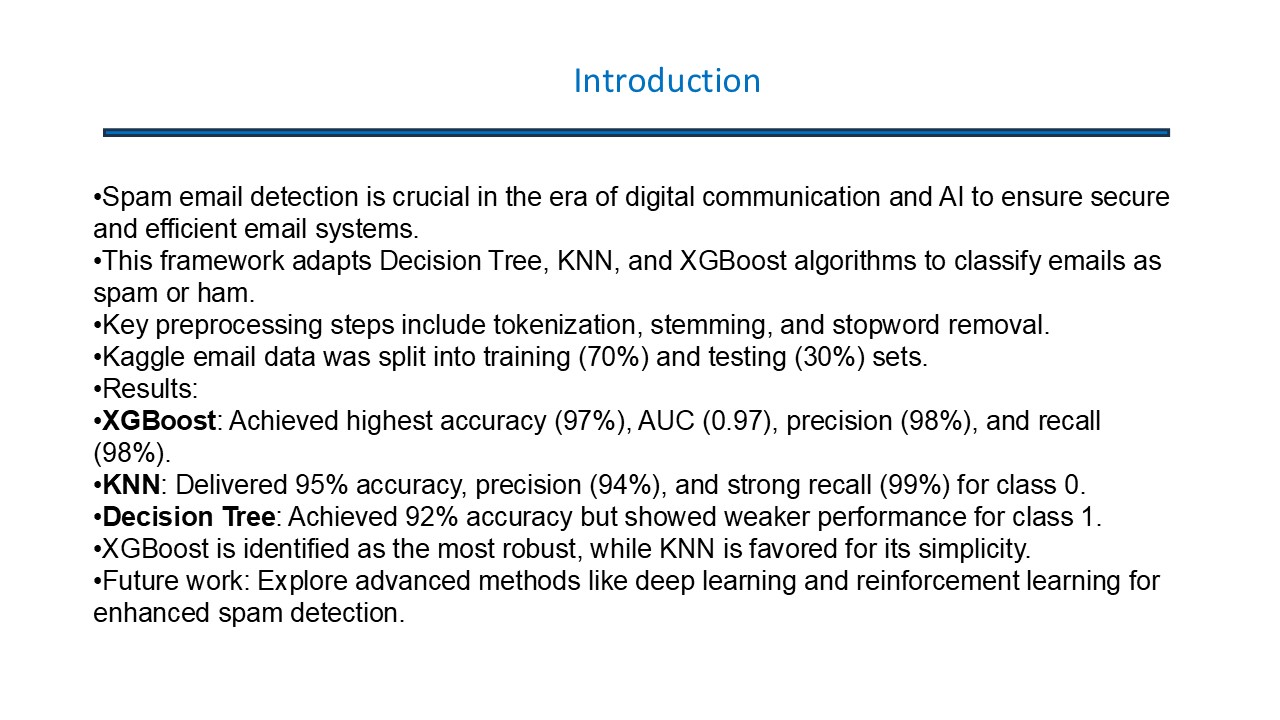 |
In the age of digital communication and artificial intelligence, spam email detection and classification have become essential tasks to ensure the efficiency and security of email systems. With the increasing volume of email traffic, distinguishing between legitimate emails (ham) and unwanted spam has become more challenging. This research focuses on optimizing machine learning algorithms to enhance spam detection accuracy. We explore the adaptation of Decision Tree, KNN, and XGBoost algorithms, leveraging preprocessing and feature extraction techniques such as tokenization, stemming, and stopword removal. By analyzing email data from Kaggle, split into training and testing sets, we aim to identify the most effective algorithm for spam classification. Our findings demonstrate that well-implemented preprocessing and feature engineering significantly improve model performance, with XGBoost emerging as the most robust algorithm. This study not only contributes to the field of email security but also paves the way for future research into advanced techniques like deep learning and reinforcement learning to further optimize spam detection and address emerging email threats.
|
|
ICACT20250220 Slide.03
[Big slide for presentation]
|
Chrome Text-to-Speach Click!! |
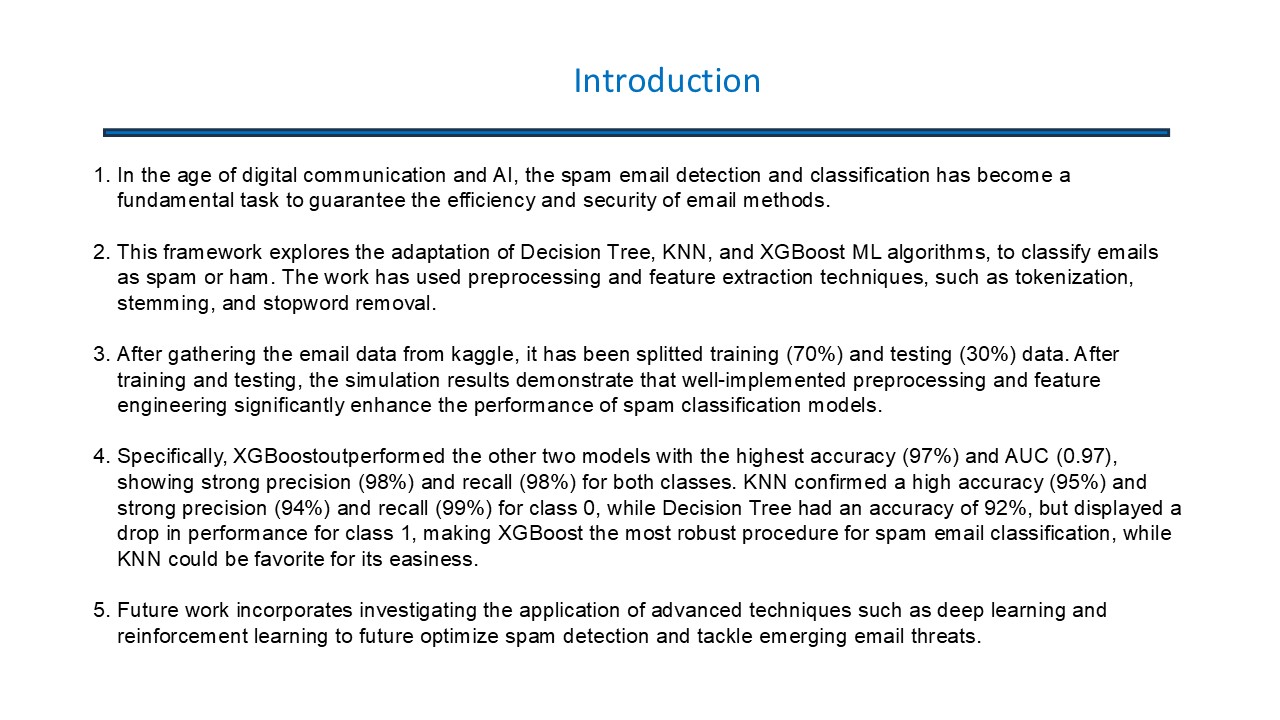 |
In the age of digital communication and artificial intelligence, spam email detection and classification have become essential tasks to ensure the efficiency and security of email systems. With the increasing volume of email traffic, distinguishing between legitimate emails (ham) and unwanted spam has become more challenging. This research focuses on optimizing machine learning algorithms to enhance spam detection accuracy. We explore the adaptation of Decision Tree, KNN, and XGBoost algorithms, leveraging preprocessing and feature extraction techniques such as tokenization, stemming, and stopword removal. By analyzing email data from Kaggle, split into training and testing sets, we aim to identify the most effective algorithm for spam classification. Our findings demonstrate that well-implemented preprocessing and feature engineering significantly improve model performance, with XGBoost emerging as the most robust algorithm. This study not only contributes to the field of email security but also paves the way for future research into advanced techniques like deep learning and reinforcement learning to further optimize spam detection and address emerging email threats.
|
|
ICACT20250220 Slide.02
[Big slide for presentation]
[YouTube] |
Chrome Text-to-Speach Click!! |
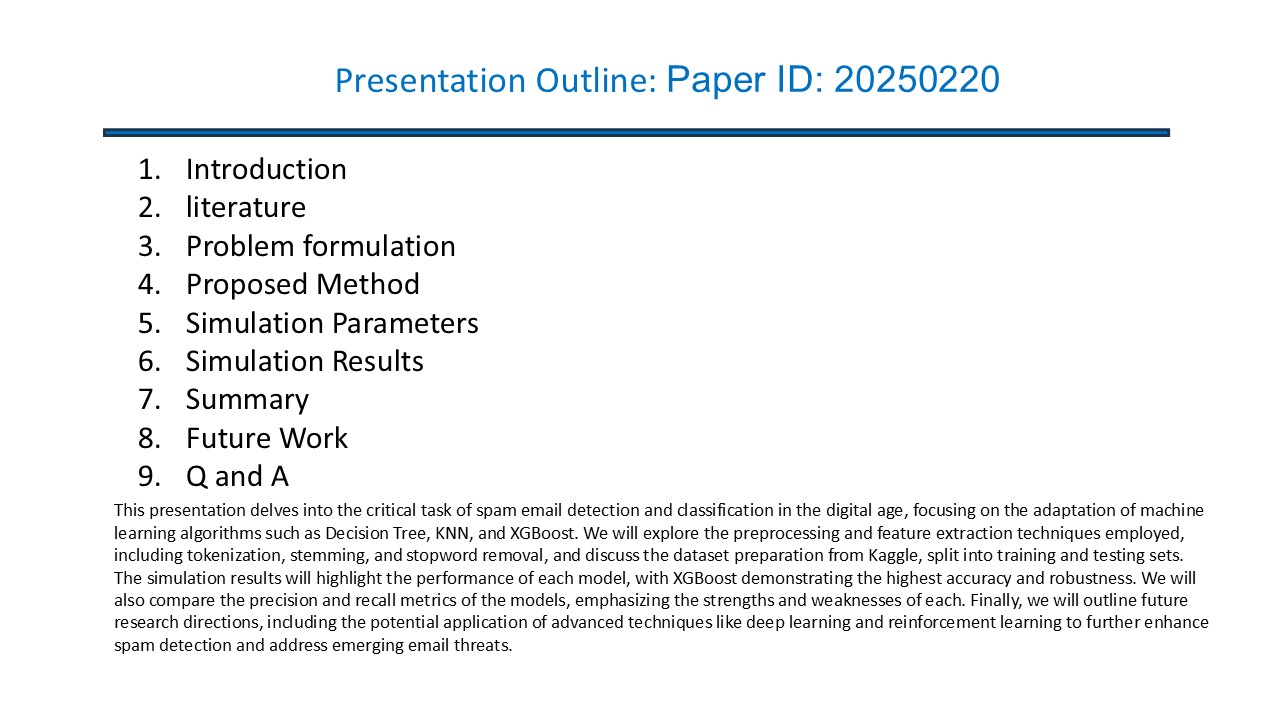 |
This presentation delves into the critical task of spam email detection and classification in the digital age, focusing on the adaptation of machine learning algorithms such as Decision Tree, KNN, and XGBoost. We will explore the preprocessing and feature extraction techniques employed, including tokenization, stemming, and stopword removal, and discuss the dataset preparation from Kaggle, split into training and testing sets. The simulation results will highlight the performance of each model, with XGBoost demonstrating the highest accuracy and robustness. We will also compare the precision and recall metrics of the models, emphasizing the strengths and weaknesses of each. Finally, we will outline future research directions, including the potential application of advanced techniques like deep learning and reinforcement learning to further enhance spam detection and address emerging email threats.
|
|
ICACT20250220 Slide.01
[Big slide for presentation]
[YouTube] |
Chrome Text-to-Speach Click!! |
 |
1) How can DRl procedures constantly learn and adapt to advancing spam strategies while reducing false positives?
2) What impact does the use of RL have on the detection time and computational efficacy of spam detection forms?
3) How can reward-based approaches in RL be actually considered to prioritize high-risk spam emails over low-
risk ones?
|
















