Now 4102 visitors
Today:0 Yesterday:0
Total: 141480
215S 51P 5R
2026-10-21, Week 43 |
| Member Login |
| TACT Journal Homepage |
| Call for Paper |
| Committee |
| Find My Paper |
| Author Homepage |
| Statistics & History |
| Welcome Message |
| Paper Procedure |
| FAQ |
| Paper Archives |
| Outstanding Papers |
| Author Homepage |
| - Paper Procedure |
| - Journal Procedure |
| - Presentation Tips |
|
| Program & Proceedings |
| Program with Papers |
| Plenary Session |
| Tutorial Session |
|
| Presentation Platform |
| Hotel & Travel Info |
| About Korea |
| Accommodation |
| Transportation |
| VISA |
| Other Infomation |
|
| Photo Gallery |
| Scheduler Login |
| Seminar |
| Archives Login |
|
| Sponsors |

|

|

|

|

|

|

|

|

|

|
|
|
|
|
main_email:birahim.babou@ucad.edu.sn
| Save the slide and description |

|
*** You can edit any slide by selecting the Slide number below***
|
 ICACT20240393 Slide.19
[Big slide for presentation] |
Chrome Text-to-Speach Click!! |
 |
REFERENCES
T. Kita, C. Nagaoka, N. Hiraoka and T. Molnár, "Development of a Moodle UI Using LINE Chat for Casual Learning as a Part of a Learner Assistive LMS," 2020 IEEE International Conference on Teaching, Assessment, and Learning for Engineering (TALE), Takamatsu, Japan, 2020, pp. 927-929, doi: 10.1109/TALE48869.2020.9368321.
W. Kaiss, K. Mansouri and F. Poirier, "Chatbot Design to Help Learners Self-Regulte Their Learning in Online Learning Environments," 2023 IEEE International Conference on Advanced Learning Technologies (ICALT), Orem, UT, USA, 2023, pp. 236-238, doi: 10.1109/ICALT58122.2023.00075.
S. Kesarwani, Titiksha and S. Juneja, "Student Chatbot System: A Review on Educational Chatbot," 2023 7th International Conference on Trends in Electronics and Informatics (ICOEI), Tirunelveli, India, 2023, pp. 1578-1583, doi: 10.1109/ICOEI56765.2023.10125876.
B. Rawat, A. S. Bist, U. Rahardja, Q. Aini and Y. P. Ayu Sanjaya, "Recent Deep Learning Based NLP Techniques for Chatbot Development: An Exhaustive Survey," 2022 10th International Conference on Cyber and IT Service Management (CITSM), Yogyakarta, Indonesia, 2022, pp. 1-4, doi: 10.1109/CITSM56380.2022.9935858.
J. J. Sophia and T. P. Jacob, "EDUBOT-A Chatbot For Education in Covid-19 Pandemic and VQAbot Comparison," 2021 Second International Conference on Electronics and Sustainable Communication Systems (ICESC), Coimbatore, India, 2021, pp. 1707- 1714, doi: 10.1109/ICESC51422.2021.9532611.
S. Ondáš, M. Pleva and D. Hládek, "How chatbots can be involved in the education process," 2019 17th International Conference on Emerging eLearning Technologies and Applications (ICETA), Starý Smokovec, Slovakia, 2019, pp. 575-580, doi: 10.1109/ICETA48886.2019.9040095.
|
|
ICACT20240393 Slide.18
[Big slide for presentation]
|
Chrome Text-to-Speach Click!! |
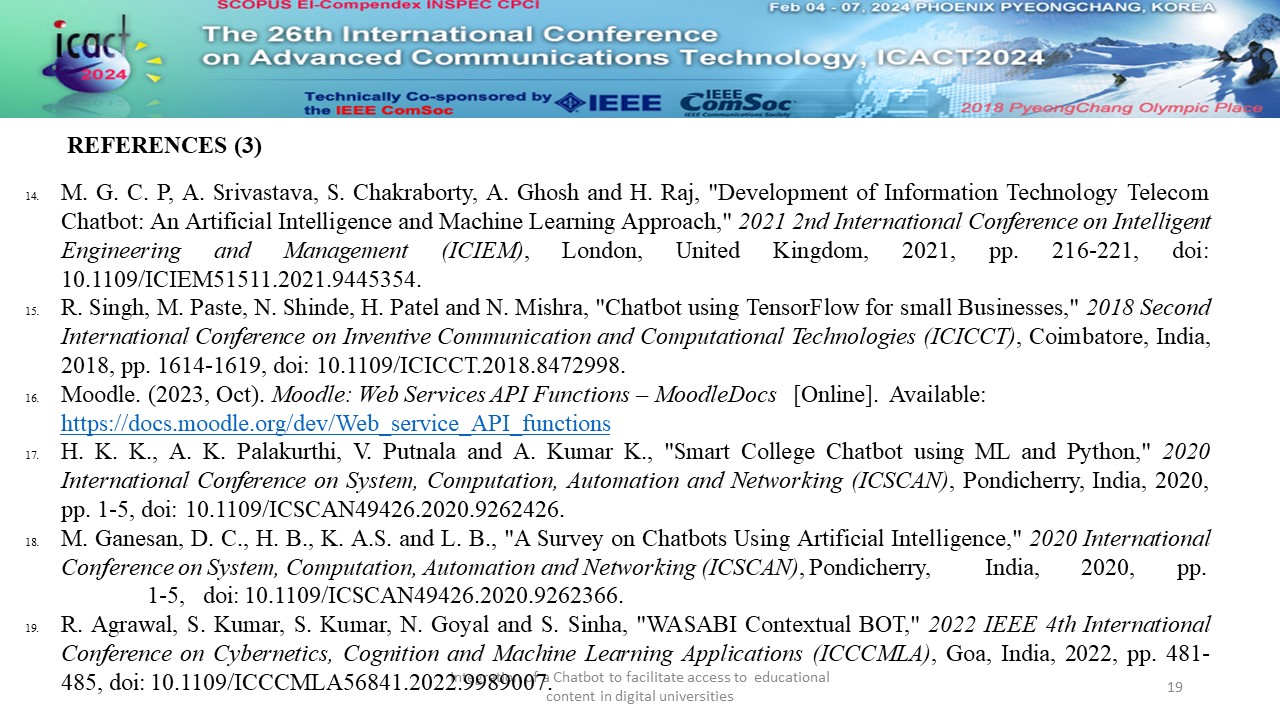 |
M. G. C. P, A. Srivastava, S. Chakraborty, A. Ghosh and H. Raj, "Development of Information Technology Telecom Chatbot: An Artificial Intelligence and Machine Learning Approach," 2021 2nd International Conference on Intelligent Engineering and Management (ICIEM), London, United Kingdom, 2021, pp. 216-221, doi: 10.1109/ICIEM51511.2021.9445354.
R. Singh, M. Paste, N. Shinde, H. Patel and N. Mishra, "Chatbot using TensorFlow for small Businesses," 2018 Second International Conference on Inventive Communication and Computational Technologies (ICICCT), Coimbatore, India, 2018, pp. 1614-1619, doi: 10.1109/ICICCT.2018.8472998.
Moodle. (2023, Oct). Moodle: Web Services API Functions – MoodleDocs [Online]. Available: https://docs.moodle.org/dev/Web_service_API_functions
H. K. K., A. K. Palakurthi, V. Putnala and A. Kumar K., "Smart College Chatbot using ML and Python," 2020 International Conference on System, Computation, Automation and Networking (ICSCAN), Pondicherry, India, 2020, pp. 1-5, doi: 10.1109/ICSCAN49426.2020.9262426.
M. Ganesan, D. C., H. B., K. A.S. and L. B., "A Survey on Chatbots Using Artificial Intelligence," 2020 International Conference on System, Computation, Automation and Networking (ICSCAN), Pondicherry, India, 2020, pp. 1-5, doi: 10.1109/ICSCAN49426.2020.9262366.
R. Agrawal, S. Kumar, S. Kumar, N. Goyal and S. Sinha, "WASABI Contextual BOT," 2022 IEEE 4th International Conference on Cybernetics, Cognition and Machine Learning Applications (ICCCMLA), Goa, India, 2022, pp. 481-485, doi: 10.1109/ICCCMLA56841.2022.9989007.
|
|
ICACT20240393 Slide.17
[Big slide for presentation]
|
Chrome Text-to-Speach Click!! |
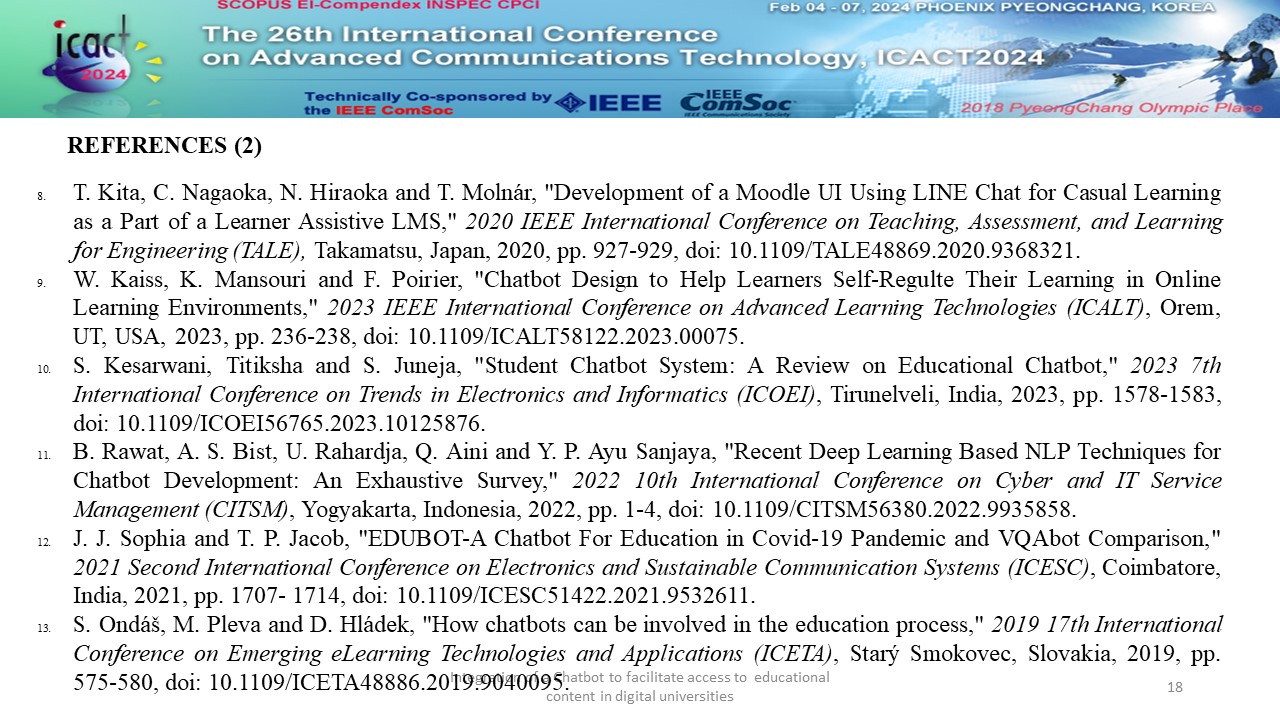 |
REFERENCES
T. Kita, C. Nagaoka, N. Hiraoka and T. Molnár, "Development of a Moodle UI Using LINE Chat for Casual Learning as a Part of a Learner Assistive LMS," 2020 IEEE International Conference on Teaching, Assessment, and Learning for Engineering (TALE), Takamatsu, Japan, 2020, pp. 927-929, doi: 10.1109/TALE48869.2020.9368321.
W. Kaiss, K. Mansouri and F. Poirier, "Chatbot Design to Help Learners Self-Regulte Their Learning in Online Learning Environments," 2023 IEEE International Conference on Advanced Learning Technologies (ICALT), Orem, UT, USA, 2023, pp. 236-238, doi: 10.1109/ICALT58122.2023.00075.
S. Kesarwani, Titiksha and S. Juneja, "Student Chatbot System: A Review on Educational Chatbot," 2023 7th International Conference on Trends in Electronics and Informatics (ICOEI), Tirunelveli, India, 2023, pp. 1578-1583, doi: 10.1109/ICOEI56765.2023.10125876.
B. Rawat, A. S. Bist, U. Rahardja, Q. Aini and Y. P. Ayu Sanjaya, "Recent Deep Learning Based NLP Techniques for Chatbot Development: An Exhaustive Survey," 2022 10th International Conference on Cyber and IT Service Management (CITSM), Yogyakarta, Indonesia, 2022, pp. 1-4, doi: 10.1109/CITSM56380.2022.9935858.
J. J. Sophia and T. P. Jacob, "EDUBOT-A Chatbot For Education in Covid-19 Pandemic and VQAbot Comparison," 2021 Second International Conference on Electronics and Sustainable Communication Systems (ICESC), Coimbatore, India, 2021, pp. 1707- 1714, doi: 10.1109/ICESC51422.2021.9532611.
S. Ondáš, M. Pleva and D. Hládek, "How chatbots can be involved in the education process," 2019 17th International Conference on Emerging eLearning Technologies and Applications (ICETA), Starý Smokovec, Slovakia, 2019, pp. 575-580, doi: 10.1109/ICETA48886.2019.9040095.
|
|
ICACT20240393 Slide.16
[Big slide for presentation]
|
Chrome Text-to-Speach Click!! |
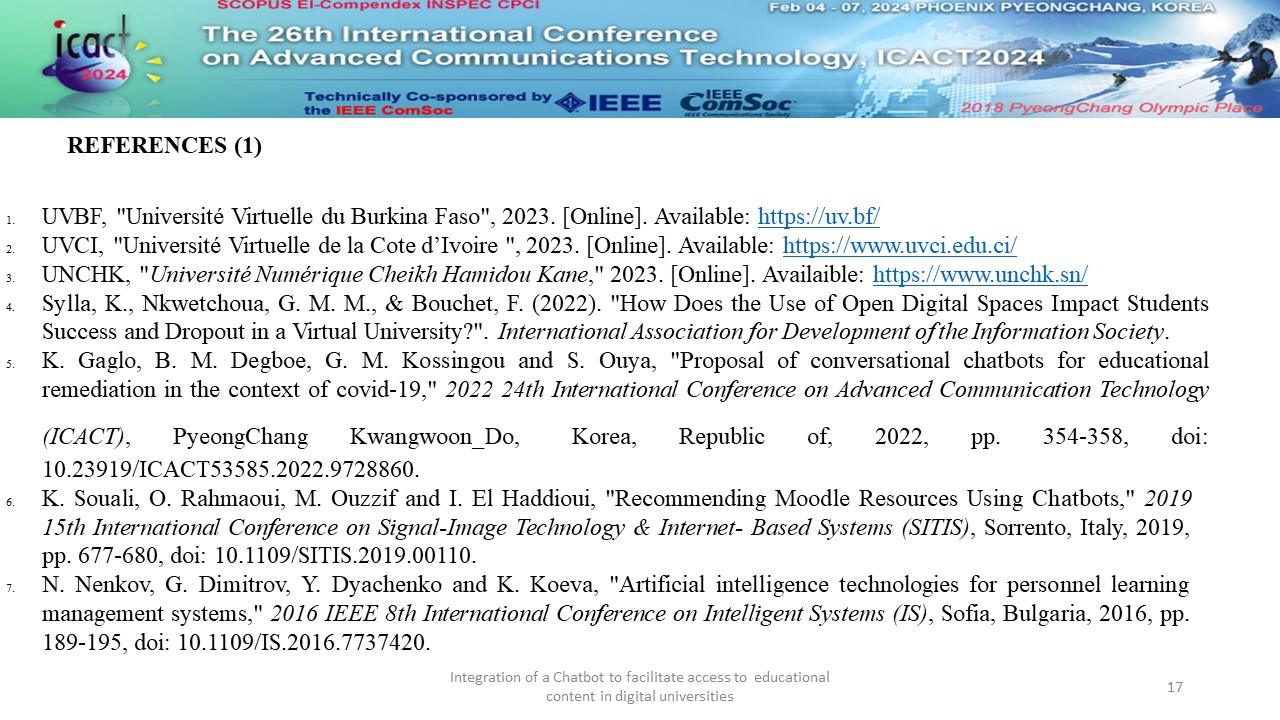 |
REFERENCES
UVBF, "Université Virtuelle du Burkina Faso", 2023. [Online]. Available: https://uv.bf/
UVCI, "Université Virtuelle de la Cote d¡¯Ivoire ", 2023. [Online]. Available: https://www.uvci.edu.ci/
UNCHK, "Université Numérique Cheikh Hamidou Kane," 2023. [Online]. Availaible: https://www.unchk.sn/
Sylla, K., Nkwetchoua, G. M. M., & Bouchet, F. (2022). "How Does the Use of Open Digital Spaces Impact Students Success and Dropout in a Virtual University?". International Association for Development of the Information Society.
K. Gaglo, B. M. Degboe, G. M. Kossingou and S. Ouya, "Proposal of conversational chatbots for educational remediation in the context of covid-19," 2022 24th International Conference on Advanced Communication Technology (ICACT), PyeongChang Kwangwoon_Do, Korea, Republic of, 2022, pp. 354-358, doi: 10.23919/ICACT53585.2022.9728860.
K. Souali, O. Rahmaoui, M. Ouzzif and I. El Haddioui, "Recommending Moodle Resources Using Chatbots," 2019 15th International Conference on Signal-Image Technology & Internet- Based Systems (SITIS), Sorrento, Italy, 2019, pp. 677-680, doi: 10.1109/SITIS.2019.00110.
N. Nenkov, G. Dimitrov, Y. Dyachenko and K. Koeva, "Artificial intelligence technologies for personnel learning management systems," 2016 IEEE 8th International Conference on Intelligent Systems (IS), Sofia, Bulgaria, 2016, pp. 189-195, doi: 10.1109/IS.2016.7737420.
|
|
ICACT20240393 Slide.15
[Big slide for presentation]
|
Chrome Text-to-Speach Click!! |
 |
A chatbot is a new form of automated contextual interaction enabling communication between users and machines or systems. This system exploits a conversational approach based on natural language.
The chatbot implemented in this article with Artificial Intelligence (AI), Machine Learning (ML) and Rasa tools, then interconnected with the Moodle training platform, enables learners to self-train by considering the basic modules for training in the IT field.
With the advancement of AI, our next objective will be to interconnect this chatbot with ChatGPT to be able to answer questions from learners who are not on the Moodle training platform. This will make the tool complete and accessible to users in all training streams.
|
|
ICACT20240393 Slide.14
[Big slide for presentation]
|
Chrome Text-to-Speach Click!! |
 |
RESULTS AND ANALYSIS
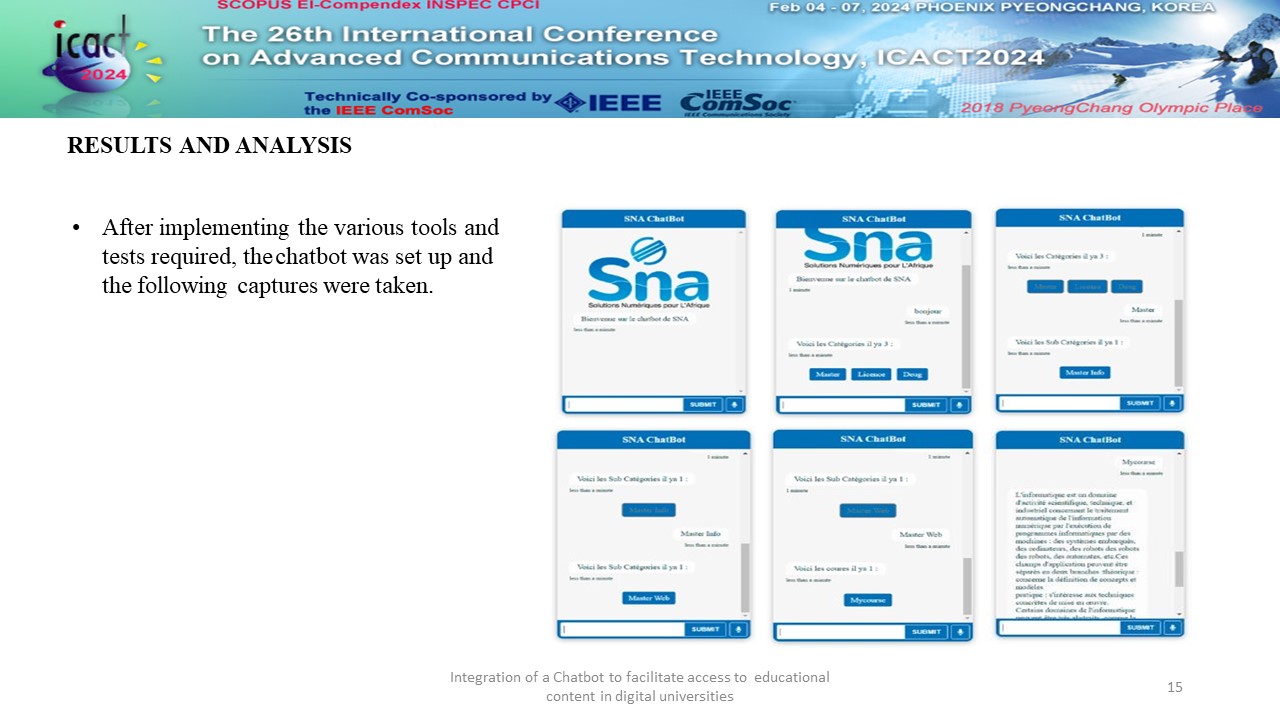
After implementing the various tools and tests required, the chatbot was set up and the following captures were taken.
|
|
ICACT20240393 Slide.13
[Big slide for presentation]
|
Chrome Text-to-Speach Click!! |
 |
SOLUTION IMPLEMENTATION
Steering and Continuous Improvement
Depending on the indicators set to measure the system's performance, it is important to measure the rate of understanding of the entities' performance, and to make continuous improvements by adding responses as the system is used.
|
|
ICACT20240393 Slide.12
[Big slide for presentation]
|
Chrome Text-to-Speach Click!! |
 |
SOLUTION IMPLEMENTATION
Solution development
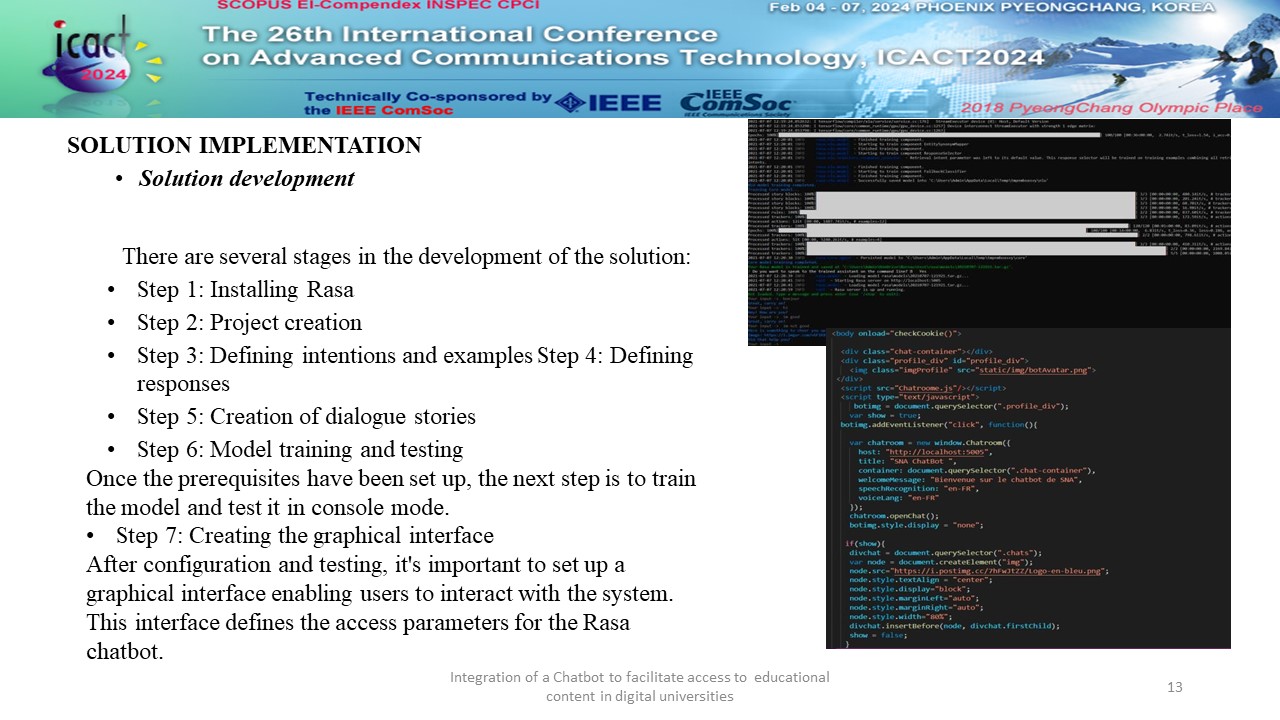
There are several stages in the development of the solution:
Step 1: Installing Rasa
Step 2: Project creation
Step 3: Defining intentions and examples Step 4: Defining responses
Step 5: Creation of dialogue stories
Step 6: Model training and testing
Once the prerequisites have been set up, the next step is to train the model and test it in console mode.
Step 7: Creating the graphical interface
After configuration and testing, it's important to set up a graphical interface enabling users to interact with the system. This interface defines the access parameters for the Rasa chatbot.
|
|
ICACT20240393 Slide.11
[Big slide for presentation]
|
Chrome Text-to-Speach Click!! |
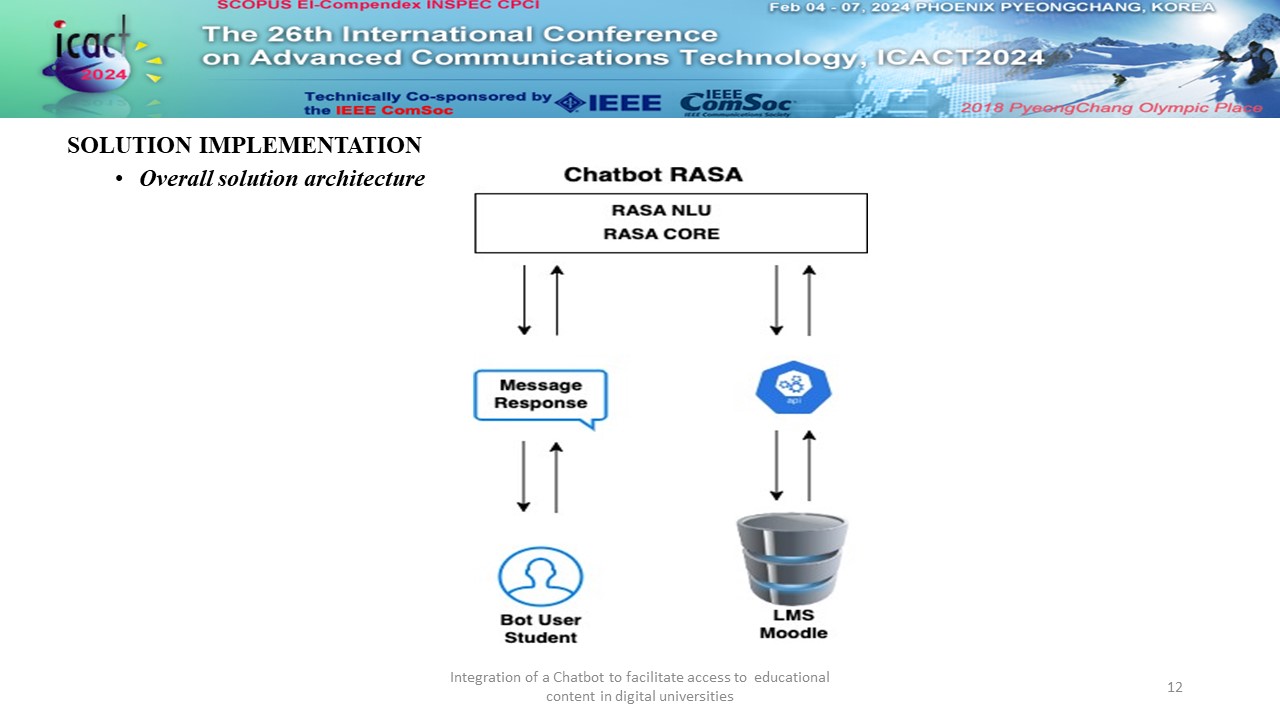 |
Overall solution architecture
|
|
ICACT20240393 Slide.10
[Big slide for presentation]
|
Chrome Text-to-Speach Click!! |
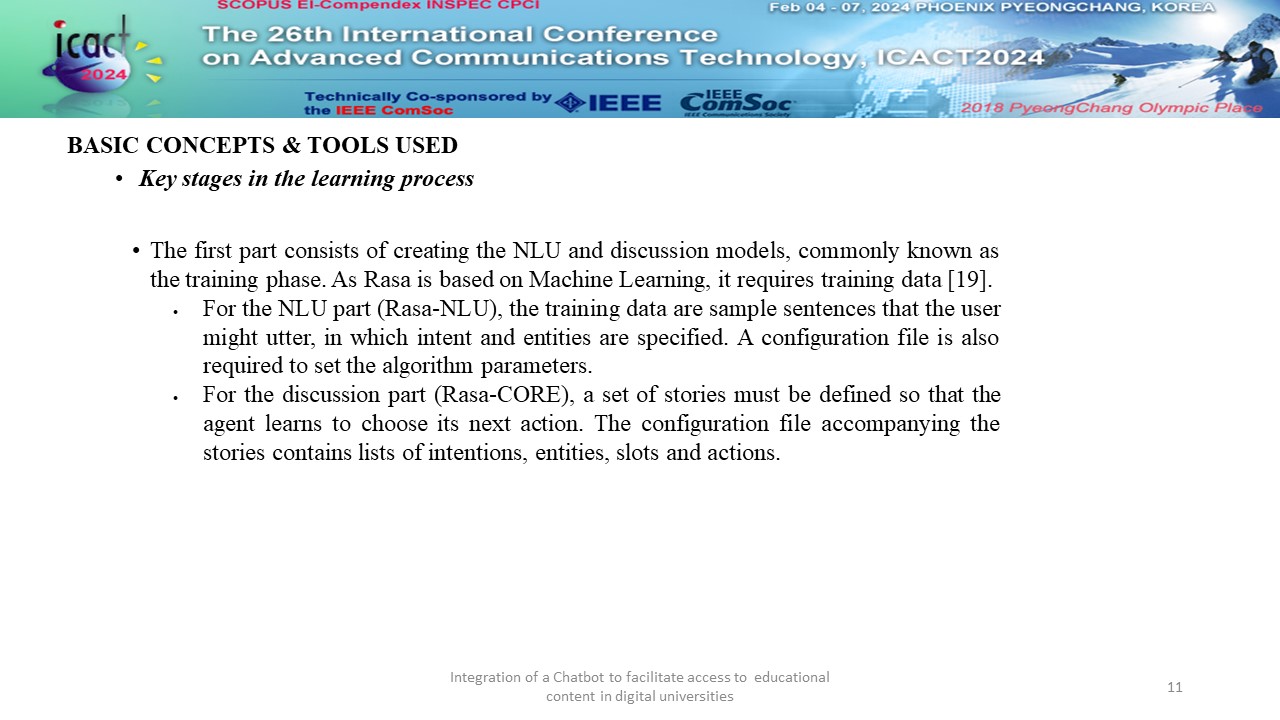 |
BASIC CONCEPTS & TOOLS USED
Key stages in the learning process
The first part consists of creating the NLU and discussion models, commonly known as the training phase. As Rasa is based on Machine Learning, it requires training data [19].
For the NLU part (Rasa-NLU), the training data are sample sentences that the user might utter, in which intent and entities are specified. A configuration file is also required to set the algorithm parameters.
For the discussion part (Rasa-CORE), a set of stories must be defined so that the agent learns to choose its next action. The configuration file accompanying the stories contains lists of intentions, entities, slots and actions.
|
|
ICACT20240393 Slide.09
[Big slide for presentation]
|
Chrome Text-to-Speach Click!! |
 |
BASIC CONCEPTS & TOOLS USED
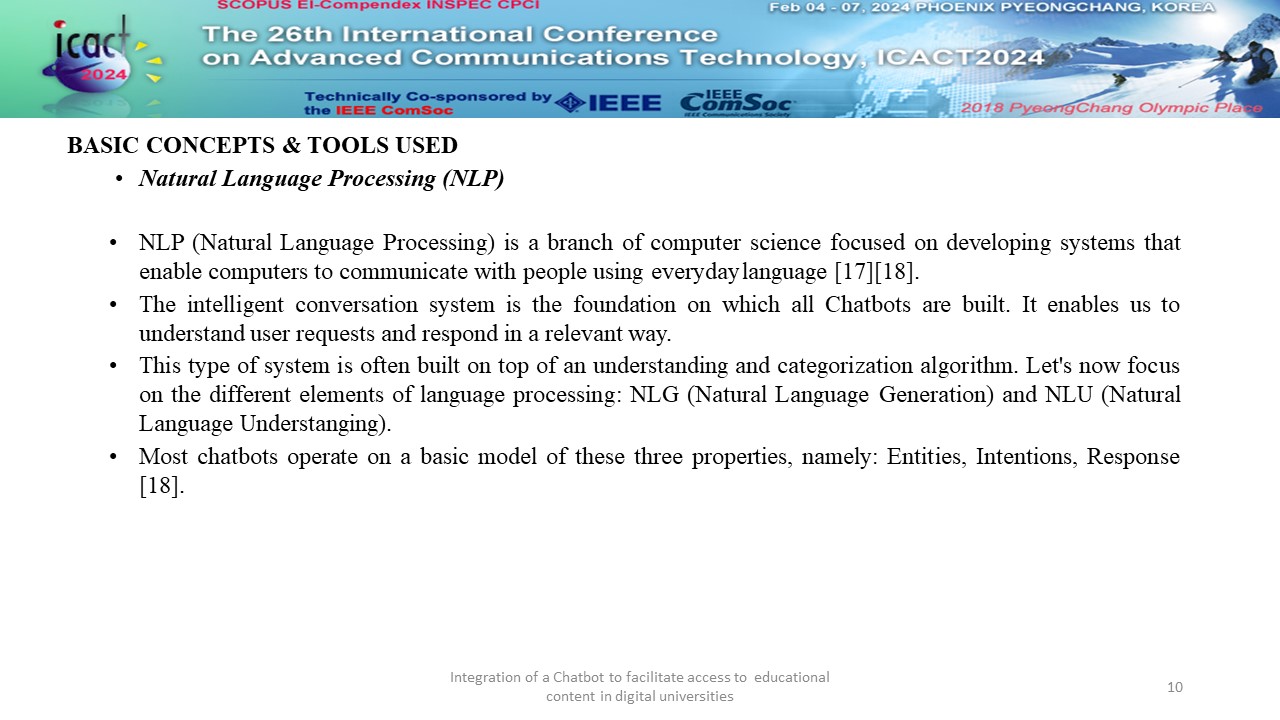
Natural Language Processing (NLP)
NLP (Natural Language Processing) is a branch of computer science focused on developing systems that enable computers to communicate with people using everyday language [17][18].
The intelligent conversation system is the foundation on which all Chatbots are built. It enables us to understand user requests and respond in a relevant way.
This type of system is often built on top of an understanding and categorization algorithm. Let's now focus on the different elements of language processing: NLG (Natural Language Generation) and NLU (Natural Language Understanging).
Most chatbots operate on a basic model of these three properties, namely: Entities, Intentions, Response [18].
|
|
ICACT20240393 Slide.08
[Big slide for presentation]
|
Chrome Text-to-Speach Click!! |
 |
BASIC CONCEPTS & TOOLS USED
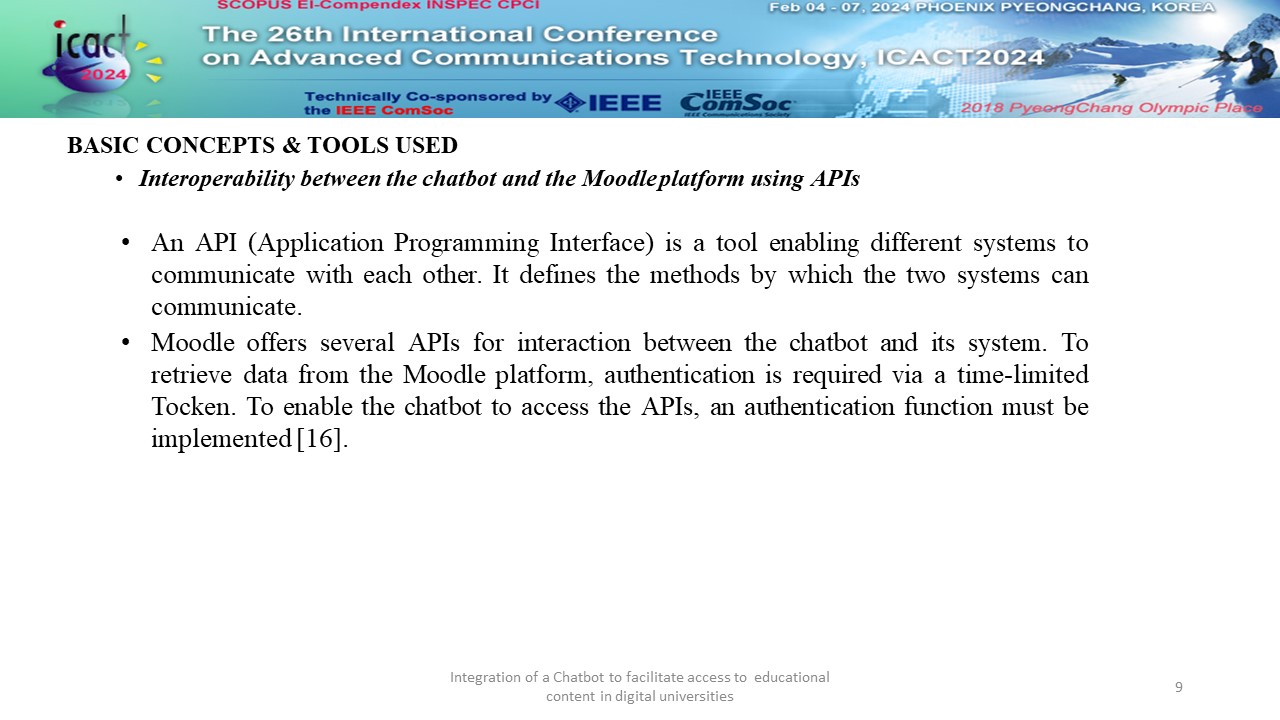
Interoperability between the chatbot and the Moodle platform using APIs
An API (Application Programming Interface) is a tool enabling different systems to communicate with each other. It defines the methods by which the two systems can communicate.
Moodle offers several APIs for interaction between the chatbot and its system. To retrieve data from the Moodle platform, authentication is required via a time-limited Tocken. To enable the chatbot to access the APIs, an authentication function must be implemented [16].
|
|
ICACT20240393 Slide.07
[Big slide for presentation]
|
Chrome Text-to-Speach Click!! |
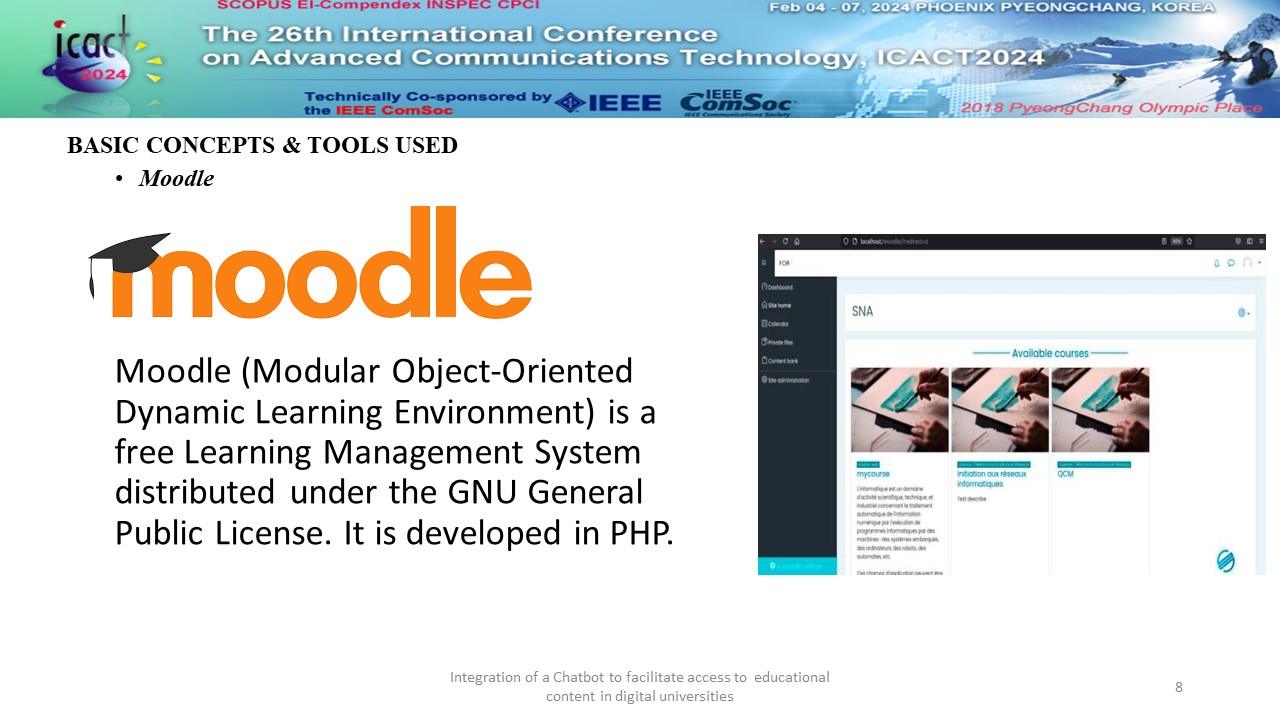 |
Moodle (Modular Object-Oriented Dynamic Learning Environment) is a free Learning Management System distributed under the GNU General Public License. It is developed in PHP. In addition to the possibility of creating courses with integrated tools and categorizing content by course, cohort level, sub-category, etc., the platform offers the possibility of being interconnected with external tools via secure APIs [16].
|
|
ICACT20240393 Slide.06
[Big slide for presentation]
|
Chrome Text-to-Speach Click!! |
 |
RELATED WORK
B. Rawat et al [11] carried out a detailed survey of recent deep learning techniques for chatbots. This has brought developers' understanding closer to good chatbot design.
J. J. Sophia and T. P. Jacob [12], in their article, demonstrate and present the design and development of Student Chatbot software integrated with a user website that manages student queries via defined intents. The article covers the chatbot system with the Recurrent Neural Network (RNN) to handle the language part, the Convolutional Neural Network (CNN) to handle the image part, Dialogflow, accurately illustrating the intention and entity representation and keyword matching techniques.
S. Ondáš, M. Pleva and D. Hládek [13], have developed three chatbots to support teaching at their university's Department of Electronics and Multimedia Telecommunications. The first is the KEMTbot, which is a robot located on the department's web page. It provides information from the Web and about the department's staff. The second chatbot is a bot that accompanies students during exercises in the subject "Databases". The last is an Amazon Alexa chatbot skill, which answers questions about the department on Amazon Echo devices.
|
|
ICACT20240393 Slide.05
[Big slide for presentation]
|
Chrome Text-to-Speach Click!! |
 |
RELATED WORK
Authors T. Kita, C. Nagaoka, N. Hiraoka and T. Molnár [8], in their article entitled "Development of a Moodle UI Using LINE Chat for Casual Learning as a Part of a Learner Assistive LMS", set up a chatbot for a mobile application enabling interaction between users and a Moodle LMS platform. This tool is used on a specific LINE Chat application and meets a need in the Japanese community.
W. Kaiss, K. Mansouri and F. Poirier [9], to improve the quality of online learning, have proposed a methodology, chatbot architectural design, to help learners self-regulate their learning by accompanying them via a chatbot within the Moodle platform, which constitutes a metacognitive virtual assistant.
S. Kesarwani, Titiksha and S. Juneja [10], with their chatbot in place, have enabled their institution's administration to reduce the amount of work they have to do in providing the required information to students, thus reducing their workload in continuing to answer all student questions. They also confirm that chatbot systems can be used in a wide range of sectors, including education, healthcare and marketing.
|
|
ICACT20240393 Slide.04
[Big slide for presentation]
|
Chrome Text-to-Speach Click!! |
 |
RELATED WORK
|
|
ICACT20240393 Slide.03
[Big slide for presentation]
|
Chrome Text-to-Speach Click!! |
 |
AUTORS
Birahim BABOU
LITA Laboratory, Polytechnic High School
Cheikh Anta Diop University of Senegal
birahim.babou@ucad.edu.sn
Khalifa SYLLA
Department of Applied Mathematics and Computer Science, Cheikh Hamidou Kane Digital University (UNCHK) of Senegal
khalifa.sylla@unchk.edu.sn
M.Y. SOW
Infrastructure and Information Systems Department, UNCHK of Senegal
Cheikh Hamidou Kane Digital University (UNCHK) of Senegal
mouhamadouyaya.sow@unchk.edu.sn
Samuel OUYA
Director of LITA Laboratory
Polytechnic High School
Cheikh Anta Diop University of Senegal
samuel.ouya@gmail.com
|
|
ICACT20240393 Slide.02
[Big slide for presentation]
|
Chrome Text-to-Speach Click!! |
 |
INTRODUCTION
Today, digital universities have been developed in several African countries to meet the need for massification. To mitigate these problems, some virtual or digital universities [1][2][3] have proposed several pedagogical approaches often based on open digital spaces (ODS) to complement the virtual space and offer students a place to work and solve pedagogical, technical, administrative and social problems [3][4].
In these digital learning institutions, learners use distance learning platforms to take their courses.
To reduce the dropout rate and facilitate access to educational content, some universities are integrating a number of solutions into their pedagogical model, including social media and pedagogical supervision by tutors.
Faced with this problem, largely linked to the framing and ergonomics of certain Learning Management System (LMS)
platforms, we propose in this paper the integration of a chatbot to facilitate access to educational content and improve the learning experience for students.
A chatbot is a new form of automated contextual interaction enabling communication between users and machines or systems. This system exploits a conversational approach based on natural language [6].
This article will be structured as follows: after the introduction, we'll review related work in the field, followed by some basic chatbot concepts. After that, we'll talk about the design and implementation of the solution. We'll then conclude with a look ahead.
|
|
ICACT20240393 Slide.01
[Big slide for presentation]
|
Chrome Text-to-Speach Click!! |
 |
Plan
INTRODUCTION
AUTEURS
RELATED WORK
BASIC CONCEPTS & TOOLS USED
Moodle
Interoperability between the chatbot and the Moodle platform using APIs
Natural Language Processing (NLP)
Key stages in the learning process
SOLUTION IMPLEMENTATION
Overall solution architecture
Solution development
RESULTS AND ANALYSIS
CONCLUSION AND PERSPECTIVES
REFERENCES
|
|
ICACT20240393 Slide.00
[Big slide for presentation]
|
Chrome Text-to-Speach Click!! |
 |
Presentation
|
| |





