 ICACT20220386 Slide.20
[Big slide for presentation] |
Chrome Text-to-Speach Click!! |
 |
Thank you for listening.
|
|
ICACT20220386 Slide.19
[Big slide for presentation]
[YouTube] |
Chrome Text-to-Speach Click!! |
 |
References
|
|
ICACT20220386 Slide.18
[Big slide for presentation]
|
Chrome Text-to-Speach Click!! |
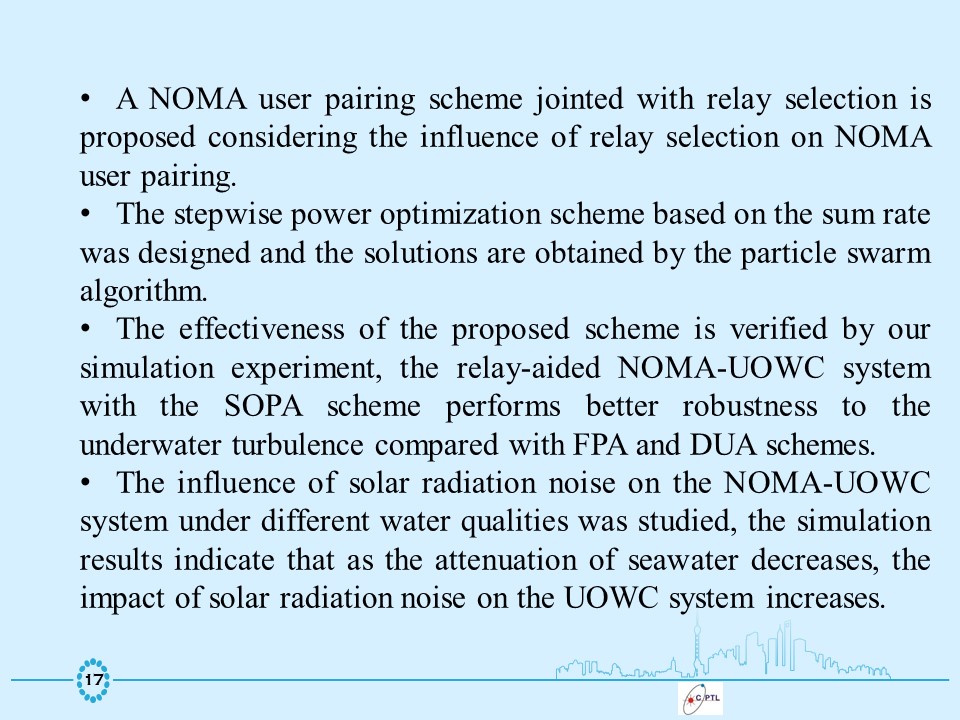 |
A NOMA user pairing scheme jointed with relay selection is proposed considering the influence of relay selection on NOMA user pairing.The stepwise power optimization scheme based on the sum rate was designed and the solutions are obtained by the particle swarm algorithm.The effectiveness of the proposed scheme is verified by our simulation experiment, the relay-aided NOMA-UOWC system with the SOPA scheme performs better robustness to the underwater turbulence compared with FPA and DUA schemes.The influence of solar radiation noise on the NOMA-UOWC system under different water qualities was studied, the simulation results indicate that as the attenuation of seawater decreases, the impact of solar radiation noise on the UOWC system increases.
|
|
ICACT20220386 Slide.17
[Big slide for presentation]
|
Chrome Text-to-Speach Click!! |
 |
Conclusion
|
|
ICACT20220386 Slide.16
[Big slide for presentation]
|
Chrome Text-to-Speach Click!! |
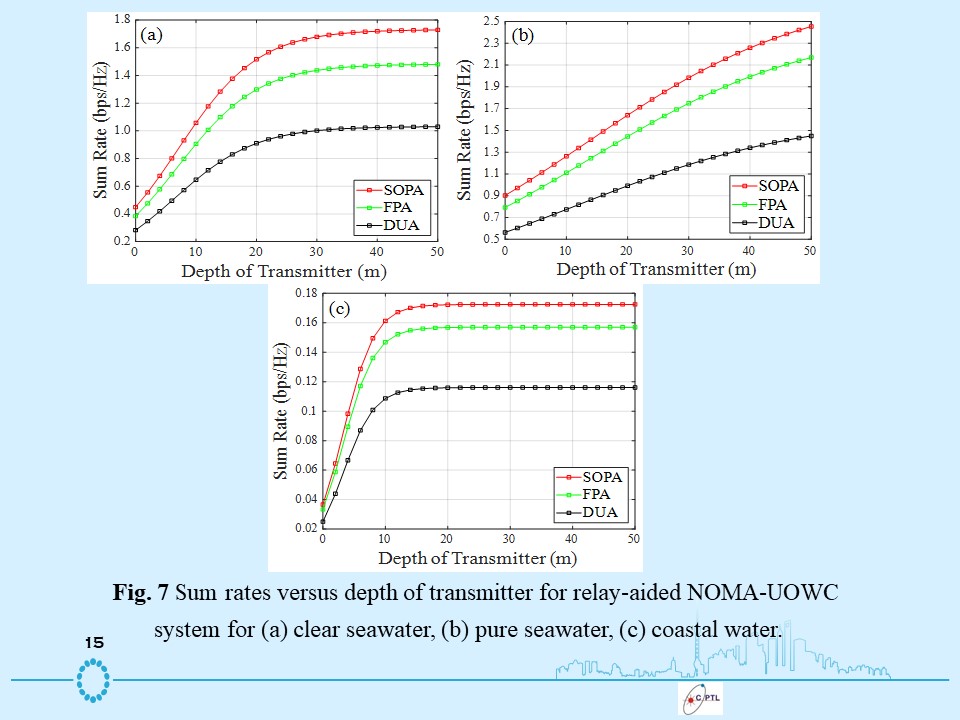 |
In our simulation work, the receiving rate of NOMA node will change significantly with the depth of the node under the same transmission condition. According to the formula in the previous section, we believe that this change is closely related to the solar radiation noise. The sum rate versus the depth of transmitter for Aided-NOMA system in three typical seawaters. It can be clearly seen that in clean seawater, the system rate reaches 1.73bps/Hz with the SOPA algorithm in the depth of 42m, and the sum rate hardly increases when the depth increases after 42m. We call it the equilibrium depth. The equilibrium depth of the system with FPA and DUA algorithms in the clean seawater are 40m, 36m around. Similarly, in coastal water, the system has a balance point within the depth of 50m and the equilibrium depths of the system with SOPA, FPA and DUA algorithms are subequal. But in pure seawater, the system sum rate increases linearly with the increase of depth when the depth of transmitter is less than 50m, i.e., the solar radiation noise still has a greater influence on the node receiving signal-to-noise ratio in this depth range.
|
|
ICACT20220386 Slide.15
[Big slide for presentation]
|
Chrome Text-to-Speach Click!! |
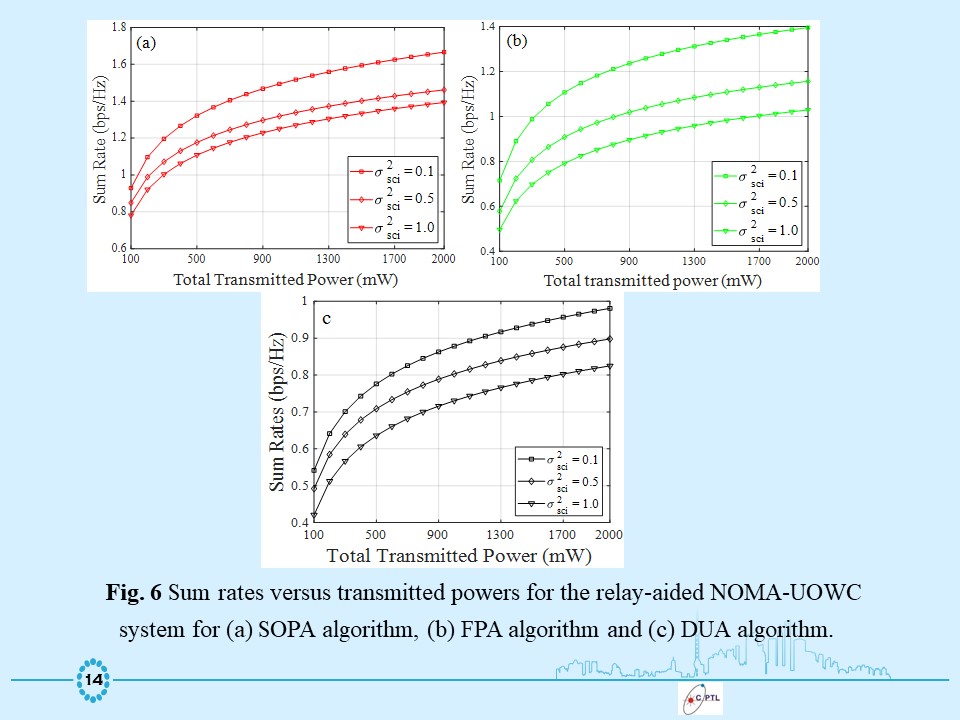 |
The effect of ocean turbulence on the performance of NOMA network is further investigated as follows. As the scintillation coefficients are set to 0.1, 0.4 and 1.0 respectively, that the performance of the proposed SOPA is compared with those of the FPA and DUA algorithms, can be shown in Fig. 3. With the increase of the transmission power, the increasing trend of the sum rate is gradually weakening, which is caused by the interference between the paired nodes in the NOMA group.
|
|
ICACT20220386 Slide.14
[Big slide for presentation]
|
Chrome Text-to-Speach Click!! |
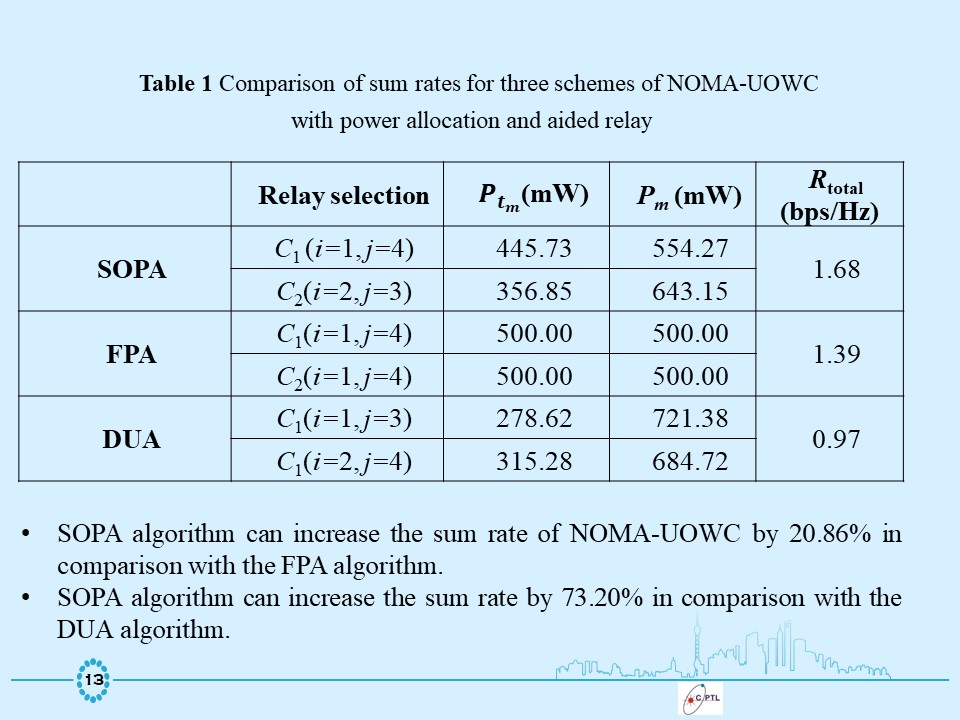 |
The results of power allocation and system sum rates of relay-aided NOMA network in typical clear seawater can be summarized in Table 2 where the FPA stands for the fixed power allocation scheme under that the transmitting powers of the relay node and the transmitter are equally distributed, and the DUP stands for the direct user-pairing scheme under that the nodes are directly paired according to the principle of maximum distance. It can be seen that the relay selections of NOMA users under the three schemes are different, and our simulation results show that the SOPA algorithm proposed in this paper can always obtain the maximum sum rate.
|
|
ICACT20220386 Slide.13
[Big slide for presentation]
|
Chrome Text-to-Speach Click!! |
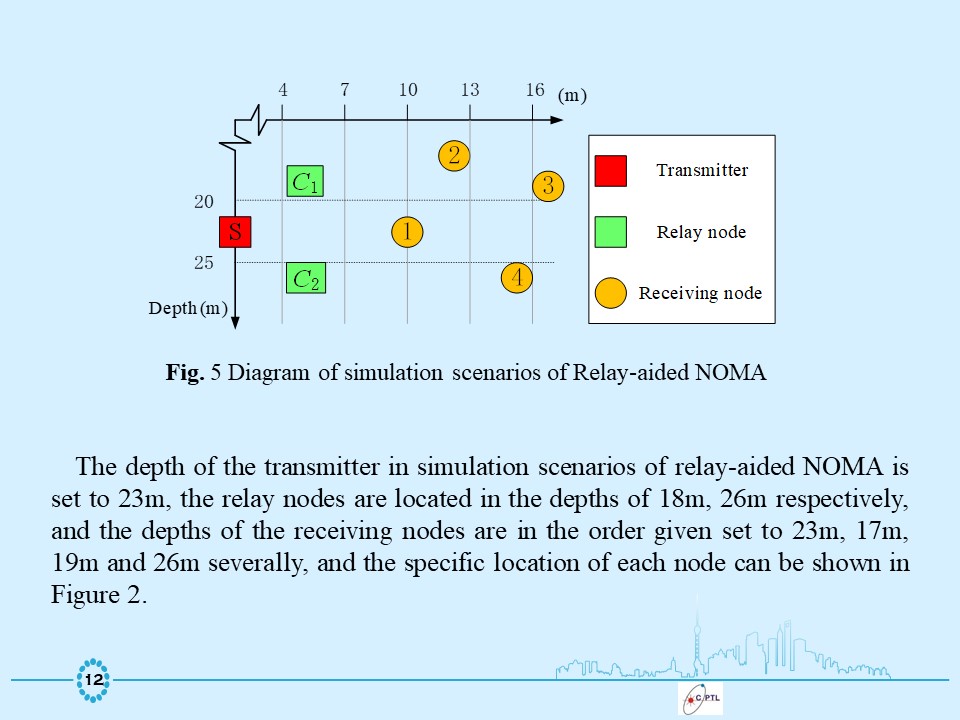 |
We conduct simulation comparison experiments to verify the effectiveness of the SOPA algorithm proposed in this paper based on the relay-aided NOMA network. The depth of the transmitter in simulation scenarios of relay-aided NOMA is set to 23m, the relay nodes are located in the depths of 18m, 26m respectively, and the depths of the receiving nodes are in the order given set to 23m, 17m, 19m and 26m severally, and the specific location of each node can be shown in this Figure.
|
|
ICACT20220386 Slide.12
[Big slide for presentation]
|
Chrome Text-to-Speach Click!! |
 |
Evaluation
|
|
ICACT20220386 Slide.11
[Big slide for presentation]
|
Chrome Text-to-Speach Click!! |
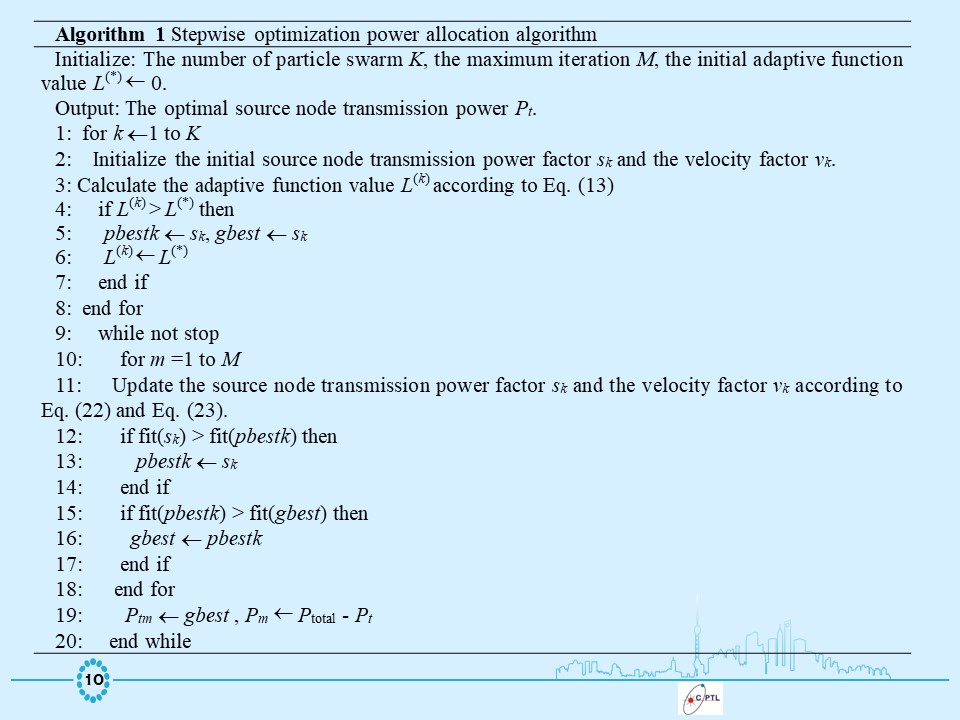 |
In order to reduce algorithm complexity, this section proposes a stepwise solution scheme based on the NOMA principle. We assume that the relay power can satisfy the minimum communication quality requirements of the remote users in the NOMA node. According to the principle of NOMA system power allocation assisted by the relay [16], the system can temporarily implement the power allocation coefficient of NOMA paired users to ensure the communication quality of NOMA receiving nodes with the transmitting power of the relay node being a constant. After the power allocation in the NOMA group is determined, the above optimization problem can be transformed into a power distribution problem between the relay node and transmitter. However, although NOMA paired users use non-orthogonal multiple access for superimposed transmission, NOMA groups still use OMA for transmission. Then we can use the particle swarm algorithm to solve this problem. Compared with the genetic algorithm, the particle swarm algorithm can memorize all the problem solutions, and only needs to update the search direction according to the internal speed. The algorithm is easier to implement and the convergence speed is faster. The pseudo code of the stepwise optimization algorithm designed in summary is shown in Algorithm 1.
|
|
ICACT20220386 Slide.10
[Big slide for presentation]
|
Chrome Text-to-Speach Click!! |
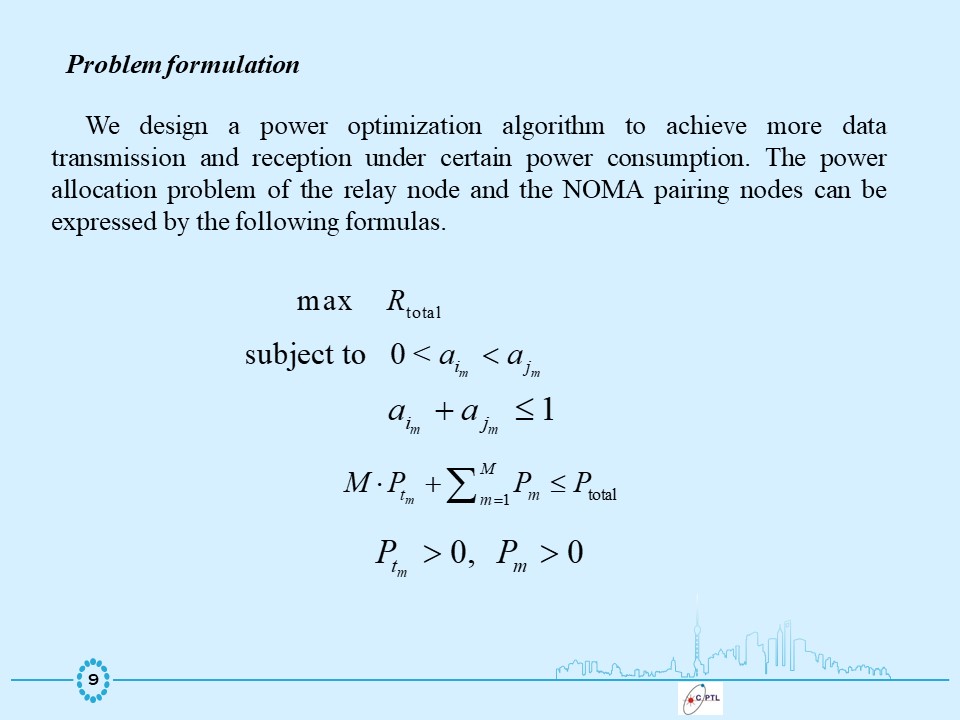 |
The locations of nodes are difficult to deploy and the secondary replacement is hard to accomplish for the optical wireless network in the marine environment. Therefore, a priority should be given to the ability to achieve more information transmission during the limited life cycle of the node when designing the system model, namely, we need to design a power optimization algorithm to achieve more data transmission and reception under certain power consumption. Then the power allocation problem of the relay node and the NOMA pairing nodes can be expressed by the following formulas.
|
|
ICACT20220386 Slide.09
[Big slide for presentation]
|
Chrome Text-to-Speach Click!! |
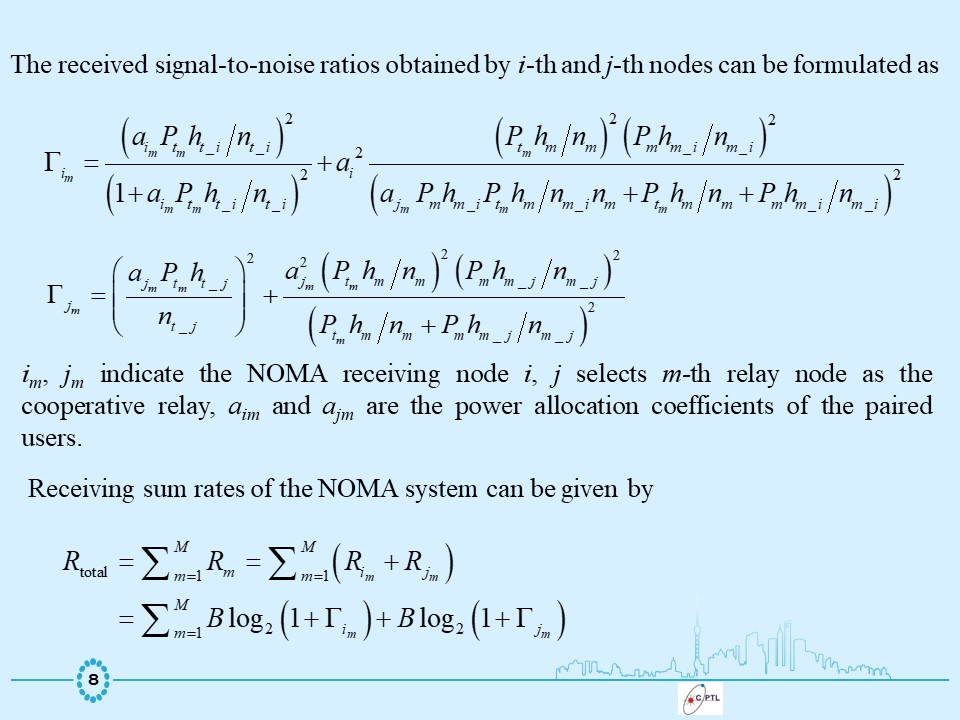 |
The received signal-to-noise ratios obtained by i-th and j-th nodes can be formulated as this formula, Therefore, receiving sum rates of the NOMA system can be given.
|
|
ICACT20220386 Slide.08
[Big slide for presentation]
|
Chrome Text-to-Speach Click!! |
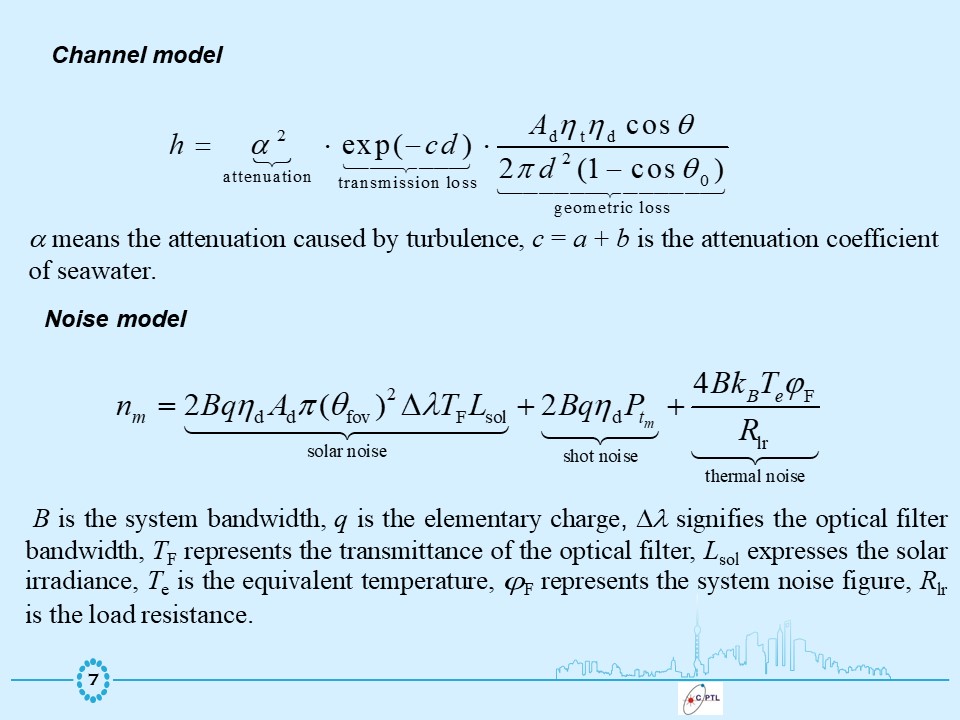 |
The channel gain between the n-th receiving user node and the transmitter can be obtained by the following formula, Here we consider the weakly turbulent channel, so the probability density function can be expressed as a log-normal model. Unlike terrestrial wireless communication networks, there are multiple noise sources in the marine environments. Here, we pick solar radiation noise, dark current noise and shot noise as the main noise that can be obtained by the following expression.
|
|
ICACT20220386 Slide.07
[Big slide for presentation]
|
Chrome Text-to-Speach Click!! |
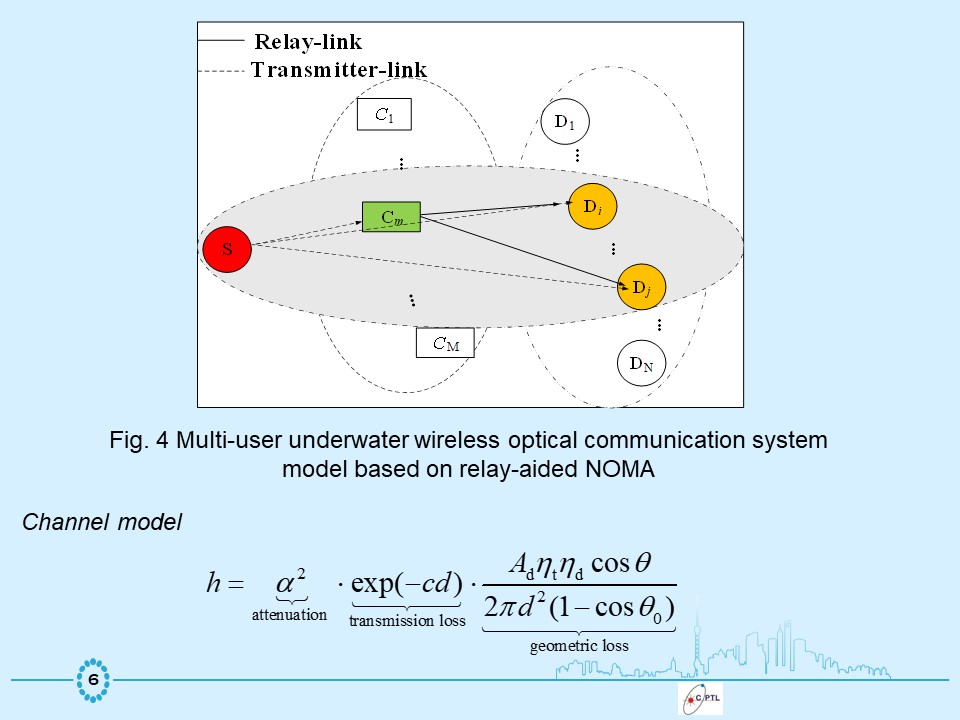 |
We consider a realistic scenario with multiple NOMA receivers in the underwater environment as shown in the Figure.A forward relay needs to be selected in real time for the optical signal amplification and forwarding before the transmission link constructed formally.
|
|
ICACT20220386 Slide.06
[Big slide for presentation]
|
Chrome Text-to-Speach Click!! |
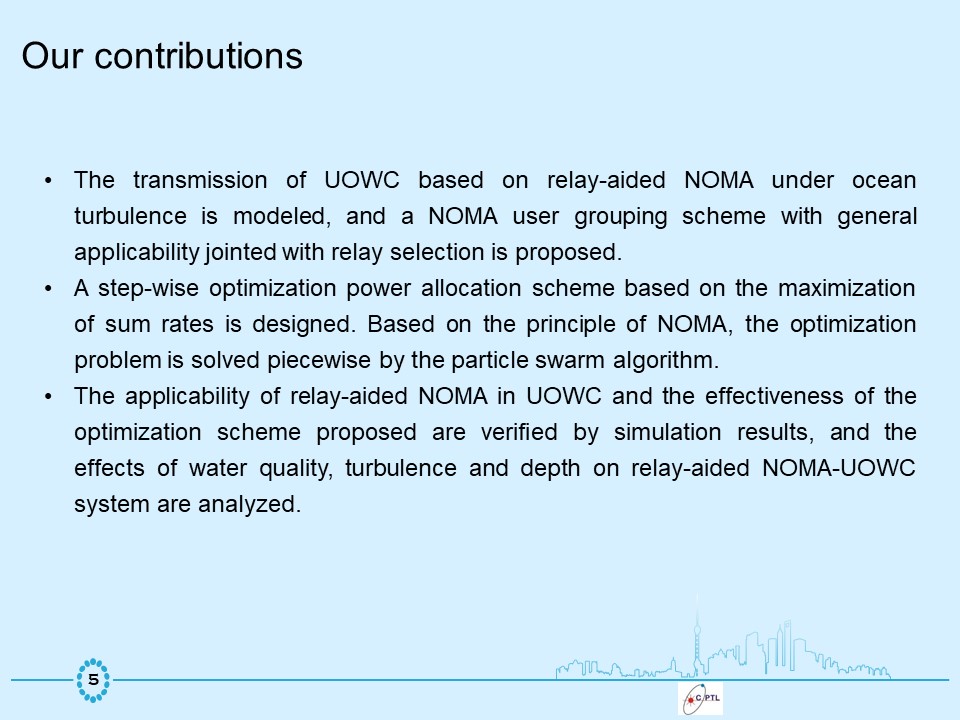 |
The work we have done can be roughly divided into three parts. First, we modeled the transmission of UOWC based on relay-aided NOMA under ocean turbulence, and we proposed a NOMA user grouping scheme with general applicability jointed with relay selection. Second, we designed the step-wise optimization power allocation scheme based on the maximization of sum rates. Third, the applicability of relay-aided NOMA in UOWC and the effectiveness of the optimization scheme we proposed are verified by simulation results. The effects of water quality, turbulence and depth on relay-aided NOMA-UOWC system are analyzed.
|
|
ICACT20220386 Slide.05
[Big slide for presentation]
|
Chrome Text-to-Speach Click!! |
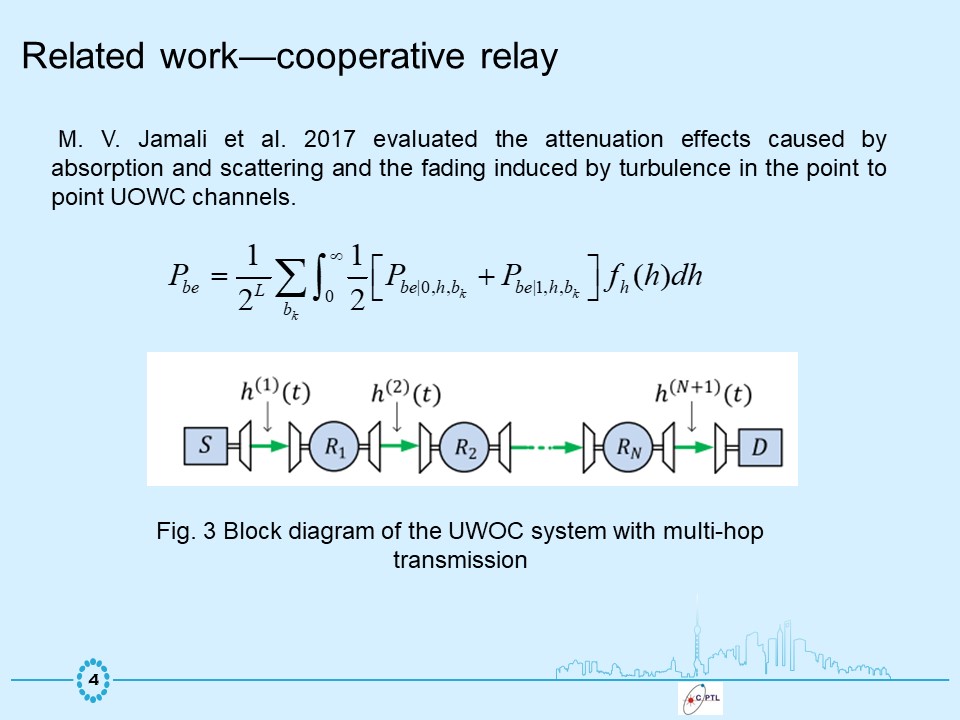 |
In 2017, Jamali evaluated the attenuation effects caused by absorption and scattering and the fading induced by turbulence in the point to point UOWC channels thoroughly, and the closed-form solution for the system bit error rate (BER) in a single-hop UOWC link, is deduced as follows. Here they considered the ocean weak turbulence, but as they analyze the ocean noise, the solar radiation noise is ignored.
|
|
ICACT20220386 Slide.04
[Big slide for presentation]
|
Chrome Text-to-Speach Click!! |
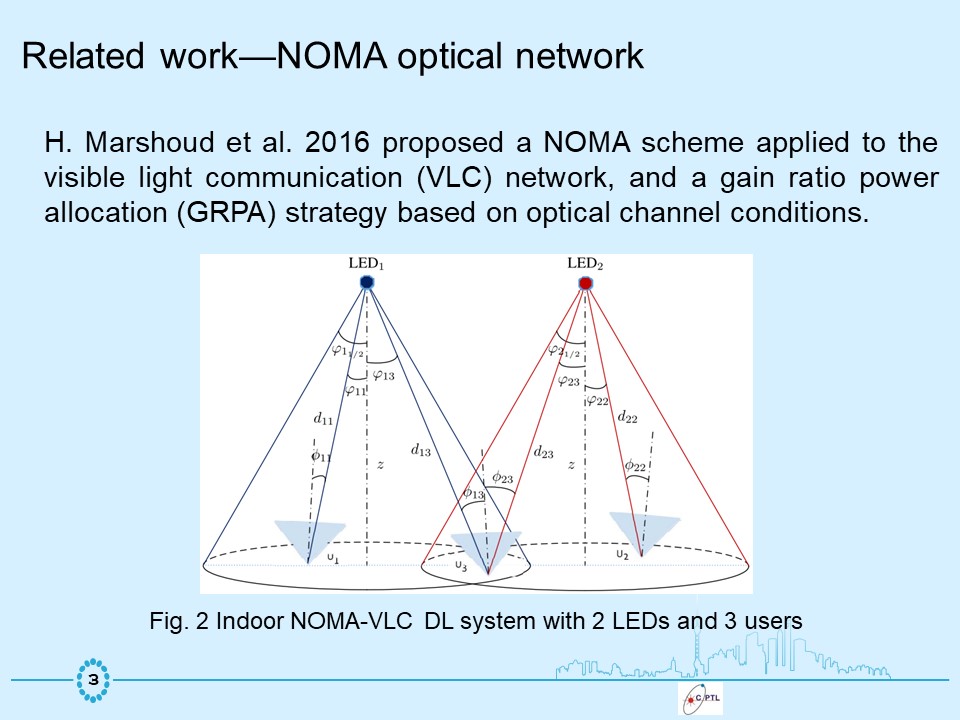 |
NOMA has already been researched in optical network. In 2016, H. Marshoud and his team proposed a NOMA scheme applied to the visible light communication (VLC) network, and they adopted a novel channel-dependant power allocation strategy for VLC-NOMA. But there is very few related work involving the underwater environment.
|
|
ICACT20220386 Slide.03
[Big slide for presentation]
|
Chrome Text-to-Speach Click!! |
 |
Related work & Our contribution
|
|
ICACT20220386 Slide.02
[Big slide for presentation]
|
Chrome Text-to-Speach Click!! |
 |
The first question is why we consider NOMA and cooperative relay as the technology directions of UOWC. The answer is that Non-orthogonal multiple access (NOMA) is a promising technique to improve the spectral efficiency and more important is NOMA has proved its effectiveness in terrestrial communication systems. Meanwhile, cooperative relay can improve transmission reliability which is an effective complement to NOMA technology.
|
|
ICACT20220386 Slide.01
[Big slide for presentation]
|
Chrome Text-to-Speach Click!! |
 |
Hello, everybody. my name is Yanjun Liang. For ICACT2022, I have cooperated with four partners from DLUT. Professer Yin, professer jing, Dr. Ji and Dr. Wang. Our presentation today is about the performance analysis of relay-aided NOMA in the underwater optical wireless communication system.
|
















