 ICACT20240241 Slide.21
[Big slide for presentation]
[YouTube] |
Chrome Text-to-Speach Click!! |
 |
Thank you very much!
|
|
ICACT20240241 Slide.20
[Big slide for presentation]
[YouTube] |
Chrome Text-to-Speach Click!! |
 |
In this paper, a dual-RIS assisted ISAC system is proposed to achieve high-precision accurate positioning of users in the uplink transmission and the optimal beamforming design of the BS and RISs is presented based on the positioning information. The proposed ISAC system realizes the sensing and communication under the same frequency and timeresources. It is verified through simulation that the presented SMP algorithm has excellent positioning performance and the near-optimal system achievable rate can be achieved with the optimal beamforming design of the BS and RISs.
|
|
ICACT20240241 Slide.19
[Big slide for presentation]
[YouTube] |
Chrome Text-to-Speach Click!! |
 |
In the following, we study the TI-AO algorithm based beamforming design of the BS antennas and the RIS units according to the obtained positioning information. The system achievable rate with the proposed beamforming design is shown in Fig. 5. We set the uniform sampling number as 2000, the number of BS antennas as 8 and 16, and the number of RIS units as 36 and 64, respectively. The random phase shifts of RIS are also considered for comparison. It is shown that the increase of the SNR, the number of BS antennas, and the number of RIS units, will improve the system achievable rate. At the same time, it is found that, when the number of RIS units is small, the system achievable rate does not increase linearly with the increased SNR due to the large positioning MSE at the first stage shown in Fig. 3. However, when the number of RIS units is 64, the achievable system rate increases linearly with the SNR.
|
|
ICACT20240241 Slide.18
[Big slide for presentation]
[YouTube] |
Chrome Text-to-Speach Click!! |
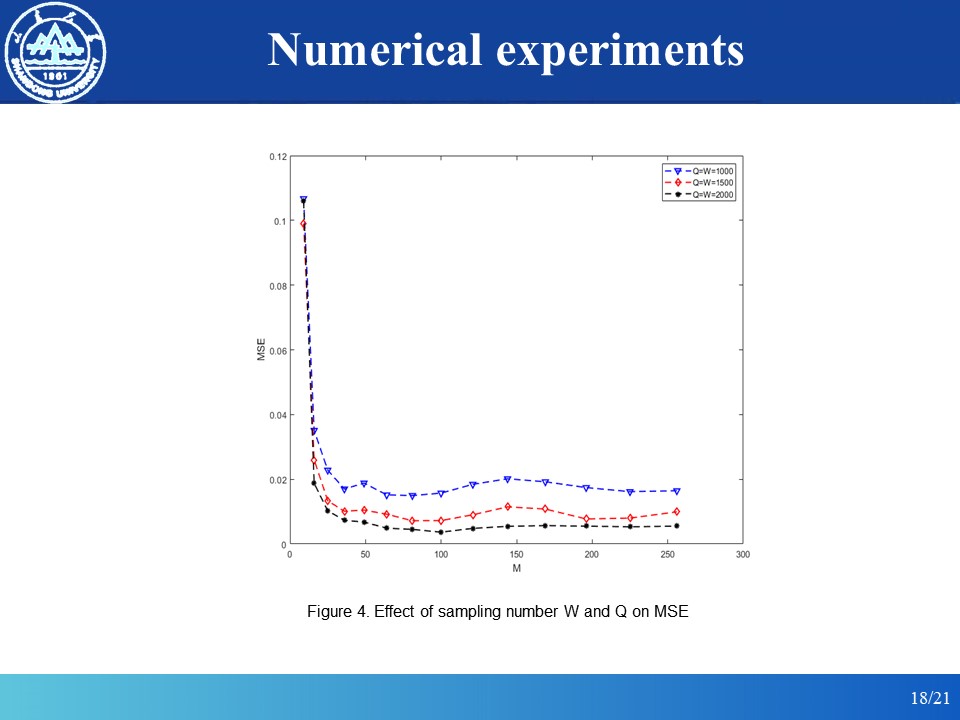 |
The effect of angle division on the MSE of positioning is depicted in Fig. 4. The accuracy of CS depends largely on the meshing of channels in the MP algorithm. When the uniform sampling number is small and the user is not on the grid point, a large positioning error may appear. As illustrated in Figure 4, when the number of uniform samples increases, the MSE gradually decreases and the volatility of MSE also decreases. When the number of uniform samples increases indefinitely, the MSE will tend to be 0. If the user is located on the grid, the MSE also becomes 0. The MSE tends to be stable when the number of RIS reflection units exceeds 64.
|
|
ICACT20240241 Slide.17
[Big slide for presentation]
[YouTube] |
Chrome Text-to-Speach Click!! |
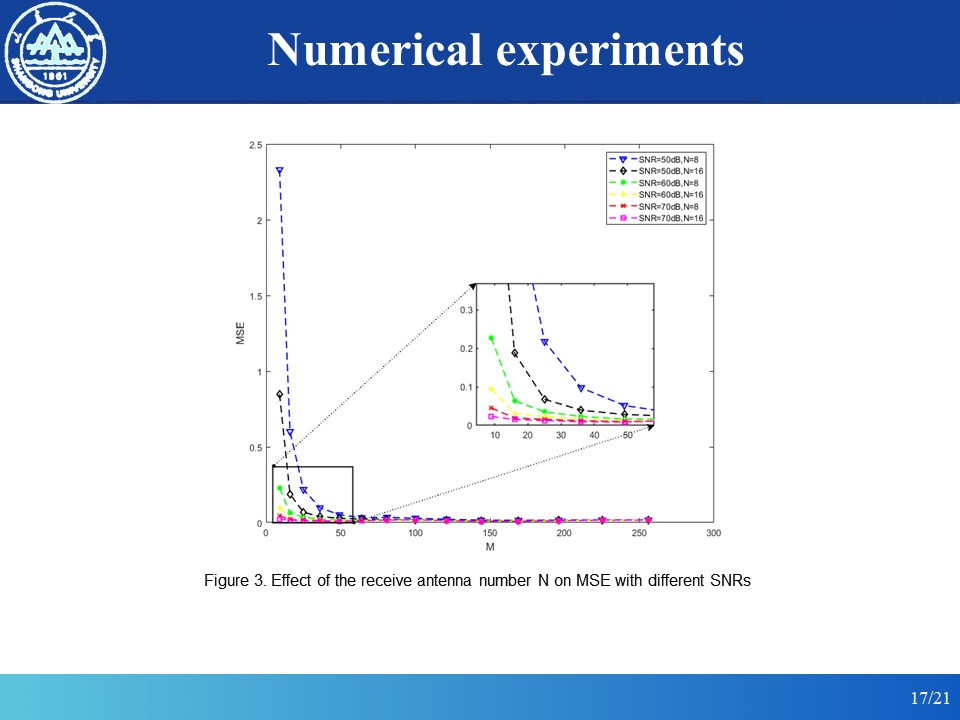 |
We further study the influence of the number of BS receive antennas on the mean square error (MSE) of positioning with different SNRs. The length of time is L=100. We set SNR=50dB, 60dB, and 70dB, respectively, and the number of BS antennas N=8 and 16, respectively. As seen from Fig. 3, the increasing SNR can significantly improve the positioning performance. That is, the positioning MSE decreases significantly with the increase of SNR since the influence of noise on the positioning error becomes marginal with the increase of SNR. If the SNR increases continuously, the MSE will become very small but not zero even with increasing reflection units of the RISs, which is due to the limitation of the uniform sampling number of angles. When the user is not at the grid points decided by the perception matrix, certain errors will happen and increasing the sampling number can further solve this problem. It is also shown that, when the number of BS receive antennas and the number of RIS reflection units increase, the MSE gradually decreases and then becomes marginal, indicating that the MSE can be affected by both of them, but with limited influence at large number. When the number of RIS units reaches 64, the subsequent MSE changes very little and becomes stable.
|
|
ICACT20240241 Slide.16
[Big slide for presentation]
[YouTube] |
Chrome Text-to-Speach Click!! |
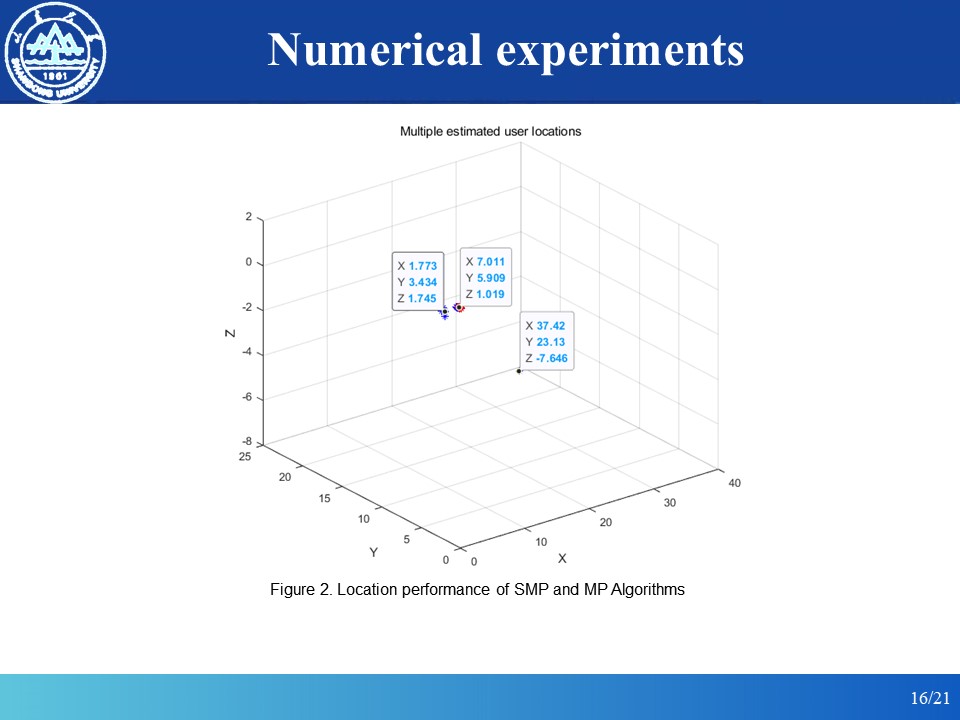 |
As shown in Fig. 2, the red star-shaped dot set is the positioning result of the SMP algorithm, and the blue diamond-shaped one is the result of the traditional MP algorithm. It is seen that the SMP algorithm achieves better positioning performance compared with the MP algorithm. The reason is that different combination values of angles may get relatively similar results for the MP algorithm due to the two-dimensional CS and the positioning error may increase for the influence of noise.
|
|
ICACT20240241 Slide.15
[Big slide for presentation]
[YouTube] |
Chrome Text-to-Speach Click!! |
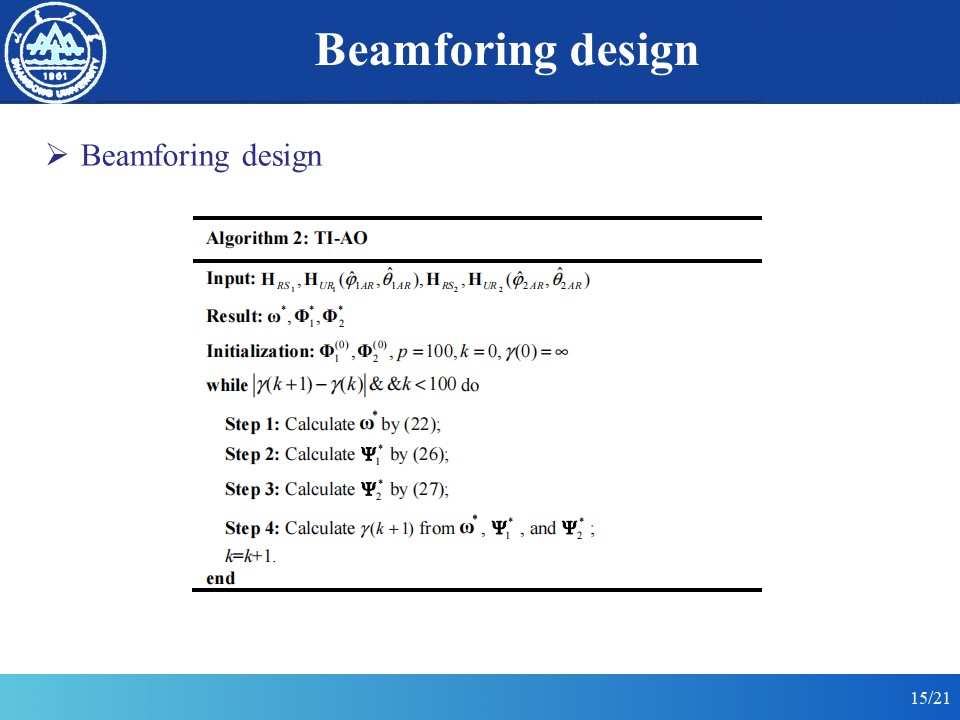 |
The following table is the pseudo-code of the alternate optimization algorithm we used, which is relatively simple and of low complexity.
|
|
ICACT20240241 Slide.14
[Big slide for presentation]
[YouTube] |
Chrome Text-to-Speach Click!! |
 |
The optimal solution is obtained as~~~~~, Finally, the optimal 𝚽_1 is converted into a diagonal matrix . Similar to the solution of 𝚽_1, for given 𝛚 and 𝚽_1. And the optimal solution is obtained as~~~~~
|
|
ICACT20240241 Slide.13
[Big slide for presentation]
[YouTube] |
Chrome Text-to-Speach Click!! |
 |
At the BS, in order to maximize the receive SNR, we can take the maximal ratio combining (MRC) method. Then, we can fix the phase shift matrix of one RIS, while optimizing the phase shift matrix of the other RIS.
|
|
ICACT20240241 Slide.12
[Big slide for presentation]
[YouTube] |
Chrome Text-to-Speach Click!! |
 |
The optimization problem of the RIS beamforming design can be described as (p1). Firstly, we can transform (P1) into a sub-problem about 𝛚 and find the optimal solution. Then, the sub-problems of 𝚽_1 and 𝚽_2 can be solved in turn, which can ensure the quality of the received signal of each time slot at the BS.
|
|
ICACT20240241 Slide.11
[Big slide for presentation]
[YouTube] |
Chrome Text-to-Speach Click!! |
 |
After we complete the user location estimation in the first stage, we complete the following beamforming based on the estimated information in the first stage. In this work, with the known channel state information (CSI), we aim to maximize the system achievable rate at the BS through the design of the receive beamforming of the BS antennas and the phase shift matrix of the RISs. R is the achievable rate at the base station, and beta is the signal to noise ratio at the base station.
|
|
ICACT20240241 Slide.10
[Big slide for presentation]
[YouTube] |
Chrome Text-to-Speach Click!! |
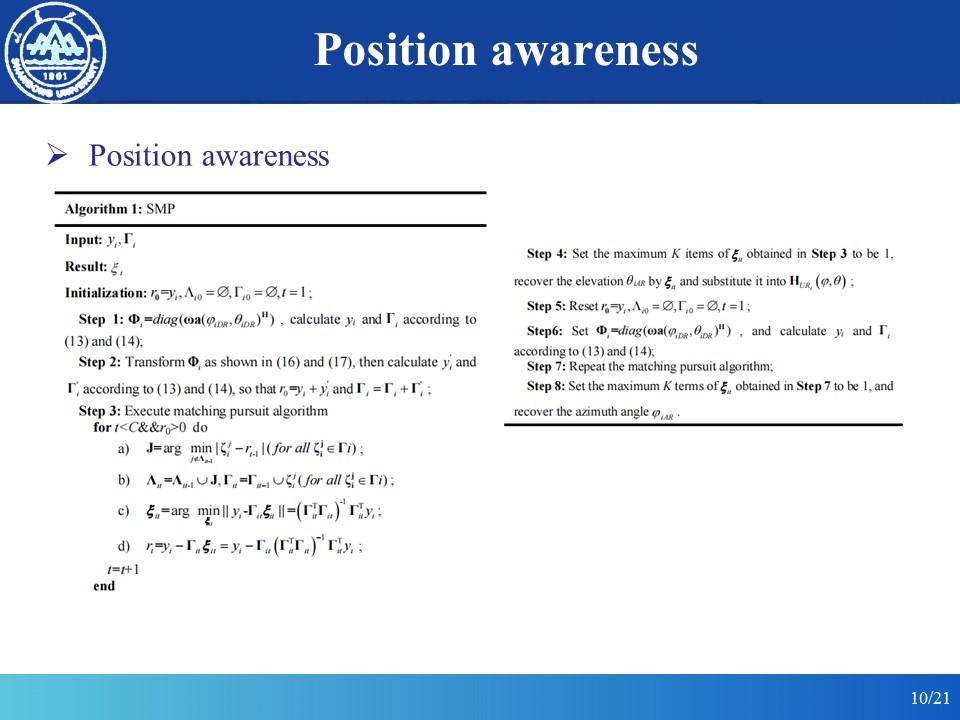 |
The following table is the pseudo-code of our entire algorithm. The idea of this algorithm is to realize separate estimation of two angles through the control of RIS reflection unit. After the previous transformation, we can realize single Angle estimation through the original MP algorithm. Finally, the estimation of pitch Angle and azimuth Angle is realized, so as to realize position estimation.
|
|
ICACT20240241 Slide.09
[Big slide for presentation]
[YouTube] |
Chrome Text-to-Speach Click!! |
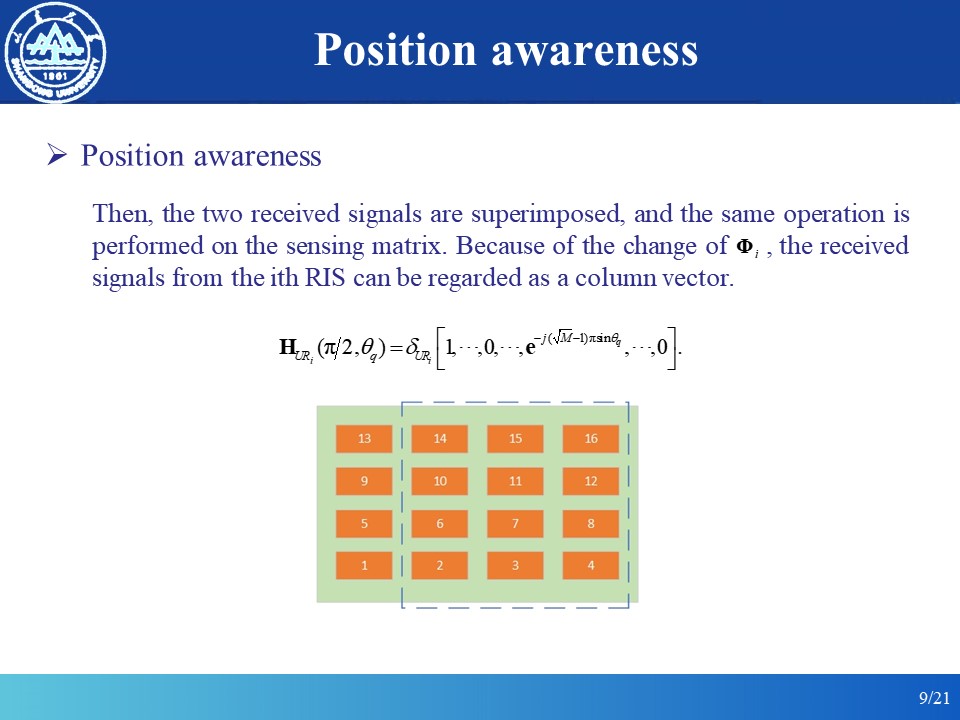 |
Then, the two received signals are superimposed, and the same operation is performed on the sensing matrix. Because of the change of phase shift matrix , the received signals from the ith RIS can be regarded as a column vector. As shown in the figure below, after the above transformation, the signal reflected only by the ris reflection units in the left column can be obtained.
|
|
ICACT20240241 Slide.08
[Big slide for presentation]
[YouTube] |
Chrome Text-to-Speach Click!! |
 |
According to the above CS problem, only the user's angle corresponding to each RIS is unknown in the formula. To reduce the effect of channel noise on the positioning perception, we first set ~~~~, And let the user send the identical signals in two adjacent time slots. After the completion of the first signal transmission, we have ~~~~~~.
|
|
ICACT20240241 Slide.07
[Big slide for presentation]
[YouTube] |
Chrome Text-to-Speach Click!! |
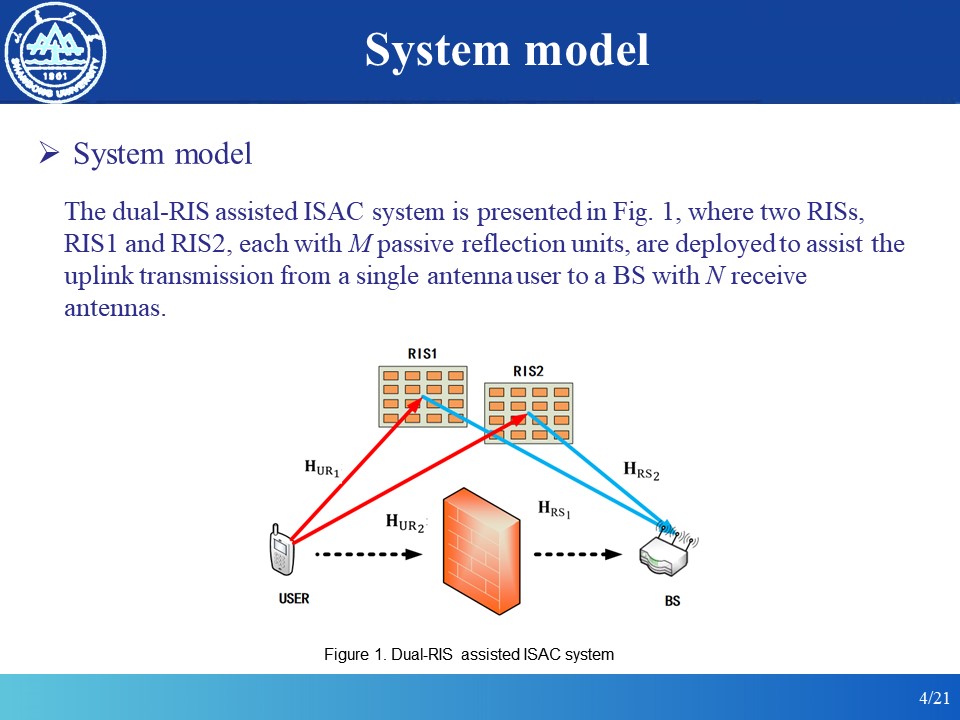 |
Considering the signal sparsity in the channel estimation, the angle estimation problem can be transformed into a traditional CS problem. Firstly, the angles of azimuth and elevation are uniformly sampled into discrete values with the size of W and Q, respectively, as ~~~. And the received signal at the BS from the ith RIS can be reformulated as~~~~ . Due to the sparsity of angles, the location recovery problem can be transformed into a classical CS problem. Thus, the received can be viewed as the observed value in the CS problem, and is the sensing matrix.
|
|
ICACT20240241 Slide.06
[Big slide for presentation]
[YouTube] |
Chrome Text-to-Speach Click!! |
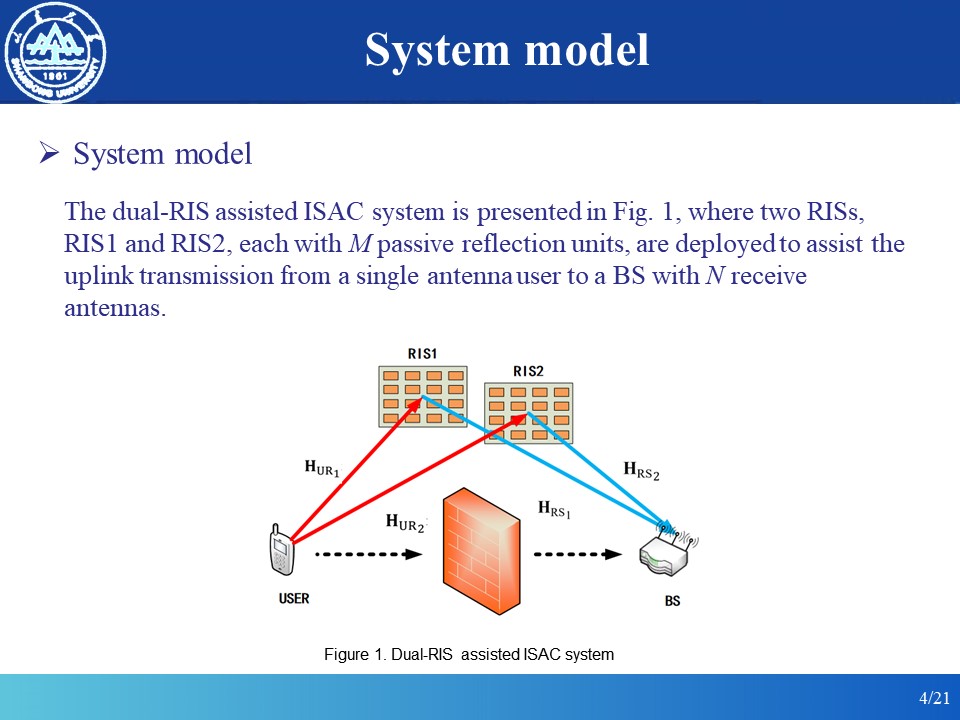 |
Similarly, the channel matrix from the user to the ith RIS can be expressed as~~~~~~,And the received signal at the BS from the two RISs is~~~~~,The signal sent by the user at time l is x(l) with power~~~~~~~.
|
|
ICACT20240241 Slide.05
[Big slide for presentation]
[YouTube] |
Chrome Text-to-Speach Click!! |
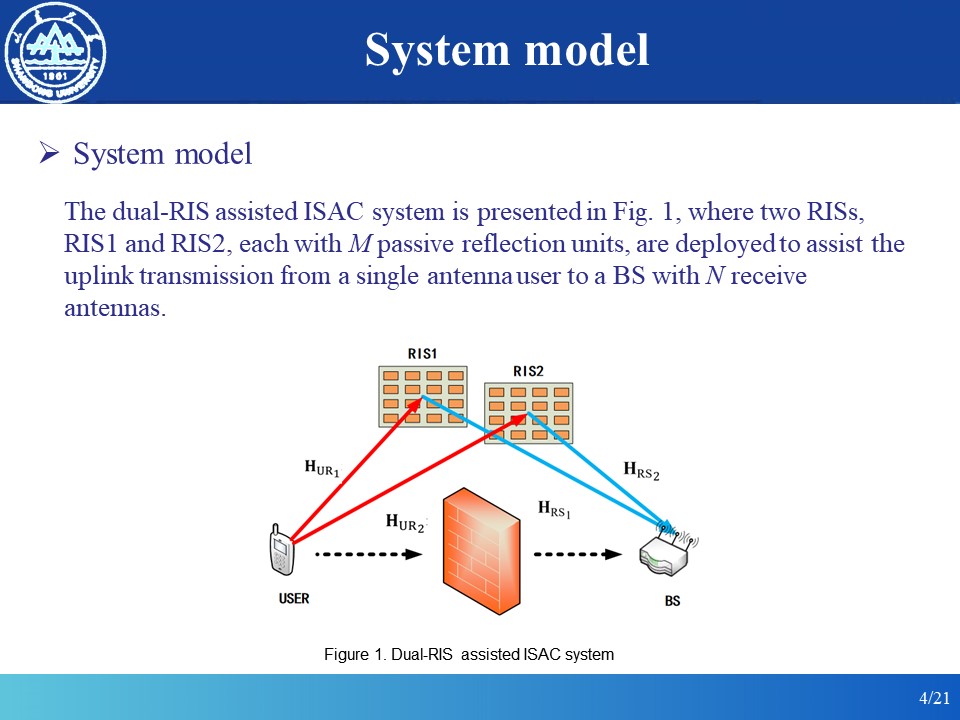 |
It is assumed that the positions of the BS and RISs are known. the channel matrix between the ith RIS and the BS can be written as this form,For the array response, we give its concrete expression.
|
|
ICACT20240241 Slide.04
[Big slide for presentation]
[YouTube] |
Chrome Text-to-Speach Click!! |
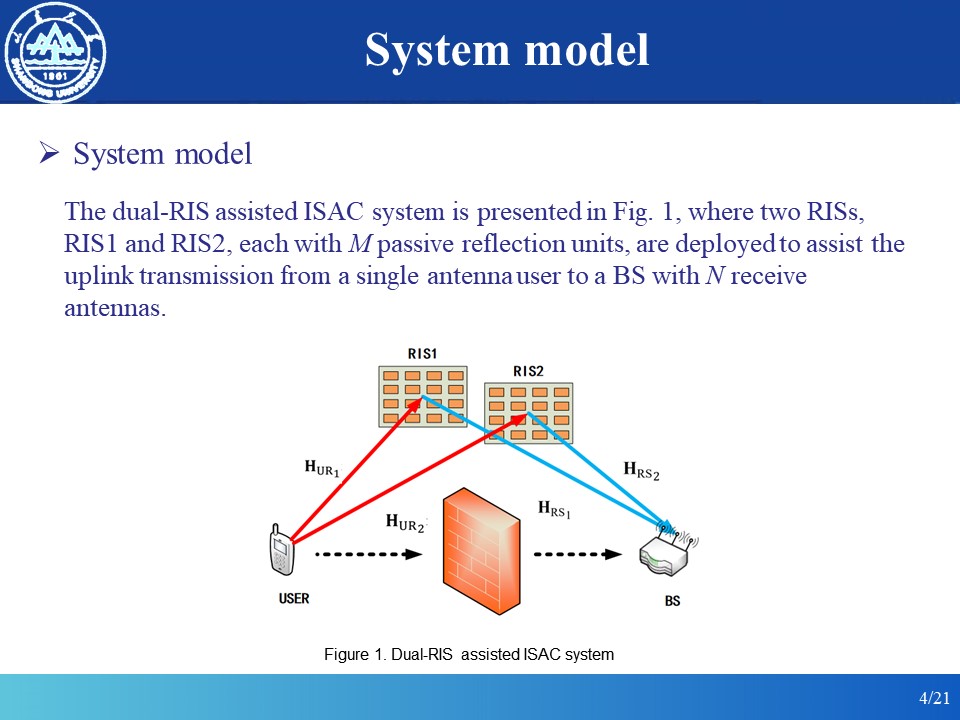 |
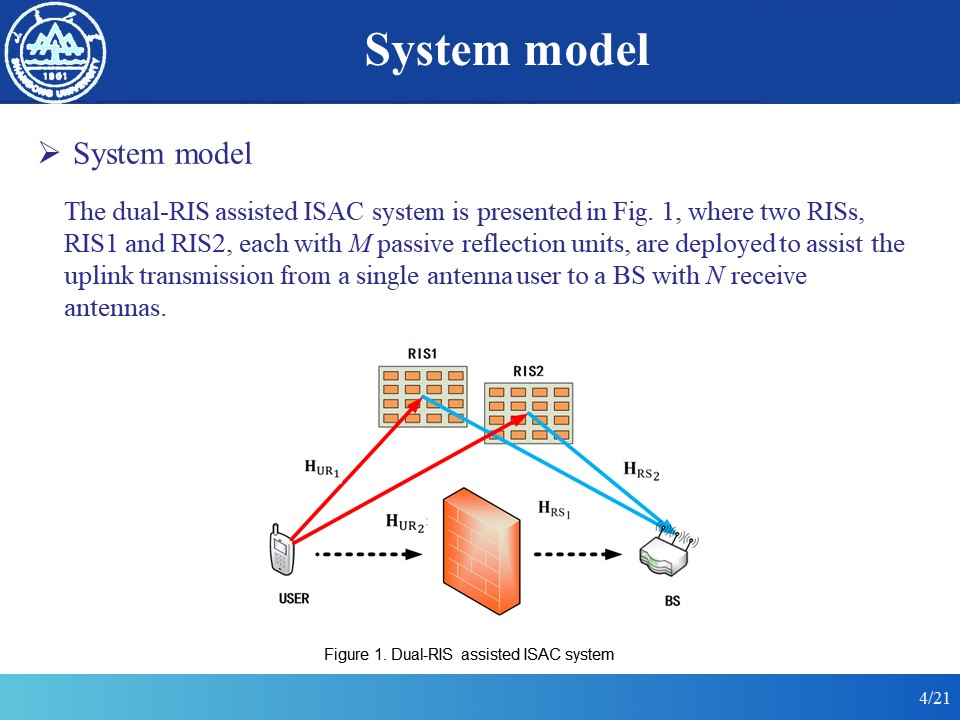
The dual-RIS assisted ISAC system is presented in Fig. 1, where two RISs, RIS1 and RIS2, each with M passive reflection units, are deployed to assist the uplink transmission from a single antenna user to a BS with N receive antennas.
|
|
ICACT20240241 Slide.03
[Big slide for presentation]
[YouTube] |
Chrome Text-to-Speach Click!! |
 |
Integrated sensing and communication (ISAC) has become one of the main technologies in 6G communications . By realizing the communication and sensing in the same spectrum, ISAC can avoid the interference and improve the spectrum efficiency. However, the increasing demands for high communication spectrum leads to the increase of costs and energy consumption, which also influences the signal propagation range. The emerging reconfigurable intelligent surface (RIS) technology can properly adjust the transmission environment and control the wireless channel to a certain extent. It is feasible to introduce RIS into the ISAC system and improve the communication quality and coverage .In this paper, we study the 3D positioning and beamforming design in dual-RIS assisted ISAC system, then we transform the localization in the ISAC system into a compressed sensing (CS) problem and propose a stepwise matching pursuit (SMP) algorithm. Based on the positioning information, we complete the beamforming design of the BS and RISs by an alternating optimization algorithm based on the triangle inequality (TI-AO).
|
|
ICACT20240241 Slide.02
[Big slide for presentation]
[YouTube] |
Chrome Text-to-Speach Click!! |
 |
Next, I will introduce the main work of this paper in detail from the following aspects. They are System model, Problem statement, Position awareness and Beamforing design, Numerical experiments and Conclution.
|
|
ICACT20240241 Slide.01
[Big slide for presentation]
[YouTube] |
Chrome Text-to-Speach Click!! |
 |
Hello everyone, my paper ID is 20240241. Today, my paper topic is Dual-RIS Assisted 3D Positioning and Beamforming Design in ISAC System.
|
















