 ICACT20250175 Slide.22
[Big slide for presentation]
[YouTube] |
Chrome Text-to-Speach Click!! |
 |
That’s all. Thank you. Welcome to ask me questions
|
|
ICACT20250175 Slide.21
[Big slide for presentation]
[YouTube] |
Chrome Text-to-Speach Click!! |
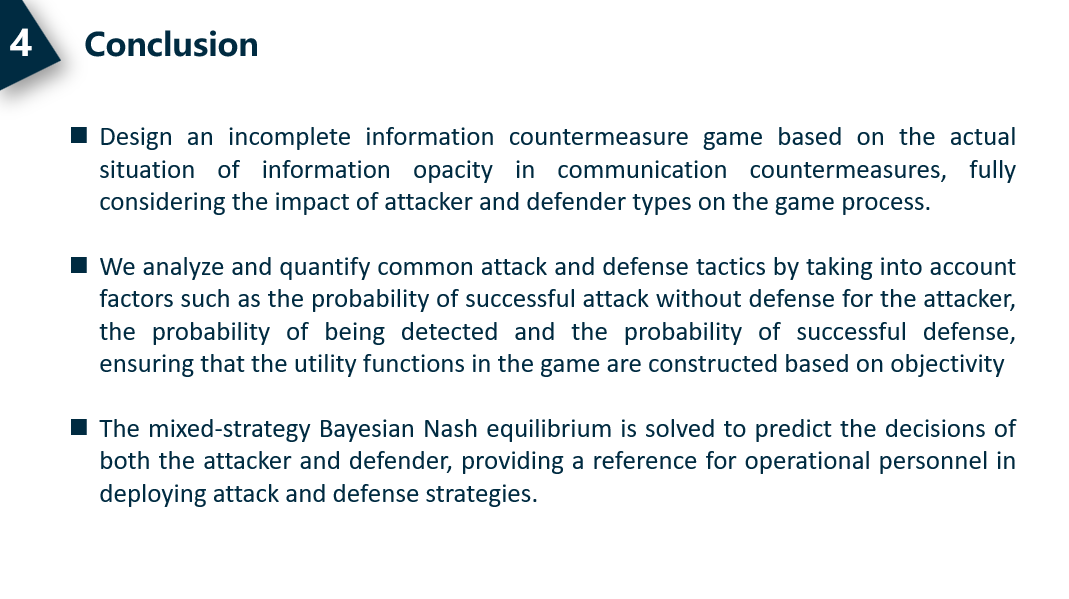 |
This paper designs an incomplete information countermeasure game based on the actual situation of information opacity in communication countermeasures, fully considering the impact of attacker and defender types on the game process. Additionally, it comprehensively analyzes and quantifies common attack and defense tactics by taking into account factors such as the probability of successful attack without defense for the attacker, the probability of being detected and the probability of successful defense, ensuring that the utility functions in the game are constructed based on objectivity Finally, the mixed-strategy Bayesian Nash equilibrium is solved to predict the decisions of both the attacker and defender, providing a reference for operational personnel in deploying attack and defense strategies.
|
|
ICACT20250175 Slide.20
[Big slide for presentation]
[YouTube] |
Chrome Text-to-Speach Click!! |
 |
Final, we will give a conclusion of this paper
|
|
ICACT20250175 Slide.19
[Big slide for presentation]
[YouTube] |
Chrome Text-to-Speach Click!! |
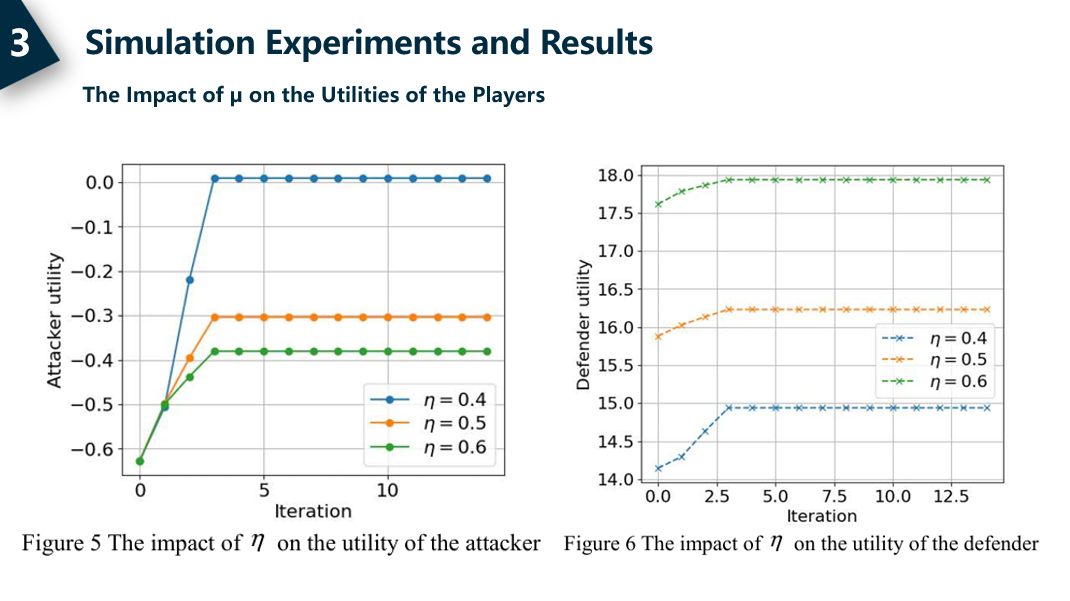 |
From Figures 5 and 6, it can be seen that as the discount factor for defense failure increases, the utility of the attacker at equilibrium decreases, while the utility of the defender increases. When the discount factor for defense failure is relatively high, even if the defender fails, they can still obtain significant benefits by obtaining the information related to the attack. At this point, the defender is more willing to engage in defense, hindering the attack and thereby reducing the utility of the attacker.
|
|
ICACT20250175 Slide.18
[Big slide for presentation]
[YouTube] |
Chrome Text-to-Speach Click!! |
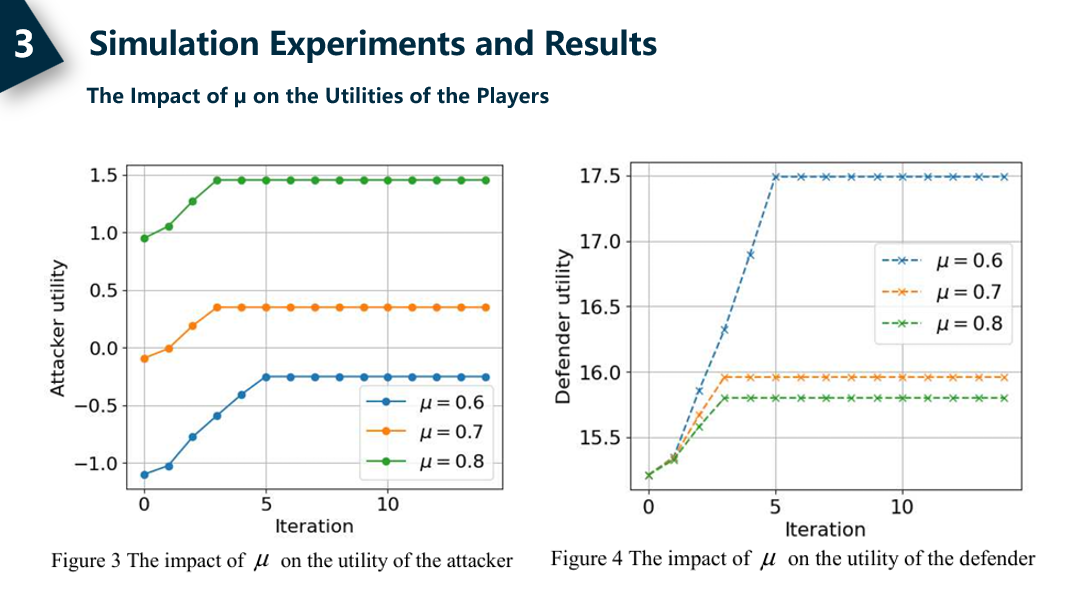 |
From Figures 3 and 4, it can be seen that the higher mu (the probability of successful attack without defense), the greater the utility of the attacker can obtain at equilibrium, while the utility of the defender decreases. This is because a higher probability of successful attack without defense makes defense more difficult, leading to poorer defensive outcomes, resulting in a gradual decrease in the utility of the defender at equilibrium.
|
|
ICACT20250175 Slide.17
[Big slide for presentation]
[YouTube] |
Chrome Text-to-Speach Click!! |
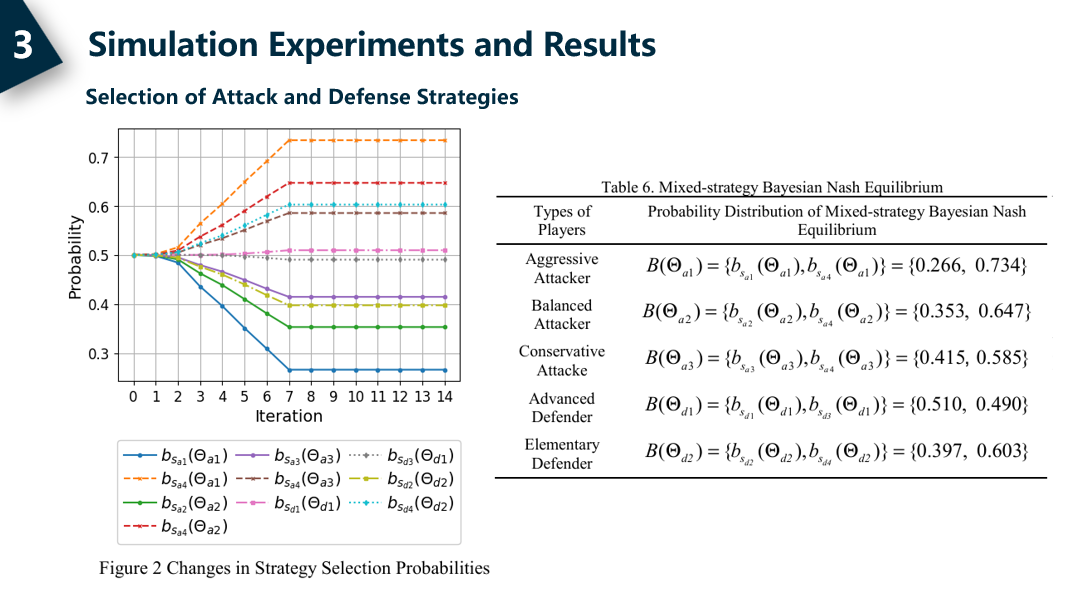 |
After conducting the game tree, we can analyze and solve the mixed-strategy equilibrium of the game. The changes in strategy selection probabilities for different types of attackers and defenders are shown in Figure 2. It is evident that the probabilities gradually converge over the iterations, ultimately stabilizing at the mixed-strategy Bayesian Nash equilibrium, which is shown in Table 6. The probability of the attacker selecting the jamming strategy increases in the order of adventurous, balanced, and conservative types. This is because the corresponding costs of these jamming strategies decrease progressively, making it more profitable for the conservative attackers to adopt their attack strategies under the given parameter settings. Regarding the defenders, the advanced defenders are more likely to choose the defensive strategy compared to the elementary defenders. Although they incur higher strategic costs, their greater probability of successful defense ensures that the benefits gained from successful defenses are sufficient to offset those costs.
|
|
ICACT20250175 Slide.16
[Big slide for presentation]
[YouTube] |
Chrome Text-to-Speach Click!! |
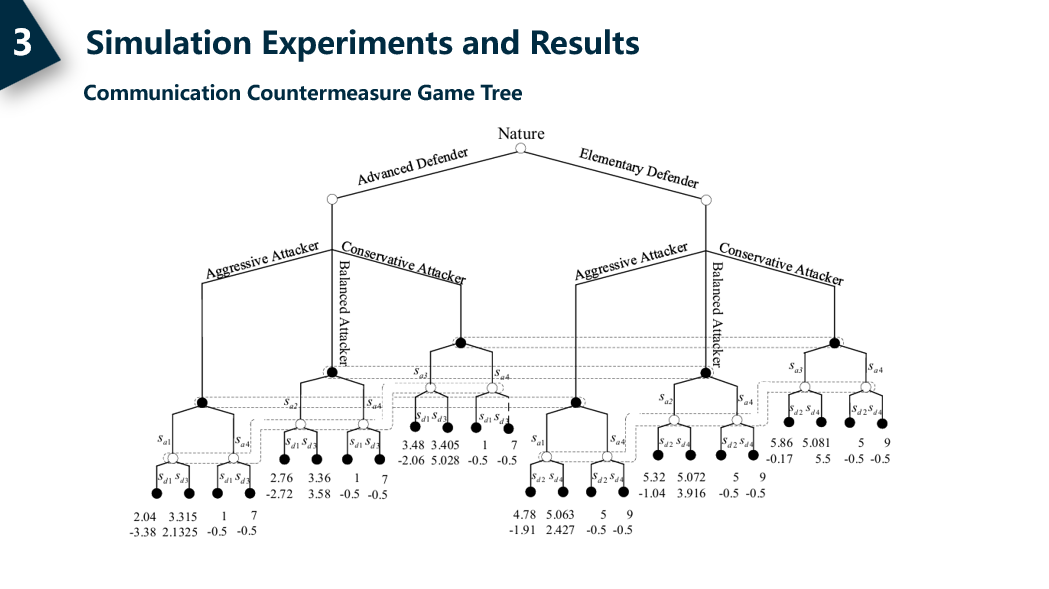 |
Based on the above settings, we can use the Harsanyi transformation, introducing a virtual player 'Nature’. The Nature selects the defender types, and the above incomplete information game can be converted into an imperfect information game. We can then analyze and solve this game using standard methods. Based on the parameter settings mentioned, the communication countermeasure game tree is constructed as shown in Figure
|
|
ICACT20250175 Slide.15
[Big slide for presentation]
[YouTube] |
Chrome Text-to-Speach Click!! |
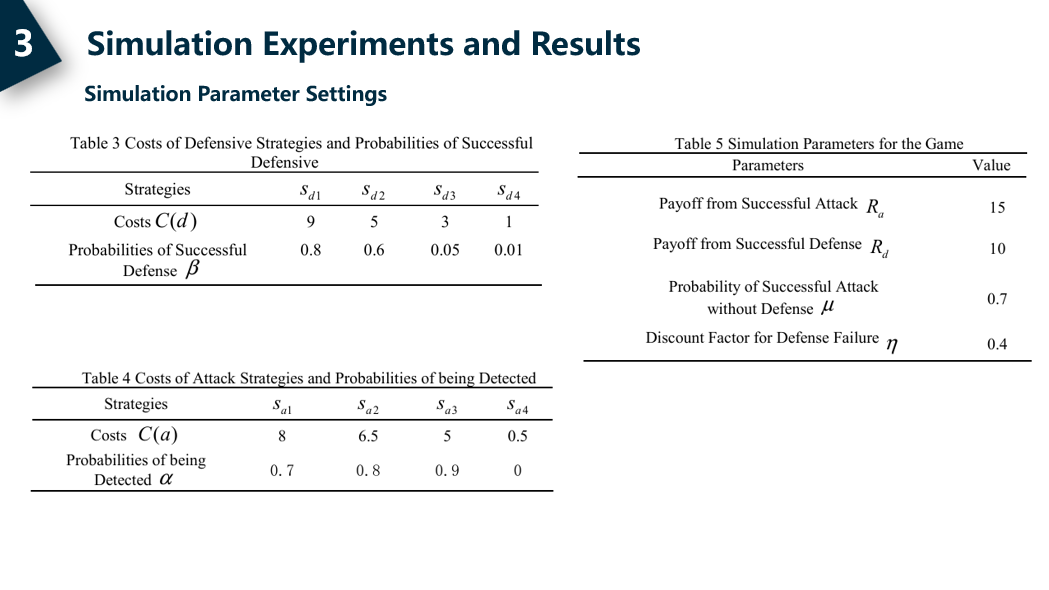 |
The costs of the defensive strategies and probabilities of successful defensive are shown in Table 3.
And the costs of the attack strategies and probabilities of being detected are shown in Table 4.
Other simulation parameter settings are shown in Table 5.
|
|
ICACT20250175 Slide.14
[Big slide for presentation]
[YouTube] |
Chrome Text-to-Speach Click!! |
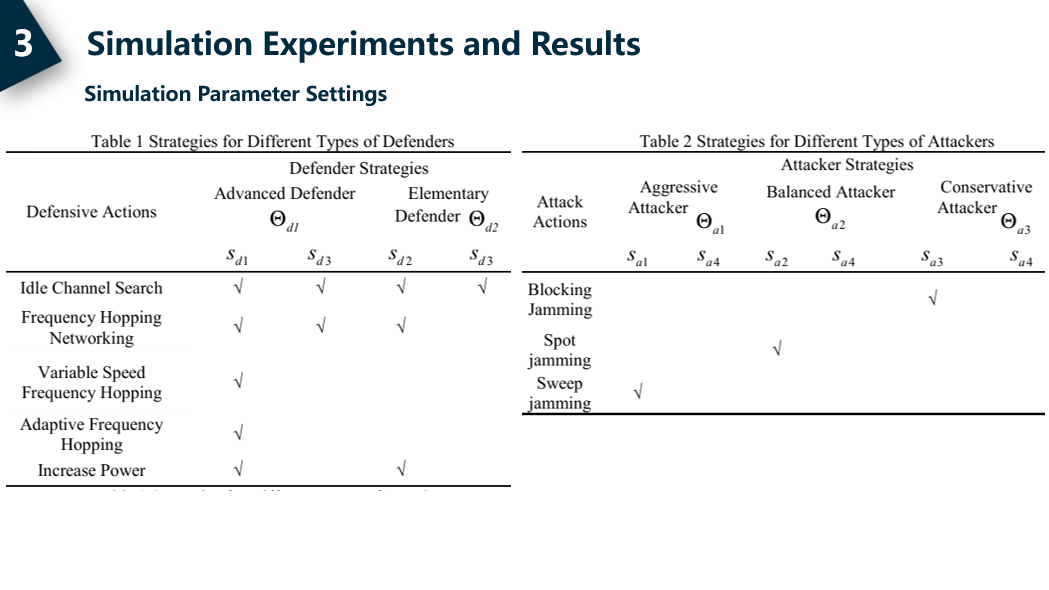 |
In this paper, we assume that the defender includes two types: advanced and elementary defenders, while the attacker includes three types: aggressive, balanced, and conservative.
Considering the common defensive and attack tactcis introduced above, the strategies for different types of defenders and attackers are shown in Tables 1 and 2.
|
|
ICACT20250175 Slide.13
[Big slide for presentation]
[YouTube] |
Chrome Text-to-Speach Click!! |
 |
Part 3 is about the simulation experiments and results in this paper
|
|
ICACT20250175 Slide.12
[Big slide for presentation]
[YouTube] |
Chrome Text-to-Speach Click!! |
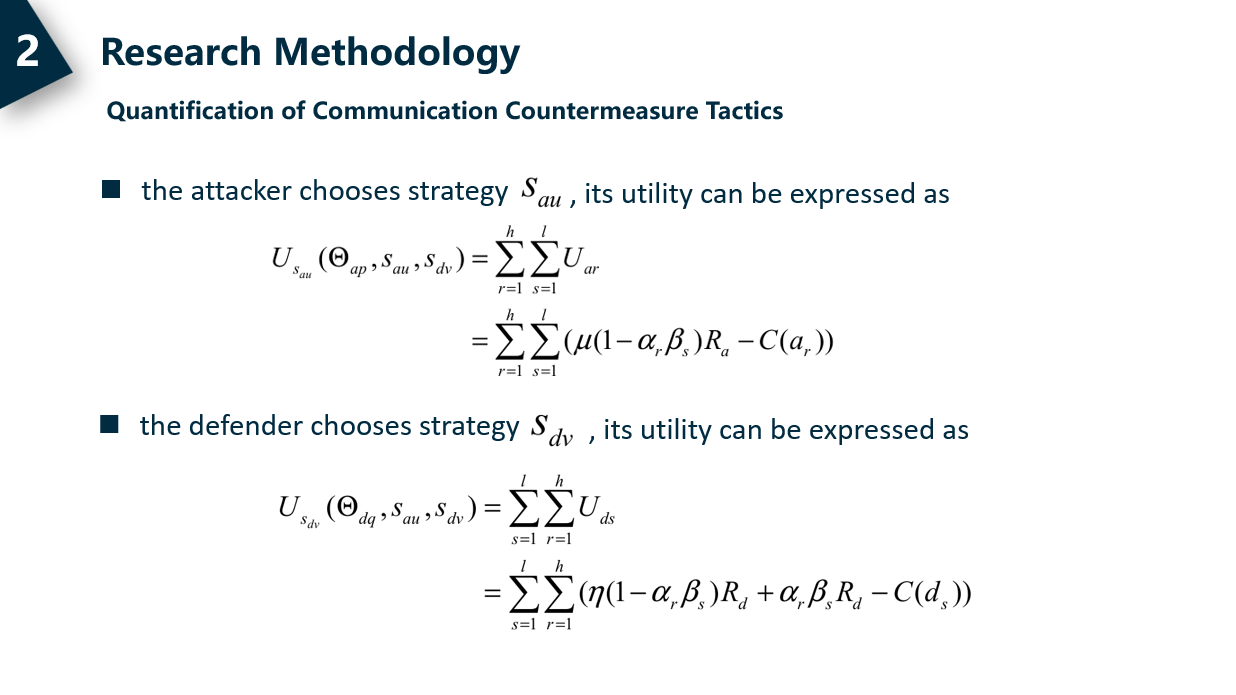 |
Based on the above analysis, when the attacker chooses strategy Sau, its utility is
And if the defender chooses strategy Sdv, its utility is
According to Brouwer's fixed-point theorem, there must exist a mixed-strategy Nash equilibrium in finite normal-form games.
That means the game model we built in this power must have a mixed-strategy nash equilibrium of the game
Then we can begin to solve.
|
|
ICACT20250175 Slide.11
[Big slide for presentation]
[YouTube] |
Chrome Text-to-Speach Click!! |
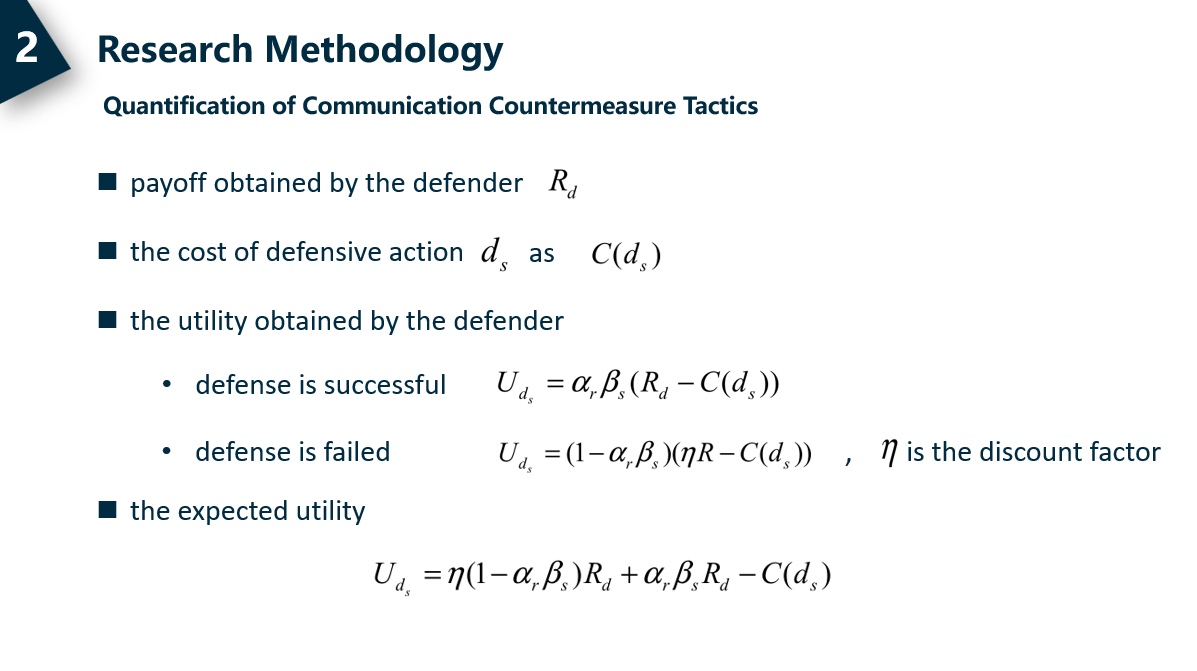 |
For the defender, a payoff is obtained regardless of whether the defense’s success. Even if the defense fails, the defender can gain valuable information about the attacker’s tactics, which can be used to future decision making. We denote it as Rd.
And the cost of the defensive action ds is C(ds)
When the defense is successful, the utility obtained by the defender can be expressed as
And when the defense is failed, the utility is ,and eta is the discount factor.
So the expected utility is
|
|
ICACT20250175 Slide.10
[Big slide for presentation]
[YouTube] |
Chrome Text-to-Speach Click!! |
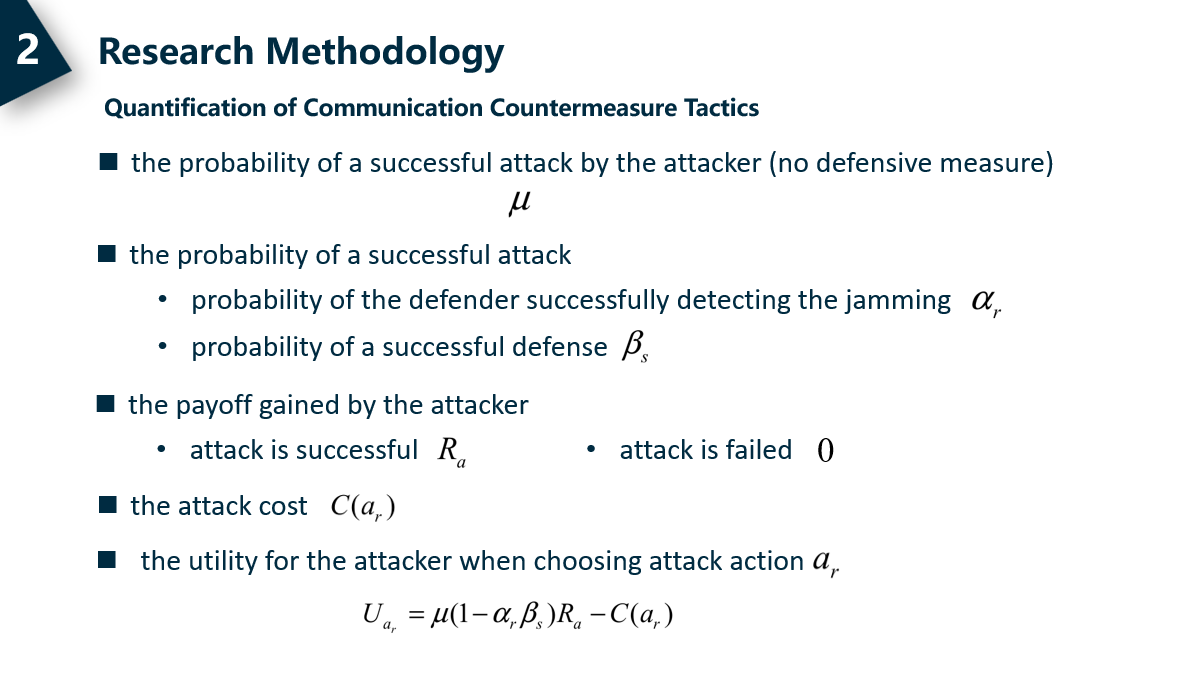 |
Then, I will introduce how this paper quantifies these tactics , so we can define the utility function of the players.
When the attacker conducts jamming attacks, it is possible for the attack to fail even if the defender does not implement any defensive measures. This can occur because limitations such as jamming power or targeting accuracy prevent the jamming signal from fully covering the defender's communication frequency band.
So we denote the probability of a successful attack by the attacker as mu, when no defensive measures are implemented.
In this article we assume the probability of a successful attack is related to two factors.
One is the probability of the defender successfully detecting the jamming alpha r.
(r represents the index of an attack action in a given attack strategy)
The other one is the probability of a successful defense beta s.
(s denotes the index of a defense action in a given defense strategy)
Furthermore, we consider the attacker gains a payoff Ra when the attack is successful, and gains nothing if the attack fails.
And regardless of whether the attack succeeds or fails, an attack cost Car must be paid.
Therefore, the utility for the attacker when choosing attack action ar can be expressed as this equation.
|
|
ICACT20250175 Slide.09
[Big slide for presentation]
[YouTube] |
Chrome Text-to-Speach Click!! |
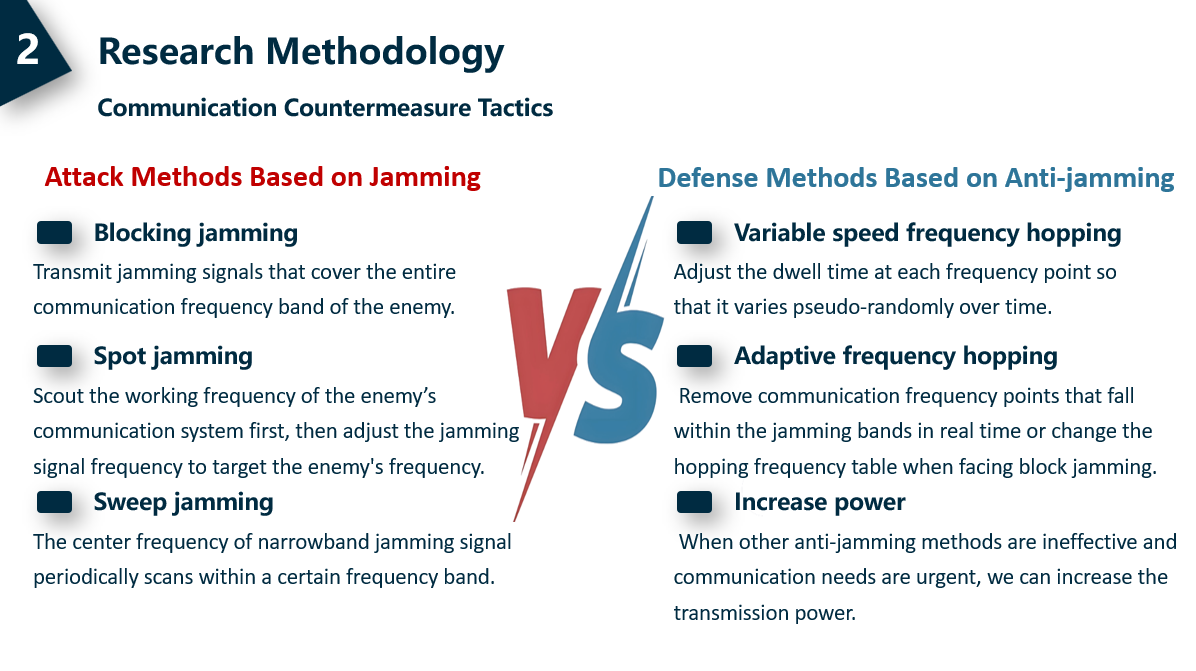 |
Next, let me introduce some common communication countermeasure tactics.
Based on the spectral width of the jamming signals, we divide the attack methods into 3 types: blocking jamming, spot jamming and sweep jamming.
Blook jamming transmits jamming signals that cover the entire communication frequency band of the enemy. The method is relatively simple, as it does not require precise knowledge of the enemy‘s communication frequency. But the power density within the bandwidth is low, resulting in weaker jamming intensity。
Spot jamming first scouts the working frequency of the enemy’s communication system , then adjust the jamming signal frequency to target the enemy's frequency. The jamming power of spot jamming is concentrated, resulting in high power utilization and good jamming results. However, it has high requirements for frequency reconnaissance and targeting
In sweep jamming, the center frequency of narrowband jamming signal periodically scans within a certain frequency band. It is more difficult to filter out compared to other jamming methods.
As for defense methods, common ones include variable speed frequency hopping, adaptive frequency hopping and increase power.
Variable speed frequency hopping adjusts the dwell time at each frequency point so that it varies pseudo-randomly over time.
Adaptive frequency hopping removes communication frequency points that fall within the jamming bands in real time or change the hopping frequency table when facing block jamming.
When other anti-jamming methods are ineffective and communication needs are urgent, we can increase the transmission power.
|
|
ICACT20250175 Slide.08
[Big slide for presentation]
[YouTube] |
Chrome Text-to-Speach Click!! |
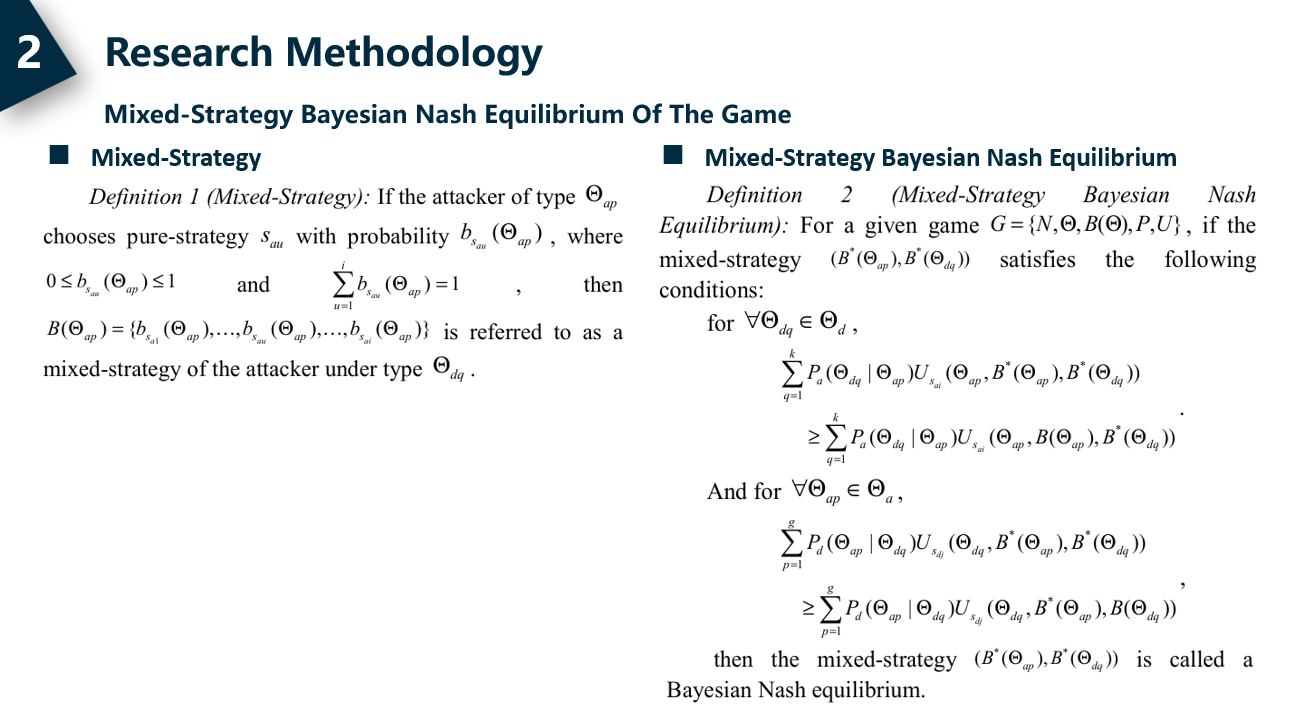 |
We hope to solve the mix-strategy Bayesian nash equilibrium of the game. What is the mix-strategy and the nash equilibrium? The game theory have given the definition. For the mixed-strategy, If the attacker of type theta ap choose pure strategy sau with the probability bsau, and the probability satisfies the following conditions, then we call B theta ap as the mixed-strategy of the attacker under typer theta ap. If the mixed-strategy satisfies the following equations, we call B*theta ap B*theta dp is the nash equilibrium. These equations mean when the players adopt the strategy B*theta ap B*theta dp, both the attackers and the defenders can obtain the max benefits. Any deviation from this strategy by either party will result in a decrease in their benefits.
|
|
ICACT20250175 Slide.07
[Big slide for presentation]
[YouTube] |
Chrome Text-to-Speach Click!! |
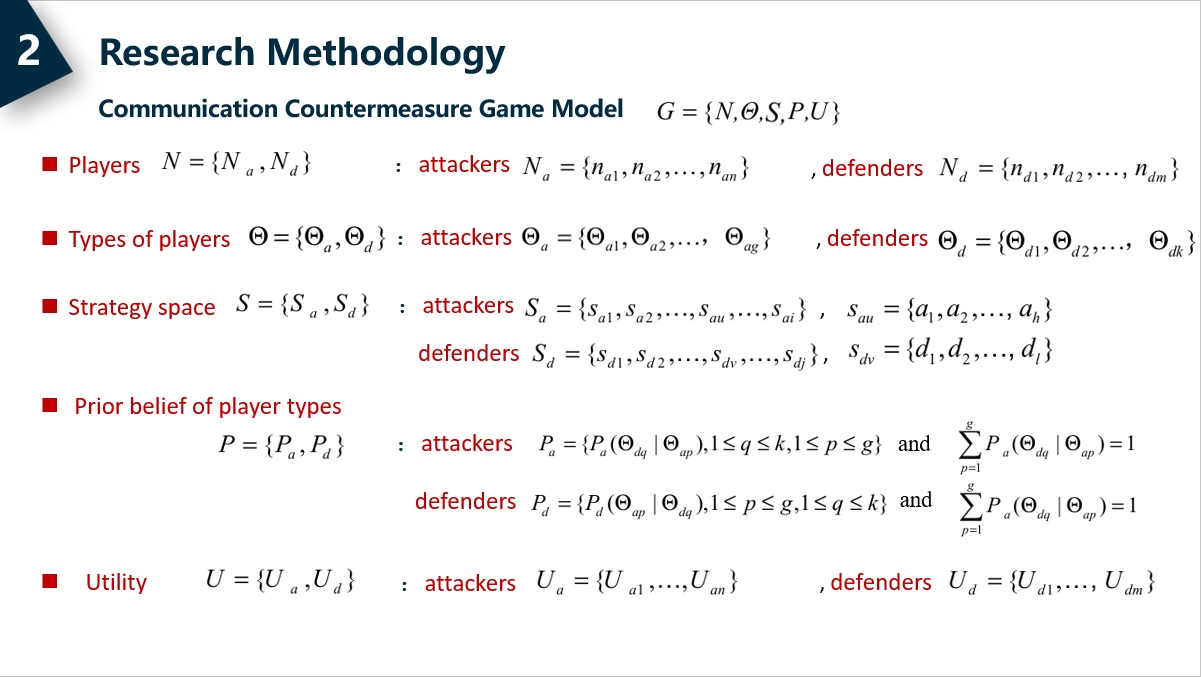 |
We denote the model as G, which includes 5 elements.
First is N, which denotes the players in the game. Players are the decision-makers in the game and in this model they are divided into attackers and defenders
Second is theta, which denotes the types of players. Similar to the set of players, it consists of 2 subsets, namely attacker type and defender type
The third one is S, which is strategy space. Sa is the strategy space of the attackers, and the element Sau in the Sa set contains m actions, namely a1 to ah. The situation for defenders is similar.
And P denotes the set of prior belief of player types. The prior belief of player types refers to the estimation of the probabilities of other players’ type when a player has known its own type. Both the attacker and defender subsets need to satisfy the following equation condition, that is, the sum of all elements in each subset is 1.
The last element is U, which means utility. It is the payoff of the players during the game and is also the optimization objective of the players. Ua represents the utility function of the attackers, while Ud represents the utility function of the defenders.
|
|
ICACT20250175 Slide.06
[Big slide for presentation]
[YouTube] |
Chrome Text-to-Speach Click!! |
 |
Part 2 is about our research methodology.
|
|
ICACT20250175 Slide.05
[Big slide for presentation]
[YouTube] |
Chrome Text-to-Speach Click!! |
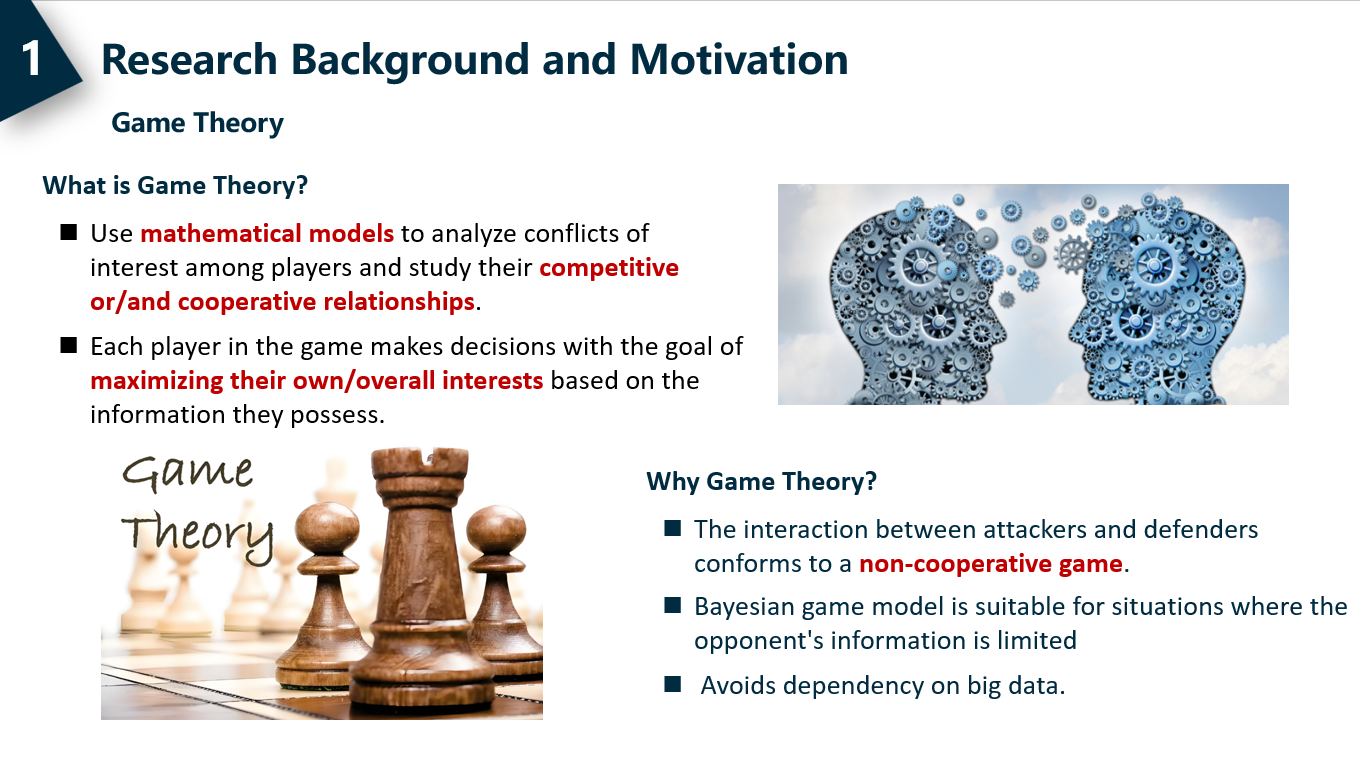 |
To address these issues, we propose a game-theoretic framework for communication countermeasures under incomplete information.
What is game Theory?
Game theory uses mathematical models to analyze conflicts of interest among players and study their competitive or/and cooperative relationships.
Each player in the game makes decisions with the goal of maximizing their own/overall interests based on the information they possess.
Then why we use game theory?
First, The interaction between attackers and defenders conforms to a non-cooperative game.
In communication countermeasures, attackers employ tactics like eavesdropping or jamming to gather enemy information or disrupt the opponent's communication capabilities. The attacker and defender counterbalance each other, aiming to maximize their own interests and weaken the opponent’s. Similarly, in non-cooperative games, players are
guided by individual rationality and act to maximize their own utilities without considering the utilities of others. Player utilities conflict
and mutually influence each another.
Second, modeling incomplete information through Bayesian Game can adapt to situations where both parties have limited knowledge of enemy strategy space, resource allocation, and other information.
Last, the method can avoid dependency on big data.
|
|
ICACT20250175 Slide.04
[Big slide for presentation]
[YouTube] |
Chrome Text-to-Speach Click!! |
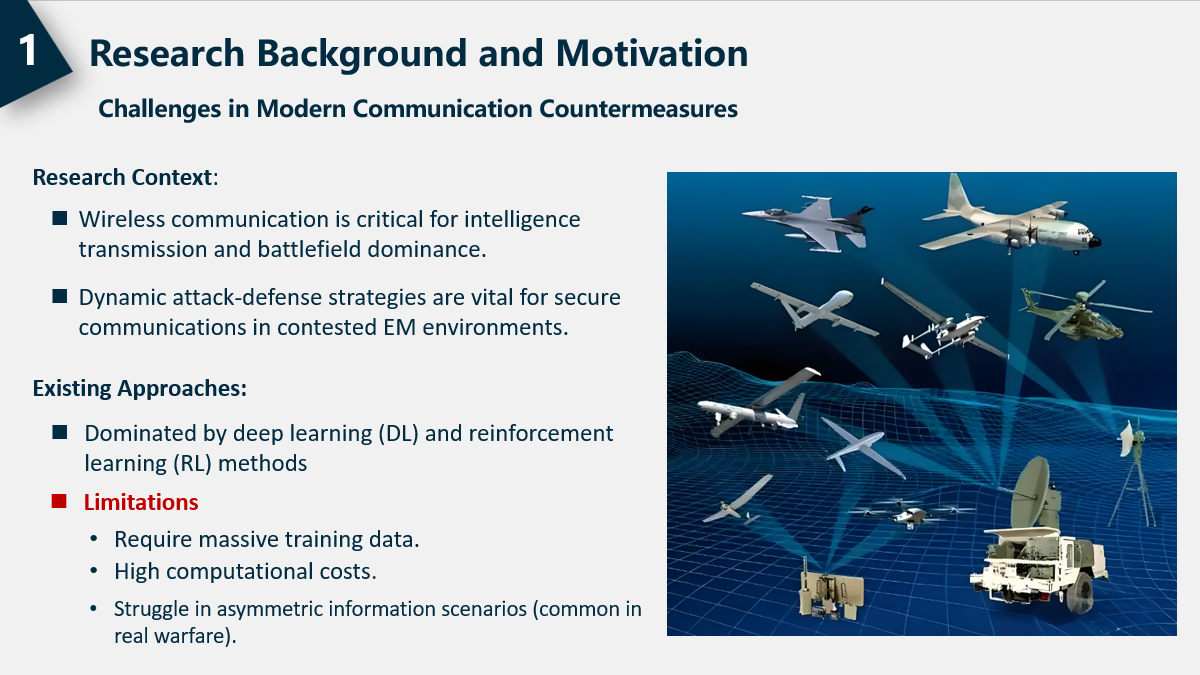 |
Wireless communication plays a pivotal role in intelligent transmission and battlefield dominance. However, the modern electromagnetic (EM) environment has become highly complex, and various communication countermeasure techniques are constantly emerging. Under such conditions, making real-time and adaptive decisions on attack and defense strategies is essential to ensure secure communications.
The existing methods for solving this problem primarily rely on deep learning (DL) and reinforcement learning (RL). While effective, these methods face three major limitations:
First, DL/RL models require massive datasets, which are difficult to obtain in real warfare.
Second, deep learning and reinforcement learning models demand powerful hardware. Deploying these models in real-time would drain resources, slow down decision-making, or even fail entirely under field conditions.
Third, in real combat, attackers and defenders often lack complete knowledge of each other’s strategies. Traditional AI methods rely on pre-trained data and struggle to adapt to unforeseen scenarios , leading to suboptimal or outdated responses.
|
|
ICACT20250175 Slide.03
[Big slide for presentation]
[YouTube] |
Chrome Text-to-Speach Click!! |
 |
Let me begin by outlining the research background and motivation behind this work.
|
|
ICACT20250175 Slide.02
[Big slide for presentation]
[YouTube] |
Chrome Text-to-Speach Click!! |
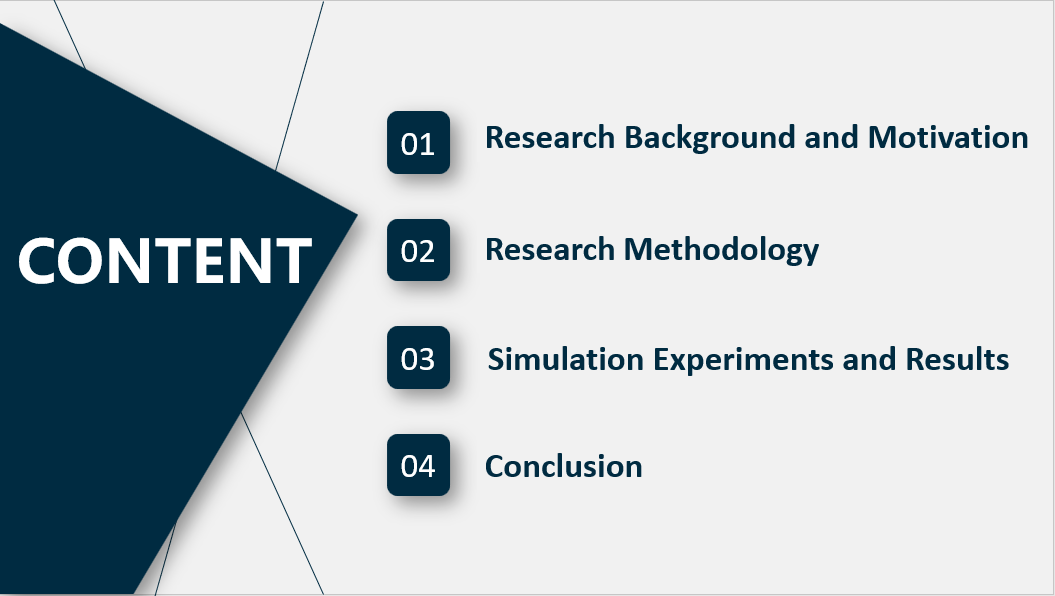 |
In this presentation, I will discuss the paper through four main sections.
|
|
ICACT20250175 Slide.01
[Big slide for presentation]
[YouTube] |
Chrome Text-to-Speach Click!! |
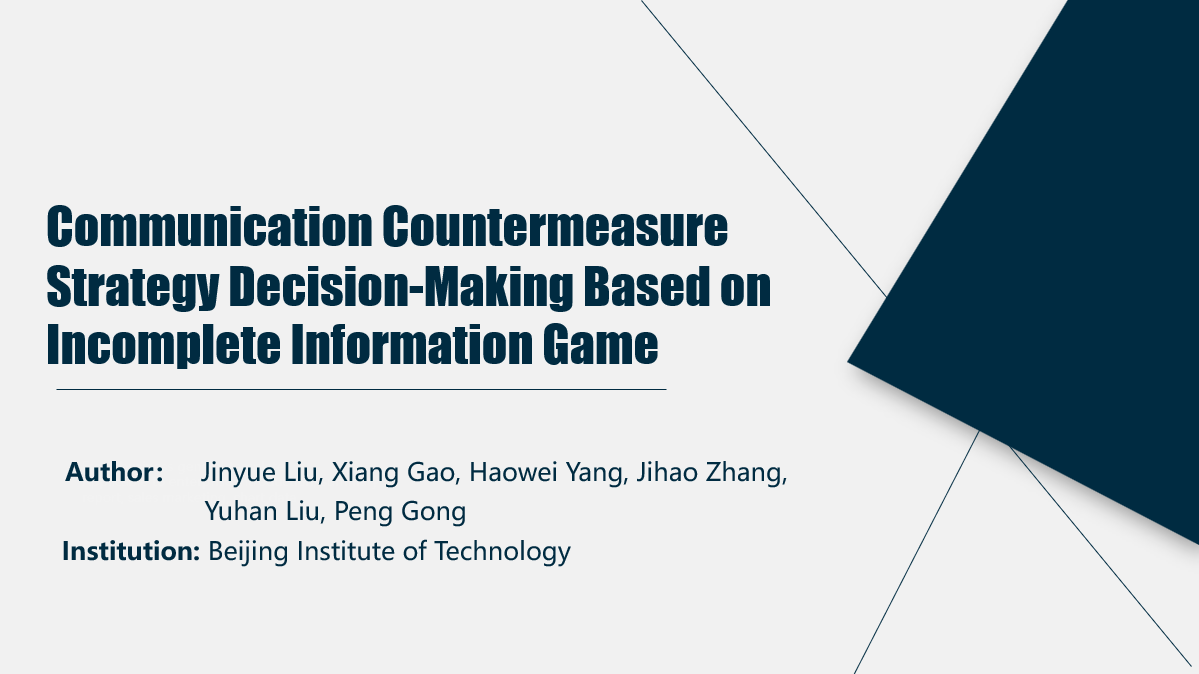 |
Hi everybody, my name is Jinyue Liu. For ICACT2025, I have cooperated with five parteners from Beijing Institute of Technology. They are Mr. Gao Xiang, Mr Yang Haowei, Mr Zhang Jihao, Mrs Liu Yuhan and Mr Gong Peng. Our presentation today is about how to make strategic decisions in communication countermeasure based on incomplete information game.
|
















