 ICACT20250046 Slide.22
[Big slide for presentation] |
Chrome Text-to-Speach Click!! |
 |
thank you for listening my presentation.
|
|
ICACT20250046 Slide.21
[Big slide for presentation]
|
Chrome Text-to-Speach Click!! |
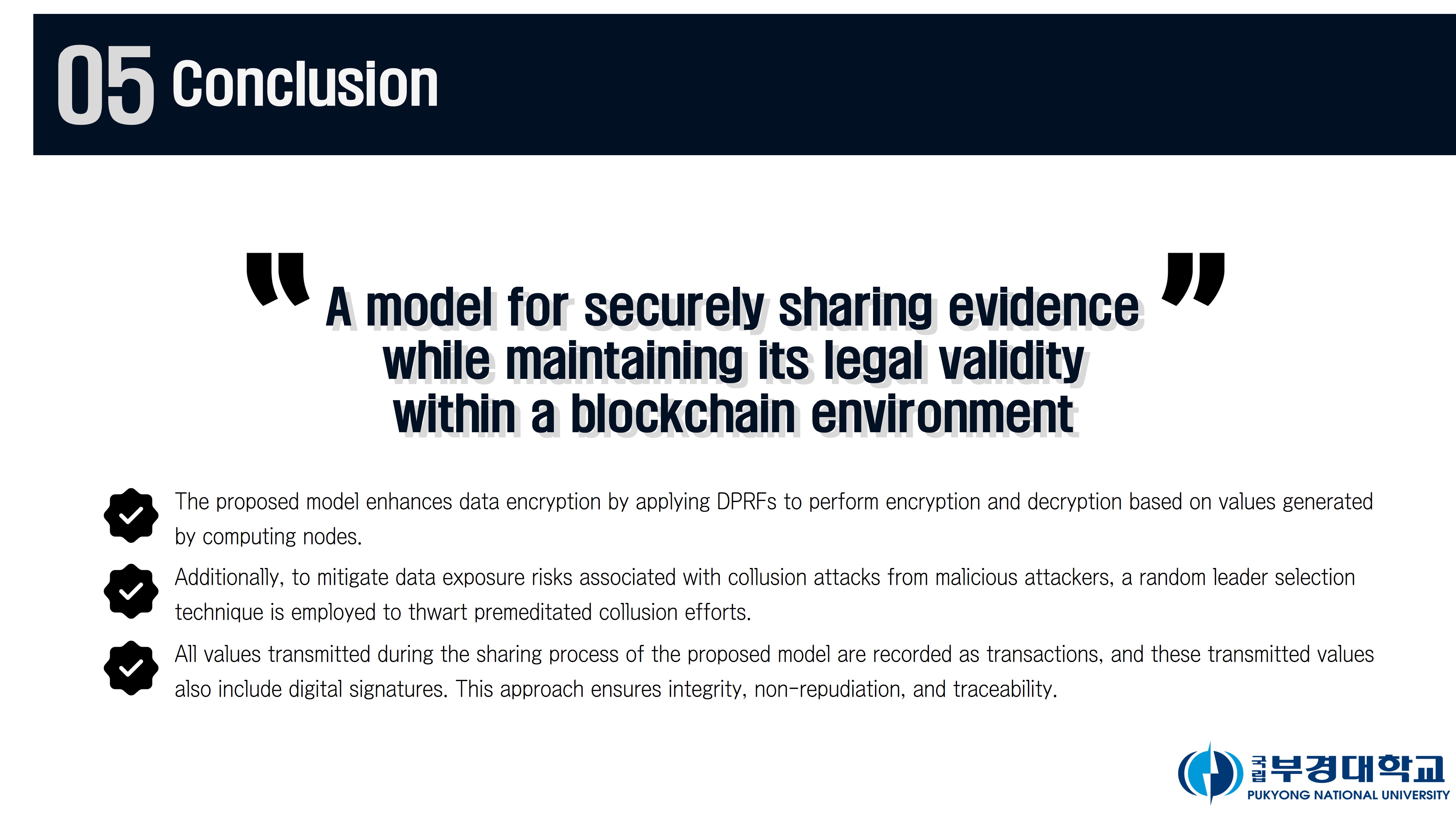 |
We proposed a model for securely sharing evidence while maintaining its legal validity within a blockchain environment.
The proposed model enhances data encryption by applying DPRFs to perform encryption and decryption based on values generated by computing nodes.
Additionally, to mitigate data exposure risks associated with collusion attacks form malicious attackers, a random leader selection technique is employed to thwart premeditated collusion efforts.
All values transmitted during the sharing process of the proposed model are recorded as transactions, and these transmitted values also include digital signatures. This approach ensures integrity, non-repudiation, and traceability.
|
|
ICACT20250046 Slide.20
[Big slide for presentation]
|
Chrome Text-to-Speach Click!! |
 |
Last chapter, conclusion.
|
|
ICACT20250046 Slide.19
[Big slide for presentation]
|
Chrome Text-to-Speach Click!! |
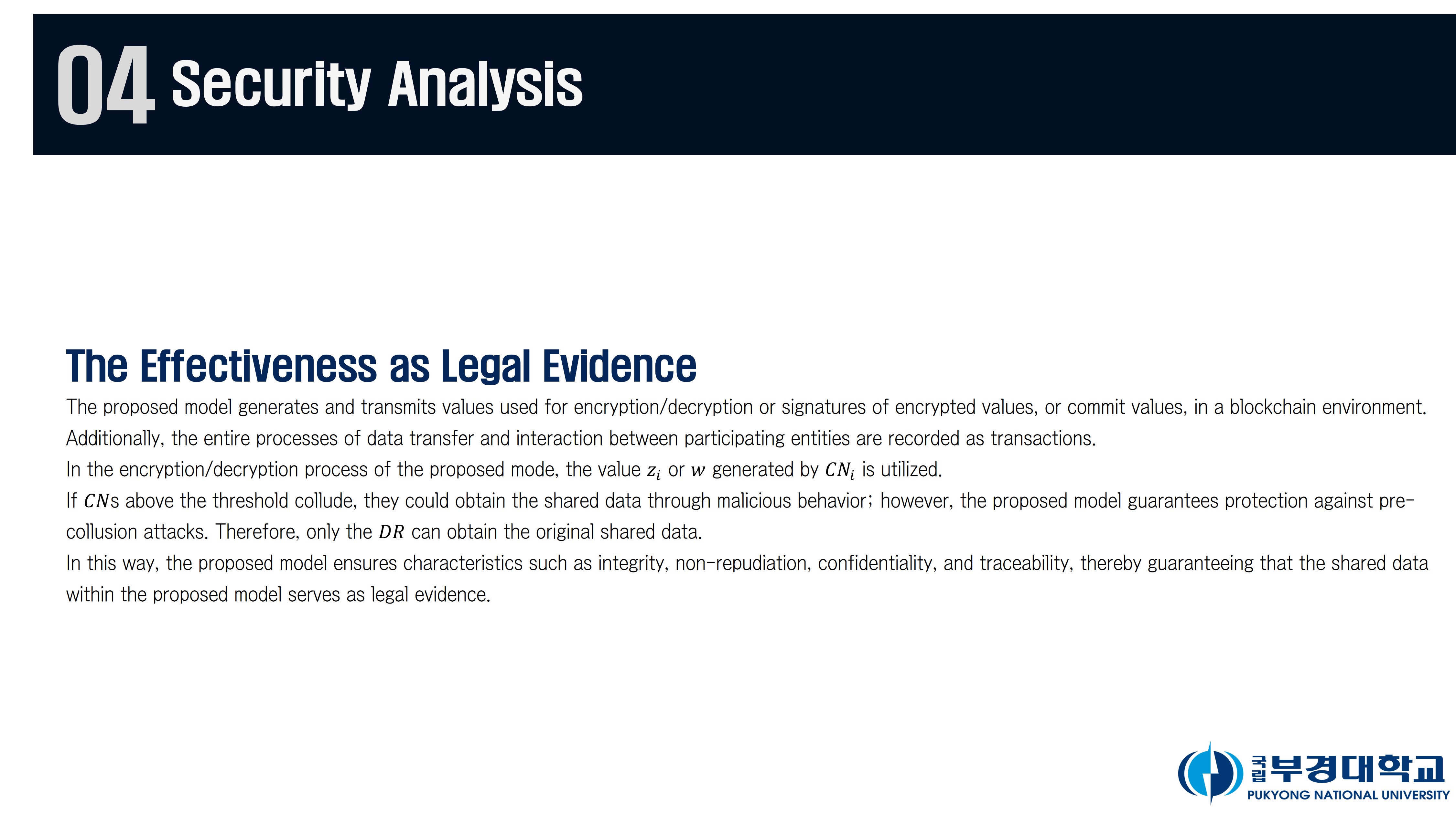 |
Last, the effectiveness as legal evidence
The proposed model ensures the integrity, confidentiality, and traceability of shared data by recording encryption-related values and interactions as blockchain transactions.
It prevents pre-collusion attacks, ensuring that only the DR can obtain the original data, thereby establishing its validity as legal evidence.
|
|
ICACT20250046 Slide.18
[Big slide for presentation]
|
Chrome Text-to-Speach Click!! |
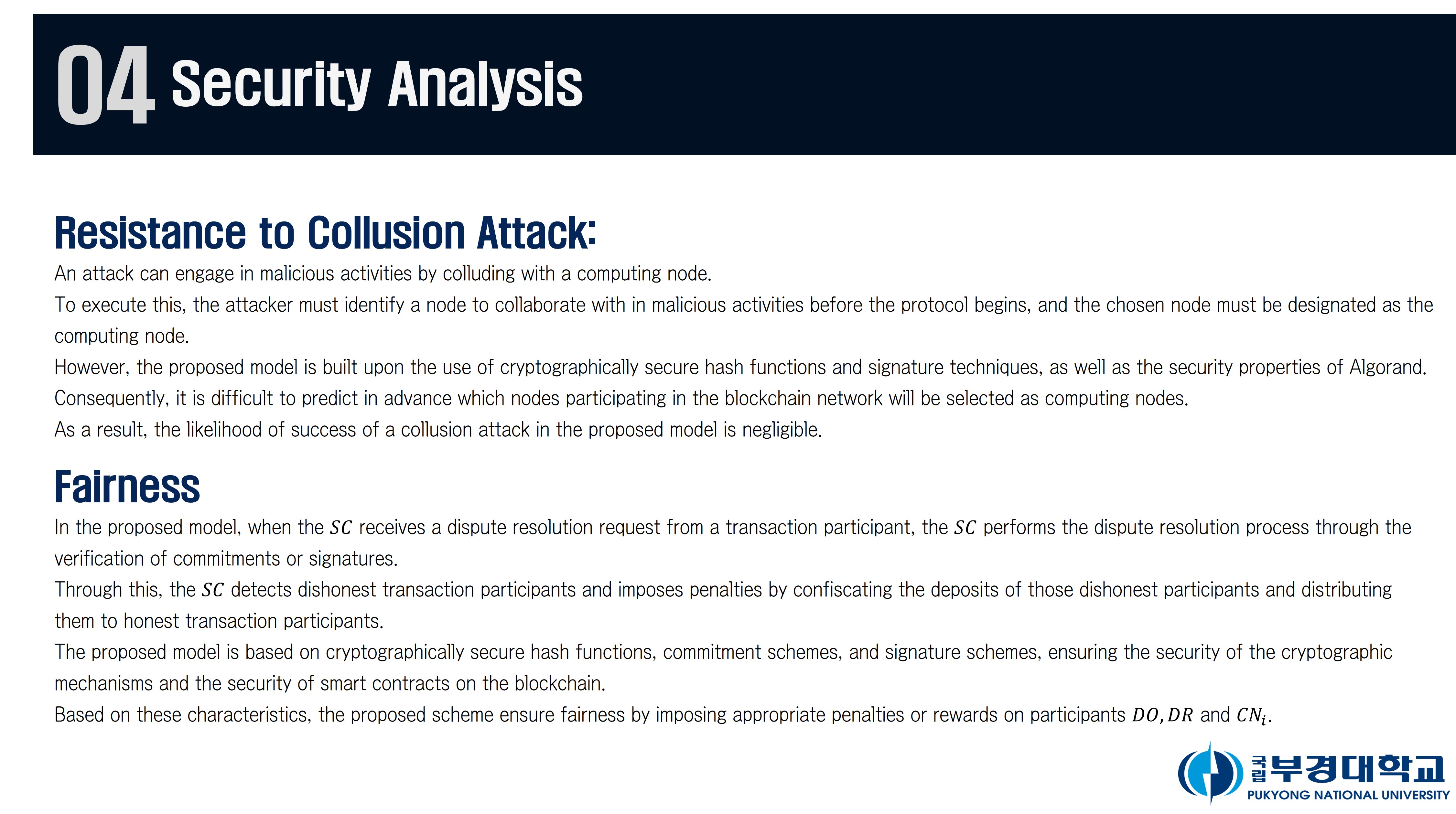 |
In this chapter, we perform a security analysis of the proposed model, examining it from the perspectives of collusion attacks, fairness, and its effectiveness as legal evidence.
Resistance to collusion attack,
In the proposed model, the attacker cannot predict which node will be selected as the calculation node by utilizing cryptographic hash functions, signature technology, and Algorand's security properties, so the possibility of collusion attack is virtually negligible.
Next, fairness.
In the proposed model, the SC resolves disputes by verifying commitments or signatures, identifying dishonest participants, and enforcing penalties. By leveraging cryptographic hash functions, commitment schemes, and signature schemes, the model ensures fairness through appropriate penalties and rewards for DO, DR, and CN.
|
|
ICACT20250046 Slide.17
[Big slide for presentation]
|
Chrome Text-to-Speach Click!! |
 |
Chapter four, security analysis.
In this chapter, we perform a security analysis of the proposed model, examining it from the perspectives of collusion attacks, fairness, and its effectiveness as legal evidence.
|
|
ICACT20250046 Slide.16
[Big slide for presentation]
|
Chrome Text-to-Speach Click!! |
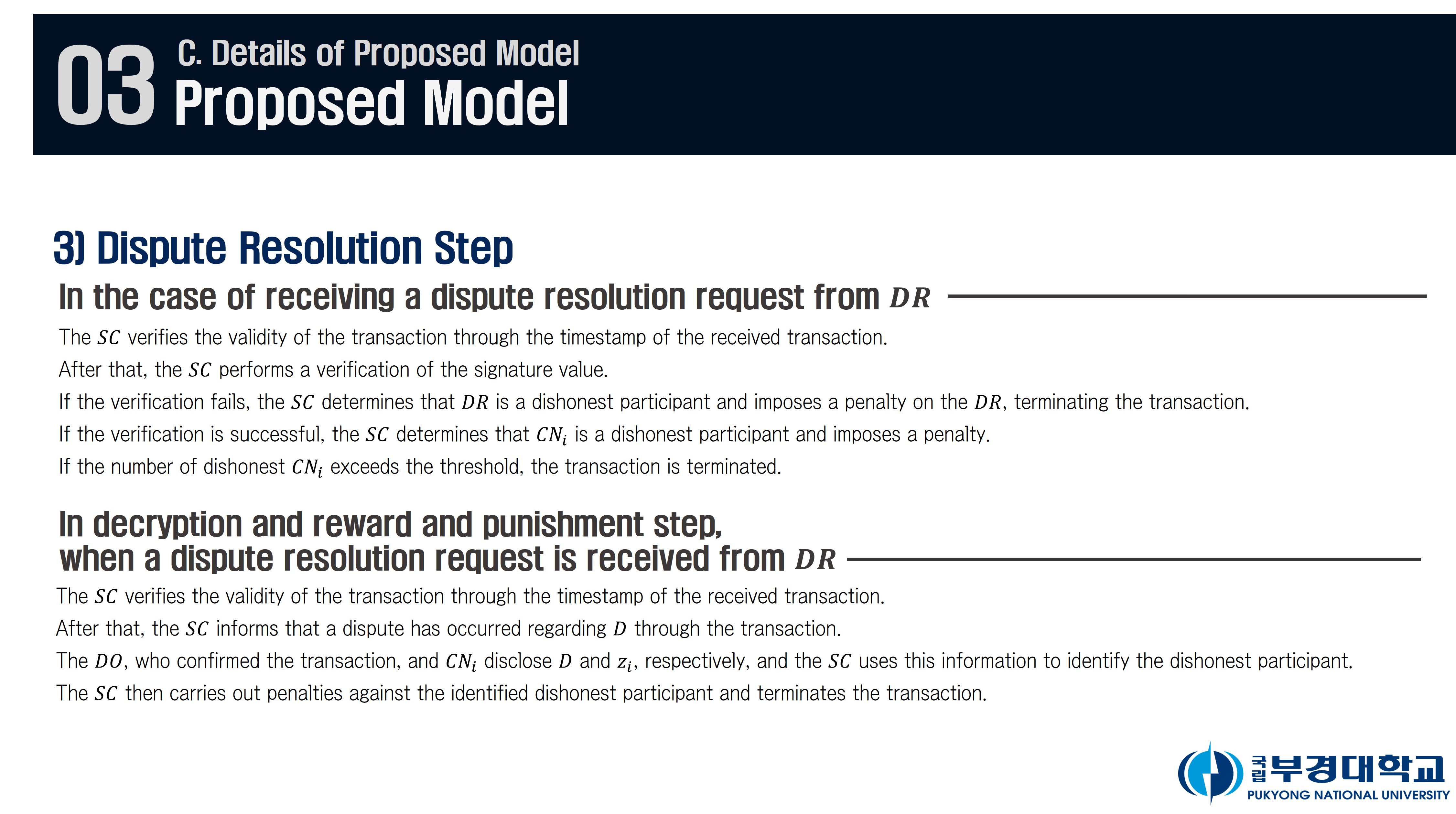 |
And receiving a dispute resolution request from DR.
The SC verifies the transaction's validity using timestamps and signatures.
If the verification fails, the SC determines that the DR is a dishonest participant and imposes a penalty on the DR, terminating the transaction.
If the verification is successful, the SC determines that CN is a dishonest participant and imposes a penalty.
If the number of dishonest CN exceeds the threshold, the transaction is terminated.
Last, in decryption and reward and punishment step, when a dispute resolution request is received from DR.
The SC verifies the transaction's validity and announces a dispute regarding D.
The DO and CN disclose D and zi, respectively, allowing the SC to identify and penalize the dishonest participant before terminating the transaction.
|
|
ICACT20250046 Slide.15
[Big slide for presentation]
|
Chrome Text-to-Speach Click!! |
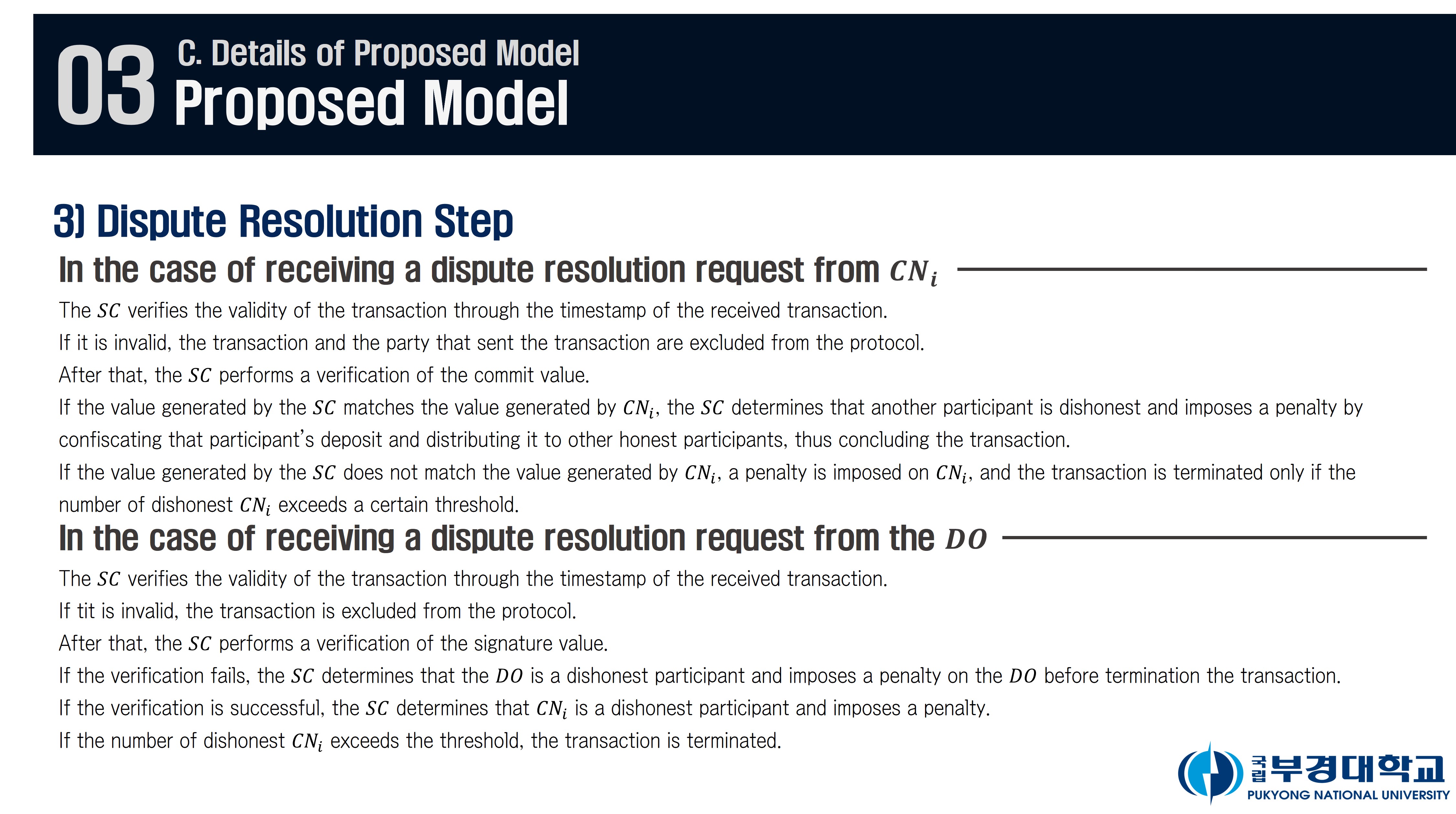 |
The dispute resolution stage is carried out only when the SC receives a dispute resolution request from each participant.
The SC identifies dishonest participants and imposes appropriate penalties and compensations accordingly.
First, receiving a dispute resolution request from CN.
The SC verifies transaction validity using timestamps and commitment values.
If inconsistencies are found, dishonest participants are penalized by confiscating their deposits, ensuring fairness before concluding the transaction.
Second, receiving a dispute resolution request from the DO.
The SC verifies the transaction's validity using timestamps and signatures.
If the verification fails, the SC penalizes the dishonest DO or CN accordingly.
If the number of dishonest CN exceeds the threshold, the transaction is terminated.
|
|
ICACT20250046 Slide.14
[Big slide for presentation]
|
Chrome Text-to-Speach Click!! |
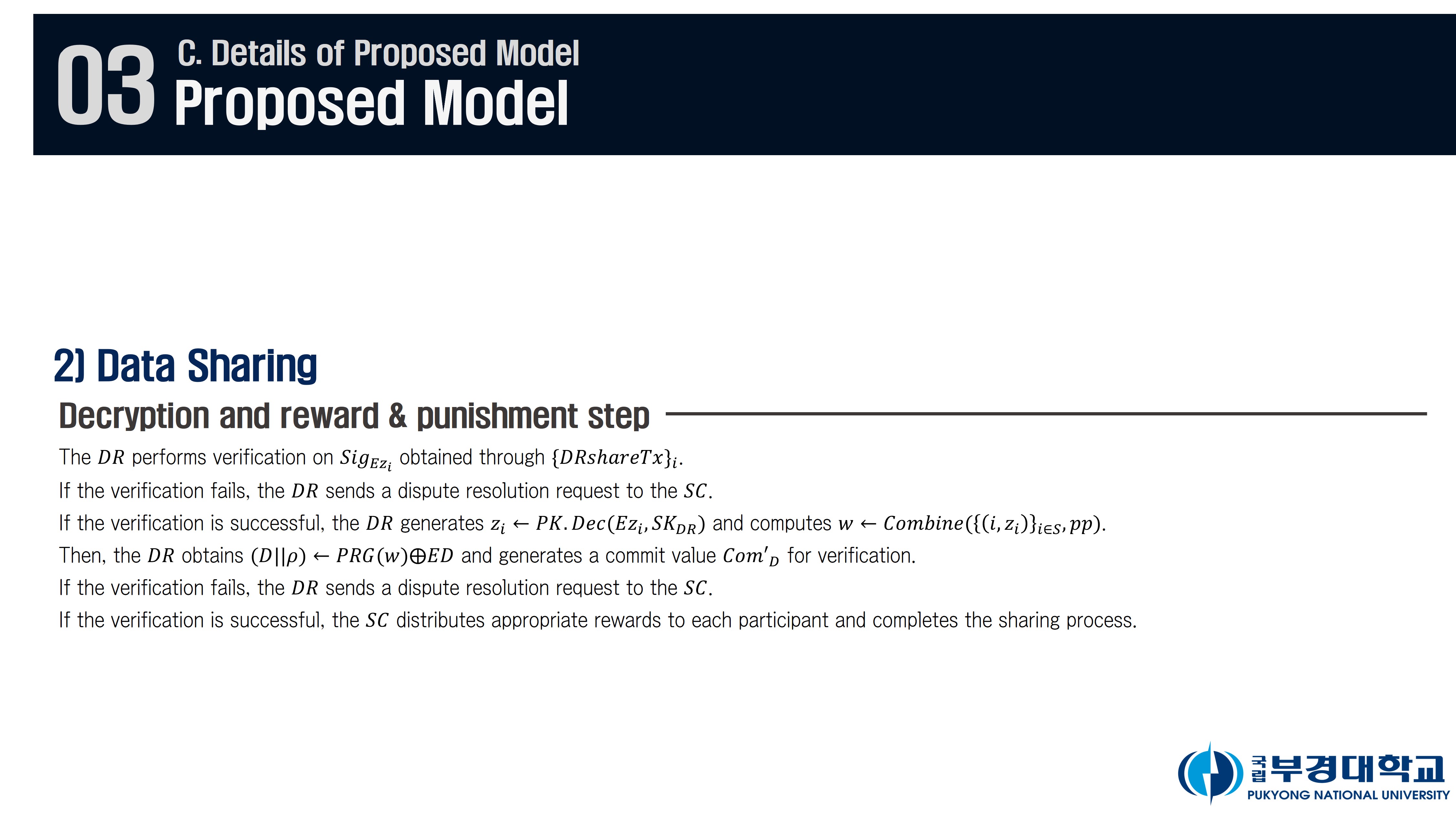 |
Last, decryption and reward and punishment step.
The DR verifies the received encrypted shares, reconstructs the key, decrypts the original data, and validates its integrity.
If verification succeeds, the SC distributes rewards to participants, finalizing the data-sharing process.
|
|
ICACT20250046 Slide.13
[Big slide for presentation]
|
Chrome Text-to-Speach Click!! |
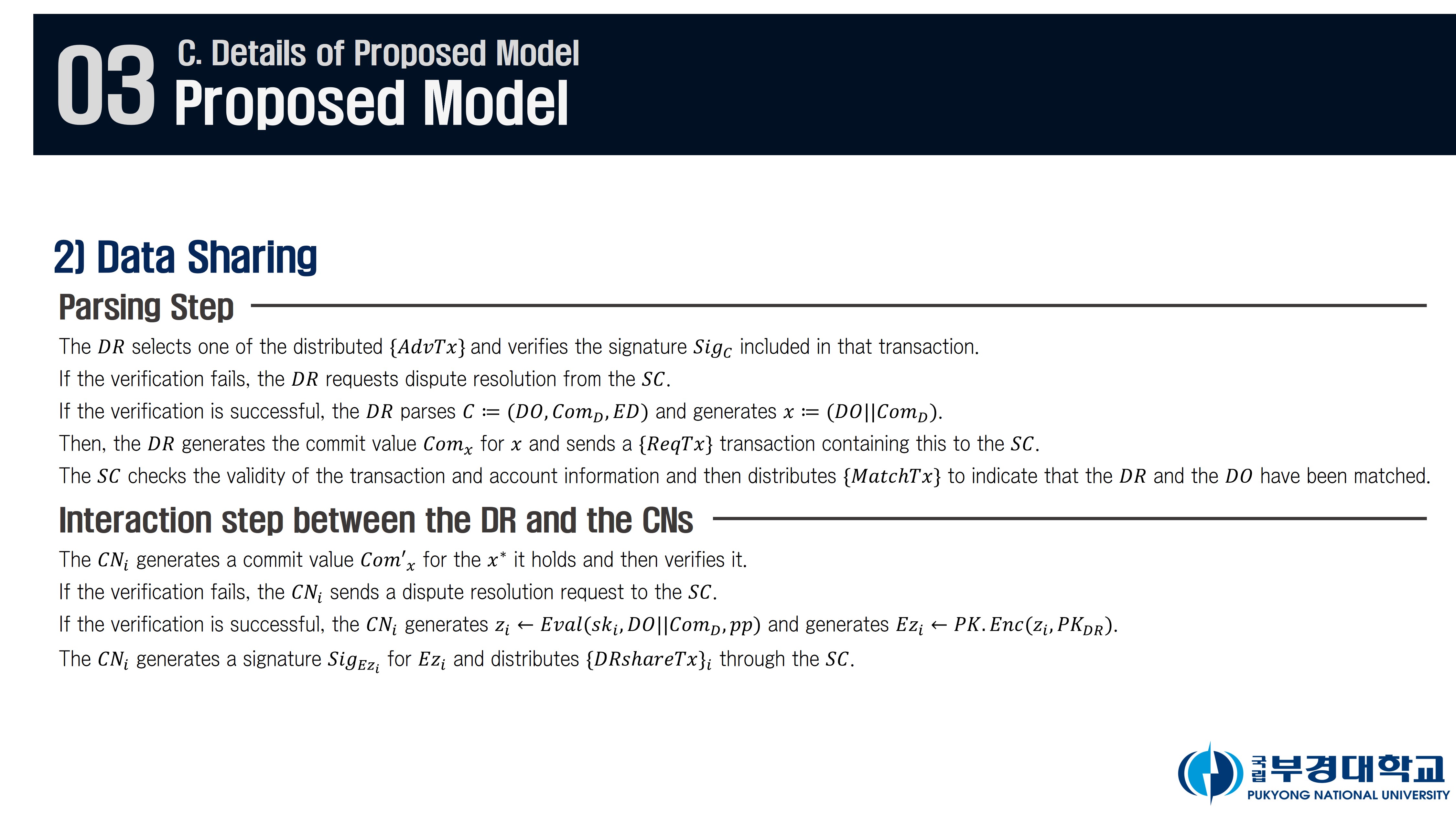 |
The data sharing step proceeds in the following order: Parsing step, interaction stage between DR and CNs, and finally the decryption and reward and punishment step.
First, parsing step.
The DR selects an AdvTx transaction, verifies its signature, and generates a commitment value.
Then, DR sends a ReqTx transaction to the Smart Contract (SC), which validates the request and issues a MatchTx transaction to confirm the matching between DR and DO.
Second, interaction step between the DR and the CN.
The CN verifies the commitment value and, if successful, computes an encryption share for the DR.
It then signs the encrypted share and submits a DRshareTx transaction via the SC.
|
|
ICACT20250046 Slide.12
[Big slide for presentation]
|
Chrome Text-to-Speach Click!! |
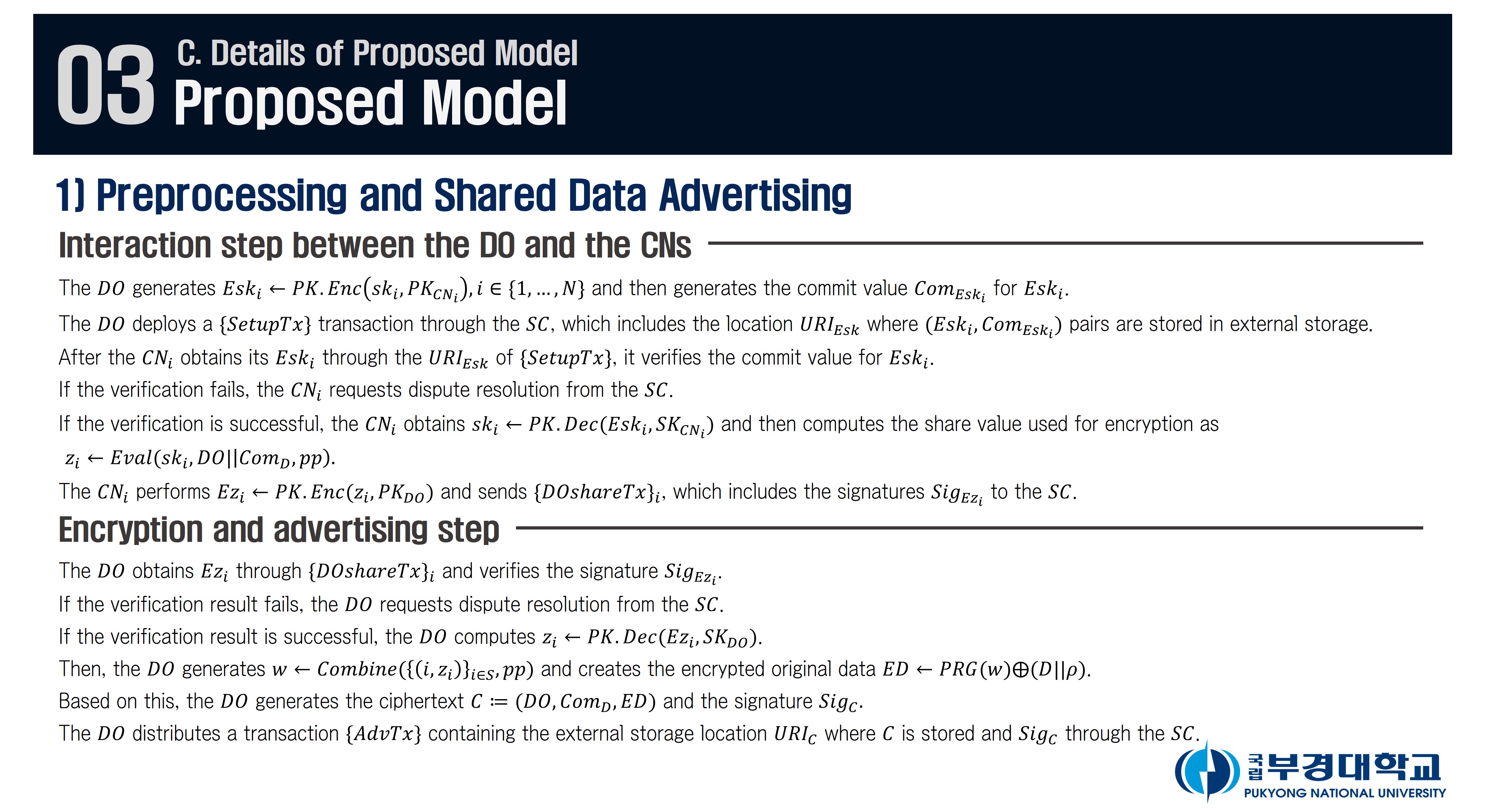 |
Next, interaction step between the DO and the CN.
The DO encrypts secret keys and generates commitment values, then deploys a SetupTx transaction via the SC, storing encrypted keys in external storage.
Each CN retrieves its encrypted key, verifies the commitment, decrypts its share, computes the encryption share, and submits a DOshareTx transaction with its signature to the SC.
Last, encryption and advertising step.
The Data Owner (DO) verifies the received encrypted shares, reconstructs the key, and encrypts the original data.
Then, DO generates a ciphertext and signature before distributing an AdvTx transaction via the SC, which includes the external storage location of the ciphertext.
|
|
ICACT20250046 Slide.11
[Big slide for presentation]
|
Chrome Text-to-Speach Click!! |
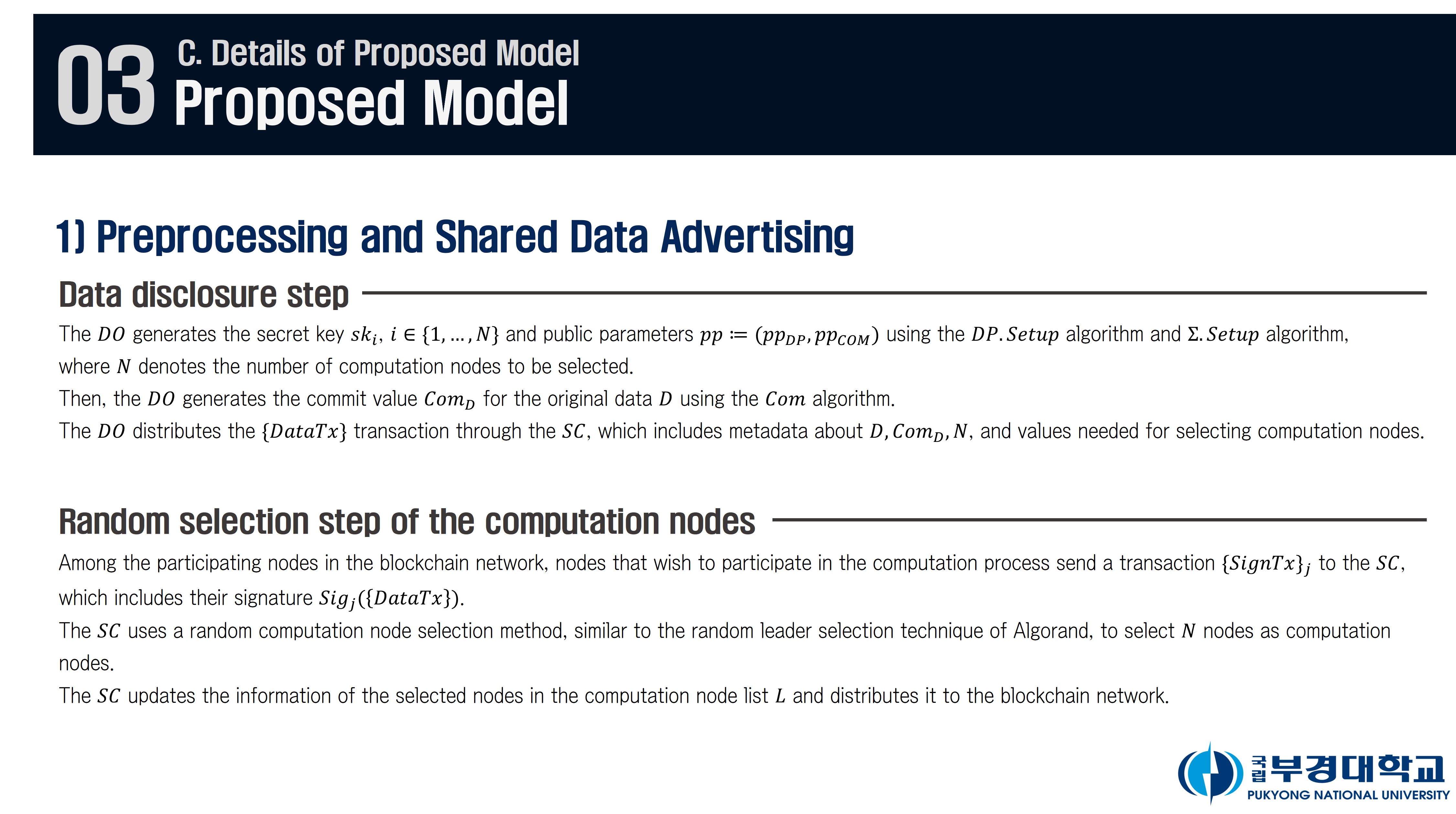 |
The preprocessing and shared data advertising stage proceeds in the following order: the data disclosure stage, the random selection stage of the computation nodes, the interaction stage between DO and CNs and the encryption and advertising stage.
First, data disclosure step.
The DO generates secret keys, public parameters, and a commitment value for the original data using cryptographic setup algorithms. Then, DO distributes a DataTx transaction through the SC, which contains metadata, the commitment value, and necessary parameters for selecting computation nodes.
Second, random selection step of the computation nodes.
Nodes wishing to participate in the computation process submit a signed SignTx transaction to the SC.
The SC then selects N computation nodes using a random selection method similar to Algorand’s leader selection, updates the computation node list, and distributes it to the blockchain network.
|
|
ICACT20250046 Slide.10
[Big slide for presentation]
|
Chrome Text-to-Speach Click!! |
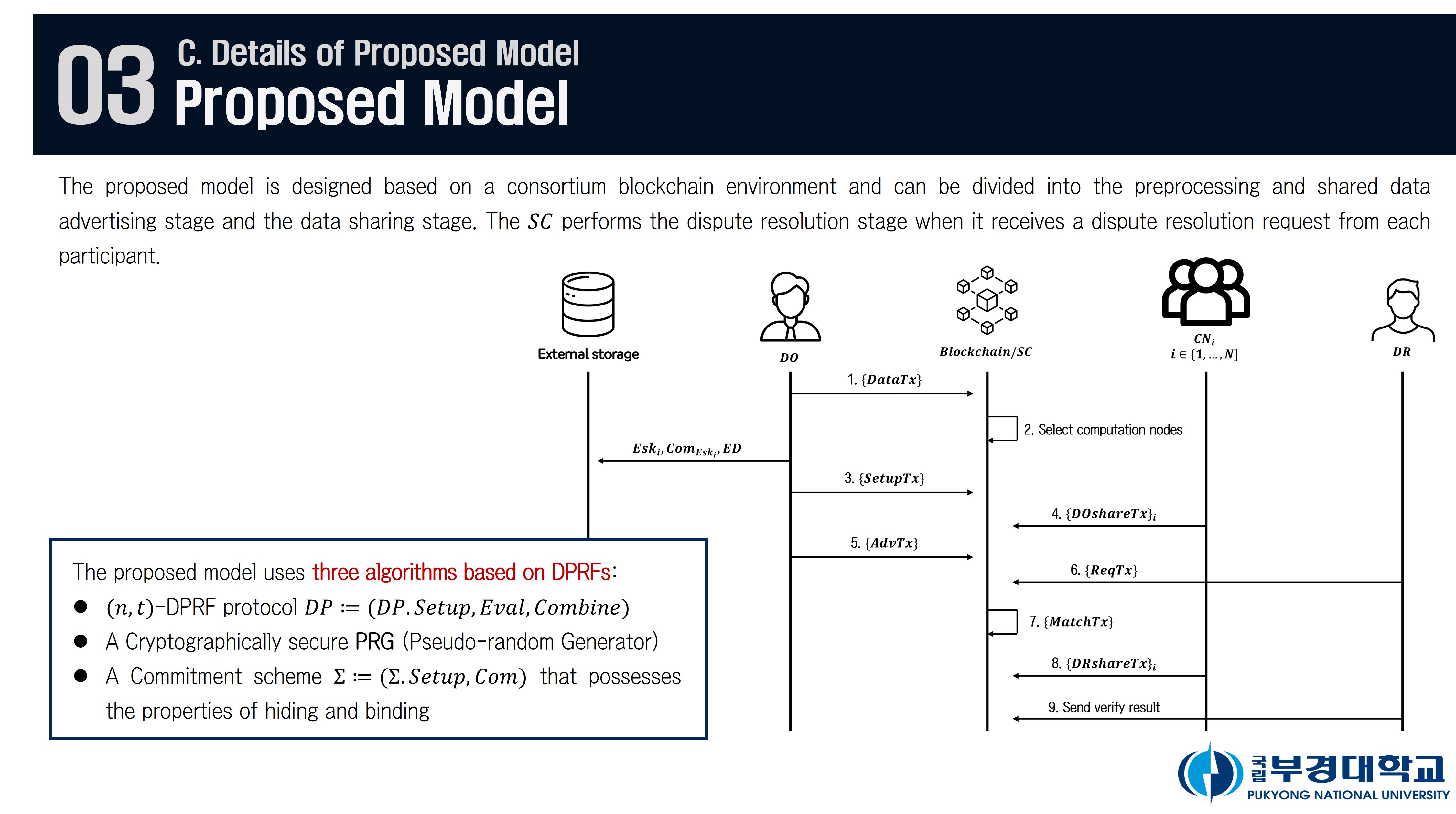 |
The proposed model is designed based on a consortium blockchain environment and can be divided into the preprocessing and shared data advertising stage and the data sharing stage.
The 𝑆𝐶 performs the dispute resolution stage when it receives a dispute resolution request from each participant.
|
|
ICACT20250046 Slide.09
[Big slide for presentation]
|
Chrome Text-to-Speach Click!! |
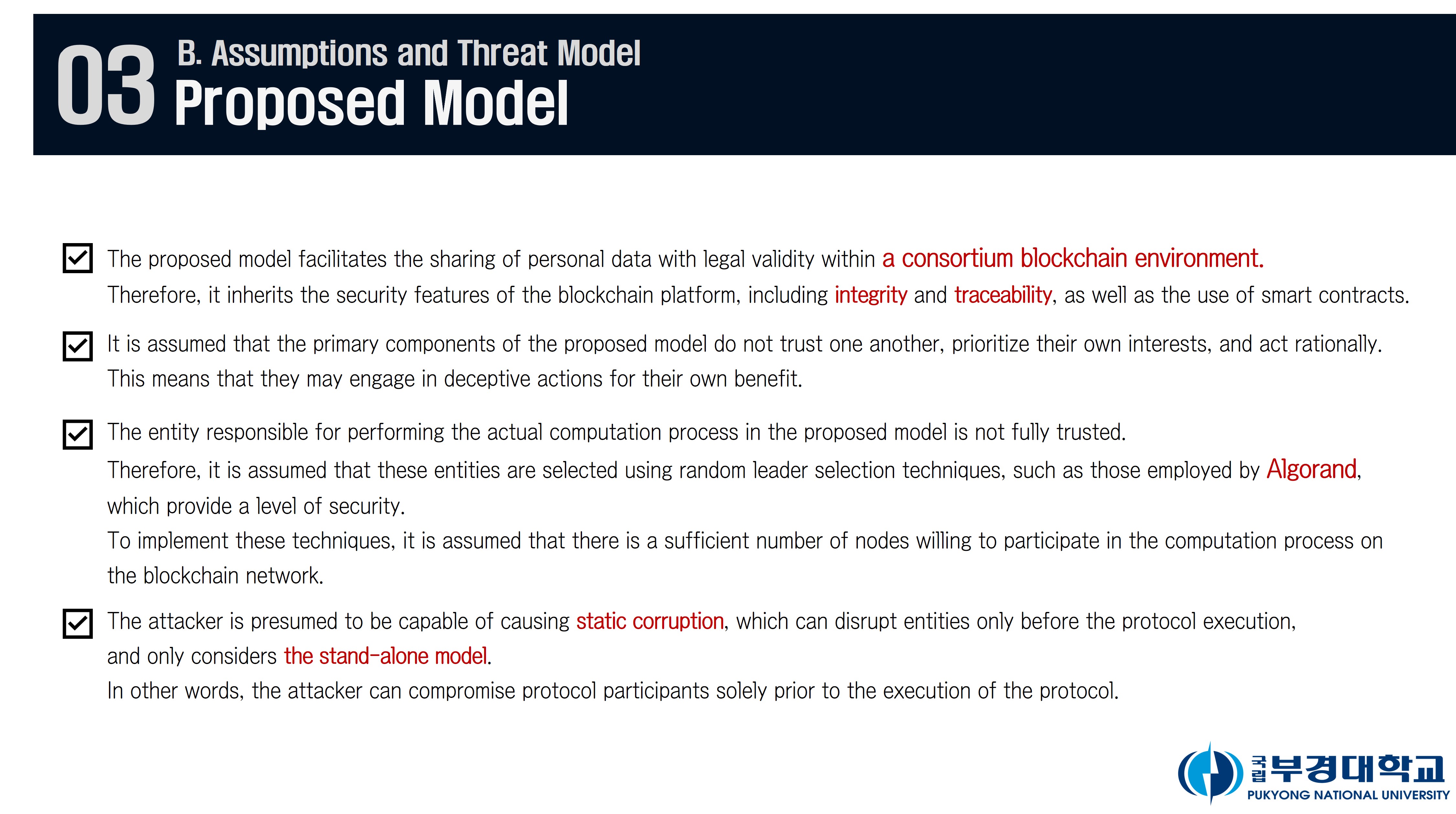 |
We propose a model based on a consortium blockchain environment, assuming an attacker capable of static corruption while considering only the stand-alone model.
|
|
ICACT20250046 Slide.08
[Big slide for presentation]
|
Chrome Text-to-Speach Click!! |
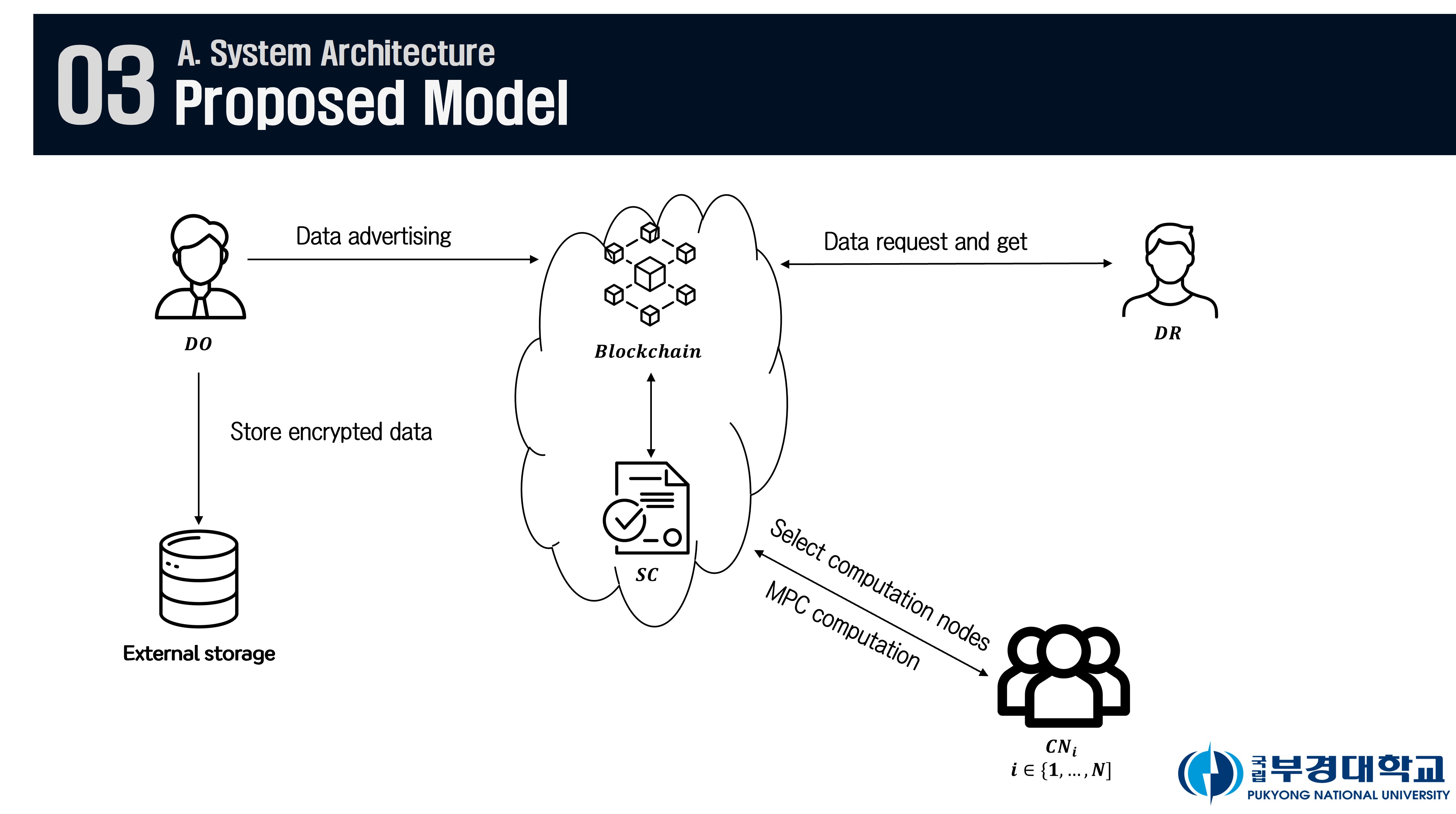 |
In this paper, we propose a secure legal evidence-sharing model based on a consortium blockchain environment.
To ensure the efficiency of transaction data management, we utilize external storage solutions such as IPFS.
The components of the proposed model include a data requester DR, a data owner DO, a computation node CN that participates in the computation process, and a smart contract.
The SC is responsible for randomly selecting computation nodes from the participating nodes in the blockchain network.
Additionally, SC manages the dispute resolution process, enforcing penalties and rewards as necessary.
|
|
ICACT20250046 Slide.07
[Big slide for presentation]
|
Chrome Text-to-Speach Click!! |
 |
Chapter 3, proposed model.
|
|
ICACT20250046 Slide.06
[Big slide for presentation]
|
Chrome Text-to-Speach Click!! |
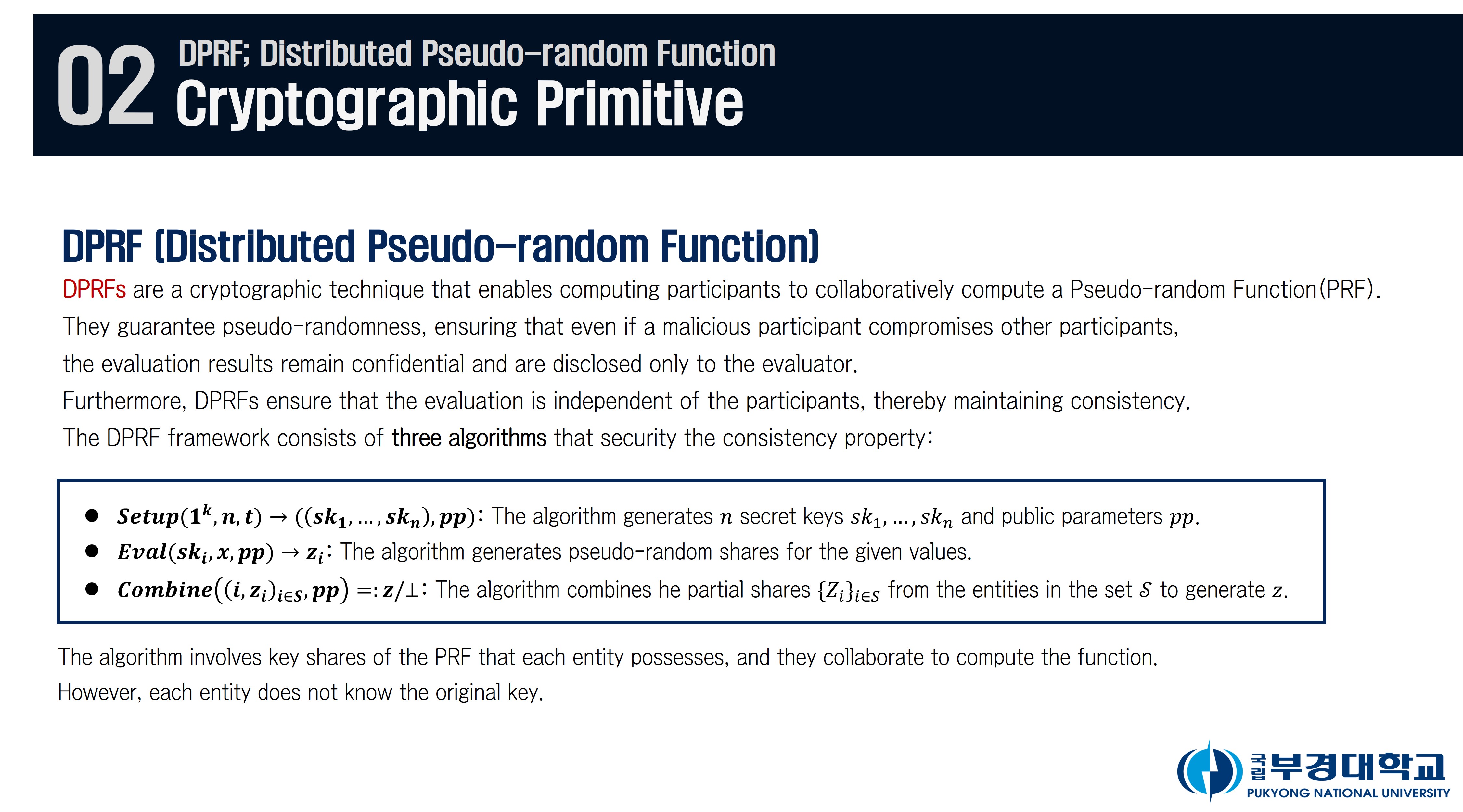 |
In this paper, we design a protocol based on DPRF, a type of MPC.
DPRFs are a cryptographic technique that allows multiple participants to collaboratively compute a Pseudo-Random Function (PRF).
They ensure pseudo-randomness, meaning that even if a malicious participant compromises others, the evaluation results remain confidential and are revealed only to the designated evaluator.
The DPRF framework is designed to maintain consistency and consists of three core algorithms that enforce this property.
|
|
ICACT20250046 Slide.05
[Big slide for presentation]
|
Chrome Text-to-Speach Click!! |
 |
Chapter 2, cryptographic primitive
|
|
ICACT20250046 Slide.04
[Big slide for presentation]
|
Chrome Text-to-Speach Click!! |
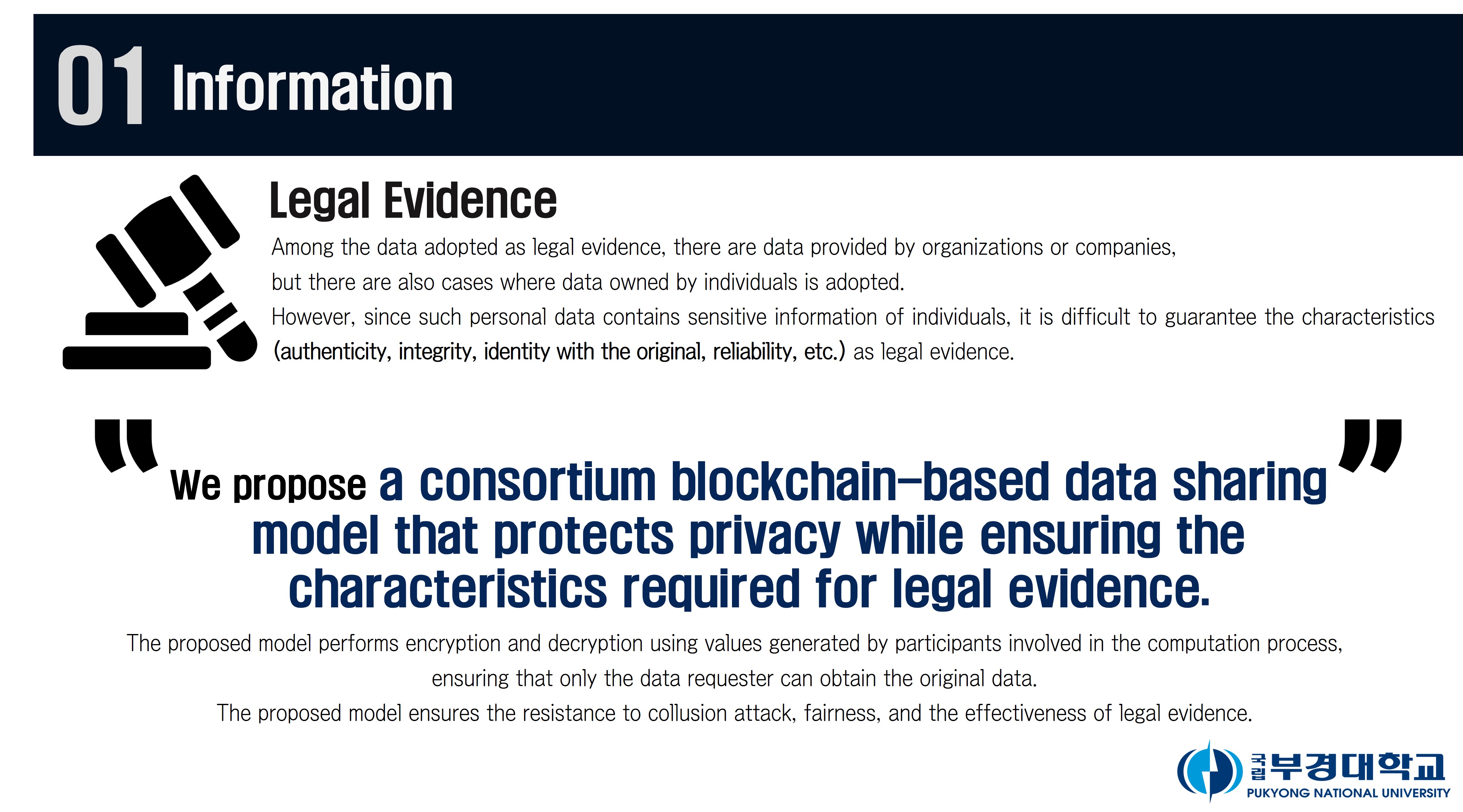 |
Our paper presents a consortium blockchain-based data-sharing model that ensures privacy while maintaining the reliability of personal data as legal evidence.
Unlike existing models that primarily verify user identity and access rights, our approach directly protects the original data, minimizing risks of exposure and manipulation.
By leveraging encryption and decryption based on computation participants’ values, our model guarantees that only authorized requesters can access the data.
It also ensures resistance to collusion attacks, fairness, and the effectiveness of legal evidence.
|
|
ICACT20250046 Slide.03
[Big slide for presentation]
|
Chrome Text-to-Speach Click!! |
 |
Chapter 1, introduction
|
|
ICACT20250046 Slide.02
[Big slide for presentation]
|
Chrome Text-to-Speach Click!! |
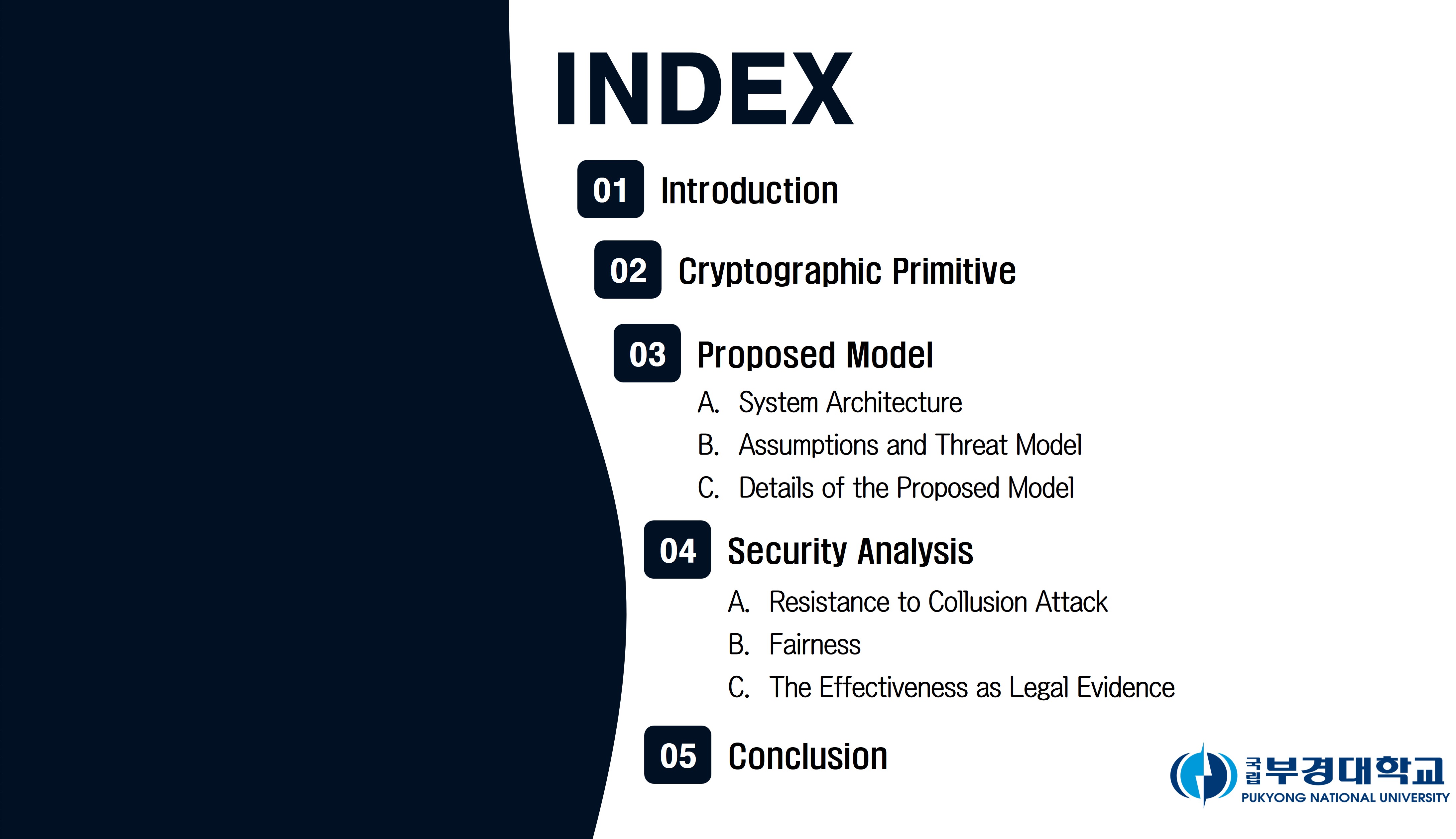 |
The table of contents is as follows.
|
|
ICACT20250046 Slide.01
[Big slide for presentation]
|
Chrome Text-to-Speach Click!! |
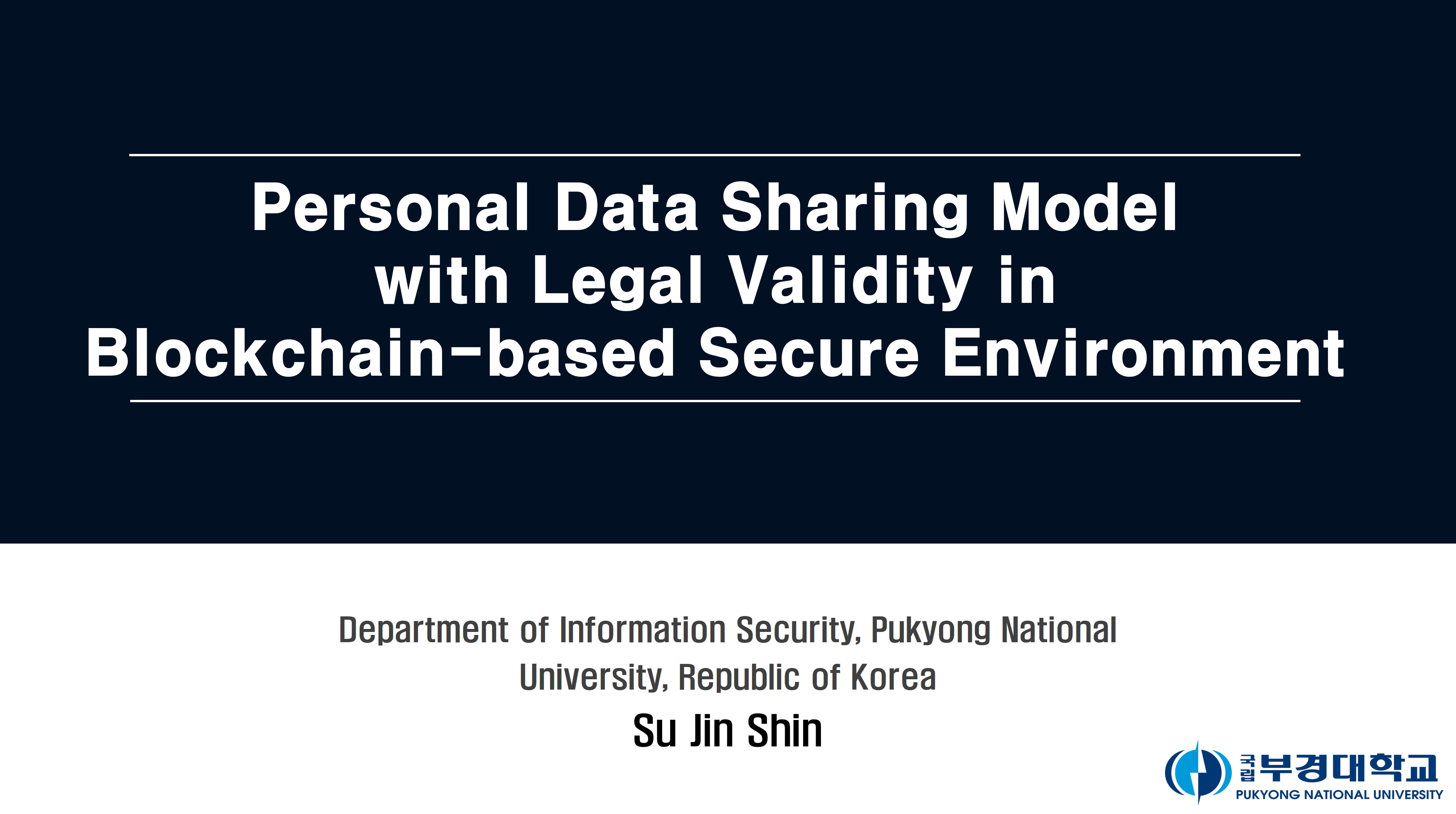 |
Hi
I’m Su Jin Shin, a student in the department of information security at pukyong national university,
And today I will be presenting on the topic “Personal data sharing model with legal validity in blockchain-based secure environment”.
|
















