 ICACT20240470 Slide.24
[Big slide for presentation] |
Chrome Text-to-Speach Click!! |
 |
thank you
|
|
ICACT20240470 Slide.23
[Big slide for presentation]
|
Chrome Text-to-Speach Click!! |
 |
Thank you!
|
|
ICACT20240470 Slide.22
[Big slide for presentation]
|
Chrome Text-to-Speach Click!! |
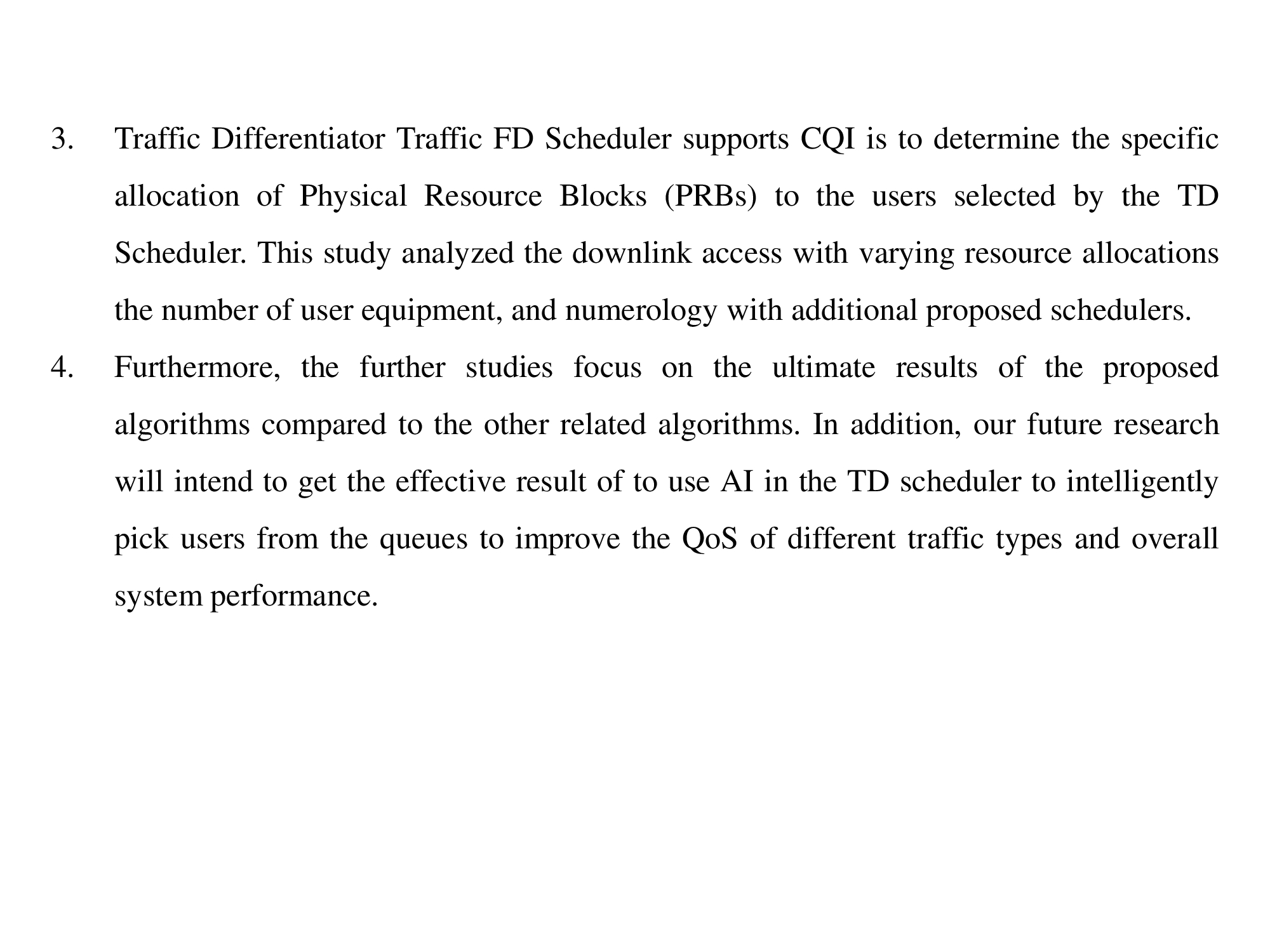 |
This research supports a fair distribution of resources across different service types, ultimately improving the overall system-level performance for non-standalone 5G NR system. The proposed algorithms of a content delivering for 5G NR service-oriented deployment focuses on the classification of mixed traffic into distinct queues, with an RT queue comprising emergency message content, followed by RT and NRT queues designated for streaming video services.
|
|
ICACT20240470 Slide.21
[Big slide for presentation]
|
Chrome Text-to-Speach Click!! |
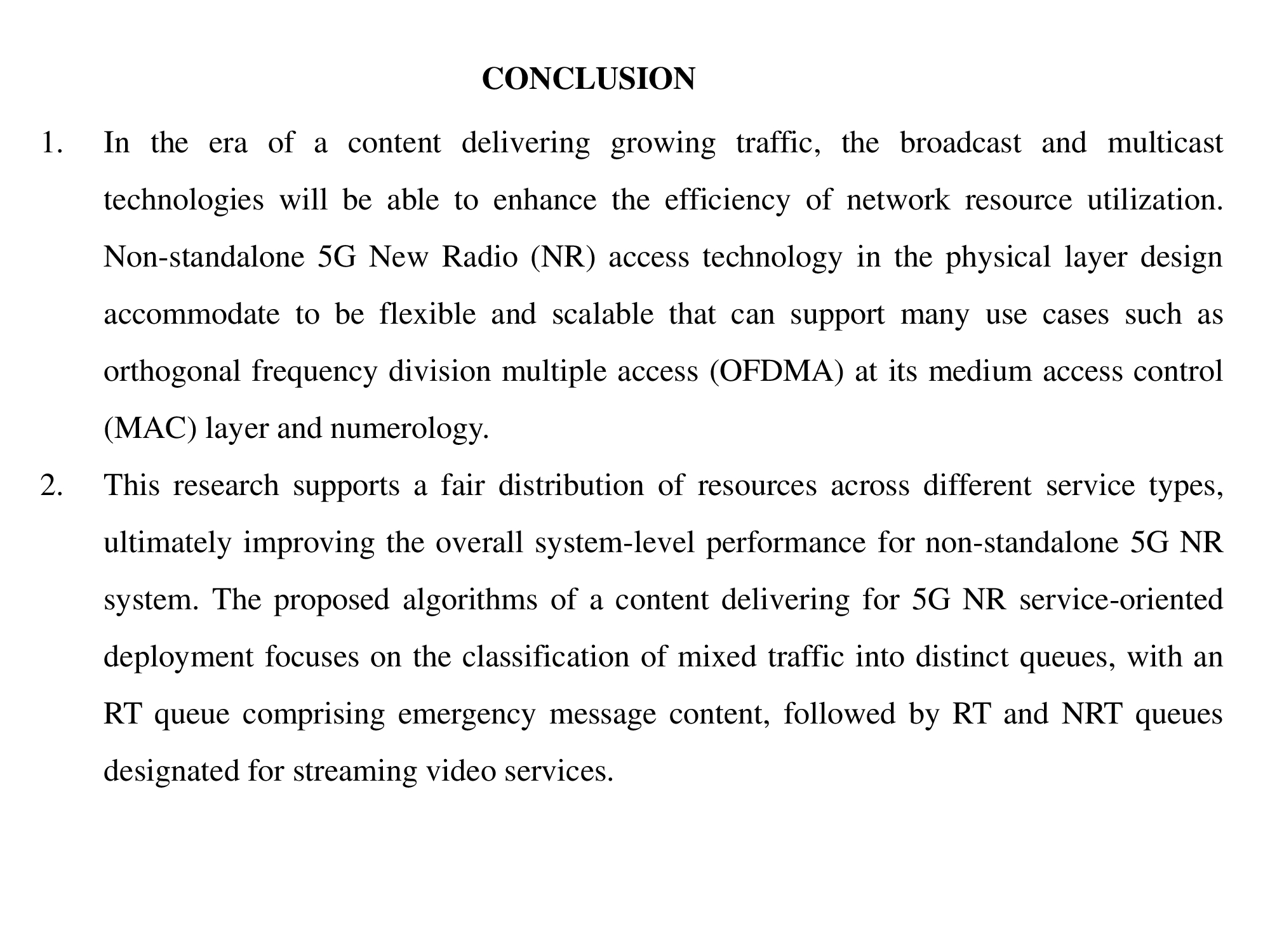 |
1. A content delivering growing traffic, the broadcast and multicast technologies will be able to enhance the efficiency of network resource utilization.
2. Non-standalone 5G New Radio (NR) access technology in the physical layer design accommodate to be flexible and scalable that can support many use cases such as orthogonal frequency division multiple access (OFDMA) at its medium access control (MAC) layer and numerology.
|
|
ICACT20240470 Slide.20
[Big slide for presentation]
|
Chrome Text-to-Speach Click!! |
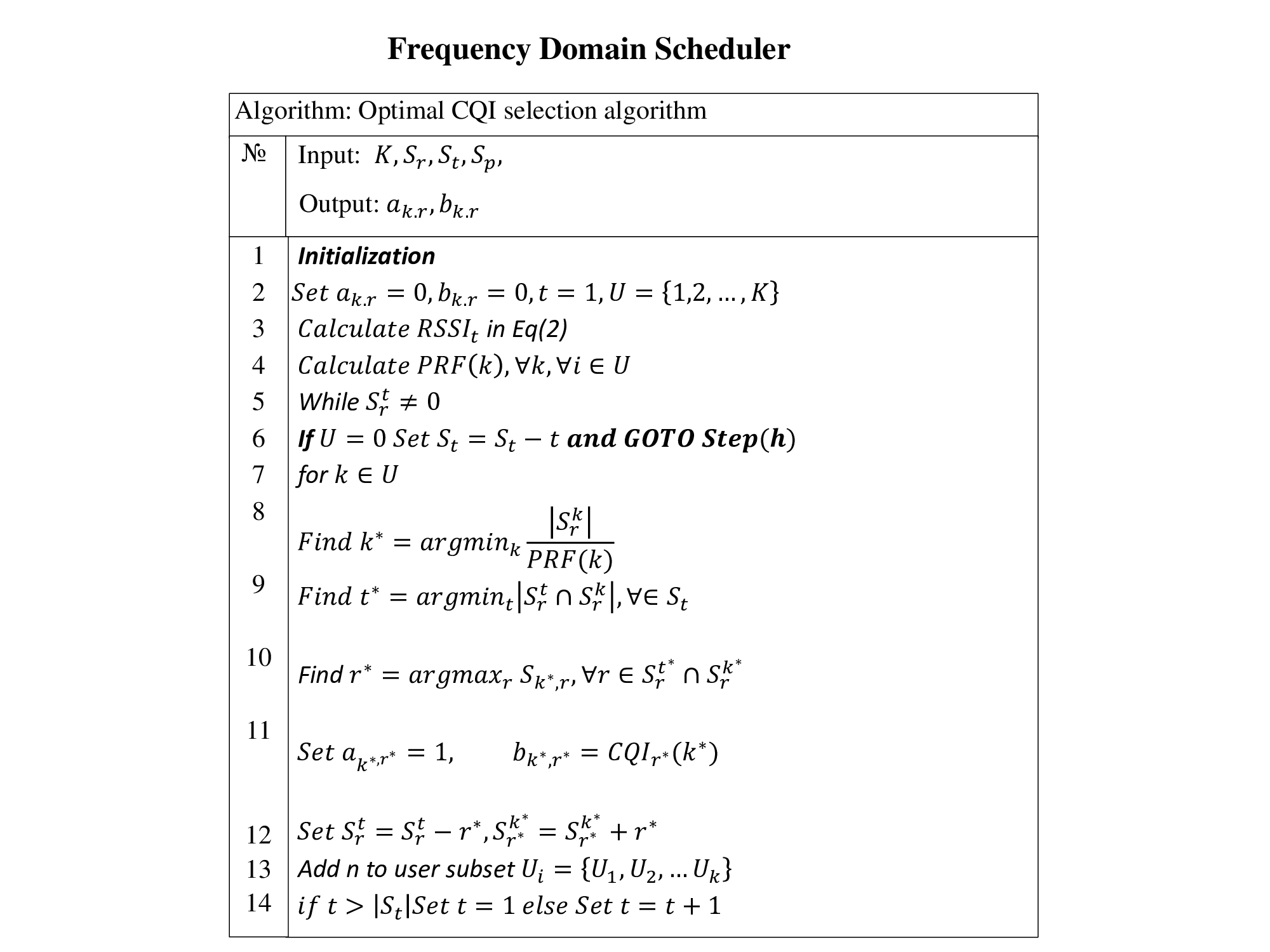 |
The role of the FD Scheduler has a significant value as it
determines the specific allocation of Physical Resource Blocks (PRBs) to the users selected by the TD Scheduler.
In order to optimize the assignment of PRBs to each user, multi-user diversity is leveraged in the frequency domain.
Once the resource allocation decision is made, the Quality of Service (QoS) measurement unit comes into play and calculates key metrics such as the average throughput of Non-Real-Time (NRT) users, average delay, and average Packet Error Rate (PER) of RealTime (RT) users.
|
|
ICACT20240470 Slide.19
[Big slide for presentation]
|
Chrome Text-to-Speach Click!! |
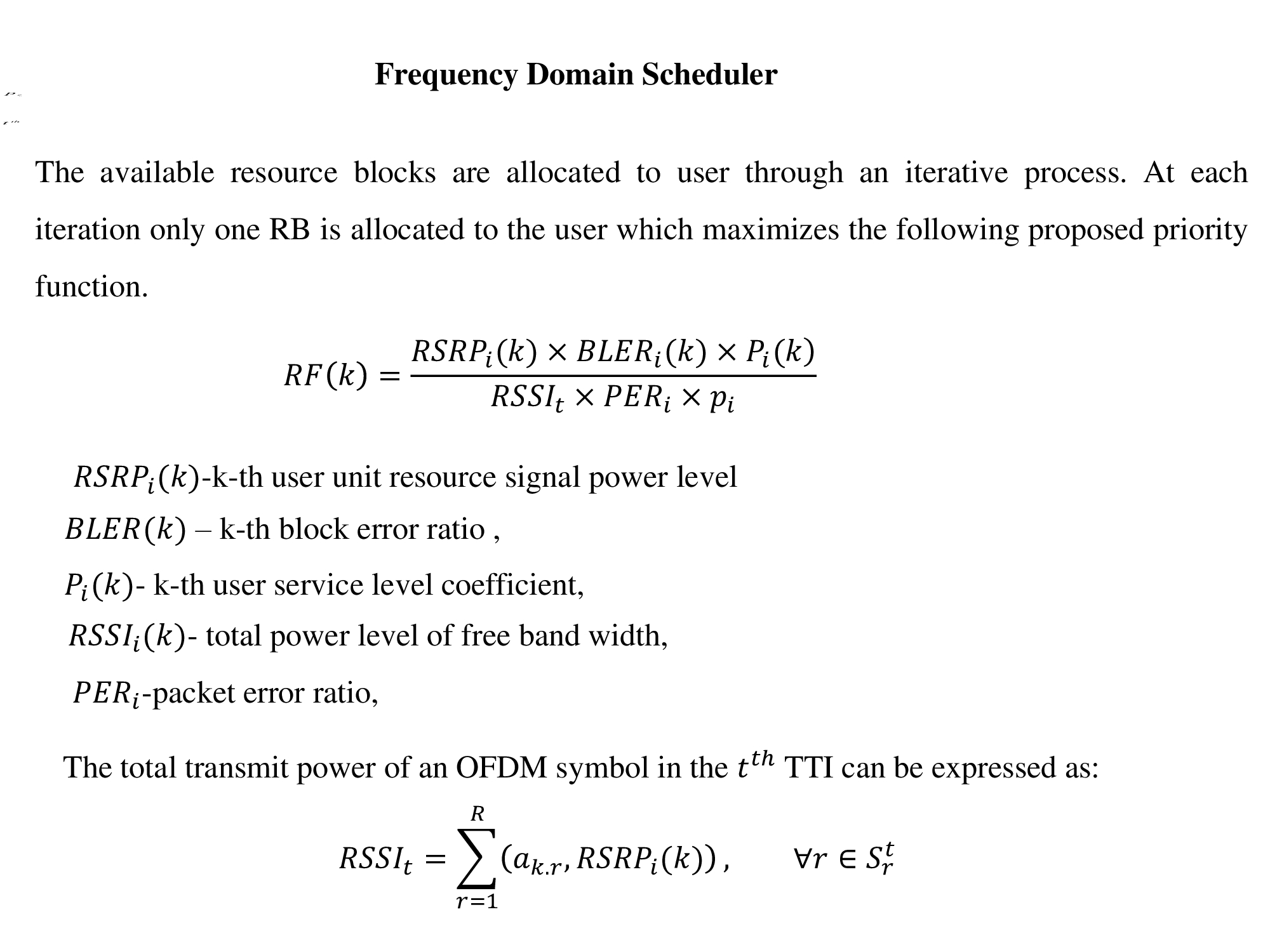 |
The available resource blocks are allocated to user through an iterative process. At each iteration only one RB is allocated to the user which maximizes the following proposed priority function.
|
|
ICACT20240470 Slide.18
[Big slide for presentation]
|
Chrome Text-to-Speach Click!! |
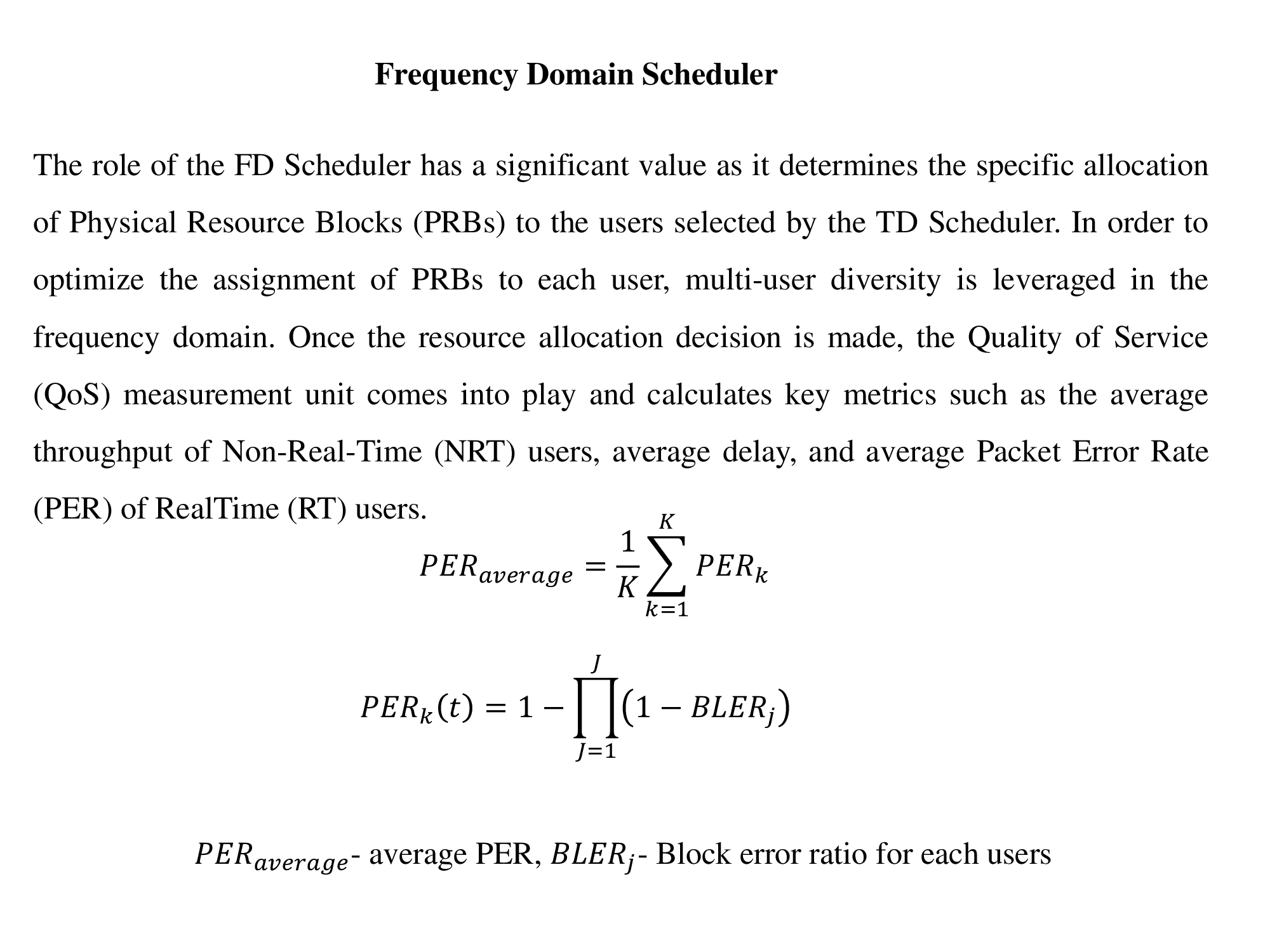 |
Once the resource allocation decision is made, the Quality of Service (QoS) measurement unit comes into play and calculates key metrics such as the average throughput of Non-Real-Time (NRT) users, average delay, and average Packet Error Rate (PER) of RealTime (RT) users.
|
|
ICACT20240470 Slide.17
[Big slide for presentation]
|
Chrome Text-to-Speach Click!! |
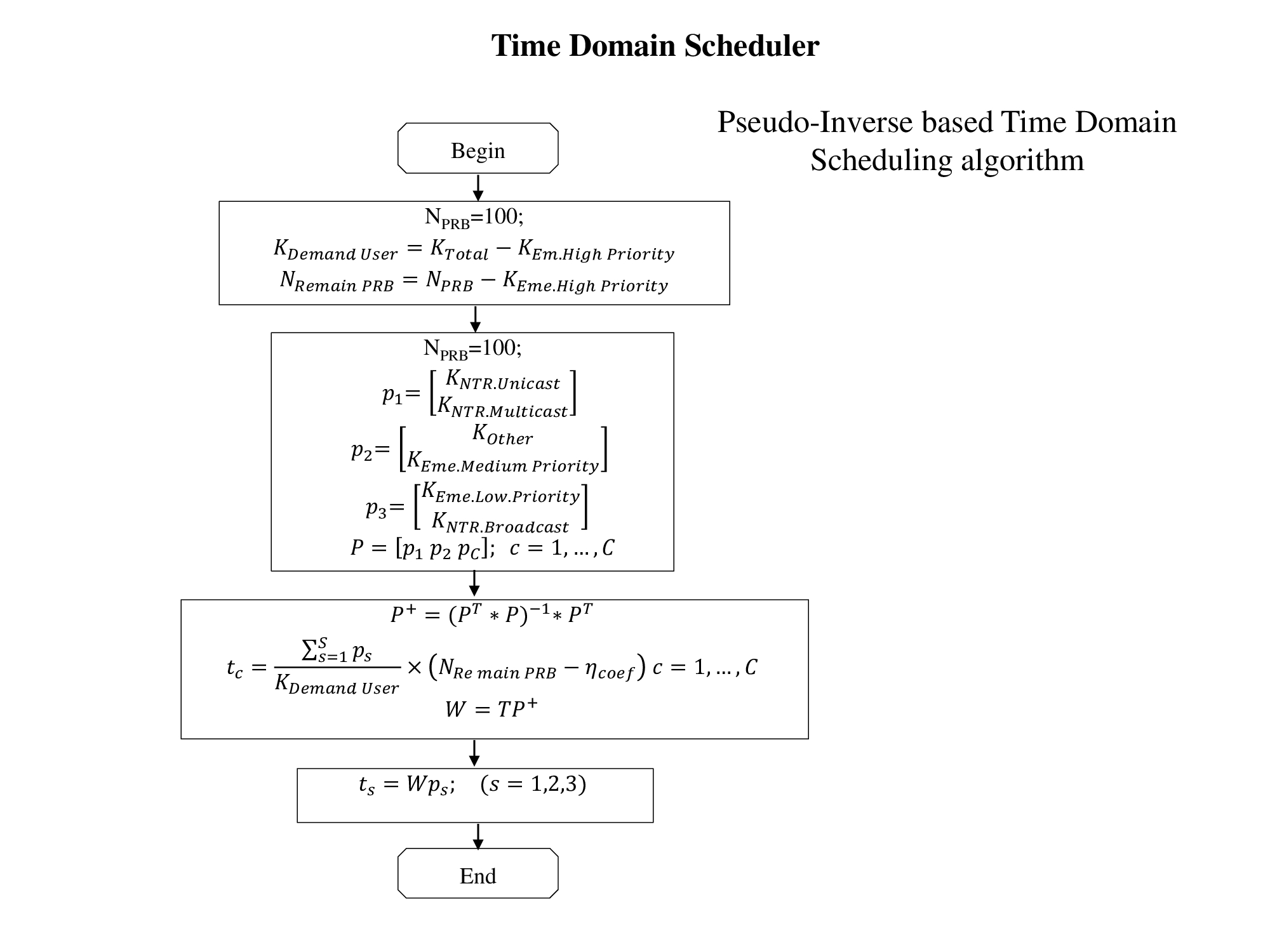 |
In the process of pseudo-inverse, the input values are referred to as pi, whereas the corresponding output values are designated.
Both the input and output values are expressed as row vectors.
By utilizing a methodology similar to that employed in neural networks, we determine the quantity of chosen requests from the complete set of user requests for different services during a given time period.
This selection procedure assists in determining the ideal number of requests to be accommodated within a specific timeframe.
|
|
ICACT20240470 Slide.16
[Big slide for presentation]
|
Chrome Text-to-Speach Click!! |
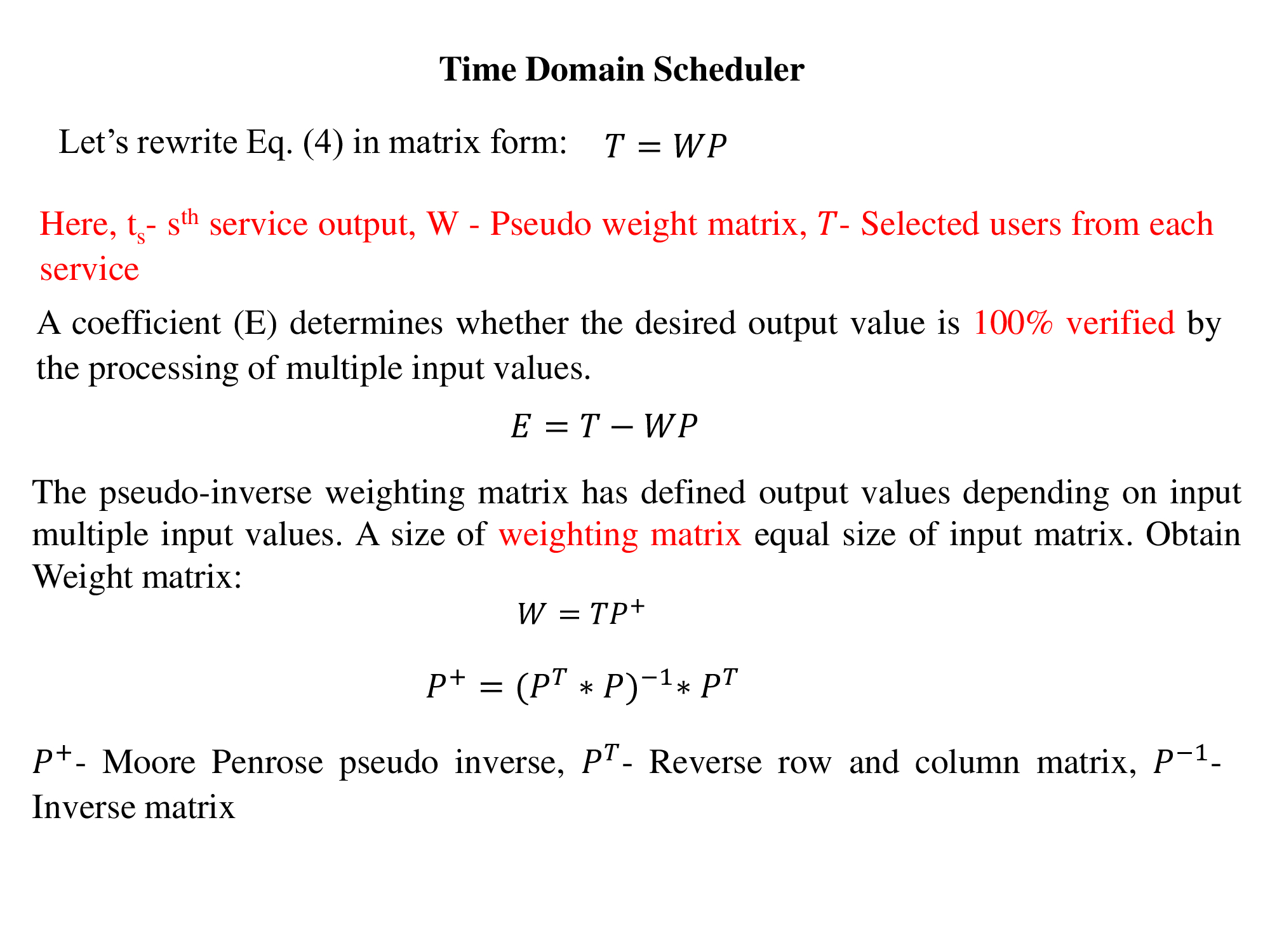 |
A coefficient (E) determines whether the desired output value is 100% verified by the processing of multiple input values.
The pseudo-inverse weighting matrix has defined output values depending on input multiple input values. A size of weighting matrix equal size of input matrix. Obtain Weight matrix:
|
|
ICACT20240470 Slide.15
[Big slide for presentation]
|
Chrome Text-to-Speach Click!! |
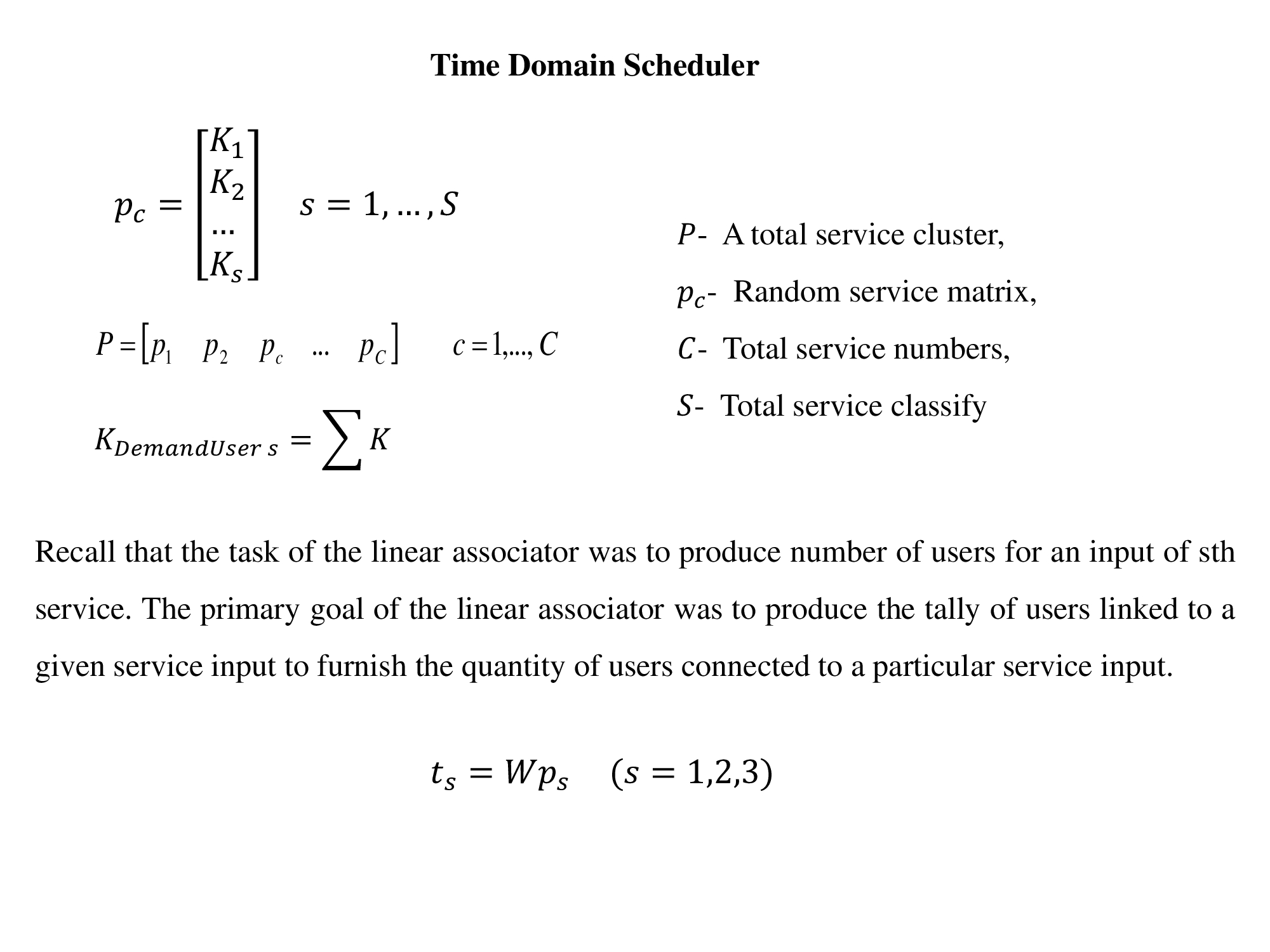 |
The primary goal of the linear associator was to produce the tally of users linked to a given service input to furnish the quantity of users connected to a particular service input.
𝑃- A total service cluster,
𝑝𝑐- Random service matrix,
𝐶- Total service numbers,
𝑆- Total service classify
|
|
ICACT20240470 Slide.14
[Big slide for presentation]
|
Chrome Text-to-Speach Click!! |
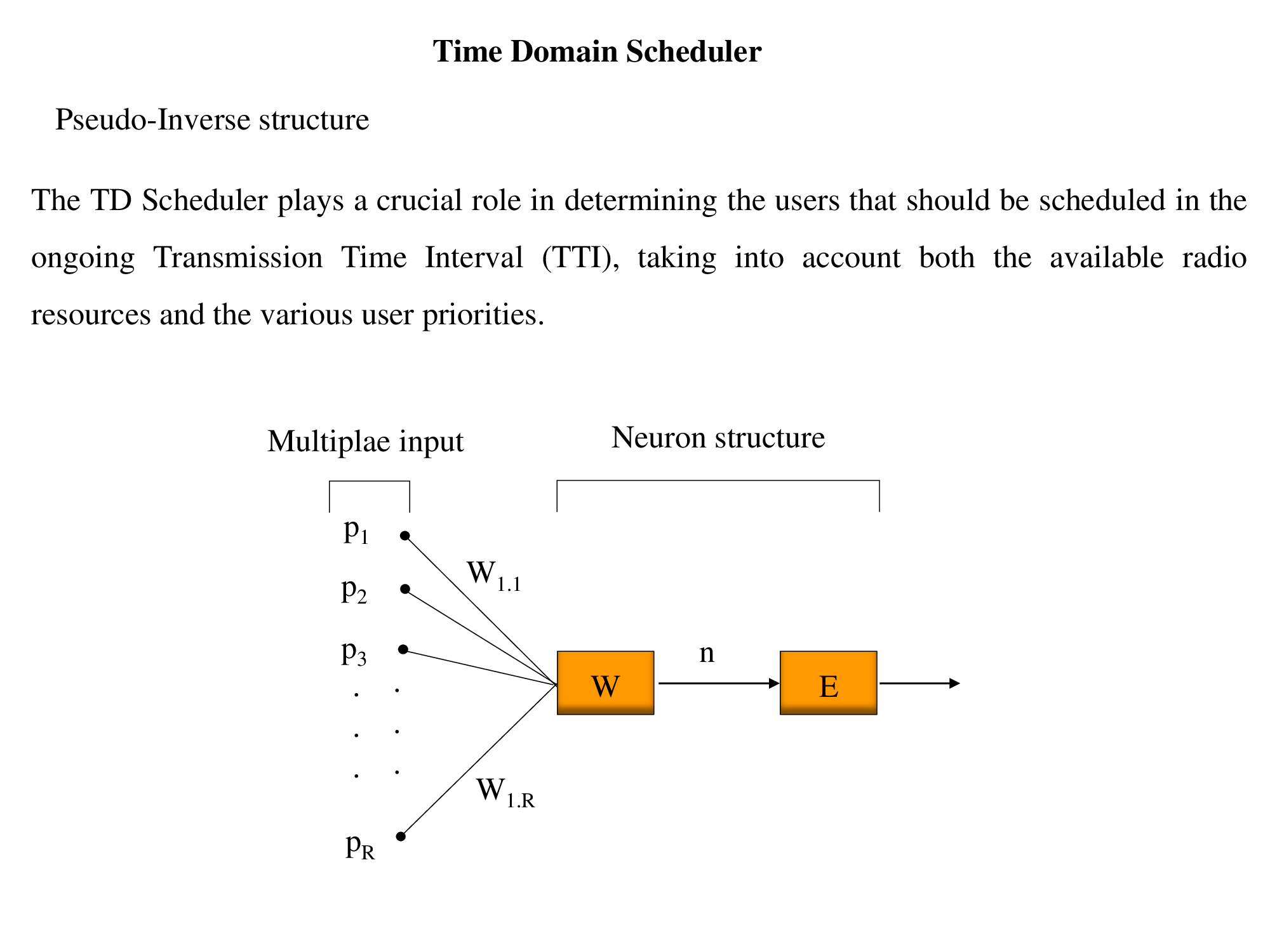 |
The TD Scheduler stage introduces a roposed Time Domain Scheduling Algorithm based on Pseudo-Inverse. This algorithm incorporates the PseudoInverse process, which enables adaptive resource allocation. By applying the Pseudo-Inverse (Figure) structure, the algorithm identifies the optimal number of Real-Time (RT) and Non-RealTime (NRT) users to be scheduled in the current TTI. This approach guarantees a fair distribution of resources across different service types, ultimately improving the overall systemlevel performance.
|
|
ICACT20240470 Slide.13
[Big slide for presentation]
|
Chrome Text-to-Speach Click!! |
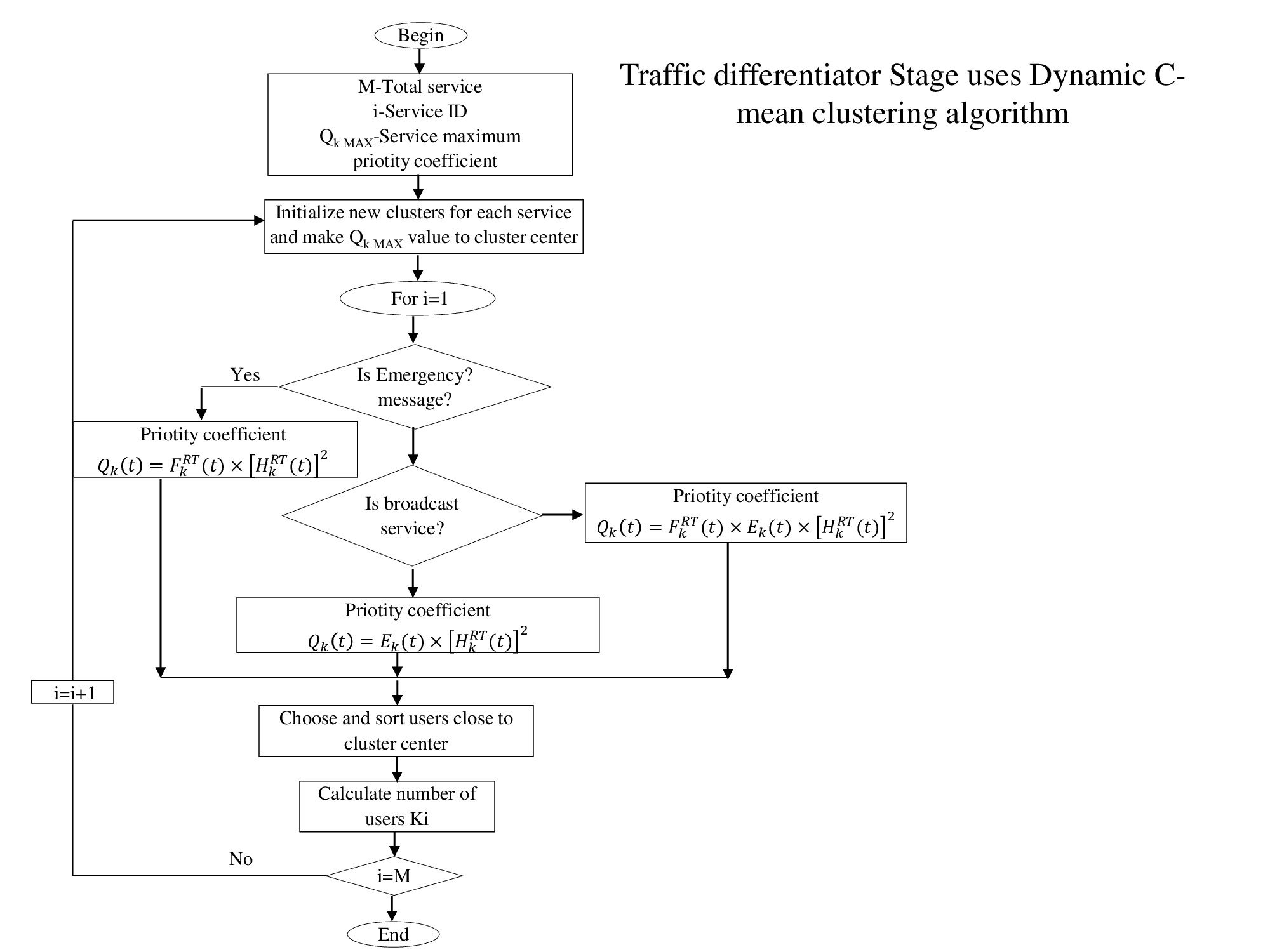 |
It illustrates the complex operation of the traffic differentiation, demonstrating the categorization of mixed traffic into separate segments:
RT emergency users, NRT streaming users, and the allocation of their control information into a dedicated queue.
This procedure employs a Dynamic c-mean clustering algorithm to effectively organize the priorities of chosen RT users.
The arrangement is determined by their individual Qk(t) priority coefficients, with the objective of enhancing and optimizing the priority metric to enhance system performance.
|
|
ICACT20240470 Slide.12
[Big slide for presentation]
|
Chrome Text-to-Speach Click!! |
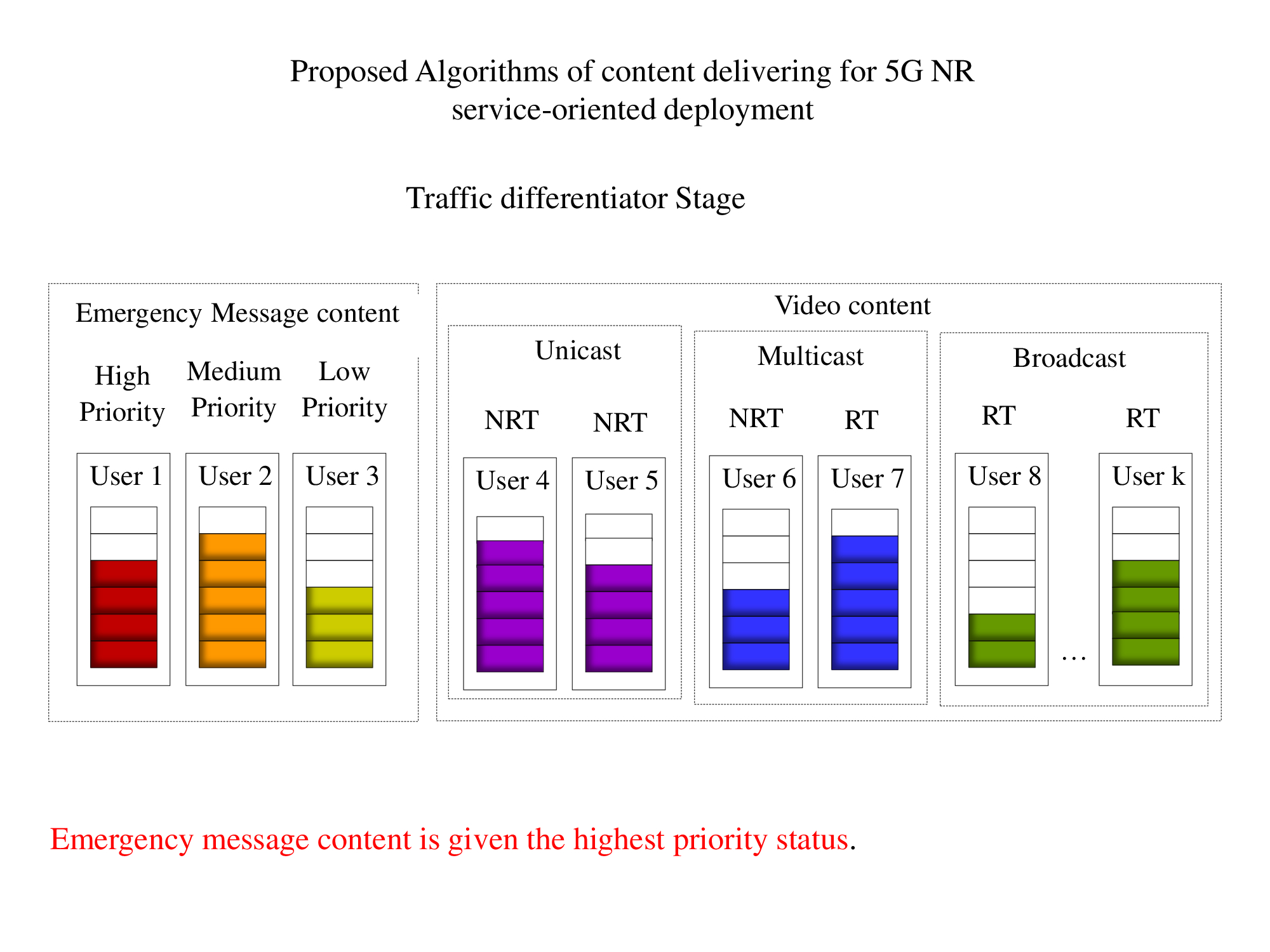 |
The mobile network's mixed-traffic flow is directed to the eNB with different QoS requirements.
Each queue employs a tailored queue sorting algorithm depending on the specific QoS demands of the respective service type.
This study presents the classification of mixed traffic into six distinct queues, with an real time (RT) queue comprising emergency message content, followed by RT and NRT queues designated for streaming video services.
|
|
ICACT20240470 Slide.11
[Big slide for presentation]
|
Chrome Text-to-Speach Click!! |
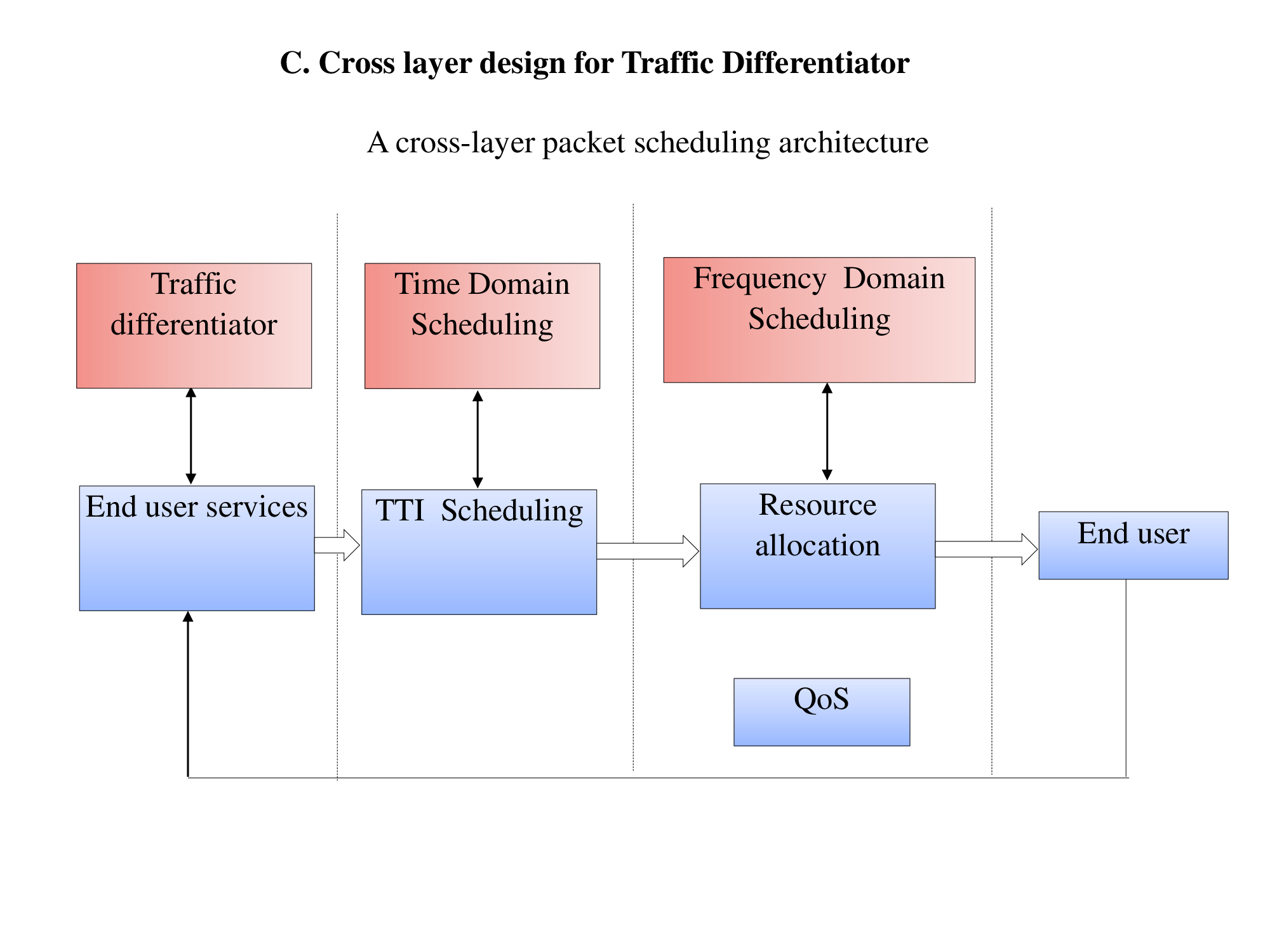 |
The resource allocation approach in NR very close LTE scheduling, but NR requires a higher level of precision, especially in its time domain scheduling within the physical layer.
The suggested architecture utilizes a cross-layer concept, incorporating information from different layers to guide scheduling decisions, as illustrated in Figure. This approach divides the scheduling process into three stages: the Traffic Differentiator, the TD Scheduler, and the FD Scheduler, which in the scheduling of Time Domain (TD) and Frequency Domain (FD) operations, respectively.
|
|
ICACT20240470 Slide.10
[Big slide for presentation]
|
Chrome Text-to-Speach Click!! |
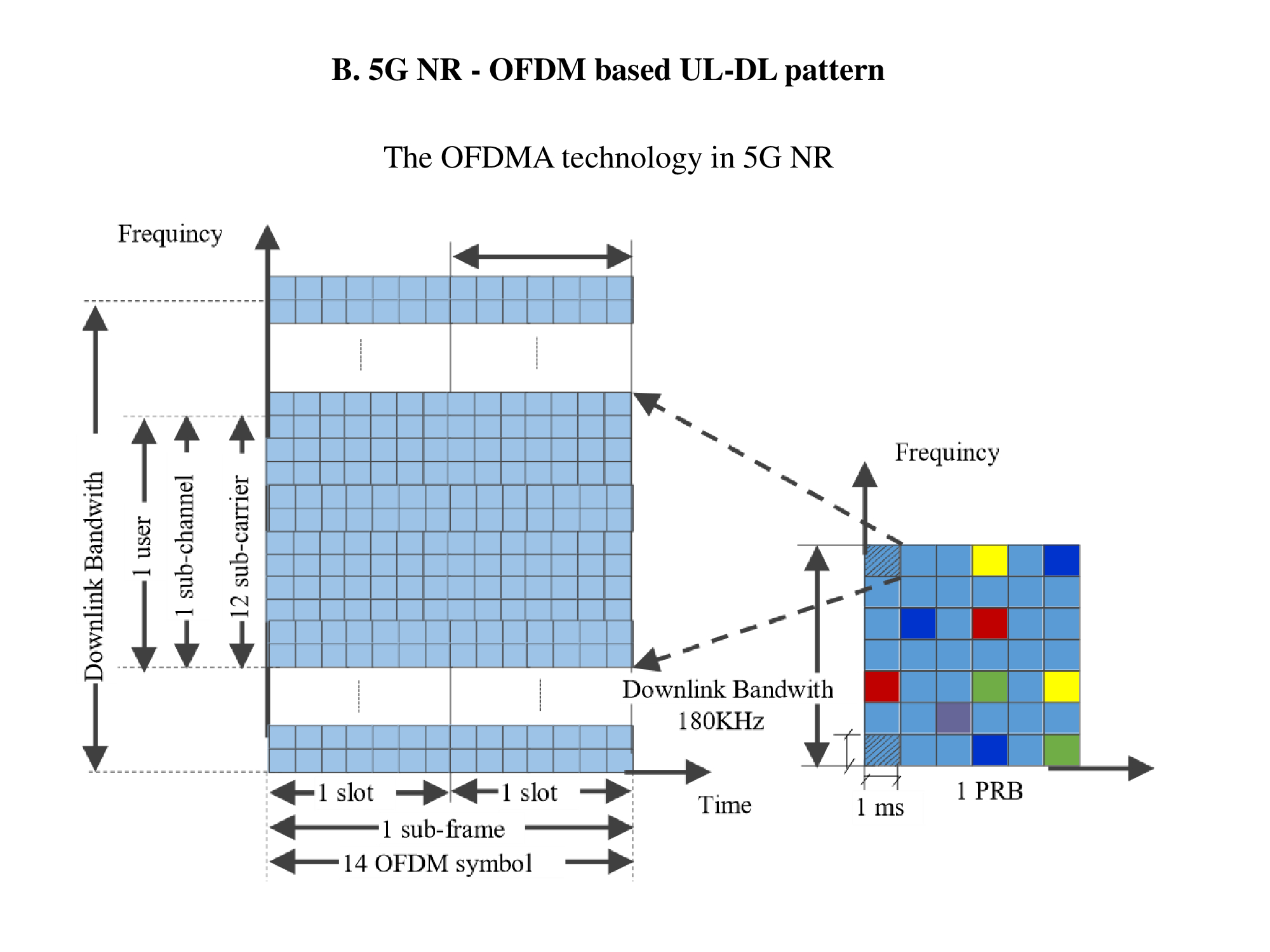 |
5G NR utilizes two types of OFDM: cyclic prefix OFDM (CPOFDM) and Discrete Fourier Transform Spread OFDM (DFT-S OFDM).
CP-OFDM, similar to the access technology employed in LTE, incorporates a variable subcarrier spacing known as numerology, which is support of various subcarrier separations.
DFT-S OFDM, also referred to as SCOFDM (Single Carrier OFDM), combines the transmission characteristics of a single carrier with OFDM, presenting a transmission scheme to OFDMA. This scheme assigns distinct Fourier coefficients to different transmitters based on a complex constellation of symbols derived from the transmitted bits for each user.
|
|
ICACT20240470 Slide.09
[Big slide for presentation]
|
Chrome Text-to-Speach Click!! |
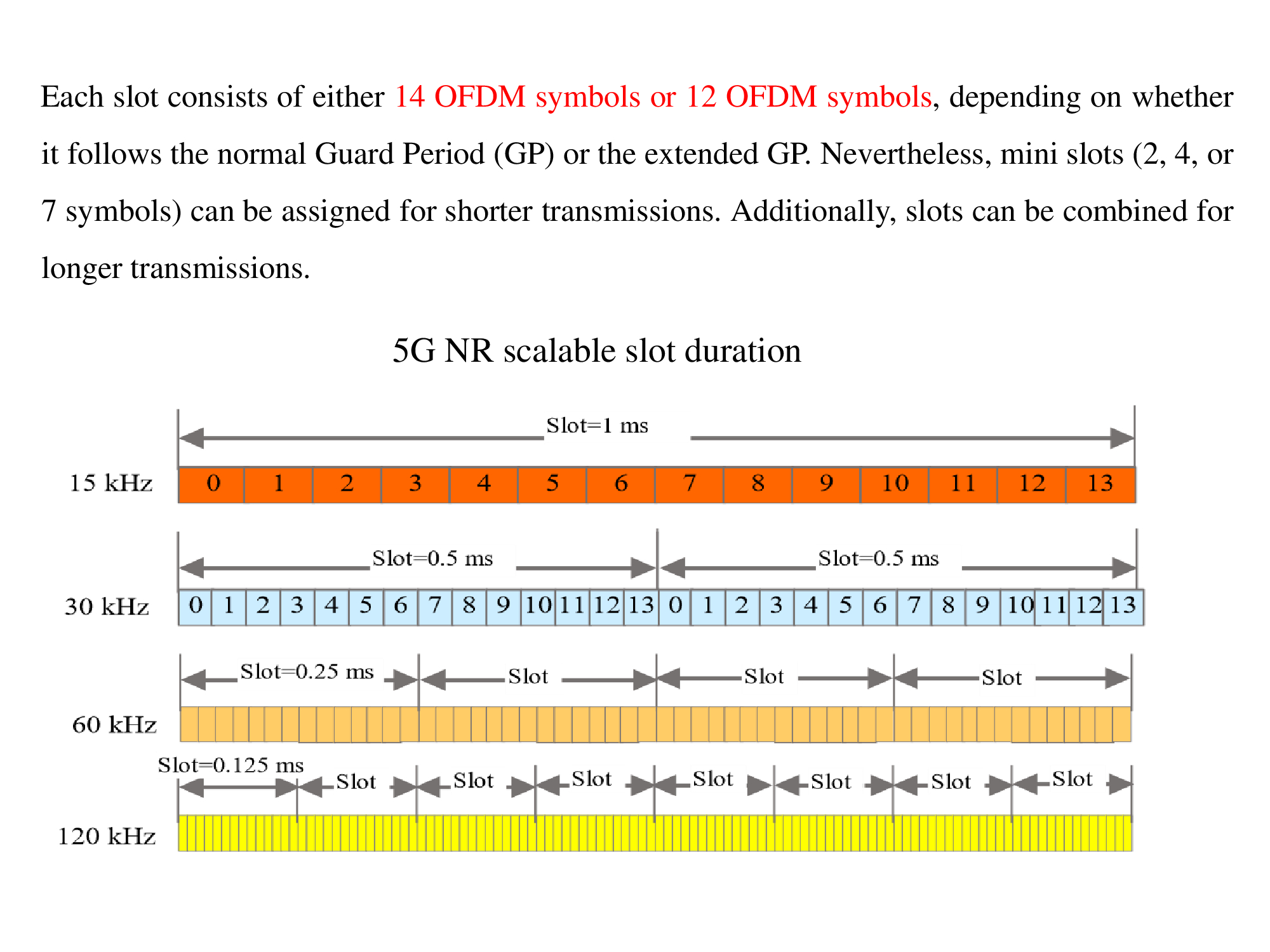 |
The 5G NR frame structure is designed to support both Frequency Division Duplex (FDD) for paired spectrum bands and Time Division Duplex (TDD) for unpaired spectrum bands.
Unlike LTE, where a subframe is made up of two slots containing 7 OFDM symbols, in 5G NR, a subframe is created by combining slots. Each slot is composed of either 7 or 14 OFDM symbols for Sub-Carrier Spacing (SCS) of 60 kHz, and 2, 4, 7, or 14 OFDM symbols for SCS of 120 kHz.
|
|
ICACT20240470 Slide.08
[Big slide for presentation]
|
Chrome Text-to-Speach Click!! |
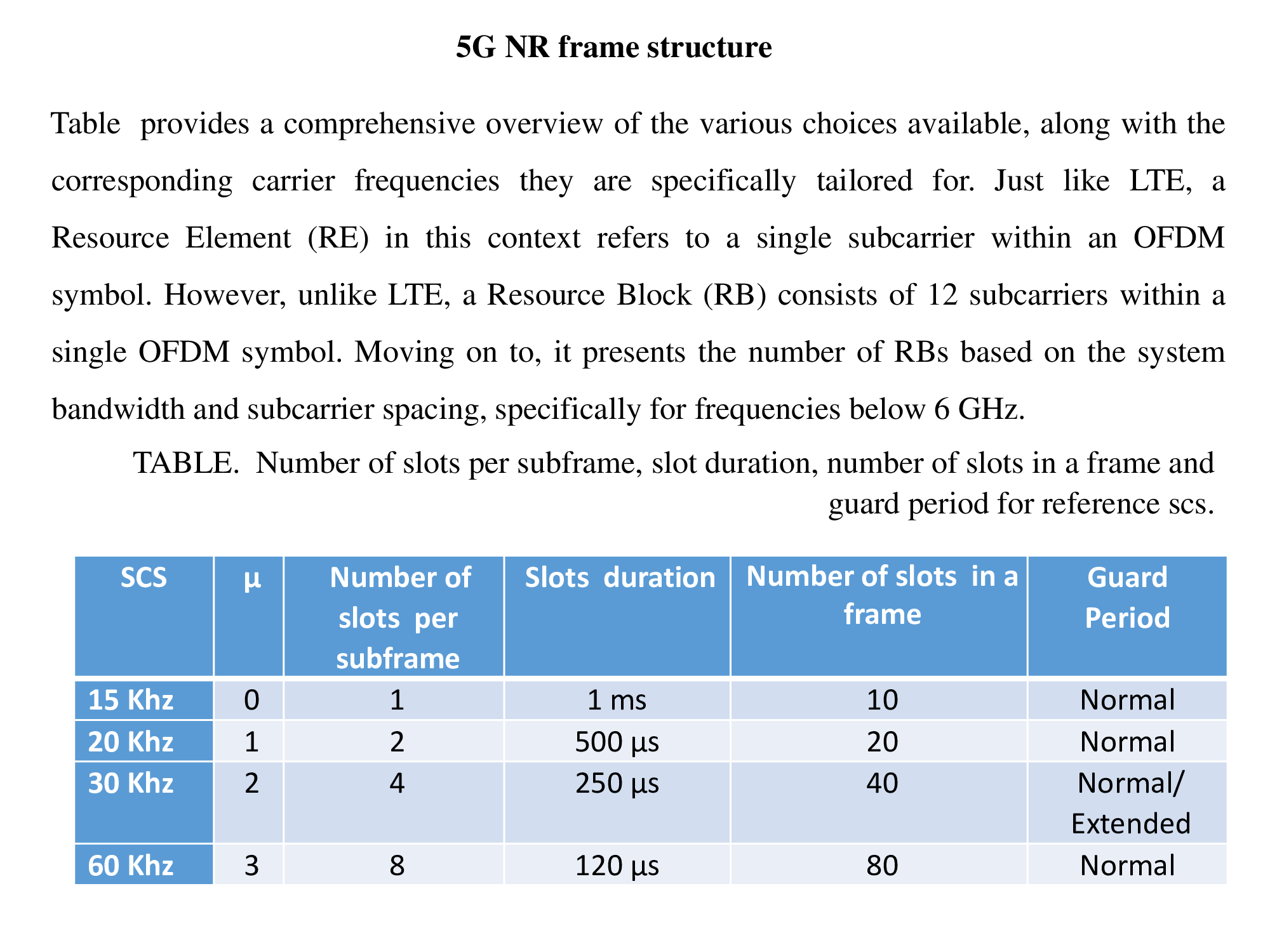 |
In table shown an overview of the various choices available, along with the corresponding carrier frequencies.
Just like LTE, a Resource Element (RE) in this context refers to a single subcarrier within an OFDM symbol. However, unlike LTE, a Resource Block (RB) consists of 12 subcarriers within a single OFDM symbol.
It presents the number of RBs based on the system bandwidth and subcarrier spacing, specifically for frequencies below 6 GHz.
|
|
ICACT20240470 Slide.07
[Big slide for presentation]
|
Chrome Text-to-Speach Click!! |
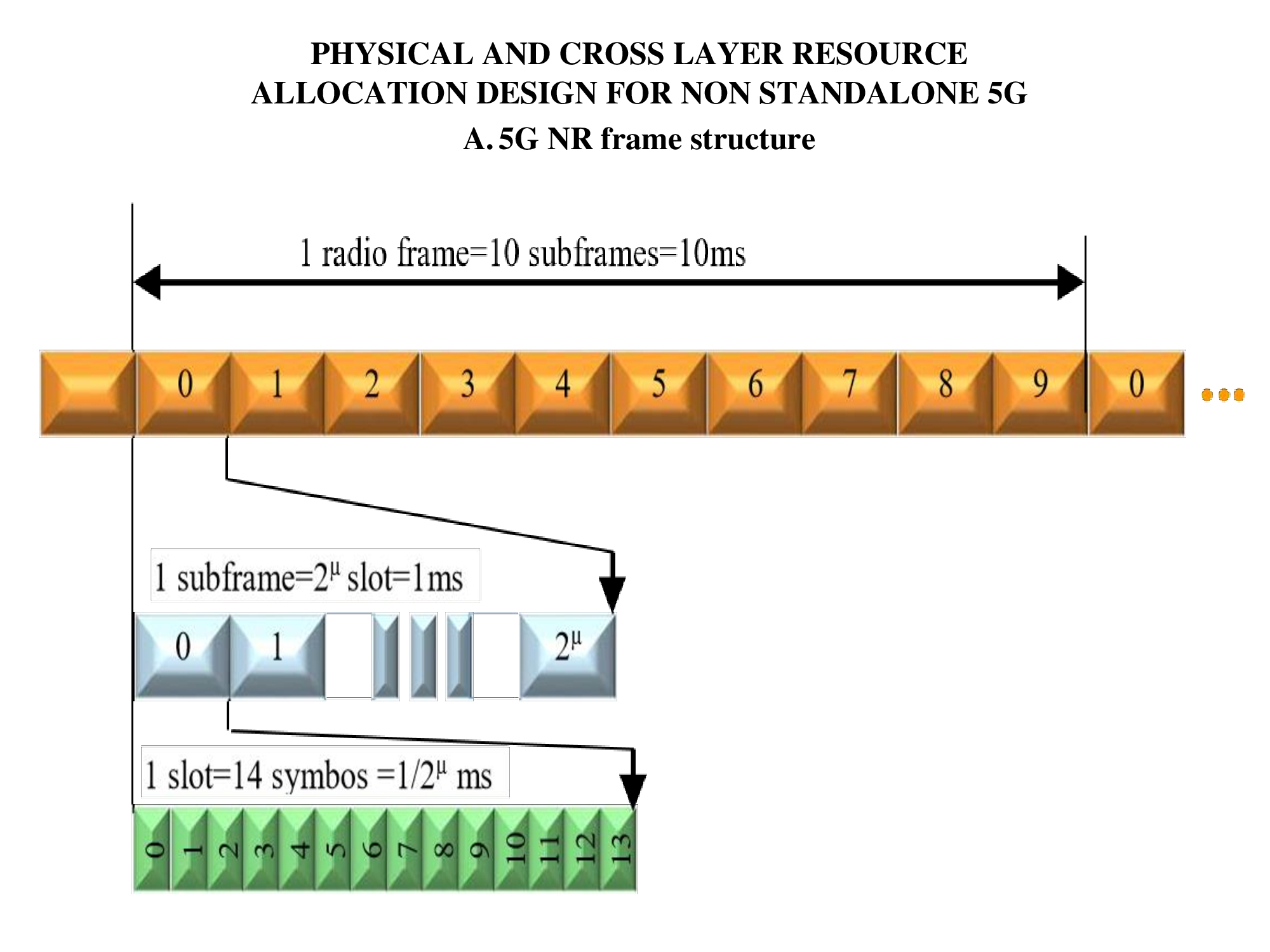 |
The 5G NR technology is capable of supporting both frequency division duplexing (FDD) and time division duplexing (TDD).
A 5G NR frame structure is designed for efficient support of users service requirements.
While the 5G NR frame structure shares similarities with LTE, it brings about significant improvements and important modifications.
Just like LTE, each frame lasts for 10 ms and consists of 10 subframes per each frame, with each subframe having a duration of 1 ms. Within a slot, there are 14 OFDM symbols, the structure of the 5G NR frame.
|
|
ICACT20240470 Slide.06
[Big slide for presentation]
|
Chrome Text-to-Speach Click!! |
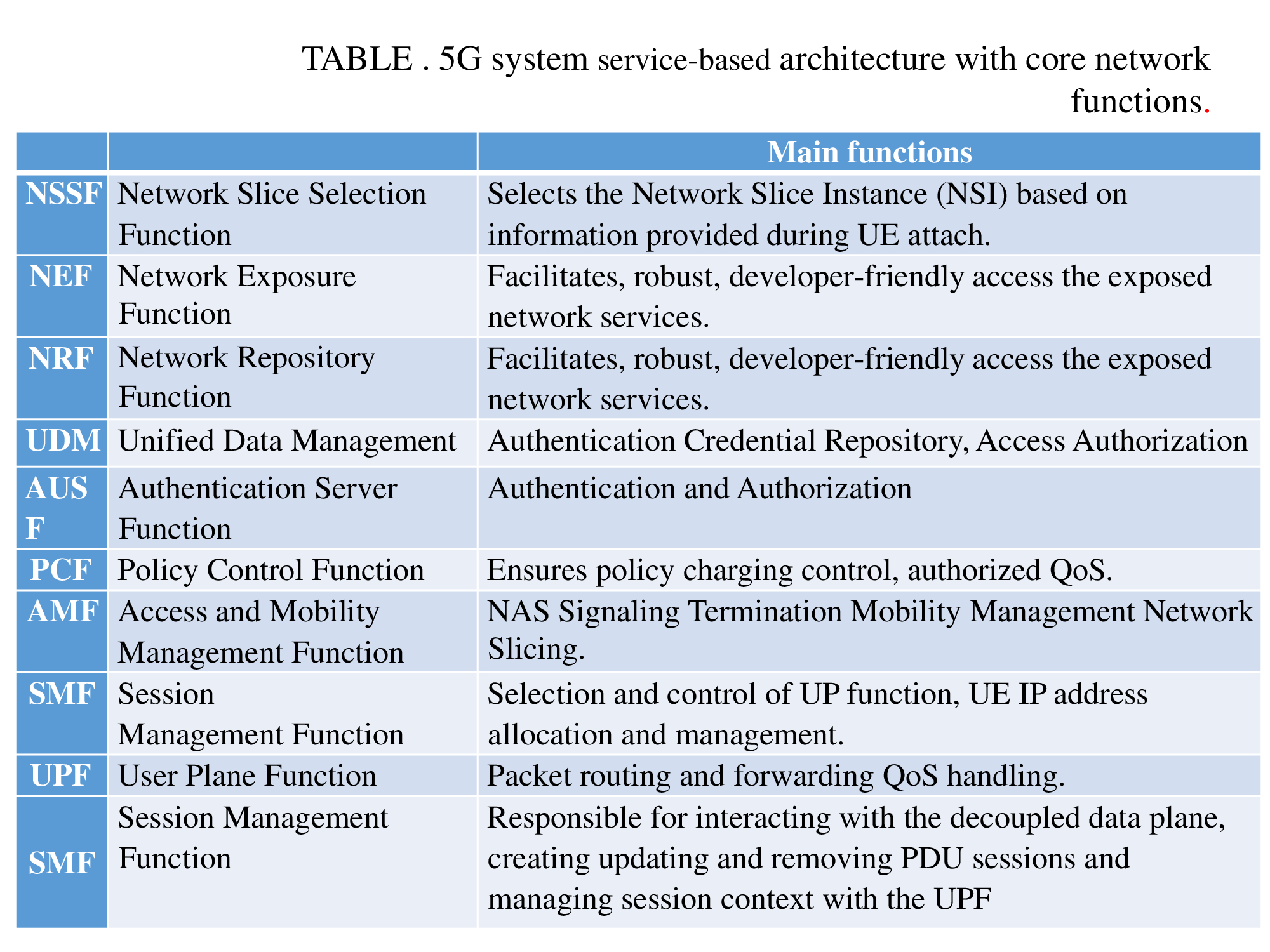 |
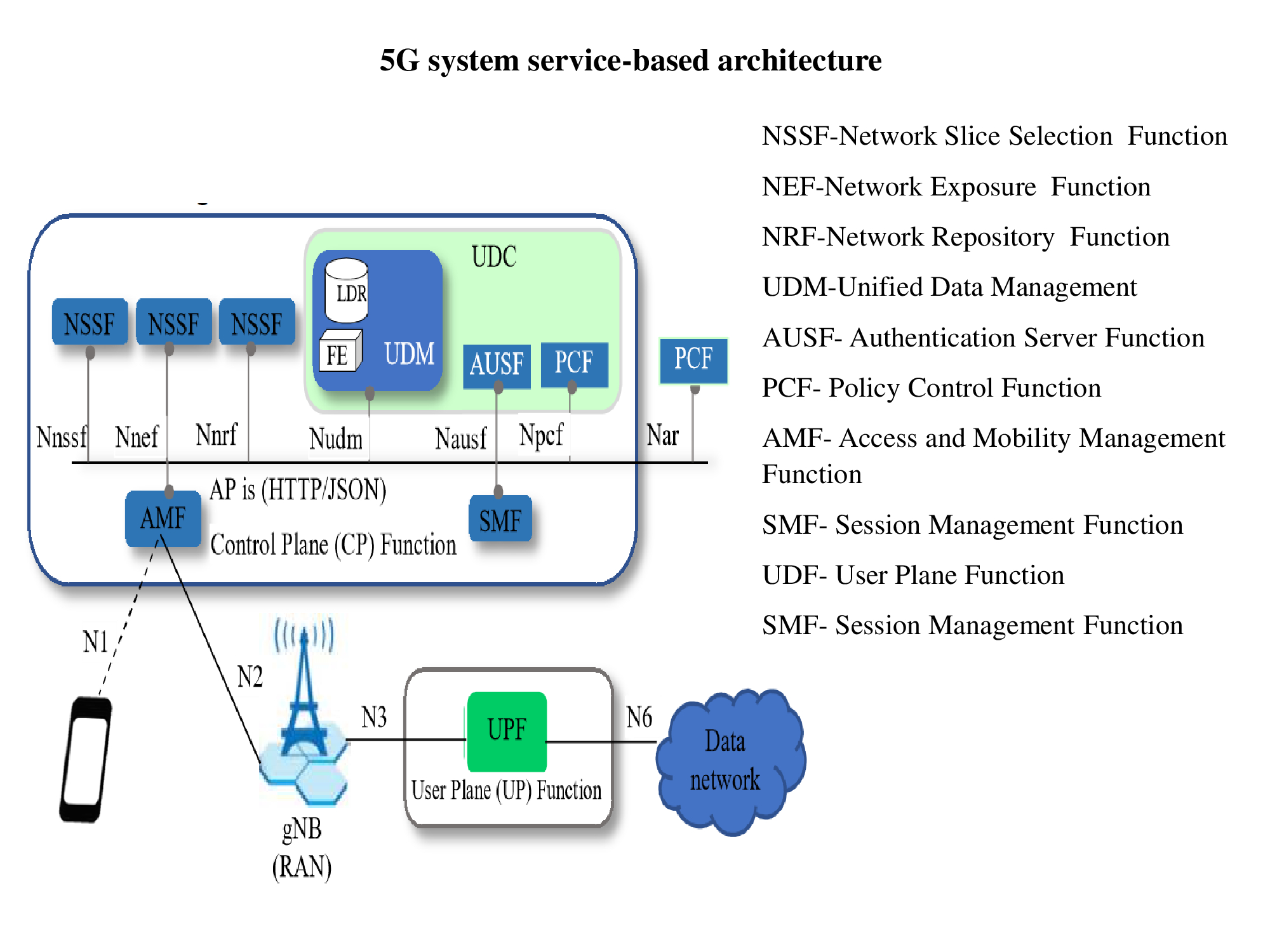
Figure depicts the Service-based architecture of the 5G NR NSA system it describes its corresponding functions.
As research work in mobile communication is focusing on 5G technology and researches are progressing towards the World Wide Wireless Web (WWWW), Dynamic Adhoc Wireless Networks (DAWN) & totally real wireless world.
User can avail specific feature of 5G such as very high speed & massive data bandwidth at the low cost per bit. With the help of these advanced technologies, LTE networks can now cater to a diverse range of applications and fulfill the data rate requirements set by 3GPP, which is 100 Mbps for DL and 50 Mbps for UL, along with 1.5bps/Hz spectrum efficiency in a 20 MHz bandwidth.
|
|
ICACT20240470 Slide.05
[Big slide for presentation]
|
Chrome Text-to-Speach Click!! |
 |
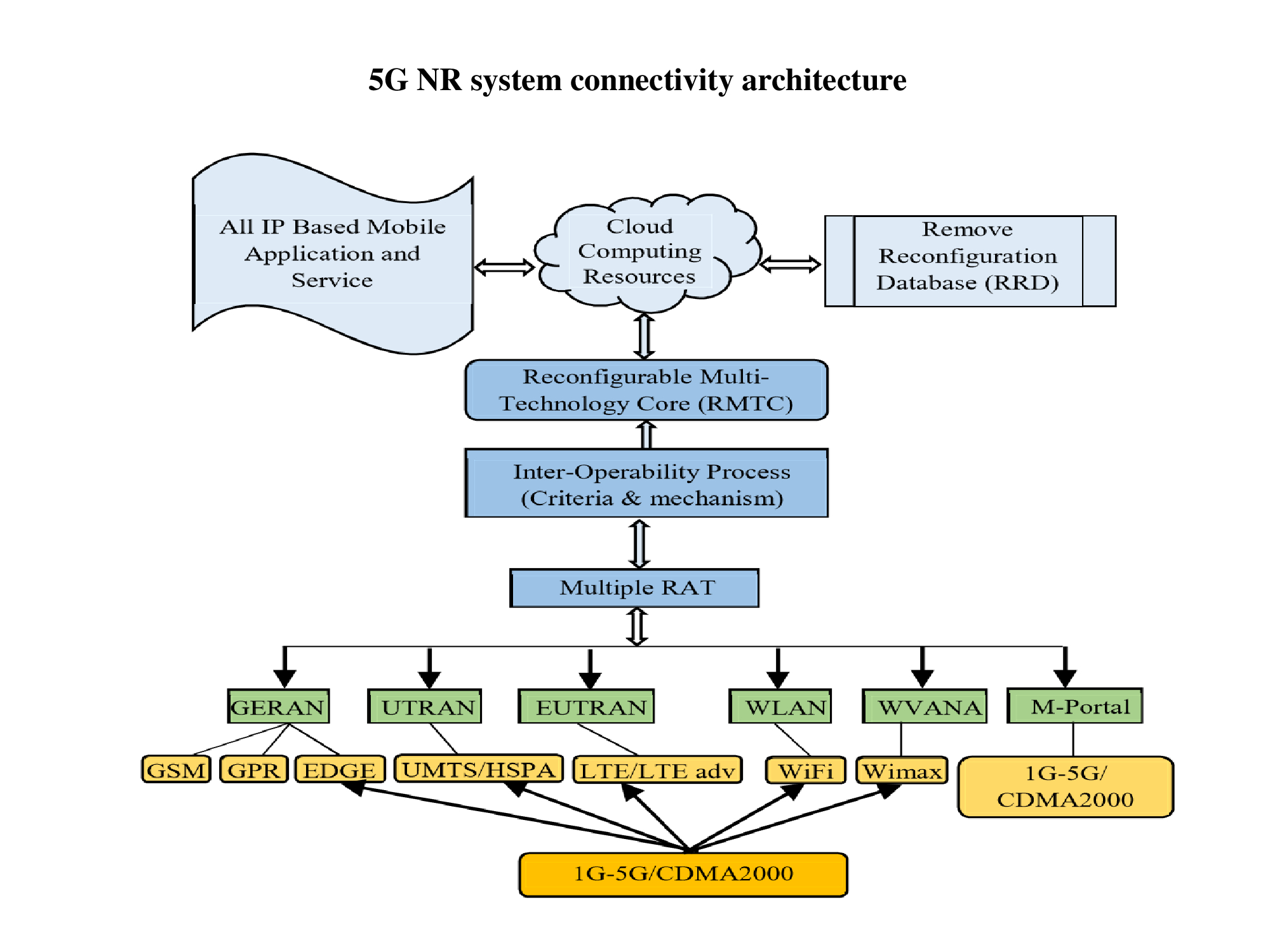
In this figure shown the end-to-end network architecture of 5G consists of various components.
These include the Next Generation RAN (NG-RAN), Cloud RAN which is responsible for providing wireless connectivity.
Additionally, there is Multi-Access Edge Computing (MEC) within the Virtual Evolved Packet Core (vEPC), which enables efficient processing at the network edge.
|
|
ICACT20240470 Slide.04
[Big slide for presentation]
|
Chrome Text-to-Speach Click!! |
 |
Showcasing the extensive connectivity of 5G NR, which aims to enable communication not only between humans but also between MTC.
It¡¯s expected that current technologies like OFDMA will continue to be effective for the next 50 years, and there is no pressing need for modifications.
|
|
ICACT20240470 Slide.03
[Big slide for presentation]
|
Chrome Text-to-Speach Click!! |
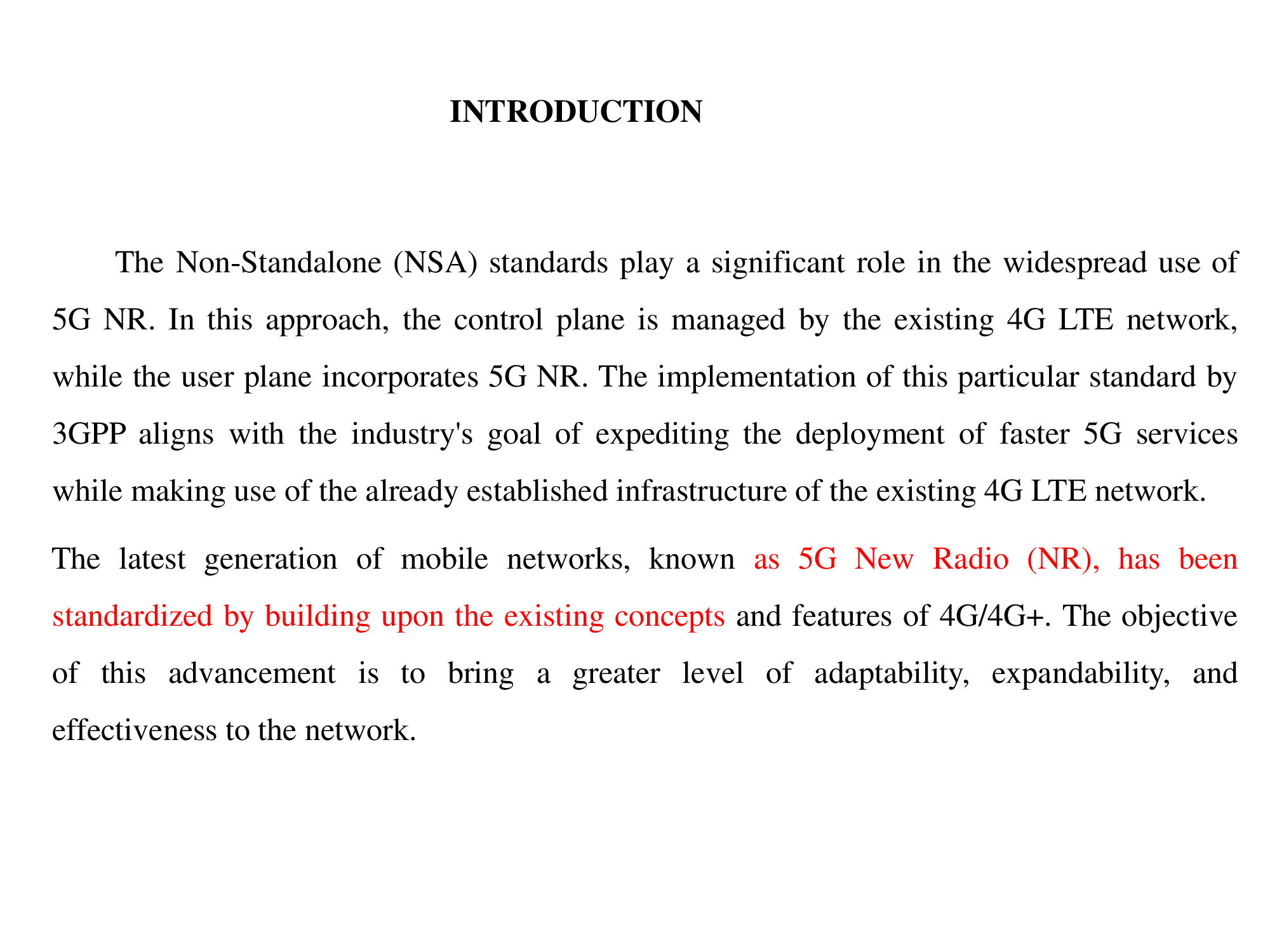 |
The NSA standards play a significant role in the widespread use of 5G NR. In this case, the control plane is managed by the existing 4G LTE network, while the user plane incorporates 5G NR.
The implementation of this particular standard by 3GPP shows more economical and faster the deployment 5G services using already established infrastructure of the existing 4G LTE network.
That approach deployment 5G NR is to bring a greater level of adaptability, expandability, and effectiveness to the network.
|
|
ICACT20240470 Slide.02
[Big slide for presentation]
|
Chrome Text-to-Speach Click!! |
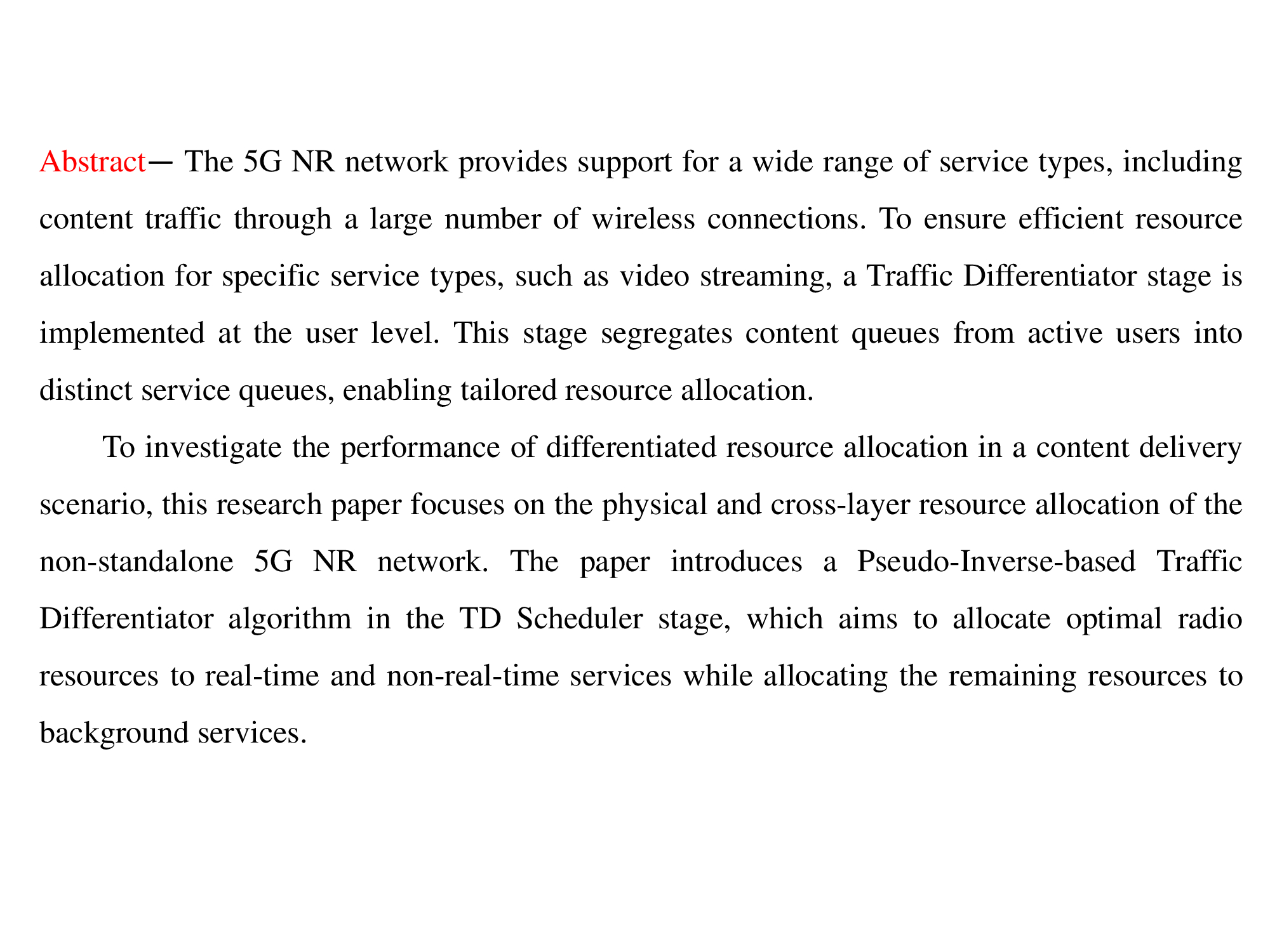 |
The 5G NR network provides for a wide range of service types of content traffic to a large number of wireless connections.
To ensure efficient resource allocation for specific service types, such as video streaming.
A traffic differentiation stage is implemented at the user level.
In this stage isolated content queues from active users into special service queues, enabling specific resource allocation.
To investigate the performance of differentiated resource allocation in a content delivery case, this research paper focuses on the physical and cross-layer resource allocation of the non-standalone 5G NR network.
We will introduce a Pseudo-Inverse-based Traffic Differentiation algorithm in the TD Scheduler stage, which aims to allocate optimal radio resources to real-time and non-real-time services while allocating the remaining resources to background
|
|
ICACT20240470 Slide.01
[Big slide for presentation]
|
Chrome Text-to-Speach Click!! |
 |
Content
|
|
ICACT20240470 Slide.00
[Big slide for presentation]
|
Chrome Text-to-Speach Click!! |
 |
An Efficient Resource Allocation Algorithm for
Traffic of Content Streaming in Non-Standalone OFDM-Based 5G NR
|
















