 ICACT20250027 Slide.36
[Big slide for presentation] |
Chrome Text-to-Speach Click!! |
 |
Thank you for reading!!!
|
|
ICACT20250027 Slide.35
[Big slide for presentation]
|
Chrome Text-to-Speach Click!! |
 |
These are references.
|
|
ICACT20250027 Slide.34
[Big slide for presentation]
|
Chrome Text-to-Speach Click!! |
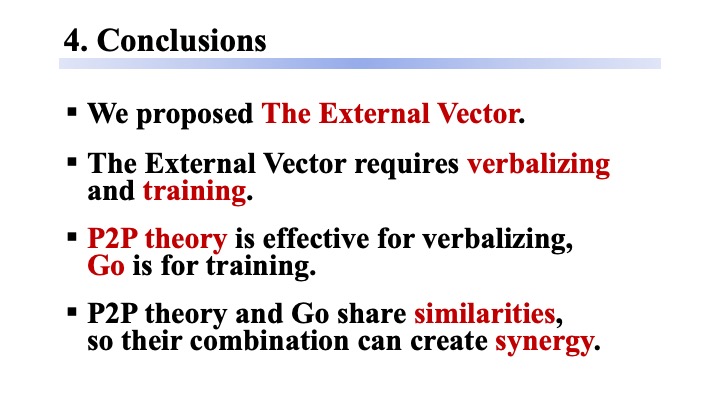 |
In this study, we proposed the External Vector.
And we demonstrated that:
・Verbalizing (theorizing) and training are essential for the External Vector.
・P2P is effective for verbalization, Go is for training.
・Since P2P and Go share similarities, their combination can create synergy.
|
|
ICACT20250027 Slide.33
[Big slide for presentation]
|
Chrome Text-to-Speach Click!! |
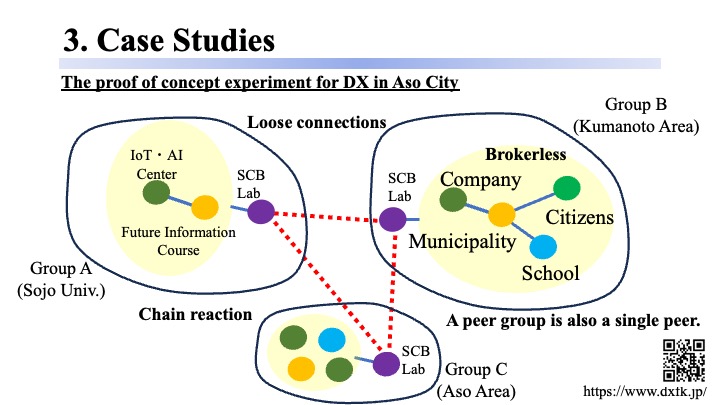 |
Notably, in Aso City, Japan, a proof of concept experiment for the External Vector is currently underway. Specifically, a proof of concept experiment has been launched to create new values through loose connections. In this experiment, Group A, centered around Sojo University’s IoT Center, Group B, consisting of companies, local governments, and citizens in the Kumamoto area, and Group C, representing those of the Aso area, are loosely connected through SCB Lab. By fostering these connections, the experiment aims to create and explore new values.
|
|
ICACT20250027 Slide.32
[Big slide for presentation]
|
Chrome Text-to-Speach Click!! |
 |
Finally, we would like to explain “self-organization,” which is the last similarity of P2P. In P2P, if Peer A, which were connecting Peer Group X and Y, goes down, Peer B can take over and rebuild the connections. Thus, in P2P, even in the event of a failure, or disappear, self-organization enables peers or peer groups to continue service. Likewise, in Go, if Go Stone O, which was connecting Go Stone Group X and Go Stone Group Y, is lost, Go Stones ② and ④ take over and rebuild the connections.
|
|
ICACT20250027 Slide.31
[Big slide for presentation]
|
Chrome Text-to-Speach Click!! |
 |
The forth similarity between P2P and Go is Simultaneous Participation Concatenation. In P2P, Peer A serves as a bridge, connecting Peer Group X and Peer Group Y. Similarly, in Go, Go Stones ①③⑤ loosely connects Go Stone Group X and Go Stone Group Y.
|
|
ICACT20250027 Slide.30
[Big slide for presentation]
|
Chrome Text-to-Speach Click!! |
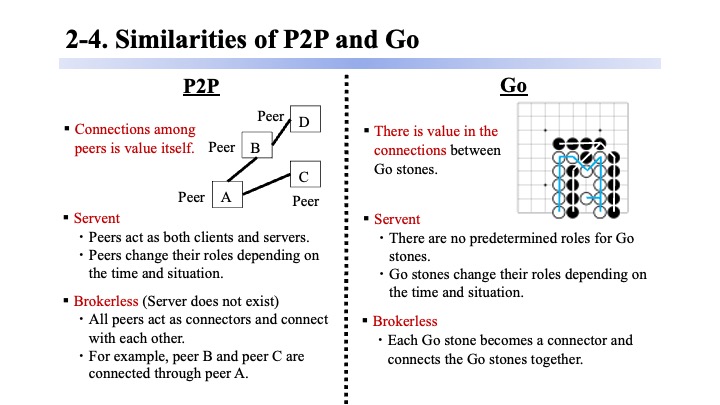 |
First, connections among peers is value itself. Likewise, in Go, there is value in the connections between Go stones. Next, the second similarity between P2P and Go is Servant. In P2P, Peers function as a Servant, meaning it can take on both client and server roles as needed. Likewise, in Go, each stone does not have a predefined role. A stone functions as a Servant, adapting its role depending on the situation. The third similarity between P2P and Go is Brokerless. In P2P, each peer becomes a connector and connects each other because there is no broker that connects peers. Likewise, in Go, each stone acts as a connector and connects each other.
|
|
ICACT20250027 Slide.29
[Big slide for presentation]
|
Chrome Text-to-Speach Click!! |
 |
This table corresponds to table 1 in the paper. It illustrates the similarities between Go and P2P. Especially, we would like to explain only Servant, Brokerless, and Simultaneous Participation Concatenation.
|
|
ICACT20250027 Slide.28
[Big slide for presentation]
|
Chrome Text-to-Speach Click!! |
 |
This section corresponds to the red-labeled part in the diagram.
|
|
ICACT20250027 Slide.27
[Big slide for presentation]
|
Chrome Text-to-Speach Click!! |
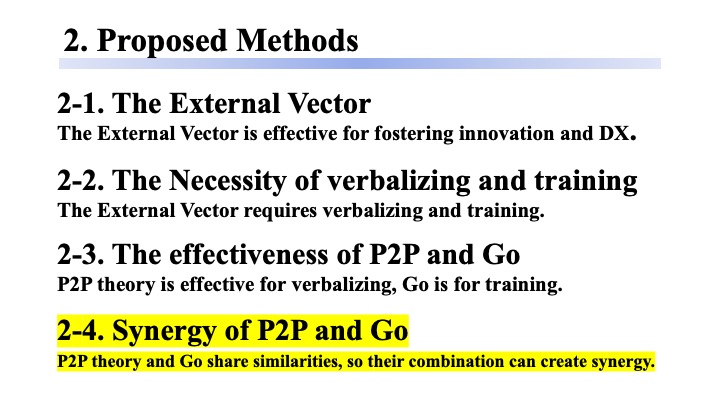 |
Finally, through our research process, we discovered a high degree of similarity between P2P and Go. I will explain how their*combination is expected to create synergy.
|
|
ICACT20250027 Slide.26
[Big slide for presentation]
|
Chrome Text-to-Speach Click!! |
 |
Go is a game that demands us to create a good balance between weak and strong connections. Therefore, Go is considered effective for training and cultivating awareness of building the External Vector.
|
|
ICACT20250027 Slide.25
[Big slide for presentation]
|
Chrome Text-to-Speach Click!! |
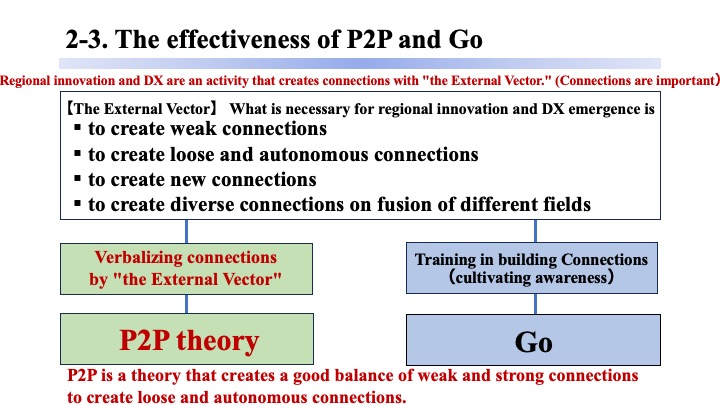 |
P2P is a framework that has been programmed into software operating on the internet. Therefore, its mechanism was adopted as the verbalizing (theorizing) of the External Vector. However, for other theories, verbalizing the External Vector remains an ongoing challenge.
|
|
ICACT20250027 Slide.24
[Big slide for presentation]
|
Chrome Text-to-Speach Click!! |
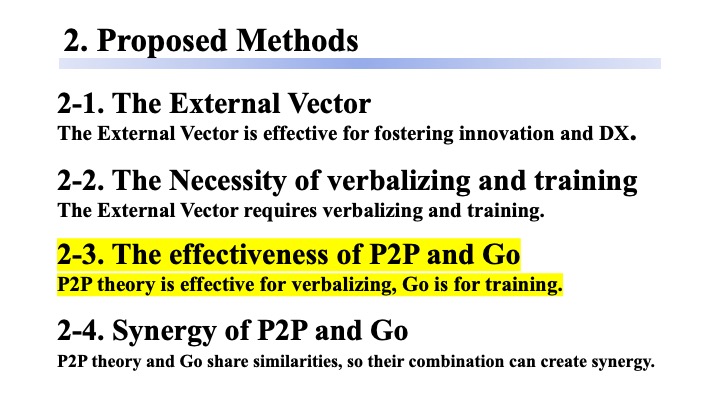 |
Next, we will explain the third point: “The combination of “P2P Concepts and Principles” is effective for verbalizing, and “Go Concepts and Principles” is effective for training.”
|
|
ICACT20250027 Slide.23
[Big slide for presentation]
|
Chrome Text-to-Speach Click!! |
 |
To realize the External Vector, training to build connections through the External Vector, in other words, fostering an awareness of weak and loose connections, is required. And, we must change our way of thinking from an "the Internal Vector" to "the External vector". In addition, in order to use "the Internal Vector" and "the External Vector” as two wheels in a well-balanced manner. However, in the current situation where strong connections are practiced unconsciously as common sense, it is not easy to consciously aim for weak and loose connections. Therefore, training in building connections is essential.
|
|
ICACT20250027 Slide.22
[Big slide for presentation]
|
Chrome Text-to-Speach Click!! |
 |
The different fields have differences in language, customs, and thinking. This is why building new connections between diverse resources across different fields is not easy. And it is difficult to build sustainable, reproducible, and general-purpose connections at low cost, low risk, and with high reliability. Therefore, verbalizing the essence of connections is crucial.
|
|
ICACT20250027 Slide.21
[Big slide for presentation]
|
Chrome Text-to-Speach Click!! |
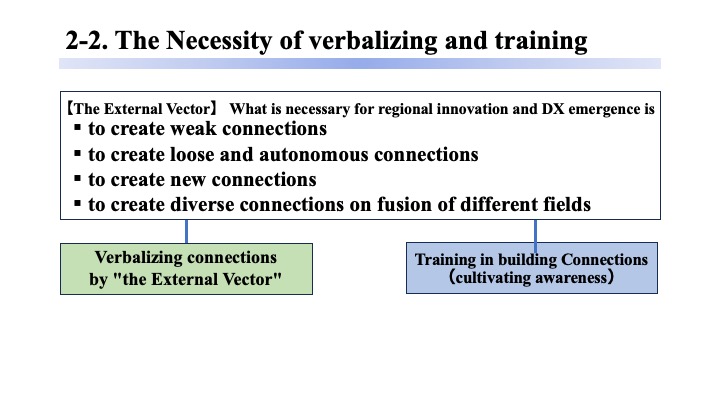 |
First, the External Vector requires verbalizing (theorizing).
|
|
ICACT20250027 Slide.20
[Big slide for presentation]
|
Chrome Text-to-Speach Click!! |
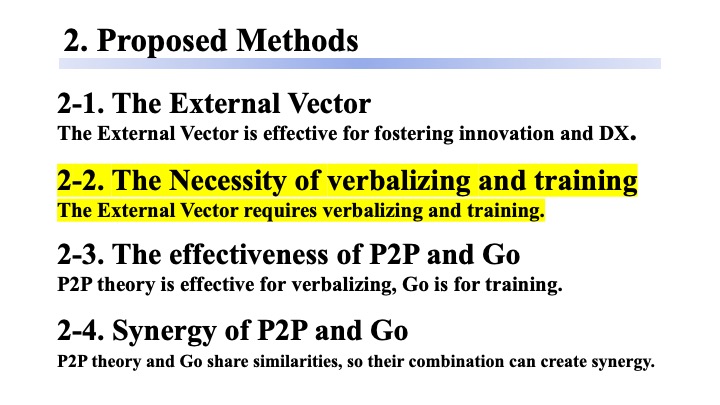 |
Next, we would like to explain the third point: “The External Vector requires verbalizing and training.”
|
|
ICACT20250027 Slide.19
[Big slide for presentation]
|
Chrome Text-to-Speach Click!! |
 |
Based on these points, we propose using the External Vector to connect regional resources. In other words, by building new, weak, loose, and autonomous connections across different fields, new values are created from these connections.
|
|
ICACT20250027 Slide.18
[Big slide for presentation]
|
Chrome Text-to-Speach Click!! |
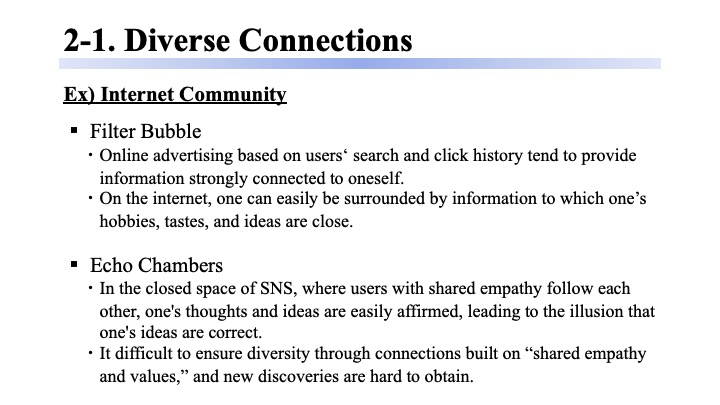 |
For example, on the internet, the concepts of Filter Bubble and Echo chambers are well known.
Filter Bubble pointed out that online advertising based on users‘ search and click history tends to provide information strongly connected to oneself. As a result, on the internet, one can easily be surrounded by information to which one’s hobbies, tastes, and ideas are close. Moreover, Echo chambers mentioned that in the closed space of SNS, where users with shared empathy follow each other, one's thoughts and ideas are easily affirmed, leading to the illusion that one's ideas are correct. In other words, the internet environment makes it difficult to ensure diversity through connections built on “shared empathy and values,” and new discoveries are hard to obtain.
Thus, new discoveries and values are unlikely to obtain through connections with shared values.
|
|
ICACT20250027 Slide.17
[Big slide for presentation]
|
Chrome Text-to-Speach Click!! |
 |
Dr. Chesbrough’s Open Innovation mentioned that it is valid to secure diversity and fusion of different fields in order to create new values. This means that no matter how many resources in closed areas such as within a single domain or a single industry, are connected, innovation is unlikely to emerge from them. In a single industry like banking, where only banks exist, innovation and new value are difficult to create.
|
|
ICACT20250027 Slide.16
[Big slide for presentation]
|
Chrome Text-to-Speach Click!! |
 |
New value also emerged from the new combination of cameras and mobile phones. It was not just a mobile phone with a camera. This new combination created the new value, "share emotions in real-time." Thus, a new combination is not merely an addition of elements but the creation of new values.
|
|
ICACT20250027 Slide.15
[Big slide for presentation]
|
Chrome Text-to-Speach Click!! |
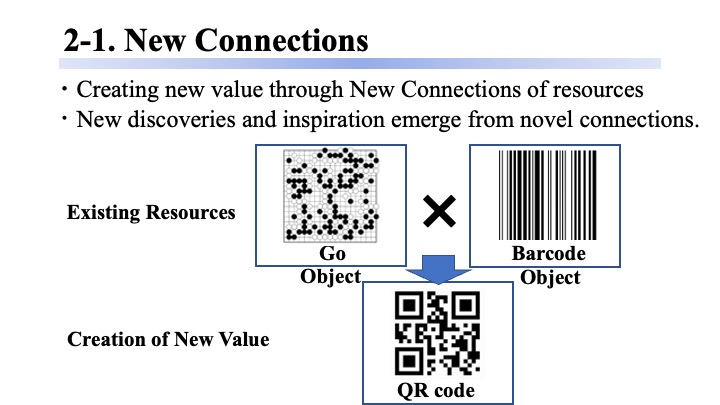 |
Shumpeter’s New Combinations emphasized the importance of “new connections (new combinations)” between resources. This means that new discoveries and stimuli can be obtained from new connections, rather than from well-known and familiar connections. For example, the QR code was born from the new connections between the existing and well-known barcode and Go. While traditional barcodes differentiate patterns in one direction, QR codes use dot patterns, enabling about 200 times more data storage. Thus, new discoveries and stimuli can be obtained from new connection between resources.
|
|
ICACT20250027 Slide.14
[Big slide for presentation]
|
Chrome Text-to-Speach Click!! |
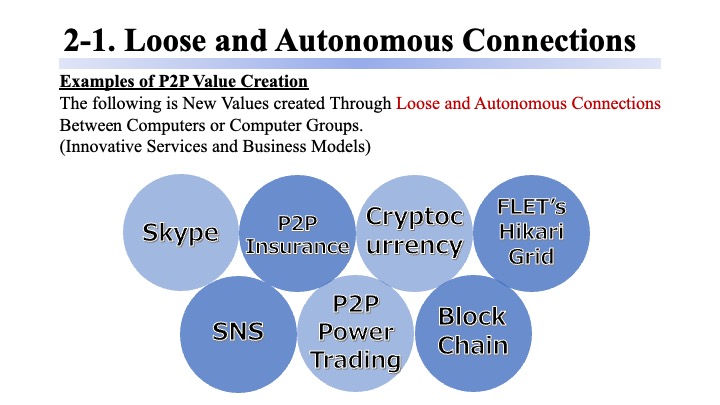 |
As we have just explained, in P2P, computers or computer groups are loosely and autonomously connected, allowing new value to emerge from these connections. For example,
- Skype, an internet-based IP phone service.
- P2P insurance, first launched by Alibaba, which reached 100 million subscribers in just one year.
- Cryptocurrency.
- NTT's FLET’S Hikari Grid.
- Social networking services (SNS).
- P2P electricity, a service provided by Kansai Electric Power.
- Blockchain technology.
These are many innovative services and business models have emerged from P2P’s loose connection.
|
|
ICACT20250027 Slide.13
[Big slide for presentation]
|
Chrome Text-to-Speach Click!! |
 |
Based on these key points of P2P, we focused on the potential of the Semi-Pure Model. Semi-Pure Model connects Client Server Model and Pure Model. Both models function as two wheels. For example, let’s consider an educational setting. First, the teacher will tell students A, B and C who are allowed to enter and exit which rooms they will enter and exit from. While Student D, who may cause disruptions, is denied entry and exit. Second, within this community, each member exists as a peer, and acts as a servant, teaching each other. As a result, even though the number of students increases, the burden on teachers does not increase significantly.
|
|
ICACT20250027 Slide.12
[Big slide for presentation]
|
Chrome Text-to-Speach Click!! |
 |
Finally, we will explain “self-organization,” which is the last key point of P2P. In Client Server Model, if the server goes down, clients or client groups cannot be connected to each other. On the other hand, in P2P, if Peer A, which were connecting Peer Group X and Y, goes down, Peer B can take over and rebuild the connections. Thus, in P2P, even in the event of a failure, or disappear, self-organization enables peers or peer groups to continue service.
|
|
ICACT20250027 Slide.11
[Big slide for presentation]
|
Chrome Text-to-Speach Click!! |
 |
The third point of P2P is “Simultaneous Participation Concatenation,” also known as ”chain reaction.” In Client Server Model, in order to connect Client Group X and Client Group Y, the server connects the two group. In contrast, in P2P, a peer (Peer A) belong to both Peer Group X and Peer Group Y simultaneously. This allows Peer Groups X and Y are connected through Peer A. Thus, P2P has the loose connections.
|
|
ICACT20250027 Slide.10
[Big slide for presentation]
|
Chrome Text-to-Speach Click!! |
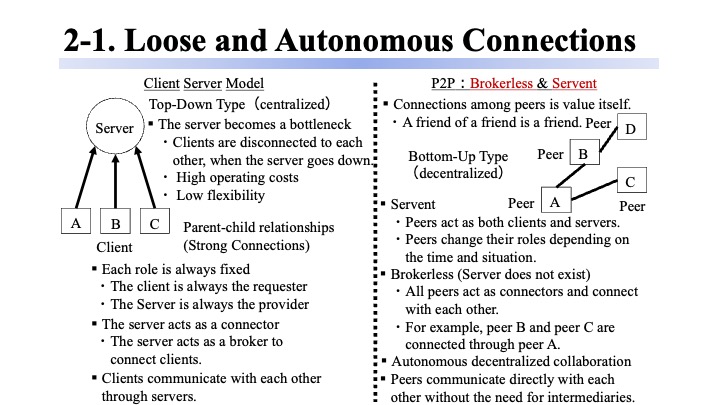 |
We explained the relationship between organizations and employees, and now we would like to describe this relationship in terms of the field of computer networks. By comparing P2P with traditional Client Server Model, we would like to explain 4 key points of P2P.
In Client Server Model, computers A, B, and C communicate with each other only through servers. In other words, there is a strong parent-child relationships, where the server acts as the parent and clients act as the children. As a result, this model has several issues: as the number of clients increases, the server’s processing capacity decreases; if the server goes down, clients cannot connect to each other; and the cost of operating the server becomes a burden. The strong connections come with costs, making it difficult for new value to emerge. This Client Server Model is a centralized, Top-Down Type. In contrast, in P2P, server doesn’t exist. Computers connect in a friend of a friend manner. For example, Computer B can connect to Computer C through Computer A. This P2P is a decentralized, Bottom-Up Type. In P2P, such a connection is called “Brokerless”. Additionally, since server doesn’t exist, all peers act as connectors and connect with each other. This is known as “Servant.” These two concepts, ”Brokerless” and ”Servant,” are the first and second key points of P2P.
|
|
ICACT20250027 Slide.09
[Big slide for presentation]
|
Chrome Text-to-Speach Click!! |
 |
For example, the same applies to employment structures. Japanese companies adopt a membership-based model. In this model, the company and employees are connected by “strong connections” as if they were parent and child. In contrast, in the U.S., a job-based model is adopted. In this model, the company and employees maintain an equal relationship and are connected by “weak connections.” Thus, 33% of employees in the U.S. are enthusiastic about working, while in Japan the figure is the lowest at 5%, or about a seventh of the U.S. level. Therefore, the percentage of employees who are willing to learn (reskilling) is also overwhelmingly low in Japan, at a third of that in the U.S. As a result, a vicious cycle has developed in which wages do not increase in Japan.
|
|
ICACT20250027 Slide.08
[Big slide for presentation]
|
Chrome Text-to-Speach Click!! |
 |
On the other hand, it is more likely that new value will be created when social connections are weaker, such as friends of friends, casual acquaintances whose age, occupation, or address are unknown, acquaintances of acquaintances, and mom friends who meet occasionally.
|
|
ICACT20250027 Slide.07
[Big slide for presentation]
|
Chrome Text-to-Speach Click!! |
 |
Granovetter’s SWT theory pointed out that from a sociological perspective new values do not emerge from those connected by strong connections in a social context, such as family, close friends, coworkers, or groups with clear and shared goals and empathy. This means that new values are unlikely to emerge from internal planning meetings or within single industries or fields that share common values.
|
|
ICACT20250027 Slide.06
[Big slide for presentation]
|
Chrome Text-to-Speach Click!! |
 |
These ①〜④ are previous research findings that relate to innovation. we proposes integrating these four theories. In other words, by building new, weak, loose, and autonomous connections across different fields, new values are created from these connections. We define the connections as the External Vector.
|
|
ICACT20250027 Slide.05
[Big slide for presentation]
|
Chrome Text-to-Speach Click!! |
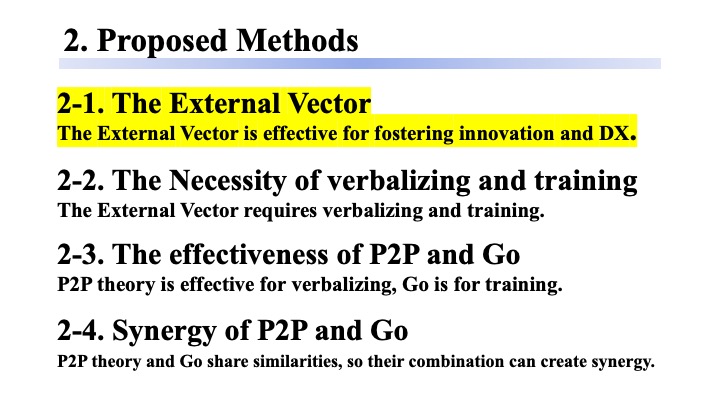 |
First of all, we would like to explain the first key point: The External Vector is effective for fostering innovation and DX.
|
|
ICACT20250027 Slide.04
[Big slide for presentation]
|
Chrome Text-to-Speach Click!! |
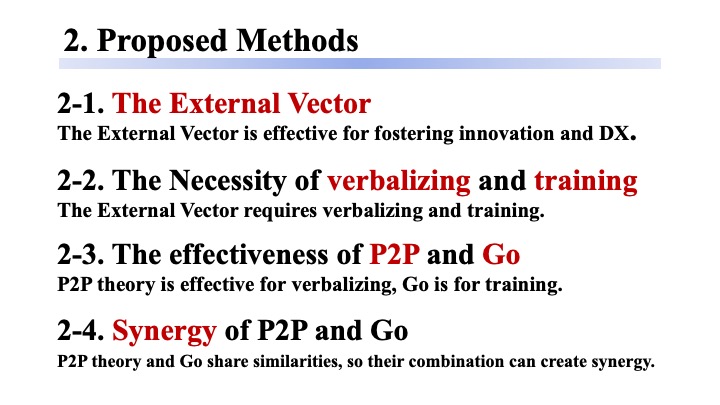 |
This study proposes the following four key points:
1. The External Vector is effective for fostering innovation and DX.
2. The External Vector requires both verbalizing (theorizing) and training.
3. P2P concepts and principles are effective for verbalizing (theorizing), while Go is effective for training. Go is a game in which players place stones on a board to compete for territory. It has a long history and is well known worldwide.
4. Through the research, we arrived at the combination of P2P and Go, and by integrating these two, greater synergy can be expected.
|
|
ICACT20250027 Slide.03
[Big slide for presentation]
|
Chrome Text-to-Speach Click!! |
 |
First, we’ll explain the background of our research. Some issues, such as depopulation in rural areas and financial difficulties caused by a declining birthrate, an aging population, and urban concentration, are accelerating decline and depopulation of local regions. Therefore, we need regional revitalization and local revitalization. Under these circumstances, it is essential to promote regional innovation and regional digital transformation.
And, we define innovation as "the creation of new values through novel ideas and perspectives." Furthermore, we define DX (Digital Transformation) as the process of creating new values by utilizing ICT (data) and transforming societal models, business models, and organizations through the application of ICT. For regional revitalization and local development, the urgent task is to create new values and drive transformation within the region. In particular, fostering innovation and transformation through the "connections" between regional resources is an effective approach.
|
|
ICACT20250027 Slide.02
[Big slide for presentation]
|
Chrome Text-to-Speach Click!! |
 |
Here’s the outline: Background, Proposed Methods, Case studies , Conclusions, References.
|
|
ICACT20250027 Slide.01
[Big slide for presentation]
|
Chrome Text-to-Speach Click!! |
 |
I’m Maho Hoshiai from Chuo University in Japan. We would like to present on “A Method for Emerging Innovation and DX by Using P2P and Go.”
|
















