 ICACT20210117 Slide.01
[Big Slide] |
Chrome  Click!! |
 |
Thanks for giving me the floor, my name is Ibrahima GUEYE. Gentlemen of the jury, dear guests hello. It is an honor for me today to present to you my research work on: Performance Analysis of Mixed MIMO RF/FSO DF Relaying Based on Globally Coupled Low Density Parity Check (GC-LDPC) Codes . So the presentation will revolve around his points
|
| ICACT20210117 Slide.02
[Big Slide]
|
Chrome Click!! |
 |
Presentation of the different parts of the plan |
| ICACT20210117 Slide.03
[Big Slide]
|
Chrome Click!! |
 |
Radio frequency (RF) communication systems have advantages like low power with good operating range and besides these here the line of sight (LOS) is not mandatory for communication. However, the problem is a lack of licensed spectrum with insufficient and also expensive data throughput |
| ICACT20210117 Slide.04
[Big Slide]
|
Chrome Click!! |
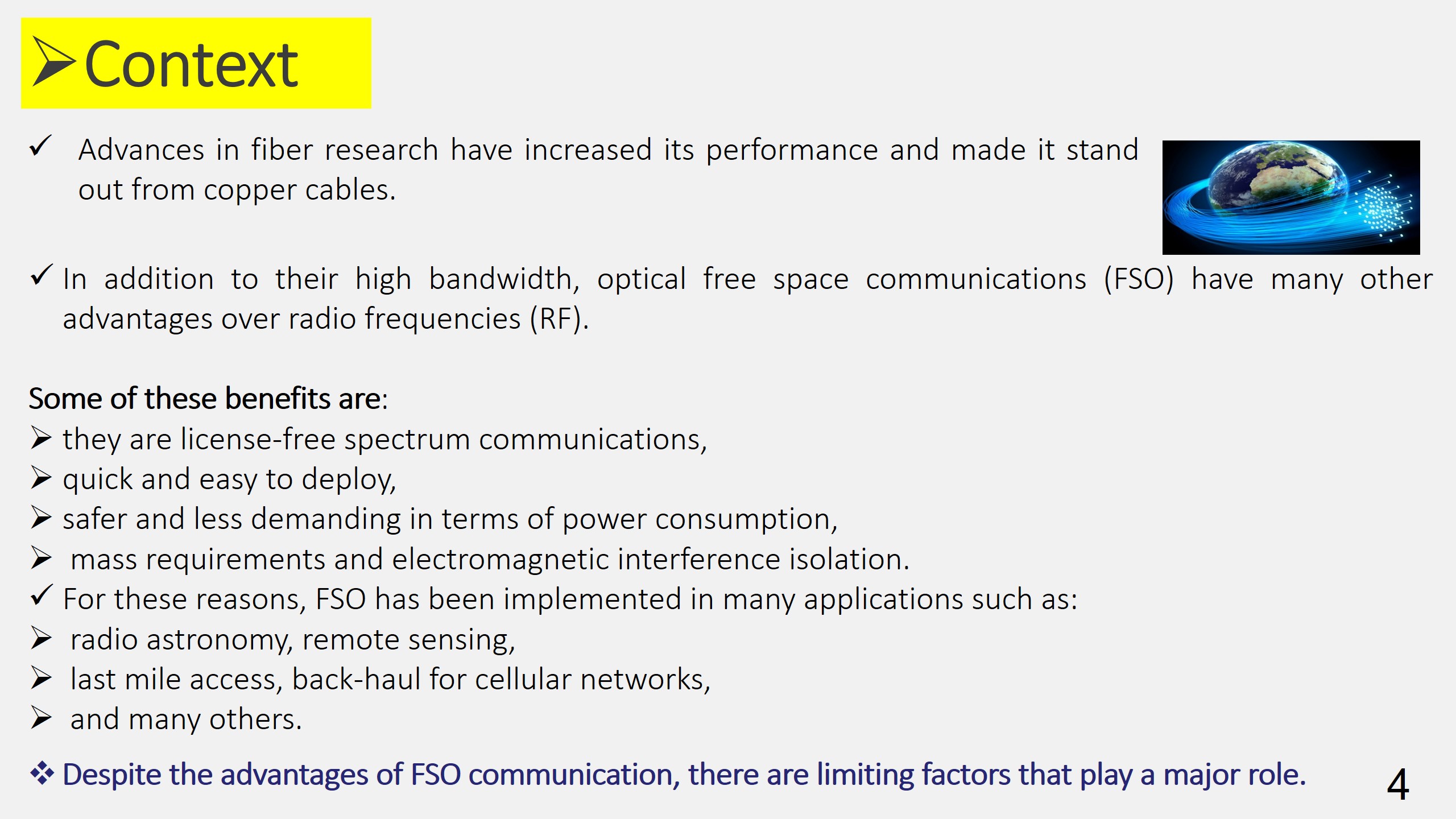 |
Advances in fiber research have increased its performance and made it stand out from copper cables. These performances now make fiber the leading medium in terms of capacity and also in terms of range if we were limited to terrestrial transmission.
In addition to their high bandwidth, optical free space communications (FSO) have many other advantages over radio frequencies (RF).
Some of these benefits are: they are license-free spectrum communications, quick and easy to deploy, safer and less demanding in terms of power consumption, mass requirements and electromagnetic interference isolation. For these reasons, FSO has been implemented in many applications such as: radio astronomy, remote sensing, last mile access, back-haul for cellular networks, and many others.
|
| ICACT20210117 Slide.05
[Big Slide]
|
Chrome Click!! |
 |
A major challenge in FSO communications is:
rain,
fog,
dust,
snow,
turbulence and misalignment. |
| ICACT20210117 Slide.06
[Big Slide]
|
Chrome Click!! |
 |
The objective of this article is to propose a cooperative MIMO RF / FSO systems assisted by DF relay based on the LDPC codes with global coupling (GC-LDPC). The main contribution of this article is to propose a cooperative MIMO RF / FSO scheme assisted by a DF relay based on error correcting codes, in particular globally coupled LDPC codes (GC-LDPC).
|
| ICACT20210117 Slide.07
[Big Slide]
|
Chrome Click!! |
 |
In these networks, the (sources) transmit their information to a base transceiver station (relay) by RF link in the first hop, while in the second hop this relay transmits the information to the backbone network (destination by FSO connection Another advantage of this mixed relay scheme is that it saves economic resources.
|
| ICACT20210117 Slide.08
[Big Slide]
|
Chrome Click!! |
 |
Motivated by the applications of RF/FSO, MIMORF/FSO systems and taking into account the limitations of the existing literature, we study the performance of cooperative RF / FSO and MIMO RF / FSO systems assisted by DF relay based on error correcting codes particularly the globally linked LDPC codes (GC-LDPC).
We also used PPM to modulate the data, we assume that FSO links follow the Gamma-Gamma distribution, while MIMO-RF links follow Rayleigh fading. We will also compare the use of GC-LDPC in mixed MIMORF / FSO communication versus SC-LDPC and QC-LDPC codes.
|
| ICACT20210117 Slide.09
[Big Slide]
|
Chrome Click!! |
 |
Consider a mixed MIMO-RF / FSO DF cooperative relay network. -Relais is better than that of the Source-Destination channel (𝑆𝑁𝑅𝑆-𝑅 > 𝑆𝑁𝑅𝑠-𝐷)) in which the source is equipped with several 𝑁_𝑇 antennas communicate with the destination via a node an intermediate relay in the presence of a receiver equipped with several 𝑁_𝑅 antennas as shown in Fig. 1. The communication channel between the source node and the relay node is a Rayleigh fading MIMO RF link, with the source and relay nodes equipped respectively with transmit 𝑁_𝑇 and receive 𝑁_𝑅 antennas. Unlike the AF protocol, the relay first decodes the symbols transmitted during the first phase using the error correcting codes particularly the GC-LDPC codes and retransmits them to the destination via an FSO link in the next phase. To allow point-to-point FSO communication, the relay and the destination are assumed to be equipped with a single photo-opening transmitter and a single photo-detector, respectively.
|
| ICACT20210117 Slide.10
[Big Slide]
|
Chrome Click!! |
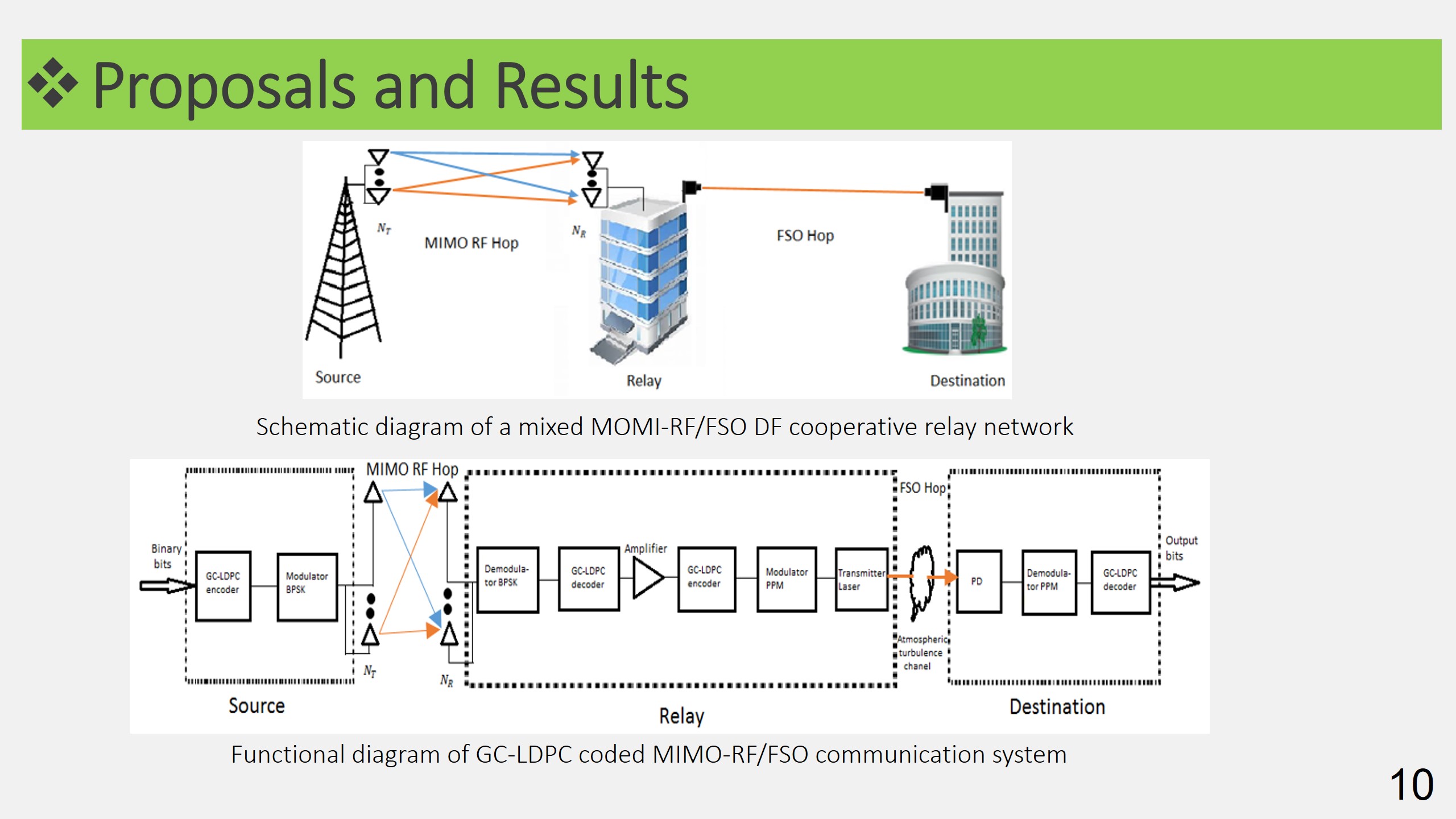 |
study model |
| ICACT20210117 Slide.11
[Big Slide]
|
Chrome Click!! |
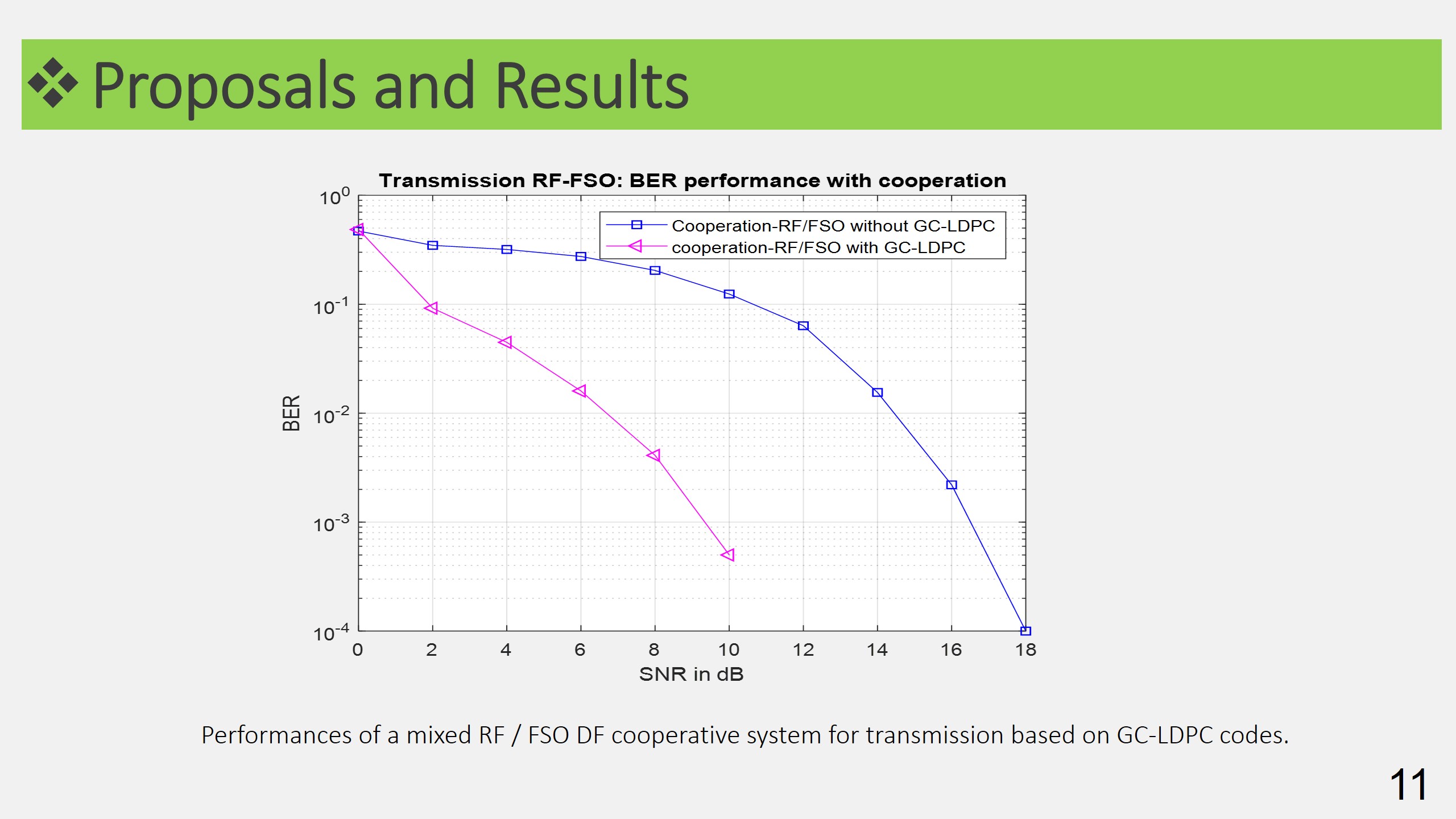 |
Figure is the BER versus the SNR graph, when two cooperation schemes are used. As can be seen, the performance of the end-to-end system improves when using error correcting codes including GC-LDPC codes.
|
| ICACT20210117 Slide.12
[Big Slide]
|
Chrome Click!! |
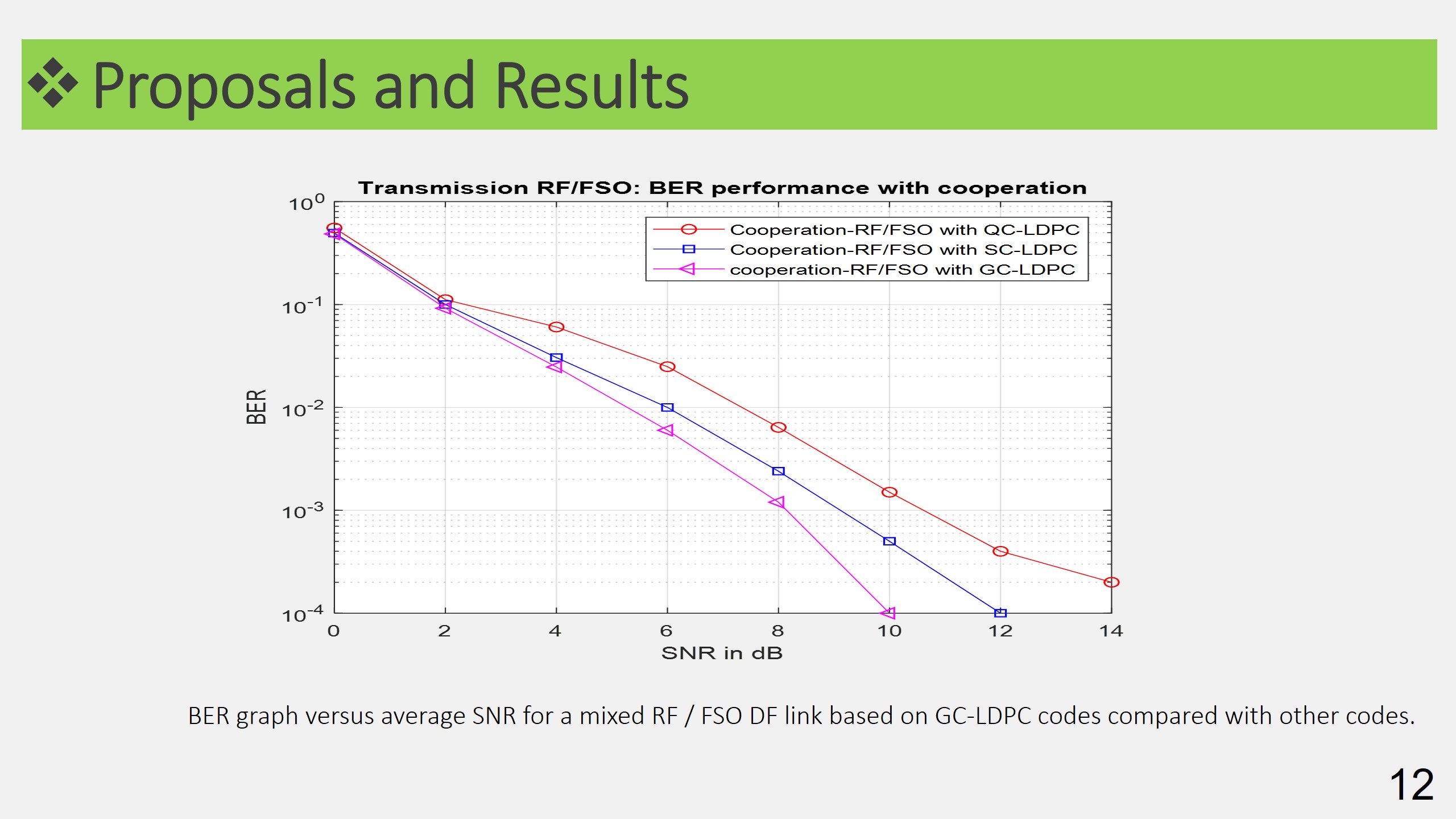 |
Figure 6 shows the comparison between the use of GC-LDPC codes with the codes mentioned above. All of these codes have been applied in mixed RF-FSO transmission.
As can be seen, the BER decreases with the use of GC-LDPC codes and this results in better performance in mixed RF-FSO transmission. It can be seen that RF / FSO transmission using error correcting codes including GC-LDPC codes have better performance compared to mixed RF / FSO transmission using SC-LDPC and QC-LDPC.
|
| ICACT20210117 Slide.13
[Big Slide]
|
Chrome Click!! |
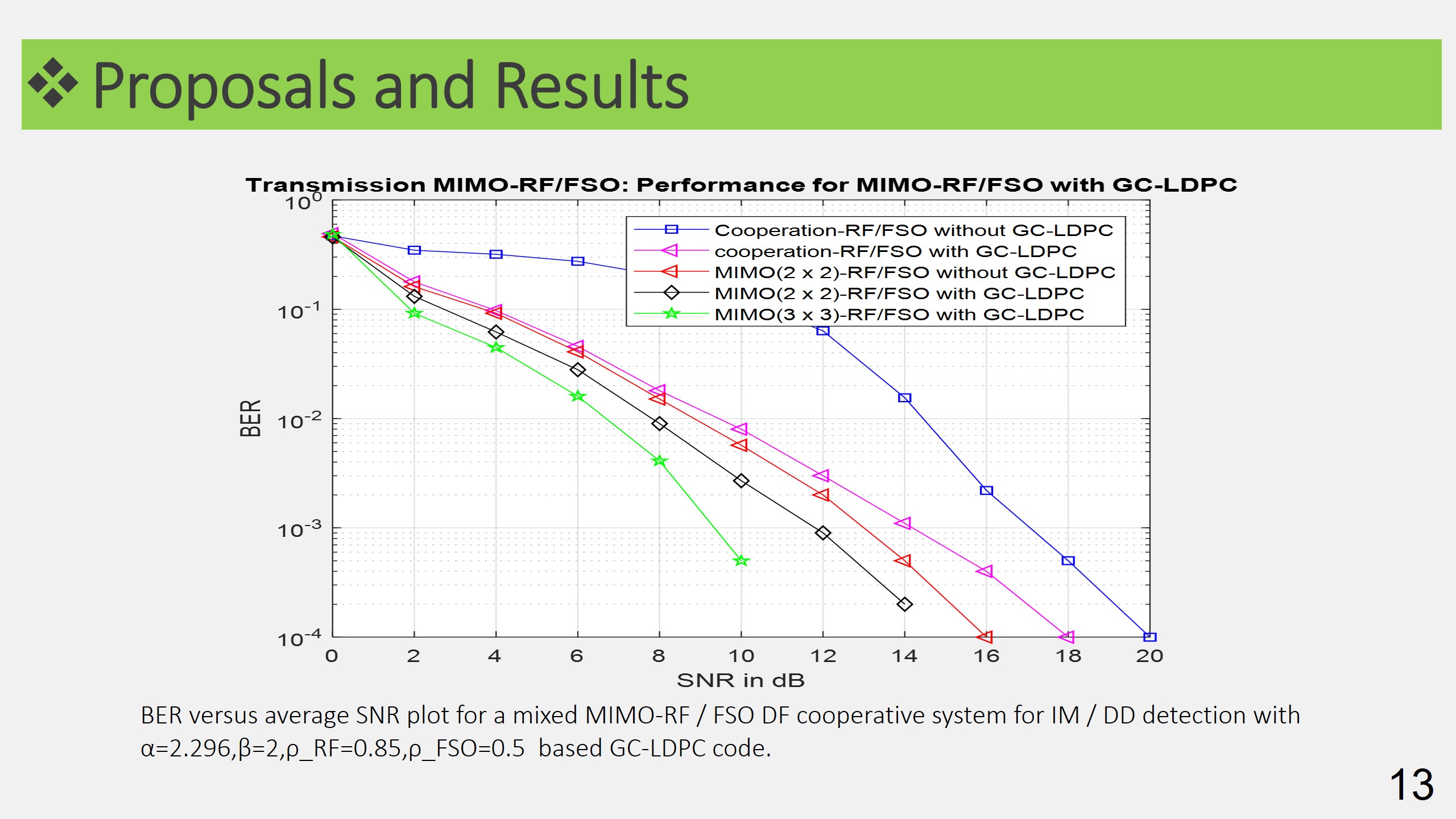 |
The figure shows the graph of the analytical BER, simulated against the mean SNR to show the impact of DF MIMO-RF / FSO cooperative systems using GC-LDPC codes for conditions of strong atmospheric turbulence.
This figure also shows the advantage of using mixed DF MIMO-RF / FSO cooperative systems using GC-LDPC codes. It is clearly seen that the performance of MIMO-RF/FSO systems is better than that of end-to-end (RF/FSO) systems. In addition, one can also see the impact of the number of transmitting and receiving antennas on the performance of the MIMO-RF / FSO system.
|
| ICACT20210117 Slide.14
[Big Slide]
|
Chrome Click!! |
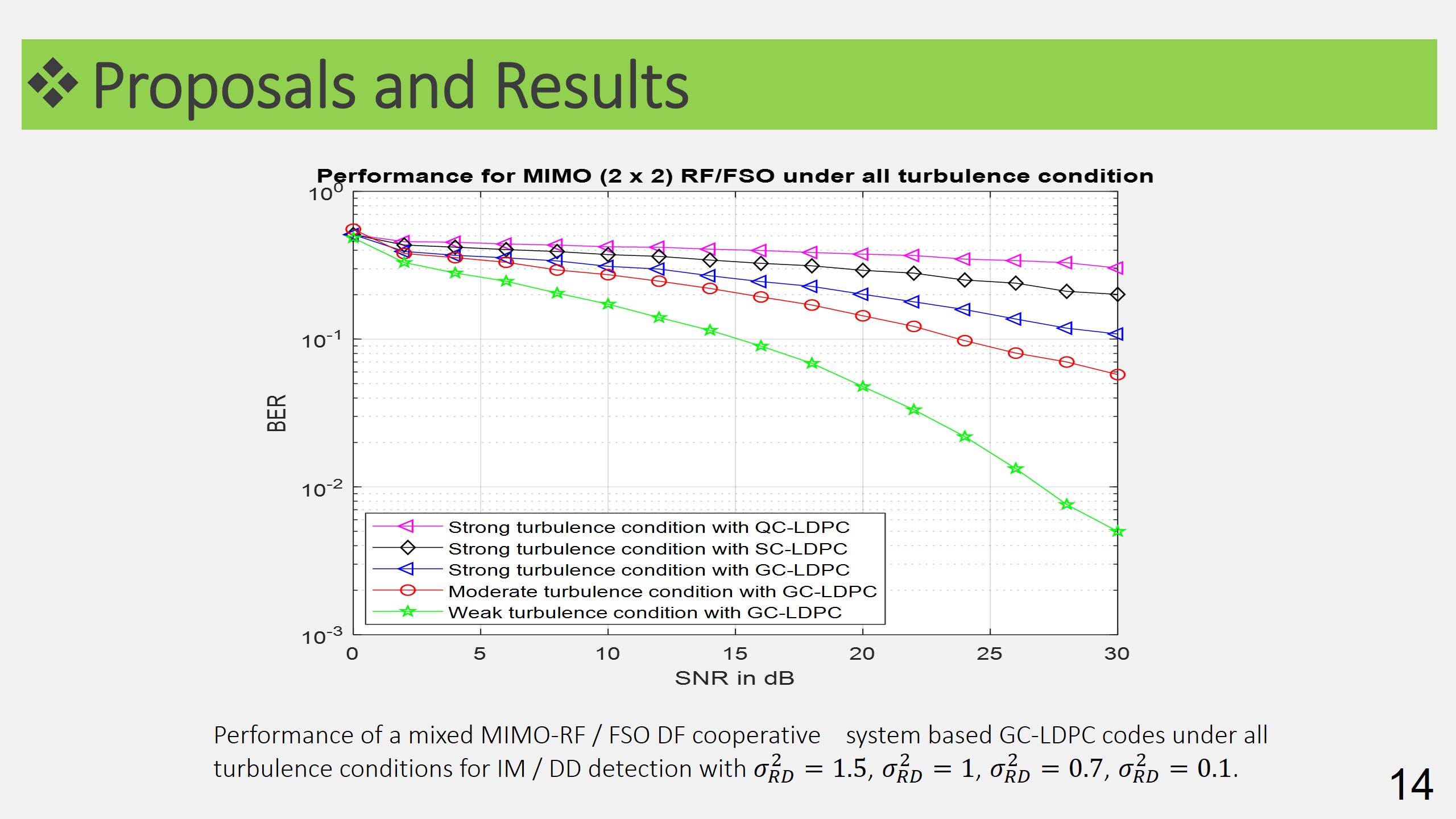 |
Figure shows the BER versus mean SNR graph to assess the influences of atmospheric turbulence parameters 𝜎_𝑅𝐷^2 the robustness of the GC-LDPC codes for conditions of strong and moderate atmospheric turbulence as well as for conditions of weak atmospheric turbulence.
In it can be clearly seen that smaller values 𝜎_𝑅𝐷^2, i.e. lower atmospheric turbulence, give better performance compared to schemes with higher values 𝜎_𝑅𝐷^2, i.e stronger atmospheric turbulence. Here we obtained BER performance that is better for low turbulent revs compared to moderate and high turbulence environments. The graph shows that the performance of the system deteriorates as the force of the turbulence increases.
|
| ICACT20210117 Slide.15
[Big Slide]
|
Chrome Click!! |
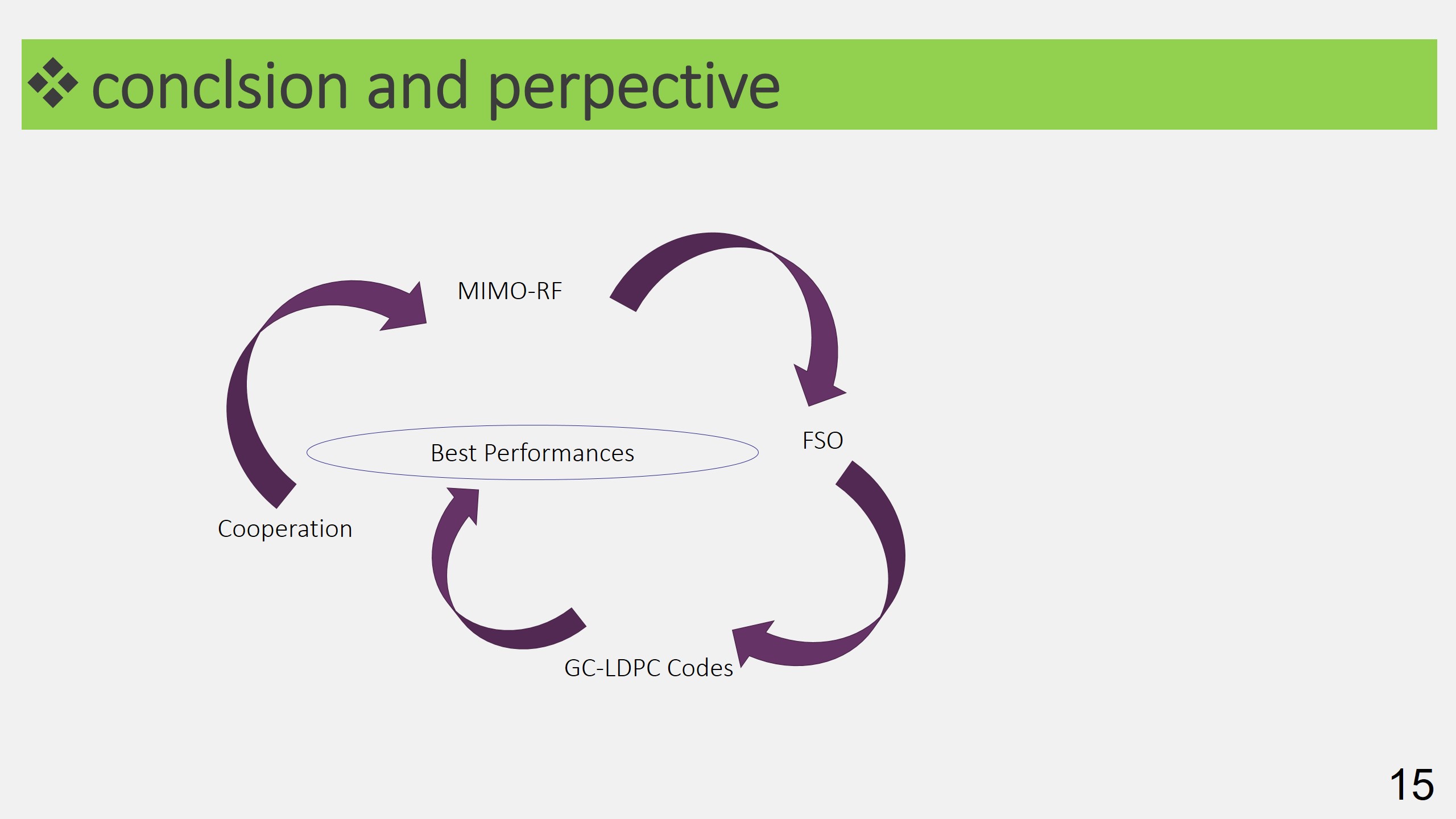 |
MIMO RF links were assumed to follow Rayleigh fading, while the FSO link was a distributed Gamma-Gamma point-to-point link, affected by path loss and pointing errors. In MIMO RF hopping, the IA technique has been used to eliminate interference, and therefore this leads to improving the multiplexing gain in this hop, and as a result, the overall performance of the system is improved. Using error-correcting codes called GC-LDPC codes has been shown to help protect information resulting in improved system performance. it is also shown that a MIMO-RF / FSO system using the GC-LDPC error correcting codes gives a substantial improvement in performance compared to a MIMO-RF / FSO system without the error correcting codes but also compared to an RF/FSO system using the other codes like the codes SC-LDPC and QC-LDPC. |
| ICACT20210117 Slide.16
[Big Slide]
|
Chrome Click!! |
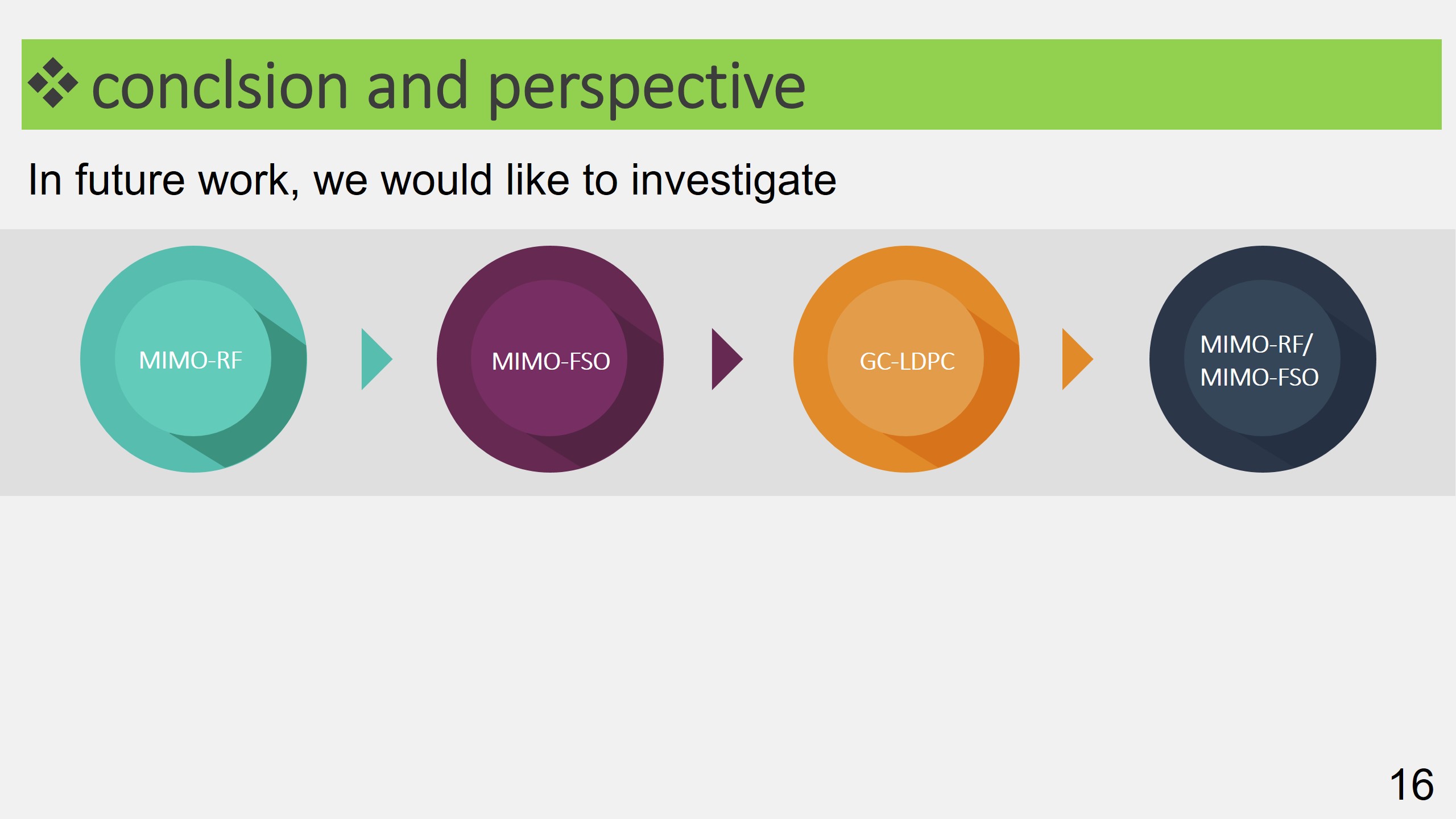 |
In our future research, we are interested in the use of MIMO-RF / MIMO-FSO systems associated with error correcting codes and the use of MIMO FSO systems in advanced telecommunications i.e. the fifth generation. (5G). |
| ICACT20210117 Slide.17
[Big Slide]
|
Chrome Click!! |
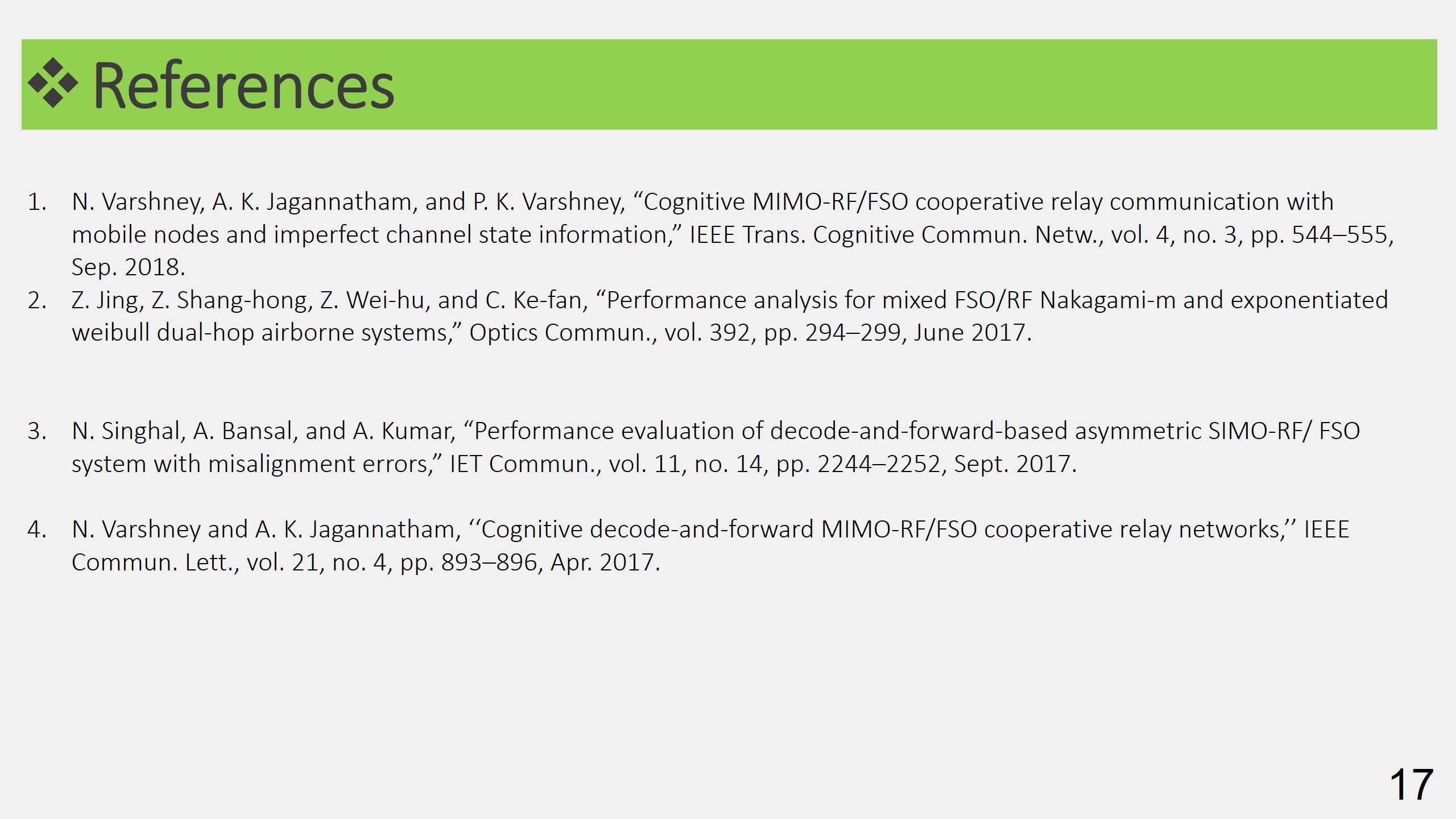 |
Repositories |
| ICACT20210117 Slide.18
[Big Slide]
|
Chrome Click!! |
 |
Thank you for your attention |















