 ICACT20210156 Slide.01
[Big Slide] |
Chrome  Click!! |
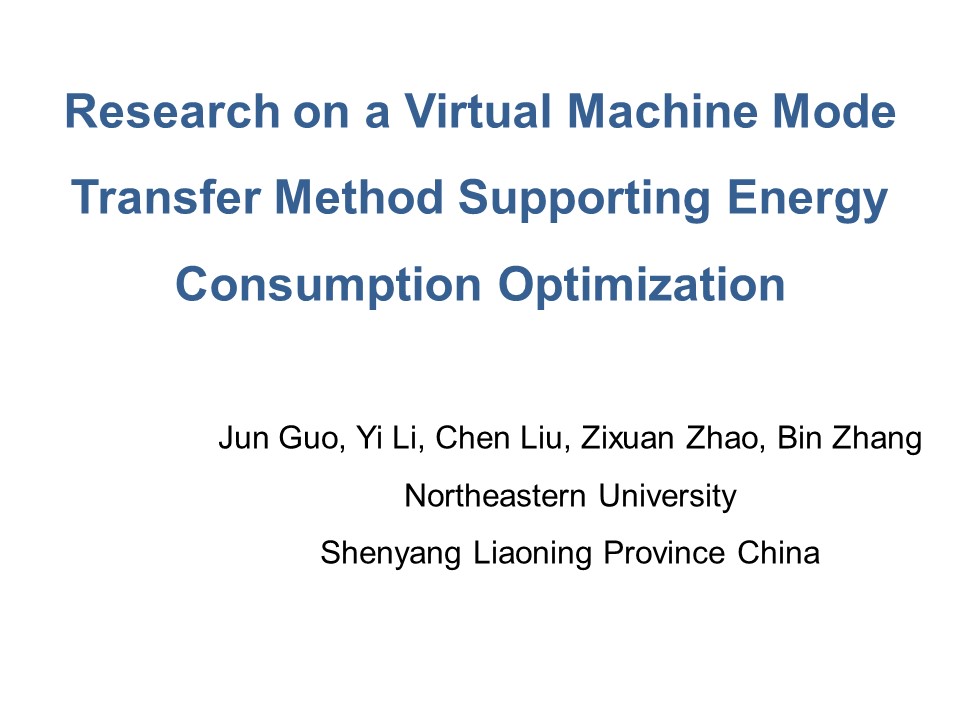 |
Hi everybody, my name is Yi Li. For ICACT 2021, I have cooperated with four partners from Northeastern University. Dr. Jun Guo, Mrs. Chen Liu, Mr. Zixuan Zhao, Dr. Bin Zhang. Our presentation today is about a research on a virtual machine mode transfer method supporting energy consumption optimization |
| ICACT20210156 Slide.02
[Big Slide]
|
Chrome Click!! |
 |
As the Internet technologies are developing rapidly, performance is often taken into account as the primary goal. A great number of cloud systems are constructed with a resource configuration for the maximum service performance. Nevertheless, such configuration programs can result in problems such as low resource utilization and energy dissipation in practices. With the expansion of cloud systems, these problems are becoming overwhelmed, forcing IT system managers to address energy consumption more seriously
|
| ICACT20210156 Slide.03
[Big Slide]
|
Chrome Click!! |
 |
However, there are numerous scenarios in which performance and energy consumption are not compatible due to the complex counteraction between performance and energy metrics. For example, allocating more virtual machines to a task can effectively improve performance, while consuming more energy. Therefore, it is necessary to make appropriate allocation of virtual machines to find an optimal balance between performance and energy consumption.
|
| ICACT20210156 Slide.04
[Big Slide]
|
Chrome Click!! |
 |
To address the above problems and reduce energy consumption, this paper focuses on the transfer target of mode virtual machines, that is, when reducing the number of hot mode virtual machines, hot mode virtual machines are switched to the cold mode, for which a solution that reduces the most energy consumption is selected by using hot mode sleep selection algorithm that supports energy protection; when increasing the number of hot mode virtual machines, cold mode virtual machines are switched to the hot mode, for which a solution that increases fewer energy consumption is selected by using cold mode wake-up selection algorithm that supports energy protection. The effectiveness of the method is verified experimentally.
|
| ICACT20210156 Slide.05
[Big Slide]
|
Chrome Click!! |
 |
After activating a cloud service system, energy consumption, both basic and dynamic, is occurred. When the system is in standby, it will only produce basic energy consumption; when the system is running tasks, it will produce both basic and dynamic energy consumption. Table 1 shows the measured no-load power consumption of servers in the experiment. The data analysis results show that energy consumption generated by the sleep and shutdown state of servers is much smaller than that generated by the no-load and standby state of servers. |
| ICACT20210156 Slide.06
[Big Slide]
|
Chrome Click!! |
 |
In order to reduce energy consumption, further considerations of transfer target of each mode virtual machines are necessary, that is, operating mode and hot mode virtual machines are converged in a cluster of physical machines of minimum amount to reduce energy consumption by shutting down idle physical machines; the cold mode virtual machines are converged in another cluster of physical machines of as few physical machines as possible to reduce energy consumption through collective sleep. The pseudo-code of the algorithm is shown in 1 |
| ICACT20210156 Slide.07
[Big Slide]
|
Chrome Click!! |
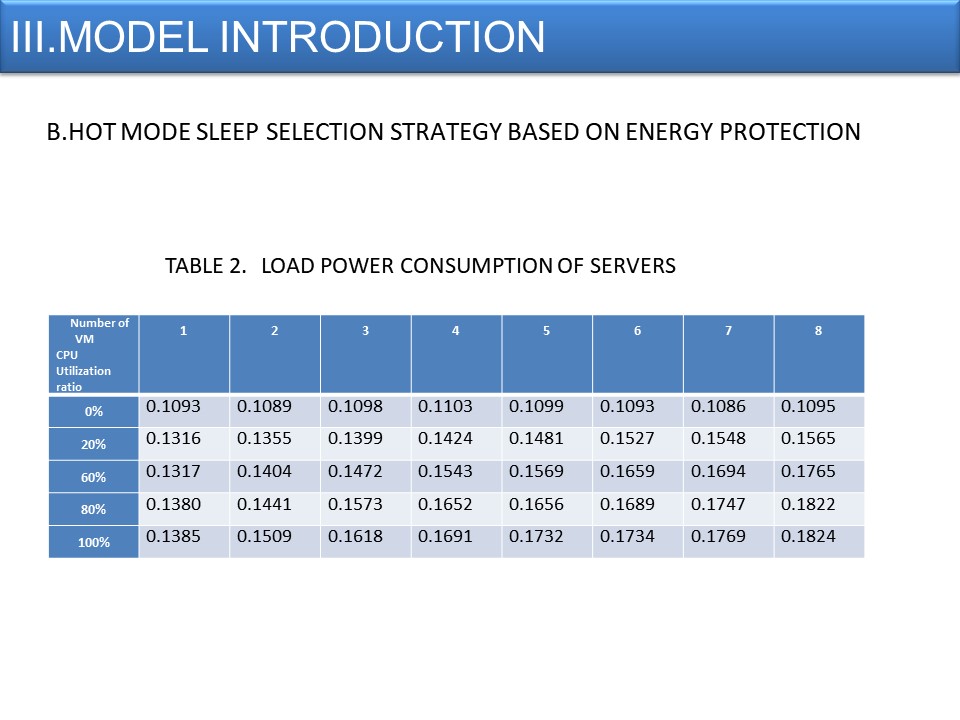 |
When reducing the number of hot mode virtual machines, hot mode virtual machines are switched to cold mode. In this paper, it will choose a solution with greater decrement in energy consumption. Table 2 shows the measured power consumption of loaded servers in the experiment. The data analysis result shows that servers with more cold mode switch from hot mode to cold mode will reduce less energy consumption. In contrast, physical machines with fewer cold mode switch from hot mode to cold mode will reduce greater energy consumption. Therefore, when reducing the number of hot mode virtual machines, to ensure as few energy consumption as possible, physical machines are set to sleep as the number of cold mode exceeds the number on a physical machine. Therefore, the optimal solution is to reduce hot mode on physical machines with more cold mode, so that it will reduce the number of migrated virtual machines while the physical machines are sleep. |
| ICACT20210156 Slide.08
[Big Slide]
|
Chrome Click!! |
 |
From the above analyses, this paper designs a hot mode sleep selection algorithm supporting energy protection, the pseudo-code of which is shown in 2. |
| ICACT20210156 Slide.09
[Big Slide]
|
Chrome Click!! |
 |
When increasing the number of hot mode virtual machines, cold mode virtual machines are switched to hot mode. In this paper, it will choose a solution with less increment in energy consumption. According to the energy consumption model of physical machines, the physical machines with more cold mode switch from cold mode to hot mode will generate greater energy consumption. On the contrary, physical machines with less cold mode switch from cold mode to hot mode will generate less energy consumption. Therefore, in order to consume as few energy as possible when increasing the number of hot mode virtual machines, this paper designs a cold mode wake-up selection algorithm supporting energy protection, the pseudo-code of which is shown in 3. |
| ICACT20210156 Slide.10
[Big Slide]
|
Chrome Click!! |
 |
Table 3 shows a default set of experimental parameters. To better characterize each method, the loadrunner is used to load the backup system in three time periods: during 0-4 hours, simulate 0-5,000 requests per second; during 5-8 hours, simulate 5,000-10,000 requests per second; during 8-12 hours, simulate 1,000-10,000 requests per second. In each time period, three experiments are conducted to test the adjustment methods: the first experiment uses control method 1, and the second experiment uses control method 2. The number of operating modes is adjusted according to the predicted concurrency against control method 2 for fairness. The third experiment uses the method designed in this paper. Finally, this experiment uses the system energy consumption as an index to analyze the performance of adjustment methods to verify the effectiveness of the virtual machine mode transfer method based on energy consumption optimization designed in this paper |
| ICACT20210156 Slide.11
[Big Slide]
|
Chrome Click!! |
 |
In this paper, three sets of controlled experiments are conducted, comparing method 1 (all operating modes), method 2 (traditional backup method), and the method designed in this paper (virtual machine mode transfer method based on energy consumption optimization), and the results are shown in Figure |
| ICACT20210156 Slide.12
[Big Slide]
|
Chrome Click!! |
 |
Figure shows that within 12 hours, the average energy consumption of the working virtual machines under the adjustment method proposed in this paper is much lower than that of the control method 1. Because the dynamic optimization method in this paper includes a mode transfer strategy based on energy protection, which transfers cold mode to a physical machine as much as possible, while the control method 1 that has all virtual machines in working state without considering energy savings consumes the most energy. The control method 2 is a traditional backup method that only considers a backup mode (cold mode) which is in sleep state, so that consumes less energy. It is calculated that the proposed strategy in this paper generates an average energy savings of 12.16% compared to the control method 1 and 10.15% compared to the control method 2. |
| ICACT20210156 Slide.13
[Big Slide]
|
Chrome Click!! |
 |
In this paper, a virtual machine mode transfer method supporting energy consumption optimization is proposed, and three sets of controlled experiments are designed to verify the effectiveness of the proposed method, which can make flexible adjustment according to the request status, and reduces energy consumption while ensuring cloud service performance and responding to user requirements.
|
| ICACT20210156 Slide.14
[Big Slide]
|
Chrome Click!! |
 |
In this paper, with respect to the mode transfer method that supports energy protection, when the operating mode virtual machines fail, the complete switch of hot mode is taken into account without expecting failure during switch, which may affect the effectiveness of dynamic optimization strategy. It is recommended that switch failure types of hot mode switch may be included in further studies.
|
| ICACT20210156 Slide.15
[Big Slide]
|
Chrome Click!! |
 |
Thanks for your attention !
|
| ICACT20210156 Slide.16
[Big Slide]
|
Chrome Click!! |
 |
|















