 ICACT20210157 Slide.01
[Big Slide] |
Chrome  Click!! |
 |
Hello everybody, my name is Heyan Gao. For ICACT 2021, I have cooperated with three students from Northeastern University of China.
They are Zeyu Yan, Jiahui Cao and Zhenbo Fu. And our work has been done with the help of our assistant professor, Jun Guo.
Our presentation today is about an algorithm of vehicle detection counting based on Background Subtraction Algorithm and Sort.
|
| ICACT20210157 Slide.02
[Big Slide]
|
Chrome Click!! |
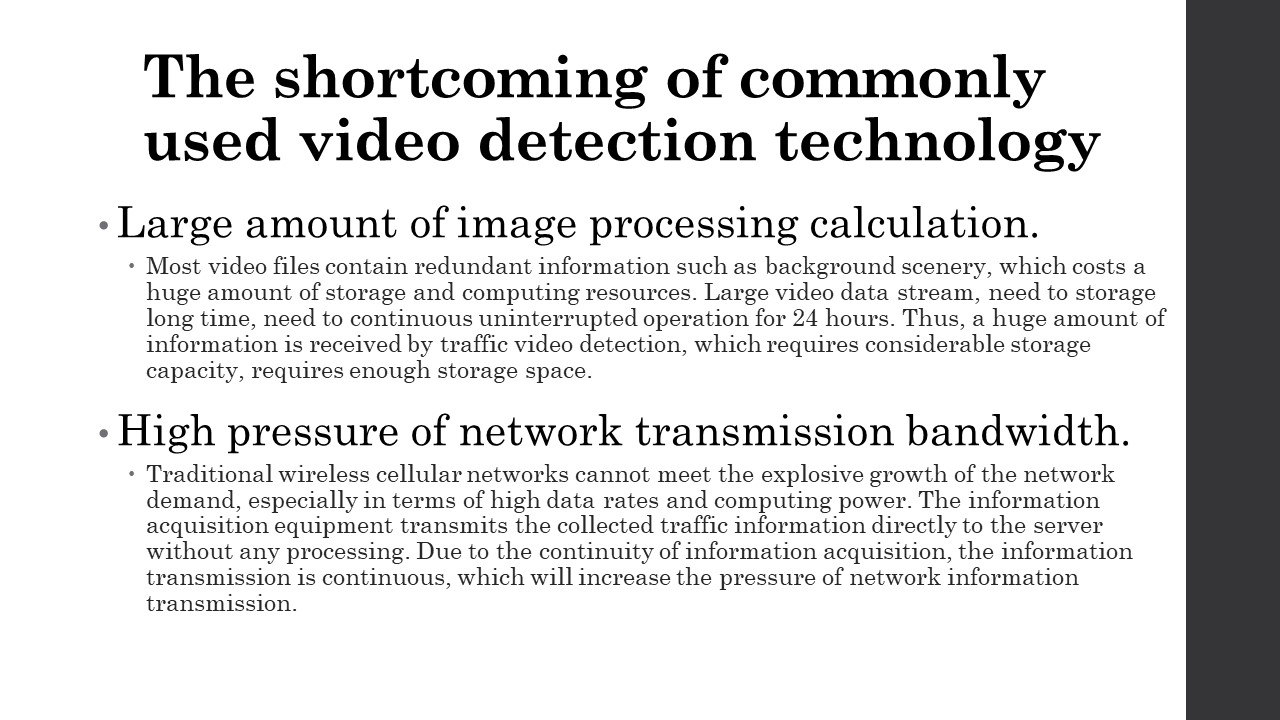 |
The commonly used technology for expressway traffic anomaly monitoring in the current intelligent transportation system is video detection technology, but it still has the following shortcomings:
It needs large amount of image processing calculation and the video transmission leads to high pressure of network transmission bandwidth. Therefore, expressway still needs fast and efficient image processing algorithm to realize low-cost dynamic vehicle detection.
|
| ICACT20210157 Slide.03
[Big Slide]
|
Chrome Click!! |
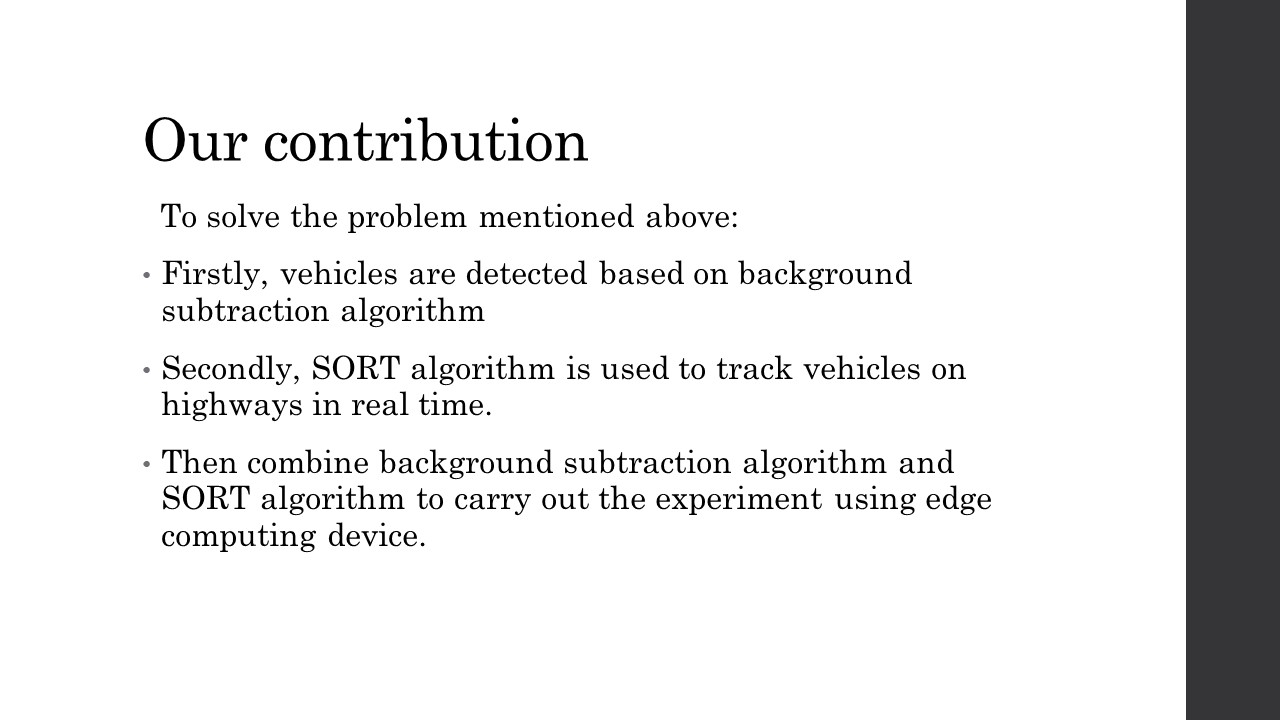 |
This is our main work: we use background subtraction algorithm to detect vehicles and use SORT algorithm to achieve multi-vehicle tracking. Then background subtraction algorithm and SORT algorithm are combined to achieve vehicle counting.
|
| ICACT20210157 Slide.04
[Big Slide]
|
Chrome Click!! |
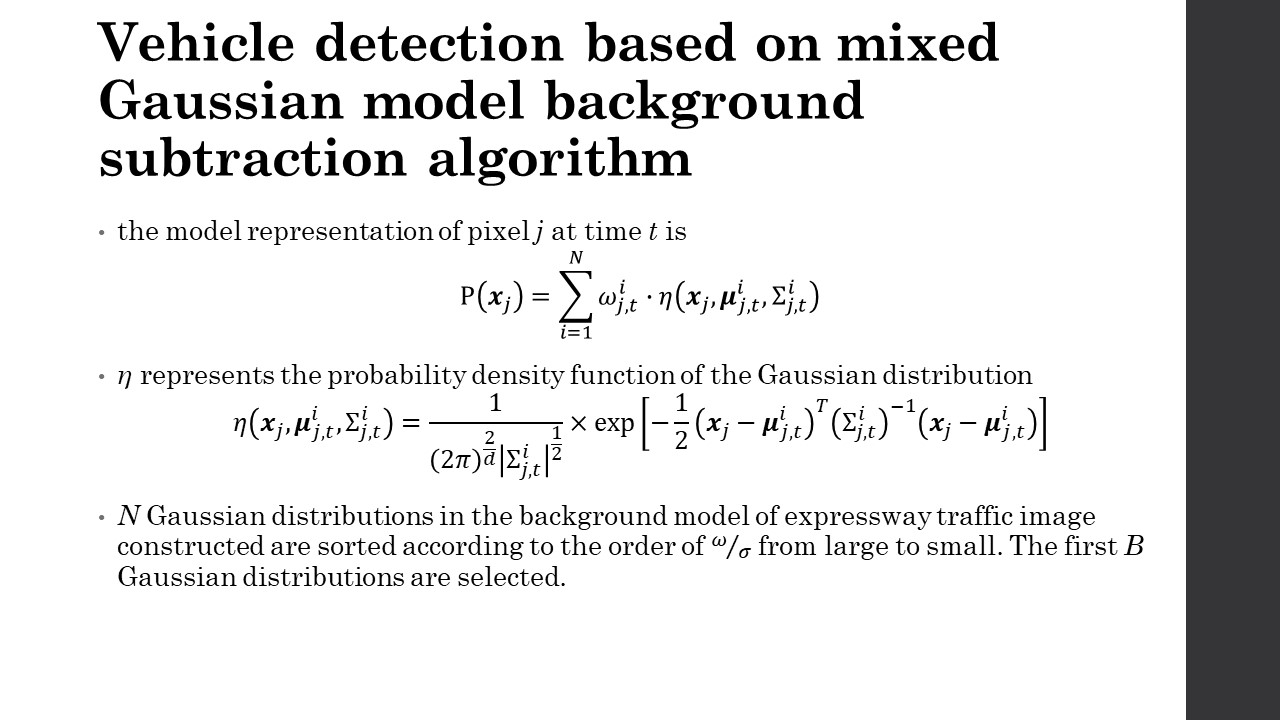 |
Assuming that the observed values of each pixel in the expressway traffic video image collected by the edge computing device are independent of each other, and each pixel in the expressway traffic image is modeled by a mixed Gaussian model containing N Gaussian distributions, the model representation of pixel j at time t is shown in formula.
|
| ICACT20210157 Slide.05
[Big Slide]
|
Chrome Click!! |
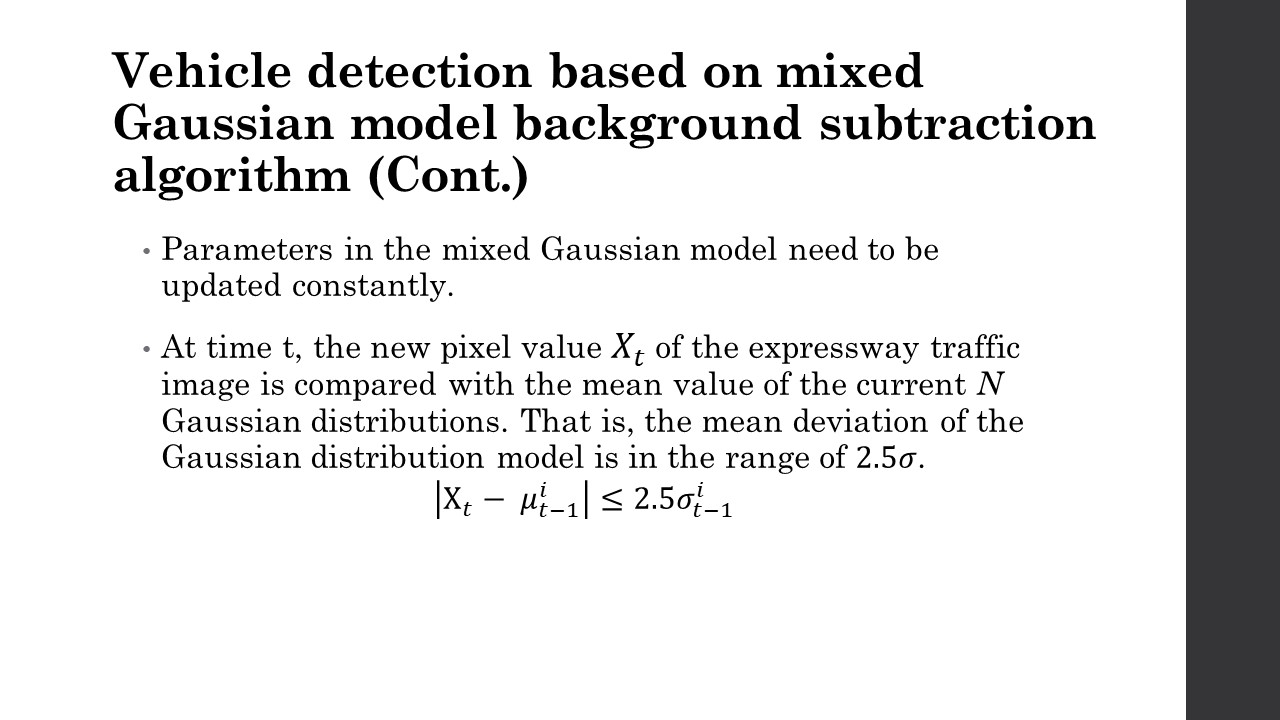 |
In order to make the background model of expressway traffic image robust[16], the parameters in the mixed Gaussian model need to be updated constantly. Therefore, at time t, the new pixel value 𝑋_𝑡 of the expressway traffic image is compared with the mean value of the current N Gaussian distributions, then the Gaussian distribution model matching the new pixel value 𝑋_𝑡 of the expressway traffic image is found. That is, the mean deviation of the Gaussian distribution model is in the range of 2.5¥ò.
|
| ICACT20210157 Slide.06
[Big Slide]
|
Chrome Click!! |
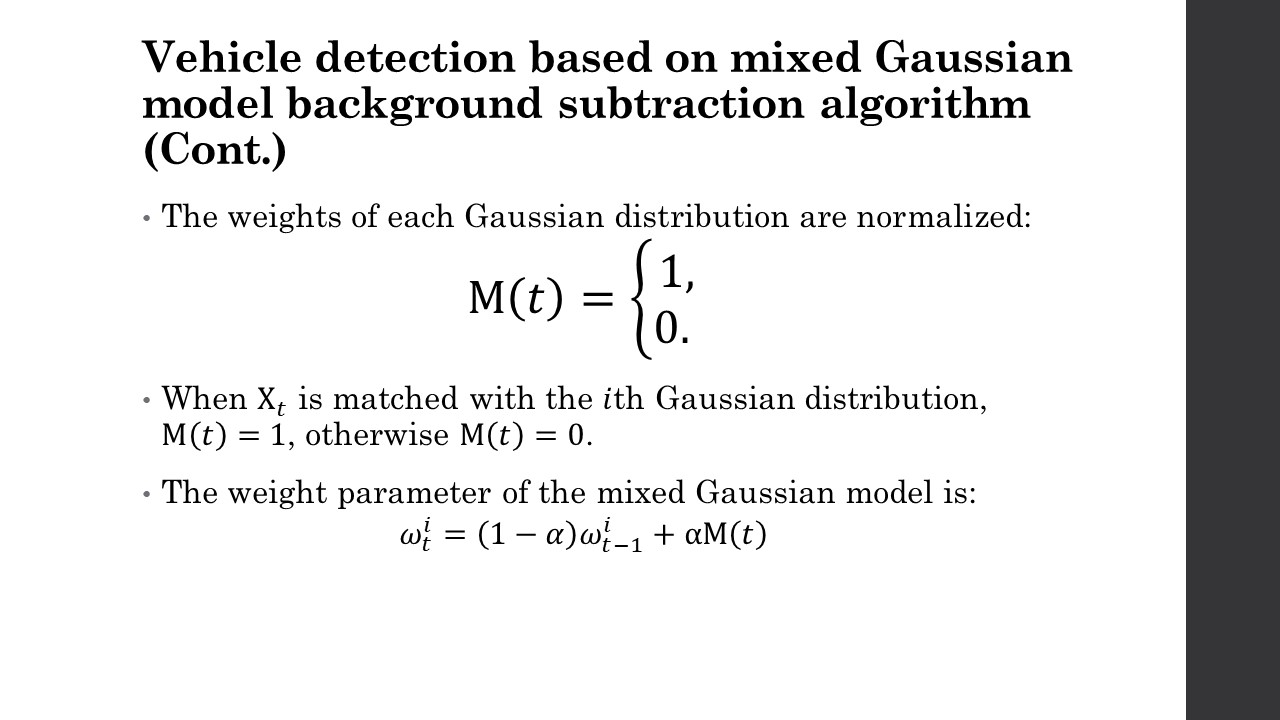 |
The weights of each Gaussian distribution are normalized. The weight parameters of the mixed Gaussian model are updated as the formula.
|
| ICACT20210157 Slide.07
[Big Slide]
|
Chrome Click!! |
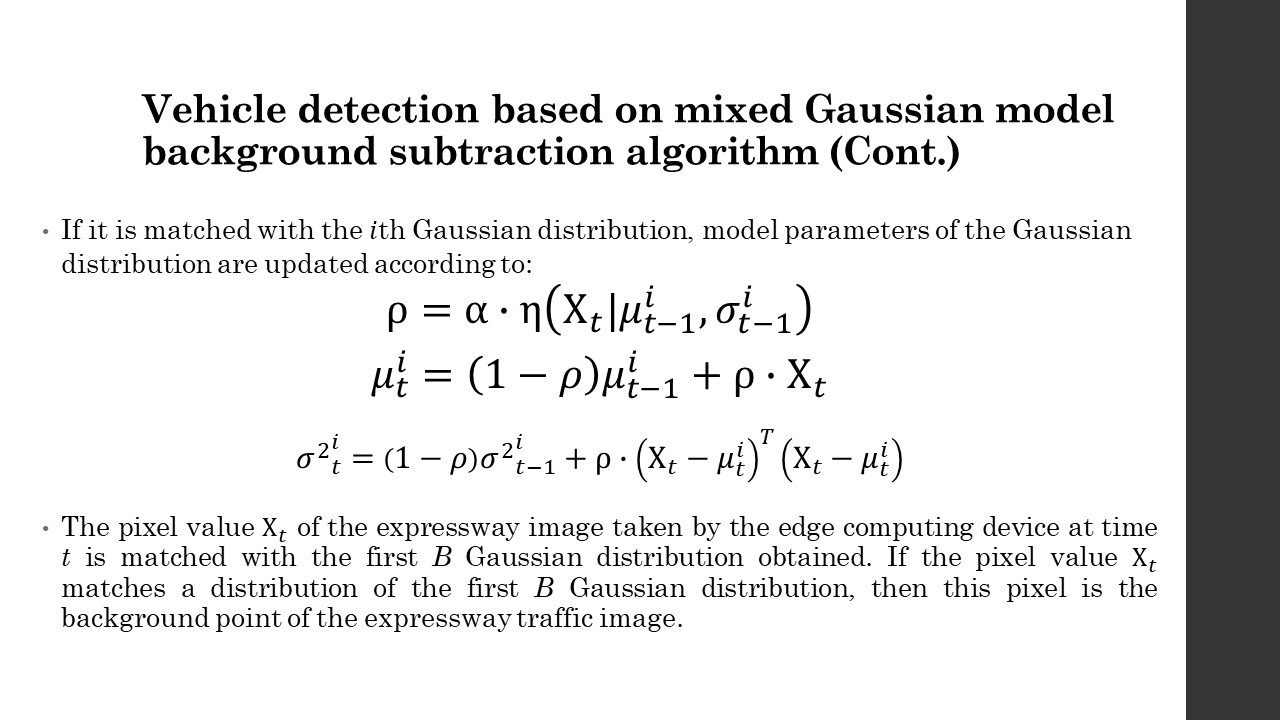 |
If it is matched with the 𝑖th Gaussian distribution, then the model parameters of the Gaussian distribution are updated according to the formulas. If X_𝑡 is not matched with the 𝑖th Gaussian distribution, then the model mean and standard deviation of the Gaussian distribution remain unchanged.
|
| ICACT20210157 Slide.08
[Big Slide]
|
Chrome Click!! |
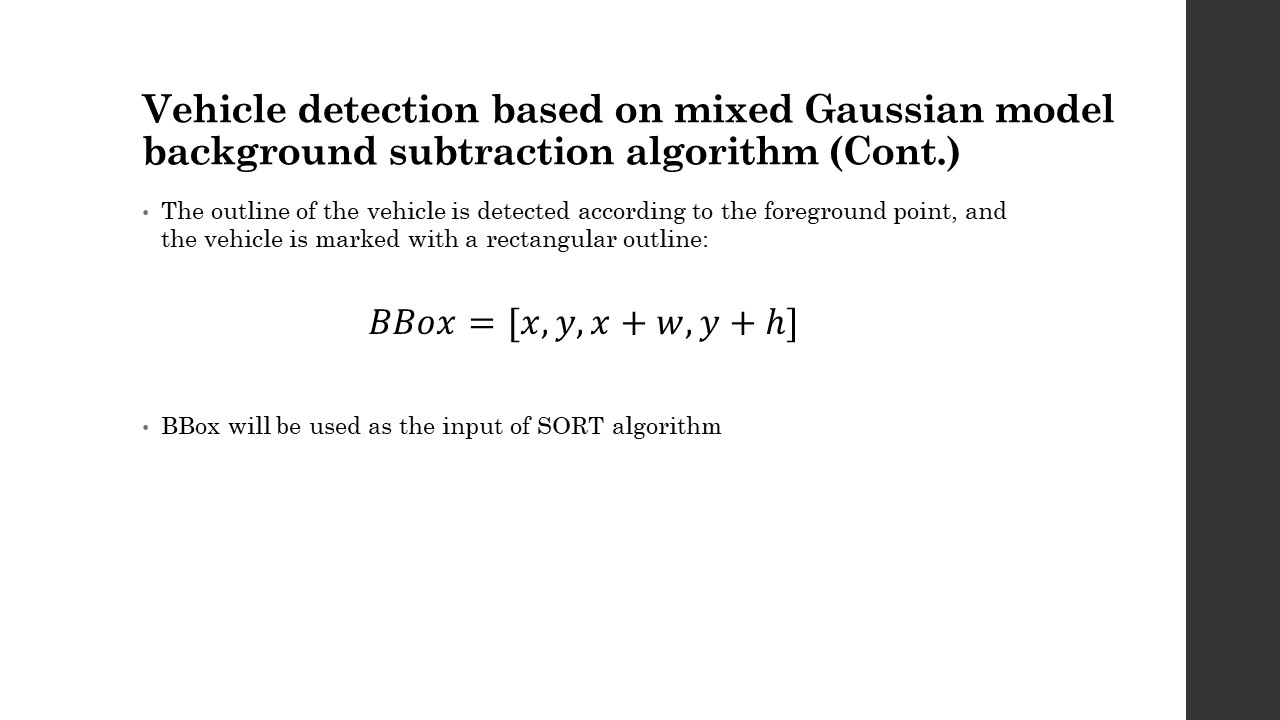 |
The outline of the vehicle is detected according to the foreground point, and the vehicle is marked with a rectangular outline, which is represented as the formula and used as the input of SORT algorithm.
|
| ICACT20210157 Slide.09
[Big Slide]
|
Chrome Click!! |
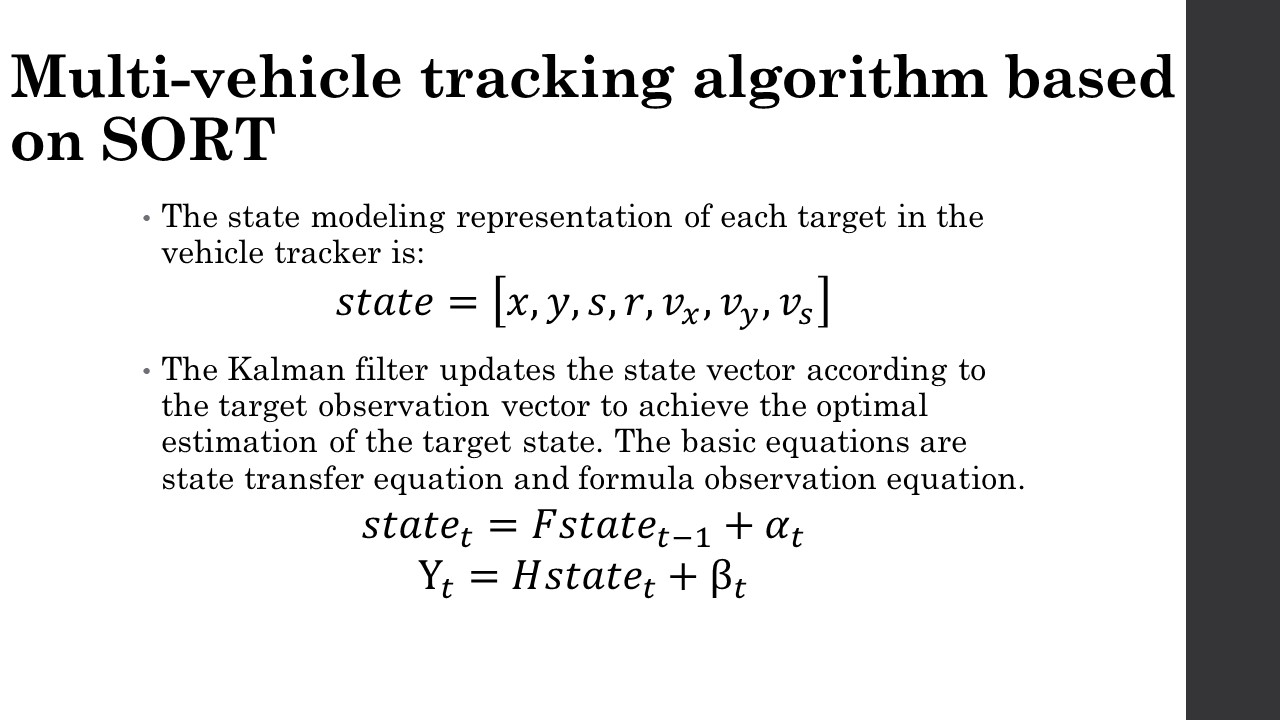 |
The state modeling representation of each target in the vehicle tracker is shown in formula. 𝑥 is the horizontal coordinate of the target center. 𝑦 is the vertical coordinates of target center. 𝑠 is the target boundary box area. 𝑟 is the target boundary frame aspect ratio. 𝑣_𝑥 is the target velocity in a horizontal component, 𝑣_𝑦 is a target velocity component in vertical direction, 𝑣_𝑠 is the area of the target boundary box change rate. The Kalman filter updates the state vector according to the target observation vector to achieve the optimal estimation of the target state. The basic equations are state transfer equation and observation equation.
|
| ICACT20210157 Slide.10
[Big Slide]
|
Chrome Click!! |
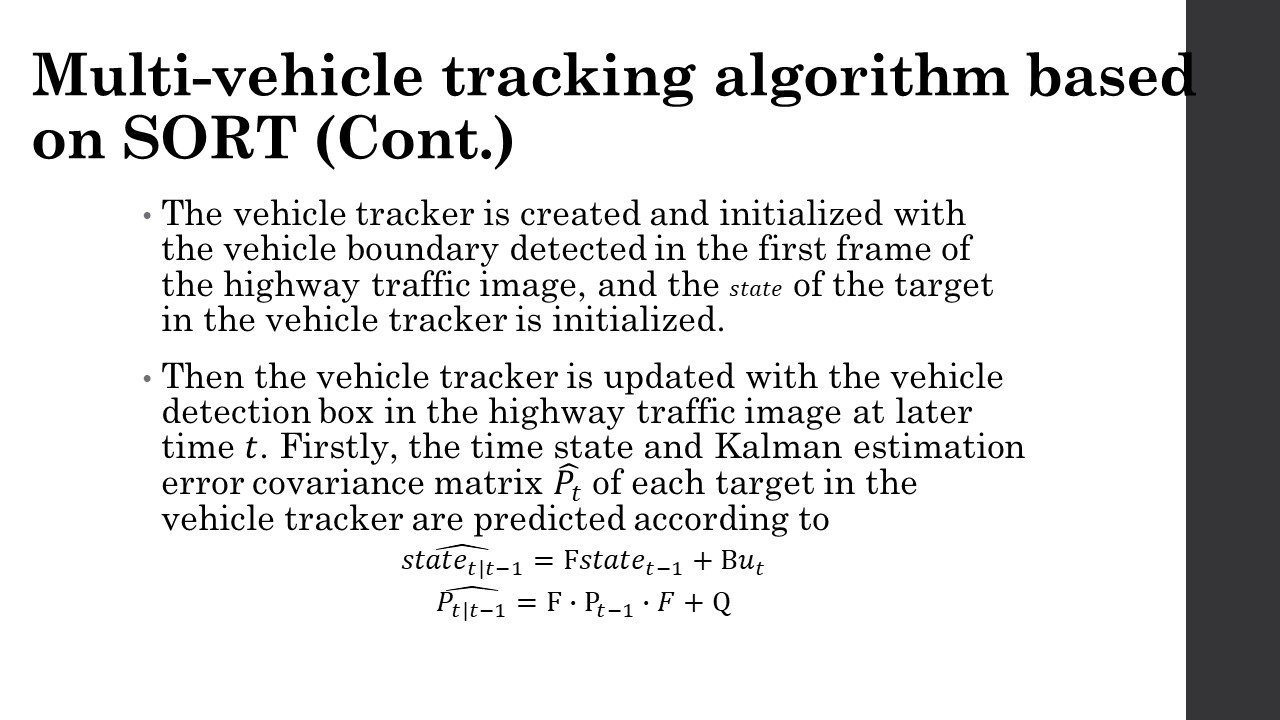 |
The vehicle tracker is created and initialized with the vehicle boundary detected in the first frame of the highway traffic image, and the 𝑠𝑡𝑎𝑡𝑒 of the target in the vehicle tracker is initialized.
Then the vehicle tracker is updated with the vehicle detection box in the highway traffic image at later time 𝑡. Firstly, the time state and Kalman estimation error covariance matrix (𝑃_𝑡 ) ̂ of each target in the vehicle tracker are predicted according to the formula.
|
| ICACT20210157 Slide.11
[Big Slide]
|
Chrome Click!! |
 |
The predicted state of the target in the vehicle tracker is then transformed into the BBox of the target, and the IOU (Intersection over Union) of the vehicle BBox detected in the current frame is calculated and the IOU matrix of multiple targets in the vehicle tracker can be obtained by the IOU of the vehicle BBox detected in the current frame. Then algorithm was used to get the IOU composite index pair with the maximum match.
|
| ICACT20210157 Slide.12
[Big Slide]
|
Chrome Click!! |
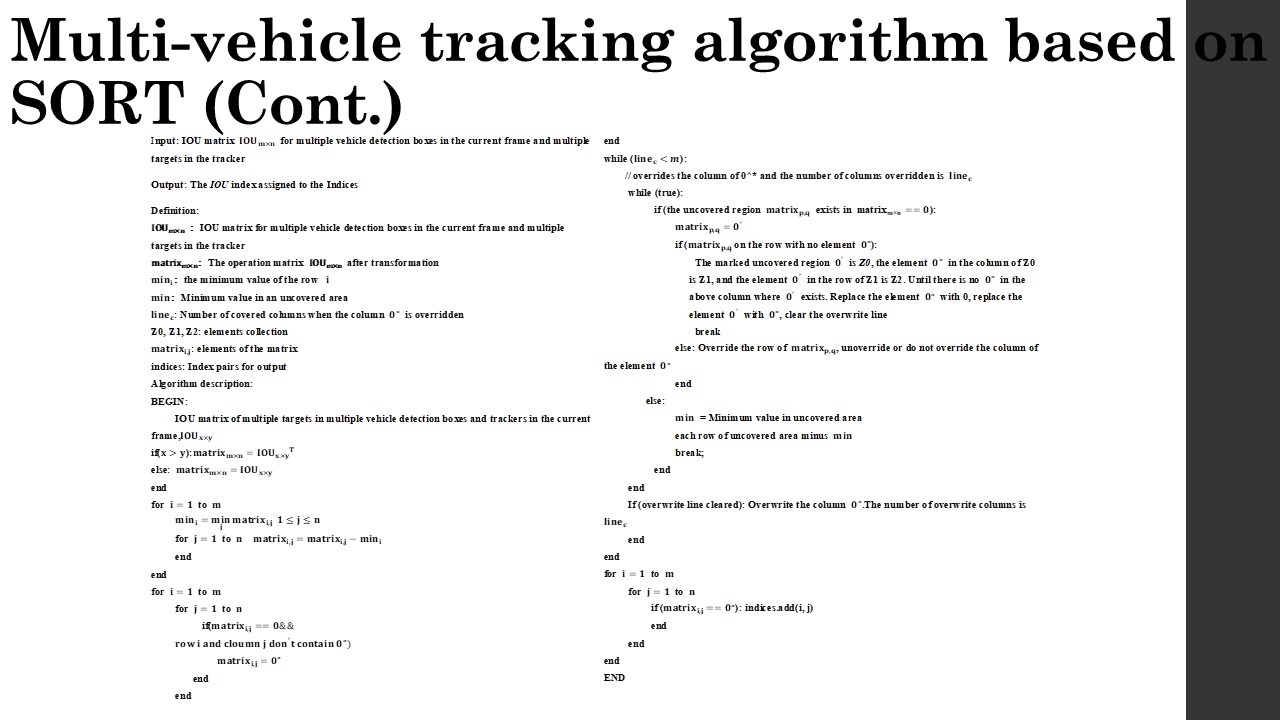 |
The algorithm.
|
| ICACT20210157 Slide.13
[Big Slide]
|
Chrome Click!! |
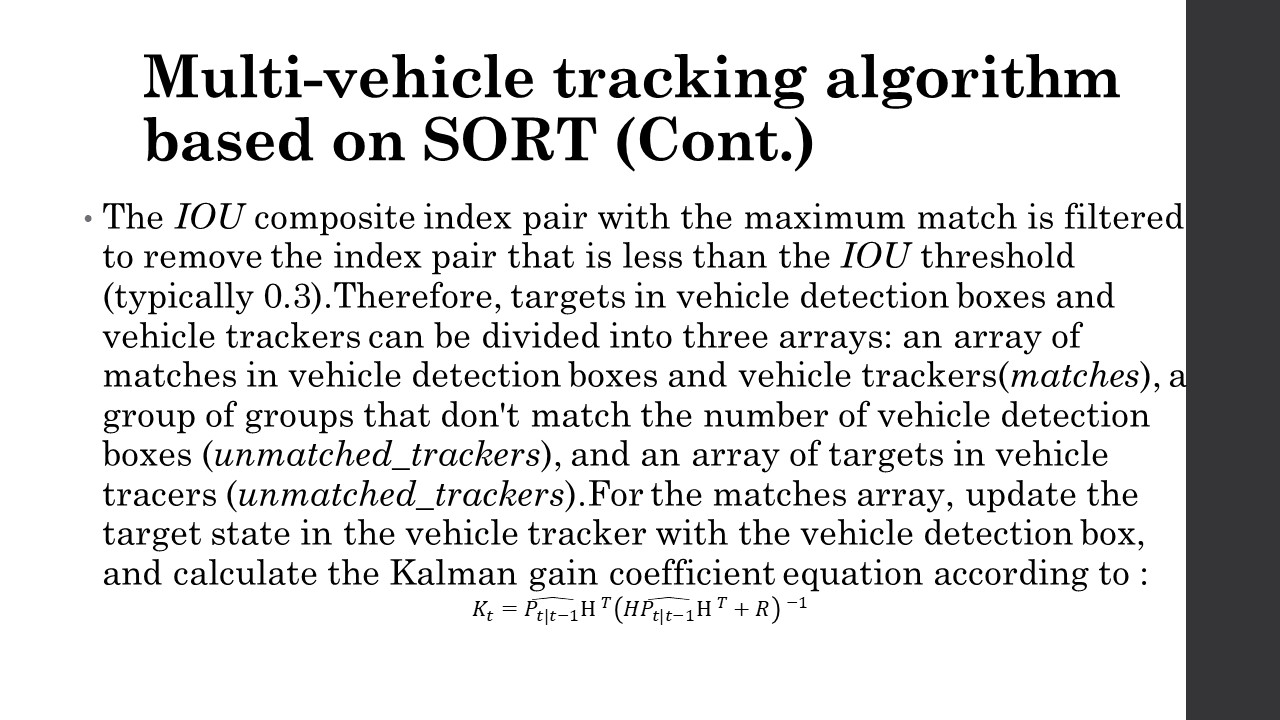 |
The IOU composite index pair with the maximum match is filtered to remove the index pair that is less than the IOU threshold (typically 0.3).Therefore, targets in vehicle detection boxes and vehicle trackers can be divided into three arrays: an array of matches in vehicle detection boxes and vehicle trackers(matches), a group of groups that don't match the number of vehicle detection boxes (unmatched_trackers), and an array of targets in vehicle tracers (unmatched_trackers).For the matches array, update the target state in the vehicle tracker with the vehicle detection box, and calculate the Kalman gain coefficient equation according to the formula.
|
| ICACT20210157 Slide.14
[Big Slide]
|
Chrome Click!! |
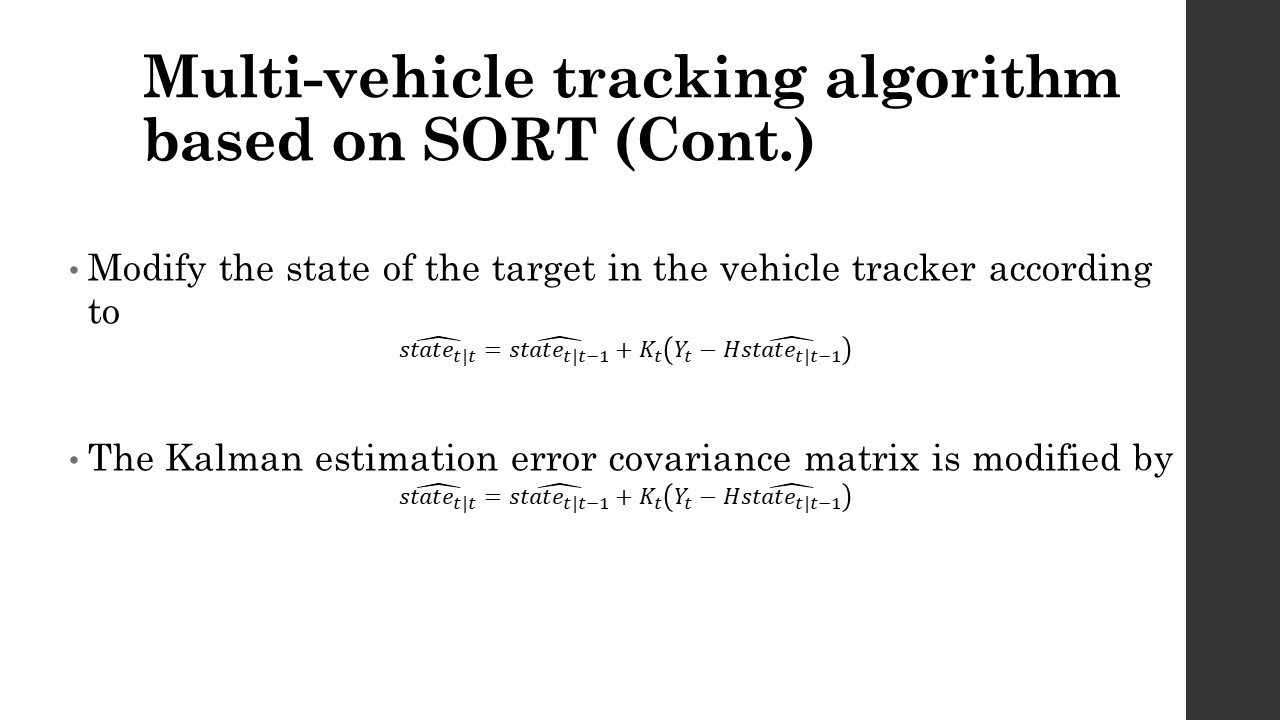 |
The state of the target and the Kalman estimation error covariance matrix are modified by the formula.
|
| ICACT20210157 Slide.15
[Big Slide]
|
Chrome Click!! |
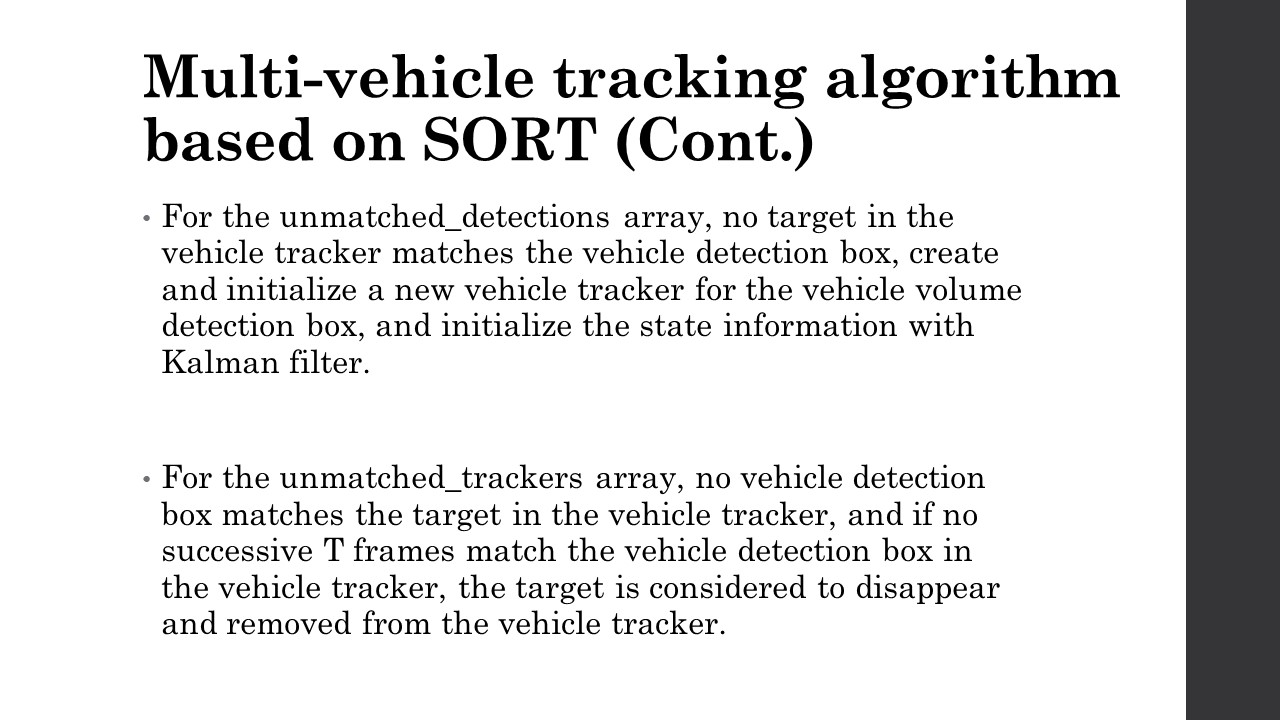 |
For the unmatched_detections array, no target in the vehicle tracker matches the vehicle detection box, create and initialize a new vehicle tracker for the vehicle volume detection box, and initialize the state information with Kalman filter.
for the unmatched_trackers array, no vehicle detection box matches the target in the vehicle tracker, and if no successive T frames match the vehicle detection box in the vehicle tracker, the target is considered to disappear and removed from the vehicle tracker.
|
| ICACT20210157 Slide.16
[Big Slide]
|
Chrome Click!! |
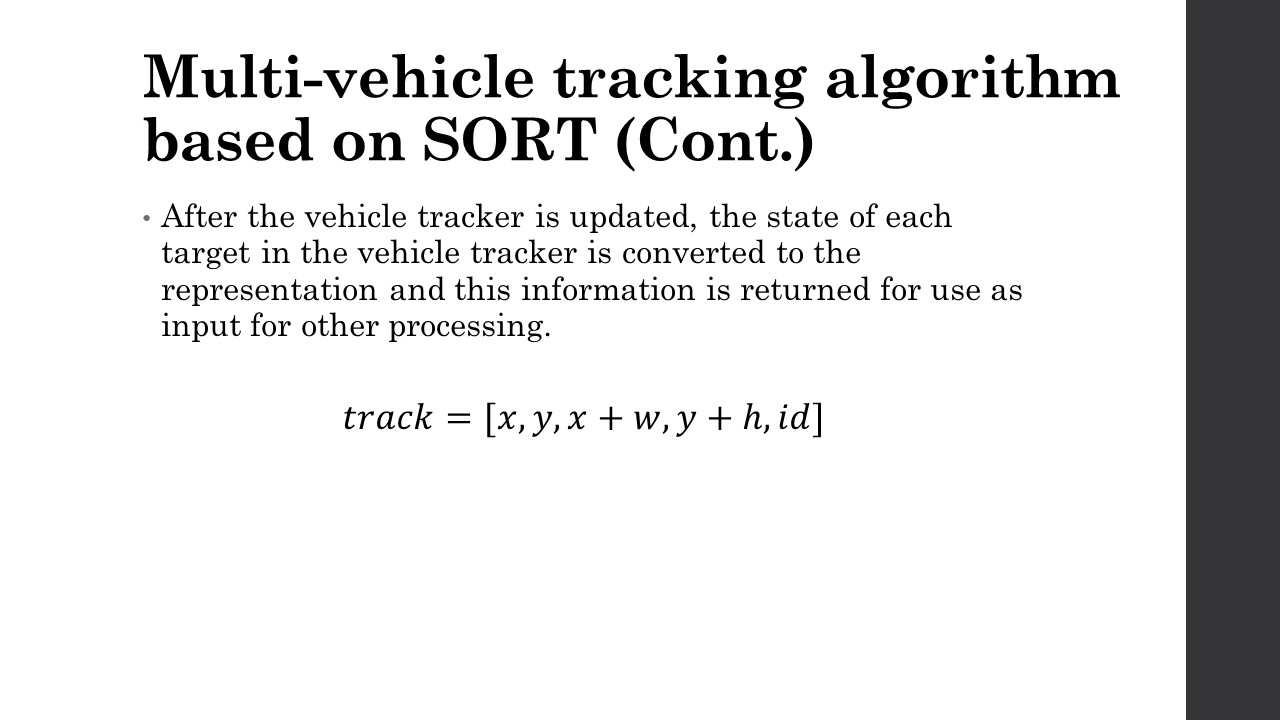 |
After the vehicle tracker is updated, the state of each target in the vehicle tracker is converted to the representation and this information is returned for use as input for other processing.
|
| ICACT20210157 Slide.17
[Big Slide]
|
Chrome Click!! |
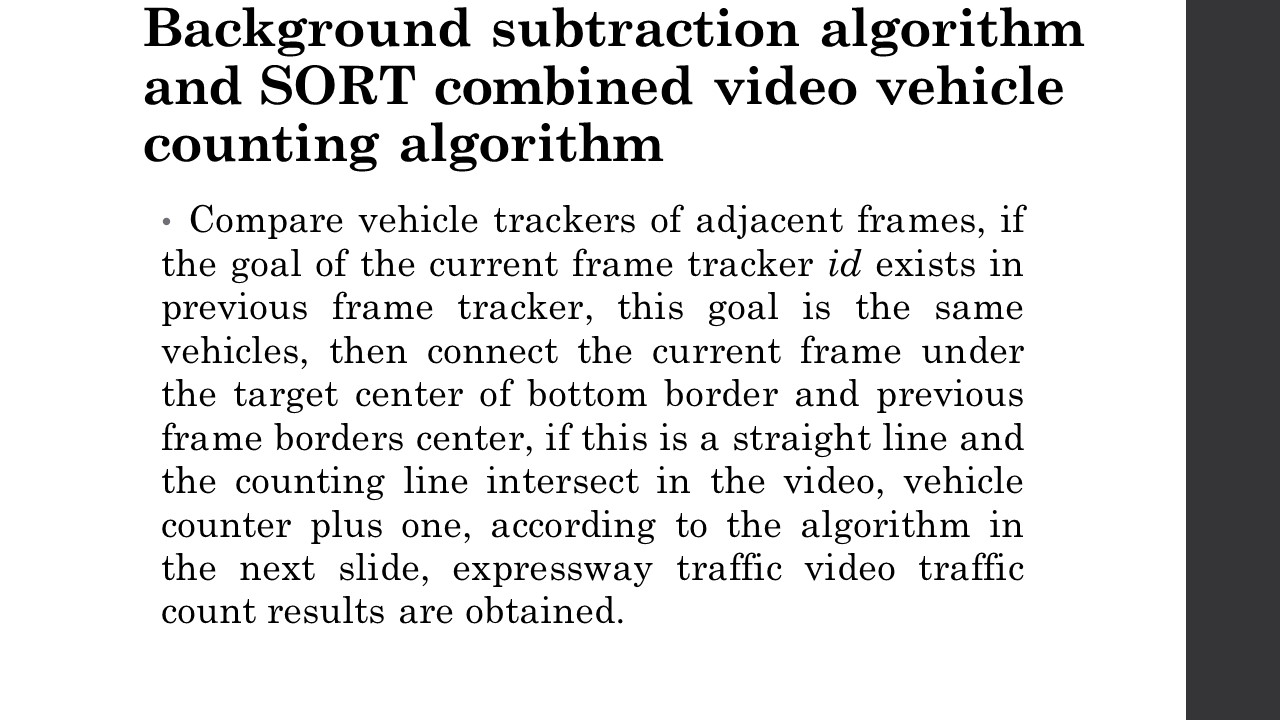 |
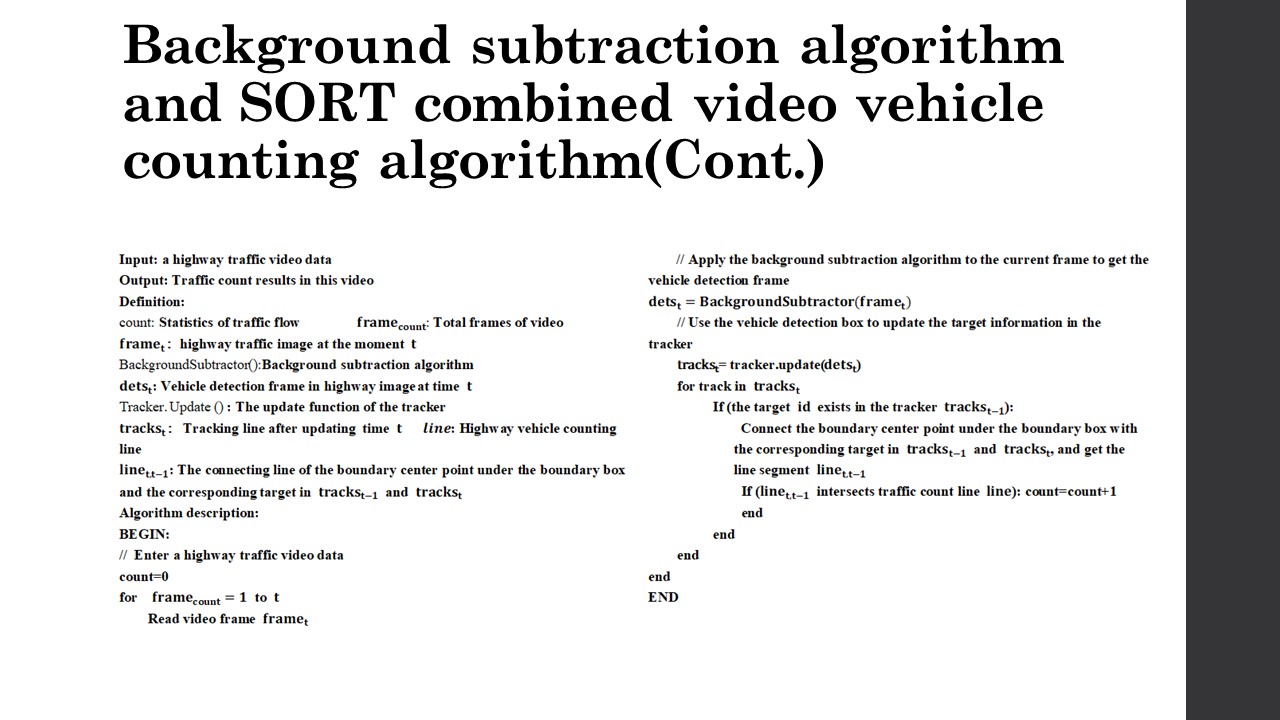
Compare vehicle trackers of adjacent frames, if the goal of the current frame tracker id exists in previous frame tracker, this goal is the same vehicles, then connect the current frame under the target center of bottom border and previous frame borders center, if this is a straight line and the counting line intersect in the video, vehicle counter plus one, according to the algorithm in the next slide, expressway traffic video traffic count results are obtained.
|
| ICACT20210157 Slide.18
[Big Slide]
|
Chrome Click!! |
 |
The algorithm.
|
| ICACT20210157 Slide.19
[Big Slide]
|
Chrome Click!! |
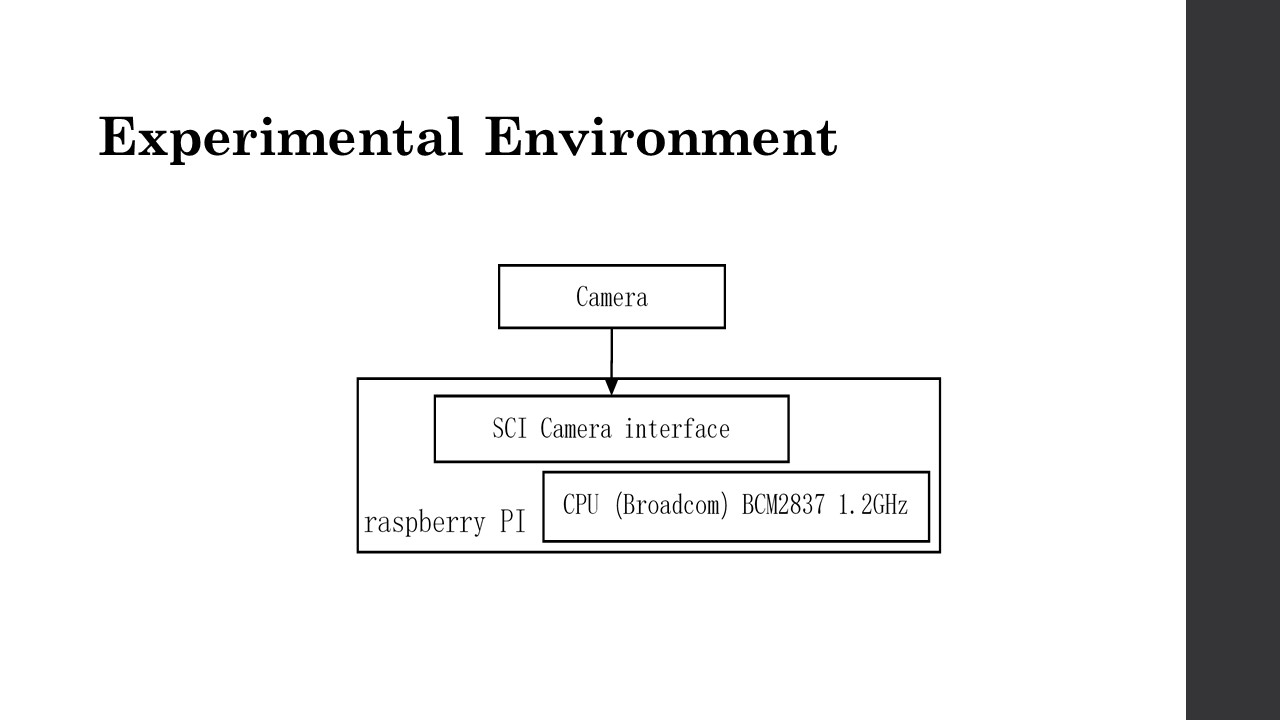 |
Raspberry PI 3 Model B is used as edge computing device, the raspberry PI official 5-megapixel camera is used to collect highway traffic video data. The camera is connected to raspberry PI through a 15-core cable.
|
| ICACT20210157 Slide.20
[Big Slide]
|
Chrome Click!! |
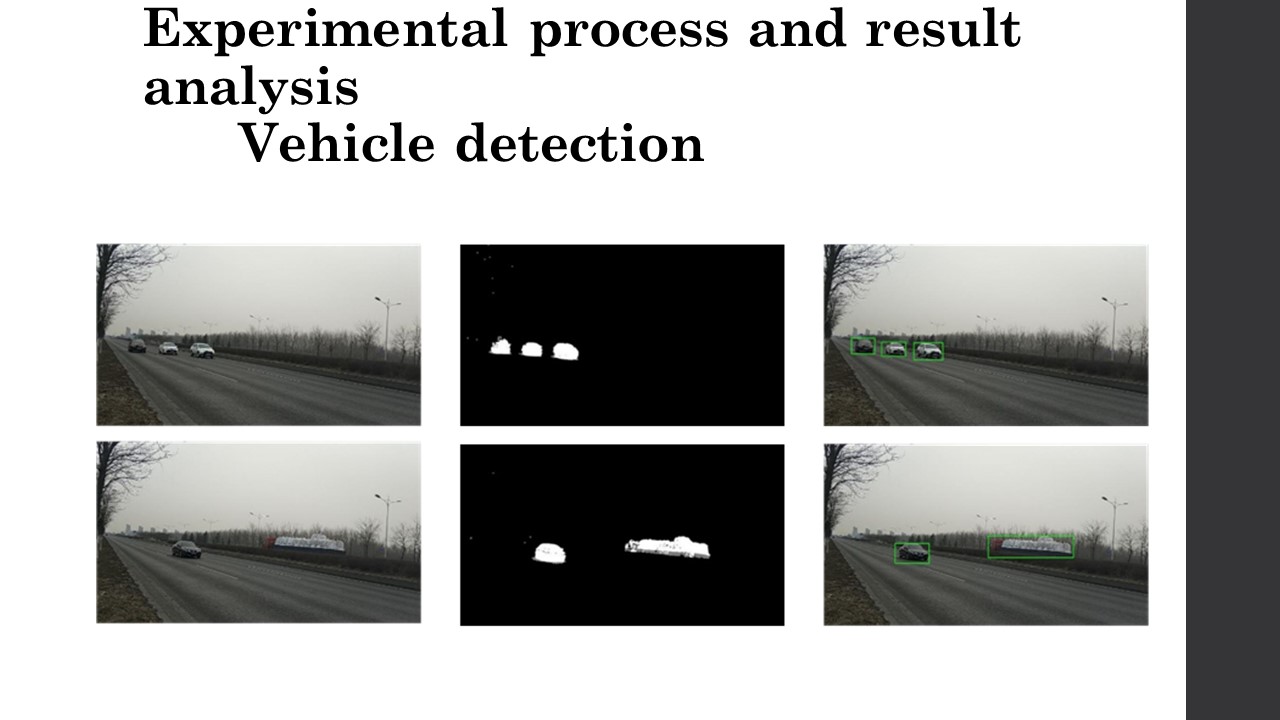 |
video image diagram, background difference effect diagram and vehicle contour marking diagram
|
| ICACT20210157 Slide.21
[Big Slide]
|
Chrome Click!! |
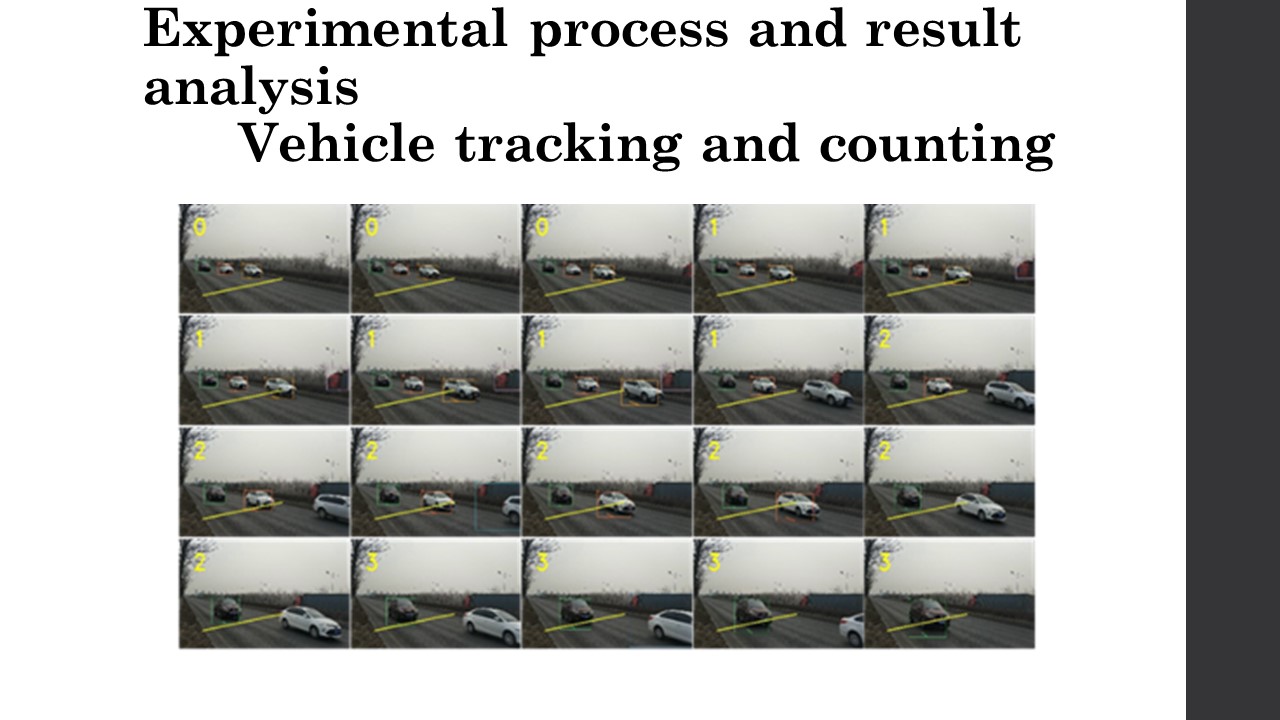 |
video-based visualization of highway traffic flow count diagram
|
| ICACT20210157 Slide.22
[Big Slide]
|
Chrome Click!! |
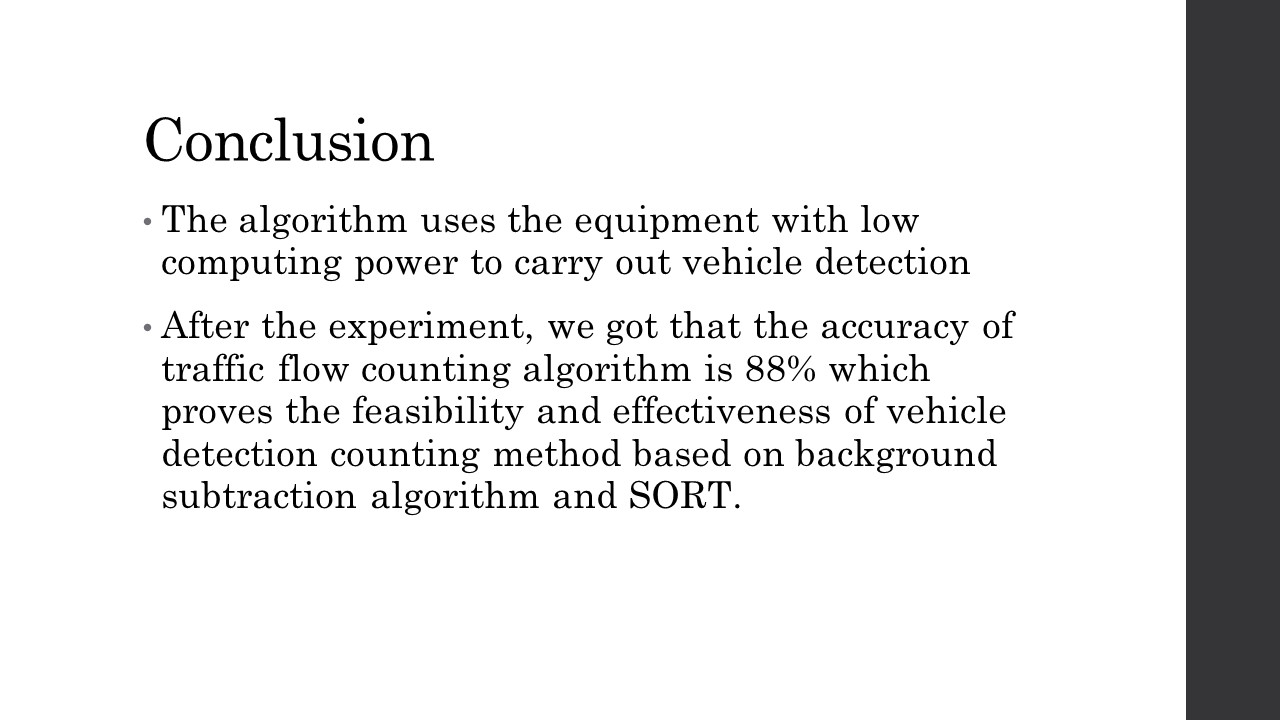 |
The algorithm uses the equipment with low computing power to carry out vehicle detection
After the experiment, we got that the accuracy of traffic flow counting algorithm is 88% which proves the feasibility and effectiveness of vehicle detection counting method based on background subtraction algorithm and SORT.
|
| ICACT20210157 Slide.23
[Big Slide]
|
Chrome Click!! |
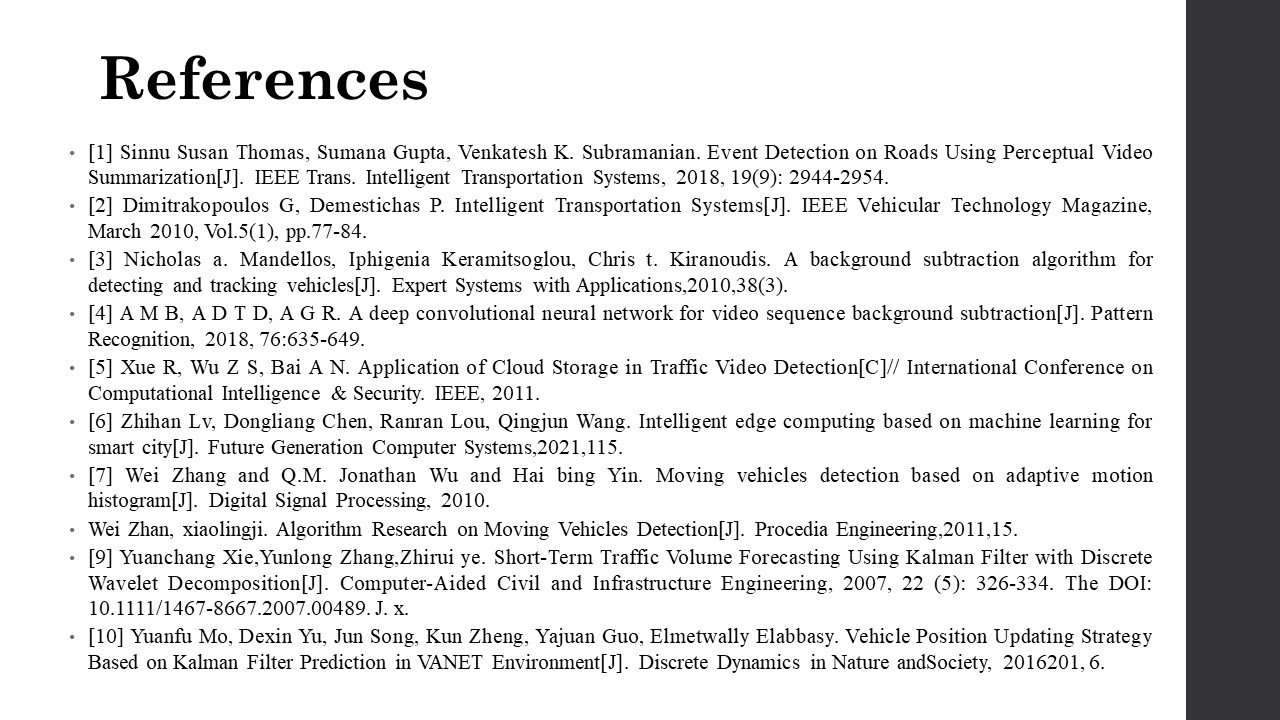 |
References |
| ICACT20210157 Slide.24
[Big Slide]
|
Chrome Click!! |
 |
References |
| ICACT20210157 Slide.25
[Big Slide]
|
Chrome Click!! |
 |
Thanks for your attention!
|















