 ICACT20210167 Slide.01
[Big Slide] |
Chrome  Click!! |
 |
Hello. My name’s Bumho Kim. I am a senior researcher at ETRI.
Today I’m going to be talking about a study on the population distribution prediction in large city using agent-based simulation. �
|
| ICACT20210167 Slide.02
[Big Slide]
|
Chrome Click!! |
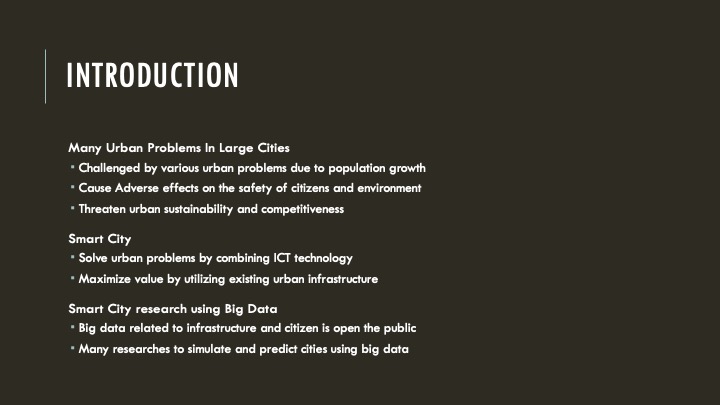 |
Most large cities are challenged by various urban problems such as housing problems, traffic congestion, lack of parking spaces due to population growth.
These problems cause adverse effects on the safety of citizens and environment, and threaten urban sustainability and competitiveness.
In order to solve these problems, many cities are trying to create Smart City.
Smart city is defined as a platform for leveraging technologies such as ICT and big data to improve the quality of life for citizens, the sustainability and the competitiveness of the city.
As the smart city service progresses, there are many researches to simulate and predict cities using big data which is open to the public.
|
| ICACT20210167 Slide.03
[Big Slide]
|
Chrome Click!! |
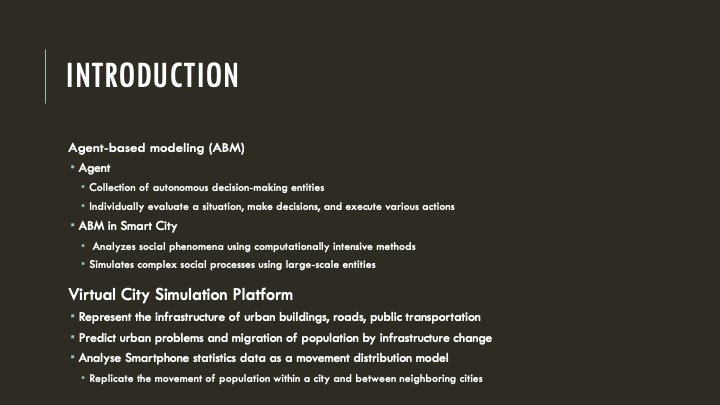 |
Among these researches, agent-based modeling is a simulation modeling technique that exploited to simulate cities and calculate urban changes.
Agent-based modeling systems are modeled as a collection of autonomous decision-making entities called agents, and each agent can make decisions and execute actions individually.
Agent-based modeling and simulation of urban society analyzes social phenomena and simulates complex social processes employing large-scale entities.
In this paper, we propose urban simulation platform to represent the infrastructure of urban buildings, roads, public transportation and to predict changes of the city.
In particular, we analyze smartphone statistics data and uses it as a movement distribution model to replicate the movement of population within a city and between neighboring cities.
The proposed virtual city simulation platforms can estimate population migration and various urban problems that can occur due to changes in infrastructure.
|
| ICACT20210167 Slide.04
[Big Slide]
|
Chrome Click!! |
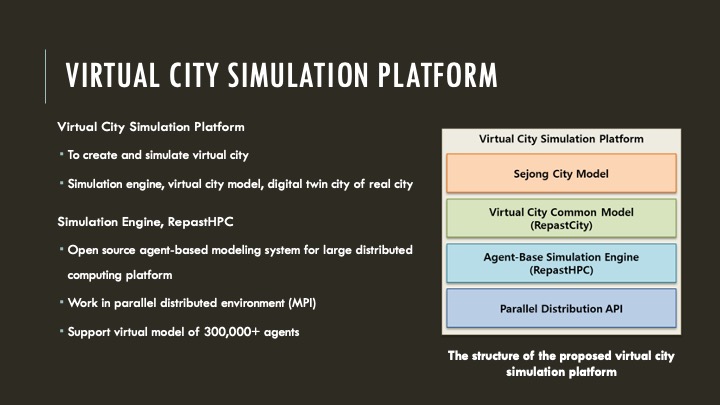 |
This slide outlines the proposed virtual city simulation platform.
To create and simulate a virtual city, we design a virtual city simulation platform which is consisting of a simulation engine, a virtual city model, and a digital twin city of the real city.
To support more than 300,000 metropolitan cities, we use the RepastHPC simulator.
Repast for High Performance Computing is an open source agent-based modeling system for large distributed computing platforms.
It implements the basic Repast Simphony concept to work in a parallel distributed environment.
|
| ICACT20210167 Slide.05
[Big Slide]
|
Chrome Click!! |
 |
I will explain the details of virtual city simulation platform.
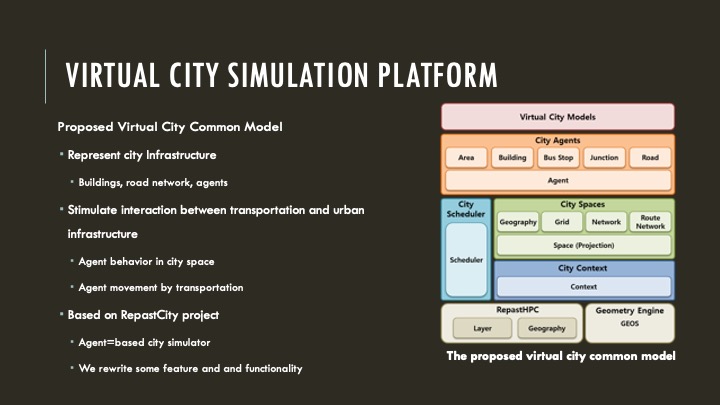
We design the virtual city common model to represent the city's diverse infrastructure such as buildings, road network, and agents.
To implement the virtual city common model, we use RepastCity project which is an agent-based simulator built on the Repast Simphony.
We rewrite some of the features and add more functionality to original project.
The Proposed virtual city common model aims to stimulate the interaction between the transportation and the urban infrastructure.
|
| ICACT20210167 Slide.06
[Big Slide]
|
Chrome Click!! |
 |
In this paper, we implement Sejong City as a virtual city on a proposed virtual city simulation platform.
Sejong City is an administrative city with a population of about 350,000
Sejong city is a planned city created in 2012 and is a rapidly changing city that grows at an annual population growth rate of over 10 percentage.
In order to build a virtual city of Sejong City, we use public data and administrative data such as building information, road network, traffic network, and citizen data.
|
| ICACT20210167 Slide.07
[Big Slide]
|
Chrome Click!! |
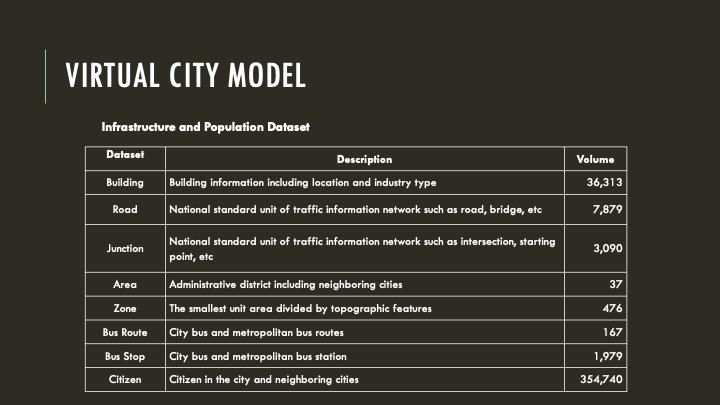 |
This slide shows the table of infrastructure and population dataset which are used in this paper.
First, we use building data, road network, and area data to represent the city’s infrastructure.
Second, in order to implement the agent, we exploit citizen data in the Sejong city and neighboring cities.
Lastly, we utilize public bus data to implement public transportation model.
|
| ICACT20210167 Slide.08
[Big Slide]
|
Chrome Click!! |
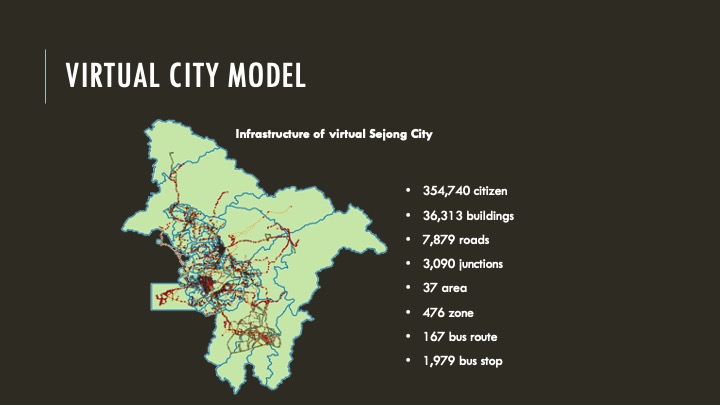 |
This figure shows the infrastructure information used in this paper on a map.
Area includes Sejong city and nearby cities such as Daejeon-si, Cheongju-si, Cheonan-si, Gongju-si
|
| ICACT20210167 Slide.09
[Big Slide]
|
Chrome Click!! |
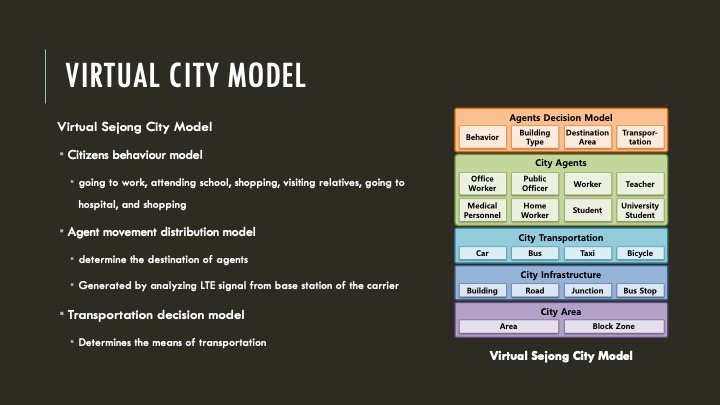 |
I will explain the details of virtual city virtual Sejong city model in this slide.
First, agent behaviour model resolves citizens’ behaviour and movement.
Citizen agents are classified by occupation and autonomously perform behaviours such as going to work, attending school, shopping, visiting relatives, going to hospital, and shopping
Agent behaviour probability distribution is generated according to the probability of actions by occupation in the National Living Time Survey.
Next, the destination of agents is determined according to the movement distribution model.
The movement distribution is generated by analyzing LTE signal from base station of the carrier.
Finally, transportation decision model determines the means of transportation in consideration of the distance, presence or absence of transportation, and route.
|
| ICACT20210167 Slide.10
[Big Slide]
|
Chrome Click!! |
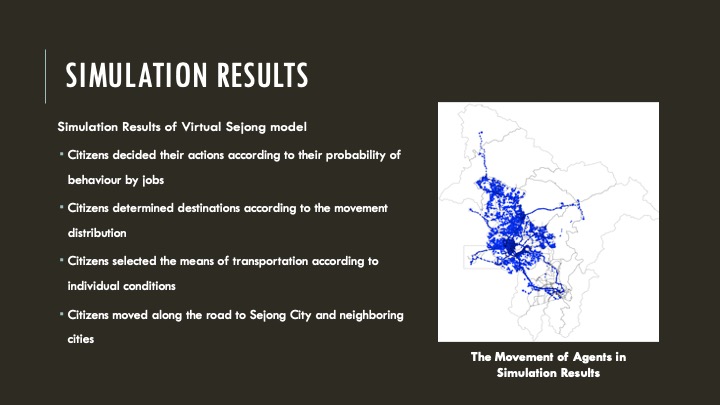 |
This slide summarizes the results we obtained from simulation.
I will explain the details of each step in our virtual city model.
Citizens decided their actions according to their probability of behaviour by jobs.
Next they determined destinations according to the movement distribution, then selected the means of transportation according to individual conditions
Finally they moved along the road to Sejong City and neighboring cities.
Right figure shows the movement of agents collected as a result of the simulation.
|
| ICACT20210167 Slide.11
[Big Slide]
|
Chrome Click!! |
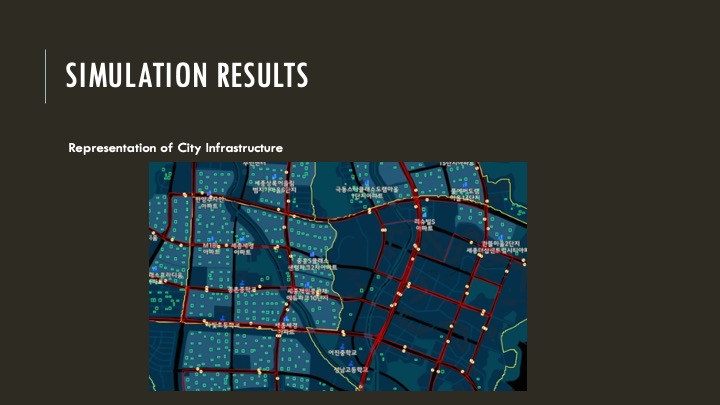 |
This slide shows the representation of Sejong City infrastructure.
Green squares represent buildings in the city.
Yellow area show block zones, which is the same spatial attribute unit.
Red lines and yellow dots indicate public bus routes and bus stop respectively.
|
| ICACT20210167 Slide.12
[Big Slide]
|
Chrome Click!! |
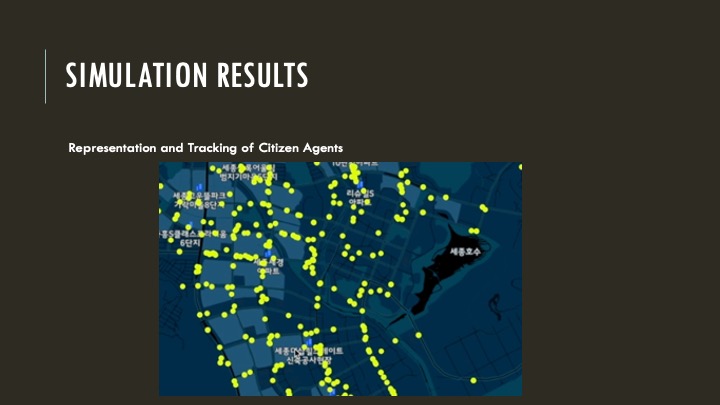 |
This figure shows the movement of agents collected as a simulation results.
Yellow dot indicates each citizen who is moving to destination.
|
| ICACT20210167 Slide.13
[Big Slide]
|
Chrome Click!! |
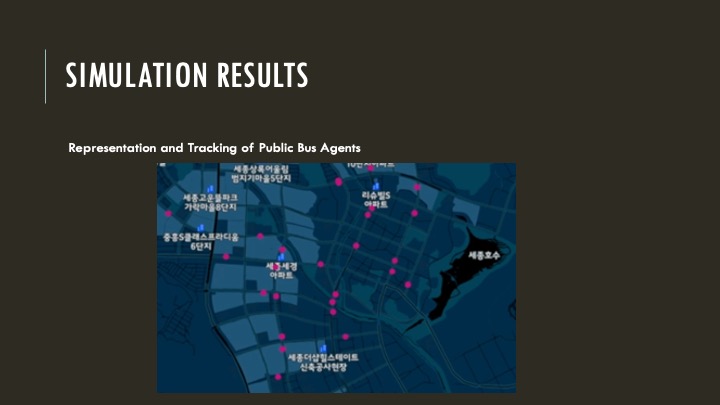 |
This slide shows the movement of public buses collected as a results of the simulation.
Red dot represents a bus moving along its own route.
|
| ICACT20210167 Slide.14
[Big Slide]
|
Chrome Click!! |
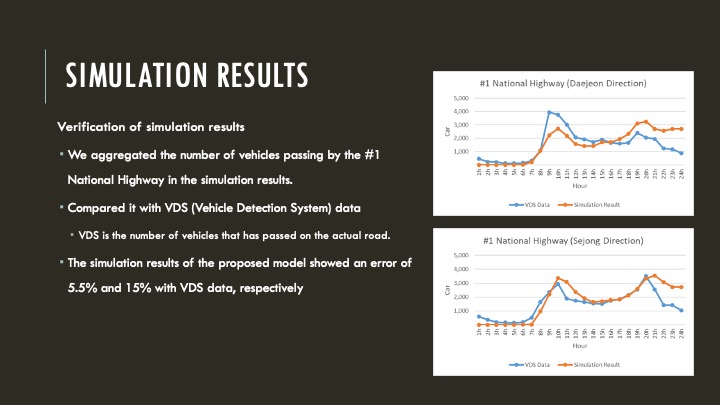 |
For verification, we compared the simulation result with VDS data.
VDS is the number of vehicles that has passed on the actual road.
In the simulation results, we aggregated the number of vehicles passing by the road and compared it with the VDS data.
The simulation results showed an error of 5.5 percentage and 15 percentage with VDS data, respectively
|
| ICACT20210167 Slide.15
[Big Slide]
|
Chrome Click!! |
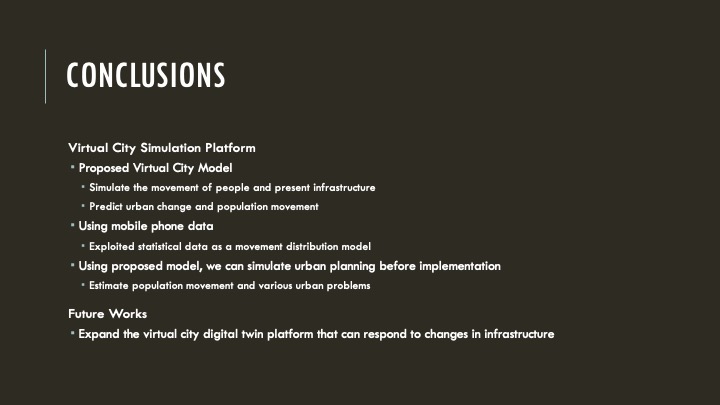 |
Now I’d like to sum up my presentation with following points.
Using digital twins that replicate the physical city to create a virtual city, we can simulate urban planning before implementation.
In this paper, we created a virtual city model that can simulate the movement of people and predict urban change and population movement.
In particular, we analyzed mobile phone statistical data and exploited it as a movement distribution model.
The proposed virtual city simulation platform can estimate population movement and various urban problems.
As a future work, we plan to expand the virtual city digital twin platform that can respond to changes in infrastructure.
|
| ICACT20210167 Slide.16
[Big Slide]
|
Chrome Click!! |
 |
This last slide shows the reference papers and projects.
Thank you very much.
|















