 ICACT20210174 Slide.01
[Big Slide] |
Chrome  Click!! |
 |
Hello Everyone,
I am Nurazmina Lingas from UTB |
| ICACT20210174 Slide.02
[Big Slide]
|
Chrome Click!! |
 |
presentation outline |
| ICACT20210174 Slide.03
[Big Slide]
|
Chrome Click!! |
 |
Introduction |
| ICACT20210174 Slide.04
[Big Slide]
|
Chrome Click!! |
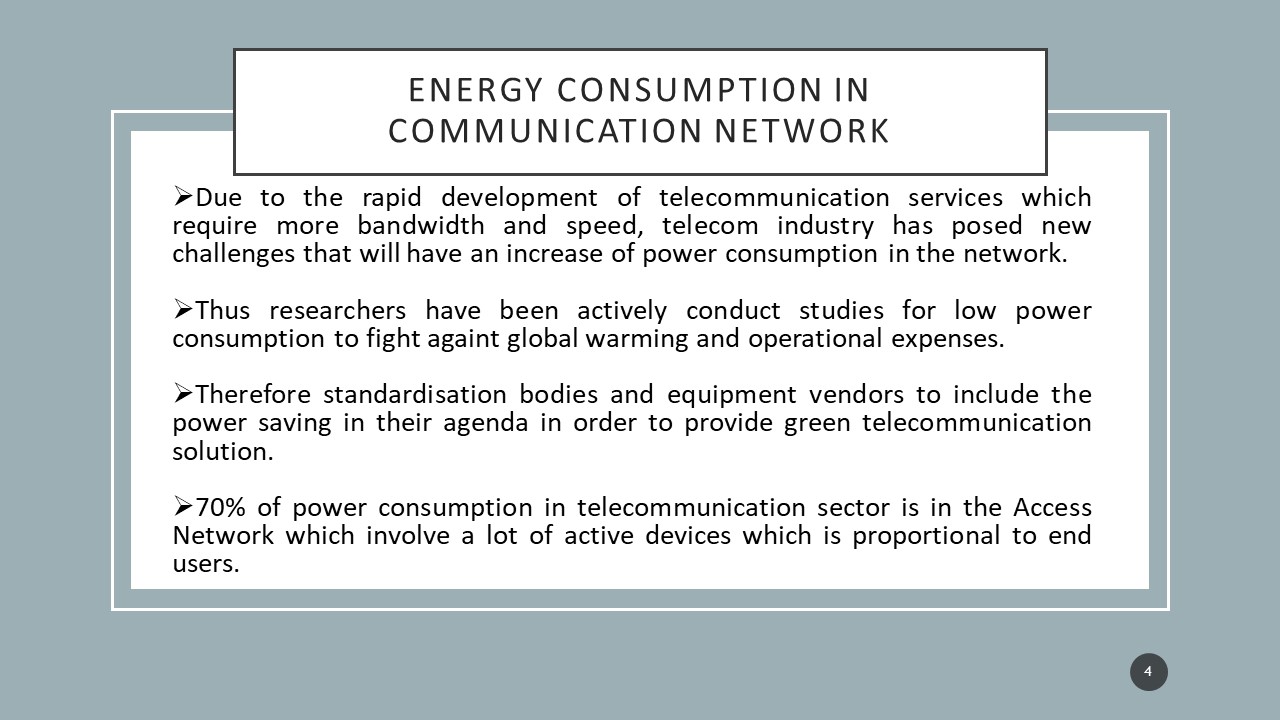 |
Energy consumption in communication network |
| ICACT20210174 Slide.05
[Big Slide]
|
Chrome Click!! |
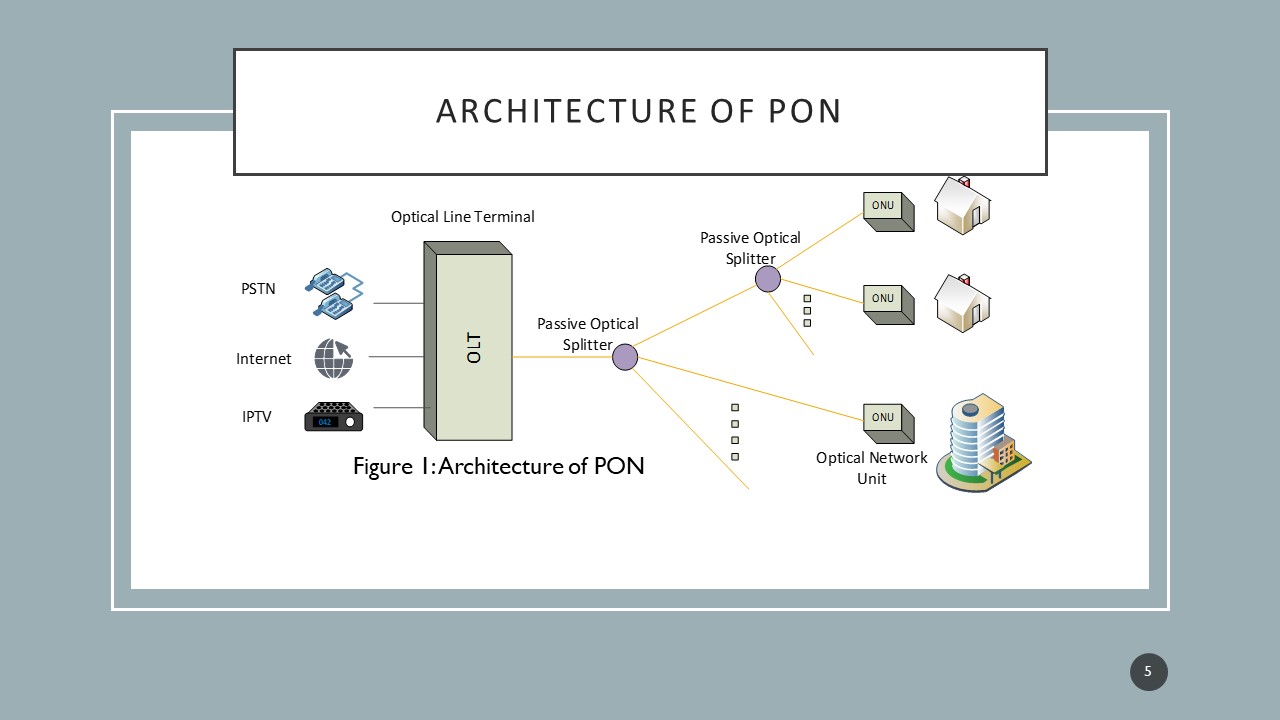 |
Architecture of PON
PON is a passive network featuring one to multiple point architecture.
PON consists of Optical Line Terminal (OLT), Optical Network Unit (ONU) and Passive Optical Splitter.
TDM PON play an important role in all access of optical access network solutions to distribute reasonably high bandwidth to the customers through an optical fiber network infrastructure.
Due to lower maintenance costs and more reliable operation network operators tend to support the TDM-PON scheme.
However, the bandwidth provided by one wavelength is shared by the whole optical network units in the network because the time division multiplexing passive optical network architecture provides only limited scope for improving the bandwidth performance.
|
| ICACT20210174 Slide.06
[Big Slide]
|
Chrome Click!! |
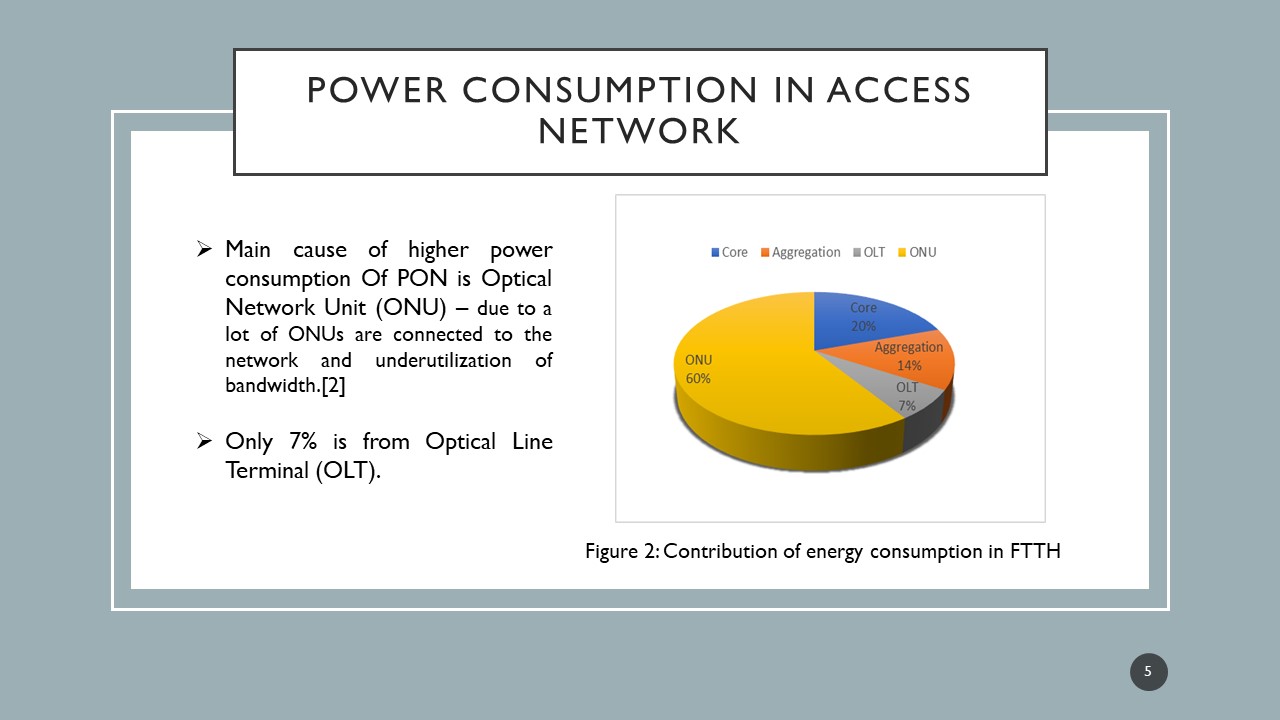 |
About 70% of the power consumption in communication/ICT system is from the Access Network. 60% from ONU and 7% from OLT |
| ICACT20210174 Slide.07
[Big Slide]
|
Chrome Click!! |
 |
ONU power consumption |
| ICACT20210174 Slide.08
[Big Slide]
|
Chrome Click!! |
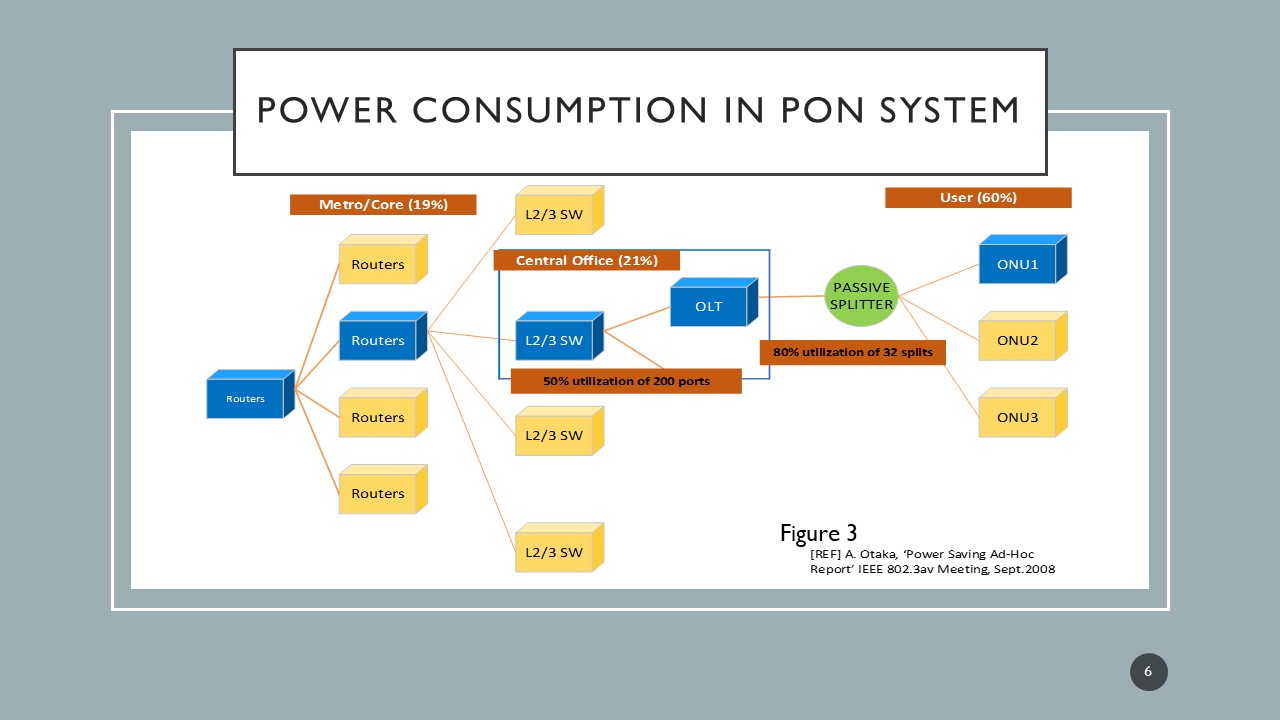 |
Figure shows the detail distribution of FTTH power consumption |
| ICACT20210174 Slide.09
[Big Slide]
|
Chrome Click!! |
 |
ONU sleep mechanism |
| ICACT20210174 Slide.10
[Big Slide]
|
Chrome Click!! |
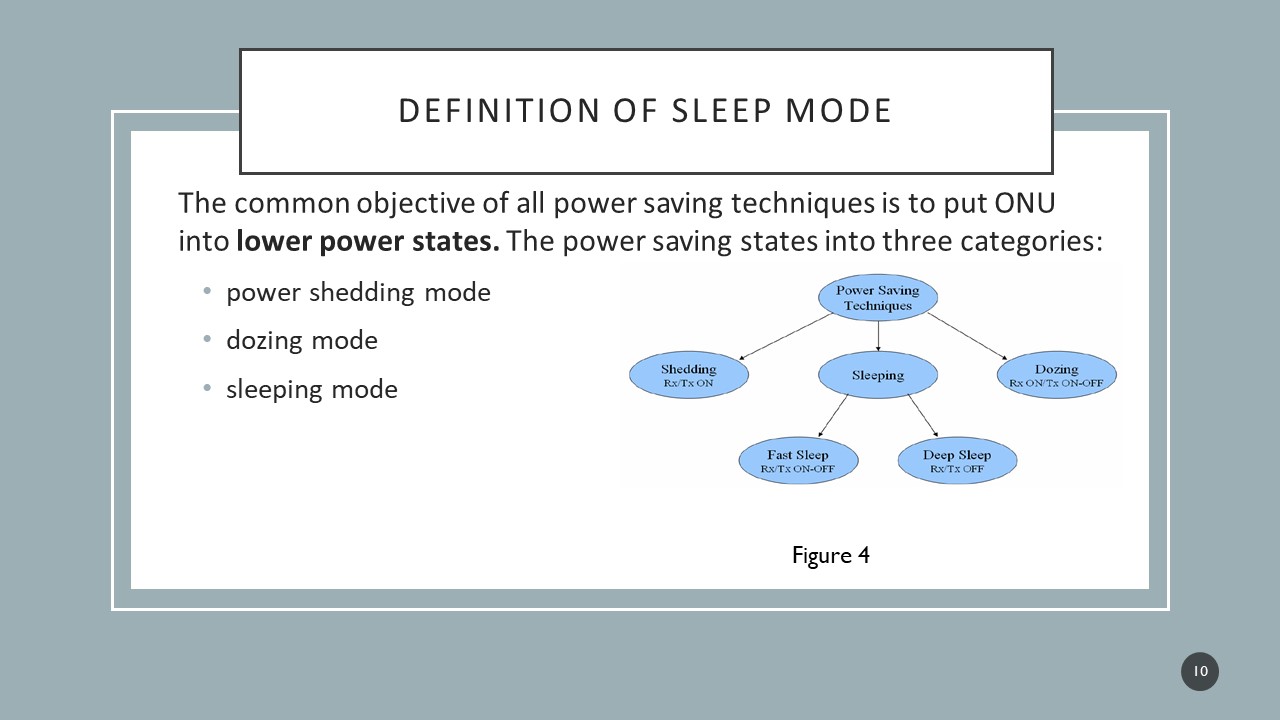 |
power shedding mode - used when the ONU operates under battery power, the ONU powers off or reduces the power to non-essential part of functions and services only.
dozing mode - the ONU keeps all the downstream functions operational but turns off the transmitter and ignores OLT bandwidth request when ONU does not have upstream traffic to send.
sleeping mode, - by switching off some ONU components functions when there is no available uplink or downlink traffic to/from ONU.
|
| ICACT20210174 Slide.11
[Big Slide]
|
Chrome Click!! |
 |
Basic concept of sleep mode |
| ICACT20210174 Slide.12
[Big Slide]
|
Chrome Click!! |
 |
Sleep mode technique |
| ICACT20210174 Slide.13
[Big Slide]
|
Chrome Click!! |
 |
Simulation of fast sleep mode |
| ICACT20210174 Slide.14
[Big Slide]
|
Chrome Click!! |
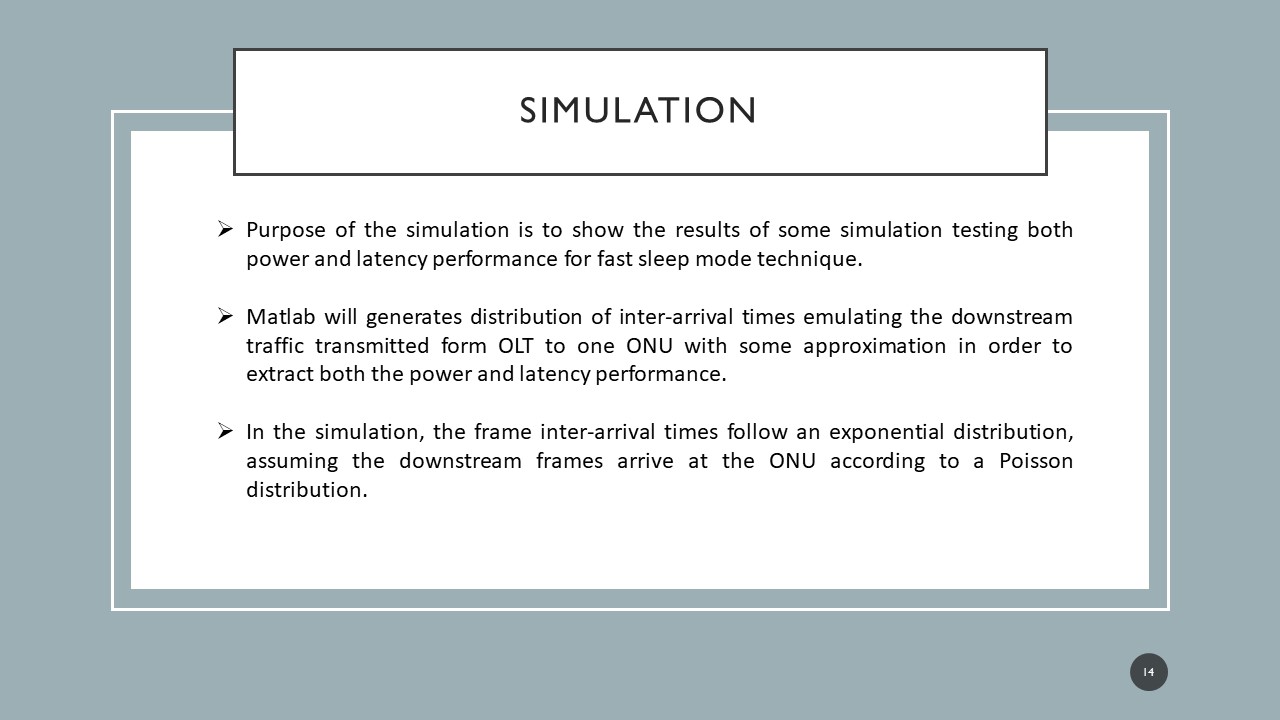 |
The results of the Matlab simulations show that if the frame arrivals follow a Poisson distribution, the method 1 generally leads to higher energy saving than the technique based on a simplified prediction method 2. This becomes more and more evident as the traffic rate gets lower.
On the other hand method 2 usually produces less additional latency on the traffic than method 1. The situation changes when the frame interarrival times follow an exponential distribution with a mean value that changes over time.
In this case the proposed method 1 shows better latency performances than method 2 in the majority of the tests. This happens thanks to the prediction method adopted in method 1 that adapts more quickly to changing traffic conditions.
|
| ICACT20210174 Slide.15
[Big Slide]
|
Chrome Click!! |
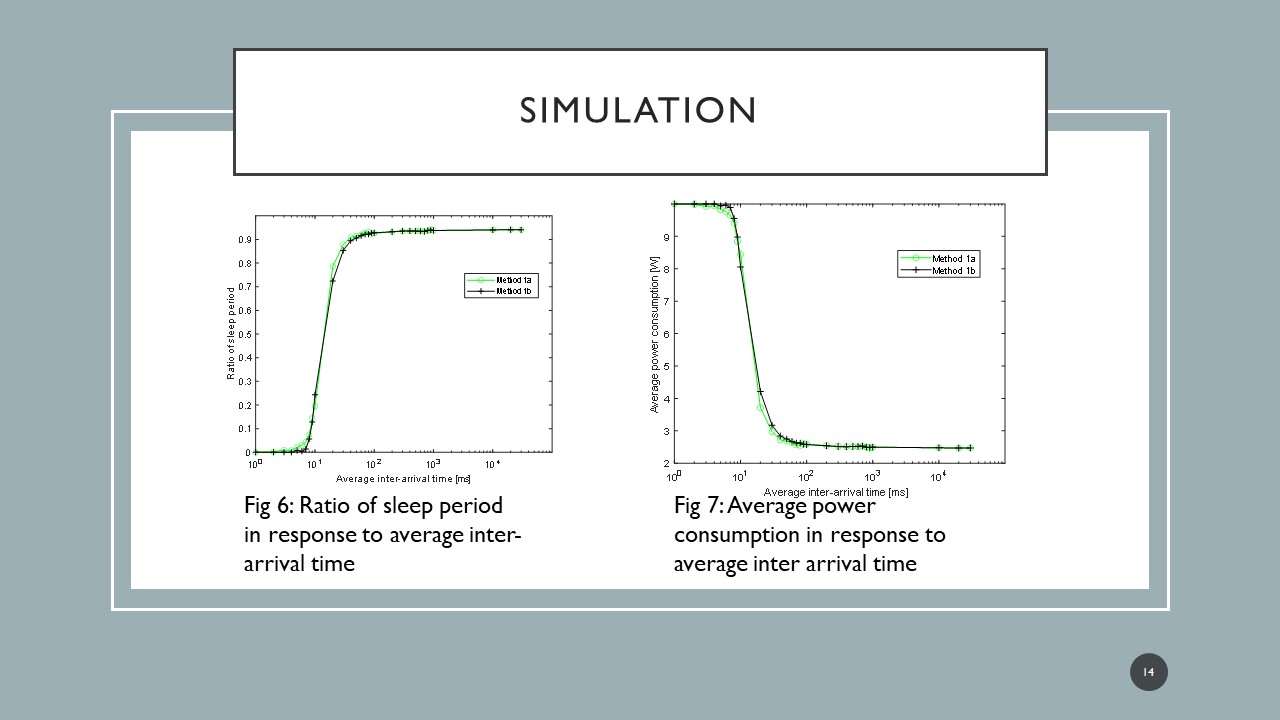 |
Simulation 1 & 2 |
| ICACT20210174 Slide.16
[Big Slide]
|
Chrome Click!! |
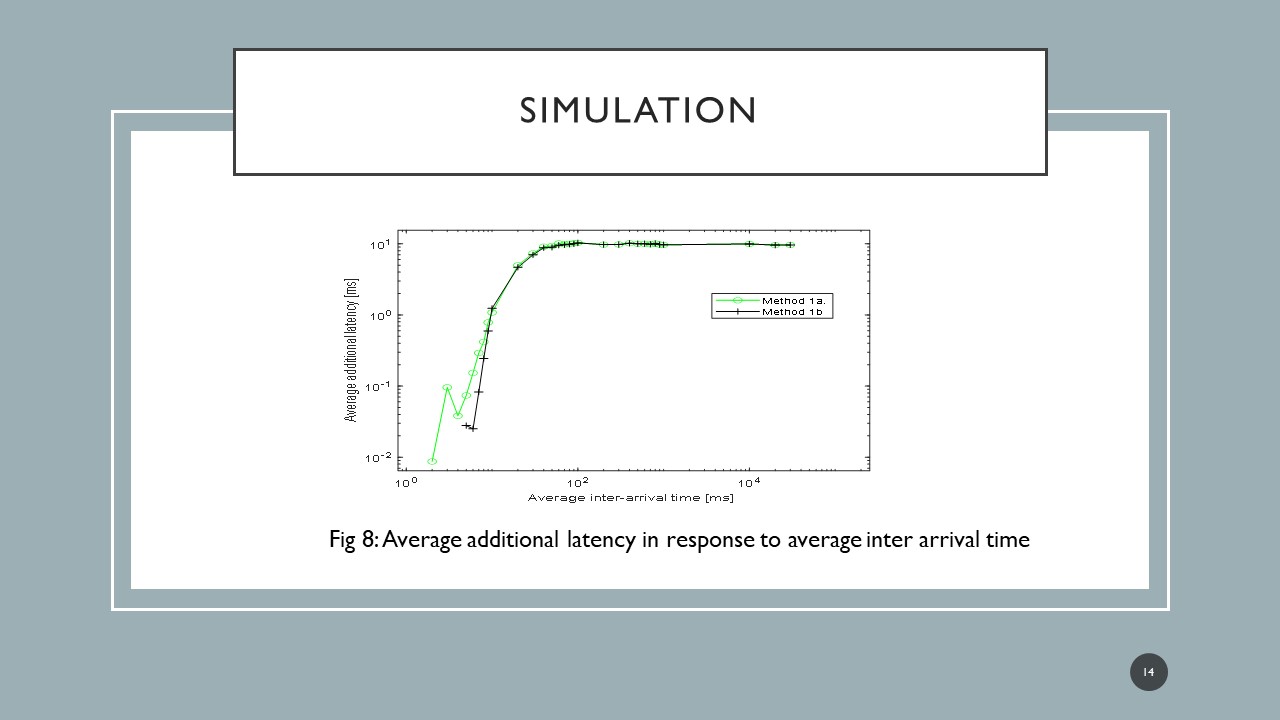 |
Simulation 3 |
| ICACT20210174 Slide.17
[Big Slide]
|
Chrome Click!! |
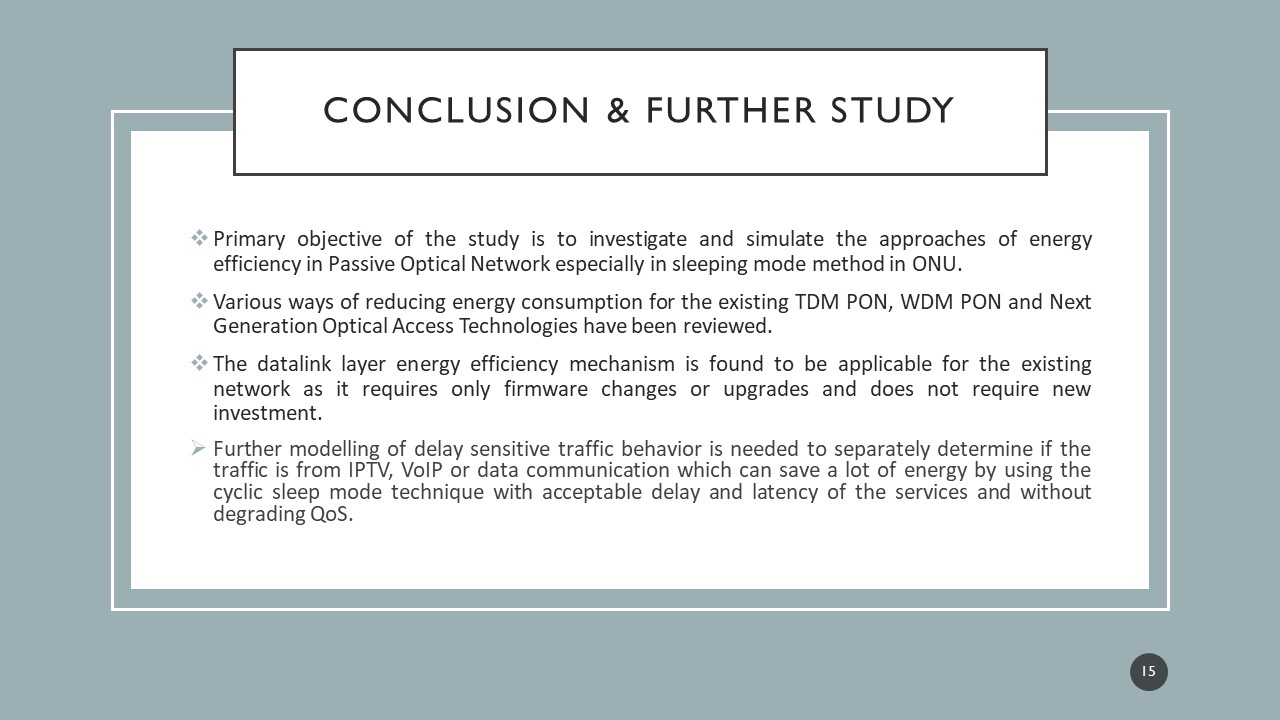 |
Conclusion |
| ICACT20210174 Slide.18
[Big Slide]
|
Chrome Click!! |
 |
Question and Answer Session.
Thank you. |















