 ICACT20210188 Slide.01
[Big Slide] |
Chrome  Click!! |
 |
This is Kwihoon Kim from KNUE. |
| ICACT20210188 Slide.02
[Big Slide]
|
Chrome Click!! |
 |
This paper is about an integrated automatic object and pose recognition technology for a media image editing solution. In particular, as an example, after recognizing face objects, food objects, and specific poses occurring in media images at the same time, it includes a function to log the recognized results in real time every second. Therefore, in order to make an automatic video editing solution, this paper focuses on real-time realization by integrating various recognition technologies, and includes the following two key element technologies. |
| ICACT20210188 Slide.03
[Big Slide]
|
Chrome Click!! |
 |
Recently, deep learning algorithms with high accuracy have been actively applied to face recognition technology. In the existing facial recognition algorithm, recognition was performed using a combination of high features defined by humans such as Harr-like features. There is a limitation in finding the optimal feature shape and combination in the way that a person defines features in advance. In contrast, the deep learning algorithm finds the optimal feature shape and combination for the situation by itself, and shows higher performance than the existing algorithm. |
| ICACT20210188 Slide.04
[Big Slide]
|
Chrome Click!! |
 |
As deep learning techniques based on the latest Convolutional Neural Networks (CNN) are applied to images, the performance of object recognition technology has dramatically improved. The early image-based deep learning algorithm was a technology that received a single image as an input and classified the entire image into which class, and the probability of belonging to each class was presented as an output value of the algorithm. |
| ICACT20210188 Slide.05
[Big Slide]
|
Chrome Click!! |
 |
Various methods for estimating a person's pose have been introduced over the years, and it has been developed from estimating one person's pose to a method of estimating multiple poses. In order to estimate the pose, human skeleton information is often used, and each coordinate of the skeleton is called a joint or keypoint, and the entire pose is finally estimated by estimating the effective connection between the two parts. |
| ICACT20210188 Slide.06
[Big Slide]
|
Chrome Click!! |
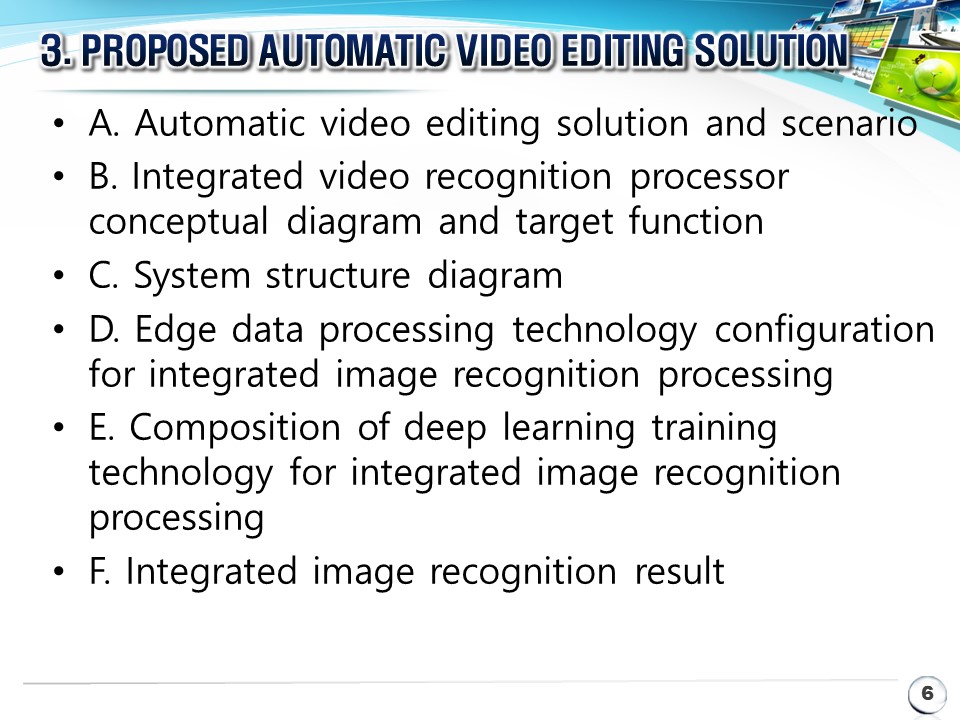 |
This section explains proposed automatic video editing solution. |
| ICACT20210188 Slide.07
[Big Slide]
|
Chrome Click!! |
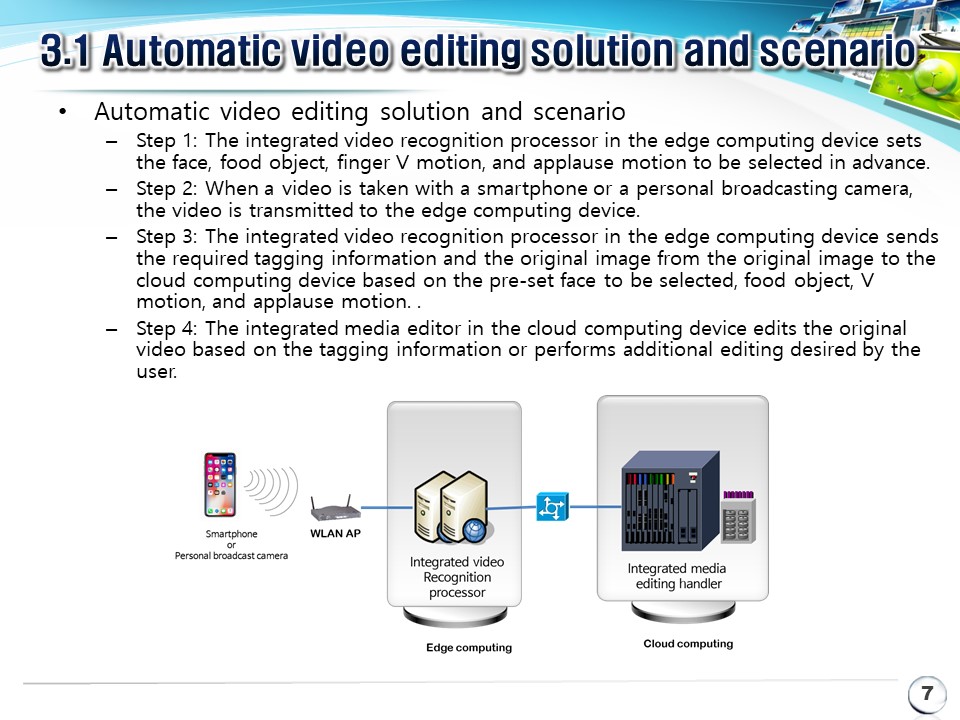 |
This figure shows the overall configuration of the automatic video editing solution. The processing scenario of the automatic video editing solution is as follows. |
| ICACT20210188 Slide.08
[Big Slide]
|
Chrome Click!! |
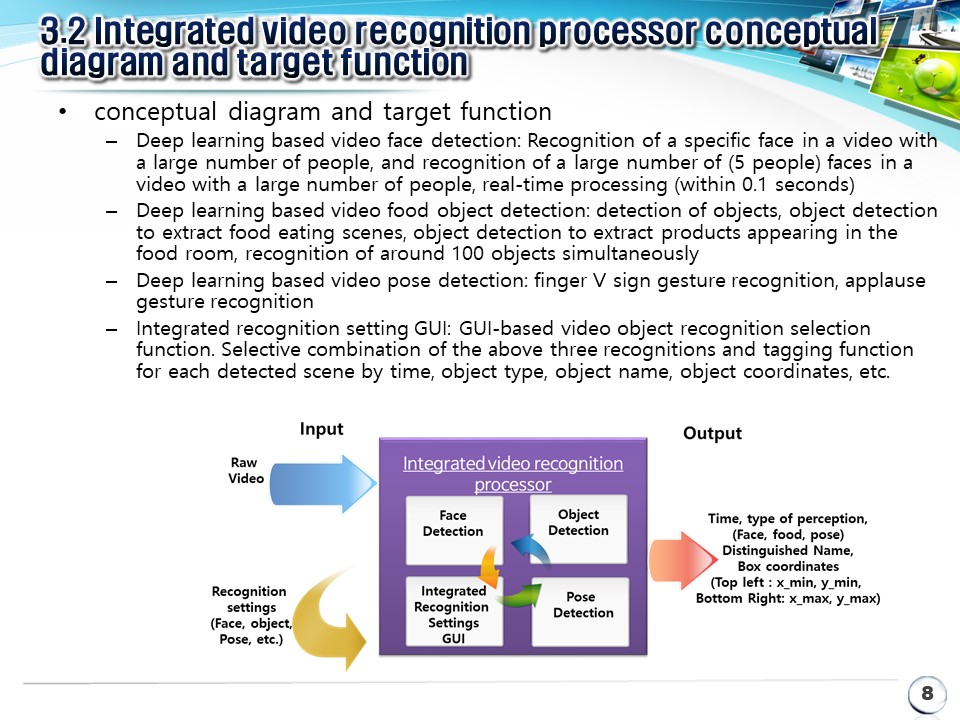 |
This figure shows the conceptual diagram of the integrated video recognition processor. By applying various deep learning technologies such as object detection by receiving video from personal broadcasting, only scenes in which specific people/objects appear, specific motions (V-shaped finger movements, applause, etc.) are extracted and the reconstructed video is output as output. to provide. Each input/output is as follows. |
| ICACT20210188 Slide.09
[Big Slide]
|
Chrome Click!! |
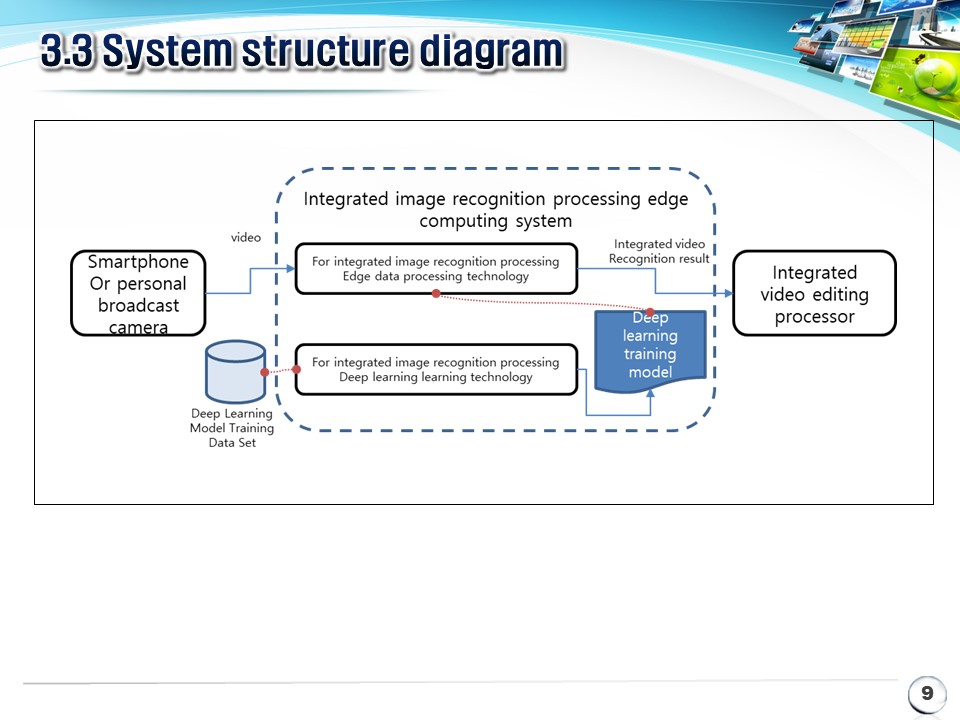 |
This figure is a solution that provides integrated recognition results for automatic video editing. |
| ICACT20210188 Slide.10
[Big Slide]
|
Chrome Click!! |
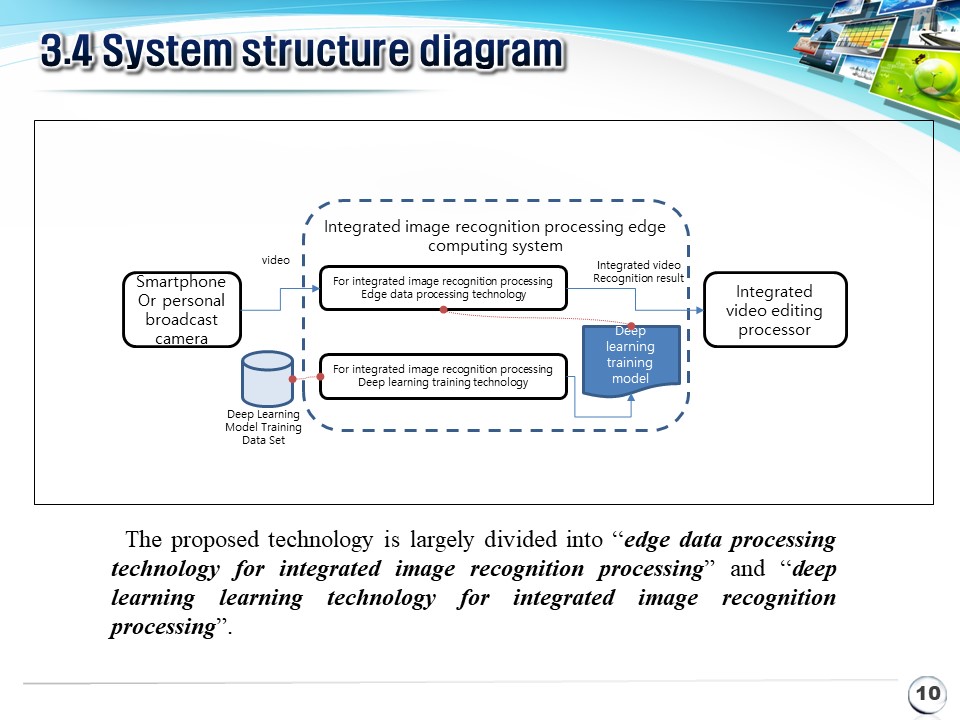 |
The edge data processing technology for integrated image recognition processing consists of a base class module in charge of driving the entire system, common library modules supporting it, and individual recognition processing modules. The common library module is composed of Const, Data container, Guicomp, and log, and each recognition processing module is composed of mtcnn, deepid, tracker, deepfood, and deeppose. |
| ICACT20210188 Slide.11
[Big Slide]
|
Chrome Click!! |
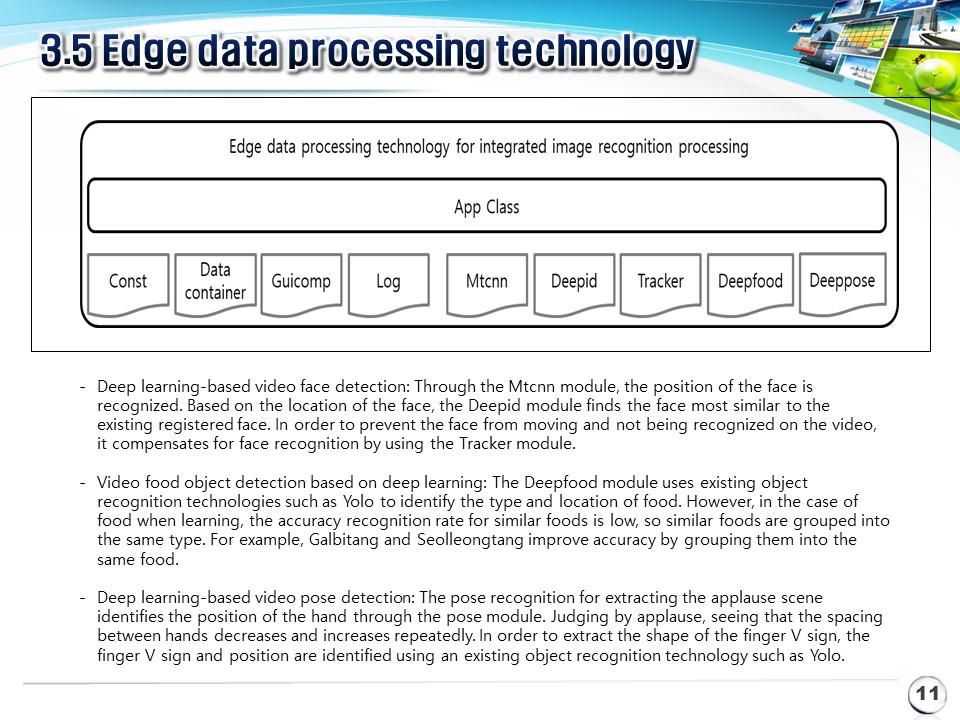 |
Deep learning training technology for integrated image recognition processing is largely composed of a learning module for food recognition and a learning module for V sign recognition. However, deep learning models for face recognition and pose recognition use an existing trained model, and there is no need for new training, so separate training modules are not configured. |
| ICACT20210188 Slide.12
[Big Slide]
|
Chrome Click!! |
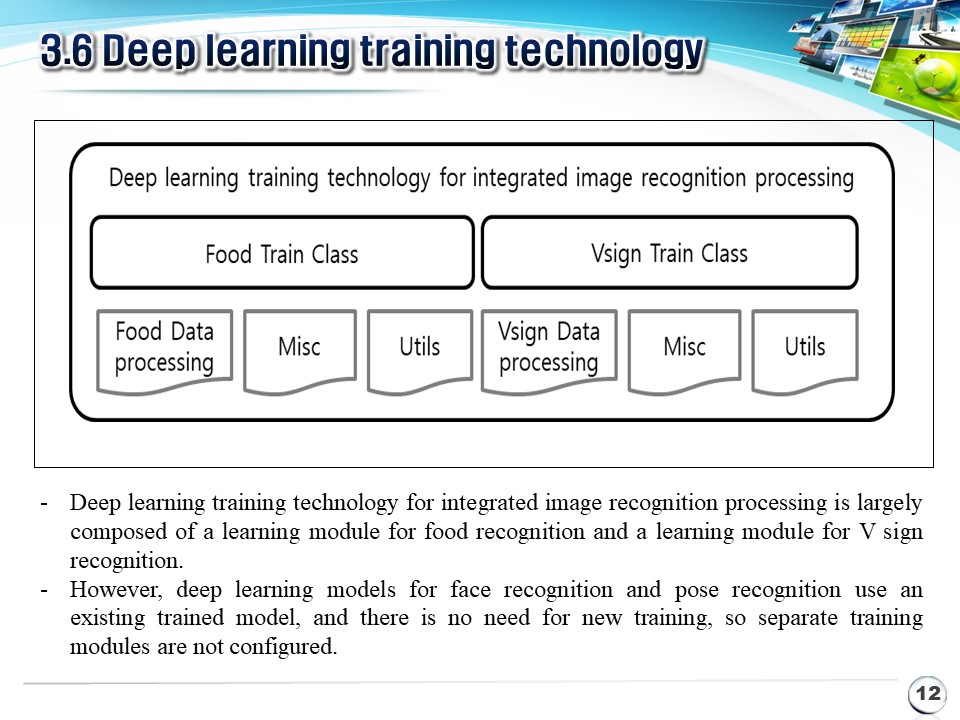 |
This Figure shows the result of integrated image recognition. The result log is displayed in one file. In each frame log, recognized names and coordinates for faces, foods, and poses by time are shown. At this time, if multiple faces appear, specify multiple faces in the face tag. Food and pose are also specified in the same way. |
| ICACT20210188 Slide.13
[Big Slide]
|
Chrome Click!! |
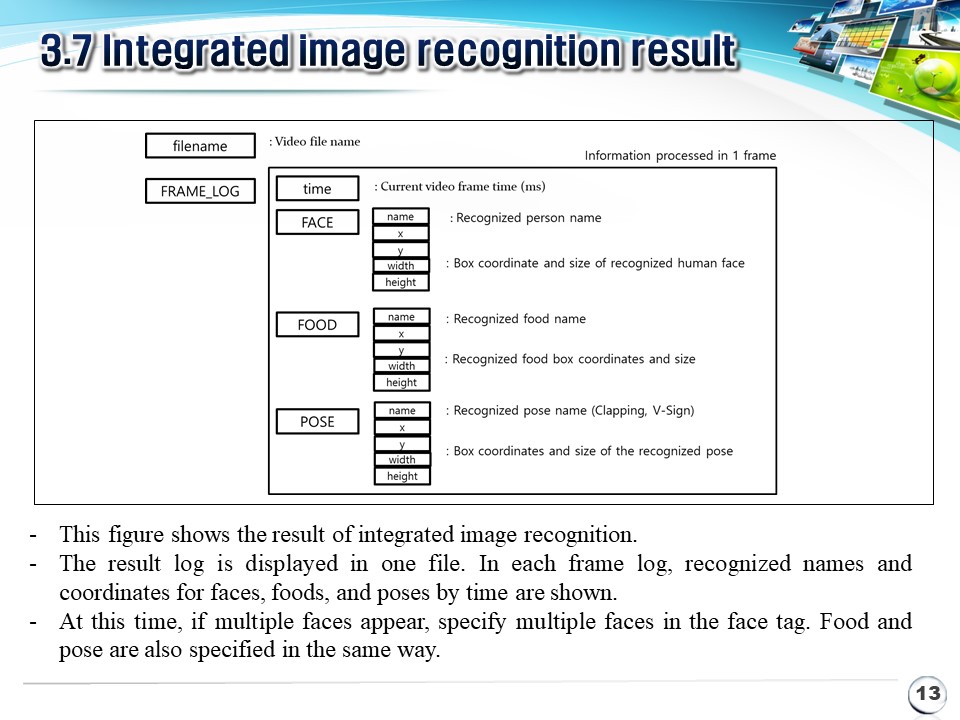 |
Deep learning training technology for integrated image recognition processing is largely composed of a learning module for food recognition and a learning module for V sign recognition. However, deep learning models for face recognition and pose recognition use an existing trained model, and there is no need for new training, so separate training modules are not configured. |
| ICACT20210188 Slide.14
[Big Slide]
|
Chrome Click!! |
 |
This paper proposes a deep learning-based integrated recognition service for automatic image editing. Through this paper, we provide a basic technology that can easily edit only the desired video scenes by recognizing face recognition, food object recognition, and pose recognition in a real-time video stream. By applying this paper, personal broadcasters will be able to reduce video editing time. |
| ICACT20210188 Slide.15
[Big Slide]
|
Chrome Click!! |
 |
Thank you |















