 ICACT20210193 Slide.01
[Big Slide] |
Chrome  Click!! |
 |
Hello everyone, my name is Ali Hussain. For ICACT 2021, I have coauthored with six co-authors.The title of our presentation is "Detection of different stages of COPD patients using machine learning techniques". |
| ICACT20210193 Slide.02
[Big Slide]
|
Chrome Click!! |
 |
The agenda of the presentation is mentioned in this slide |
| ICACT20210193 Slide.03
[Big Slide]
|
Chrome Click!! |
 |
Introduction |
| ICACT20210193 Slide.04
[Big Slide]
|
Chrome Click!! |
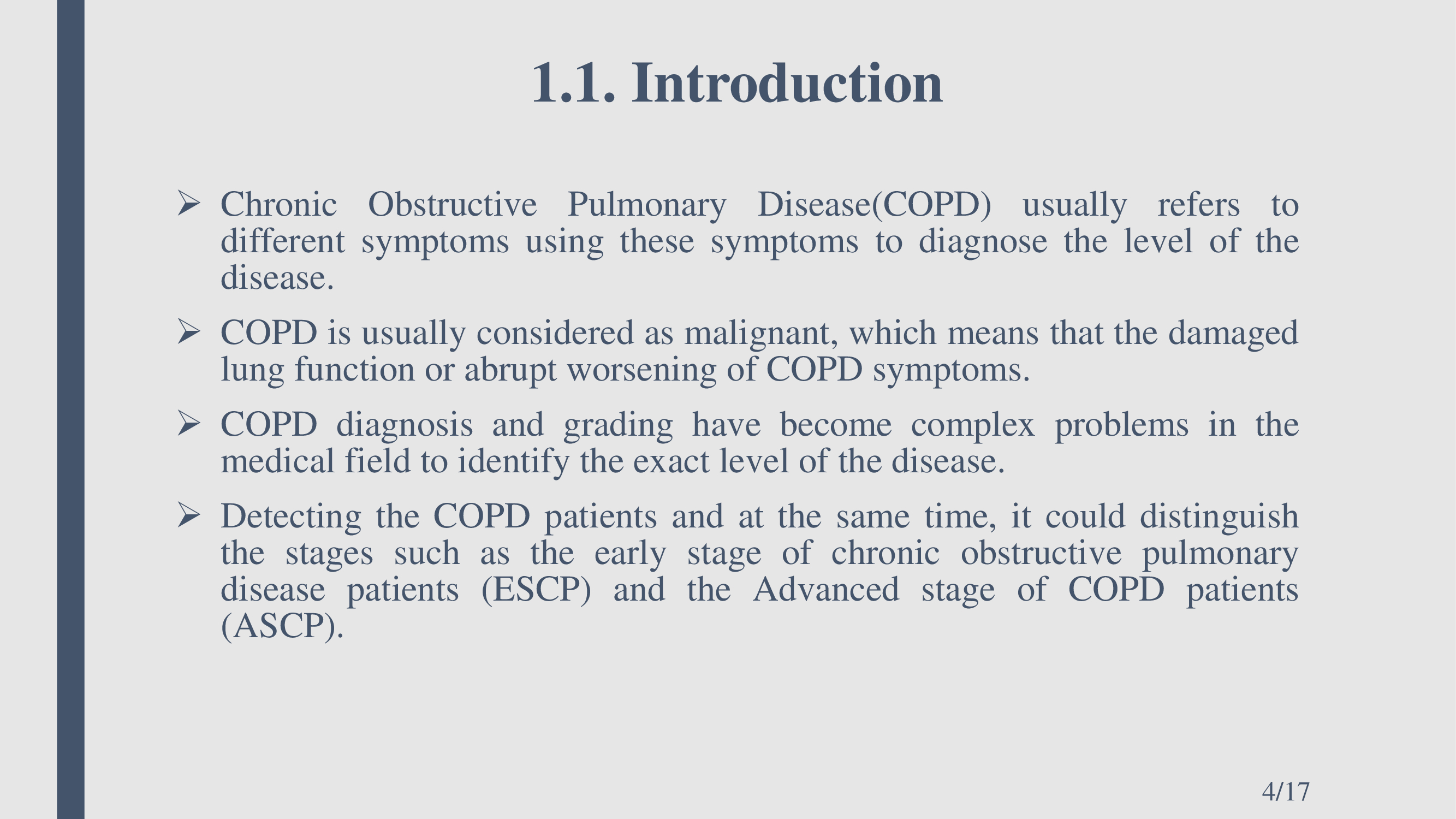 |
Chronic Obstructive Pulmonary Disease(COPD) usually refers to different symptoms using these symptoms to diagnose the level of the disease.
COPD is usually considered as malignant, which means that the damaged lung function or abrupt worsening of COPD symptoms.
COPD diagnosis and grading have become complex problems in the medical field to identify the exact level of the disease.
Detecting the COPD patients and at the same time, it could distinguish the stages such as the early stage of chronic obstructive pulmonary disease patients (ESCP) and the Advanced stage of COPD patients (ASCP).
|
| ICACT20210193 Slide.05
[Big Slide]
|
Chrome Click!! |
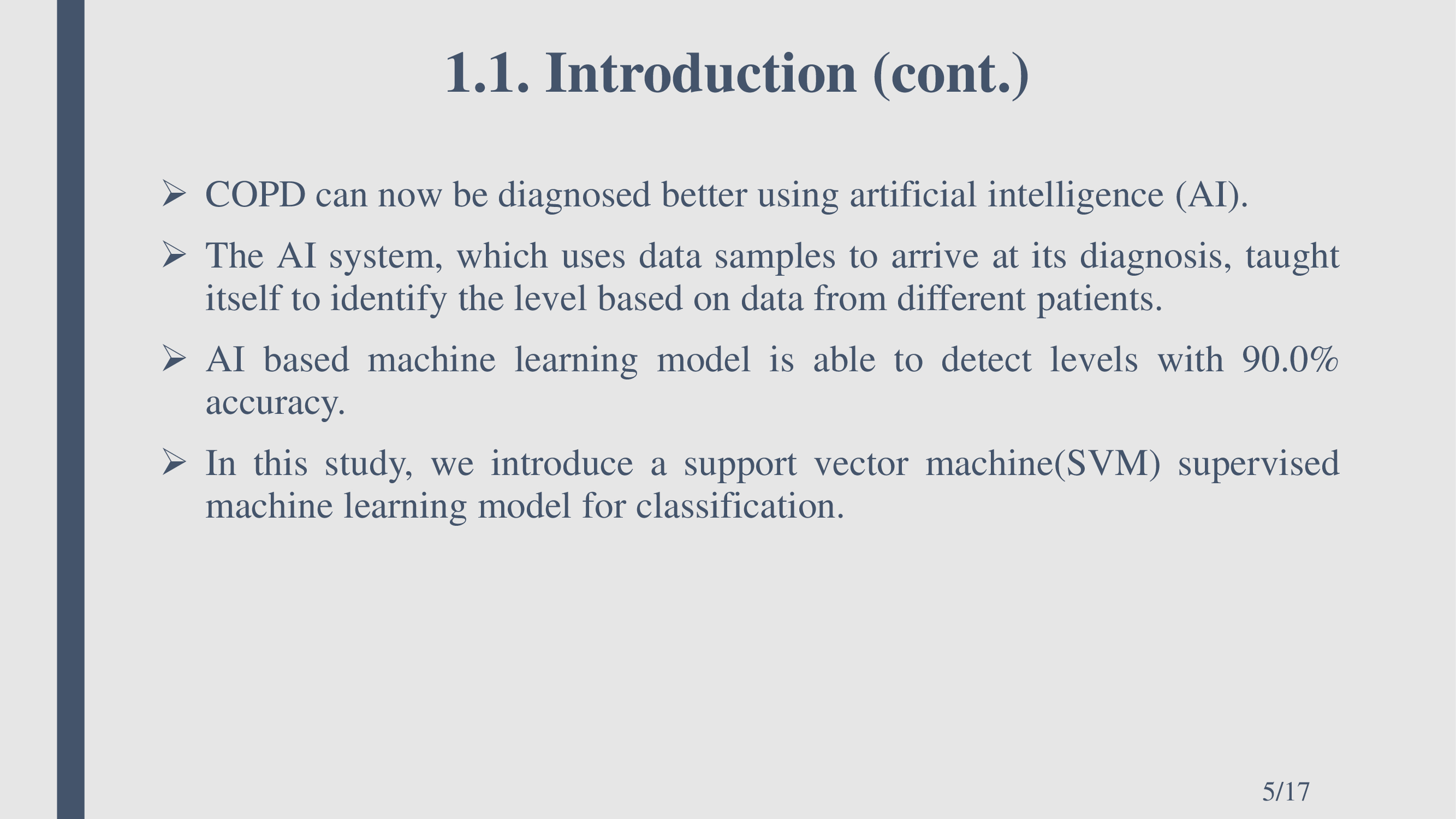 |
COPD can now be diagnosed better using artificial intelligence (AI).
The AI system, which uses data samples to arrive at its diagnosis, taught itself to identify the level based on data from different patients.AI based machine learning model is able to detect levels with 90.0% accuracy.
In this study, we introduce a support vector machine(SVM) supervised machine learning model for classification.
|
| ICACT20210193 Slide.06
[Big Slide]
|
Chrome Click!! |
 |
Materials and Methods |
| ICACT20210193 Slide.07
[Big Slide]
|
Chrome Click!! |
 |
COPD data was collected from Inje University Paik Hospital.
Data includes two groups, one belongs to (ESCP) and the other is (ASCP).
Early Stage of chronic obstructive pulmonary disease (ESCP) patients belong to one class.
Advanced Stage of obstructive pulmonary disease (ASCP) patients belong to the second class.
|
| ICACT20210193 Slide.08
[Big Slide]
|
Chrome Click!! |
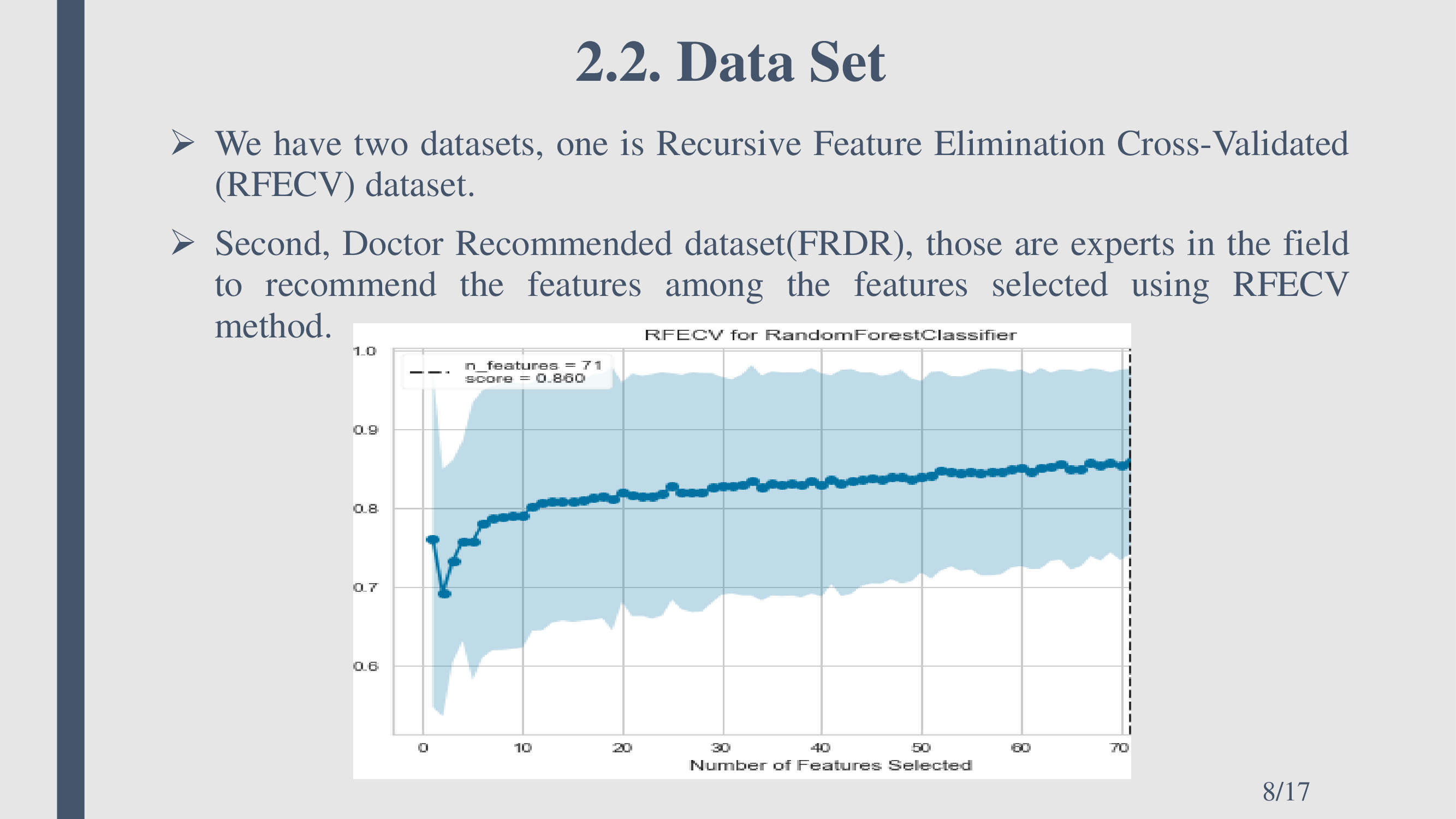 |
We have two datasets, one is Recursive Feature Elimination Cross-Validated (RFECV) dataset.
Second, Doctor Recommended dataset(FRDR), those are experts in the field to recommend the features among the features selected using RFECV method.
|
| ICACT20210193 Slide.09
[Big Slide]
|
Chrome Click!! |
 |
This system can detect the level with an RFECV dataset accuracy of 96% percent, while another FRDR dataset with an accuracy of 90 percent.
|
| ICACT20210193 Slide.10
[Big Slide]
|
Chrome Click!! |
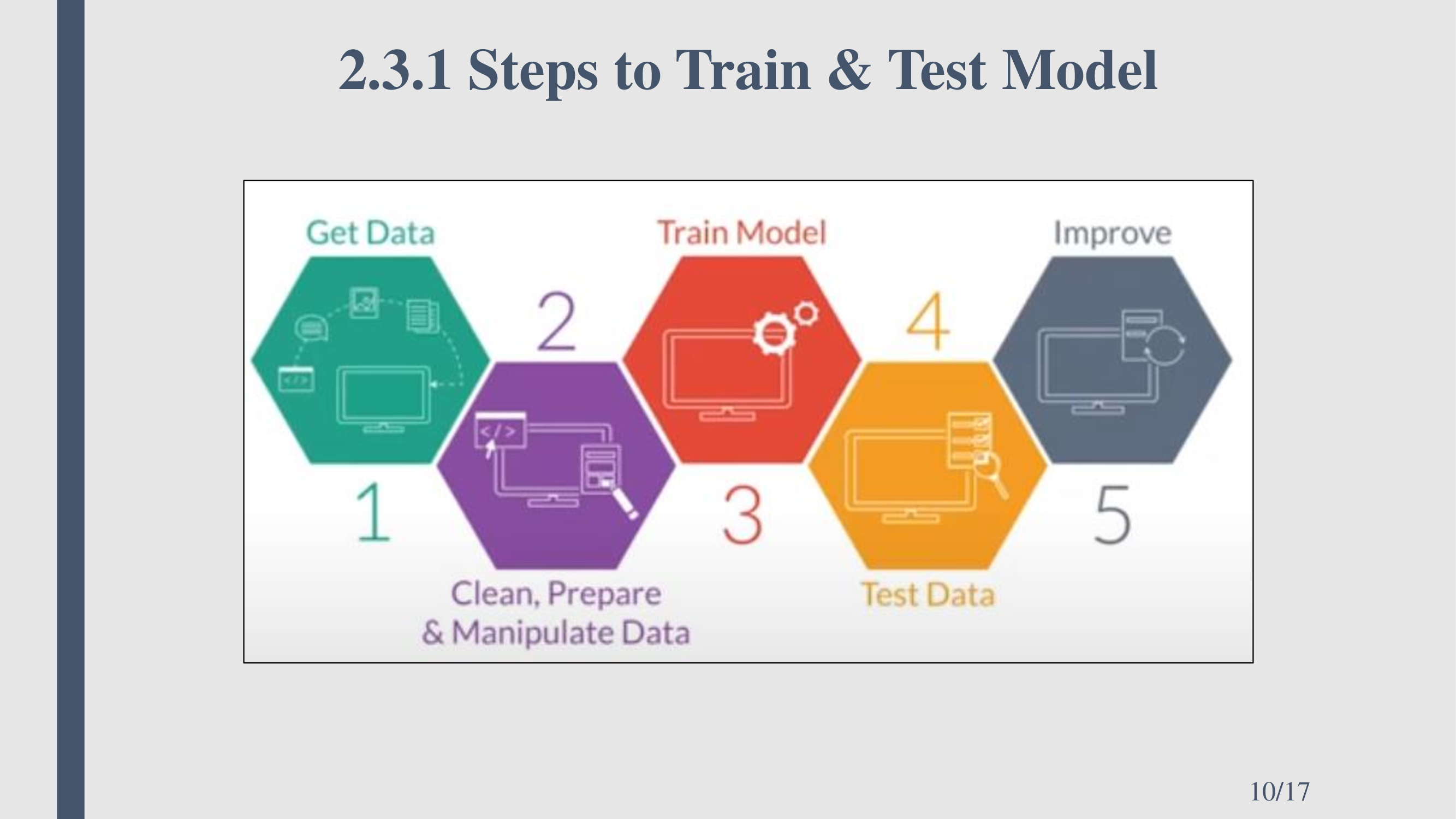 |
Steps to train and test models |
| ICACT20210193 Slide.11
[Big Slide]
|
Chrome Click!! |
 |
In this study, we proposed a SVM model for COPD classification.
It has been proven that COPD analysis using computational method performs fast and better.
Support Vector Machine(SVM) based machine learning is more effective than traditional methods.
|
| ICACT20210193 Slide.12
[Big Slide]
|
Chrome Click!! |
 |
Results |
| ICACT20210193 Slide.13
[Big Slide]
|
Chrome Click!! |
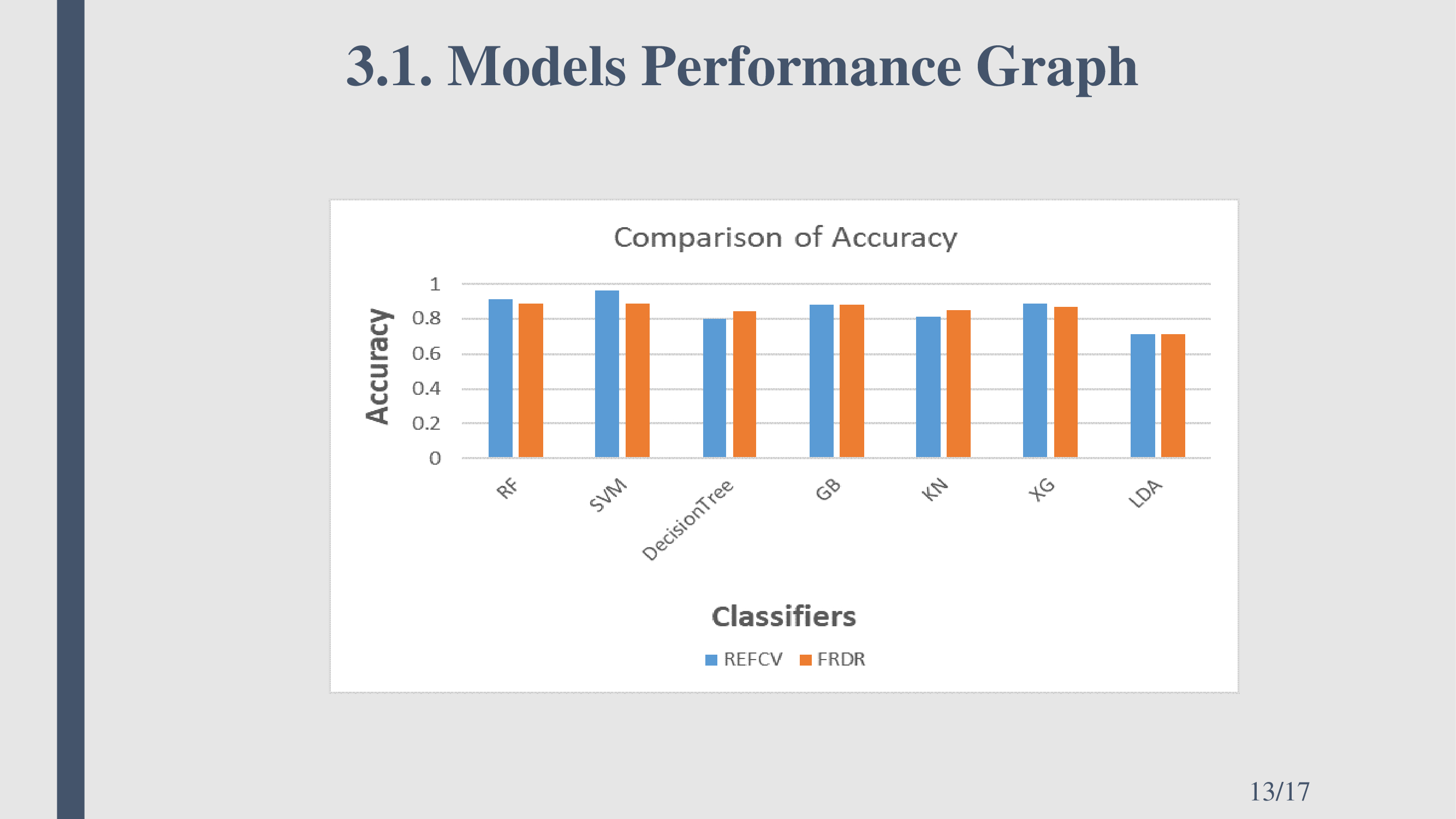 |
Models performance graph |
| ICACT20210193 Slide.14
[Big Slide]
|
Chrome Click!! |
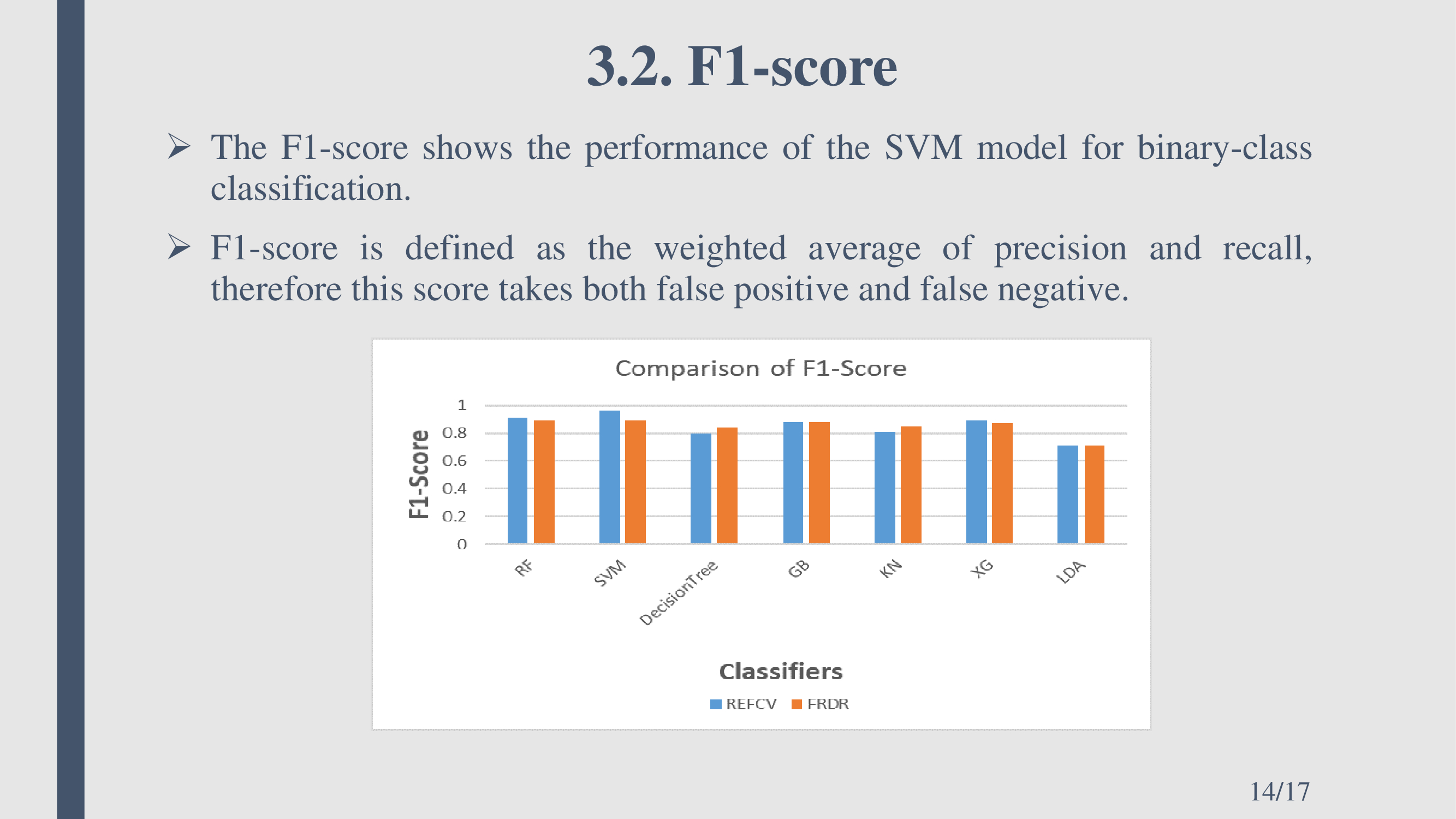 |
The F1-score shows the performance of the SVM model for binary-class classification.
F1-score is defined as the weighted average of precision and recall, therefore this score takes both false positive and false negative.
|
| ICACT20210193 Slide.15
[Big Slide]
|
Chrome Click!! |
 |
Conclusion |
| ICACT20210193 Slide.16
[Big Slide]
|
Chrome Click!! |
 |
The model was trained to predict the probabilities for two different classes, our trained model has shown better performance.
The proposed SVM model achieved a better result compared to the other models.
Therefore, a computerized system for COPD classification will greatly help Doctors in COPD diagnosis and grading.
|
| ICACT20210193 Slide.17
[Big Slide]
|
Chrome Click!! |
 |
Thanks for your attention! Now! Floor is open for QnA. Welcome any comment or question.
|















