 ICACT20210203 Slide.01
[Big Slide] |
Chrome  Click!! |
.jpg) |
Good morning, I am Tanatthep Jarawan. Today I will present the paper with the title Wi-Fi Received Signal Strength-based Indoor Localization System Using K-Nearest Neighbors fingerprint integrated D star algorithm. |
| ICACT20210203 Slide.02
[Big Slide]
|
Chrome Click!! |
 |
Introduction |
| ICACT20210203 Slide.03
[Big Slide]
|
Chrome Click!! |
.jpg) |
Wi-Fi received signal strength (RSSI) can help find a relationship between two positions to translate into distance values in indoor localization. Wi-Fi RSSI measures in dBm. The Wi-Fi RSSI values have typical negative values ranging between 0 dBm (excellent signal) and -110 dBm (low signal). Signal strength is taken to calculate the distance between nodes from the signal attenuation values. The Wi-Fi RSSI values are not complex to understand.
|
| ICACT20210203 Slide.04
[Big Slide]
|
Chrome Click!! |
.jpg) |
The K-Nearest Neighbour Algorithm (K-NN) is one of the simplest machine learning algorithms based on supervised learning and non-parametric algorithms. Previous research has applied K-NN for indoor positioning since it does not have high complexity and its computing is not highly time-consuming. The K-NN algorithm is a method used to classify. |
| ICACT20210203 Slide.05
[Big Slide]
|
Chrome Click!! |
.jpg) |
The D star algorithm comes from the Dijkstra algorithm, which is used to determine the path of a robot’s moves in eight directions. D star algorithms will generate an optimal trajectory for the efficient planning of robot movements. It is also used for route planning that results in unmanned aerial vehicle(UAV) flight routes by forming the ”flying, judging, and planning” autonomous planning pattern.
|
| ICACT20210203 Slide.06
[Big Slide]
|
Chrome Click!! |
.jpg) |
In this paper, the implementation of the D star algorithm for a motion planning algorithm uses a starting point from K-NN in the localization process. Then, the target point and the position of the obstacle are assigned. |
| ICACT20210203 Slide.07
[Big Slide]
|
Chrome Click!! |
.jpg) |
Related works |
| ICACT20210203 Slide.08
[Big Slide]
|
Chrome Click!! |
.jpg) |
Related work of WiFi Received Signal Strength Indicator(WiFi RSSI). RSSI stands for Received Signal Strength Indicator. The position of Wi-Fi RSSI in indoor localization systems is similar to that of the Global Positioning System (GPS) in outdoor world mapping since the GPS has insufficient inaccuracy when working indoors, especially because there are many floor plans. Therefore, Wi-Fi RSSI is widely used for indoor localization instead. The application can be used in several areas, such as office buildings, factories, and warehouses. Although WIFI localization has an error of 1-2 meters because of the noise from other access points and attenuation from obstacles such as walls, it achieves better results than GPS for indoor localization. WiFi RSSI behaves high value when the position near to access point, whereas it shows low value when the position far away from the access point.
|
| ICACT20210203 Slide.09
[Big Slide]
|
Chrome Click!! |
.jpg) |
Related work of K Nearest Neighbor algorithm (K-NN). K-NN is widely deployed in various applications. K-NN is a simple machine learning algorithm based on a supervised learning technique. |
| ICACT20210203 Slide.10
[Big Slide]
|
Chrome Click!! |
.jpg) |
The Euclidean distance is mostly the mathematics inside the processing of KNN present as this equation. From the equation, theta represents the first position, Rho is the second position, and n is the number of data dimensions.
|
| ICACT20210203 Slide.11
[Big Slide]
|
Chrome Click!! |
.jpg) |
Besides, the K value in KNN should be set with a proper value to obtain a high level of prediction efficiency. K value is the number of points closest to the focused point that will be used to find the average value for predictions. The dataset that will be used with K-NN must be separated into a training set and a testing set. In the experiment, 20% of the dataset is assigned to be the testing set and the remaining 80% is used for the training set.
|
| ICACT20210203 Slide.12
[Big Slide]
|
Chrome Click!! |
.jpg) |
Related work of D star algorithm. The Traditional motion planning is designed for applications with one-time planning such as the A*algorithm. Therefore, it needs more programming to adjust to changes in the environment. The D*algorithm is developed for global use with a small modification or improvement for higher searching efficiency.
|
| ICACT20210203 Slide.13
[Big Slide]
|
Chrome Click!! |
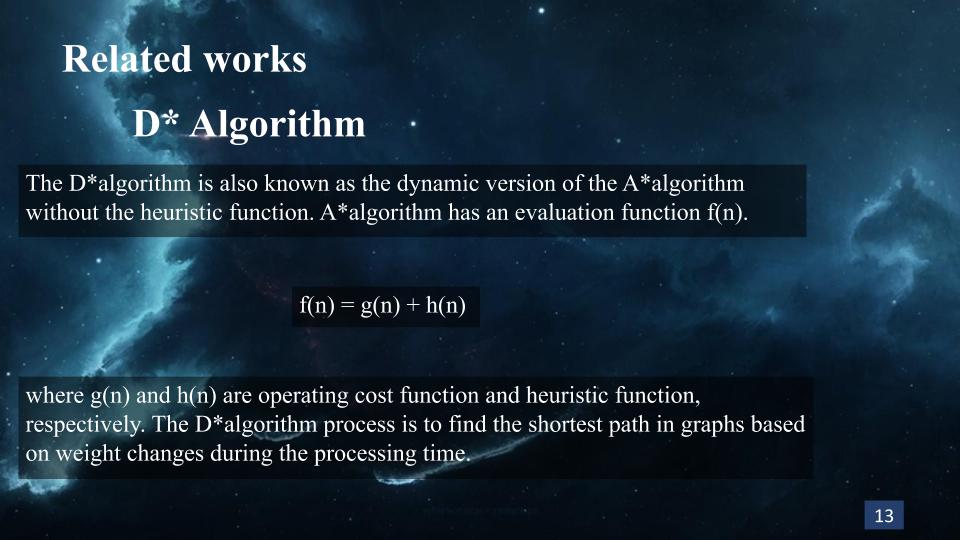 |
The D star algorithm is also known as the dynamic version of the A star algorithm without the heuristic function. A star algorithm has an evaluation function fn as the equation below. From the equation, gn and hn are operating cost function and heuristic function, respectively. The D star algorithm process is to find the shortest path in graphs based on weight changes during the processing time.
|
| ICACT20210203 Slide.14
[Big Slide]
|
Chrome Click!! |
.jpg) |
Method |
| ICACT20210203 Slide.15
[Big Slide]
|
Chrome Click!! |
.jpg) |
The proposed method processes begin with design a point for gathering Wi-Fi values in the Terminal 2 building. International Academy of Aviation Industry King Mongkut's Institute of Technology Ladkrabang. The building has only one floor and has room aliment as the figure. Also, it demonstrates the position for four access points that focused on the experiment, which is located in 4 corners of the walkway. Each point in the walkway is assigned to be X-Y coordinate, which has a distance of 1.2 meters.
|
| ICACT20210203 Slide.16
[Big Slide]
|
Chrome Click!! |
.jpg) |
The second step is Coding Python on Raspberry pi for reading Wi-Fi signal strength value (in dBm) from each access point number 1 2 3 and 4, gathering data from each point in Terminal 2. |
| ICACT20210203 Slide.17
[Big Slide]
|
Chrome Click!! |
.jpg) |
The third step is Gathering Wi-Fi signal strength data from each point and each access point for 110 data shown as the figure. |
| ICACT20210203 Slide.18
[Big Slide]
|
Chrome Click!! |
.jpg) |
The proposed method presents a combination of processes between the KNN and D star Algorithm. The KNN is applied for localization of the current position, while the D star Algorithm optimizes the motion path to avoid the obstacle and reach the target point at the end. |
| ICACT20210203 Slide.19
[Big Slide]
|
Chrome Click!! |
.jpg) |
RESULT AND DISCUSSION |
| ICACT20210203 Slide.20
[Big Slide]
|
Chrome Click!! |
.jpg) |
Demonstrates the signal level, which is obtained from four access points. It indicates that different signals from different access points show different patterns of data. According to the signal from the access point, number 1 has a peak signal at point 15, which is assigned to be the point (0,0). The signal from the second access point has a peak signal at point number 0, identified by (0,18) in the coordinate system. The third and the fourth access points have the highest signals at point number 55(30,18) and point number 40(30,0), respectively. The clear differences in the signal pattern support the model of the KNN algorithm.
|
| ICACT20210203 Slide.21
[Big Slide]
|
Chrome Click!! |
.jpg) |
The first result is to evaluate the KNN result, as illustrated in TABLE 1. The experiment set K = 1, and RMSE for displacement is 1.190 meters, while RMSE in the X-Axis and the Y-Axis are 2.491 and 1.363 meters, respectively. These error results are satisfactory for indoor positioning since typically the margin of error will be between 1-2 meters in displacement.
|
| ICACT20210203 Slide.22
[Big Slide]
|
Chrome Click!! |
.jpg) |
If the approximation of the floor plan equals 52 points in the X-Axis and 82 points in the Y-Axis, the map represents this with the “.” symbol, and the area of an obstacle is represented “#” symbol. D star Algorithm has processes for finding the optimal path. The result of path planning is illustrated as the symbol “*” in Fig. 3
|
| ICACT20210203 Slide.23
[Big Slide]
|
Chrome Click!! |
.jpg) |
conclusion |
| ICACT20210203 Slide.24
[Big Slide]
|
Chrome Click!! |
.jpg) |
This experiment presents the indoor localization system using the K-NN and D star algorithm applied to WiFi received signal strength. The experiment was conducted based on the building that is a one-floor plan and separated into 76 points, each point has a distance of about 1.2 meters. The data has been collected for 8,360 records and divided to form a training set and testing set for K-NN modeling. The result of the model, when K=1, is very delightful for further process. D star algorithm is the consequent step that results from K-NN identifying the current location and setting it as the starting point. The map also approximates generated to present the obstacle at four corners of the building. D star algorithm generates the optimal path by avoiding the obstacle and reach the target point as set before.
Although the proposed localization system provides a satisfying performance, other specific environments should be concentrated, for instance, the size of the object or vehicles that would like to implement this localization system. Developers should pay attention to the sophisticated detail of map generation for the K-NN and D*algorithm, which should correspond to each other.
|
| ICACT20210203 Slide.25
[Big Slide]
|
Chrome Click!! |
.jpg) |
Thank you |















