Now 4580 visitors
Today:0 Yesterday:0
Total: 144639
215S 51P 5R
2026-10-21, Week 43 |
| Member Login |
| TACT Journal Homepage |
| Call for Paper |
| Committee |
| Find My Paper |
| Author Homepage |
| Statistics & History |
| Welcome Message |
| Paper Procedure |
| FAQ |
| Paper Archives |
| Outstanding Papers |
| Author Homepage |
| - Paper Procedure |
| - Journal Procedure |
| - Presentation Tips |
|
| Program & Proceedings |
| Program with Papers |
| Plenary Session |
| Tutorial Session |
|
| Presentation Platform |
| Hotel & Travel Info |
| About Korea |
| Accommodation |
| Transportation |
| VISA |
| Other Infomation |
|
| Photo Gallery |
| Scheduler Login |
| Seminar |
| Archives Login |
|
| Sponsors |

|

|

|

|

|

|

|

|

|

|
|
|
|
|
 ICACT20210211 Slide.01
[Big Slide]
[YouTube] |
Chrome  Click!! |
 |
Hi eveybody, i'm Sung-Chan Nam.
For 2021 ICACT, i have cooperated Mr.Hong-Beom Choi and Dr.Young-Bae Ko.
Our presentation today is about mitigation of ranging errors for through-the-body NLOS conditions using CNN.
|
| ICACT20210211 Slide.02
[Big Slide]
[YouTube] |
Chrome Click!! |
 |
i will proceed with presentation in order of introduction, proposal scheme, experimental setup, performance, and conclusion.
|
| ICACT20210211 Slide.03
[Big Slide]
[YouTube] |
Chrome Click!! |
 |
First, I will proceed with the introduction.
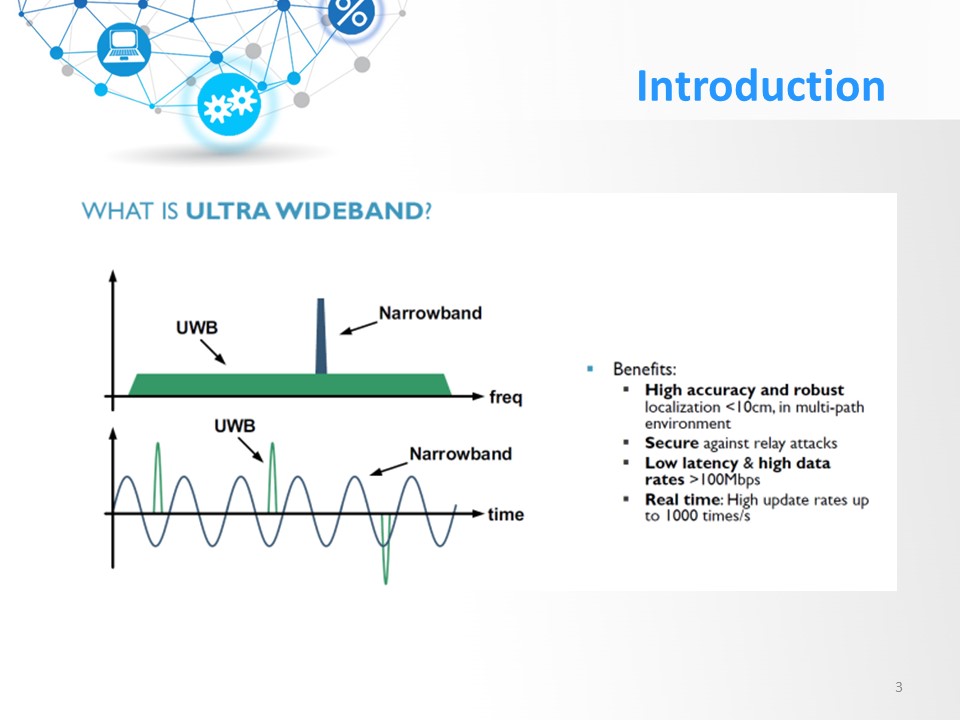
Impulse-radio ultra-wideband is a promising technology for high-precision indoor localization technology due to its various advantages such as low energy consumption, centimeter level precision, and robustness against to NLOS(Non-Line of Sight) due to characteristic of pulse signal and its wide bandwidth.
|
| ICACT20210211 Slide.04
[Big Slide]
[YouTube] |
Chrome Click!! |
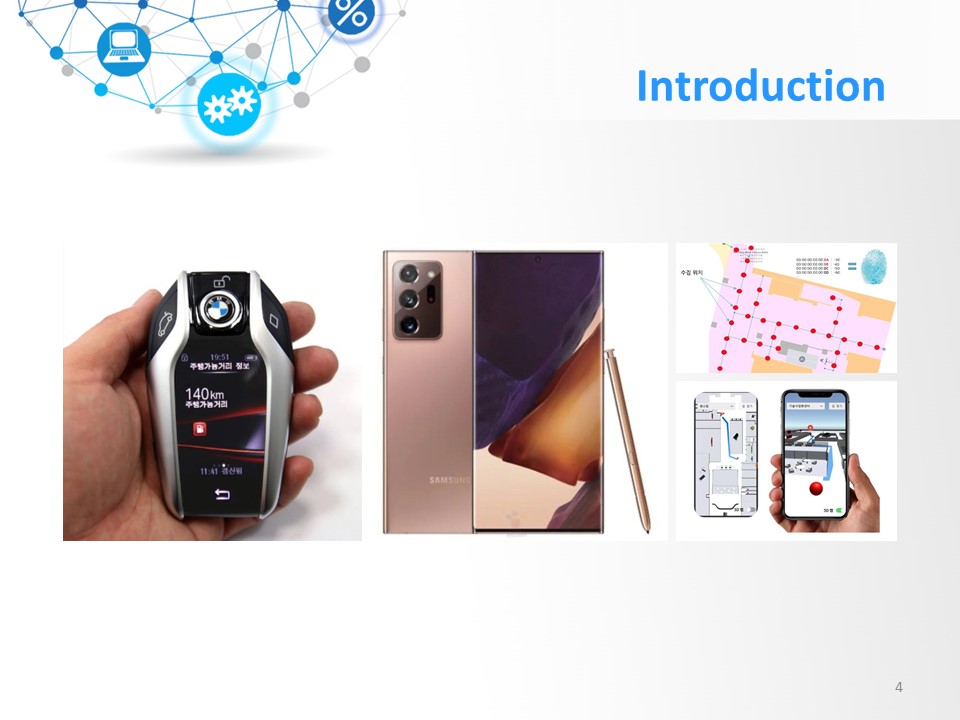 |
Because of this advantage of UWB, recently,UWB localization technology has begun to appear on latest mobile device such as Apple iPhone 11 Pro and Samsung Galaxy Note 20 Ultra, promising novel location-based services such as ‘Find My’ service. |
| ICACT20210211 Slide.05
[Big Slide]
[YouTube] |
Chrome Click!! |
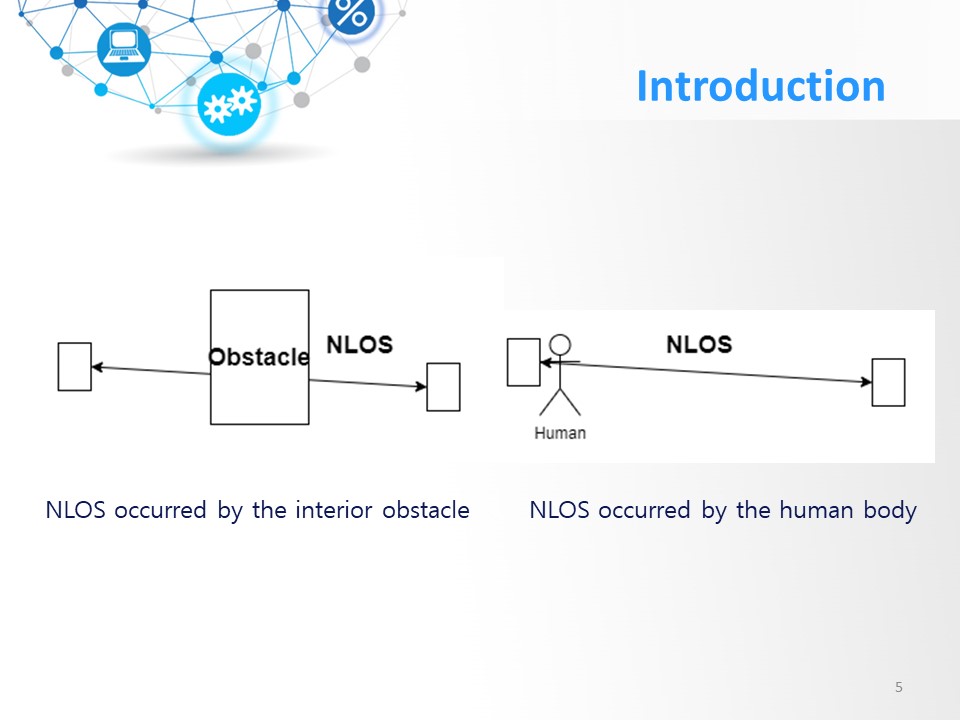 |
In this context, most of the devices for the UWB based services are inevitably human carrying. When user hold device or in the user’s pocket, some angles between UWB devices in all directions will always be obscured by human body such as wrists, thighs, head. Therefore, a technique that mitigates error caused by human is essential for future location-based service. If a person has a UWB wearable sensor, there will be large and small side errors depending on the sensor’s position on the human body. However, so far, research on mitigating errors in UWB indoor localization is focused on mitigating errors in indoor localization caused by NLOS effects of the indoor structure, and research on mitigating errors on human body characteristics has not been well discussed. Therefore, i conducted a research on mitigating errors caused by human body characteristics. |
| ICACT20210211 Slide.06
[Big Slide]
[YouTube] |
Chrome Click!! |
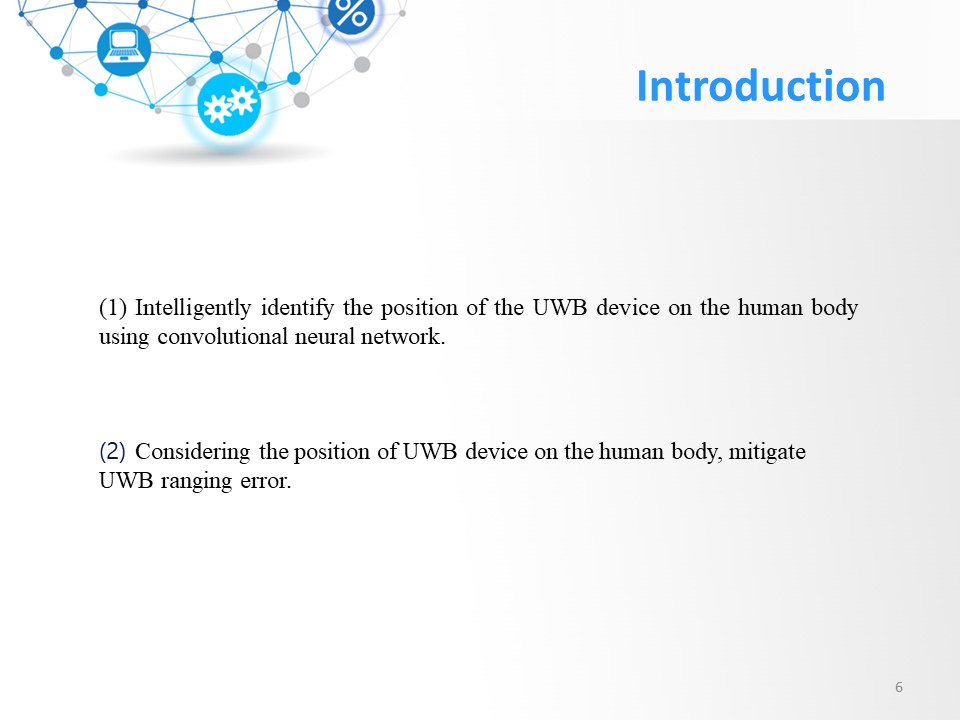 |
In this paper, we propose a framework considering the effect of human body in ranging error mitigating.
The main contributions of the paper can be summarized as follows:
First, we Intelligently identify the position of the UWB device on the human body using CNN.
Second, we mitigate UWB ranging error considering the position of UWB device on the human body. |
| ICACT20210211 Slide.07
[Big Slide]
[YouTube] |
Chrome Click!! |
 |
Next, i will explain our proposed scheme.
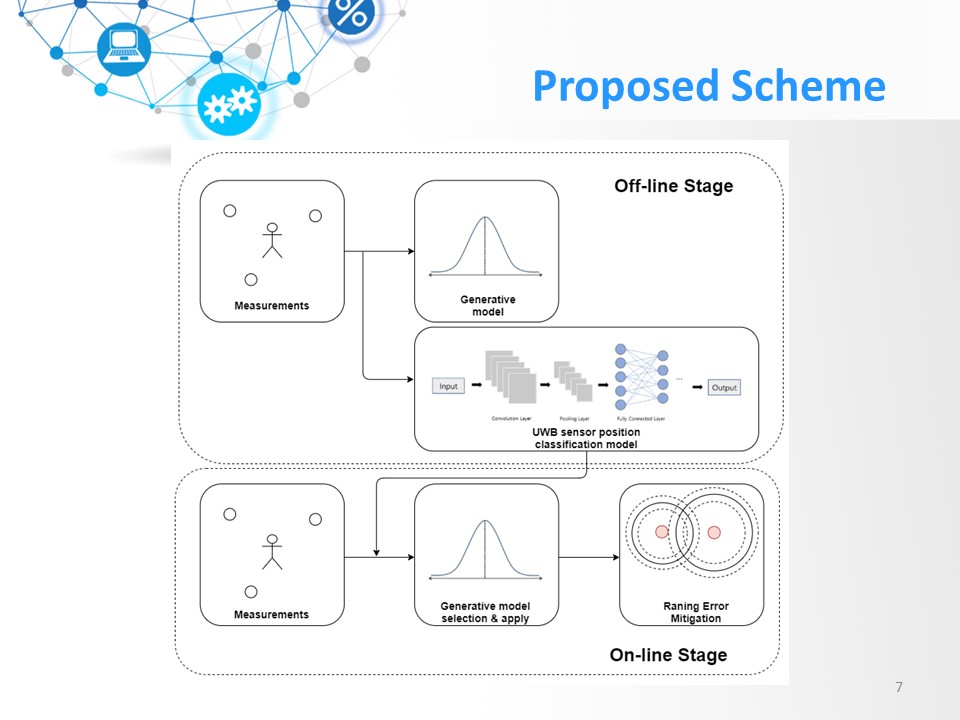
In this page, the figure represents our proposed scheme.
In off-line stage, first, we collect CIR data. Secondly, we analysis CIR data and generate generative model. Lastly, we use CIR data to deep learning CNN model.
In on-line stage, first, we measure CIR data. Secondly, we put the measured CIR data into the CNN model to identify where the UWB device is located in the body. Lastly, we select and apply generative models via identified label to mitigate ranging errors. |
| ICACT20210211 Slide.08
[Big Slide]
[YouTube] |
Chrome Click!! |
 |
Next, i will explain our experimental setup.
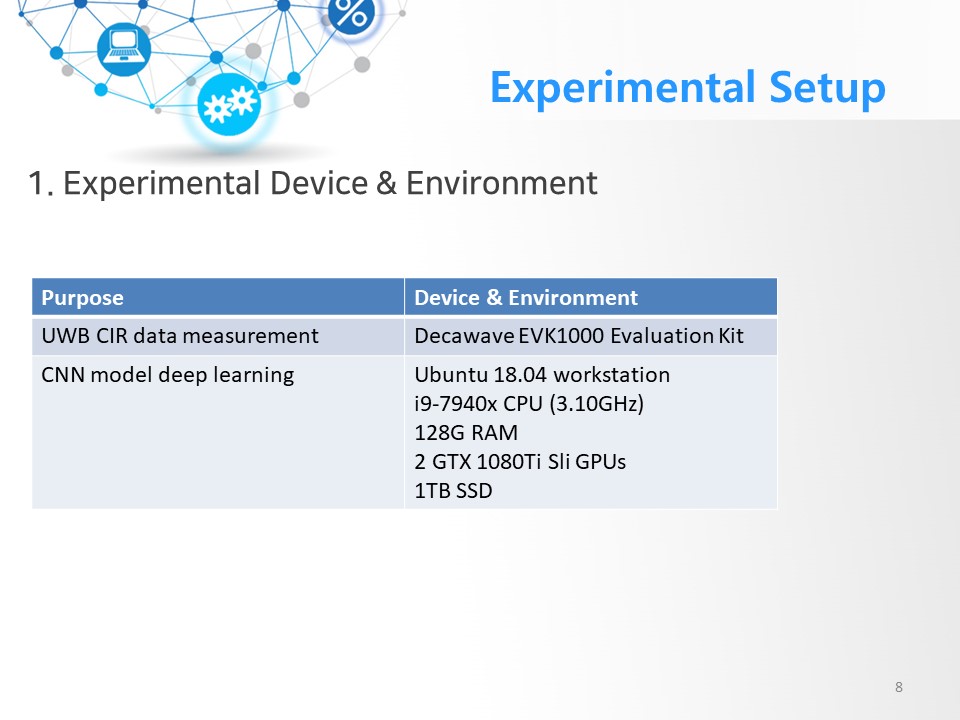
In this page, the table shows the devices used to proceed with our research and the environment in which the research was conducted. If you want to know the equipment used in our study and the environment in which the study was conducted, please refer to the table. |
| ICACT20210211 Slide.09
[Big Slide]
[YouTube] |
Chrome Click!! |
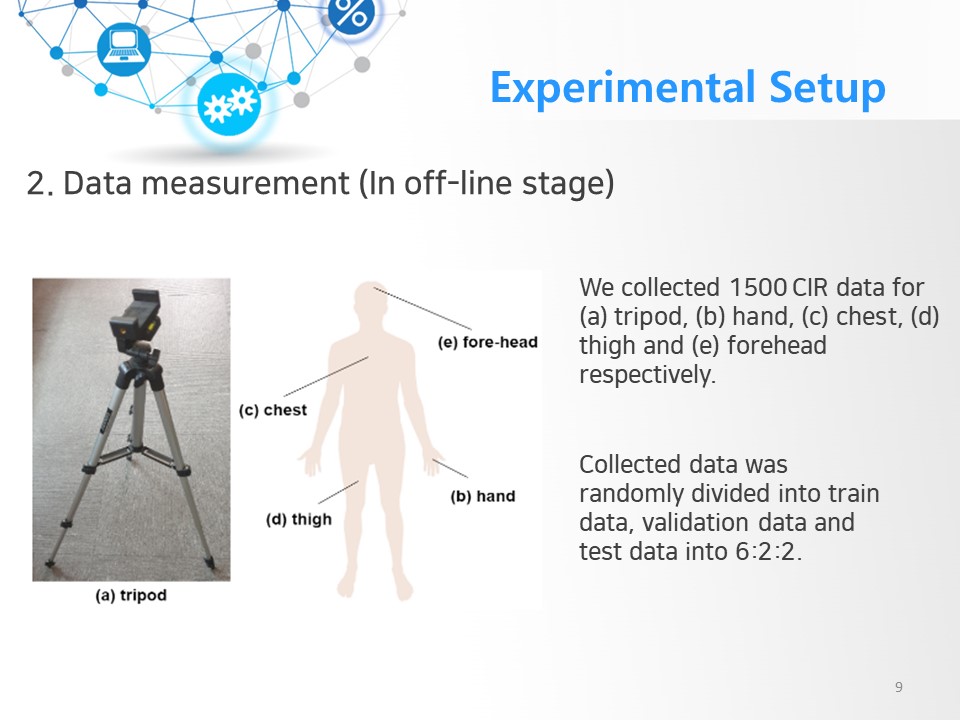 |
In this page, the figure represents the place where we placed the UWB device. Also, we collected 1500 CIR data for tripod, hand, chest, thigh and forehead respectively. Collected data was randomly divided into train data, validation data and test data into 6:2:2. |
| ICACT20210211 Slide.10
[Big Slide]
[YouTube] |
Chrome Click!! |
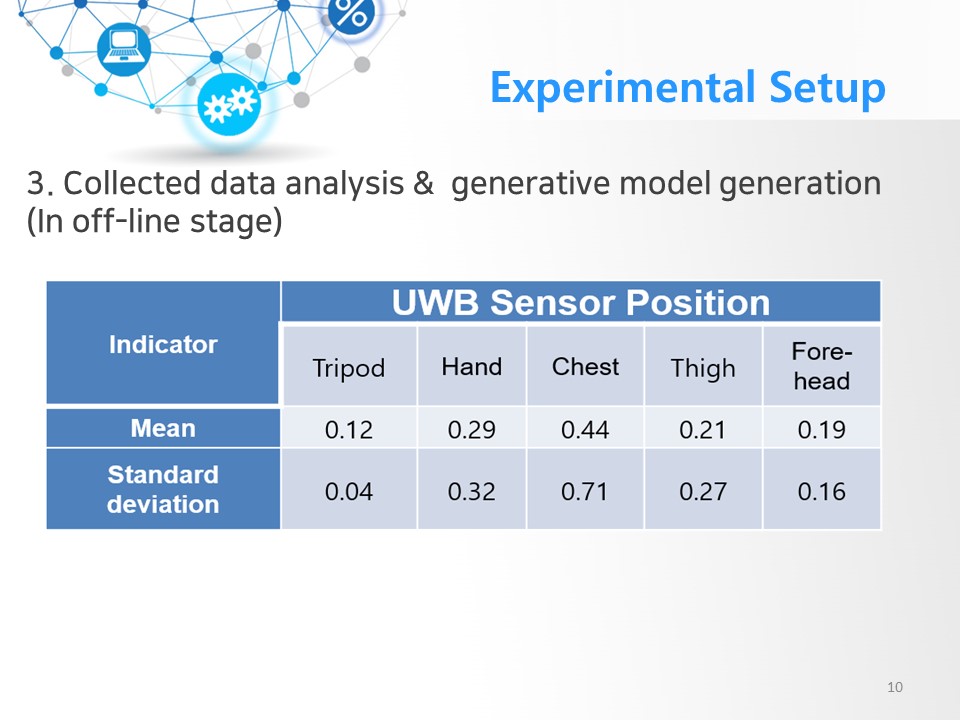 |
In this page, the table shows generative model.
As a result of creating a generative model, if, of course, the UWB device was not on the body, in other words, the mean and standard deviation of the error were the smallest if it was on the tripod. In addition, if the UWB device was on the body, the mean and standard deviation of the error were greatest when the UWB device was in the chest, and the mean and standard deviation were smallest when the UWB device was in the forehead. |
| ICACT20210211 Slide.11
[Big Slide]
[YouTube] |
Chrome Click!! |
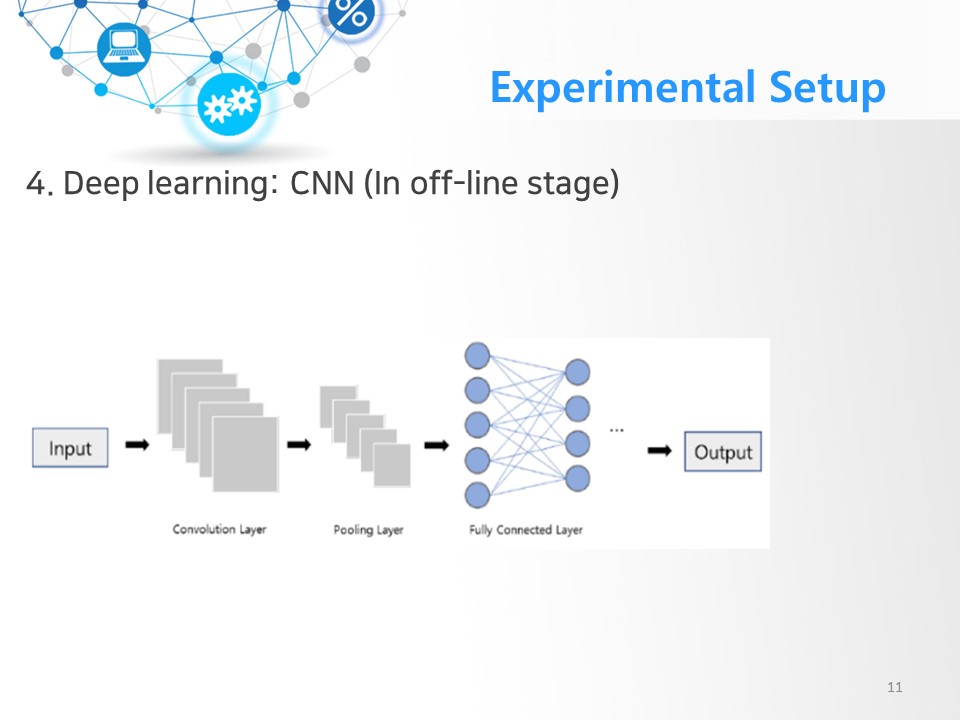 |
In order to classify the position of UWB device on the human body from the one-dimensional form of channel data, we used CNN structures. CNN consists of input, convolution layer, pooling layer, hidden layer, and output. |
| ICACT20210211 Slide.12
[Big Slide]
[YouTube] |
Chrome Click!! |
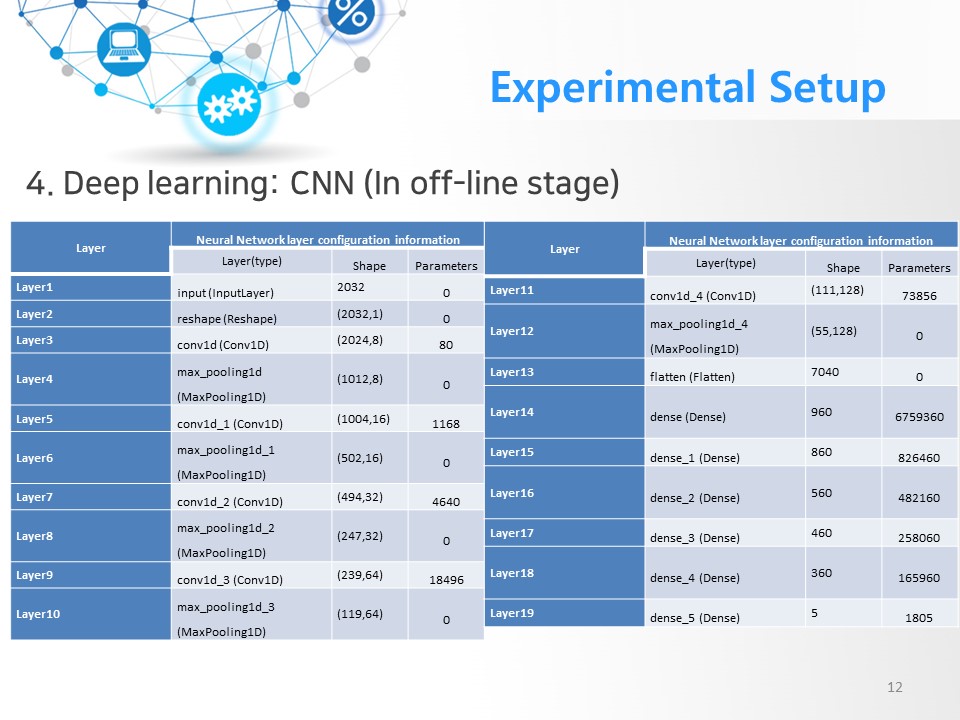 |
In this page, the table represents the details of the layer of the CNN model.
Since the UWB CIR data has 2032 features, the input layer has 2032 dimensions, and the output layer has 5 dimensions because our study uses only 5 labels. In addition to this, if you want to know the details of the CNN model used in our study, please refer to the table. |
| ICACT20210211 Slide.13
[Big Slide]
[YouTube] |
Chrome Click!! |
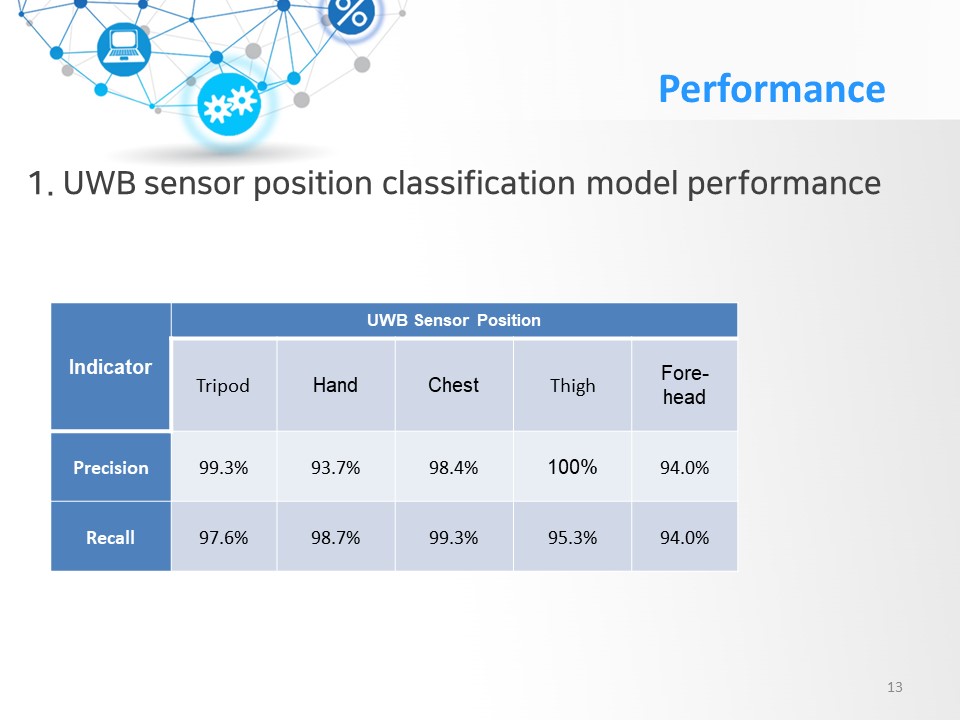 |
In this page, the table shows the identification accuracy of the identifier with the precision and recall values. The identifier has a high precision of at least 93.7% to 100% for each UWB device location. And, the identifier has a high recall of at least 94% to 99.3% for each UWB device location. |
| ICACT20210211 Slide.14
[Big Slide]
[YouTube] |
Chrome Click!! |
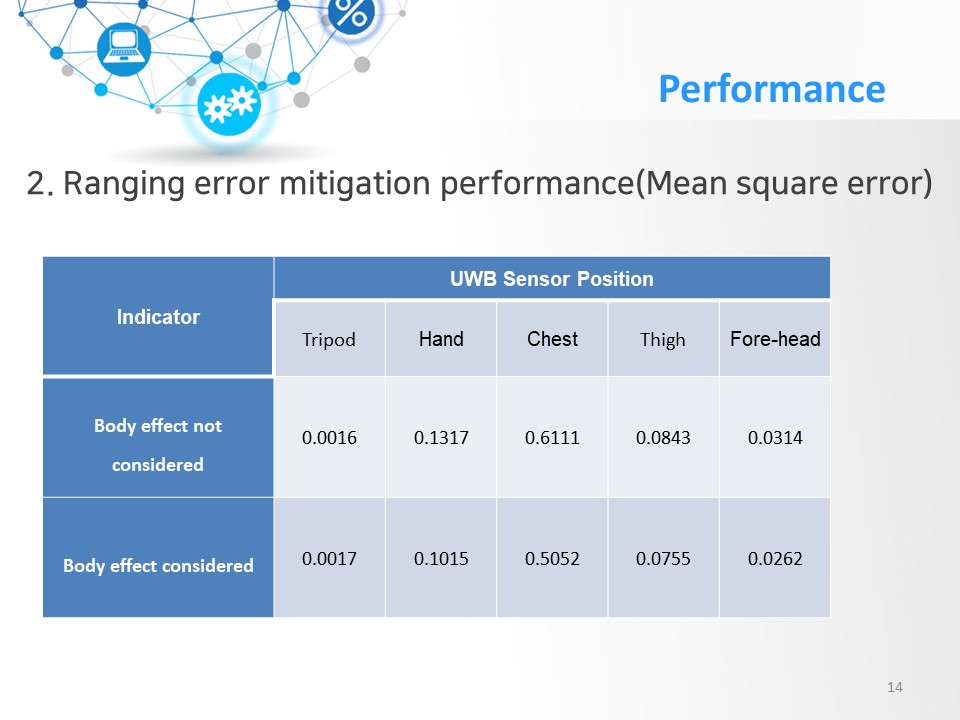 |
In this page, the table shows MSE values for mitigating range errors while considering the effects of the human body and mitigation range errors without considering the effects of the human body. When the UWB device is on a tripod, the identifier can slightly mis-predict that the UWB device is on the human body. As a result, the MSE value increased when the body effect was considered than when the body effect was not considered. But, when the UWB device is on the human body, the MSE value significantly decreased when the body effect was considered than when the body effect was not considered. |
| ICACT20210211 Slide.15
[Big Slide]
[YouTube] |
Chrome Click!! |
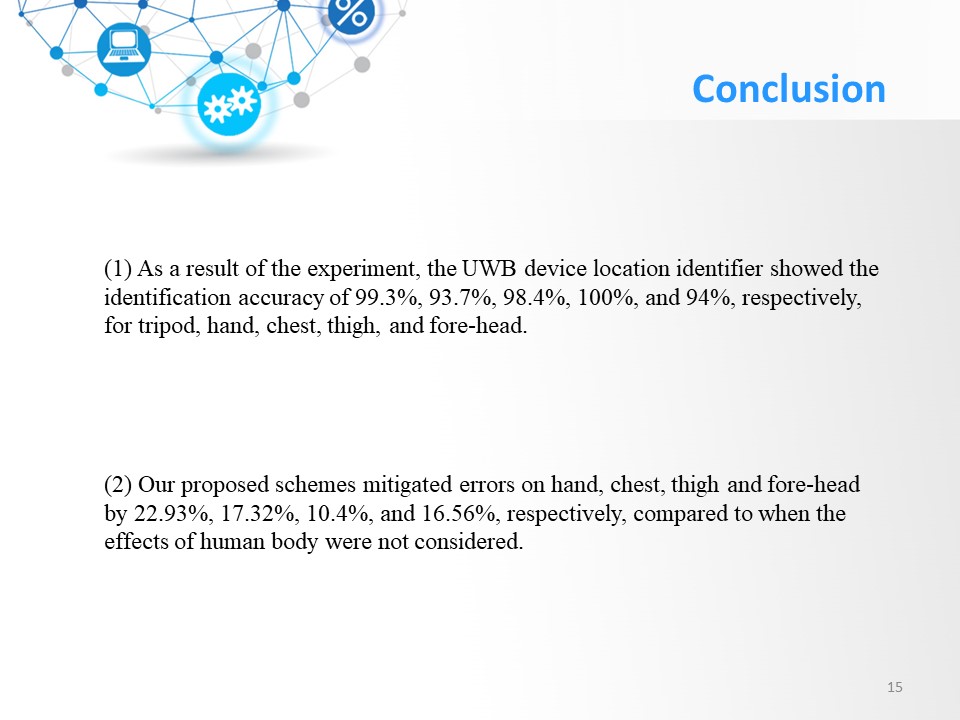 |
I explained about our research so far. The field of indoor localization using UWB is highly useful in various industries due to its high-precision and robustness to obstacles. However, in these areas, the error caused by NLOS caused by inter-communication inter-terminal obstacles is the biggest problem that needs to be addressed by compensating for the errors caused by NLOS and increasing the measurement accuracy. Recently, various approaches to responding to errors have been attempted using deep learning, but this is mostly the study of NLOS by indoor obstacles, and there is not enough research to respond to NLOS by the human body. Therefore, we proposed a system to identify where the UWB device is on the body and apply range error mitigation differently depending on the location of the UWB device to mitigate errors caused by NLOS by the human body. As a result of the experiment, the UWB device location identifier showed the identification accuracy of 99.3%, 93.7%, 98.4%, 100%, and 94%, respectively, for tripod, hand, chest, thigh, and fore-head. Also, our proposed schemes mitigated errors on hand, chest, thigh and fore-head by 22.93%, 17.32%, 10.4%, and 16.56%, respectively, compared to when the effects of human body were not considered. The following study attempts to mitigate localization error according to the position of the UWB device on the human body, not to mitigate the range error. |
| ICACT20210211 Slide.16
[Big Slide]
[YouTube] |
Chrome Click!! |
 |
Thank you for listening. |
| |





