 ICACT20210215 Slide.01
[Big Slide]
[YouTube] |
Chrome  Click!! |
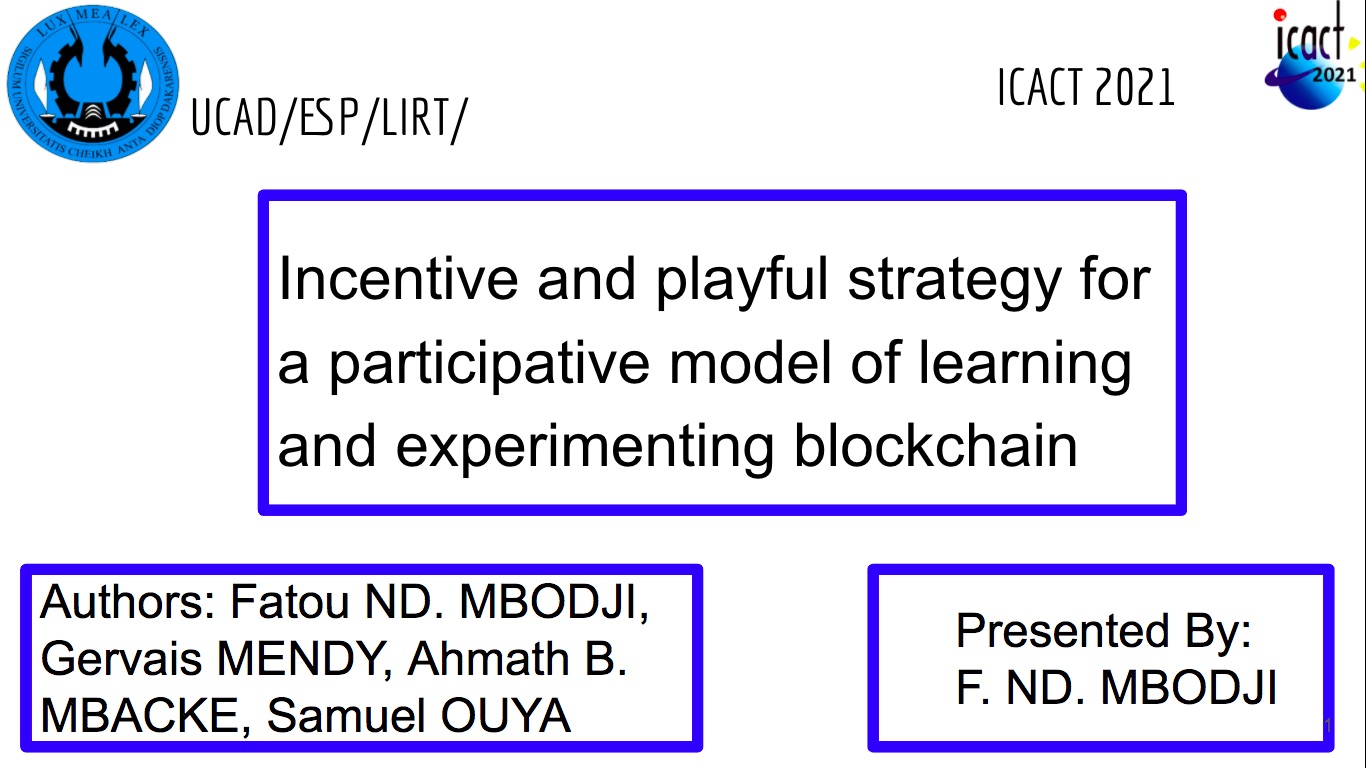 |
Hi,I am Fatou Ndiaye MBODJI. I'm going to present our work conducted at our laboratory which is the LIRT of the ESP of UCAD.
Work carried out with the other authors who are professors Gervais MENDY, Ahmath Bamba MBACKE and Samuel OUYA. In this work we propose an "Incentive and playful strategy for a participative model of learning and experimenting blockchain" which is a paper submitted to the ICACT 2021 conference. |
| ICACT20210215 Slide.02
[Big Slide]
[YouTube] |
Chrome Click!! |
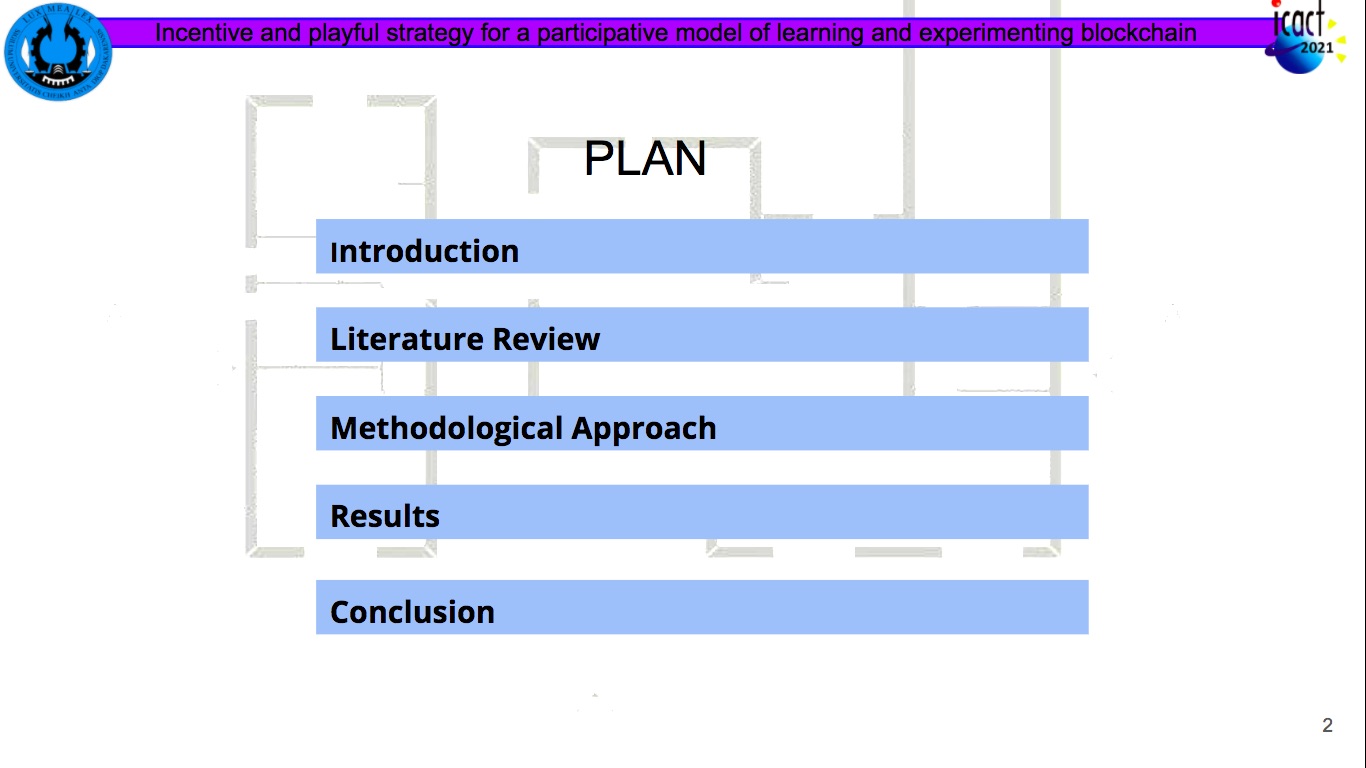 |
Our plan is structured around these 5 points.
An introduction, a literature review that will allow us to identify the main question of this study and a methodological approach to provide answers materialized by the results before ending with a general conclusion. |
| ICACT20210215 Slide.03
[Big Slide]
[YouTube] |
Chrome Click!! |
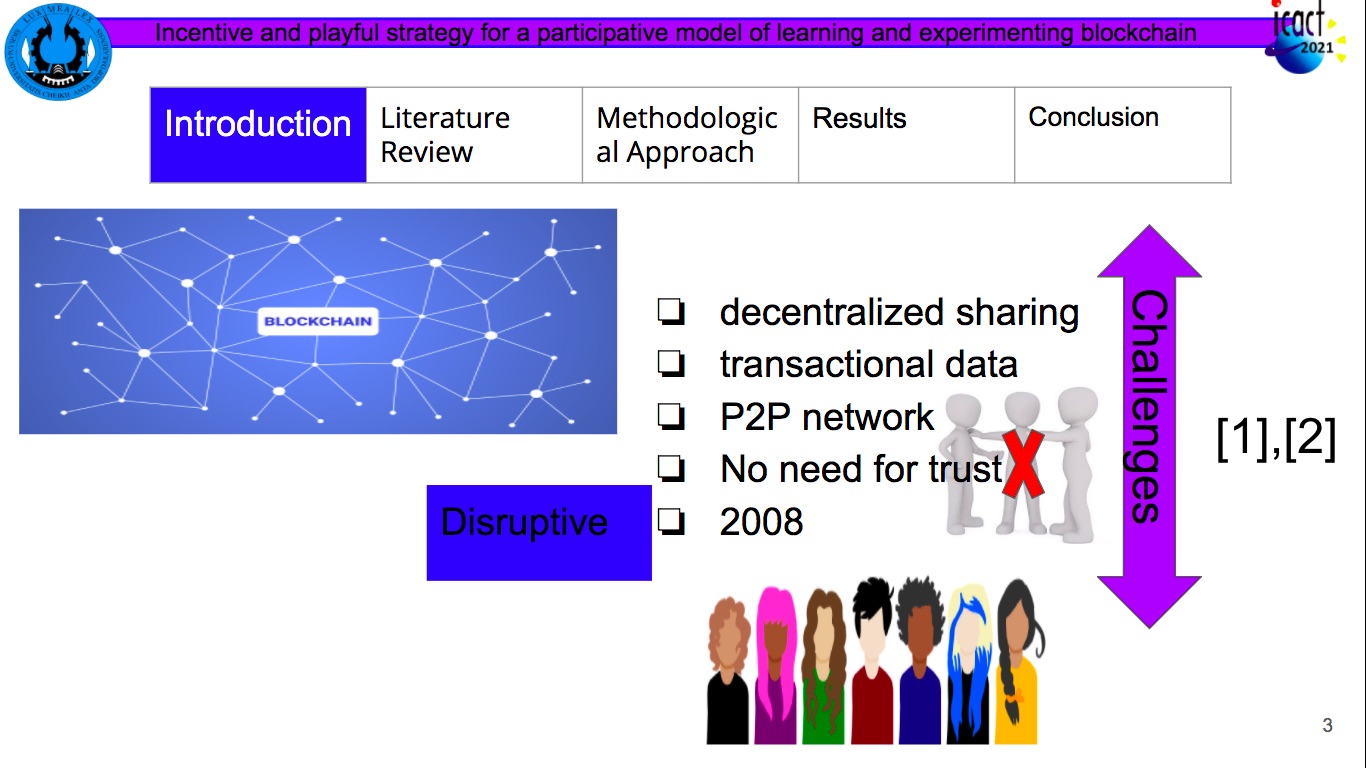 |
Blockchain is a disruptive technologyis , a protocol for the secure transfer of informations without the use of a third-party intermediary. It interest to various professions and profiles such as learners, designers, researchers and business. |
| ICACT20210215 Slide.04
[Big Slide]
[YouTube] |
Chrome Click!! |
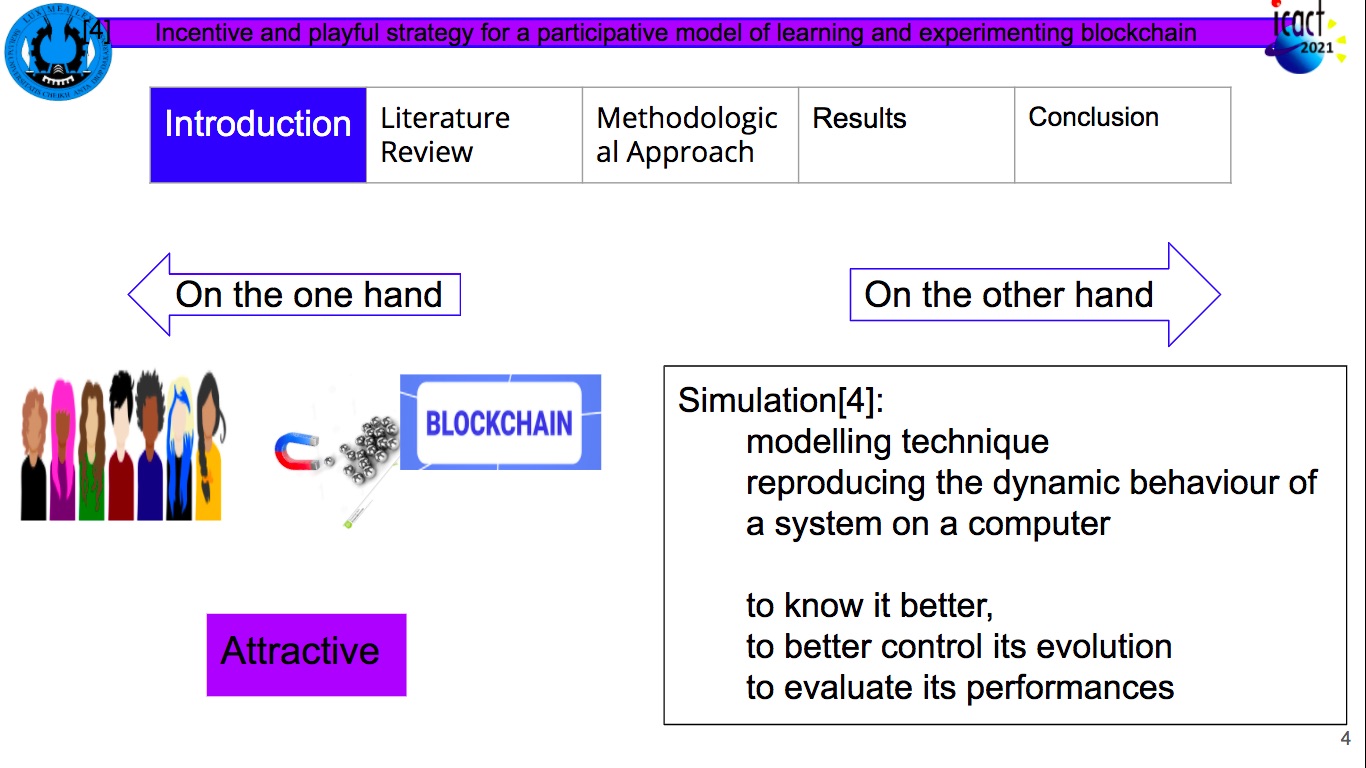 |
On the one hand we have these profiles that are interested in the blockchain. On the other hand we have simulation which consists in reproducing the dynamic behaviour of a system on a computer in order to know it better, to better control its evolution over time in a given environment and to evaluate its performances. |
| ICACT20210215 Slide.05
[Big Slide]
[YouTube] |
Chrome Click!! |
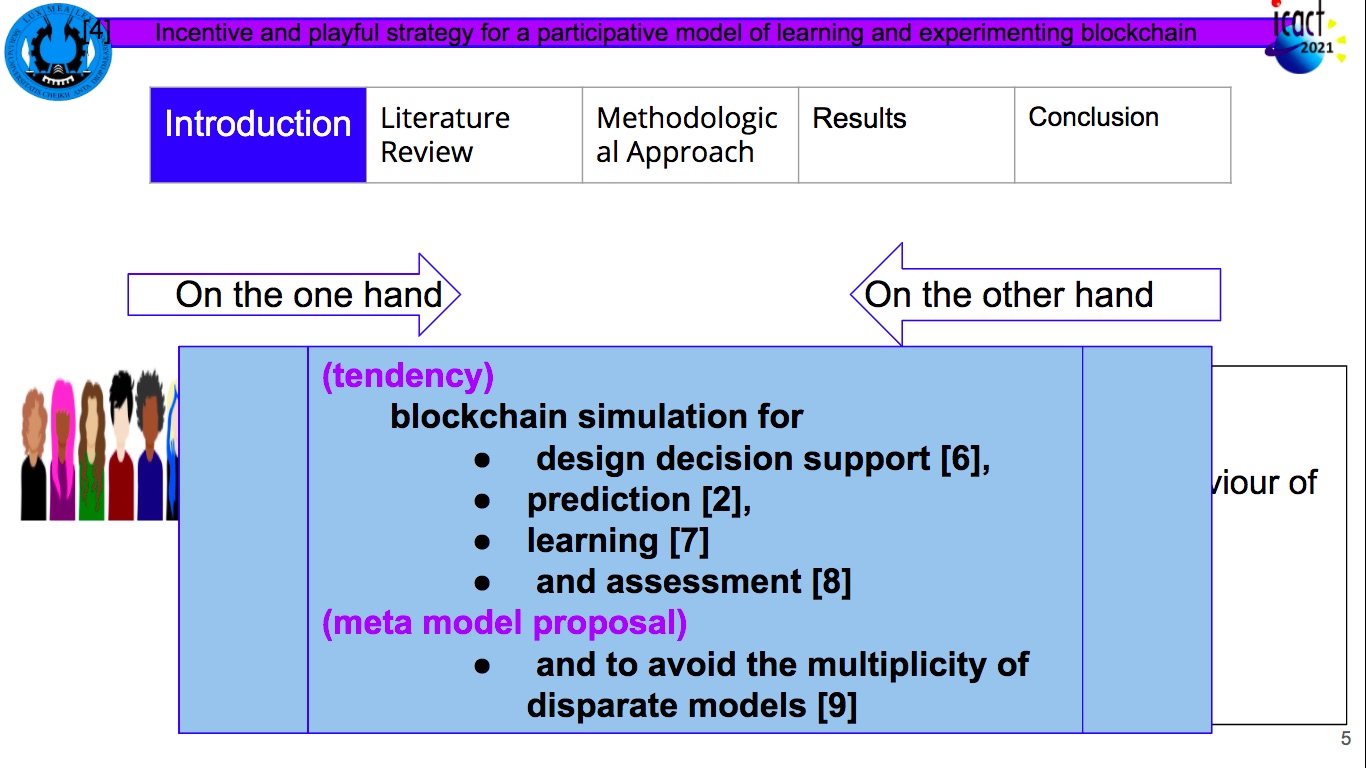 |
Hence, the use of blockchain simulation for: design decision , prediction , learning and assessment ; is a tendency.
To avoid the multiplicity of disparate models, the study 9 identies the need of a metamodel to standardise such models |
| ICACT20210215 Slide.06
[Big Slide]
[YouTube] |
Chrome Click!! |
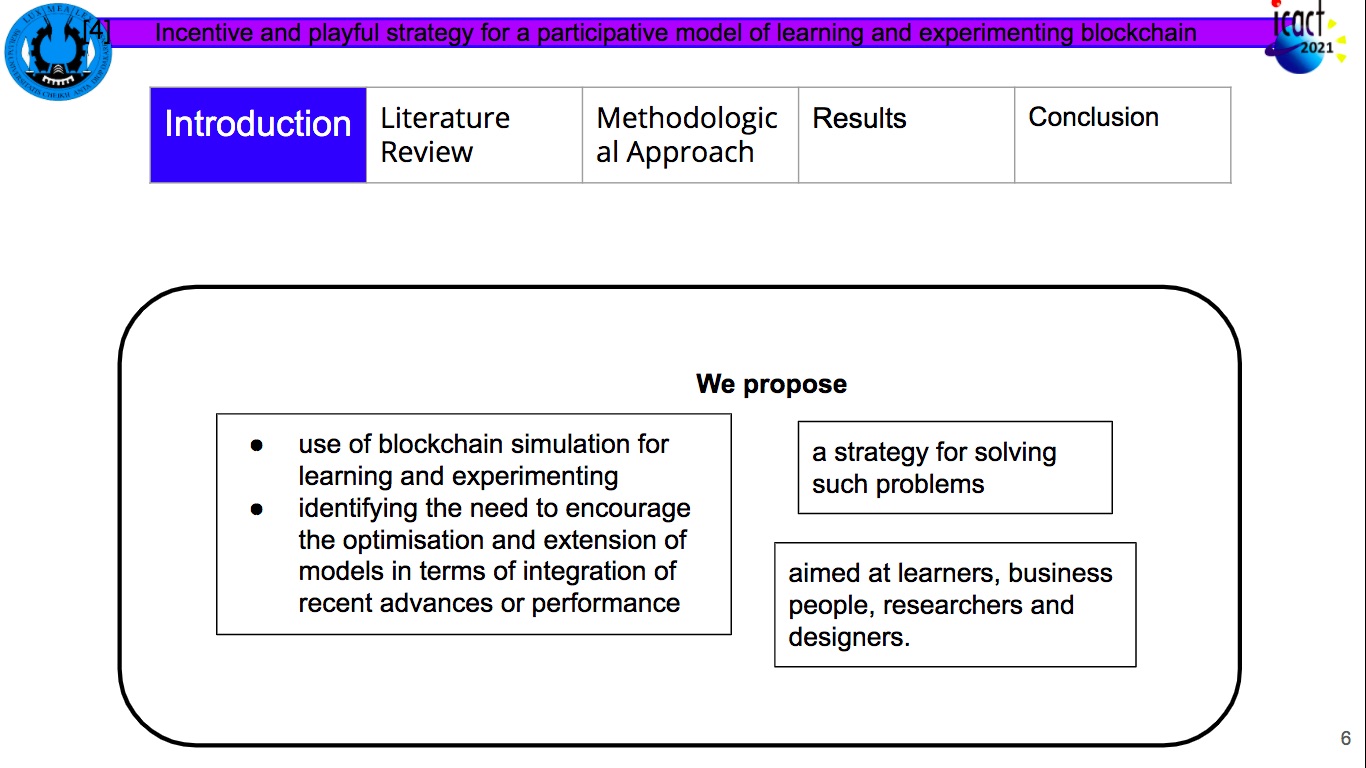 |
Thus we propose the use of blockchain simulation for learning and experimenting by identifying the need to encourage the optimisation and extension of models in terms of integration of recent advances or performance. After proposing a strategy for solving such problems, we set up a simulator that takes this characteristic into account for the purposes of learning, modelling, implementation, testing and evaluation of the blockchain. |
| ICACT20210215 Slide.07
[Big Slide]
[YouTube] |
Chrome Click!! |
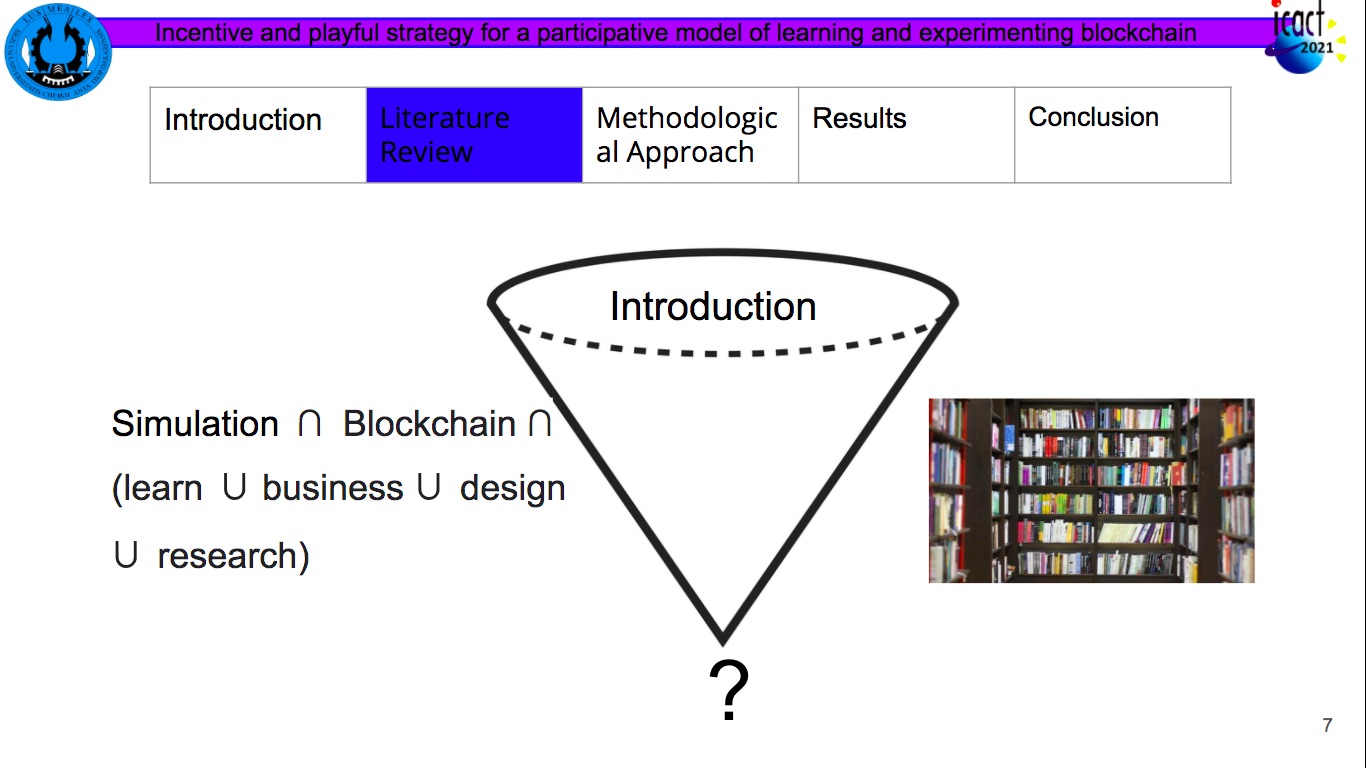 |
The use of simulation in the blockchain oriented to this areas is of great interest. Thus, we go to the literature review. |
| ICACT20210215 Slide.08
[Big Slide]
[YouTube] |
Chrome Click!! |
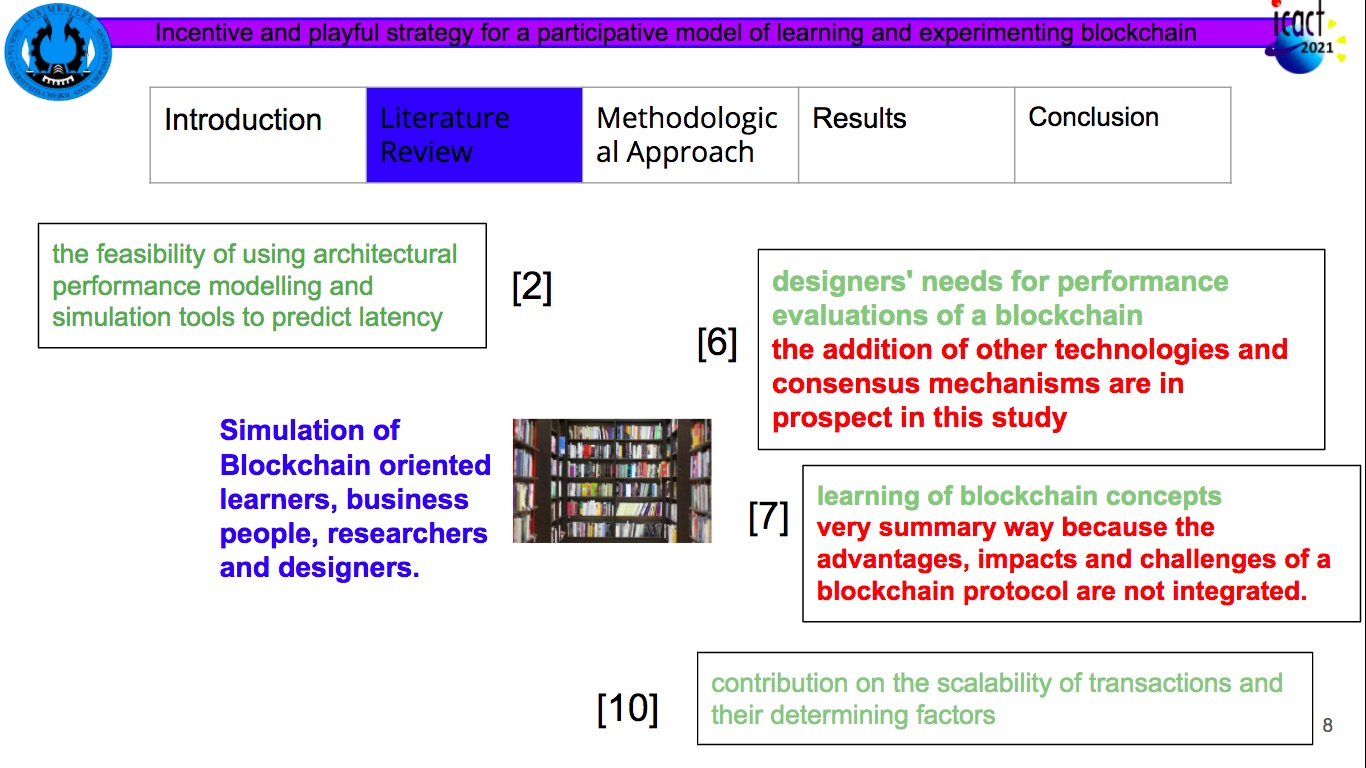 |
study 6 have addressed the designers' needs for performance evaluations of a blockchain. However, the addition of other technologies and consensus mechanisms are in prospect in this study. Others such the study 7 have contributed to the learning of blockchain concepts but in a very summary way because the advantages, impacts and challenges of a blockchain protocol are not integrated. The author of 10 has made a contribution on the scalability of transactions and their determining factors. In the paper 2, The authors show the feasibility of using architectural performance modelling and simulation tools to predict latency. |
| ICACT20210215 Slide.09
[Big Slide]
[YouTube] |
Chrome Click!! |
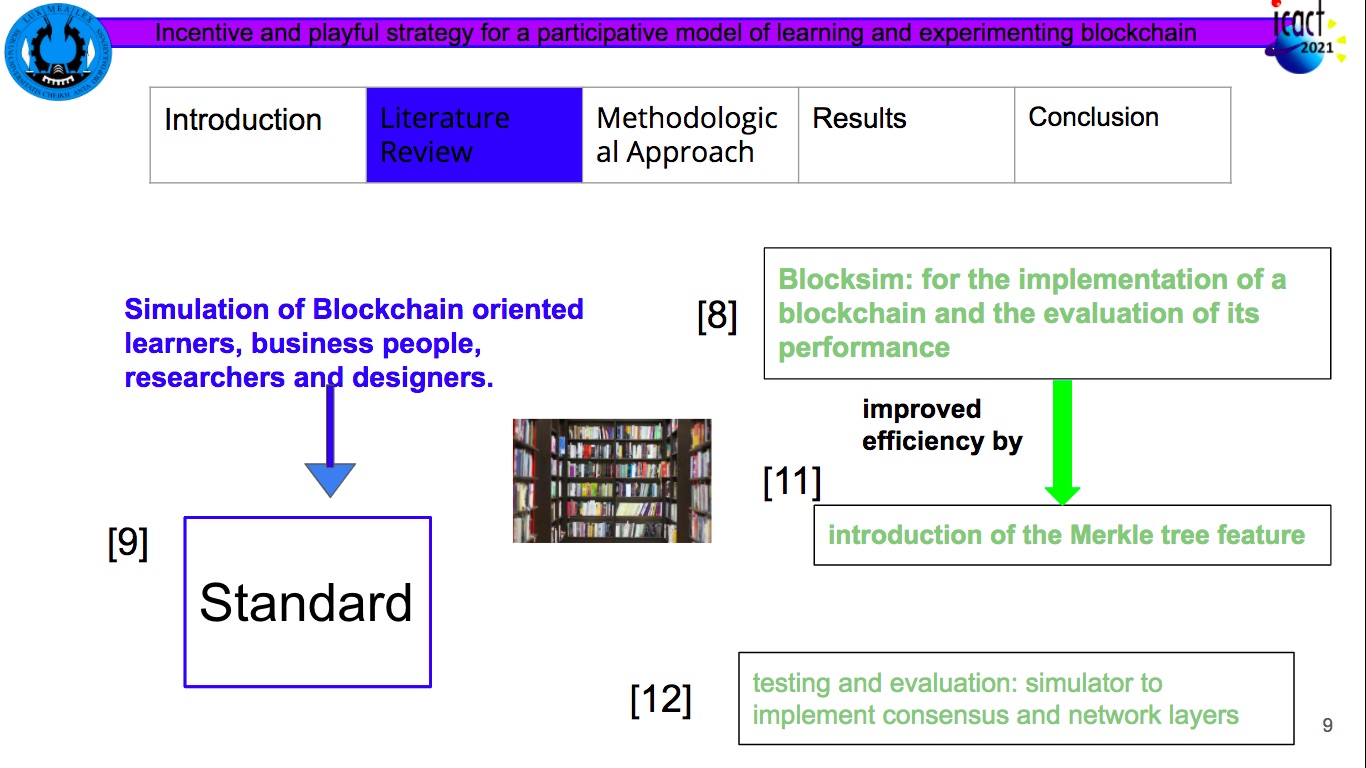 |
Faria C. et al. present Blocksim: a simulator for the implementation of a blockchain and the evaluation of its performance, which the study 11 has improved in efficiency by introducing the Merkle tree feature. Foytik et al. studied platform testing and evaluation. In order to standardise this sphere of use of simulation in the field of blockchain, the study 9 identifies the need to set up a meta-model validated by the community and presents responsible event strategies. |
| ICACT20210215 Slide.10
[Big Slide]
[YouTube] |
Chrome Click!! |
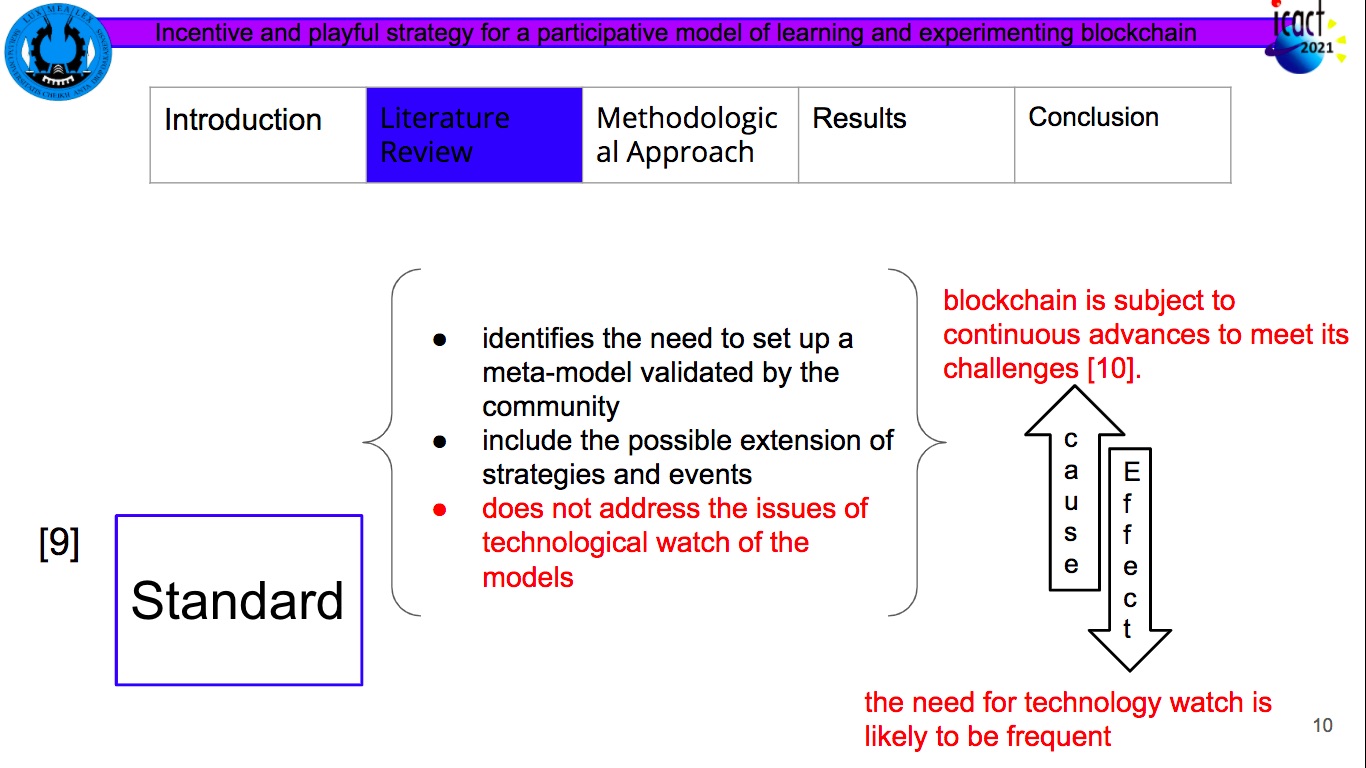 |
In the proposal of 9, the possible extension of strategies and events by a model is included. However, it does not address the issues of technological watch of the models. And yet, the need for technology watch is likely to be frequent. Indeed, the blockchain is subject to continuous advances to meet its challenges. |
| ICACT20210215 Slide.11
[Big Slide]
[YouTube] |
Chrome Click!! |
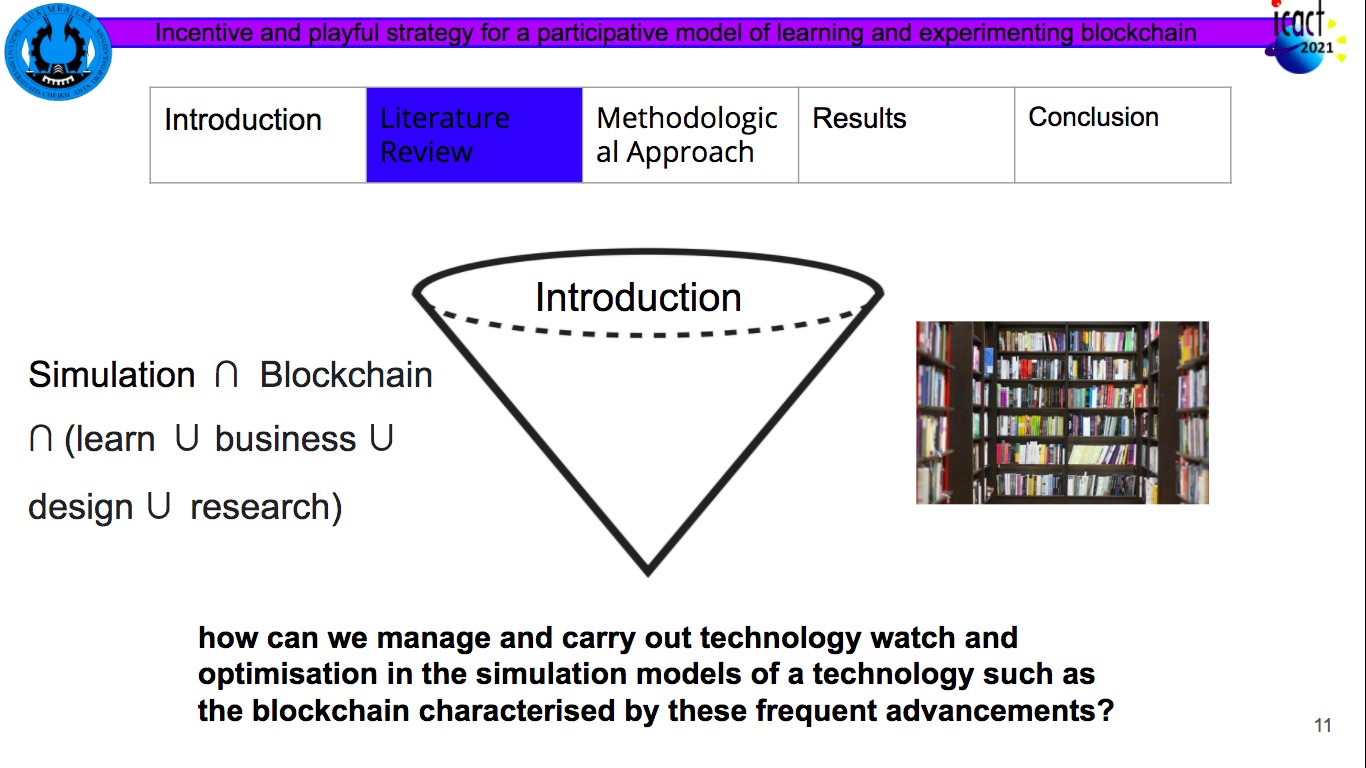 |
So we asked the following question: how can we manage and carry out technology watch and optimisation in the simulation models of a technology such as the blockchain characterised by these frequent advancements? In the following, we describe the work that led to the proposed model and its application. Let’s go to our methodological approach |
| ICACT20210215 Slide.12
[Big Slide]
[YouTube] |
Chrome Click!! |
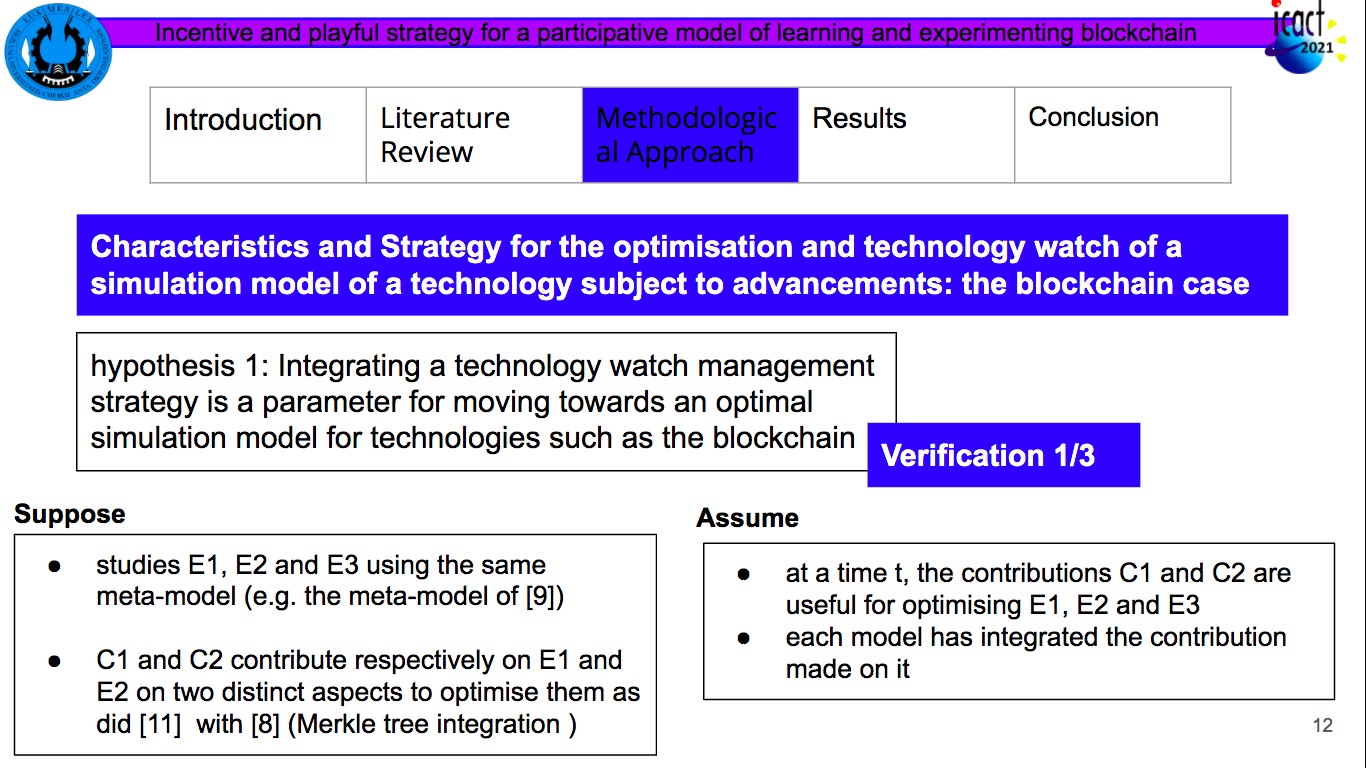 |
We complete the characteristics for a reliable use of simulation models and present a model integrating our proposals. Indeed, in this part we formulate our hypothesis 1 which is: Integrating a technology watch management strategy is a parameter for moving towards an optimal simulation model for technologies such as the blockchain.
Suppose we have three studies E1, E2 and E3 using the same meta-model like that of 9 . Two studies C1 and C2 contribute respectively on E1 and E2 on two distinct aspects to optimise them as did the study 11 which shows that BlockSim can be optimised with the integration of merkles trees. Assume that at a time t, the contributions C1 and C2 are useful for optimising E1, E2 and E3. Let us also admit that each model has only integrated the contribution made on it. |
| ICACT20210215 Slide.13
[Big Slide]
[YouTube] |
Chrome Click!! |
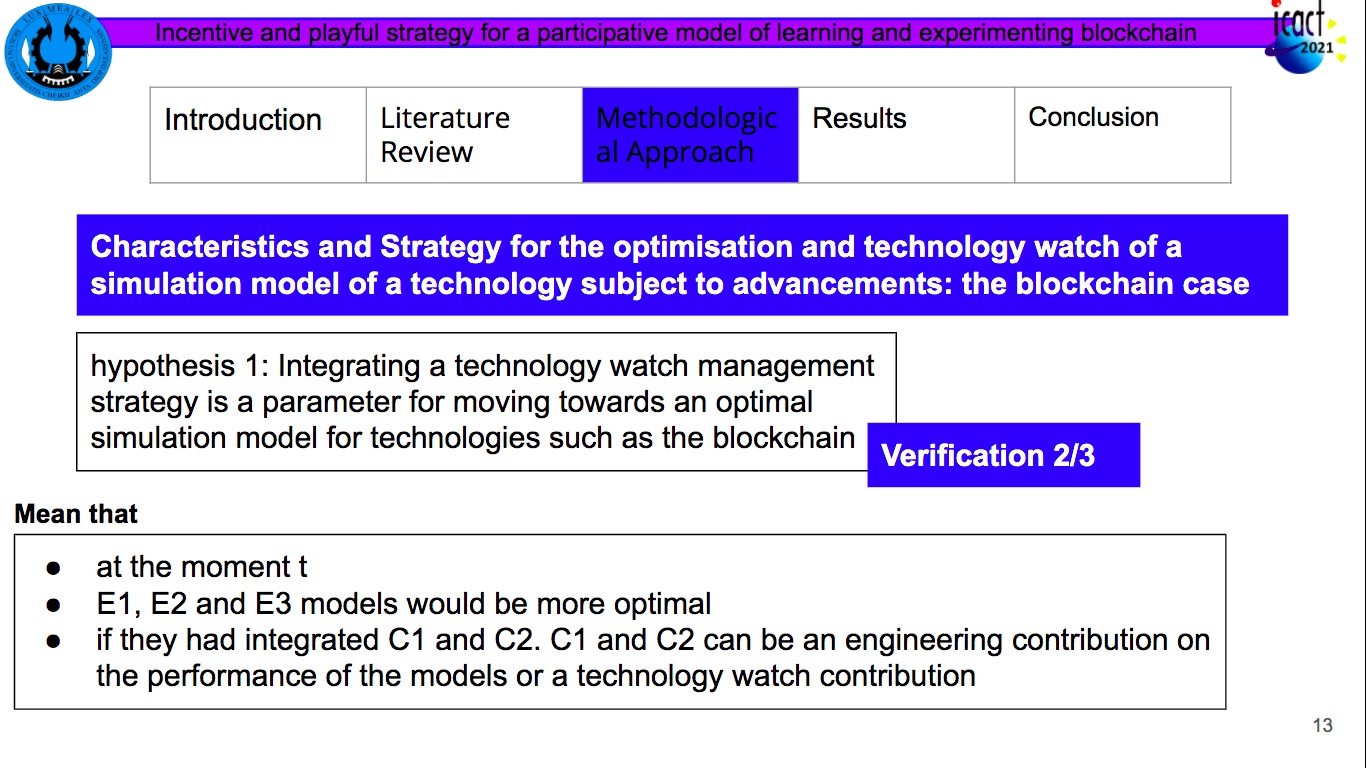 |
This would mean that at the moment t the E1, E2 and E3 models would be more optimal if they had integrated C1 and C2. C1 and C2 can be an engineering contribution on the performance of the models or a technology watch contribution |
| ICACT20210215 Slide.14
[Big Slide]
[YouTube] |
Chrome Click!! |
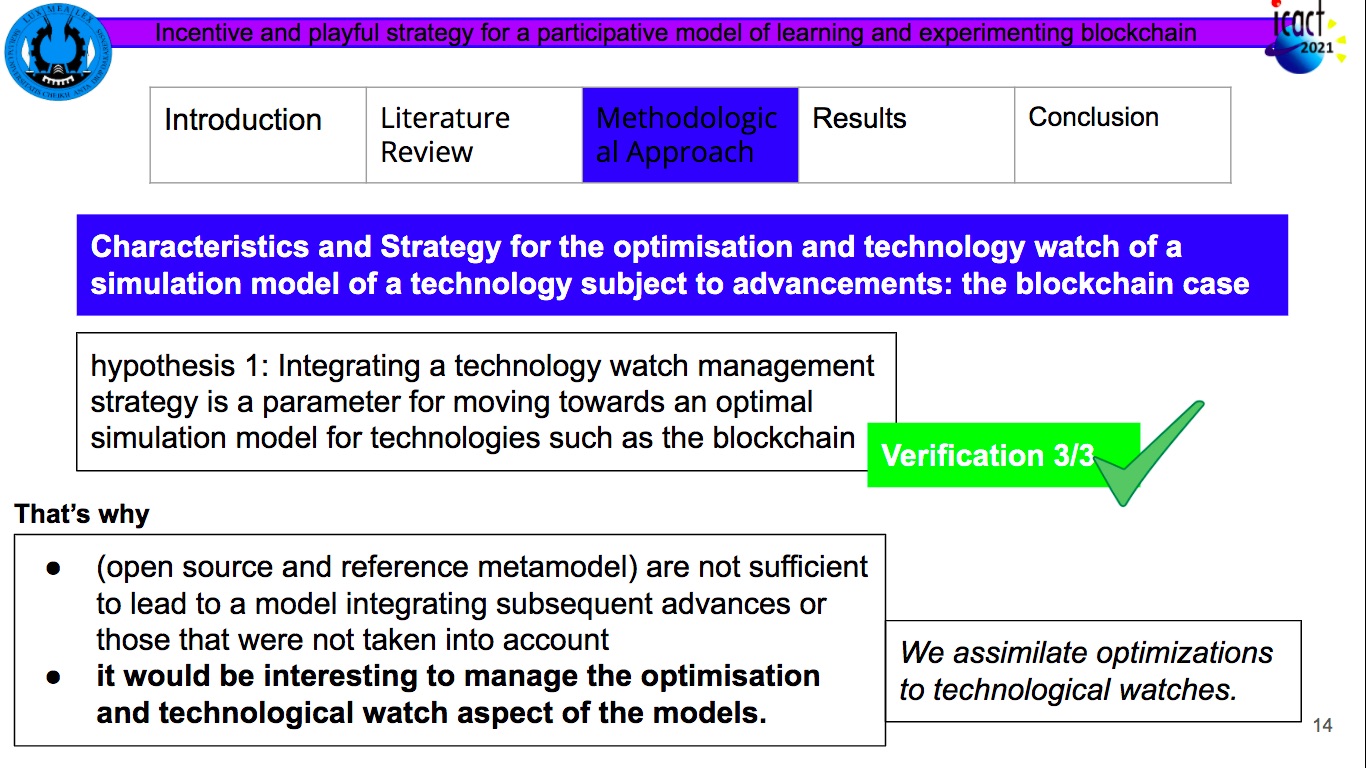 |
Thus, our first hypothesis is verified. |
| ICACT20210215 Slide.15
[Big Slide]
[YouTube] |
Chrome Click!! |
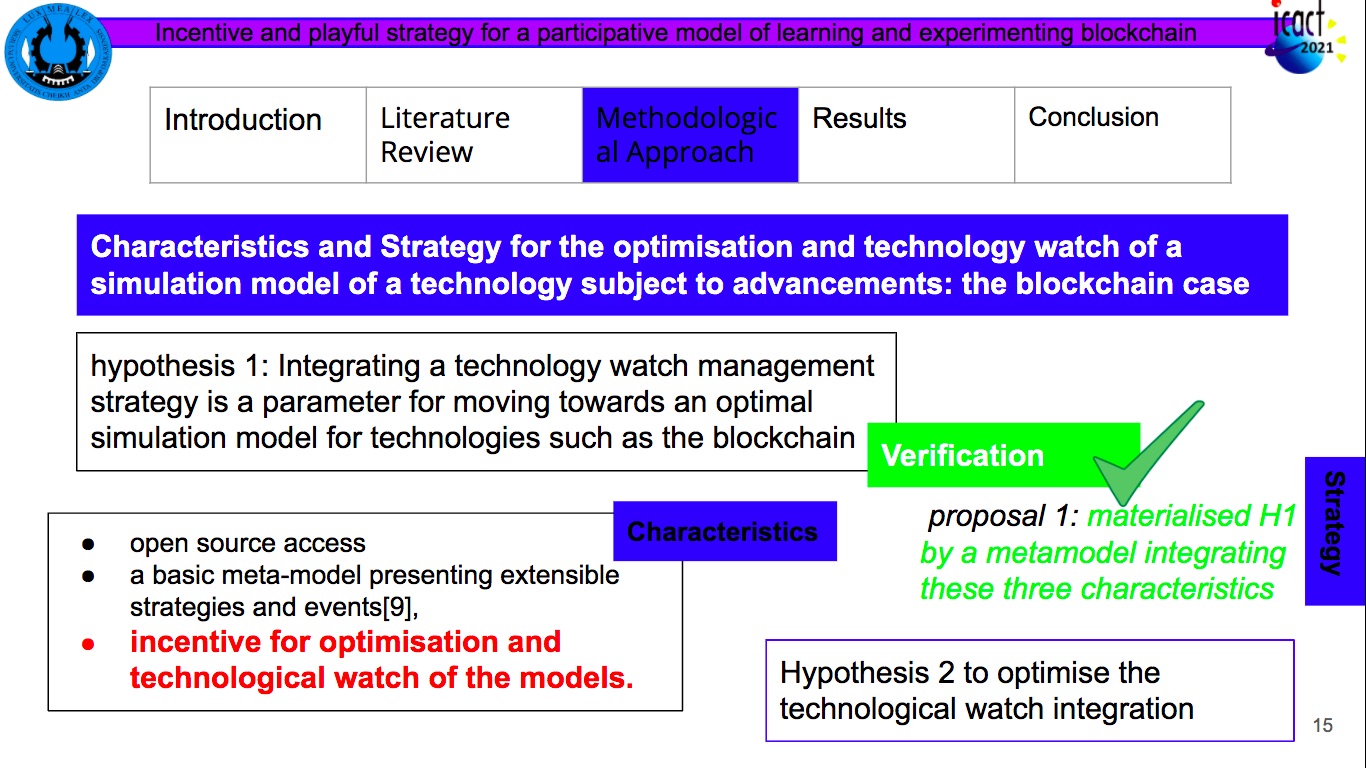 |
The identified characteristics are :
open source access ,a basic meta-model presenting extensible strategies and events, incentive for optimisation and technological watch of the models.
it’s is materialised by a metamodel integrating these three characteristics |
| ICACT20210215 Slide.16
[Big Slide]
[YouTube] |
Chrome Click!! |
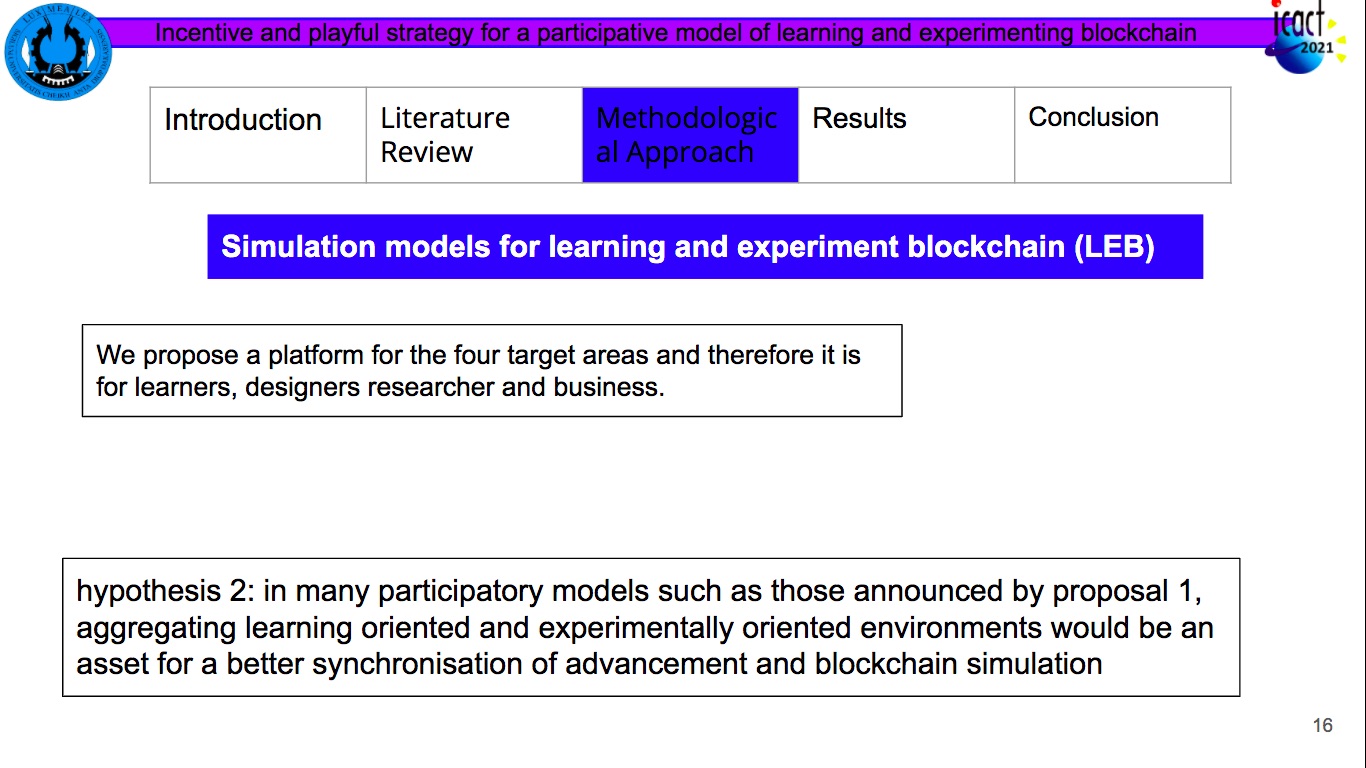 |
We follow with the formulation of hypothesis 2: in many participatory models such as those announced by proposal 1, aggregating learning oriented and experimentally oriented environments would be an asset for a better synchronisation of advancement and blockchain simulation. |
| ICACT20210215 Slide.17
[Big Slide]
[YouTube] |
Chrome Click!! |
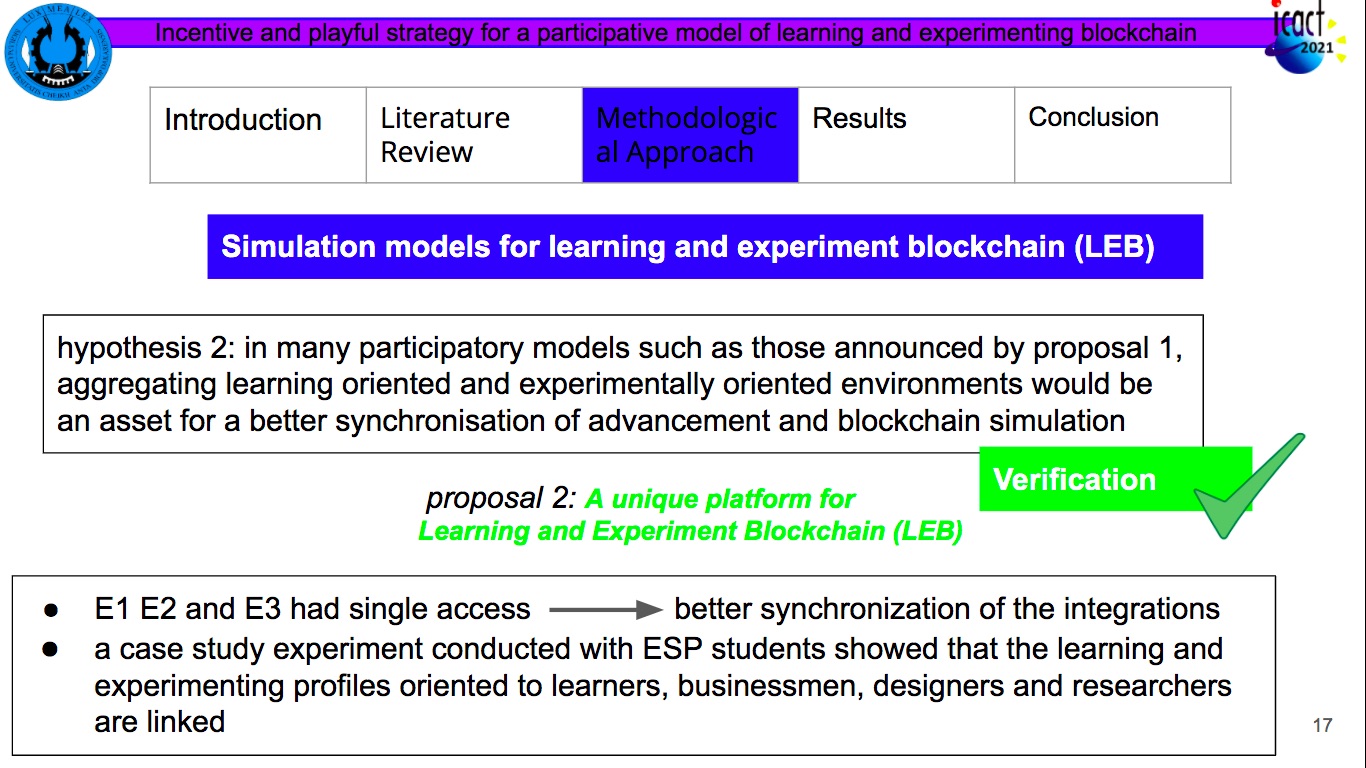 |
Indeed, If E1, E2, and E3 had a single access, we would have a better technology watch and a better synchronization of the integrations. In fact, the contributions added on one study would be accessible to the others.
In addition, a case study experiment conducted with ESP students showed that the learning and experimenting profiles oriented to learners, businessmen, designers and researchers are linked |
| ICACT20210215 Slide.18
[Big Slide]
[YouTube] |
Chrome Click!! |
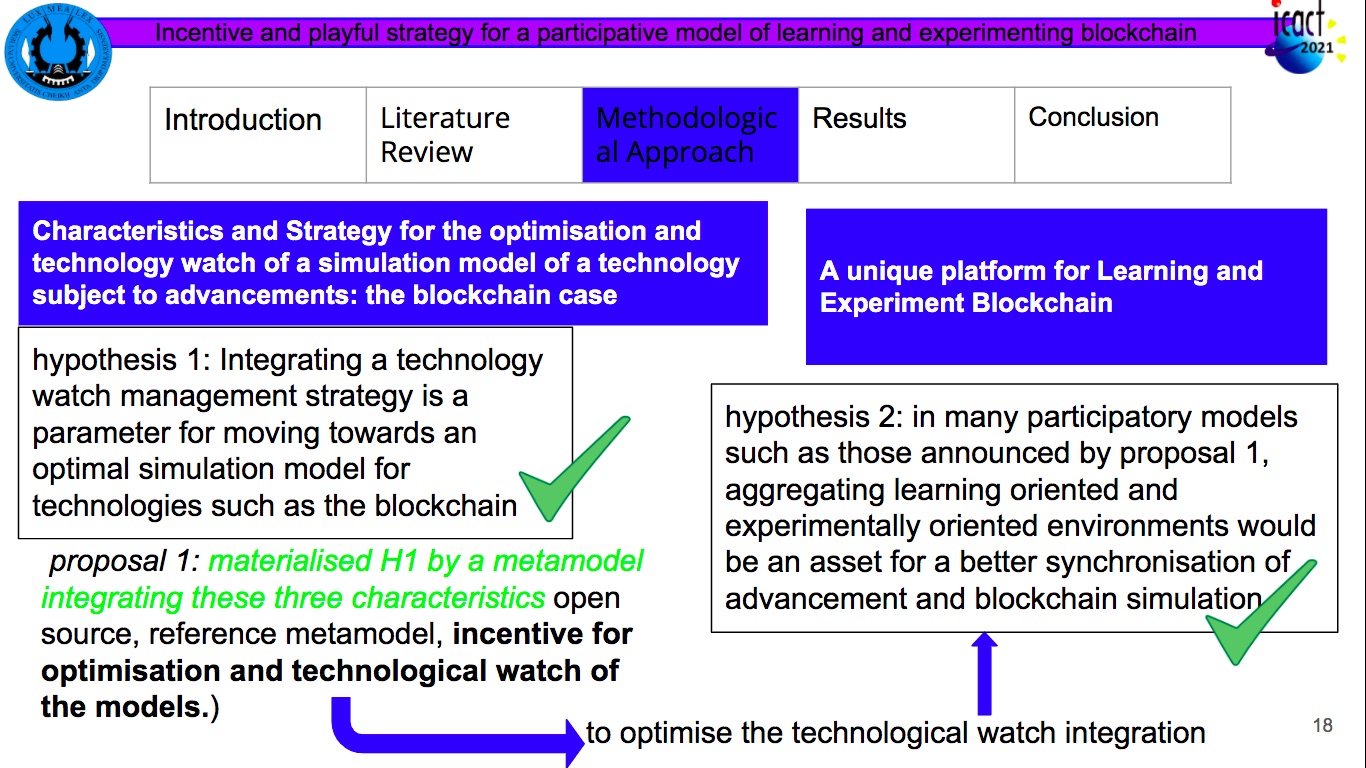 |
In sum, our approach consisted of: identify and justify the need for a third incentive feature for optimization and technological watch. To optimise the technological watch integration, we justify and propose a unique platform for learning and eperimenting blockchain |
| ICACT20210215 Slide.19
[Big Slide]
[YouTube] |
Chrome Click!! |
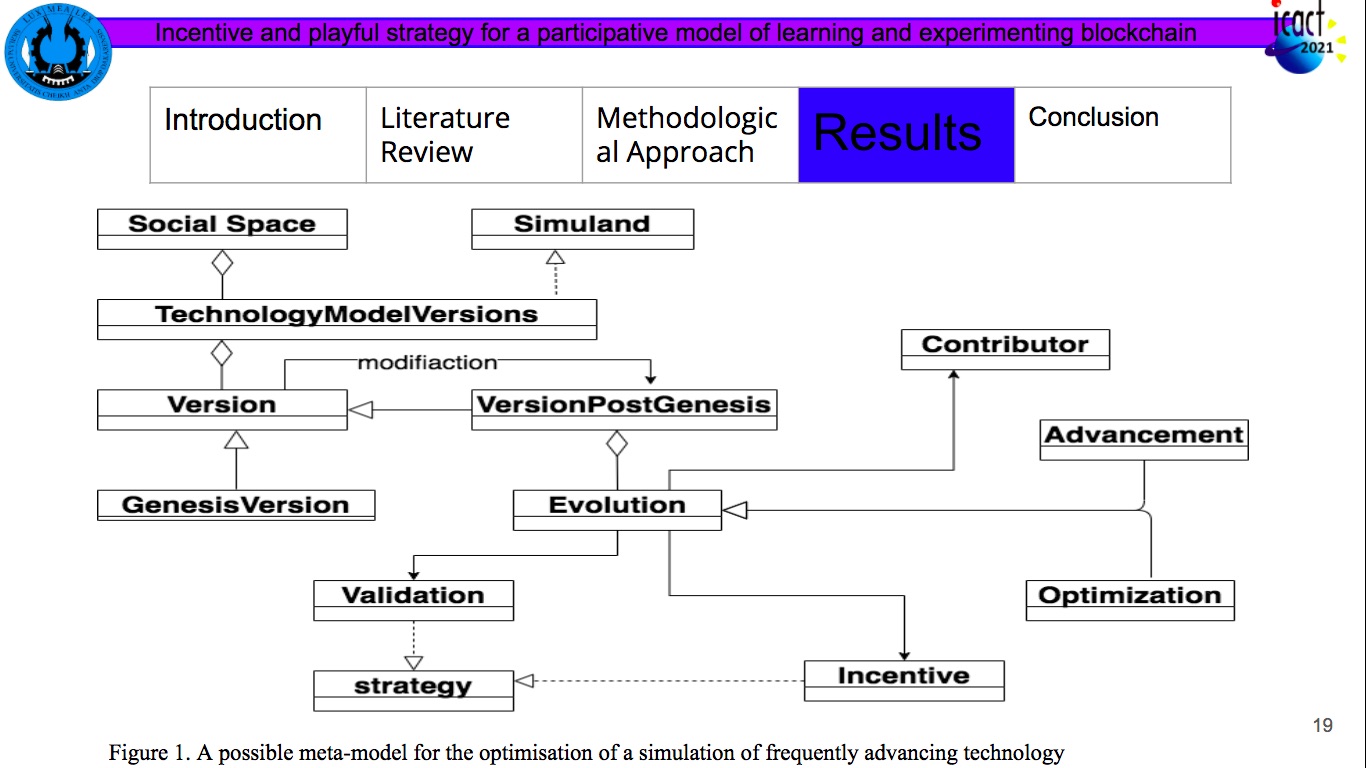 |
In a social space favouring interactive interventions, we will have the open source models contained in TechnologyModelVersions.
These apply a simuland which can be the generic and logical functioning of the technology in question as the meta-model of study 9. TechnologyModelVersion contains the different versions. The first version is called the genesis version Other versions can be added to the TechnologyModelVersions. A PostGenesisVersion thus contains an evolution modifying an existing version. In order to encourage contributors to add developments based on advancements or optimizations of operations, an incentive strategy is needed. The strategy tcontains the incentive strategy and the validation mechanism by analogy to mining and the consensus mechanism. |
| ICACT20210215 Slide.20
[Big Slide]
[YouTube] |
Chrome Click!! |
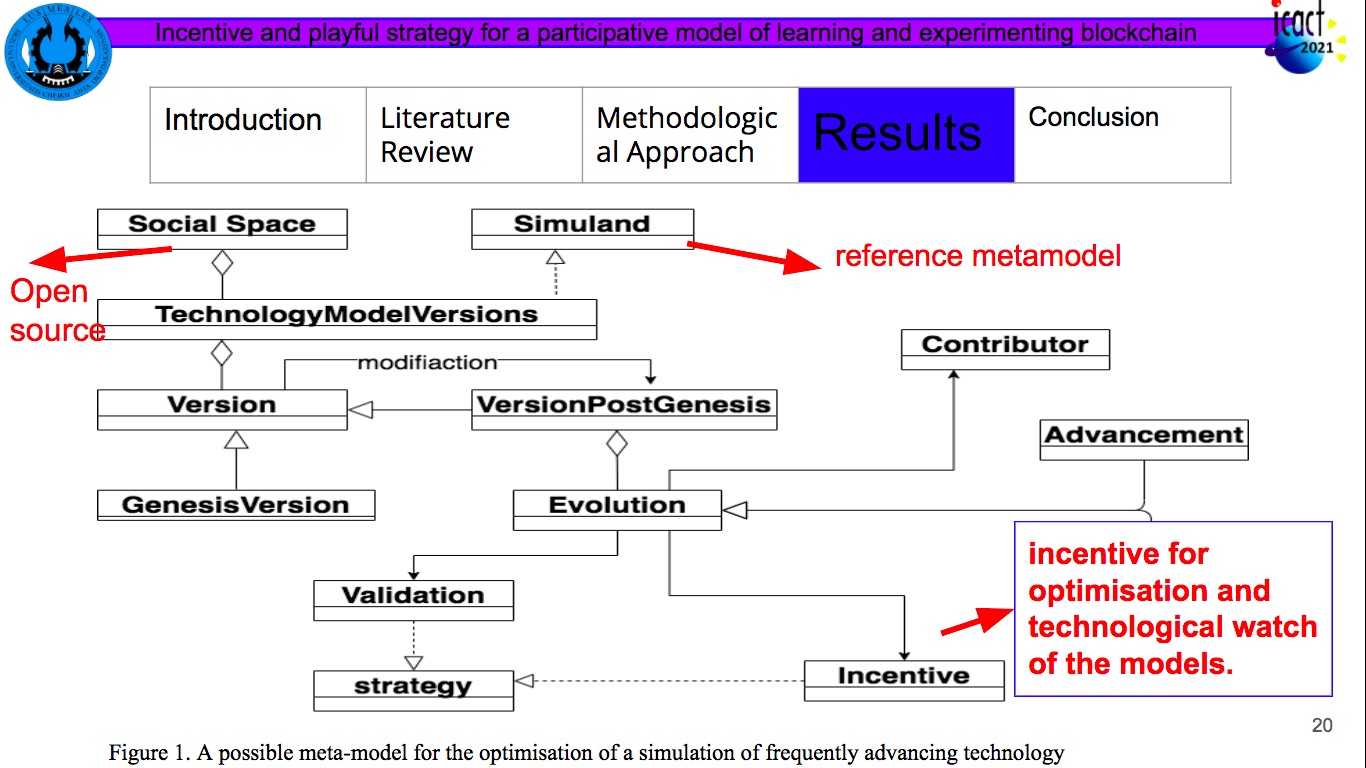 |
This model therefore takes into account the identified characteristic |
| ICACT20210215 Slide.21
[Big Slide]
[YouTube] |
Chrome Click!! |
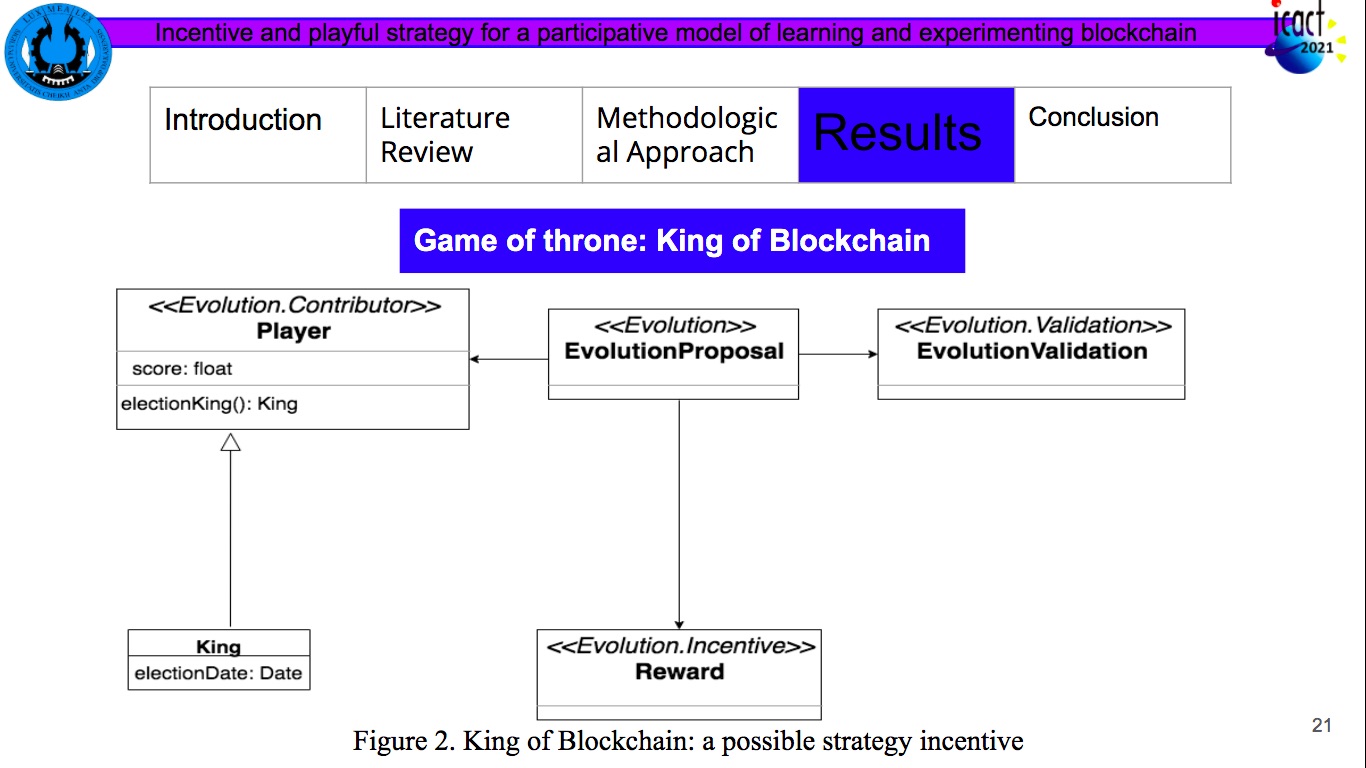 |
This part develops a strategy model for an evolution of the model. We call it king of X where X is the name of the technology in question for example the blockchain. It is made by analogy with the smart contract King of ether. The goal in our case is to elect each time a king who will sit on the throne. The access to the throne is facilitated by the importance of the evolution brought. The challenge for the players is therefore to replace the king. |
| ICACT20210215 Slide.22
[Big Slide]
[YouTube] |
Chrome Click!! |
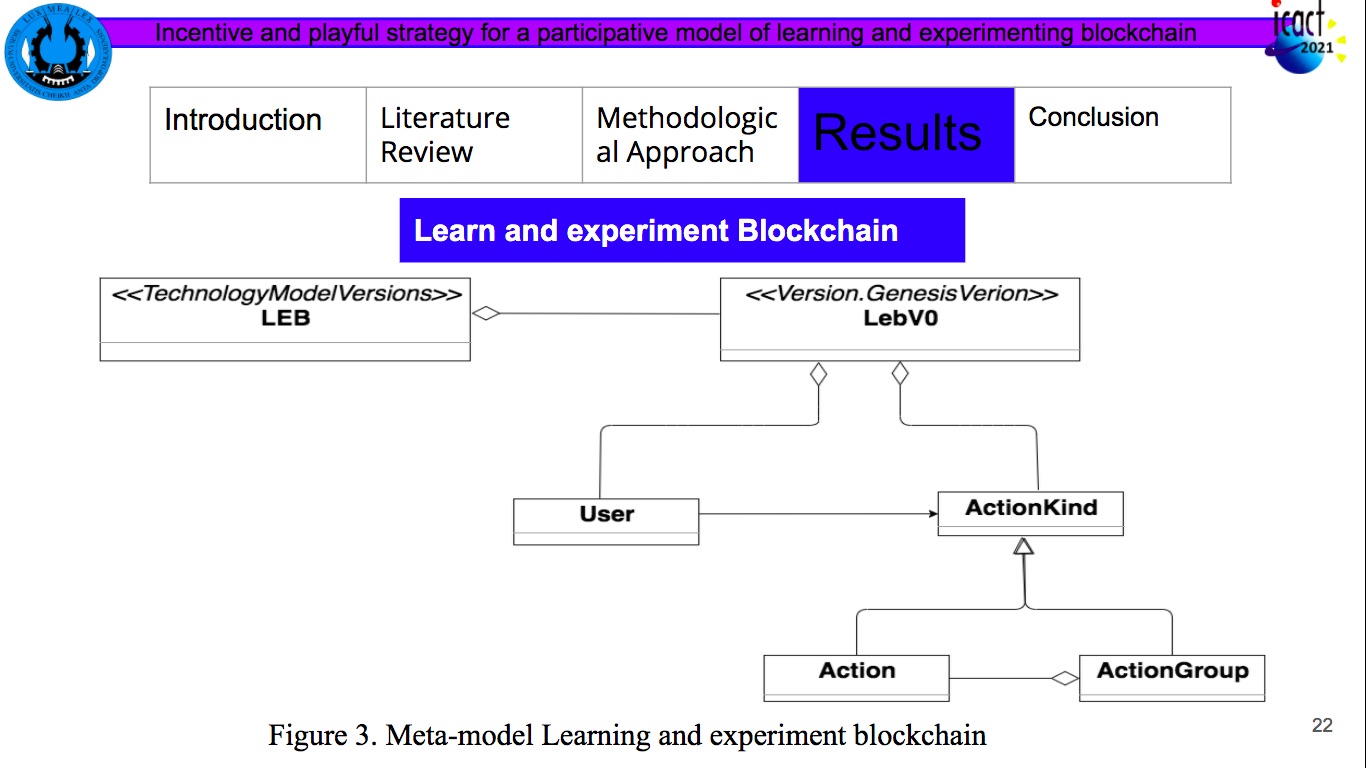 |
we have abstracted the model at a first level because, as in our preliminary study, the same individual can find himself requesting actions with different profiles. |
| ICACT20210215 Slide.23
[Big Slide]
[YouTube] |
Chrome Click!! |
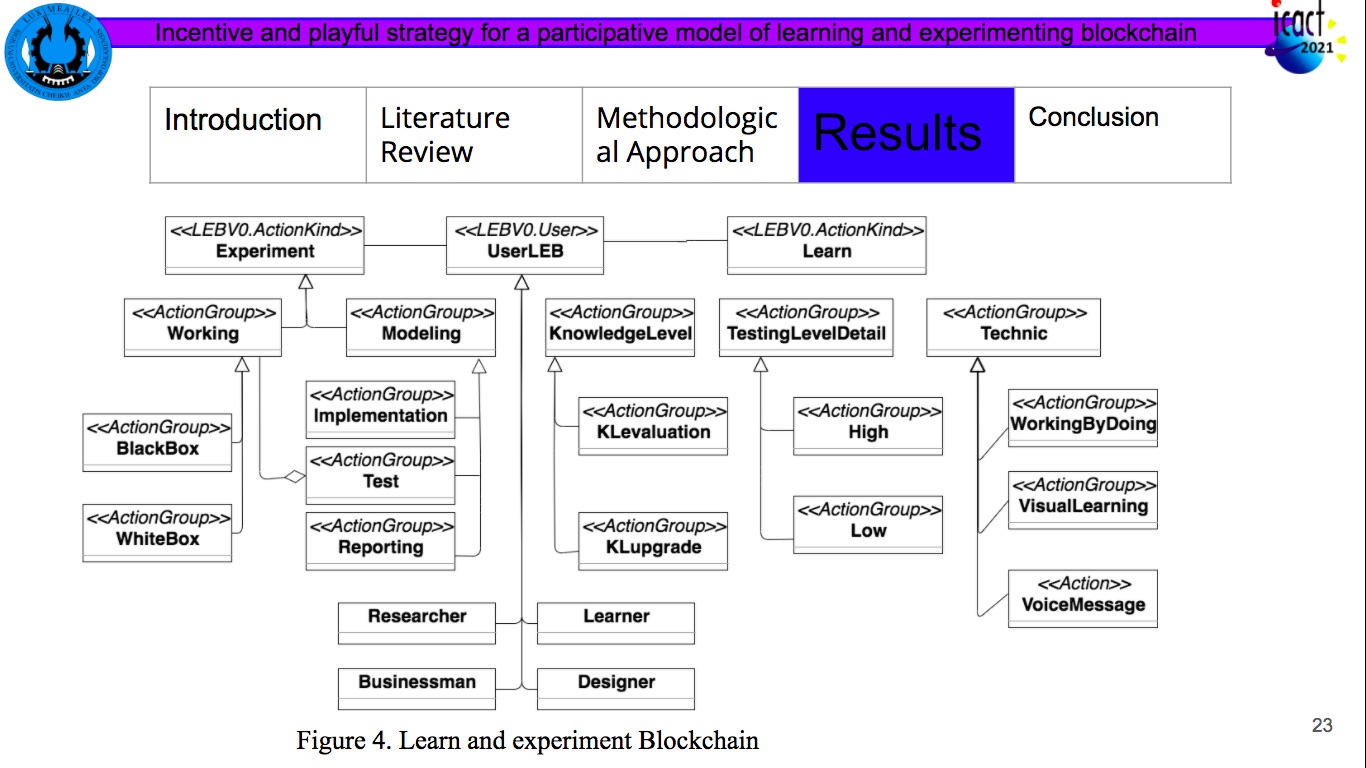 |
These are the modules of our genesis version for learning and experimenting blockchain. |
| ICACT20210215 Slide.24
[Big Slide]
[YouTube] |
Chrome Click!! |
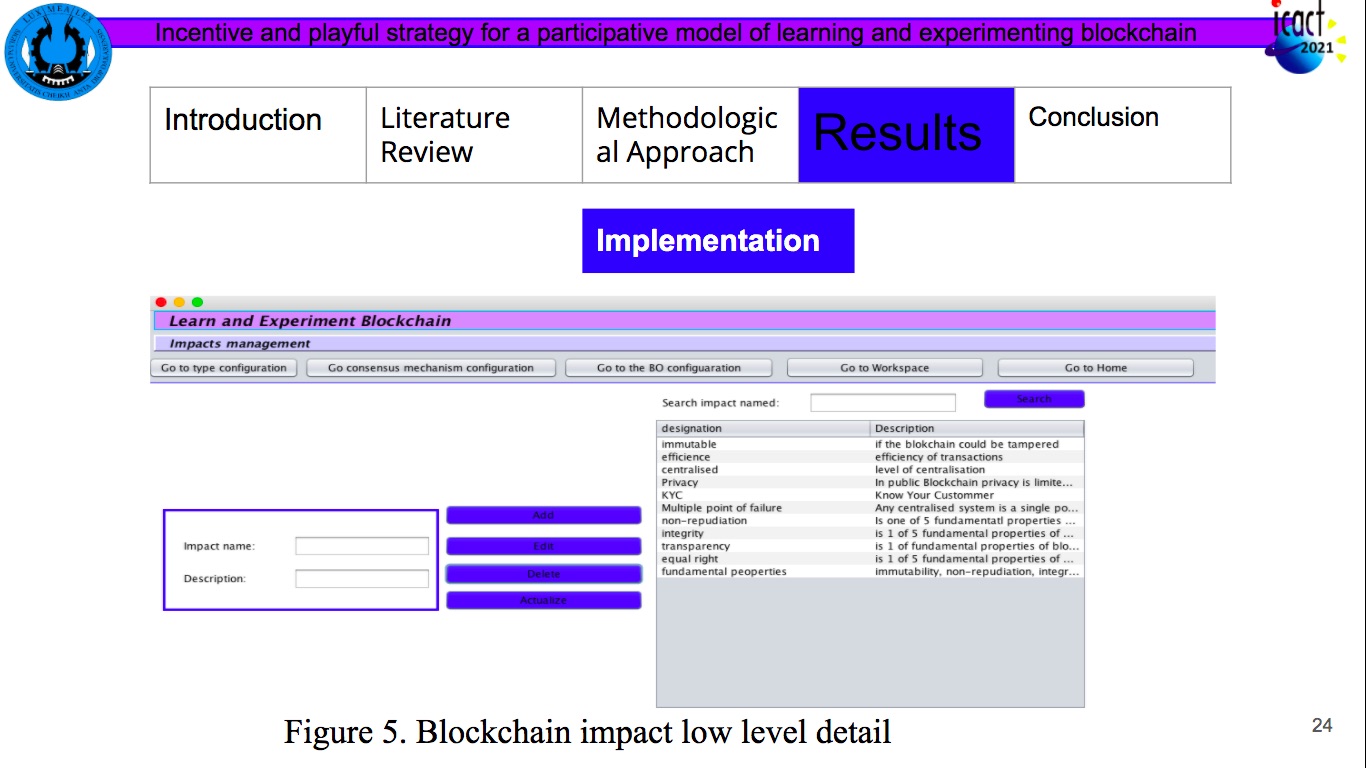 |
These are the modules of our genesis version for learning and experimenting blockchain. |
| ICACT20210215 Slide.25
[Big Slide]
[YouTube] |
Chrome Click!! |
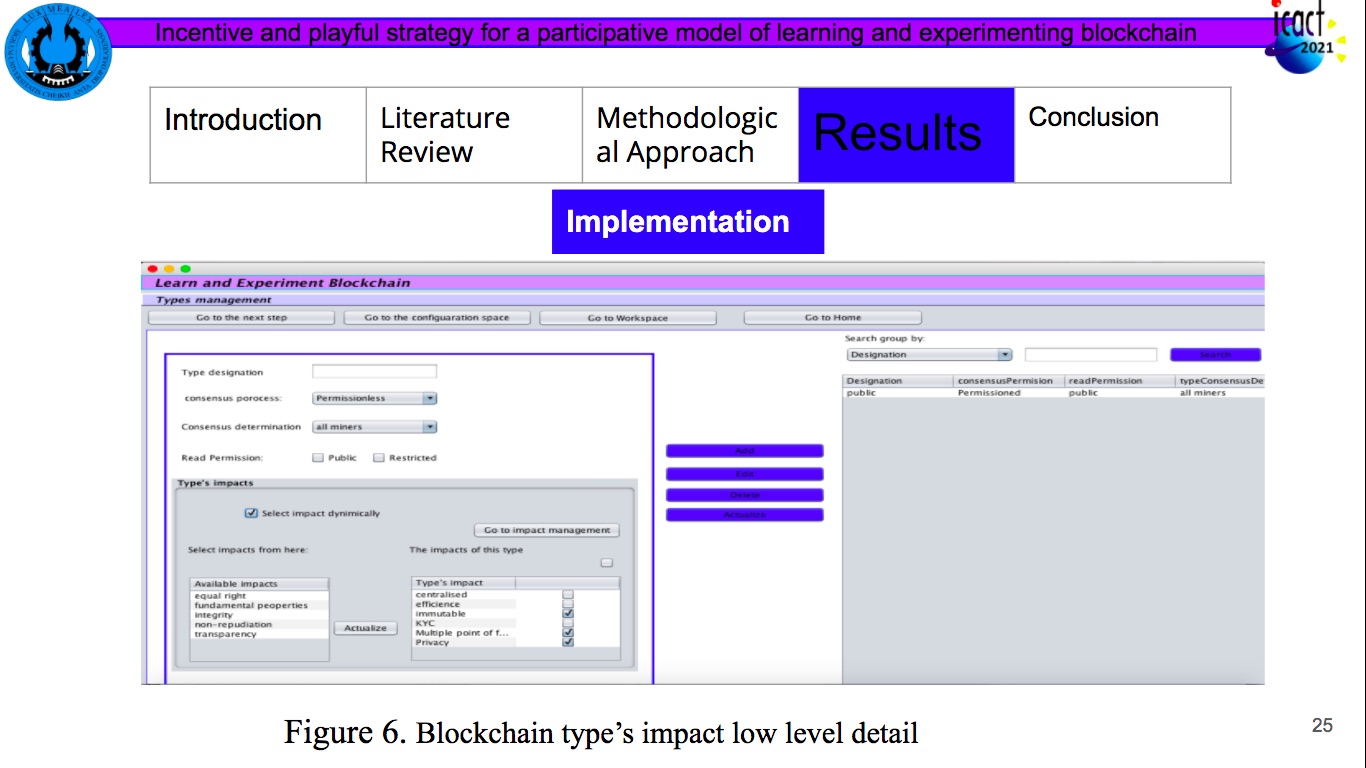 |
These are the modules of our genesis version for learning and experimenting blockchain. |
| ICACT20210215 Slide.26
[Big Slide]
[YouTube] |
Chrome Click!! |
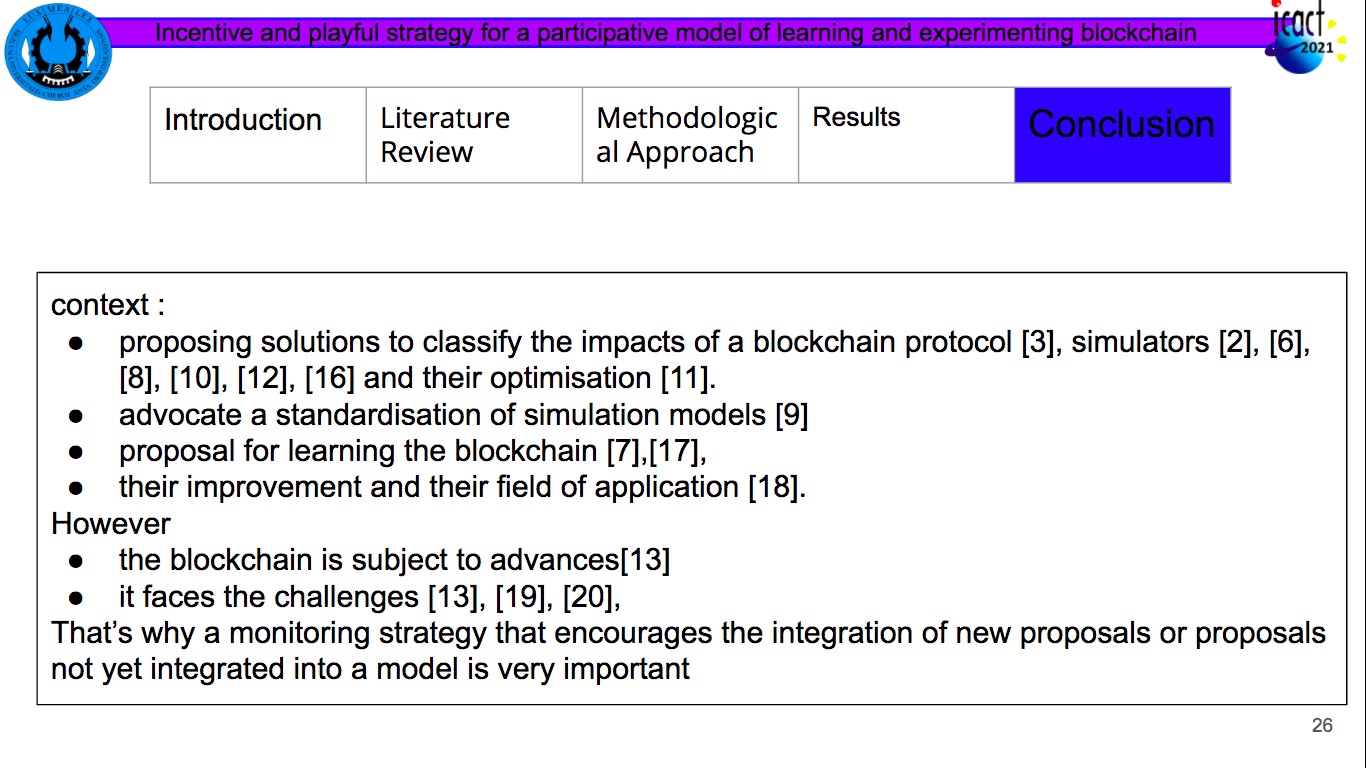 |
These are the modules of our genesis version for learning and experimenting blockchain. |
| ICACT20210215 Slide.27
[Big Slide]
[YouTube] |
Chrome Click!! |
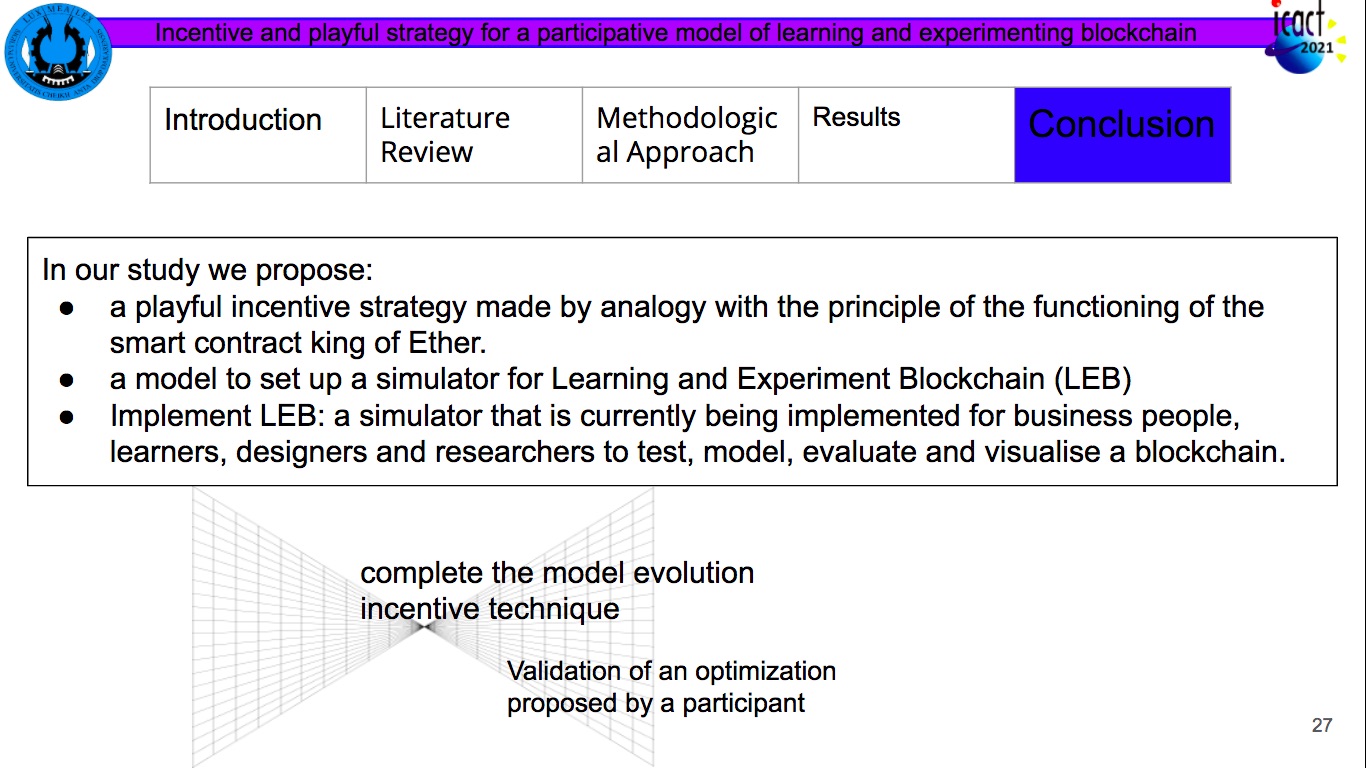 |
This is what we manage in this study by proposing a playful incentive strategy made by analogy with the principle of the functioning of the smart contract king of Ether. We use the model to set up a simulator for Learning and Experiment Blockchain LEB. LEB is a simulator that is currently being implemented for business people, learners, designers and researchers to test, model, evaluate and visualise a blockchain. In perspective, future work will be done on the validation part recommended in our optimization incentive strategy, to complete the model evolution incentive technique presented in this paper |
| ICACT20210215 Slide.28
[Big Slide]
[YouTube] |
Chrome Click!! |
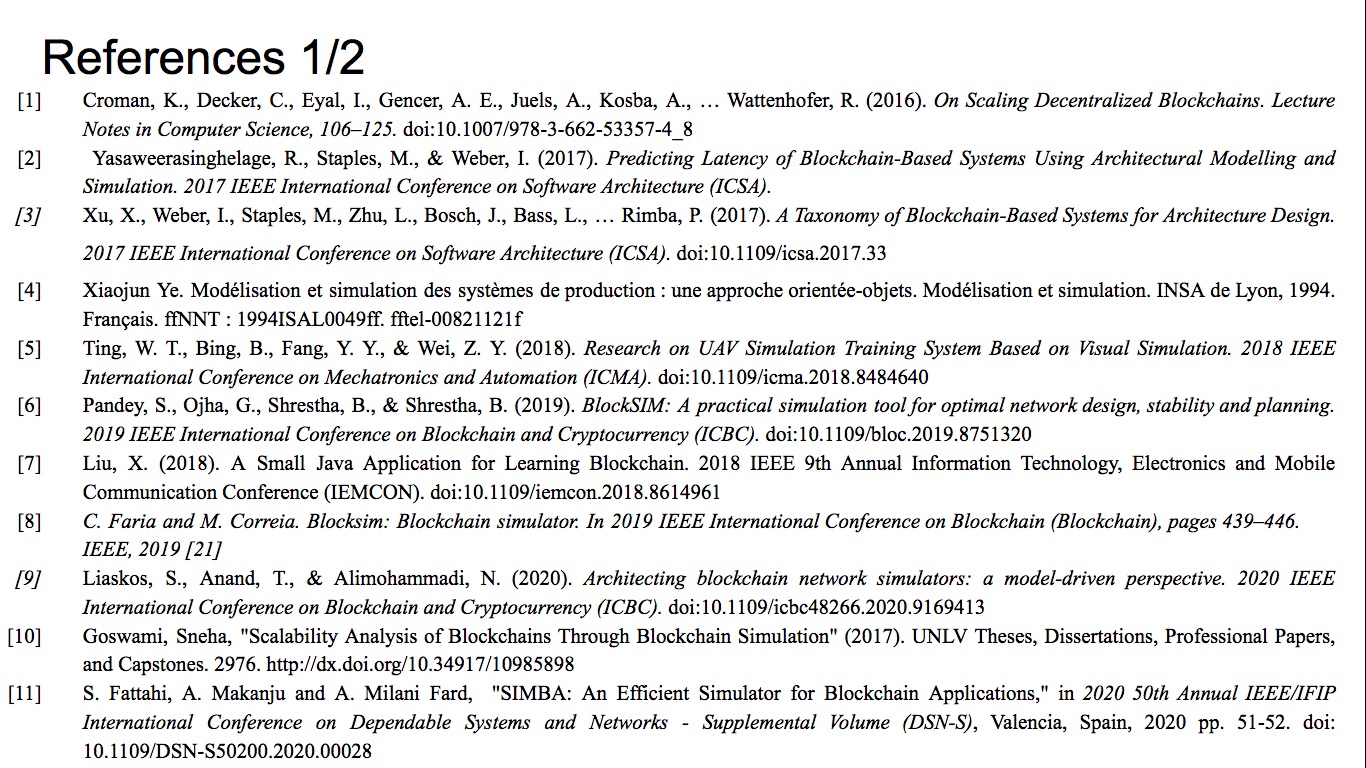 |
Here are the references cited in this study. |
| ICACT20210215 Slide.29
[Big Slide]
[YouTube] |
Chrome Click!! |
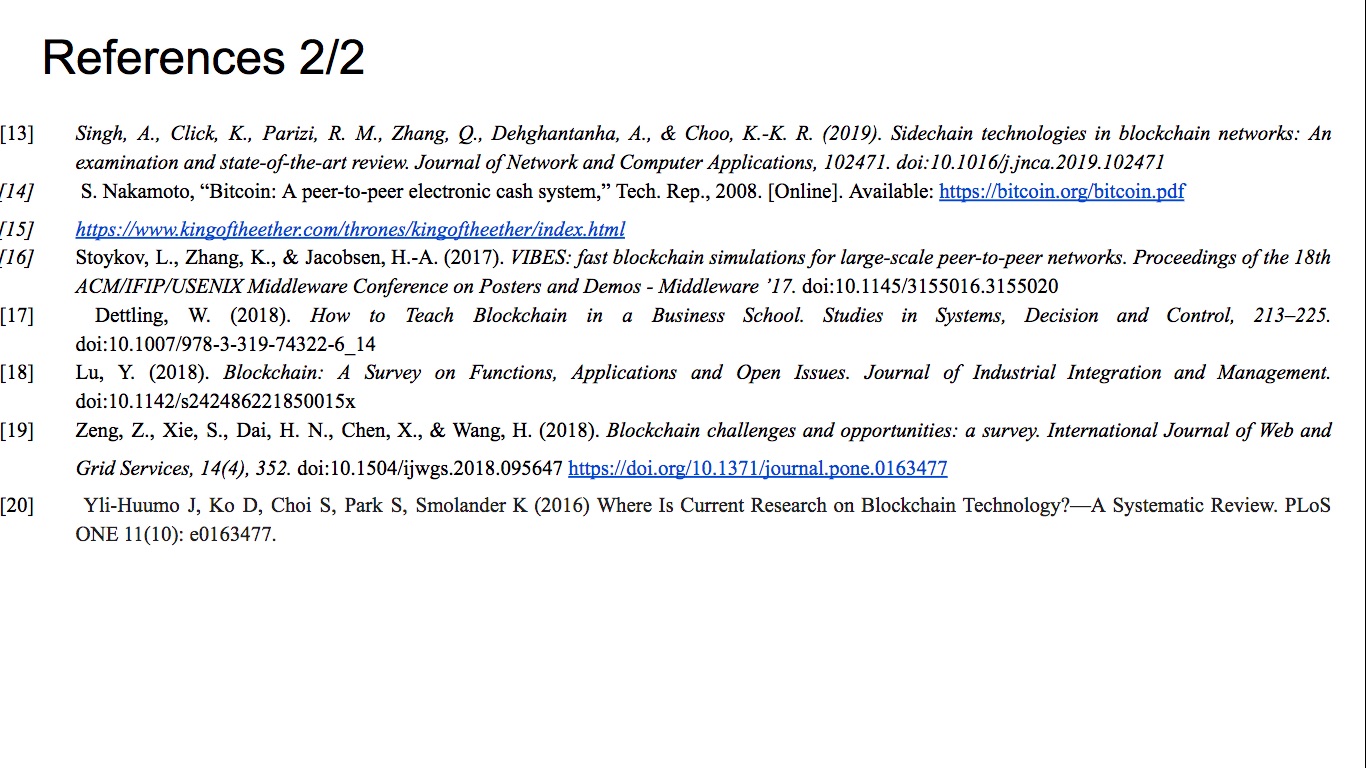 |
Continued references |
| ICACT20210215 Slide.30
[Big Slide]
[YouTube] |
Chrome Click!! |
 |
Thank you... |
| ICACT20210215 Slide.31
[Big Slide]
|
Chrome Click!! |
 |
deleted |
| ICACT20210215 Slide.32
[Big Slide]
|
Chrome Click!! |
 |
deleted |
| ICACT20210215 Slide.33
[Big Slide]
|
Chrome Click!! |
 |
deleted |
| ICACT20210215 Slide.34
[Big Slide]
|
Chrome Click!! |
 |
deleted |
| ICACT20210215 Slide.35
[Big Slide]
|
Chrome Click!! |
 |
deleted |
| ICACT20210215 Slide.36
[Big Slide]
|
Chrome Click!! |
 |
deleted |
| ICACT20210215 Slide.37
[Big Slide]
|
Chrome Click!! |
 |
deleted |
| ICACT20210215 Slide.38
[Big Slide]
|
Chrome Click!! |
 |
deleted |
| ICACT20210215 Slide.40
[Big Slide]
|
Chrome Click!! |
 |
deleted |















