 ICACT20210229 Slide.01
[Big Slide] |
Chrome  Click!! |
 |
This paper is about implementing smart farm equipment such as sensors and actuators using open source.
|
| ICACT20210229 Slide.02
[Big Slide]
|
Chrome Click!! |
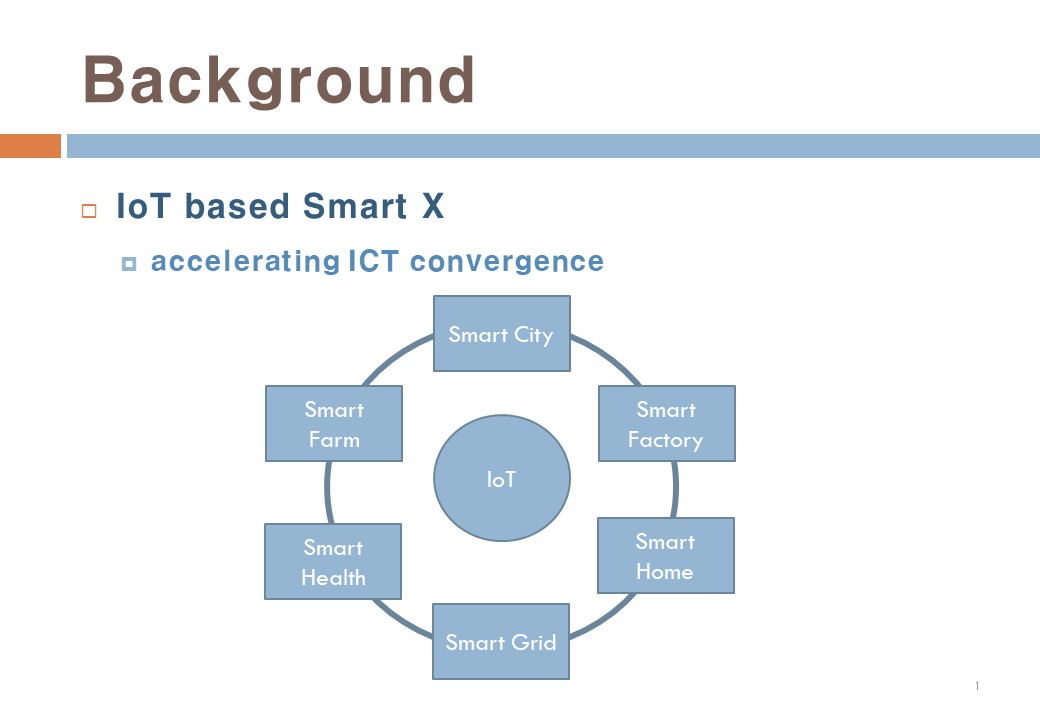 |
The Internet of Things (IoT) is attracting attention as the core of the next-generation ICT industry, and attempts to apply it to various fields are expanding.
One of the areas that is receiving the most attention among various fields is smart farm.
|
| ICACT20210229 Slide.03
[Big Slide]
|
Chrome Click!! |
 |
Currently, the biggest obstacle to the spread of smart farms is the lack of compatibility between devices.
Although different equipment is built according to the needs of the farm, it is not easy to maintain and introduce new equipment because the compatibility between manufacturers is not guaranteed.
|
| ICACT20210229 Slide.04
[Big Slide]
|
Chrome Click!! |
 |
OCF is a standard technology platform that connects devices with a lightweight protocol (coap) and interlocks with each other, based on a REST structure that implements IoT.
Many different attempts can be made by utilizing OCF.
|
| ICACT20210229 Slide.05
[Big Slide]
|
Chrome Click!! |
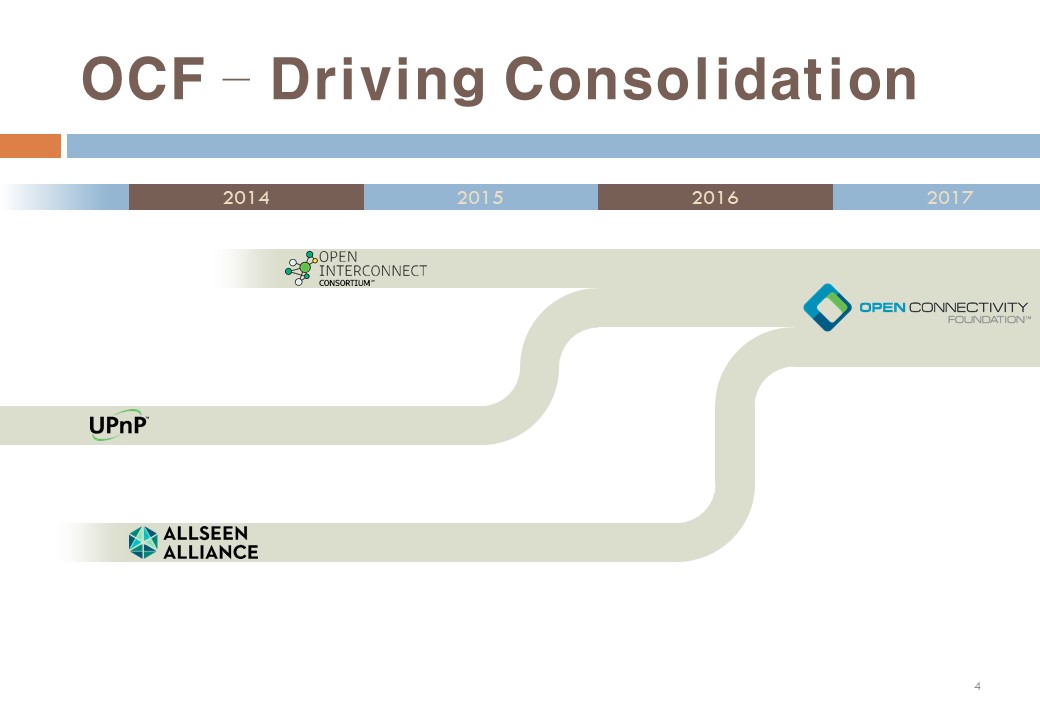 |
The beginning of OCF is OIC.
Since then, the Open Interconnect Consortium (OIC) has integrated UPnP.
In 2016, it was merged into OCF up to the Allseen Alliance.
|
| ICACT20210229 Slide.06
[Big Slide]
|
Chrome Click!! |
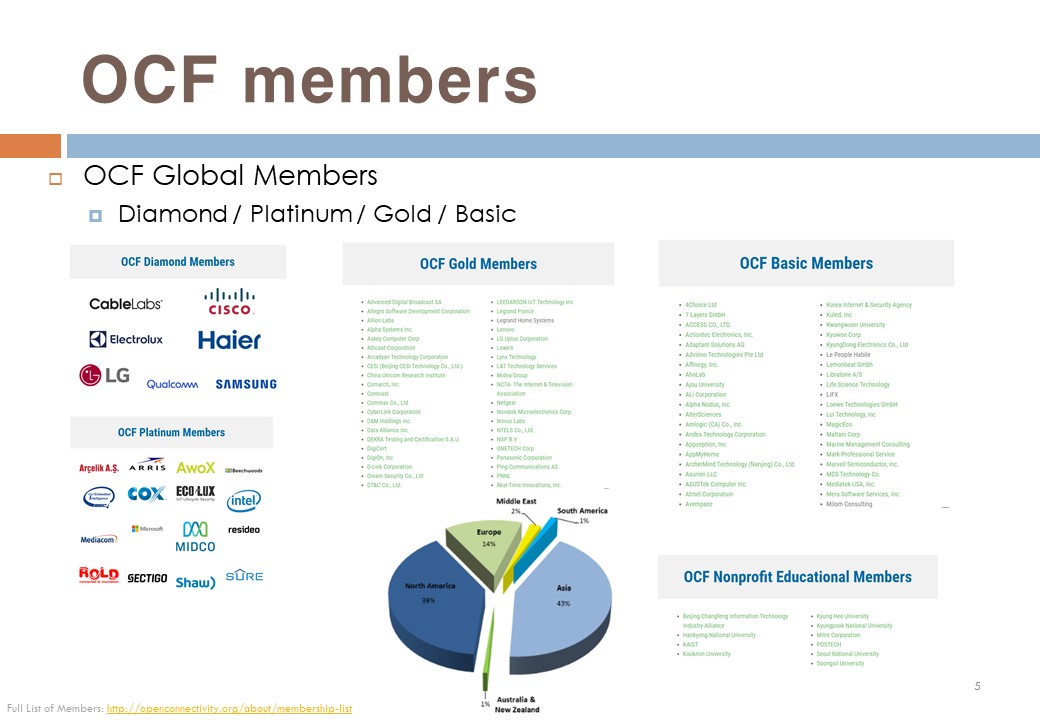 |
OCF is the largest international IoT standards organization with large companies such as Samsung, LG, Haier, Electrolux, Cisco, and many IoT companies participating. OCF currently has over 500 member companies.
|
| ICACT20210229 Slide.07
[Big Slide]
|
Chrome Click!! |
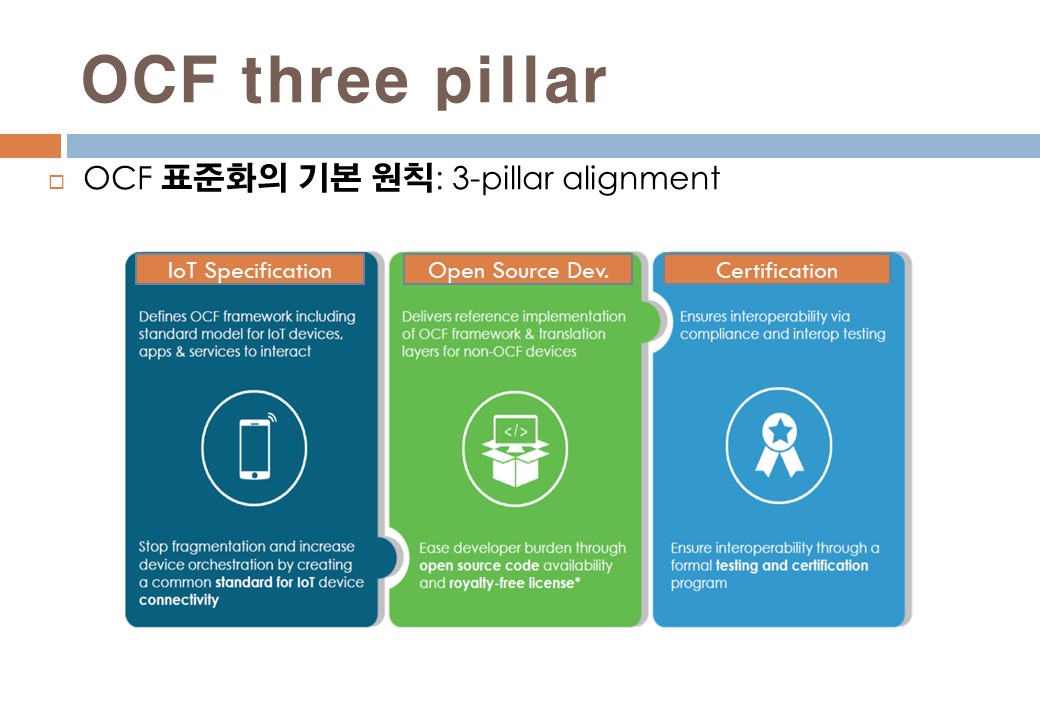 |
OCF follows the 3-pillar alignment policy as the basic principle of standardization.
This is a policy in which standards can be established and revised only when standard documentation, open source code implementation, and certification program development are all preceded.
This allows OCF to ensure compatibility with standards and interoperability between products.
|
| ICACT20210229 Slide.08
[Big Slide]
|
Chrome Click!! |
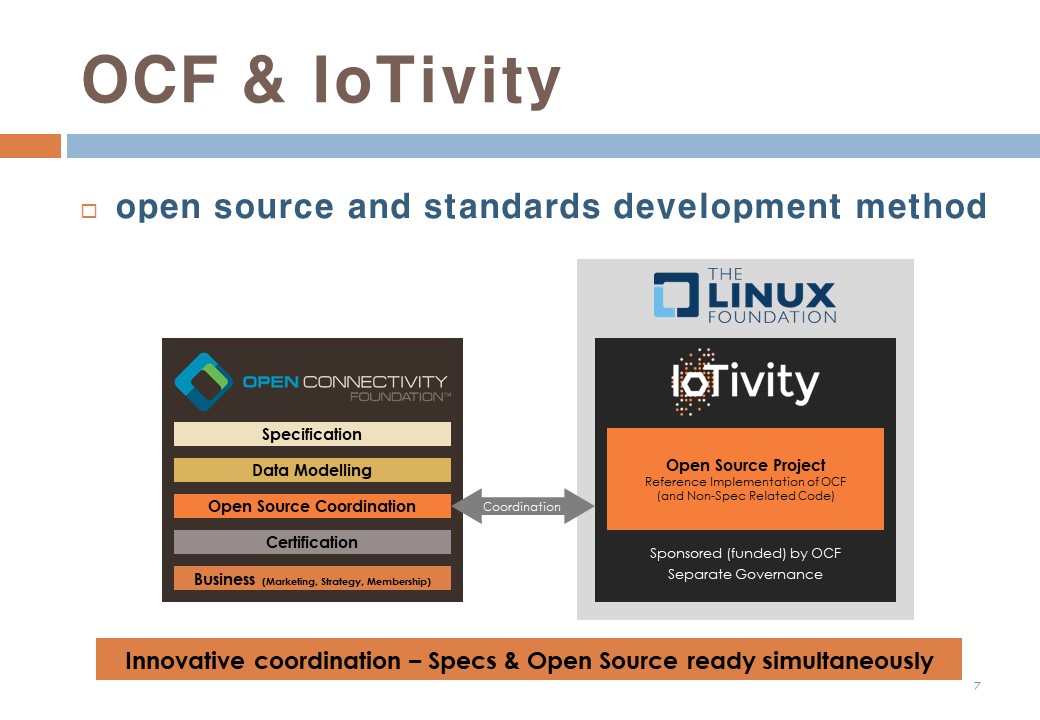 |
OCF has a comparative advantage over other standards in terms of ecosystem expansion by simultaneously developing and publishing standards and simultaneously conducting open source projects (iotivity) to expand the ecosystem.
|
| ICACT20210229 Slide.09
[Big Slide]
|
Chrome Click!! |
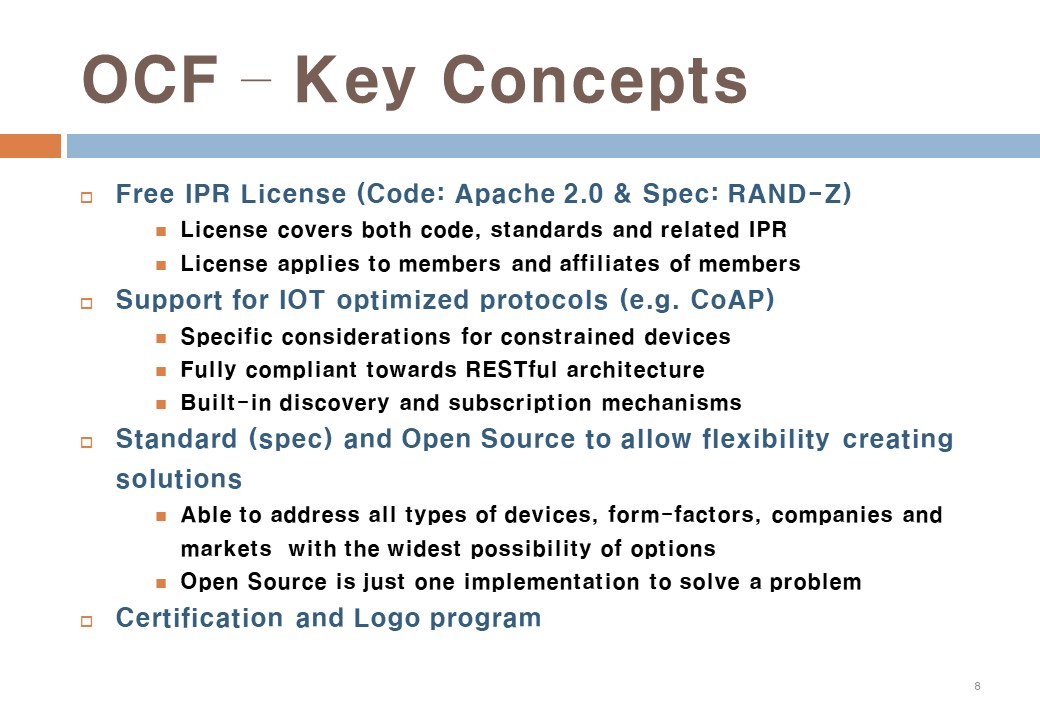 |
The biggest advantage of OCF is its free patent policy.
All OCF member companies can use all patents in OCF-related technology for free. This is called RAND-Z.
|
| ICACT20210229 Slide.10
[Big Slide]
|
Chrome Click!! |
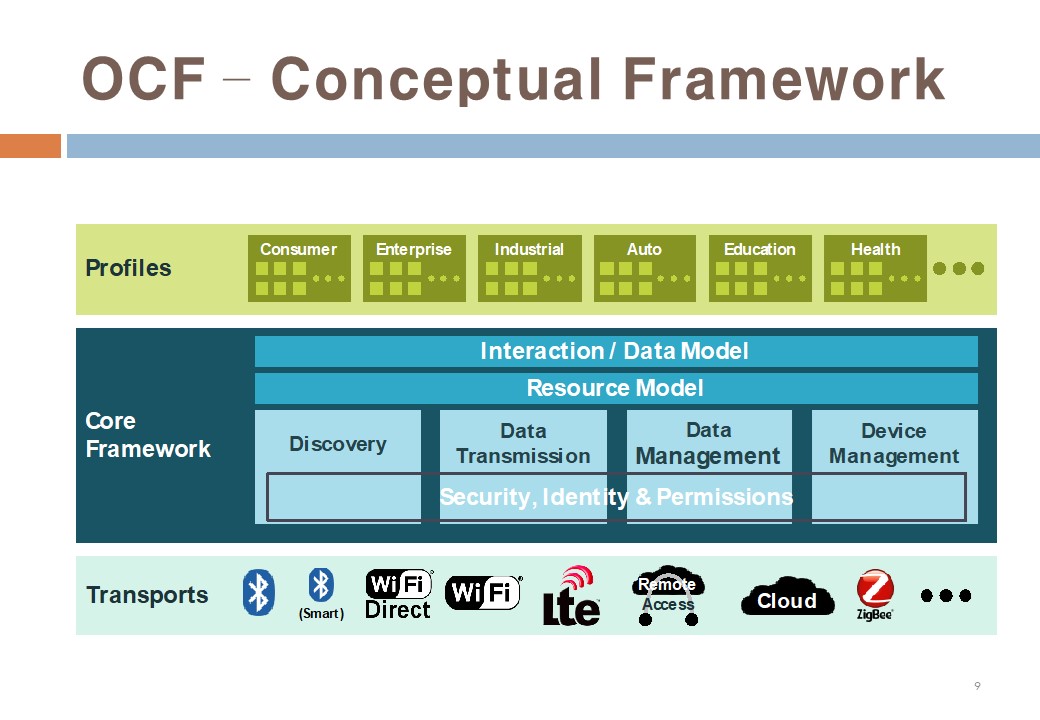 |
OCF is built using various IoT wired/wireless connection technologies and interoperability.
Various IoT services such as smart home, automobile, logistics, and healthcare can be developed through the use of OCF.
|
| ICACT20210229 Slide.11
[Big Slide]
|
Chrome Click!! |
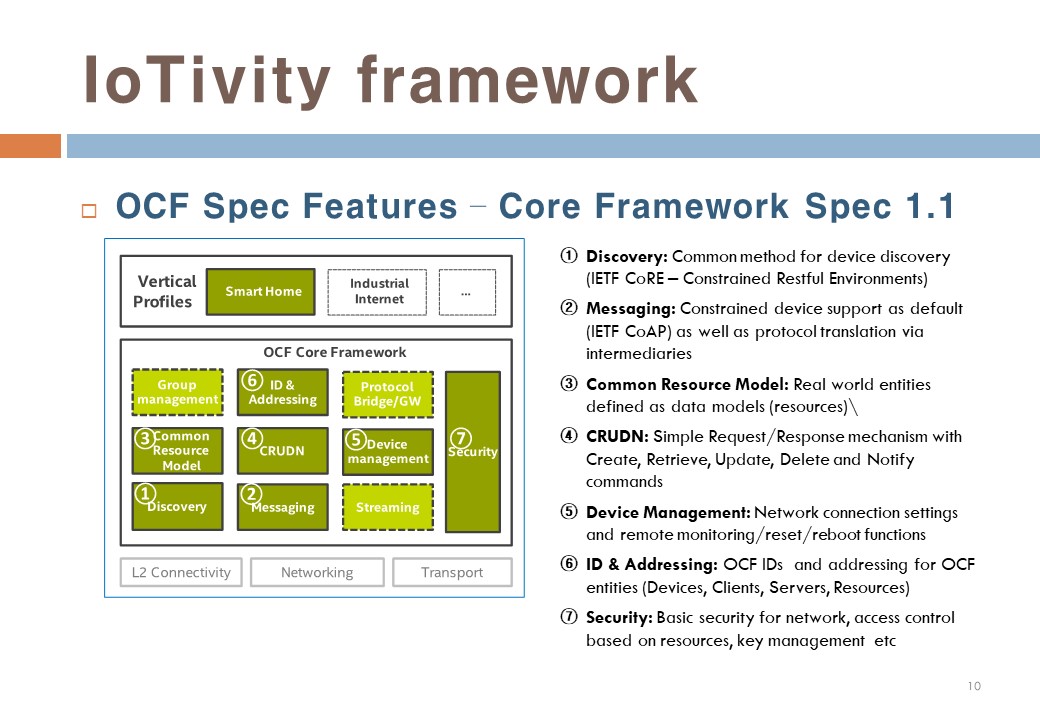 |
Core Framework consists of Discovery, Messaging, Common Resource Model, CRUDN, ID&Addressing, and Protocol Bridge/GW.
In particular, Messaging supports communication between devices by natively adopting IETF CoAP.
In the case of the Common Resource Model, it is responsible for defining Resource, which is a data model for nodes that actually exist. CRUND means Create(C), Retrieve(R), Update(U), Delete(D), Notify(N) commands in Request/Response technique. ID&Addressing stands for ID and addressing for OCF objects. Finally, Protocol Bridge/GW is about bridging-related technology to provide interoperability with other standards. Security is basically applied to all entities in the OCF ecosystem.
|
| ICACT20210229 Slide.12
[Big Slide]
|
Chrome Click!! |
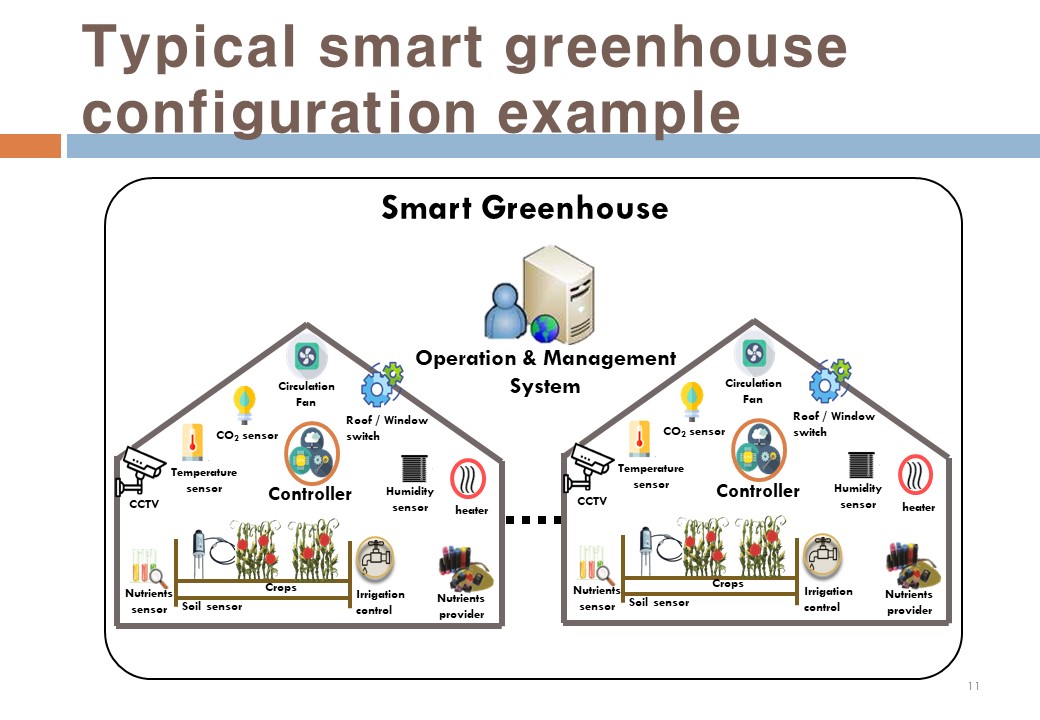 |
Among the smart farms, this is the composition of the smart greenhouse.
The general configuration of a smart farm is a sensor device for monitoring growth and environmental information (temperature, humidity, CO2, soil, nutrients, etc.), an actuator that controls the smart farm facility (window switch, ventilation, heating, irrigation, watering, etc.), It consists of a controller that controls the devices attached to each facility, and an operation management system that manages them in an integrated manner.
|
| ICACT20210229 Slide.13
[Big Slide]
|
Chrome Click!! |
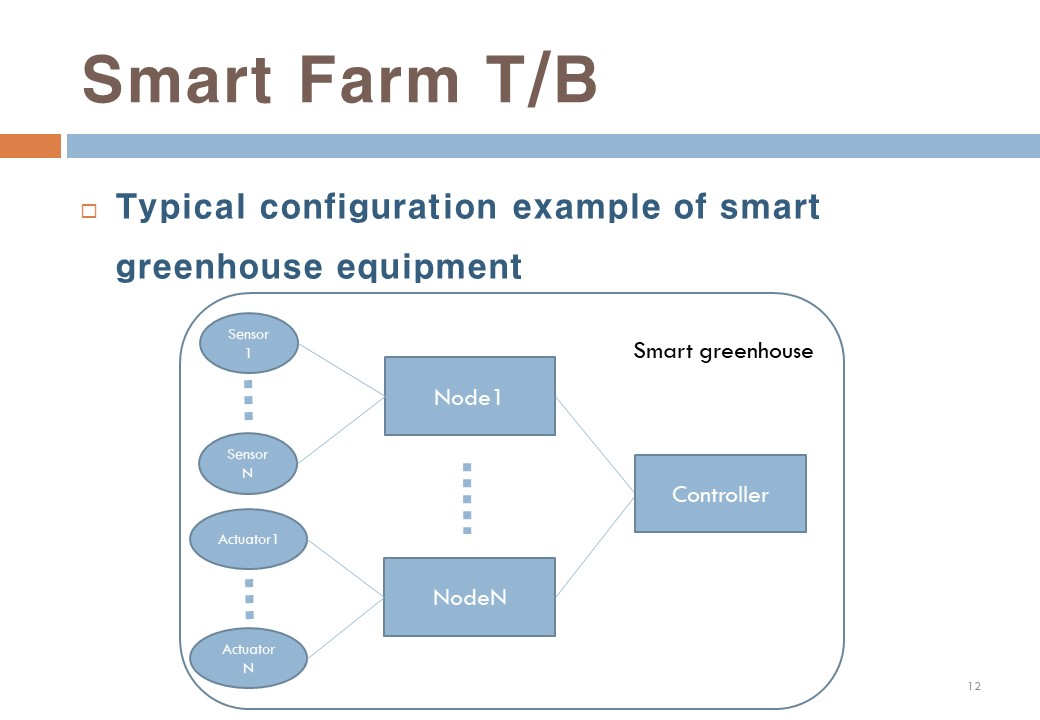 |
This is showing the smart farm test bed implemented in this paper. The test bed was constructed based on the smart greenhouse.
Nodes can be divided into three main types. These are sensor nodes, actuator nodes, and control nodes.
The smart greenhouse test bed is equipped with sensor nodes and actuators, and a controller that receives environmental and equipment status data from them and transmits control commands for them.
|
| ICACT20210229 Slide.14
[Big Slide]
|
Chrome Click!! |
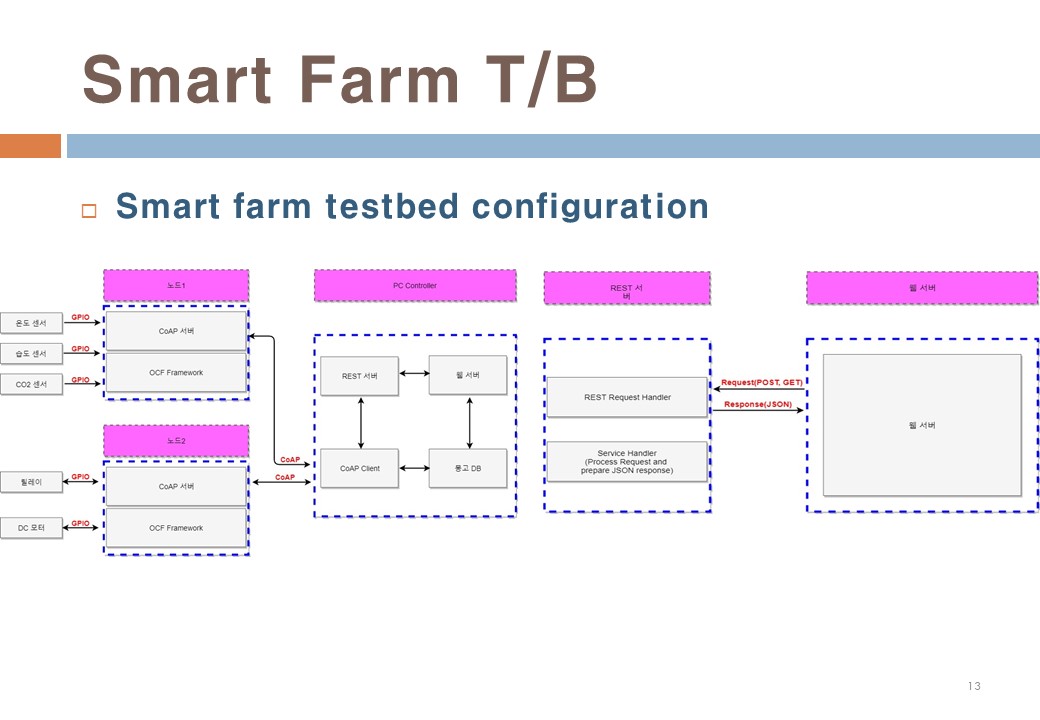 |
The overall composition of the smart farm test bed system implemented in this paper is shown in this chapter.
The sensor node, driver node, and control node are implemented in Raspberry Pi, and the web server and REST server are implemented in Linux.
|
| ICACT20210229 Slide.15
[Big Slide]
|
Chrome Click!! |
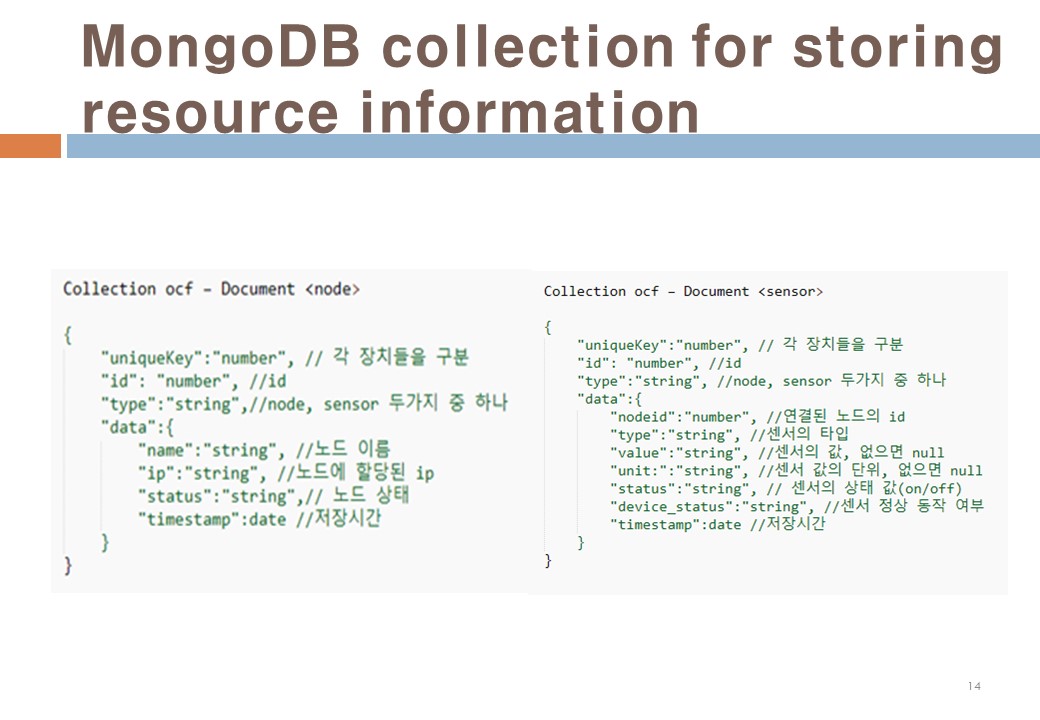 |
The schema for storing the environment and state data generated by sensor nodes and actuator nodes is defined as this slide.
|
| ICACT20210229 Slide.16
[Big Slide]
|
Chrome Click!! |
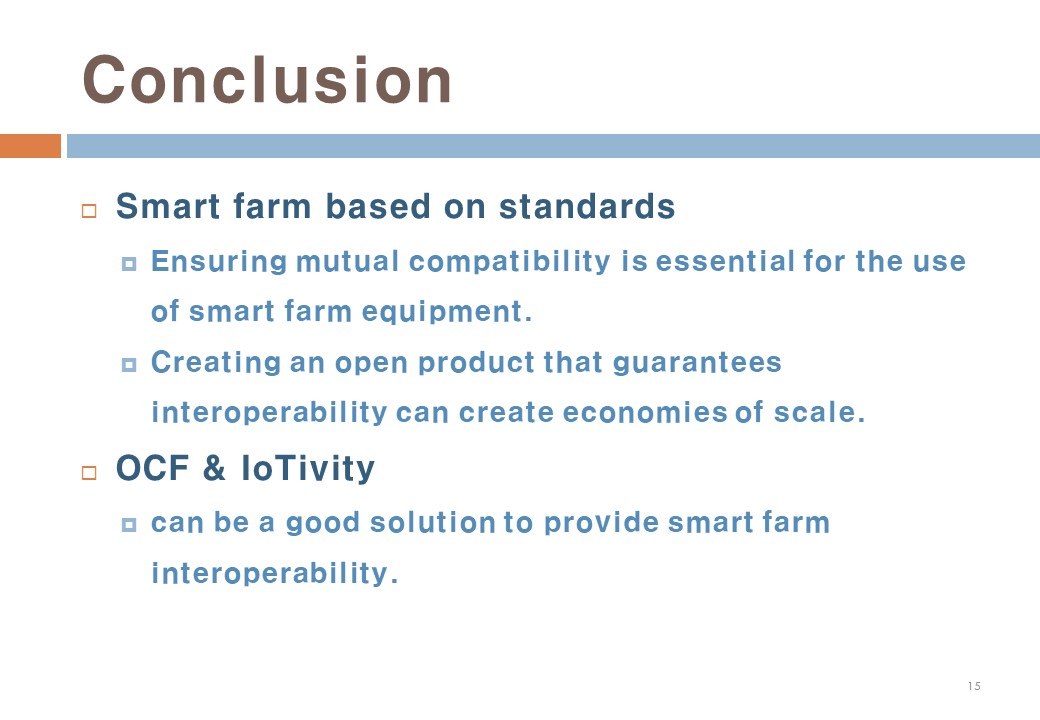 |
This paper confirmed whether mutual compatibility can be applied to Smart Farm by implementing open source based smart farm devices.
This confirmed the technical possibility that general smart farm device manufacturers or installers can easily use and operate IoT devices.
It is expected that OCF and IoTivity will be widely used to ensure compatibility of smart farm equipment in the future.
|















