 ICACT20210237 Slide.01
[Big Slide]
[YouTube] |
Chrome  Click!! |
 |
Hi All, Thank you very much for joining this presentation. I am Shubham Jain and I want to present my work on An Extensible Parsing Pipeline for Unstructured Data Processing. |
| ICACT20210237 Slide.02
[Big Slide]
[YouTube] |
Chrome Click!! |
 |
Our agenda for this presentation is mentioned in this slide. We start with an introduction to a parsing pipeline followed by the contribution. We then discuss two methodologies presented in the paper followed by the dataset and evaluation metrics used to evaluate the methods. In the end, we discuss the conclusion and highlights of the research. We also discuss the future scope. |
| ICACT20210237 Slide.03
[Big Slide]
[YouTube] |
Chrome Click!! |
 |
Network monitoring and diagnostics systems depict the running system's state and generate enormous amounts of unstructured data through log files, print statements, and other reports. It is not feasible to manually analyze all these files due to limited resources and the need to develop custom parsers to convert unstructured data into desirable file formats. Prior research focuses on rule-based and relationship-based parsing methods to parse unstructured data into structured file formats; these methods are labor-intensive and need large annotated datasets. |
| ICACT20210237 Slide.04
[Big Slide]
[YouTube] |
Chrome Click!! |
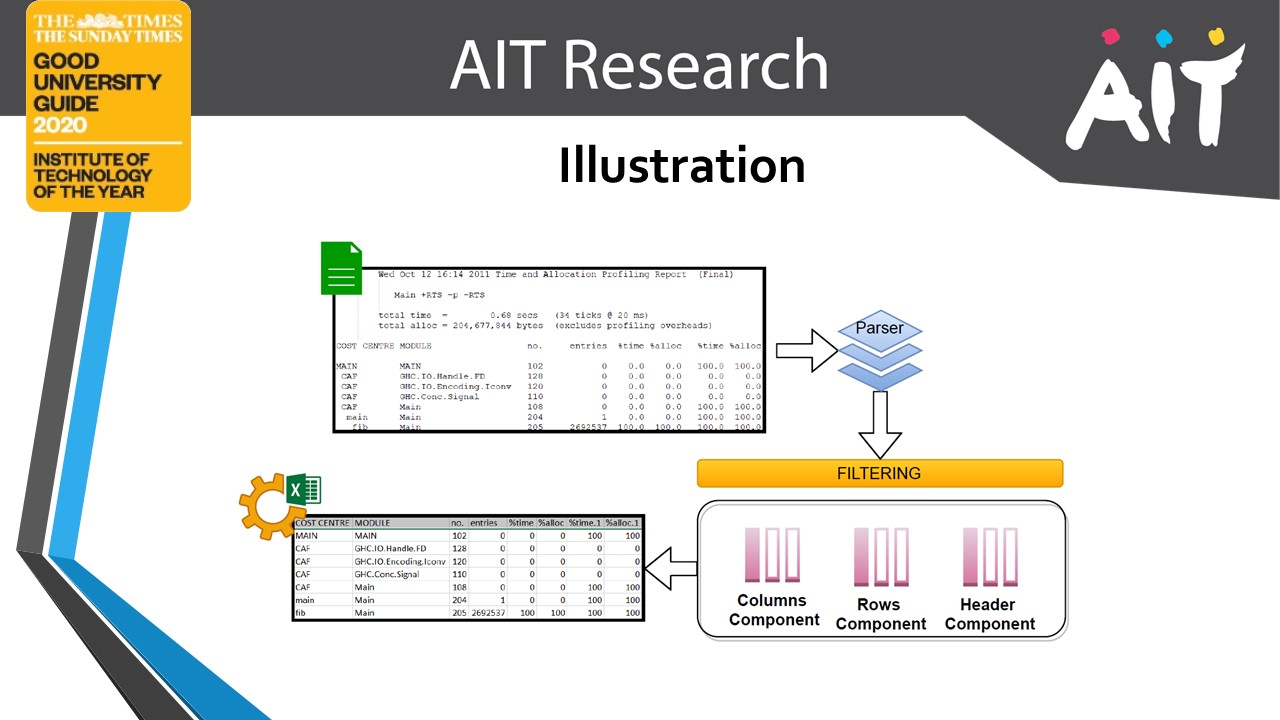 |
A simple illustration of our unstructured data parsing is shown in this figure. A text file is used as an input to the parser; the next step is identifying useful information from the text that can be used for exploratory data analysis. We remove information such as timestamp, metadata, and any information that is not useful. The filtered file is then analyzed to identify different tabular components such as header rows, data rows, and columns. The analyzed file is then parsed into a structured format and can be used for various machine learning applications. |
| ICACT20210237 Slide.05
[Big Slide]
[YouTube] |
Chrome Click!! |
 |
In this paper, we present an extensible text processing pipeline that analyses various data files with uneven character distribution and large variance in structure across different data sources, identifies the extraneous information blocks in the structure, and removes them, and extracts tabular components to later parse them into a structured data format. The processed data can be made available for exploratory data analysis, anomaly detection, incident management, autonomous problem validation, root cause analysis, and many more.
|
| ICACT20210237 Slide.06
[Big Slide]
[YouTube] |
Chrome Click!! |
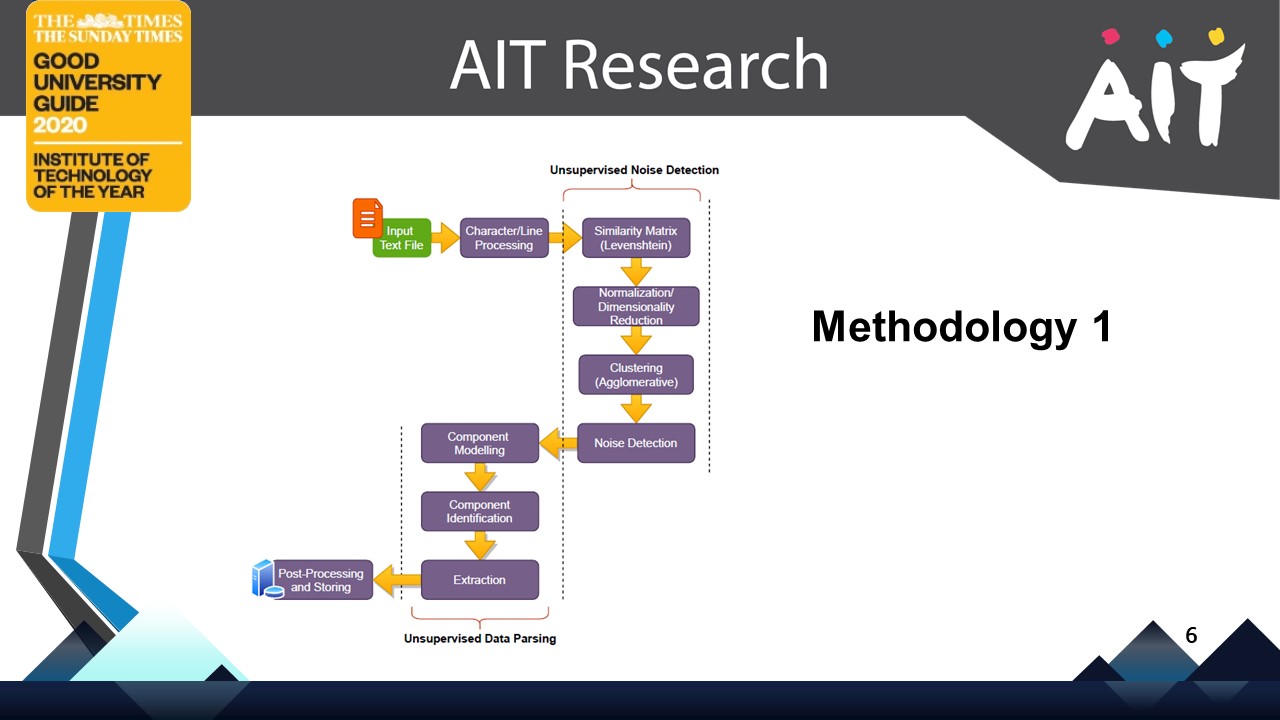 |
As illustrated in this figure, we use this similarity matrix to cluster the lines of text using Agglomerative clustering. This clustering technique identifies the two closest lines and merges them to form a cluster, repeating this all the lines are merged into a single cluster. The distance between consecutive pairs of nearest lines is recorded to generate a dendrogram that classifies the input file into noise and data. We further use the classified file with noise and data to identify table components. We analyze data rows using white space distribution and index positions of the words. We analyze lines and calculate a similarity score and meta score, which is the word's size and the front and back whitespaces. We use these scores to calculate the mean and then split words in the line and append them to a column. We further analyze the maximum similarity score in the lines and label that as our header line.
|
| ICACT20210237 Slide.07
[Big Slide]
[YouTube] |
Chrome Click!! |
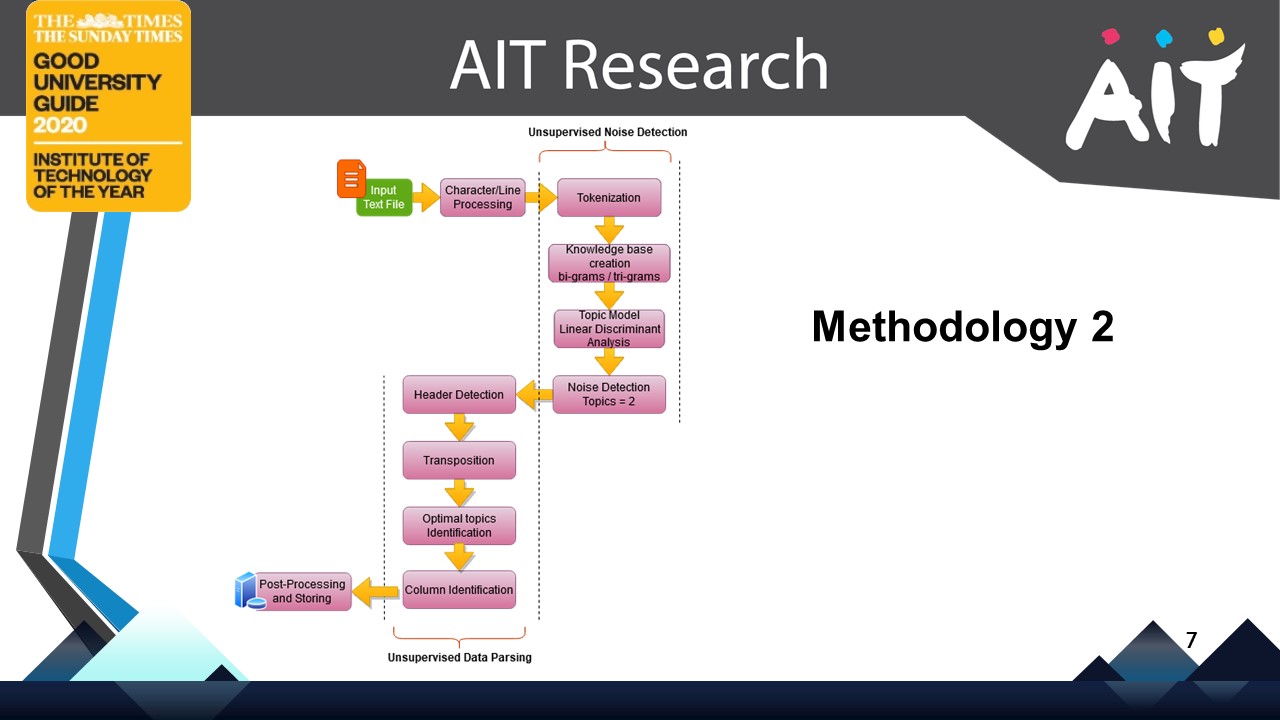 |
We also implemented a novel method using topic modeling algorithm shown in this figure. We pass the input file and split each line with whitespace as a separator to generate a token. We then use the tokens to transform the contiguous sequence of texts using n-grams. grouping words into bi-grams and tri-grams and creating a dictionary of words. Linear Discriminant Analysis is used to create a topic model with maximum topics set to three so that the model only classifies lines into two topics; Noise, Data, and Header. We filter out the noise label and split columns from data and header lines using whitespace distribution and meta scores similar to the previous approach. We then transpose the generated rows and columns of data and create another LDA topic model. We then compute the coherence scores to compute the best value of topics that are then used as column lengths. After choosing the best value k, we use that model to identify columns and then append them to rows to create a structured file format. |
| ICACT20210237 Slide.08
[Big Slide]
[YouTube] |
Chrome Click!! |
 |
We evaluated our pipeline on a sample dataset provided by Ericsson. The details are hidden as it contains proprietary information We also collected open-source samples from NTC-template that provides free-form, unstructured text from a variety of network vendors to evaluate each pipeline of algorithms. We labeled each line with noise and data labels to evaluate the accuracy of our unsupervised approach. Our evaluation method consists of manually labeling each input and determining the accuracy of the processed file by comparing it with the manual labels. We then take a mean of the accuracy of the 50 samples and calculate F1-score.
|
| ICACT20210237 Slide.09
[Big Slide]
[YouTube] |
Chrome Click!! |
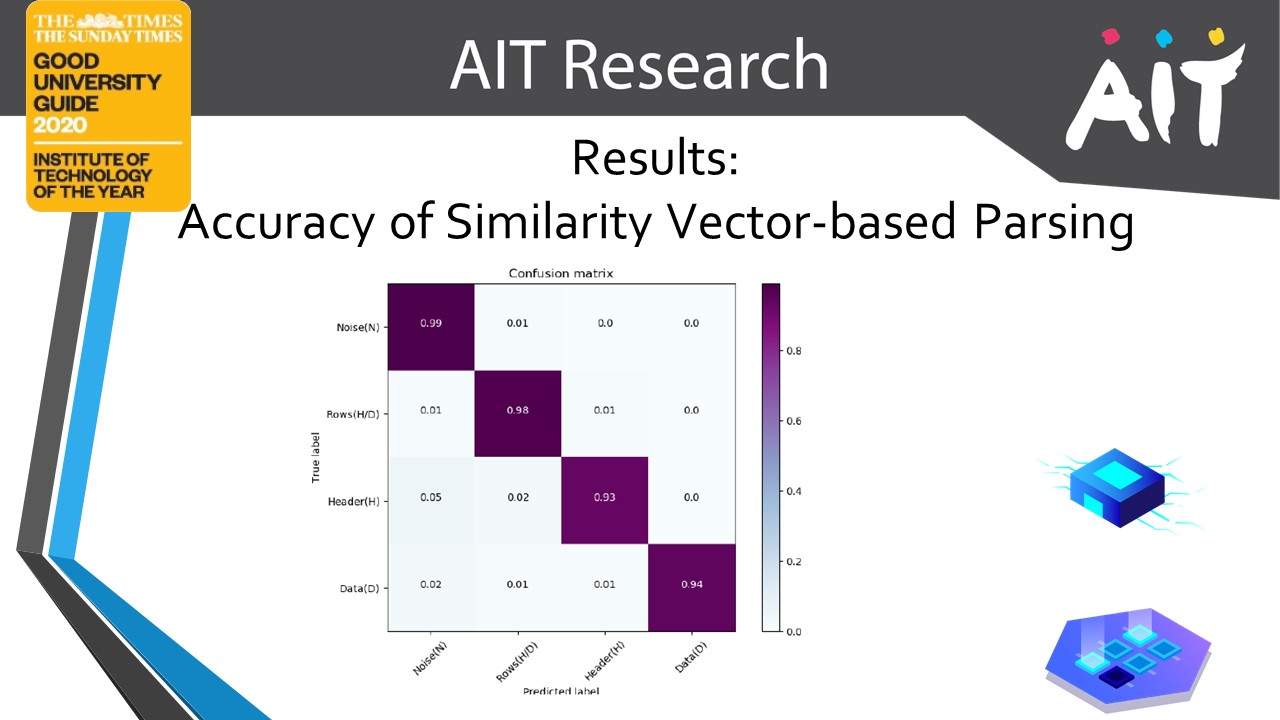 |
The accuracy of the method that uses Levenshtein distance to calculate similarity and Agglomerative clustering for filtering and parsing is presented in this figure. This method identifies noise, relevant rows, header, and data with higher accuracy, as seen in the figure. Identifying header components from data is confusing for the algorithm for some structures where the data contains similar keywords.
|
| ICACT20210237 Slide.10
[Big Slide]
[YouTube] |
Chrome Click!! |
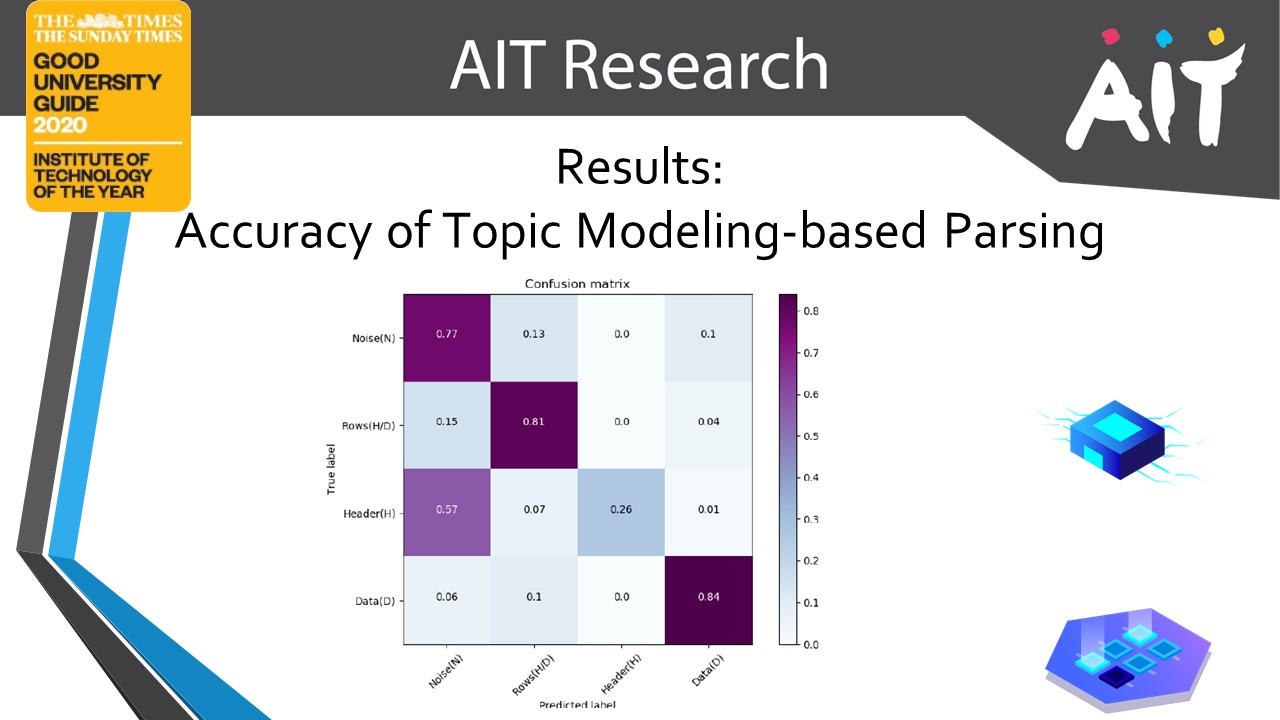 |
The accuracy of the Topic Modeling method is presented in this figure. This method works well to segregate relevant data from noise in most cases, but it fails to segregate header components from relevant data rows.
|
| ICACT20210237 Slide.11
[Big Slide]
[YouTube] |
Chrome Click!! |
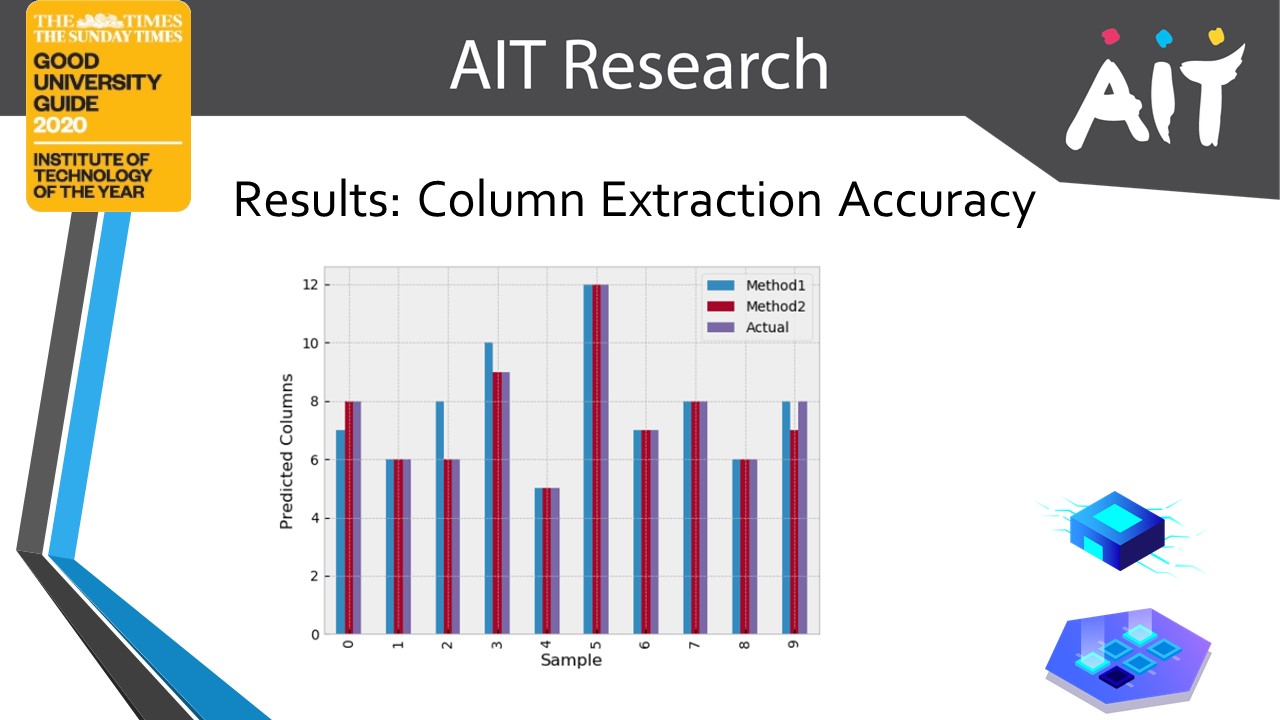 |
We used 10 data samples with the highest column structure variation to calculate the column component extraction accuracy of both methods. As seen in the figure, the predicted and actual columns by both methods are plotted. The results suggest that both the approaches worked well for column component extraction; however, the classification of columns as topics provided better predictions than finding similarity of lines and calculating the mean score of whitespace distributions. Thus, method 1 has more accuracy in eliminating extraneous information and detecting relevant rows and headers, while method 2 has better accuracy in extracting column components.
|
| ICACT20210237 Slide.12
[Big Slide]
[YouTube] |
Chrome Click!! |
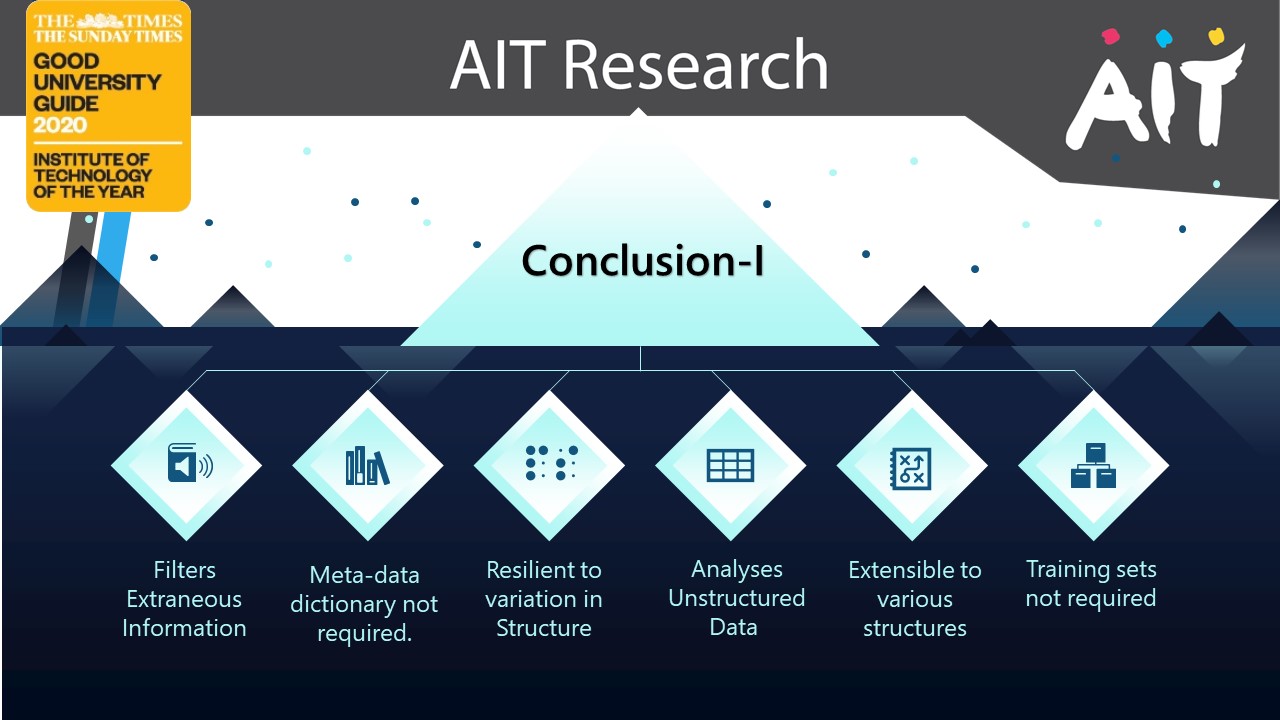 |
Our text processing pipeline analyses unstructured data, Filters extraneous information, does not require a knowledgebase or training sets, is resilient to variation in structure, and extensible to various unstructured text samples. |
| ICACT20210237 Slide.13
[Big Slide]
[YouTube] |
Chrome Click!! |
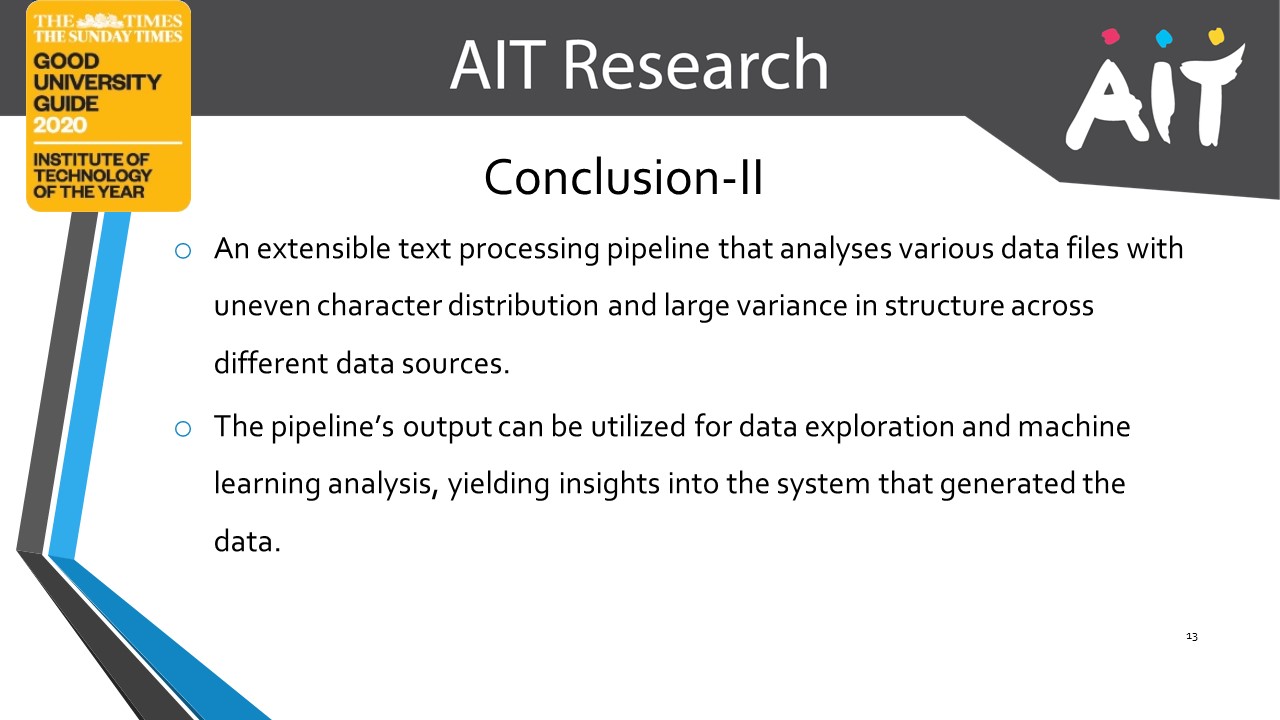 |
We presented an extensible text processing pipeline that analyses various data files with uneven character distribution and large variance in structure across different data sources, identifies the extraneous information blocks in the structure, and removes them, and extracts tabular components to later parse them into a structured data format. |
| ICACT20210237 Slide.14
[Big Slide]
[YouTube] |
Chrome Click!! |
 |
The future work involves further analysis of the extraneous information to extract relevant information in unstructured data. This work is funded by Irish Research Council Enterprise Partnership Scheme and co-funded by Ericsson. |
| ICACT20210237 Slide.15
[Big Slide]
[YouTube] |
Chrome Click!! |
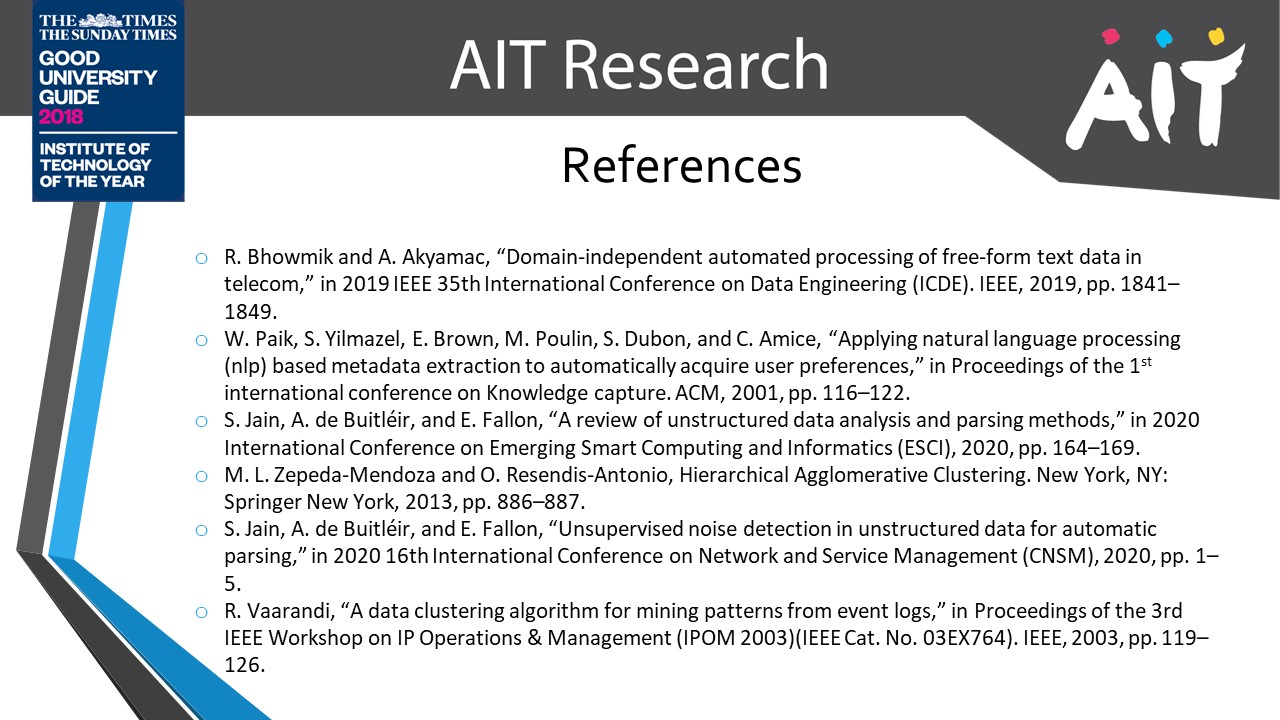 |
This slide includes few references, an earlier version of this paper is referenced in point five. |
| ICACT20210237 Slide.16
[Big Slide]
[YouTube] |
Chrome Click!! |
 |
Thank you very much for attending this presentation. I look forward to your questions. |















