 ICACT20210252 Slide.01
[Big Slide] |
Chrome  Click!! |
 |
Good morning everyone. My name is RACHATA MANEKKUT, from photonic transport network laboratory, KDDI research, JAPAN. It is very great honor to be here today. Now, I’m going to present my work entitled “Demonstration of Hybrid Probabilistic Geometric Shaping 64QAM Optical Fiber Transmission Using Optimized Constellation for MAP Detection with Hard Decision Decoding”. |
| ICACT20210252 Slide.02
[Big Slide]
|
Chrome Click!! |
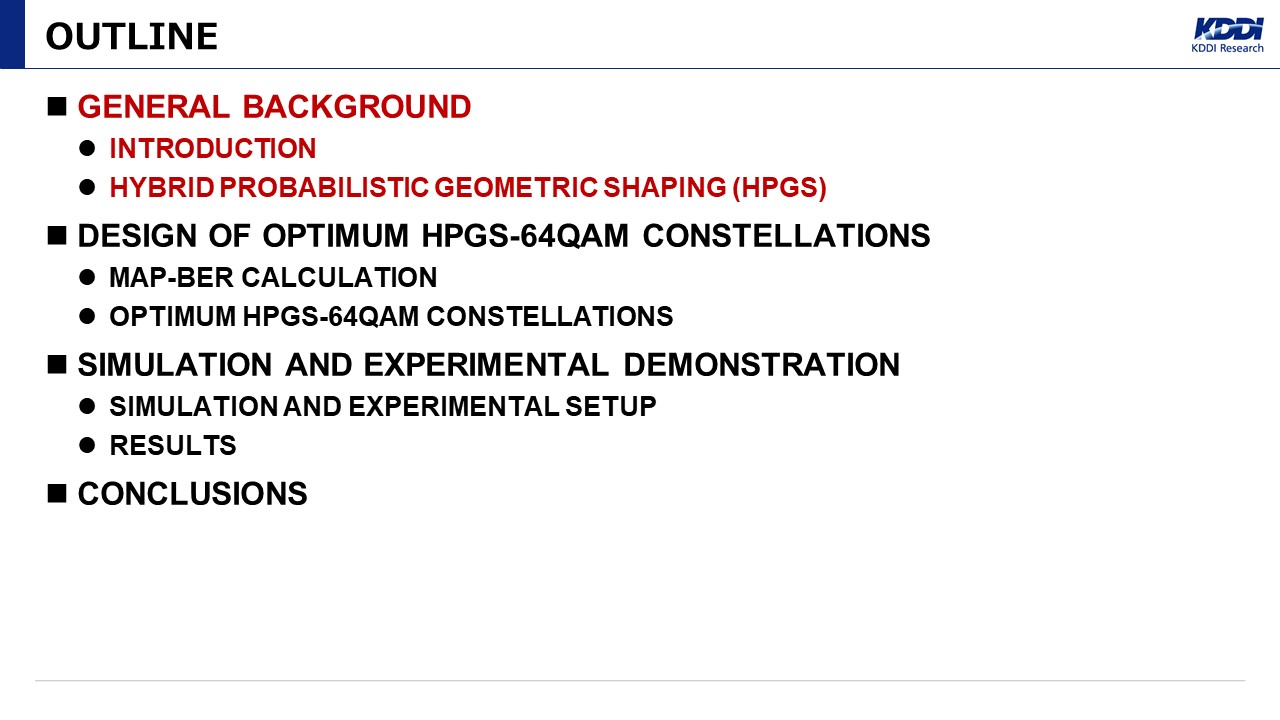 |
The outline of this presentation is listed as below. I will firstly talk about the current technology of optical transmission system and the reason why we need the constellation shaping techniques, especially the hybrid probabilistic/geometric shaping. Second, the proposed constellations under the optimized condition will be explained. Then, the simulation and the experimental setup and results will be shown. Finally, the conclusion will be shown. |
| ICACT20210252 Slide.03
[Big Slide]
|
Chrome Click!! |
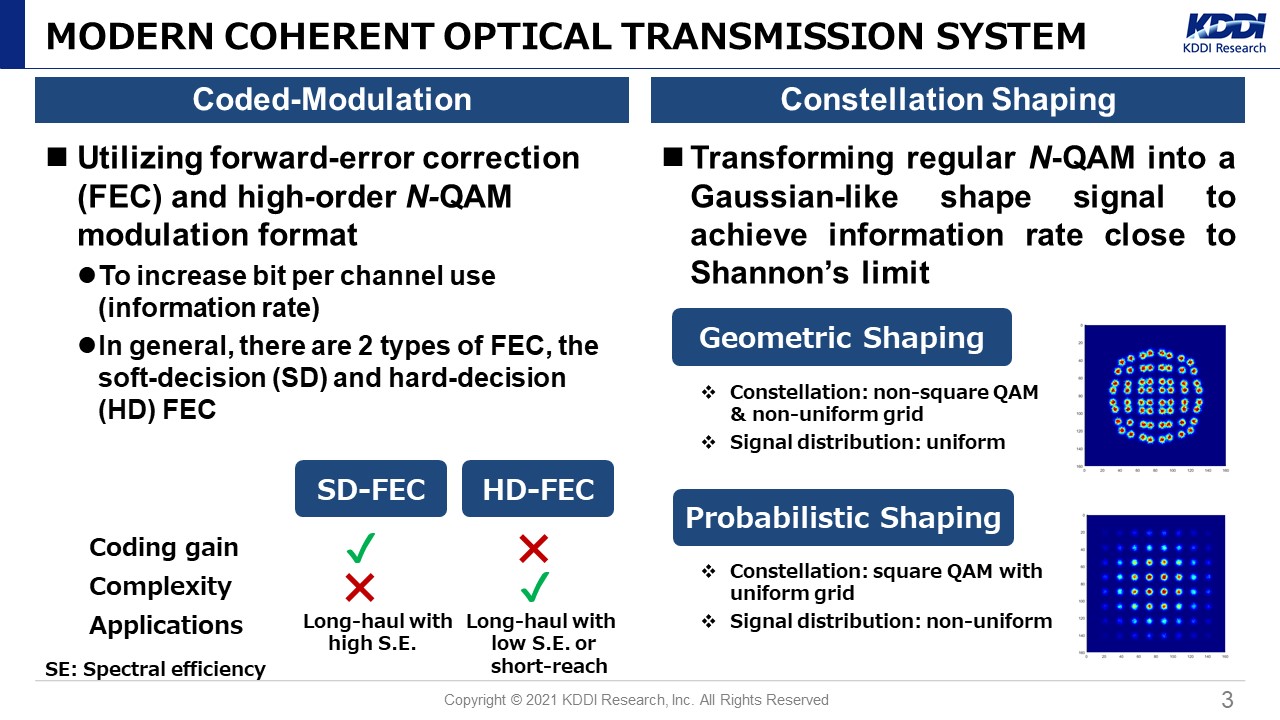 |
In modern coherent optical transmission technology, we aim to transmit the signal with as high spectral efficiency as we can achieved. On the other hand, we try to achieve the capacity of Shannon’s limit. Two main technologies are being paid lots of attention, coded-modulation and constellation shaping. The coded-modulation is a combination of using forward error correction (FEC) and high-order QAM format. Basically, there are 2 types of FEC, the soft-decision (SD) and hard decision (HD) FEC. The SD-FEC is greater than HD-FEC in terms of the performance but it has the power consumption and complexity more than the HD-FEC. Therefore, in some scenarios such as a long-haul transmission with low S.E or short reach transmission which concern about cost and complexity, HD-FEC may be preferable. The constellation shaping is the technique to shape the transmitted signal into a Gaussian-like shape to achieve the SE close to Shannon’s limit. There are generally two types of the constellation shaping. The first one is Geometric shaping which the signal distribution (or probability) is uniform whereas the constellation is not on the uniform grid of regular square N-QAM. The second one is the probabilistic shaping which the signal distribution is not uniform, but the constellation is on the regular square N-QAM grid. The difference is shown in figures in the right-hand side. |
| ICACT20210252 Slide.04
[Big Slide]
|
Chrome Click!! |
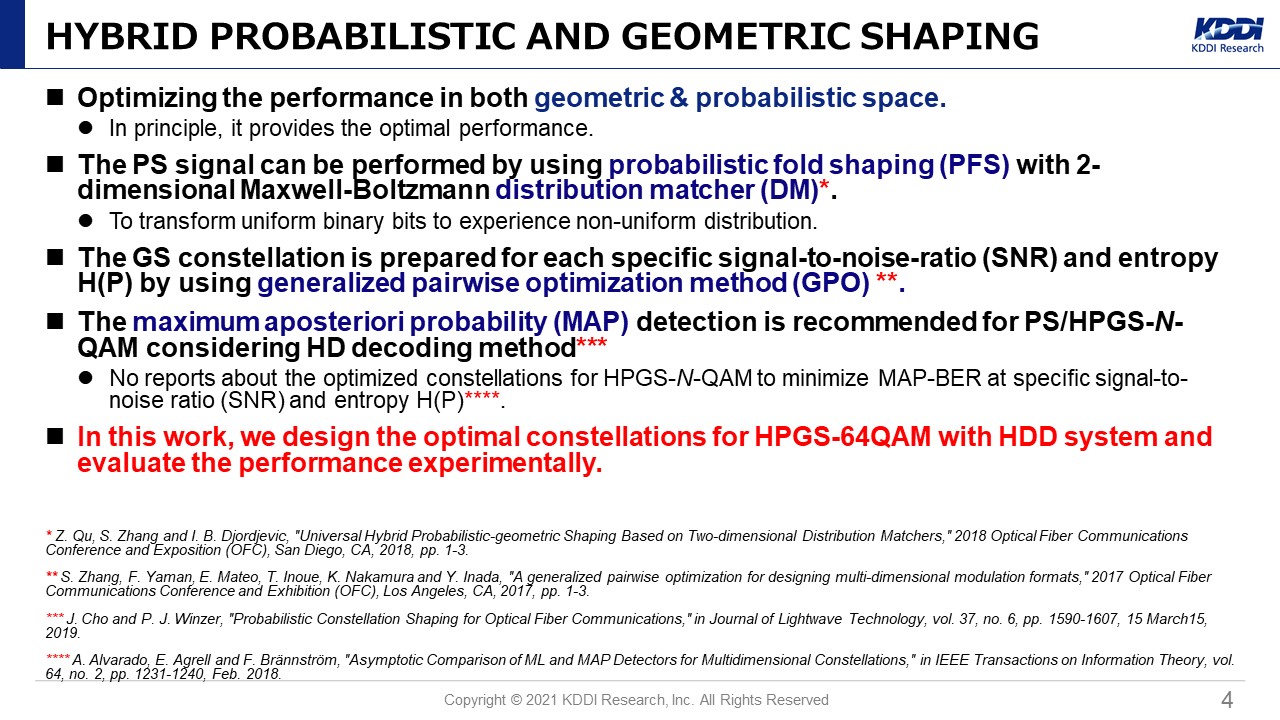 |
To combine the geometric and probabilistic shaping together, it is called hybrid probabilistic-geometric shaping. In principle, it provides the optimal performance. The PS signal can be performed by using probabilistic fold shaping (PFS) with 2-dimensional Maxwell-Boltzmann distribution matcher (DM) to transform uniform binary bits to experience non-uniform distribution. The GS constellation is prepared for each specific signal-to-noise-ratio (SNR) and entropy H(P) by using generalized pairwise optimization method (GPO). Furthermore, the maximum aposteriori probability (MAP) detection is recommended for PS/HPGS-N-QAM considering HD decoding method. Since there are no reports about the optimized constellations for HPGS-N-QAM to minimize MAP-BER at specific signal-to-noise ratio (SNR) and entropy H(P), in this work, we design the optimal constellations for HPGS-64QAM with HDD system and evaluate the performance experimentally. |
| ICACT20210252 Slide.05
[Big Slide]
|
Chrome Click!! |
 |
Next, I will explain about how to design a constellation and probability for HPGS. |
| ICACT20210252 Slide.06
[Big Slide]
|
Chrome Click!! |
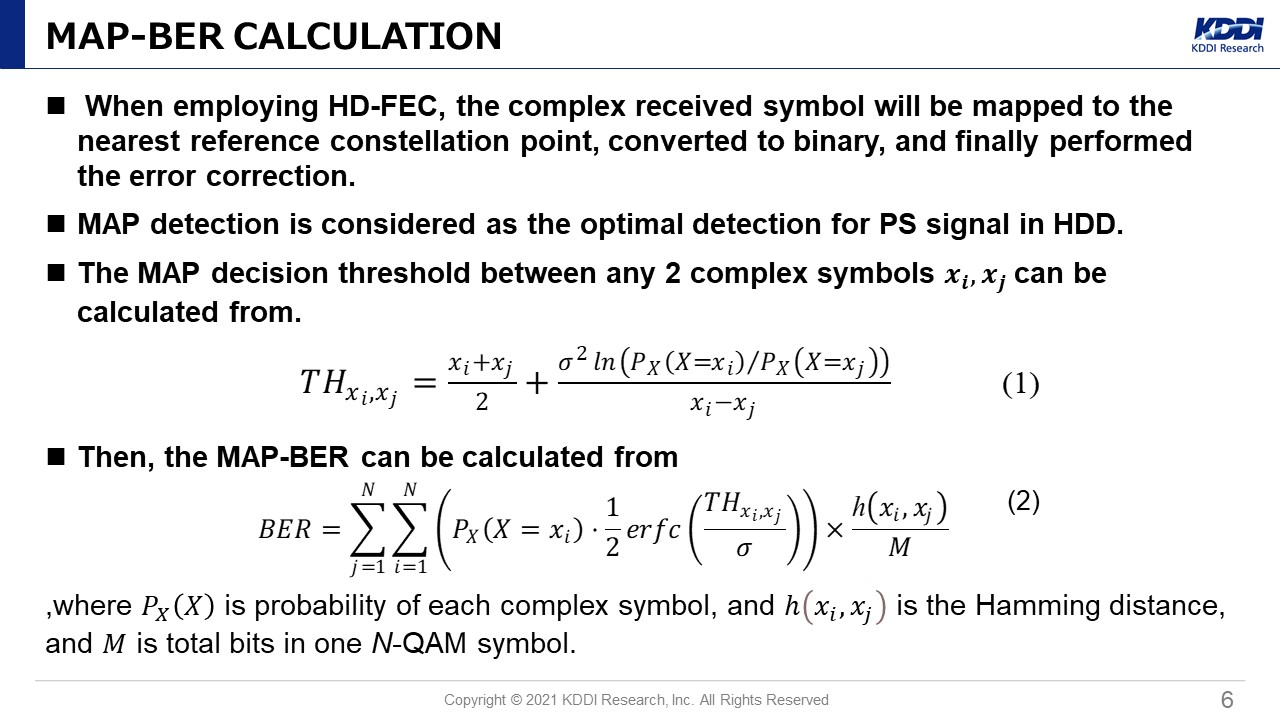 |
When employing HD-FEC, the complex received symbol will be mapped to the nearest reference constellation point, converted to binary, and finally performed the error correction. Generally, for maximum likelihood (ML) detection, the threshold is at the middle point of any two constellation points which is not suitable for non-uniform signal like PS (and also HPGS) signal. MAP detection is considered as the optimal detection for PS signal in HDD. The MAP decision threshold between any 2 complex symbols x_i,x_j can be calculated from equation (1). Then, the MAP-BER can be calculated from equation (2)
,where P_X (X) is probability of each complex symbol, and h(x_i,x_j ) is the Hamming distance, and M is total bits in one N-QAM symbol. Note that, if the signal distribution is uniform, the second term in equation (1) will be zero and it turns into ML threshold and the BER in equation (2) is considered as ML-BER instead.
|
| ICACT20210252 Slide.07
[Big Slide]
|
Chrome Click!! |
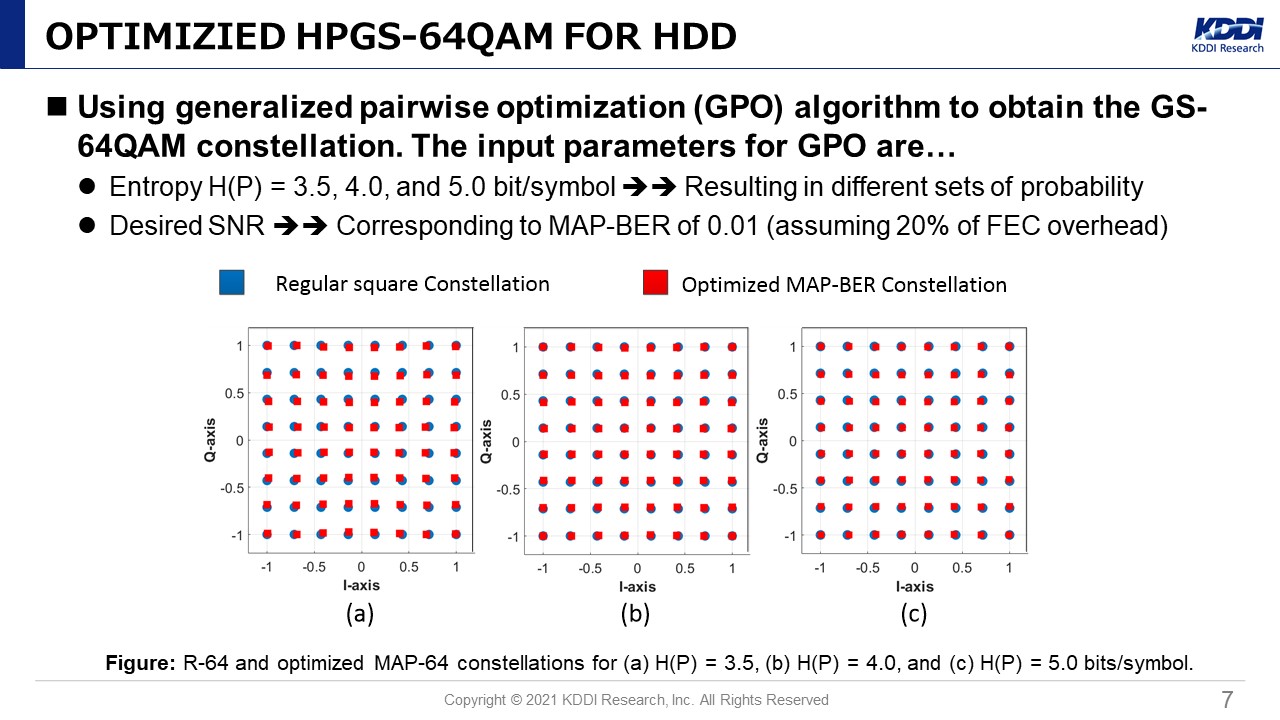 |
To obtain the optimized constellation for hard-decision decoding, we should minimize the MAP-BER at a specific signal-to-noise ratio (SNR) and entropy H(P). We use the generalized pairwise optimization (GPO) to shape the constellation. The entropy we would like to test is 3.5, 4.0, and 5.0 bit/symbol. The SNR value is corresponding to MAP-BER of 0.01 in each entropy. The figure shows the comparison between the optimized constellations and the regular square 64-QAM constellations. |
| ICACT20210252 Slide.08
[Big Slide]
|
Chrome Click!! |
 |
Next, we will show the simulation/experimental setup and results. |
| ICACT20210252 Slide.09
[Big Slide]
|
Chrome Click!! |
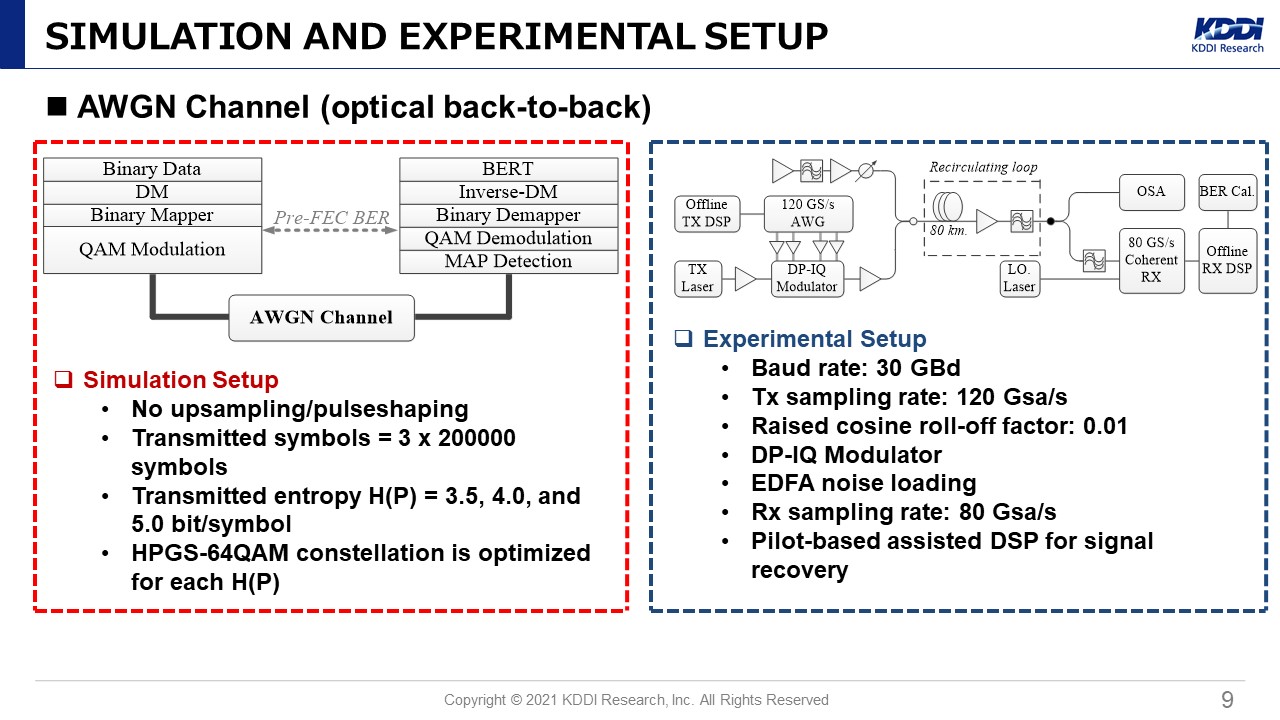 |
On the left-side in the red box is the simulation setup. The random binary sequence will be mapped to the optimized constellation with desired entropy generated by 2D-DM and PFS method. 3x200000 prepared symbols were sent to Additive White Gaussian Noise (AWGN) channel. At the receiver side, the noisy received symbols are converted back to bit using MAP detection and then the BER is calculated. On the right-side in the blue box is the experimental setup. The pre-processed symbols are up-sampled and pulse-shaped with a root raised-cosine filter and sent to 120 GSa/s arbitrary waveform generator (AWG). A dual-polarization I/Q modulator, and an external cavity laser is used to create the modulated optical signal. The EDFA noise loading is added to the modulated signal to emulate the AWGN channel in the optical back-to-back test. At the receiver, the signal is detected by an 80 GSa/s oscilloscope and equalized by DSP to recover the signal. Finally, the MAP detection is performed and the BER is measured. |
| ICACT20210252 Slide.10
[Big Slide]
|
Chrome Click!! |
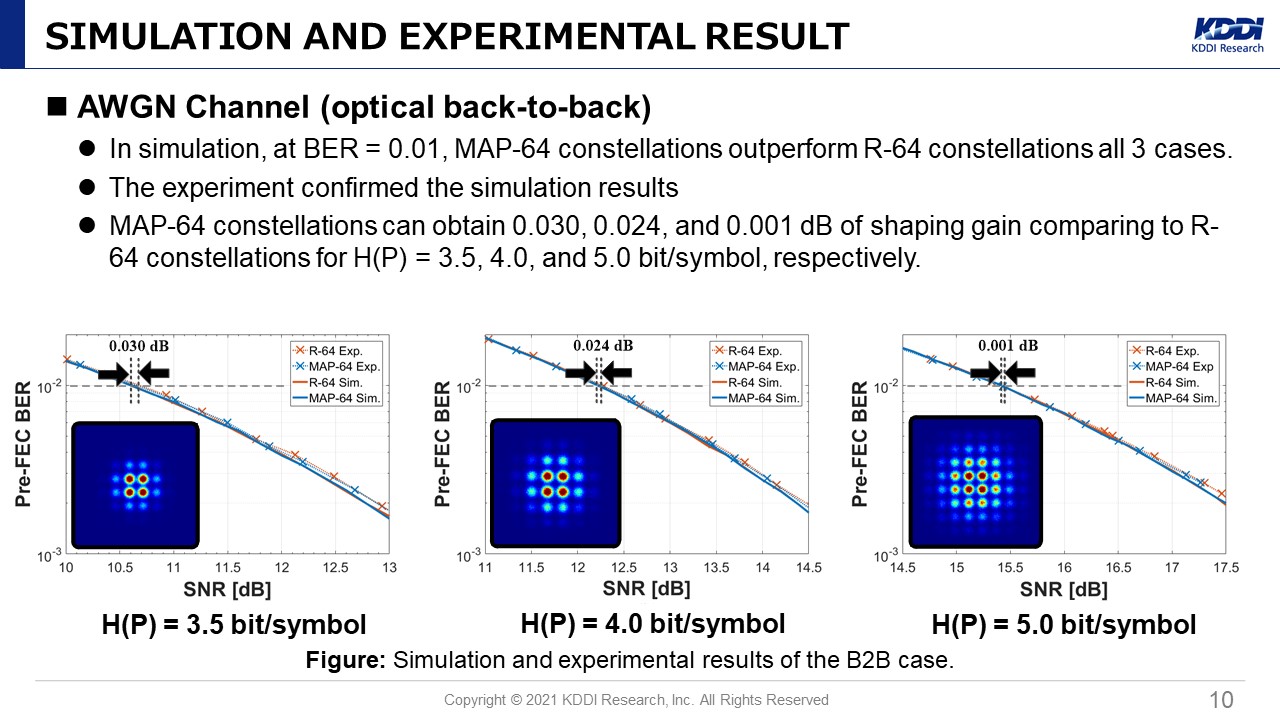 |
In AWGN channel, In simulation, at BER = 0.01, MAP-64 constellations outperform R-64 constellations all 3 cases (entropy H(P) = 3.5, 4.0, and 5.0 bit/symbol). The experiment confirmed the simulation results.
The proposed MAP-64 constellations can obtain 0.030, 0.024, and 0.001 dB of shaping gain comparing to R-64 constellations for H(P) = 3.5, 4.0, and 5.0 bit/symbol, respectively. The insets in the figure show the received constellations from the back-to-back experiment.
|
| ICACT20210252 Slide.11
[Big Slide]
|
Chrome Click!! |
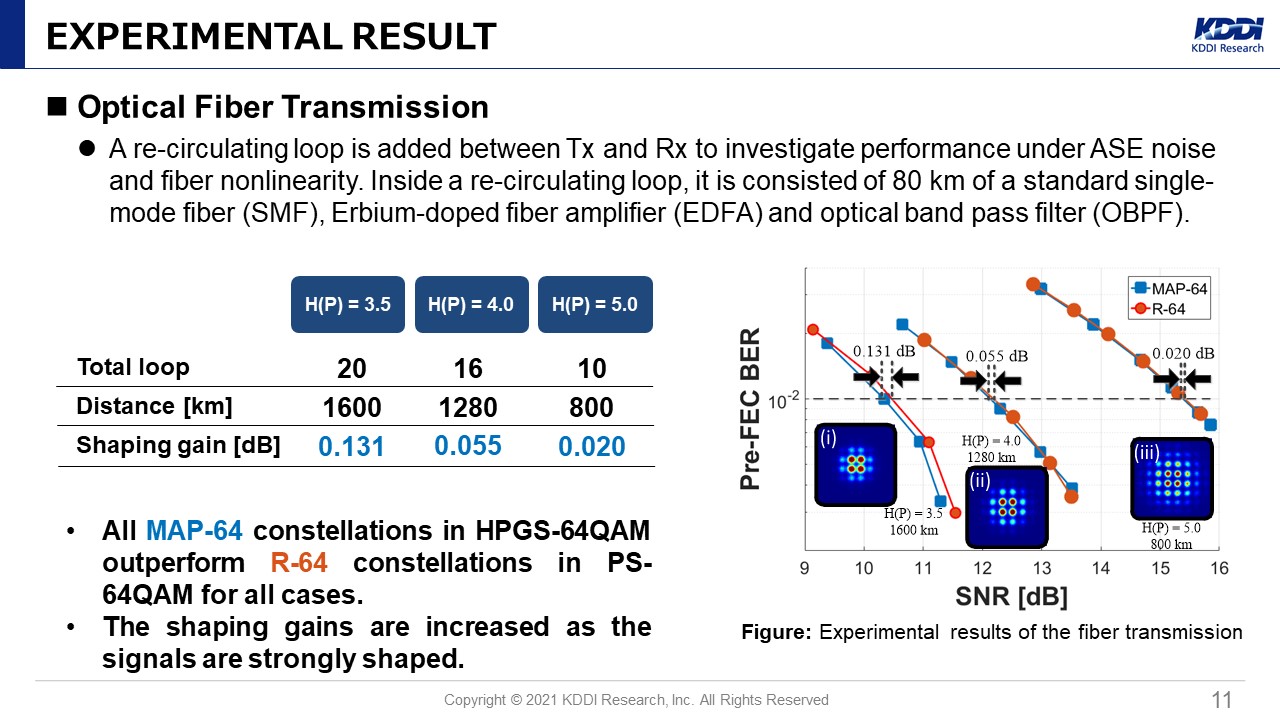 |
In the fiber transmission, a re-circulating loop is added between Tx and Rx in the experiment setup diagram to investigate performance under ASE noise and fiber nonlinearity. Inside a re-circulating loop, it is consisted of 80 km of a standard single-mode fiber (SMF), Erbium-doped fiber amplifier (EDFA) and optical band pass filter (OBPF). We adjust the number of re-circulating loops so independently in each entropy so that we can investigate the performance at BER around 0.01. As a result, all MAP-64 constellations in HPGS-64QAM outperform R-64 constellations in PS-64QAM for all cases. The shaping gains are 0.131, 0.050, and 0.020 for H(P) = 3.5, 4.0, and 5.0, respectively. The shaping gains are found to be increased as the signals are strongly shaped. |
| ICACT20210252 Slide.12
[Big Slide]
|
Chrome Click!! |
 |
Finally, a conclusion is… |
| ICACT20210252 Slide.13
[Big Slide]
|
Chrome Click!! |
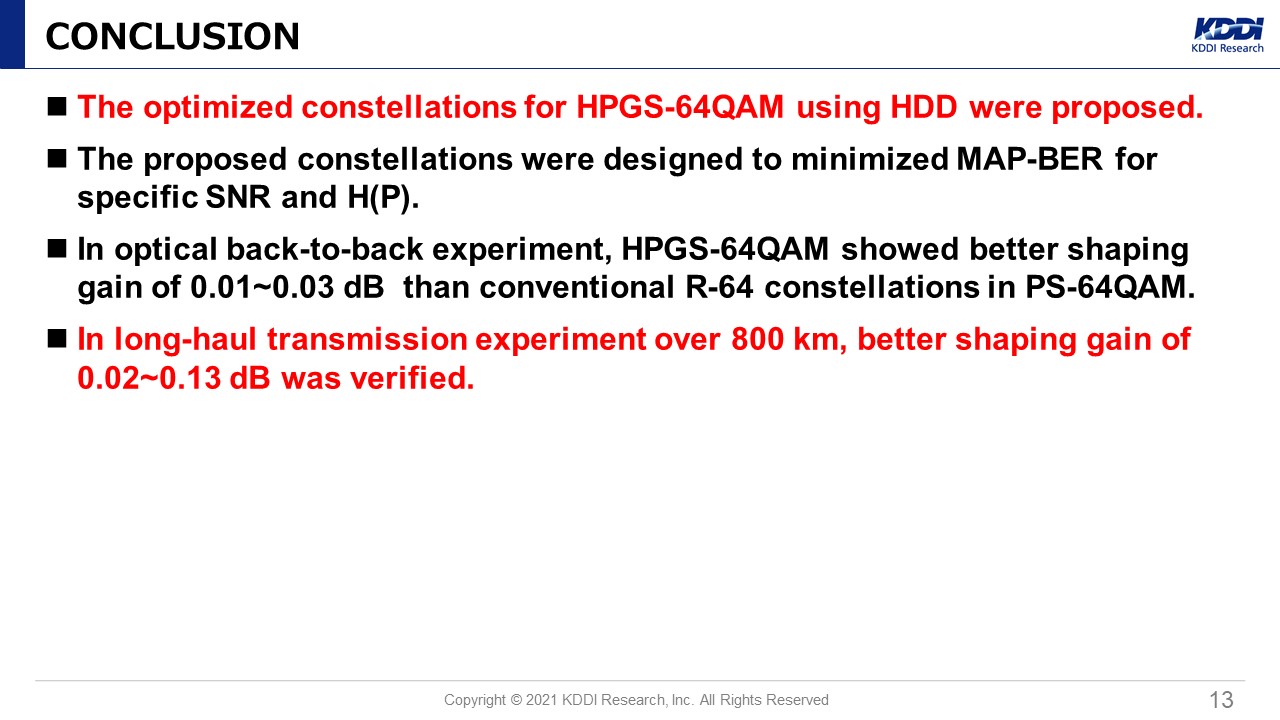 |
•The optimized constellations for HPGS-64QAM using HDD were proposed.
•The proposed constellations were designed to minimized MAP-BER for specific SNR and H(P).
•In optical back-to-back experiment, HPGS-64QAM showed better shaping gain of 0.01~0.03 dB than conventional R-64 constellations in PS-64QAM.
•In long-haul transmission experiment over 800 km, better shaping gain of 0.02~0.13 dB was verified.
|
| ICACT20210252 Slide.14
[Big Slide]
|
Chrome Click!! |
 |
Thank you very much for your attention. All questions and valuable suggestions are welcome. |
| ICACT20210252 Slide.15
[Big Slide]
|
Chrome Click!! |
 |
Thank you |















