 ICACT20210256 Slide.01
[Big Slide] |
Chrome  Click!! |
 |
Hi everybody, my name is Matasem Saleh. For ICACT 2020, I have cooperated with the following researchers, DR. NZ Jhanjhi and Dr. Azween Abdullah from Taylor’s University and Miss Raazia Saher from King Faisal University.
I am here to propose an encryption selection model for IoT device based on IoT device design.
|
| ICACT20210256 Slide.02
[Big Slide]
|
Chrome Click!! |
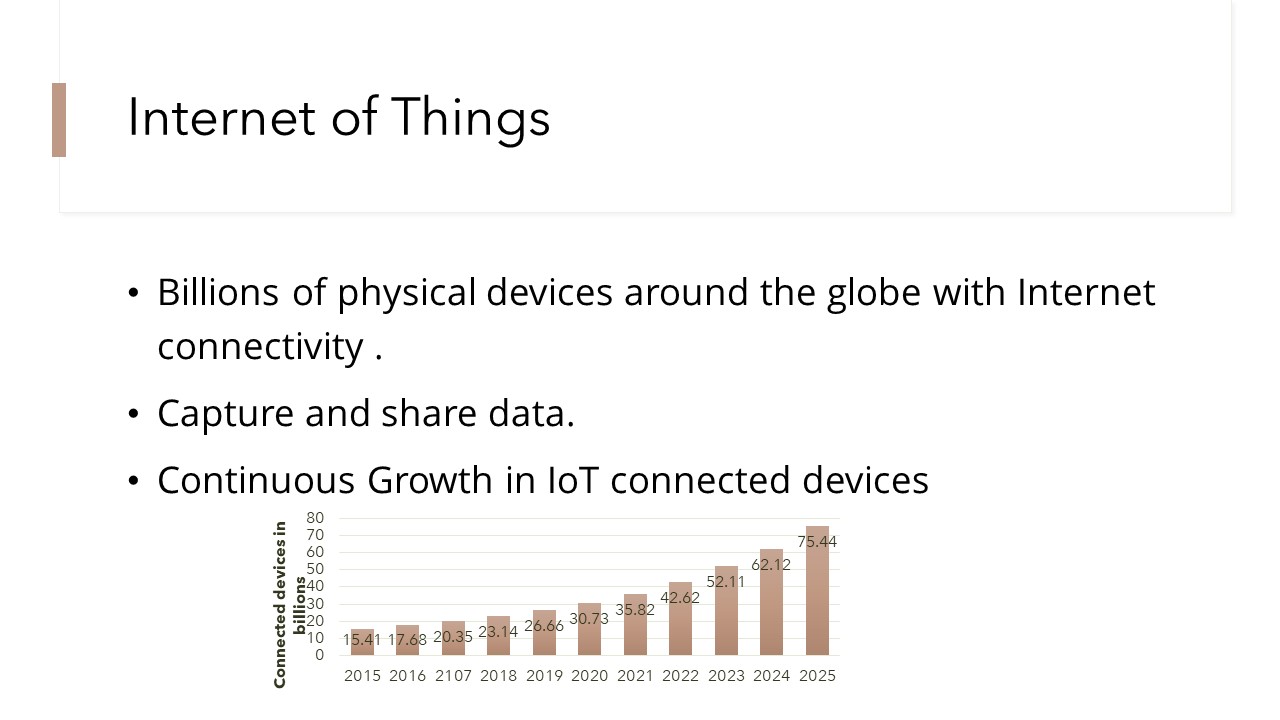 |
Internet of things is one of the most groundbreaking innovations in human life. IoT has evolved and spread quickly due to the useful services it delivers to users. IoT device incorporates unlimited number of components to allow technological advancement and facilitate people’s everyday life and function.
IoT applies to billions of internet connected devices all over the world, that store and exchange data. There is a further growth in the amount of IoT devices in the world, predicted by Statista that by 2025 more than 75,440 billion of devices will be functioning. This exponential rise is attributed to low-cost manufacture of computer chips and the spread of communication technologies.
In IoT devices, sensors are used for detecting and collecting real data from the world. The data obtained is redirected to remote services for further process and analysis, review thanks to the advanced internet access mechanism integrated in IoT devices.
|
| ICACT20210256 Slide.03
[Big Slide]
|
Chrome Click!! |
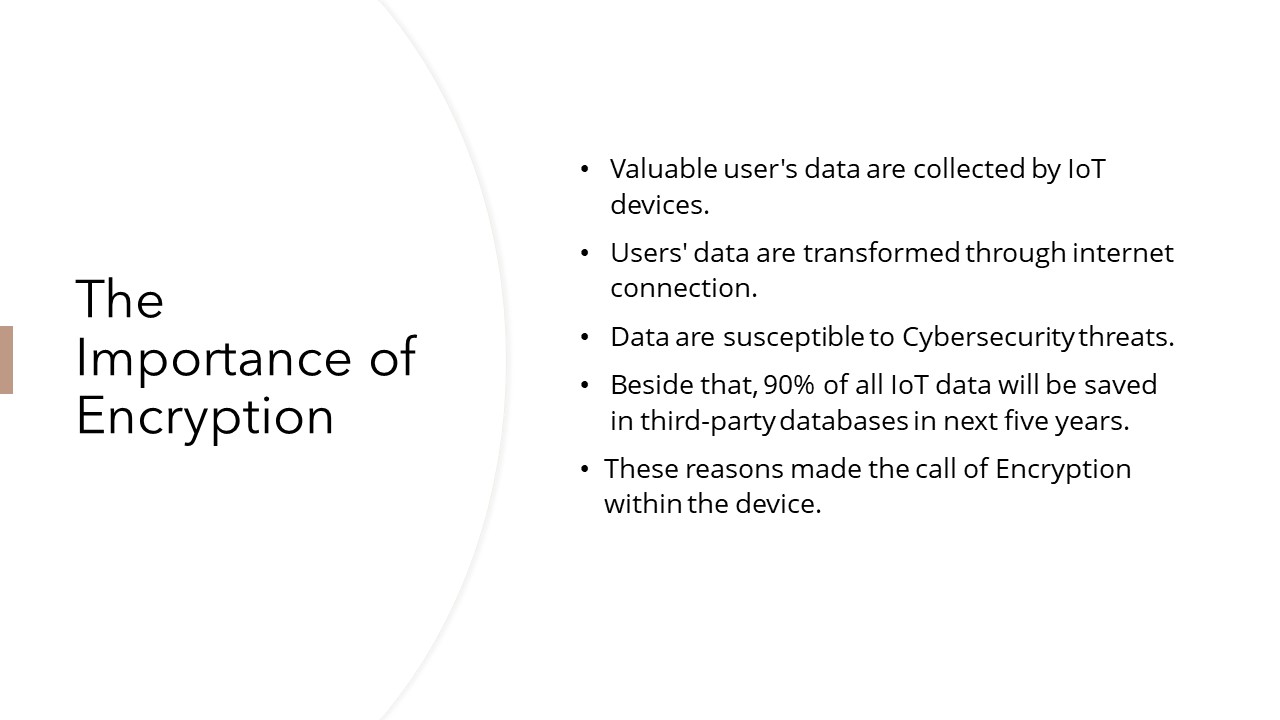 |
Since IoT devices are primarily configured to collect and transfer data through the internet without being administered by people, they can be at risk that any machine connected to internet might confront. In addition, it is challenging to protect IoT devices in contrast to other online connected devices because of its restricted resources. IoT device’s collected data hold numerous personal details of the consumer that places high emphasis on confidentiality in the user perspective. For these reasons attackers consider IoT device’s collected data as their primary targets. In fact, growing demand of IoT technologies has attracted hackers to focus their efforts to manipulate and monitor these devices and data they generate. To mitigate this adverse situation, IoT devices should be safe from any possible attacks. Beside that, 90% of all IoT data will be saved in third-party databases in next five years. These reasons made the call of Encryption within the device.
|
| ICACT20210256 Slide.04
[Big Slide]
|
Chrome Click!! |
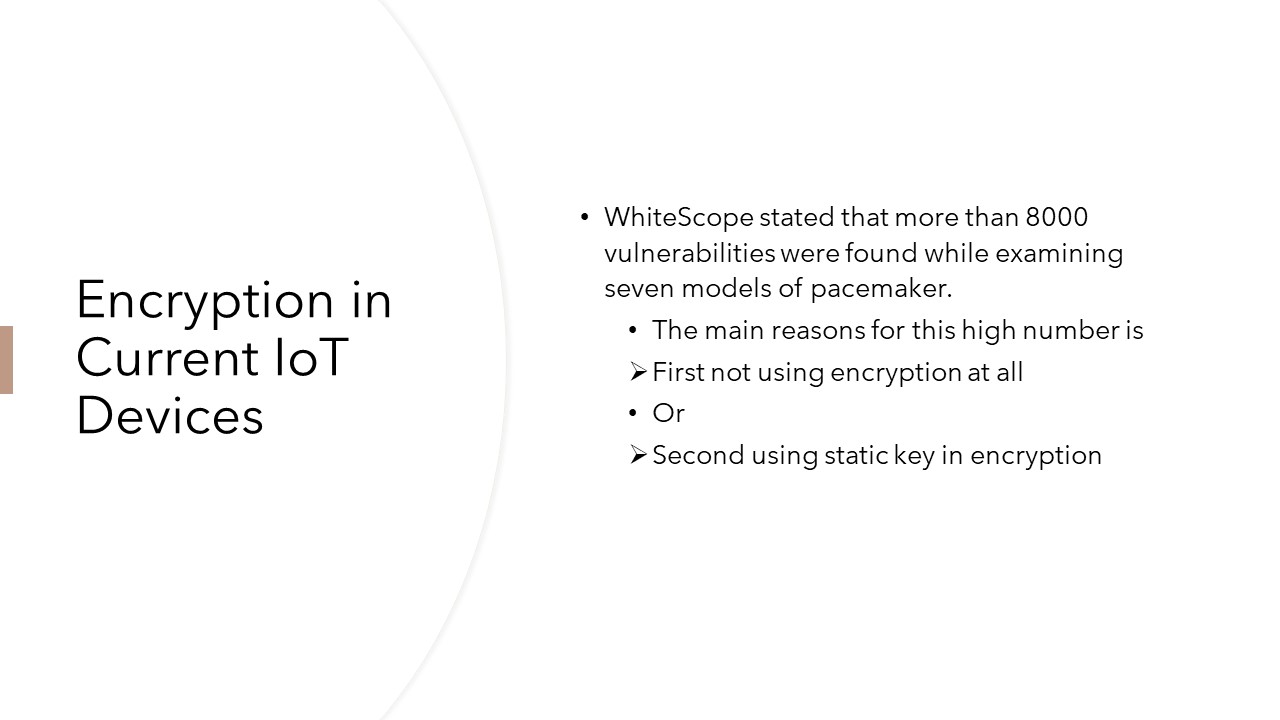 |
Whitescop stated that more than 8000 vulnerabilities were found while examining seven models of pacemaker. The main reasons for this high number is first not using encryption at all or second using static key in encryption
|
| ICACT20210256 Slide.05
[Big Slide]
|
Chrome Click!! |
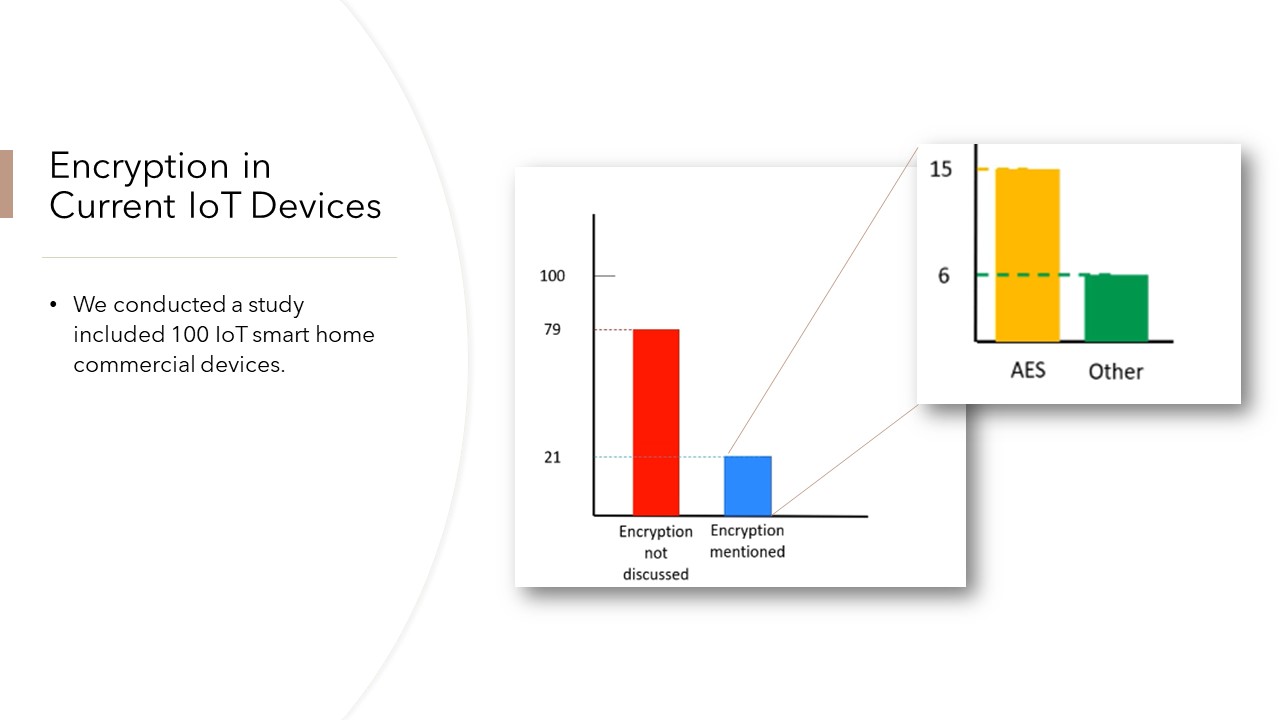 |
We conducted a study included 100 IoT smart home commercial devices and we found that 79 smart home devices out of those 100 didn’t discuss the encryption used While 15 devices out of the rest 21 devices using AES This shows that the IoT device designers have limited choices while in reality there are many encryption methods can be used as we will see down in the line.
|
| ICACT20210256 Slide.06
[Big Slide]
|
Chrome Click!! |
 |
Security by design is a creative approach suggested by several corporations to integrate required security measures into the software and hardware development life cycle, not after detecting a violation. Security by design importance is increasing as by following this method billions of vulnerable IoT devices are expected to be secured from most popular and widespread security breaches. But the question is why IoT device designers are not able to implement this approach
|
| ICACT20210256 Slide.07
[Big Slide]
|
Chrome Click!! |
 |
Indeed, IoT device designers are facing some challenges which are becoming an obstacle preventing them from securing their device by design. here we will have a look on those challenges and first we should consider the use of IoT devices which is increasing quickly and found in quite different domains such as medicine, retail, smart home, smart city, etc because every domain is welling to get the privilege of IoT benefits which its main goal is to simplify many aspects of our lives and to increase process efficiency. IoT implementation in different domains created heterogeneous measures for usage of IoT devices. This heterogeneity generated the lack of standardization which is one of the limiting factors in selecting an encryption technique.
|
| ICACT20210256 Slide.08
[Big Slide]
|
Chrome Click!! |
 |
Secondly, IoT devices are compact in scale and may be incorporated with other systems or may found as individual devices as CCTV camera and they are used in a wide range of applications which caused IoT device constrain nature. The application of IoT device determines the hardware requirement and limitations. In terms of embedding these devices, the broad variety of used parts and resources are a positive feature which makes them applicable in a wide range of applications and environments, but in the other hand the drawback is that each IoT device requires a customized encryption technique as the architecture and the used parts vary from one device to another.
|
| ICACT20210256 Slide.09
[Big Slide]
|
Chrome Click!! |
 |
There is another fact along the uprising number of IoT devices and that is the IoT device price. To get an understanding of the downturn in the price for the IoT business, we will take the single sensor pixel price as an example, we can see that over 106 of price decline, as the cost dropped from EUR 100 000 in 1960, down to 0.02 in 2010. This fall in prices will discourage IoT devices developers from investing in IoT security research.
|
| ICACT20210256 Slide.10
[Big Slide]
|
Chrome Click!! |
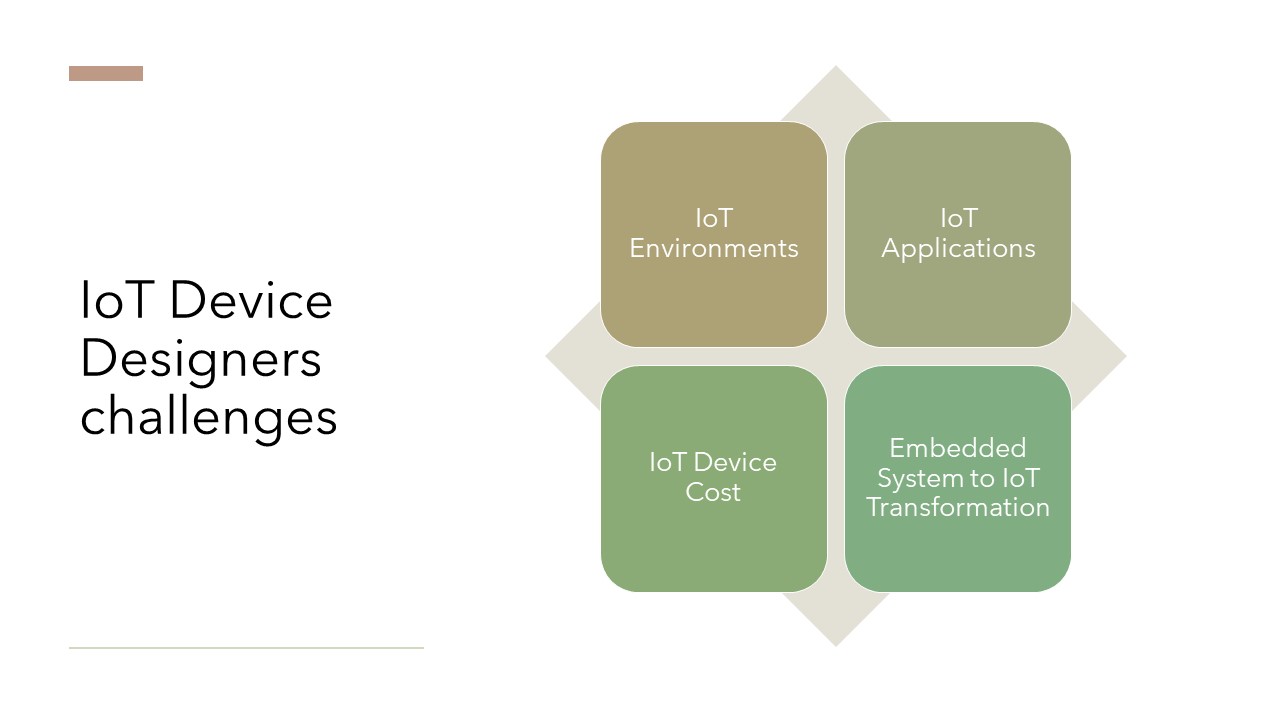 |
We also should know the background of most of IoT device designers to evaluate the support can be provided to them, to do so lets have a look at the embedded devices which were introduced in 1974 with the first integrated computer machine using a single-board computer, microcontrollers and built into a wider package. Embedded device can be described as a device that contains hardware and software that is thoroughly linked to a particular function, part of a broader framework, not independently programmable by the user, and can work with or without minimal human interference.
IoT's fundamental basis is embedded systems, with single difference is that embedded systems don't provide explicit internet connection, The IoT was first used in 1984, long before the name was recognized. Later the basic idea of IoT was adopted when sensor nodes were designed to identify and exchange data of embedded devices seamlessly. As background reveals, IoT devices are the product of the development of embedded systems. Many IoT device designers background is coming from embedded systems where cybersecurity is not considered as threat for them since embedded systems are essentially used without any internet connectivity in closed systems.
|
| ICACT20210256 Slide.11
[Big Slide]
|
Chrome Click!! |
 |
Encryption is a structure that keeps knowledge away from those who are not permitted to access it or change it Various encryption methods can be used in IoT devices, each has various hardware specifications, has a different effect on their resources and offers a different degree of protection, which makes it challenging to choose encryption.
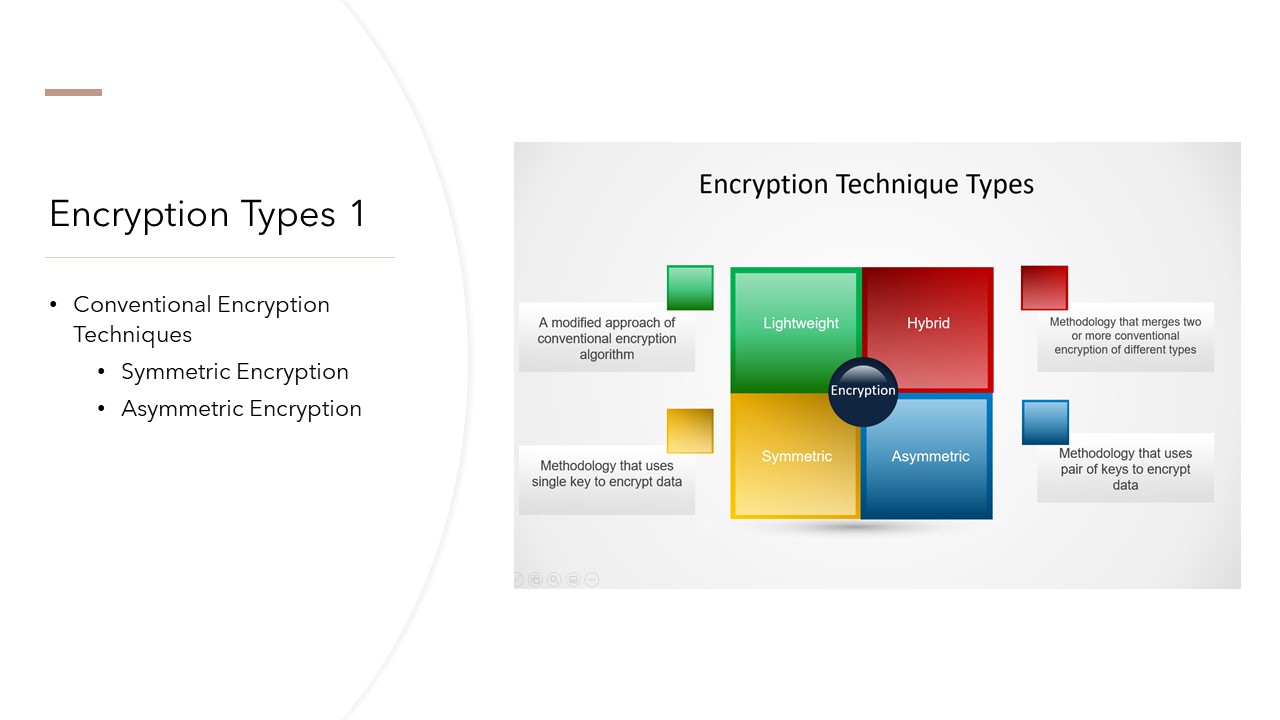
In our paper we divided encryptions into 2 main categories. First is Conventional Encryption Technique which is commonly used with ordinary computer machines. Symmetric and asymmetric are the 2 types of conventional encryption. The difference between them is that Asymmetric encryption uses 2 keys to encrypt the message which are called public and private key. while public key is only used in symmetric encryption. Many different encryption algorithms are listed under both types.
|
| ICACT20210256 Slide.12
[Big Slide]
|
Chrome Click!! |
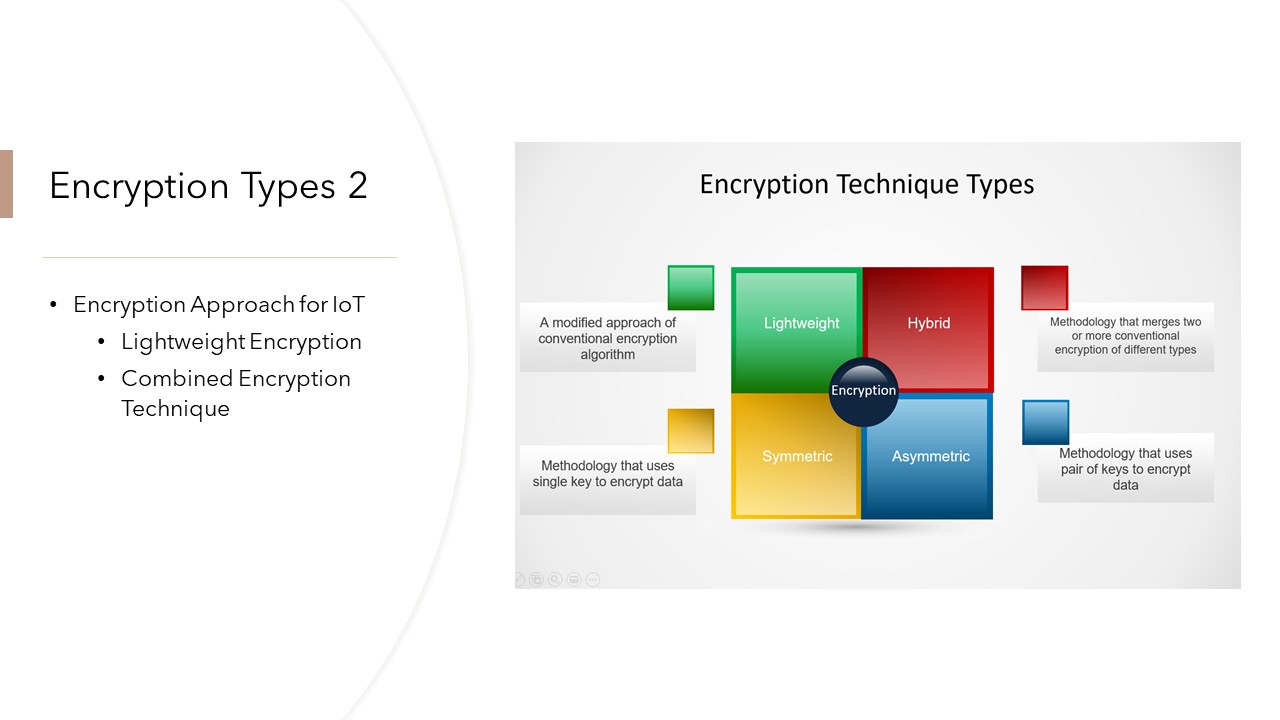 |
Since conventional encryption techniques are incompetence with most of IoT devices we included in the second category the 2 types of encryption techniques which are manly introduced to work with IoT devices. The first is Light weight encryption technique which is a compacted version of conventional encryption techniques by lowering the coding scale to minimize the utilization of device hardware. The consideration of IoT devices requirement of minimizing the effect on hardware resources, security has been compromised and weakened. Again, there are many different encryption types under lightweight encryption which makes the choice between them is complex task.
The second type is the combined encryption which is found to resolve the simplicity of lightweight encryption and bring some flexibility to IoT data encryption by combining two or more data encryption approaches As each encryption technique has its advantages and disadvantages, the combined technique aims to confront each drawback.
|
| ICACT20210256 Slide.13
[Big Slide]
|
Chrome Click!! |
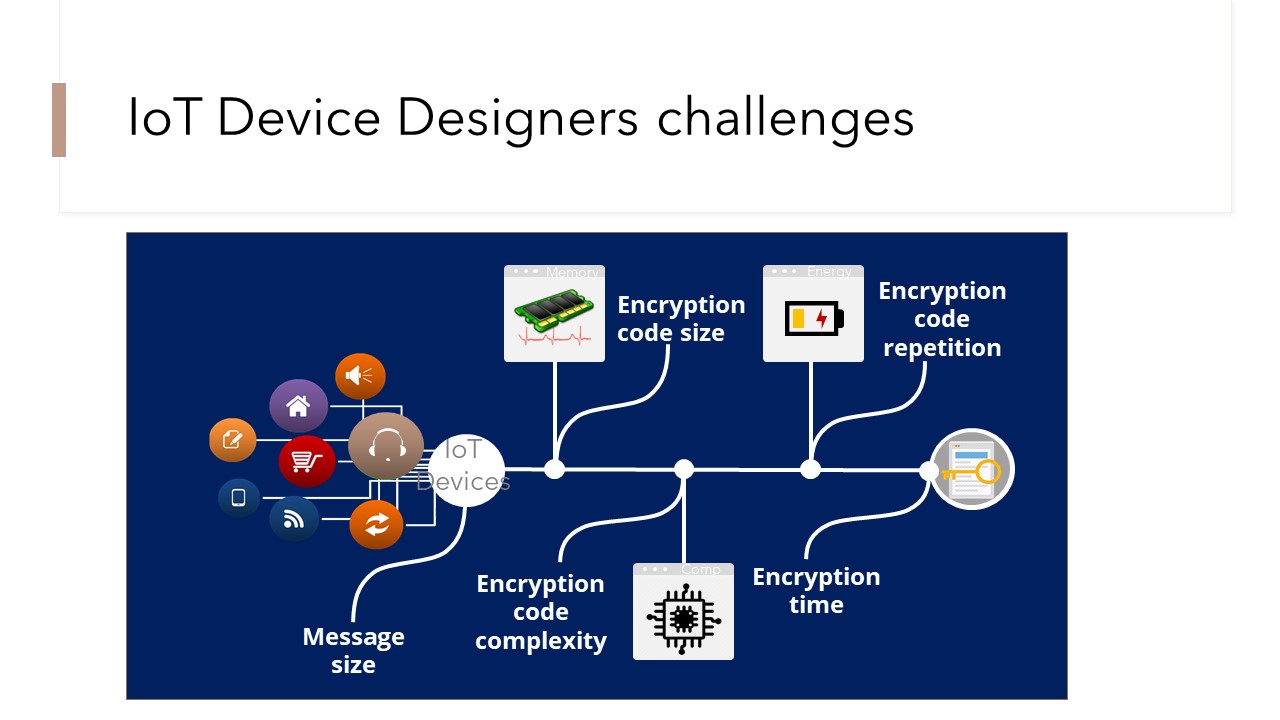 |
As we have seen that there are many different types of encryption techniques available to IoT device designers. But unfortunately, they are not considered due to unawareness of the affect of using a specific encryption on the specific device hardware parameters such as processing power and memory. Because these devices are heterogeneous the affect of an encryption on a device will not be the same on other. The application of IoT device plays an important role while choosing a suitable encryption for example a designer might require an encryption which has low impact on processor and doesn’t mind the impact on energy for example as most devices found in smart homes because power supply is available while other designer requirement can be totally different based on the applications
|
| ICACT20210256 Slide.14
[Big Slide]
|
Chrome Click!! |
 |
IoT device designers are receiving some sort of support due to the reasons mentioned earlier. Several organisations provide manuals to guide designers and developers with best practices to secure their device by design such as IoT Security Foundation and Infocom Media Development Authority IMDA. All the concerned organizations are not only responsible for providing significant resources to IoT device designers and developers but also to encourage and enable them in creating secured IoT devices capable of protecting the IoT user data.
Researchers extended their support by publishing the result of their experiments, analysis and comparisons which have been done among various encryption types. Researchers have given their conclusions in their literature as well to enhance the designer’s knowledge and simplify their decisions on encryption selection.
Taking into consideration the significance of securing the data of IoT device users in the social adoption and further development and growth of this technology, the available support to overcome this dilemma and provided publications are not enough. Further work and commitment must be expended in this area Therefore we are presenting our IoTES model which will extend the support to other level.
|
| ICACT20210256 Slide.15
[Big Slide]
|
Chrome Click!! |
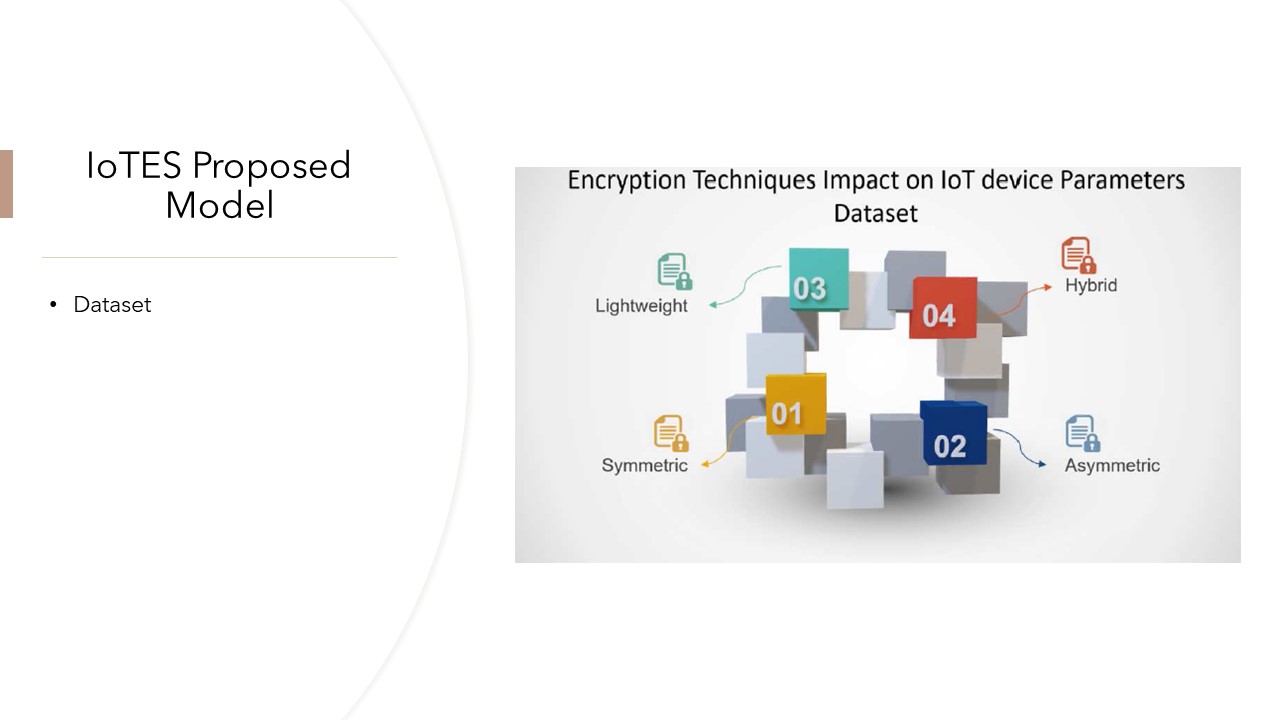 |
IoTES relies on a primary dataset which we are going to collect through several experiments. Several encryptions belonging to the four cryptography methods discussed earlier are going to be used. Three different message sizes will be encrypted by each encryption which will be operated on three different off shelf single board computers SBC such as raspberry pi to increase datapoints number and enhance the understanding of each encryption behaviour. The impact reading of tested encryption on SBC parameters will be recorded, including processing power, execution time and memory usage.
|
| ICACT20210256 Slide.16
[Big Slide]
|
Chrome Click!! |
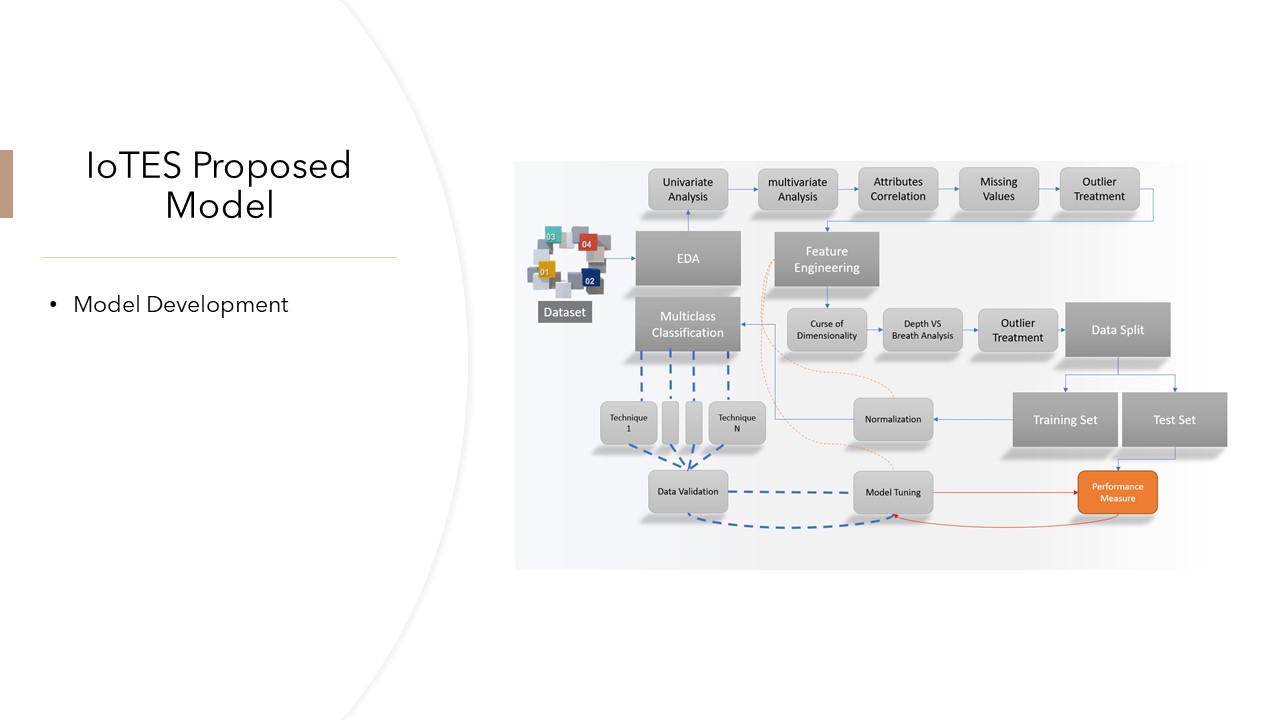 |
Model development is the next step to dataset creation. It starts with Exploratory Data Analysis EDA where data is analyzed, use different techniques to interpret the collected data to make analysis easier, more reliable and more effective. Feature Engineering plays an important role in machine learning success or failure. Features are important for predictive models. Those attributes which are useful to the model could qualify to be feature. Features should be carefully selected to reduce the curse of dimensionality and that occurs when feature space “Mathematical Space” has many dimensions and data points are spread far away from each other. Therefor depth versus breath analysis will be conducted. The purpose of a feature, other than being an attribute, would be much easier to understand in the context of a problem. A feature is a characteristic that might help when solving the problem. Next, Dataset will be splatted into 2 segments. One is for training and the other for testing and portions will be distributed 80% and 20% respectively. We will be using several Multiclass classification techniques and choose the best performance outcome. Data will be validated using several techniques and tuned to help us in the selection of best fit technique for our model. Once the best performed classification technique has been selected then we will start to test the model and keep on tuning it until we reach to highest possible performance.
|
| ICACT20210256 Slide.17
[Big Slide]
|
Chrome Click!! |
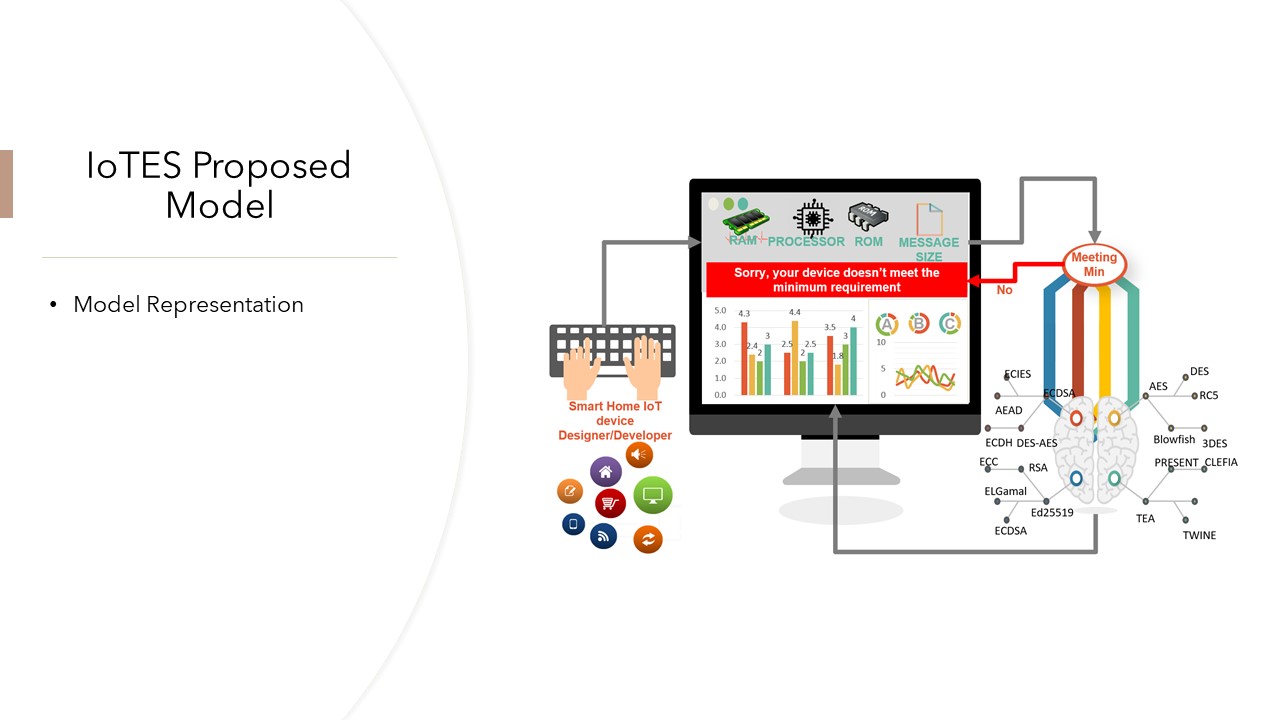 |
The model will be represented as a web-based service where a designer enters his design parameters for a specific IoT device through a provided interface. Once the parameters are received, they are sent to the IoTES model. The model is consisting of our already designed dataset where the information and different parameters of all the IoT devices are present already. Based on the machine learning algorithm, the model decides and selects the suitable encryption mechanism for the particular IoT device. The model sends the feedback of matching encryption to the
interface where designer can view and interact with the matching encryption provided options.
|
| ICACT20210256 Slide.18
[Big Slide]
|
Chrome Click!! |
 |
Thanks for your attention
|















