 ICACT20210262 Slide.01
[Big Slide] |
Chrome  Click!! |
 |
I am Ahmed Ismail, PhD student at Autonomous University of Barcelona (UAB), Spain. Iam presenting today a paper named Resilience Analysis of Multichord Peer to Peer IoT Satellite Networks under the supervision of Dr. Angeles Vazquez-Castro and Prof. Mohamed Essam Khedr. |
| ICACT20210262 Slide.02
[Big Slide]
|
Chrome Click!! |
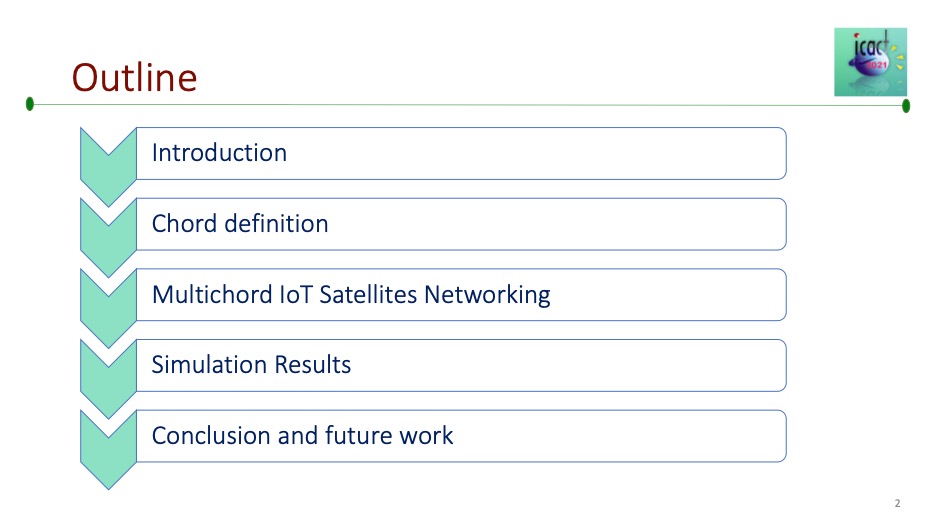 |
During my presentation, I will mainly discuss an introduction then what is chord.
After that I will go through the proposed Multichord IoT satellite networks.
The main simulation results will be presented as well.
At the end I will conclude our work and mention our future work.
|
| ICACT20210262 Slide.03
[Big Slide]
|
Chrome Click!! |
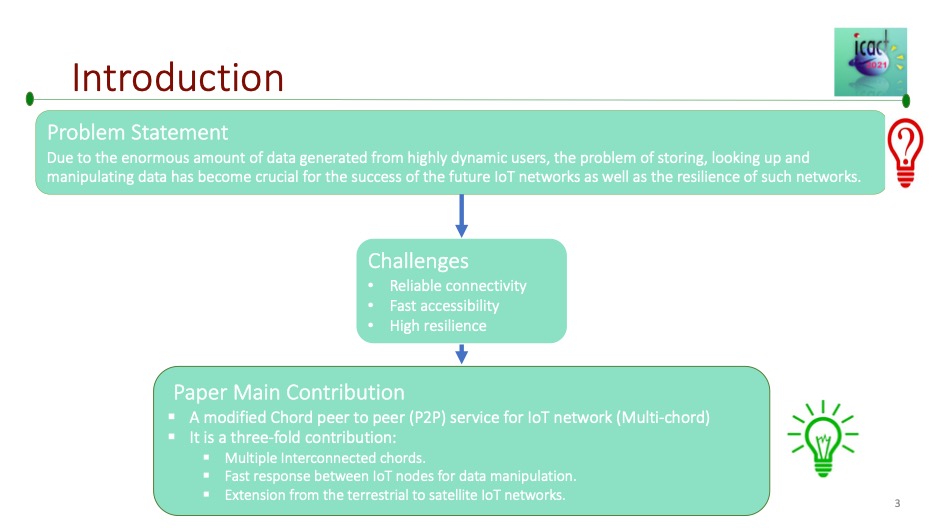 |
Our Problem statement is concerned about the issue that rise from the enormous amount of data generated from highly dynamic users such as storing, looking up and manipulating data which became very critical for the success of IoT networks.
Based on that problem statement we found our problem key points which are Reliable connectivity, Fast accessibility and High resilience. To tackle these challenges in our research we proposed a modified Chord peer to peer service for IoT networks.
We considered our work as a three fold contribution, first one is the architecture itself (Multichord) which consists of main chord and subchords and each subchord is responsible for a certain type of data. Secondly is the algorithm we developed to achieve the fast response between different nodes in IoT networks and the last one is the extension from terrestrial to satellite IoT networks. |
| ICACT20210262 Slide.04
[Big Slide]
|
Chrome Click!! |
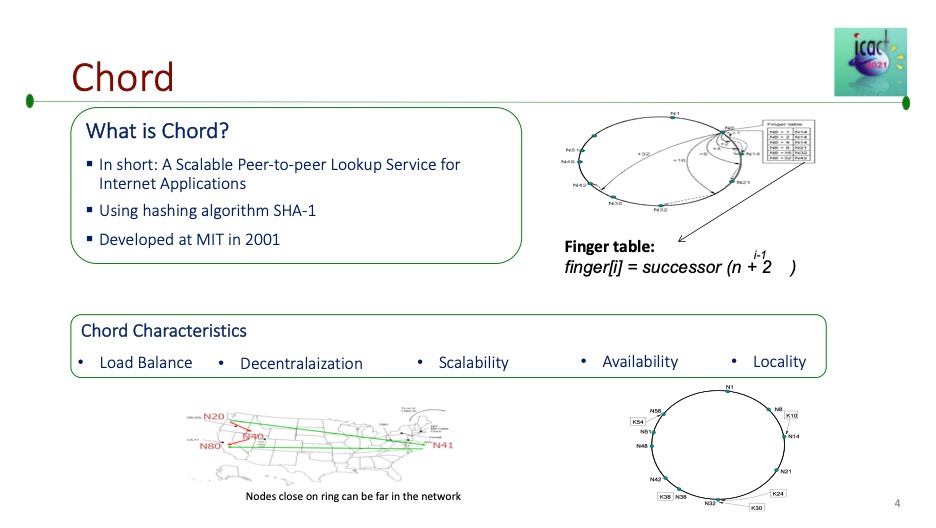 |
Chord is a scalable peer to peer lookup service for internet applications using hashing algorithm SHA-1.
Chord is mainly developed at MIT in 2001 and currently used as a one of peer to peer service.
The main characteristics are load balance, decentralization, scalability, availability and locality.
The chord uses a finger table as a routing table.
|
| ICACT20210262 Slide.05
[Big Slide]
|
Chrome Click!! |
 |
Here I would like to discuss the challenges that we faced to deploy standard chord in IoT networks
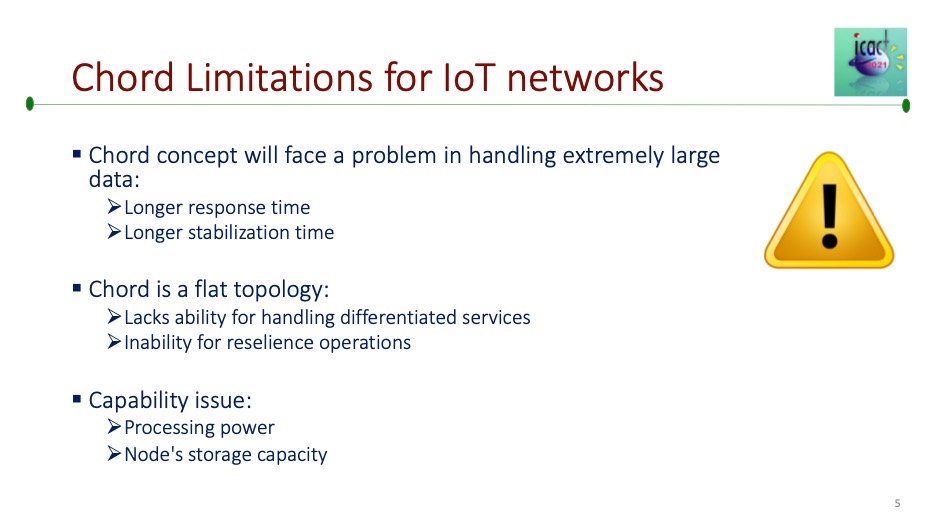
First, the chord concept will face a problem in handling extremely large data which will led to longer response time and longer stabilization time.
Secondly, chord is a flat topology and there is no hierarchy which lacks the ability of handling differentiated services and inability for resilience operations.
At last, the nodes capabilities aren't enough in terms of processing power and storage capacity
|
| ICACT20210262 Slide.06
[Big Slide]
|
Chrome Click!! |
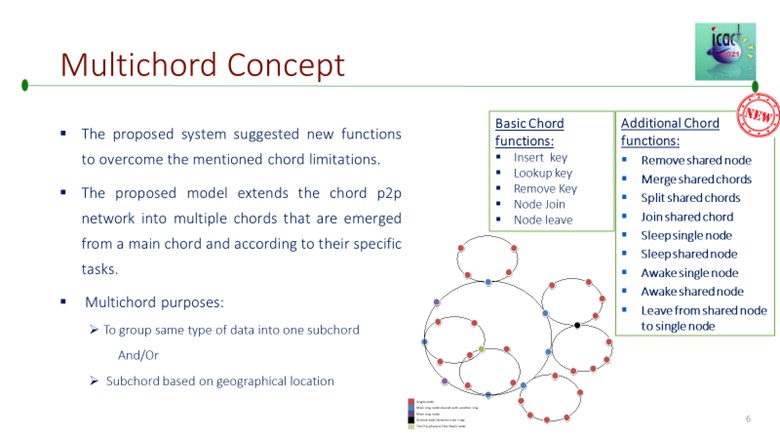 |
The proposed model is an extension for the original chord to multiple chord that are emerged from a main chord according to specific tasks. The proposed model suggested new commands to cope with the new architecture.
Multichord purposes are to group same type of data into one subchord and/or according to their geographical location
|
| ICACT20210262 Slide.07
[Big Slide]
|
Chrome Click!! |
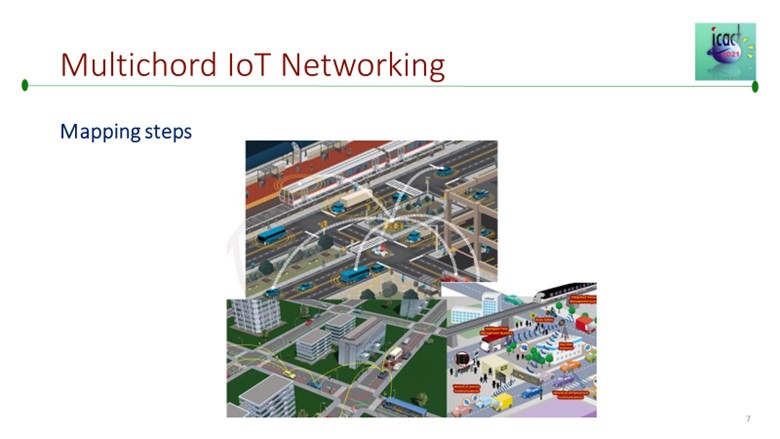 |
Now we will illustrate the mapping steps to get multichord IoT network for the smart city in this slide as an example
|
| ICACT20210262 Slide.08
[Big Slide]
|
Chrome Click!! |
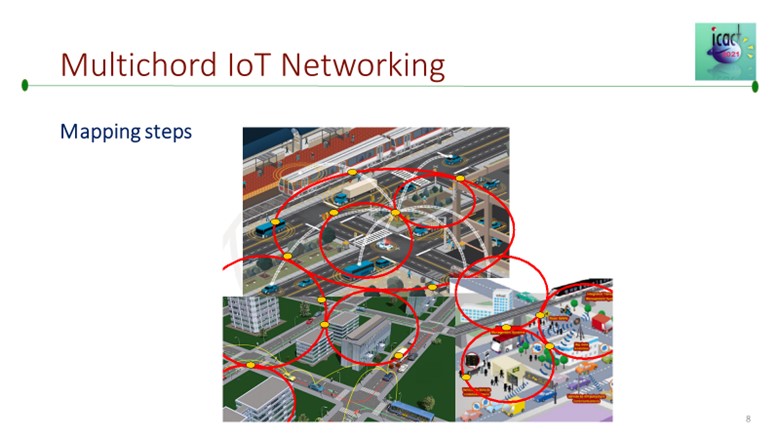 |
smart nodes are connected peer to peer forming chord rings, main chord and subchords
|
| ICACT20210262 Slide.09
[Big Slide]
|
Chrome Click!! |
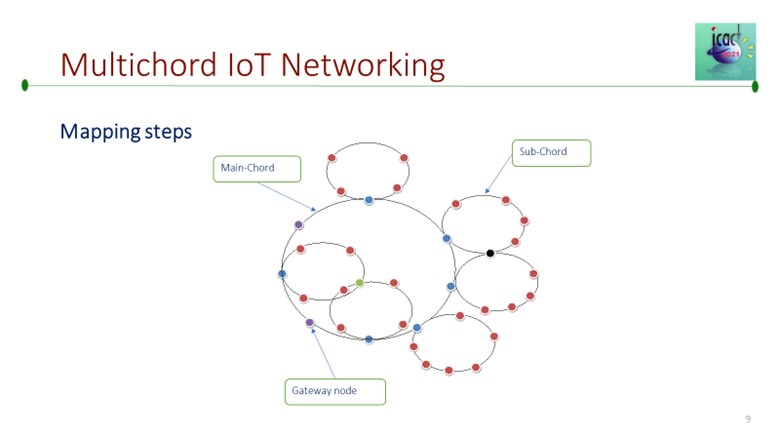 |
This is the last mapping step. the nodes presented are gateway nodes and these gateway nodes are connected to different sensors.
|
| ICACT20210262 Slide.10
[Big Slide]
|
Chrome Click!! |
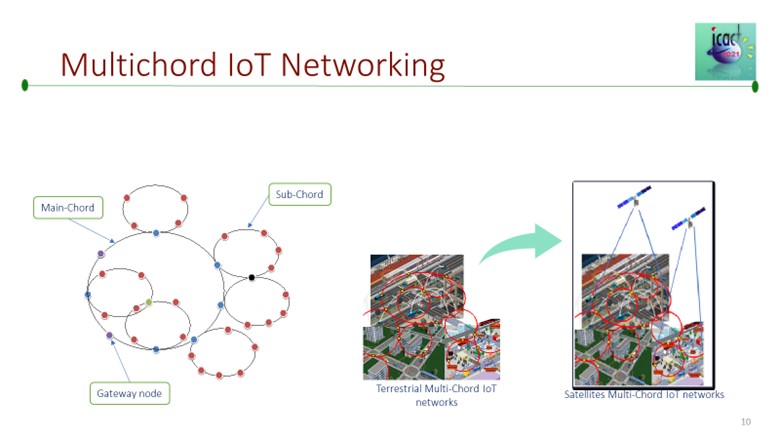 |
then extending the terrestrial Multichord IoT networks to satellites multichord IoT networks.
|
| ICACT20210262 Slide.11
[Big Slide]
|
Chrome Click!! |
 |
Resilience here means the ability of the system to cope with multiple satellites failures either in satellites of the same chord or between satellites in different chords.
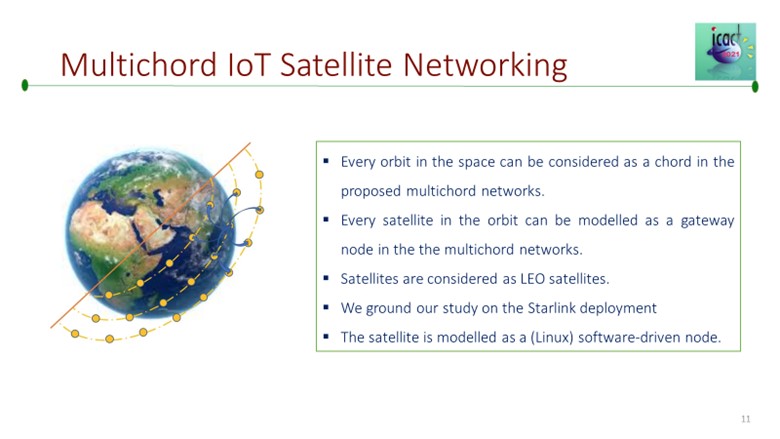
Every orbit in the space can be considered as a chord in the proposed multichord networks.
Every satellite in the orbit can be modelled as a gateway node in the the multichord networks.
Satellites are considered as LEO satellites.
We ground our study on the Starlink deployment and the satellite here is modelled as Linux software-driven node.
|
| ICACT20210262 Slide.12
[Big Slide]
|
Chrome Click!! |
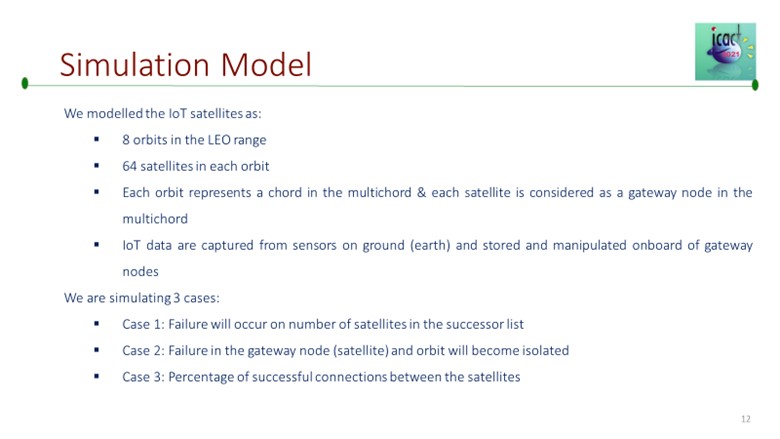 |
First let¡¯s explain our simulation model
We modelled the IoT satellites as: 8 orbits in the LEO range, 64 satellites in each orbit.
IoT data are captured from sensors on ground (earth) and stored and manipulated onboard of gateway nodes
We are simulating 3 cases:
Case 1, Failure will occur on number of satellites in the successor list.
Case 2, Failure in the gateway node (satellite) and orbit will become isolated.
Case 3, Percentage of successful connections between the satellites.
|
| ICACT20210262 Slide.13
[Big Slide]
|
Chrome Click!! |
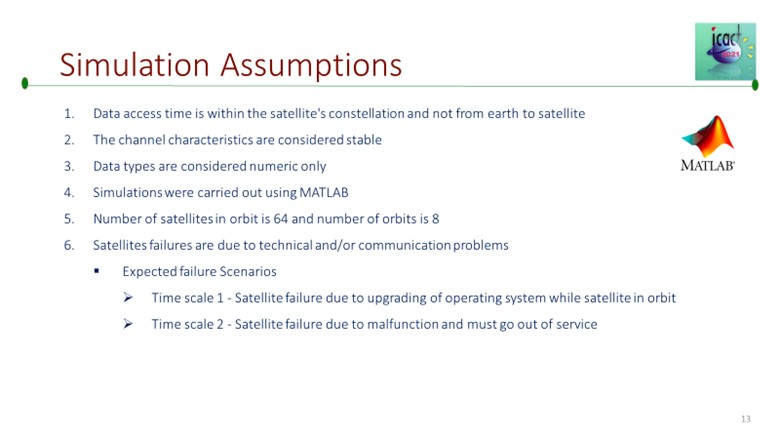 |
Our simulations were carried out by MATLAB software. Data types are only numeric. Satellites failures are due to technical or communication problems. Channel characteristics are considered stable.
Expected failure Scenarios are:
Time scale 1, Satellite failure due to upgrading of operating system while satellite in orbit.
Time scale 2, Satellite failure due to malfunction and must go out of service.
|
| ICACT20210262 Slide.14
[Big Slide]
|
Chrome Click!! |
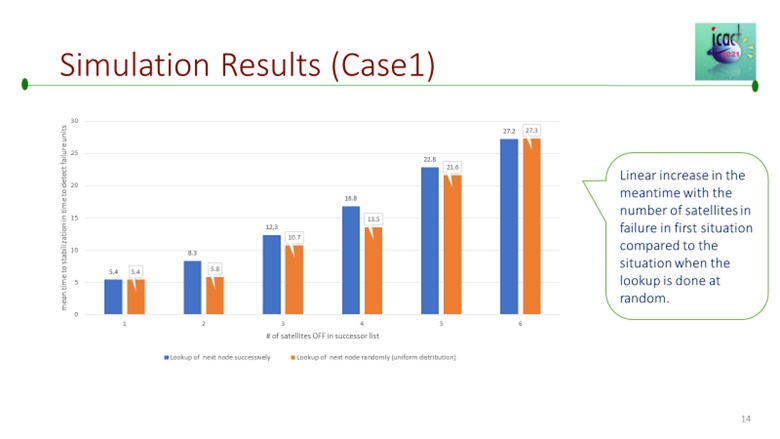 |
Stabilization time is time the chord takes to adjust its routing tables (finger tables) and data tables due to disruption in the chord. for example, failure of a satellite.
The time to detect a failure is the time a satellite takes to be aware that a link has failed. This time is taken as a unit value as this time is dependent on the satellite network and ISL properties
In this graph we measure the ability of multichord satellites to respond to the failures of satellites listed in the successor list in two scenarios, the first scenario assumed that the lookup in successor list is done in order while the second scenario the lookup is done randomly. We noticed a linear increase in the meantime with the number of failures in first scenario compared to the scenario when lookup is done randomly.
|
| ICACT20210262 Slide.15
[Big Slide]
|
Chrome Click!! |
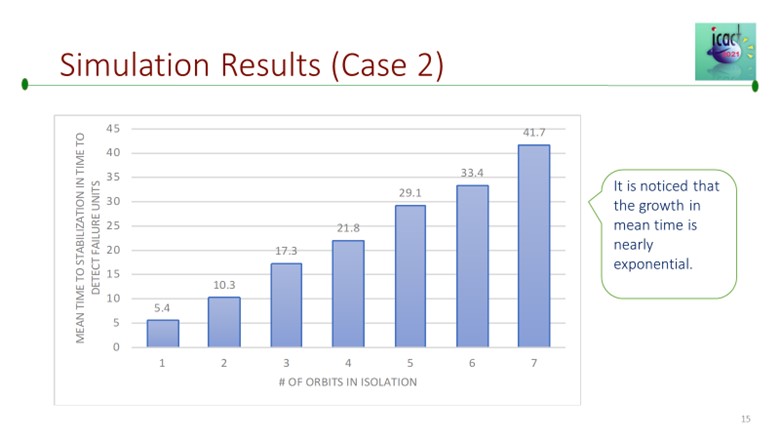 |
We measure the meantime to achieve stabilization when the failure is in the orbit itself rather than the satellites. We noticed that the growth in mean time is nearly exponential, this is due to the increase in lookup time for an alternative orbit and satellite that satellite that can be used as a successor node in that orbit. |
| ICACT20210262 Slide.16
[Big Slide]
|
Chrome Click!! |
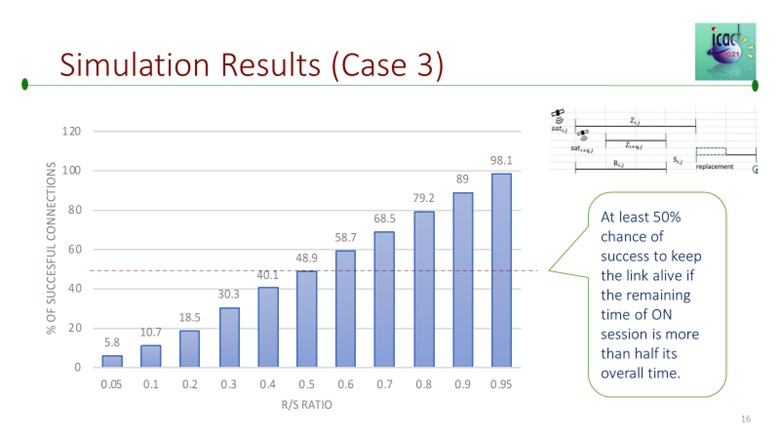 |
Percentage of successful connections is the percent of times a satellite managed to reconnect to another satellite in another orbit when main connection is lost.
In this last graph, we have measured the percentage of keeping link alive versus the remaining time available in the ON session of a satellite. We observed that there is at least 50% chance of success to keep the link alive if the remaining time of ON session is more than half its overall time. |
| ICACT20210262 Slide.17
[Big Slide]
|
Chrome Click!! |
 |
Preliminary results show that multichord IoT satellite networks can provide the required high-speed connectivity with low latency and high robustness to failure.
It is shown that the time response to satellite failure is nearly linear which confirms the scalability of the model.
Time response to re-gain the orbit in isolation is exponentially increasing
Challenge to be addressed during our future work
Future work will investigate other types of intermittent disconnectivity in inter-orbit communication and the robustness to cascaded large number of satellites failure in one and multiple orbits.
|
| ICACT20210262 Slide.18
[Big Slide]
|
Chrome Click!! |
 |
Thank you and have a good day
|















