 ICACT20220020 Slide.01
[Big Slide]
[YouTube] |
Chrome  Click!! |
 |
Good morning everyone! My name is Chih-Chien Hu, an assistant professor in Tatung university, Taiwan. Today, I'd like to give you a presentation. The topic is The effects of constructing robot-based storytelling system on college students' computational thinking skill and technology comprehension. |
| ICACT20220020 Slide.02
[Big Slide]
[YouTube] |
Chrome Click!! |
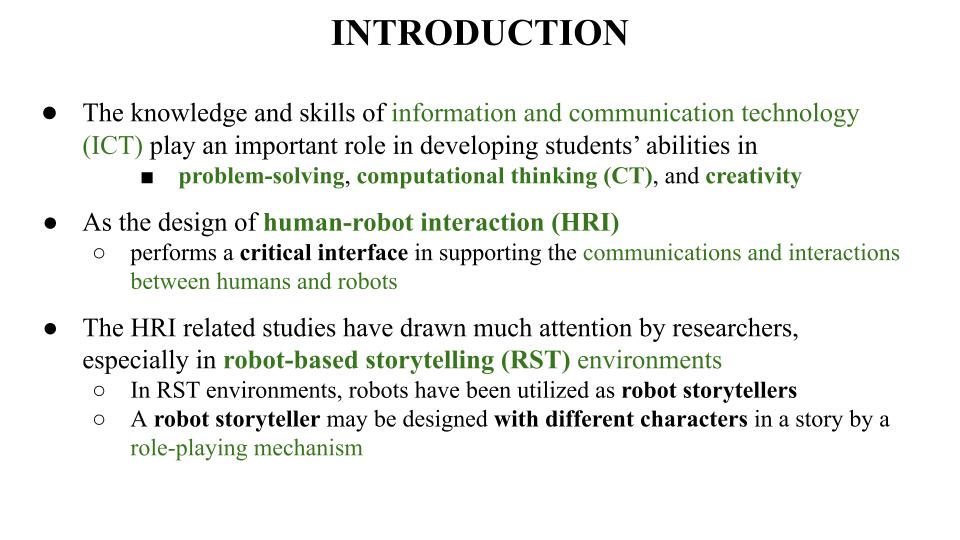 |
The knowledge and skills of information and communication technology (ICT) play an important role in developing students’ abilities in problem-solving, computational thinking (CT), and creativity.
As the design of human-robot interaction (HRI) performs a critical interface in supporting the communications and interactions between humans and robots.
The HRI related studies have drawn much attention by researchers, especially in robot-based storytelling (RST) environments.
In RST environments, robots have been utilized as robot storytellers. A robot storyteller may be designed with different characters in a story by a role-playing mechanism.
|
| ICACT20220020 Slide.03
[Big Slide]
[YouTube] |
Chrome Click!! |
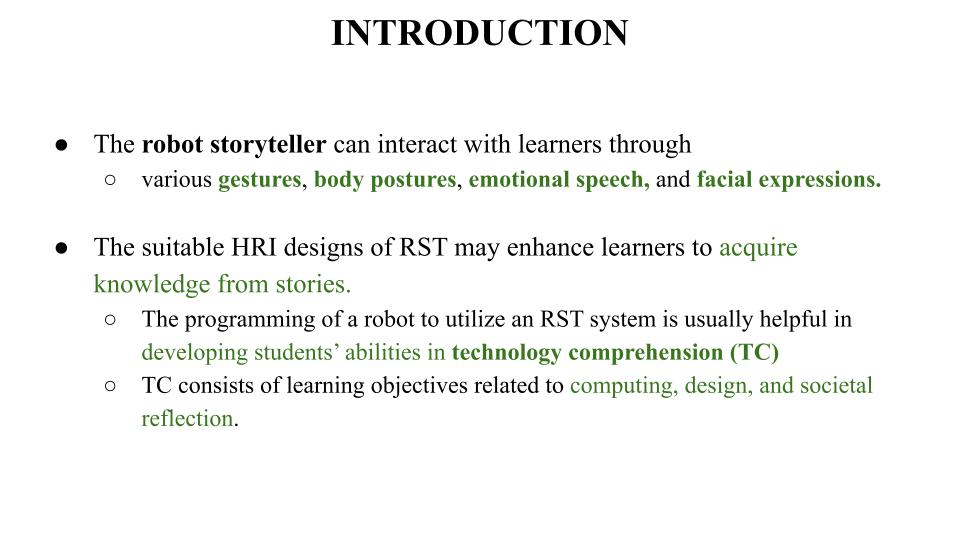 |
The robot storyteller can interact with learners through
various gestures, body postures, emotional speech, and facial expressions.
The suitable HRI designs of RST may enhance learners to acquire knowledge from stories.
The programming of a robot to utilize an RST system is usually helpful in developing students’ abilities in technology comprehension (TC).
TC consists of learning objectives related to computing, design, and societal reflection.
|
| ICACT20220020 Slide.04
[Big Slide]
[YouTube] |
Chrome Click!! |
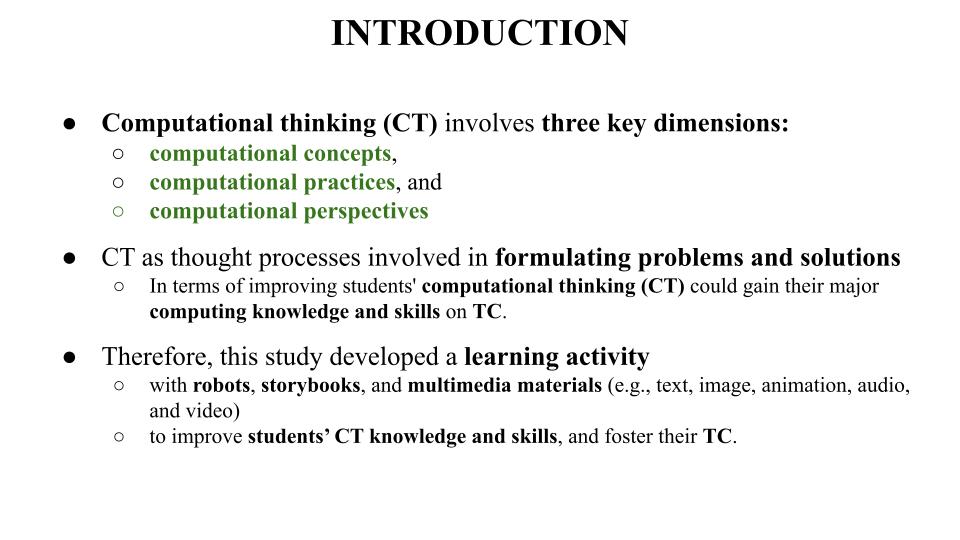 |
Computational thinking (CT) involves three key dimensions:
computational concepts, computational practices, and computational perspectives.
CT as thought processes involved in formulating problems and solutions.
In terms of improving students' computational thinking (CT) could gain their major computing knowledge and skills on TC.
Therefore, this study developed a learning activity with robots, storybooks, and multimedia materials (e.g., text, image, animation, audio, and video) to improve students’ CT knowledge and skills, and foster their TC.
|
| ICACT20220020 Slide.05
[Big Slide]
[YouTube] |
Chrome Click!! |
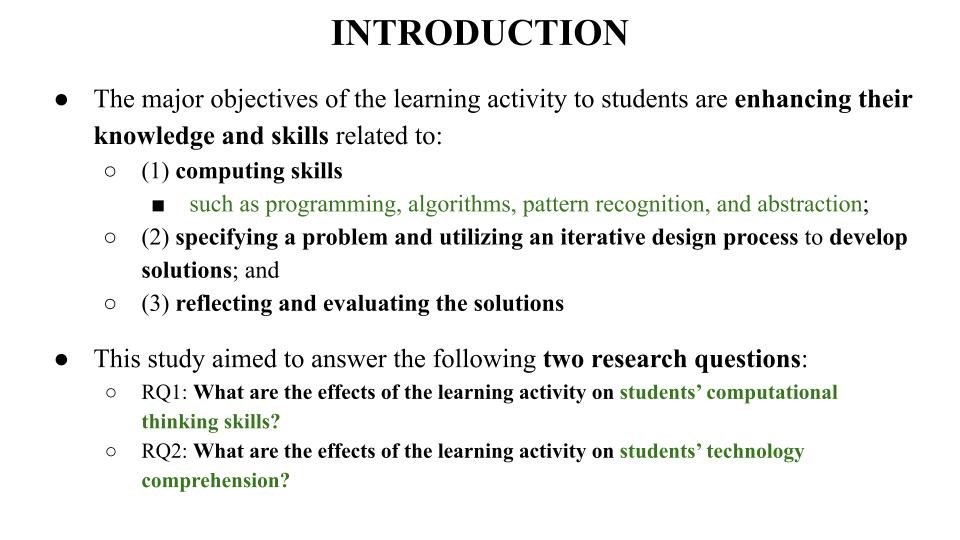 |
The major objectives of the learning activity to students are enhancing their knowledge and skills related to:
(1) computing skills such as programming, algorithms, pattern recognition, and abstraction; (2) specifying a problem and utilizing an iterative design process to develop solutions; and (3) reflecting and evaluating the solutions
This study aimed to answer the following two research questions:
RQ1: What are the effects of the learning activity on students’ computational thinking skills?
RQ2: What are the effects of the learning activity on students’ technology comprehension?
|
| ICACT20220020 Slide.06
[Big Slide]
|
Chrome Click!! |
.jpg) |
The use of robots and physical objects to improve students’ science knowledge learning is well established.
Lahey et al. (2008) presented scenarios of HRI for fostering students' interactions with robots.
In their experiment, a robot could be a robotic pet played with learners, a robot could be an avatar controlled by students,
a robot also can be integrated into a learning environment that can be used as an educational tool.
Their findings revealed these robots that can be utilized as the information source and provide direct instruction to students.
|
| ICACT20220020 Slide.07
[Big Slide]
|
Chrome Click!! |
.jpg) |
Similarly, several studies confirm that storytelling can develop students' cognition, and creativity.
When students construct stories, they explore facts and contexts from stories, create meaningful contents, and enhance abstract concepts.
According to the argument, narrative learning of storytelling is
suitable for the development of particular knowledge, skills, and positive attitudes in action.
|
| ICACT20220020 Slide.08
[Big Slide]
|
Chrome Click!! |
.jpg) |
Kopcha, & Ocak (2019) revealed that learners may need a variety of robotic learning activities to support their engagement in abstract thinking.
Learning tools such as sheet-based programming and introductory robot-based storytelling projects help learners to decompose a complex task and find solutions effectively.
We can summarize the above facts in a simple form by saying that the development of robot-based storytelling has not only affected students' narrative skills but cultivated students' CT knowledge and skills. |
| ICACT20220020 Slide.09
[Big Slide]
|
Chrome Click!! |
.jpg) |
The present study involved 15 college students from a university in Taipei, Taiwan.
These 15 students had no prior experience with robots and storytelling project development.
These students are studying in the college of management.
This study introduced an instructional design with robots, storybooks, and multimedia materials for improving college learners’ introductory ICT knowledge, fostering their TC, and
enabling them to learn and develop robot-based storytelling systems in the context of educational robots and storybooks.
|
| ICACT20220020 Slide.10
[Big Slide]
|
Chrome Click!! |
.jpg) |
The robot-based storytelling development environment includes
a robot script programming server in the cloud, a robot-based storytelling editor, several robots, multimedia materials, and storybooks in a local site.
|
| ICACT20220020 Slide.11
[Big Slide]
|
Chrome Click!! |
.jpg) |
The robot script programming server consists of a sheet-based programming editor.
The sheet-based programming editor is like a story script template based on a google sheet that can be edited by students for creating robot-based storytelling programs.
|
| ICACT20220020 Slide.12
[Big Slide]
|
Chrome Click!! |
.jpg) |
Students can use the robot-based storytelling editor in the local site or the robot script programming server in the cloud to construct their sheet-based programs, authorize their own robot-based storytelling programs, and download to the robots through the robot-based storytelling editor in the local site.
|
| ICACT20220020 Slide.13
[Big Slide]
|
Chrome Click!! |
.jpg) |
These robots receive and execute the robot-based storytelling programs from the robot-based storytelling editor to perform as storytelling robots.
Then, the storytelling robots can tell stories with gestures, body postures, emotional speech, facial expressions, and varied multimedia contents, and interact with learners who are listening to the stories. |
| ICACT20220020 Slide.14
[Big Slide]
|
Chrome Click!! |
.jpg) |
The design of teaching and learning activities for constructing robot-based storytelling systems consists of three phases:
Phase 1, Introduction to the robot-based storytelling development environment;
Phase 2, Introduction to the sheet-based robot programming editor; and
Phase 3, Constructing of robot-based storytelling systems.
|
| ICACT20220020 Slide.15
[Big Slide]
|
Chrome Click!! |
.jpg) |
(1) Introduction to the robot-based storytelling development environment:
In this phase, we provided a set of materials for introducing educational robots, the designed robot script programming server, and robot-based storytelling editor.
(2) Introduction to the sheet-based robot programming editor:
The students started to learn how to design a sheet-based robot program and utilize multimedia materials in a robot-based storytelling system.
(3) Constructing of robot-based storytelling systems:
The sheet-based robot programming editor was likely to benefit the students in developing robot programs, so that the students who might design sheet-based programs to integrate their stories, multimedia materials, facial expressions, body postures and gestures, and emotional speech for constructing robot-based storytelling systems according to their HRI analyzed results by a prepared scaffolding program.
|
| ICACT20220020 Slide.16
[Big Slide]
|
Chrome Click!! |
.jpg) |
We administered a computational thinking (CTt) pre-test, and a computational thinking skills (CTs) pre-test to evaluate the students’ technology comprehension (TC).
We then provided a series of lecturing training and hands-on learning activities.
The teaching and learning activities took six weeks (150 minutes per week).
After that, the CTt and CTs post-tests were performed (see Figure 3).
|
| ICACT20220020 Slide.17
[Big Slide]
|
Chrome Click!! |
.jpg) |
The CTt was an evaluation of the students' knowledge and skills about computational thinking.
The CTt written test consisted of 28 multiple-choice questions.
Table 1 shows the correspondence of the 28 multiple-choice questions to the items of the computational concept of CTt.
Each item of CTt addresses one or more computational concepts
e.g., directions and sequences, loops, conditionals, while conditional loops, and simple functions, which appear in increasing difficulty.
|
| ICACT20220020 Slide.18
[Big Slide]
|
Chrome Click!! |
.jpg) |
The pre-and post-tests of CTs written test and CTt written test yielded a total of 15 learning outcomes, while the students’ CT learning effects and their perceptions toward the learning activities for constructing robot-based storytelling systems answered the research questions.
The Student’s paired t-test was used to determine whether the means of the two sets of data, the pre-and post- written tests (i.e., CTs, and CTt), were paired, normally distributed, and significantly different from each other.
The R version 4.1.0 software was used to analyze the collected data for the statistical analysis.
|
| ICACT20220020 Slide.19
[Big Slide]
|
Chrome Click!! |
.jpg) |
The effects of the learning activity on students’ computational thinking skills.
In the comparisons of pre- and post- CTt written tests for learning outcomes by each student, Table 2 shows that as a whole the students had relatively increased their CT knowledge and skills with the learning activities of constructing robot-based storytelling systems.
Table 2 depicts that the score of CT concept learning outcome increased from pre-test Mean = 21.81 to post-test Mean = 22.27, a composite gain of 0.47 (p = 0.67) on all the students, indicating without a significant difference between the pre- and the post-tests.
|
| ICACT20220020 Slide.20
[Big Slide]
|
Chrome Click!! |
.jpg) |
The effects of the learning activity on students’ technology comprehension.
Table 3 shows that all the students increased their CTs scores toward their learning with the robot-based storytelling development environment.
The score of creativity increased from pre-test Mean = 4.01(0.85) to post-test Mean = 4.25(0.68), a composite gain of 0.24 (p=0.02) on all students, showing a significant improvement in their creative thinking.
The score of the cooperative decreased from pre- test Mean = 4.68(0.50) to post-test Mean = 4.40(0.64), a composite gain of -0.28 (p=0.01).
|
| ICACT20220020 Slide.21
[Big Slide]
|
Chrome Click!! |
.jpg) |
I am going to show you the result of our study.
The scores of algorithmic thinking (increased from 3.12 to 3.34), critical thinking (increased from 3.63 to 3.80), and problem-solving (increased from 2.44 to 2.62) were increased.
Moreover, the overall outcome increased from pre-test Mean = 3.53(0.30) to post-test Mean = 3.67(0.46), a composite gain of 0.14 (p=0.33) on all students.
It showed that these dimensions and the overall outcome were increased non-significantly between the pre-and the post-tests.
|
| ICACT20220020 Slide.22
[Big Slide]
|
Chrome Click!! |
.jpg) |
The curriculum of sheet-based programming was designed for the students to integrate the robots, stories, multimedia materials, and human-robot interaction elements
After participating in the learning tasks of constructing robot-based storytelling systems, all the students’ CTt and CTs were increased.
This implied that the learning activity with robots and constructing a robot-based storytelling system helped the students enhance their skills even if the effects seemed insignificant.
The first finding of this study is that the learning activities with the robot-based storytelling development environment were associated with the college students’ positive TC learning outcomes, especially connected to their capability of creativity.
|
| ICACT20220020 Slide.23
[Big Slide]
|
Chrome Click!! |
.jpg) |
These learning activities provide the students with opportunities to engage in the manipulation of constructing robot-based storytelling systems, integrate story contents with ICT elements (e.g., robots, multimedia materials, and human-robot interactions), and implement programming procedures.
These learning activities allowed the students to comprehend ICT knowledge and skills, and practice with real applications (Figure 4), which might raise their TC.
|
| ICACT20220020 Slide.24
[Big Slide]
|
Chrome Click!! |
.jpg) |
The second finding showed that the learning activity with constructing robot-based storytelling systems seemed to have a strange impact on the students’ cooperation.
The major reason might be affected by school closures due to the COVID-19 pandemic during the last 3 weeks, the students can only have classes and discuss with their team members by Google meet through the internet video-conference calls.
The students did not have a chance to collaborate with their team members in the same place as their prior expectation.
|
| ICACT20220020 Slide.25
[Big Slide]
|
Chrome Click!! |
.jpg) |
Due to the limited number of the participants in the program and COVID-19 pandemic during the experimental interval, this study did not implement a control group when investigating the impact of TC, which may pose some limitations on the validity of the study.
Future research is suggested to investigate the relationships among the students’ CT, learning perceptions, and TC in a long-term formal course setting.
|
| ICACT20220020 Slide.26
[Big Slide]
|
Chrome Click!! |
.jpg) |
I am going to give you a brief conclusion.
This study proposed teaching and learning activities
with the robot-based storytelling development environment
for constructing robot-based storytelling systems in promoting students’ TC.
The results revealed that the proposed methods improved the students’ learning outcome toward TC in terms of ICT knowledge and skills, and the positive impact on their creativity toward the robot-based storytelling development environment.
Further research is needed to evaluate the long-term impacts of learning outcomes and perceptions toward the learning activities with the robot-based storytelling development environment.
|
| ICACT20220020 Slide.27
[Big Slide]
|
Chrome Click!! |
.jpg) |
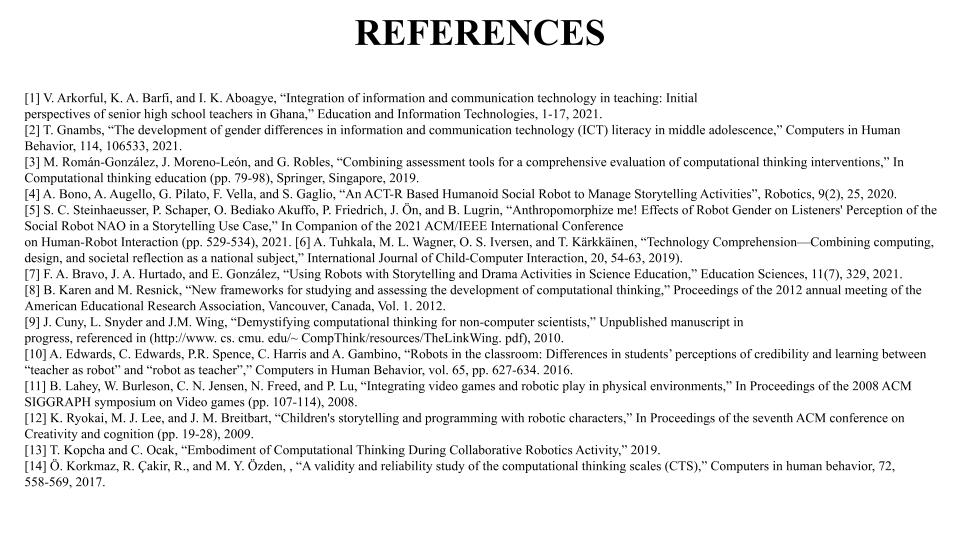
Here is the reference list for the study.
Thank you for your time. |
| ICACT20220020 Slide.28
[Big Slide]
[YouTube] |
Chrome Click!! |
 |
Reference List |















