 ICACT20220099 Slide.01
[Big Slide]
[YouTube] |
Chrome  Click!! |
 |
Hello everyone. It is my pleasure to attend this conference. The topic focus on A Novel Gateway Deployment Solution for MANETs Interconnecting with Internet |
| ICACT20220099 Slide.02
[Big Slide]
[YouTube] |
Chrome Click!! |
 |
My presentation includes Introduction, Related Work, System Model, Three-stage gateway deployment algorithm and Conclusion. |
| ICACT20220099 Slide.03
[Big Slide]
[YouTube] |
Chrome Click!! |
 |
Let me first Introduce Introduction |
| ICACT20220099 Slide.04
[Big Slide]
[YouTube] |
Chrome Click!! |
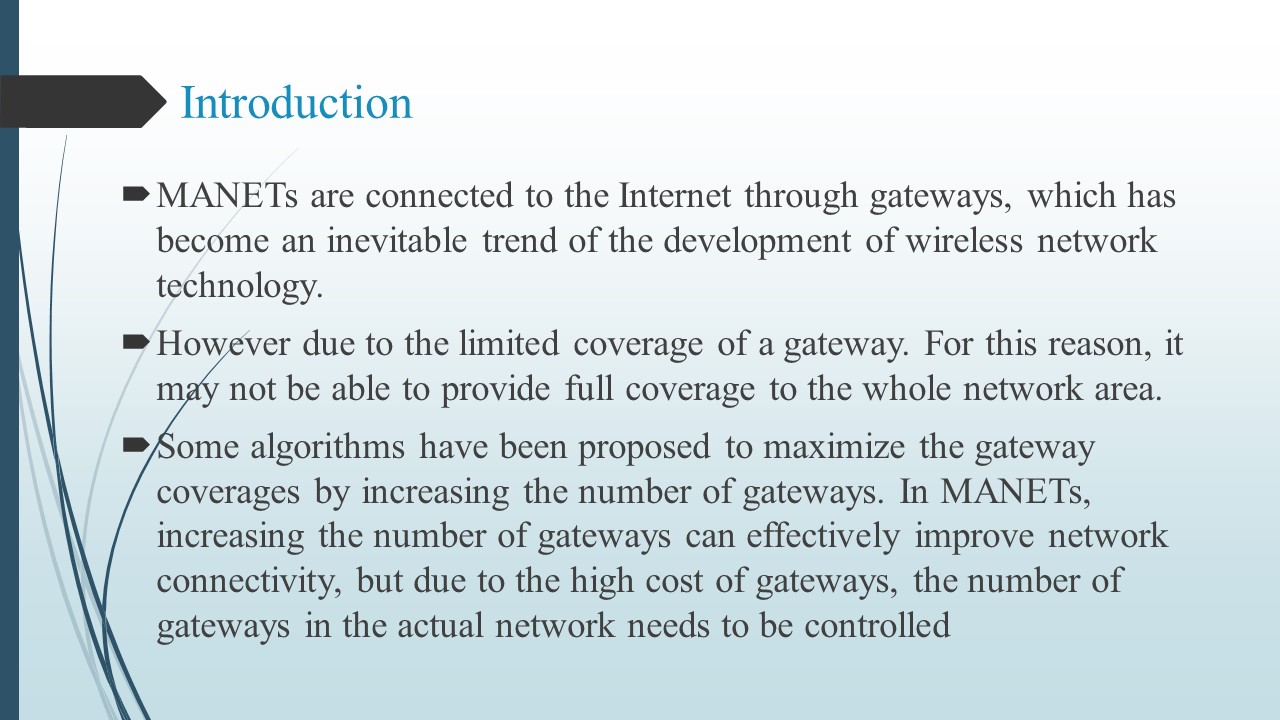 |
Wireless mobile ad hoc networks (MANETs) are a kind of special network that each node in this network serves as a router or ordinary host, and can join or leave the network freely, attract significant attention these days. MANETs can be an independent network. However, with the development of MANETs technology, isolated MANETs can no longer meet the current growing demand for service applications such as disaster recovery, search and rescue operations, military actions, and vehicular networks. MANETs are connected to the Internet through gateways, which has become an inevitable trend of the development of wireless network technology.
|
| ICACT20220099 Slide.05
[Big Slide]
[YouTube] |
Chrome Click!! |
 |
Then let me Introduce related work. |
| ICACT20220099 Slide.06
[Big Slide]
[YouTube] |
Chrome Click!! |
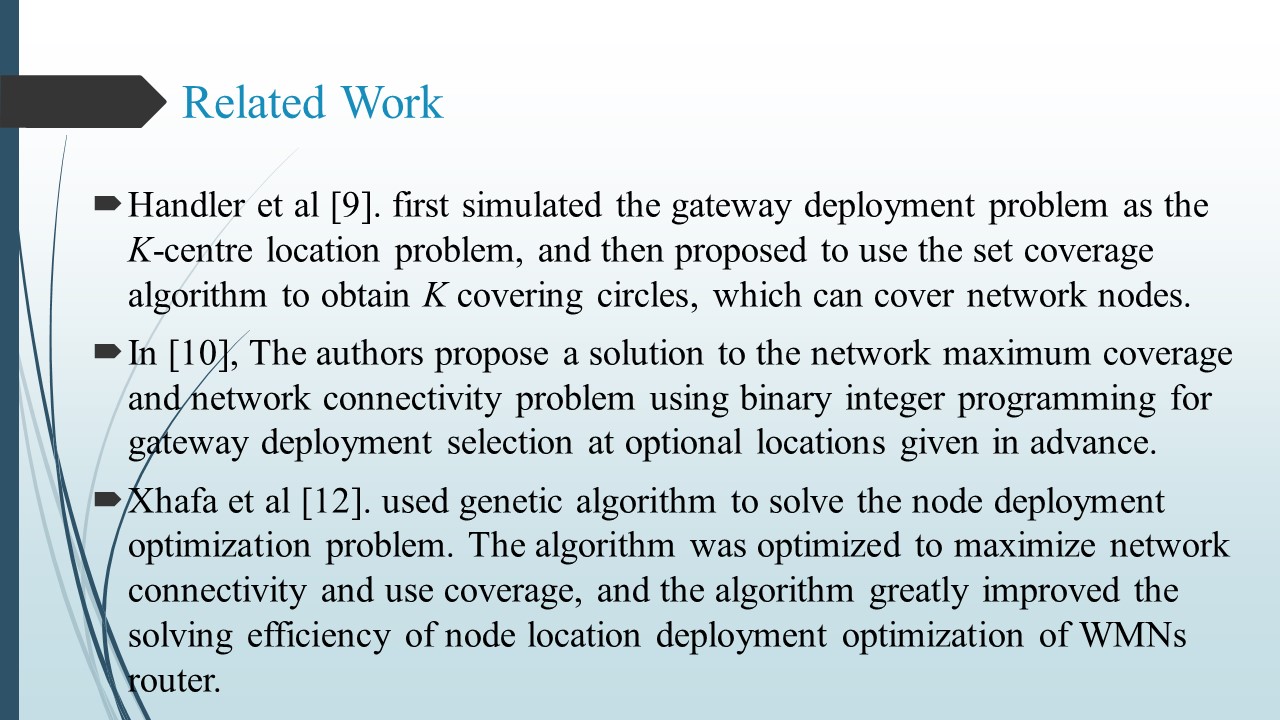 |
Handler et al [9]. first simulated the gateway deployment problem as the K-centre location problem, and then proposed to use the set coverage algorithm to obtain K covering circles, which can cover network nodes
In [10], The authors propose a solution to the network maximum coverage and network connectivity problem using binary integer programming for gateway deployment selection at optional locations given in advance.
In [11], The authors propose a genetic algorithm to solve the problem of deploying a minimum number of APs for service area coverage. The network deployment designed and implemented by the authors in the paper uses the minimum number of AP nodes within the required network performance parameters, and when faced with subsequent network expansion and performance optimisation aspects, the deployment conclusions designed using this algorithm need to be recalculated and considered, and the deployed network lacks scalability and has average practical performance Xhafa et al [12]. used genetic algorithm to solve the node deployment optimization problem. The algorithm was optimized to maximize network connectivity and use coverage, and the algorithm greatly improved the solving efficiency of node location deployment optimization of WMNs router.
|
| ICACT20220099 Slide.07
[Big Slide]
[YouTube] |
Chrome Click!! |
 |
let me Introduce system model. |
| ICACT20220099 Slide.08
[Big Slide]
[YouTube] |
Chrome Click!! |
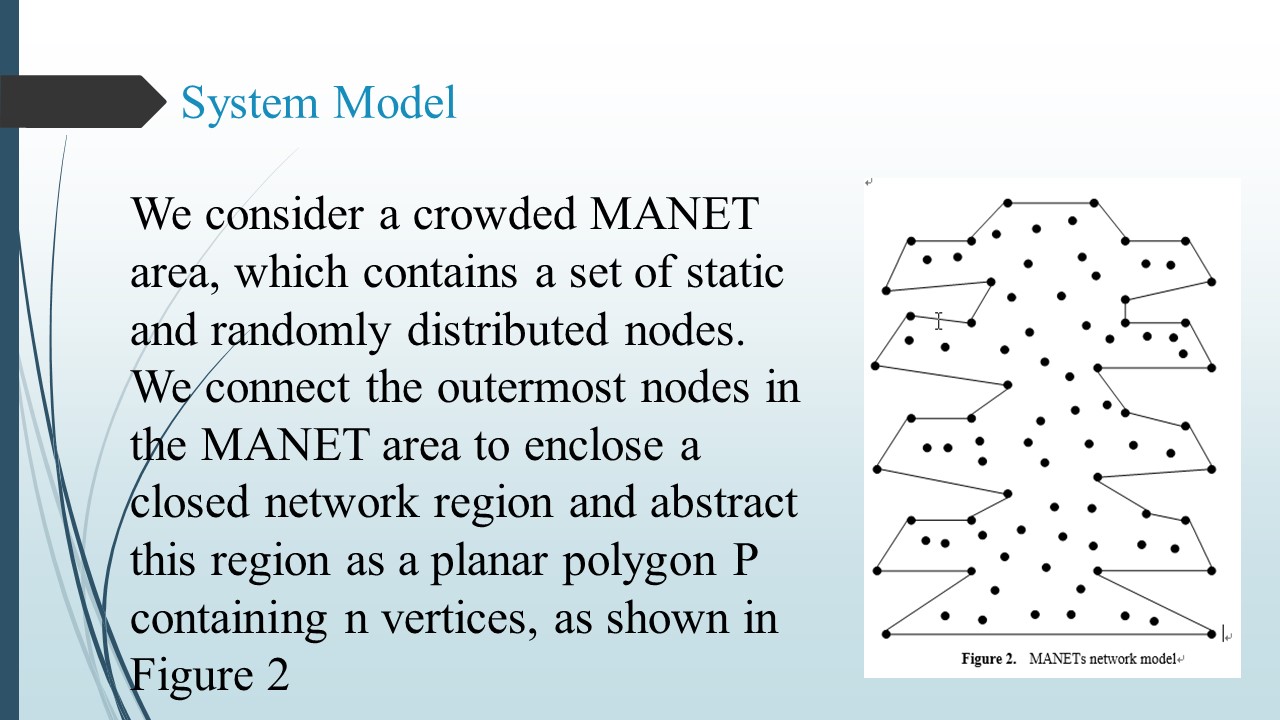 |
We consider a crowded MANET area, which contains a set of static and randomly distributed nodes. We connect the outermost nodes in the MANET area to enclose a closed network region and abstract this region as a planar polygon P containing n vertices, as shown in Figure 2 . The position of a node in MANETs corresponds to a point in the polygon. In MANETs, the distance from node to gateway is generally used to judge whether the node is in the coverage of the gateways. |
| ICACT20220099 Slide.09
[Big Slide]
[YouTube] |
Chrome Click!! |
 |
Next, I will introduce the four part, The three-stage gateway deployment algorithm |
| ICACT20220099 Slide.10
[Big Slide]
[YouTube] |
Chrome Click!! |
 |
we propose a three-stage gateway deployment algorithm that finds the approximate best gateway deployment solution that meets the node coverage requirements. Here we assume that the polygon consisting of nodes is a convex polygon in order to avoid the phenomenon of voids [15]. In the first phase, we propose a quadrangular segmentation based on typical triangle segmentation in computational geometry |
| ICACT20220099 Slide.11
[Big Slide]
[YouTube] |
Chrome Click!! |
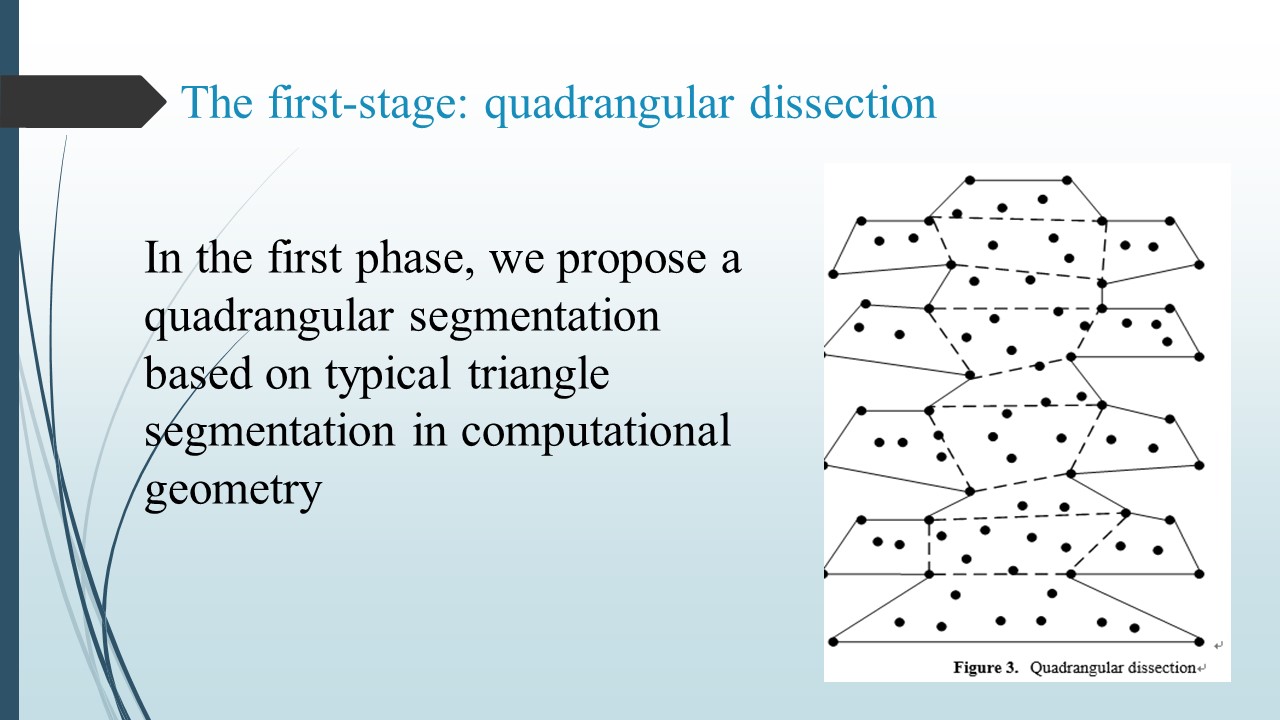 |
In the first phase, we propose a quadrangular segmentation based on typical triangle segmentation in computational geometry |
| ICACT20220099 Slide.12
[Big Slide]
[YouTube] |
Chrome Click!! |
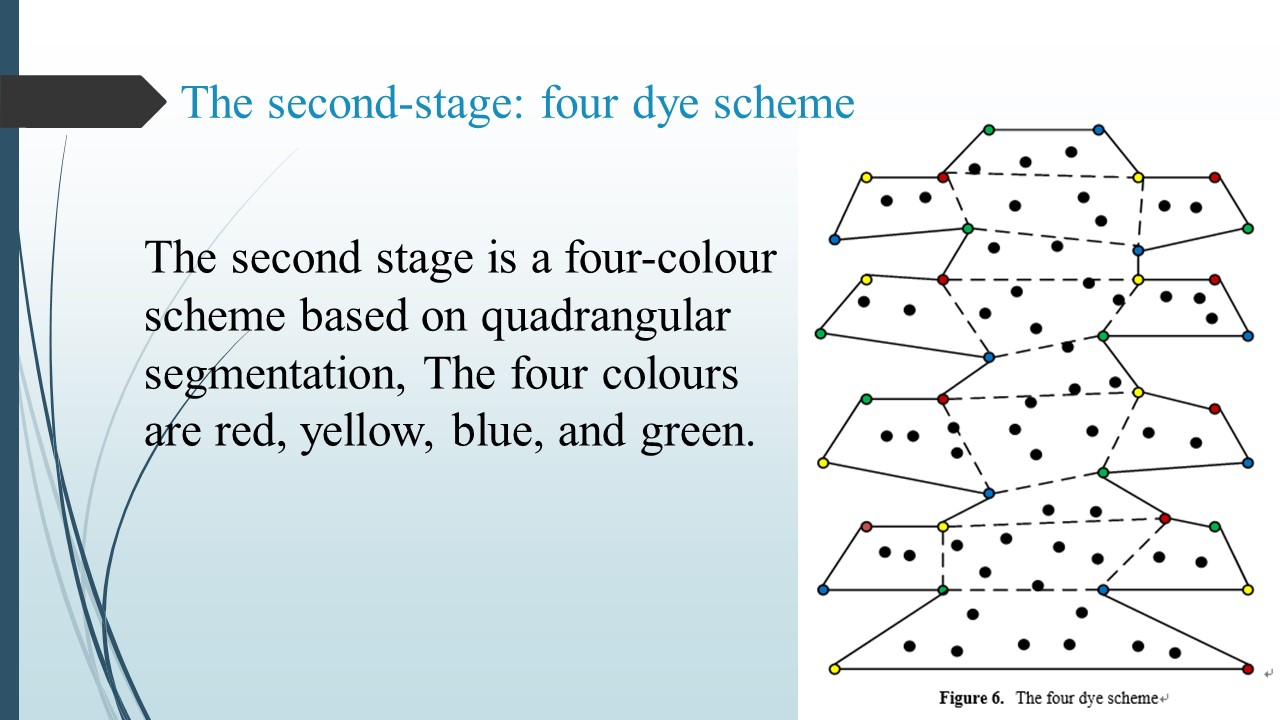 |
The second stage is a four-colour scheme based on quadrangular segmentation, The four colours are red, yellow, blue, and green |
| ICACT20220099 Slide.13
[Big Slide]
[YouTube] |
Chrome Click!! |
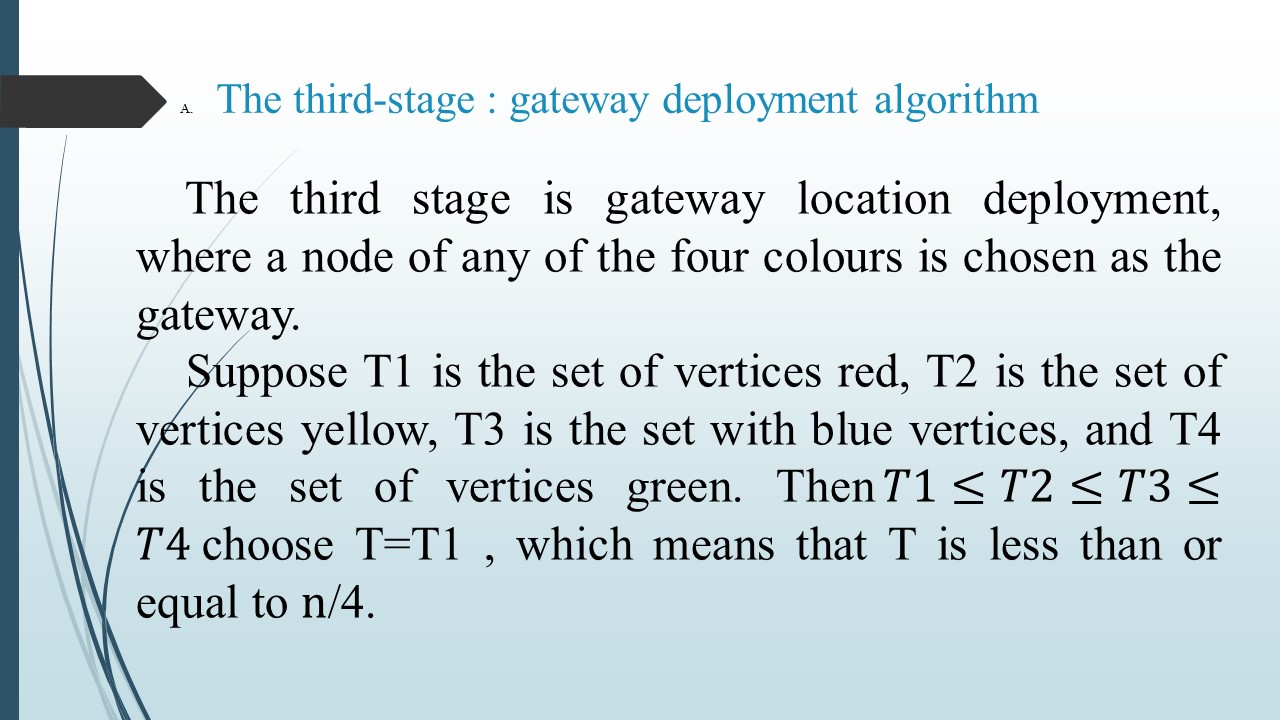 |
The third stage is gateway location deployment, where a node of any of the four colours is chosen as the gateway |
| ICACT20220099 Slide.14
[Big Slide]
[YouTube] |
Chrome Click!! |
 |
Next, let's go to the fifth part, conclusion |
| ICACT20220099 Slide.15
[Big Slide]
[YouTube] |
Chrome Click!! |
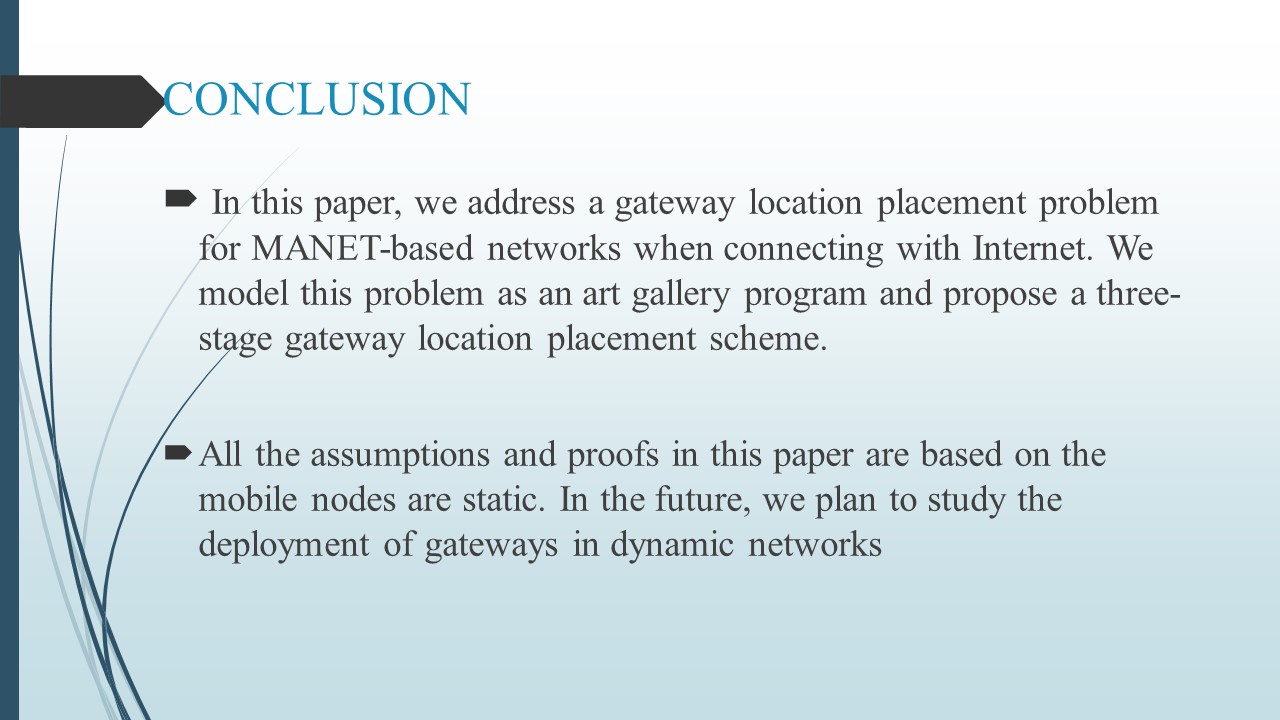 |
we address a gateway location placement problem for MANET-based networks when connecting with Internet. We model this problem as an art gallery program and propose a three-stage gateway location placement scheme. All the assumptions and proofs in this paper are based on the mobile nodes are static. In the future, we plan to study the deployment of gateways in dynamic networks |
| ICACT20220099 Slide.16
[Big Slide]
[YouTube] |
Chrome Click!! |
 |
Thank you. |















