 ICACT20220144 Slide.01
[Big Slide] |
Chrome  Click!! |
 |
Hi everybody, my name is Hye Young An.
My paper topic is real-time path planning for trajectory control in autonomous driving.
|
| ICACT20220144 Slide.02
[Big Slide]
|
Chrome Click!! |
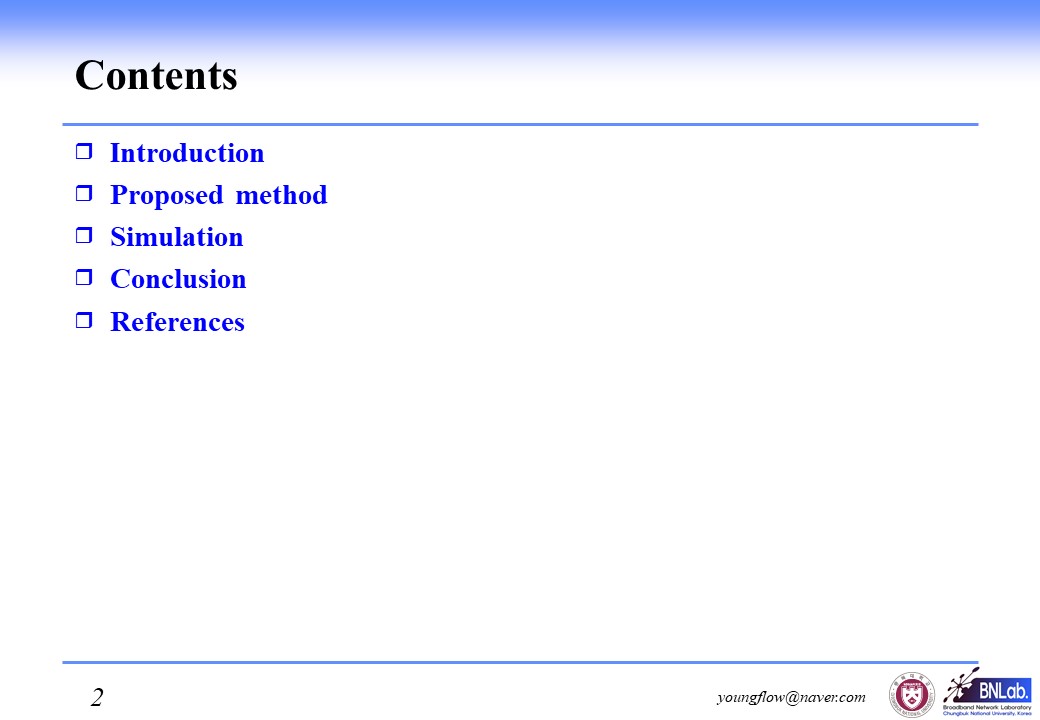 |
The sequence is as follows.
|
| ICACT20220144 Slide.03
[Big Slide]
|
Chrome Click!! |
 |
The first is an introduction.
|
| ICACT20220144 Slide.04
[Big Slide]
|
Chrome Click!! |
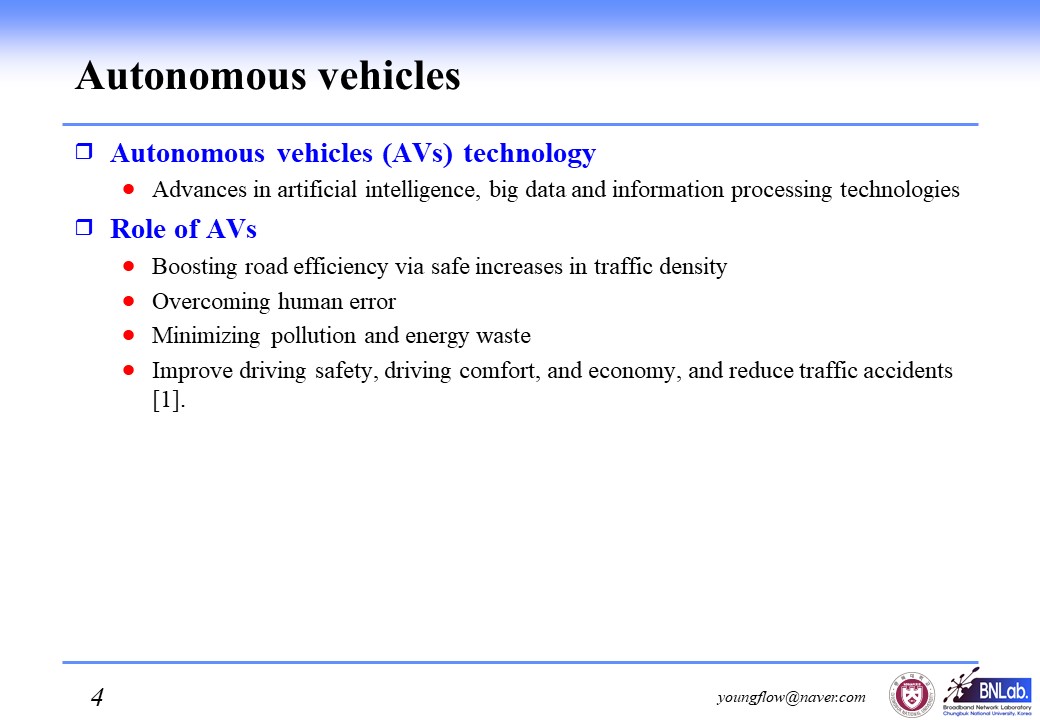 |
Nowadays, advances in artificial intelligence, big data, and information processing technologies have made autonomous vehicles more attention.
autonomous vehicles have a huge potential for boosting road efficiency via safe increases in traffic density, overcoming human error, minimizing pollution and energy waste.
In particular, autonomous vehicles technology has been advanced in various fields to improve driving safety, driving comfort, economy, and reduce traffic accidents
|
| ICACT20220144 Slide.05
[Big Slide]
|
Chrome Click!! |
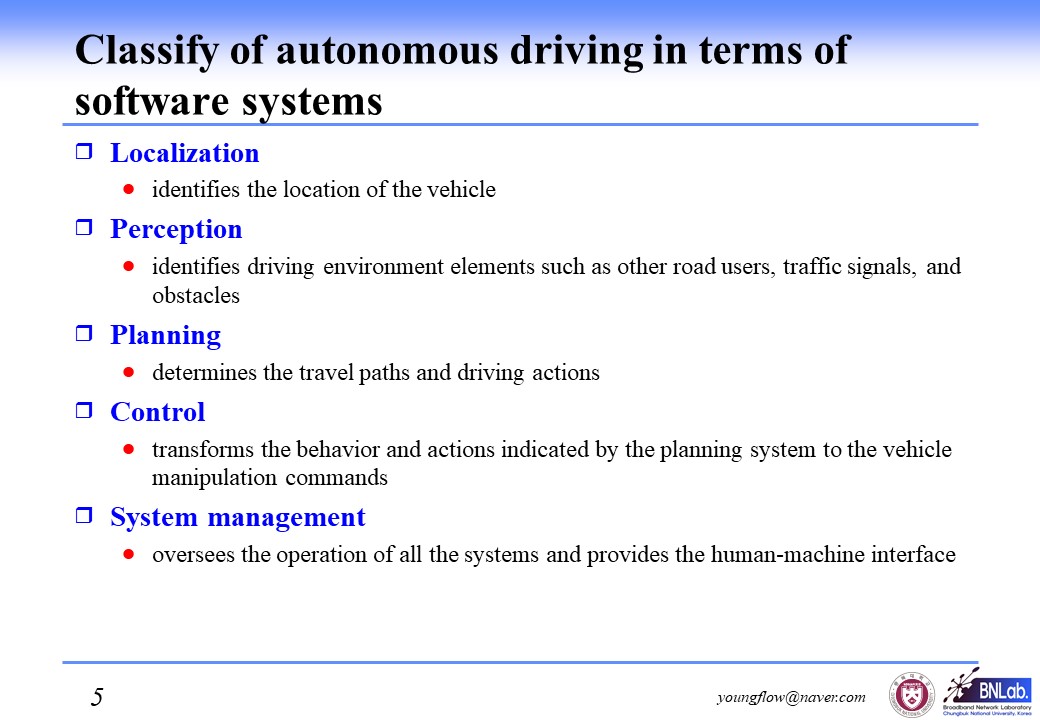 |
In general, autonomous driving classification according to software system is divided into 5 categories.
The localization identifies the location of the vehicle
the perception identifies driving environment elements
The planning determines the travel paths and driving actions
The control transforms the behavior and actions indicated by the planning
The system management oversees the operation of all the systems and provides the human-machine interface.
|
| ICACT20220144 Slide.06
[Big Slide]
|
Chrome Click!! |
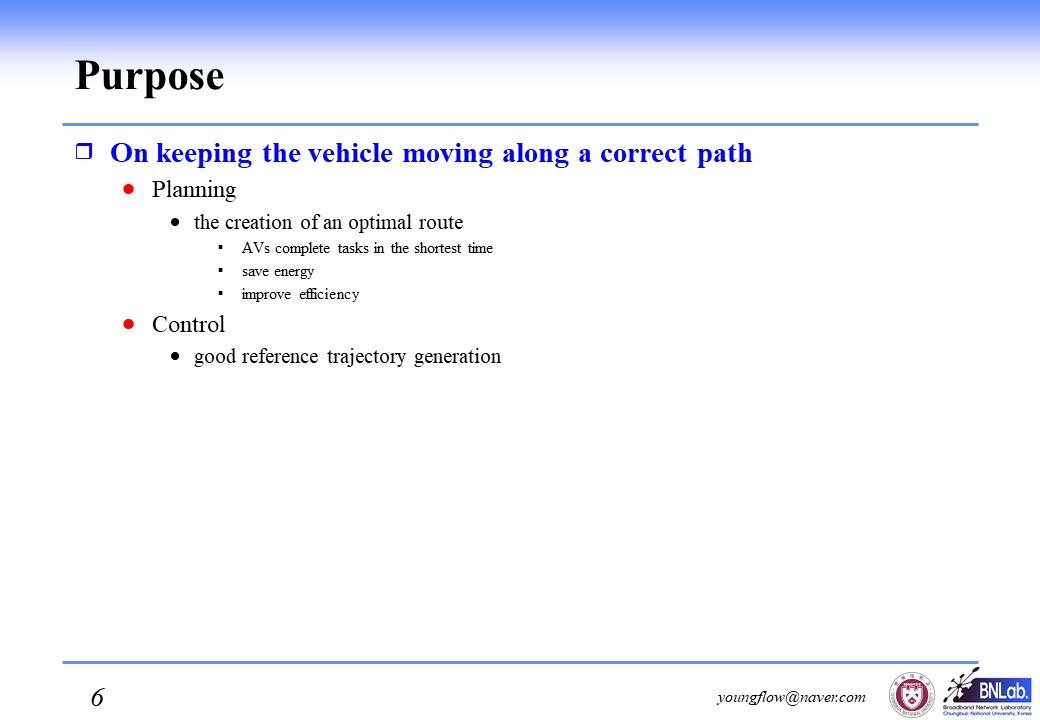 |
We are focused on keeping the vehicle moving along a correct path.
In order to achieve this task, the creation of an optimal route and good reference trajectory generation are requirements.
So we are interested in Planning and Control.
|
| ICACT20220144 Slide.07
[Big Slide]
|
Chrome Click!! |
 |
The next is a proposed method. |
| ICACT20220144 Slide.08
[Big Slide]
|
Chrome Click!! |
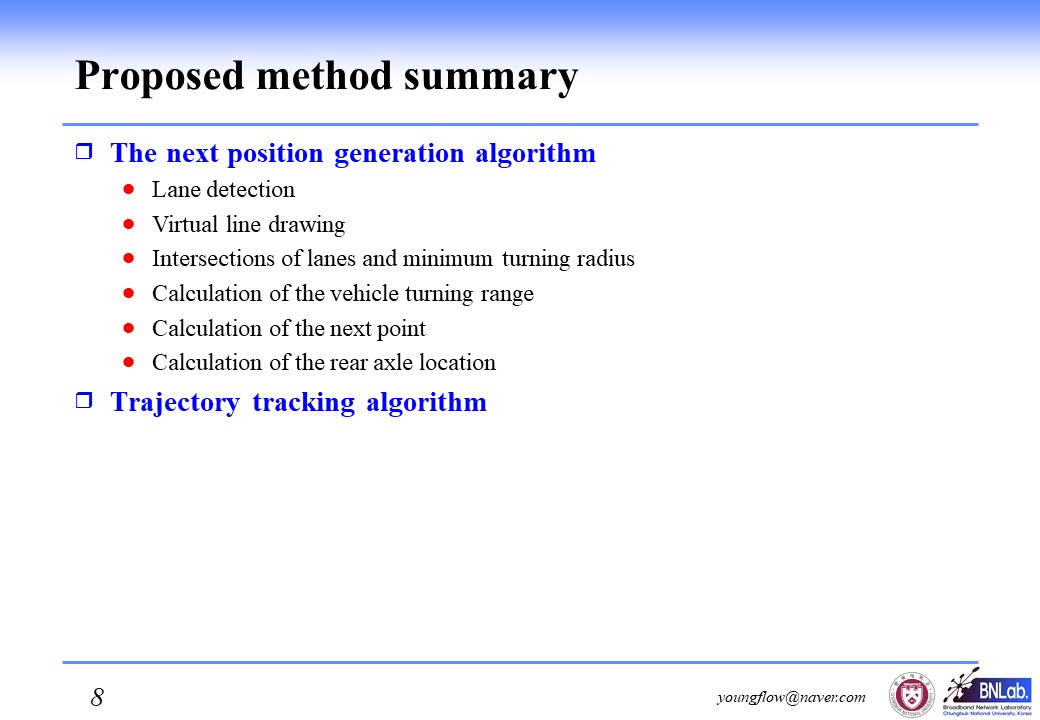 |
The proposed method is divided into two main categories.
The first is the next position generation algorithm
And the second is the Trajectory tracking algorithm
The next position generation algorithm proceeds with lane detection, drawing virtual lines, finding the intersection of lanes and minimum turning radius, calculating the vehicle’s turning range, calculating the next point, and calculating of the rear axle location.
Then, the steering angle is calculated through the trajectory tracking algorithm.
|
| ICACT20220144 Slide.09
[Big Slide]
|
Chrome Click!! |
 |
various sensors are utilized for autonomous driving
For example, LiDAR, Radar, Camera, IMU and Odometry are utilized.
In most studies, it can be seen that object detection method utilizing sensors offers accurate image analysis in AV.
Therefore, planning and control are performed on the premise that lane detection is possible based on sensors.
|
| ICACT20220144 Slide.10
[Big Slide]
|
Chrome Click!! |
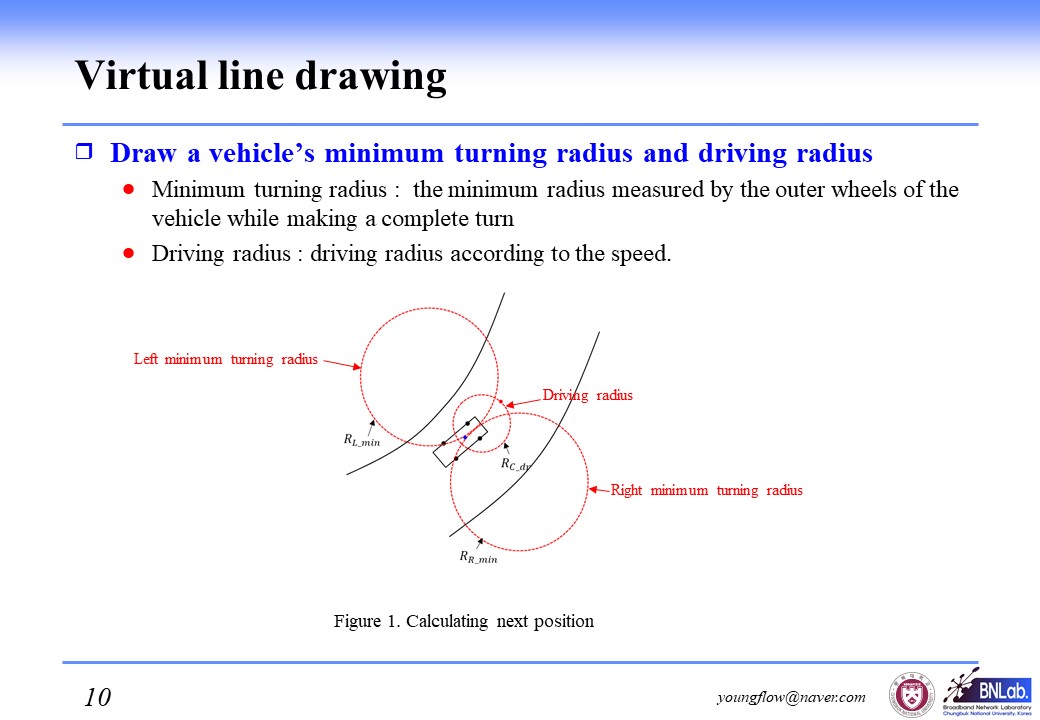 |
The minimum turning radius and driving radius are drawn with a virtual line.
A vehicle’s minimum turning radius is the minimum radius measured by the outer wheels of the vehicle while making a complete turn.
The driving radius is a radius that can be moved according to the vehicle speed.
It's the red dotted line in the Figure 1.
|
| ICACT20220144 Slide.11
[Big Slide]
|
Chrome Click!! |
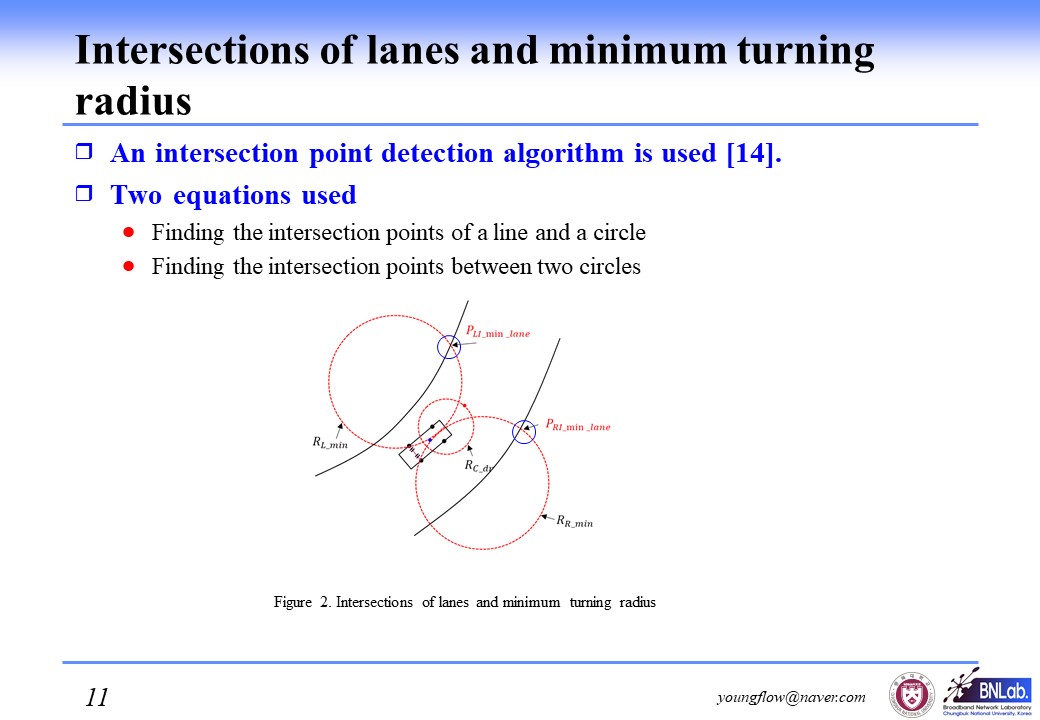 |
the road consists of curved and straight parts
An intersection point detection algorithm is used in reference paper 14.
There are two equations used.
The first is the intersection equation of a line and a circle.
The second uses the formulas for finding the intersection points between two circles.
In Figure 2, these two points are the intersections.
|
| ICACT20220144 Slide.12
[Big Slide]
|
Chrome Click!! |
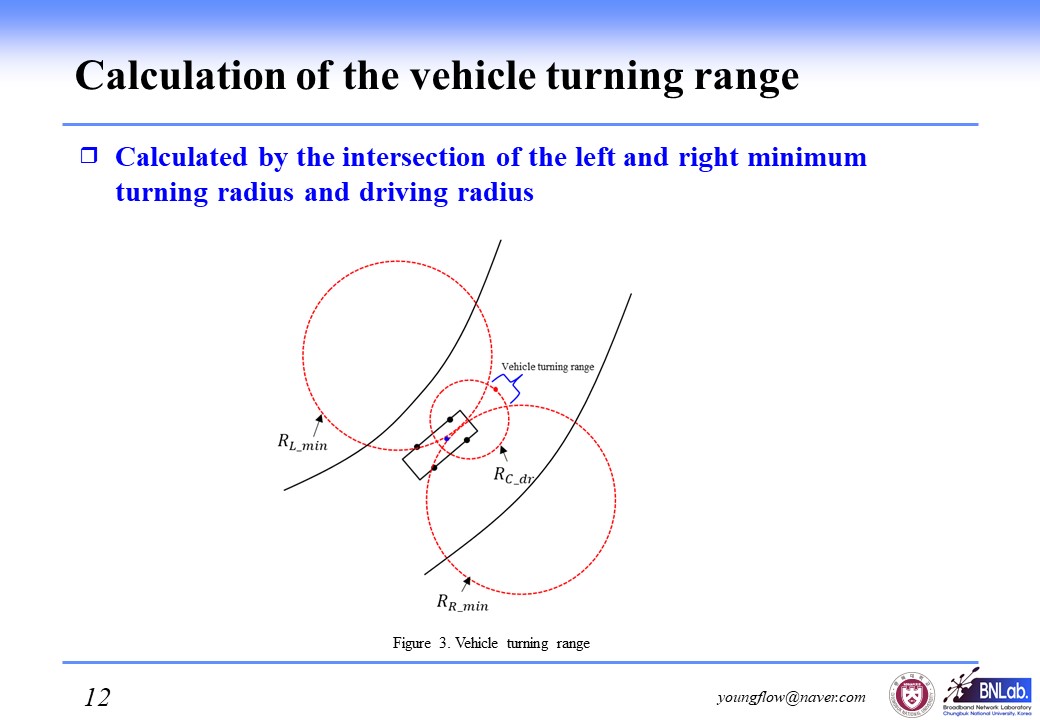 |
The vehicle turning range is this area.
This area range is calculated based on the left and right minimum turning radius and driving radius.
|
| ICACT20220144 Slide.13
[Big Slide]
|
Chrome Click!! |
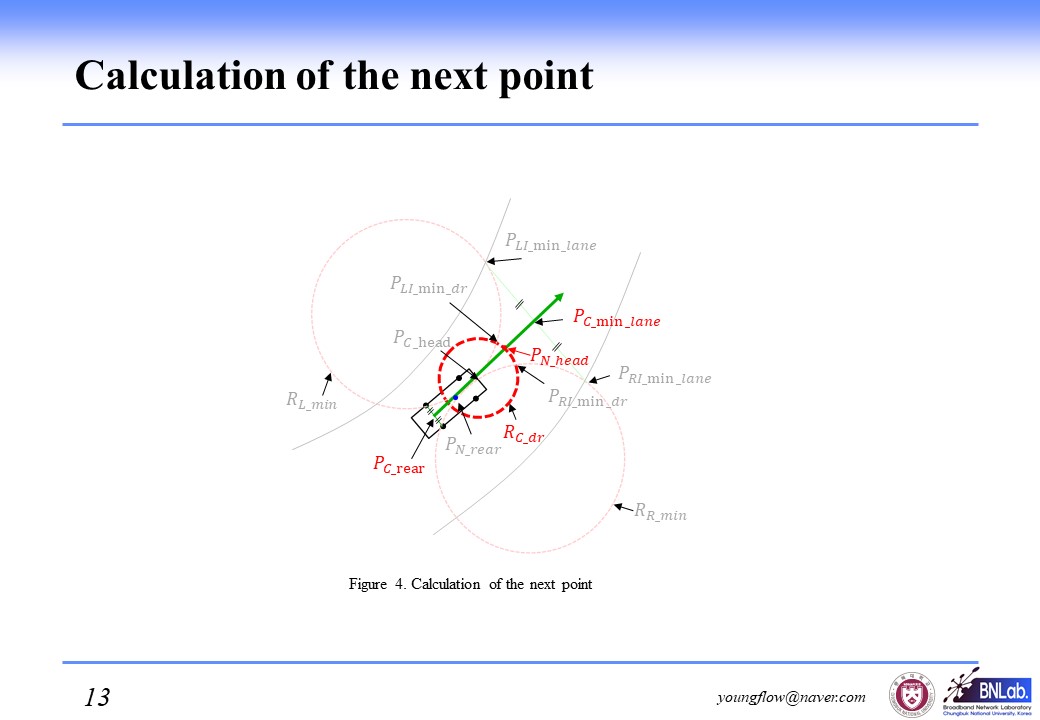 |
Our goal is to determine the next point, which is the Pn_head in this figure.
The midpoint of lines connecting two intersection points left and right is center.
The intersection point ( Pn_head ) of line segments ( Pc_rear and Pc_min_lane) and driving radius is selected as the next position as shown in Figure 4.
|
| ICACT20220144 Slide.14
[Big Slide]
|
Chrome Click!! |
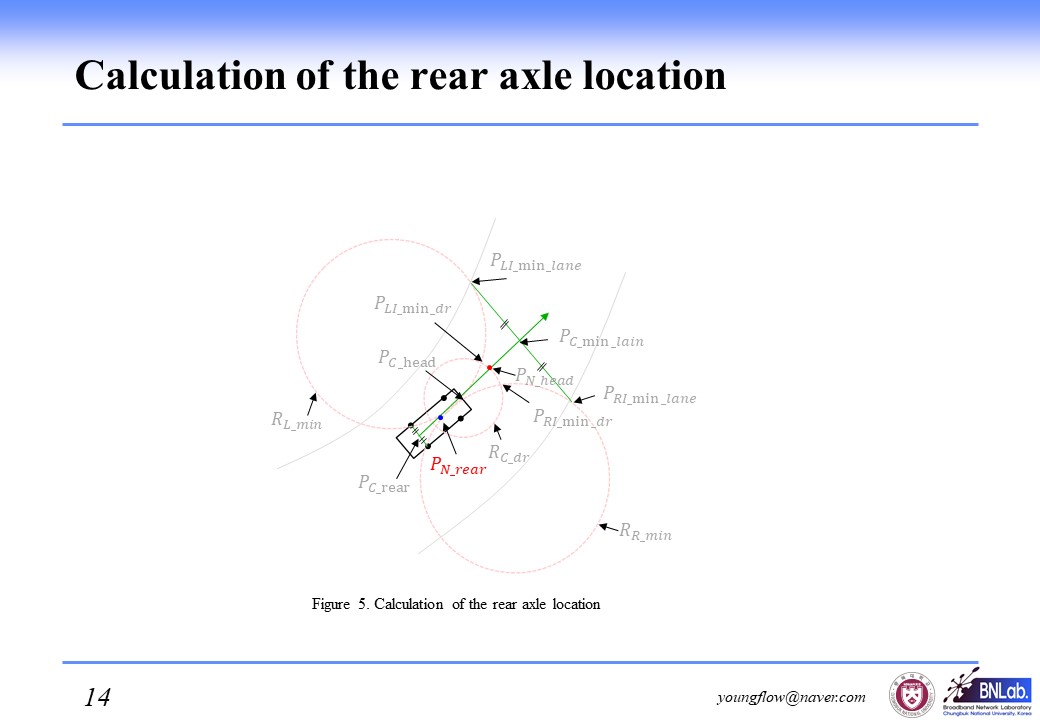 |
When the vehicles move in the direction of Pn_head position, it is necessary to calculate the position of the rear axle.
Because trajectory algorithm is calculated based on rear axle.
rear axle location ( Pn_rear) is calculated considering driving radius and yaw angle with respect to the global coordinates.
|
| ICACT20220144 Slide.15
[Big Slide]
|
Chrome Click!! |
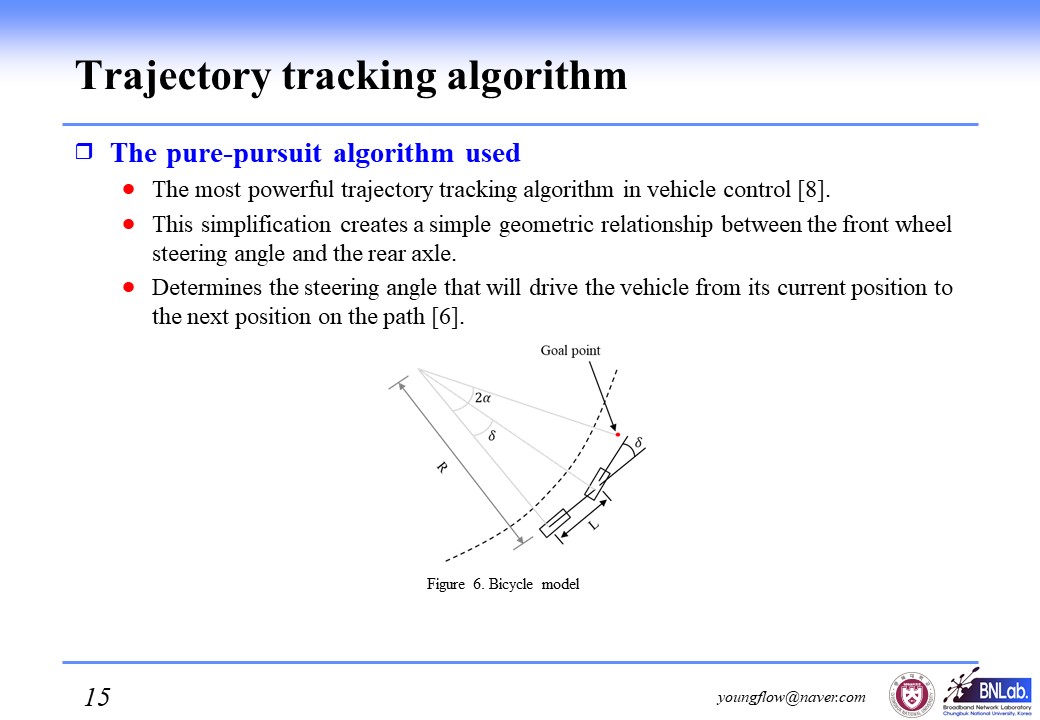 |
The pure-pursuit algorithm used in our project.
This algorithm is one of the most common and the most powerful trajectory tracking algorithm.
As shown in Figure 6, this algorithm can be better visualized by using the Bicycle Model to represent the vehicle
This algorithm approach geometrically determines the steering angle that will drive the vehicle from its current position to the next position on the path
|
| ICACT20220144 Slide.16
[Big Slide]
|
Chrome Click!! |
 |
The next is a simulation |
| ICACT20220144 Slide.17
[Big Slide]
|
Chrome Click!! |
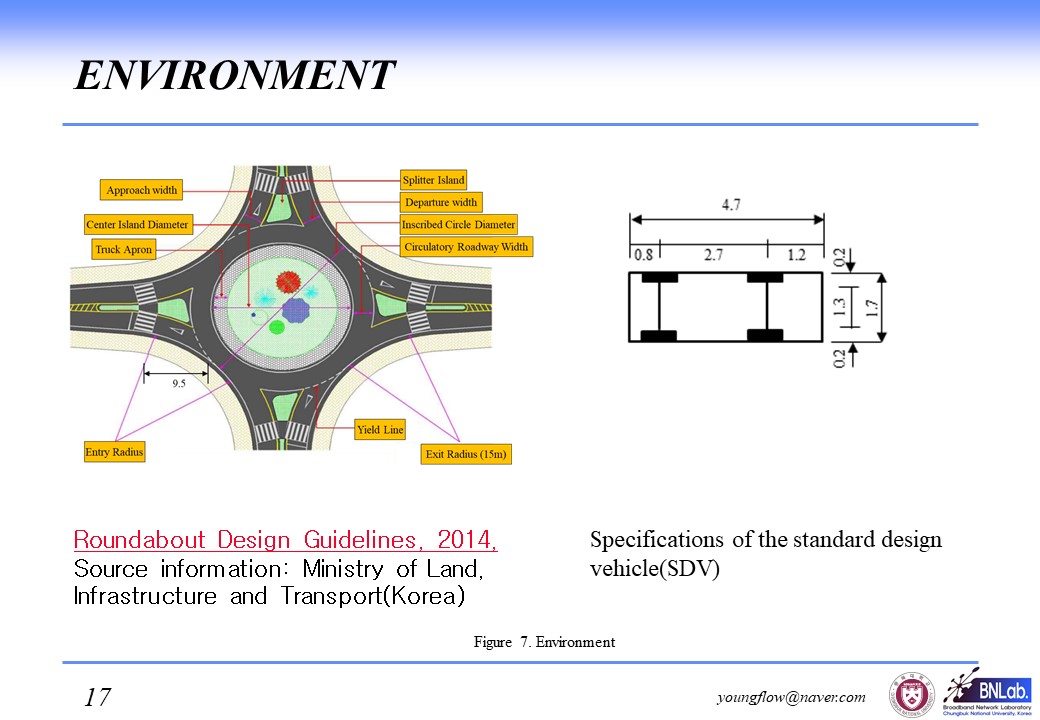 |
Our approach was tested considering the construction of the vehicle paths at a single-lane roundabout according to the design guidelines
in Figure 7. The basic proportions and overall dimensions of the vehicle is governed by the specifications of the SDV
|
| ICACT20220144 Slide.18
[Big Slide]
|
Chrome Click!! |
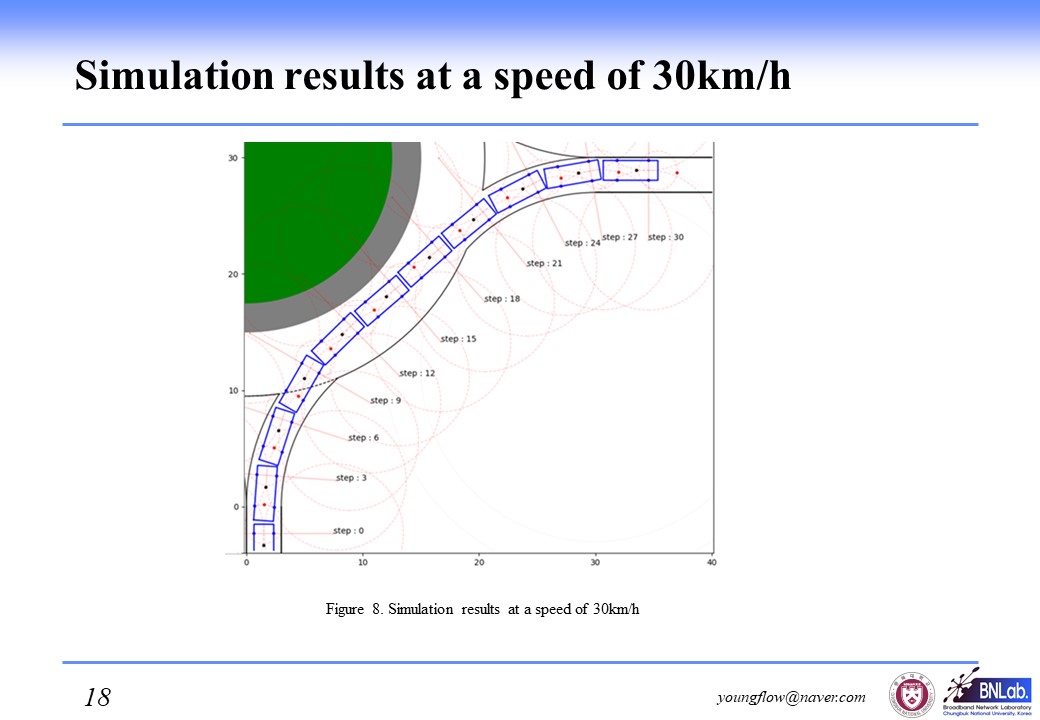 |
We simulated vehicle movement in a roundabout environment including both circular arcs and straight lines using python
it was tested from 20km/h to 50km/h in a simulation environment.
this simulation calculates the driving radius every 300ms.
Figure 8. shows simulation result at a speed 30km/h.
The movement of the vehicle is drawn every 3 steps.
The obtained simulation works well at a speed of 30km/h.
|
| ICACT20220144 Slide.19
[Big Slide]
|
Chrome Click!! |
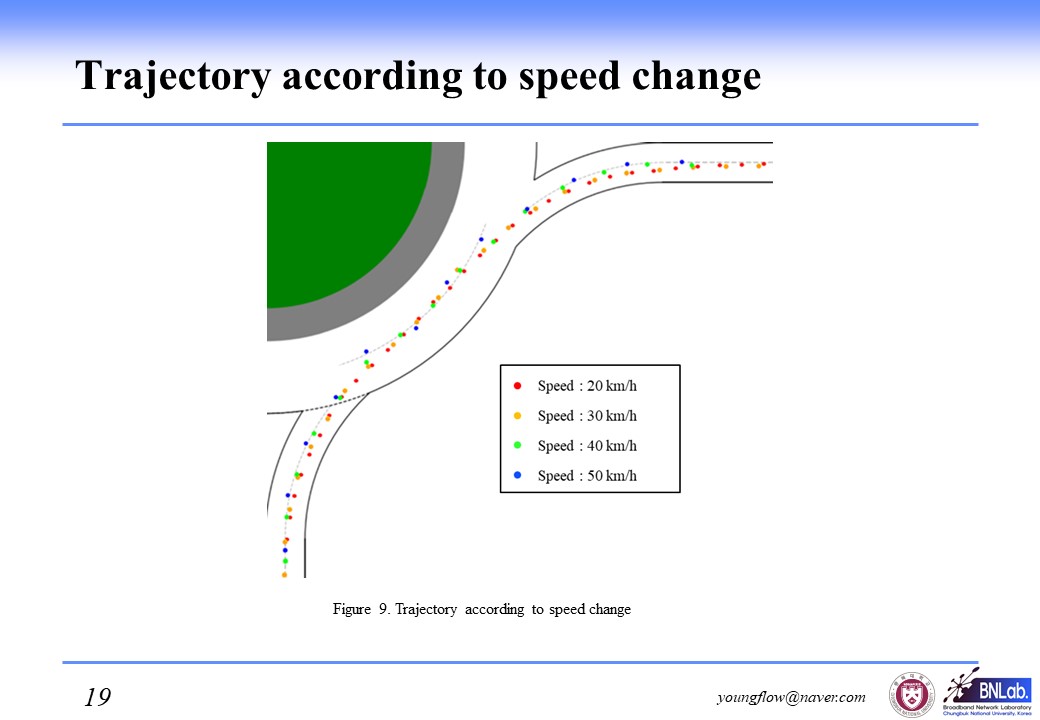 |
Figure 9. shows trajectory according to various speed.
As a result, the vehicle follows a safe trajectory at various speeds.
|
| ICACT20220144 Slide.20
[Big Slide]
|
Chrome Click!! |
 |
Here is the conclusion part. |
| ICACT20220144 Slide.21
[Big Slide]
|
Chrome Click!! |
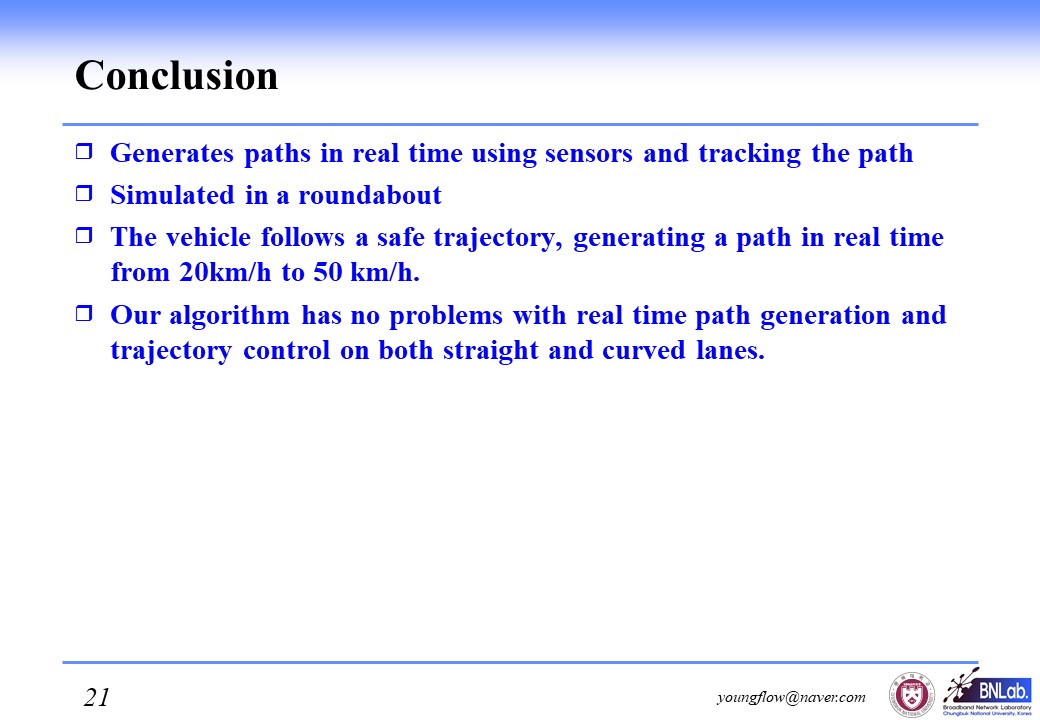 |
This paper studied the trajectory control that generates paths in real time using sensors and tracking the path.
We simulated in a roundabout
As a result, the vehicle follows a safe trajectory, generating a path in real time from 20km/h to 50 km/h.
The result shows that our algorithm has no problems with real time path generation and trajectory control.
|
| ICACT20220144 Slide.22
[Big Slide]
|
Chrome Click!! |
 |
Here is a reference. |
| ICACT20220144 Slide.23
[Big Slide]
|
Chrome Click!! |
 |
Here is a reference. |
| ICACT20220144 Slide.24
[Big Slide]
|
Chrome Click!! |
 |
Here is a reference. |
| ICACT20220144 Slide.25
[Big Slide]
|
Chrome Click!! |
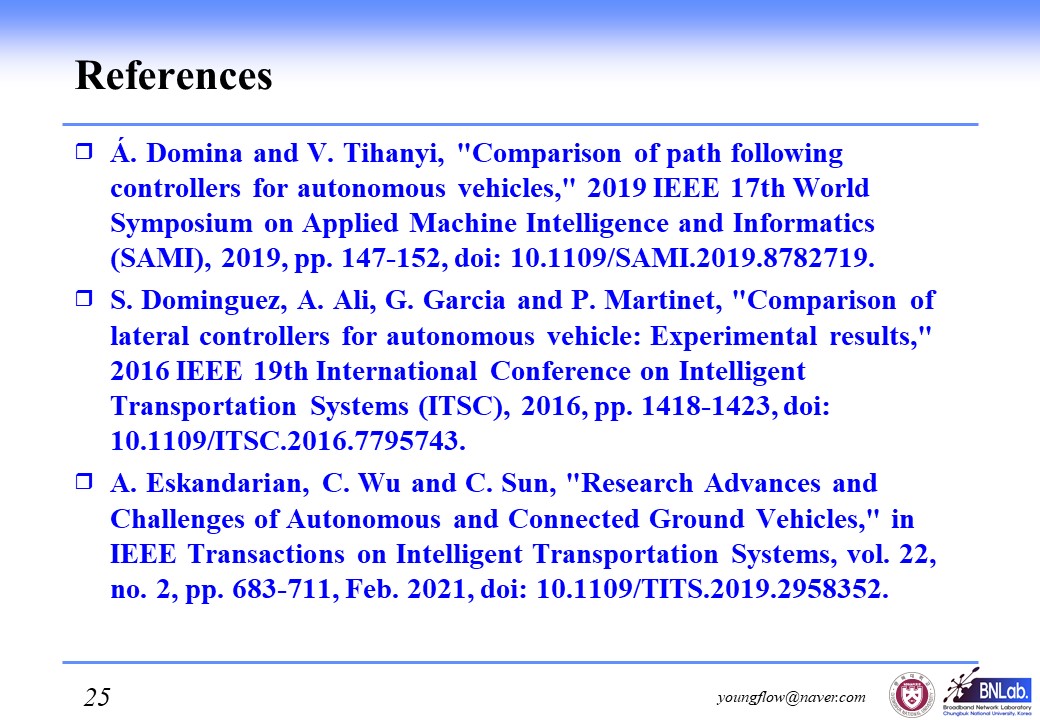 |
Here is a reference. |
| ICACT20220144 Slide.26
[Big Slide]
|
Chrome Click!! |
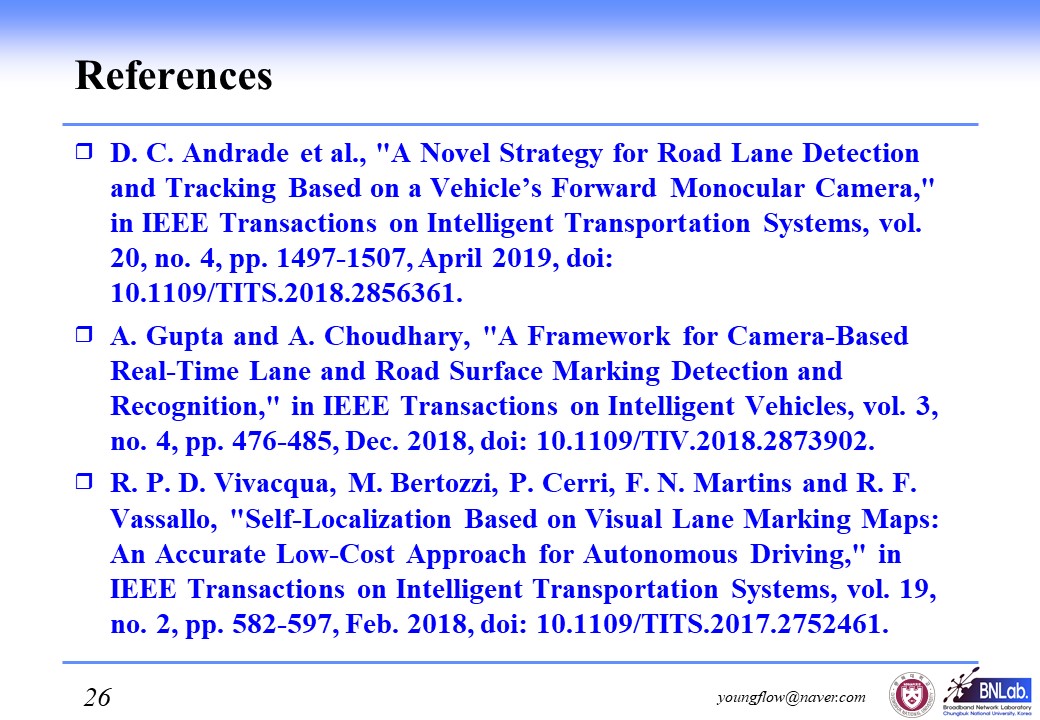 |
Here is a reference. |
| ICACT20220144 Slide.27
[Big Slide]
|
Chrome Click!! |
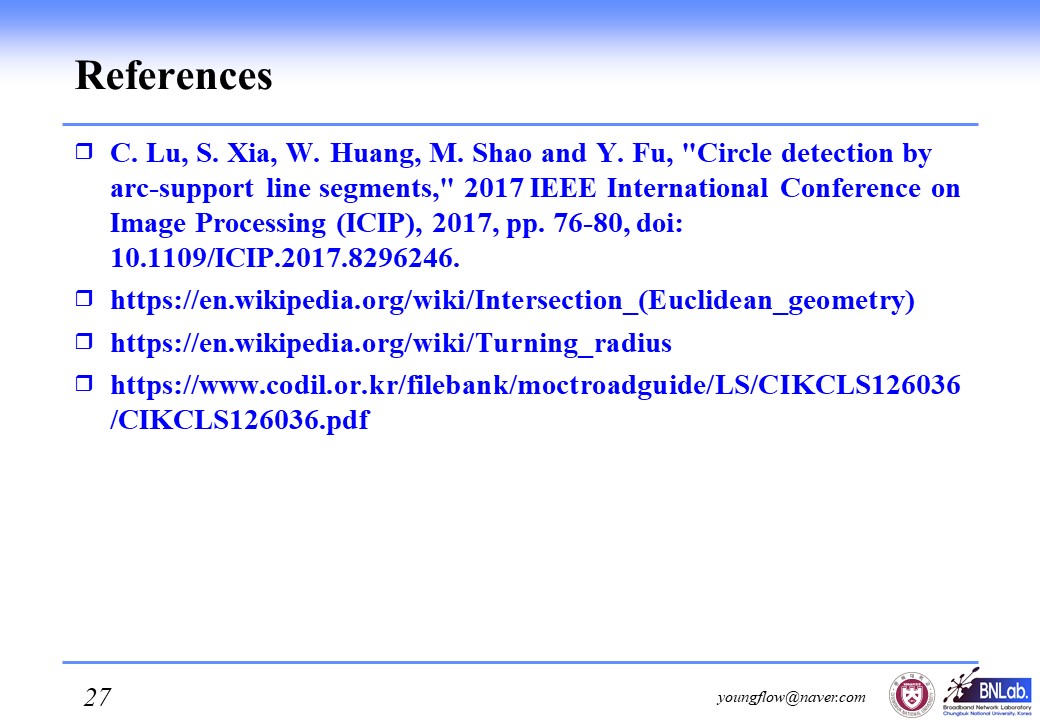 |
Here is a reference. |
| ICACT20220144 Slide.28
[Big Slide]
|
Chrome Click!! |
 |
Thank you. |















