ICACT20220159 Slide.01
[Big Slide] ICACT20220159 Slide.01
[Big Slide]
|
Chrome  Click!! Click!! |
 |
Hello, my name is Hyun-Woo Rhee and I’m from KAIST Nano Electronic and photonic systems lab, Korea.
Today I will introduce about 8K Video Data Transmission through Optical Phased Array Packaged by Direct Optical Wire Bonding.
The presentation consists of two parts. One is about data transmission through optical phased array. And another one is about optical packaging through direct optical wire bonding.
|
| ICACT20220159 Slide.02
[Big Slide]
|
Chrome Click!! |
 |
So optical wireless communication.
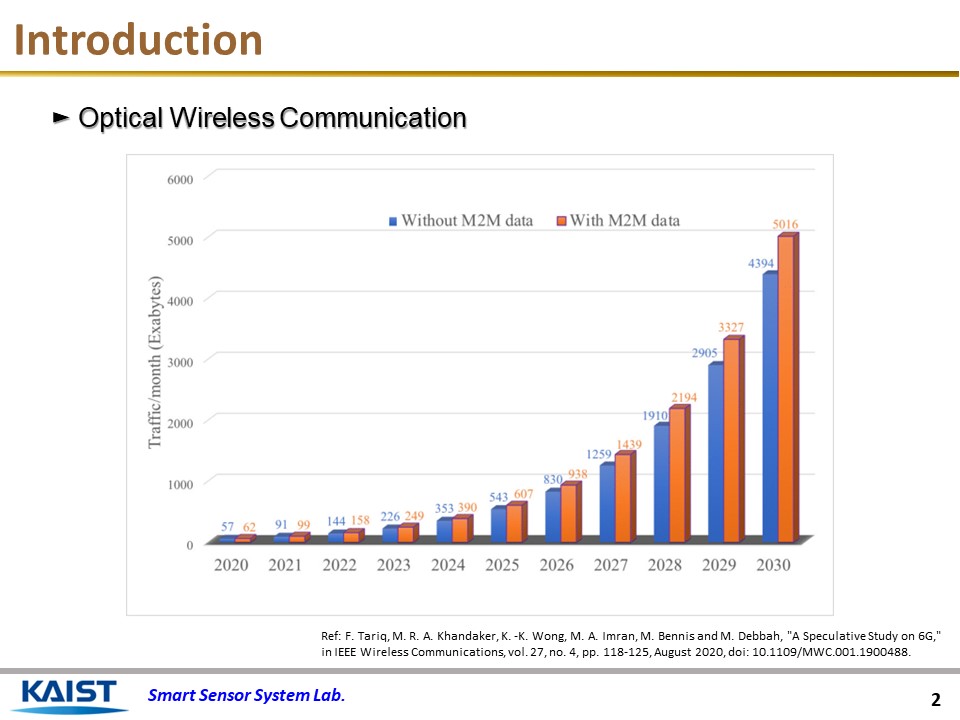
As you can see in the graph, data traffic is significantly increasing.
Smartphones TVs internet videos. Data has been exploded and needs technologies that are capable of delivering ultra-high data rates.
|
| ICACT20220159 Slide.03
[Big Slide]
|
Chrome Click!! |
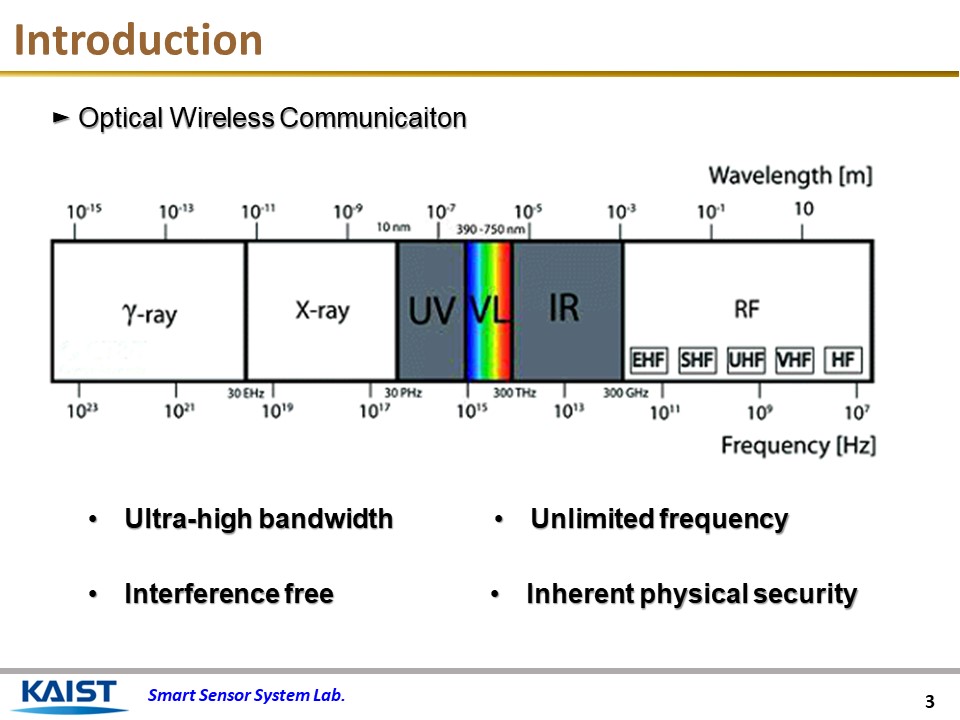 |
So, from RF transmission~ wavelength has been shorten down to optical areas and developed data transmissions by using optical wavelengths.
optical wireless communication (OWC), which offers practically an unlimited bandwidth (400 THz), includes infrared (IR), visible (VL) and ultraviolet (UV) sub-bands, as shown in Fig.
The use of these bands for communications purposes offers unique opportunities, which remains mostly unexplored so far.
In comparison to the RF counterparts, OWC enjoys superior features such as ultra-high bandwidth, robustness to electromagnetic interference, unlimited frequency and inherent physical security.
Furthermore, since OWC technologies can be operated in the unregulated spectrum, no licensing fee is required thus leading to a cost-effective solution for a number of applications.
And our lab has researched optical wireless communications using IR regions, with optical phased arrays which has been mainly discovered for LiDAR.
|
| ICACT20220159 Slide.04
[Big Slide]
|
Chrome Click!! |
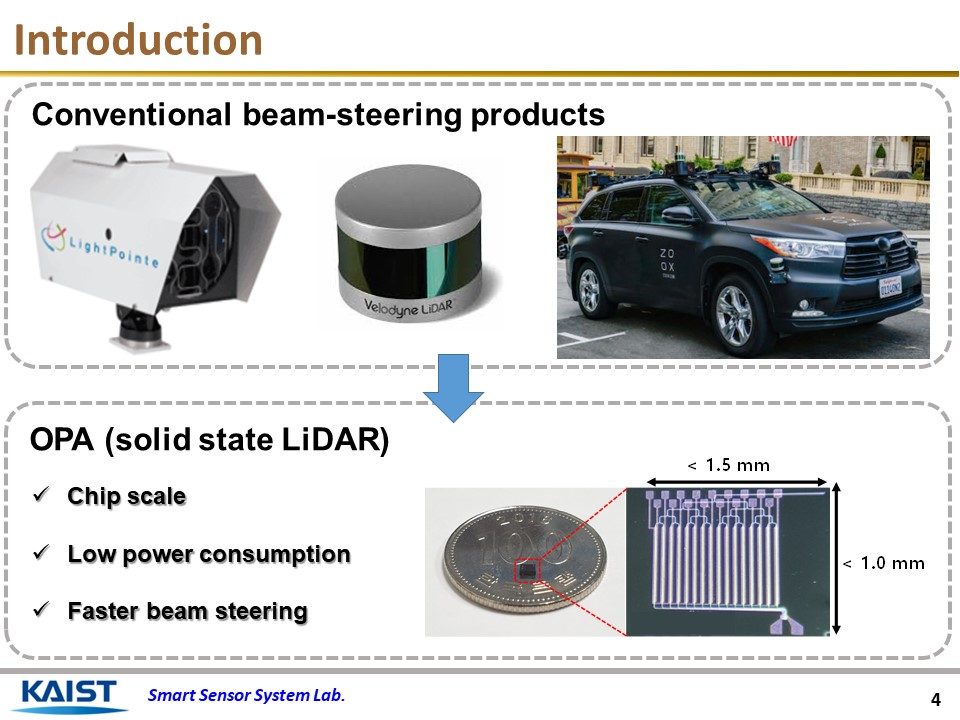 |
So! by using our OPA, we can make this system very small~ to a chip scale.
The conventional beams-steering products are shown~~the right picture, black SUV car is a picture I took this week and you can easily see in roads. start-up by Zoox , and..it has LiDAR sensor larger than a fist.
OPA, can make this beam-steering products into chip size scale.
And because, it uses phase arraying technique for beam-steering, it has no mechanical steering resulting less power than mechanical steering. and has a much faster steering-speed.
|
| ICACT20220159 Slide.05
[Big Slide]
|
Chrome Click!! |
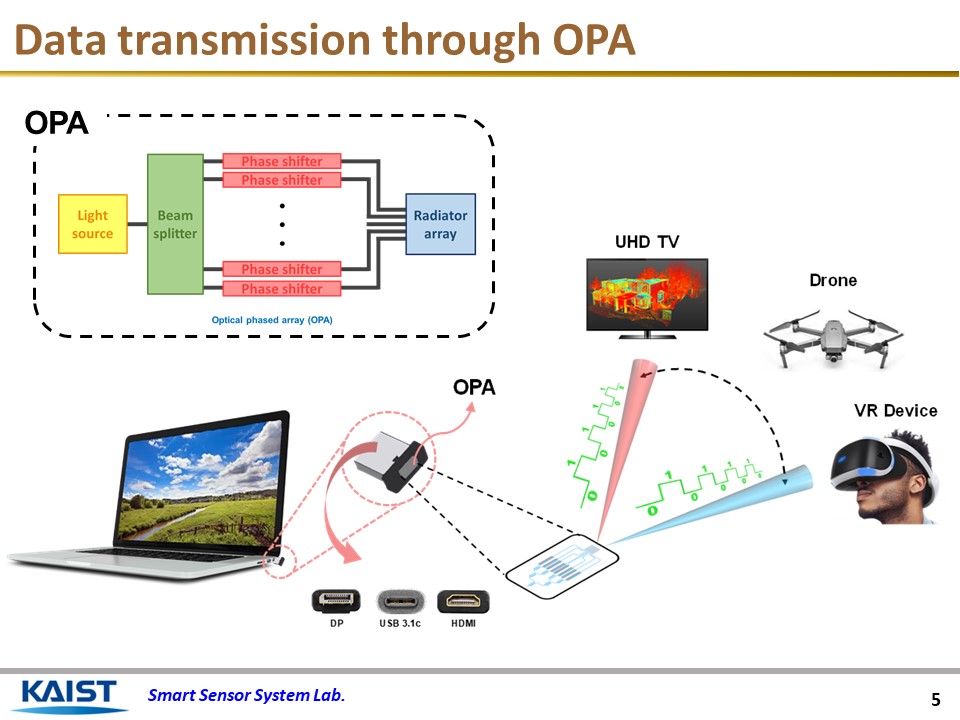 |
The OPA structure can be represented simply like this figure.
This structure is designed to control the direction of emitted light.
First, the light from the light source is divided equally into several channels.
Then, the light passes through the phase shifters of each channel and channels are gathered closely to form a radiator array.
Using this OPA, we introduce a data transmission system as shown in the picture.
|
| ICACT20220159 Slide.06
[Big Slide]
|
Chrome Click!! |
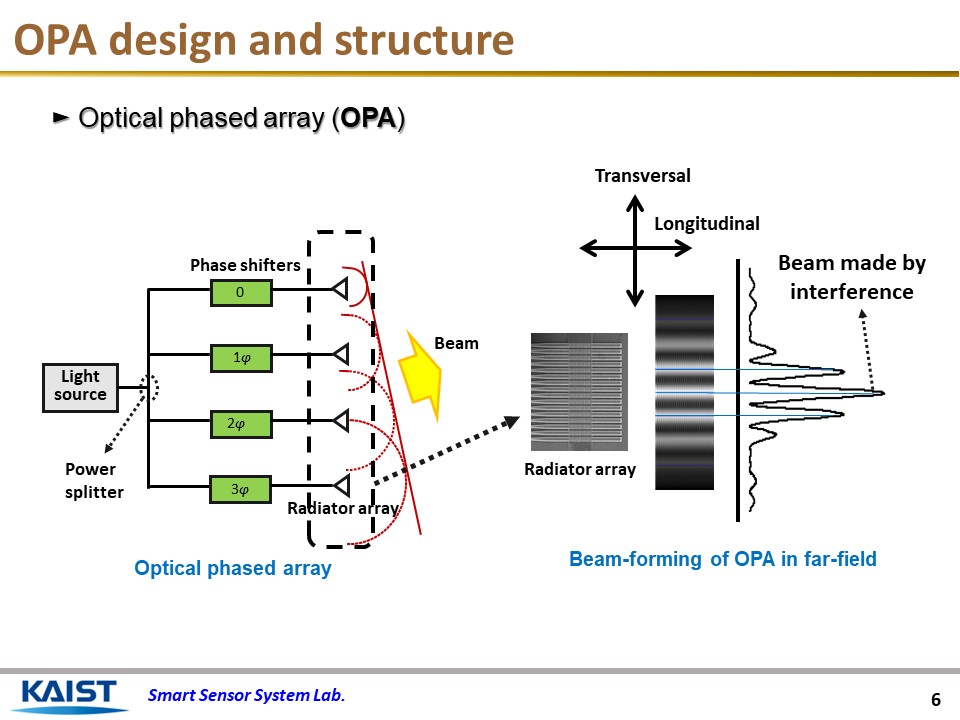 |
After passing the phase shifter, the light reaches the radiator.
light from each radiators interfere, forming beams at various angles.
Diffraction occurs, which is similar to the double slit. And using the strongest beam among them, beam-scanning is performed in the desired direction.
With this technique we have made a small sized OPA that can steer 45 degrees in transversal angle.
|
| ICACT20220159 Slide.07
[Big Slide]
|
Chrome Click!! |
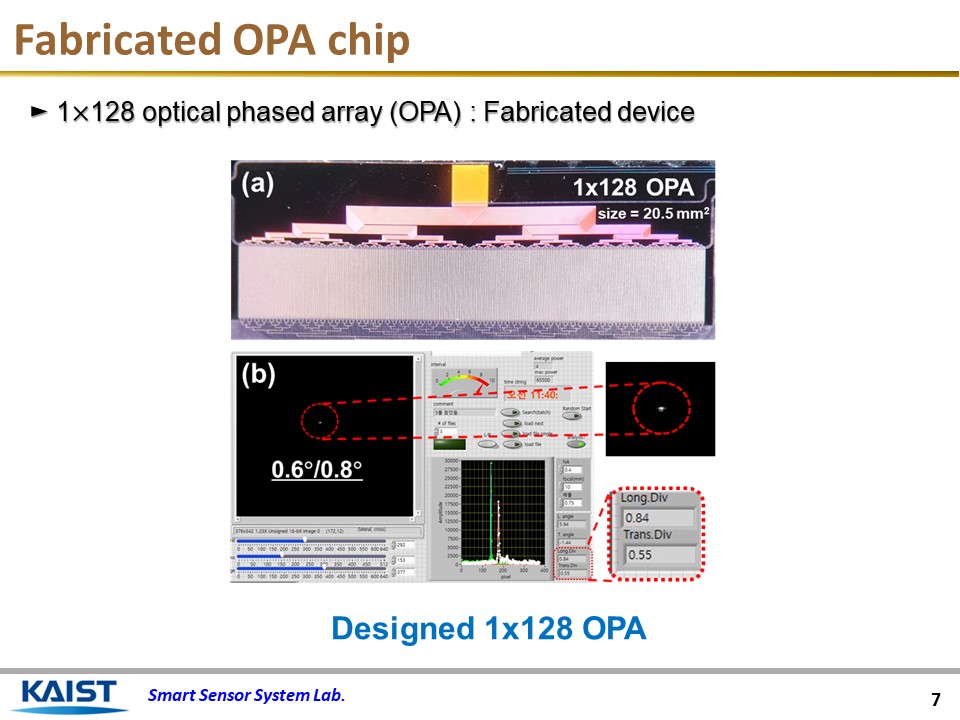 |
This is the manufactured OPA chip. It has grating couplers, mmi power splitters, phase shifters, phase feeding lines and grating radiators. The fabricated OPA has 128 channel.
|
| ICACT20220159 Slide.08
[Big Slide]
|
Chrome Click!! |
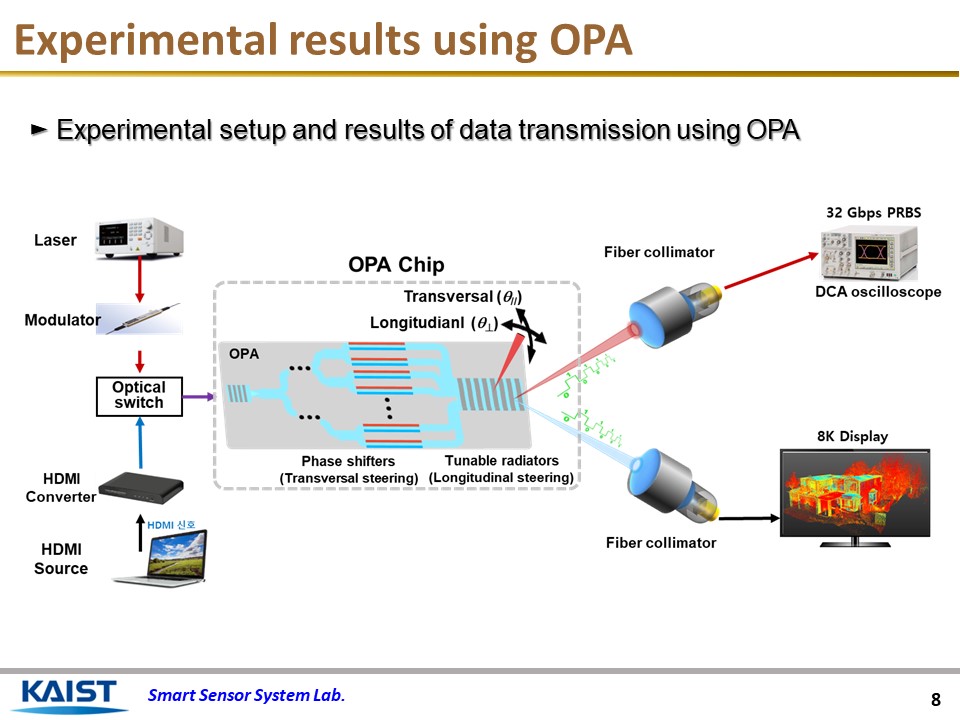 |
This is the experimental setup of data transmission using OPA chip.
We tested with 32Gbps PRBS signal and with 8K video data.
|
| ICACT20220159 Slide.09
[Big Slide]
|
Chrome Click!! |
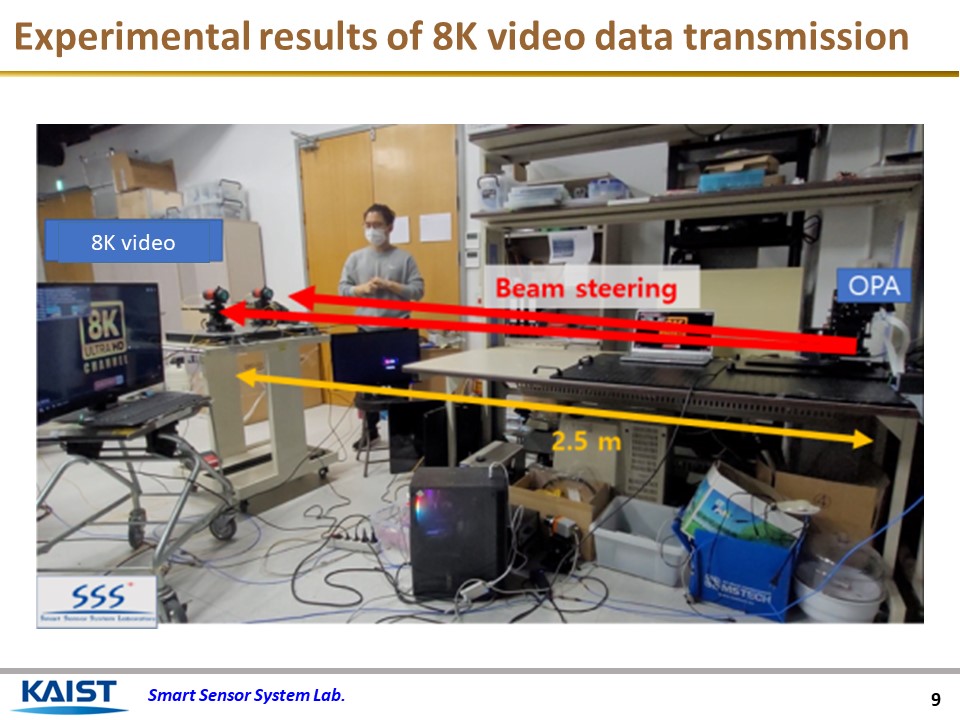 |
This is the picture of actual 8K video data transmission experiment.
Beam steering is done by OPA and align to the receiver for receiving 8K video data.
|
| ICACT20220159 Slide.10
[Big Slide]
|
Chrome Click!! |
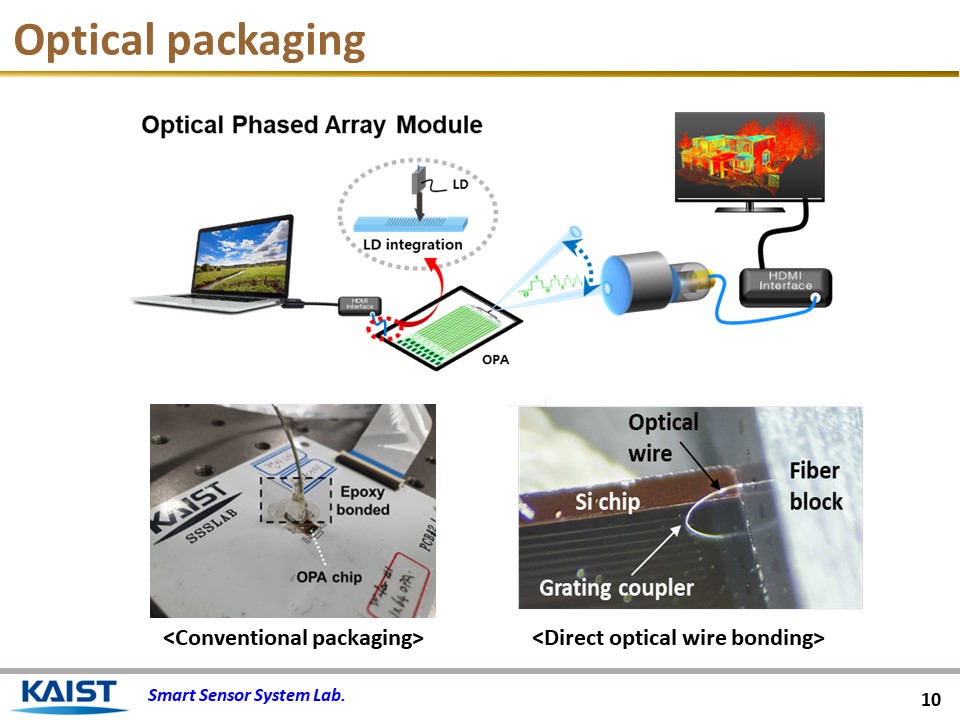 |
To make the OPA chip in to a module, optical packaging is needed.
We have mainly used epoxy bonding for packaging fiber block array to OPA chip.
This is the conventional packaging method for optical packaing, but has very low manufacturing yield.
And also has a very bulky size not suitable for optical components.
We have developed a new technology called direct optical wire bonding with Lessengers Inc. for optical packaging.
|
| ICACT20220159 Slide.11
[Big Slide]
|
Chrome Click!! |
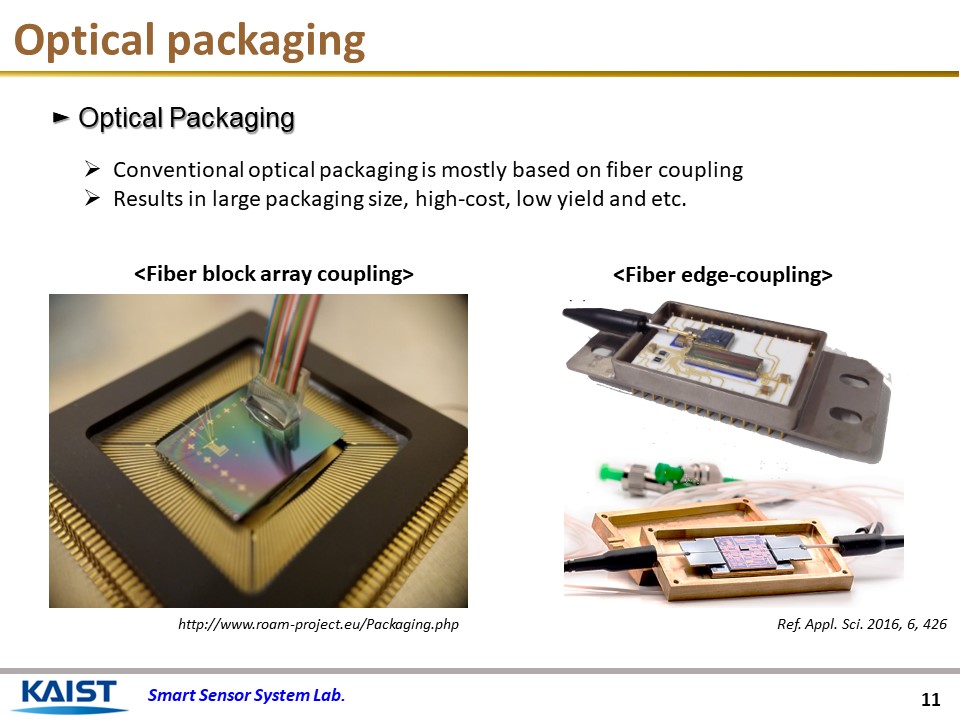 |
Currently, most of the optical packaging is based on fiber coupling.
But this fiber coupling needs an active aligning process.
mostly you have to manualy align the chip and then cure it.
These results in low-yield, high-cost, and large packaging size
|
| ICACT20220159 Slide.12
[Big Slide]
|
Chrome Click!! |
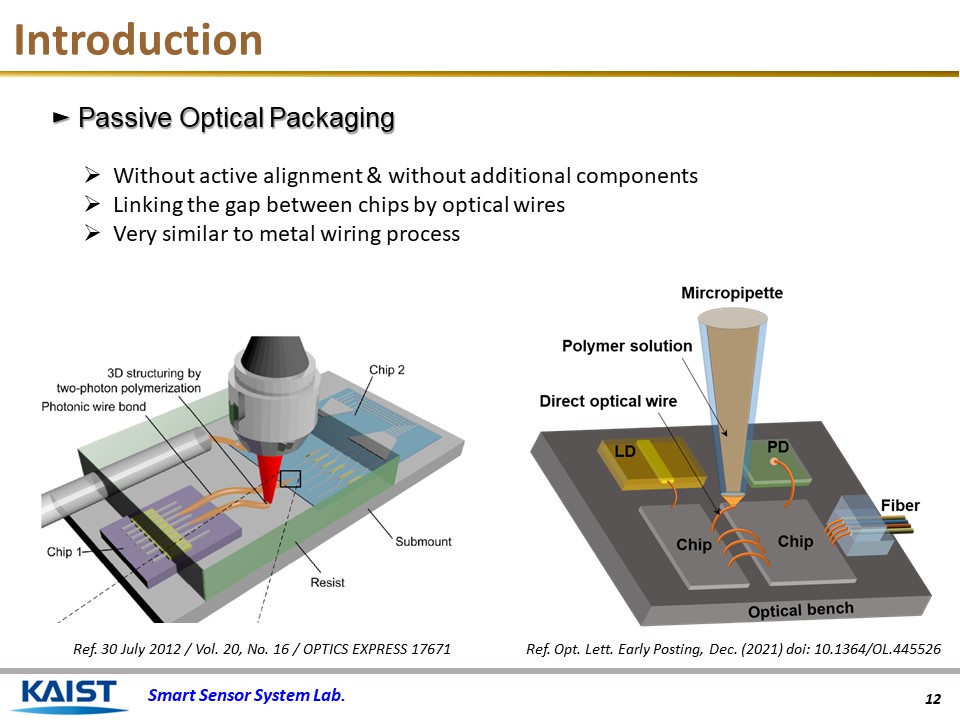 |
for that, passive optical packaging without additional structural components have been developed.
It uses polymer waveguides to link the gap between chips.
The concept is the link the gap just like metal wiring.
The very first research on this concept was done by the KIT group. also known as photonic wire bond.
It uses two-photon lithography with negative-tone resist for fabricating the wire.
But, we developed the equal concept technology without using the lithography. and can be fabricated in open-air
|
| ICACT20220159 Slide.13
[Big Slide]
|
Chrome Click!! |
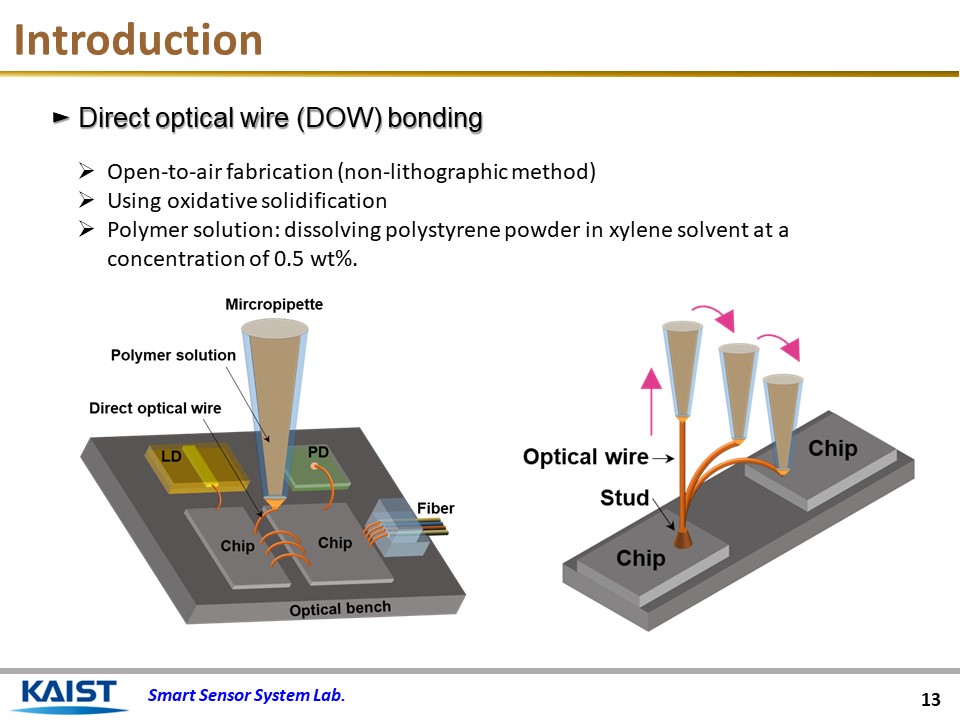 |
It is called Direct optical wire bonding.
This optical wire is fabricated by only physical actions of the micropitte and the polymer solution.
The polymer solution is extruded from the micropipette, and solidifies in the air. by oxidative-solidification.
Than the polymer wire is formed as an optical waveguide.
since it only controlls the micropitte, it offers a one-stop procedure.
|
| ICACT20220159 Slide.14
[Big Slide]
|
Chrome Click!! |
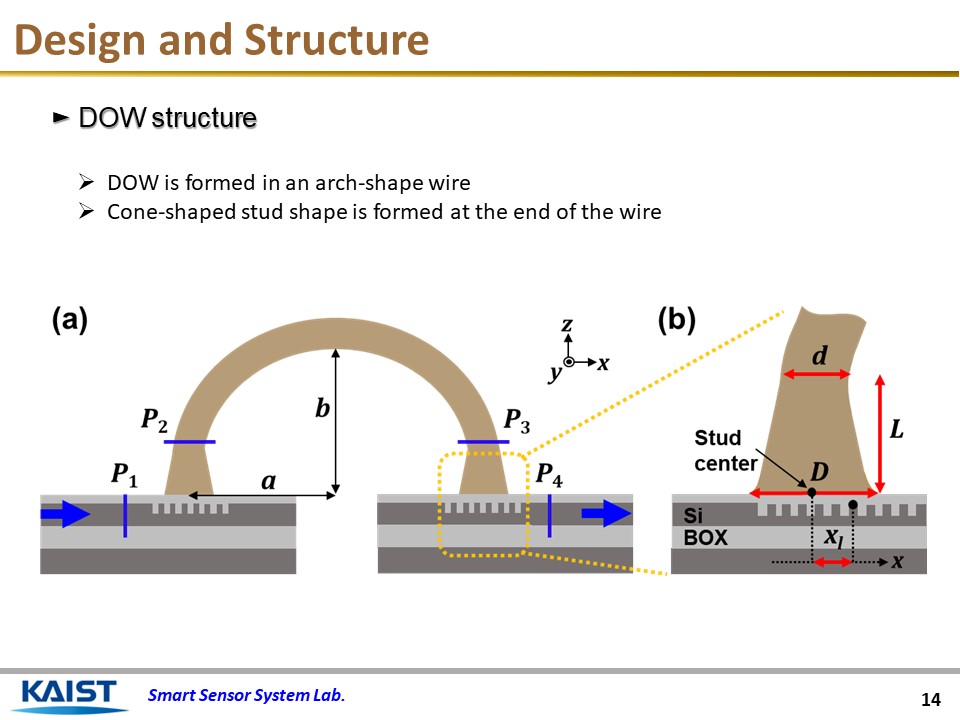 |
the DOW bonding has an arch-shape.
The arch-shape wire has a horizontal radius and a vertical radius.
Also the wire has a cone-shaped stud at the end of the wire.
the stud shape is very important since, the coupling is mainly decided at that structure.
The stud has a contact diameter and wire diameter, and the tapered region length.
|
| ICACT20220159 Slide.15
[Big Slide]
|
Chrome Click!! |
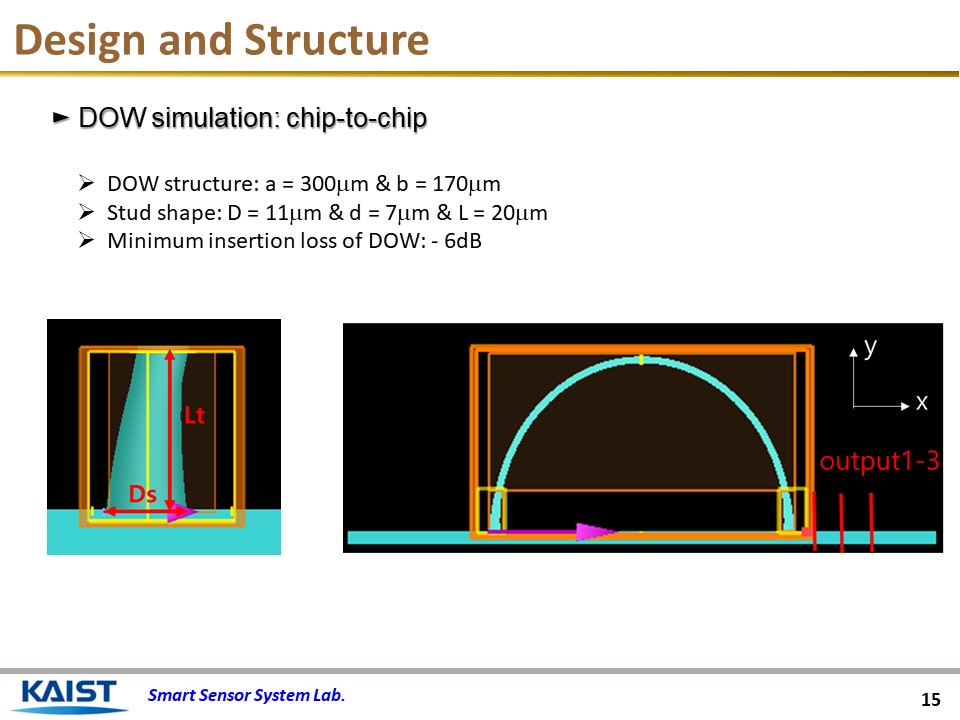 |
By FDTD simulation, we have decided the structure of DOW.
The stud shape has a contact diameter of 11um and wire diameter of 7um and tapered length of 20um
we also simulated the whole structure of DOW linking two chips.
and had a minimum insertion loss of -6 dB.
|
| ICACT20220159 Slide.16
[Big Slide]
|
Chrome Click!! |
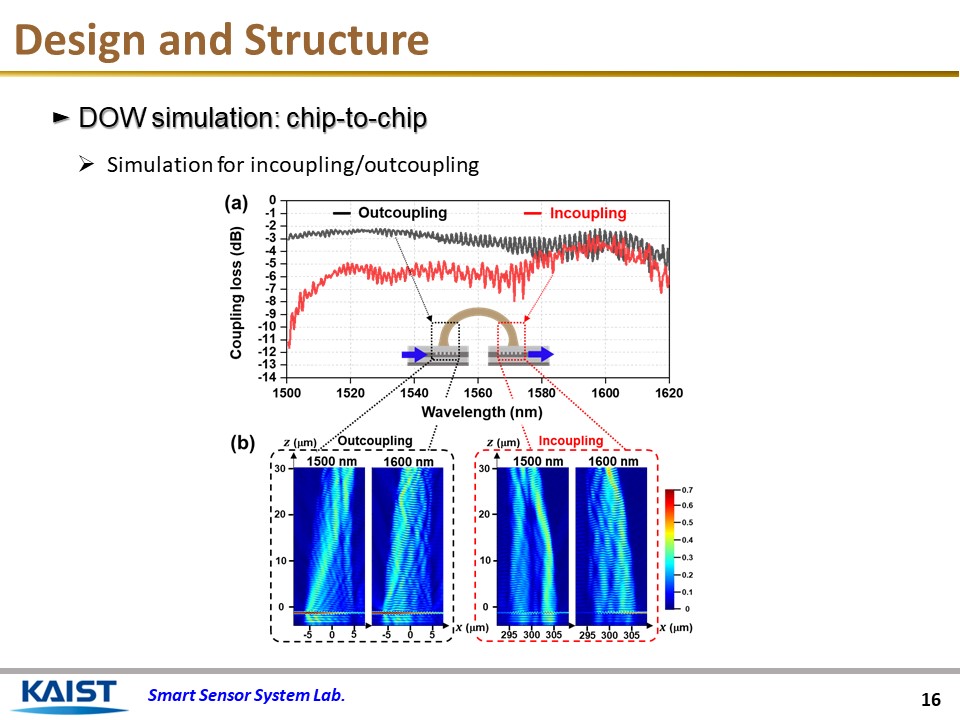 |
to further investigate the coupling through DOW.
We have separately analyzied the outcoupling and incoupling.
The outcoupling has large bandwidth since, the wire is multimode as you can see.
but, the incoupling has larger loss in short wavelength.
|
| ICACT20220159 Slide.17
[Big Slide]
|
Chrome Click!! |
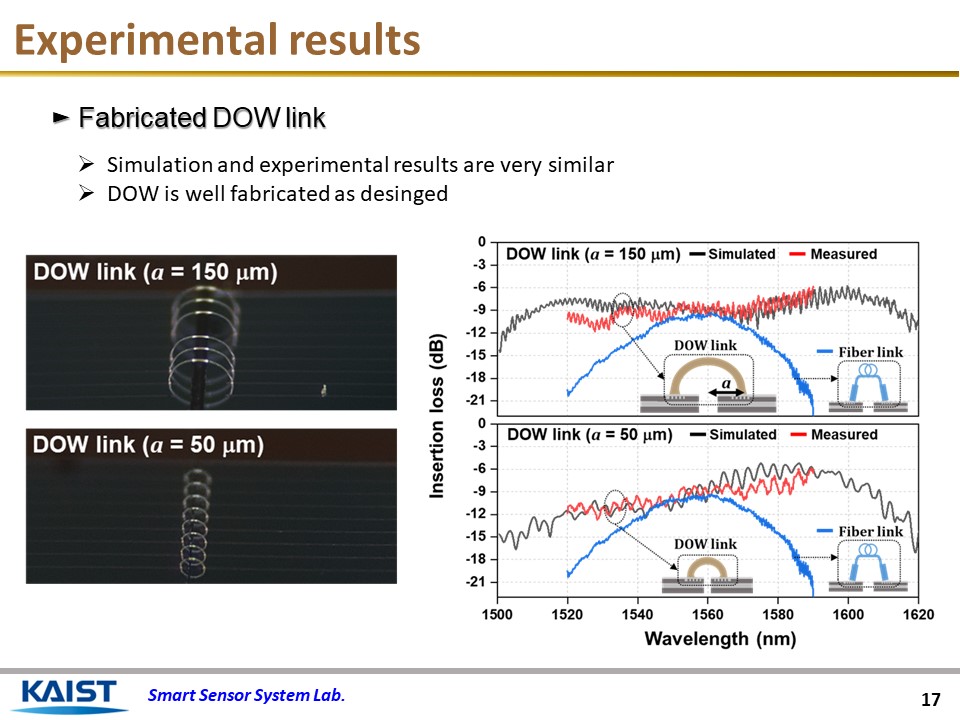 |
And for the fabrication, we have fabricated with two different chip distances of 300um and 100um
the experiment results were very similar with the simulation results, proving that the wire is well made
comparing to the fiber link, the DOW link has lower coupling loss and larger bandwidth.
|
| ICACT20220159 Slide.18
[Big Slide]
|
Chrome Click!! |
 |
And for further research, we will apply this DOW technology for fiber-to-chip and hybrid integration of lasers.
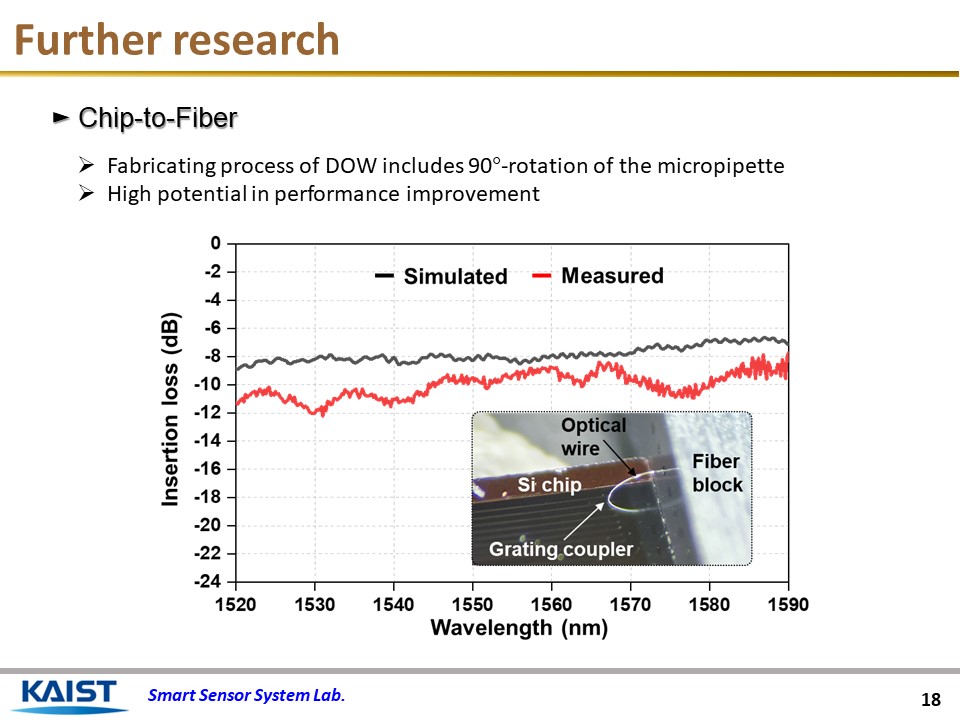
First, we have researched on fiber-to-chip coupling.
It had lower results than the simulation, since
the out-of-plane DOW bonding needs additional technique for rotating the micropipette.
In our current fabrication set-up the rotation of the micropipette is a little unstable.
but we are modifying the set-up and equipments..so in the near feature, the performance will be highly improved.
|
| ICACT20220159 Slide.19
[Big Slide]
|
Chrome Click!! |
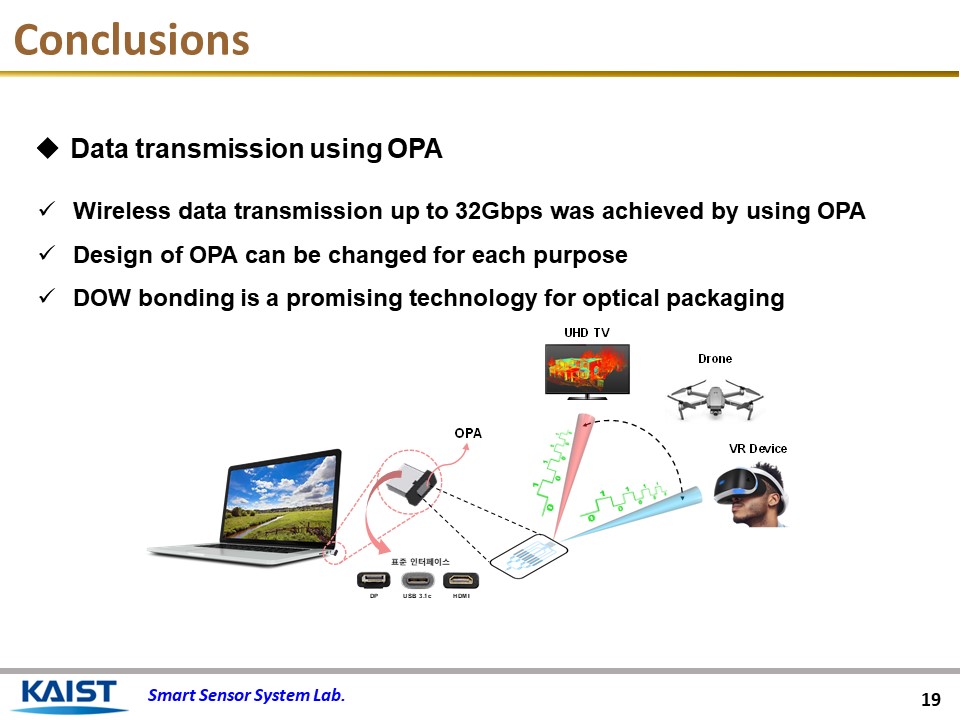 |
So in conclusion, by using OPA, we were able to achieve high data rate, 32Gbps wireless data transmission.
And this technology can be used as the picture shown.
It will replace many existing wires, making the hole system simpler.
It can be mainly used in Displays, Drons, VR technologys.
|
| ICACT20220159 Slide.20
[Big Slide]
|
Chrome Click!! |
 |
Thank you. |