 ICACT20220326 Slide.01
[Big Slide] |
Chrome  Click!! |
 |
Hi everybody, my name is James Tamgno kouawa. To carry out the research work that led to the presentation of this article, the team of the eINOV laboratory of the Ecole Supérieure Multinationale des Télécommunications (ESMT) of Dakar cooperated with the team of researchers from the Laboratoire d'Informatique, de Télécommunications et Applications (LITA) of the Ecole Supérieure Polytechnique (ESP) of Dakar. |
| ICACT20220326 Slide.02
[Big Slide]
|
Chrome Click!! |
 |
The objective of this work is to propose an algorithmic approach to deal with the problem of EIGRP routing in a communication network. This type of network is characterized by dynamic traffic conditions, which requires taking into account the QoS at the routing level. Therefore, any adaptive routing approach must be sufficiently responsive and robust to account for any changes in traffic conditions while minimizing end-to-end routing time. However, the effectiveness of this approach is highly dependent on load information. This information must be sufficient and relevant and at the same time reliably reflect the actual network load at the time of the routing decision.
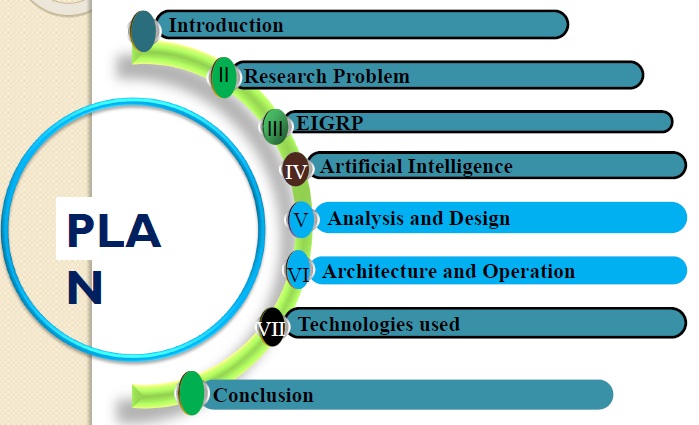
The Content of our presentation will focus on: |
| ICACT20220326 Slide.03
[Big Slide]
|
Chrome Click!! |
 |
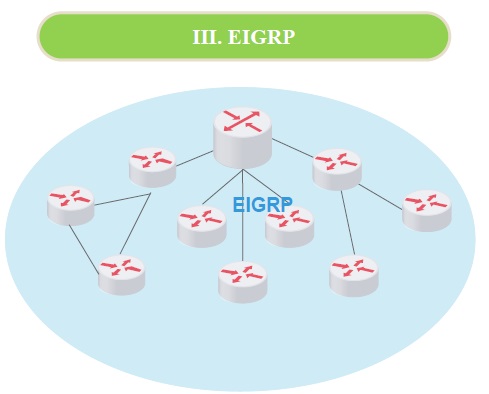
Enhanced Interior Gateway Routing Protocol (EIGRP) is an advanced distance-vector routing protocol that is used on a computer network for automating routing decisions and configuration. The protocol was designed by Cisco Systems as a proprietary protocol, available only on Cisco routers. Functionality of EIGRP was converted to an open standard in 2013[1] and was published with informational status as RFC 7868 in 2016.
EIGRP is used on a router to share routes with other routers within the same autonomous system. |
| ICACT20220326 Slide.04
[Big Slide]
|
Chrome Click!! |
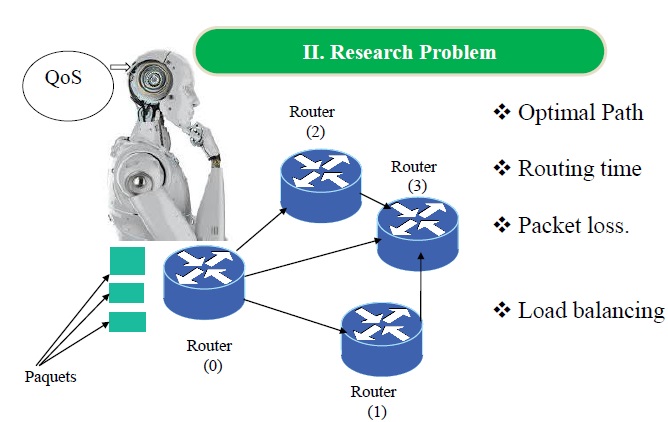 |
The objectives of routing with the EIGRP protocol are based on several principles:
Best path, QoS (time, loss, performance) and security.
|
| ICACT20220326 Slide.05
[Big Slide]
|
Chrome Click!! |
 |
Almost all routers contain a routing table that contains rules by which traffic is forwarded in a network. If the router does not contain a valid path to the destination, the traffic is discarded. EIGRP is a dynamic routing protocol by which routers automatically share route information. This eases the workload on a network administrator who does not have to configure changes to the routing table manually. In addition to the routing table, EIGRP uses the following tables to store information: Neighbor Table: The neighbor table keeps a record of the IP addresses of routers that have a direct physical connection with this router. Routers that are connected to this router indirectly, through another router, are not recorded in this table as they are not considered neighbors. Topology Table: The topology table stores routes that it has learned from neighbor routing tables. Unlike a routing table, the topology table does not store all routes, but only routes that have been determined by EIGRP. The topology table also records the metrics for each of the listed EIGRP routes, the feasible successor and the successors. |
| ICACT20220326 Slide.06
[Big Slide]
|
Chrome Click!! |
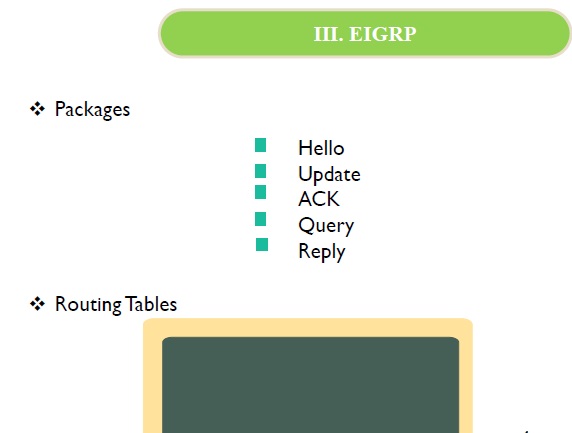 |
Les packages de EIGRP |
| ICACT20220326 Slide.07
[Big Slide]
|
Chrome Click!! |
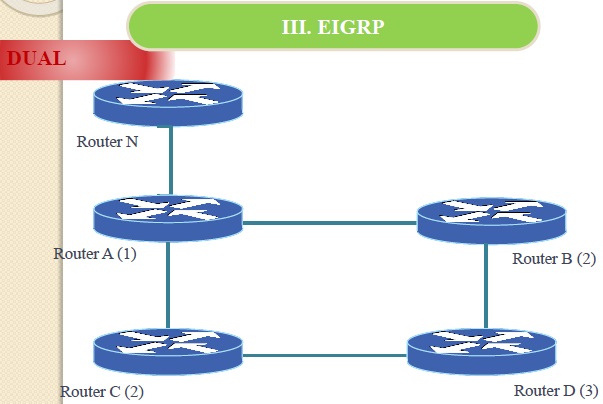 |
The diffusing update algorithm (DUAL) is the algorithm used by Cisco's EIGRP[1] routing protocol to ensure that a given route is recalculated globally whenever it might cause a routing loop. It was developed by J.J. Garcia-Luna-Aceves at SRI International.
Routing metric
The composite routing metric calculation uses five parameters (Bandwidth, Load, Delay, Reliability, MTU), so-called K values, K1 through K5. These act as multipliers or modifiers in the composite metric calculation. K1 is not equal to Bandwidth, |
| ICACT20220326 Slide.08
[Big Slide]
|
Chrome Click!! |
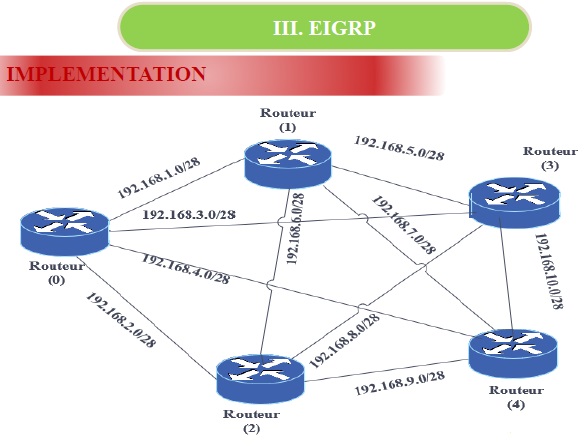 |
When a router running EIGRP is connected to another router also running EIGRP, information is exchanged between the two routers. They form a relationship, known as an adjacency. The entire routing table is exchanged between both routers at this time. After the exchange has completed, only differential changes are sent.
EIGRP is often considered a hybrid protocol because it also sends link state updates when link states change. |
| ICACT20220326 Slide.09
[Big Slide]
|
Chrome Click!! |
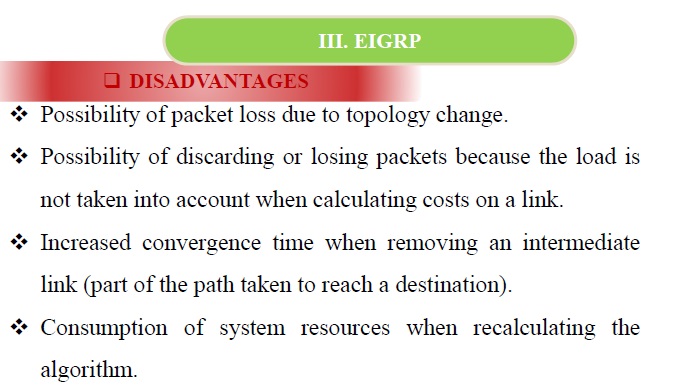 |
EIGRP has many disavantages |
| ICACT20220326 Slide.10
[Big Slide]
|
Chrome Click!! |
 |
Artificial intelligence (AI) is intelligence demonstrated by machines, as opposed to natural intelligence displayed by animals including humans. Leading AI textbooks define the field as the study of "intelligent agents": any system that perceives its environment and takes actions that maximize its chance of achieving its goals. |
| ICACT20220326 Slide.11
[Big Slide]
|
Chrome Click!! |
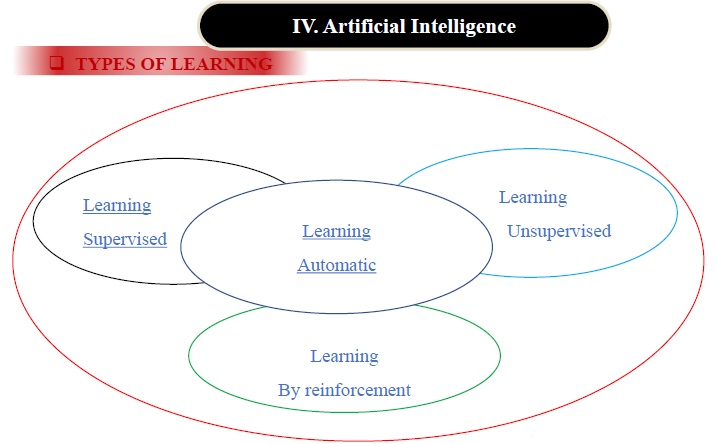 |
there are three general categories of learning that artificial intelligence (AI)/machine learning utilizes to actually learn. They are Supervised Learning, Unsupervised Learning and Reinforcement learning.
The teaching of machine learning models to make a series of decisions is known as reinforcement learning.
Unsupervised machine learning algorithms predict patterns from a dataset without using recognised or labelled outcomes as a guide.
Supervised learning is a form of machine learning in which machines are taught using well-labeled training data and then predict results using that data. |
| ICACT20220326 Slide.12
[Big Slide]
|
Chrome Click!! |
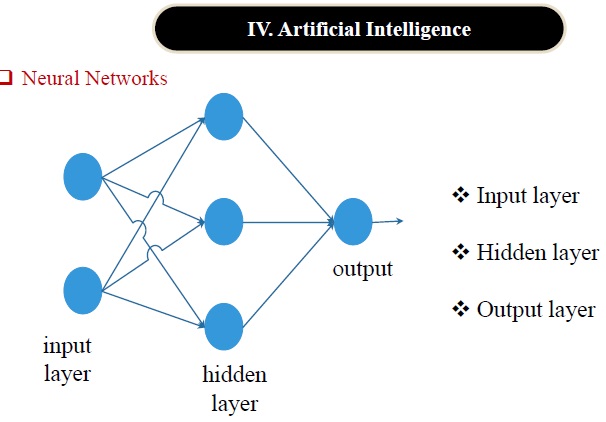 |
A neural network is a series of algorithms that endeavors to recognize underlying relationships in a set of data through a process that mimics the way the human brain operates.
Neural networks can adapt to changing input; so the network generates the best possible result without needing to redesign the output criteria.
The concept of neural networks, which has its roots in artificial intelligence, is swiftly gaining popularity in the development of trading systems. |
| ICACT20220326 Slide.13
[Big Slide]
|
Chrome Click!! |
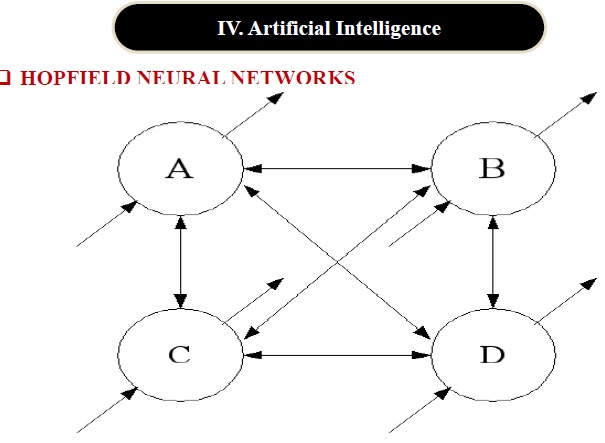 |
The Hopfield Neural Networks, invented by Dr John J. Hopfield consists of one layer of ‘n’ fully connected recurrent neurons. It is generally used in performing auto association and optimization tasks. It is calculated using a converging interactive process and it generates a different response than our normal neural nets. |
| ICACT20220326 Slide.14
[Big Slide]
|
Chrome Click!! |
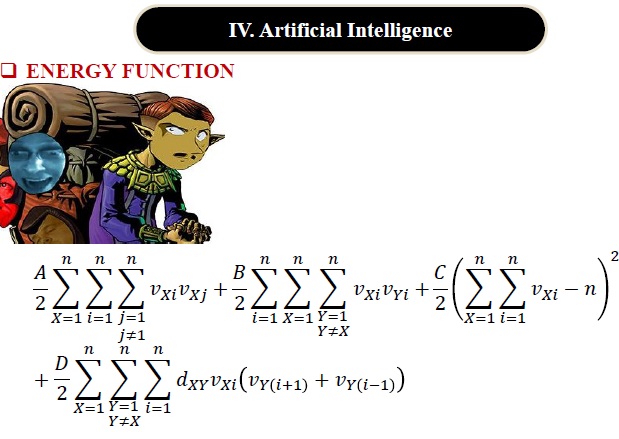 |
The Hopfield modified energy function is
If the neuron j undergoes a given activation change between two iterations, the corresponding energy variation changes.
The energy function is often used to specify the constraints that a network must satisfy in order to solve an optimization problem. |
| ICACT20220326 Slide.15
[Big Slide]
|
Chrome Click!! |
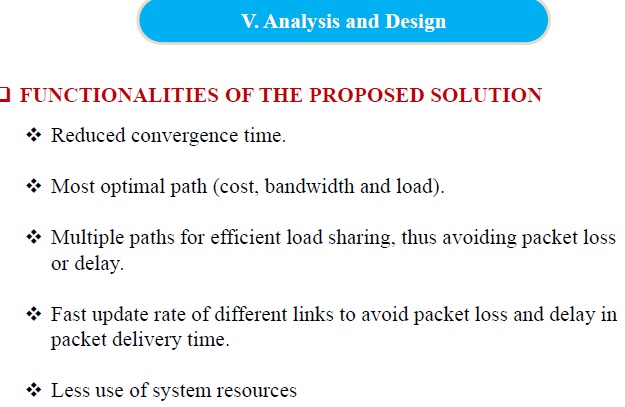 |
Features of the proposed solution to optimize routing in EIGRP based on AI |
| ICACT20220326 Slide.16
[Big Slide]
|
Chrome Click!! |
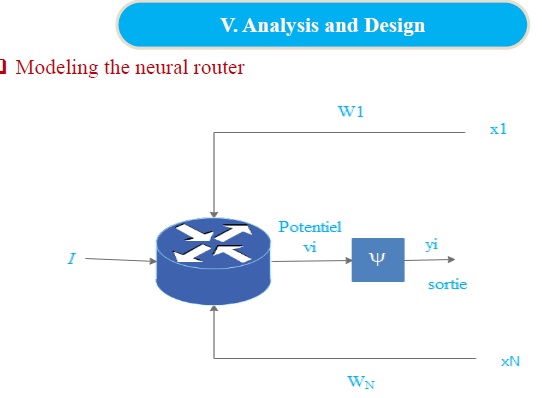 |
For the solution of our problem our solution is the following. This graphical model shows a little bit how our router will be represented with the different inputs like costs and other parameters like bandwidth and link load.
The inputs at the neuron level, namely the weights and the y's, will be the costs and the routers respectively. The input I will be the variable on which all our constraints will be set so that the algorithm can satisfy them. Subsequently, our desired operation will be performed which will be that of the input I on a summation of the different input properties such as the cost and the other properties of the input y which constitute our routers. From the source to the destination of the intended router, this operation will be performed along the way by the energy function. We will use a Hopfield method that uses a single activation at a time so all the routers along the way will execute the various parameters represented above until we reach the destination. At the destination of the target router we will have an energy function that contains the minimum cost (cost, bandwidth and capacity) for this path with the intermediary of an output expressed in a potential vi to which a transfer function is applied to allow the convergence towards an optimal solution. |
| ICACT20220326 Slide.17
[Big Slide]
|
Chrome Click!! |
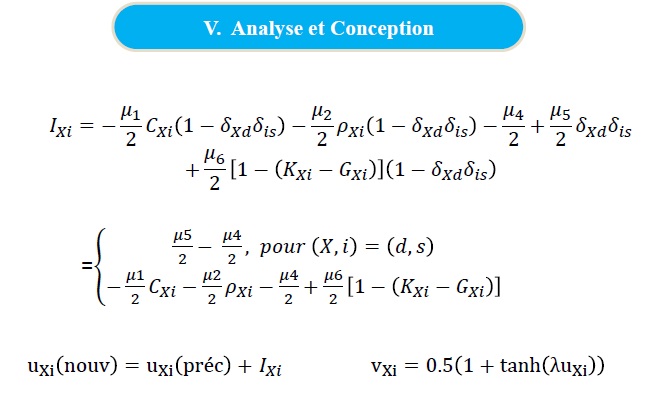 |
In a first step, the algorithm will run on each router by presenting the cost, the bandwidth and the delay as inputs at each router. Then a summation of the value I will be made on the various inputs at each router. After this summation, the final calculation will allow the activation of a neuron (link) to indicate to the current router which is the best path to reach a given destination.
So taking into account our requirements or constraints the value of the input I will be expressed as follows.
First we will use the same activation function as Hopfield's. The stability of the Liapunov network can be verified by observing the energy function describing the state of the network.
The coefficients C_xi are the costs of linking a router X to a router i.
The term μ_1 minimizes the total cost,
μ_2 prevents non-existent links from being included in the chosen path,
μ_3 is zero for each router in the valid path (the number of incoming links is equal to the number of outgoing links).
μ_4 forces the neural network state to converge to one of the stable states,
μ_5 is equal to zero when the output v_ds is equal to 1. This term is introduced to guarantee that the source and destination routers belong to the solution (the shortest path).
In the end, our input I can be expressed as follows to satisfy all our desired constraints. |
| ICACT20220326 Slide.18
[Big Slide]
|
Chrome Click!! |
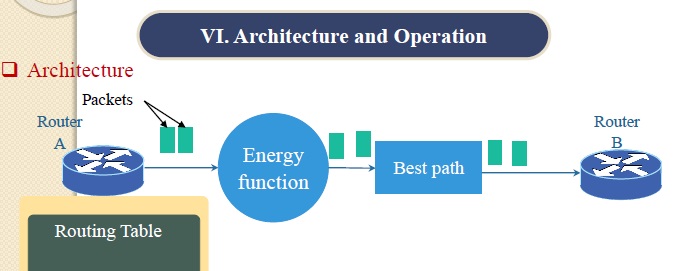 |
Diagram of the simulation |
| ICACT20220326 Slide.19
[Big Slide]
|
Chrome Click!! |
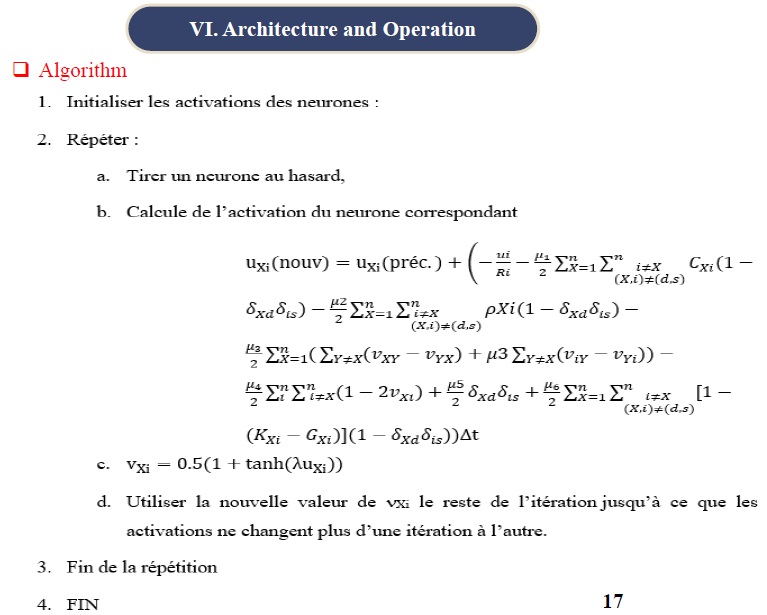 |
Programming algorithm:
execution step:
1:Begin
2:Repeat
a-pull a neuron at random
b-calculate the activation of the corresponding neuron
c-result: Vxi
d-use the new value of Vxi the rest of the iteration until the activations do not change from one iteration to another.
3:End repeat
4:End |
| ICACT20220326 Slide.20
[Big Slide]
|
Chrome Click!! |
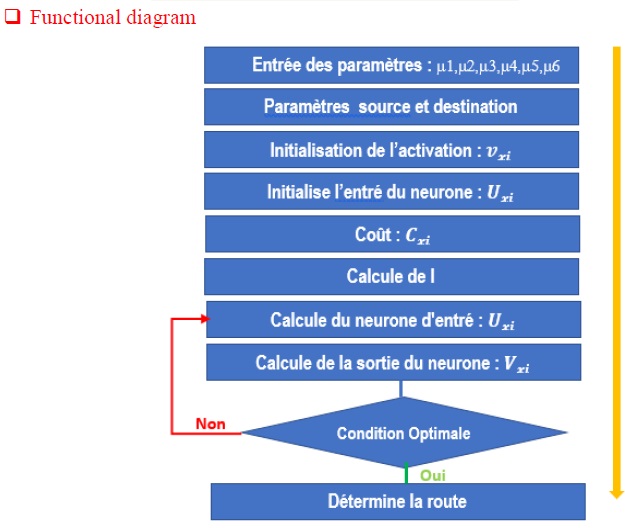 |
Illustration of the steps in the operation of the algorithm |
| ICACT20220326 Slide.21
[Big Slide]
|
Chrome Click!! |
 |
Tools used for implementation and testing
-eclipse
-JAVA
-GNS3 |
| ICACT20220326 Slide.22
[Big Slide]
|
Chrome Click!! |
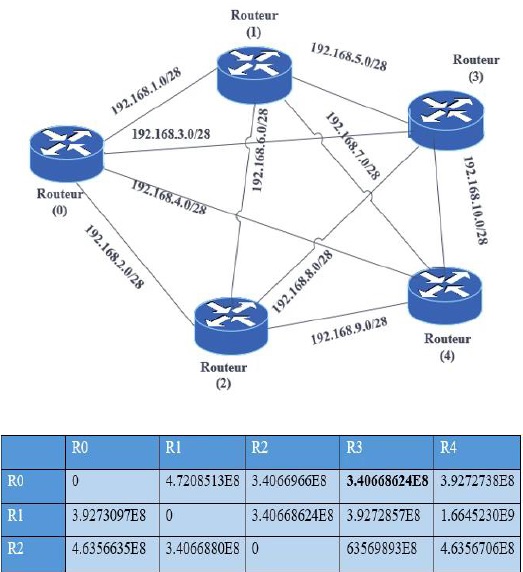 |
Comparative analysis of the proposed solution:
1/ EIGRP and its DUAL algorithm
ADVANTAGES:
-No Routing Loop
-Fast convergence time
-Multiple paths
DISADVANTAGES:
-No consideration of load (by default)
-Possibility of packet loss.
-Slow update time when deleting paths.
-Possibility of overloading a link.
-Greedy in use of system resources
2/ EIGRP and proposed neural network based algorithm
Observed ADVANTAGES:
-Load balancing
-Takes into account the load of a link.
-Avoids overloading a link.
-Reduction of packet loss.
-Fast convergence and update time.
-Can be adapted to any protocol.
-Less use of system resources
DISADVANTAGES noted:
-Many parameters to consider and adjust to get the best result.
|
| ICACT20220326 Slide.23
[Big Slide]
|
Chrome Click!! |
 |
Thank you for your listening |















