 ICACT20220332 Slide.01
[Big Slide]
[YouTube] |
Chrome  Click!! |
 |
Hello, everyone! I am very glad to have this opportunity to attend the conference. My name is Li Yiran, I am from Waseda University. The topic of my presentation is about An Efficient Topology-based Optimization Method of Broadband Absorbing Material. |
| ICACT20220332 Slide.02
[Big Slide]
[YouTube] |
Chrome Click!! |
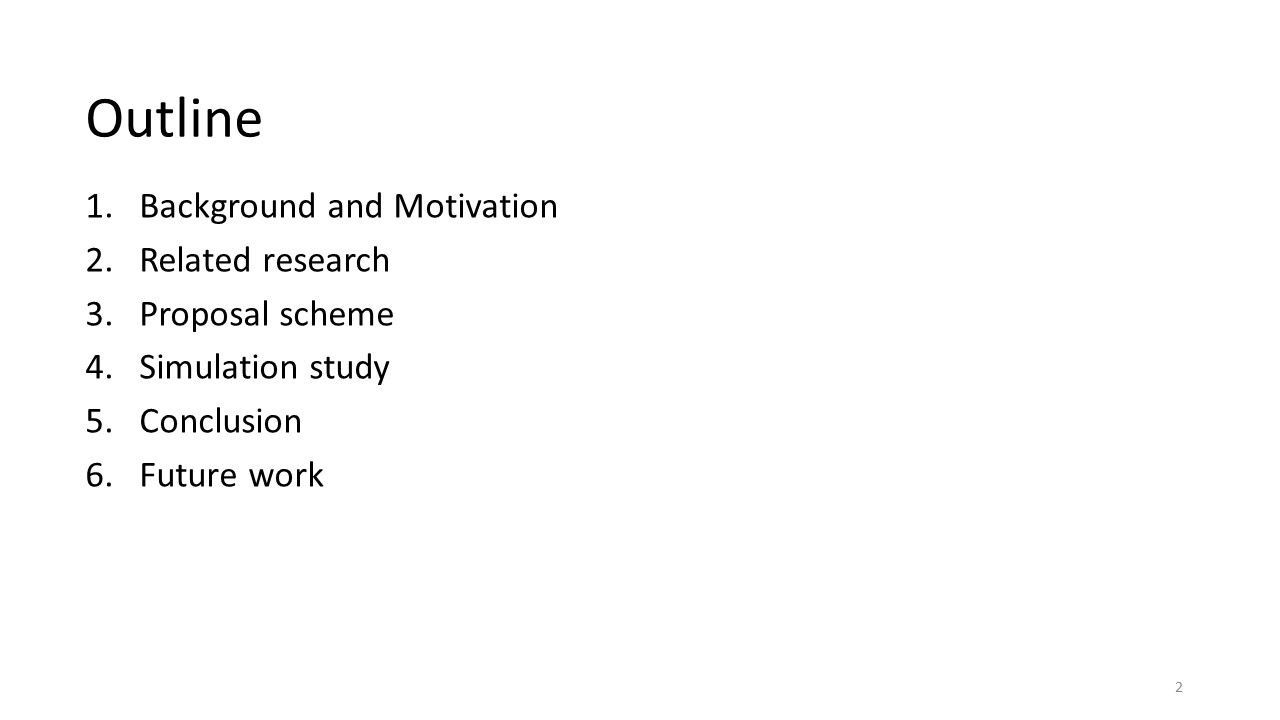 |
My presentation will mainly include these parts: Background and Motivation; Related research; Proposal scheme; Simulation study; Conclusion and Future work. |
| ICACT20220332 Slide.03
[Big Slide]
[YouTube] |
Chrome Click!! |
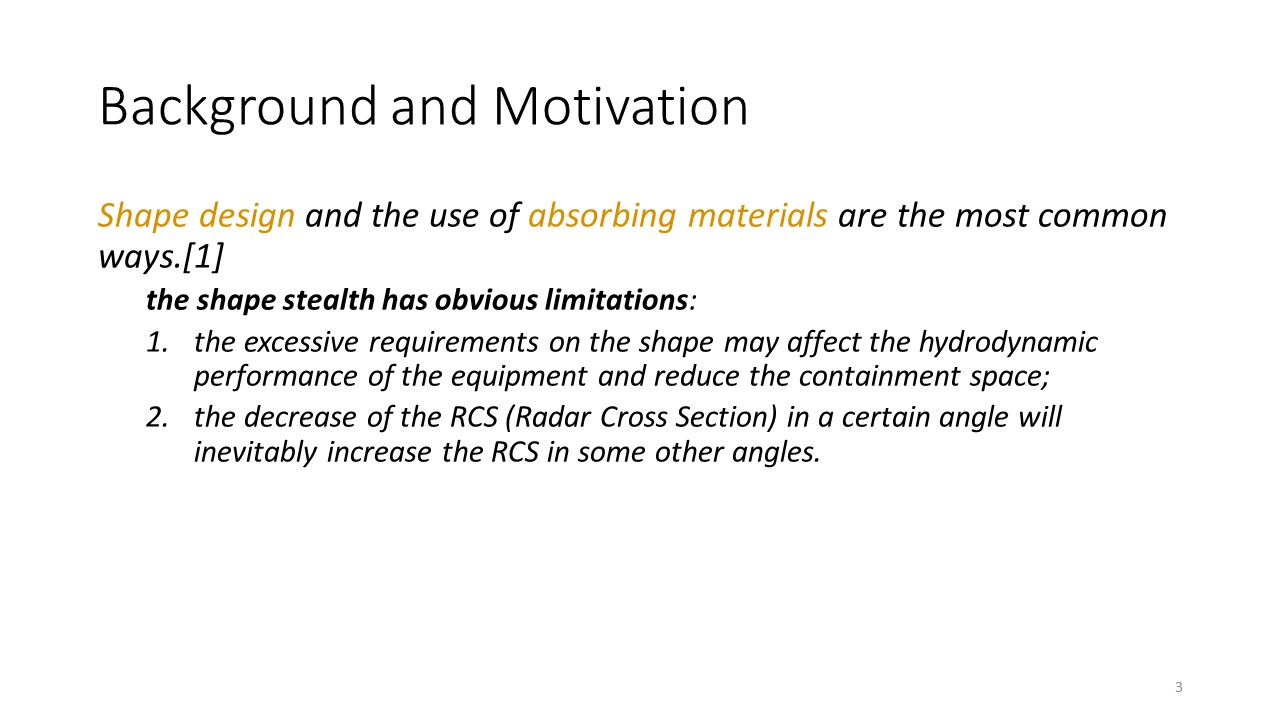 |
Currently, the anti-radar detection materials have achieved unprecedented development. Shape design and the use of absorbing materials are the most common ways. However, the shape design has obvious limitations: first, the excessive requirements on the shape may affect the hydrodynamic performance of the equipment and reduce the containment space; second, the decrease of the RCS (Radar Cross Section) in a certain angle will inevitably increase the RCS in some other angles. Therefore, if we want to fundamentally endow the target with excellent stealth performance must rely on materials intrinsic stealth function, that is the development of radar absorbing materials. |
| ICACT20220332 Slide.04
[Big Slide]
[YouTube] |
Chrome Click!! |
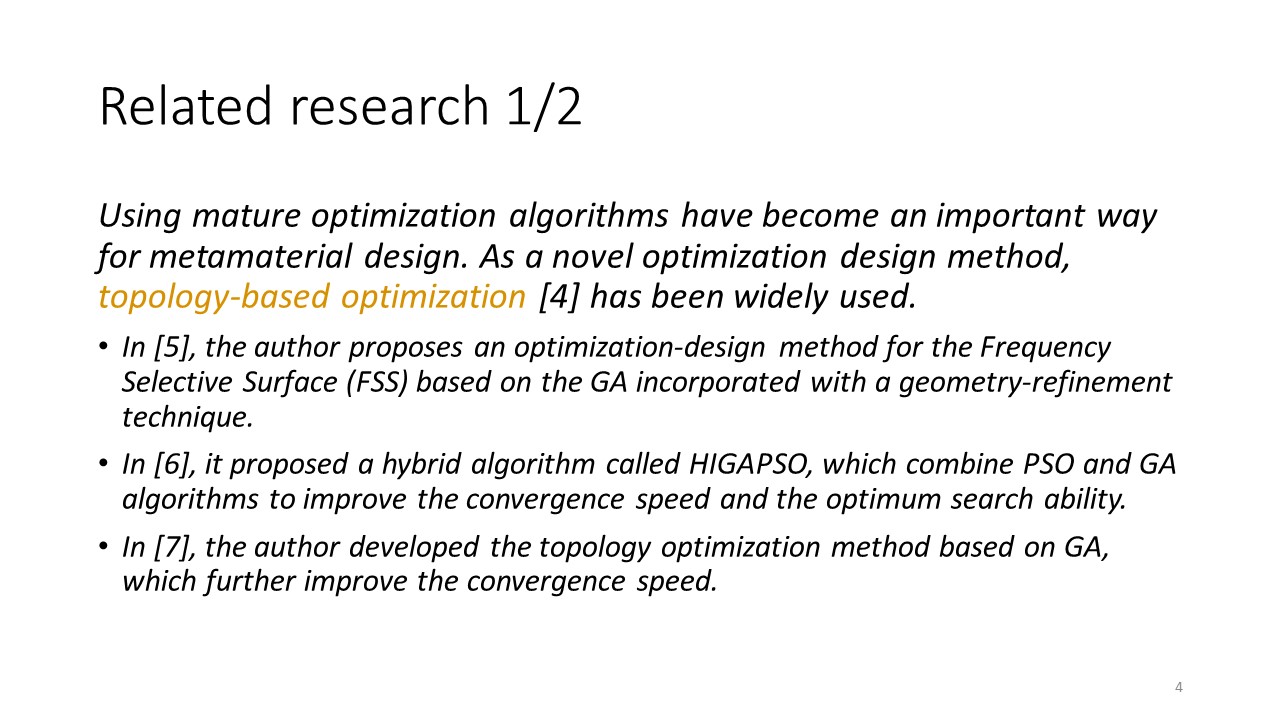 |
As shown in this ppt, there is already some research about using optimization algorithms for metamaterial design. As a novel optimization design method, topology-based optimization has been widely used. |
| ICACT20220332 Slide.05
[Big Slide]
[YouTube] |
Chrome Click!! |
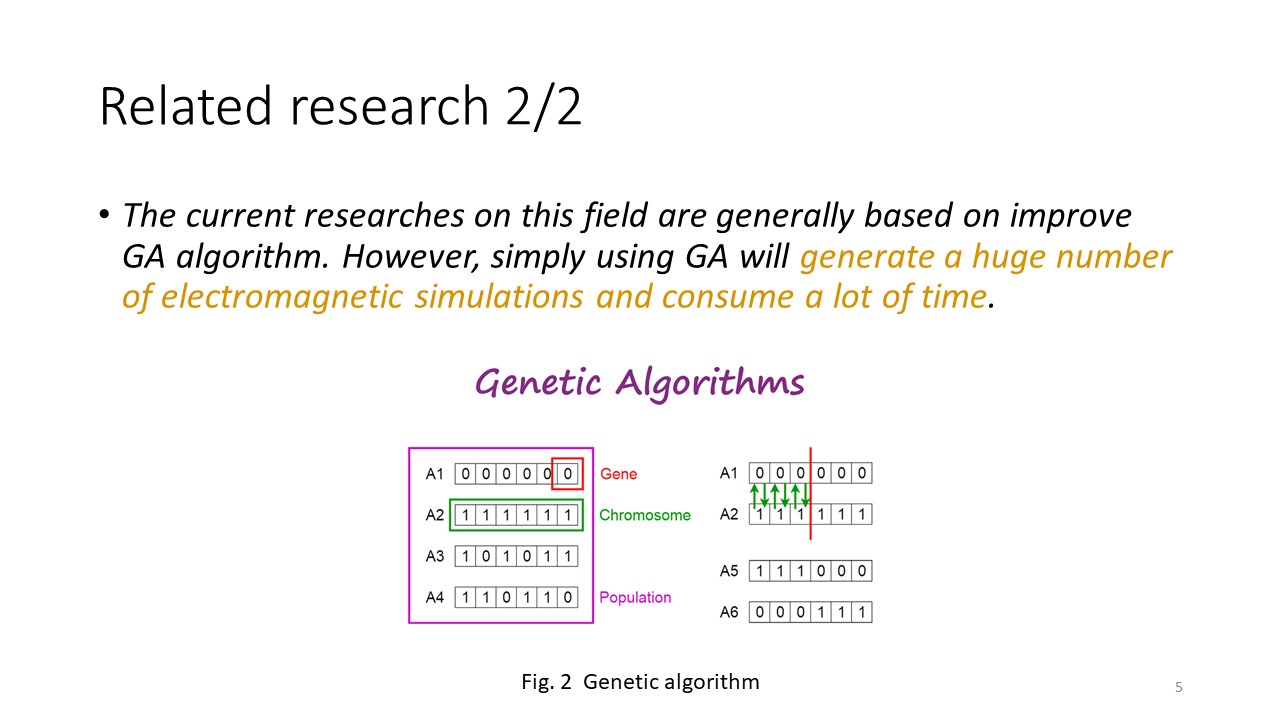 |
However, the current research on this field is generally based on improve GA algorithm. GA usually starts from a population of randomly generated individuals. In each generation, the fitness of every individual in the population is evaluated and the more fit individuals are selected. Commonly, the algorithm terminates when either a maximum number of generations has been produced, or a satisfactory fitness level has been reached for the population. Simply using GA will generate a huge number of electromagnetic simulations and consume a lot of time. |
| ICACT20220332 Slide.06
[Big Slide]
[YouTube] |
Chrome Click!! |
 |
This paper combined GA with the surrogate model to design an efficient topology-based optimization method. This method uses Kriging interpolation as the surrogate model instead of the electromagnetic model for the evaluation. By using the kind of mathematical model can greatly reduce the time required for simulation. |
| ICACT20220332 Slide.07
[Big Slide]
[YouTube] |
Chrome Click!! |
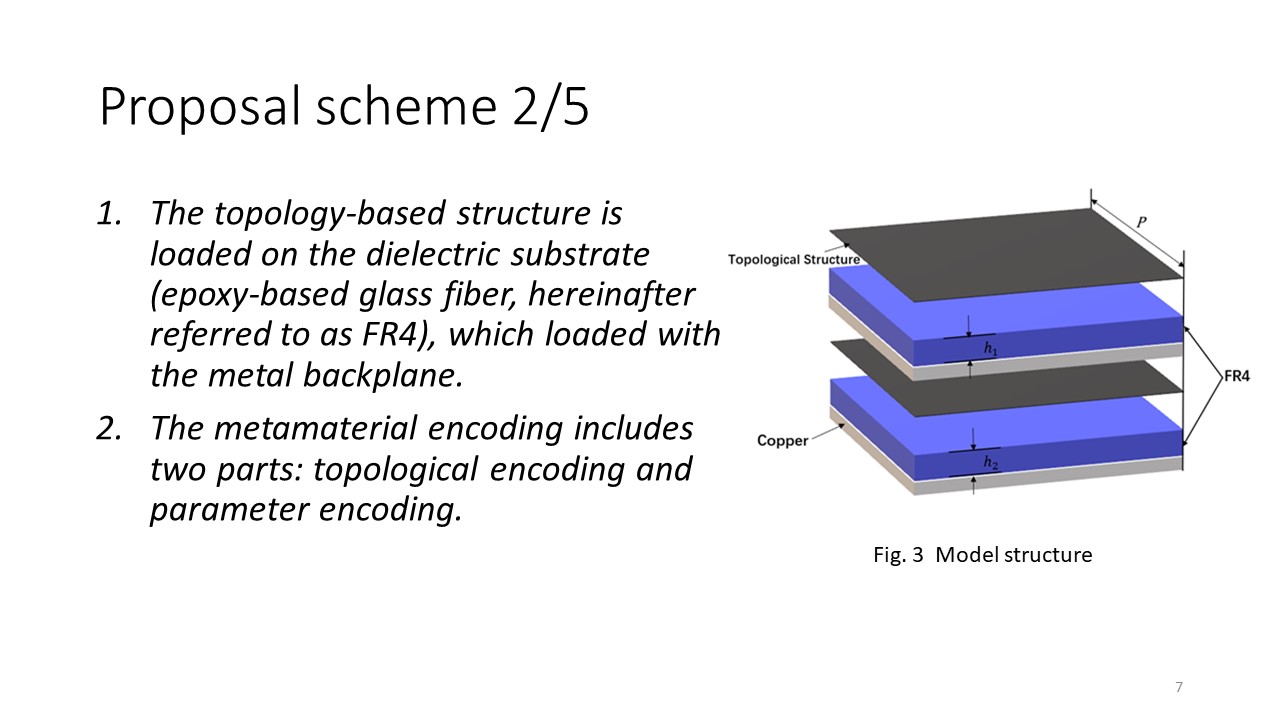 |
The topology-based structure is shown in this figure. The metamaterial encoding includes two parts: topological encoding and parameter encoding. |
| ICACT20220332 Slide.08
[Big Slide]
[YouTube] |
Chrome Click!! |
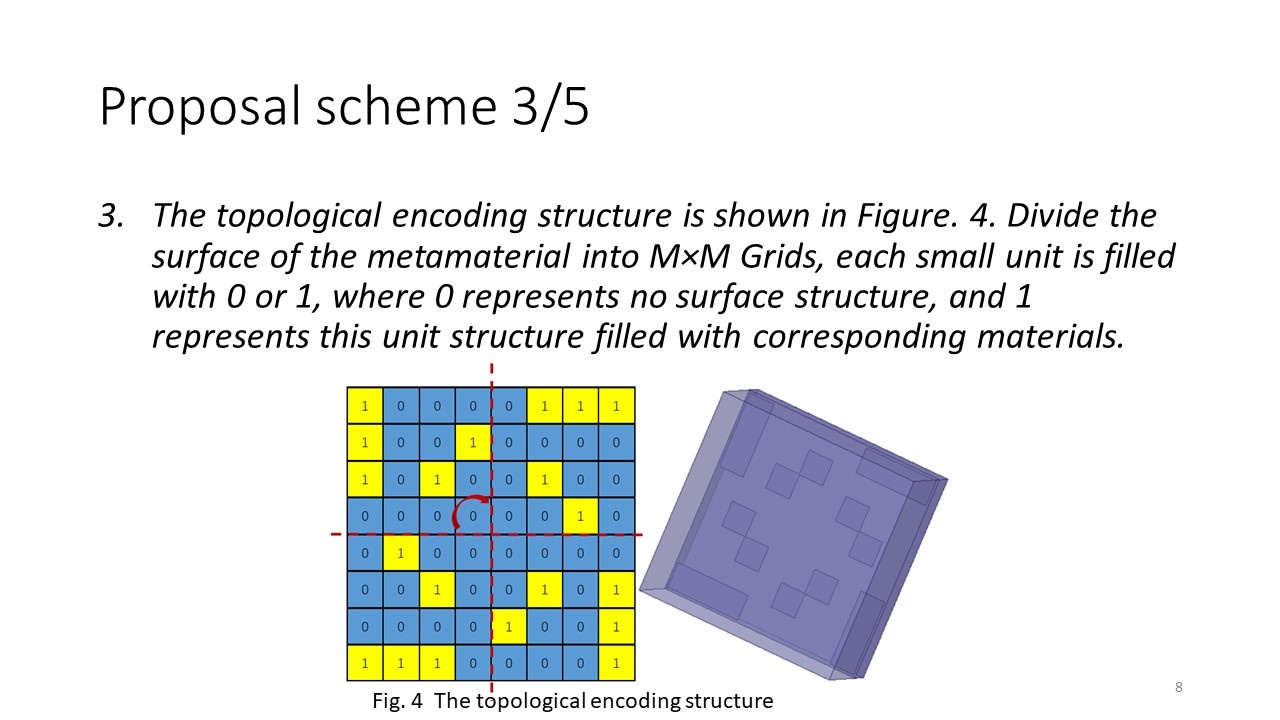 |
The topological encoding structure is shown in Figure. 4. Divide the surface of the metamaterial into M×M Grids, each small unit is filled with 0 or 1, where 0 represents no surface structure, and 1 represents this unit structure filled with corresponding materials. |
| ICACT20220332 Slide.09
[Big Slide]
[YouTube] |
Chrome Click!! |
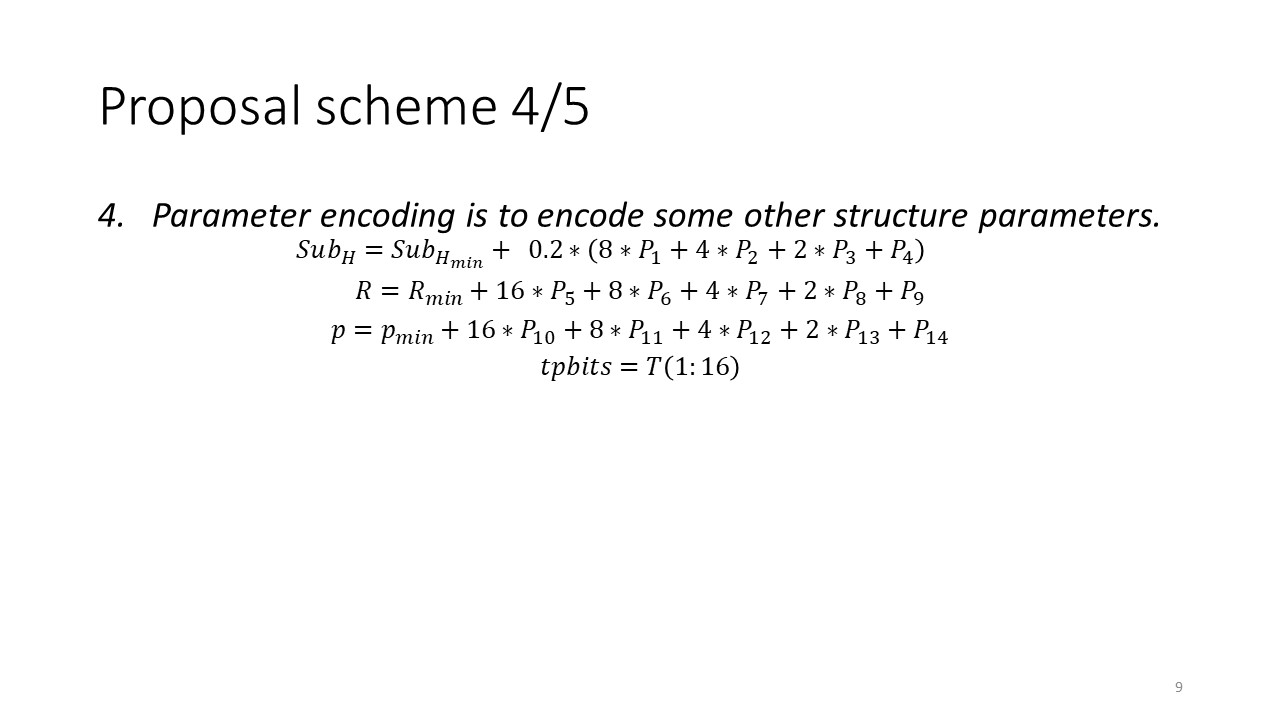 |
Parameter encoding is to encode some other structure parameters. The decoding process is shown in these equations, where Sub_H, R, p represents the binary code of the periodic unit structure, the thickness of the substrate and the square resistance of the resistor value respectively. |
| ICACT20220332 Slide.10
[Big Slide]
[YouTube] |
Chrome Click!! |
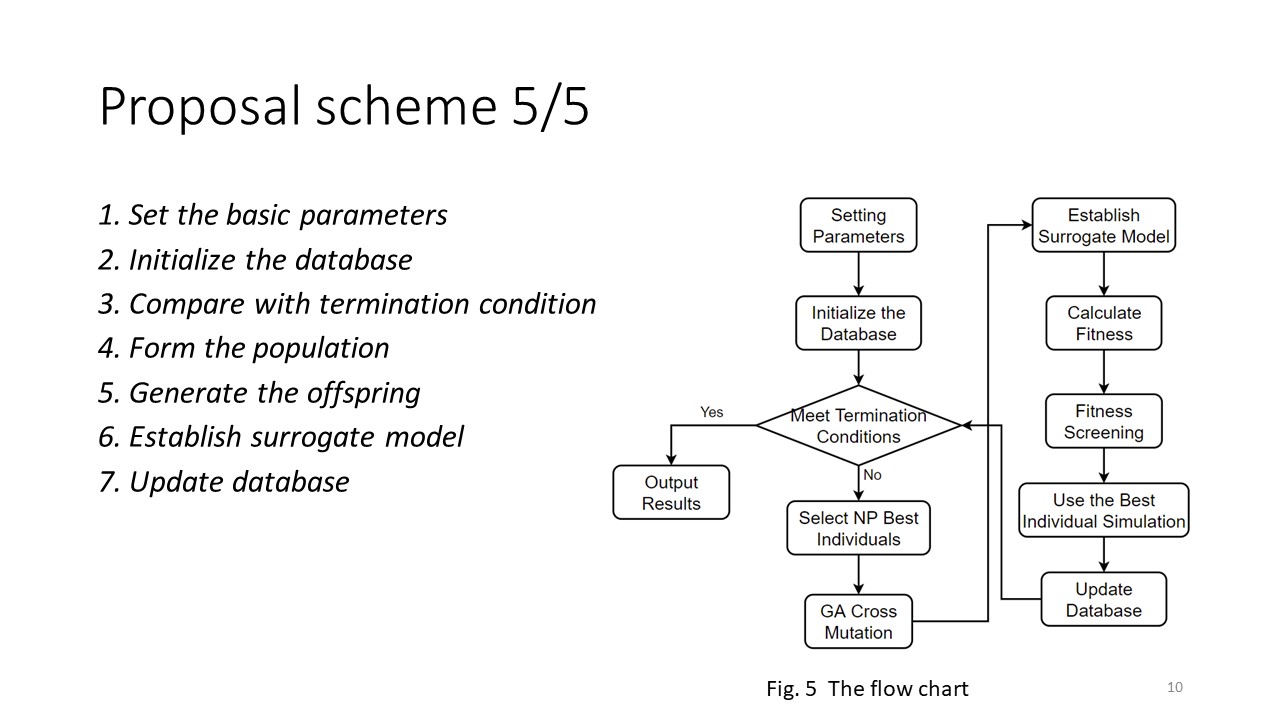 |
The whole process is like first set the basic parameters and initialize the database, compare it with termination condition; then form the population, generate the offspring; use the current data to establish surrogate model and update database. |
| ICACT20220332 Slide.11
[Big Slide]
[YouTube] |
Chrome Click!! |
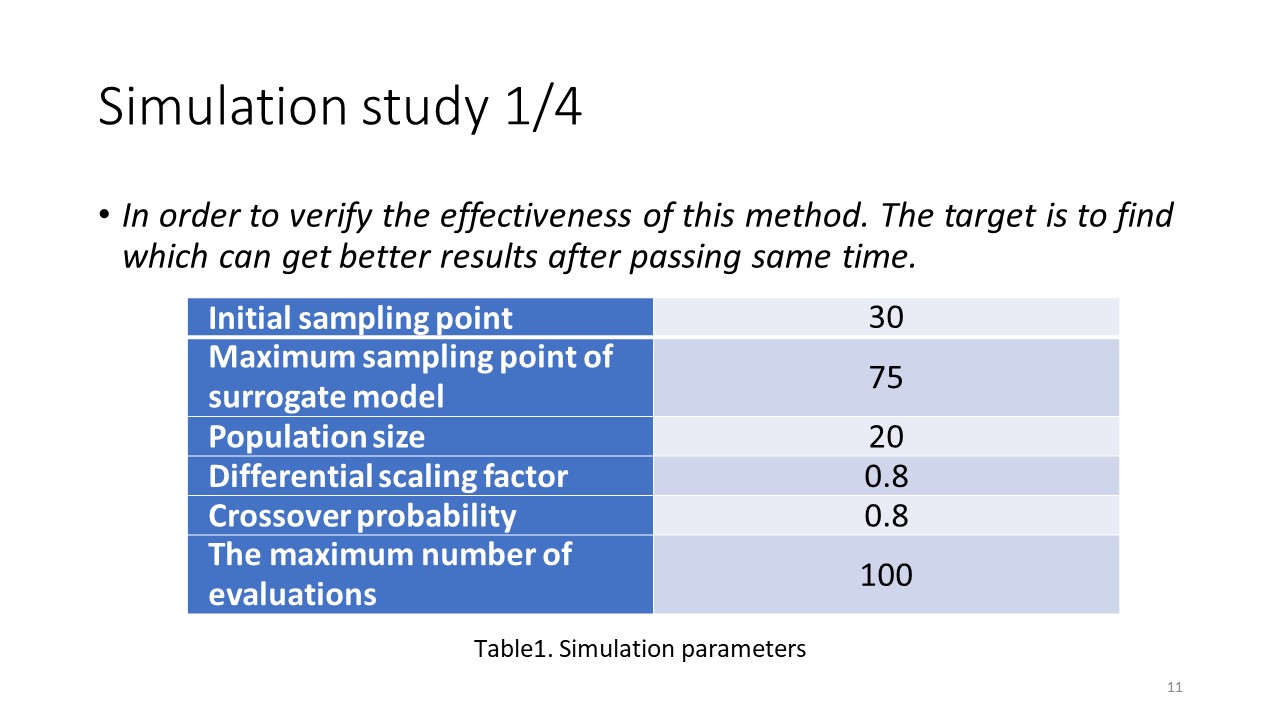 |
To verify the effectiveness of this method. The target is to find using GA and my proposal scheme which can get better results after passing same time. The parameters are setting as follow. |
| ICACT20220332 Slide.12
[Big Slide]
[YouTube] |
Chrome Click!! |
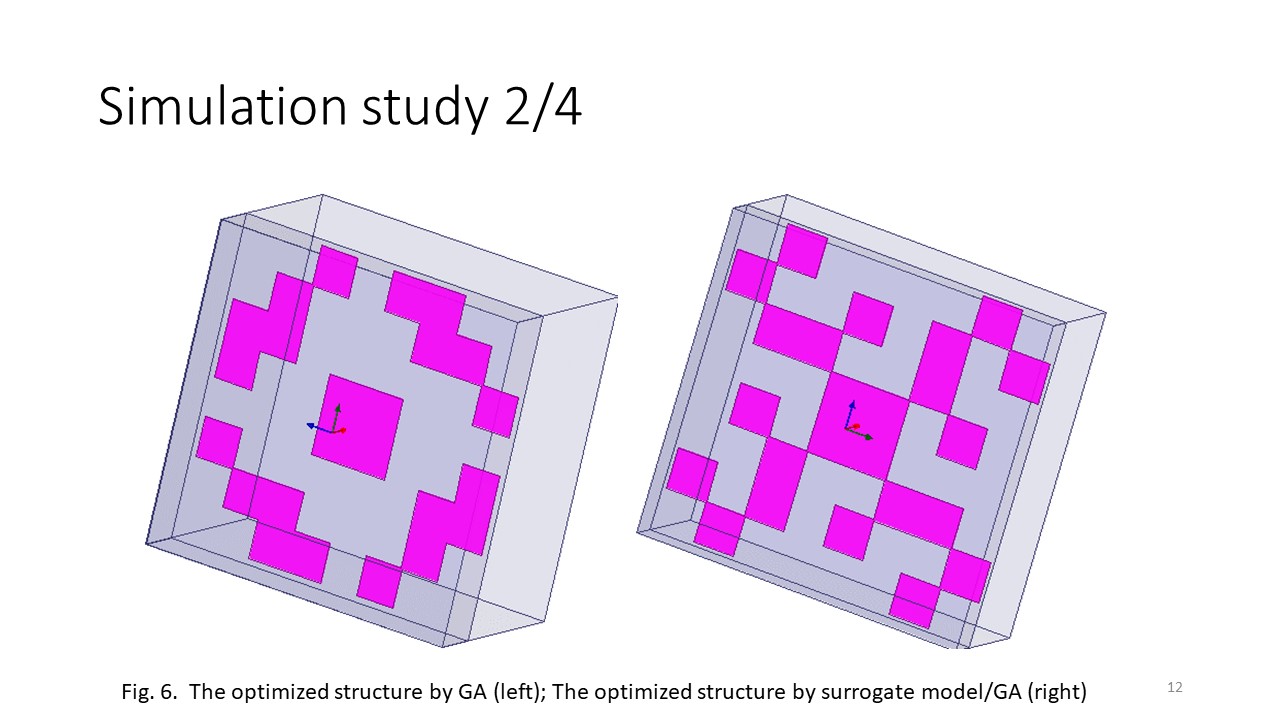 |
These figures are the final optimized structure. The right one is which optimized by GA and the left one is which optimized by Surrogate model/GA. |
| ICACT20220332 Slide.13
[Big Slide]
[YouTube] |
Chrome Click!! |
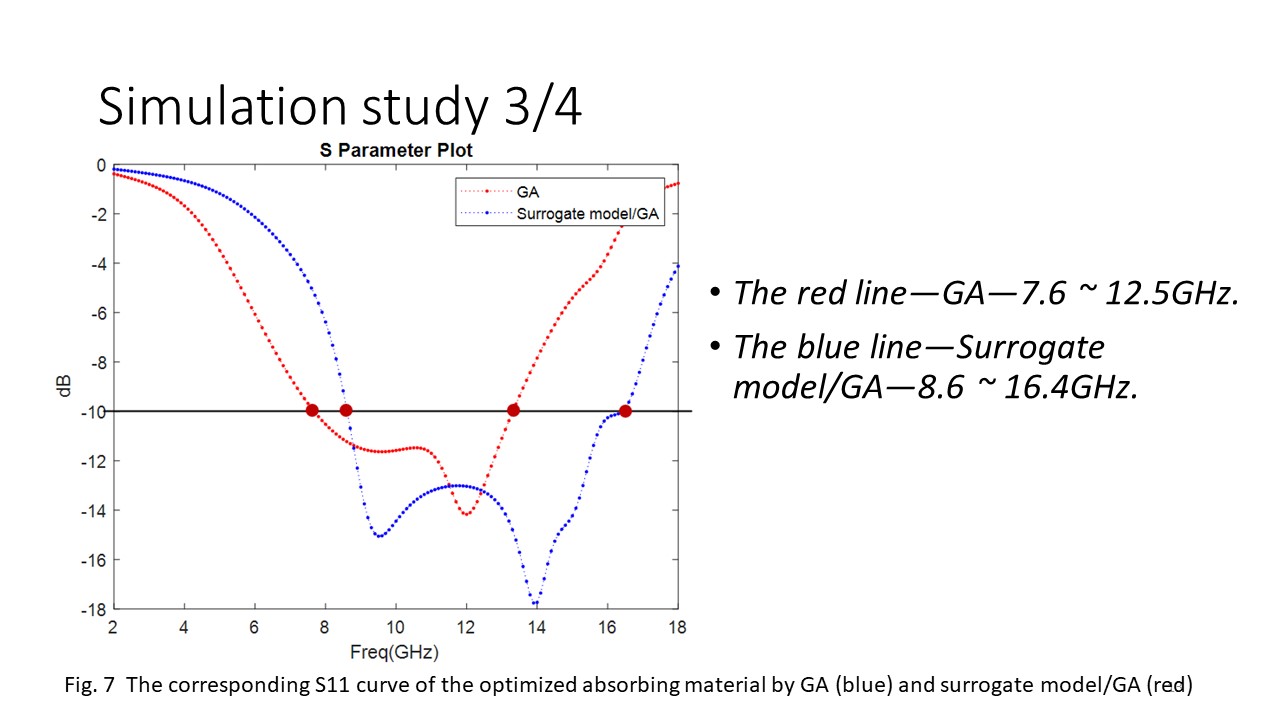 |
This figure shows the corresponding S11 curve of the final structure. The red line shows that the structure optimized by GA could absorb wave in 7.6 ~ 12.5GHz, while the blue line shows that the structure optimized by Surrogate model/GA could absorb wave in 8.6 ~ 16.4GHz. |
| ICACT20220332 Slide.14
[Big Slide]
[YouTube] |
Chrome Click!! |
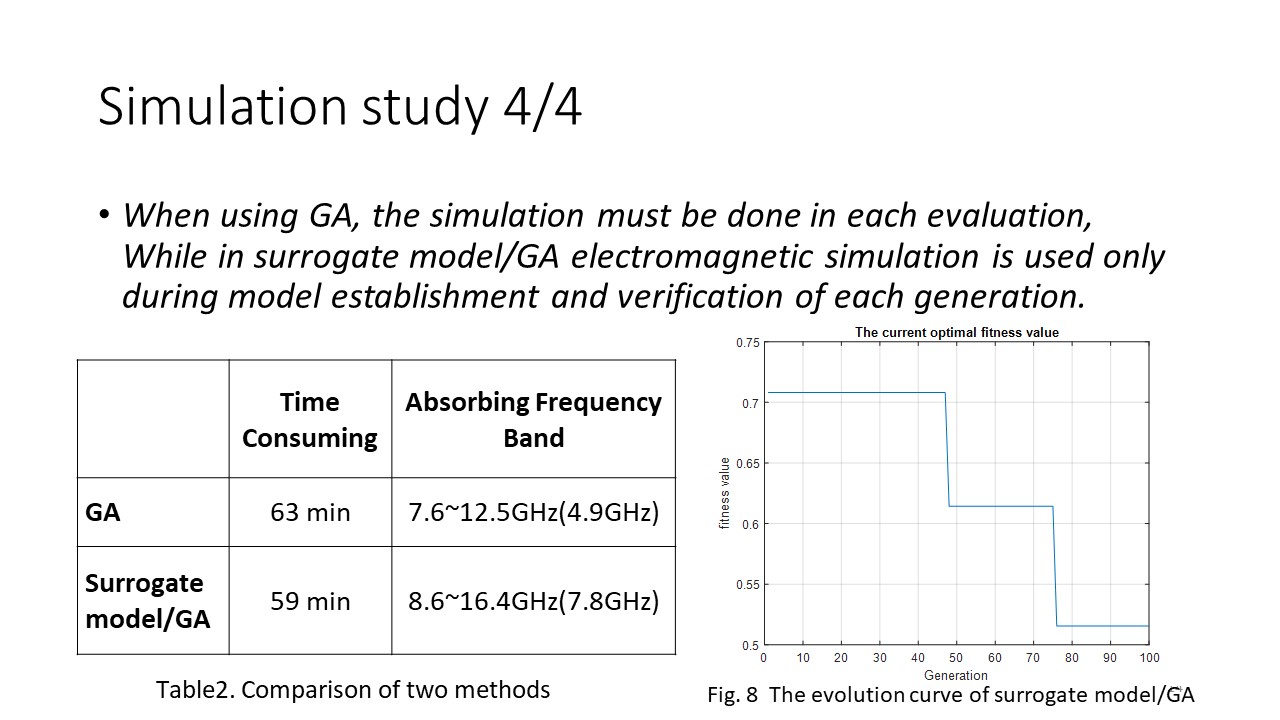 |
That's because when using GA, the simulation must be done in each calculation. While in surrogate model/GA electromagnetic simulation is used only during model establishment and verification of each generation. It shown in Fig. 5 the algorithm has found the best design parameters in the 76th generation. |
| ICACT20220332 Slide.15
[Big Slide]
[YouTube] |
Chrome Click!! |
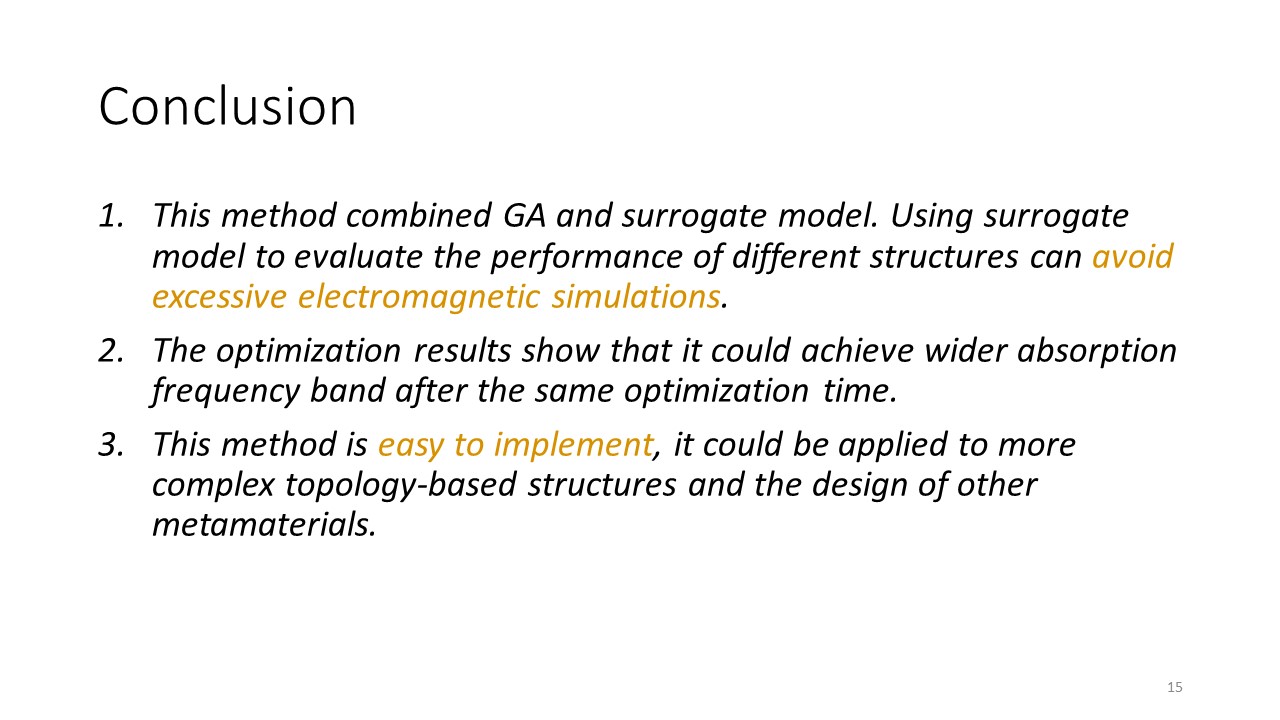 |
We move to the part of conclusion. By combining GA and surrogate model can avoid excessive electromagnetic simulations. The optimization results proves that it could achieve wider absorption frequency band after the same optimization time. Moreover, it could be applied to more complex topology-based structures and other metamaterials. |
| ICACT20220332 Slide.16
[Big Slide]
[YouTube] |
Chrome Click!! |
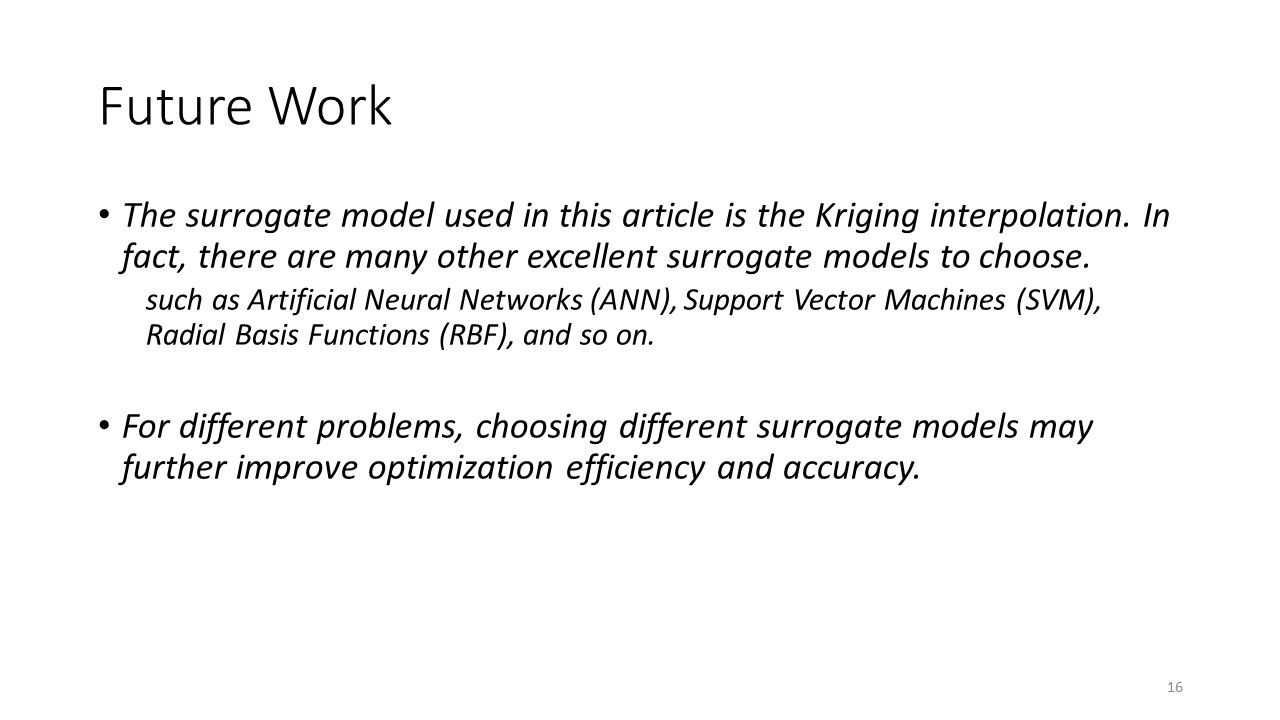 |
Now, we come to the last part —future work. The surrogate model used in this article is the Kriging interpolation. In fact, there are many other excellent surrogate models to choose. For different problems, choosing different surrogate models may further improve optimization efficiency and accuracy. |
| ICACT20220332 Slide.17
[Big Slide]
[YouTube] |
Chrome Click!! |
 |
That’s all for my presentation. If you have any question, please feel free to contact me. Thank you! |















