 ICACT20230033 Slide.01
[Big Slide]
[YouTube] |
Chrome  Click!! |
 |
The topic of my speech today is A Survey of Data Center Network Topology Structure
|
| ICACT20230033 Slide.02
[Big Slide]
[YouTube] |
Chrome Click!! |
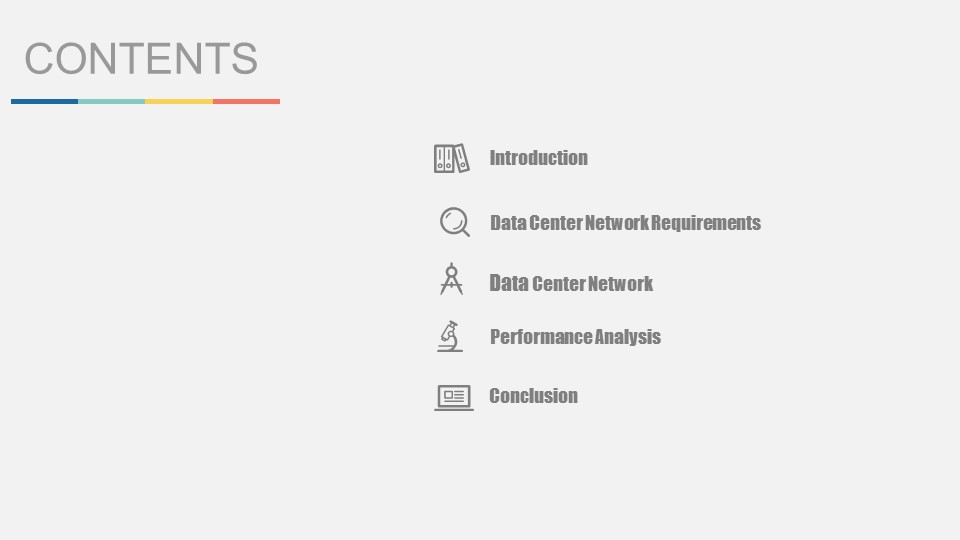 |
This article is divided into five parts,introduction,introduction,data center network requirements
,data center network,performance analysis and conclusion.
|
| ICACT20230033 Slide.03
[Big Slide]
[YouTube] |
Chrome Click!! |
 |
This section is introduction.
|
| ICACT20230033 Slide.04
[Big Slide]
[YouTube] |
Chrome Click!! |
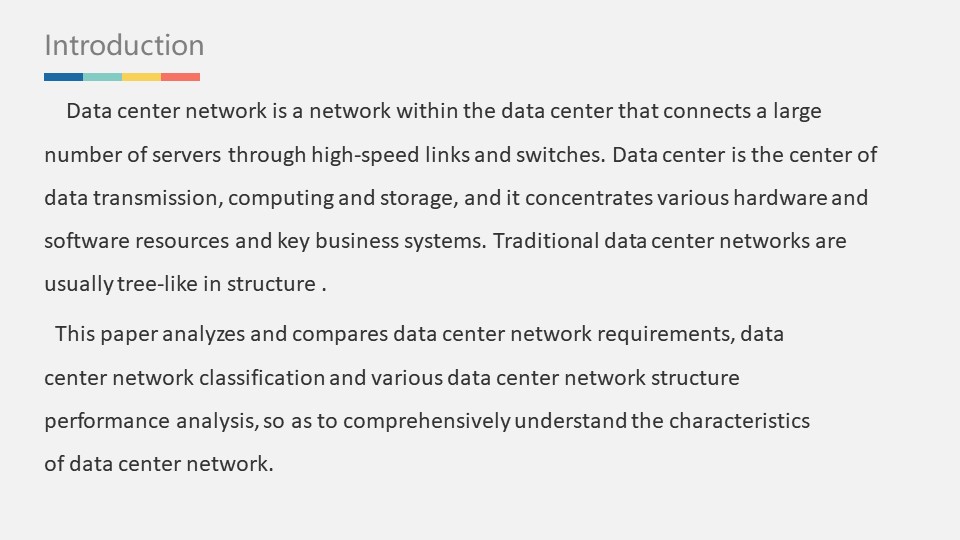 |
Data center network is a network within the data center that connects a large number of servers through high-speed links and switches. Data center is the center of data transmission, computing and storage, and it concentrates various hardware and software resources and key business systems. Traditional data center networks are usually tree-like in structure .
|
| ICACT20230033 Slide.05
[Big Slide]
[YouTube] |
Chrome Click!! |
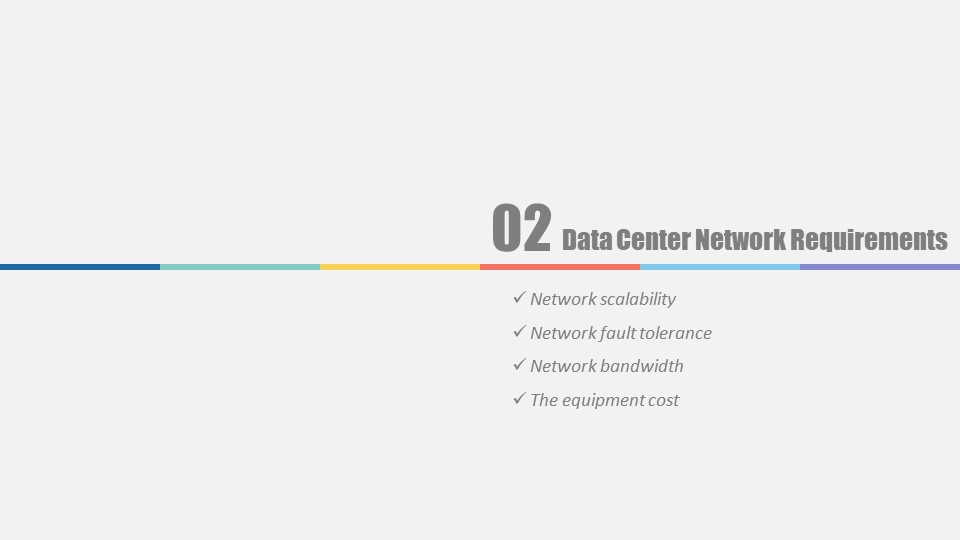 |
The second section is Data Center Network Requirements.
|
| ICACT20230033 Slide.06
[Big Slide]
[YouTube] |
Chrome Click!! |
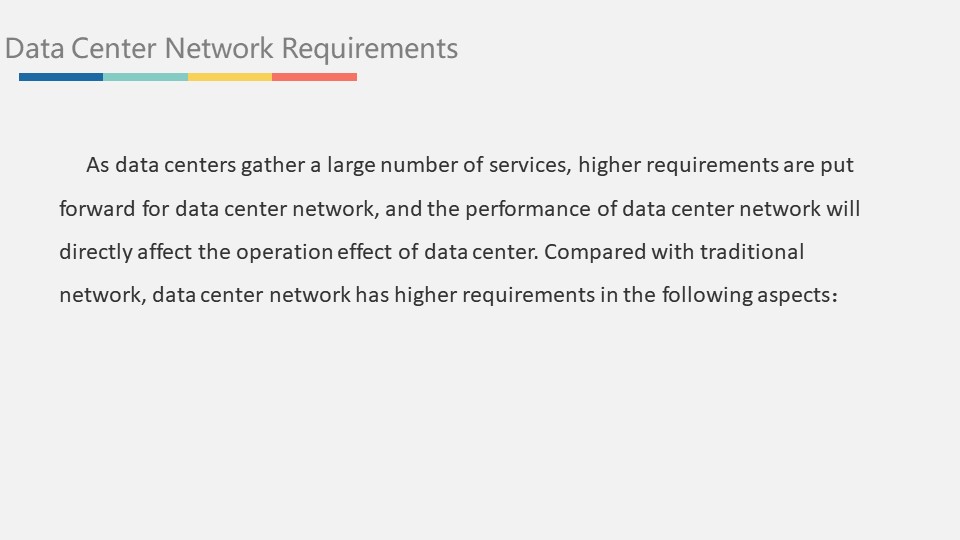 |
As data centers gather a large number of services, higher requirements are put forward for data center network, and the performance of data center network will directly affect the operation effect of data center. Compared with traditional network, data center network has higher requirements in the following aspects£º
|
| ICACT20230033 Slide.07
[Big Slide]
[YouTube] |
Chrome Click!! |
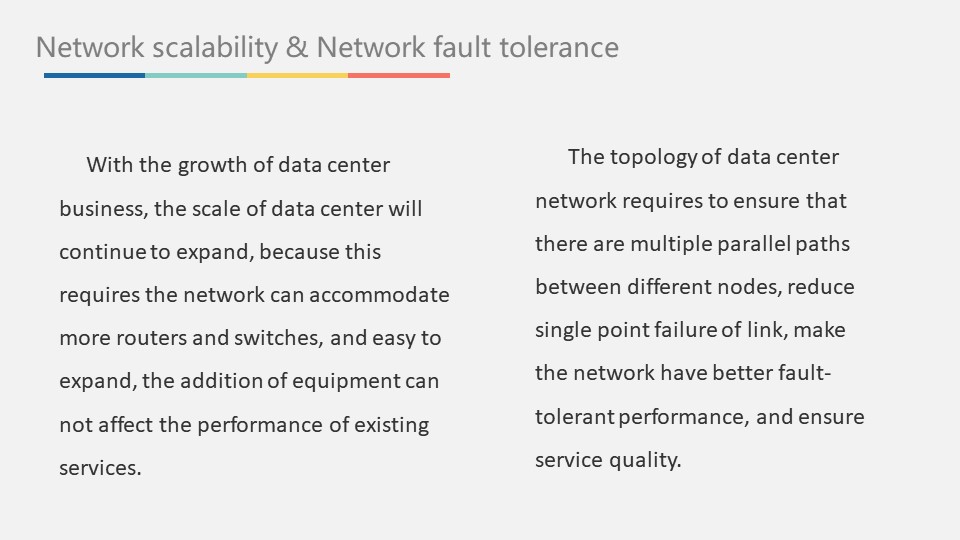 |
Network scalability & Network fault tolerance
|
| ICACT20230033 Slide.08
[Big Slide]
[YouTube] |
Chrome Click!! |
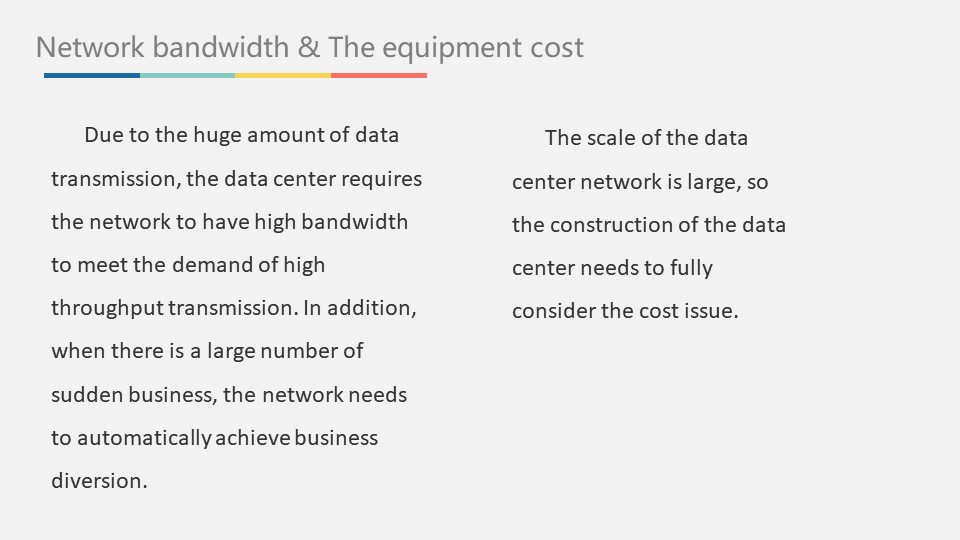 |
Network bandwidth & The equipment cost
|
| ICACT20230033 Slide.09
[Big Slide]
[YouTube] |
Chrome Click!! |
 |
This section is Data Center Network.
|
| ICACT20230033 Slide.10
[Big Slide]
[YouTube] |
Chrome Click!! |
 |
It is usually divided into two levels or three levels to deploy, in more traditional root tree structure, servers are connected to the switches on the edge level, boundary level switches to connect to the aggregation level switch or directly connected to the core level switches, the aggregation level switches connected to several core level switches, then through the core level switches connected to the Internet.
|
| ICACT20230033 Slide.11
[Big Slide]
[YouTube] |
Chrome Click!! |
 |
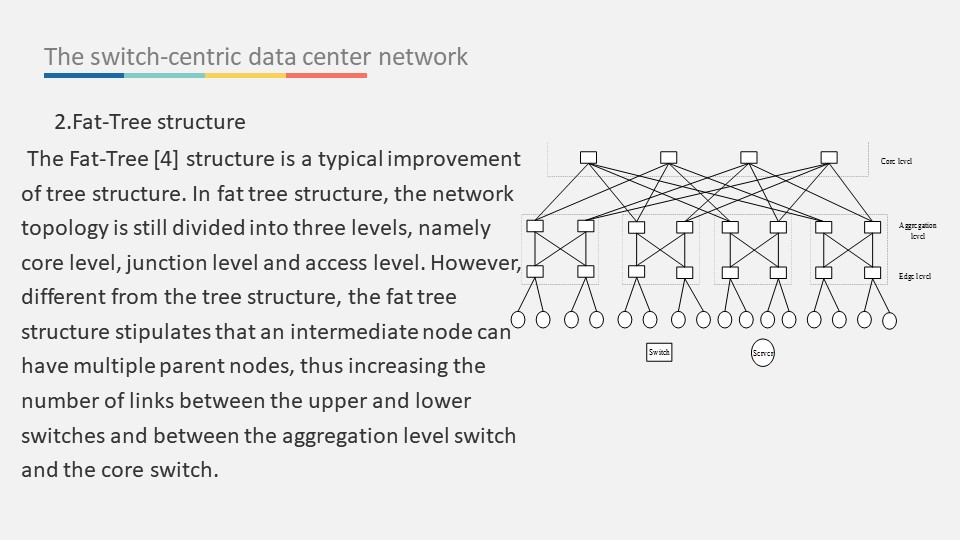
The Fat-Tree structure is a typical improvement of tree structure. In fat tree structure, the network topology is still divided into three levels, namely core level, junction level and access level. However, different from the tree structure, the fat tree structure stipulates that an intermediate node can have multiple parent nodes, thus increasing the number of links between the upper and lower switches and between the aggregation level switch and the core switch.
|
| ICACT20230033 Slide.12
[Big Slide]
[YouTube] |
Chrome Click!! |
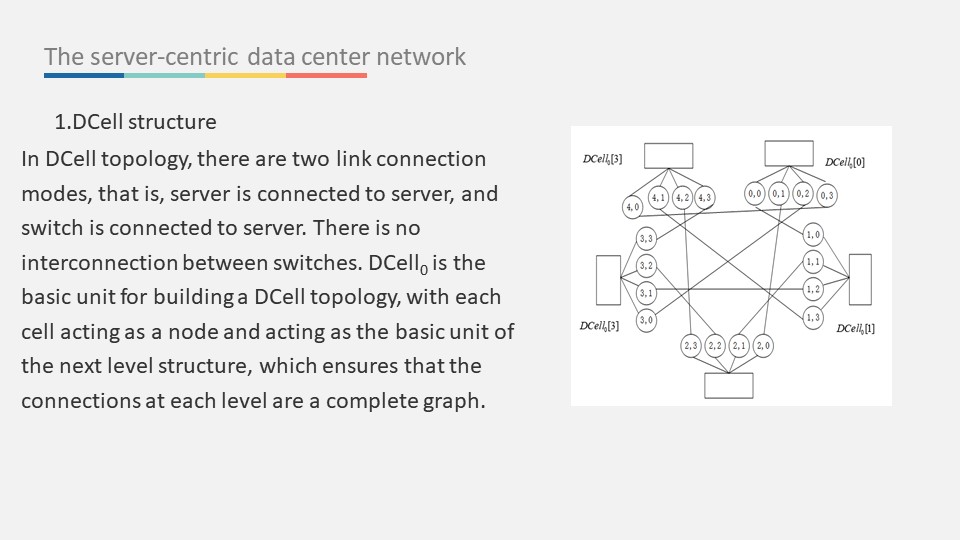 |
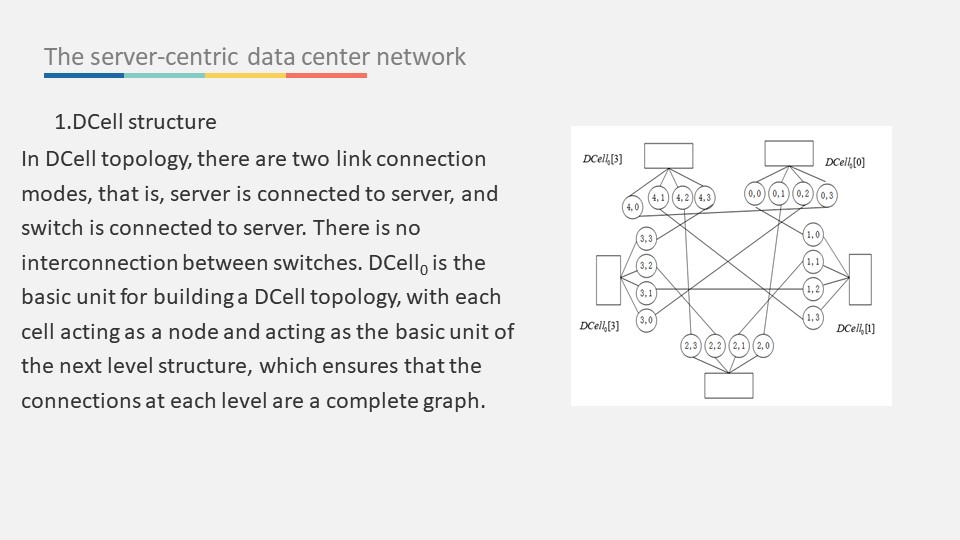
In DCell topology, there are two link connection modes, that is, server is connected to server, and switch is connected to server. There is no interconnection between switches. DCell0 is the basic unit for building a DCell topology, with each cell acting as a node and acting as the basic unit of the next level structure, which ensures that the connections at each level are a complete graph.
|
| ICACT20230033 Slide.13
[Big Slide]
[YouTube] |
Chrome Click!! |
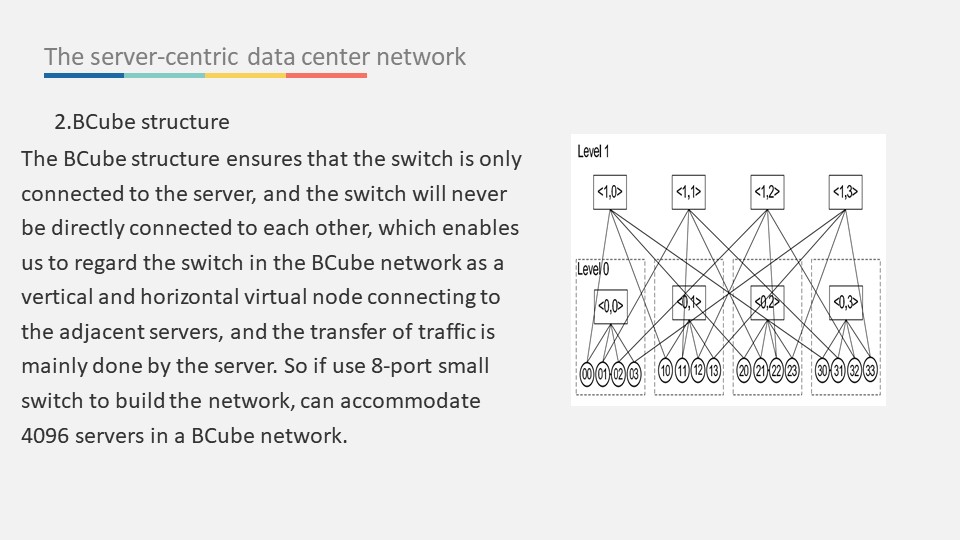 |
The BCube structure ensures that the switch is only connected to the server, and the switch will never be directly connected to each other, which enables us to regard the switch in the BCube network as a vertical and horizontal virtual node connecting to the adjacent servers, and the transfer of traffic is mainly done by the server. So if use 8-port small switch to build the network, can accommodate 4096 servers in a BCube network.
|
| ICACT20230033 Slide.14
[Big Slide]
[YouTube] |
Chrome Click!! |
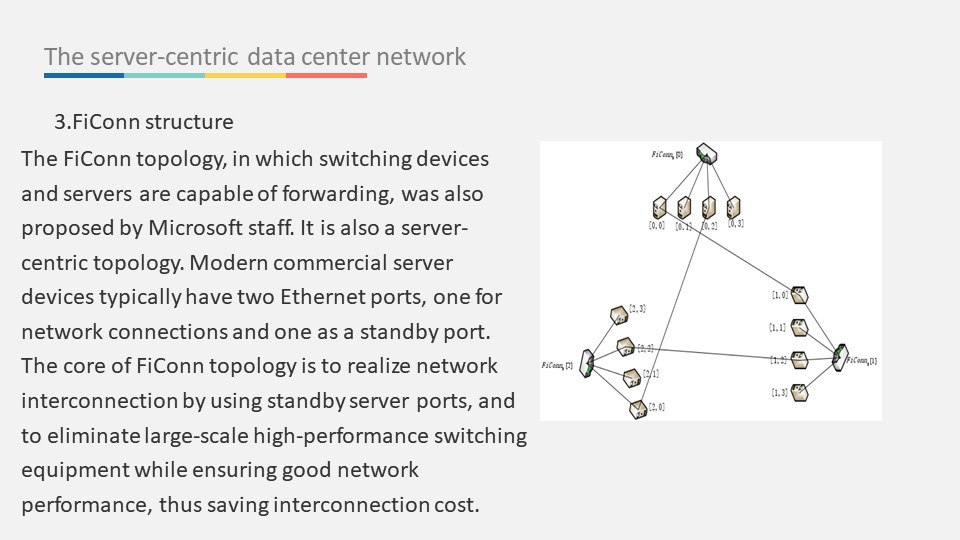 |
The FiConn topology, in which switching devices and servers are capable of forwarding, was also proposed by Microsoft staff. It is also a server-centric topology. Modern commercial server devices typically have two Ethernet ports, one for network connections and one as a standby port. The core of FiConn topology is to realize network interconnection by using standby server ports, and to eliminate large-scale high-performance switching equipment while ensuring good network performance, thus saving interconnection cost.
|
| ICACT20230033 Slide.15
[Big Slide]
[YouTube] |
Chrome Click!! |
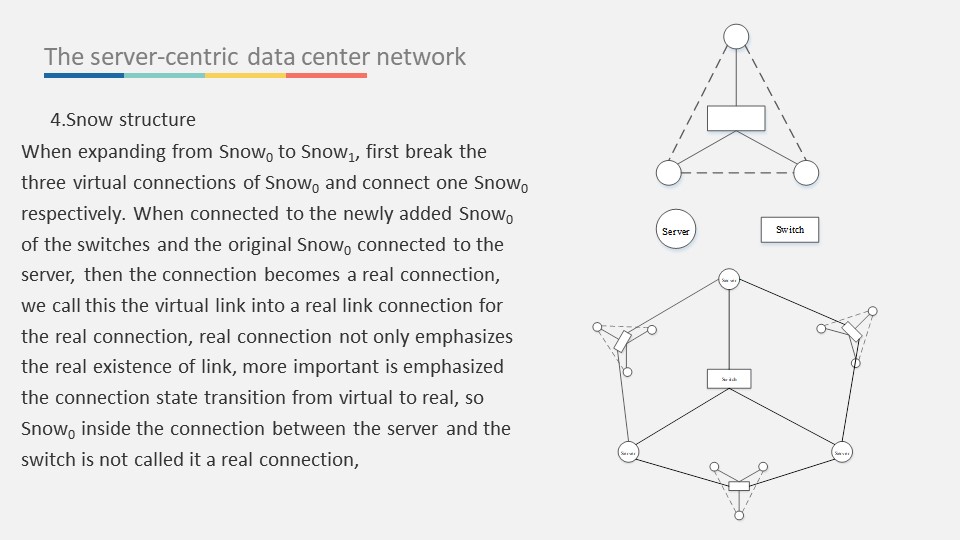 |
When expanding from Snow0 to Snow1, first break the three virtual connections of Snow0 and connect one Snow0 respectively. When connected to the newly added Snow0 of the switches and the original Snow0 connected to the server, then the connection becomes a real connection, we call this the virtual link into a real link connection for the real connection, real connection not only emphasizes the real existence of link, more important is emphasized the connection state transition from virtual to real, so Snow0 inside the connection between the server and the switch is not called it a real connection.
|
| ICACT20230033 Slide.16
[Big Slide]
[YouTube] |
Chrome Click!! |
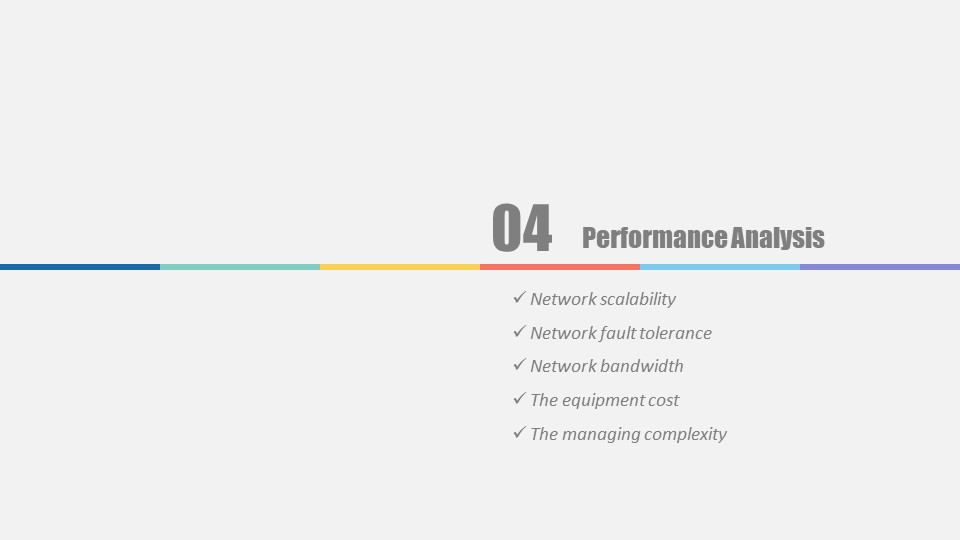 |
This section is Performance Analysis.
|
| ICACT20230033 Slide.17
[Big Slide]
[YouTube] |
Chrome Click!! |
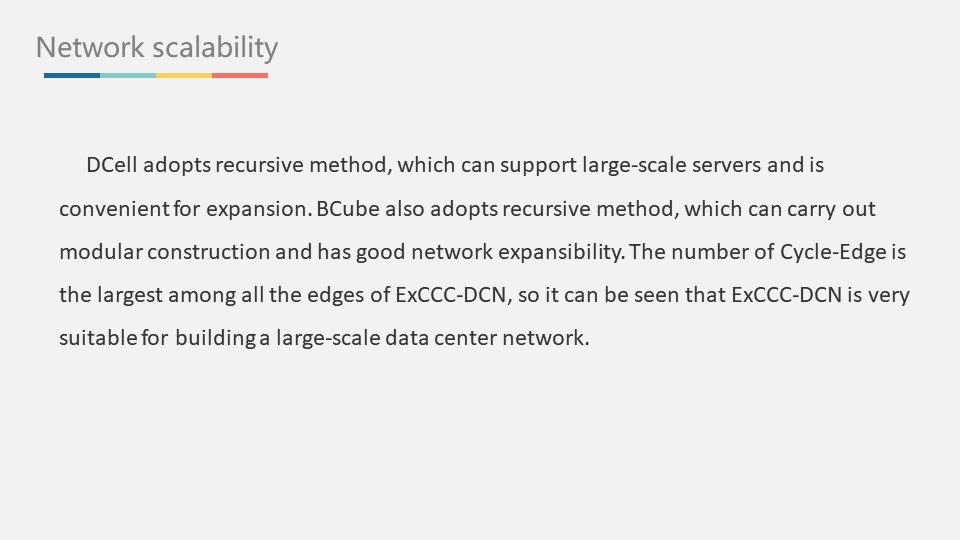 |
Network scalability:DCell adopts recursive method, which can support large-scale servers and is convenient for expansion. BCube also adopts recursive method, which can carry out modular construction and has good network expansibility. The number of Cycle-Edge is the largest among all the edges of ExCCC-DCN, so it can be seen that ExCCC-DCN is very suitable for building a large-scale data center network.
|
| ICACT20230033 Slide.18
[Big Slide]
[YouTube] |
Chrome Click!! |
 |
Network fault tolerance:
BCube performs better than DCell in the case of incomplete structure and has the best fault-tolerant performance. The FiConn network has multiple parallel links between different servers, so the fault tolerance of the network is very good. ExCCC-DCN has very low construction cost and energy consumption.
|
| ICACT20230033 Slide.19
[Big Slide]
[YouTube] |
Chrome Click!! |
 |
Network bandwidth:
The DCell topological defects is uneven distribution of flow, the bottom flow rate on the link on the high side, hierarchical full connection and server implementation forward capability will affect throughput and network latency [19],[20]. BCube and FiConn network has a large bandwidth and can meet the demand of high throughput transmission of data. ExCCC-DCN has better fault tolerance.
|
| ICACT20230033 Slide.20
[Big Slide]
[YouTube] |
Chrome Click!! |
 |
The equipment cost:
DCell networks replace high performance switches with long chains, which leads to increased link overhead. FiConn makes full use of the standby port of the server and saves some device overhead. The advantage of snowflake structure is that the micro-switch replaces the expensive switch, so the cost is low. ExCCC-DCN has very low construction cost and energy consumption.
|
| ICACT20230033 Slide.21
[Big Slide]
[YouTube] |
Chrome Click!! |
 |
The managing complexity:
There are many switches in BCube, so THE cost of routing layout and deployment in BCube is relatively high. The complexity of FiConn topology wiring is high. If the underlying server and switch fail, the level of the snowflake structure may directly reduce one level, which will reduce the number of servers by a lot. The underlying switch and server are relatively difficult to manage, with high management complexity and relatively high cost. However, ExCCC-DCN has a complex structure, and its wired link deployment mode also has some shortcomings.
|
| ICACT20230033 Slide.22
[Big Slide]
[YouTube] |
Chrome Click!! |
 |
This section is conclusion. |
| ICACT20230033 Slide.23
[Big Slide]
[YouTube] |
Chrome Click!! |
 |
This paper first introduces the status quo of data center network, then introduces the requirements of modern data center network from several aspects, then introduces the basic characteristics of different types of data center network, and compares the structure from different aspects. Through analysis, it is found that the two types of schemes have their own advantages and disadvantages. It is hoped that subsequent researchers can propose more new structures with high fault tolerance and scalability to promote the development of data center networks. This paper is of great learning significance for the people who are first exposed to the data center network.
|
| ICACT20230033 Slide.24
[Big Slide]
[YouTube] |
Chrome Click!! |
 |
Thanks for your attention! Floor is open for QnA. |















