 ICACT20230039 Slide.01
[Big Slide]
[YouTube] |
Chrome  Click!! |
 |
Hi everyone. I am Dhivya from C-DAC Chennai, India. I would like to thank ICACT organizers for giving us the opportunity to present our work. My presentation is about NLoS-VICINITY: A Non-Line of Sight Approach for Visible LIght Communication based INdoor PosITioning System |
| ICACT20230039 Slide.02
[Big Slide]
[YouTube] |
Chrome Click!! |
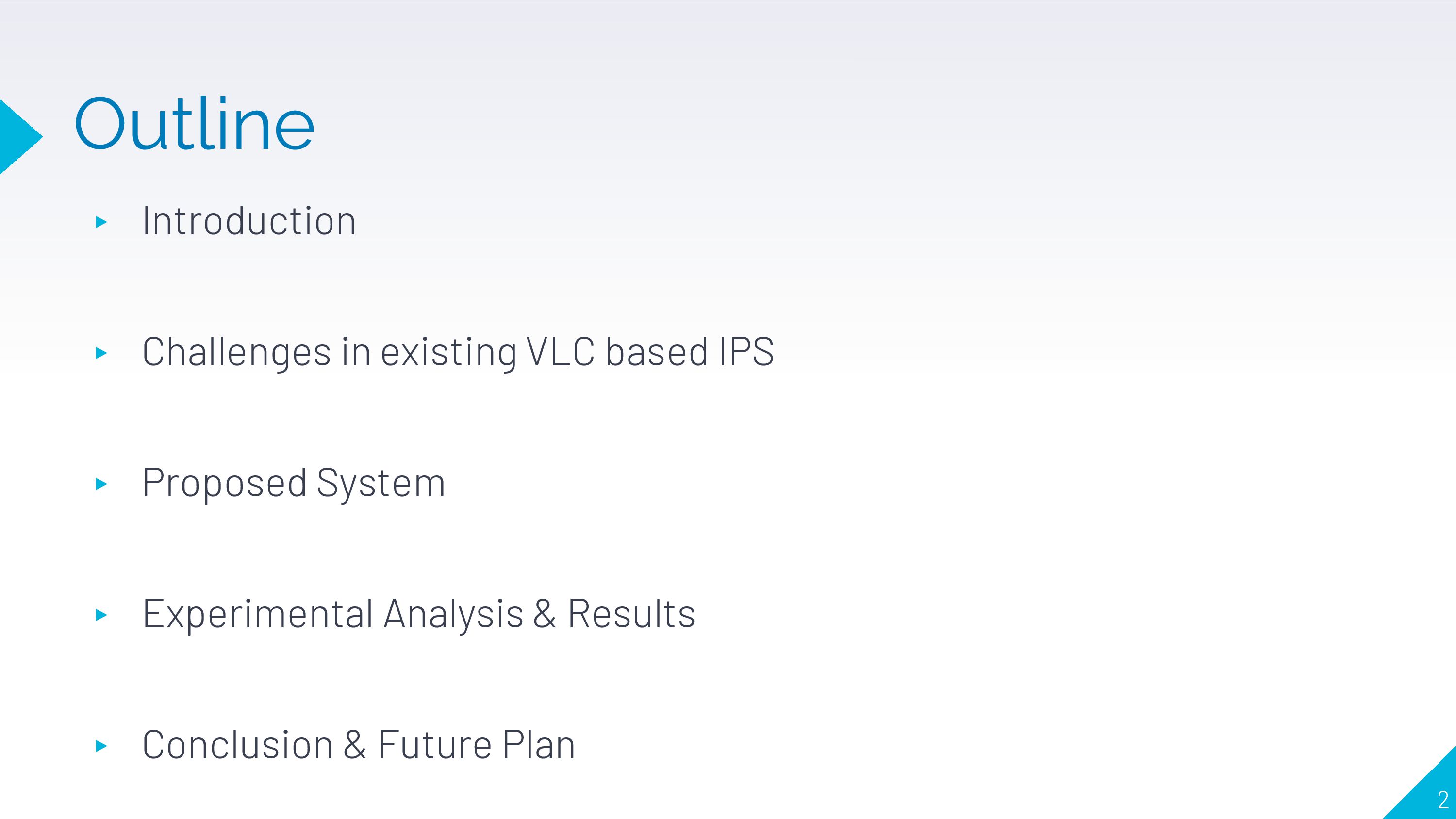 |
Outline of my presentation is as follows: First, the introduction section will cover the background knowledge about our work. Challenges in the existing VLC based Indoor Positioning System and how our proposed system addresses those challenges will be discussed in the next section. Followed by this, details of our proposed system with experimental analysis and results will be discussed. Presentation ends with conclusion summary and our future plan |
| ICACT20230039 Slide.03
[Big Slide]
[YouTube] |
Chrome Click!! |
 |
Introduction section explains about the background knowledge for our work |
| ICACT20230039 Slide.04
[Big Slide]
[YouTube] |
Chrome Click!! |
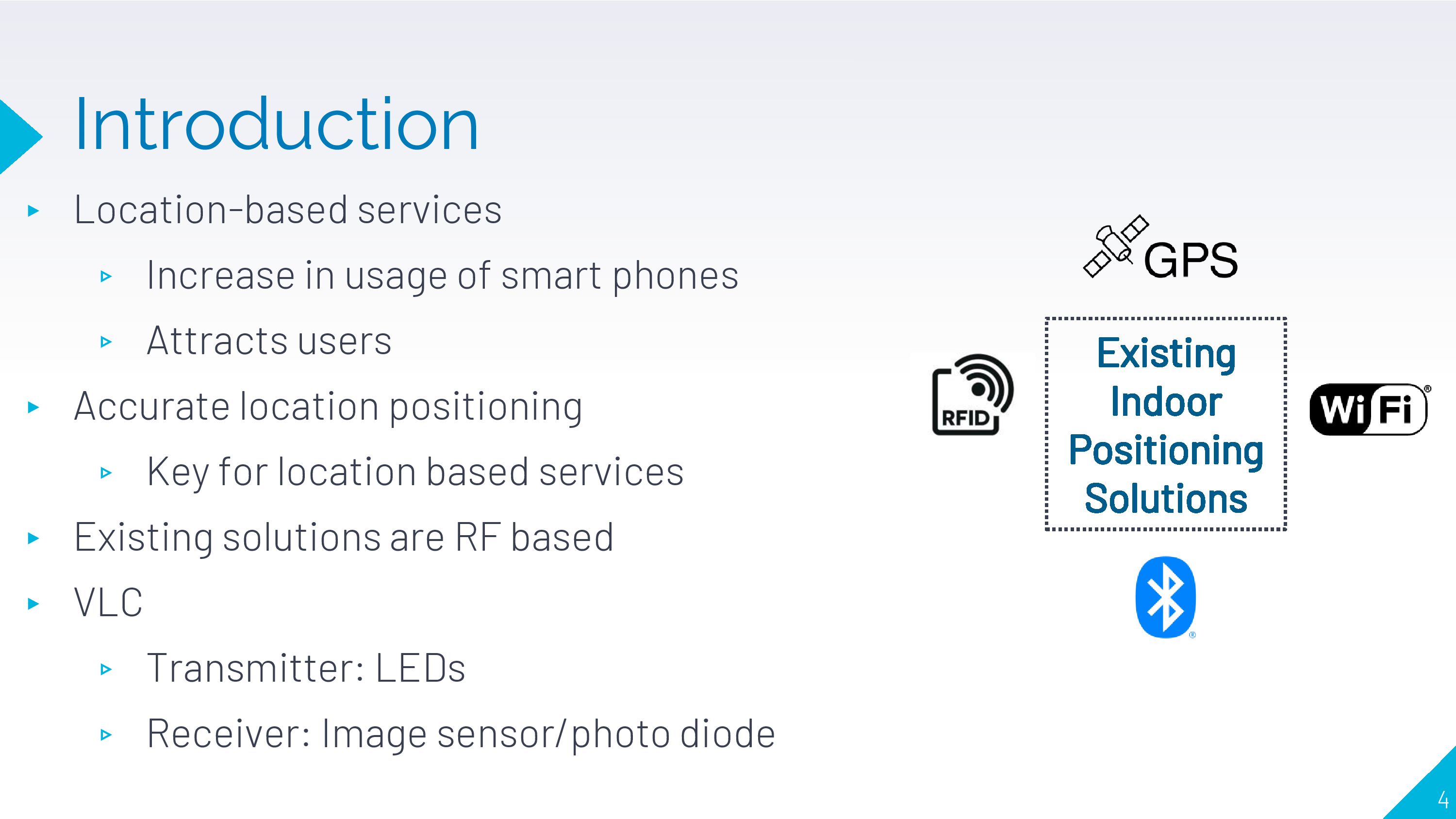 |
With the increase in use of smart phones, location-based services attract a large number of users. Accurate positioning is the key for providing location-based services. GPS has poor coverage indoors whereas Wi-Fi, BLE and RFID are used to position the users in an indoor environment. These solutions need additional devices to position the user and add infrastructure cost. Positioning systems based on LEDs emerged in recent years, which leverage visible light signal instead of RF. In VLC system, LEDs are used as transmitters and photodiode or image sensor is used as receiver |
| ICACT20230039 Slide.05
[Big Slide]
[YouTube] |
Chrome Click!! |
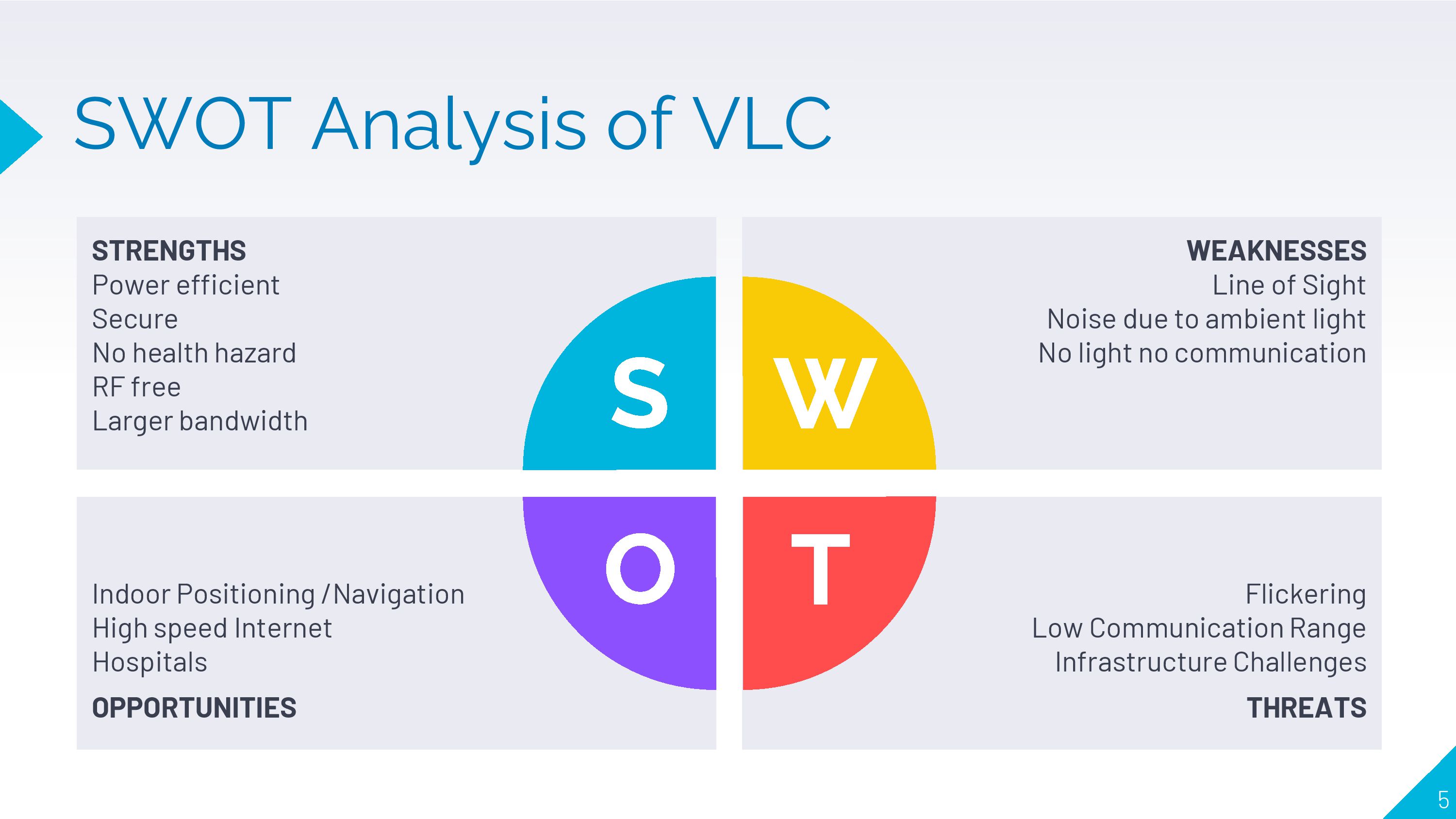 |
Visible light communication is an optical wireless communication technology that combines illumination and communication thereby saving energy and cost. Advantages of VLC are RF free, larger bandwidth, secure, no EMI emission and power efficient. It can be used for indoor positioning, indoor navigation and to provide high speed internet access. VLC requires LoS to establish communication between the transmitter and receiver. If data to be transmitted is not modulated properly it will appear as visual flicker which creates user discomfort |
| ICACT20230039 Slide.06
[Big Slide]
[YouTube] |
Chrome Click!! |
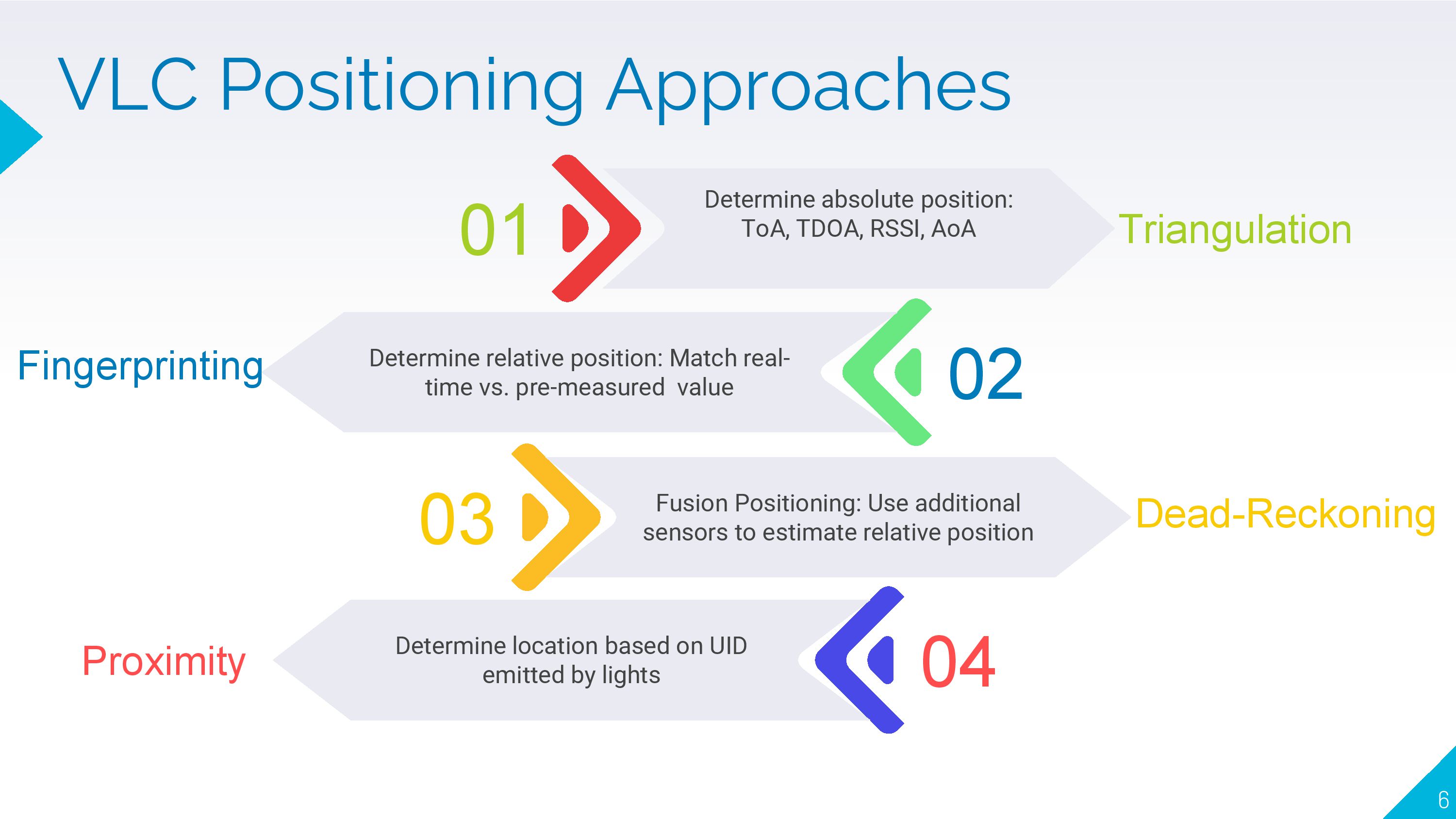 |
Triangulation, fingerprinting, dead-reckoning and proximity are the approaches used in VLC for user positioning.
Triangulation uses Time of Arrival, Time Difference of Arrival, Angle of Arrival and Received Signal Strength to determine the absolute position. TOA and TDOA are not feasible for real-time implementation whereas AoA and RSSI are used for VLC based positioning. AOA is more accurate in photodiode-based receiver than the camera-based receiver.
Fingerprinting approach estimates the relative position by matching real-time value with the pre-measured location data. It is sensitive to environment changes.
Dead-reckoning is a fusion positioning method that uses additional sensors such as accelerometer, gyroscope to estimate the relative position.
Proximity approach determines the location based on the signal from a single LED base station with a unique identification code.
|
| ICACT20230039 Slide.07
[Big Slide]
[YouTube] |
Chrome Click!! |
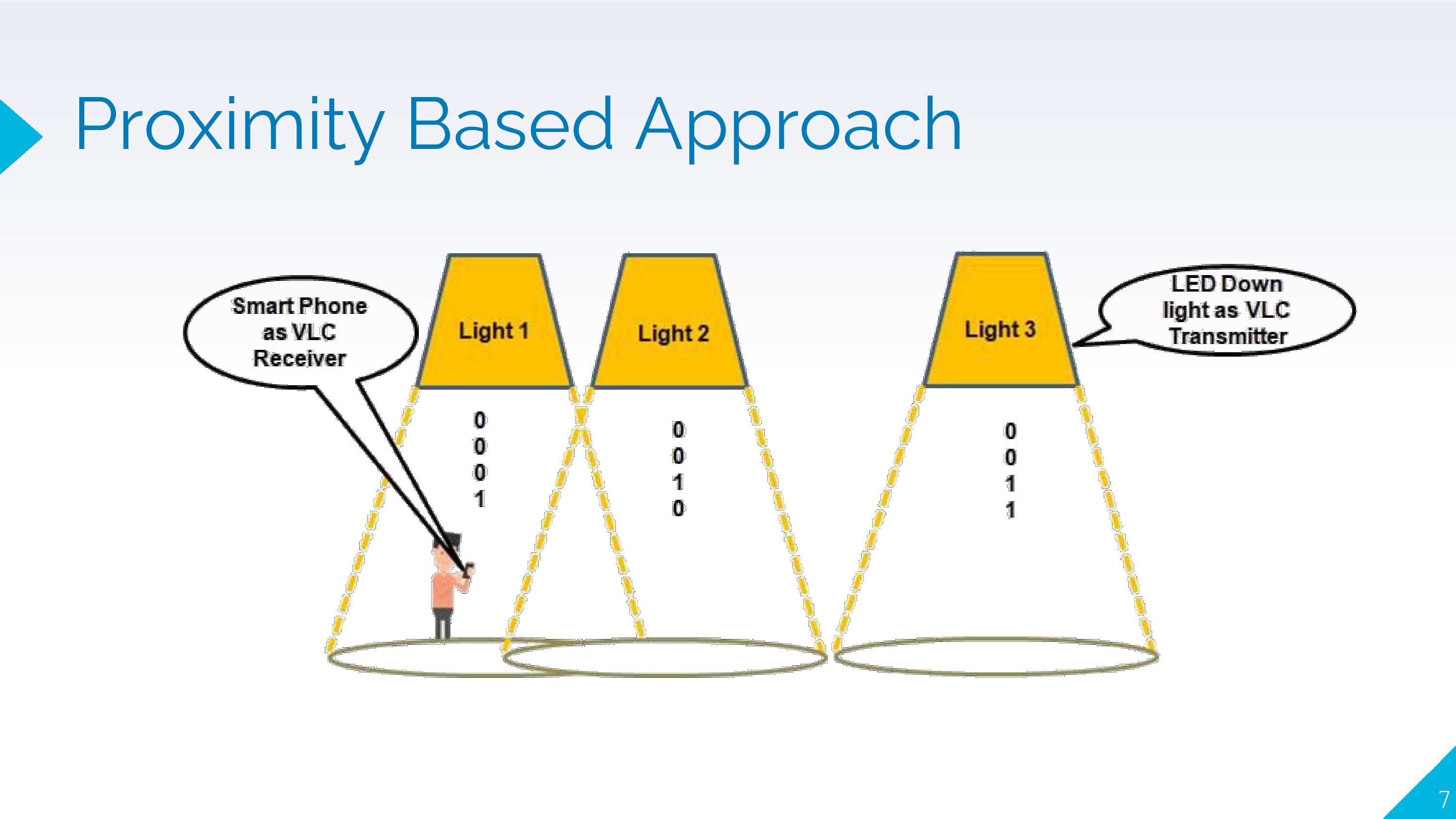 |
Our proposed system is based on proximity approach. Each light transmits a unique ID as 1’s and 0’s. Image sensor of smart phone is received as black (0’s) and white (1’s) stripes. |
| ICACT20230039 Slide.08
[Big Slide]
[YouTube] |
Chrome Click!! |
 |
This section describes the challenges of existing VLC based Indoor Positioning System |
| ICACT20230039 Slide.09
[Big Slide]
[YouTube] |
Chrome Click!! |
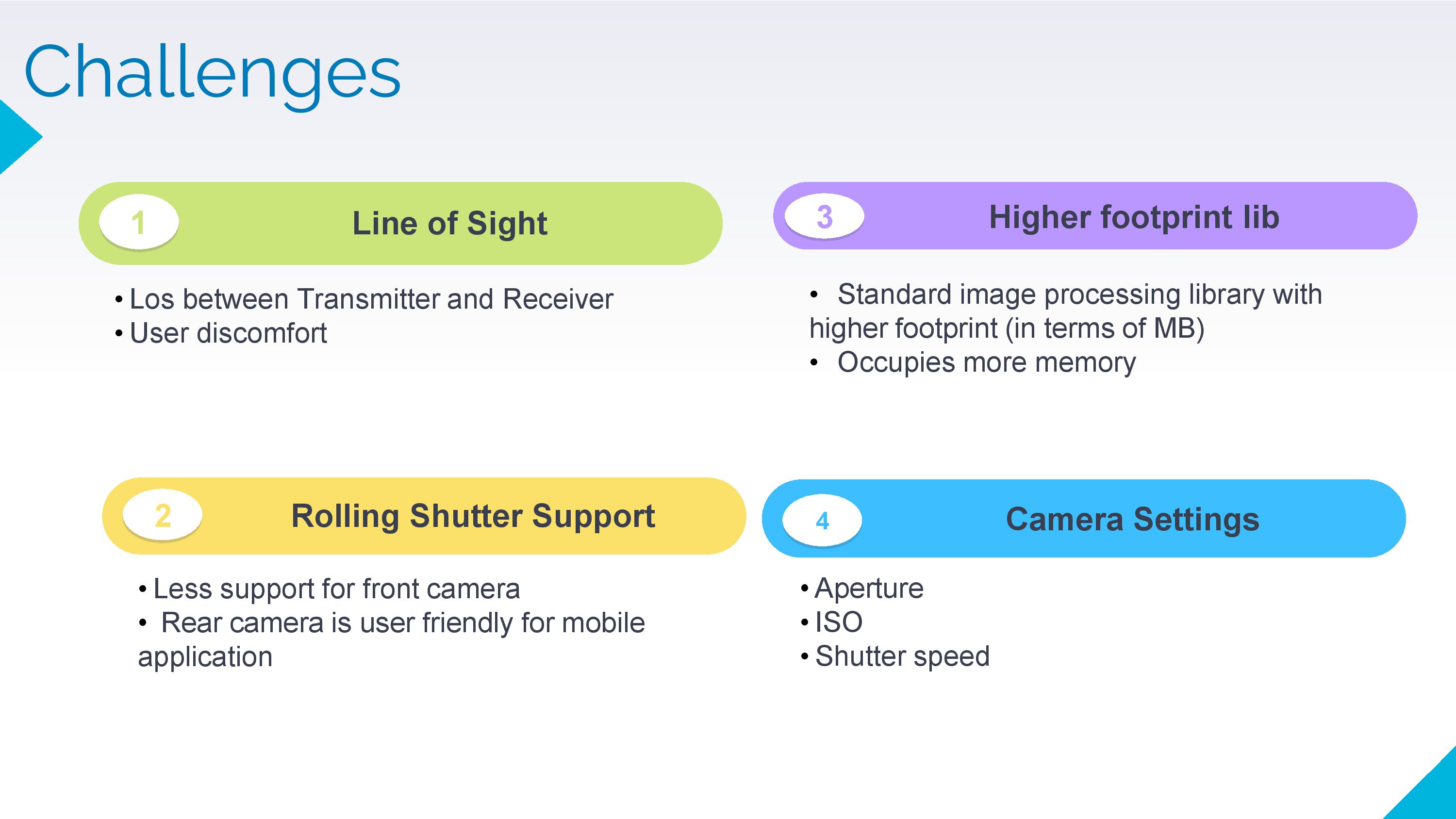 |
(i) VLC requires Line of Sight to establish communication between transmitter and receiver that leads to user discomfort.
(ii) For VLC Receiver, capturing images using smart phone camera needs the support of rolling shutter feature. Rolling shutter captures the image using row-by-row exposure. Support for this feature for front camera is very minimal in commercially available smart phones. Most of the commercially available smart phone’s rear camera supports the rolling shutter effect. Use of rear camera is user friendly compared to the usage of front camera in a mobile application.
(iii) Conventionally researchers use smart phone camera to capture the data as video streams where data is spread across multiple frames. These data are processed using standard image processing libraries of higher footprint (hundreds of MB). This in turn increases the memory footprint and the processing time.
(iv) Camera settings play a major role when using smart phone based receivers. Exposure determines what is actually recorded on a camera's image sensor. ISO sensitivity, aperture, and shutter speed are the three adjustable elements that control the exposure.
|
| ICACT20230039 Slide.10
[Big Slide]
[YouTube] |
Chrome Click!! |
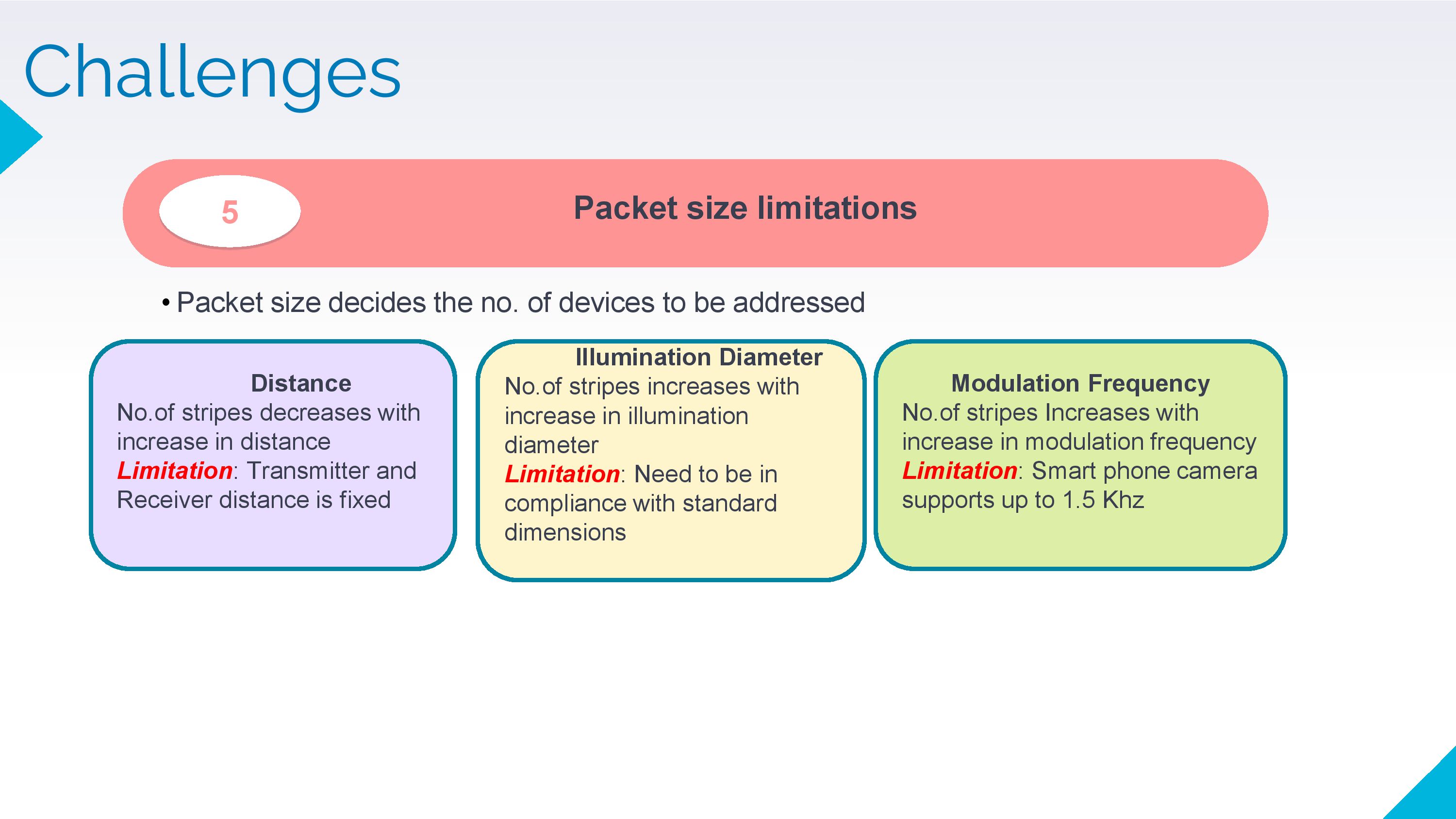 |
Using LoS approach, packet size is limited based on the number of stripes received. Number of stripes decides the maximum addressable lights. Capturing the entire packet in a single frame using LoS approach depends on the distance between transmitter and receiver modulation frequency and diameter of light.
(i) No. of stripes captured in a frame decreases with increase in distance between transmitter and receiver. But, in real scenario transmitter and receiver distance is fixed.
(ii) No. of stripes captured in a frame increases with illumination diameter. But diameter needs to be in compliance with standard dimensions and cannot be varied.
(iii) No. of stripes captured in a frame increases with increase in modulation frequency. But commercial smart phone camera supports up to 1.5 KHz.
|
| ICACT20230039 Slide.11
[Big Slide]
[YouTube] |
Chrome Click!! |
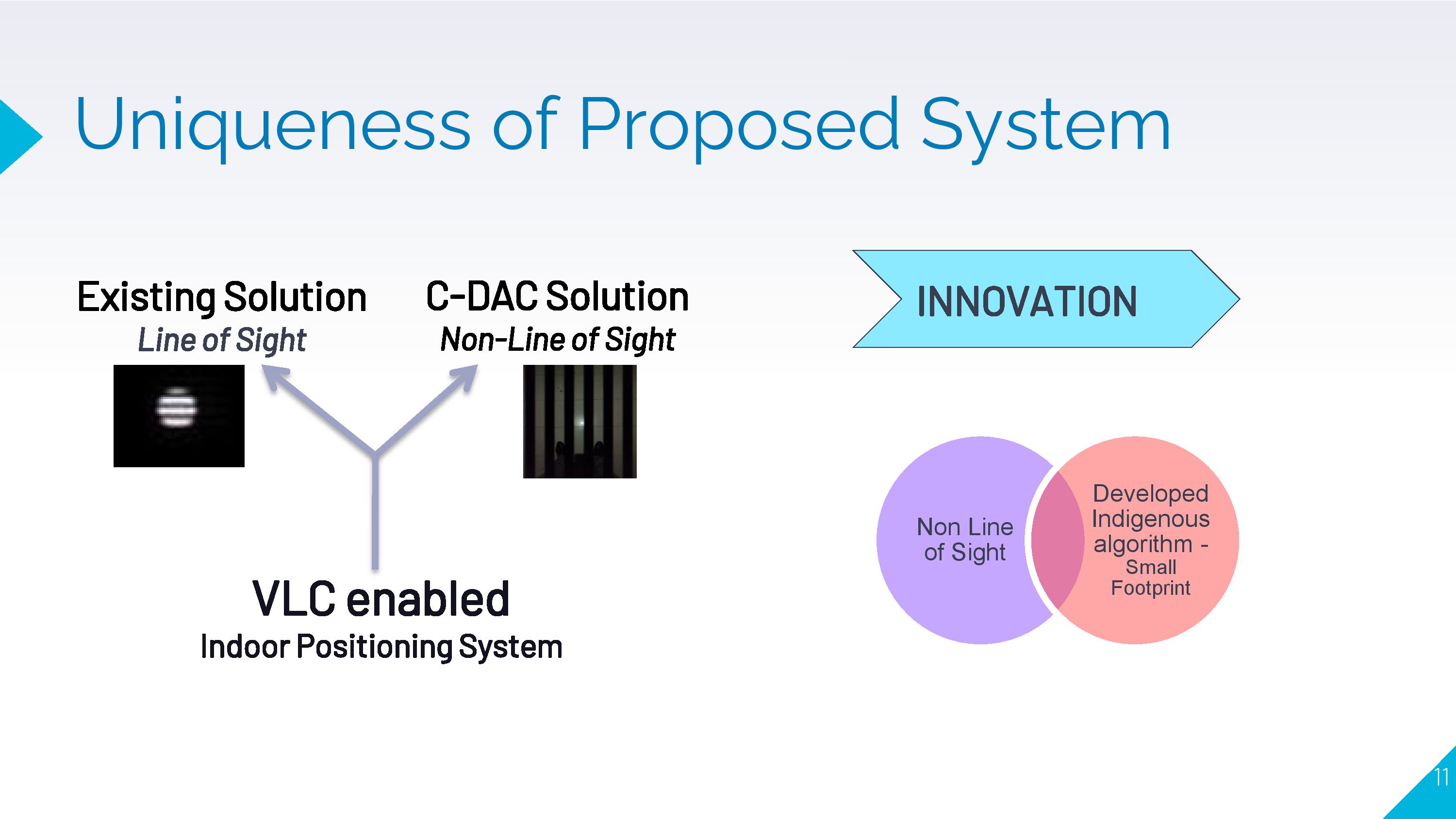 |
(i) To overcome the constraints of rolling shutter support, packet size limitations and user discomfort using LOS approach, a NLOS approach (capture reflected image from floor using rear camera) to receive the data has been proposed.
(ii) To overcome the challenge of higher footprint libraries, an indigenous decoding algorithm with a smaller footprint has been developed.
|
| ICACT20230039 Slide.12
[Big Slide]
[YouTube] |
Chrome Click!! |
 |
This section describes our proposed system |
| ICACT20230039 Slide.13
[Big Slide]
[YouTube] |
Chrome Click!! |
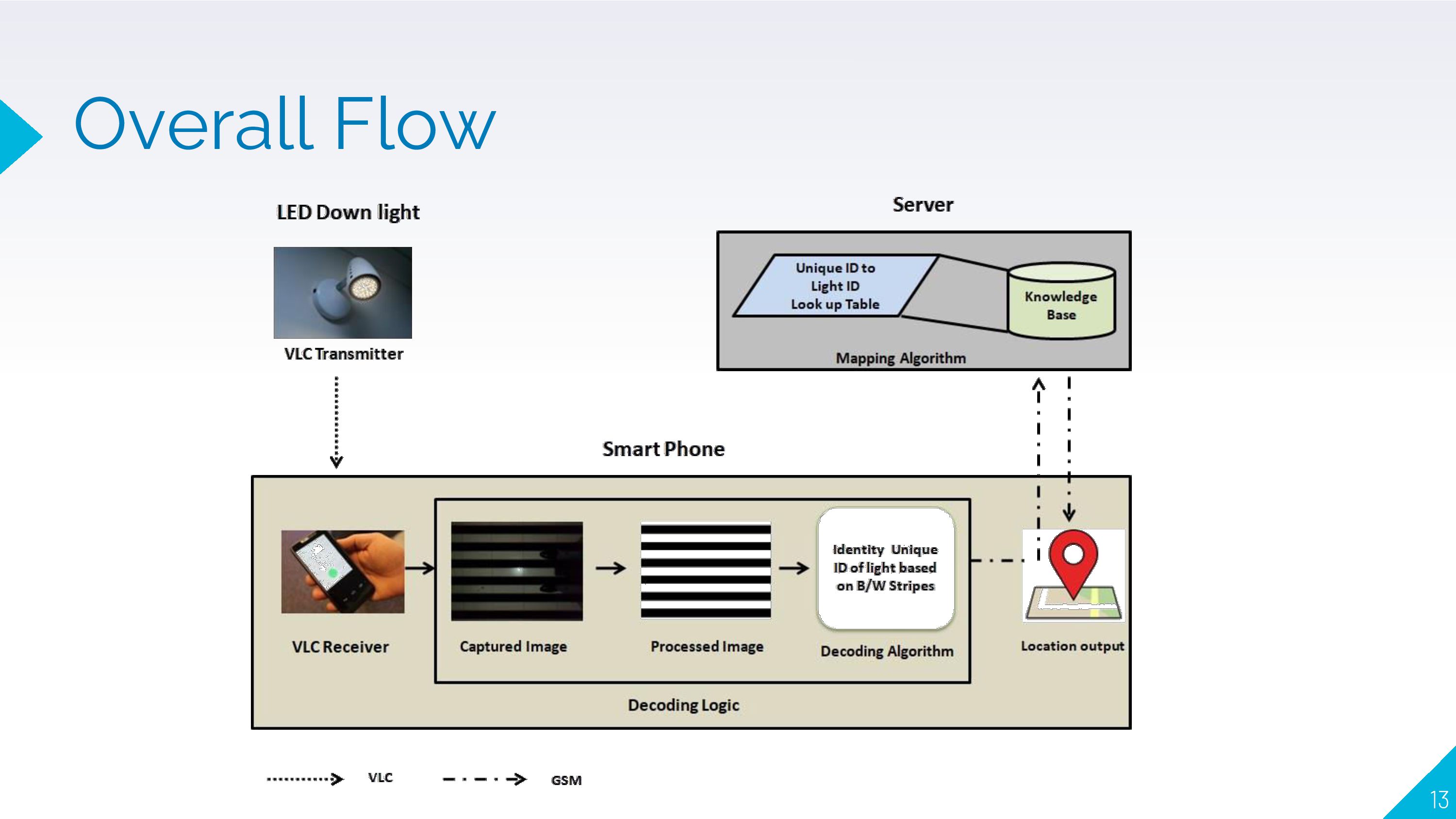 |
Each VLC transmitter is programmed to transmit a unique ID that is not visible to the human eye. Transmitted unique ID will be received as black and white stripes by rear camera of smart phone through a mobile App using Non-Line of Sight approach.
Decoding logic running in the mobile App processes the captured image and decodes the unique ID. Upon detection of the unique ID, mobile app will communicate with server via GSM/Wi-Fi to fetch the user position. Based on the received unique ID, the algorithm running in the server provides the exact position of user and the services associated with it. Mobile App after receiving the information from server displays the user location on a map and also pops the associated services.
|
| ICACT20230039 Slide.14
[Big Slide]
[YouTube] |
Chrome Click!! |
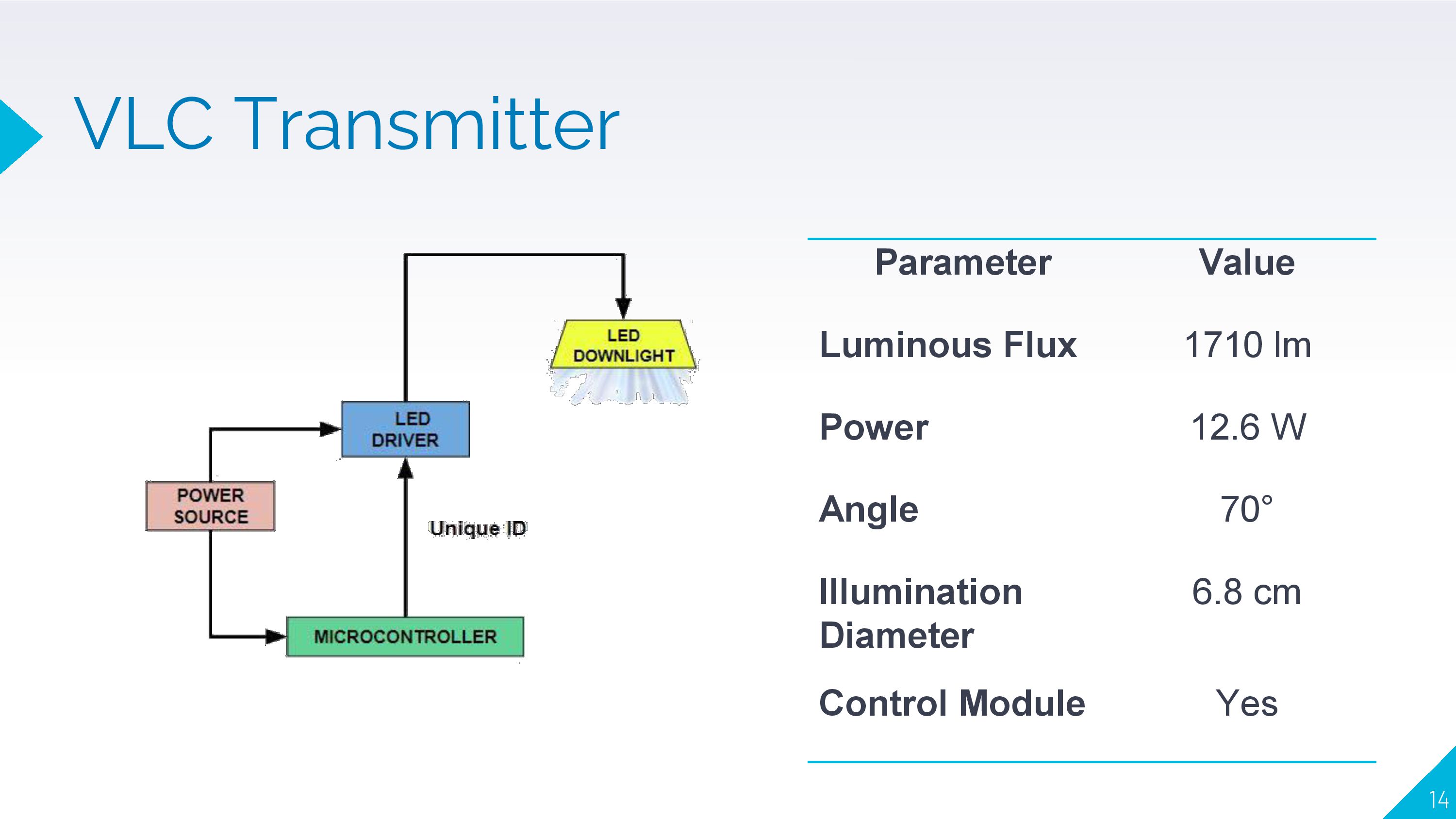 |
Smart LED down light is designed and developed to act as a VLC Transmitter. Each VLC transmitter consists of a microcontroller, LED driver, power supply and LED down light. Unique ID generated by the microcontroller will be fed to the LED down light through LED driver and is transmitted using visible light communication. Specifications of transmitter is shown here |
| ICACT20230039 Slide.15
[Big Slide]
[YouTube] |
Chrome Click!! |
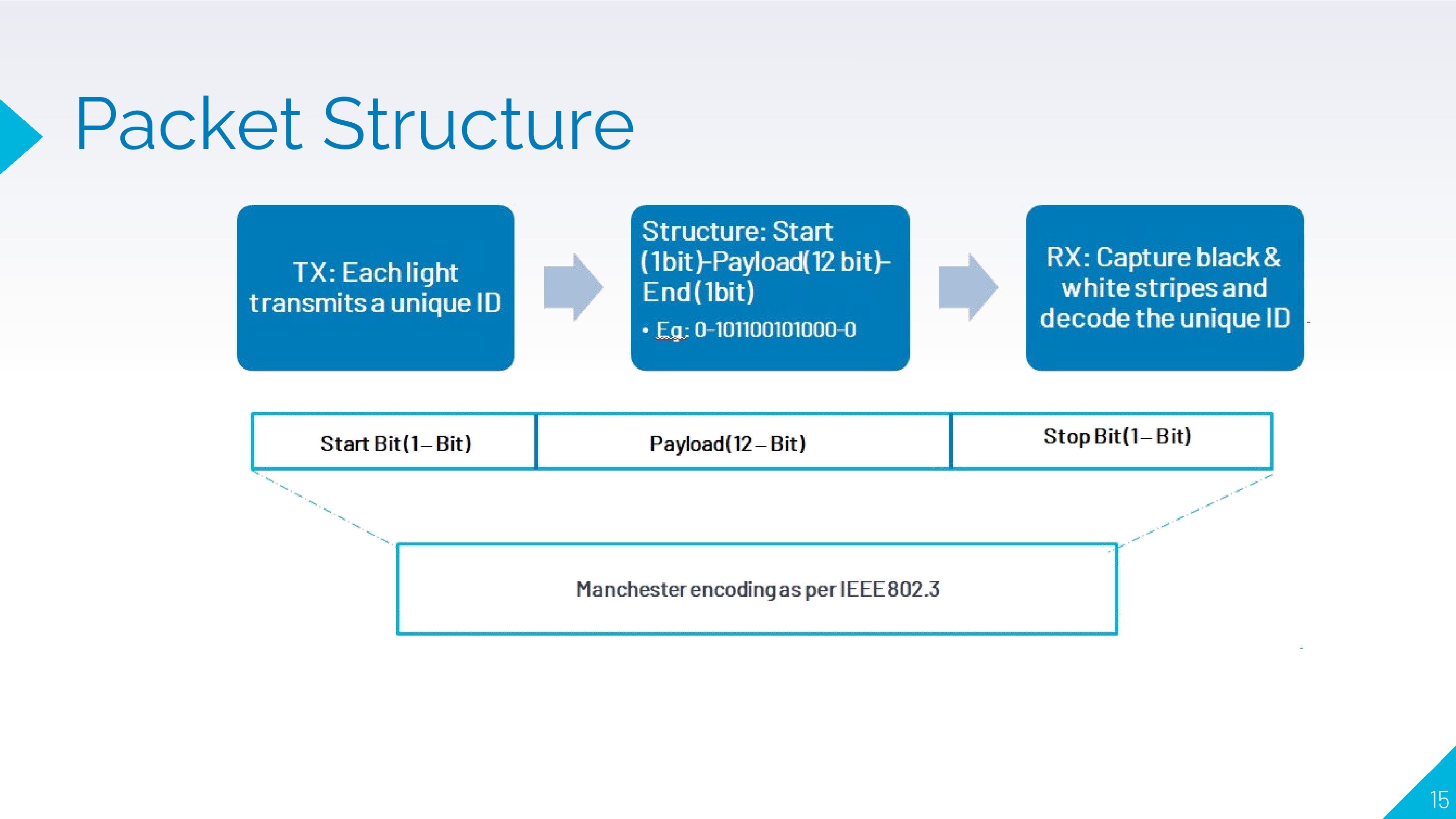 |
12-bit unique ID with 1 start bit and 1 stop bit modulated using OOK modulation and Manchester encoding are generated using control module. Using the proposed system 4096 lights can be addressed. |
| ICACT20230039 Slide.16
[Big Slide]
[YouTube] |
Chrome Click!! |
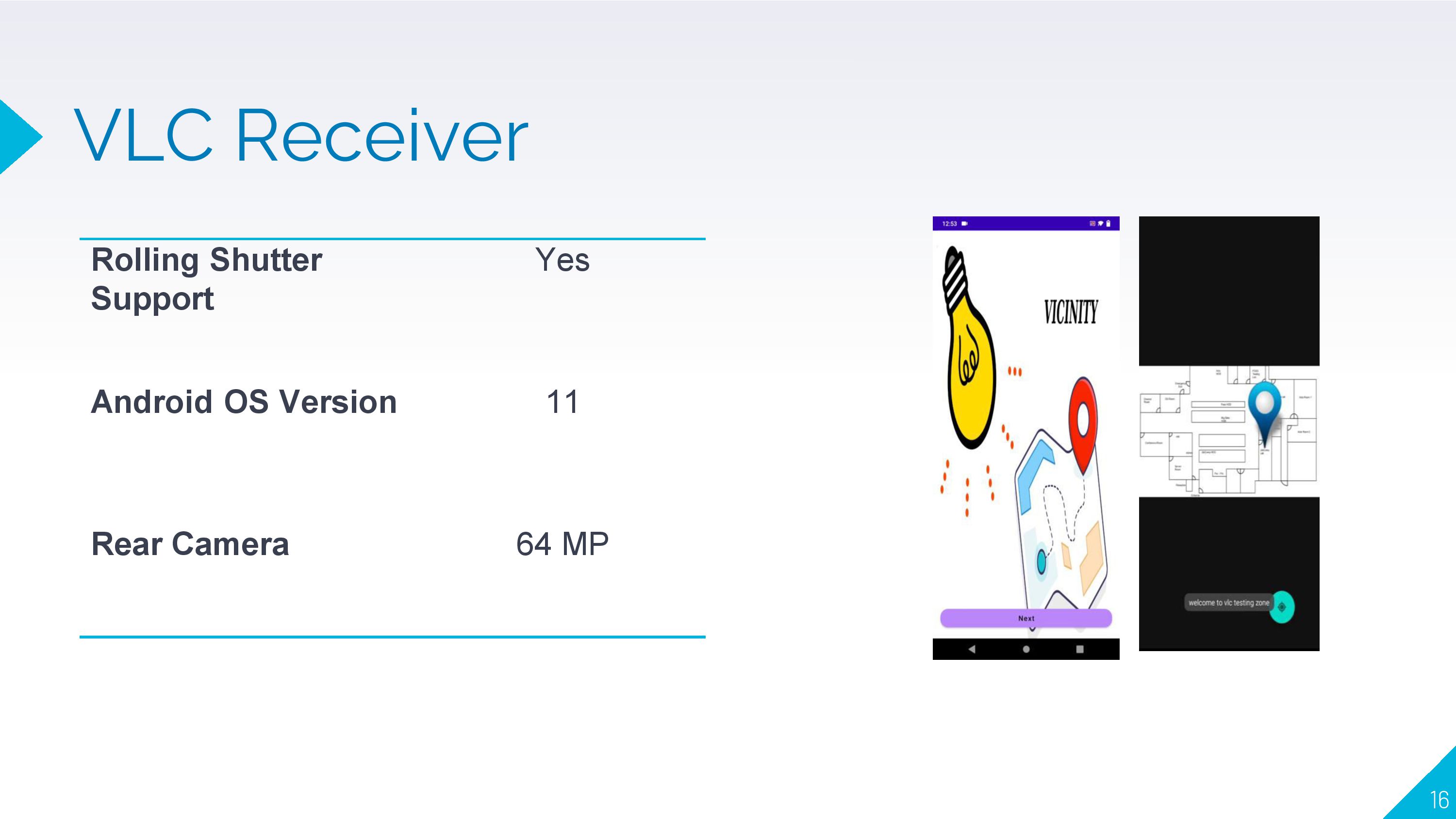 |
Rear camera of smart phone is used as VLC Receiver. Configuration details of the smart phone used for experimentation is shown here |
| ICACT20230039 Slide.17
[Big Slide]
[YouTube] |
Chrome Click!! |
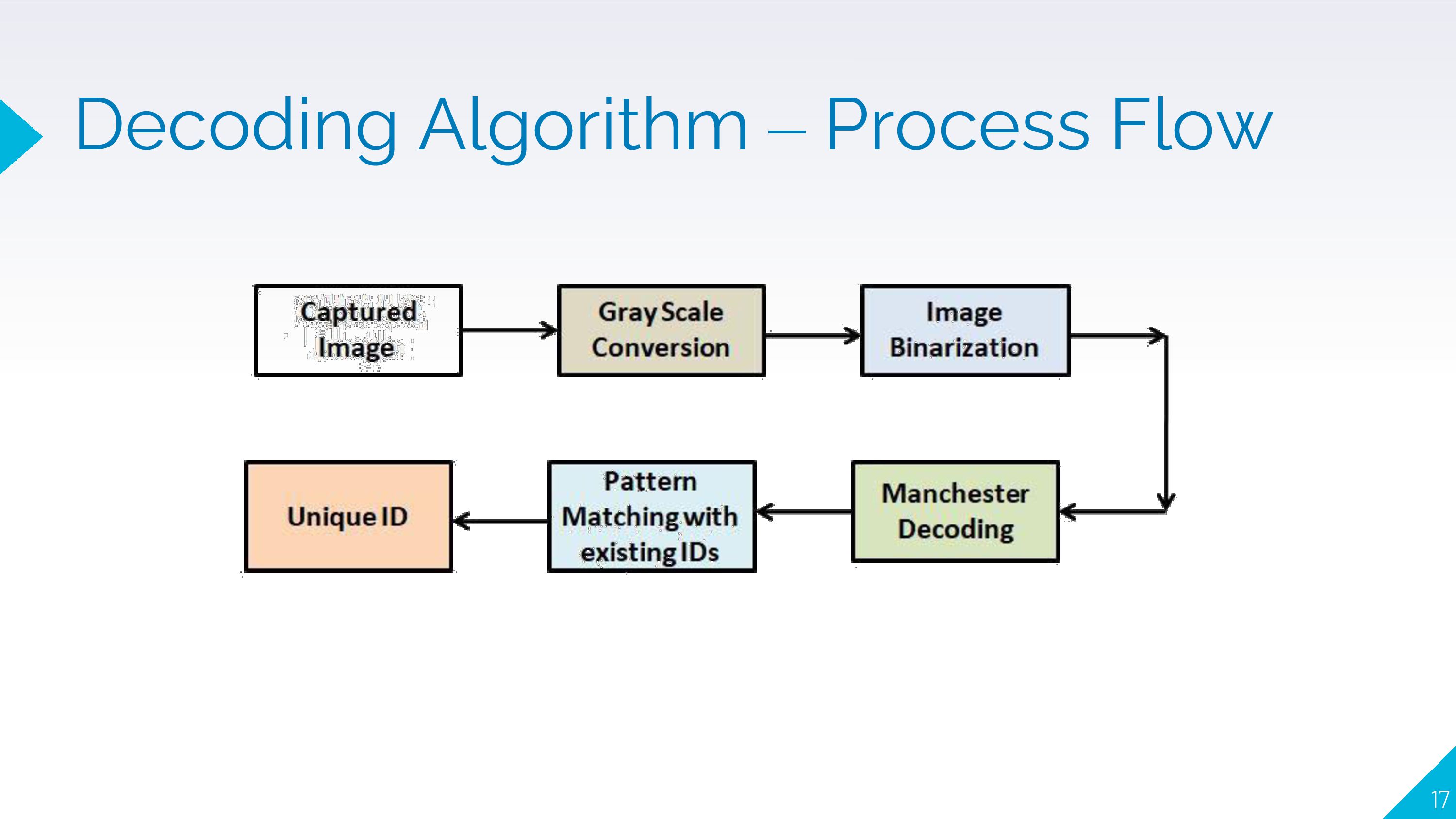 |
The process flow of decoding algorithm is as described here.
The captured image is converted to gray scale. In next stage, Binarization of the images and decoding is carried out. Then Unique ID is obtained by performing pattern matching with existing IDs
|
| ICACT20230039 Slide.18
[Big Slide]
[YouTube] |
Chrome Click!! |
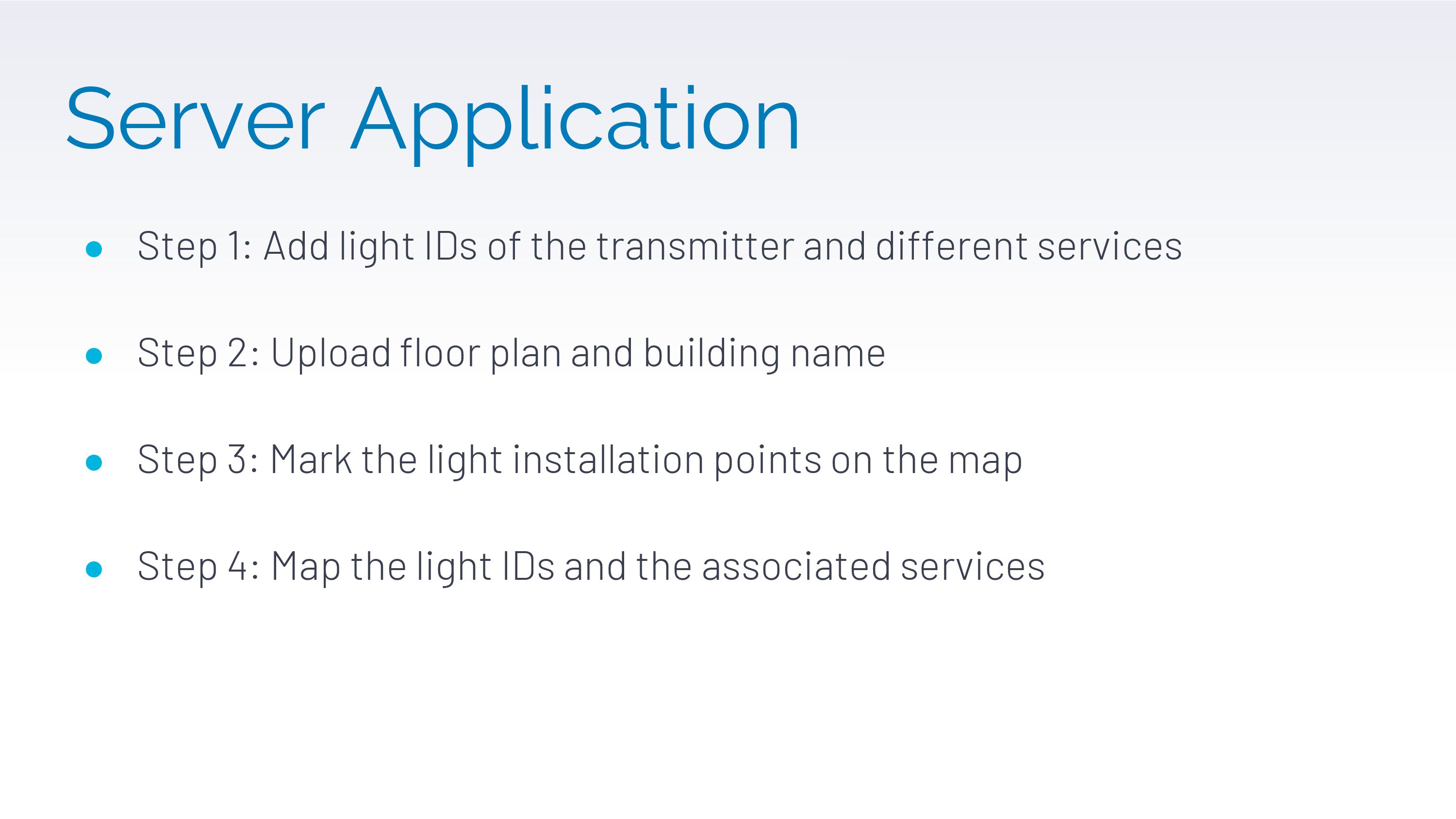 |
Server application consists of the following steps. In step 1, light IDs of the transmitter and different services are added. In step 2, the floor plan and building name are uploaded. Using a mobile app, the building name will be updated which will be then visible in the configuration page. In step 3, the light installation points on the map are marked. In step 4, the light IDs against their locations and the associated services available to those locations are mapped |
| ICACT20230039 Slide.19
[Big Slide]
[YouTube] |
Chrome Click!! |
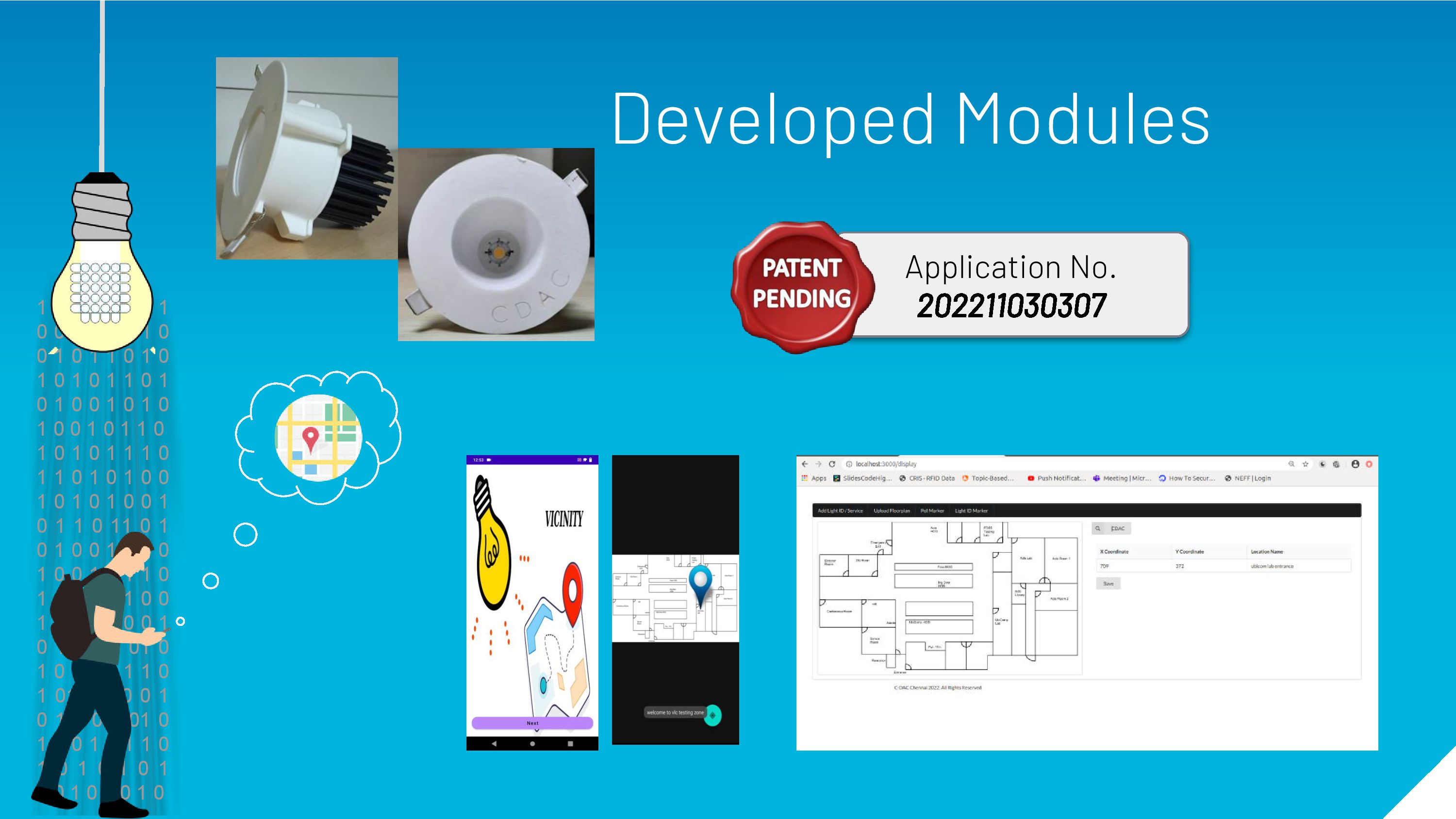 |
Developed VLC Transmitter, Receiver app and Server application is shown here. Indian patent has been filed for the proposed system |
| ICACT20230039 Slide.20
[Big Slide]
[YouTube] |
Chrome Click!! |
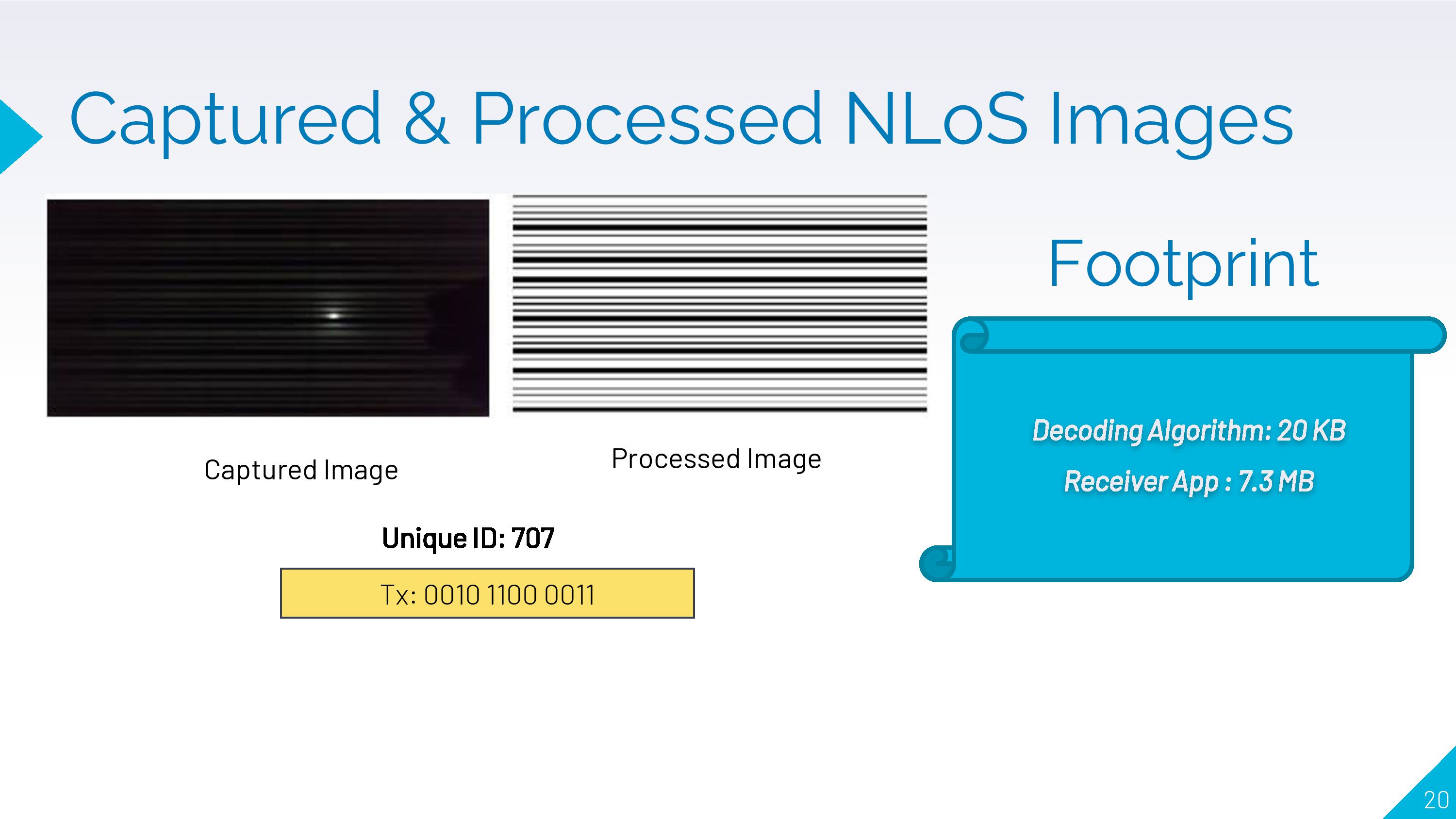 |
Captured and processed image for Unique ID - 707 is shown here. Footprint of developed indigenous decoding algorithm is 20 KB and overall size of the receiver App is 7.3 MB with a processing time of about 6 seconds. |
| ICACT20230039 Slide.21
[Big Slide]
[YouTube] |
Chrome Click!! |
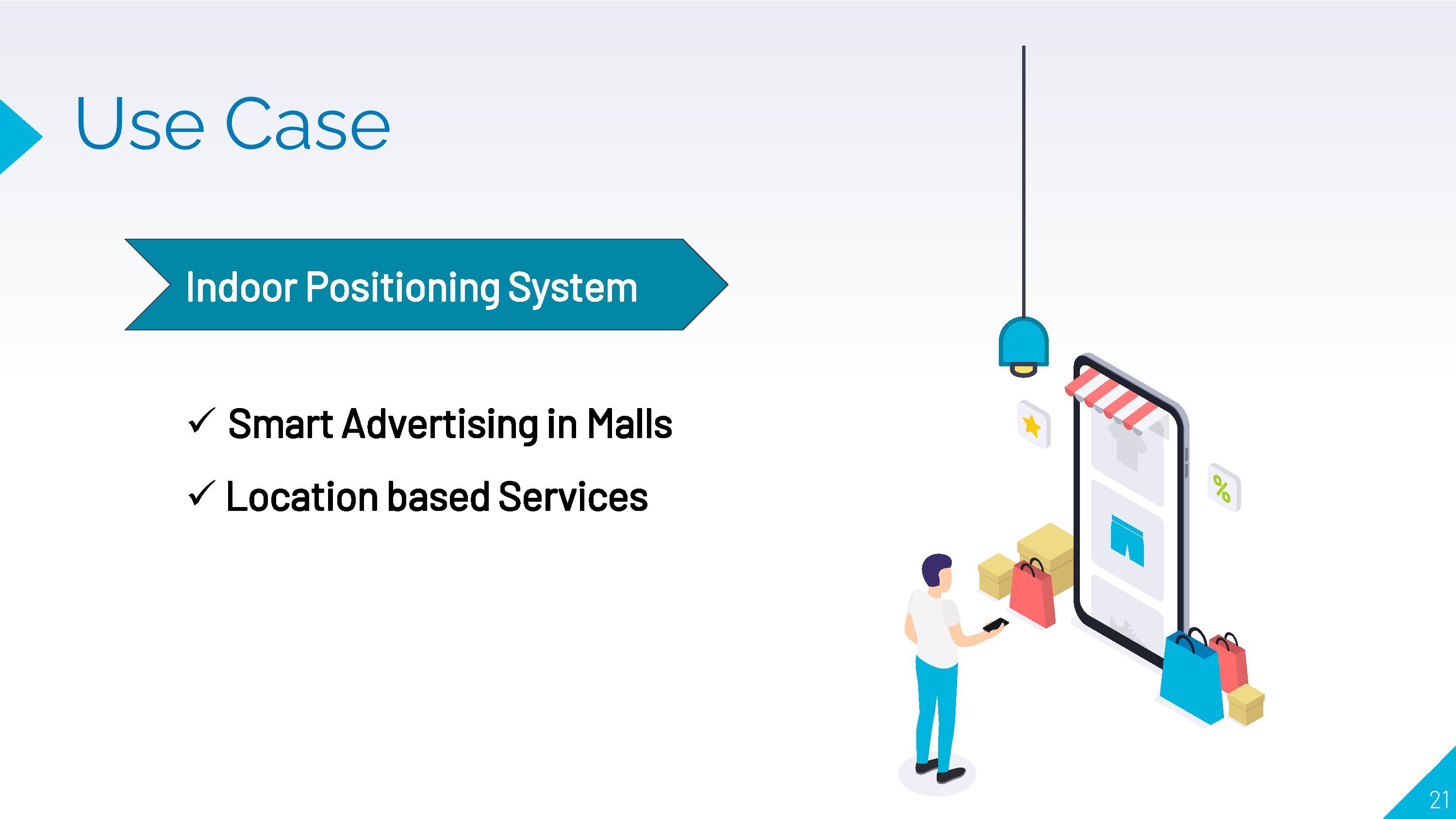 |
Proposed system can be used for smart advertising in malls and to provide any location-based services |
| ICACT20230039 Slide.22
[Big Slide]
[YouTube] |
Chrome Click!! |
 |
This section describes the experimental analysis and results |
| ICACT20230039 Slide.23
[Big Slide]
[YouTube] |
Chrome Click!! |
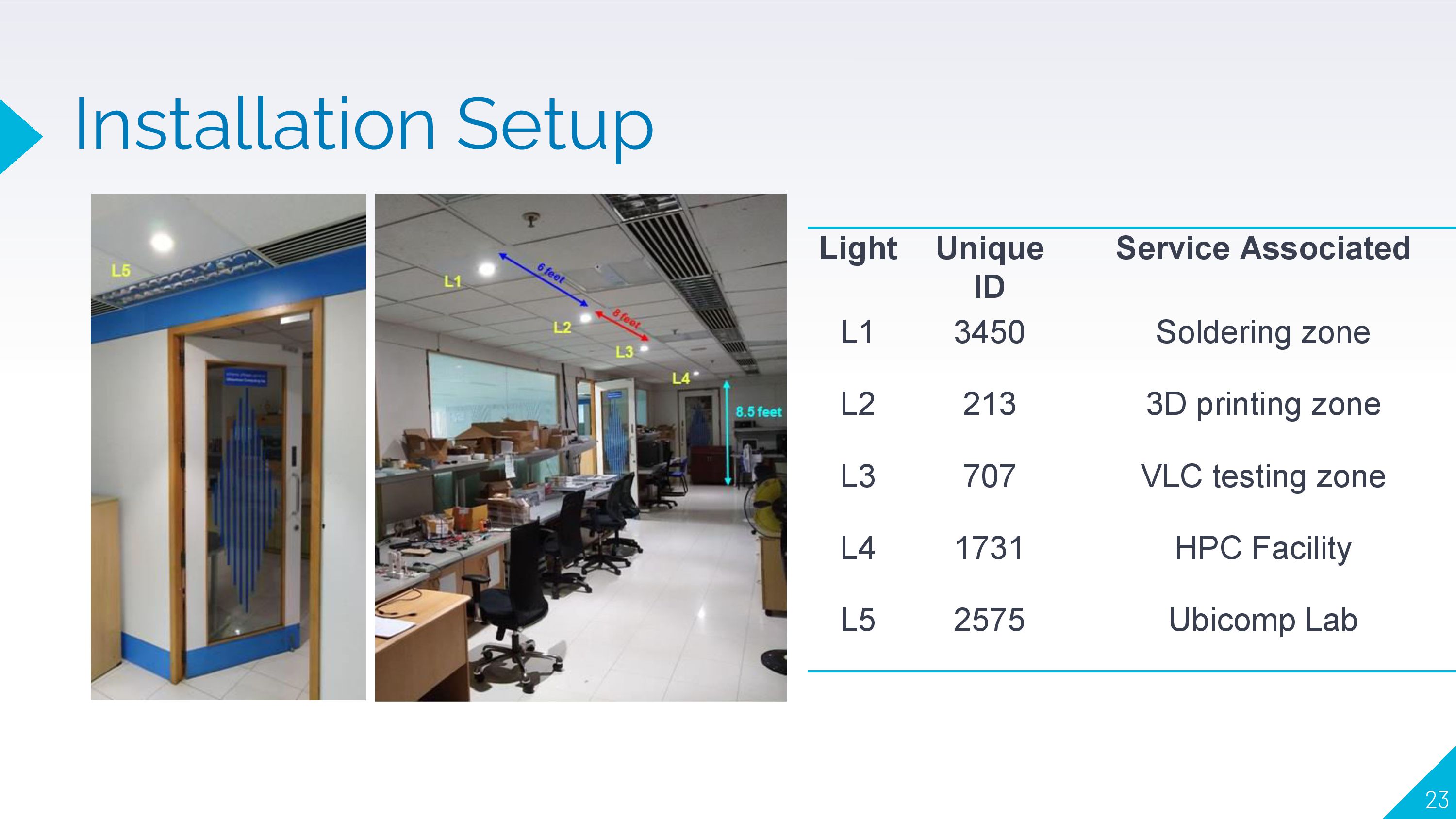 |
Five Transmitters (L1 to L5) are installed in lab premises at C-DAC Chennai. Unique IDs and services associated with it are shown in the Table. Experiments have been performed to analyze the accuracy of the proposed system under single and multiple light sources. Performance of the system under different colored surfaces was also analyzed. |
| ICACT20230039 Slide.24
[Big Slide]
[YouTube] |
Chrome Click!! |
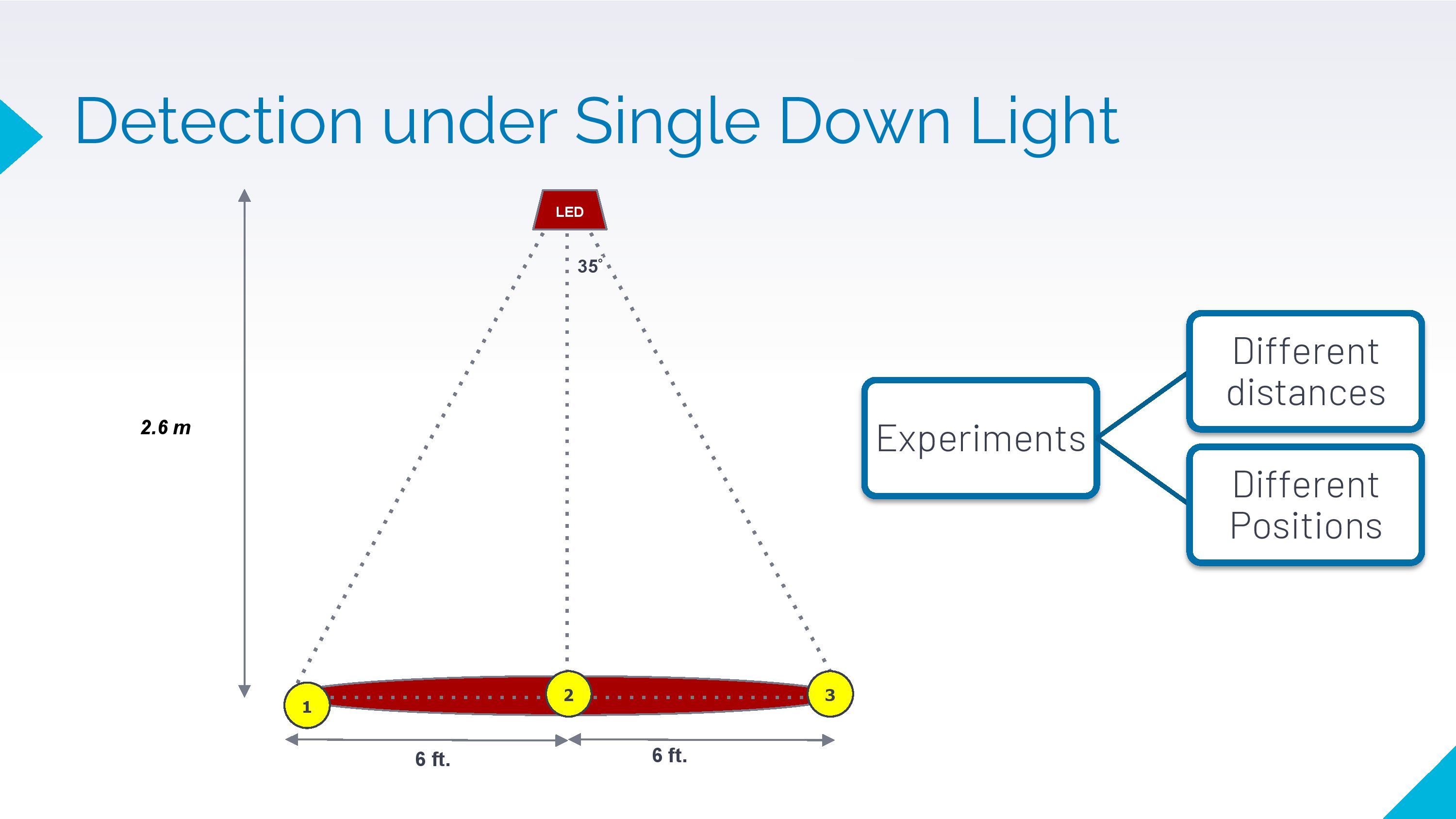 |
Each transmitter has a coverage area of 12 feet. Experiments have been performed to analyze the accuracy of the system under different distances and different mobile holding positions for single light source. |
| ICACT20230039 Slide.25
[Big Slide]
[YouTube] |
Chrome Click!! |
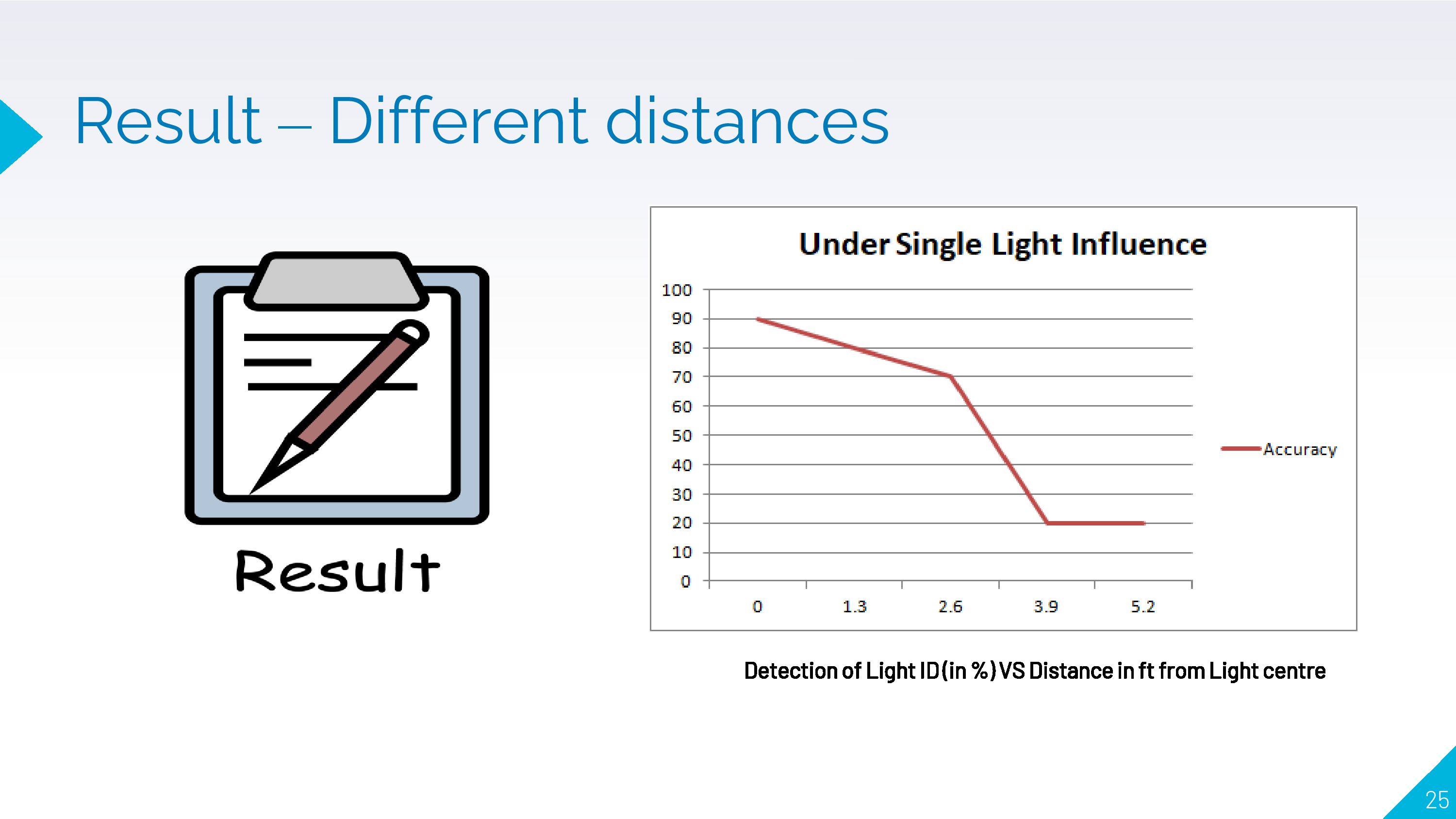 |
Results shows that system is 90% accurate at 0 feet and 70% accurate at 2.6 feet |
| ICACT20230039 Slide.26
[Big Slide]
[YouTube] |
Chrome Click!! |
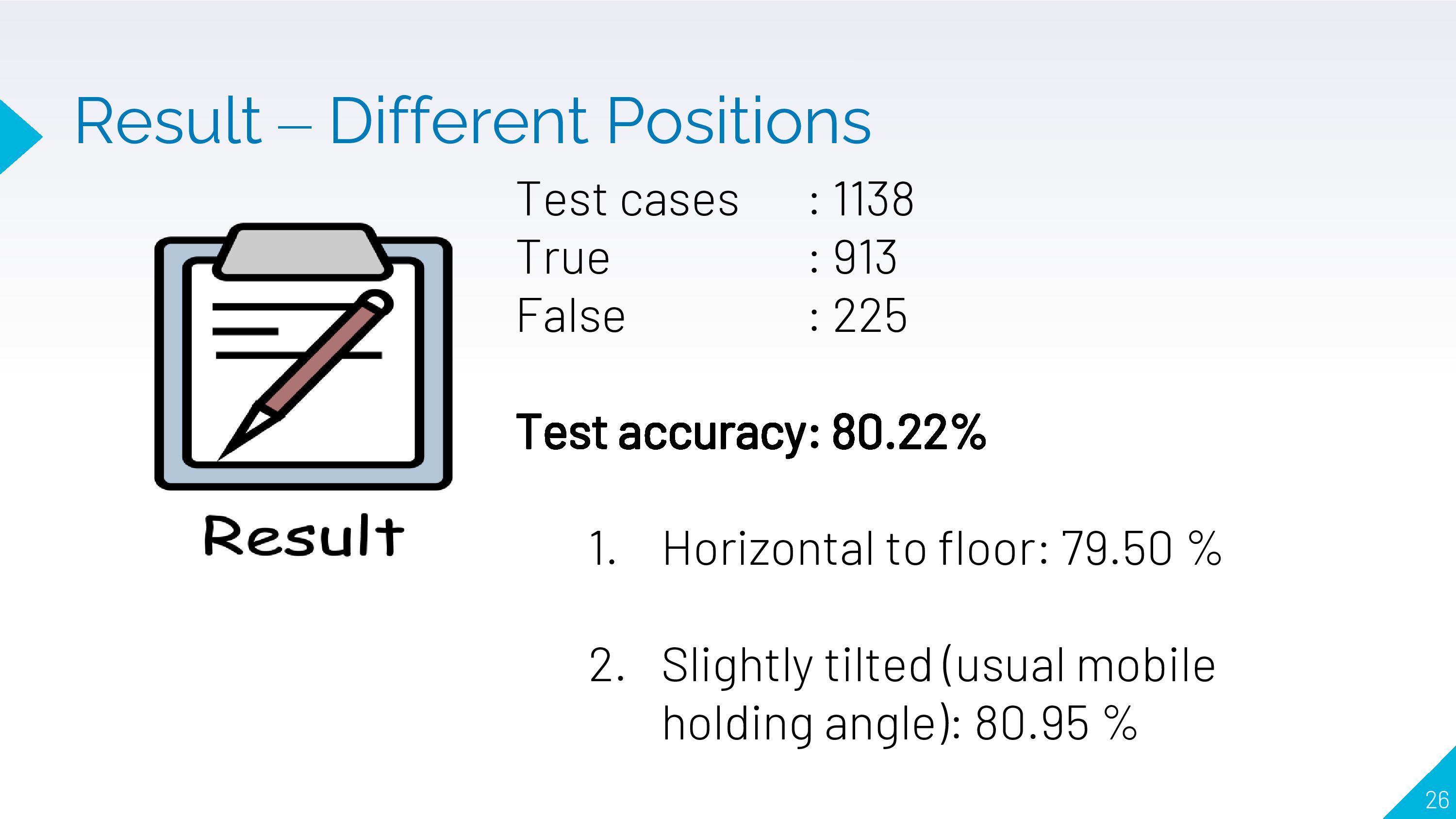 |
Performance of the system is analyzed for different mobile holding positions viz. horizontal to floor and casual mobile holding angle. Using 12-bit unique ID transmission, the proposed system can address 4096 lights. A total of 163 unique IDs from ID number 25 to ID number 4096 (in steps of 25) has been taken for analysis. For each ID, 3 to 4 attempts have been experimented. Out of 1138 test cases, 913 cases are positive and 225 are negative. Accuracy obtained for horizontal to floor position and casual mobile holding angle positions are 79.5% and 80.95% respectively. Results show that NLOS approach is user friendly and can achieve up to 80% accuracy. |
| ICACT20230039 Slide.27
[Big Slide]
[YouTube] |
Chrome Click!! |
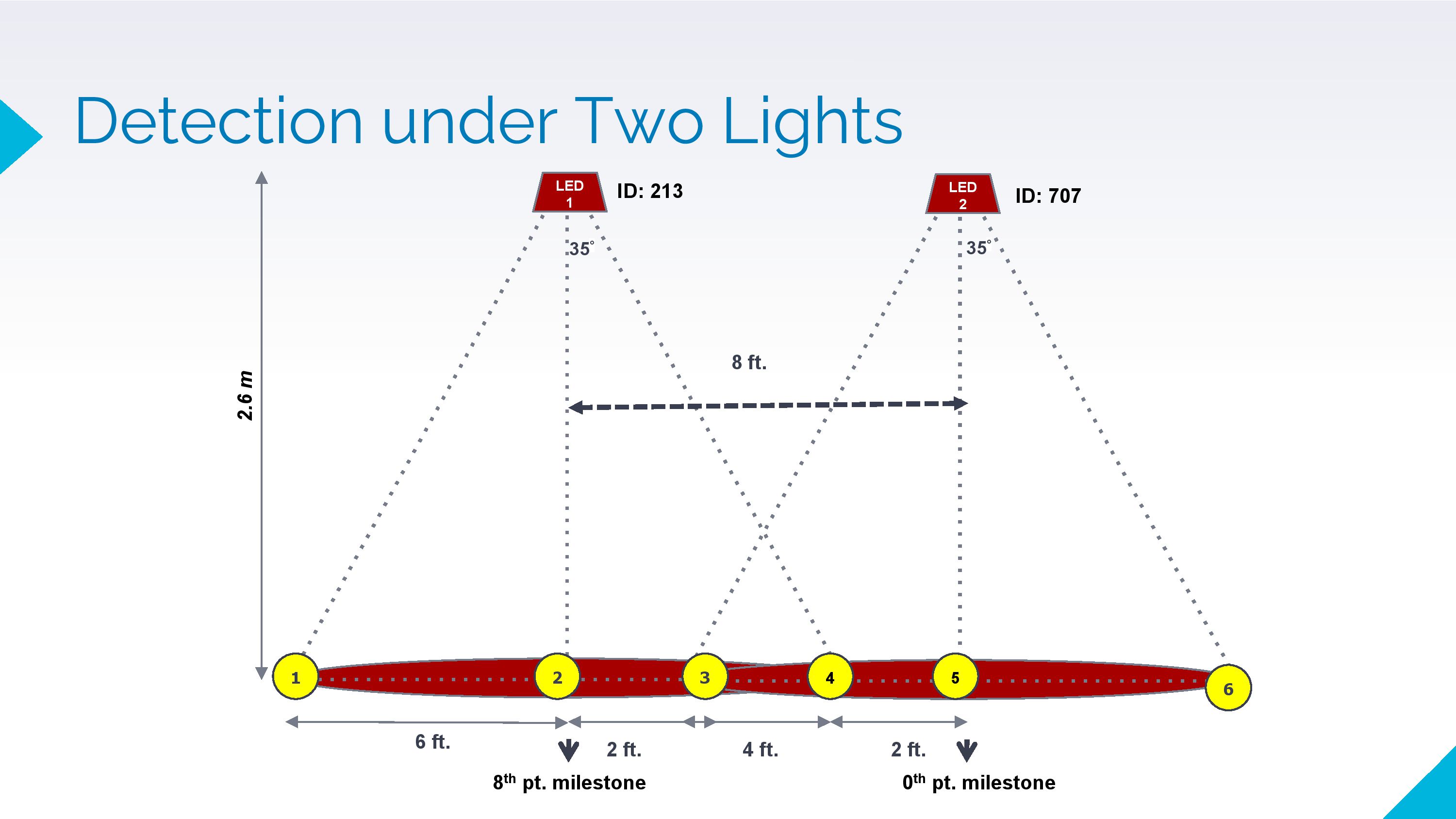 |
For performance analysis under 2 lights, starting from the LED down light ID: 707, pt. 5 performance has been checked at every 0.5 ft towards ID: 213, pt. 2. And the same process has been repeated from pt. 2 to pt. 5. |
| ICACT20230039 Slide.28
[Big Slide]
[YouTube] |
Chrome Click!! |
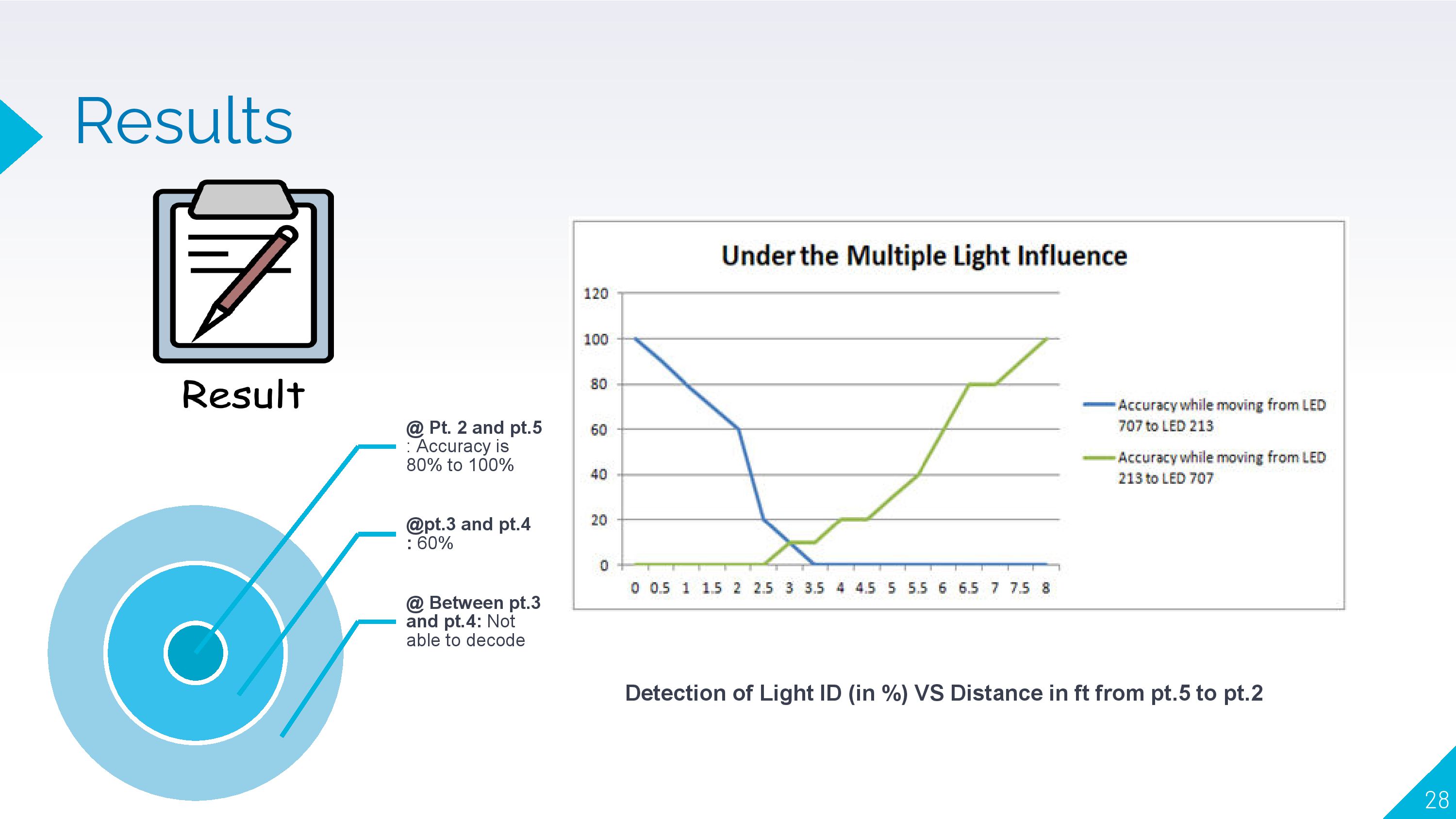 |
At Pt. 2 and pt.5, accuracy is 80% to 100% from center of the light to up to 1 ft. At pt.3 and pt.4, up to 2 ft region on either side of the light from the center, Unique IDs are detected with minimum accuracy of 60%. In the area between pt.3 and pt.4, accuracy drastically drops after 2ft. Unique IDs detection were not successful in this region.
The receiver was able to decode the unique ID in the presence of standard color mats such as red, blue and wooden floors.
|
| ICACT20230039 Slide.29
[Big Slide]
[YouTube] |
Chrome Click!! |
 |
This section briefs the conclusion summary and our future plan |
| ICACT20230039 Slide.30
[Big Slide]
[YouTube] |
Chrome Click!! |
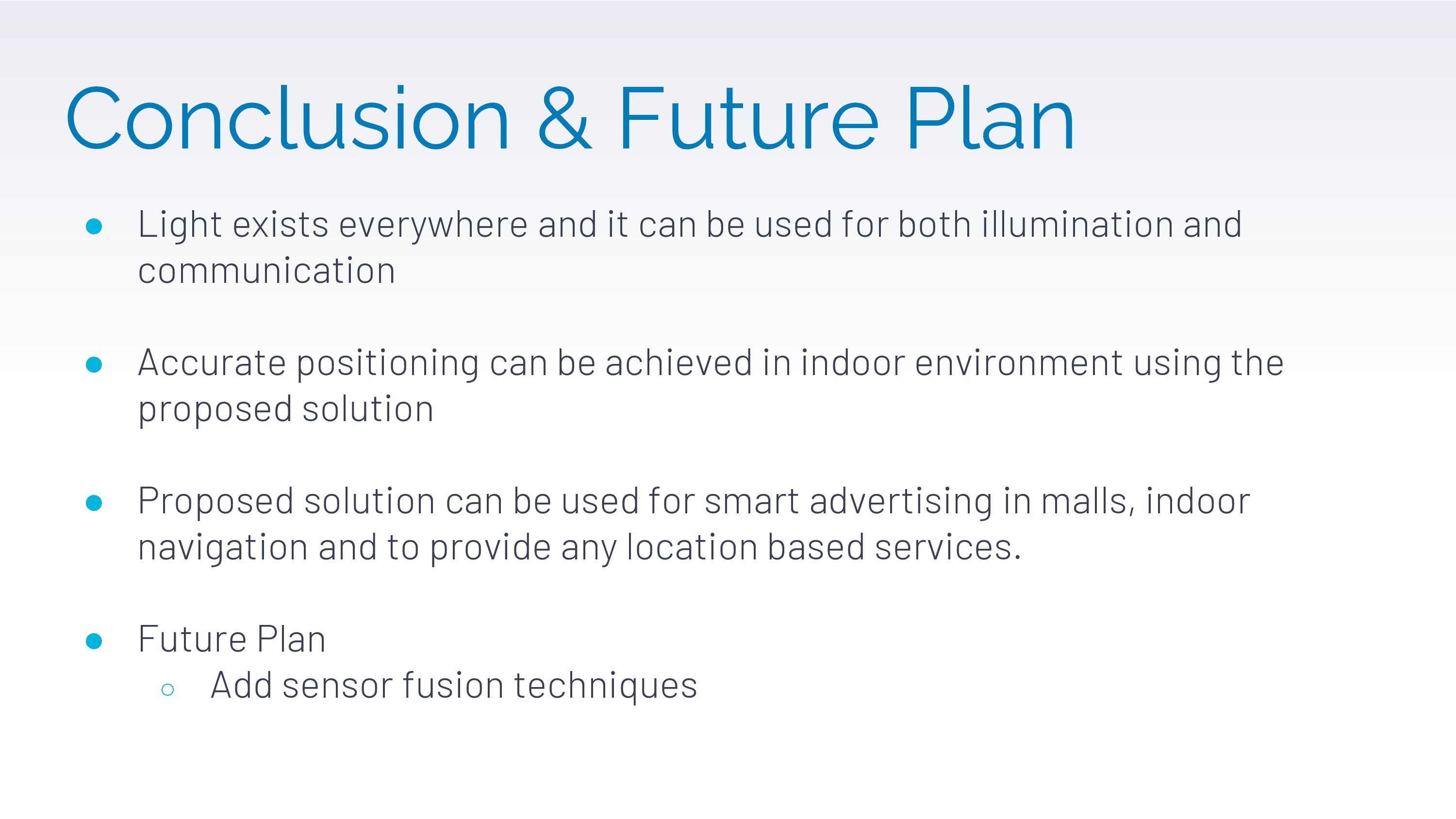 |
Light exists everywhere and it can be used for both illumination and communication. Accurate positioning can be achieved in indoor environment using the proposed solution. The proposed solution can be used for smart advertising in malls, indoor navigation and to provide any location-based services. In future, we would like to improve the accuracy of the system by adding sensor fusion techniques |
| ICACT20230039 Slide.31
[Big Slide]
[YouTube] |
Chrome Click!! |
 |
Thank you for listening. |















