Now 13367 visitors
Today:0 Yesterday:0
Total: 188169
216S 51P 5R
2026-10-21, Week 43 |
| Member Login |
| TACT Journal Homepage |
| Call for Paper |
| Committee |
| Find My Paper |
| Author Homepage |
| Statistics & History |
| Welcome Message |
| Paper Procedure |
| FAQ |
| Paper Archives |
| Outstanding Papers |
| Author Homepage |
| - Paper Procedure |
| - Journal Procedure |
| - Presentation Tips |
|
| Program & Proceedings |
| Program with Papers |
| Plenary Session |
| Tutorial Session |
|
| Presentation Platform |
| Hotel & Travel Info |
| About Korea |
| Accommodation |
| Transportation |
| VISA |
| Other Infomation |
|
| Photo Gallery |
| Scheduler Login |
| Seminar |
| Archives Login |
|
| Sponsors |

|

|

|

|

|

|

|

|

|

|
|
|
|
|
 ICACT20230040 Slide.01
[Big Slide]
[YouTube] |
Chrome  Click!! |
 |
Hello everyone. I’m Ahyun Song, a PhD Student from SKK University.
I’m presenting today our study on the work of analysis of Olympus DAO. |
| ICACT20230040 Slide.02
[Big Slide]
|
Chrome Click!! |
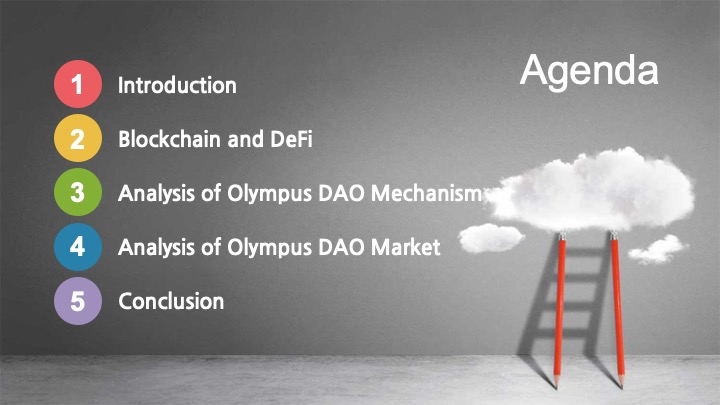 |
The presentation agenda is as follows. |
| ICACT20230040 Slide.03
[Big Slide]
|
Chrome Click!! |
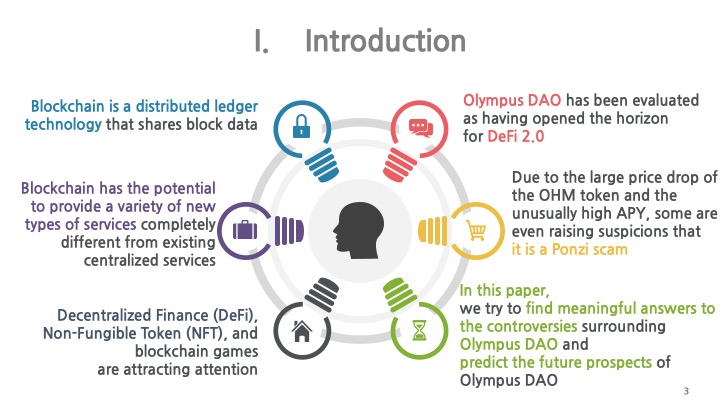 |
Blockchain is a distributed ledger technology that shares block data in a distributed environment via peer-to-peer network, so that anyone can read the data but cannot manipulate the data.
Blockchain has the potential to provide a variety of new types of services completely different from existing centralized services because data, services, and decision-making are decentralized in this way. Recently, Decentralized Finance (DeFi), Non-Fungible Token (NFT), and blockchain games are attracting attention.
In this paper, we analyze Olympus DAO, which is attracting attention as an innovative model of DeFi 2.0, in detail. Olympus DAO, an Ethereum-based decentralized reserve currency protocol, has been evaluated as having opened the horizon for DeFi 2.0 by proposing the concept of Protocol Owned Liquidity.
Assets deposited in the Olympus DAO peaked at the end of 2021 at around $880 million. However, as of October 2022, when the cryptocurrency market such as Bitcoin and Ethereum is stagnant, it has fallen sharply to about $269 million.
Due to the large price drop of the OHM token and the unusually high APY, some are even raising suspicions that it is a Ponzi scam. Therefore, in this paper, we try to find meaningful answers to the controversies surrounding Olympus DAO and predict the future prospects of Olympus DAO by analyzing the mechanism and market of Olympus DAO.
|
| ICACT20230040 Slide.04
[Big Slide]
|
Chrome Click!! |
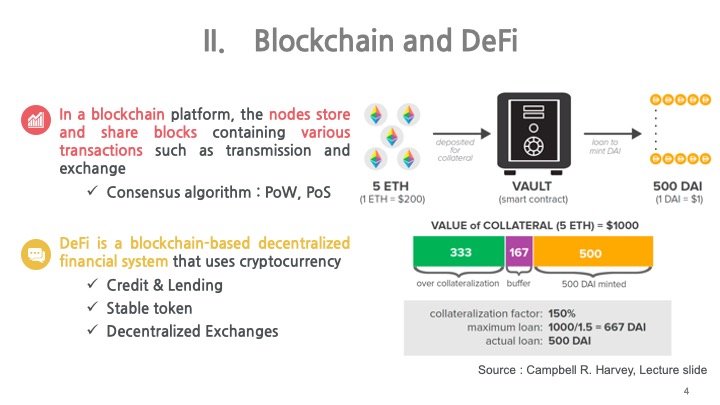 |
In this slide, we look into blockchain and DeFi, which is the background knowledge for understanding Olympus DAO.
In a blockchain platform, the nodes store and share blocks containing various transactions such as transmission and exchange, and they are rewarded for mining new blocks. The blockchain platform adds new blocks by achieving consensus among nodes through a consensus algorithm such as Proof of Work (PoW) or Proof of Stake (PoS).
DeFi is a blockchain-based decentralized financial system that uses cryptocurrency.
For example, in a secured loan service, a centralized organization determines important matters such as the interest rate of a loan and the amount that can be borrowed in traditional financial systems, whereas in DeFi, the loan interest rate is set transparently by supply and demand on the blockchain. Users can borrow as much as they want with their cryptocurrency as collateral. At this time, the collateral is stored in the smart contract, and if the value of the collateralized cryptocurrency is lower than the value of the loan, the smart contract sells it to the market and repays the loan amount. In this case, the safety of the loan service is supported by the secured cryptocurrency of the borrower and the smart contract technology.
|
| ICACT20230040 Slide.05
[Big Slide]
|
Chrome Click!! |
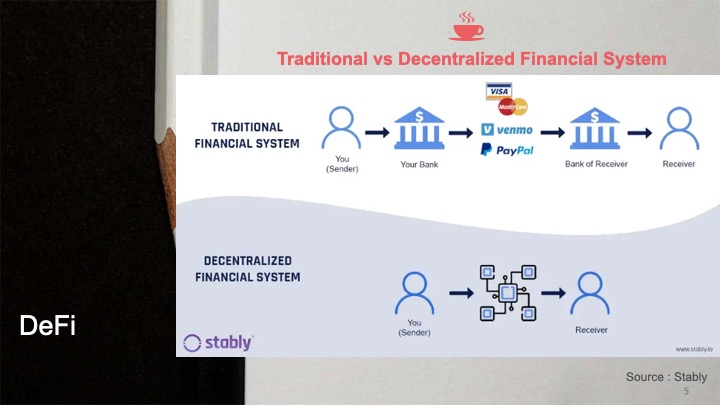 |
So, in traditional finance, a centralized financial organization records and manages all transactions on a central server, but DeFi records and executes transactions in the blockchain using smart contract technology.
DeFi is receiving attention as it can provide new alternatives to information asymmetry between financial companies and users, high transaction fees, and transaction delays, which have been considered structural problems that traditional financial system cannot solve.
|
| ICACT20230040 Slide.06
[Big Slide]
|
Chrome Click!! |
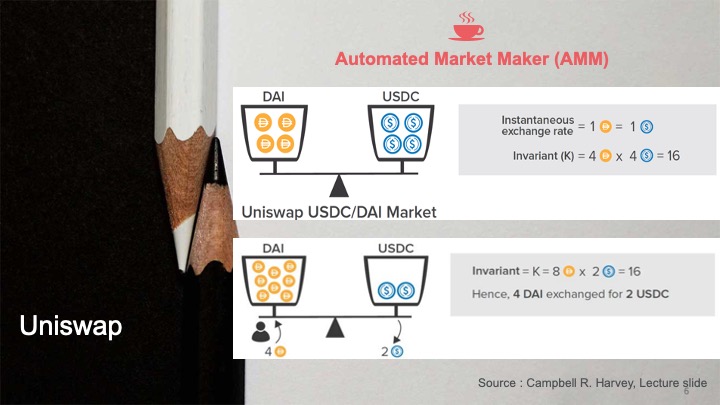 |
And decentralized exchanges have important meanings in the DeFi ecosystem. Uniswap is the most representative and successful decentralized exchange, and it provides liquidity using the Automated Market Maker (AMM) system. In the AMM system, the liquidity provider provides two tokens to the liquidity pool, and these two tokens are tied to smart contracts. Users utilize the liquidity of this pool to exchange tokens and pay a fee, which goes back to the liquidity provider.
Following the success of Uniswap, various protocols have emerged that give out self-issuing tokens to hold long-term liquidity providers in the liquidity pool. However, as the token price falls due to an increase in token circulation, the profits of liquidity providers also fall. Thus, liquidity providers seek alternative liquidity pools that provide higher interest rates and withdraw liquidity from the pool after only a short period of time. This has led to the critical risk of exhausted liquidity, so there have been concerns about how to lock liquidity in the liquidity pool for a longer period.
|
| ICACT20230040 Slide.07
[Big Slide]
|
Chrome Click!! |
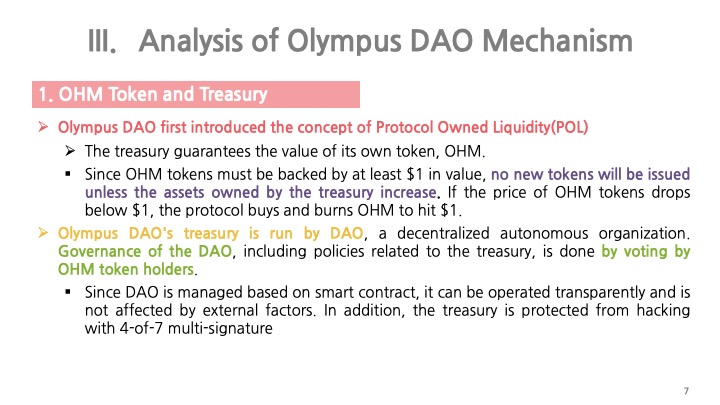 |
Olympus DAO first introduced the concept of Protocol Owned Liquidity (POL), and the treasury operated by a Decentralized Autonomous Organization (DAO) guarantees the value of its own token, OHM. Since OHM tokens must be backed by at least $1 in value, no new tokens will be issued unless the assets owned by the treasury increase. If the price of OHM tokens drops below $1, the protocol buys and burns OHM to hit $1.
Olympus DAO's treasury is run by DAO, a decentralized autonomous organization. Governance of the DAO, including policies related to the treasury, is done by voting by OHM token holders. Since DAO is managed based on smart contract, it can be operated transparently and is not affected by external factors. In addition, the treasury is protected from hacking with 4-of-7 multi-signature.
|
| ICACT20230040 Slide.08
[Big Slide]
|
Chrome Click!! |
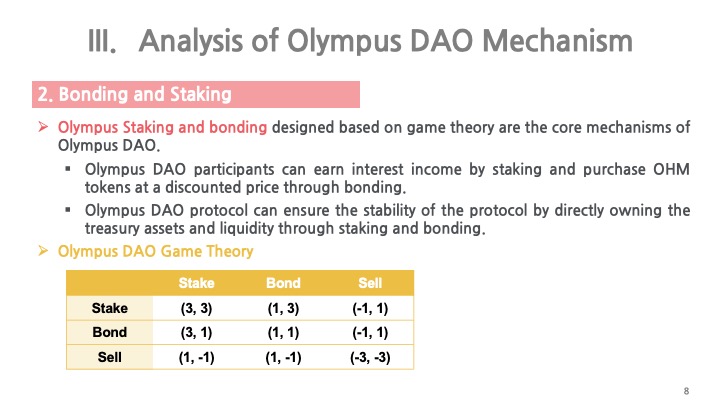 |
Staking and bonding designed based on game theory are the core mechanisms of Olympus DAO. Olympus DAO participants can earn interest income by staking and purchase OHM tokens at a discounted price through bonding. In addition, the Olympus DAO protocol can ensure the stability of the protocol by directly owning the treasury assets and liquidity through staking and bonding.
Bonding plays an important role in increasing the assets owned by the treasury. Bonders can purchase OHM tokens at a discount from the market price. The bonder can hold the OHM token and participate in staking or sell it after a certain period of time, which is about 5 days by default, to get a profit. The protocol will increase the treasury assets by receiving the payment for purchasing tokens from the bonder.
Through staking, the staker locks the OHM token and receives rebase rewards accordingly. Olympus DAO drives demand for OHM tokens by offering high APY to stakers. When OHM tokens are staked, the staker will receive the same amount of sOHM. And the quantity of sOHM tokens increases by once every 8 hours according to the APY, the yield given by the smart contract. The staker will receive the same amount of OHM tokens as sOHM when unstaking.
Olympus DAO uses (3,3) memes to explain Olympus DAO game theory strategies. Olympus DAO participants can take three actions: staking, bonding, and selling. Staking and bonding, which increase the value of OHM tokens, are positive actions for the protocol, but selling can cause the protocol's value to decline. The following table quantifies the profit and loss according to the actions of Olympus DAO participants. First, +2 points, +1 points, and -2 points are given as basic points for each action of staking, bonding, and selling. In addition, +1 point or -1 point is given in consideration of the profit or loss caused by the actions of others.
|
| ICACT20230040 Slide.09
[Big Slide]
|
Chrome Click!! |
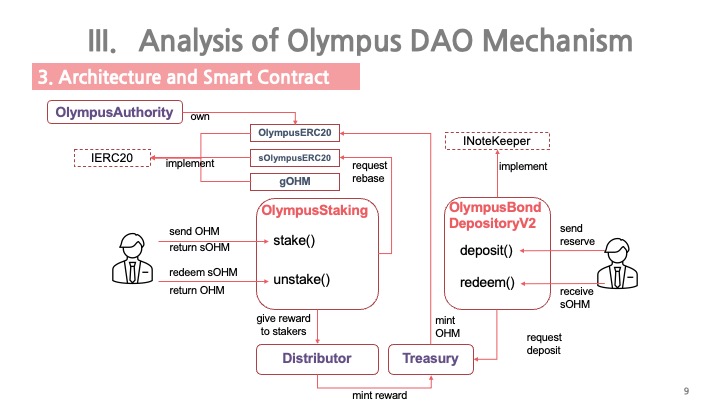 |
Currently Olympus DAO is running on the Ethereum mainnet. We analysed the deployed smart contract codes in which can be also seen in Etherscan and figured out the system architecture of Olympus DAO as shown in Figure. Specifically, we derived the overall flow of the model by identifying the roles and functions of smart contracts and analysing the relationships between smart contracts. The role of each smart contract is as follows.
OlympusERC20 is an implementation for OHM token as reserve currency issued by Olympus DAO, and it complies with ERC20 standard. In Olympus DAO, both SafeMath and SafeERC20 libraries are applied to enhance security for all tokens including OHM.
sOlympusERC20 is an implementation for sOHM token that OHM owners receive at a 1:1 ratio when staking, and it also complies with ERC20 standard.
Treasury acts as a vault for storing the collected assets and is protected by 4-of-7 multi-signature. Only this Treasury contract can mint new OHM.
OlympusBondDepositoryV2 manages various bonds such as OHM-DAI LP bond and FRAX bond. The user can purchase bonds by calling deposit() function and exercise the bond by calling redeem() function.
OlympusStaking is a smart contract that manages users to stake their OHM and receive rewards. When a user stakes his or her OHM, an equal amount of sOHM is paid. Conversely, when the user unstakes, this contract receives sOHM and pays the corresponding OHM. For user compensation, it requests a rebase from sOHM to make rewards every 8 hours. After that, the Distributor contract is called to distribute the rewards to the stakers. |
| ICACT20230040 Slide.10
[Big Slide]
|
Chrome Click!! |
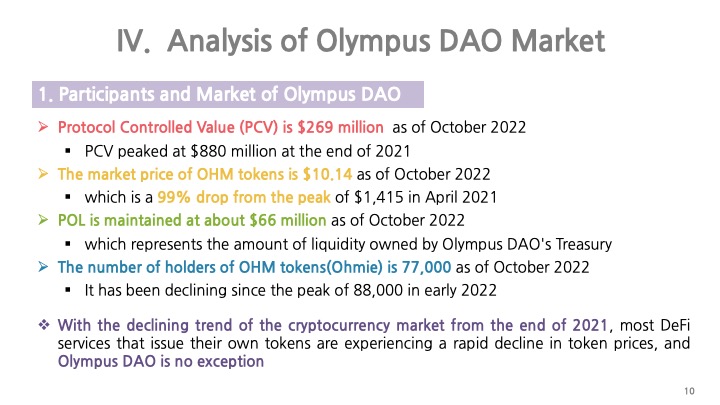 |
Protocol Controlled Value (PCV) is the total amount of assets deposited in Olympus DAO. This is used as one of the indicators of how successfully the Olympus DAO is attracting attention to active market participants. After Olympus DAO launched in March 2021, the PCV peaked at $880 million at the end of 2021, but has since dropped sharply and is $269 million as of October 2022.
The market price of OHM tokens is $10.14 as of October 2022, which is a 99% drop from the peak of $1,415 in April 2021.
And the POL, which represents the amount of liquidity owned by Olympus DAO's Treasury, is maintained at about $66 million as of October 2022.
With the declining trend of the cryptocurrency market from the end of 2021, most DeFi services that issue their own tokens are experiencing a rapid decline in token prices, and Olympus DAO is no exception. Moreover, as Olympus DAO has claimed that POL can solve this problem, negative opinions about Olympus DAO are increasing due to the sharp drop in token price.
|
| ICACT20230040 Slide.11
[Big Slide]
|
Chrome Click!! |
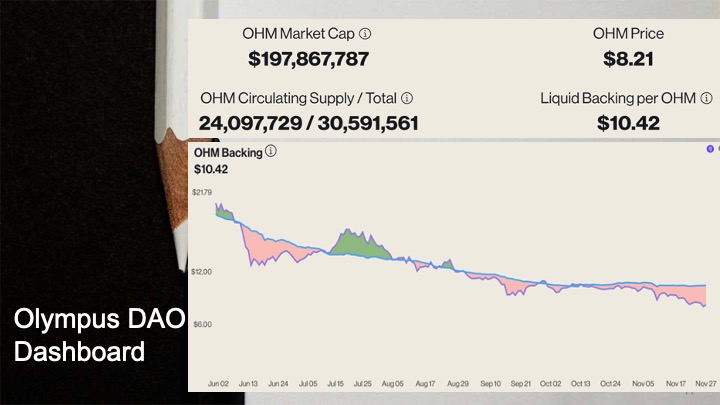 |
The figure you are looking at is a capture of the Olympus DAO Dashboard at the end of last November. You can check Olympus DAO market related data, such as OHM Price explained in the previous slide. |
| ICACT20230040 Slide.12
[Big Slide]
|
Chrome Click!! |
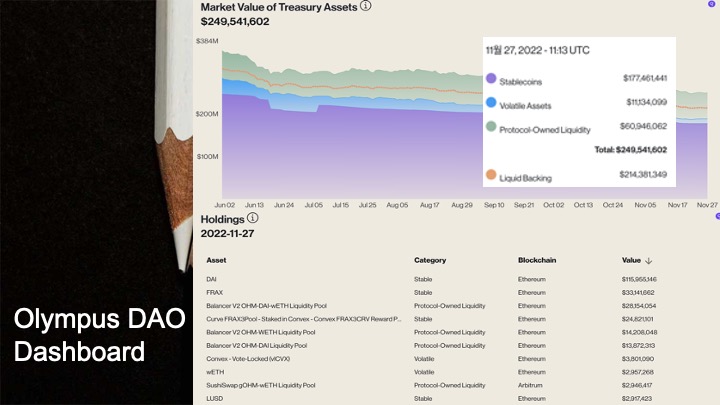 |
This graph shows the market value of treasury assets on the Olympus DAO Dashboard. |
| ICACT20230040 Slide.13
[Big Slide]
|
Chrome Click!! |
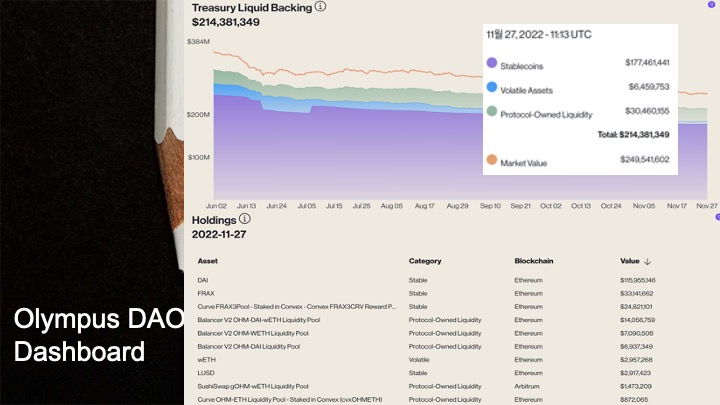 |
This graph shows the Treasury Liquid Backing on the Olympus DAO Dashboard. |
| ICACT20230040 Slide.14
[Big Slide]
|
Chrome Click!! |
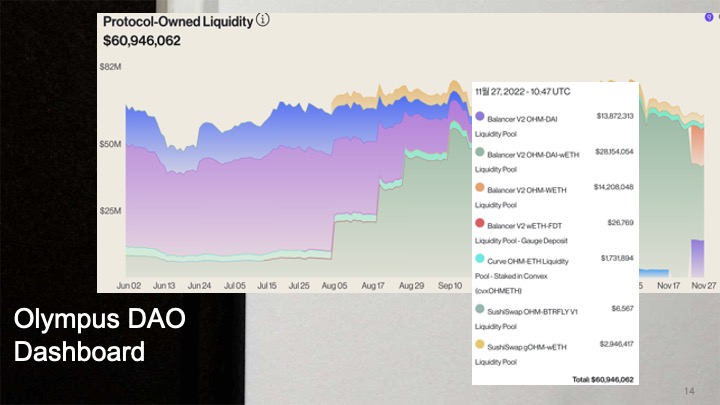 |
This graph shows the Protocol Owned Liquidity on the Olympus DAO Dashboard. |
| ICACT20230040 Slide.15
[Big Slide]
|
Chrome Click!! |
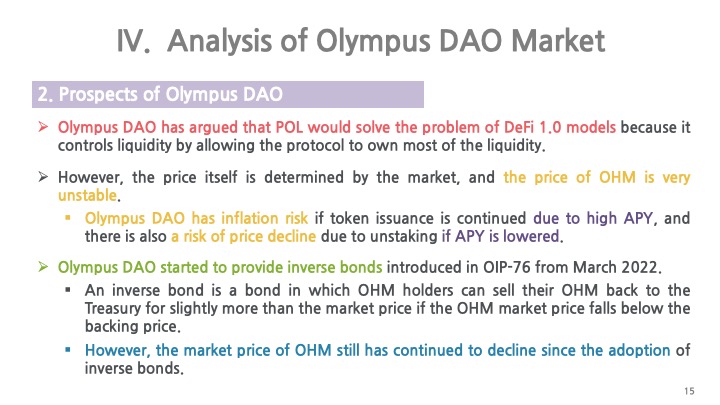 |
Olympus DAO has argued that POL would solve this problem because it controls liquidity by allowing the protocol to own most of the liquidity. However, in the end, the price itself is determined by the market, and the price of OHM is very unstable. Olympus DAO has inflation risk if token issuance is continued due to high APY, and there is also a risk of price decline due to unstaking if APY is lowered.
Olympus DAO started to provide inverse bonds introduced in OIP-76 from March 2022. An inverse bond is a bond in which OHM holders can sell their OHM back to the Treasury for slightly more than the market price if the OHM market price falls below the backing price.
Olympus DAO explains that through these inverse bonds, the Treasury absorbs OHM and reduces the market circulation, thereby increasing the backing price. However, the market price of OHM still has continued to decline since the adoption of inverse bonds. Until now the effect of inverse bonds is not yet visible, and it remains questionable whether it will be helpful in defending price.
|
| ICACT20230040 Slide.16
[Big Slide]
|
Chrome Click!! |
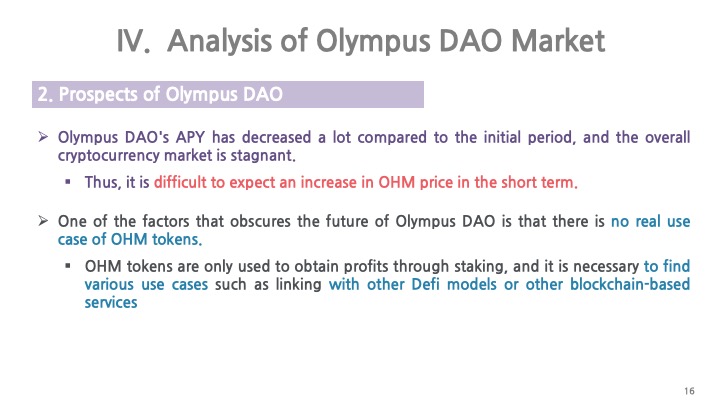 |
Olympus DAO's APY has decreased a lot compared to the initial period, and the overall cryptocurrency market is stagnant. Thus, it is difficult to expect an increase in OHM price in the short term.
And one of the factors that obscures the future of Olympus DAO is that there is no real use case of OHM tokens. OHM tokens are only used to obtain profits through staking, and it is necessary to find various use cases such as linking with other Defi models or other blockchain-based services.
|
| ICACT20230040 Slide.17
[Big Slide]
|
Chrome Click!! |
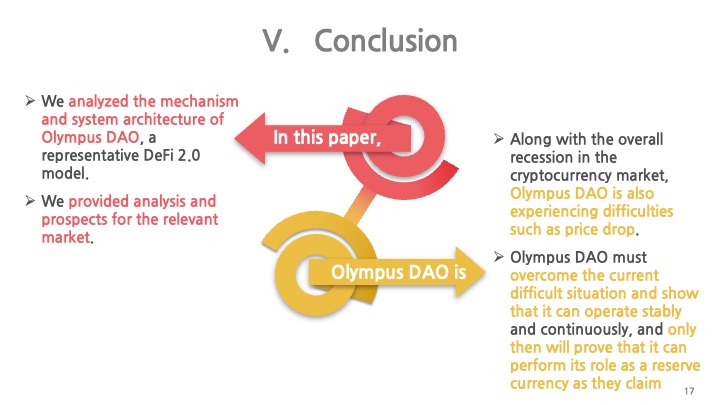 |
In this paper, we analyzed the mechanism and system architecture of Olympus DAO, a representative DeFi 2.0 model, and provided analysis and prospects for the relevant market. Olympus DAO tried to solve the liquidity problem of existing DeFi models with a new POL concept and succeeded in attracting public attention. However, along with the overall recession in the cryptocurrency market, Olympus DAO is also experiencing difficulties such as price drop. Olympus DAO must overcome the current difficult situation and show that it can operate stably and continuously, and only then it will prove that it can perform its role as a reserve currency as they claim. |
| ICACT20230040 Slide.18
[Big Slide]
|
Chrome Click!! |
 |
Thank you for listening.
And now it’s over to you. I’ll be happy to answer questions.
|
| |





