Now 4116 visitors
Today:0 Yesterday:0
Total: 141299
215S 51P 5R
2026-10-21, Week 43 |
| Member Login |
| TACT Journal Homepage |
| Call for Paper |
| Committee |
| Find My Paper |
| Author Homepage |
| Statistics & History |
| Welcome Message |
| Paper Procedure |
| FAQ |
| Paper Archives |
| Outstanding Papers |
| Author Homepage |
| - Paper Procedure |
| - Journal Procedure |
| - Presentation Tips |
|
| Program & Proceedings |
| Program with Papers |
| Plenary Session |
| Tutorial Session |
|
| Presentation Platform |
| Hotel & Travel Info |
| About Korea |
| Accommodation |
| Transportation |
| VISA |
| Other Infomation |
|
| Photo Gallery |
| Scheduler Login |
| Seminar |
| Archives Login |
|
| Sponsors |

|

|

|

|

|

|

|

|

|

|
|
|
|
|
 ICACT20230153 Slide.01
[Big Slide] |
Chrome  Click!! |
 |
Goog morning Everyone.
I'm Sang-yun working for ETRI in South Korea.
My presentation is Damage Detection and Safety Diagnosis for Immovable Cultural Assets Using Deep Learning Framework
.
I will start my presentation. |
| ICACT20230153 Slide.02
[Big Slide]
|
Chrome Click!! |
 |
Regular inspection and maintenance work is required to secure the structural stability of wooden cultural properties that are deteriorating due to deterioration and artificial activities.
However, there are many restrictions on investigation for safety inspection due to the uniqueness of cultural heritage itself. Therefore, the inspection process is usually conducted by methods such as visual inspection and non-destructive ones.
However, this type of regular inspection has limitations in terms of time and cost. Recently, various studies have been conducted to predict damage or deformation of cultural properties in advance by using Deep Learning technology and coping with the possible problems in the early stages.
In recent studies [3], [4], [5], a Deep Learning model that measures the amount of displacement using a generative model was presented.
In this paper, we propose a method for normal-abnormal binary classification using CCTV image data of the roof of Heunginjimun, Korea's treasure No. 1. To this end, six image datasets were created, and by using them, we propose a Deep Learning framework that can detect subtle tilts that are difficult to be identified even with the human eye.
|
| ICACT20230153 Slide.03
[Big Slide]
|
Chrome Click!! |
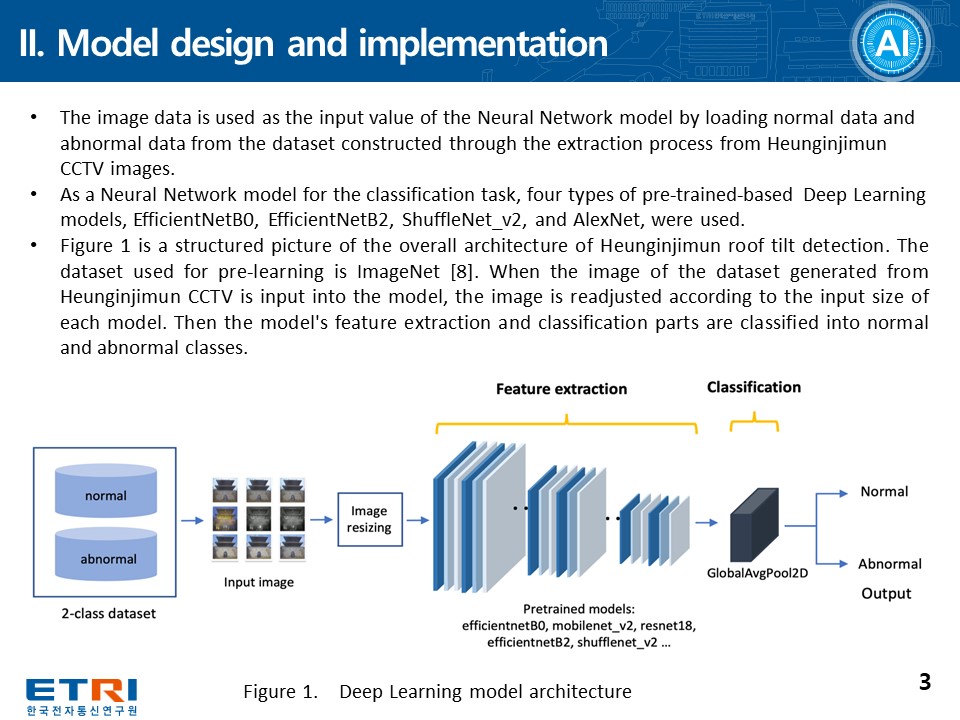 |
The image data is used as the input value of the Neural Network model by loading normal data and abnormal data from the dataset constructed through the extraction process from Heunginjimun CCTV images.
As a Neural Network model for the classification task, four types of pre-trained-based Deep Learning models, EfficientNetB0, EfficientNetB2, ShuffleNet_v2, and AlexNet, were used.
Figure 1 is a structured picture of the overall architecture of Heunginjimun roof tilt detection. The dataset used for pre-learning is ImageNet [8]. When the image of the dataset generated from Heunginjimun CCTV is input into the model, the image is readjusted according to the input size of each model. Then the model's feature extraction and classification parts are classified into normal and abnormal classes.
|
| ICACT20230153 Slide.04
[Big Slide]
|
Chrome Click!! |
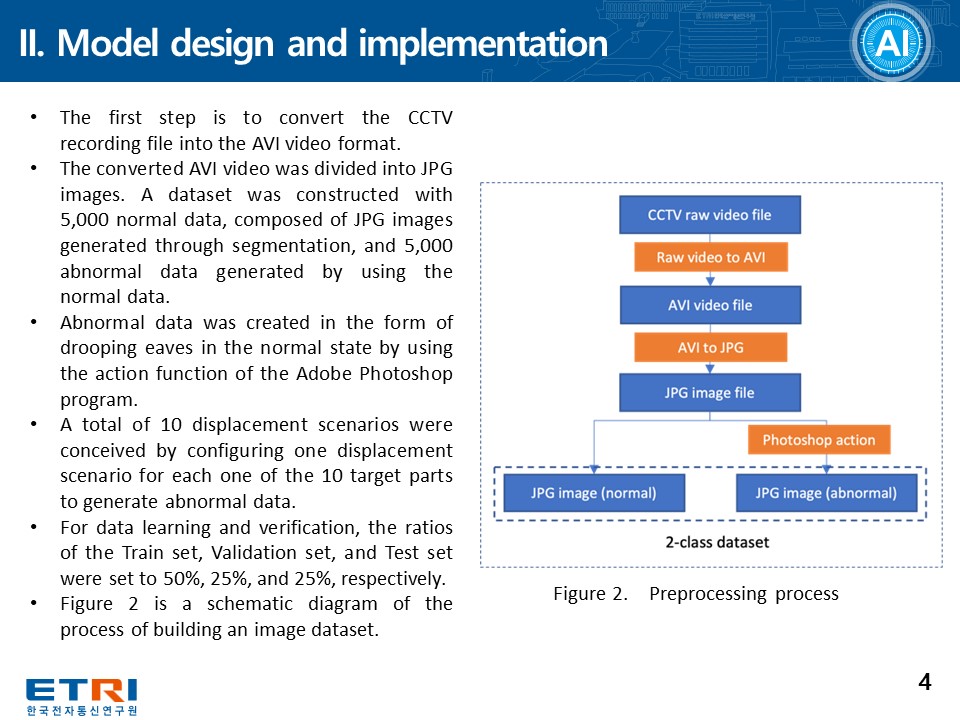 |
The first step is to convert the CCTV recording file into the AVI video format.
The converted AVI video was divided into JPG images. A dataset was constructed with 5,000 normal data, composed of JPG images generated through segmentation, and 5,000 abnormal data generated by using the normal data.
Abnormal data was created in the form of drooping eaves in the normal state by using the action function of the Adobe Photoshop program.
A total of 10 displacement scenarios were conceived by configuring one displacement scenario for each one of the 10 target parts to generate abnormal data.
For data learning and verification, the ratios of the Train set, Validation set, and Test set were set to 50%, 25%, and 25%, respectively.
Figure 2 is a schematic diagram of the process of building an image dataset.
|
| ICACT20230153 Slide.05
[Big Slide]
|
Chrome Click!! |
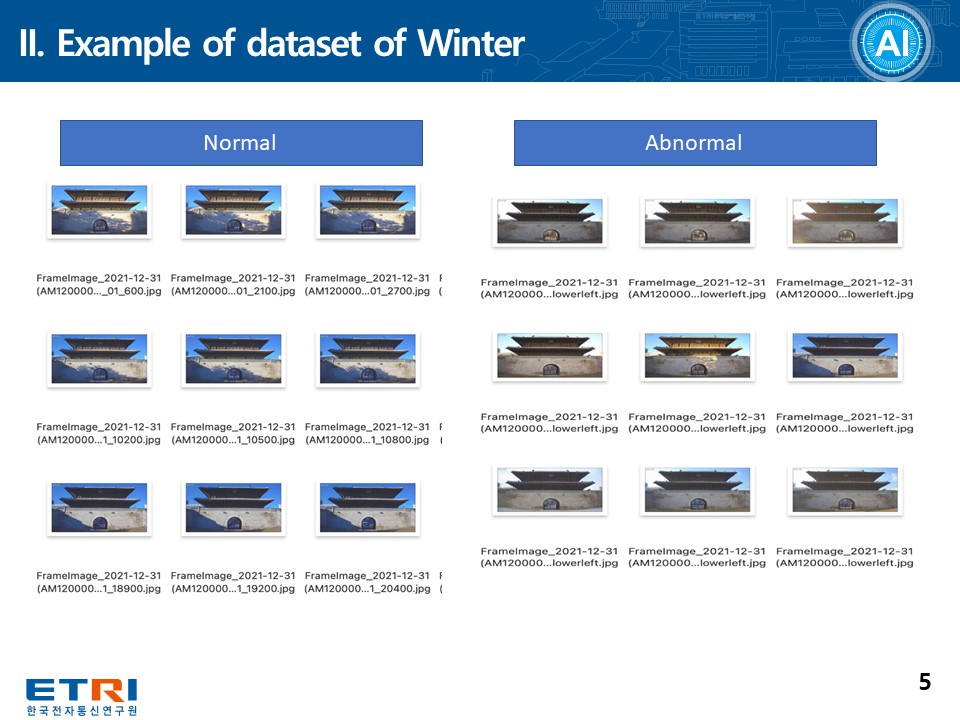 |
This picture shows the example of dataset of Winter.
Left is normal and right is abnormal dataset. |
| ICACT20230153 Slide.06
[Big Slide]
|
Chrome Click!! |
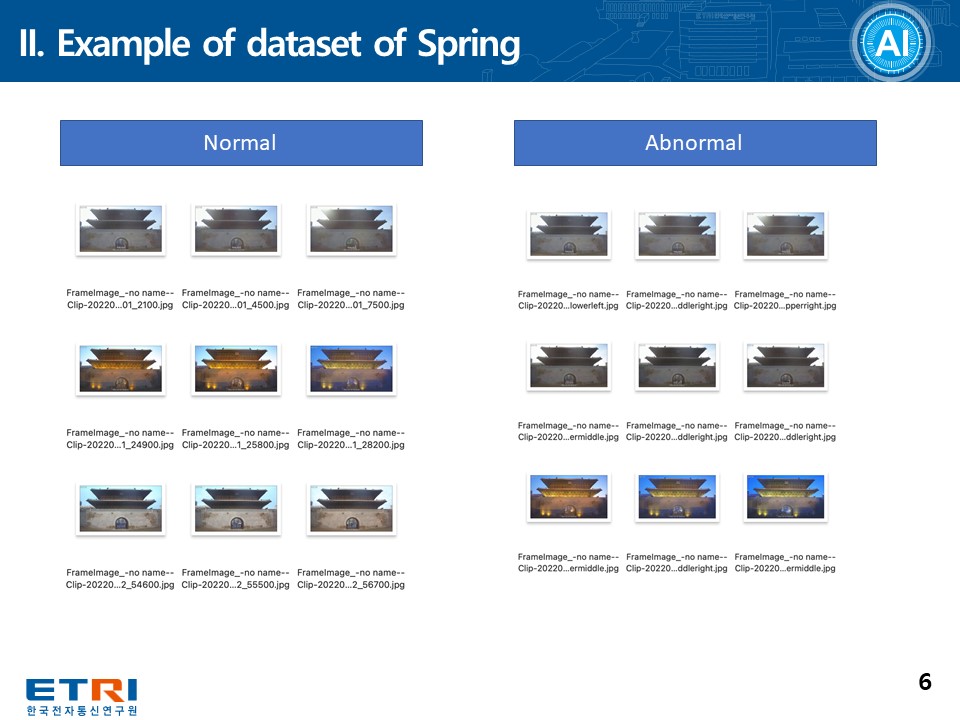 |
This picture shows the example of dataset of Spring.
Left is normal and right is abnormal dataset. |
| ICACT20230153 Slide.07
[Big Slide]
|
Chrome Click!! |
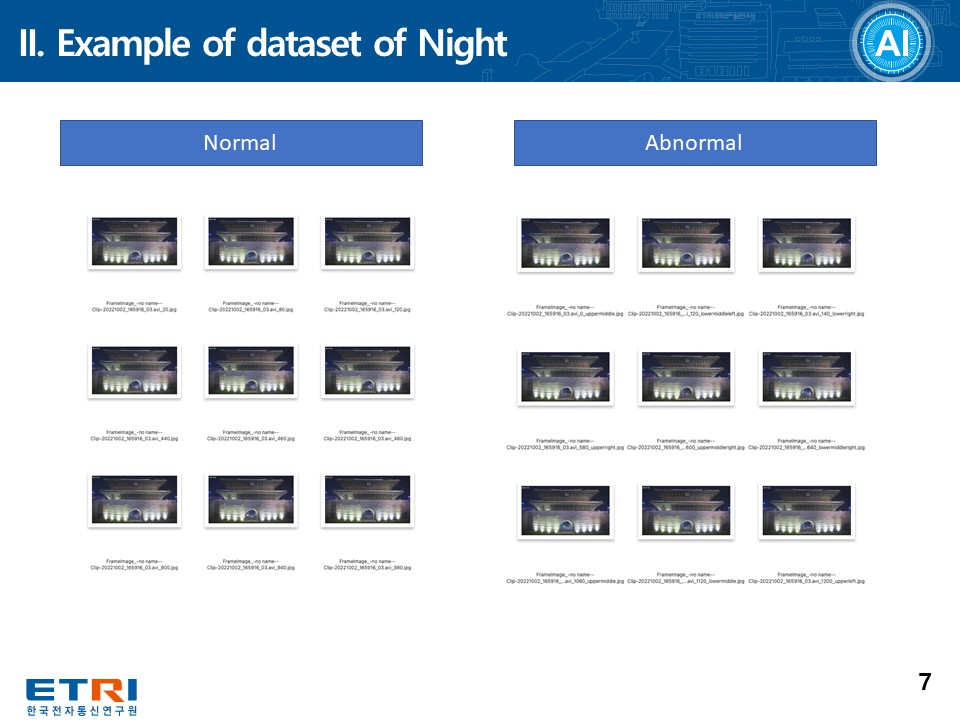 |
This picture shows the example of dataset of Night.
Left is normal and right is abnormal dataset. |
| ICACT20230153 Slide.08
[Big Slide]
|
Chrome Click!! |
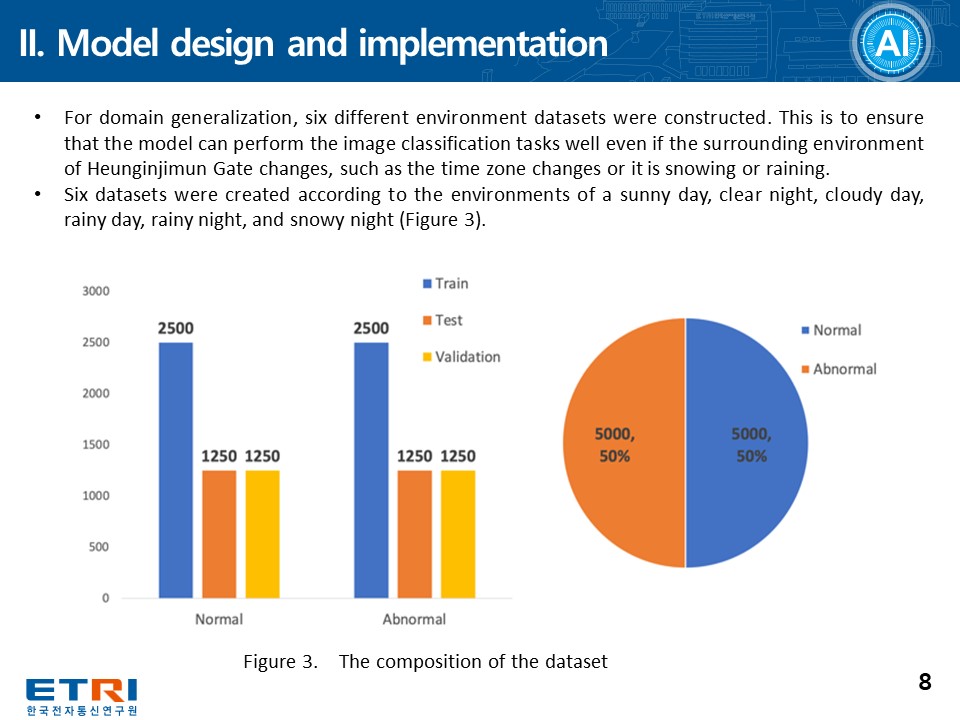 |
For domain generalization, six different environment datasets were constructed. This is to ensure that the model can perform the image classification tasks well even if the surrounding environment of Heunginjimun Gate changes, such as the time zone changes or it is snowing or raining.
Six datasets were created according to the environments of a sunny day, clear night, cloudy day, rainy day, rainy night, and snowy night (Figure 3).
|
| ICACT20230153 Slide.09
[Big Slide]
|
Chrome Click!! |
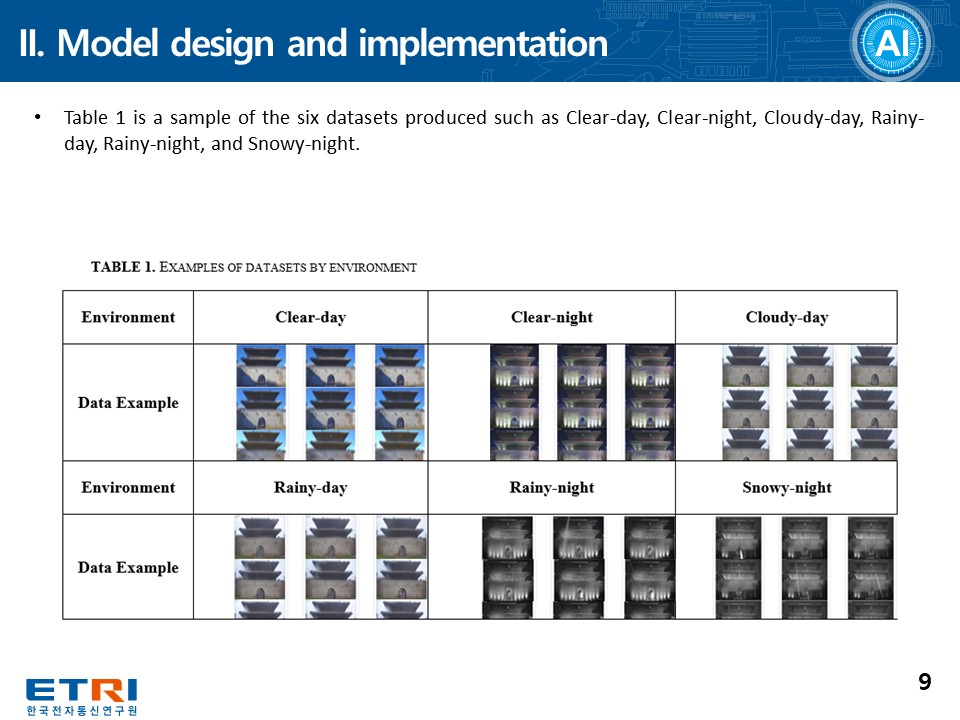 |
Table 1 is a sample of the six datasets produced such as Clear-day, Clear-night, Cloudy-day, Rainy-day, Rainy-night, and Snowy-night.
|
| ICACT20230153 Slide.10
[Big Slide]
|
Chrome Click!! |
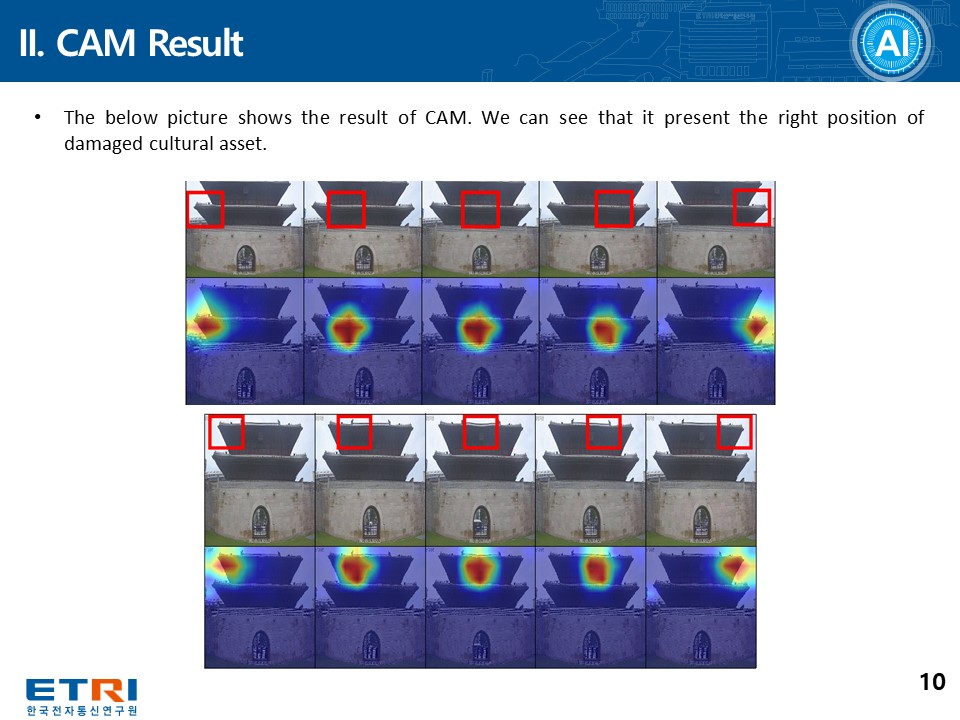 |
The below picture shows the result of CAM. We can see that it present the right position of damaged cultural asset |
| ICACT20230153 Slide.11
[Big Slide]
|
Chrome Click!! |
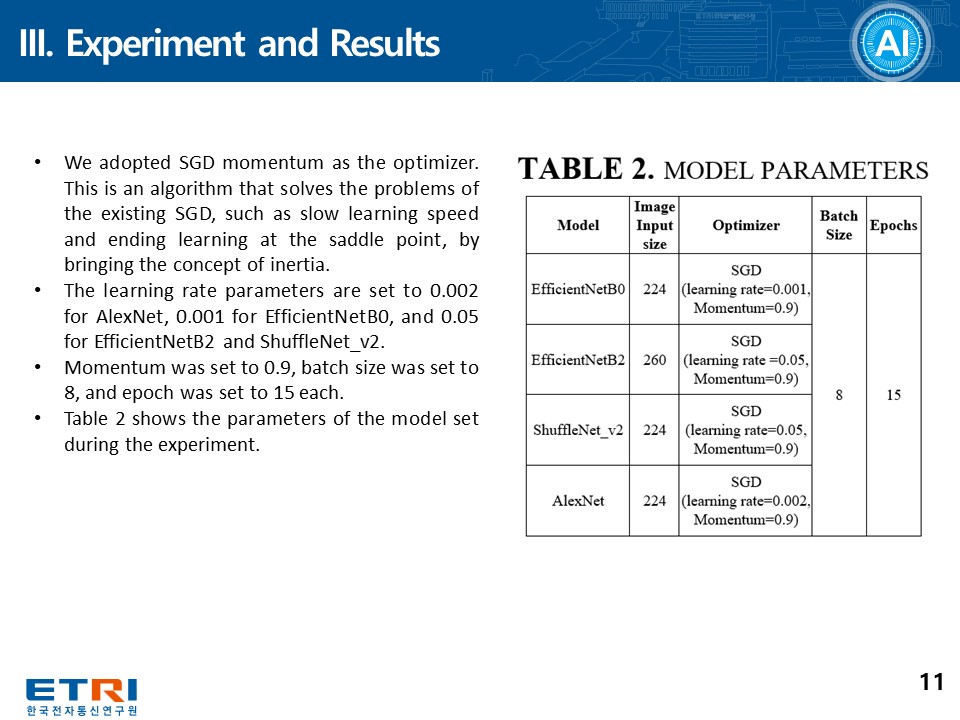 |
We adopted SGD momentum as the optimizer. This is an algorithm that solves the problems of the existing SGD, such as slow learning speed and ending learning at the saddle point, by bringing the concept of inertia.
The learning rate parameters are set to 0.002 for AlexNet, 0.001 for EfficientNetB0, and 0.05 for EfficientNetB2 and ShuffleNet_v2.
Momentum was set to 0.9, batch size was set to 8, and epoch was set to 15 each.
Table 2 shows the parameters of the model set during the experiment.
|
| ICACT20230153 Slide.12
[Big Slide]
|
Chrome Click!! |
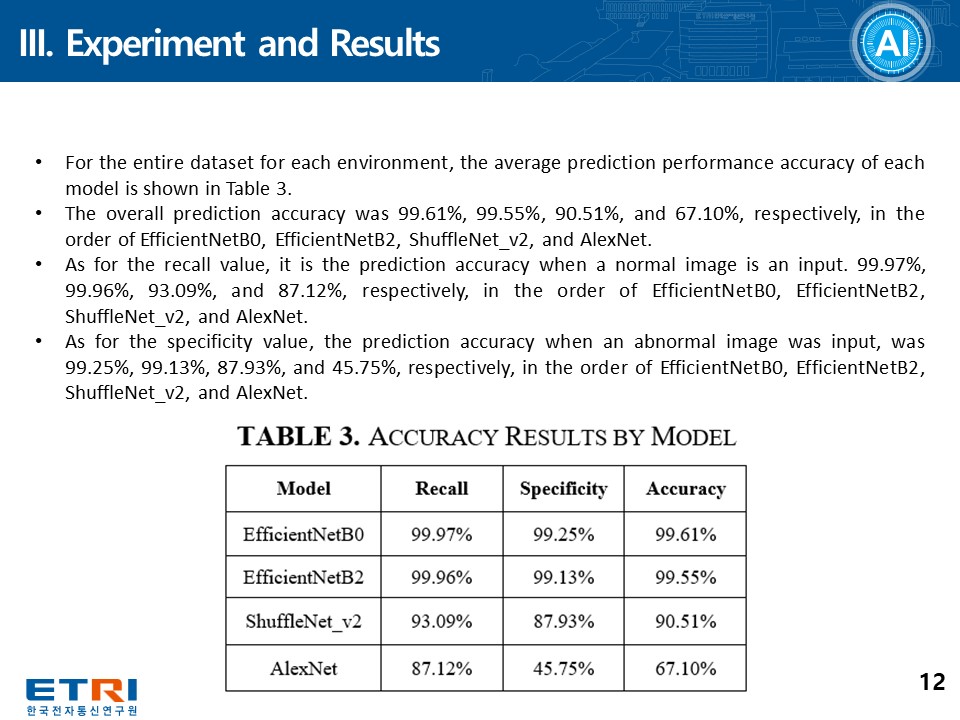 |
For the entire dataset for each environment, the average prediction performance accuracy of each model is shown in Table 3.
The overall prediction accuracy was 99.61%, 99.55%, 90.51%, and 67.10%, respectively, in the order of EfficientNetB0, EfficientNetB2, ShuffleNet_v2, and AlexNet.
As for the recall value, it is the prediction accuracy when a normal image is an input. 99.97%, 99.96%, 93.09%, and 87.12%, respectively, in the order of EfficientNetB0, EfficientNetB2, ShuffleNet_v2, and AlexNet.
As for the specificity value, the prediction accuracy when an abnormal image was input, was 99.25%, 99.13%, 87.93%, and 45.75%, respectively, in the order of EfficientNetB0, EfficientNetB2, ShuffleNet_v2, and AlexNet.
|
| ICACT20230153 Slide.13
[Big Slide]
|
Chrome Click!! |
 |
In this paper, CCTV images of Heunginjimun were collected, and a dataset was constructed to determine the displacement of the roof. We applied artificial displacements to create a virtual database. In addition, to secure the damaged images' validity, some experts reviewed them in the process.
We tested the model's performance by training the model using the built dataset. Among the models tested, the EfficientNetB0 and EfficientNetB2 models have shown high prediction accuracy of 99.61% and 99.55%, respectively, for detecting the roof tilts of Heunginjimun Gate.
This experiment presented a method for securing datasets to overcome difficulties in obtaining damage data due to the nature of cultural properties and a method for quickly detecting abnormal signs for wooden cultural properties.
The framework's robustness can be further improved by adding more diverse displacement scenarios in future experiments and applying a dataset that mixes environments for learning.
The suppose models are designed and tested for roof inclination and other types of displacement such as fullness and separation. Therefore it is expected to help significantly manage and preserve cultural properties.
|
| ICACT20230153 Slide.14
[Big Slide]
|
Chrome Click!! |
 |
The following is references. |
| ICACT20230153 Slide.15
[Big Slide]
|
Chrome Click!! |
 |
Thank you for your attension.
Do you have any question or commment? |
| |





