 ICACT20230170 Slide.00
[Big Slide]
[YouTube] |
Chrome  Click!! |
 |
Besides the obtained results, our proposal still has some limitations and needs to be overcome in future studies.
For more details about the content in this slide, please watch on youtube through provided URL.
https://youtu.be/wNO9QE3vRZY |
| ICACT20230170 Slide.01
[Big Slide]
[YouTube] |
Chrome Click!! |
 |
Hello everyone. My name is Dinh-Lam Pham, and I am from Kyonggi University, Korea.
Now I would like to present our paper at the ICACT 2023 conference. The paper entitled A Deep Learning-Based Real-Time Video Object Contextualizing and Archiving System.
|
| ICACT20230170 Slide.02
[Big Slide]
[YouTube] |
Chrome Click!! |
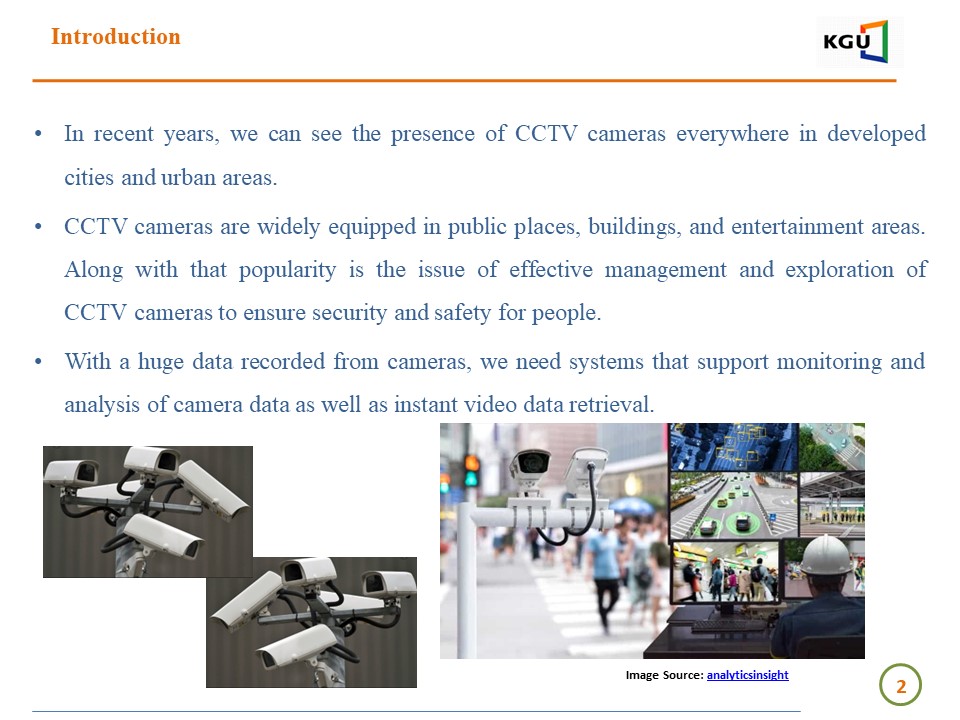 |
In recent years, we can see the presence of CCTV cameras everywhere in developed cities and urban areas.
CCTV cameras are widely equipped in public places, buildings, and entertainment areas. Along with that popularity is the issue of effective management and exploration of CCTV cameras to ensure security and safety for people.
With a huge amount of data recorded from cameras, we need systems that support monitoring and analysis of camera data and instant video data retrieval.
For more detail please watch on https://youtu.be/wNO9QE3vRZY
|
| ICACT20230170 Slide.03
[Big Slide]
[YouTube] |
Chrome Click!! |
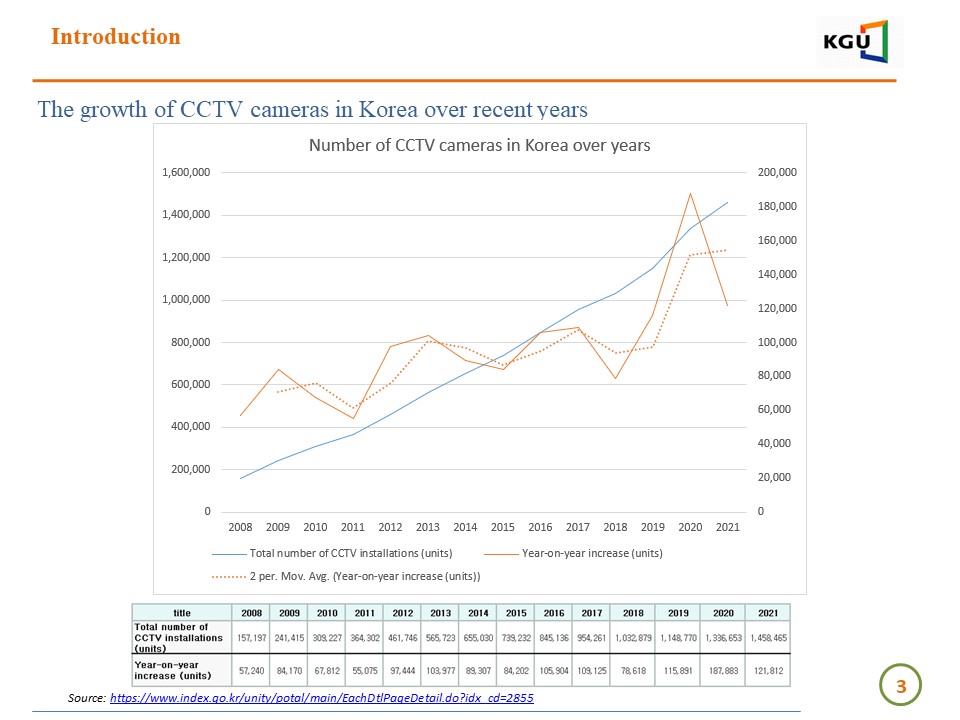 |
The chart in this figure describes The growth of CCTV cameras in Korea over recent years.
For more details about the content in this slide, please watch on youtube through provided URL. https://youtu.be/wNO9QE3vRZY |
| ICACT20230170 Slide.04
[Big Slide]
[YouTube] |
Chrome Click!! |
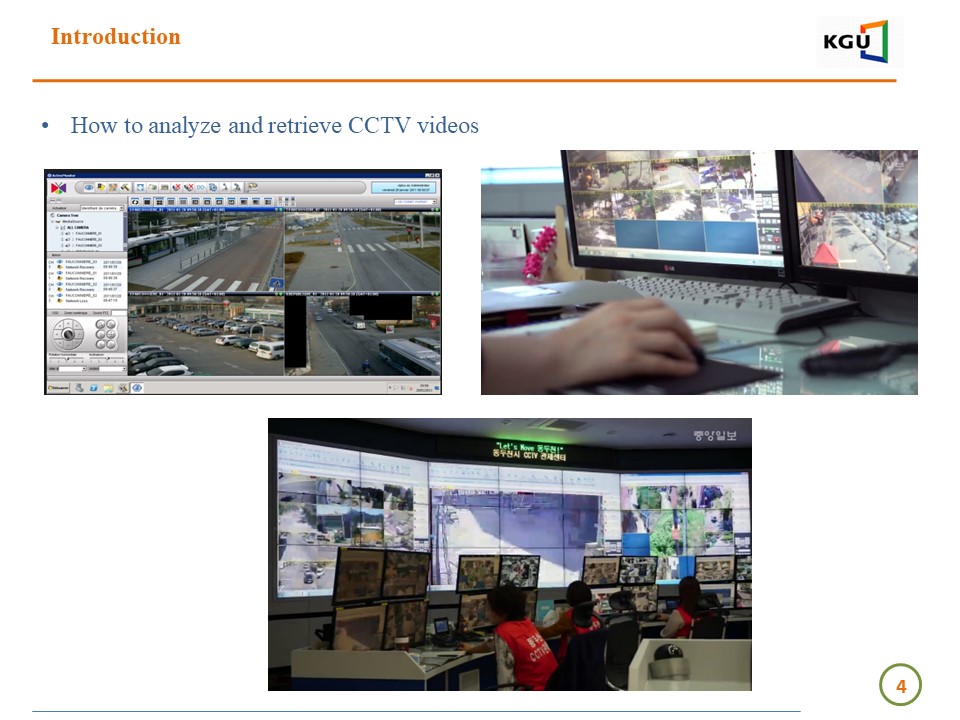 |
Traditional methods for analyzing and retrieving data from CCTV videos.
For more details about the content in this slide, please watch on youtube through provided URL.
https://youtu.be/wNO9QE3vRZY |
| ICACT20230170 Slide.05
[Big Slide]
[YouTube] |
Chrome Click!! |
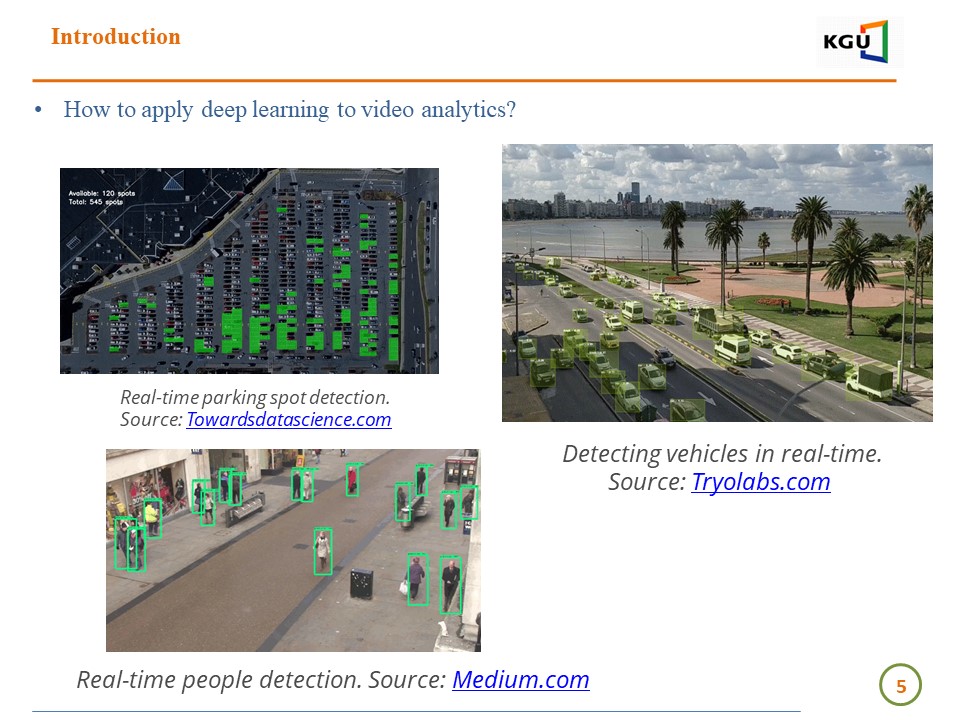 |
Recently methods using deep learning approaches to video analytics.
For more details about the content in this slide, please watch on youtube through provided URL. https://youtu.be/wNO9QE3vRZY |
| ICACT20230170 Slide.06
[Big Slide]
[YouTube] |
Chrome Click!! |
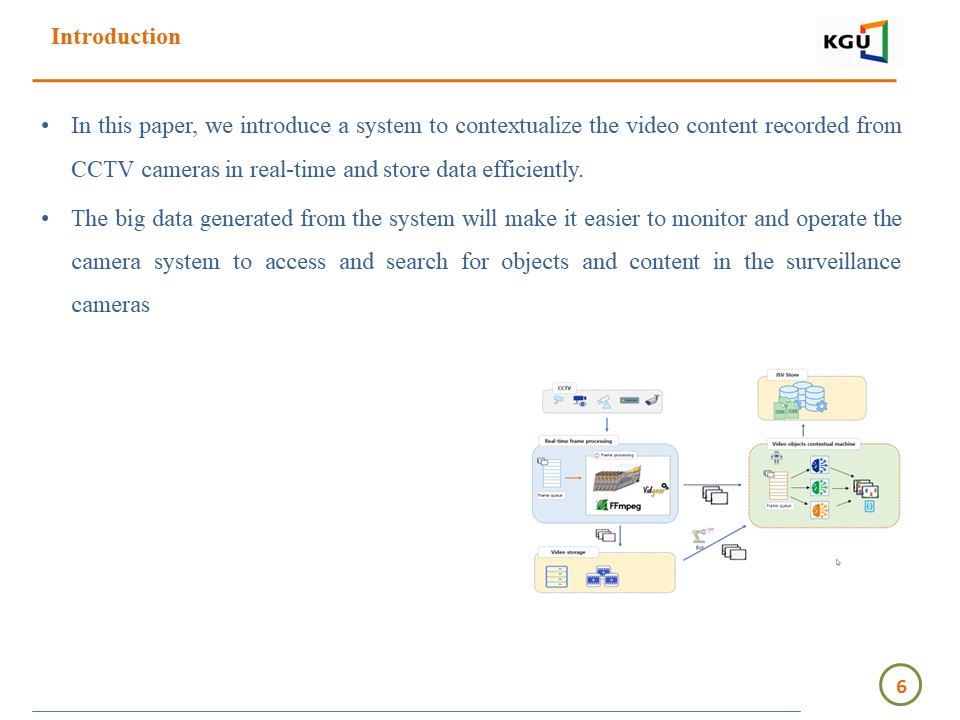 |
In this paper, we introduce a system to contextualize the video content recorded from CCTV cameras in real-time and store data efficiently.
The big data generated from the system will make it easier to monitor and operate the camera system to access and search for objects and content in the surveillance cameras.
For more details about the content in this slide, please watch on youtube through provided URL. https://youtu.be/wNO9QE3vRZY |
| ICACT20230170 Slide.07
[Big Slide]
[YouTube] |
Chrome Click!! |
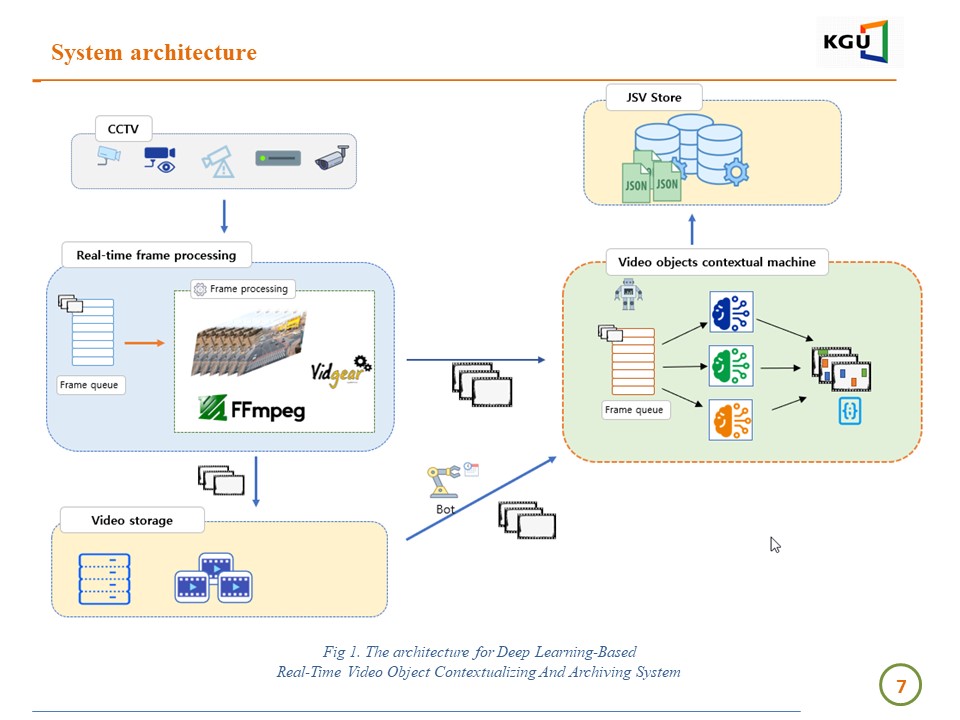 |
The proposed architecture of our approach is described in this figure in detail. The main idea of our method is that, first of all, the frames collected from CCTV cameras must be put in a frame queue for frame processing. After that, the system selects the frame following the priority of cameras to detect objects and extract information. The other frames in the queue will be combined and stored in the video storage. Using parallel processing with the YOLO object detect algorithm, we extract the information of the detected objects (bounding box, properties) and store them in a JSON file obeying a specific schema. In the architecture, we use FFmpeg and Vidgear open-source libraries for real-time processing video. |
| ICACT20230170 Slide.08
[Big Slide]
[YouTube] |
Chrome Click!! |
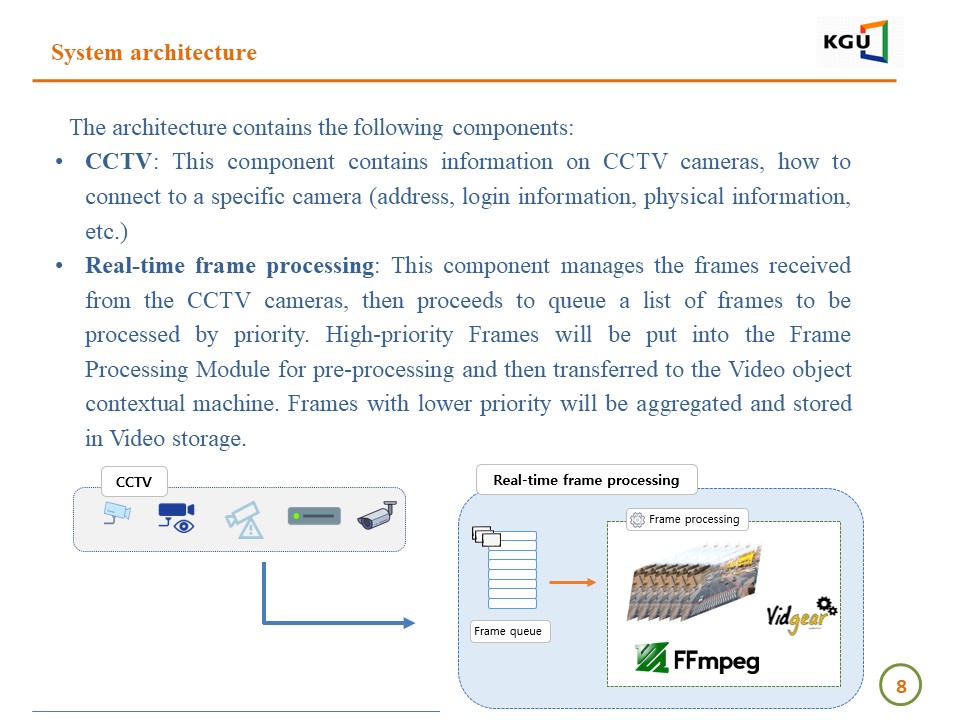 |
CCTV: This component contains information on CCTV cameras, and how to connect to a specific camera (address, login information, physical information, etc.)
Real-time frame processing: This component manages the frames received from the CCTV cameras, then proceeds to queue a list of frames to be processed by priority. High-priority Frames will be put into the Frame Processing Module for pre-processing and then transferred to the Video object contextual machine. Frames with lower priority will be aggregated and stored in Video storage.
|
| ICACT20230170 Slide.09
[Big Slide]
[YouTube] |
Chrome Click!! |
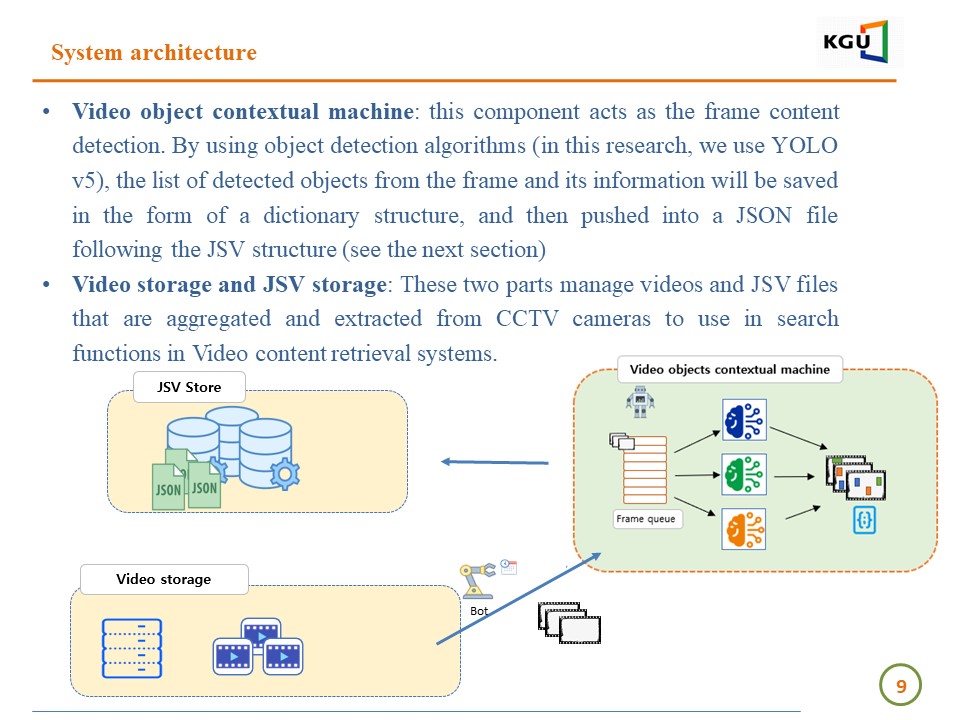 |
Video object contextual machine: this component acts as the frame content detection. By using object detection algorithms (in this research, we use YOLO v5), the list of detected objects from the frame and its information will be saved in the form of a dictionary structure, and then pushed into a JSON file following the JSV structure (see the next section)
Video storage and JSV storage: These two parts manage videos and JSV files that are aggregated and extracted from CCTV cameras to use in search functions in Video content retrieval systems
|
| ICACT20230170 Slide.10
[Big Slide]
[YouTube] |
Chrome Click!! |
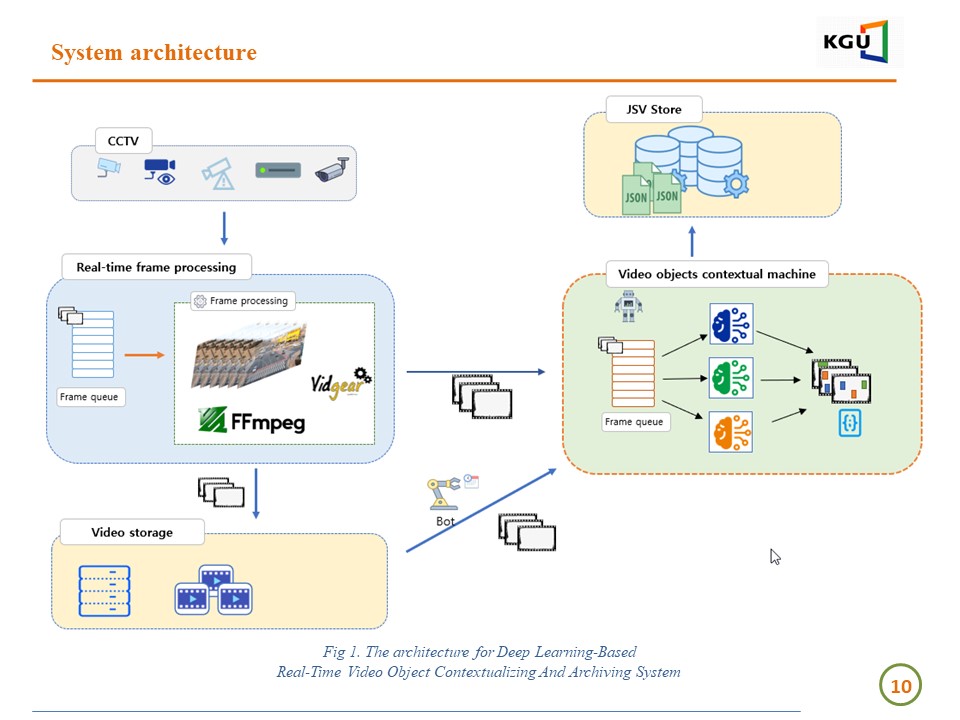 |
This figure describes the overall view of the proposed architecture.
For more details about the content in this slide, please watch on youtube through provided URL. https://youtu.be/wNO9QE3vRZY
|
| ICACT20230170 Slide.11
[Big Slide]
[YouTube] |
Chrome Click!! |
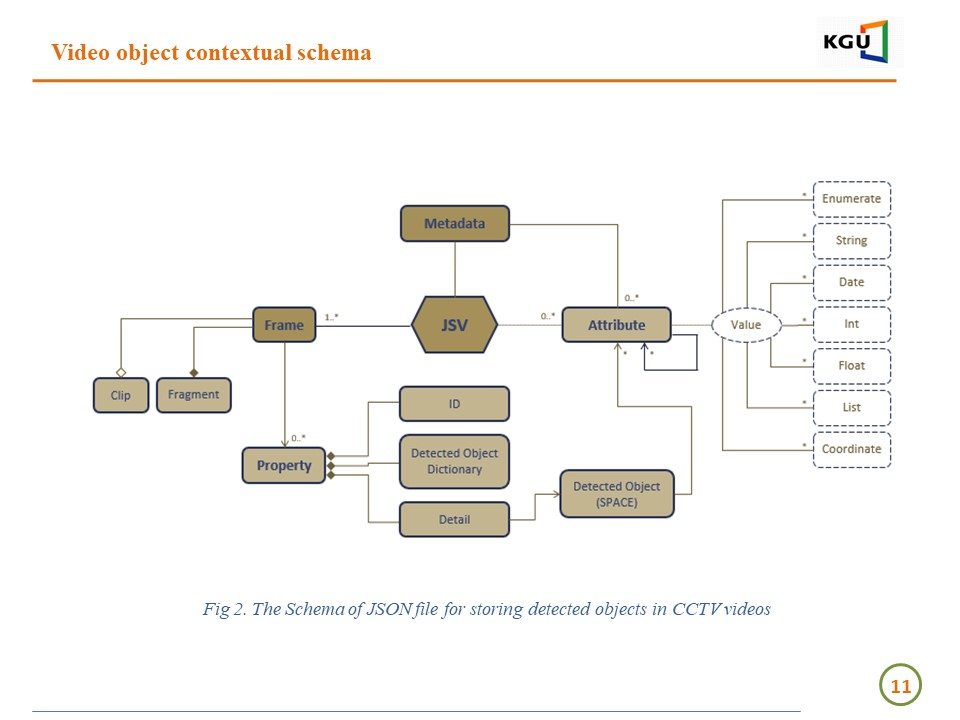 |
In this figure, we illustrate the schema of the video object contextual mechanism. To be able to access and retrieve content in the video efficiently, we use a JSON file to store the information and call the file as JSV (Json video file format). The JSV file categorizes content in a dictionary-type containing information about the video's metadata, the frames, the objects in the frame, and their properties. |
| ICACT20230170 Slide.12
[Big Slide]
[YouTube] |
Chrome Click!! |
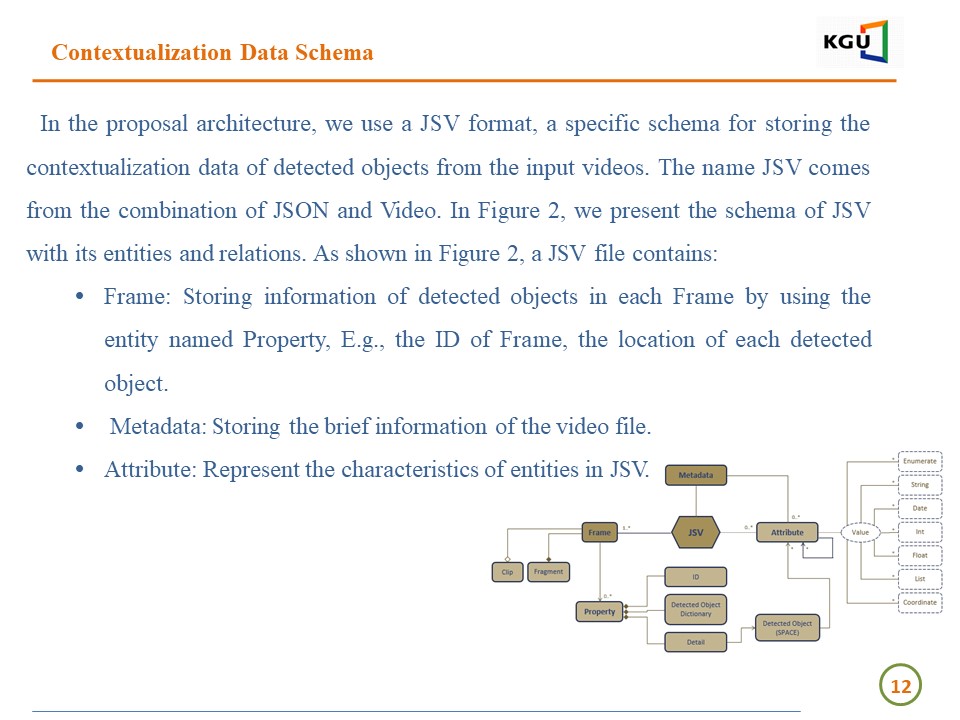 |
As we can see in the Figure, the schema includes the following objects
Metadata
Frame
Clip
Fragment
Property
ID
Detected object dictionary
Detail: Detected object space
|
| ICACT20230170 Slide.13
[Big Slide]
[YouTube] |
Chrome Click!! |
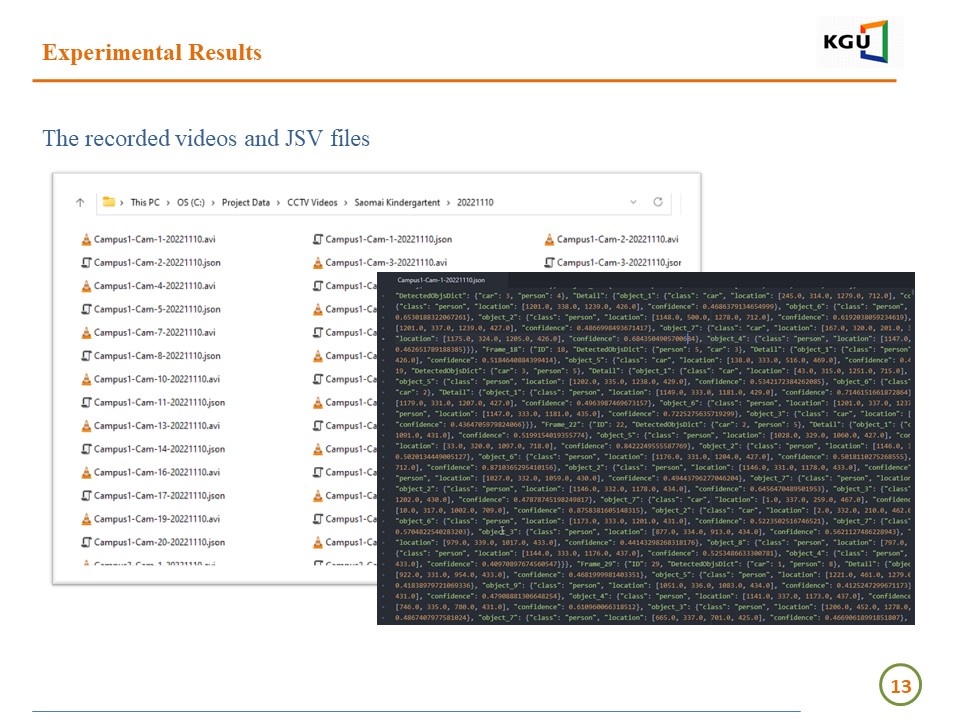 |
To evaluate the proposed method, we built a system regarding the architecture and implemented the system to manage CCTV cameras in a kindergarten school group in Vietnam. The kindergarten contains 166 CCTV cameras on six campuses, each with 20 to 30 cameras. The collected videos and JSV files generated from the system are presented in this figure. |
| ICACT20230170 Slide.14
[Big Slide]
[YouTube] |
Chrome Click!! |
 |
This paper introduced an architecture and system for real-time video object contextualizing and archiving system.
In particular, we:
summarize the recent studies on managing big data video management systems and video retrieval methodologies.
proposed an architecture-based YOLO algorithm to detect objects from CCTV cameras and then extract all information to JSON file to store for retrieving data in the future.
proposed a JSV format containing a schema for managing the content of objects detected from videos. The schema will support the video retrieval system in searching and exploring the content of CCTV video files.
applied the proposed architecture to manage and store videos from a real CCTV system.
|
| ICACT20230170 Slide.15
[Big Slide]
|
Chrome Click!! |
 |
For more details about the content in this slide, please watch on youtube through provided URL. |
| ICACT20230170 Slide.16
[Big Slide]
[YouTube] |
Chrome Click!! |
 |
Thank you for your attention! If you have any questions, don't hesitate to contact me at this session.
https://youtu.be/wNO9QE3vRZY |















