 ICACT20230176 Slide.00
[Big Slide]
[YouTube] |
Chrome  Click!! |
 |
Hi Everyone, My name is Robin Chataut, and today I am going to talk about our recent research on User Scheduling for 6G Massive MIMO Systems. In this paper, we present a novel adaptive algorithm for efficient user scheduling using the instantaneous channel rate of each user.
|
| ICACT20230176 Slide.01
[Big Slide]
[YouTube] |
Chrome Click!! |
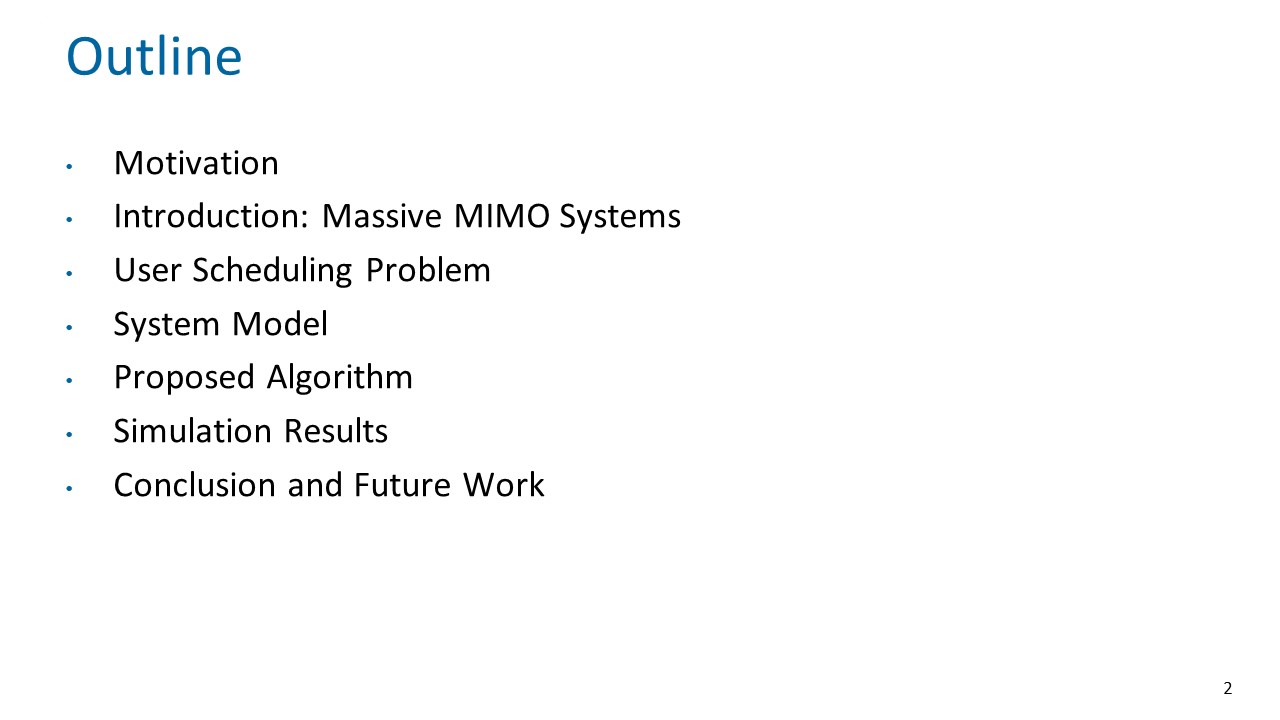 |
Here is the general outline of the presentation; I will start with the motivation behind the project, then I will briefly go over massive MIMO systems, their benefits, and the need for efficient user scheduling algorithms in this key enabling technology for 6G networks. Then I will go over the system model, discuss our proposed algorithm and simulation results, and finally, conclude with future works.
|
| ICACT20230176 Slide.02
[Big Slide]
[YouTube] |
Chrome Click!! |
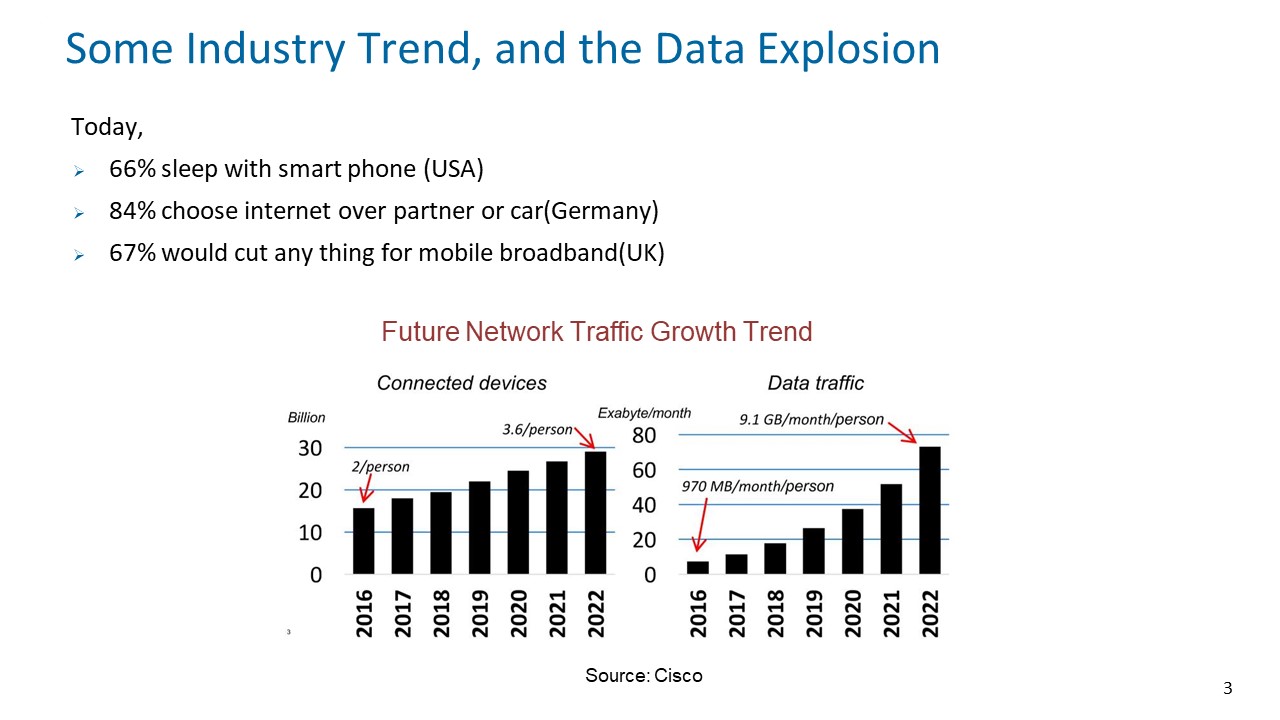 |
To begin, here are some industry trends, in the United States, almost 66% of people sleep with their cell phone, and if you look at Germany, 84% of people chose the internet over their partner or a car. In the UK, 67% of people were ready to cut anything for mobile broadband. Anything here means they were ready to cut other utilities or daily needs. If you look at the future network traffic, as of today, each person has almost four devices connected to the internet on average, and the number of devices has grown exponentially. If you look at the data traffic on your right-hand side, you can see that in 2016 each person which consuming almost 970 MB of data per month, whereas by the end of 2022, each person is consuming 9.1 GB of data, which has increased by a factor of 10 in last 6 years.
|
| ICACT20230176 Slide.03
[Big Slide]
[YouTube] |
Chrome Click!! |
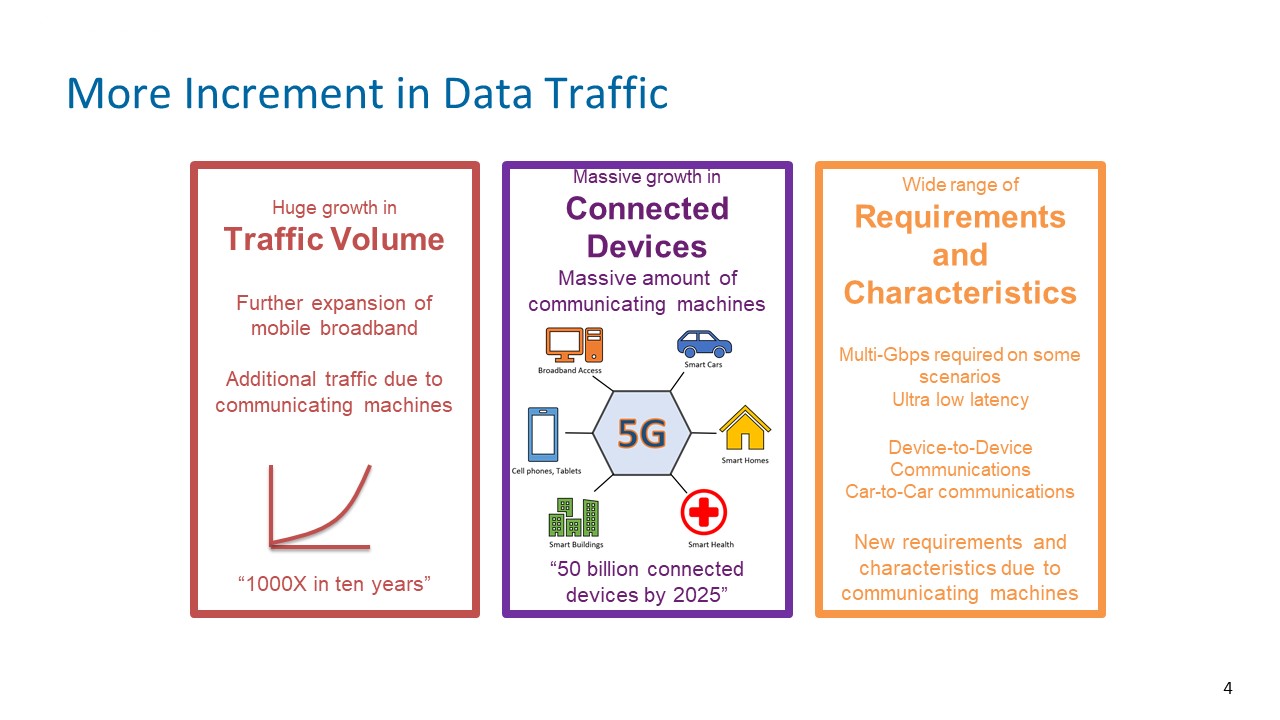 |
There is an exponential growth in data traffic, and compared to today, we will have 1000x times more data in the next decade. With the interaction of new technologies like the Internet of Things, machine-to-machine communication, augmented reality, virtual reality, and connected vehicles, data traffic will only go upwards. It has been predicted that there will be around 50 billion connected devices by 2025 and providing users with more reliability. 5G, 6G, and future generation networks will help us realize the benefits of these new technologies and applications and will make our life better by providing high speed, low latency, better energy, and spectral efficiency, which is required by almost all of these new technologies.
|
| ICACT20230176 Slide.04
[Big Slide]
[YouTube] |
Chrome Click!! |
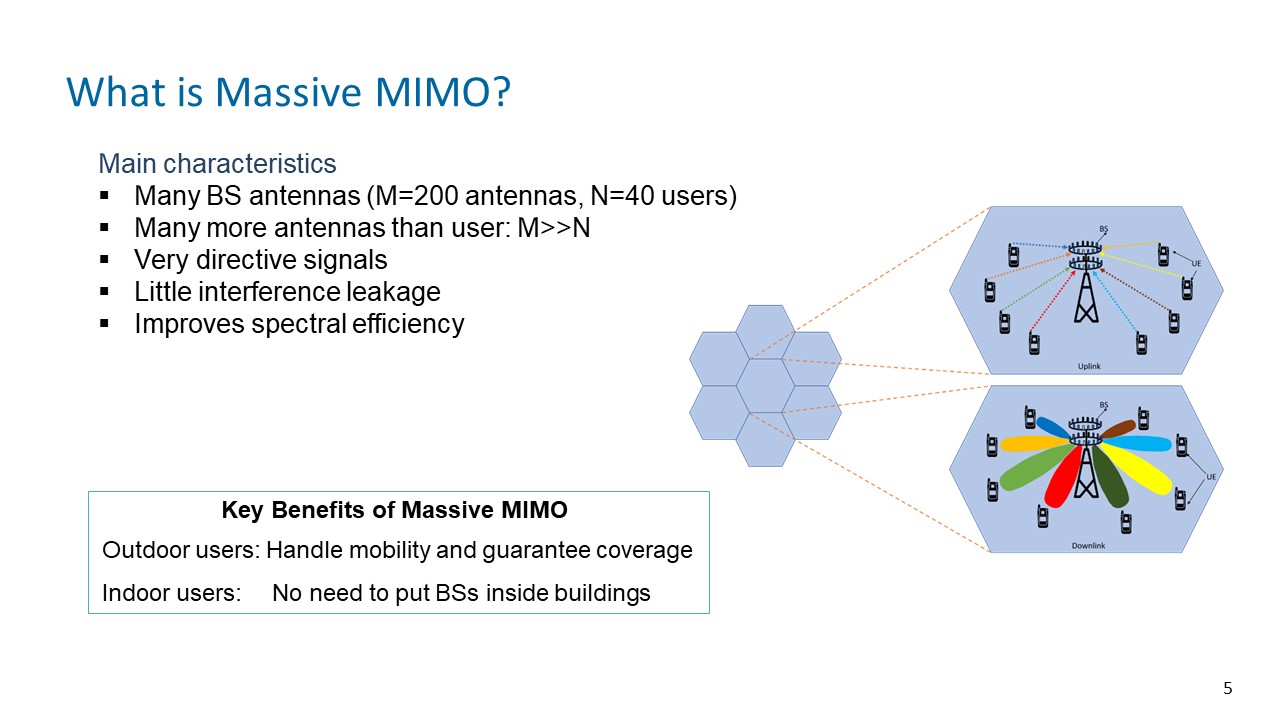 |
MIMO stands for multiple input multiple outputs, which is one of the key technologies that is used in current 4G LTE networks. massive MIMO is an extension, or I would say the advancement of current MIMO systems and is one of the most promising wireless access technology to deliver the needs of 5G and 6G networks. Massive MIMO uses hundreds and sometimes even thousands of antennae at the base station, and it can serve tens of users simultaneously. The key here is the considerable amount of antenna array gain that we get with more antennas to provide you with higher spectral efficiency and higher throughput that each and every user needs these days. In the figure below, you can see that with more antennae, the downlink beam is more narrow and spatially focused toward the user as you keep increasing the number of antennae.
The key benefit we get is better energy and spectral efficiency. For outdoor users, it handles mobility and guarantees coverage. For indoor users, we don't need to put any base station inside the buildings because its beams are spatially focused toward each user.
|
| ICACT20230176 Slide.05
[Big Slide]
[YouTube] |
Chrome Click!! |
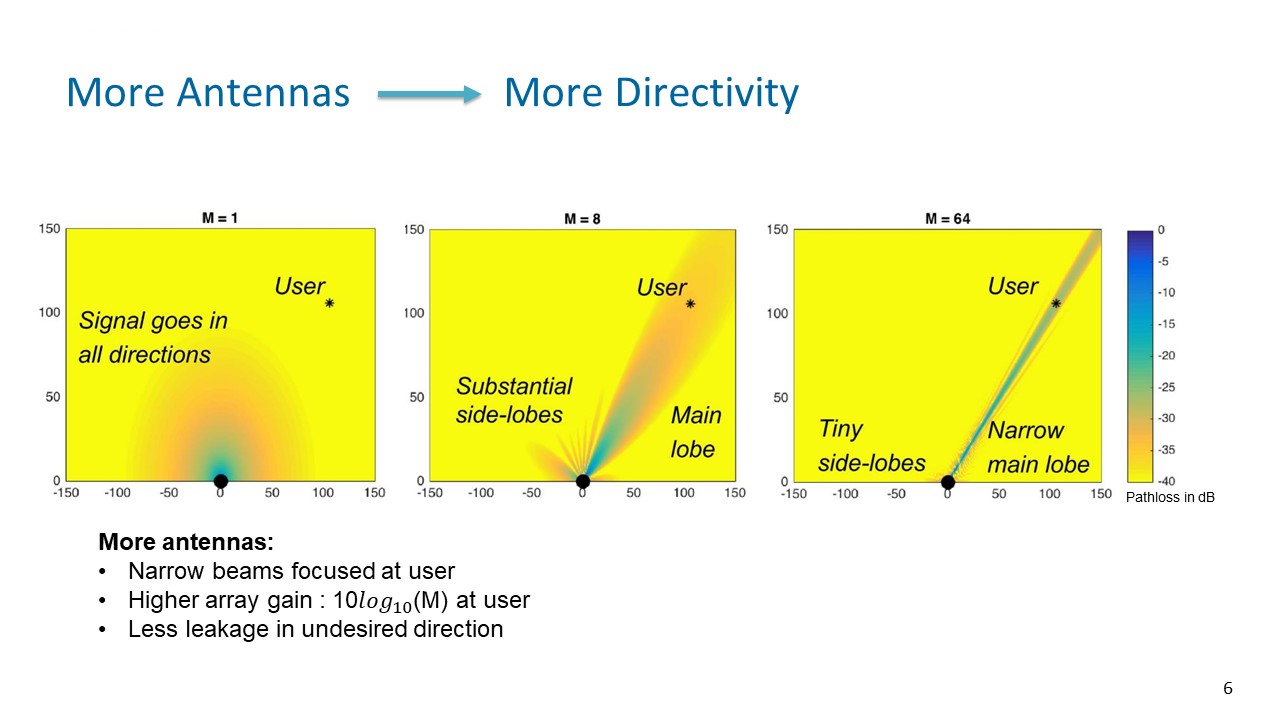 |
This slide shows you how you can get more antenna directivity with more number of antennas. This concept has been there for the past 30 to 40 years, but no one ever exploited it. If you look at the figure on your left-hand side that is with the one antenna system, you can see that signal is spreading equally in all directions. If there is a user in this area, the user won't be getting a good signal strength.
If you look at the eight antenna system, that is the figure in the middle, you can see that now the signal strength is spatially focused towards the user that you can see here, and the user at this location is now getting good single strength, but the problem here would be you are seeing the substantial side lobes, that means if you user is around this area, they might be receiving a good amount of interference. If you look at the right-hand side figure that is 64 antenna systems, the beams have become narrower and narrower and more spatially focused towards the user. You can see here the signal strength is quite good for this user, and side lobes have almost diminished, which means even if a user is around this area might not receive much interference. So comparing all there, as you keep on increasing the antennas, beams become more narrow and narrower but with more antennae, there come many challenges. One of the major channels is user scheduling, which we'll be talking about next.
|
| ICACT20230176 Slide.06
[Big Slide]
[YouTube] |
Chrome Click!! |
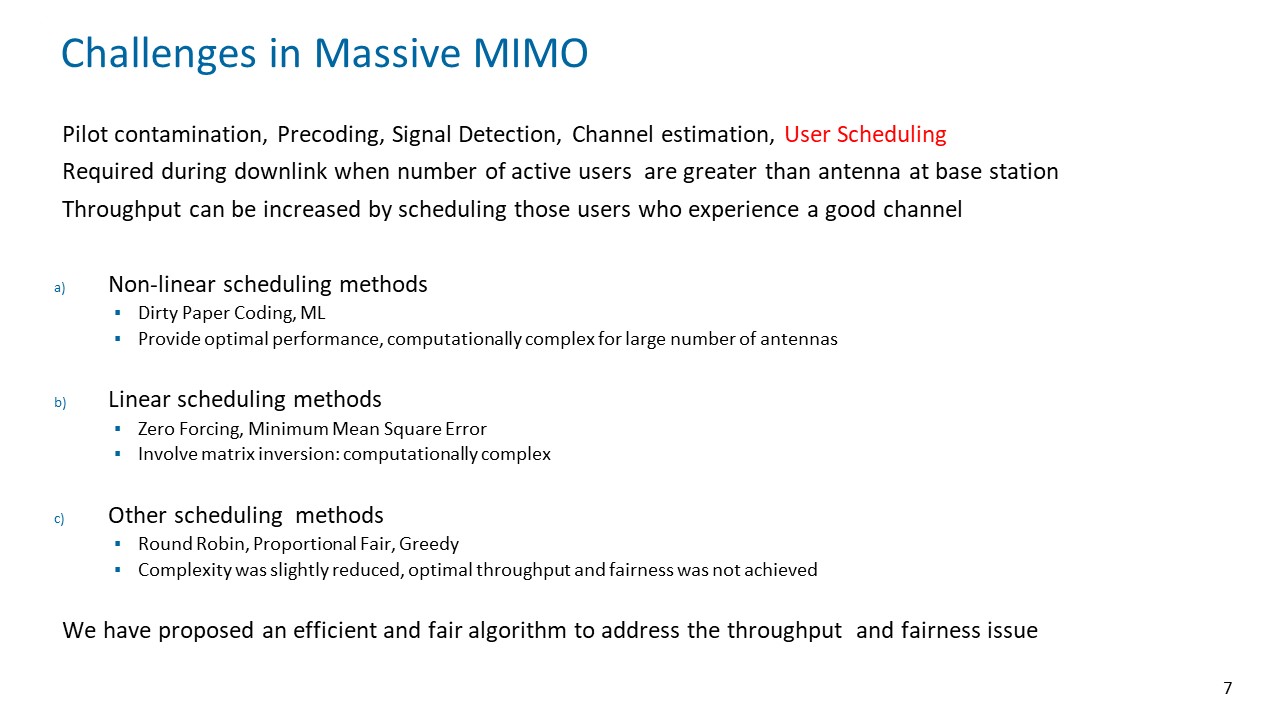 |
There are many implementation challenges in massive MIMO systems. Some of the challenges are user scheduling, pilot contamination, channel estimation, signal detection, and coupling effect. However, in this paper, we are only focusing on user scheduling issues.
A proper user scheduling method during the downlink is required to increase the throughput of the massive MIMO system when the number of active users is more than the number of base station antenna terminals. The total area throughput can be improved by scheduling users with better channel conditions. However, a proper fairness level should also be maintained to guarantee that users with bad channel conditions get scheduled in a timely manner. Significant research has been going to develop an optimal user scheduling algorithm. Many algorithms have been proposed to solve this problem. However, optimal performance in terms of both throughput and fairness has not been achieved. In this paper, we propose an adaptive user scheduling algorithm based on channel rate to provide the user with optimal throughput and ensure fairness among all the users.
|
| ICACT20230176 Slide.07
[Big Slide]
[YouTube] |
Chrome Click!! |
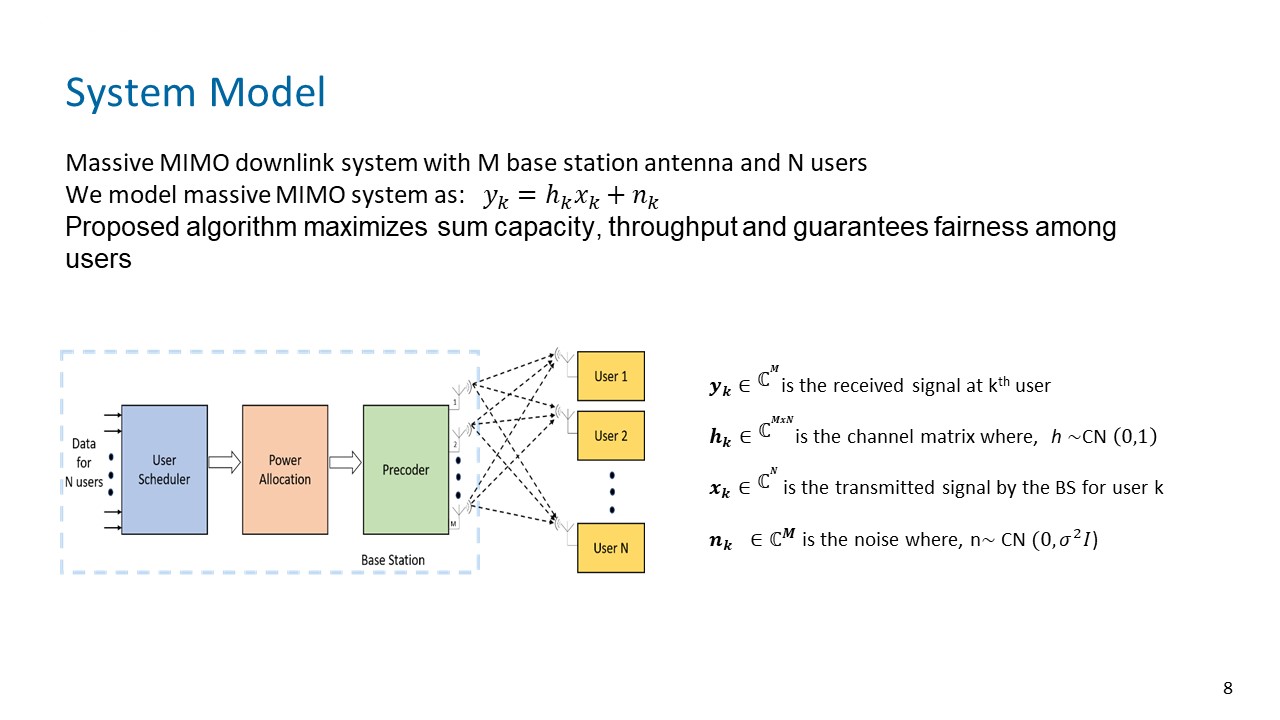 |
A massive MIMO downlink system is considered with M base station antenna terminals and N users. We model a massive MIMO system as 𝑦_𝑘=ℎ_𝑘 𝑥_𝑘+𝑛_𝑘, where y is the signal received by the kth user, and 𝒙_𝒌 is the signal
sent towards the user from the base station k. 𝒉_𝒌∈ℂ^𝑴𝒙𝑵ithe channel vector between the user terminals and the base station antenna terminals, where elements of H are independent and identically distributed. 𝒏_𝒌 ∈ℂ^𝑴 is the added white Gaussian noise. We do the precoding before scheduling the user to minimize
multi-user interference. We get the matrix for precoding by
stacking the beamforming vectors and user signals.
|
| ICACT20230176 Slide.08
[Big Slide]
[YouTube] |
Chrome Click!! |
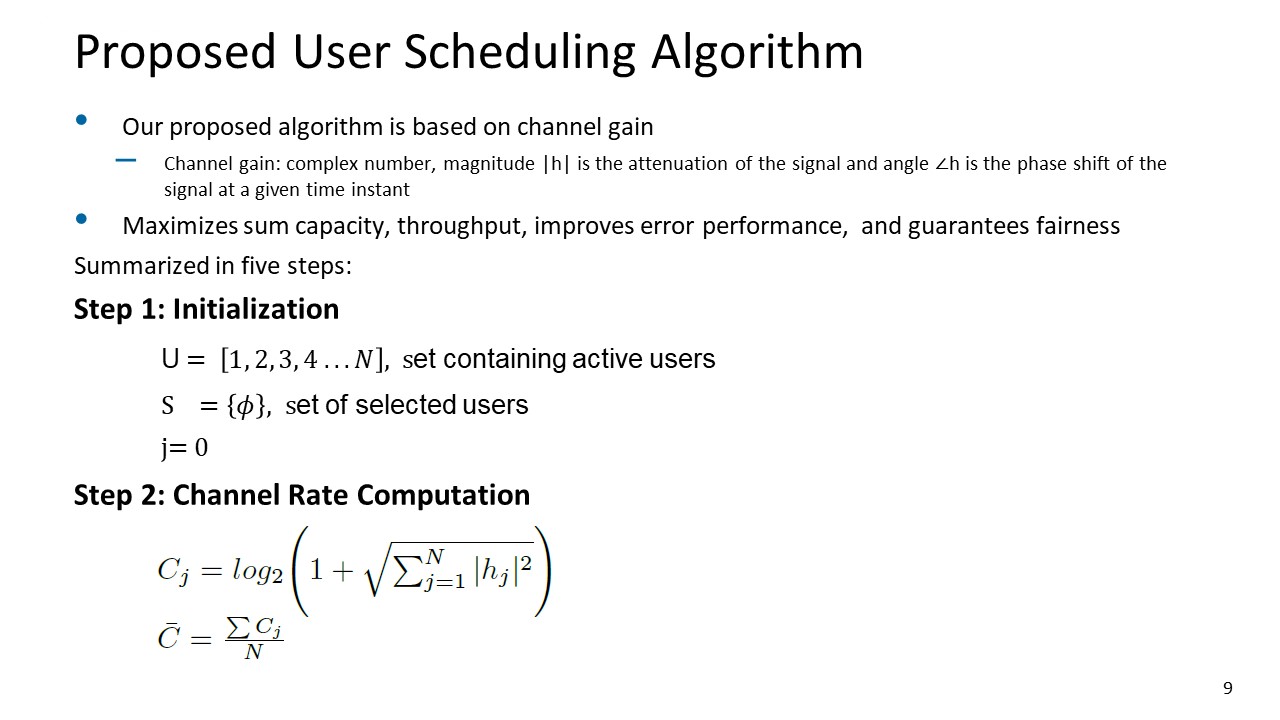 |
We initialize the active users set U, including N active users. The set of selected users is S, which is null initially as non of the users are scheduled. J here is a number of iterations.
Then we calculate the instantaneous channel rate for each user. The mean channel rate is computed based on the active users waiting to be scheduled. The calculated mean channel rate will be the selection criteria for the proposed algorithm.
|
| ICACT20230176 Slide.09
[Big Slide]
[YouTube] |
Chrome Click!! |
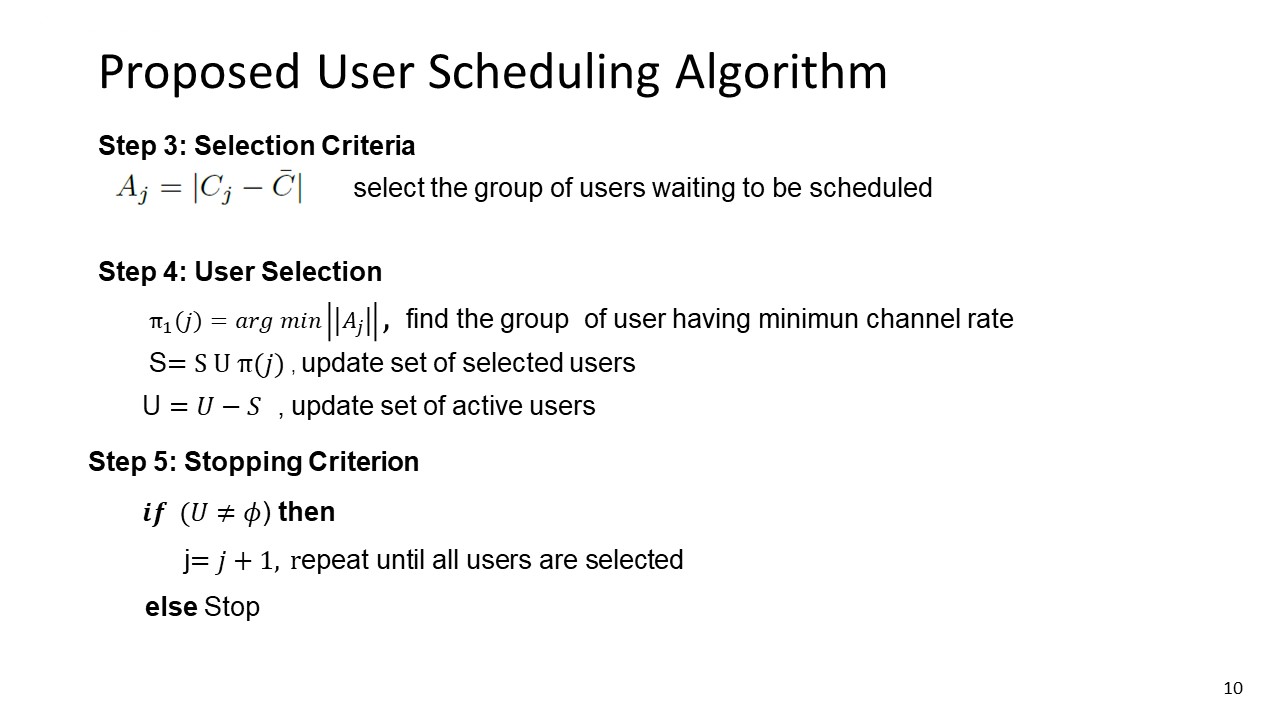 |
The user with an instantaneous channel rate closest to the mean channel rate is selected first. Once the selected user is
scheduled, we update the set containing the remaining active and selected users. The process of user selection is repeated until all the
active users are scheduled. Then, the mean channel rate is re-evaluated for the next set of active users.
|
| ICACT20230176 Slide.10
[Big Slide]
[YouTube] |
Chrome Click!! |
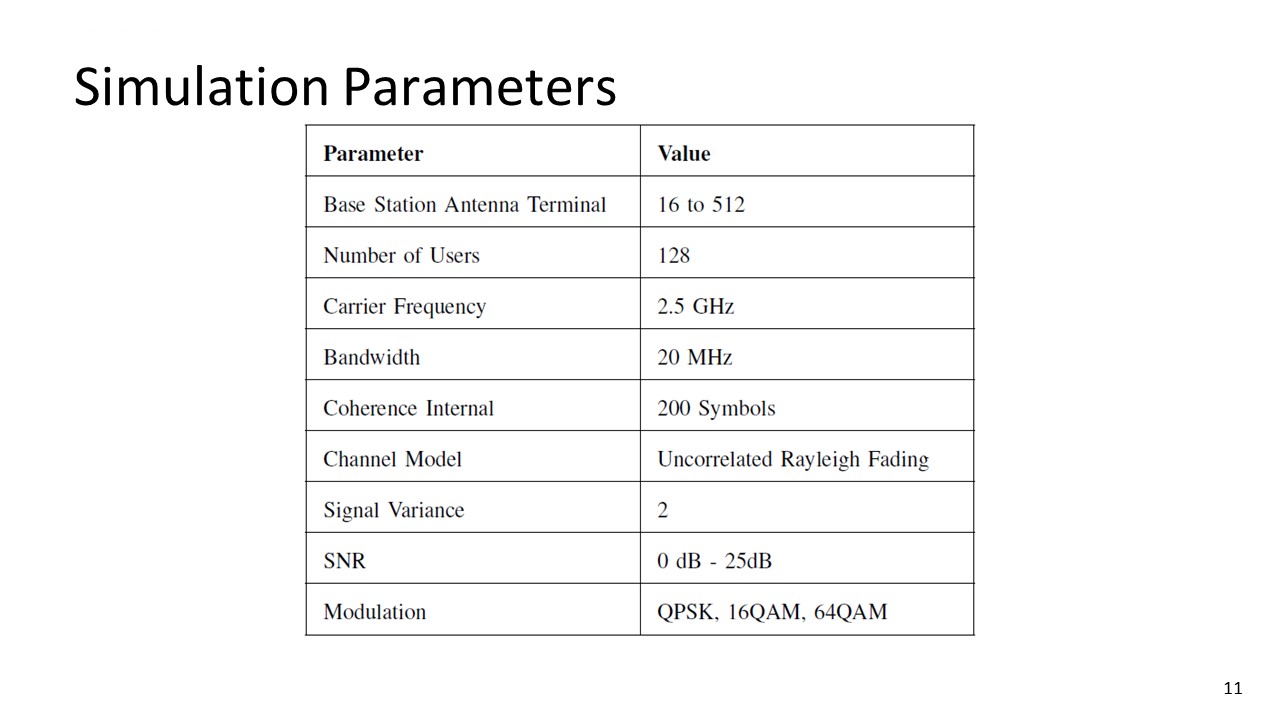 |
For our simulations, we set up a massive MIMO base station with many antenna terminals (16 to 512). We assume that all the antenna terminals are communicating with 128 single active users simultaneously. We have considered various antenna configurations with different modulation techniques (QPSK, 16QAM, 16QAM) for conducting the simulations. The system’s bandwidth is set to 20 MHz, whereas a carrier frequency of 2.5 GHz is used. A perfect channel state information (CSI) is assumed between the user and the base station, and the Rayleigh fading channel model is used for simulations. We have compared our proposed algorithm with traditional schedulers like Proportional Fair (PF) and Round Robin (RR) algorithms for analysis. In addition, we have used ZF and MMSE precoding to reduce the effect of multi-user interference and to simplify the processing required at the receiver.
|
| ICACT20230176 Slide.11
[Big Slide]
[YouTube] |
Chrome Click!! |
 |
Here are some of our simulation results:
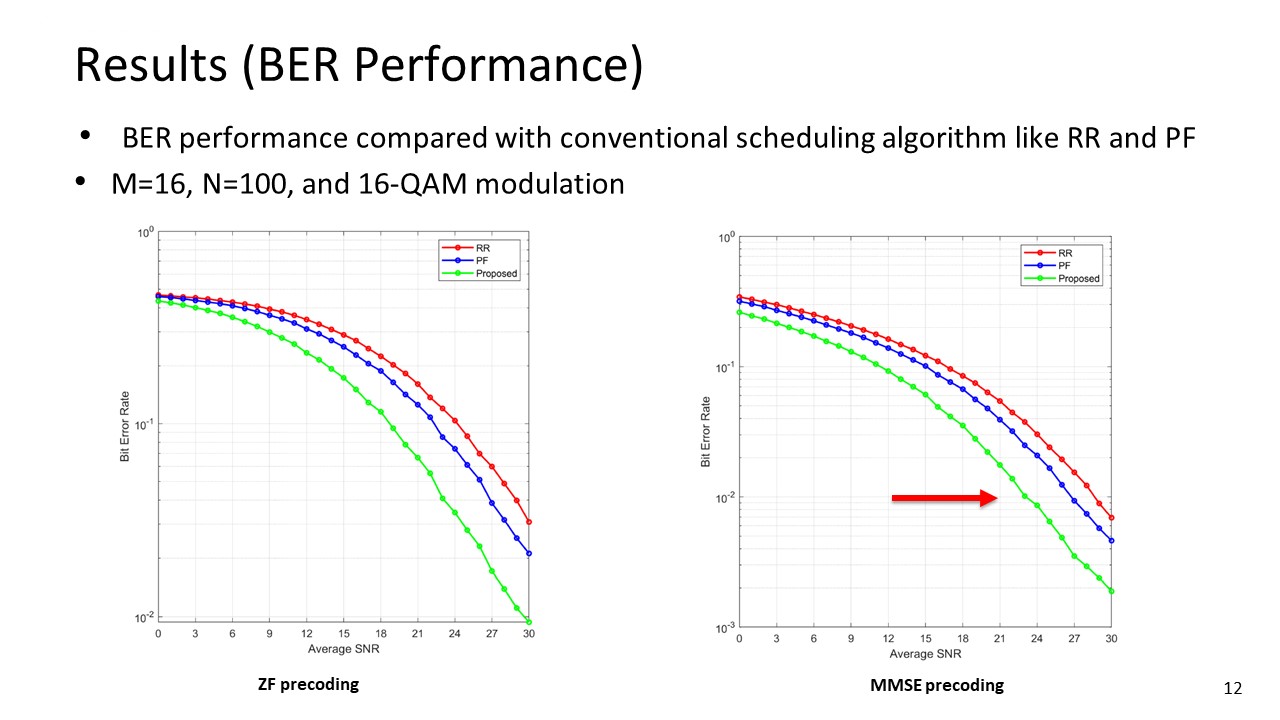
The figure on your left shows the error performance of the proposed algorithm with 16 users, 16 base station antenna terminals, 16QAM modulation, and MMSE precoding. The proposed algorithm has better BER performance than the traditional algorithm within the whole range of SNR users for simulation. For
example, at BER 10^(−1), the proposed algorithm achieved a
6dB gain over the RR algorithm and a 4 dB gain over the PF
algorithm.
The right-hand side figure shows the performance with similar parameters but with ZF precoding. We can see that the performance
the pattern is similar; however, the overall performance of all
the algorithms have reduced.
|
| ICACT20230176 Slide.12
[Big Slide]
[YouTube] |
Chrome Click!! |
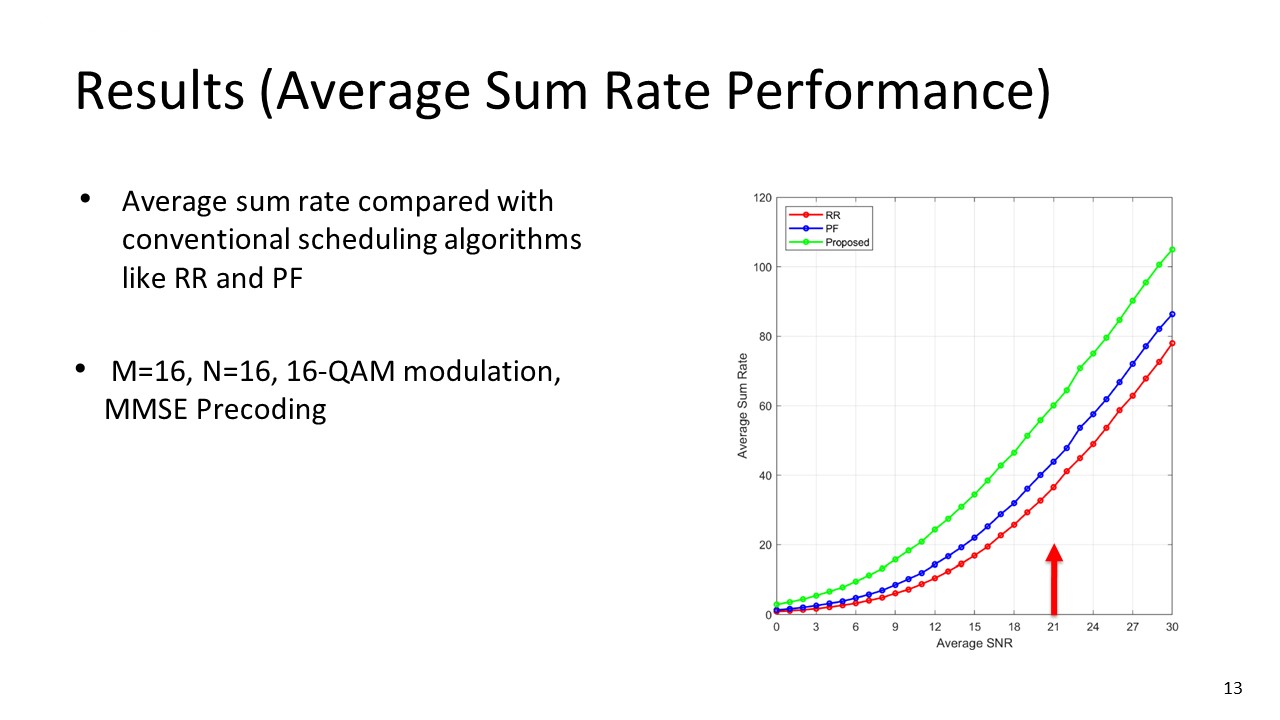 |
We analyzed the sumrate performance of the proposed
algorithm as shown in Figure. This simulation was administered
with 16 base station antenna terminals communicating with
16 users using 16QAM modulation and MMSE precoding.
The simulation results show that the proposed algorithm’s
performance is better than the traditional algorithms. For
example, at SNR= 21 dB, a sum rate of 60 bits/s/Hz is attained
by the proposed algorithm, whereas the PF algorithm achieved
a sum rate of 43 bits/s/Hz, and the RR algorithm had the worst performance among all with a sum rate of 38 bits/s/Hz.
The high sum rate is mainly due to the increased antenna
terminals. However, as the number of active users grows in a
cell, this sum rate will saturate at a point.
|
| ICACT20230176 Slide.13
[Big Slide]
[YouTube] |
Chrome Click!! |
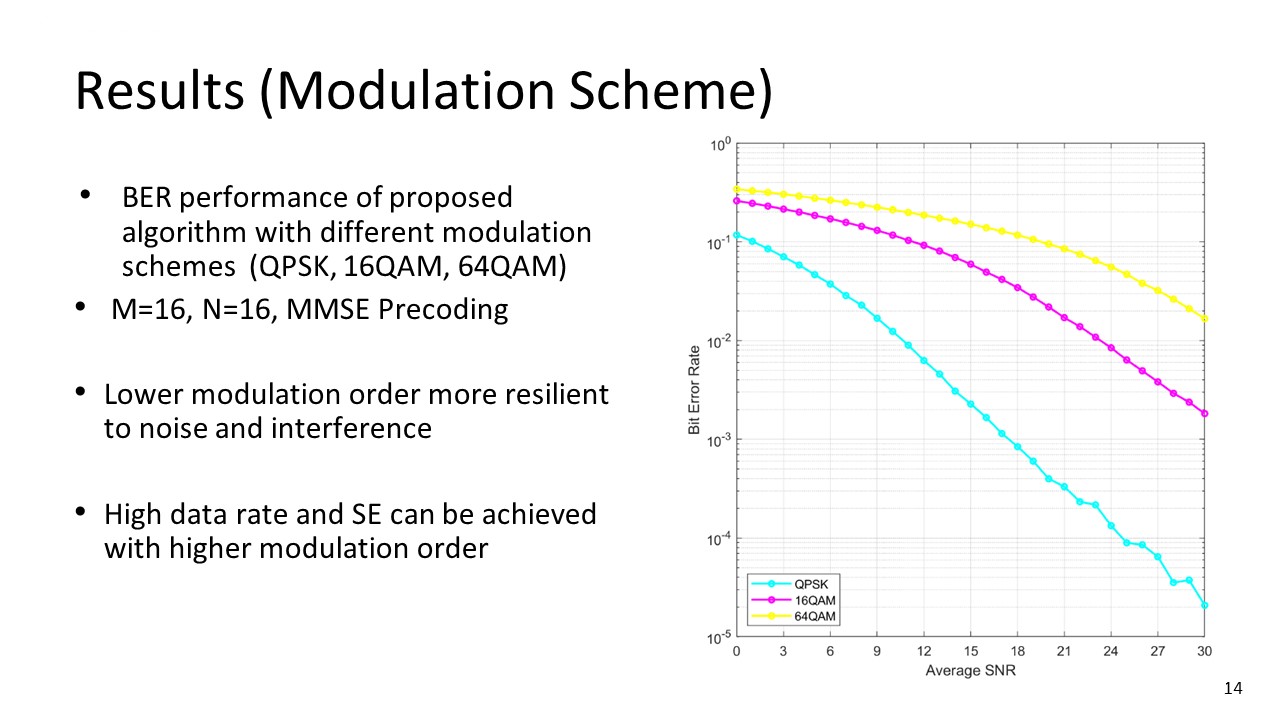 |
We then considered the performance of our proposed algorithm with several modulation techniques. Again, this simulation was administered with 16 base station antenna terminals communicating with 16 users using 16QAM modulation and MMSE precoding. As shown in figure, QPSK has the best error performance over the range of SNR, whereas 64 QAM has the best performance. This is because higher modulation orders can carry more data per symbol. On the other hand, higher modulation order has a higher error rate as it is more prone to interference and noise. Thus, a perfect modulation order is always based on the application and the user’s requirements. |
| ICACT20230176 Slide.14
[Big Slide]
[YouTube] |
Chrome Click!! |
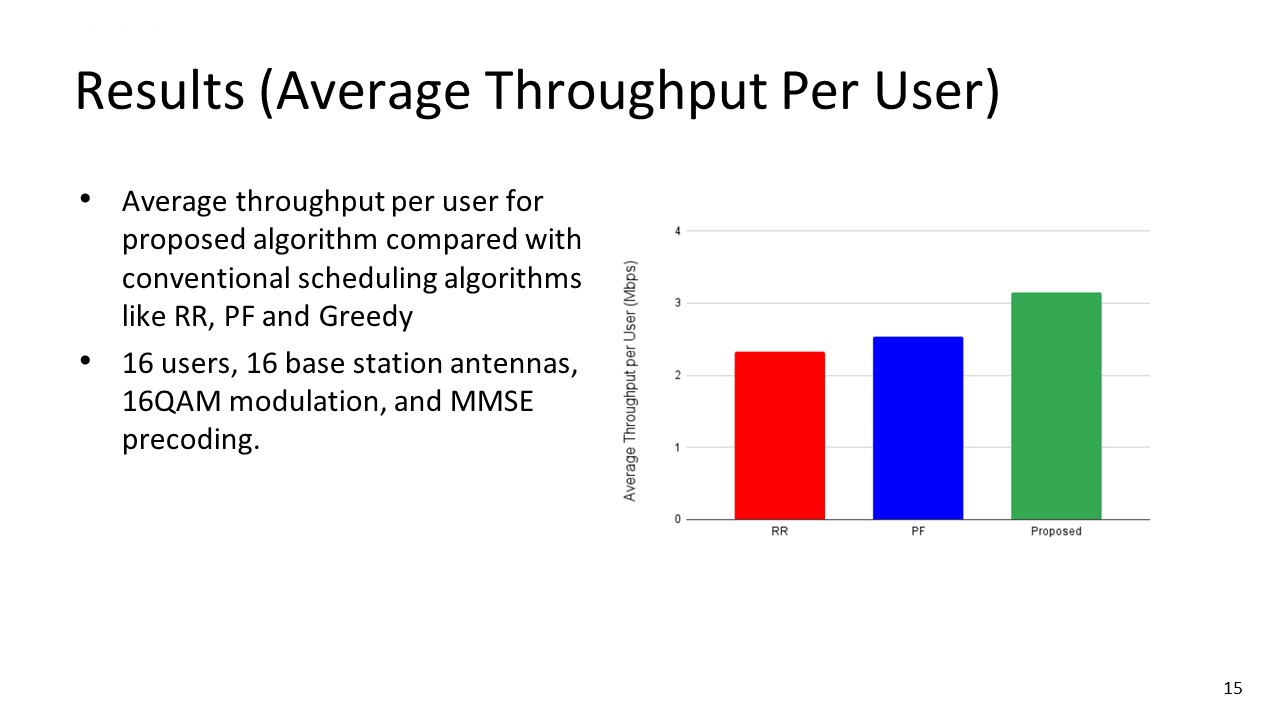 |
We evaluated the proposed algorithm’s average throughput per user performance. This simulation was administered with 16 base station antenna terminals communicating with 16 users using 16QAM modulation and MMSE precoding. As shown in the figure, the average per-user throughput for the proposed algorithm was the best among the compared algorithms. Our algorithm achieved a per-user throughput of 3.14 Mbps, whereas, for RR and PF algorithms, it was found to be 2.33 Mbps and 2.53 Mbps, respectively. |
| ICACT20230176 Slide.15
[Big Slide]
[YouTube] |
Chrome Click!! |
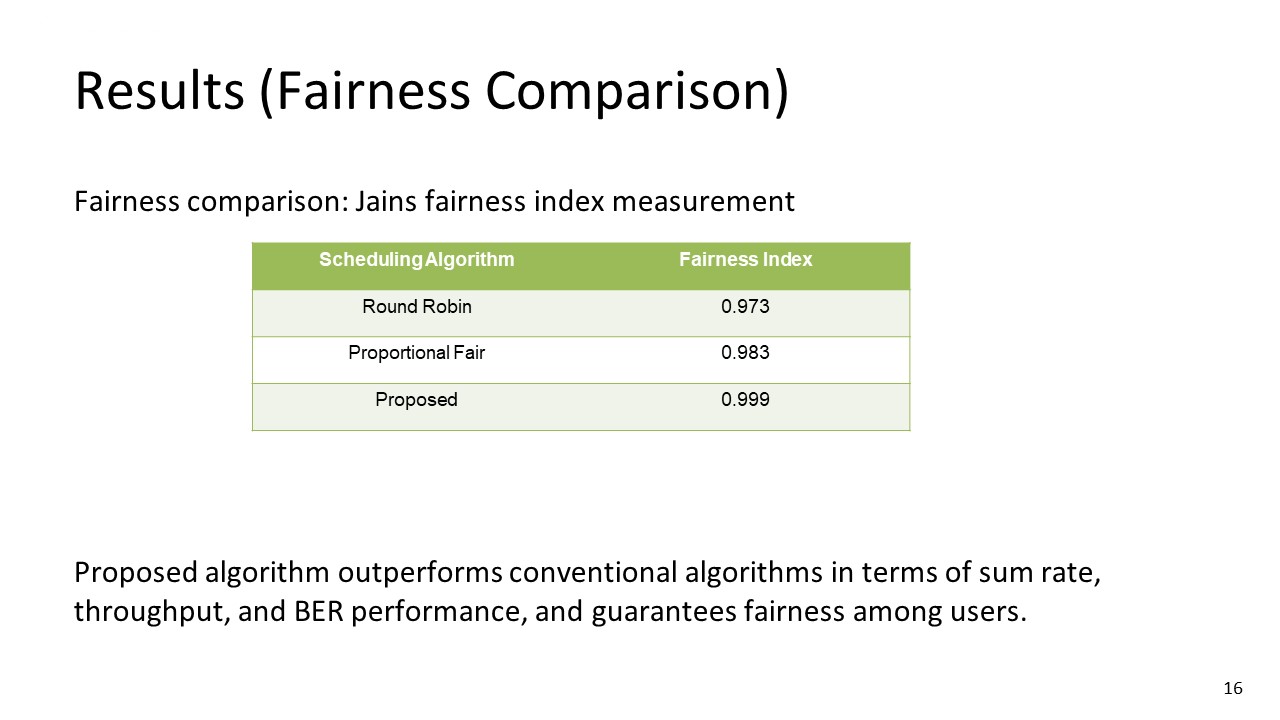 |
We use Jain’s fairness index to evaluate the performance of the proposed algorithm. simulation results show that the fairness provided by the proposed algorithm is similar to that of the traditional algorithms. |
| ICACT20230176 Slide.16
[Big Slide]
[YouTube] |
Chrome Click!! |
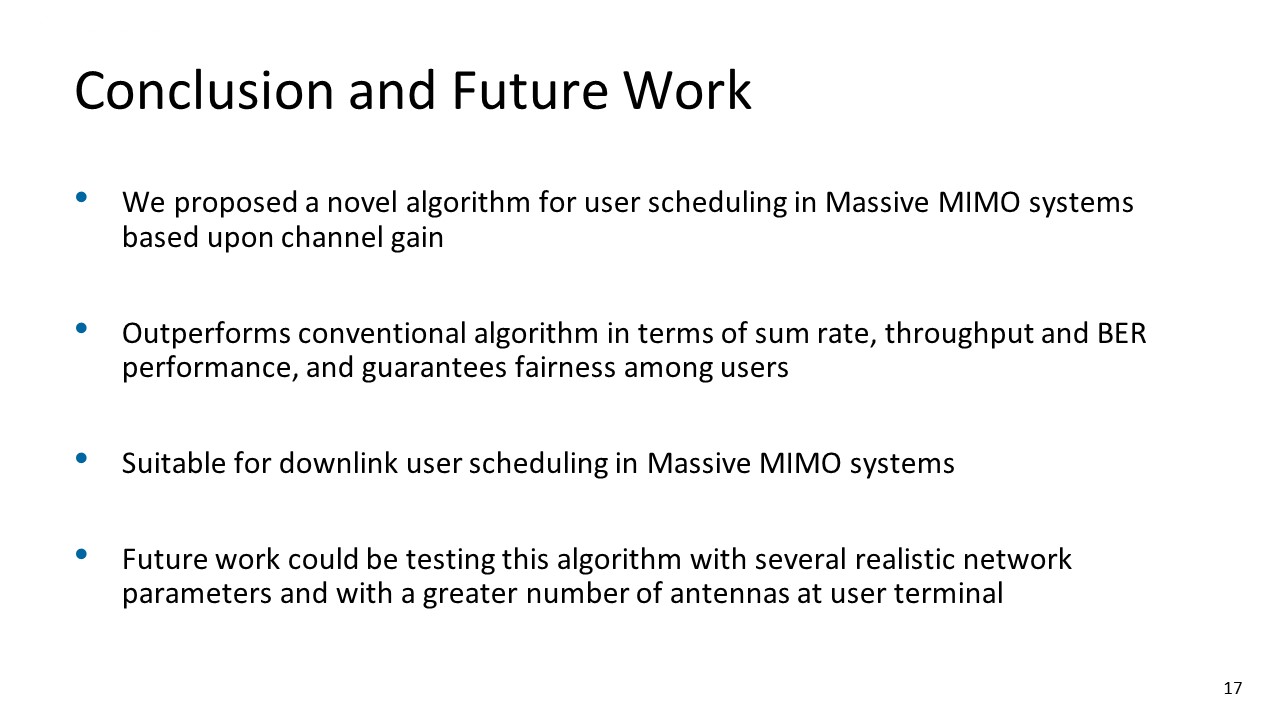 |
In this paper, we investigated the user scheduling issue during the downlink signaling in a massive MIMO system and proposed an adaptive user scheduling scheme based on instantaneous channel rate. We evaluated the sum rate, peruser throughput, and bit error performance of the proposed algorithm and compared the performance with traditional scheduling algorithms. The results obtained from the Matlab simulations show that the proposed algorithm performs better than the traditional user scheduling algorithm in terms of sumrate and per-user throughput. It also provides better error performance and establishes fairness among all users. We also studied the performance of the proposed algorithm with several modulation techniques and found that 64QAM provides the best data rate, whereas QPSK provides the best error rate. Finally, we assessed the fairness index of the proposed algorithm using Jain’s fairness index. We found that the proposed algorithm provides a fairness index of 0.99 and ensures fairness among all the users. Thus, the proposed algorithm is a suitable candidate for downlink user scheduling in a massive MIMO system with a large number of antennas. |
| ICACT20230176 Slide.17
[Big Slide]
[YouTube] |
Chrome Click!! |
 |
That’s my presentation. Please post your questions; I would be happy to answer them. Thank you.
|















