 ICACT20230179 Slide.01
[Big Slide]
[YouTube] |
Chrome  Click!! |
 |
Hello, everyone. Thanks for coming. I'm Yuyang Liu from University of Chinese Academic of sciences. Today's topic is Evolving Interest for Information Diffusion Prediction on Social Network. This is a joint work with Junruo Gao, Zefang Zhao, Haibo Wu, Zhaojuan Yue and Jun Li from University of Chinese Academic of sciences. |
| ICACT20230179 Slide.02
[Big Slide]
[YouTube] |
Chrome Click!! |
 |
My presentation will includes the following six parts |
| ICACT20230179 Slide.03
[Big Slide]
[YouTube] |
Chrome Click!! |
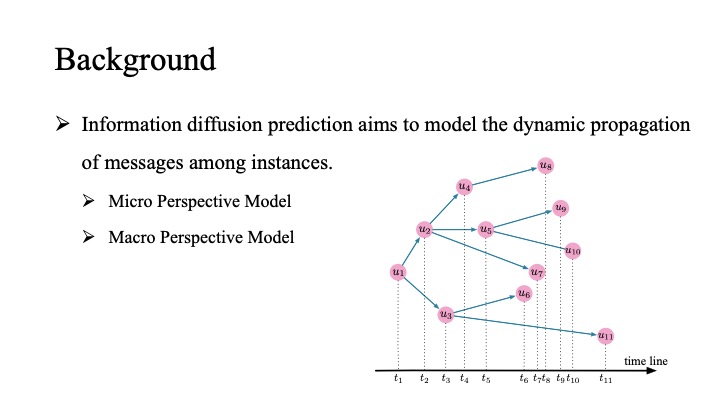 |
Firstly, we mainly focus on information diffusion prediction task, which aims to model the dynamic propagation of messages among social network users. This task can be solved from two perspectives, respectively. From a microscopic perspective, the term information cascade mainly refers to the process in which attractive content is hierarchically forwarded by individuals after it is released. The micro prediction task attempts to predict the next resharing event, including who and when. From a bigger perspective, information diffusion modeling aims to predict the future popularity. In this paper, we pay more attention to the macro prediction task. |
| ICACT20230179 Slide.04
[Big Slide]
[YouTube] |
Chrome Click!! |
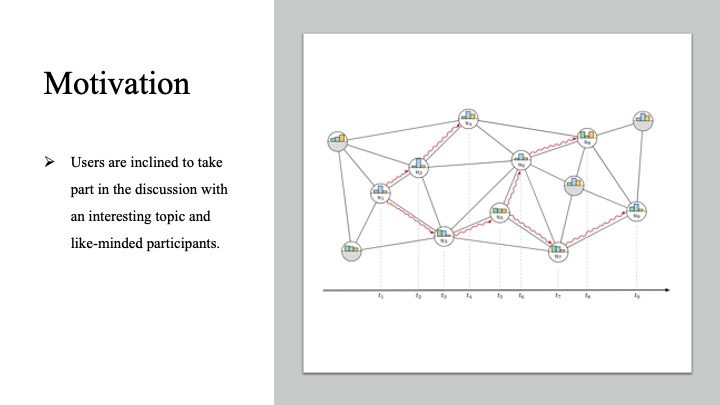 |
In the context of information diffusion, users are inclined to take part in the discussion with an interesting topic and like-minded participants. Even though many valuable insights and observations have been proposed by previous advanced research, some of which try to characterize the dynamic propagation based on individual interests, these methods still cannot explain the underlying propagation mechanism because they do not properly characterize the diverse interests of users on social network. As shown in this Figure, there are two kinds of networks. The first one is a static social network with solid lines that represent strong following relationships. Users in the static network are marked with discrete categorical histograms where each bar represents the interest intensity in the corresponding category. Taking user $u_1$ as an example, there are three kinds of interests in total, and $u_1$'s interests are mainly concentrated in the second blue category. The second network represents the diffusion topology of a specific message, in which the forwarding interactions between users are denoted by directed red squiggly lines. Initially, user $u_1$ posts a source message $m_s$ at time $t_1$, which is related to the blue topic. It is continuously forwarded by others who are interested in the blue topic, such as $u_2, u_4$ and $u_9$. Focus on user $u_6$ at time $t_6$. Although $u_6$ forwards $u_5$'s message and participates in the propagation process, it is incomplete to only consider $u_5$'s incentive for $u_6$'s forwarding behavior. Based on the strong following relationship and stable recommendation mechanism on online social platforms, $u_6$ usually has seen the participation of $u_2, u_3$ and $u_4$, who are directly connected to $u_6$ in the static network $G$ and participate in the cascade before $t_6$. These influences also affect $u_6$ to a certain extent and contribute to $u_6$'s forwarding behavior. Since individual interests essential roles in information cascade formation, it is crucial for cascade prediction to take account of it. |
| ICACT20230179 Slide.05
[Big Slide]
[YouTube] |
Chrome Click!! |
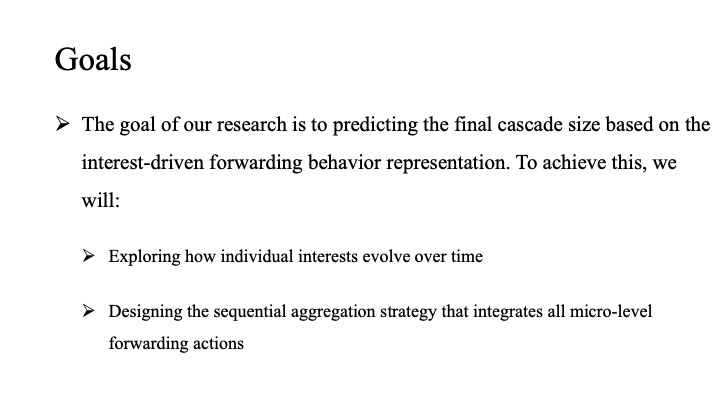 |
The goal of our research is to predicting the final cascade size based on the interest-driven forwarding behavior representation. To achieve this, we will:
Exploring how individual interests evolve over time
Designing the sequential aggregation strategy that integrates all micro-level forwarding actions |
| ICACT20230179 Slide.06
[Big Slide]
[YouTube] |
Chrome Click!! |
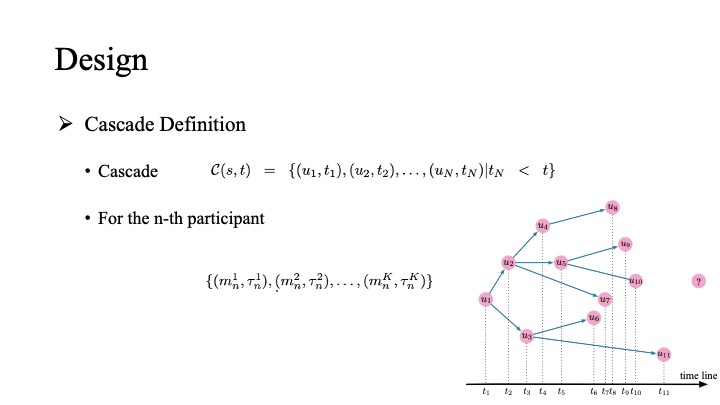 |
Then, I will offer detailed discussions of the respective modules one by one. First, the cascade is defined as C of s and t. It is a sequence of forwarding behavior denoted as $u_n$ and $t_n$. For each participant $u_n$ , its historical action sequence consists of many tuple of $(m_n^K,\tau_n^K)$, where $\tau_n^k$ is the timestamp when individual $u_n $ posts or forwards the historical message $m_n^k$. The historical action sequence represents other messages that user $u_n$ has forwarded before participating in cascade $\mathcal{C}$. |
| ICACT20230179 Slide.07
[Big Slide]
[YouTube] |
Chrome Click!! |
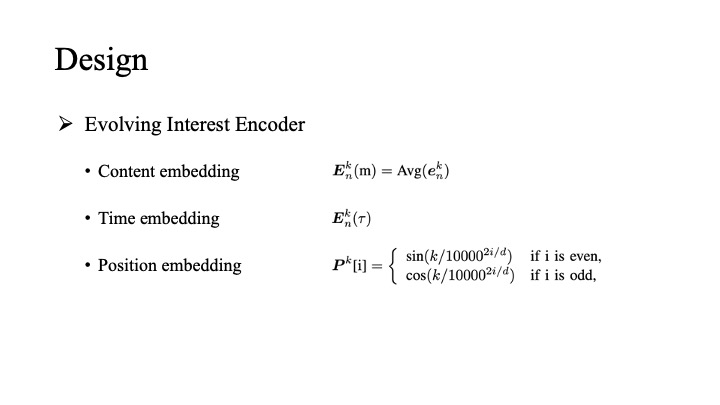 |
- Secondly, the latent message vector is further compressed by average pooling on BERT embedding. The timestamp $\tau_n^k$ is embedd into latent vectors $\boldsymbol{E}_n^k(\tau)$ based on the time2vec. We also explore the effect of relative position of historical actions. The index embedding $\boldsymbol{P}^k$ is constructed by performing periodic trigonometric transformation of the positional variables $k$ |
| ICACT20230179 Slide.08
[Big Slide]
[YouTube] |
Chrome Click!! |
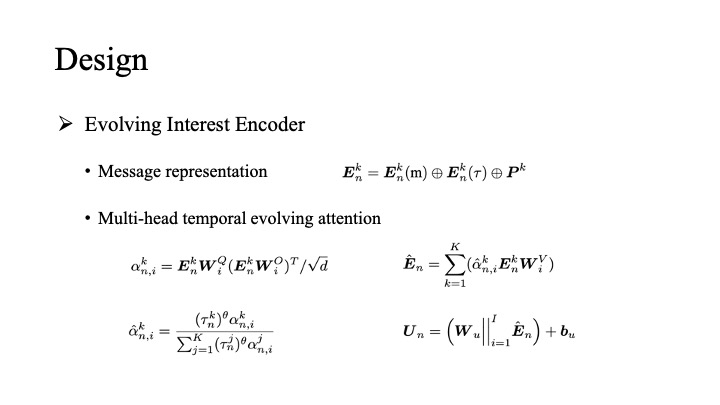 |
Each historical action of participant $u_n$ is generated by element-wise plus on content embedding, time embedding and positional embedding. Then, We feed all action embeddings to the multi-head temporal evolving attention layer. The influence of interests at different historical stages on users' current forwarding action is inconsistent. Generally speaking, the closer the timestamp $\tau_n^k$ of message $m_n^k$ is to the current forwarding timestamp $t_n$, the greater the impact. Thus, we design an power-law evolving process for all historical actions. Thus, all historical actions is aggregated by weighted summation. We concatenate multiple head representation related to one specific user and adopt a linear projection |
| ICACT20230179 Slide.09
[Big Slide]
[YouTube] |
Chrome Click!! |
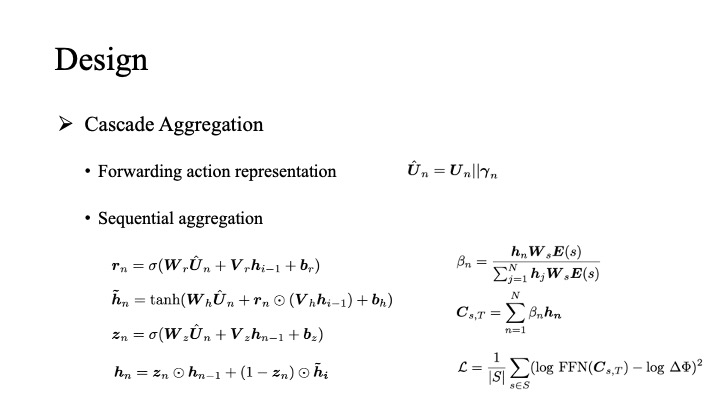 |
After getting the latent interest embeddings of users, All participants are fed into the gate recurrent units in chronological order of the forwarding action. It should be noted that the excitation of each observed user, will influence differently the incremental scale of the message. Thus, we attempt to use the cohesion degree between each user and the source message $s$ to measure their contributions. More formally, the coefficient is computed another attention mechanism. Finally, we can predict the incremental diffusion scale. |
| ICACT20230179 Slide.10
[Big Slide]
[YouTube] |
Chrome Click!! |
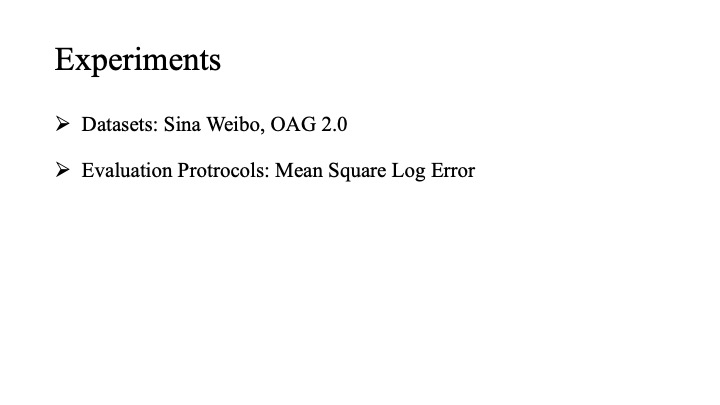 |
To evaluate the proposed model, we carry out our experiments on two large-scale real-world datasets to quantitatively evaluate the performance of the proposed framework. We cast the prediction task of incremental diffusion scale as a regression problem. The prediction performance is evaluated by mean square log error. The smaller values in MSLE indicate the better performance. |
| ICACT20230179 Slide.11
[Big Slide]
[YouTube] |
Chrome Click!! |
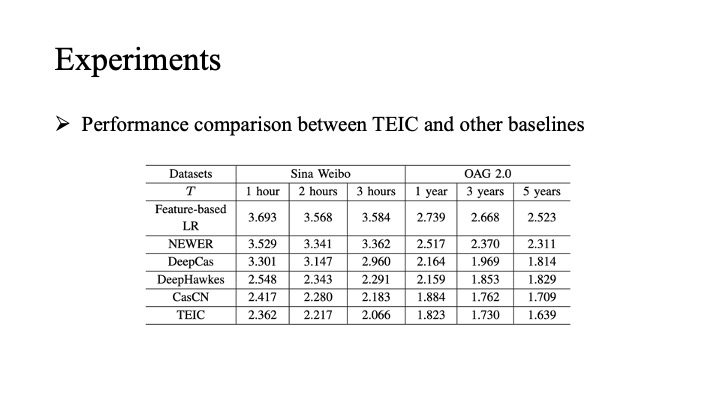 |
In terms of scale prediction task, when comparing methods, we clearly see that The prediction precision of NEWER is slightly improved relative to feature-based linear regression. DeepHawkes and CasCN are comparable in performance. Although DeepHawkes chooses more adequate features, it makes a trade-off between prediction performance and interpretability rather than purely pursuing accuracy. Our proposed TEIC achieves excellent prediction results, with MSLE = 2.066 on Sina Weibo and MSLE = 1.639 on OAG 2.0 when the observation window equals 3 hours and 7 years respectively. |
| ICACT20230179 Slide.12
[Big Slide]
[YouTube] |
Chrome Click!! |
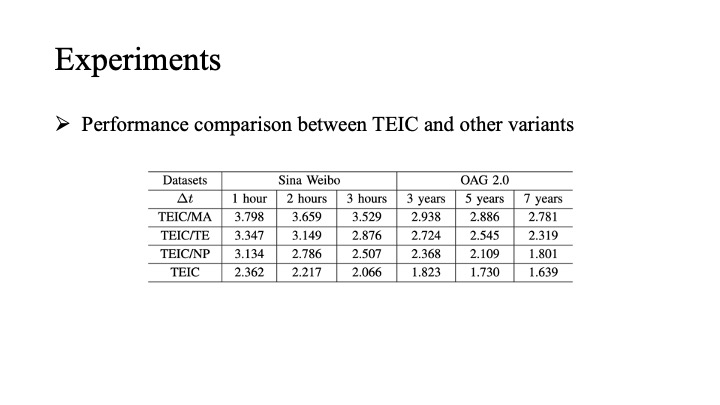 |
To substantiate the effectiveness of the major components in the IntCas model, we present three variants, denoted as \bf TEIC/MA, TEIC/TE and TEIC/NP. TEIC/MA removes multiple historical actions from TEIC and uses latest one action to represent user interests. TEIC/TE removes the temporal evolving mechanism form TEIC. In TEIC/NP, the non-participant terms are omitted. Table outlines the performance comparison among TEIC and its variants. TEIC/MA and TEIC/TE both simplify the modeling of user interests, whose prediction accuracy is far from satisfactory. For TEIC-NP, the omission of non-participants results in a minor impact on performance that corroborates the assumptions of previous works. |
| ICACT20230179 Slide.13
[Big Slide]
[YouTube] |
Chrome Click!! |
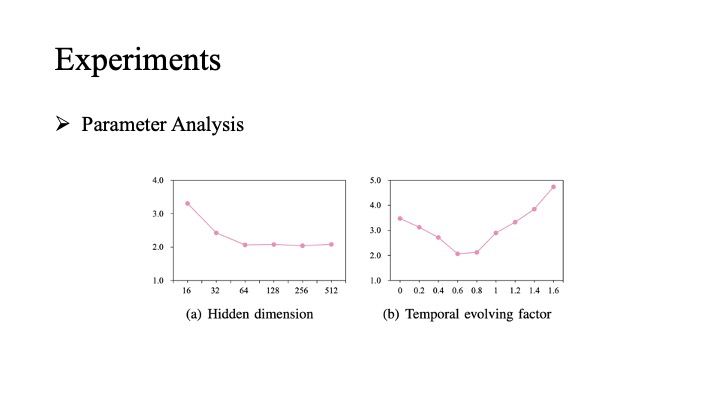 |
Moreover, We also evaluate how TEIC performs against different hyper-parameters, including hidden dimension and emporal evolving factor. |
| ICACT20230179 Slide.14
[Big Slide]
[YouTube] |
Chrome Click!! |
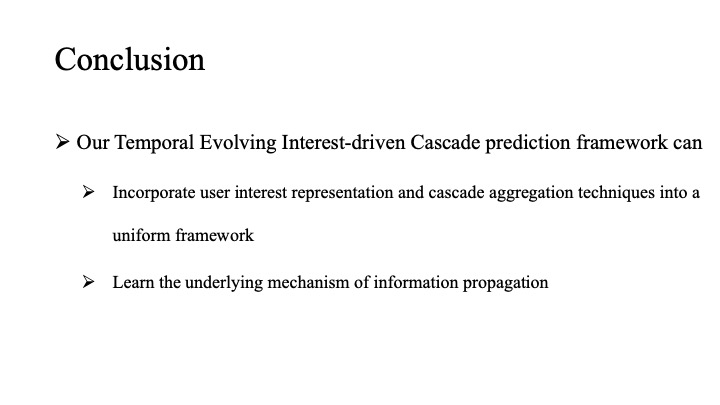 |
In conclusion, our Temporal Evolving Interest-driven Cascade prediction framework can incorporate user interest representation and cascade aggregation techniques into a uniform framework and learn the underlying mechanism of information propagation |
| ICACT20230179 Slide.15
[Big Slide]
[YouTube] |
Chrome Click!! |
 |
Thanks for your attention. Next, we will step into the Q and A part. |















