 ICACT20240070 Slide.01
[Big Slide]
[YouTube] |
Chrome  Click!! |
 |
Hello everyone.
My name is Di Zhou, today I am going to introduce my research, named QPSO-based Beamforming in Dual RIS-assisted Uplink Anti-jamming Communication System. |
| ICACT20240070 Slide.02
[Big Slide]
[YouTube] |
Chrome Click!! |
 |
My presentation will be divided into five parts, so let's start with an introduction |
| ICACT20240070 Slide.03
[Big Slide]
[YouTube] |
Chrome Click!! |
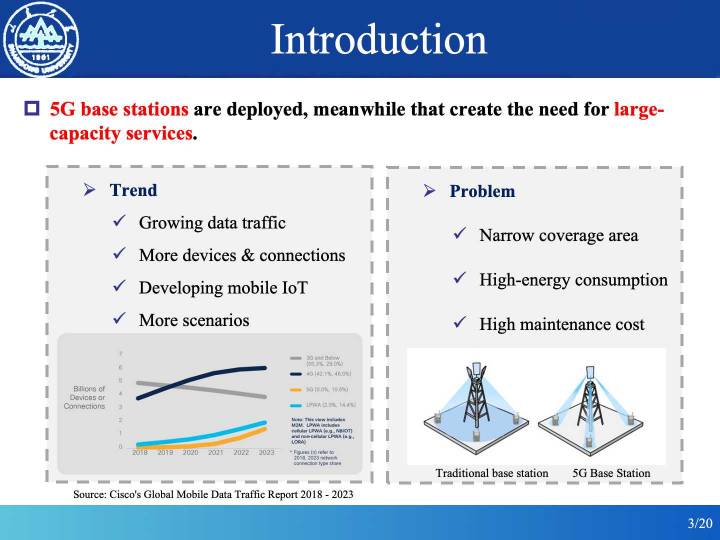 |
The problem that has become apparent during the standardisation of 5G wireless networks is that there is no single enabling technology that can support all the needs of 5G applications today.
|
| ICACT20240070 Slide.04
[Big Slide]
[YouTube] |
Chrome Click!! |
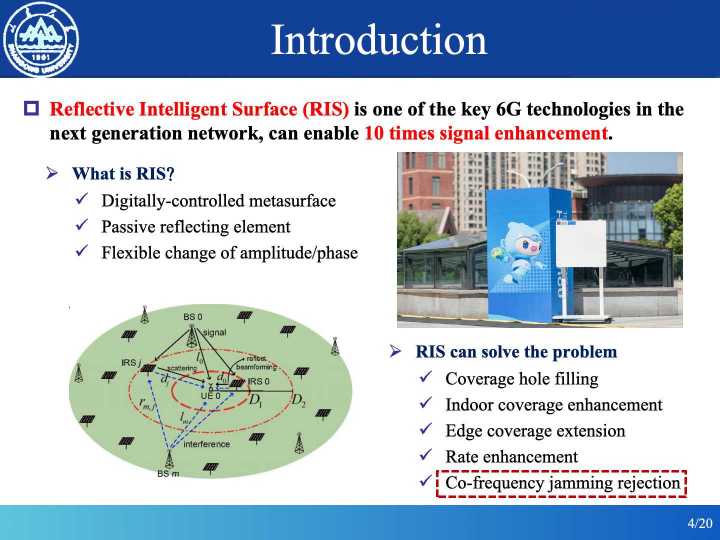 |
RIS is a technology that can be a good solution to the problems that arise above. It is one of the key technologies for 6G and is capable of achieving 10-fold signal enhancement. First of all, I think many people should be quite unfamiliar with RIS, so what is RIS? |
| ICACT20240070 Slide.05
[Big Slide]
[YouTube] |
Chrome Click!! |
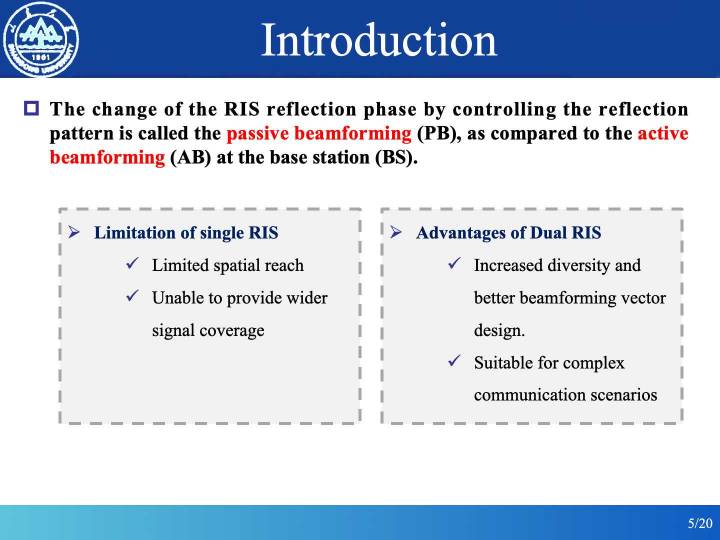 |
In my research, the main focus is around beamforming design for RIS. The change of the RIS reflection phase by controlling the reflection pattern is called the passive beamforming (PB), as compared to the active beamforming (AB) at the base station (BS).
|
| ICACT20240070 Slide.06
[Big Slide]
[YouTube] |
Chrome Click!! |
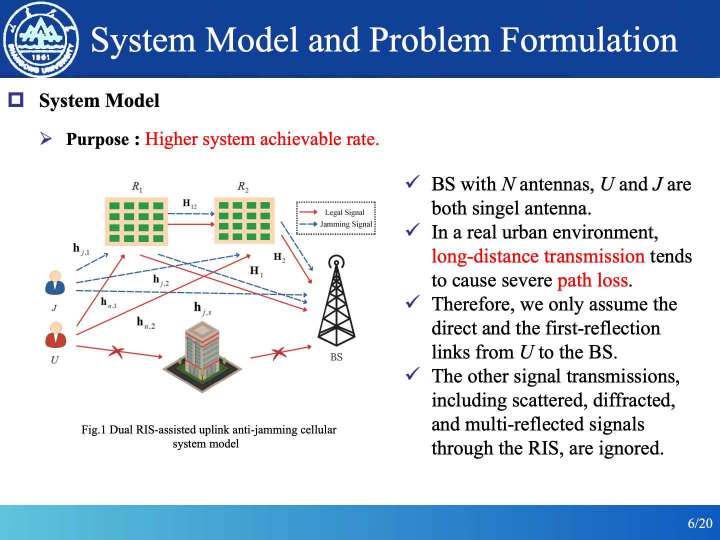 |
BS with N antennas, U and J are both singel antenna.
In a real urban environment, long-distance transmission tends to cause severe path loss.
Therefore, we only assume the direct and the first-reflection links from U to the BS.
The other signal transmissions, including scattered, diffracted, and multi-reflected signals through the RIS, are ignored.
|
| ICACT20240070 Slide.07
[Big Slide]
[YouTube] |
Chrome Click!! |
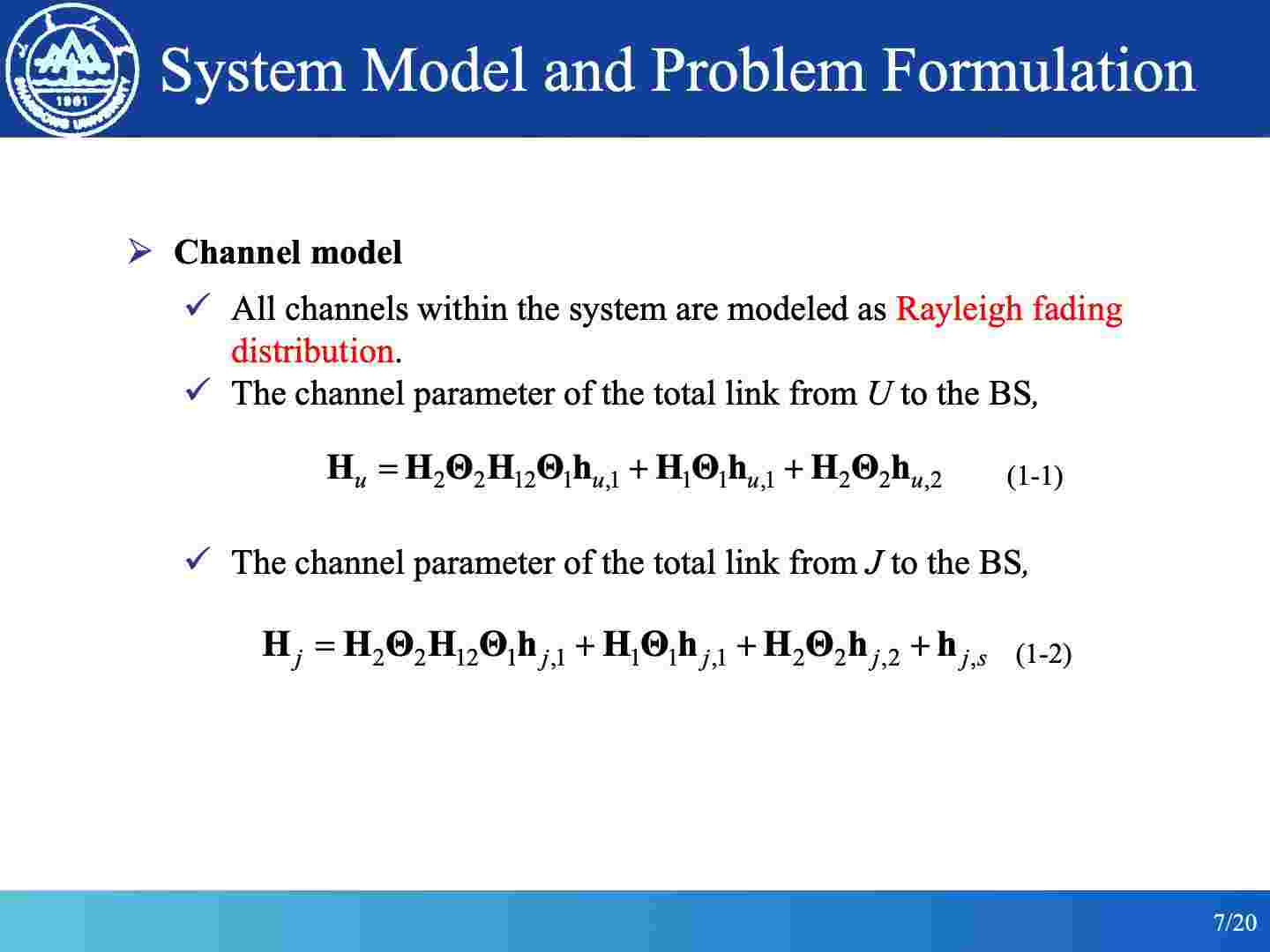 |
We assume that the channel model£¬All channels within the system are modeled as Rayleigh fading distribution.
The channel parameter of the total link from U to the BS |
| ICACT20240070 Slide.08
[Big Slide]
[YouTube] |
Chrome Click!! |
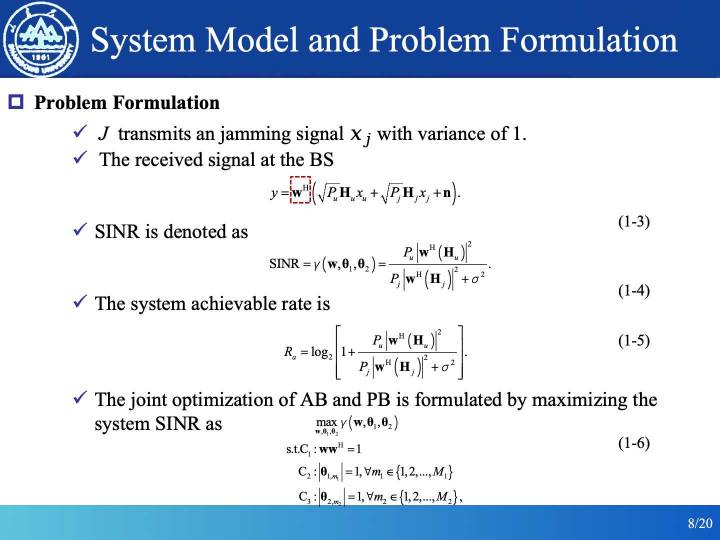 |
In my research, regarding the construction of the problem, it can be deduced from the following formula.
|
| ICACT20240070 Slide.09
[Big Slide]
[YouTube] |
Chrome Click!! |
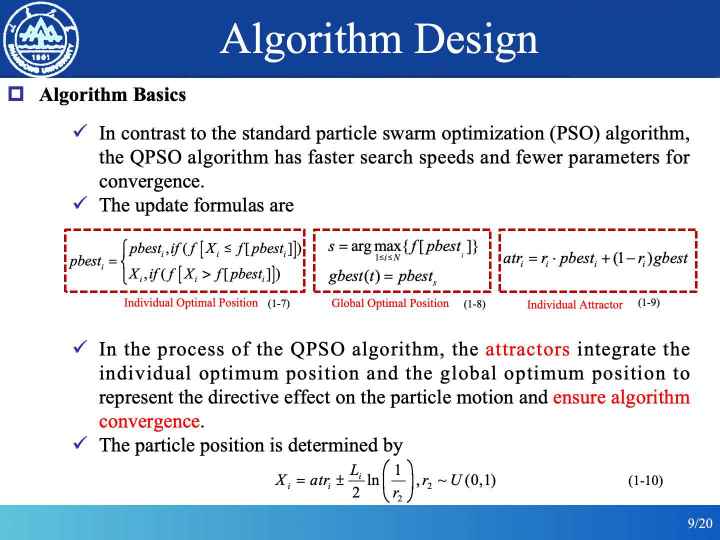 |
After modelling the problem, we have to find a suitable optimisation algorithm. |
| ICACT20240070 Slide.10
[Big Slide]
[YouTube] |
Chrome Click!! |
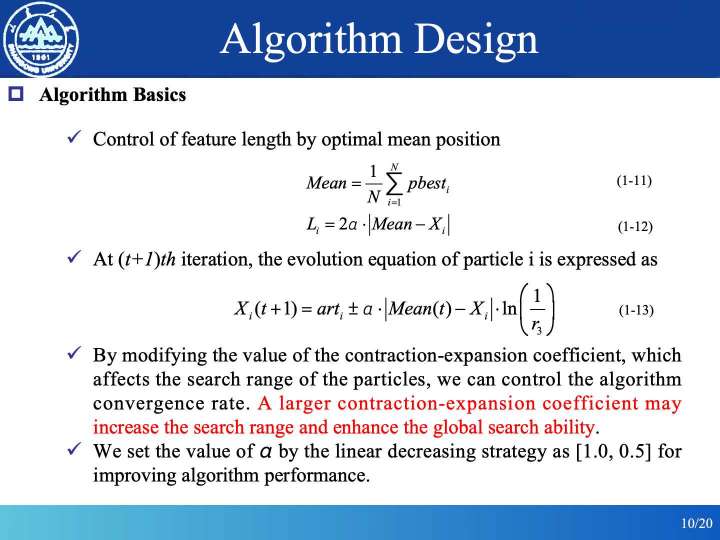 |
By modifying the value of the contraction-expansion coefficient, which affects the search range of the particles, we can control the algorithm convergence rate. A larger contraction-expansion coefficient may increase the search range and enhance the global search ability.
We set the value of ɑ by the linear decreasing strategy as [1.0, 0.5] for improving algorithm performance.
|
| ICACT20240070 Slide.11
[Big Slide]
[YouTube] |
Chrome Click!! |
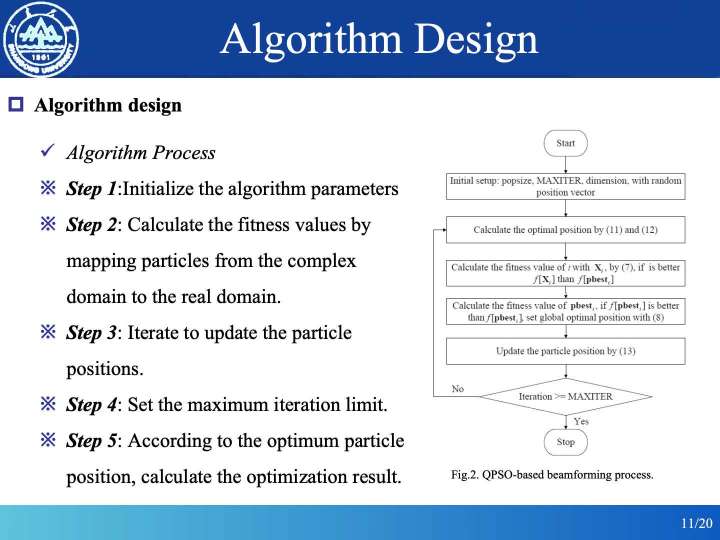 |
We show a flowchart of the algorithm |
| ICACT20240070 Slide.12
[Big Slide]
[YouTube] |
Chrome Click!! |
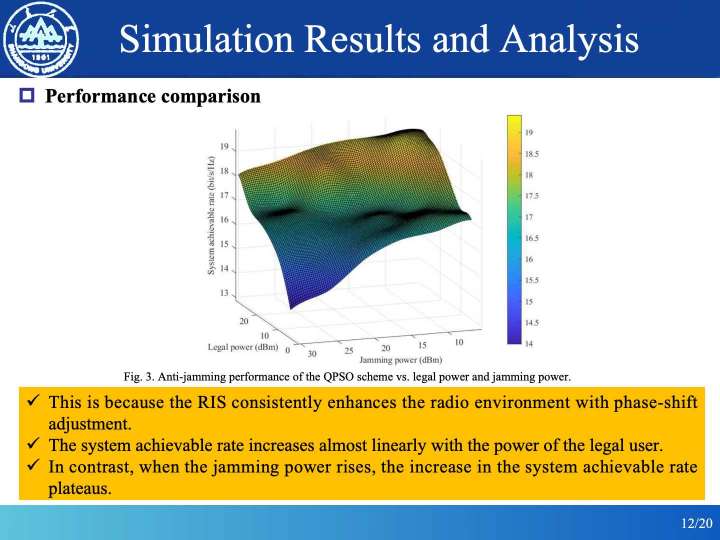 |
Here comes the most important part, that is the simulation results show |
| ICACT20240070 Slide.13
[Big Slide]
[YouTube] |
Chrome Click!! |
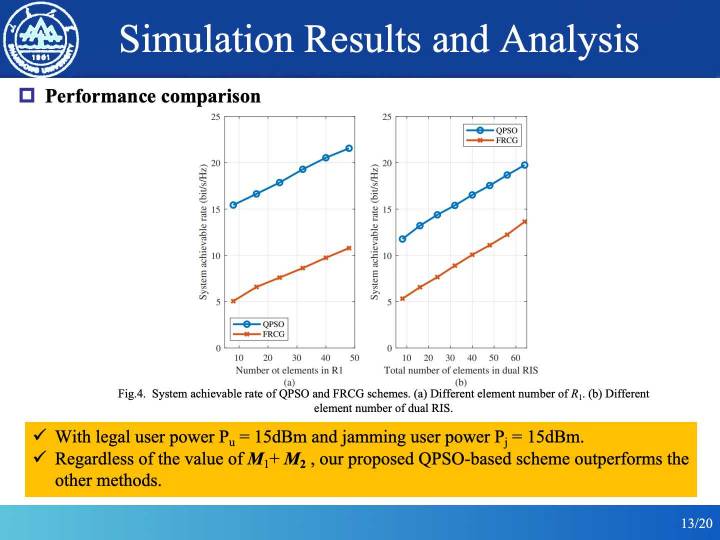 |
With legal user power Pu = 15dBm and jamming user power Pj = 15dBm.
Regardless of the value of M1+ M2 , our proposed QPSO-based scheme outperforms the other methods.
|
| ICACT20240070 Slide.14
[Big Slide]
[YouTube] |
Chrome Click!! |
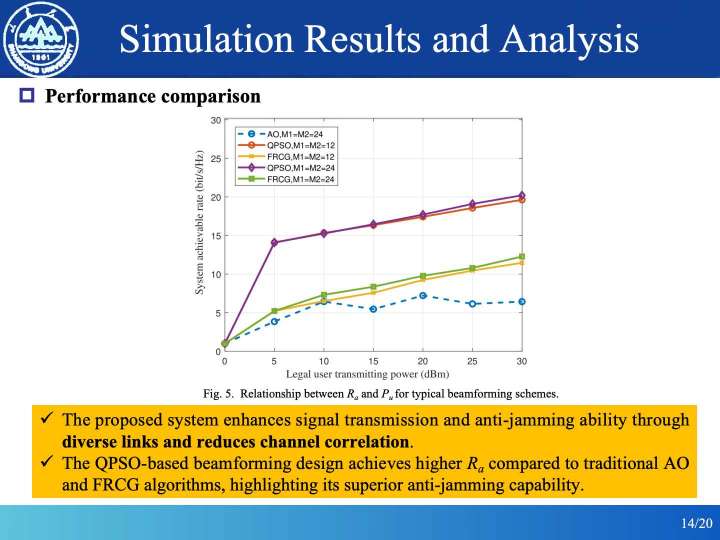 |
The proposed system enhances signal transmission and anti-jamming ability through diverse links and reduces channel correlation.
The QPSO-based beamforming design achieves higher Ra compared to traditional AO and FRCG algorithms, highlighting its superior anti-jamming capability.
|
| ICACT20240070 Slide.15
[Big Slide]
[YouTube] |
Chrome Click!! |
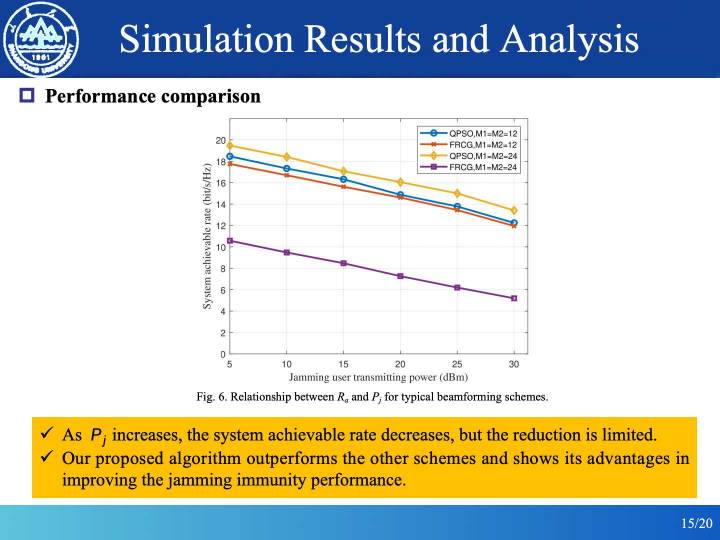 |
As Pj increases, the system achievable rate decreases, but the reduction is limited.
Our proposed algorithm outperforms the other schemes and shows its advantages in improving the jamming immunity performance.
|
| ICACT20240070 Slide.16
[Big Slide]
[YouTube] |
Chrome Click!! |
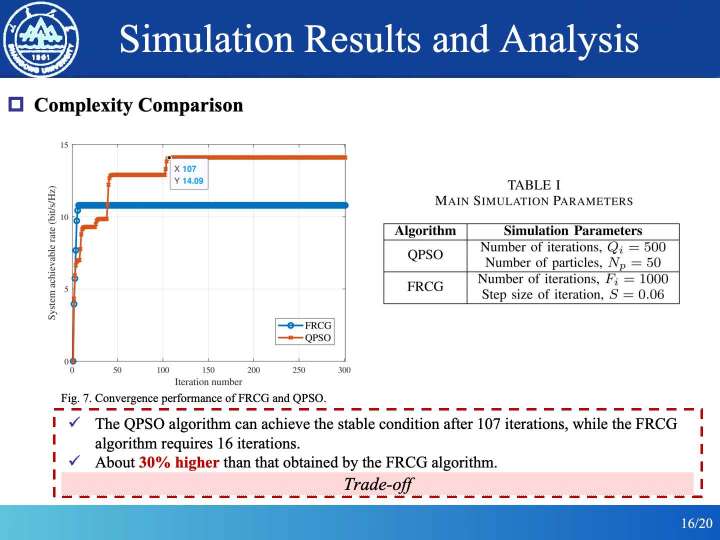 |
In addition, we compared the complexity of the two algorithms. According to the demonstrated convergence and performance parameters biao |
| ICACT20240070 Slide.17
[Big Slide]
[YouTube] |
Chrome Click!! |
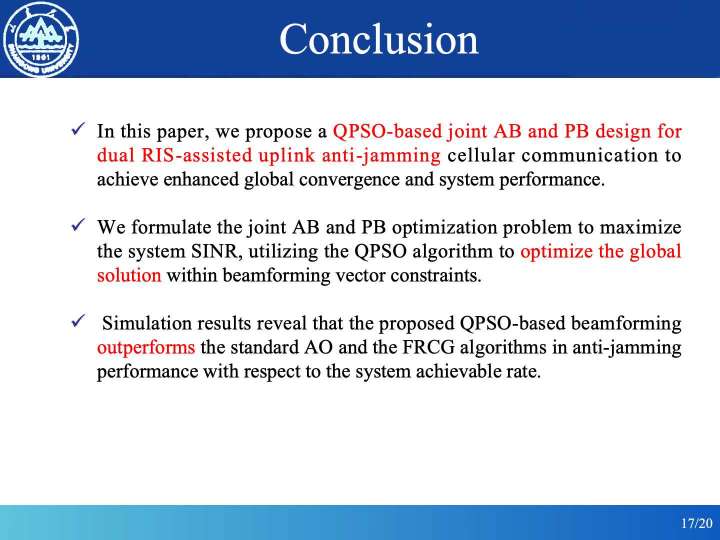 |
Finally, a summary of my research.
In this paper, we propose a QPSO-based joint AB and PB design for dual RIS-assisted uplink anti-jamming cellular communication to achieve enhanced global convergence and system performance.
We formulate the joint AB and PB optimization problem to maximize the system SINR, utilizing the QPSO algorithm to optimize the global solution within beamforming vector constraints.
Simulation results reveal that the proposed QPSO-based beamforming outperforms the standard AO and the FRCG algorithms in anti-jamming performance with respect to the system achievable rate.
|
| ICACT20240070 Slide.18
[Big Slide]
[YouTube] |
Chrome Click!! |
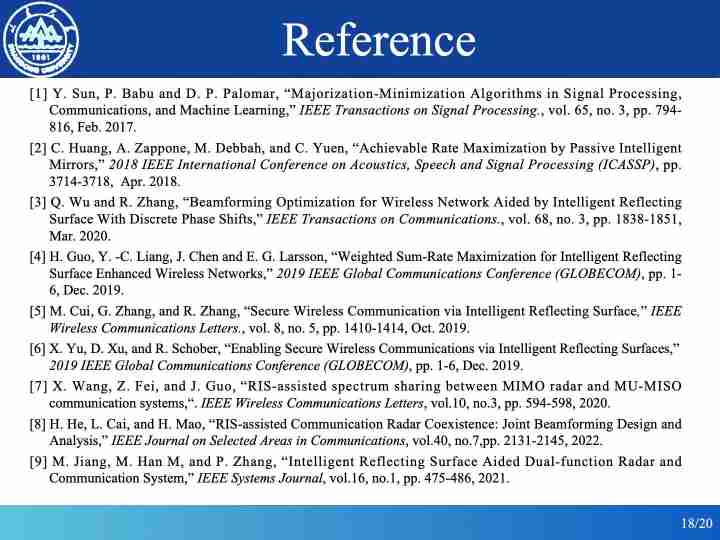 |
Here is a visual representation of this PowerPoint and the references used in the paper. |
| ICACT20240070 Slide.19
[Big Slide]
[YouTube] |
Chrome Click!! |
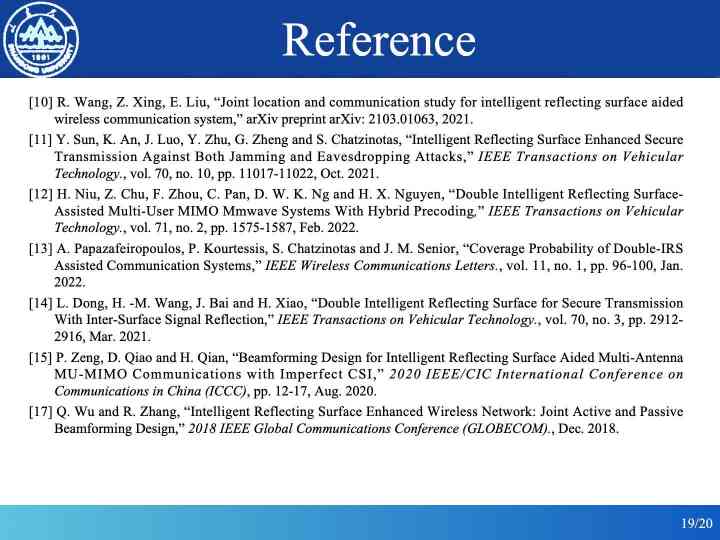 |
Here is a visual representation of this PowerPoint and the references used in the paper. |
| ICACT20240070 Slide.20
[Big Slide]
[YouTube] |
Chrome Click!! |
 |
Thank you all for listening, and this concludes my presentation. |















