 ICACT20240381 Slide.00
[Big Slide] |
Chrome  Click!! |
 |
The paper title about "The Seamless Connection between Underwater and Terrestrial Communication for 6G" |
| ICACT20240381 Slide.01
[Big Slide]
|
Chrome Click!! |
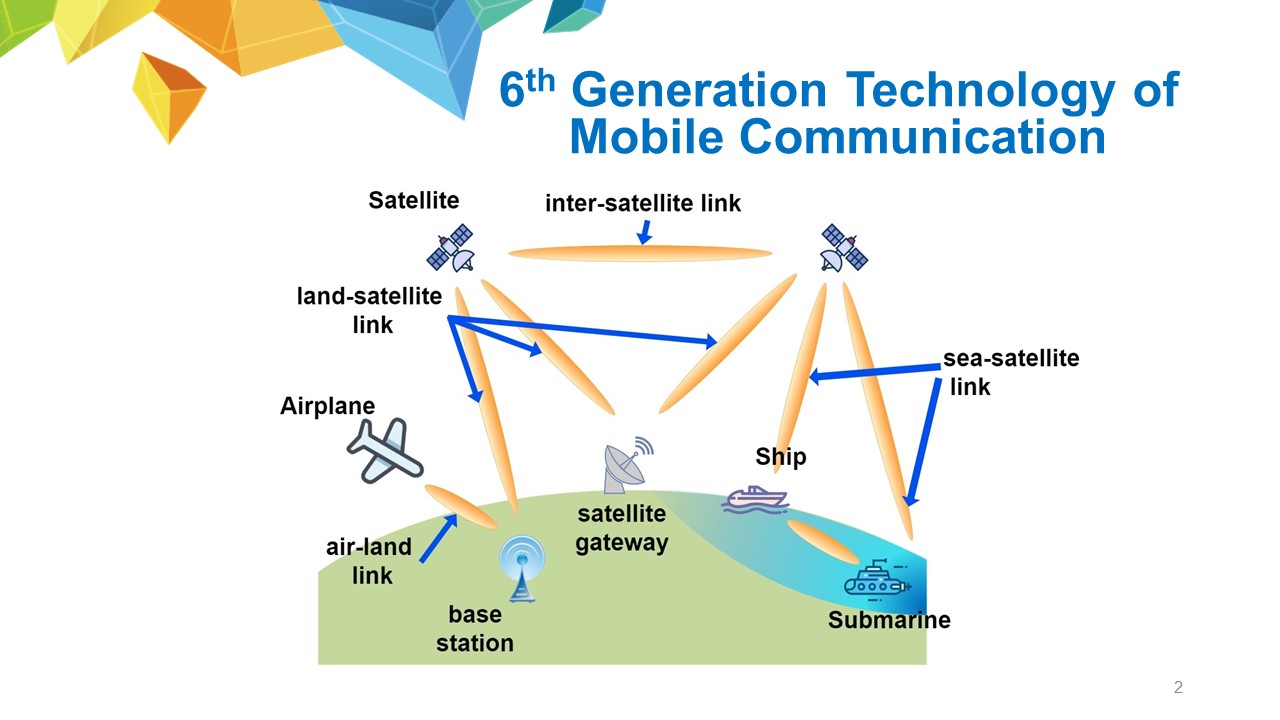 |
There are have three key technologies under the 6G network. Such as Artificial Intelligence (AI), advanced radio frequency and optical technology and network technology, New Network Topology, and the coverage of non-terrestrial network Expansion technology, etc.
|
| ICACT20240381 Slide.02
[Big Slide]
|
Chrome Click!! |
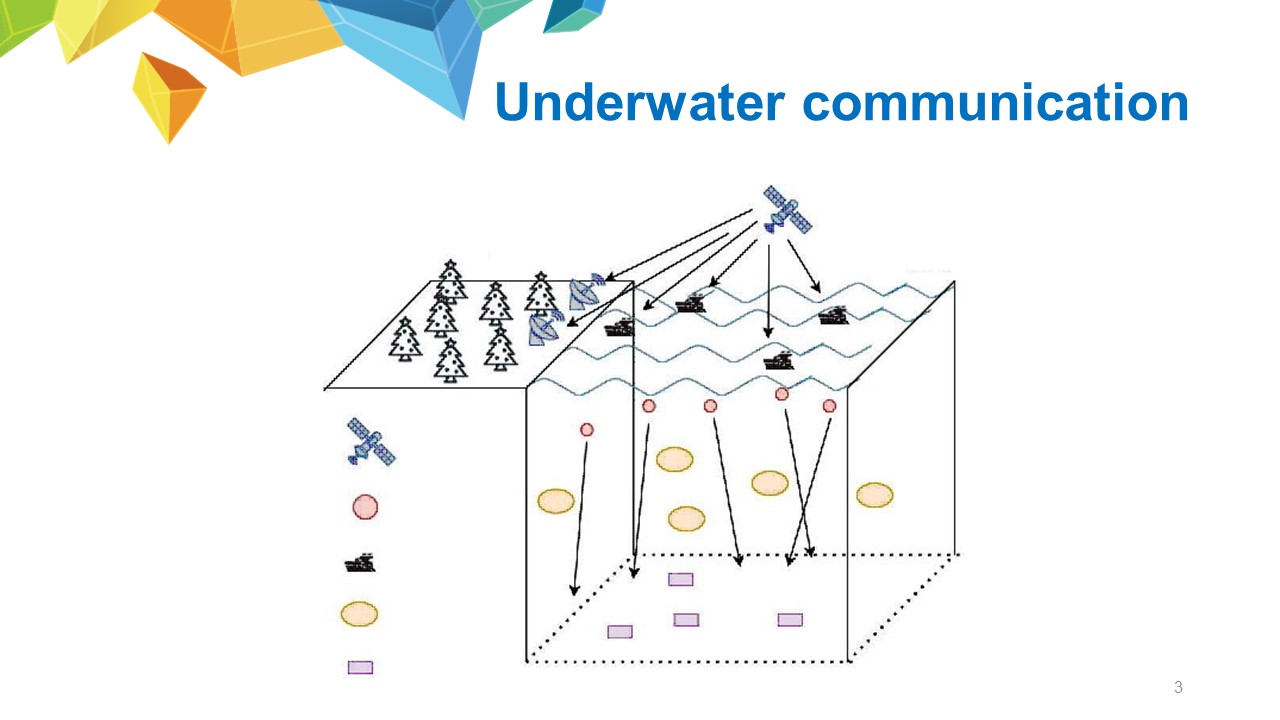 |
Underwater wireless sensor network is a network composed of wireless sensors under the water surface to perform marine environment detection, offshore exploration, navigation assistance, tsunami warning, military and other fields. An underwater wireless network often includes underwater nodes, relay stations, satellites and ground receiving stations. Nodes will continuously collect data and send data back for analysis and reference. �
Laser communication in the underwater environment mainly uses acoustic wave transmission, because if optical communication is used, there are many factors under the water surface that will affect the communication effect.
|
| ICACT20240381 Slide.03
[Big Slide]
|
Chrome Click!! |
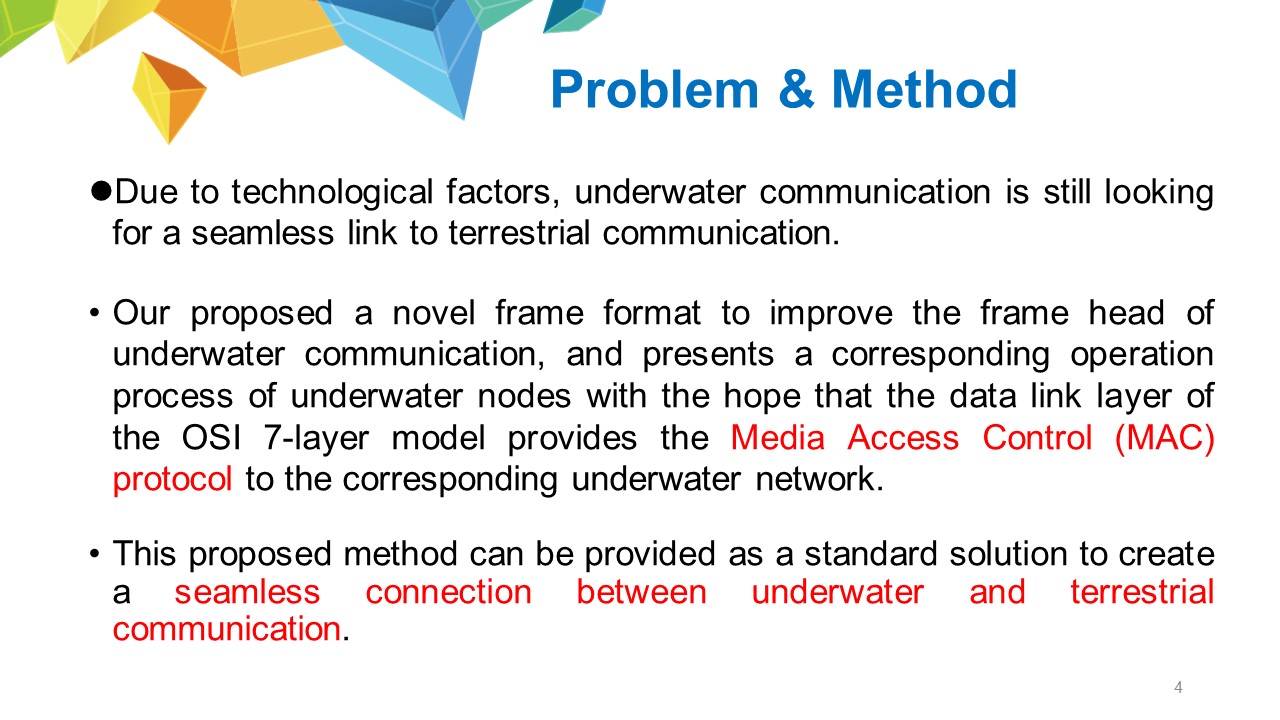 |
Due to technological factors, underwater communication is still looking for a seamless link to terrestrial communication.
Our proposed a novel frame format to improve the frame head of underwater communication and presents a corresponding operation process of underwater nodes with the hope that the data link layer of the OSI 7-layer model provides the Media Access Control (MAC) protocol to the corresponding underwater network. This proposed method can be provided as a standard solution to create a seamless connection between underwater and terrestrial communication.
|
| ICACT20240381 Slide.04
[Big Slide]
|
Chrome Click!! |
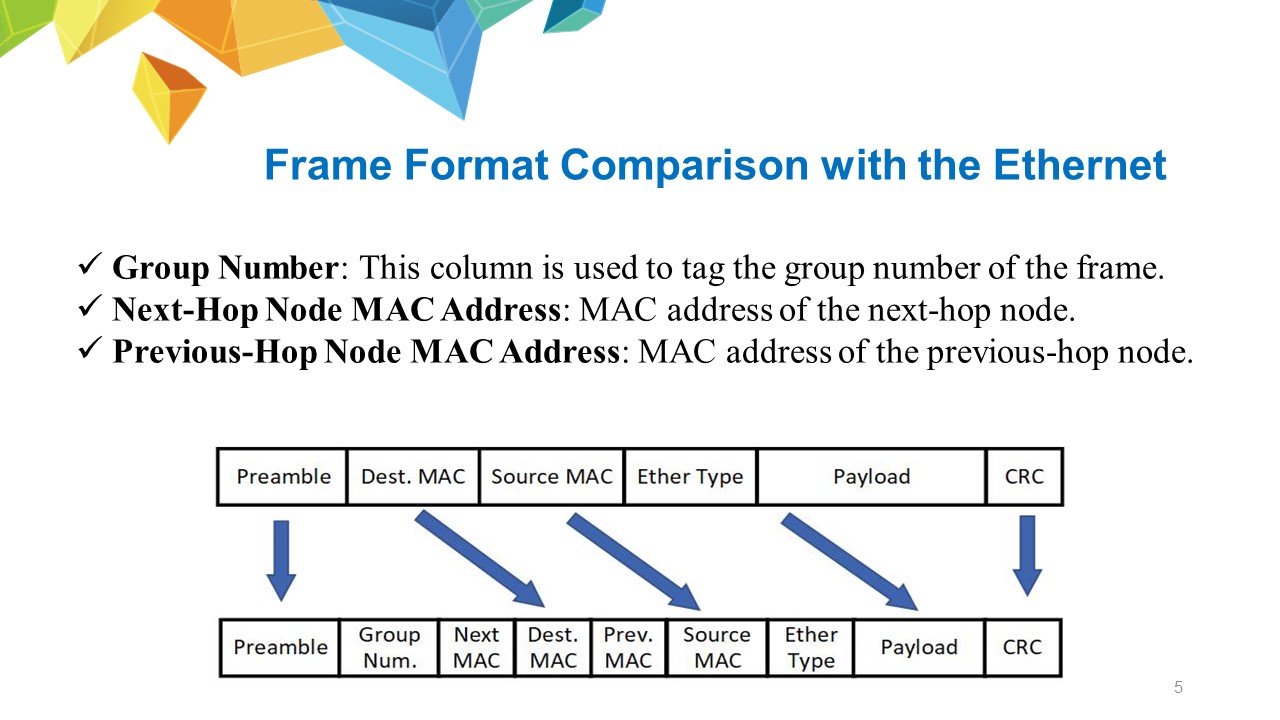 |
Because the underwater transmission of signals is far slower than the propagation of EM waves in terrestrial communication, the Ethernet frame format cannot be directly adopted. For this reason, in light of the existing frame format of terrestrial communication and the features of underwater environment, this paper improves the frame header so that underwater and terrestrial communication protocols can be compatible and interfaced to suit the requirements of the space-air-ground integrated 6G network. |
| ICACT20240381 Slide.05
[Big Slide]
|
Chrome Click!! |
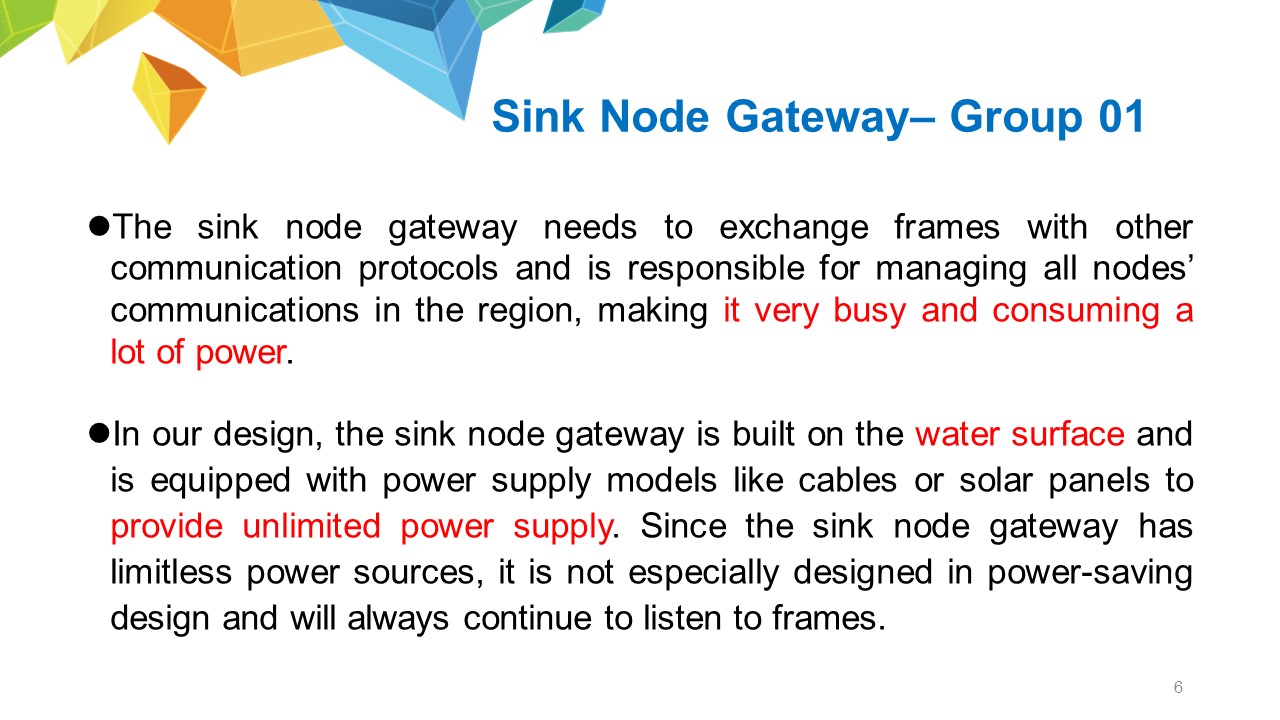 |
The sink node gateway needs to exchange frames with other communication protocols and is responsible for managing all nodes¡¯ communications in the region, making it very busy and consuming a lot of power.
In our design, the sink node gateway is built on the water surface and is equipped with power supply models like cables or solar panels to provide unlimited power supply. Since the sink node gateway has limitless power sources, it is not especially designed in power-saving design and will always continue to listen to frames.
|
| ICACT20240381 Slide.06
[Big Slide]
|
Chrome Click!! |
 |
Bridge nodes need to transfer the frames captured. So, bridge nodes will be built under the water surface and work as nodes in the underwater network. Since bridge nodes are responsible for transferring frames, they need high energy storage capacity to bridge the connections.
|
| ICACT20240381 Slide.07
[Big Slide]
|
Chrome Click!! |
 |
In our design, normal nodes do not transfer frames and therefore consume less power. However, underwater nodes perform different tasks, resulting in different transmission frequencies. An underwater environment monitoring system includes different functional sensors to measure underwater noises, temperature, salinity and so on. Since different sensors have different properties, the required times for transmission are also different. For example, while detecting the changes of sounds, sound monitoring nodes irregularly report the status of sounds to the network, but underwater temperature and salinity sensor may need to report salinity changes every half an hour. Traditionally, while encountering frames bound for sound sensors or from sound sensors, the temperature and salinity sensors need to receive the frames first. Once finding itself not the destination of the frames, the temperature and salinity sensors abandon the frames, leading to unnecessary power consumption. If energy consumption can be reduced, the temperature and salinity sensors will not require such large capacity power storage so as to reduce the manufacturing cost of building a node and extend the lifetime of underwater nodes.
|
| ICACT20240381 Slide.08
[Big Slide]
|
Chrome Click!! |
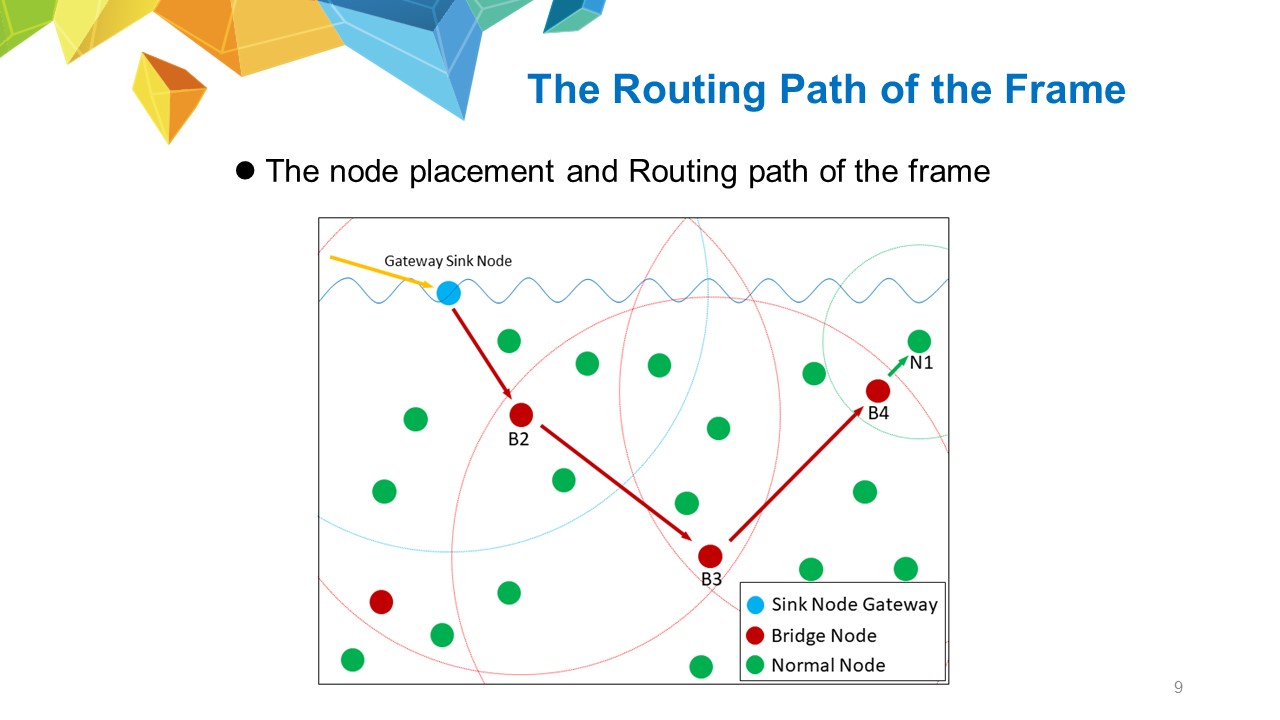 |
The figure show the system operates when a frame is transmitted from external network to N1. First, the frame enters the sink node gateway from an external network and the frame is translated into the format for underwater communication. The sink node gateway is its starting point in underwater network. When the frame is transmitted to B2, its group number is changed to 2. Because the group number of the sink node gateway and green normal nodes near B2 is 3, they stop receiving the frame and go in idle status, instead of wasting power in analyzing the frame. If a routing protocol can build a routing table for all bridge nodes and the sink node gateway, including the information of all network nodes, the bridge nodes B2, B3 and B4 in group 2 all have the detailed routing table of the underwater network and the routing table can bind normal nodes and bridge nodes together. When receiving frames from other bridge nodes, each bridge node can search for the destination address to modify the next-hop node MAC address of the header.
|
| ICACT20240381 Slide.09
[Big Slide]
|
Chrome Click!! |
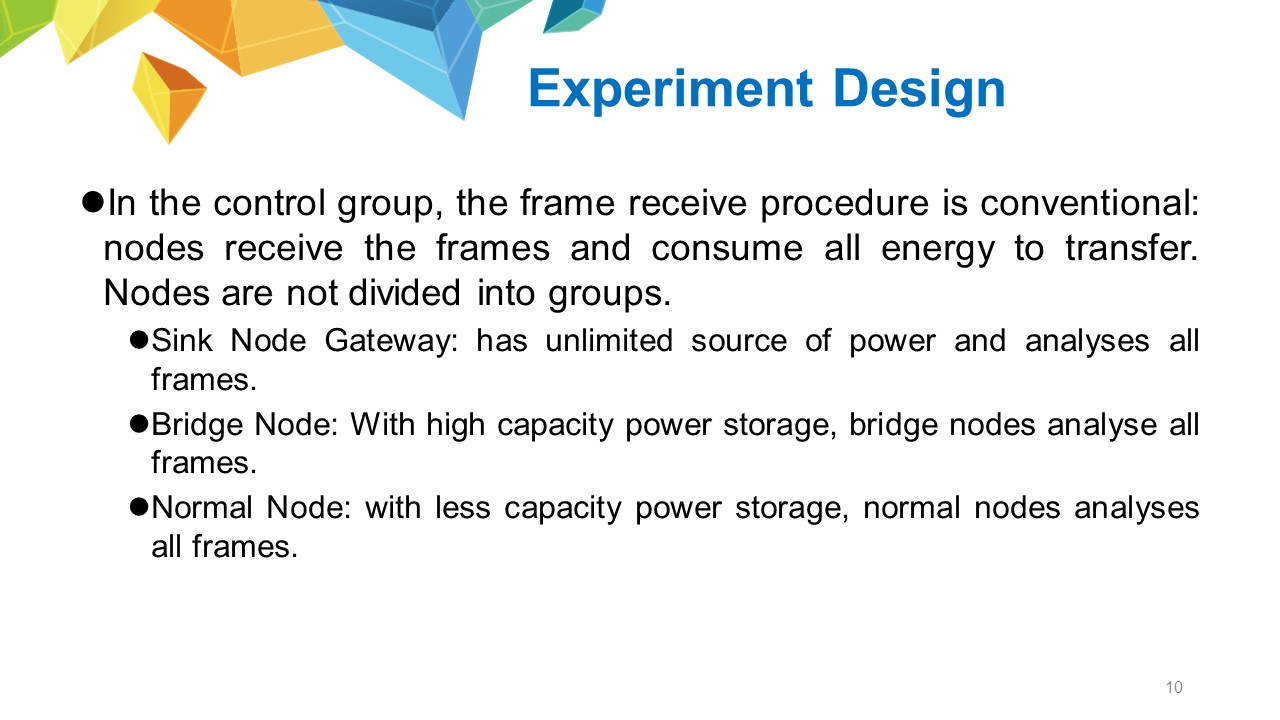 |
In the control group, the frame receive procedure is conventional: nodes receive the frames and consume all energy to transfer. Nodes are not divided into groups.
**Sink Node Gateway: has unlimited source of power and analyses all frames.
**Bridge Node: With high capacity power storage, bridge nodes analyse all frames.
**Normal Node: with less capacity power storage, normal nodes analyses all frames.
This experiment ignores the power consumption of other systems but nodes in the experimental group need to consume corresponding energy for decision making in addition to fundamental power consumption. Because of different elements in different systems, the power consumption in analysing the same data amount will be different. Therefore, this paper takes consumption counts as unit of measurement.
|
| ICACT20240381 Slide.10
[Big Slide]
|
Chrome Click!! |
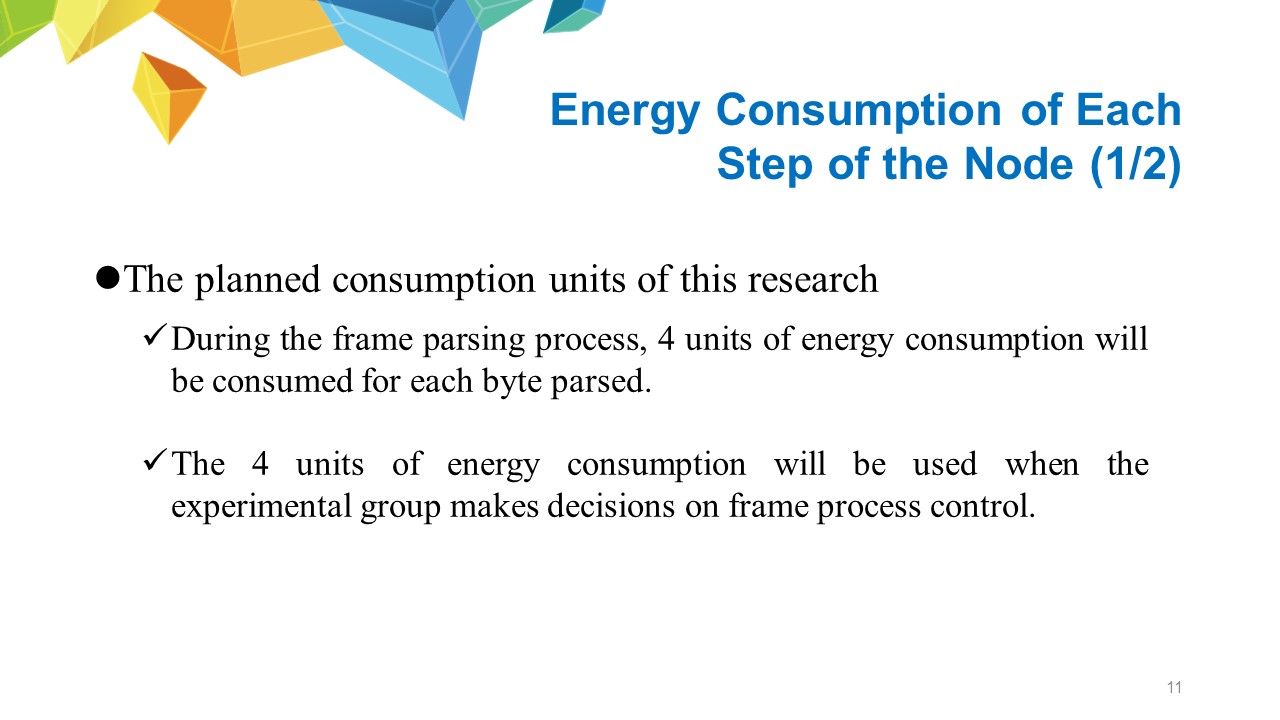 |
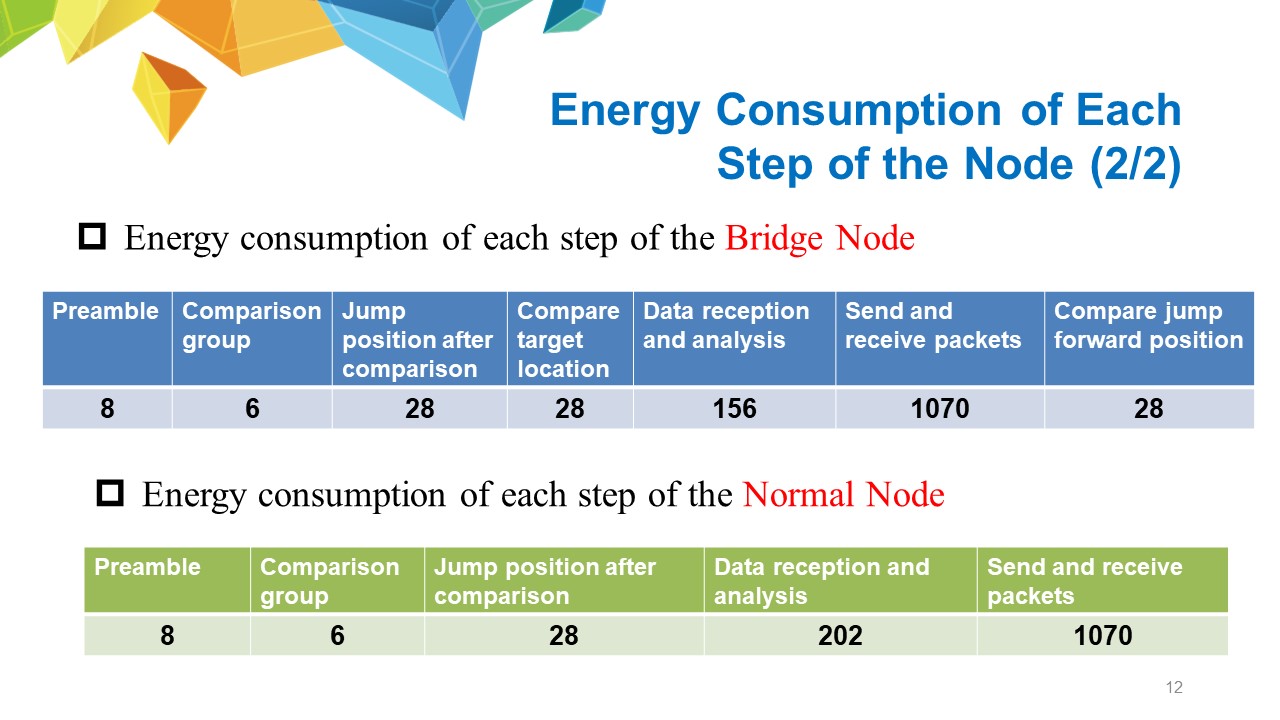
The planned consumption units of this paepr are as follows: During the frame parsing process, 4 units of energy consumption will be consumed for each byte parsed. In addition, 4 units of energy consumption will be used when the experimental group makes decisions on frame process control.
|
| ICACT20240381 Slide.11
[Big Slide]
|
Chrome Click!! |
 |
In the experimental data collection part, this research develops a simulation frame operation system, which can also record the following data:
Remaining power: This part will simulate sending a message frame and calculate the final remaining power value of each node.
System life: This part will send frames infinitely until a certain node in the overall network dies and record the life span between the two.
Record output: This part will record the operation status of each node when transmitting the frame.
|
| ICACT20240381 Slide.12
[Big Slide]
|
Chrome Click!! |
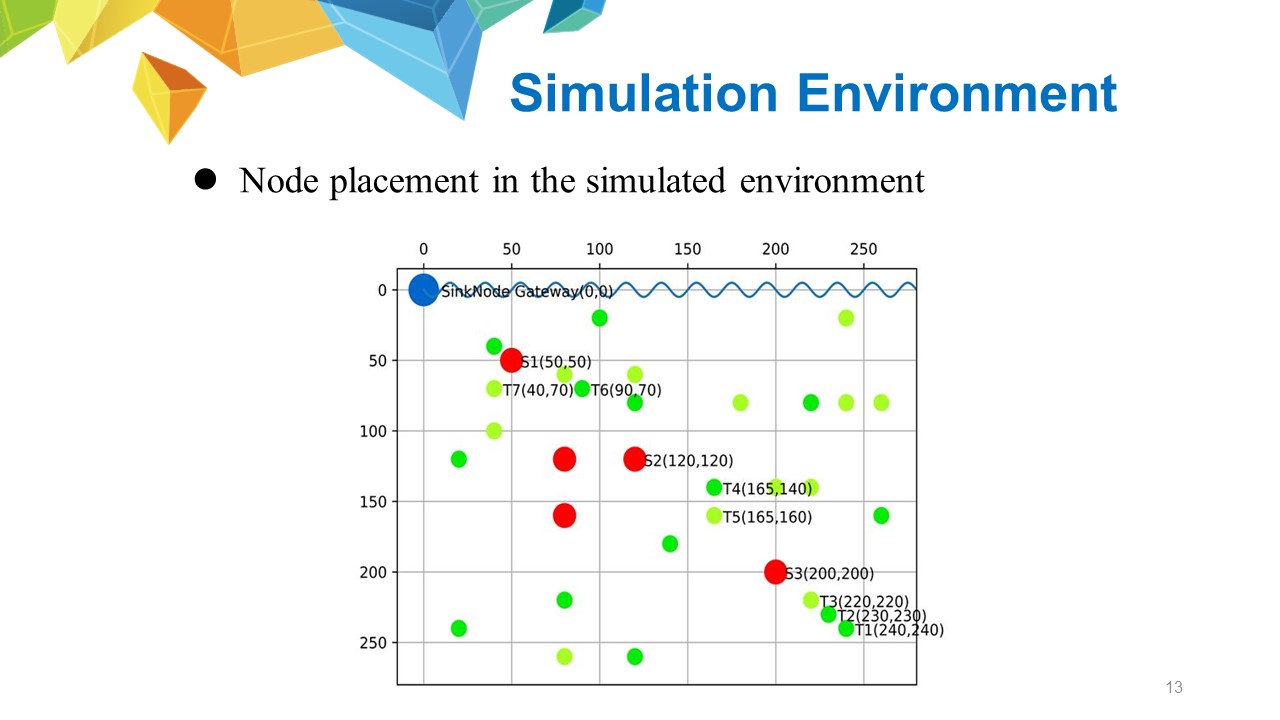 |
A simulated environment is created to analyze the performance of MAC frame and protocols. Figure shows the placement of nodes in the simulated environment and compares node power consumption.
|
| ICACT20240381 Slide.13
[Big Slide]
|
Chrome Click!! |
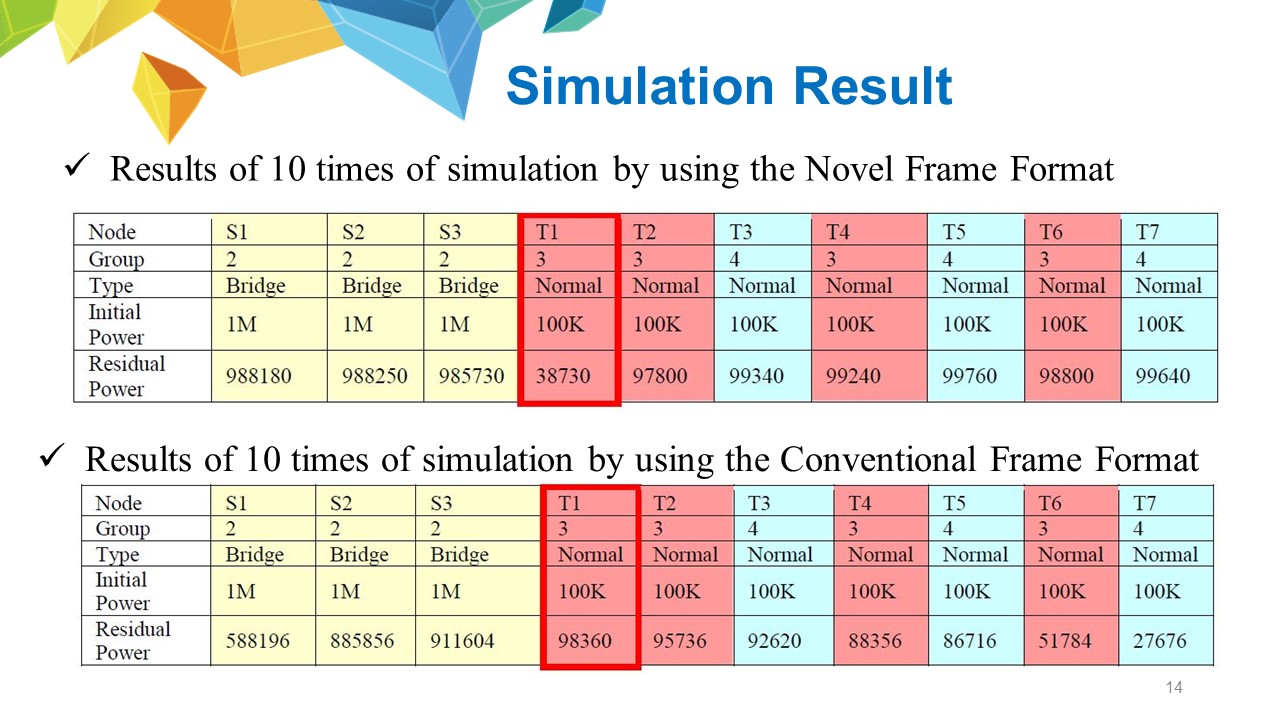 |
The two table show that the proposed new frame format can effectively reduce the power consumption of the nodes. For example, the bridge node S1 is very close to the sink node gateway and therefore receives lots of frames, including those that are destined for S1 and those that are destined for other nodes. In the conventional method, such frames must be abandoned or fully analyzed before being transferred, increasing the power consumption of the bridge nodes. By using our proposed method, S1 obviously saves a lot of energy. As far as normal nodes are concerned, normal nodes that are divided into groups effectively reduces power consumption. Take T7 as an example. T7 is close to the network center where many frames pass by. In the conventional method, T7 is not designated as the receiving node but consumes lots of power. By using our proposed method, nodes can detect and immediately ignore those packets that are bound for other destinations, extending the lifetime of normal nodes in the network.
|
| ICACT20240381 Slide.14
[Big Slide]
|
Chrome Click!! |
 |
This paper proposes a solution to improve the frame format header and modify the frame format so that the MAC protocol can be more suitable for underwater communication. By introducing the idea of backbone network and classifying the nodes, energy of the nodes can be efficiently utilized. Thus, the novel method allows underwater and terrestrial communication protocols to be compatible and interfaced and provides a solution for 6G to connect underwater and terrestrial communication.
|
| ICACT20240381 Slide.15
[Big Slide]
|
Chrome Click!! |
 |
Thanks for listening! |















