 ICACT20240396 Slide.01
[Big Slide] |
Chrome  Click!! |
 |
Hi everybody, my name is Nattagit Jiteurtragool. Today, I would like to present my work the "Generalized Parabola Chaotic Map for Pseudorandom Random Number Generator" |
| ICACT20240396 Slide.02
[Big Slide]
|
Chrome Click!! |
 |
Here is the outline of my presentation today. |
| ICACT20240396 Slide.03
[Big Slide]
|
Chrome Click!! |
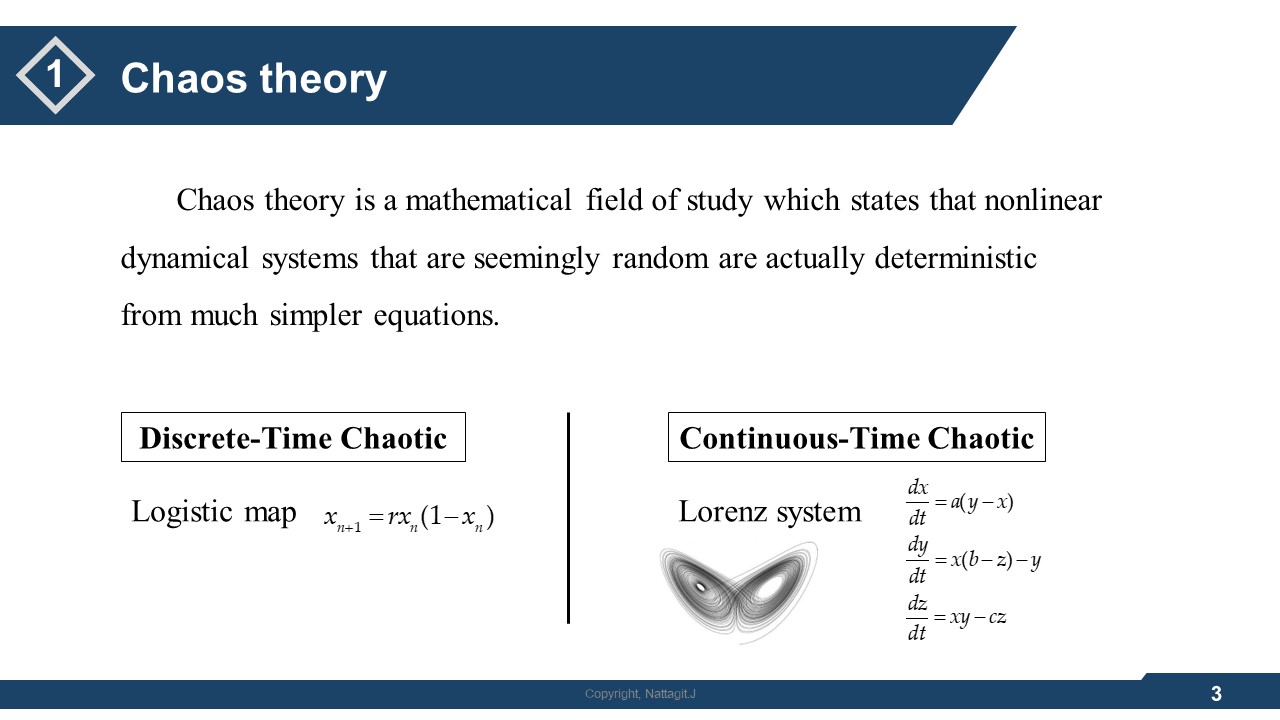 |
Chaos theory is a mathematical field of study which states that nonlinear dynamical systems that are seemingly random are actually deterministic from much simpler equations.
|
| ICACT20240396 Slide.04
[Big Slide]
|
Chrome Click!! |
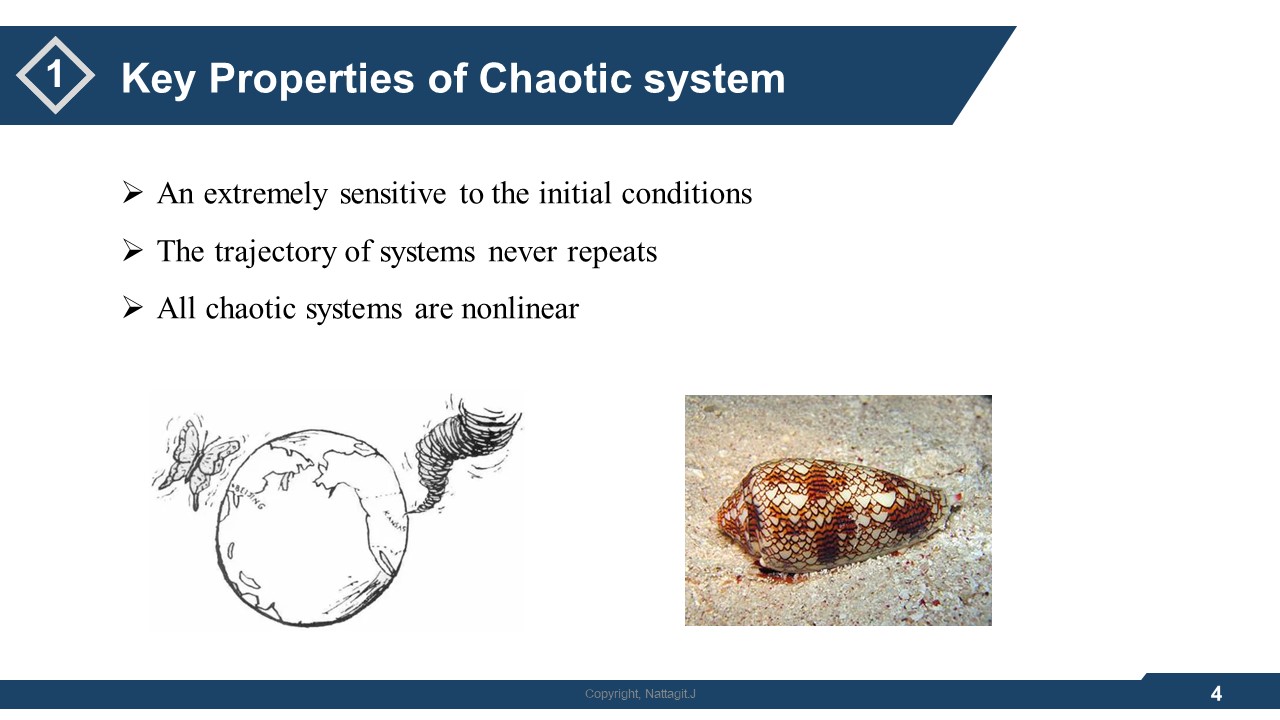 |
There are 3 main Key Properties of the Chaotic system. First the extremely sensitive to the initial conditions, second is the trajectory of systems that never repeats and lastly, all chaotic systems are nonlinear.
|
| ICACT20240396 Slide.05
[Big Slide]
|
Chrome Click!! |
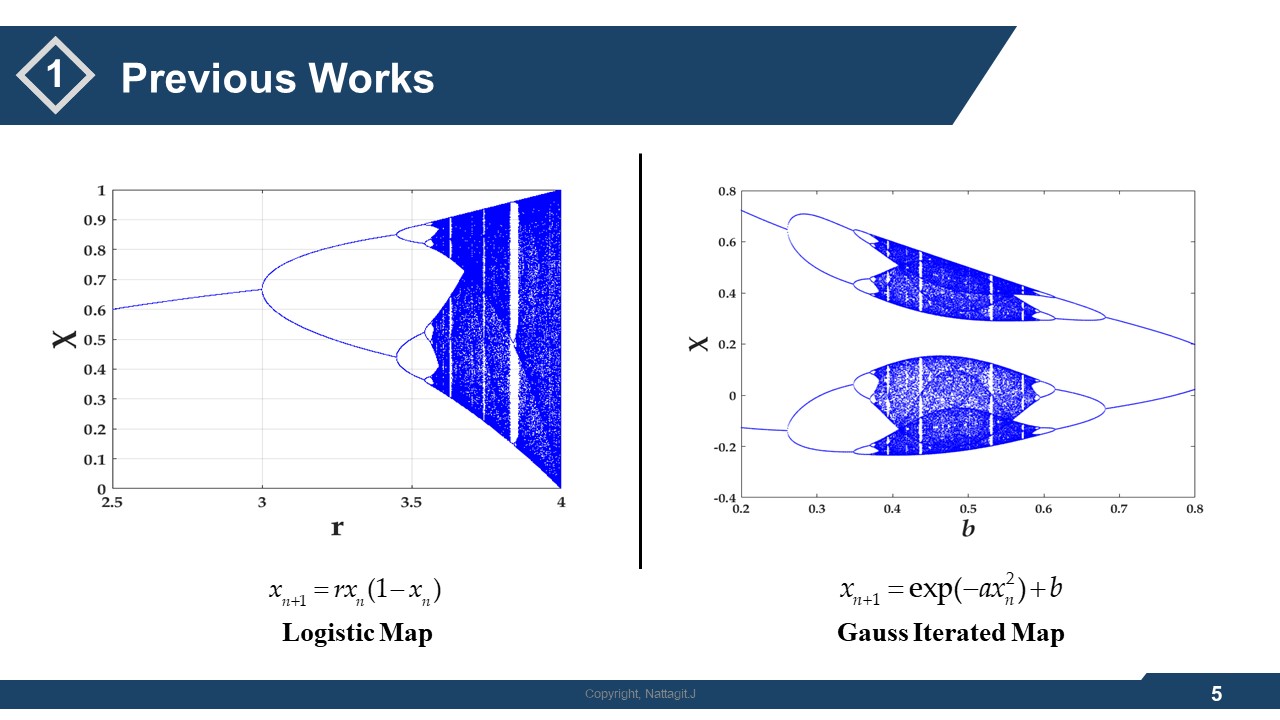 |
There are many chaotic maps proposed in the past especially the Discrete-Time chaotic map such as Logistic Map or Gauss Iterated Map.
|
| ICACT20240396 Slide.06
[Big Slide]
|
Chrome Click!! |
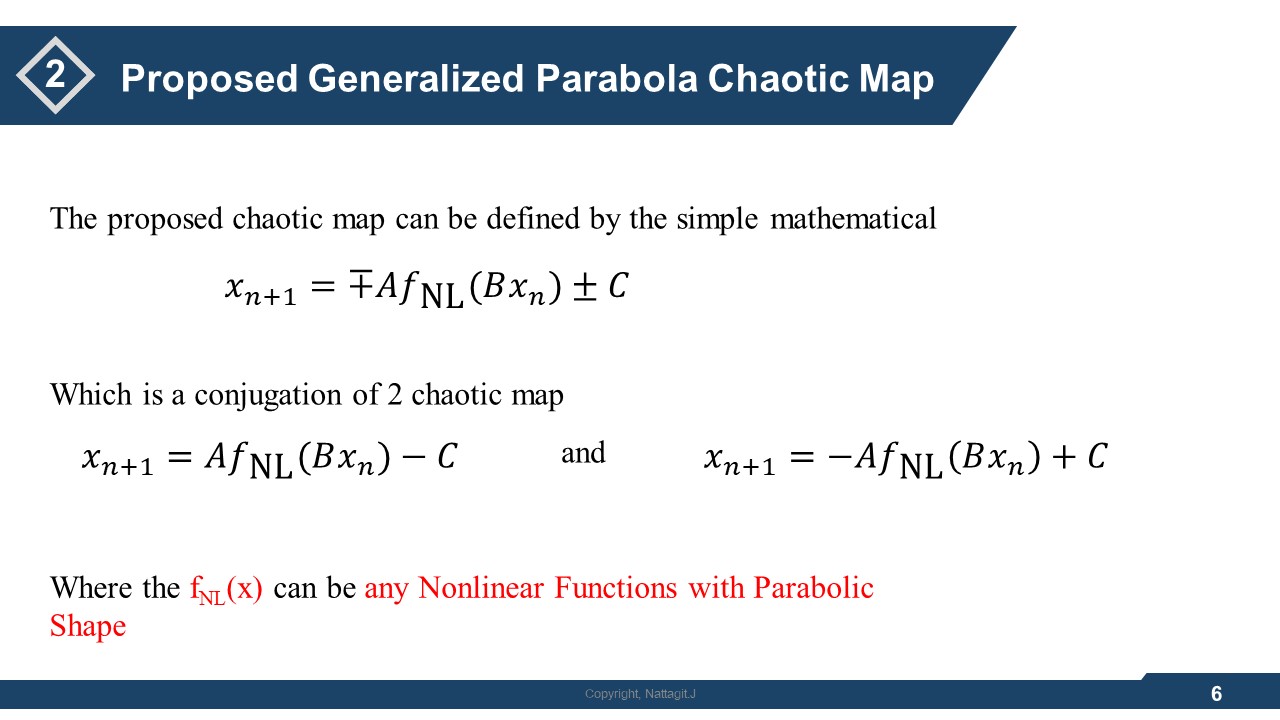 |
However, in my study, I have realized a new chaotic map. The proposed chaotic map can be defined by the simple mathematical Which is a conjugation of 2 chaotic map Where the fNL(x) can be any nonlinear function with a Parabolic Shape.
|
| ICACT20240396 Slide.07
[Big Slide]
|
Chrome Click!! |
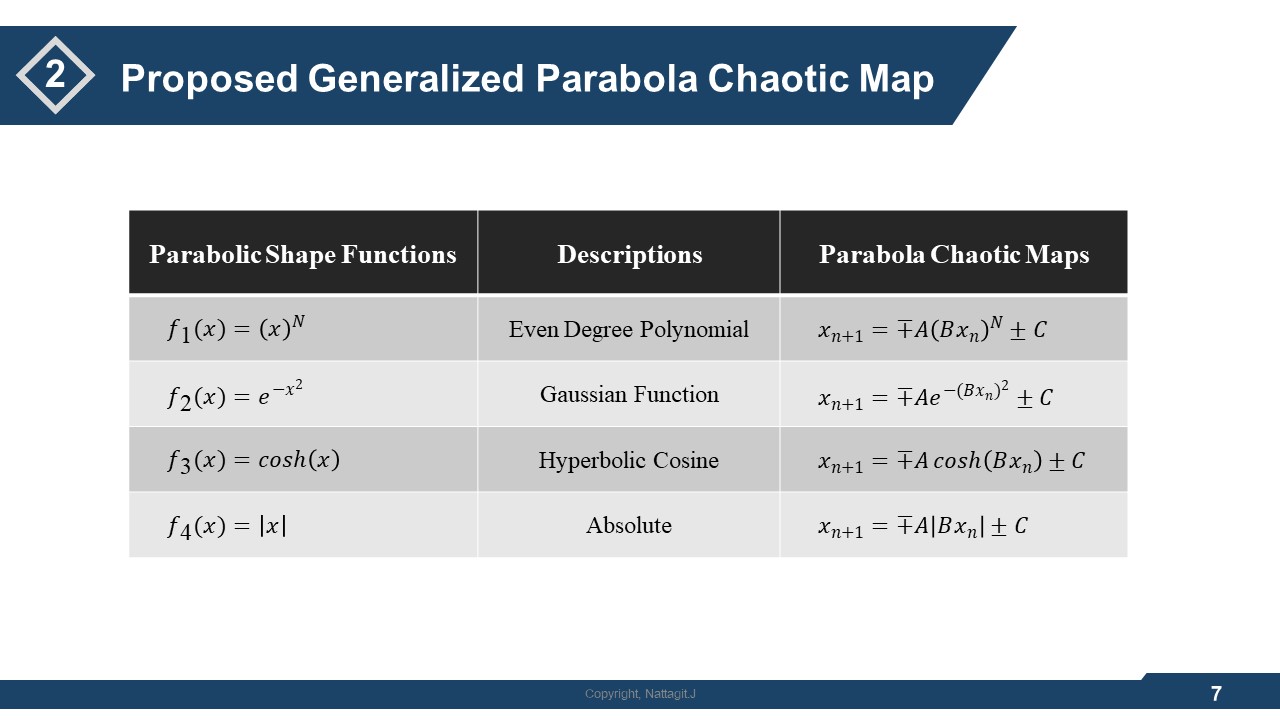 |
The summarization of the proposed chaotic map using various parabola functions is shown in the Table |
| ICACT20240396 Slide.08
[Big Slide]
|
Chrome Click!! |
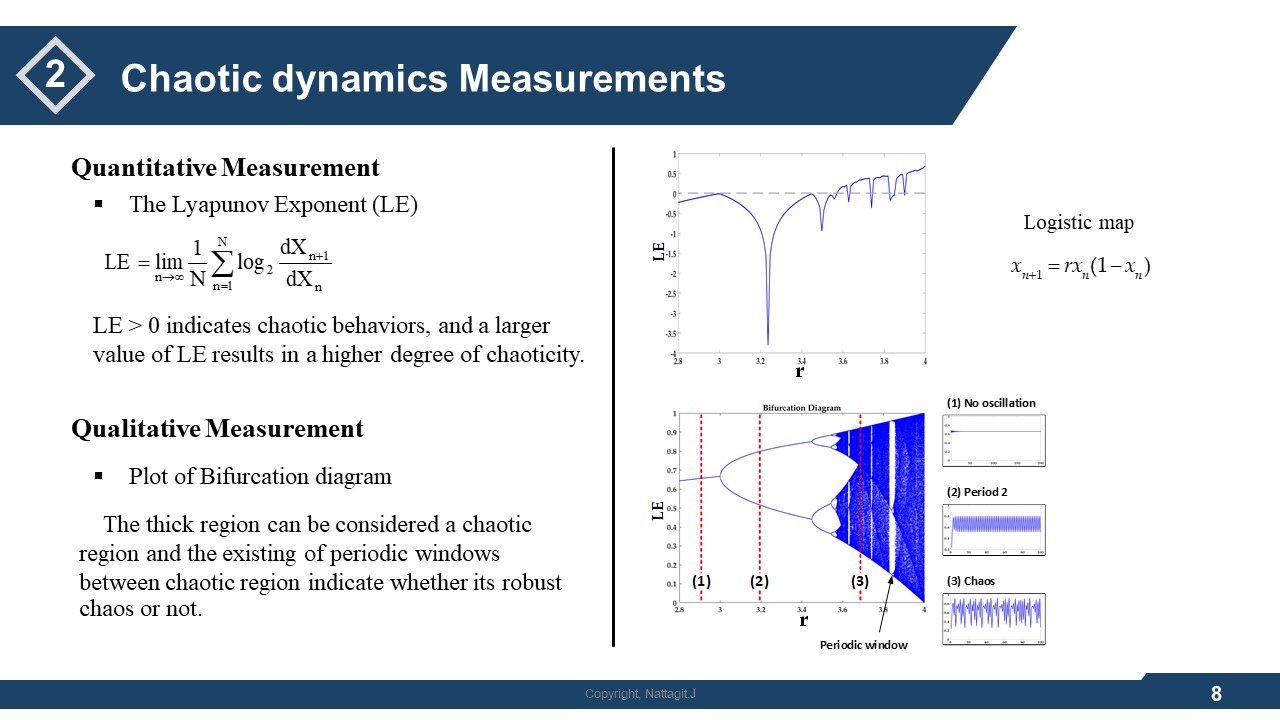 |
To exploration of chaotic behaviour both qualitatively and quantitatively, a bifurcation diagram and a Lyapunov Exponent (LE) can be used respectively. |
| ICACT20240396 Slide.09
[Big Slide]
|
Chrome Click!! |
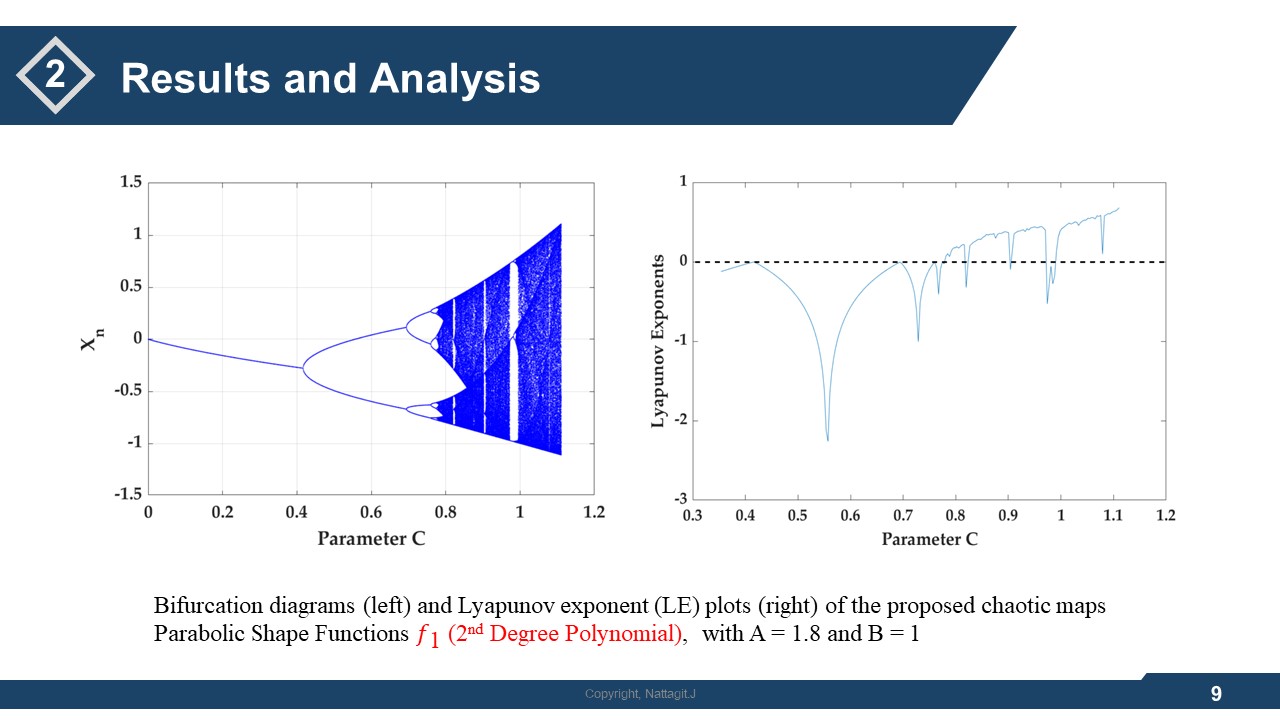 |
These are the Bifurcation diagrams and Lyapunov exponent (LE) plots of the proposed chaotic map that's based on the 2nd Degree Polynomial), where A = 1.8 and B = 1 |
| ICACT20240396 Slide.10
[Big Slide]
|
Chrome Click!! |
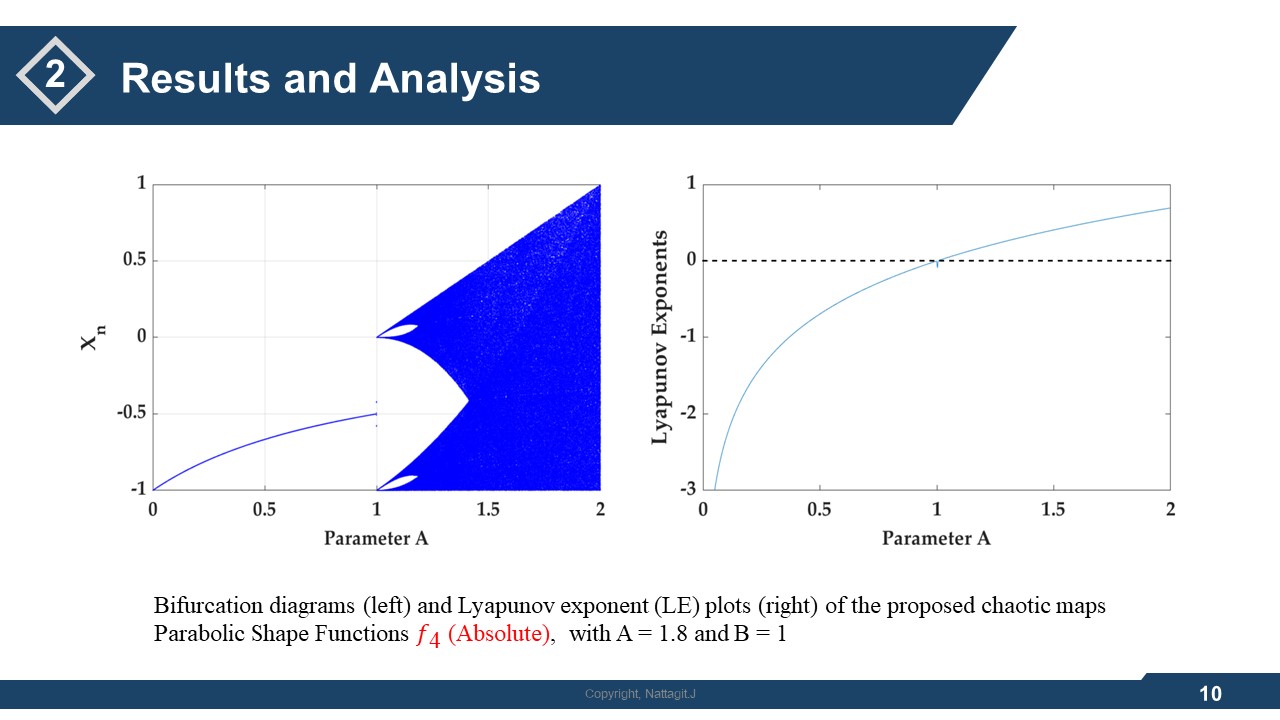 |
These are the Bifurcation diagrams and Lyapunov exponent (LE) plots of the proposed chaotic map that's based on the Absolute function, where A = 1.8 and B = 1. And we can see that with the Absolute function the proposed chaotic map can offer robust dynamics. |
| ICACT20240396 Slide.11
[Big Slide]
|
Chrome Click!! |
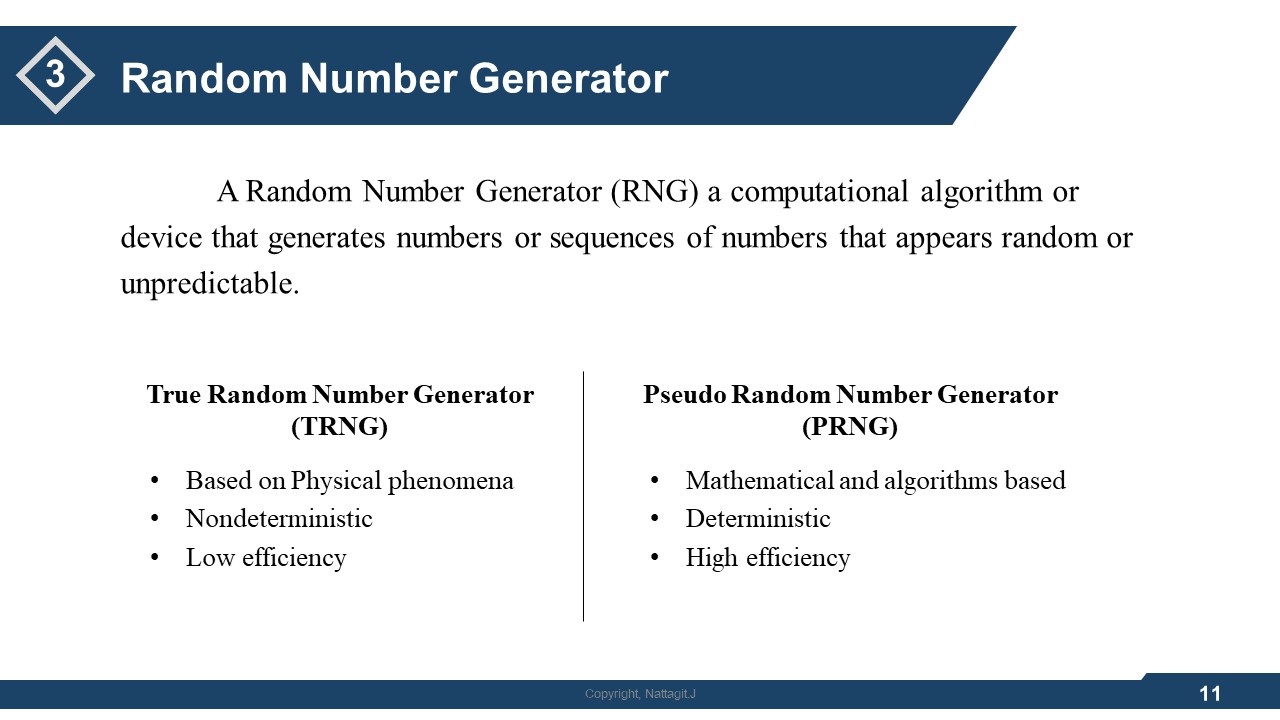 |
As a practical example, a PRNG based on the proposed Chaotic Map was also included in this work. A Random Number Generator (RNG) is a computational algorithm or device that generates numbers or sequences of numbers that appear random or unpredictable. |
| ICACT20240396 Slide.12
[Big Slide]
|
Chrome Click!! |
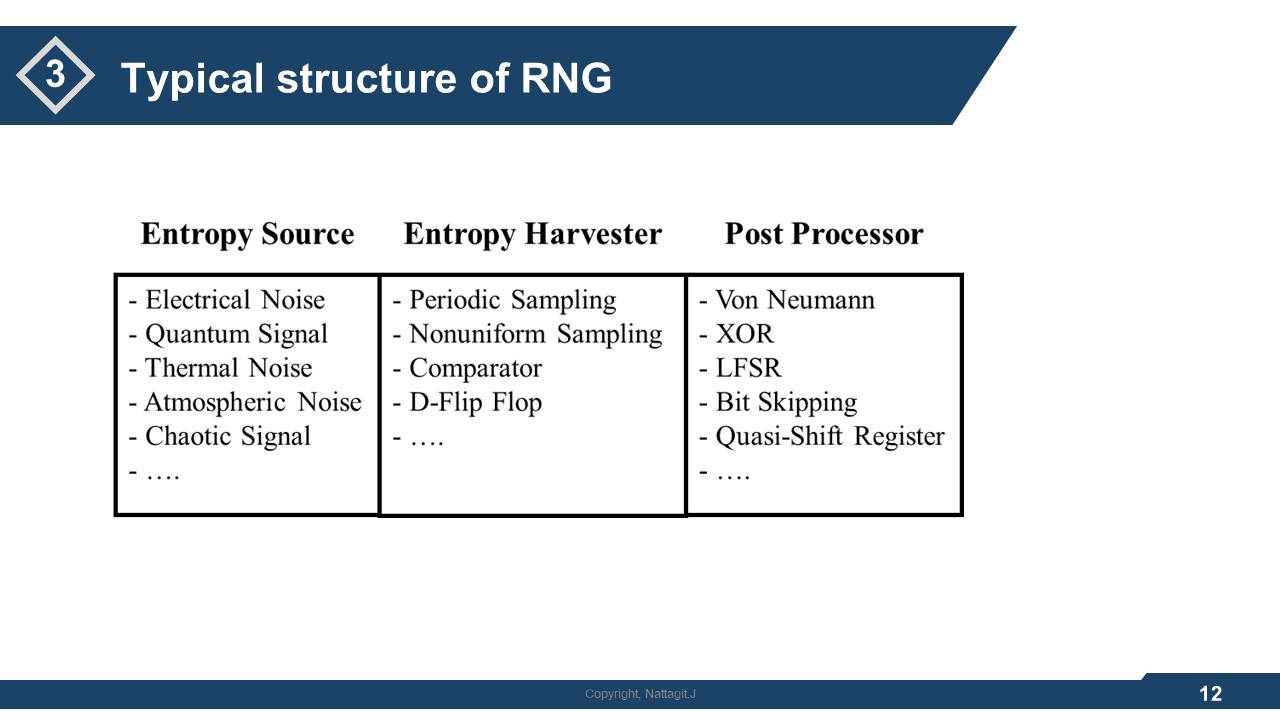 |
Typically any type of random number generator still shares a common structure which consists of several key components that work together as shown |
| ICACT20240396 Slide.13
[Big Slide]
|
Chrome Click!! |
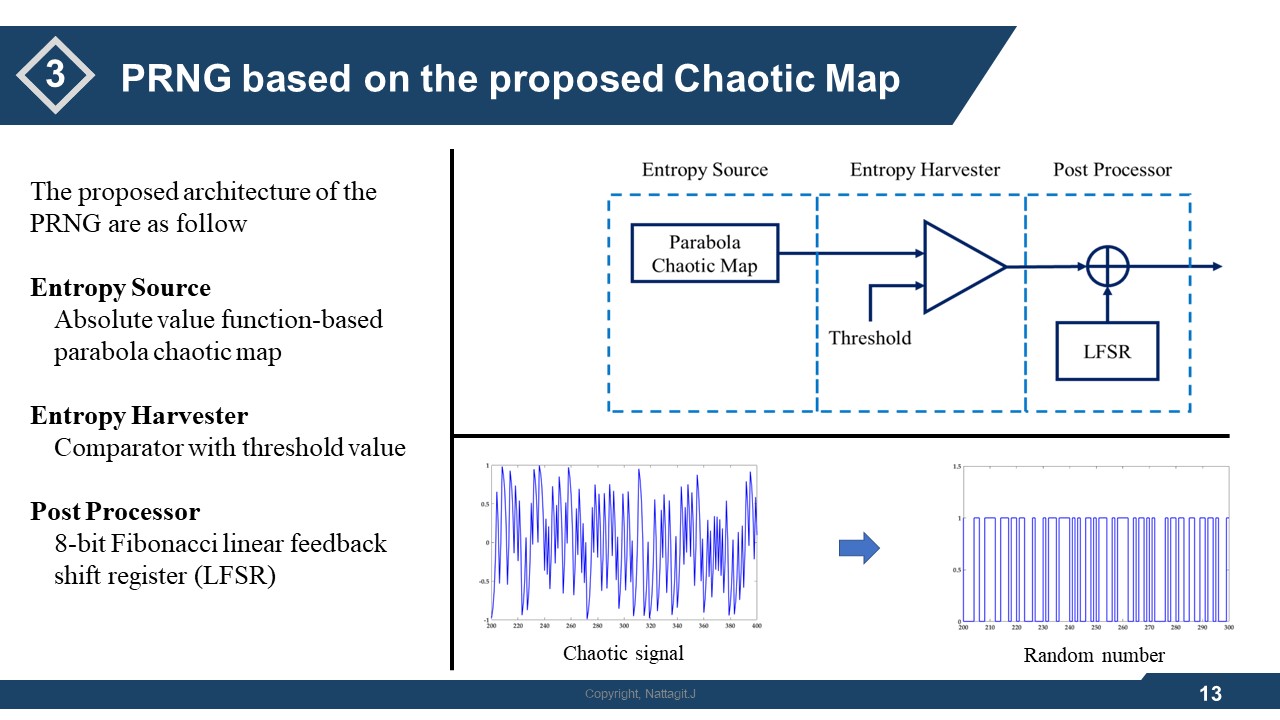 |
The proposed architecture of the PRNG was designed using the Absolute value function-based parabola chaotic map as an Entropy Source, while a Comparator with a threshold value was used as an Entropy Harvester, and lastly, an 8-bit Fibonacci linear feedback shift register (LFSR) was used as a Post Processor.
|
| ICACT20240396 Slide.14
[Big Slide]
|
Chrome Click!! |
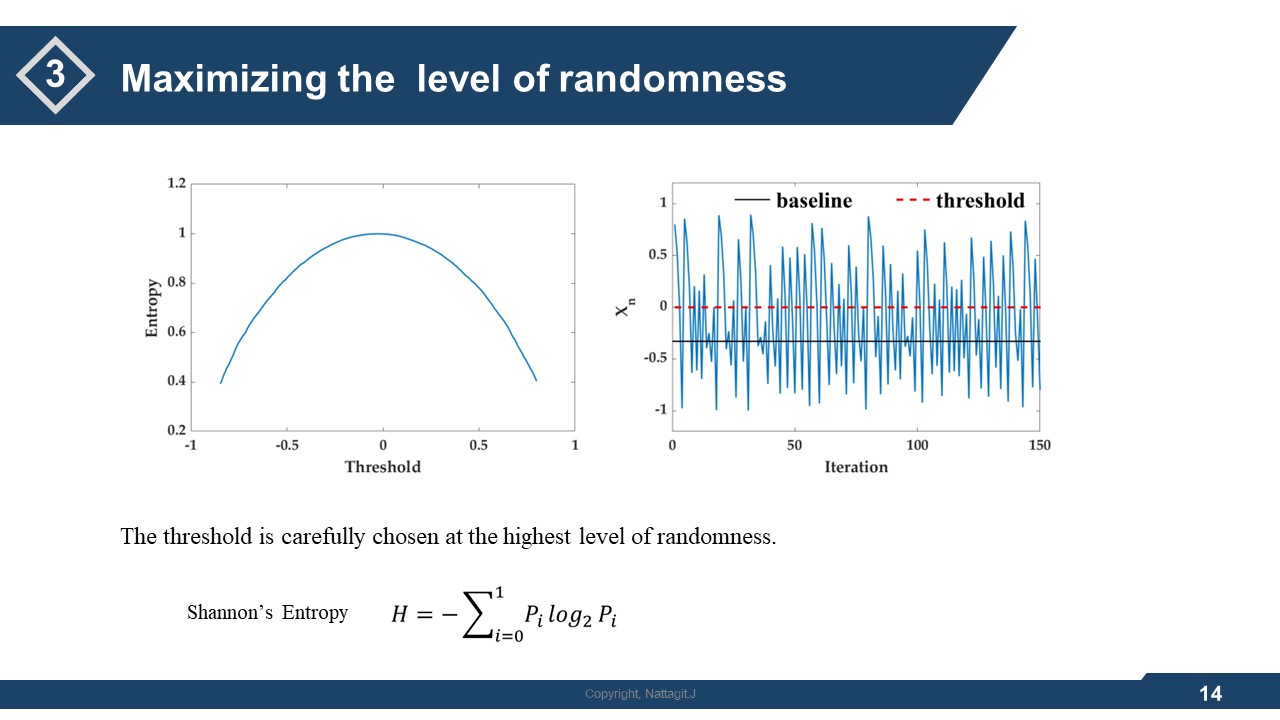 |
To Maximize the level of randomness, The threshold value of the Entropy Harvester is carefully chosen at the highest level of randomness which is calculated using Shannon¡¯s Entropy.
|
| ICACT20240396 Slide.15
[Big Slide]
|
Chrome Click!! |
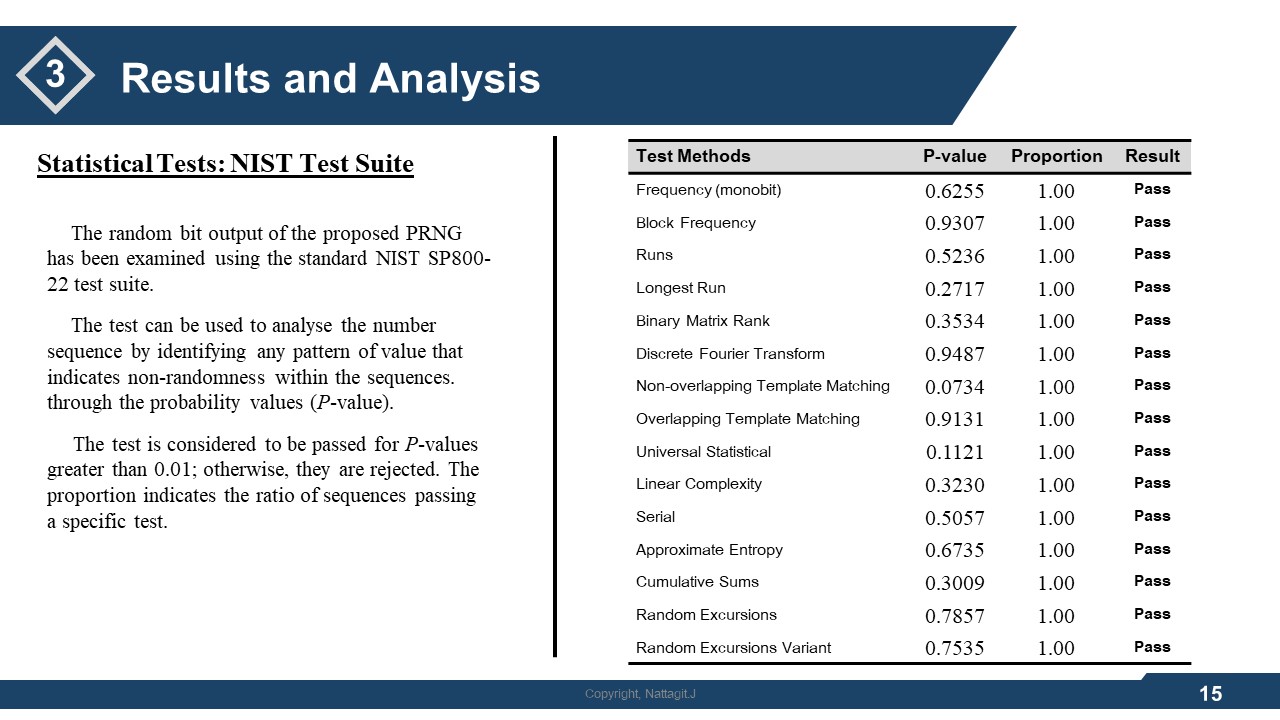 |
The random bit output of the proposed PRNG has been examined using the standard NIST SP800-22 test suite. The test can be used to analyse the number sequence by identifying any pattern of value that indicates non-randomness within the sequences. through the probability values (P-value). The test is considered to be passed for P-values greater than 0.01; otherwise, they are rejected. The proportion indicates the ratio of sequences passing a specific test.
|
| ICACT20240396 Slide.16
[Big Slide]
|
Chrome Click!! |
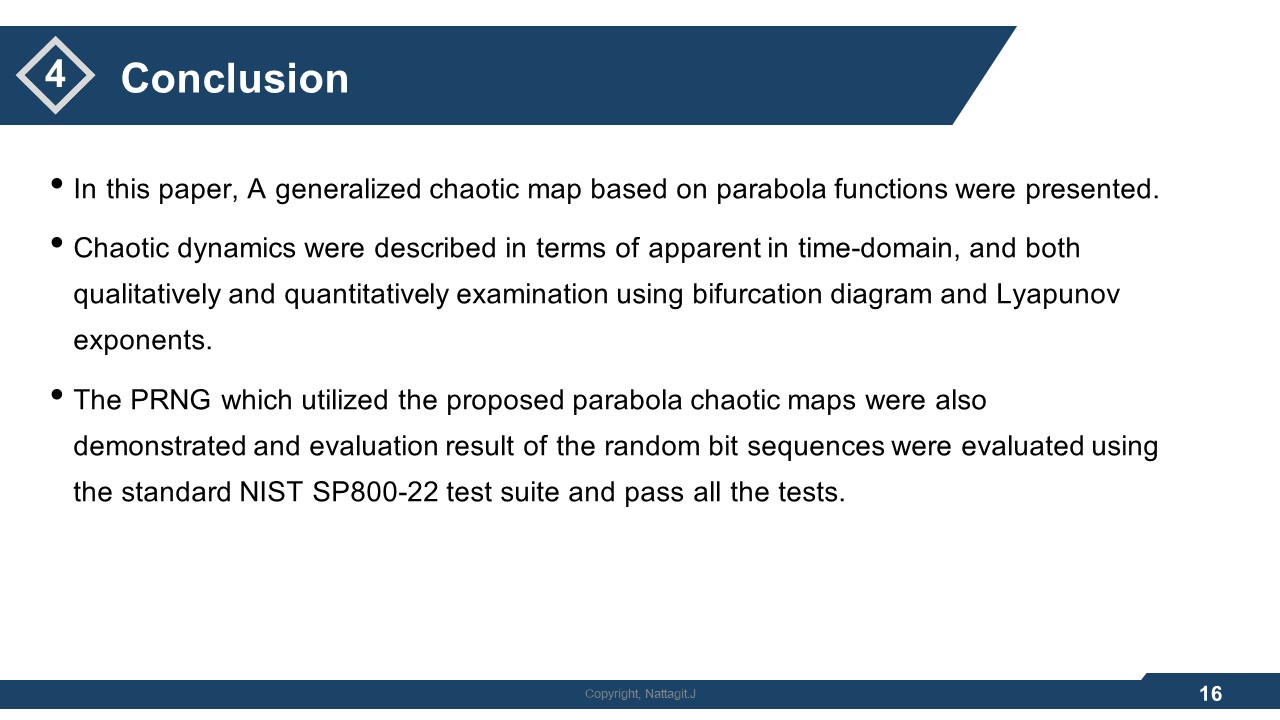 |
In this paper, A generalized chaotic map based on parabola functions were presented.
Chaotic dynamics were described in terms of apparent in time-domain, and both qualitatively and quantitatively examination using bifurcation diagram and Lyapunov exponents.
The PRNG which utilized the proposed parabola chaotic maps were also demonstrated and evaluation result of the random bit sequences were evaluated using the standard NIST SP800-22 test suite and pass all the tests.
|
| ICACT20240396 Slide.17
[Big Slide]
|
Chrome Click!! |
 |
Thank you very much for your attention. |















