 ICACT20250009 Slide.01
[Big Slide] |
Chrome  Click!! |
 |
Welcome to the presentation on AI-Enhanced Phishing Detection. This study leverages advanced transformer-based representations and Generative Adversarial Networks (GAN) to improve phishing detection and security. |
| ICACT20250009 Slide.02
[Big Slide]
|
Chrome Click!! |
 |
Today's presentation follows this structure: Why do we need phishing detection? What is our proposed idea? How does our system work? How well does it perform? |
| ICACT20250009 Slide.03
[Big Slide]
|
Chrome Click!! |
 |
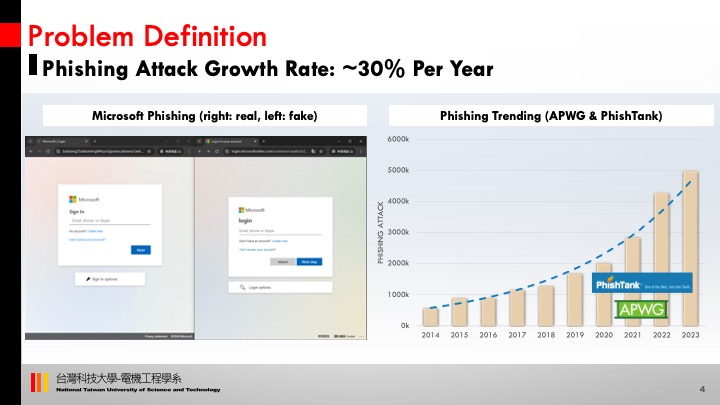
Phishing attacks are growing at an alarming rate of 30% per year. Data from APWG and PhishTank show a rising trend in phishing incidents. A comparison between real and fake Microsoft phishing emails illustrates the difficulty in distinguishing phishing attempts. |
| ICACT20250009 Slide.04
[Big Slide]
|
Chrome Click!! |
 |
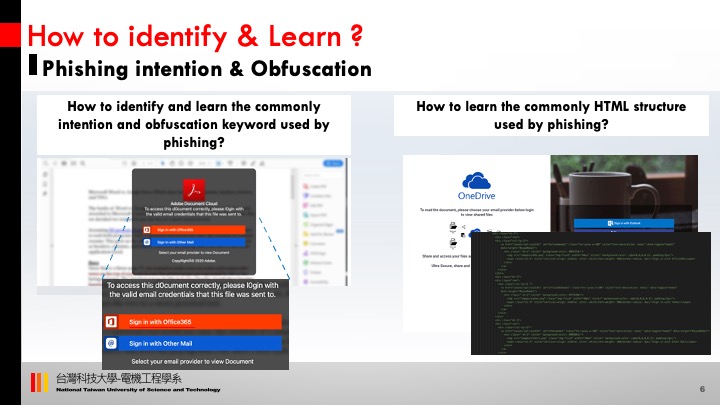
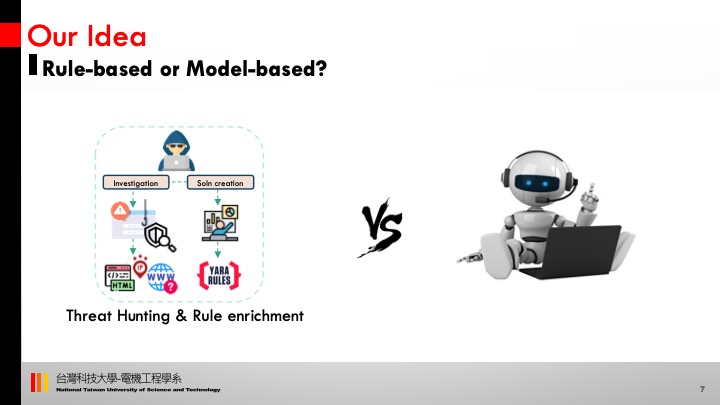
We focus on identifying phishing intent and obfuscation techniques. The key challenges include detecting commonly used phishing tactics, obfuscation keywords, and HTML structures. We explore whether a rule-based or AI-based model provides better accuracy. |
| ICACT20250009 Slide.05
[Big Slide]
|
Chrome Click!! |
 |
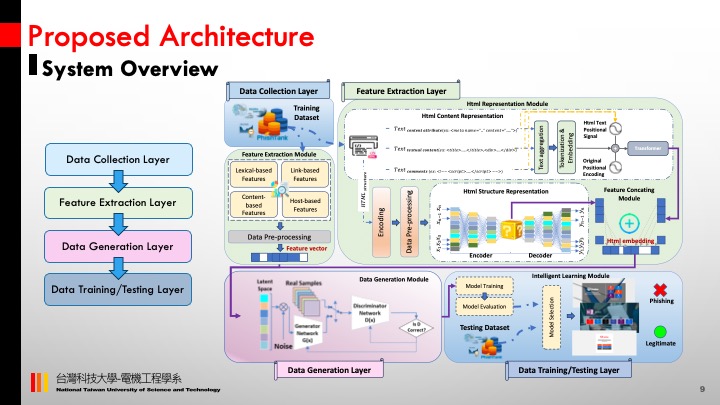
Our phishing detection system consists of four main layers:
Data Collection Layer – Collects phishing and legitimate data.
Feature Extraction Layer – Extracts relevant phishing-related attributes.
Data Generation Layer – Uses GANs to generate synthetic phishing data.
Training & Testing Layer – Utilizes transformer models for classification. |
| ICACT20250009 Slide.06
[Big Slide]
|
Chrome Click!! |
 |
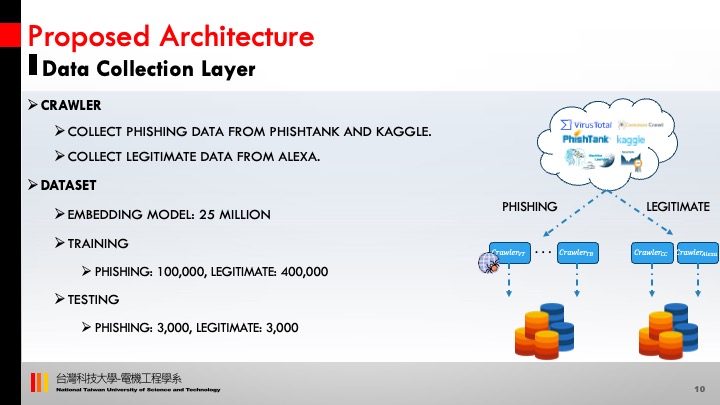
Phishing data is sourced from PhishTank and Kaggle, while legitimate data is collected from Alexa. The dataset consists of 100,000 phishing and 400,000 legitimate samples for training, with 3,000 phishing and 3,000 legitimate samples for testing. |
| ICACT20250009 Slide.07
[Big Slide]
|
Chrome Click!! |
 |
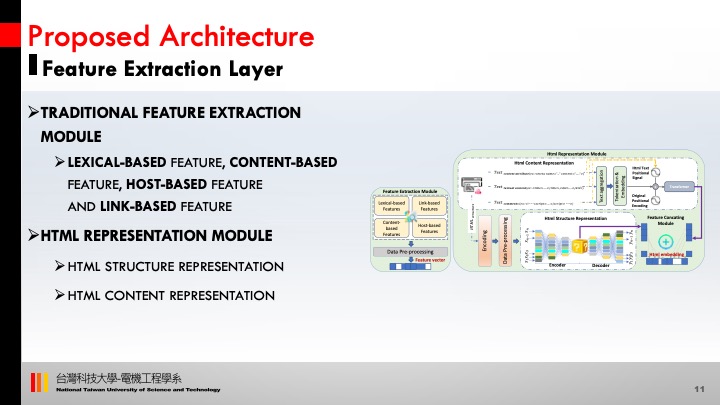
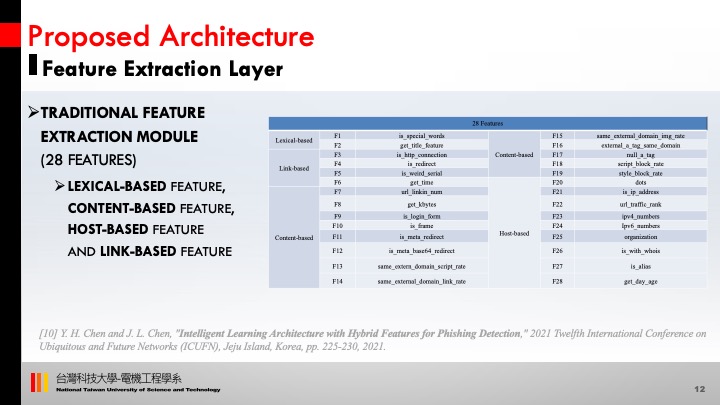
We extract 28 phishing-related features, categorized into lexical, content-based, host-based, and link-based features. These provide crucial insights into phishing behaviors. |
| ICACT20250009 Slide.08
[Big Slide]
|
Chrome Click!! |
 |
Our model represents HTML structures and content separately to analyze phishing attempts more effectively. This helps in identifying obfuscated elements within phishing emails or websites. |
| ICACT20250009 Slide.09
[Big Slide]
|
Chrome Click!! |
 |
We employ Depth-First Search (DFS) to analyze HTML tree structures. Phishing emails often use deceptive HTML elements that can be detected through this structural analysis. |
| ICACT20250009 Slide.10
[Big Slide]
|
Chrome Click!! |
 |
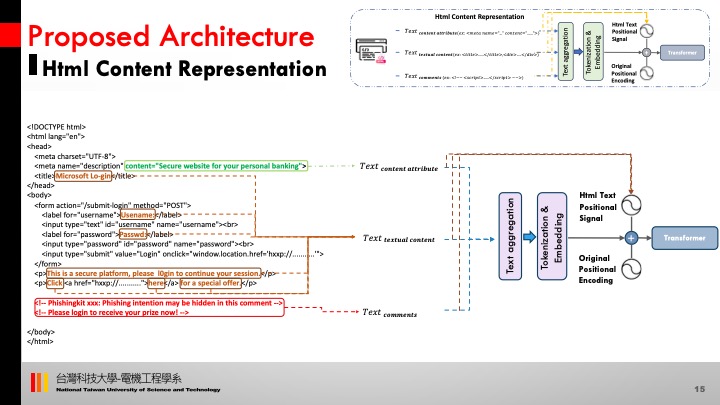
Beyond structure, we analyze HTML content. Our model identifies obfuscation techniques in phishing content and extracts hidden signals to improve detection accuracy. |
| ICACT20250009 Slide.11
[Big Slide]
|
Chrome Click!! |
 |
To improve detection performance, we use GANs to generate synthetic phishing samples, balancing the dataset and helping the model learn phishing patterns more effectively. |
| ICACT20250009 Slide.12
[Big Slide]
|
Chrome Click!! |
 |
We train our models on a dataset of 100K phishing and 400K legitimate samples. For testing, we use a balanced set of 3,000 phishing and 3,000 legitimate samples to evaluate accuracy. |
| ICACT20250009 Slide.13
[Big Slide]
|
Chrome Click!! |
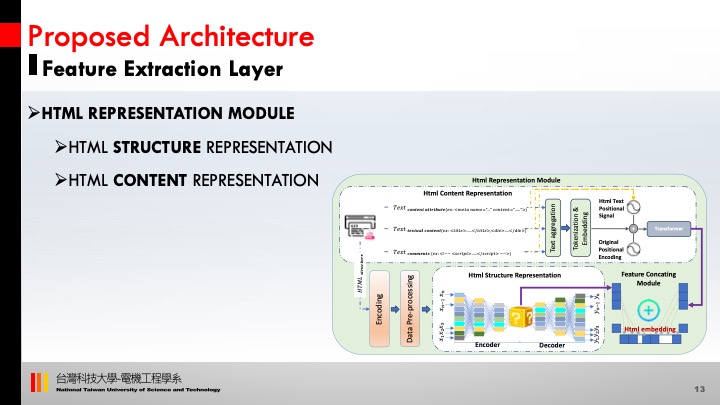 |
Our approach leverages advanced AI techniques, including XGBoost and transformer-based models. We compare different configurations to identify the most effective setup for phishing detection. |
| ICACT20250009 Slide.14
[Big Slide]
|
Chrome Click!! |
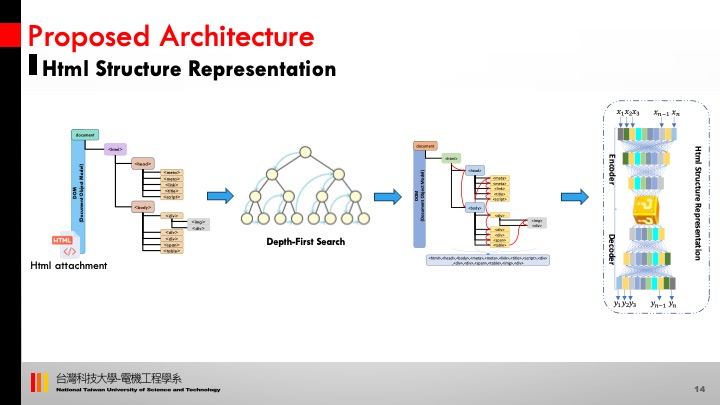 |
Our model improves phishing detection accuracy from 79.4% (baseline) to 85.6% by capturing textual and hidden signals in phishing content. |
| ICACT20250009 Slide.15
[Big Slide]
|
Chrome Click!! |
 |
Integrating GAN-generated synthetic data further boosts accuracy to 93.7%, outperforming traditional SMOTE-based oversampling techniques by 2.7%. |
| ICACT20250009 Slide.16
[Big Slide]
|
Chrome Click!! |
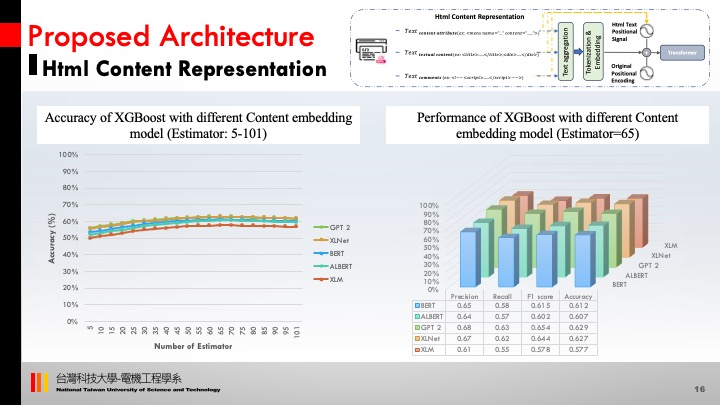 |
This slide presents the performance of XGBoost with various content embedding models. An optimal estimator setting is identified for improved phishing detection. |
| ICACT20250009 Slide.17
[Big Slide]
|
Chrome Click!! |
 |
We fine-tune XGBoost estimators, achieving the highest accuracy with 65 estimators. This optimization significantly enhances detection performance. |
| ICACT20250009 Slide.18
[Big Slide]
|
Chrome Click!! |
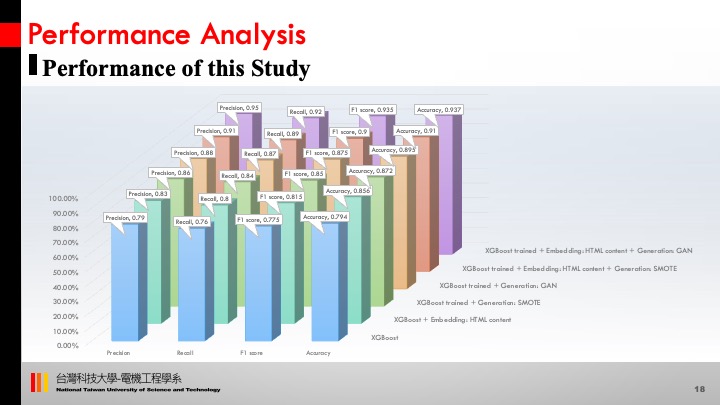 |
We evaluate our model using multiple metrics, including precision, recall, and F1-score, ensuring a comprehensive assessment of phishing detection effectiveness. |
| ICACT20250009 Slide.19
[Big Slide]
|
Chrome Click!! |
 |
Our transformer-based approach outperforms traditional rule-based and heuristic methods. The integration of GANs further enhances phishing detection capabilities. |
| ICACT20250009 Slide.20
[Big Slide]
|
Chrome Click!! |
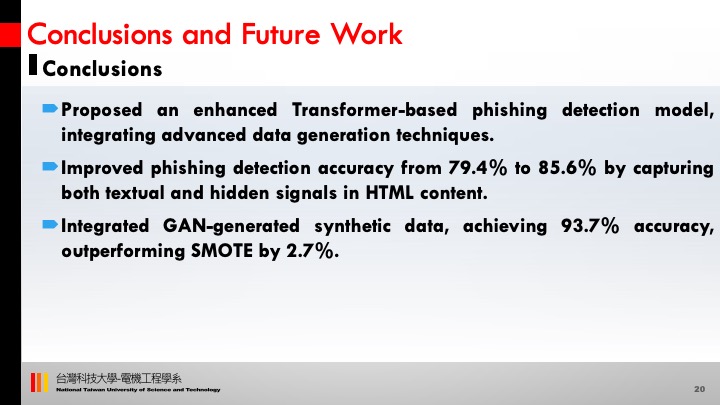 |
We proposed an advanced transformer-based phishing detection system, integrating GANs to improve detection accuracy significantly. This approach effectively captures both textual and structural phishing signals. |
| ICACT20250009 Slide.21
[Big Slide]
|
Chrome Click!! |
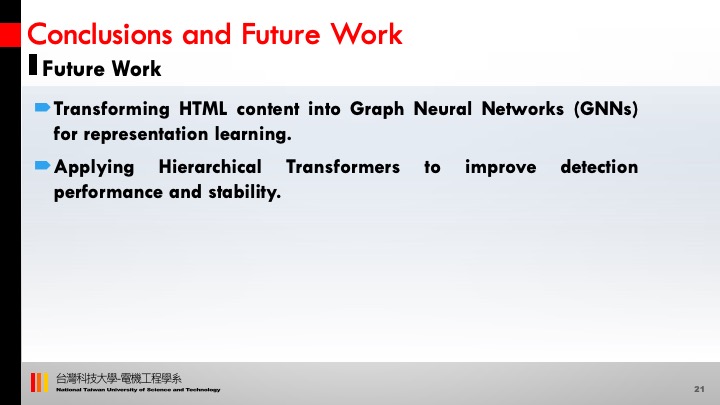 |
Future enhancements include transforming HTML content into Graph Neural Networks (GNNs) for better learning and applying Hierarchical Transformers to further improve detection performance and stability. |
| ICACT20250009 Slide.22
[Big Slide]
|
Chrome Click!! |
 |
Thank you for your attention. Any questions? |















