Now 608 visitors
Today:0 Yesterday:0
Total: 124214
212S 50P 5R
2026-10-20, Week 43 |
| Member Login |
| TACT Journal Homepage |
| Call for Paper |
| Committee |
| Find My Paper |
| Author Homepage |
| Statistics & History |
| Welcome Message |
| Paper Procedure |
| FAQ |
| Paper Archives |
| Outstanding Papers |
| Author Homepage |
| - Paper Procedure |
| - Journal Procedure |
| - Presentation Tips |
|
| Program & Proceedings |
| Program with Papers |
| Plenary Session |
| Tutorial Session |
|
| Presentation Platform |
| Hotel & Travel Info |
| About Korea |
| Accommodation |
| Transportation |
| VISA |
| Other Infomation |
|
| Photo Gallery |
| Scheduler Login |
| Seminar |
| Archives Login |
|
| Sponsors |

|

|

|

|

|

|

|

|

|

|
|
|
|
|
 ICACT20250011 Slide.01
[Big Slide]
[YouTube] |
Chrome  Click!! |
 |
Hello everyone, my name is Chen Haomin form University of Science and Technology of China, I will share my research results to you. |
| ICACT20250011 Slide.02
[Big Slide]
[YouTube] |
Chrome Click!! |
 |
I will introduce my work form these aspects:Introduction to Graph States,Graph State Distribution Method,Graph State Segmentation Method,Experimental Setup and Results,Conclusions
|
| ICACT20250011 Slide.03
[Big Slide]
[YouTube] |
Chrome Click!! |
 |
The first part is Introduction to Quantum Graph States
|
| ICACT20250011 Slide.04
[Big Slide]
[YouTube] |
Chrome Click!! |
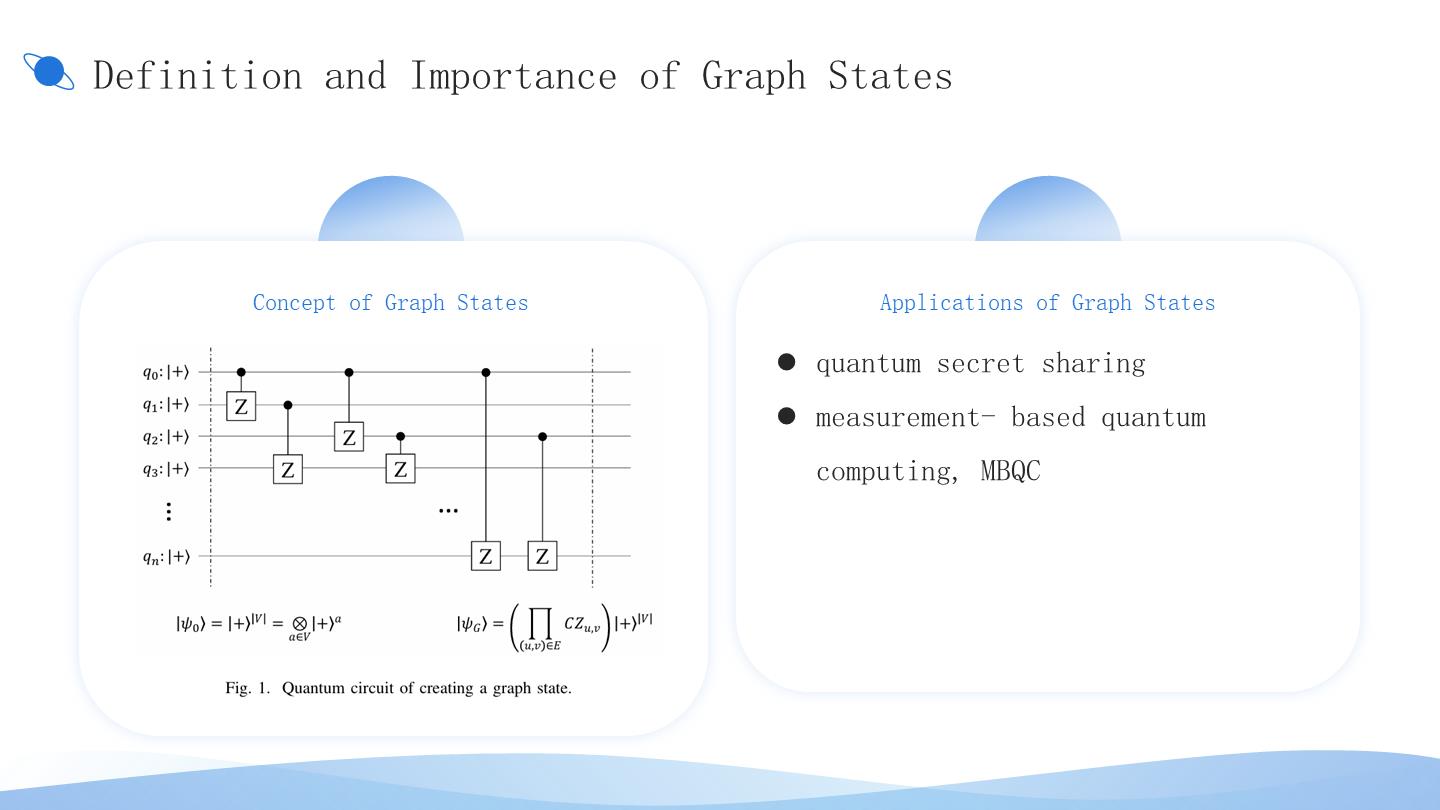 |
Graph states are a special class of multi- particle entangled quantum states represented by a graph to illustrate entanglement relationships among qubits. Both GHZ states and cluster states are types of graph states. These states are crucial in quantum secret sharing, measurement- based quantum computing, and quantum metrology, making them a significant quantum resource.
For example, to create a n- qubit graph state, we need to create n states of |+⟩ and perform controlled Z gate operations on all pairs of vertices belonging to E in graph G.
Graph states enable unique functionalities in quantum networks, such as quantum secret sharing, which allows secure distribution of information among multiple parties. They also play a vital role in measurement- based quantum computing, providing a platform for performing complex computations using entangled states.
For instance, Adrian Keet et al. proposed using graph states for quantum secret sharing, and Massimiliano Proietti et al. introduced an MBQC algorithm to solve the maximum K- cut problem using graph states.
|
| ICACT20250011 Slide.05
[Big Slide]
[YouTube] |
Chrome Click!! |
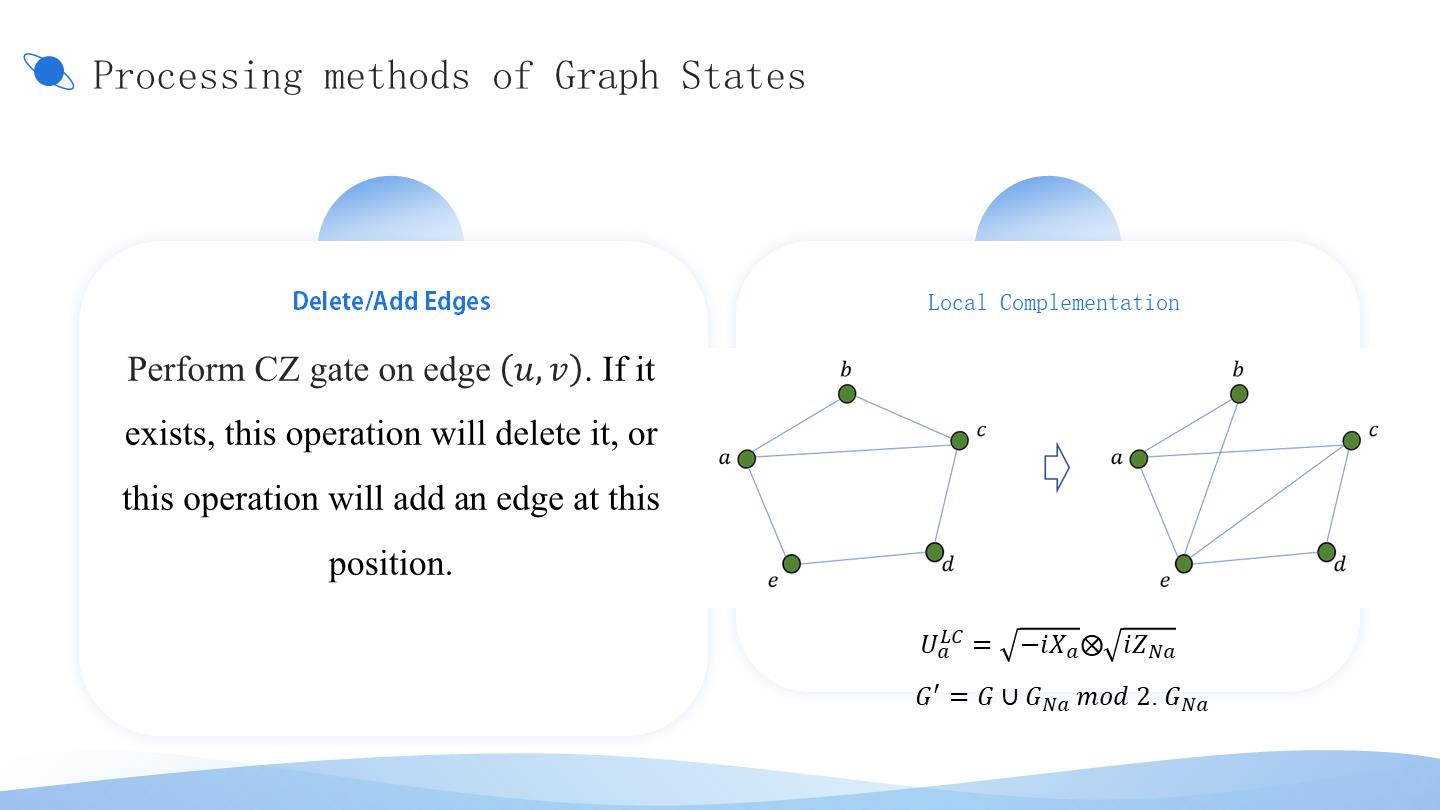 |
Perform CZ gate on edge (𝑢,𝑣). If it exists, this operation will delete it, or this operation will add an edge at this position.
perform an operator 𝑈_𝑎^𝐿𝐶=√(−𝑖𝑋_𝑎 )⨂√(𝑖𝑍_𝑁𝑎 ) to a vertex 𝑎∈𝑉, we can get the structure of graph states 𝐺^′=𝐺∪𝐺_𝑁𝑎 𝑚𝑜𝑑 2. 𝐺_𝑁𝑎, the complete graph of the neighbouring vertices of vertex 𝑎. Above means original graph 𝐺 is superimposed with 𝐺_𝑁𝑎, if there are overlapping edges, they are deleted; if not overlapping, they are retained.
|
| ICACT20250011 Slide.06
[Big Slide]
[YouTube] |
Chrome Click!! |
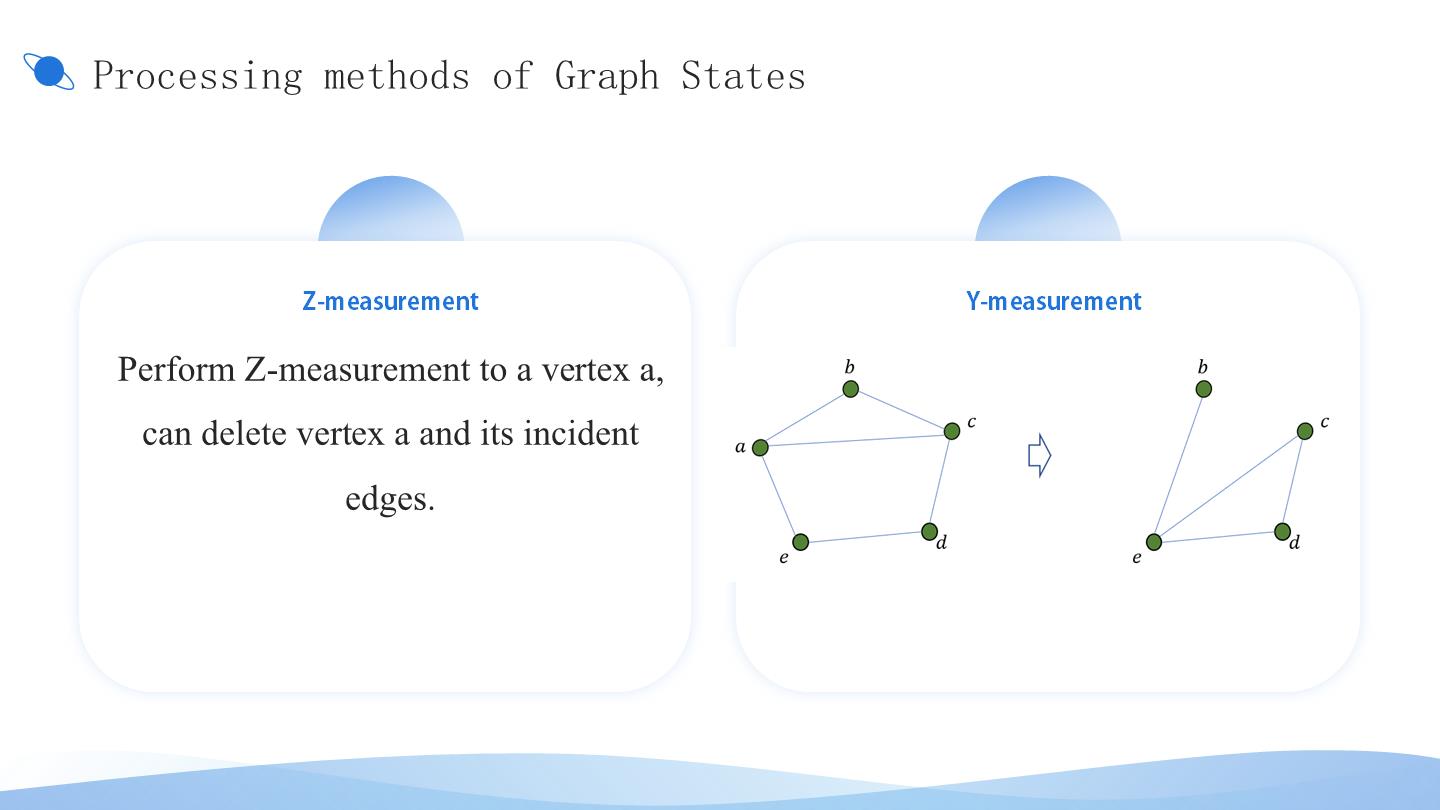 |
Perform Z-measurement to a vertex a, can delete vertex a and its incident edges.
perform Y-measurement to a vertex 𝑎, is equivalent to perform Local Complementation to vertex 𝑎, and then perform Z-measurement to vertex a.
|
| ICACT20250011 Slide.07
[Big Slide]
[YouTube] |
Chrome Click!! |
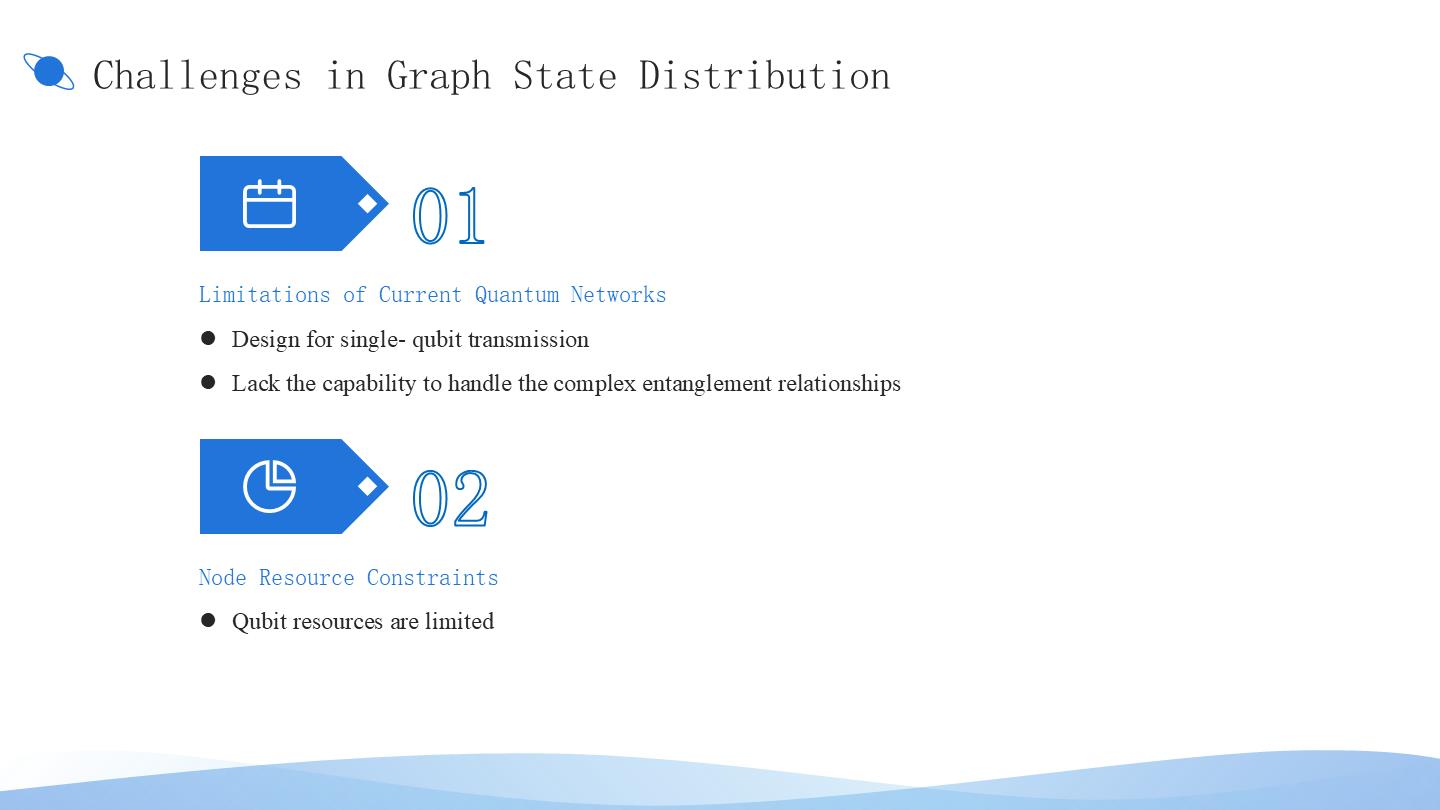 |
Existing quantum communication networks, designed primarily for single- qubit transmission, face challenges in effectively distributing graph states. These networks lack the capability to handle the complex entanglement relationships required for graph states.
For example, methods proposed by M. Cuquet et al. and Clément Meignant et al. assume unlimited node qubit resources, which is not practical in real- world quantum communication network environments.
In practical quantum communication networks, nodes have limited quantum resources. Distributing a complete graph state in one go can impose significant resource pressure on individual nodes, making it difficult to meet distribution requests.
For instance, a node preparing a large graph state copy may not have enough quantum bits to also hold the entangled pairs required for quantum teleportation, leading to resource constraints.
|
| ICACT20250011 Slide.08
[Big Slide]
[YouTube] |
Chrome Click!! |
 |
The second part is Graph State Distribution Method
|
| ICACT20250011 Slide.09
[Big Slide]
[YouTube] |
Chrome Click!! |
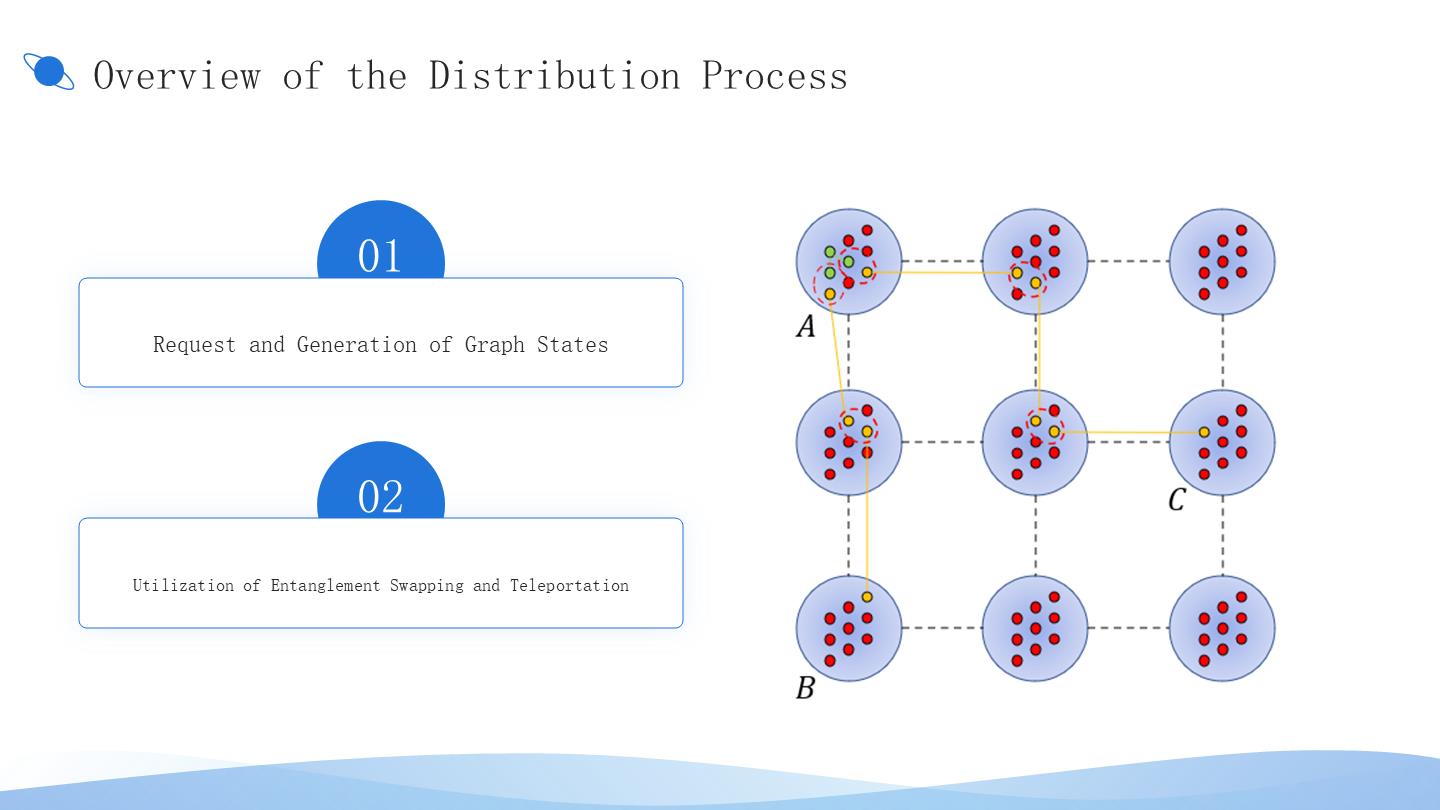 |
For a graph state distribution task, a request is sent with the required graph structure G and the vertices of graph G corresponding to the locations in the quantum communication network. The system then generates and distributes the corresponding graph state based on the request.
For example, to distribute a GHZ state over nodes A, B, and C, a copy is created on node A, and entangled pairs are shared between (A, C) and (A, B) using entanglement swapping technology.
By using entanglement swapping, entangled pairs can be shared over long distances. Quantum teleportation is then utilized to send the qubits of the graph state to the corresponding nodes, enabling the distribution of graph states across different nodes in the quantum network.
For example, after sharing entangled pairs between the nodes, quantum teleportation is performed at the graph state copy on node A to distribute the graph state to nodes B and C.
|
| ICACT20250011 Slide.10
[Big Slide]
[YouTube] |
Chrome Click!! |
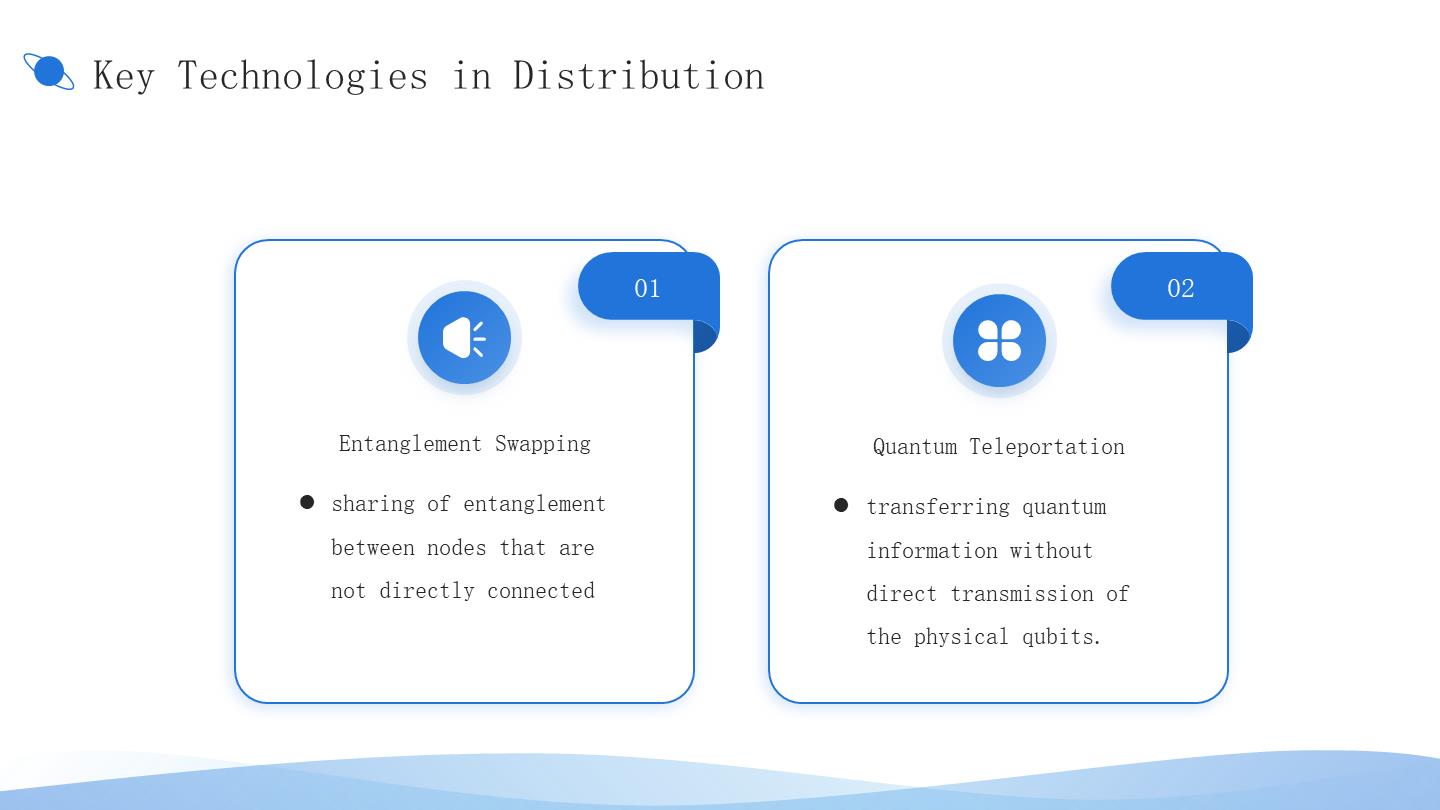 |
Entanglement swapping is crucial for extending the range of entangled pairs in the quantum network. It allows the sharing of entanglement between nodes that are not directly connected, improving the efficiency of graph state distribution.
For example, in a network with multiple nodes, entanglement swapping can be performed at repeater nodes to share entanglement between distant nodes, facilitating the distribution of graph states over long distances.
Quantum teleportation is a key technique for transferring quantum information without direct transmission of the physical qubits. It enables the distribution of graph states by transmitting the quantum state of a qubit from one node to another.
For example, when distributing a graph state, the quantum state of a qubit at the source node can be teleported to the destination node, where the corresponding operations are performed to reconstruct the graph state.
|
| ICACT20250011 Slide.11
[Big Slide]
[YouTube] |
Chrome Click!! |
 |
The third part is Graph State Segmentation Method
|
| ICACT20250011 Slide.12
[Big Slide]
[YouTube] |
Chrome Click!! |
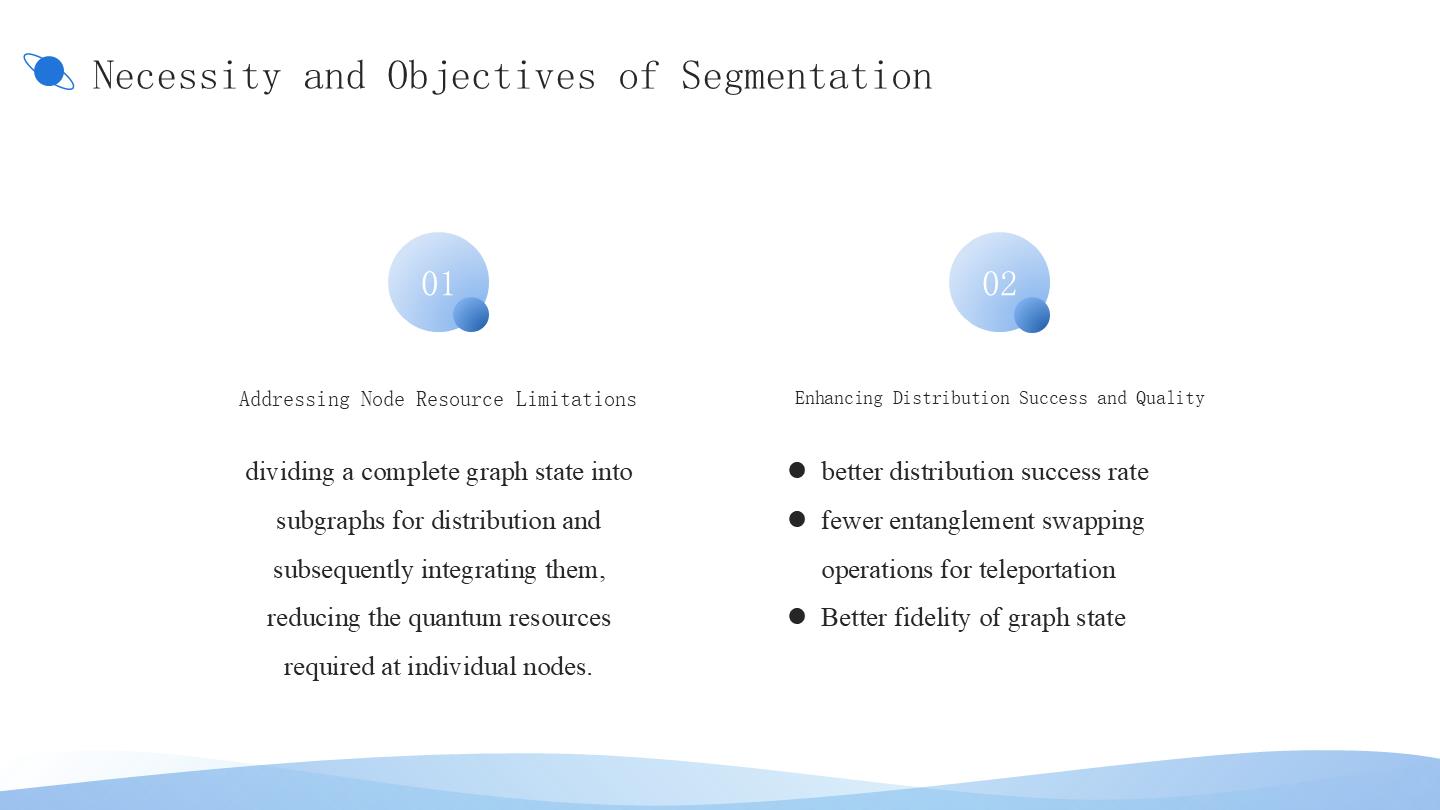 |
To overcome the limitations of node resources, a segmentation- integration method is adopted. This method involves dividing a complete graph state into subgraphs for distribution and subsequently integrating them, reducing the quantum resources required at individual nodes.
For example, by segmenting a large graph state into smaller subgraph states, each node can prepare and distribute these subgraph states more efficiently, even with limited quantum bit resources.
Segmenting larger graph states can achieve a better distribution success rate, even when the quantum bit resources at the nodes are limited. Smaller graph states require fewer entanglement swapping operations for teleportation, improving the fidelity of graph state distribution.
For example, after segmentation, the entangled pairs used for teleporting subgraph states can be prepared with fewer operations, reducing errors and improving the overall quality of the distributed graph states.
|
| ICACT20250011 Slide.13
[Big Slide]
[YouTube] |
Chrome Click!! |
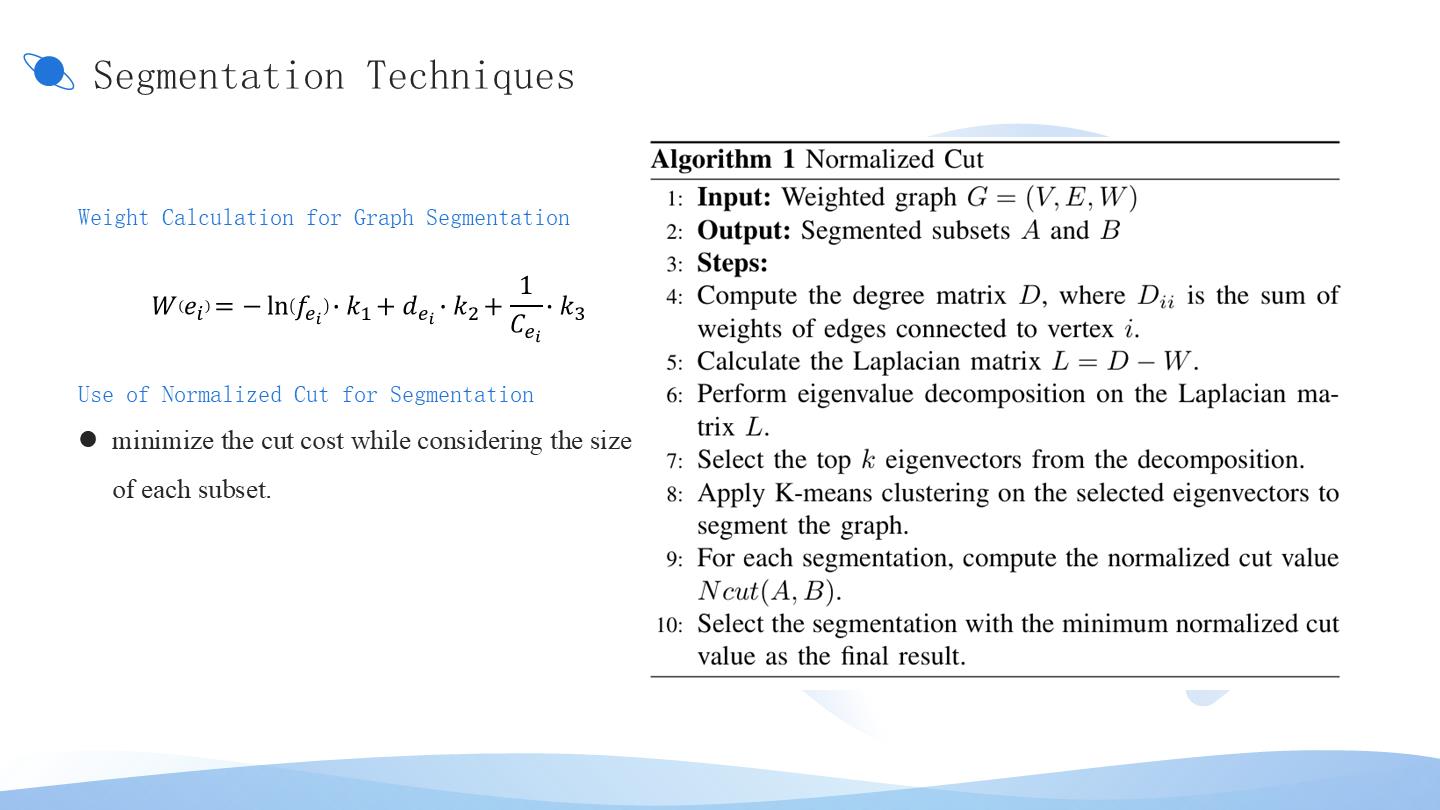 |
To segment a graph properly, weights are assigned to each edge ei ∈ E, considering factors such as available bandwidth, entanglement fidelity, and classical time delay. These weights help in determining the cost of distributing graph states through the network.
For example, the weight W(ei) is calculated using parameters like Cei (available bandwidth), fei (entanglement fidelity), and dei (classical time delay), providing a measure of the cost associated with each edge in the graph.
The Normalized Cut technique is used for graph segmentation, aiming to minimize the cut cost while considering the size of each subset. This technique involves calculating the degree matrix D, the weight matrix W, and the Laplacian matrix L, followed by eigenvalue decomposition and K- means clustering to segment the graph into different regions.
For example, after obtaining the segmentation, the maximum bit consumption per node, the estimated time required for distribution, and the expected number of quantum gates used are calculated to ensure that the nodes have sufficient resources and the operation time is within acceptable limits.
|
| ICACT20250011 Slide.14
[Big Slide]
[YouTube] |
Chrome Click!! |
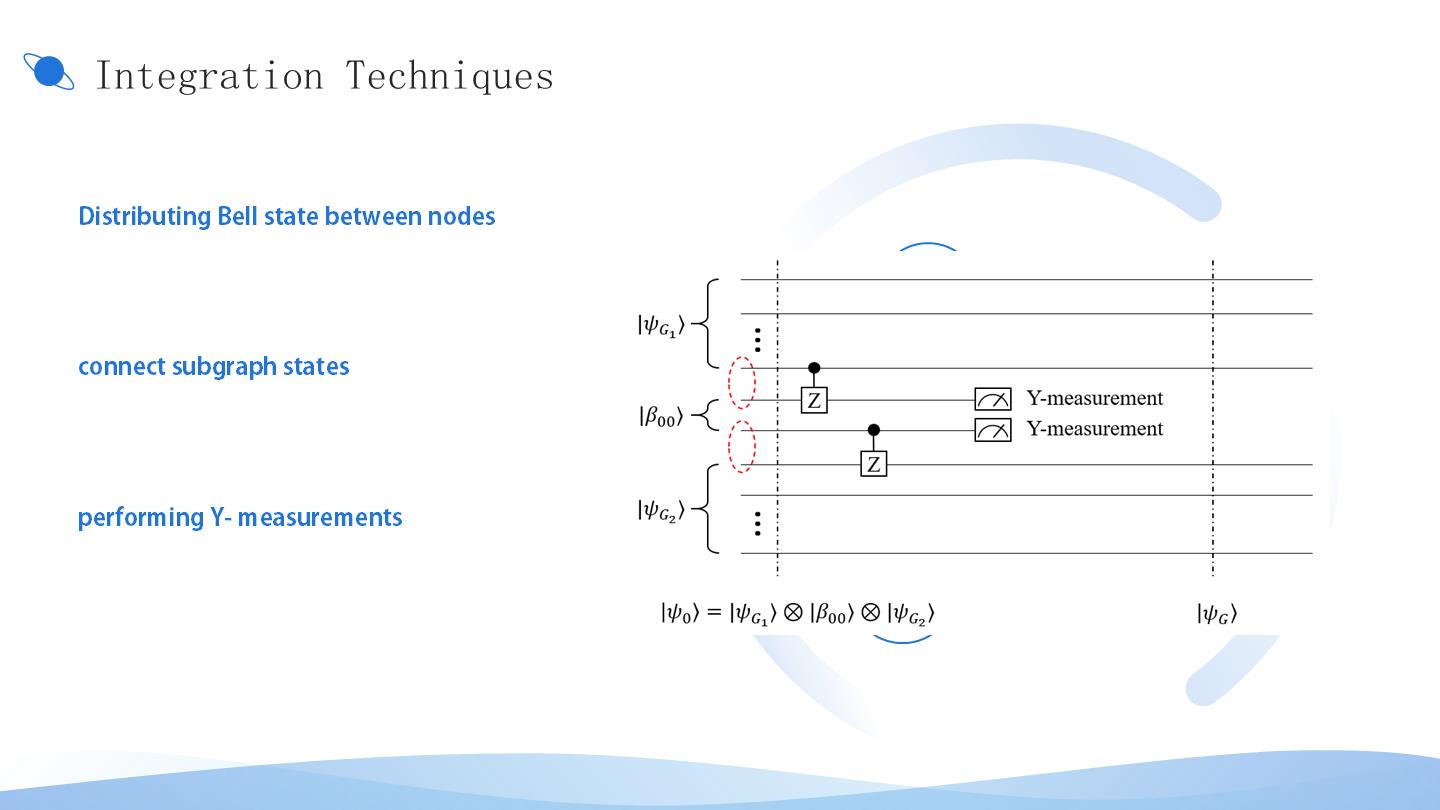 |
After distributing the subgraph states, graph state operations are performed to integrate these states into a complete graph state. This involves distributing Bell state entangled pairs between nodes, using CZ gates to connect subgraph states, and performing Y- measurements to integrate the subgraphs.
For example, to integrate two subgraph states, a pair of Bell state entangled pairs is distributed between the nodes, connected using CZ gates, and Y- measurements are performed on the qubits originally belonging to the entangled pairs, effectively connecting the subgraphs with an edge.
|
| ICACT20250011 Slide.15
[Big Slide]
[YouTube] |
Chrome Click!! |
 |
the 4th part is Experimental Setup and Results
|
| ICACT20250011 Slide.16
[Big Slide]
[YouTube] |
Chrome Click!! |
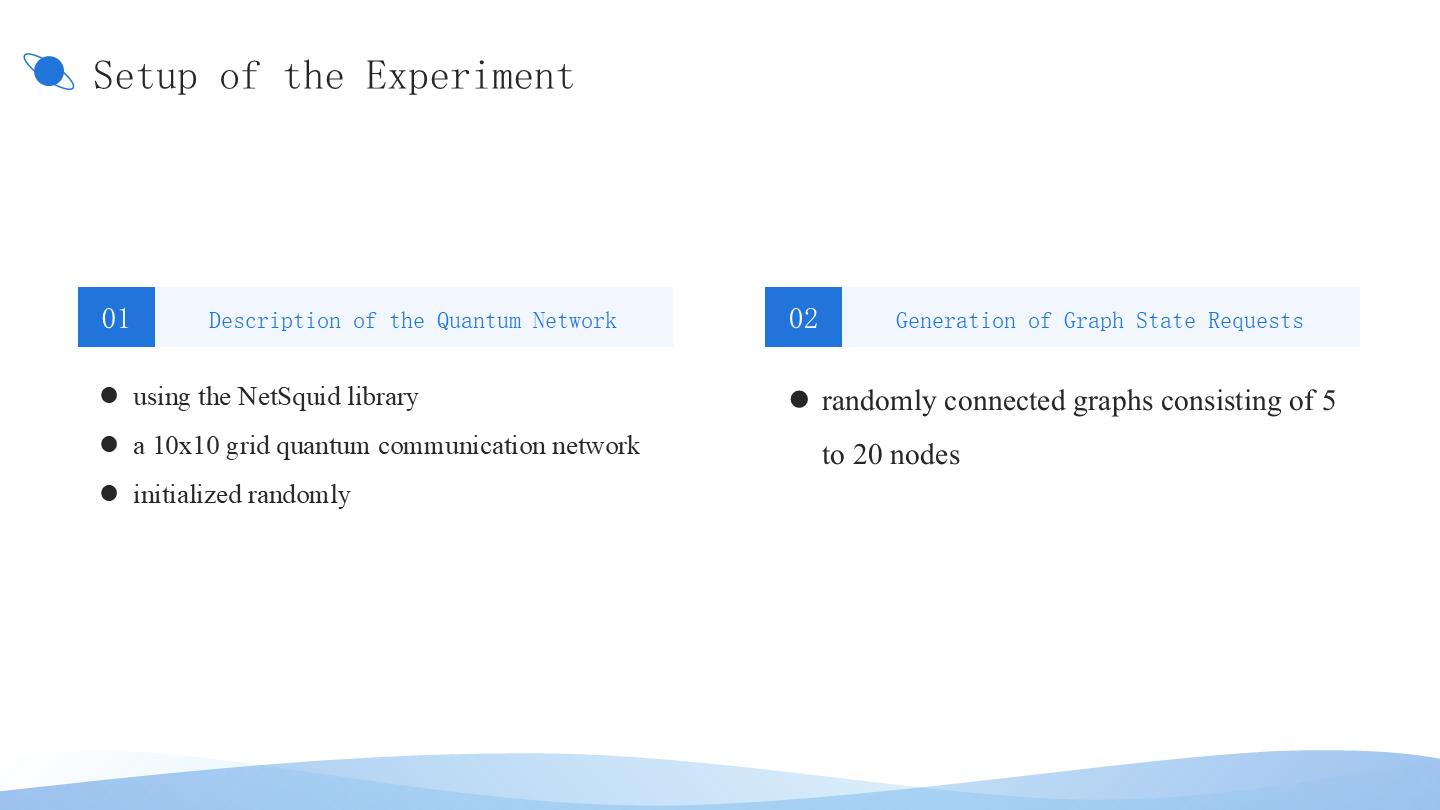 |
The experiment was conducted on a Python platform using the NetSquid library. The network is a 10x10 grid quantum communication network, with the number of qubits within each node and the parameters of quantum channels between nodes initialized randomly.
For example, the network topology is set up in a grid, allowing qubits within the nodes to be allocated to channels in any direction, with each qubit assigned to only one channel at any given time.
Randomly generated graph state requests are represented by randomly connected graphs consisting of 5 to 20 nodes. These requests are used to test the distribution and integration of graph states using the proposed segmentation method.
For example, a request for a graph state with a specific structure and size is generated, and the process of segmenting, distributing, and integrating the graph state is simulated in the quantum network.
|
| ICACT20250011 Slide.17
[Big Slide]
[YouTube] |
Chrome Click!! |
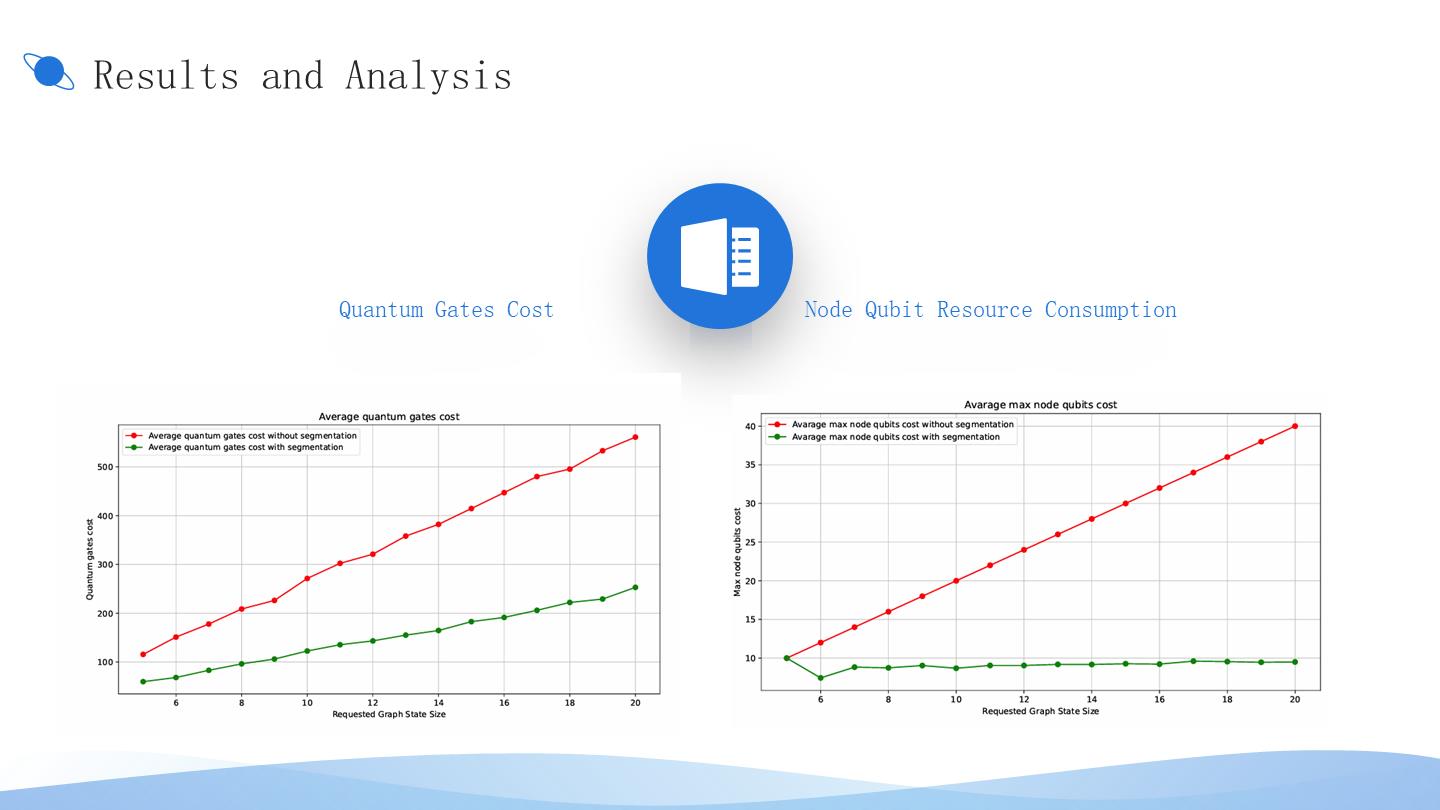 |
The number of quantum gates executed for directly preparing copies and using teleportation for graph state distribution, as well as for distributing and integrating graph states after segmentation, is calculated. The results show that the number of quantum gates used by the segmentation method is significantly lower than that of direct distribution.
For example, as the size of the requested graph state increases, the number of quantum gates executed also rises, but the segmentation method requires fewer gates, reducing losses and improving the fidelity of the graph states.
The maximum single- node qubit consumption is recorded in two scenarios: with and without segmentation. The results indicate that the segmentation method can control the qubit resource consumption at individual nodes, reducing the probability of congestion in practical quantum communication networks.
For example, by controlling the size of the subgraph states, the qubit resource consumption at individual nodes can be kept under control, even as the size of the requested graph state gradually increases, ensuring smooth operation of the network.
|
| ICACT20250011 Slide.18
[Big Slide]
[YouTube] |
Chrome Click!! |
 |
The final part is Conclusions |
| ICACT20250011 Slide.19
[Big Slide]
[YouTube] |
Chrome Click!! |
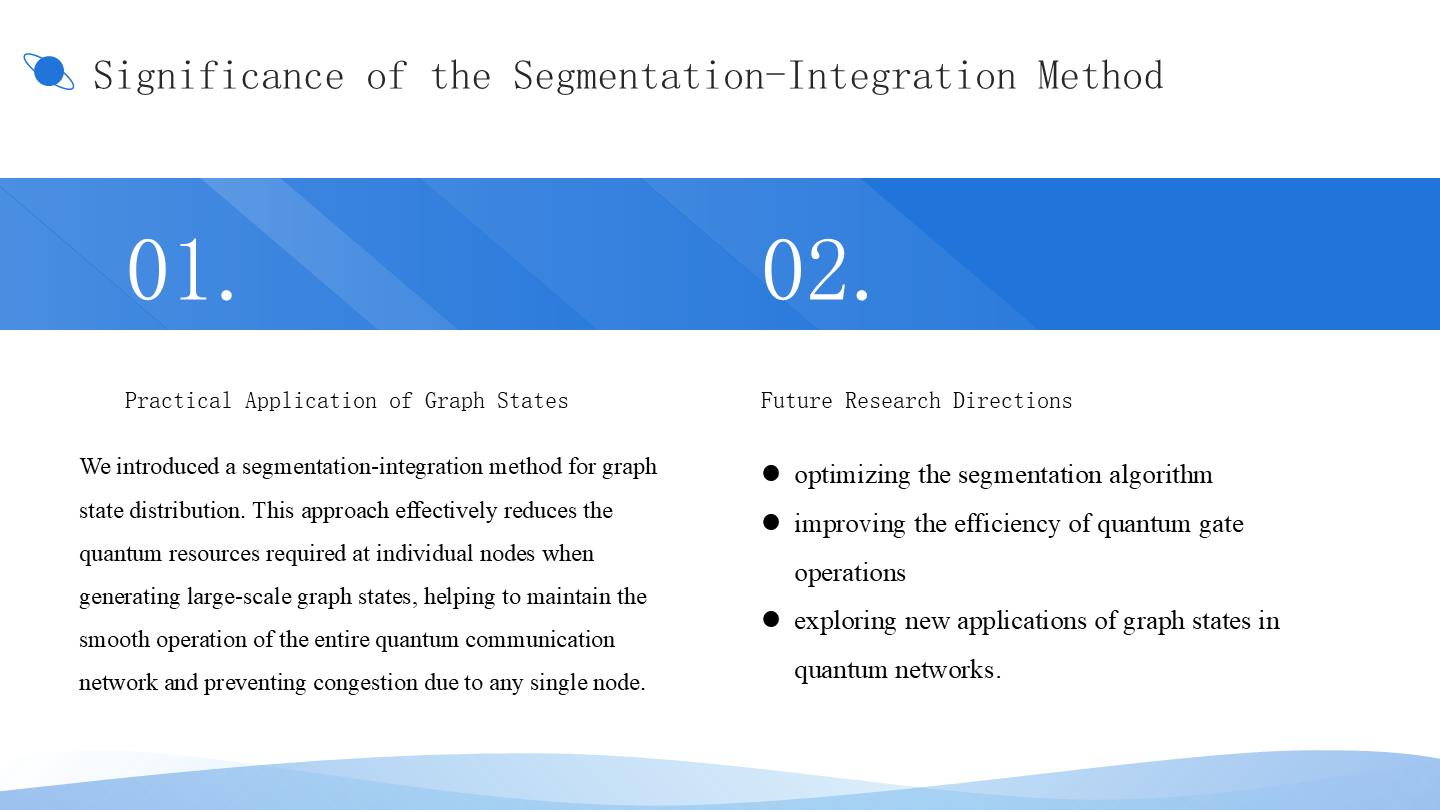 |
In existing graph state distribution methods, there is a lack of consideration for node resources. However, in practical quantum communication networks, the limited availability of quantum resources within nodes is one of the key factors that restrict communication efficiency. Therefore, proposing a graph state distribution method that takes into account the limited quantum resources of nodes is essential for the practical application of graph states. We introduce a segmentation-integration method for graph state distribution, which segments large-scale graph states into several subgraph states for separate preparation and distribution. Finally, by performing graph state-related operations on some nodes, the subgraph states are restored to the desired complete graph state. This approach effectively reduces the quantum resources required at individual nodes when generating large-scale graph states, helping to maintain the smooth operation of the entire quantum communication network and preventing congestion due to any single node.
Future research can focus on optimizing the segmentation algorithm, improving the efficiency of quantum gate operations, and exploring new applications of graph states in quantum networks.
For example, further studies can investigate the use of machine learning techniques to optimize the segmentation process or develop new quantum algorithms that leverage the properties of graph states for more efficient quantum computing and communication tasks.
|
| ICACT20250011 Slide.20
[Big Slide]
[YouTube] |
Chrome Click!! |
 |
Thanks for your listening and watching!
|
| |





