 ICACT20250026 Slide.01
[Big Slide] |
Chrome  Click!! |
 |
Hello. Today's presentation is about "Common Topic-Based Key Exchange Method for Encrypted Data Transmission in IoT Network."
|
| ICACT20250026 Slide.02
[Big Slide]
|
Chrome Click!! |
 |
|
| ICACT20250026 Slide.03
[Big Slide]
|
Chrome Click!! |
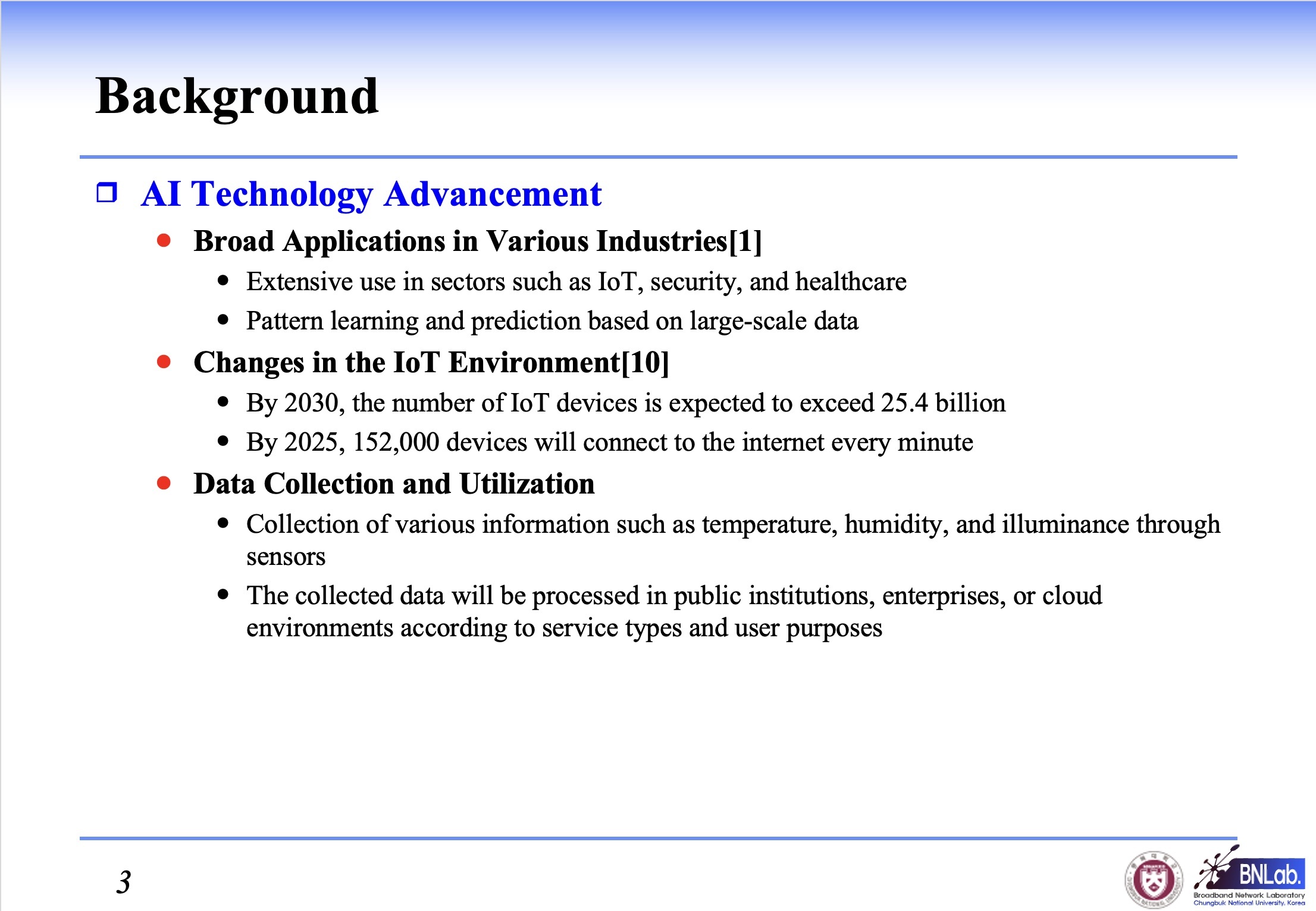 |
Due to the rapid advancement of AI, the importance of data collection is increasing, and numerous individuals and companies are utilizing IoT as a means of data collection. As a result, the IoT environment is expanding at a very fast pace.
|
| ICACT20250026 Slide.04
[Big Slide]
|
Chrome Click!! |
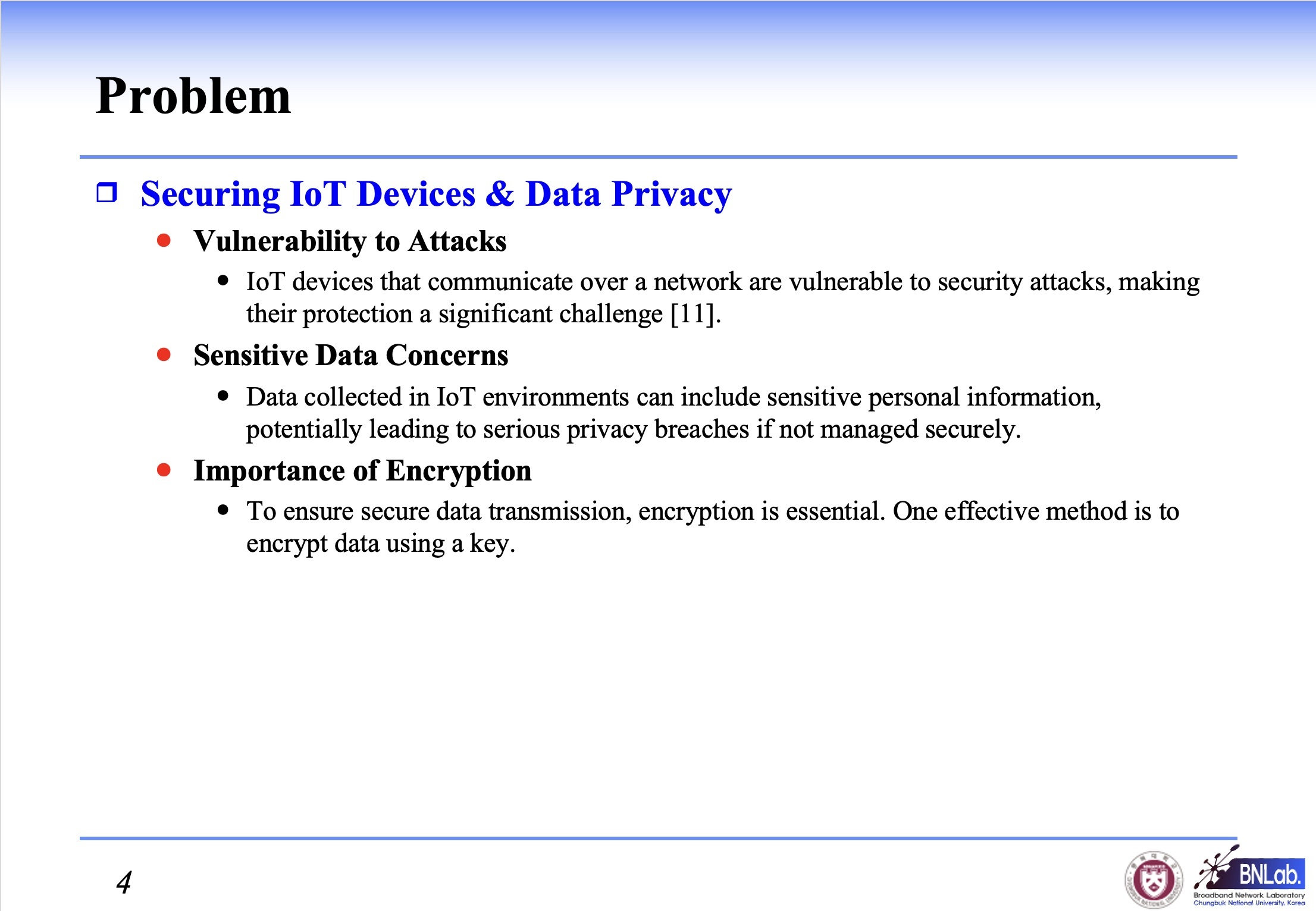 |
Because the process of communication and data collection via IoT includes sensitive information such as personal data, security has emerged as a pressing issue with the expansion of the IoT environment. Therefore, encryption is indispensable when transmitting data.
|
| ICACT20250026 Slide.05
[Big Slide]
|
Chrome Click!! |
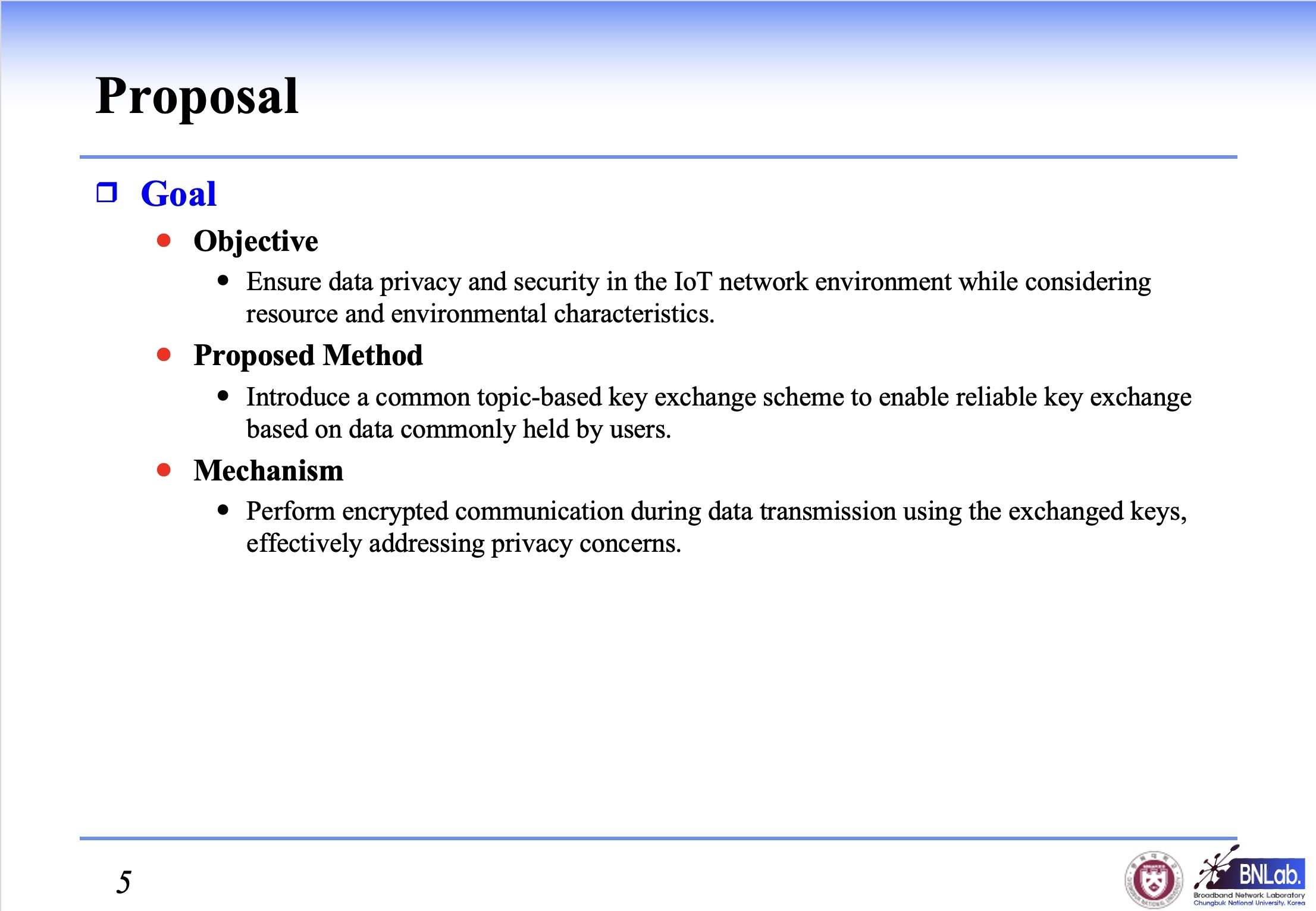 |
Therefore, to ensure data privacy and security in the IoT network environment, we propose a key exchange method based on data commonly held by users.
|
| ICACT20250026 Slide.06
[Big Slide]
|
Chrome Click!! |
 |
|
| ICACT20250026 Slide.07
[Big Slide]
|
Chrome Click!! |
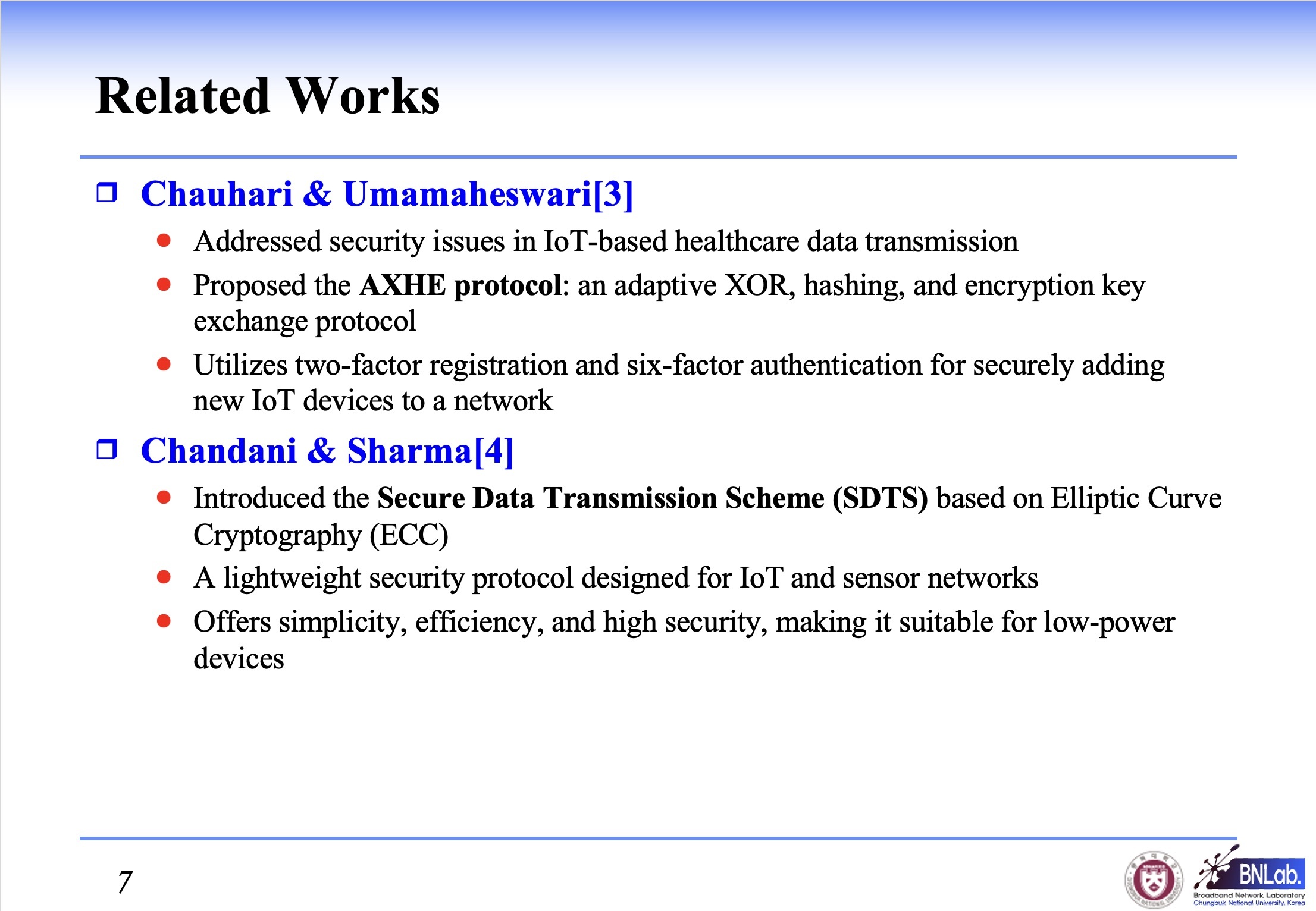 |
Chauhari & Umamaheswari addressed the security challenges of IoT-based medical data transmission by proposing the AXHE protocol (Adaptive XOR, Hashing, and Encryption Key), while Chandani & Sharma introduced a secure data transmission system based on Elliptic Curve Cryptography (ECC), offering efficiency, simplicity, and high security.
|
| ICACT20250026 Slide.08
[Big Slide]
|
Chrome Click!! |
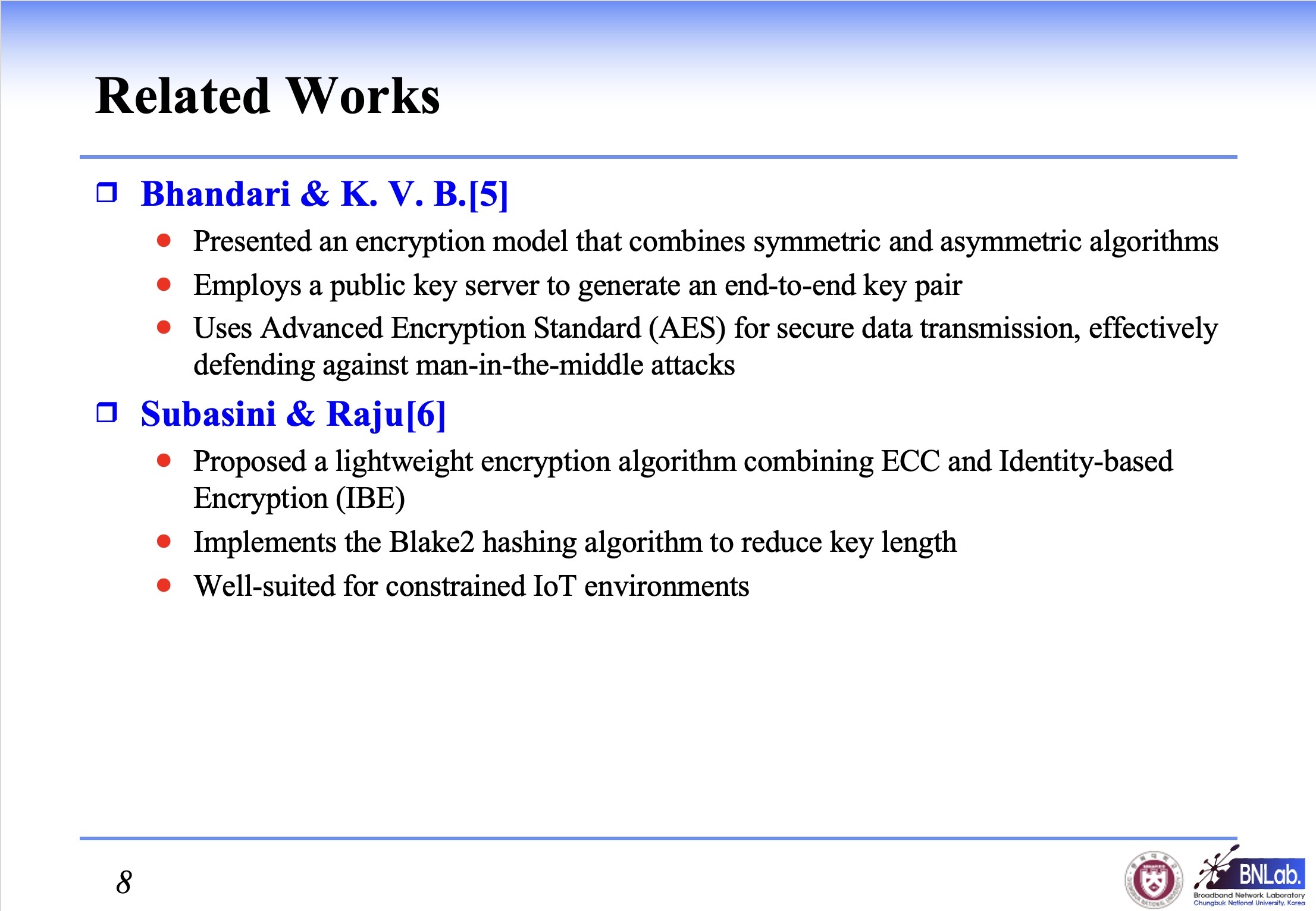 |
Bhandari and K. V. B. proposed an encryption model that combines both symmetric and asymmetric algorithms, suggesting secure data transmission using the Advanced Encryption Standard (AES). Meanwhile, Subasini and Raju introduced a lightweight encryption algorithm by combining ECC with identity-based encryption. However, conventional key exchange methods like ECC demand high computational power. Therefore, we propose a simple key exchange method that utilizes commonly shared data in advance, tailored for transmitting encrypted data in IoT environments.
|
| ICACT20250026 Slide.09
[Big Slide]
|
Chrome Click!! |
 |
|
| ICACT20250026 Slide.10
[Big Slide]
|
Chrome Click!! |
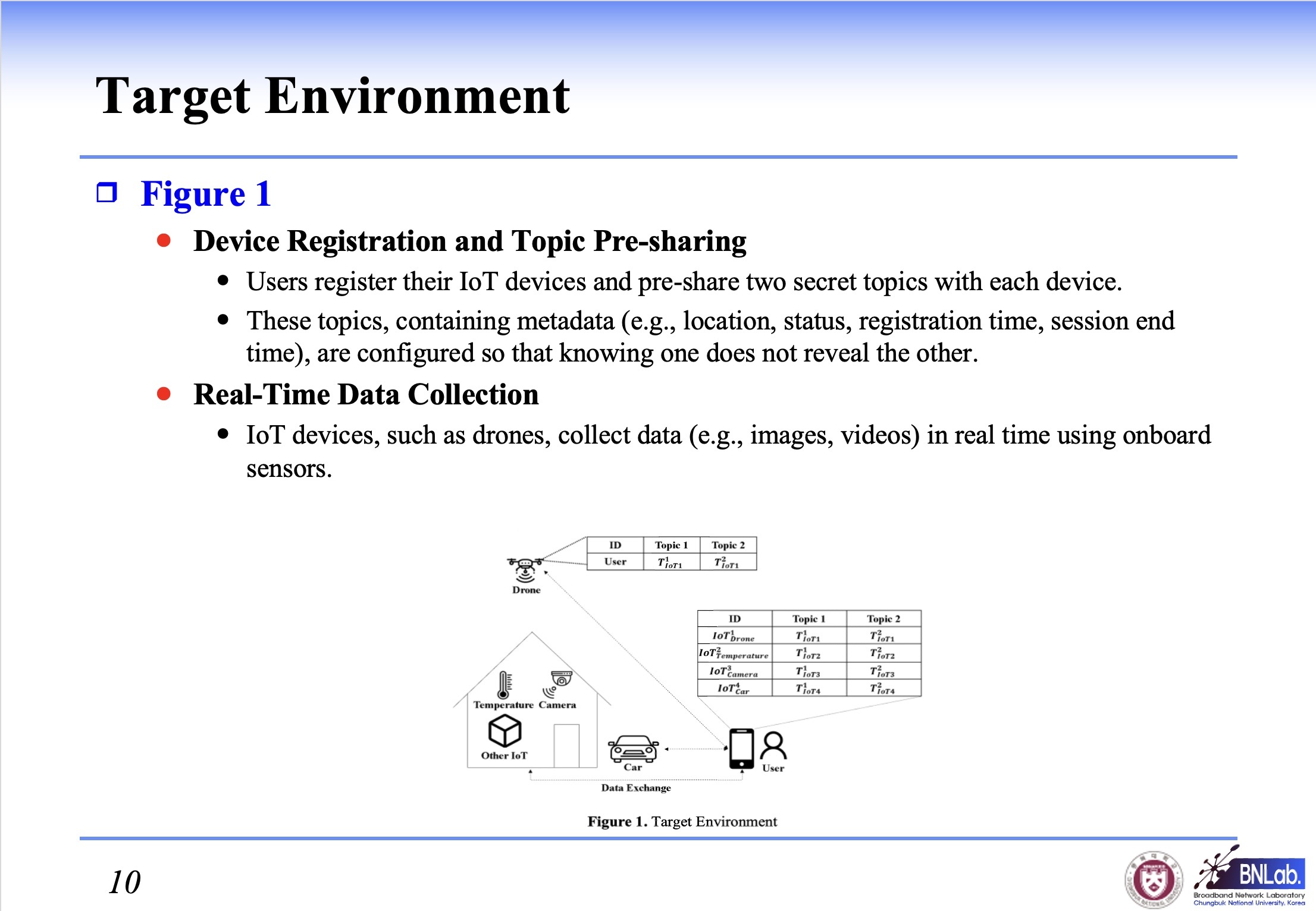 |
Our target environment is a private network where, during the registration or communication process of IoT devices, two types of metadata—such as location information and registration time—are pre-shared. These pieces of metadata are stored in a table on each device.
|
| ICACT20250026 Slide.11
[Big Slide]
|
Chrome Click!! |
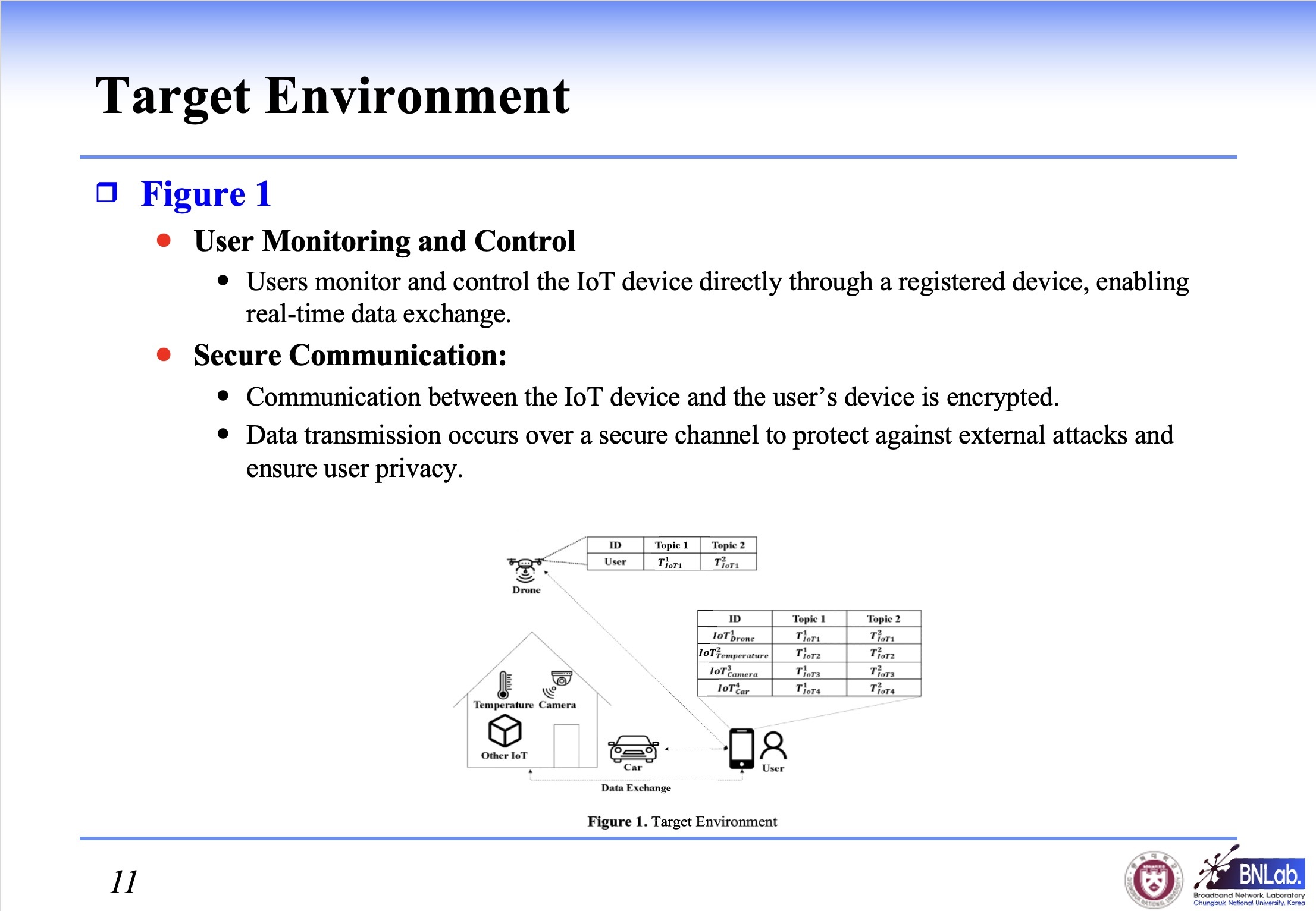 |
We propose using the shared metadata to exchange keys, and then utilizing these exchanged keys to encrypt data transmission.
|
| ICACT20250026 Slide.12
[Big Slide]
|
Chrome Click!! |
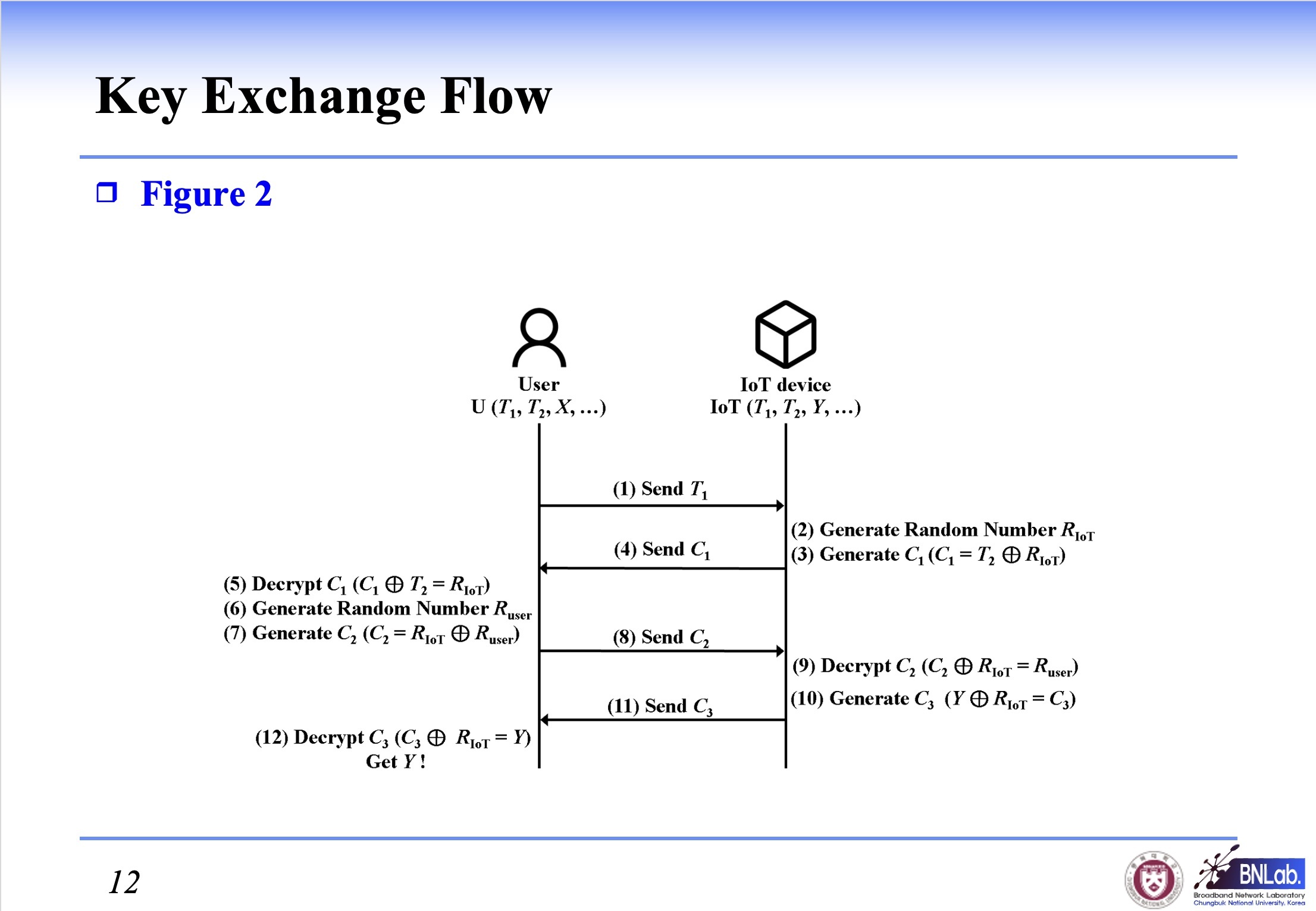 |
The diagram illustrating the key exchange procedure is shown in Figure 2. The encryption method was implemented using a simple XOR operation.
|
| ICACT20250026 Slide.13
[Big Slide]
|
Chrome Click!! |
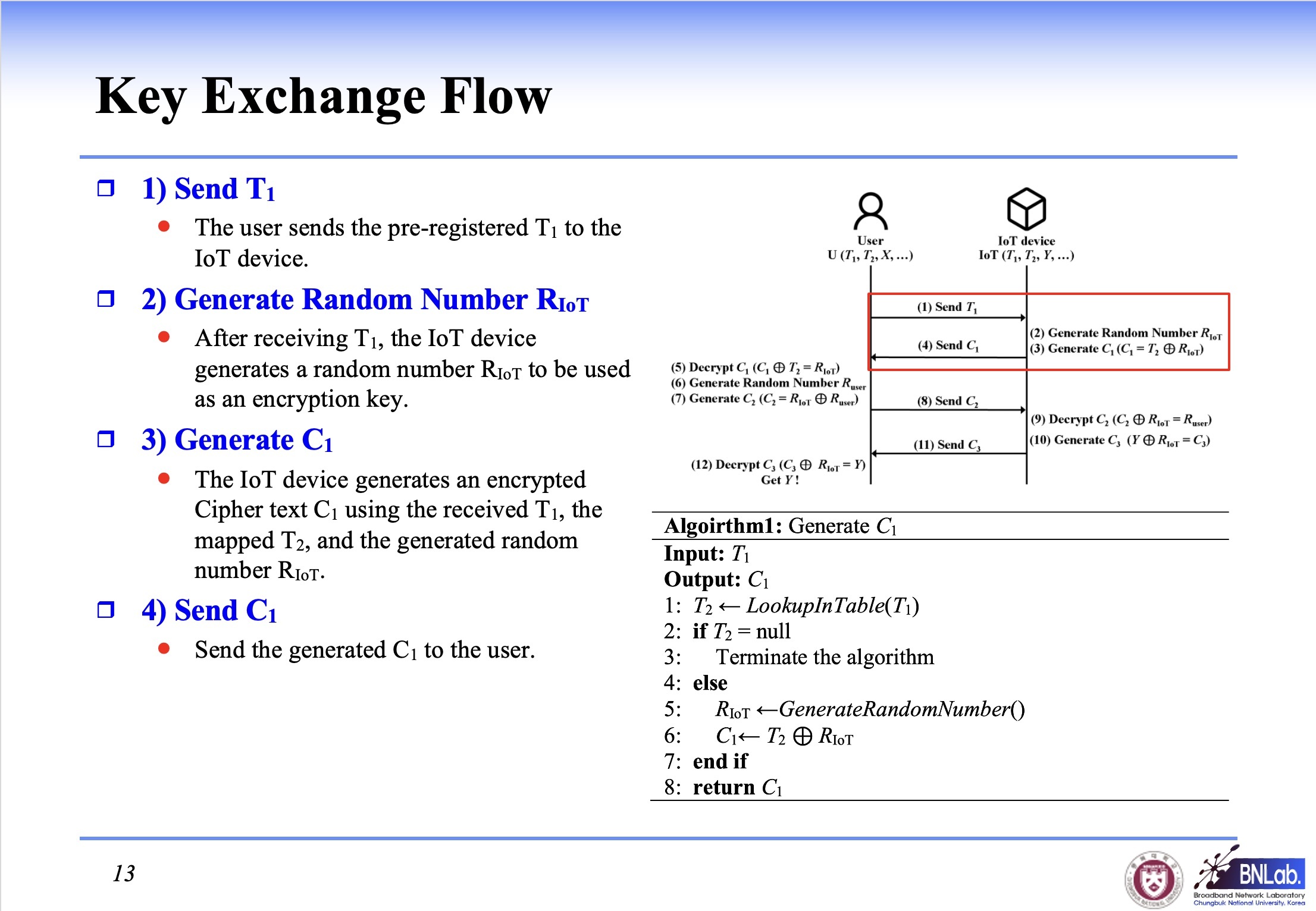 |
In the first step, the user sends the pre-registered T1 to the IoT device.�In the second step, after receiving T1, the IoT device generates a random number RIoT to be used as an encryption key.�In the third step, the IoT device creates an encrypted ciphertext C1 based on the received T1, the mapped T2, and the generated RIoT.�In the fourth step, the IoT device sends the generated C1 back to the user, completing the key exchange process.
|
| ICACT20250026 Slide.14
[Big Slide]
|
Chrome Click!! |
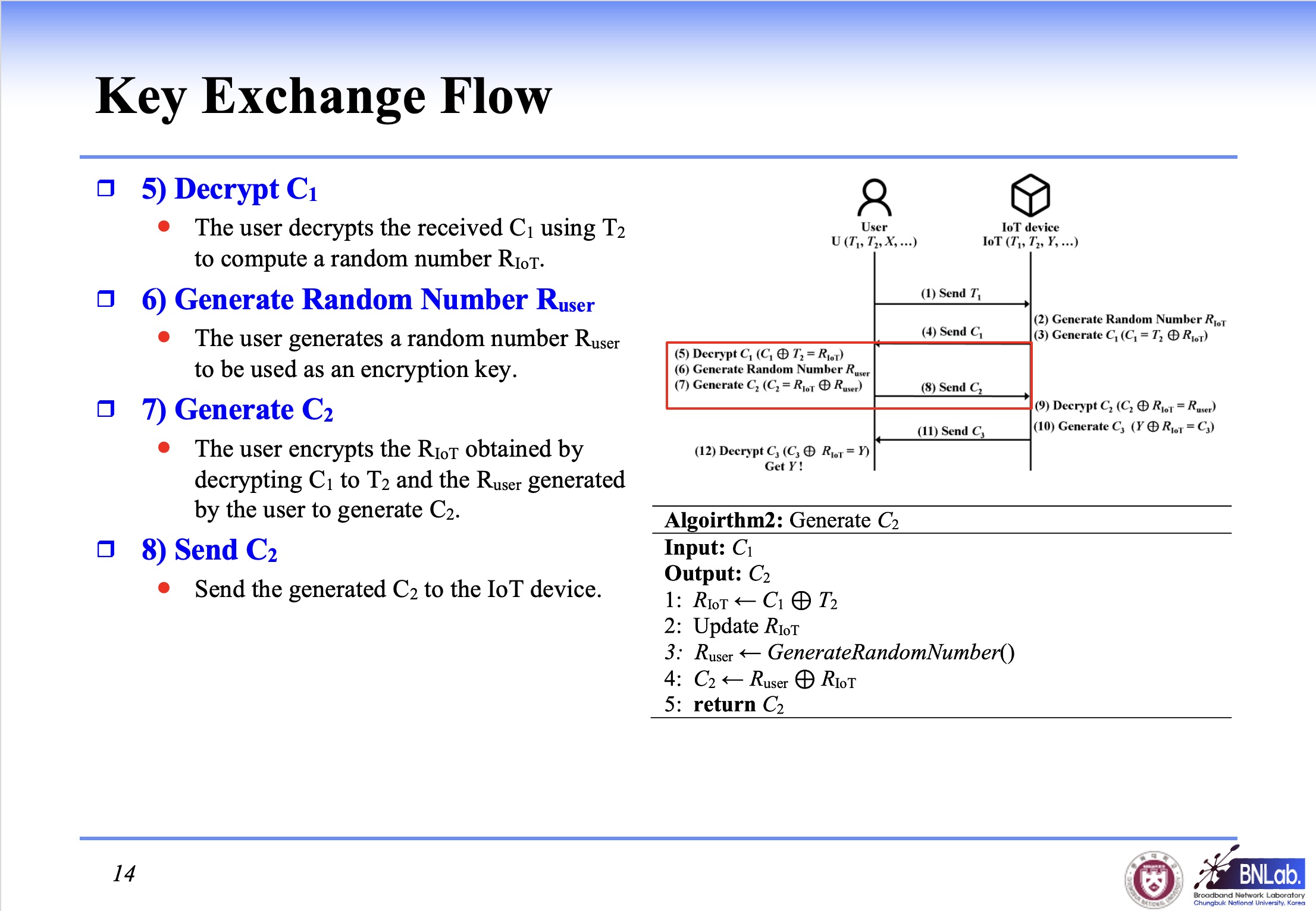 |
In the fifth step, the user decrypts the received C1 using T2 to obtain the random number RIoT.�In the sixth step, the user generates a random number Ruser to serve as an encryption key.�In the seventh step, the user encrypts both RIoT, which was obtained by decrypting C1, and the newly generated Ruser to create C2.�Finally, in the eighth step, the user sends the generated C2 to the IoT device.
|
| ICACT20250026 Slide.15
[Big Slide]
|
Chrome Click!! |
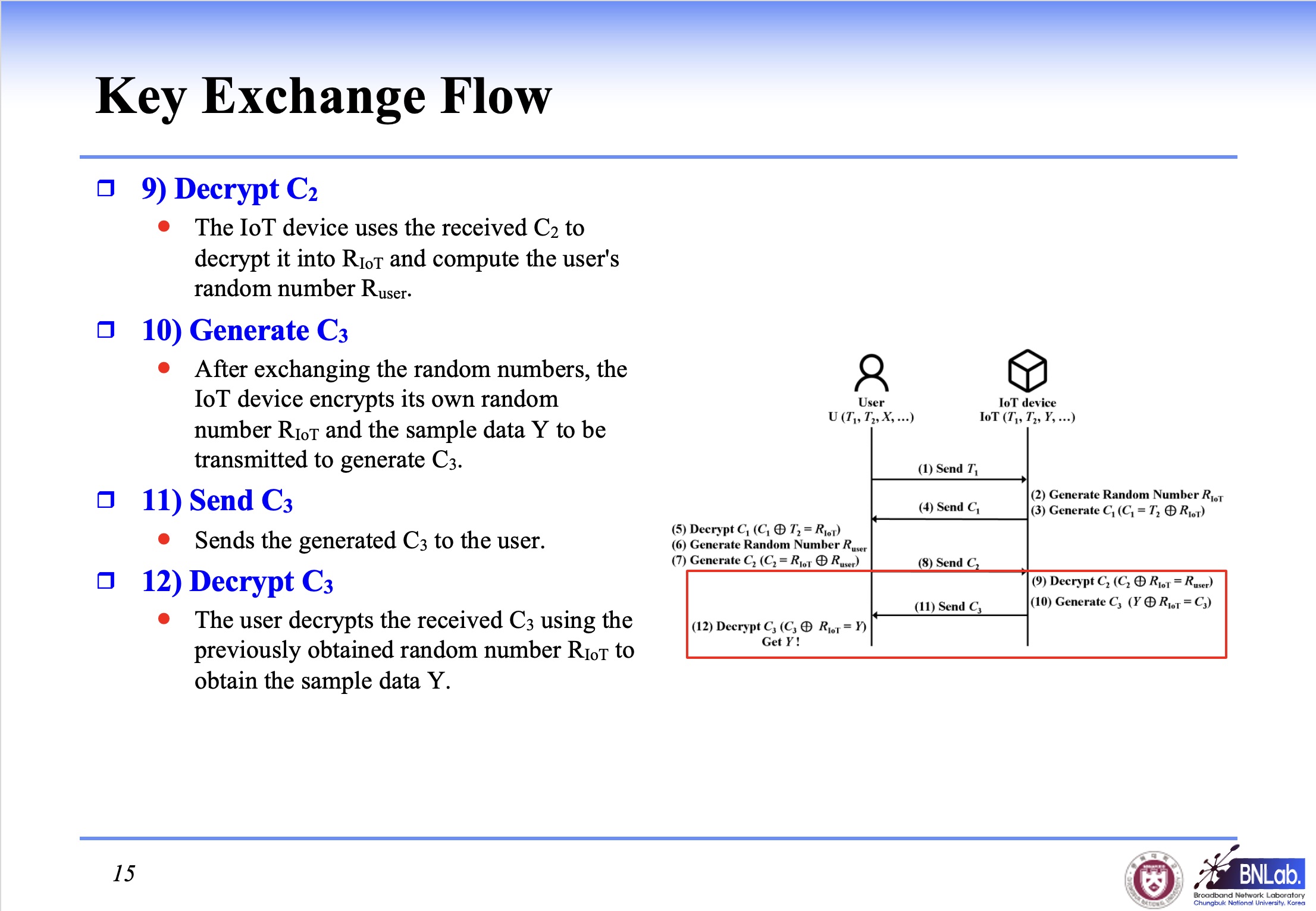 |
In the ninth step, the IoT device uses the received C2 to decrypt it into RIoT and compute the user’s random number Ruser.�In the tenth step, after exchanging the random numbers, the IoT device encrypts its own random number RIoT and the sample data Y to be transmitted, generating C3.�In the eleventh step, it sends the generated C3 to the user.�Finally, in the twelfth step, the user decrypts the received C3 using the previously obtained random number RIoT to obtain the sample data Y.
|
| ICACT20250026 Slide.16
[Big Slide]
|
Chrome Click!! |
 |
|
| ICACT20250026 Slide.17
[Big Slide]
|
Chrome Click!! |
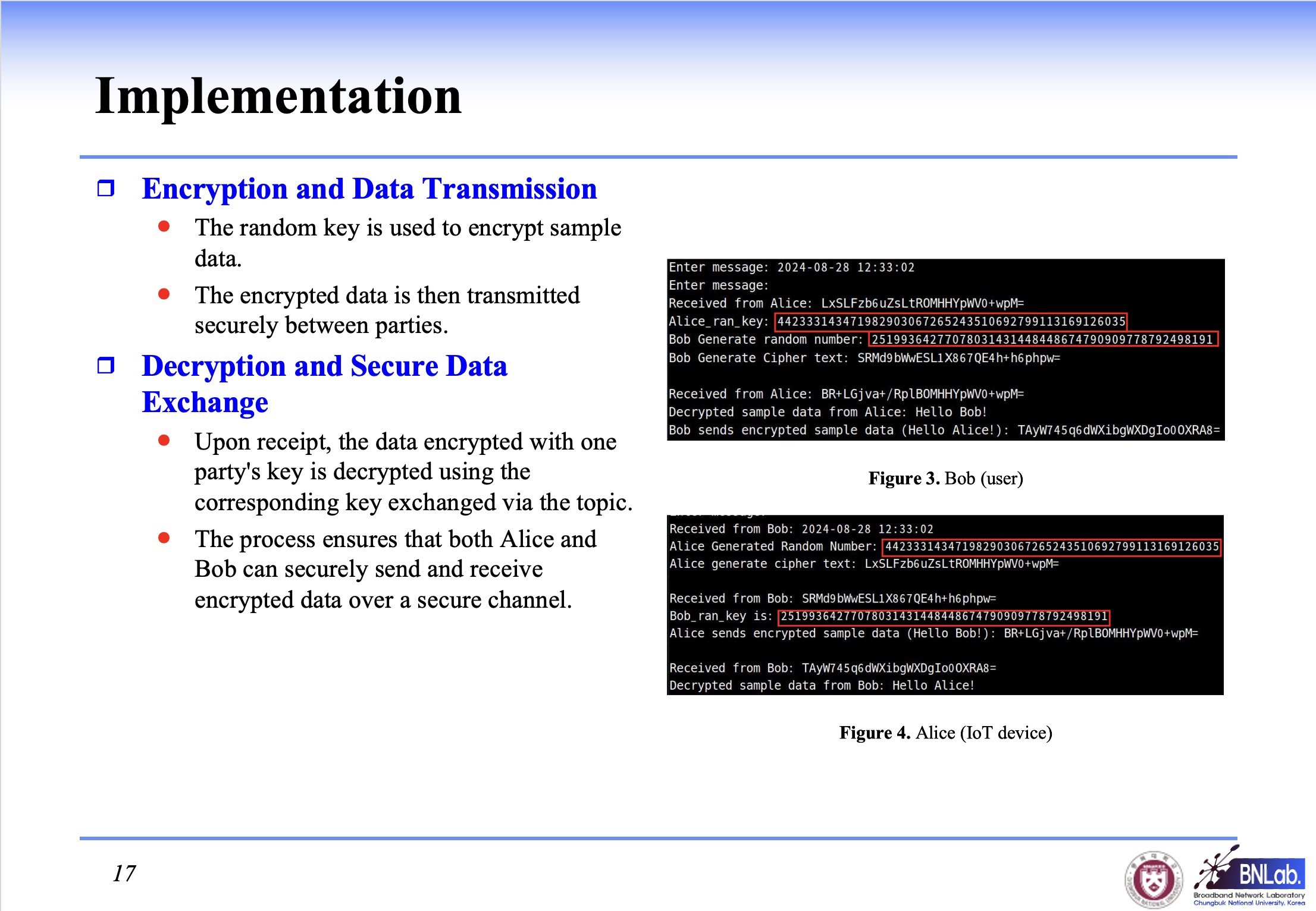 |
The implementation was carried out at a laboratory level, and we verified the key exchange process as illustrated in the figure.
|
| ICACT20250026 Slide.18
[Big Slide]
|
Chrome Click!! |
 |
|
| ICACT20250026 Slide.19
[Big Slide]
|
Chrome Click!! |
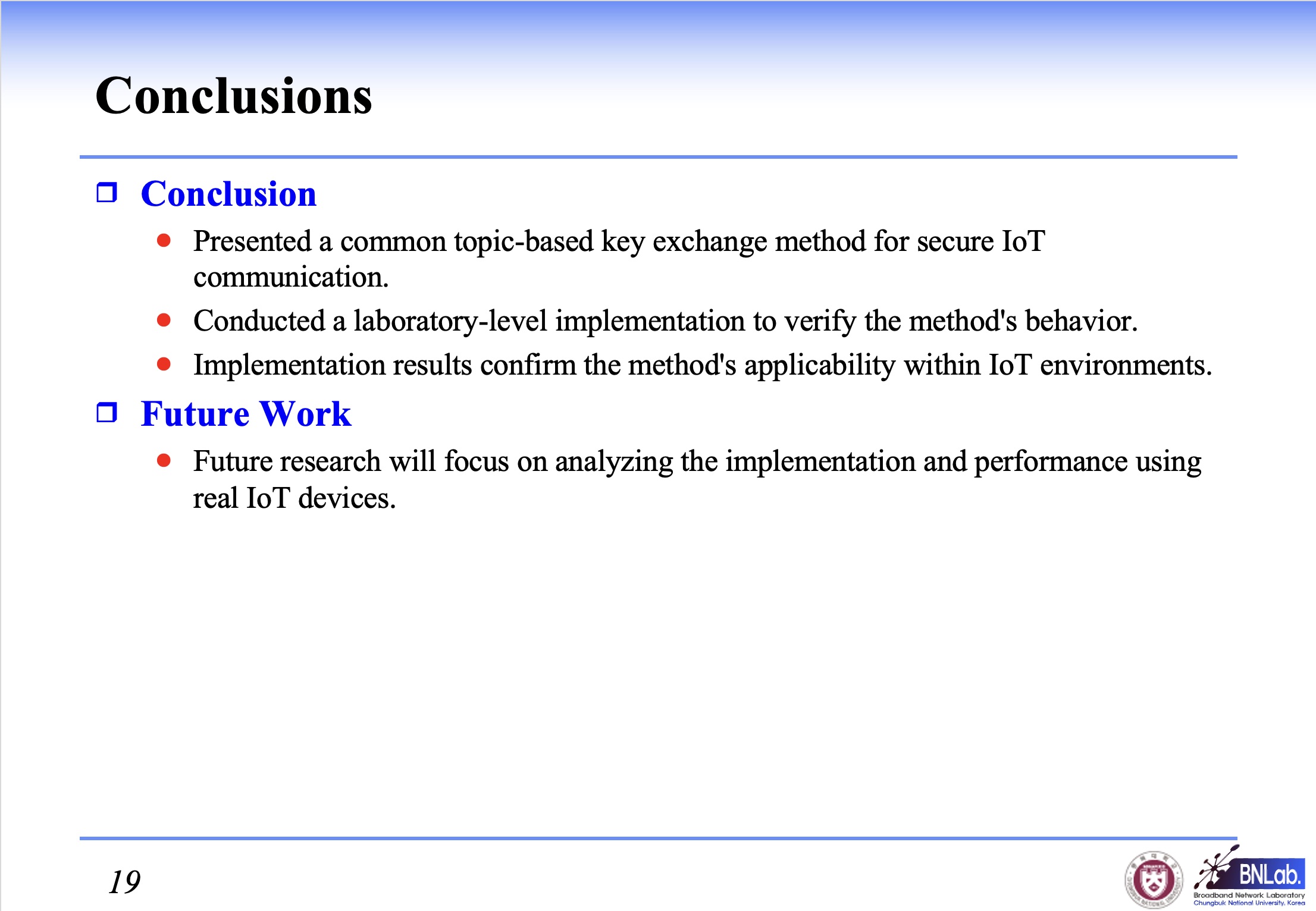 |
In this study, we presented a common topic-based key exchange method designed to secure IoT communication. We conducted a laboratory-level implementation to verify the feasibility of our approach, and the results confirmed that our method can be effectively applied within IoT environments��Moving forward, we plan to expand our research by conducting further analysis and performance testing using real IoT devices. This will allow us to evaluate the method’s scalability and robustness under more diverse and practical conditions.
|
| ICACT20250026 Slide.20
[Big Slide]
|
Chrome Click!! |
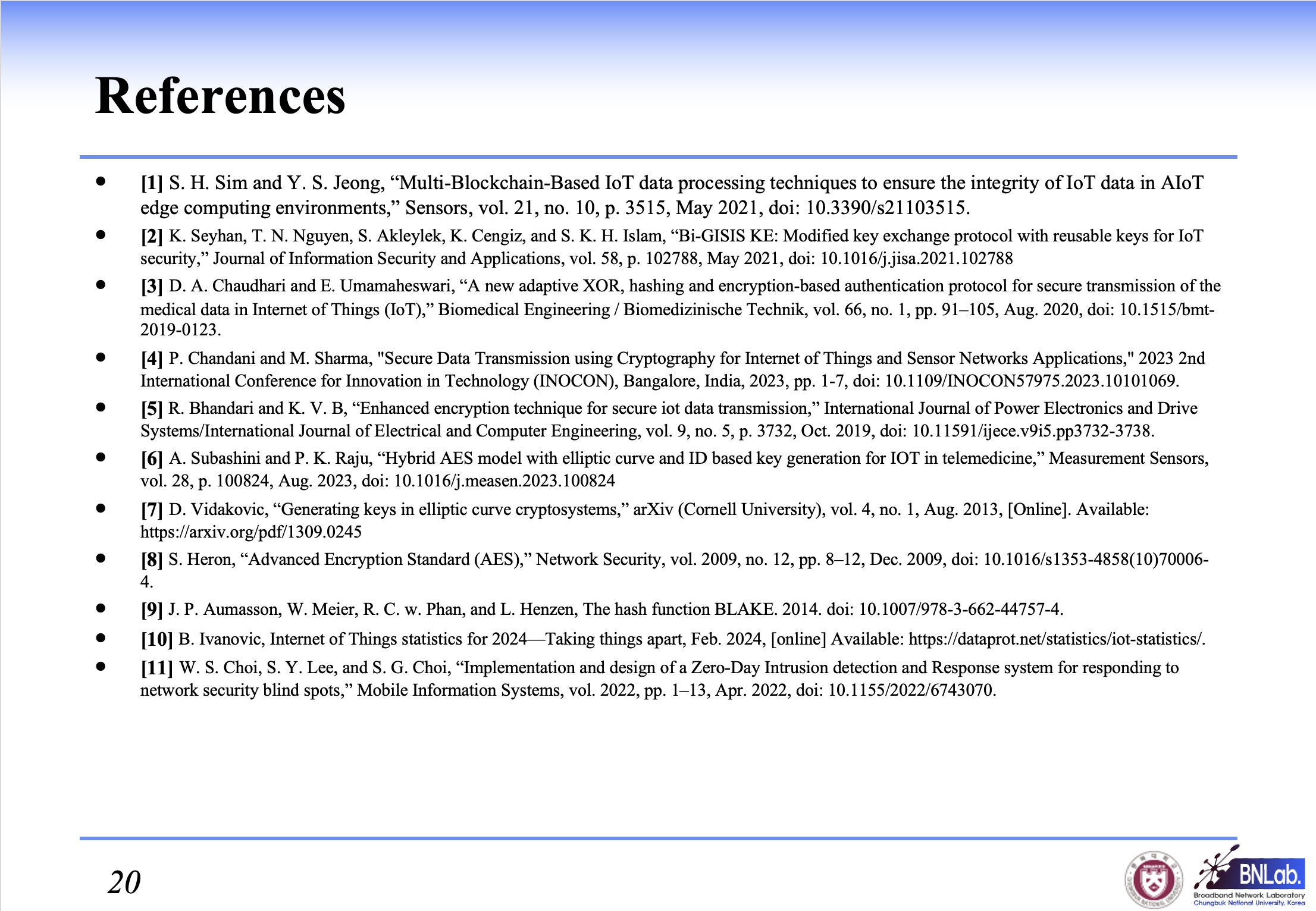 |
We utilized these references in the course of writing this paper.
|
| ICACT20250026 Slide.21
[Big Slide]
|
Chrome Click!! |
 |
|















