 ICACT20250115 Slide.01
[Big Slide]
[YouTube] |
Chrome  Click!! |
 |
Data-Driven Automation in Welding: Leveraging Advanced Machine Learning for Quality and Efficiency
Authors
Muhammad Omair Khan, Md Ariful Islam Mozumder, Ibad Ullah Azam, Mon-il Joo, Hee Cheol Kim
|
| ICACT20250115 Slide.02
[Big Slide]
[YouTube] |
Chrome Click!! |
 |
Contents ->
Abstract
Introduction
Related Work
Method and Materials
Results and Discussion
Conclusion |
| ICACT20250115 Slide.03
[Big Slide]
[YouTube] |
Chrome Click!! |
 |
Abstract ->
In this study, we analyze 15,000 welding observations that belonged to the Hanthec organization. Through comparative analysis of SVM, MLP, and Decision Tree algorithms, our research establishes an effective machine learning framework for welding parameter optimization
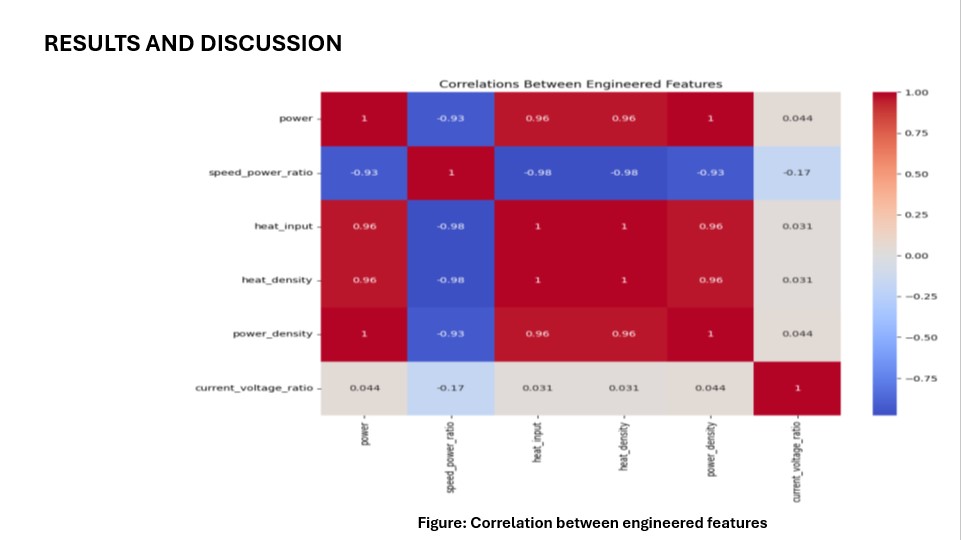
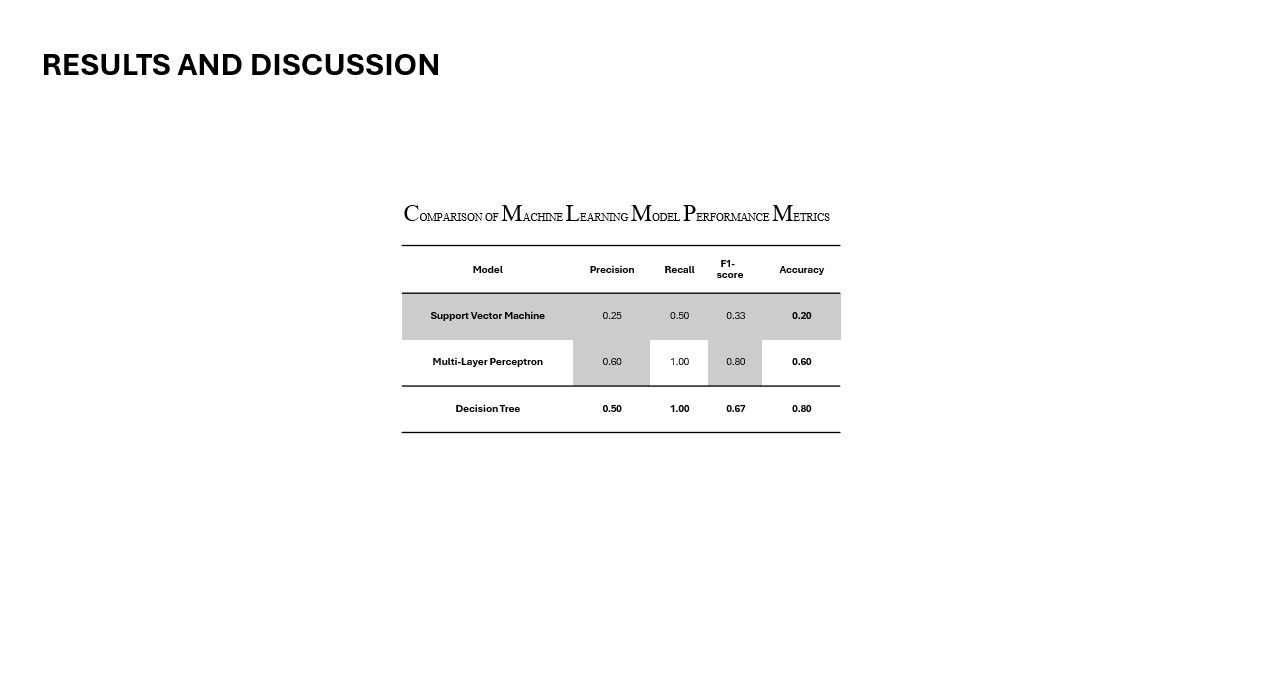
The Decision Tree model obtained an excellent performance with the best accuracy of 80% and perfect recall. High correlations between power and thermal aspects as high as 0.96 have been obtained.
The developed framework enables systematic parameter selection and demonstrates the potential for automated decision-making in industrial welding applications, contributing to improved manufacturing quality and reliability.
|
| ICACT20250115 Slide.04
[Big Slide]
[YouTube] |
Chrome Click!! |
 |
Introduction->
In recent years, the manufacturing industry has seen a significant shift toward automation, driven by the need for enhanced operational efficiency and rrigorous quality control measures.
Traditional welding methods often face challenges in achieving uniformity and precision, leading to defects and costly rework
Integration of machine learning techniques presents a compelling solution to these challenges
Research has demonstrated effectiveness of SVM and Neural Networks in predicting welding outcomes
Decision Tree algorithms offer interpretable models that can aid operators in making informed decisions
|
| ICACT20250115 Slide.05
[Big Slide]
[YouTube] |
Chrome Click!! |
 |
Related work ->
Numerous studies have explored the application of machine learning in manufacturing, focusing on various aspects of process optimization.
Machine learning-based system detected weld porosity using arc sound data from P-GTAW, validated through k-fold cross-validation
Deep learning approach using CNNs automated TIG weld quality assessment across six categories with high accuracy
The GMAW study used a Central Composite Design to analyze welding arc and bead geometry images
CNN application analyzed 3,000 training images to predict the effectiveness of Friction Stir Welded joints. |
| ICACT20250115 Slide.06
[Big Slide]
[YouTube] |
Chrome Click!! |
 |
Methodology->
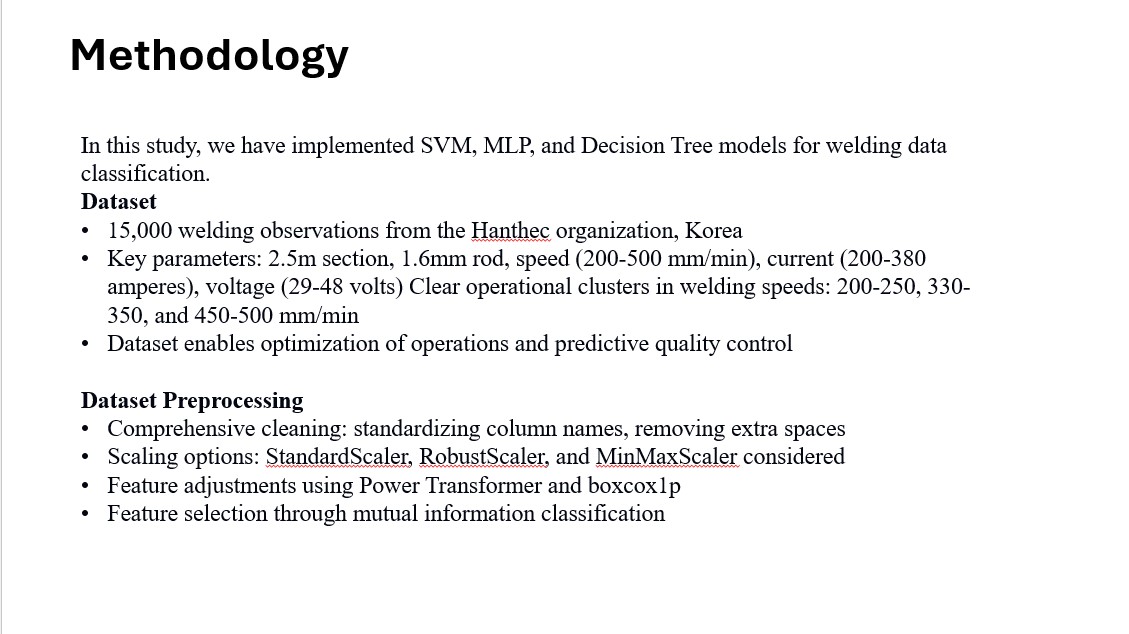
In this study, we have implemented SVM, MLP, and Decision Tree models for welding data classification.
Dataset
15,000 welding observations from the Hanthec organization, Korea
Key parameters: 2.5m section, 1.6mm rod, speed (200-500 mm/min), current (200-380 amperes), voltage (29-48 volts) Clear operational clusters in welding speeds: 200-250, 330-350, and 450-500 mm/min
Dataset enables optimization of operations and predictive quality control
Dataset Preprocessing
Comprehensive cleaning: standardizing column names, removing extra spaces
Scaling options: StandardScaler, RobustScaler, and MinMaxScaler considered
Feature adjustments using Power Transformer and boxcox1p
Feature selection through mutual information classification
|
| ICACT20250115 Slide.07
[Big Slide]
[YouTube] |
Chrome Click!! |
 |
Methodology->
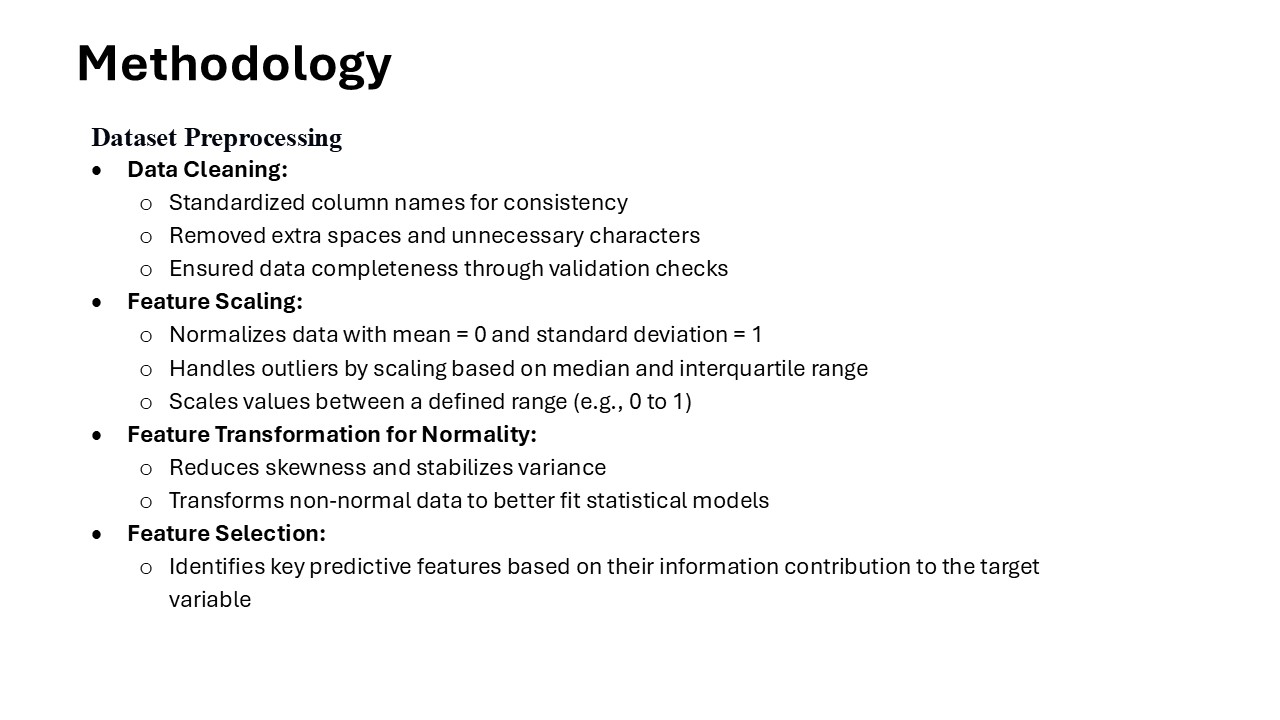
In this study, we have implemented SVM, MLP, and Decision Tree models for welding data classification.
Dataset
The experimental dataset provided by the Hanthec Organization in Korea consists of 15,000 observations related to welding processes.
The dataset includes five key parameters: a welding section length of 2.5 meters, a welding rod specification of 1.6 mm, welding speeds ranging from 200 to 500 mm/min, electrical currents between 200 and 380 amperes, and voltage levels from 29 to 48 volts.
The data reveals distinct operational clusters in welding speeds, specifically at 200-250 mm/min, 330-350 mm/min, and 450-500 mm/min.
These clusters are significant as they indicate optimal settings for achieving quality welds. The dataset not only facilitates the optimization of welding operations but also supports the development of predictive models for quality control.
By analyzing this data, manufacturers can enhance efficiency, reduce defects, and ensure consistent quality in welding processes. |
| ICACT20250115 Slide.08
[Big Slide]
[YouTube] |
Chrome Click!! |
 |
Methodology->
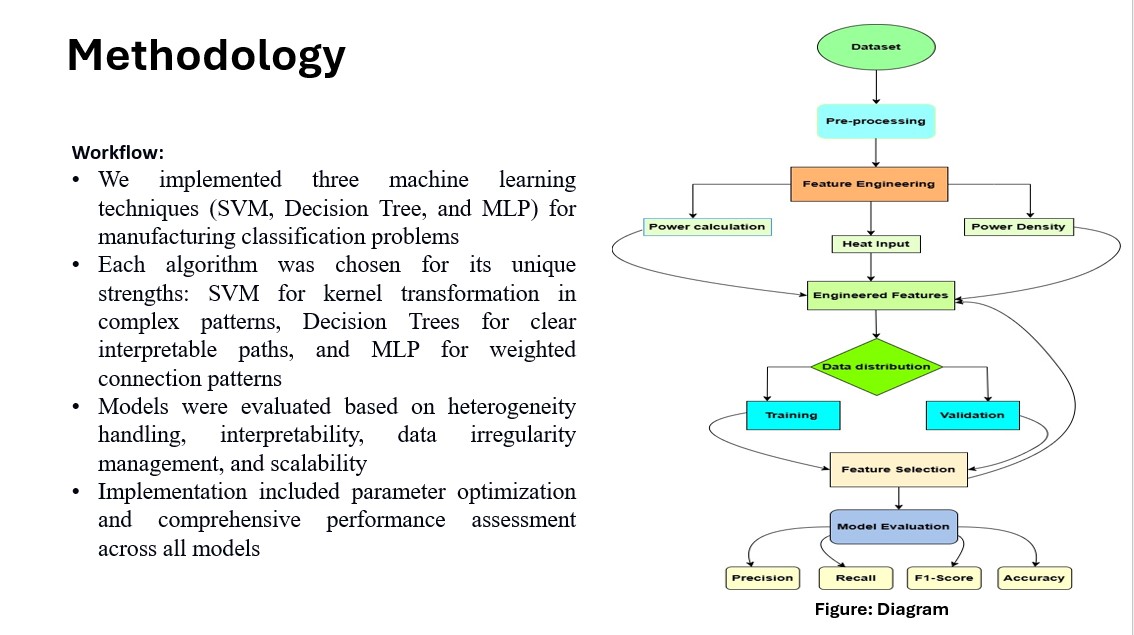
Workflow:
We implemented three machine learning techniques (SVM, Decision Tree, and MLP) for manufacturing classification problems
Each algorithm was chosen for its unique strengths: SVM for kernel transformation in complex patterns, Decision Trees for clear interpretable paths, and MLP for weighted connection patterns
Models were evaluated based on heterogeneity handling, interpretability, data irregularity management, and scalability
Implementation included parameter optimization and comprehensive performance assessment across all models
|
| ICACT20250115 Slide.09
[Big Slide]
[YouTube] |
Chrome Click!! |
 |
Methodology
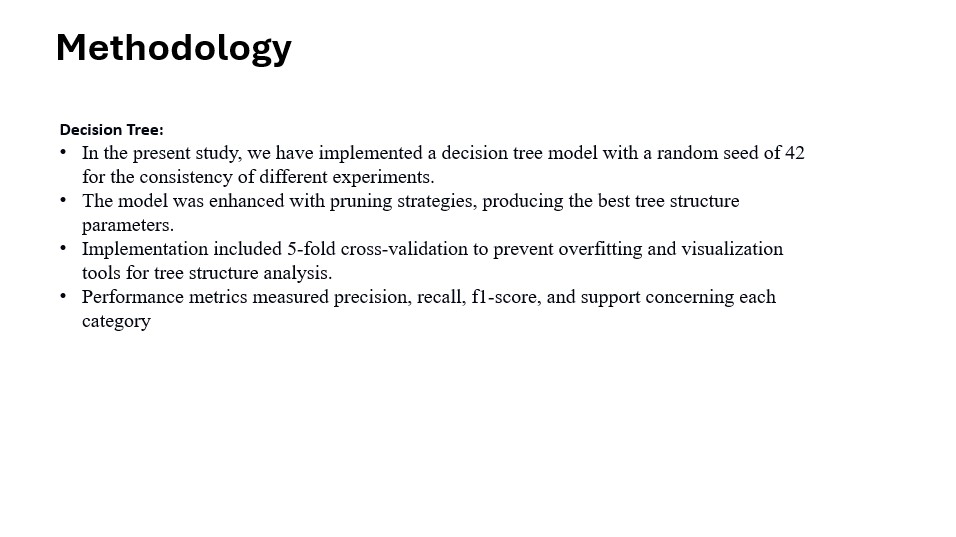
Decision Tree:
In the present study, we have implemented a decision tree model with a random seed of 42 for the consistency of different experiments.
The model was enhanced with pruning strategies, producing the best tree structure parameters.
Implementation included 5-fold cross-validation to prevent overfitting and visualization tools for tree structure analysis.
Performance metrics measured precision, recall, f1-score, and support concerning each category. |
| ICACT20250115 Slide.10
[Big Slide]
[YouTube] |
Chrome Click!! |
 |
RESULTS AND DISCUSSION
Figure: Correlation between engineered features
|
| ICACT20250115 Slide.11
[Big Slide]
[YouTube] |
Chrome Click!! |
 |
RESULTS AND DISCUSSION
Comparison of Machine Learning Model Performance Metrics
|
| ICACT20250115 Slide.12
[Big Slide]
[YouTube] |
Chrome Click!! |
 |
RESULTS AND DISCUSSION
|
| ICACT20250115 Slide.13
[Big Slide]
[YouTube] |
Chrome Click!! |
 |
RESULTS AND DISCUSSION
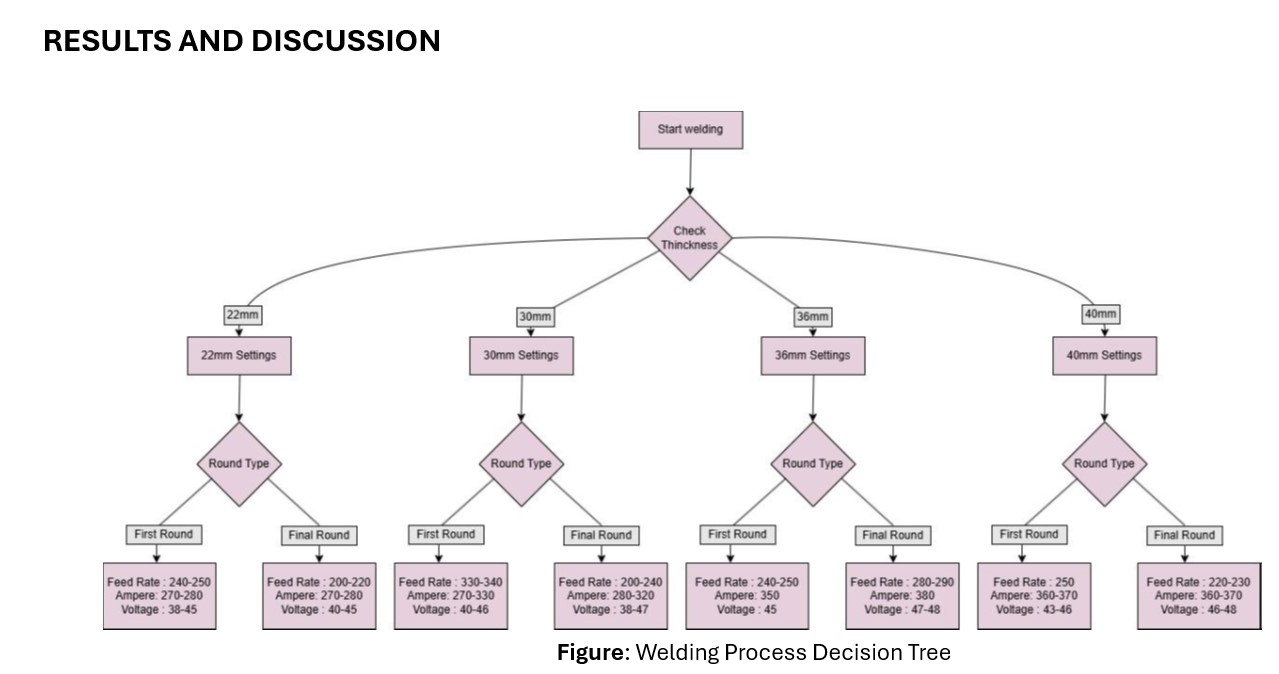
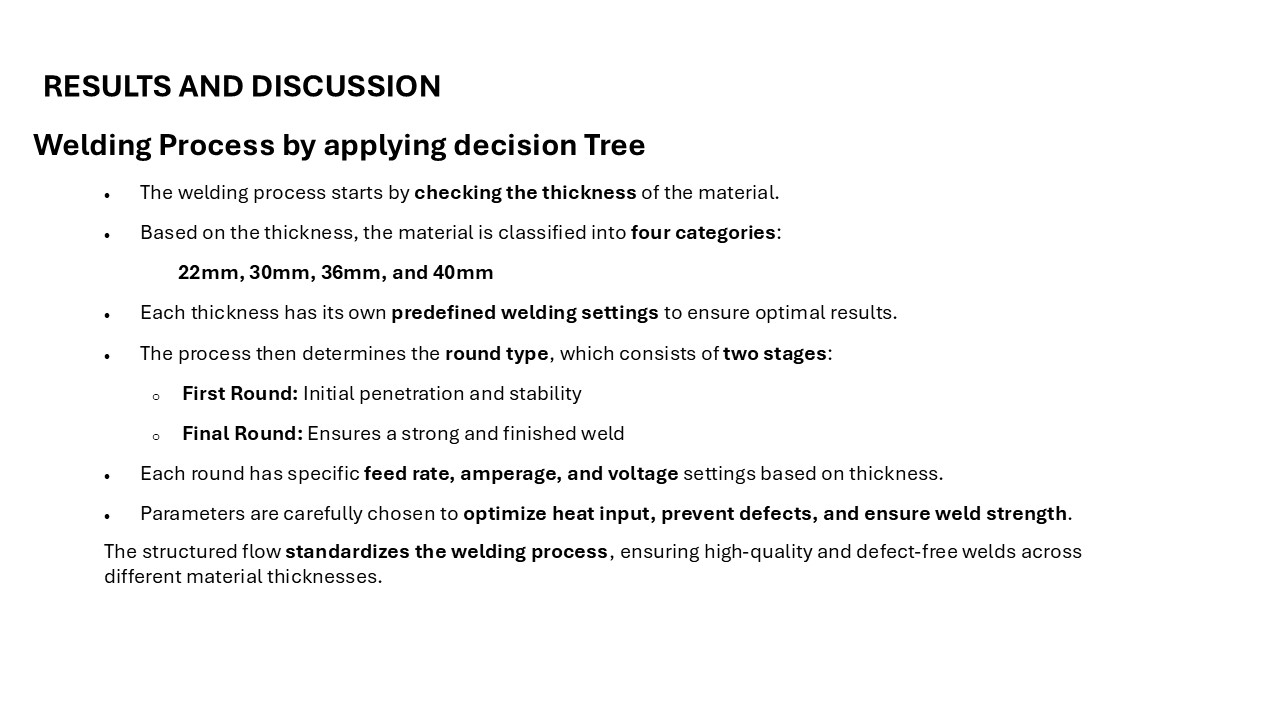
The welding process starts by checking the thickness of the material.
Based on the thickness, the material is classified into four categories:
22mm, 30mm, 36mm, and 40mm
Each thickness has its own predefined welding settings to ensure optimal results.
The process then determines the round type, which consists of two stages:
First Round: Initial penetration and stability
Final Round: Ensures a strong and finished weld
Each round has specific feed rate, amperage, and voltage settings based on thickness.
Parameters are carefully chosen to optimize heat input, prevent defects, and ensure weld strength.
The structured flow standardizes the welding process, ensuring high-quality and defect-free welds across different material thicknesses.
|
| ICACT20250115 Slide.14
[Big Slide]
[YouTube] |
Chrome Click!! |
 |
Conclusion
We developed an effective machine-learning framework for optimizing welding processes, with a Decision Tree model showing superior predictive capability
Strong correlation between power and thermal features provides valuable insights for parameter selection in industrial applications.
Framework enhances quality control and establishes a foundation for automated decision-making in manufacturing.
Systematic approach improves efficiency and reliability in industrial welding operations
|
| ICACT20250115 Slide.15
[Big Slide]
[YouTube] |
Chrome Click!! |
 |
Thank You,
Ask anything related to AI & stay with our youtube channel if you are interested in advanced AI research. |















