 ICACT20250184 Slide.01
[Big Slide]
[YouTube] |
Chrome  Click!! |
 |
Integration Of Advanced Artificial Intelligence In Supply Chain Management, Its Challenges And Opportunities.
Shifat Shima Akter
Department of Industrial & Management Engineering�
Inje University
Republic of Korea
|
| ICACT20250184 Slide.02
[Big Slide]
[YouTube] |
Chrome Click!! |
 |
Contents
Introduction
AI in Supply chain
State of art findings
Challenges
Opportunities
Conclusion
|
| ICACT20250184 Slide.03
[Big Slide]
[YouTube] |
Chrome Click!! |
 |
Introduction
Advanced AI technologies are transforming supply chain management by enhancing efficiency,
optimizing processes and enabling data-driven decision-making.
Despite its potential, AI integration faces challenges such as data privacy concerns, system complexity, high implementation costs, and the need for skilled professionals.
AI offers significant opportunities, including demand forecasting, inventory optimization, real-time tracking, and risk management, driving competitive advantage in dynamic markets.
This study examines how AI can optimize supply chain processes while addressing these challenges, highlighting best practices and strategies for successful AI adoption.
|
| ICACT20250184 Slide.04
[Big Slide]
|
Chrome Click!! |
 |
AI in Supply chain (Image) |
| ICACT20250184 Slide.05
[Big Slide]
[YouTube] |
Chrome Click!! |
 |
AI in Supply chain
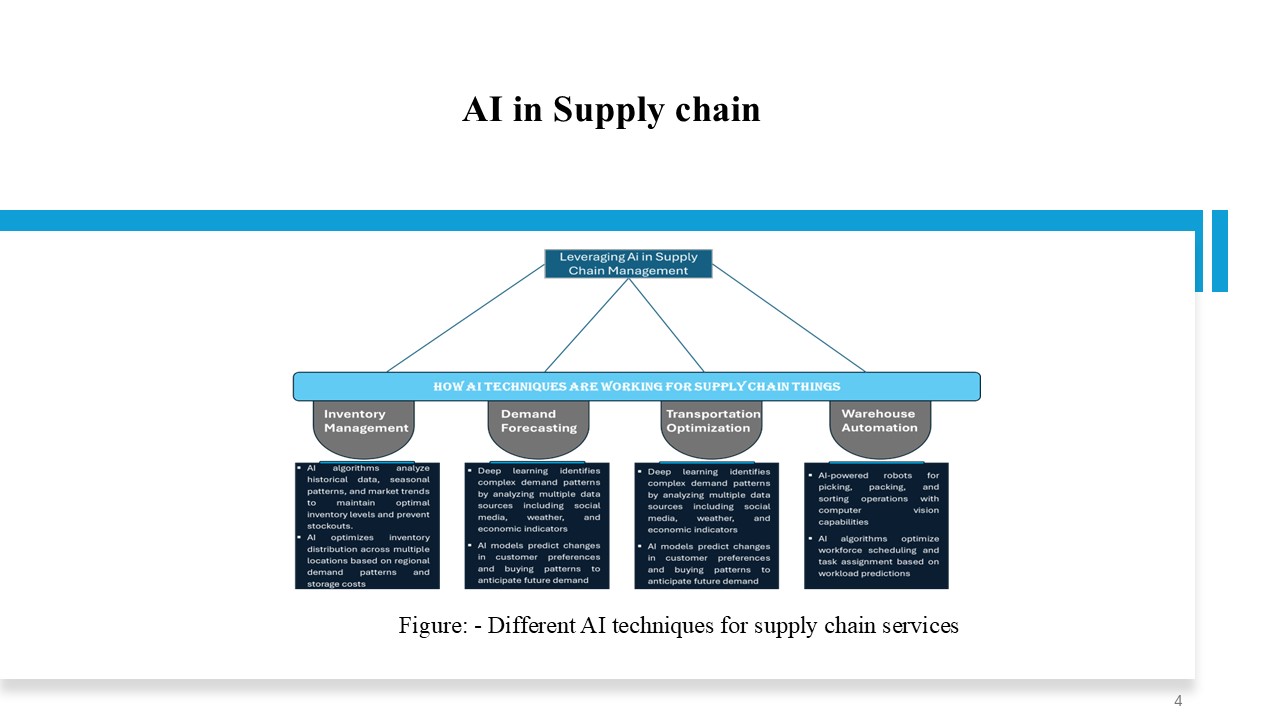
In the given figure we have shown Different AI techniques for supply chain services. How AI leveraging Supply Chain Management.
Inventory management: - AI algorithms analyze historical data, seasonal patterns, and market trends to maintain optimal inventory levels and prevent stockouts.
Also, AI optimizes inventory distribution across multiple locations based on regional demand patterns and storage costs.
Demand Forecasting: - Deep learning identifies complex demand patterns by analyzing multiple social media, weather, and economic indicators.
|
| ICACT20250184 Slide.06
[Big Slide]
[YouTube] |
Chrome Click!! |
 |
At the same time, AI models predict changes in customer preferences and buying patterns to anticipate future demand.
Transportation Optimization: - Deep Learning identifies complex demand patterns by analyzing multiple data sources including social media, weather, and economic indicators.
AI models predict changes in customer preferences and buying patterns to anticipate future demand.
Warehouse Automation: - AI powered robots for picking, packing, and sorting operations with computer vision capabilities.
AI algorithms optimize workforce scheduling and task assignment based on workload predictions.
|
| ICACT20250184 Slide.07
[Big Slide]
[YouTube] |
Chrome Click!! |
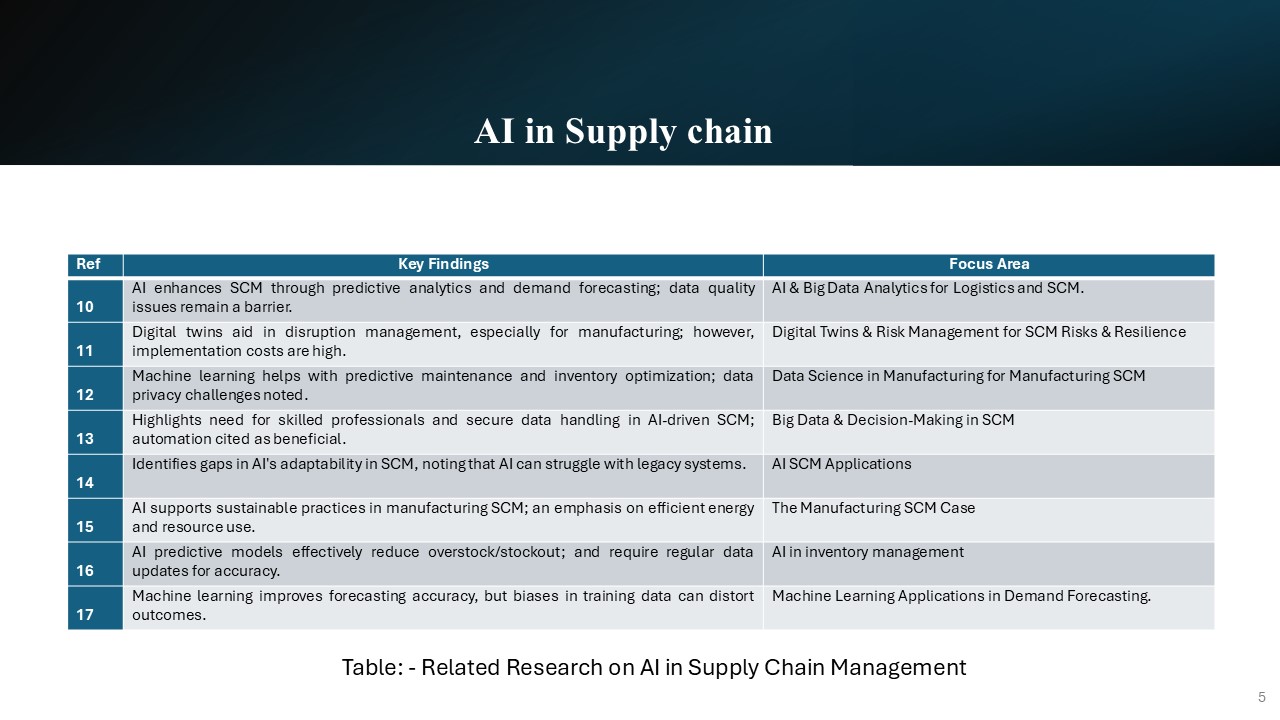 |
AI in Supply chain (Table) |
| ICACT20250184 Slide.08
[Big Slide]
[YouTube] |
Chrome Click!! |
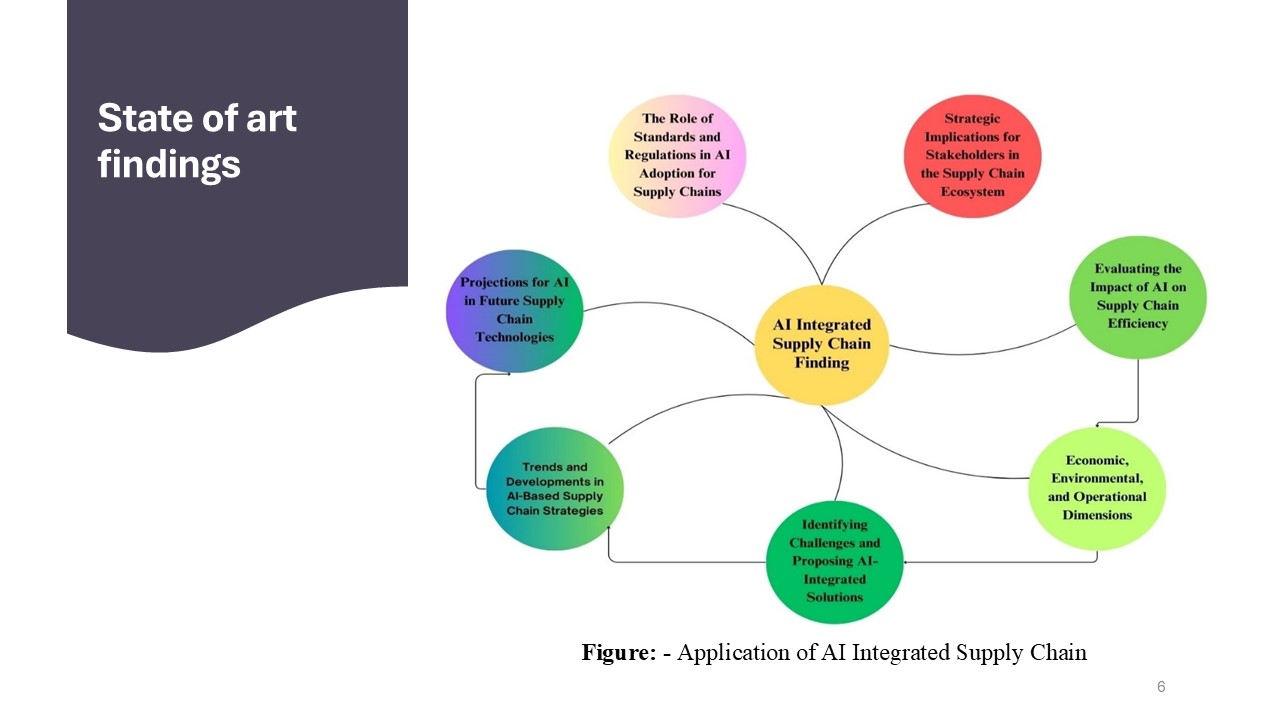 |
State of Art findings (Figure) |
| ICACT20250184 Slide.09
[Big Slide]
[YouTube] |
Chrome Click!! |
 |
State of Art Findings
Core Findings of the study shown in figure¡¦..
Evaluating the Impact of AI on Supply Chain Efficiency
Economic, Environmental, and Operational Dimensions
Identifying Challenges and Proposing AI-Integrated Solutions
Trends and Developments in AI-Based Supply Chain Strategies
The Role of Standards and Regulations in AI Adoption for Supply Chains
Strategic Implications for Stakeholders in the Supply Chain Ecosystem
|
| ICACT20250184 Slide.10
[Big Slide]
[YouTube] |
Chrome Click!! |
 |
State of Art Findings
The diagram illustrates key findings on AI integration in supply chain management.
It highlights areas such as the role of standards and regulations, strategic implications for stakeholders, and the impact of AI on supply chain efficiency.
Additionally, it covers economic, environmental, and operational dimensions, trends in AI-based strategies, future AI projections, and challenges with proposed solutions.
Together, these elements showcase AI's transformative potential and the complexities of its adoption in supply chains.
|
| ICACT20250184 Slide.11
[Big Slide]
[YouTube] |
Chrome Click!! |
 |
Challenges (Figures) |
| ICACT20250184 Slide.12
[Big Slide]
[YouTube] |
Chrome Click!! |
 |
Challenges
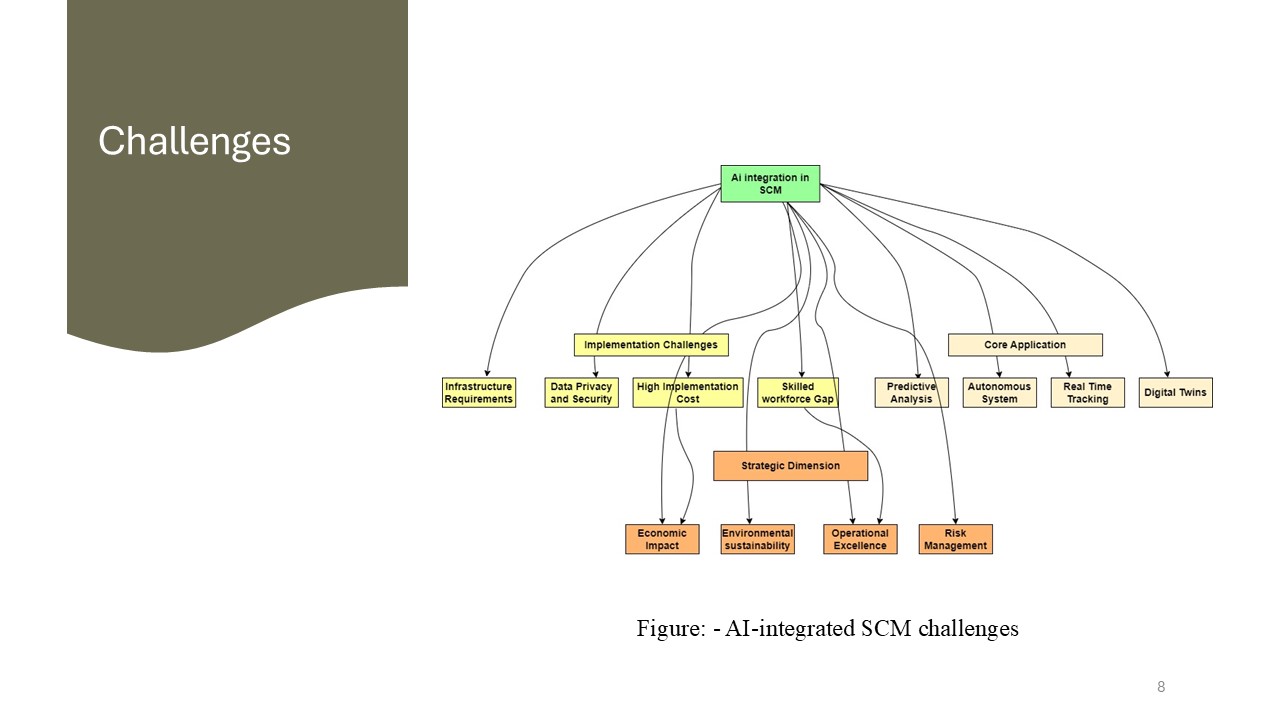
The figure illustrates the challenges of AI in Supply Chain Management (SCM), like data privacy, high implementation costs, and workforce gaps while showcasing AI-driven applications such as predictive analysis, autonomous systems, real-time tracking, and digital twins.
Additionally, the strategic dimensions of AI integration, including economic impact, environmental sustainability, operational excellence, and risk management, are emphasized.
This structured representation provides a comprehensive view of AI's role in enhancing SCM efficiency and decision-making.
|
| ICACT20250184 Slide.13
[Big Slide]
[YouTube] |
Chrome Click!! |
 |
Opportunities
AI optimizes supply chains through demand forecasting and inventory management, reducing stock outs and costs.
Automation streamlines operations, improves efficiency, and frees employees for strategic tasks.
AI enhances supplier performance monitoring, risk mitigation, and promotes sustainable practices like optimized logistics.
|
| ICACT20250184 Slide.14
[Big Slide]
[YouTube] |
Chrome Click!! |
 |
Conclusion
The integration of AI into SCM presents significant opportunities for enhancing efficiency and resilience in manufacturing supply chains.
While AI offers transformative benefits such as improved predictive analytics and streamlined operations, challenges like data privacy, high costs, and the need for skilled labor pose barriers to adoption.
This study emphasizes the importance of collaboration among stakeholders to address these issues and develop robust standards. Looking ahead, focus on creating frameworks that integrate AI with existing supply chain practices while considering ethical implications.
|
| ICACT20250184 Slide.15
[Big Slide]
[YouTube] |
Chrome Click!! |
 |
Thank You,
See our video presentation & ask your questions in your youtube. Learn Advanced AI form you youtube channel. |















