 ICACT20250205 Slide.01
[Big Slide]
[YouTube] |
Chrome  Click!! |
 |
Hellow, lady and gentleman. I am Yan-Xuan Lin come from School of Medicine, Chung Shan Medical University, Taiwan.
|
| ICACT20250205 Slide.02
[Big Slide]
[YouTube] |
Chrome Click!! |
 |
It is my pleasure to present “Medical Image Cryptography Using Chaotic Methods: an study,” in the ICACT 2025.�
|
| ICACT20250205 Slide.03
[Big Slide]
[YouTube] |
Chrome Click!! |
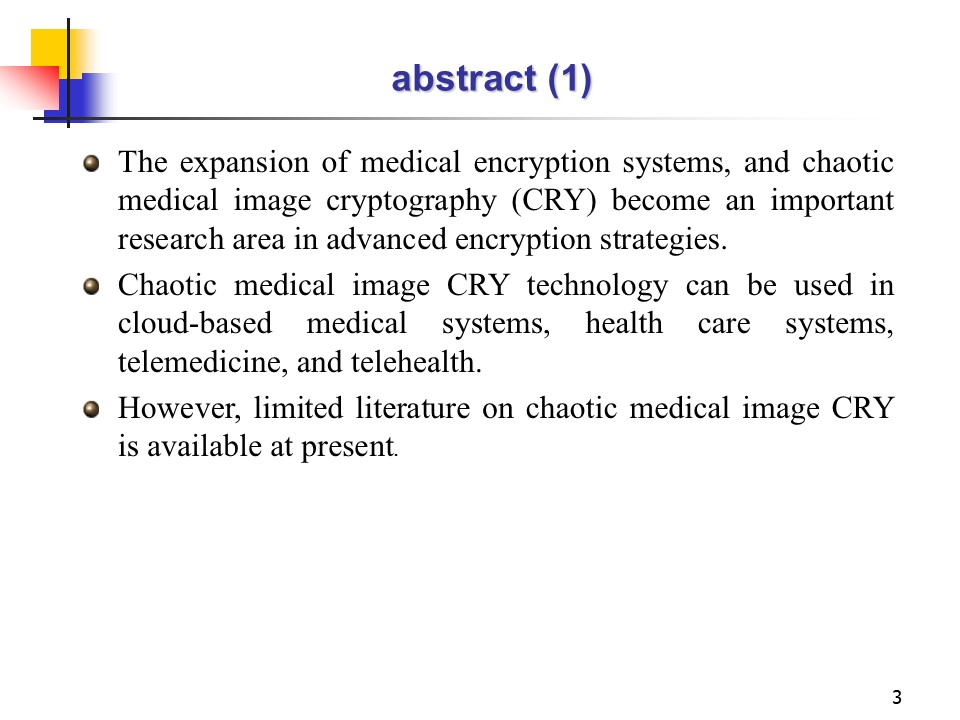 |
The expansion of medical encryption systems, and chaotic medical image cryptography (CRY) become an important research area in advanced encryption strategies.
|
| ICACT20250205 Slide.04
[Big Slide]
[YouTube] |
Chrome Click!! |
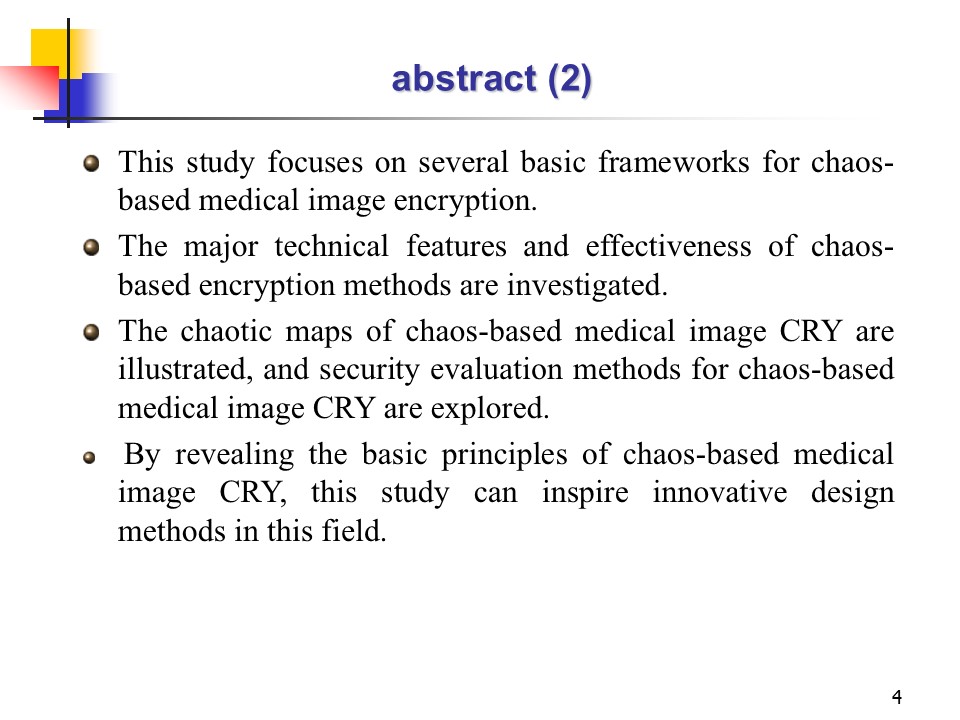 |
This study focuses on several basic frameworks for chaos-based medical image encryption.
The major technical features and effectiveness of chaos-based encryption methods are investigated.
|
| ICACT20250205 Slide.05
[Big Slide]
[YouTube] |
Chrome Click!! |
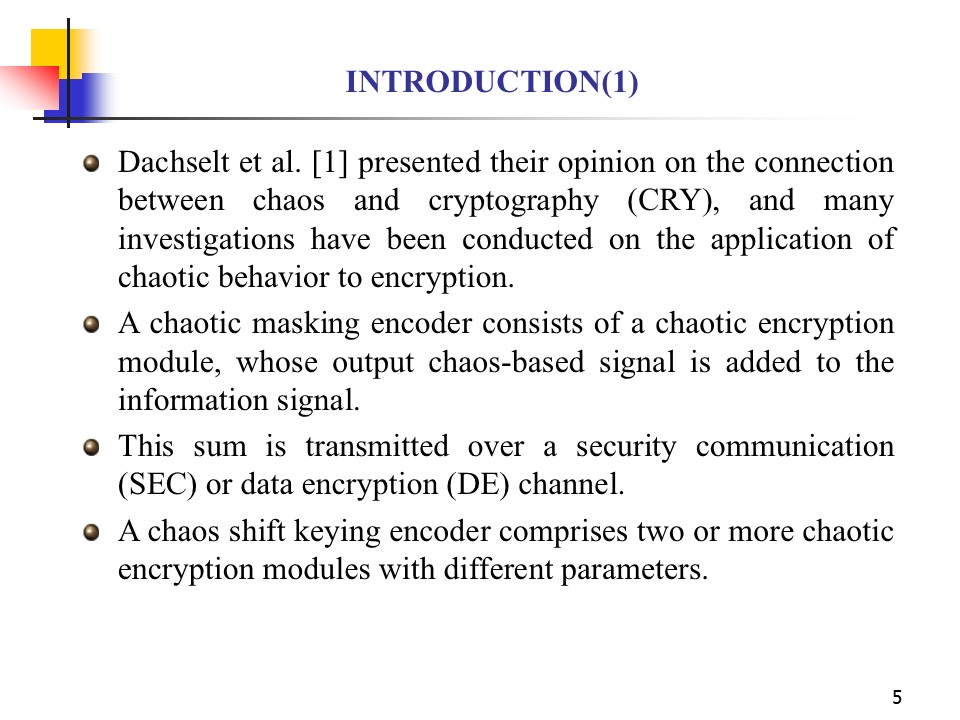 |
Dachselt et al. [1] presented their opinion on the connection between chaos and cryptography (CRY), and many investigations have been conducted on the application of chaotic behavior to encryption.
|
| ICACT20250205 Slide.06
[Big Slide]
[YouTube] |
Chrome Click!! |
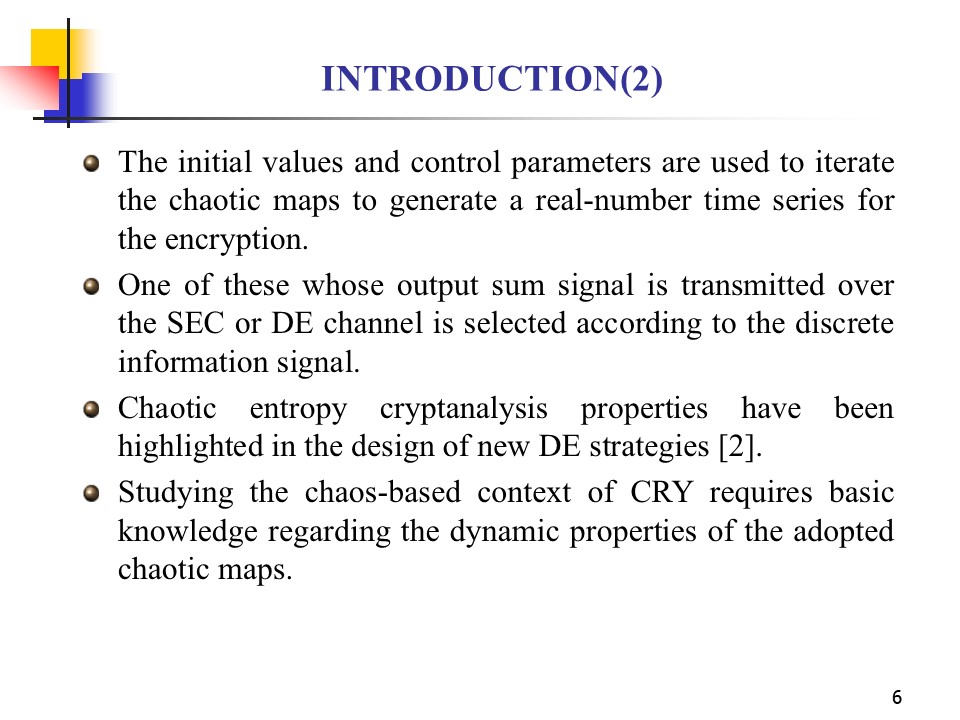 |
The initial values and control parameters are used to iterate the chaotic maps to generate a real-number time series for the encryption.
|
| ICACT20250205 Slide.07
[Big Slide]
[YouTube] |
Chrome Click!! |
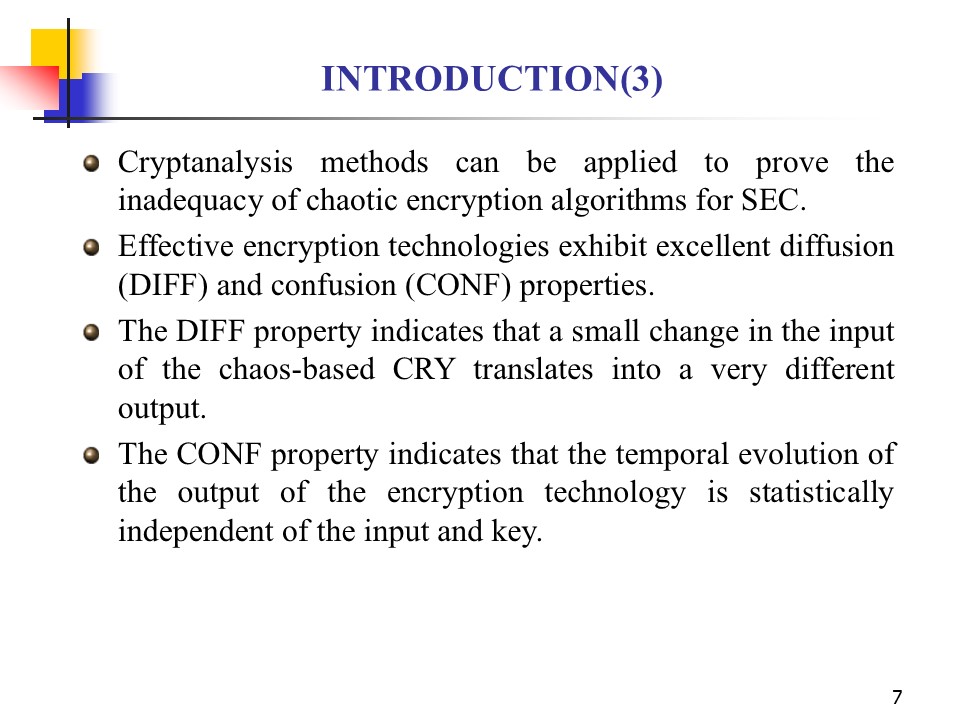 |
Cryptanalysis methods can be applied to prove the inadequacy of chaotic encryption algorithms for SEC.
Effective encryption technologies exhibit excellent diffusion and confusion properties.
|
| ICACT20250205 Slide.08
[Big Slide]
[YouTube] |
Chrome Click!! |
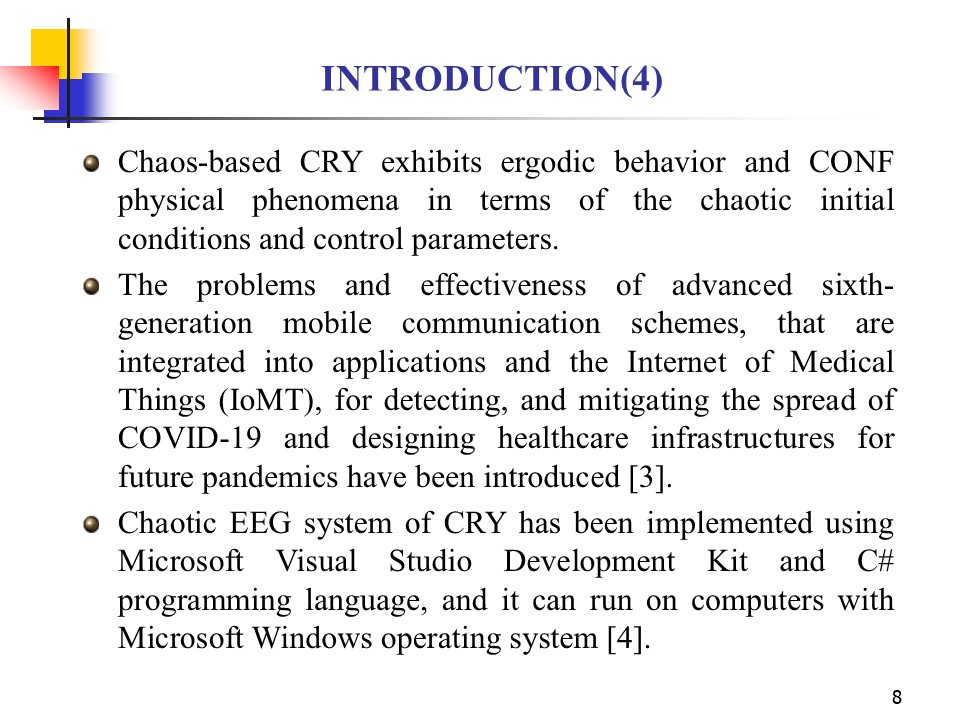 |
Chaos-based CRY exhibits ergodic behavior and CONF physical phenomena in terms of the chaotic initial conditions and control parameters.
|
| ICACT20250205 Slide.09
[Big Slide]
[YouTube] |
Chrome Click!! |
 |
The operations include logistic map (LM), discard, scramble (SCR), exclusive or (XOR), permutation (PER), percent root-mean-square difference (PRD), and time complexity analysis (TCA) parameters of the original and cipher electroencephalography (EEG) signals were explored for differential attack evaluation.
|
| ICACT20250205 Slide.10
[Big Slide]
[YouTube] |
Chrome Click!! |
 |
The aim of CRY design techniques is to provide SEC, as it protects information transmission from attackers, and is a significant aspect of data protection [5].
|
| ICACT20250205 Slide.11
[Big Slide]
[YouTube] |
Chrome Click!! |
 |
Although chaos-based maps can have any number of dimensions, simple chaotic maps can only have one or two dimensions.
|
| ICACT20250205 Slide.12
[Big Slide]
[YouTube] |
Chrome Click!! |
 |
The number of changing pixel rate (NPCR), and unified average changed intensity (UACI) parameters of the original and cipher images were analyzed.
|
| ICACT20250205 Slide.13
[Big Slide]
[YouTube] |
Chrome Click!! |
 |
Researchers need to evaluate vulnerabilities using the key space, key sensitivity, and adjacent correlation coefficient. |
| ICACT20250205 Slide.14
[Big Slide]
[YouTube] |
Chrome Click!! |
 |
Chaotic medical image CRY is a prime research focus worldwide. The medical cloud should be encrypted when the clinical information of patients is stored or transmitted between two medical institutions [9].
|
| ICACT20250205 Slide.15
[Big Slide]
[YouTube] |
Chrome Click!! |
 |
The mean square error, global and local information entropy, and TCA have been used to evaluate the encryption performance.
|
| ICACT20250205 Slide.16
[Big Slide]
[YouTube] |
Chrome Click!! |
 |
Chen et al. [10] developed an adaptive medical image CRY algorithm based on logistic sinusoidal map (LSM) chaotic mapping to increase the robustness of existing chaotic IE technology.
|
| ICACT20250205 Slide.17
[Big Slide]
[YouTube] |
Chrome Click!! |
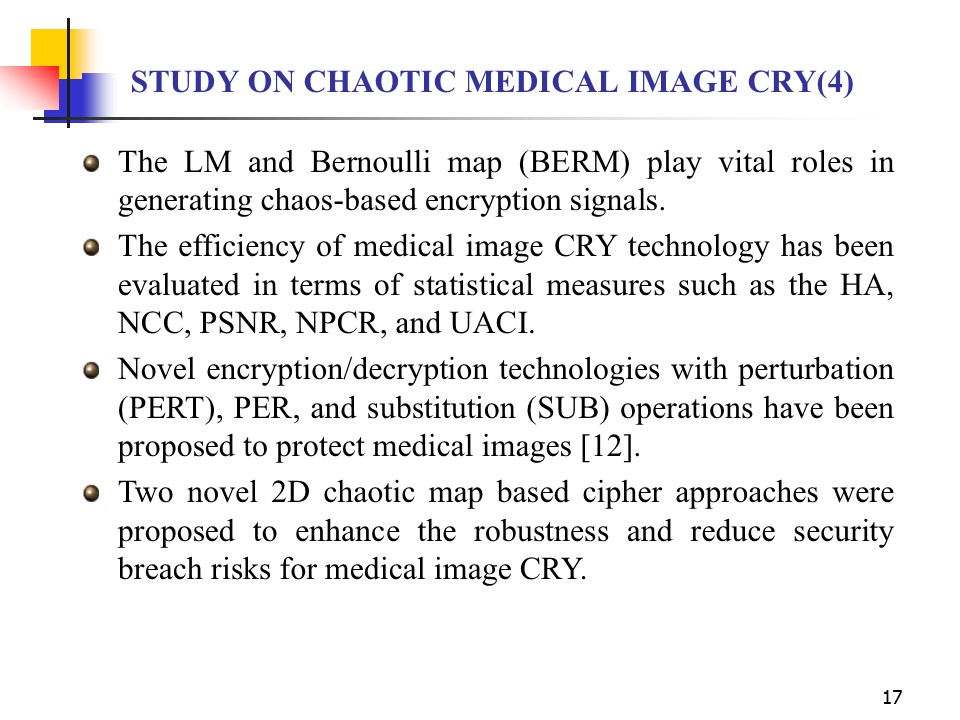 |
The LM and Bernoulli map (BERM) play vital roles in generating chaos-based encryption signals.
|
| ICACT20250205 Slide.18
[Big Slide]
[YouTube] |
Chrome Click!! |
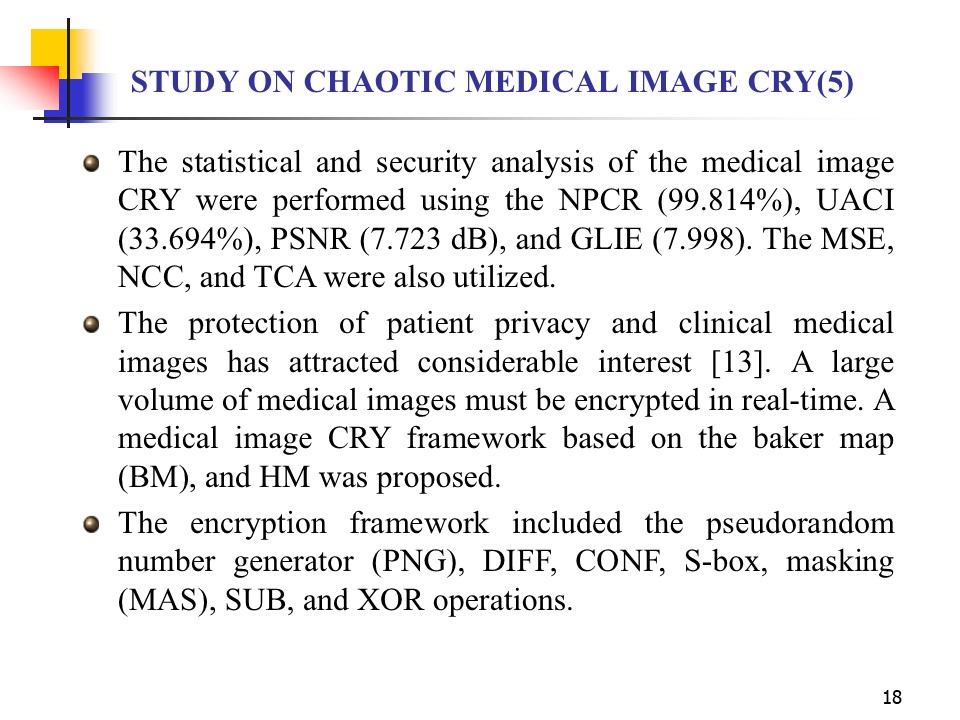 |
The statistical and security analysis of the medical image CRY were performed using the NPCR (99.814%), and UACI (33.694%). |
| ICACT20250205 Slide.19
[Big Slide]
[YouTube] |
Chrome Click!! |
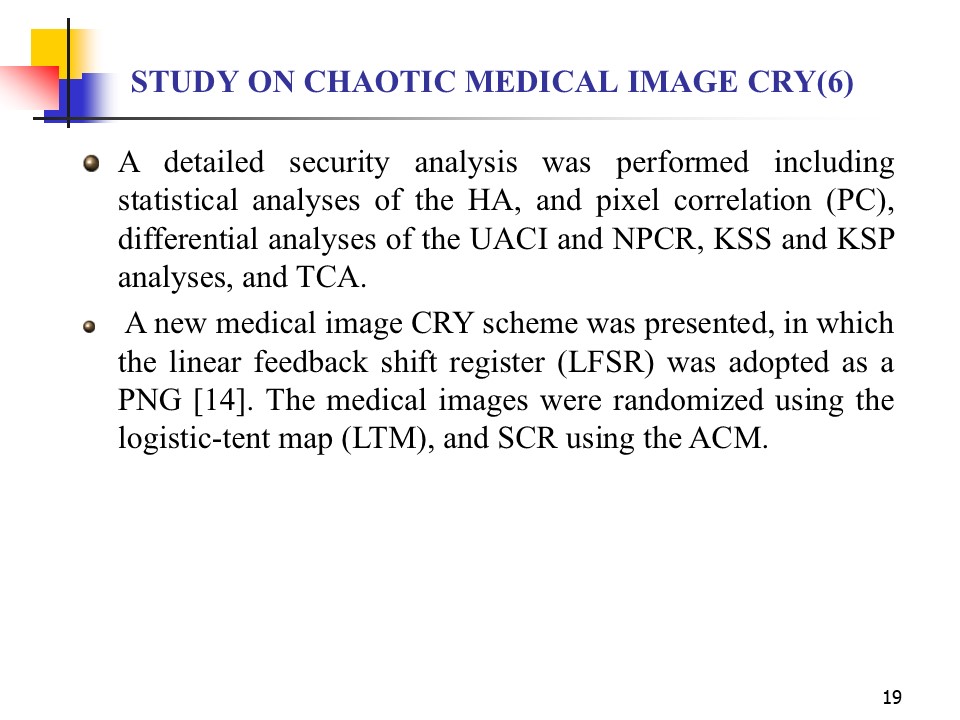 |
A detailed security analysis was performed including statistical analyses of the HA, and pixel correlation. |
| ICACT20250205 Slide.20
[Big Slide]
[YouTube] |
Chrome Click!! |
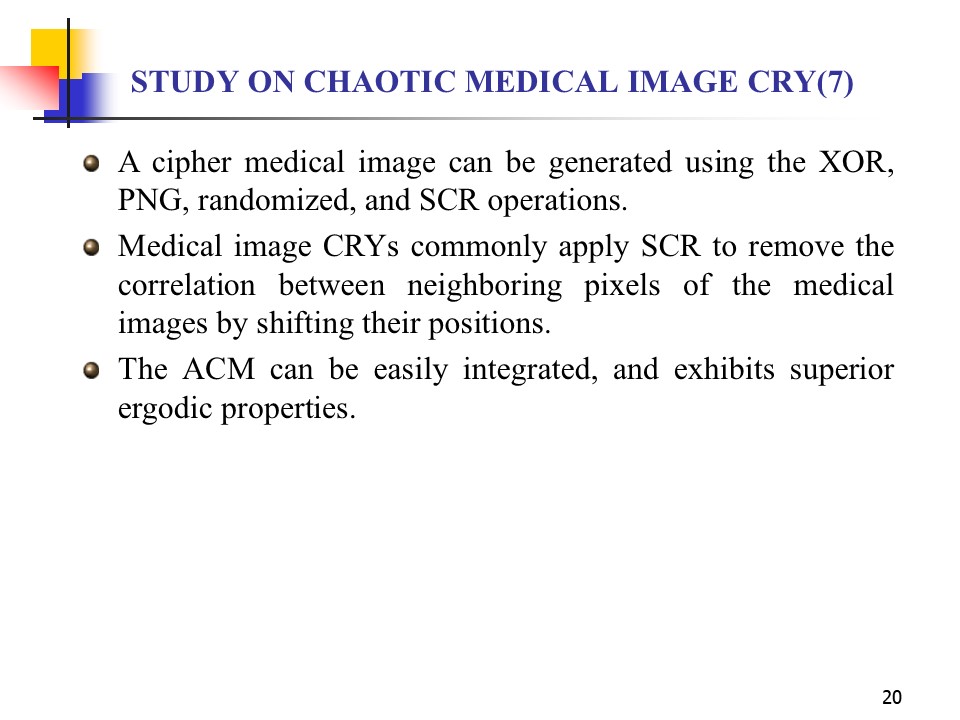 |
A cipher medical image can be generated using the XOR, PNG, randomized, and SCR operations.
|
| ICACT20250205 Slide.21
[Big Slide]
[YouTube] |
Chrome Click!! |
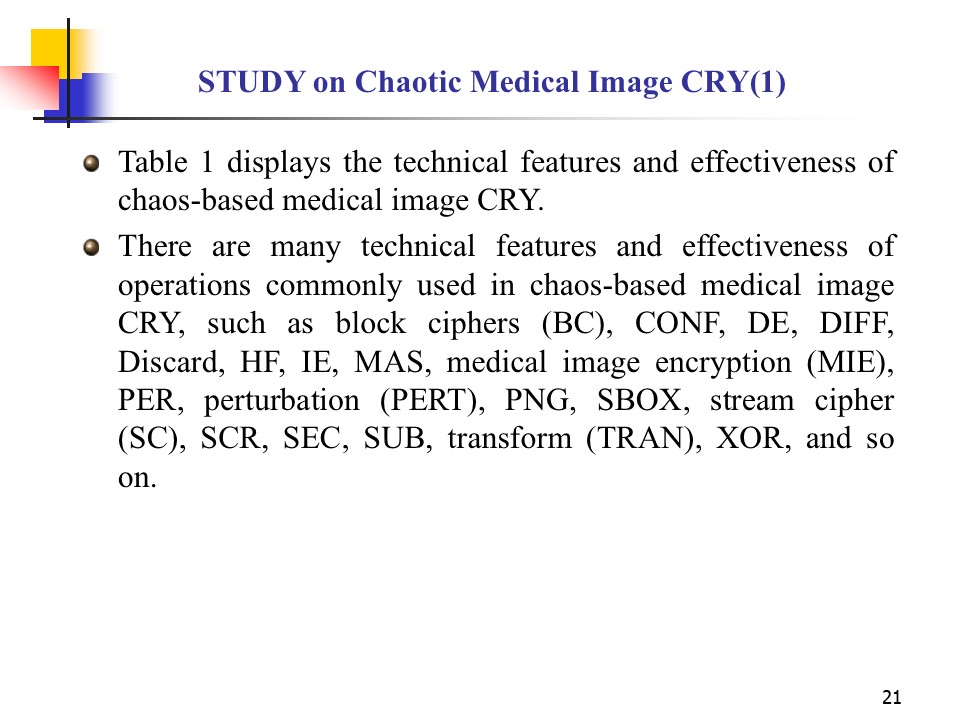 |
There are many technical features and effectiveness of operations commonly used in chaos-based medical image CRY. |
| ICACT20250205 Slide.22
[Big Slide]
[YouTube] |
Chrome Click!! |
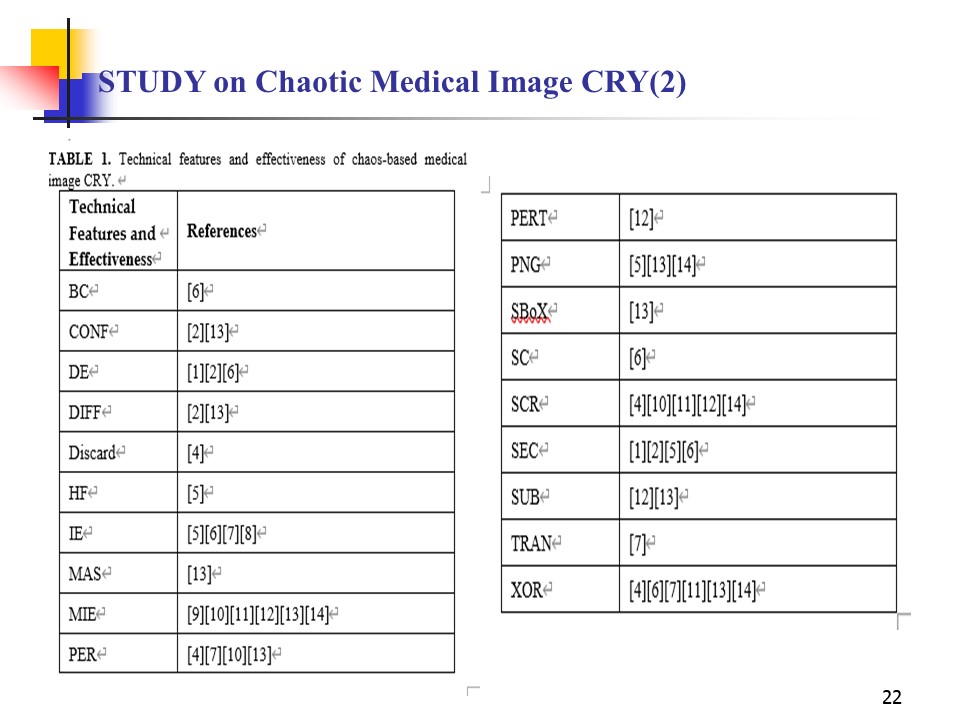 |
Table 1 displays the technical features and effectiveness of chaos-based medical image CRY.
|
| ICACT20250205 Slide.23
[Big Slide]
[YouTube] |
Chrome Click!! |
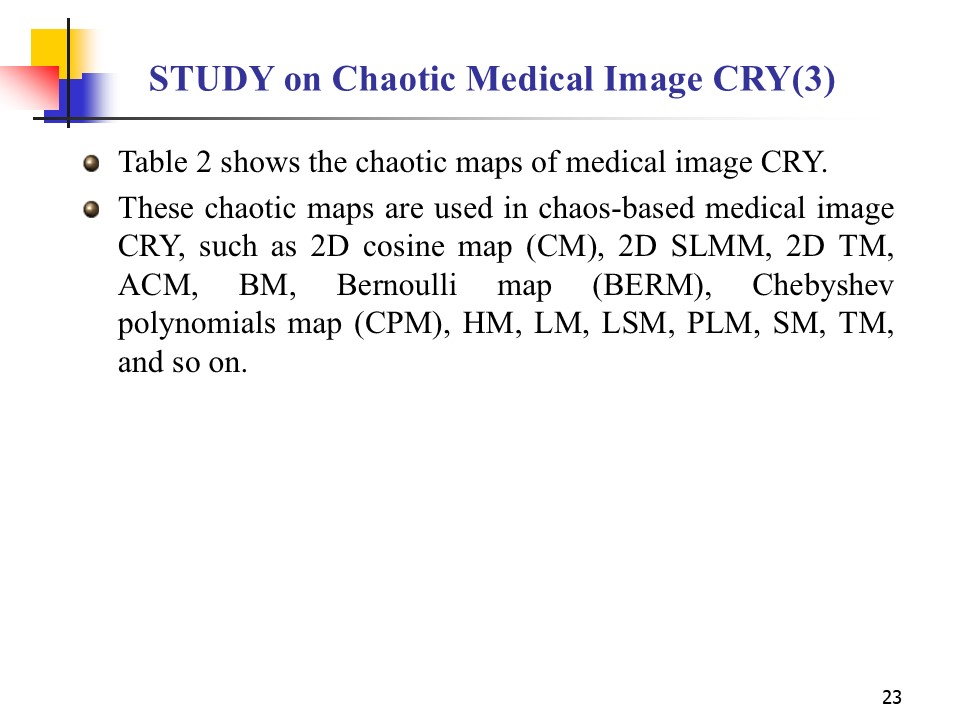 |
These chaotic maps are used in chaos-based medical image CRY.
|
| ICACT20250205 Slide.24
[Big Slide]
[YouTube] |
Chrome Click!! |
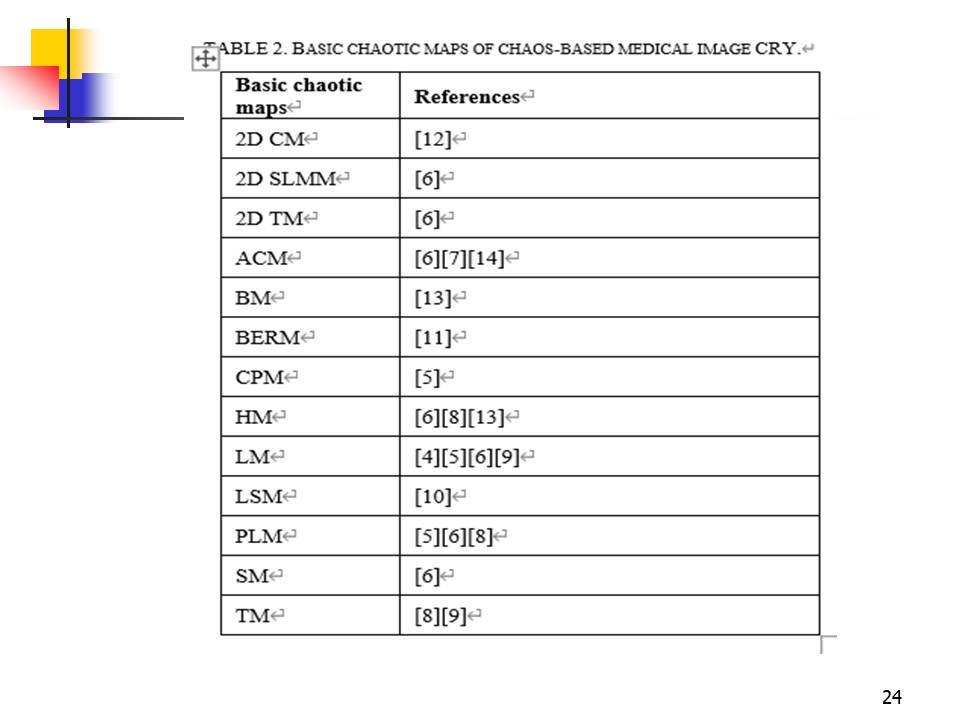 |
Table 2 shows the chaotic maps of medical image CRY.
|
| ICACT20250205 Slide.25
[Big Slide]
[YouTube] |
Chrome Click!! |
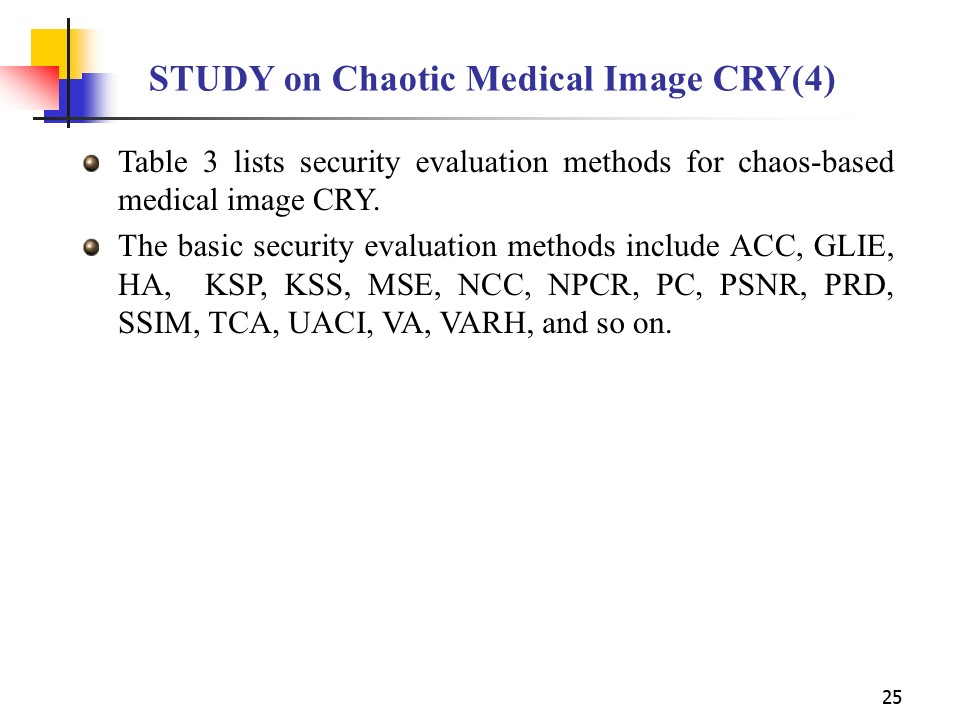 |
The basic security evaluation methods include ACC, GLIE, HA, KSP, and KSS.
|
| ICACT20250205 Slide.26
[Big Slide]
[YouTube] |
Chrome Click!! |
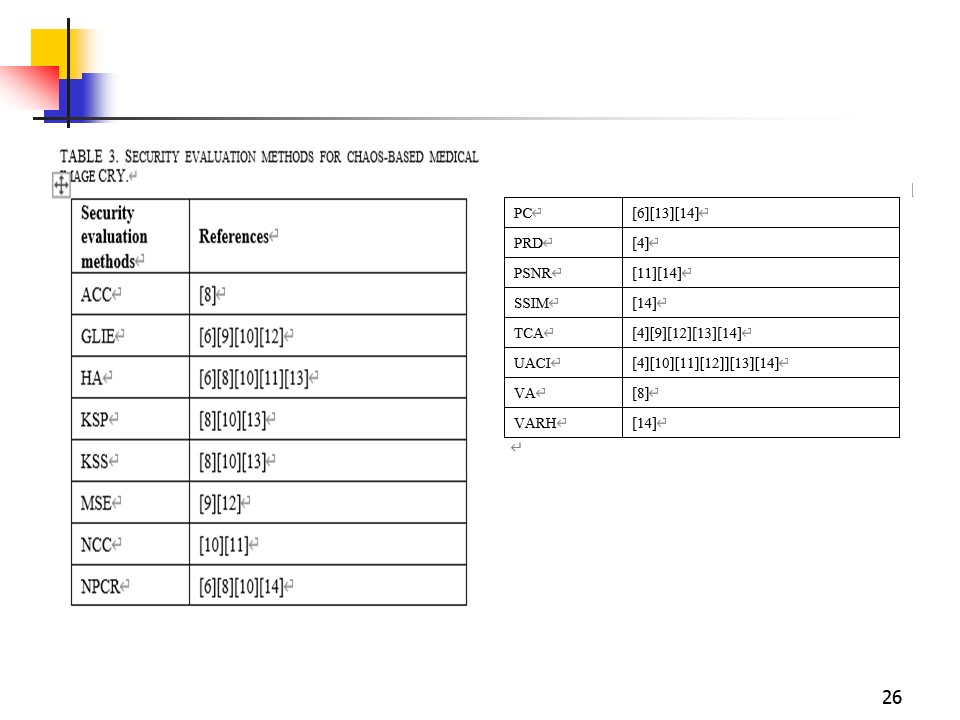 |
Table 3 lists security evaluation methods for chaos-based medical image CRY.
|
| ICACT20250205 Slide.27
[Big Slide]
|
Chrome Click!! |
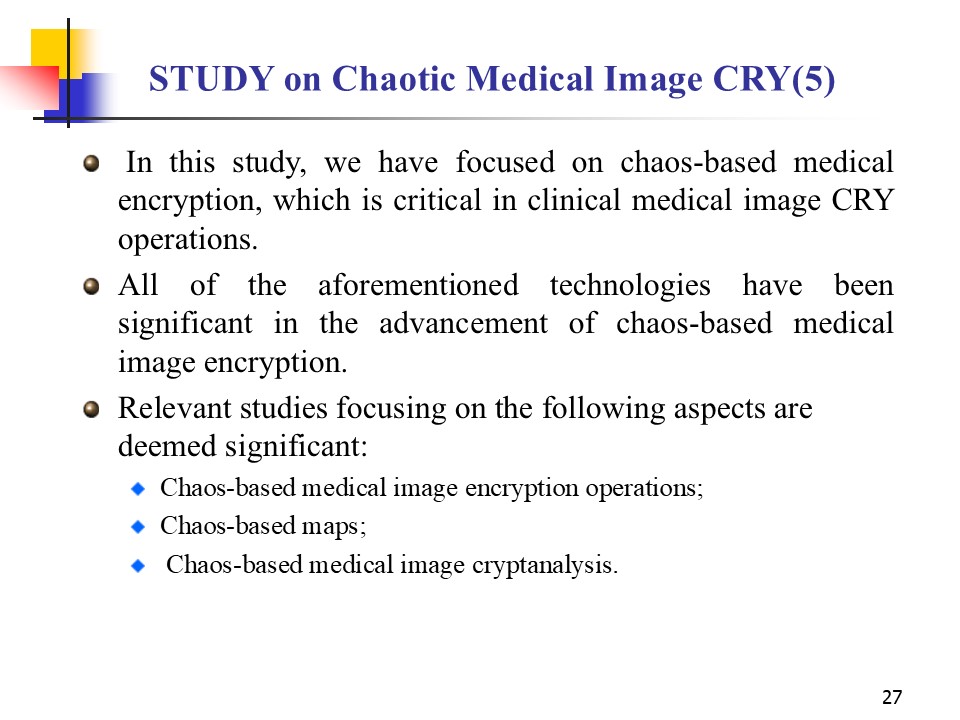 |
In this study, we have focused on chaos-based medical encryption, which is critical in clinical medical image CRY operations.
|
| ICACT20250205 Slide.28
[Big Slide]
[YouTube] |
Chrome Click!! |
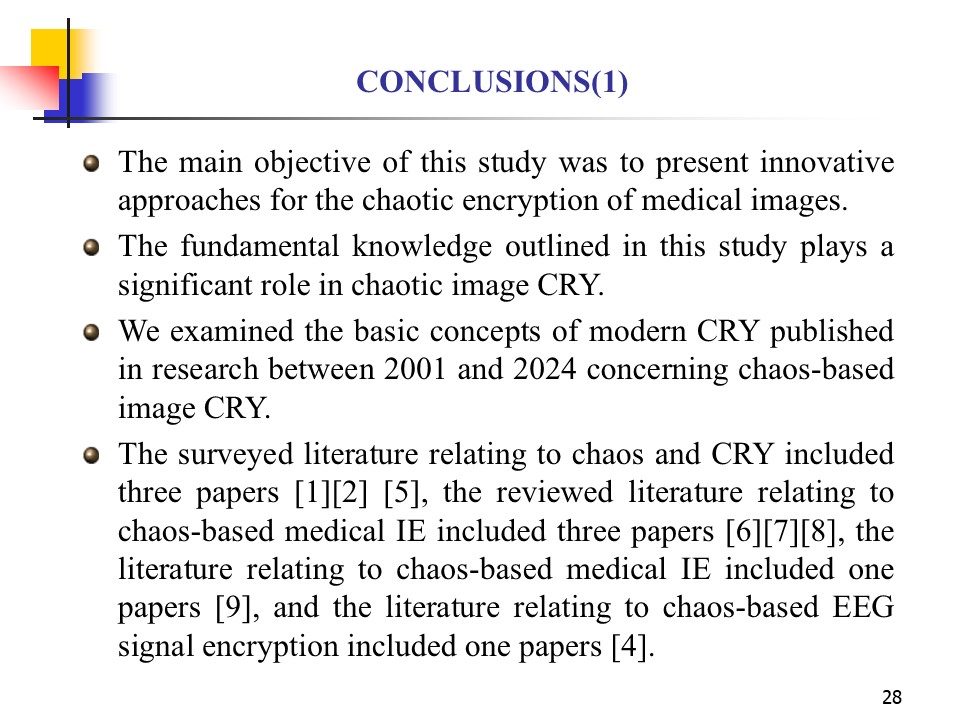 |
The main objective of this study was to present innovative approaches for the chaotic encryption of medical images.
The fundamental knowledge outlined in this study plays a significant role in chaotic image CRY.
|
| ICACT20250205 Slide.29
[Big Slide]
[YouTube] |
Chrome Click!! |
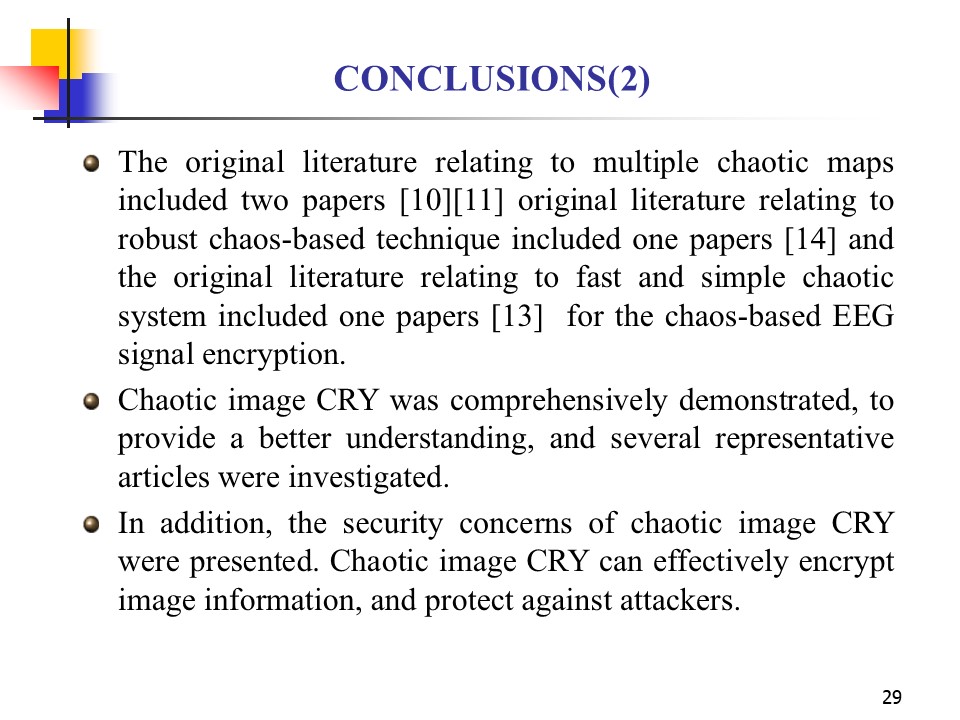 |
The original literature relating to multiple chaotic maps included two papers [10][11] original literature relating to robust chaos-based technique included one papers [14] and the original literature relating to fast and simple chaotic system included one papers [13] for the chaos-based EEG signal encryption.
|
| ICACT20250205 Slide.30
[Big Slide]
[YouTube] |
Chrome Click!! |
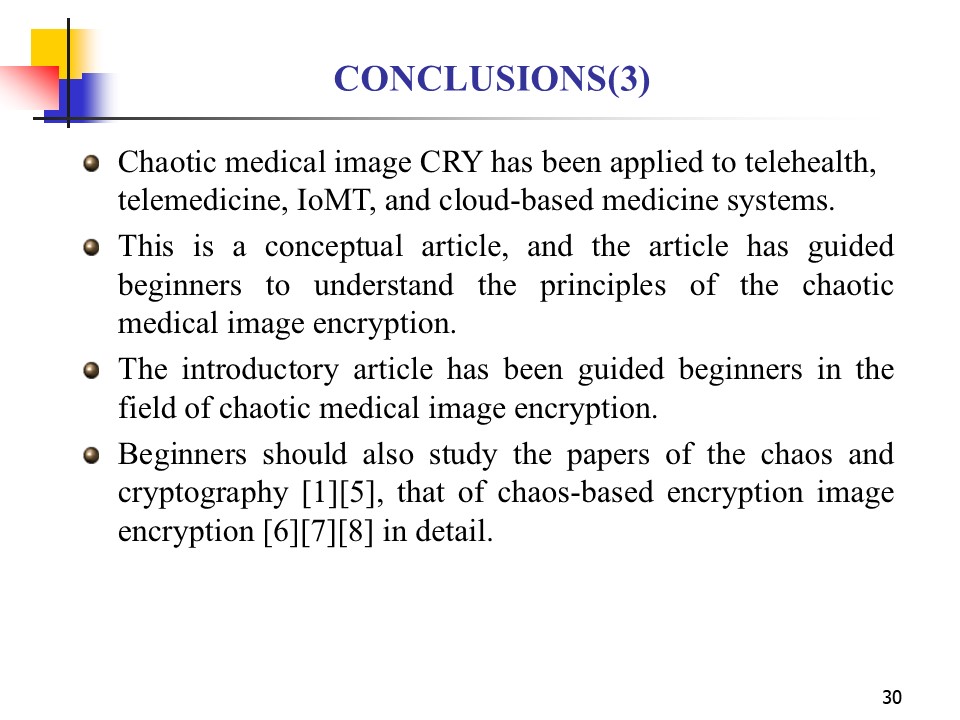 |
Chaotic medical image CRY has been applied to telehealth, telemedicine, IoMT, and cloud-based medicine systems.
|
| ICACT20250205 Slide.31
[Big Slide]
[YouTube] |
Chrome Click!! |
 |
Acknowledgment
The authors acknowledge the valuable comments of the reviewers |
| ICACT20250205 Slide.32
[Big Slide]
[YouTube] |
Chrome Click!! |
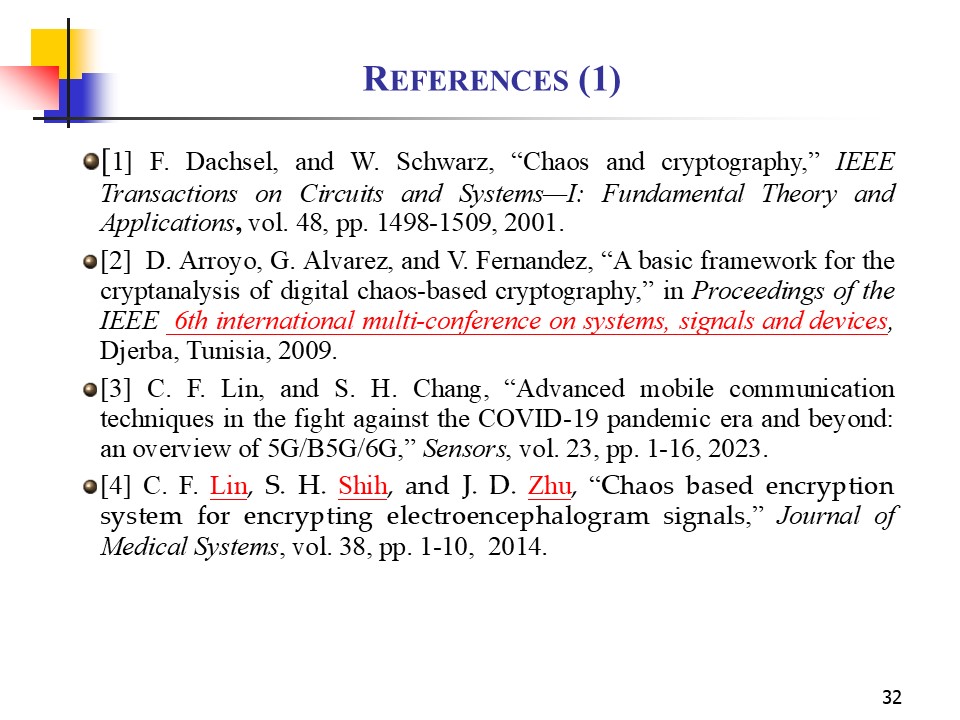 |
1 Chaos and cryptography
2 A basic framework for the cryptanalysis of digital chaos-based cryptography |
| ICACT20250205 Slide.33
[Big Slide]
[YouTube] |
Chrome Click!! |
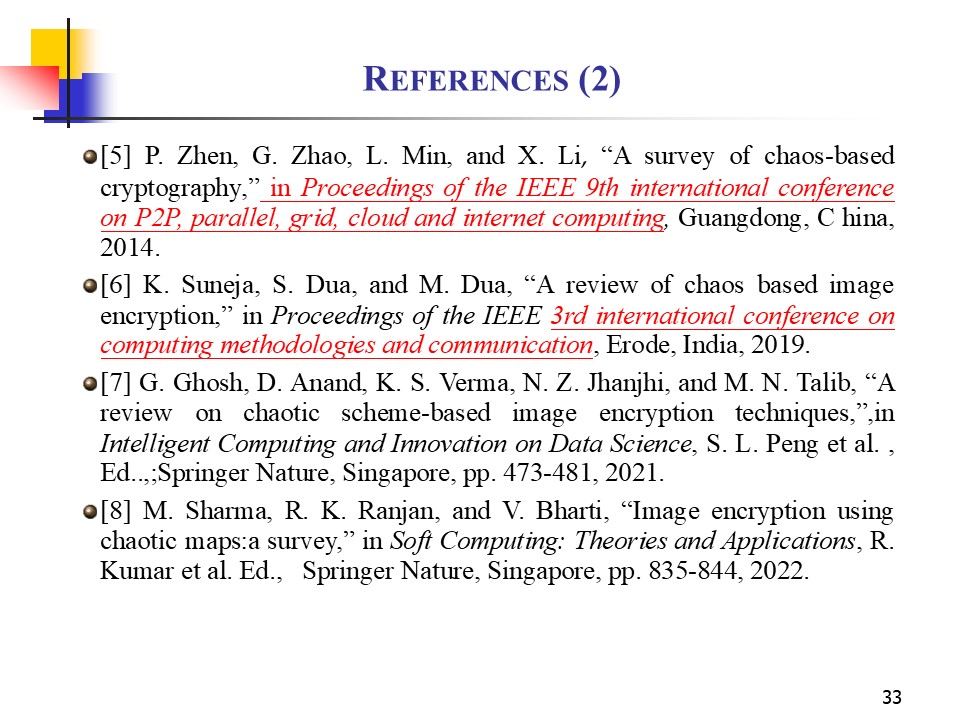 |
5 A survey of chaos-based cryptography
6 A review of chaos based image encryption |
| ICACT20250205 Slide.34
[Big Slide]
[YouTube] |
Chrome Click!! |
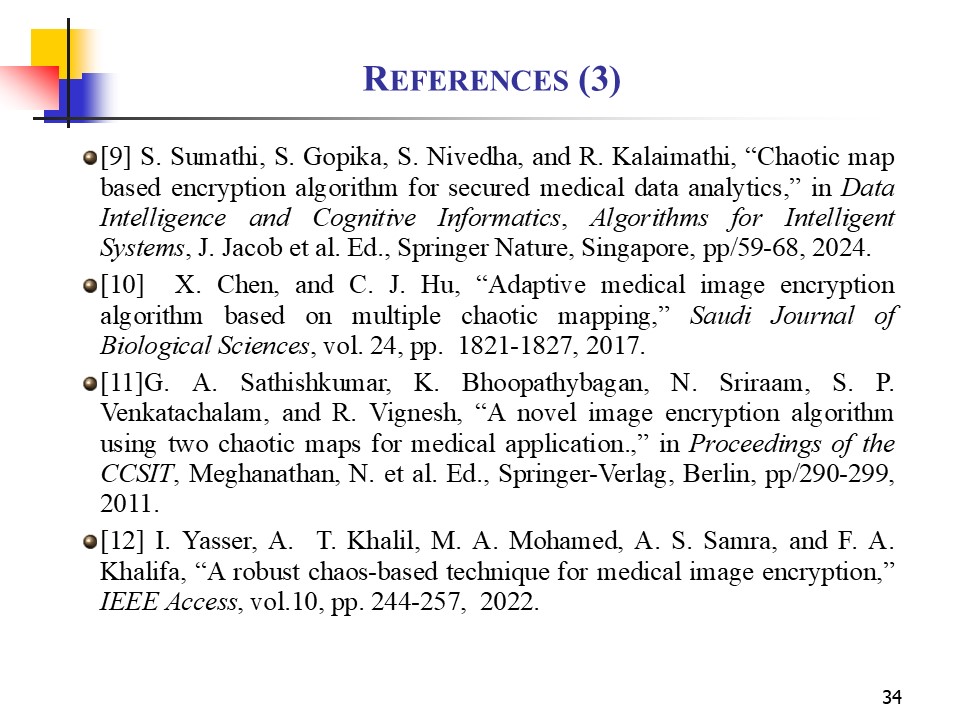 |
9 Chaotic map based encryption algorithm for secured medical data analytics
10 Adaptive medical image encryption algorithm based on multiple chaotic mapping
|
| ICACT20250205 Slide.35
[Big Slide]
[YouTube] |
Chrome Click!! |
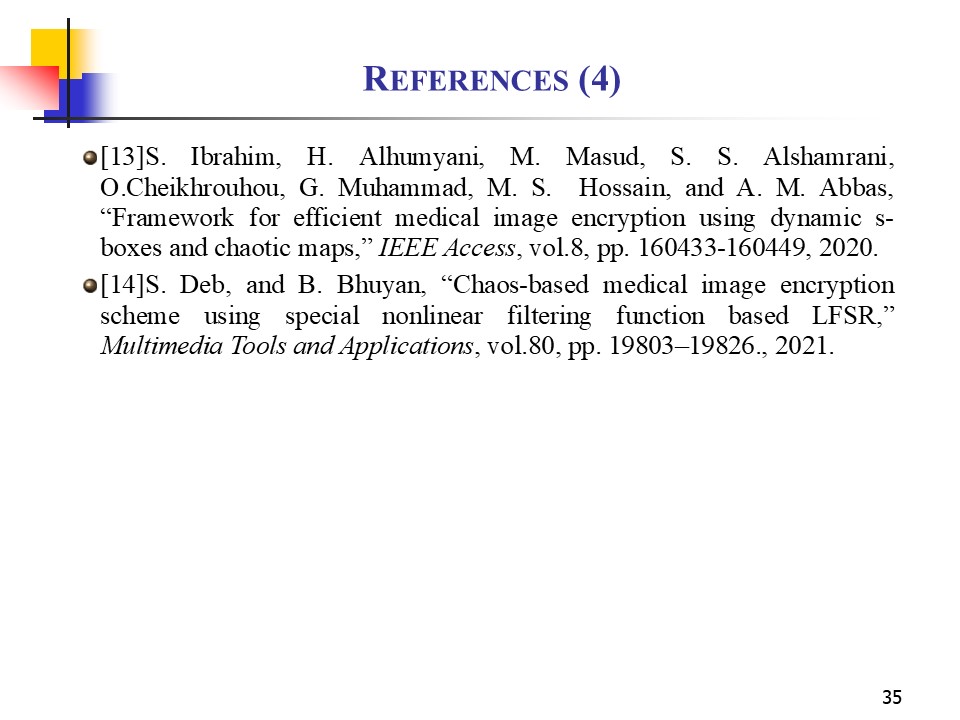 |
13 Framework for efficient medical image encryption using dynamic s-boxes and chaotic maps
14 Chaos-based medical image encryption scheme using special nonlinear filtering function based LFSR |
| ICACT20250205 Slide.36
[Big Slide]
[YouTube] |
Chrome Click!! |
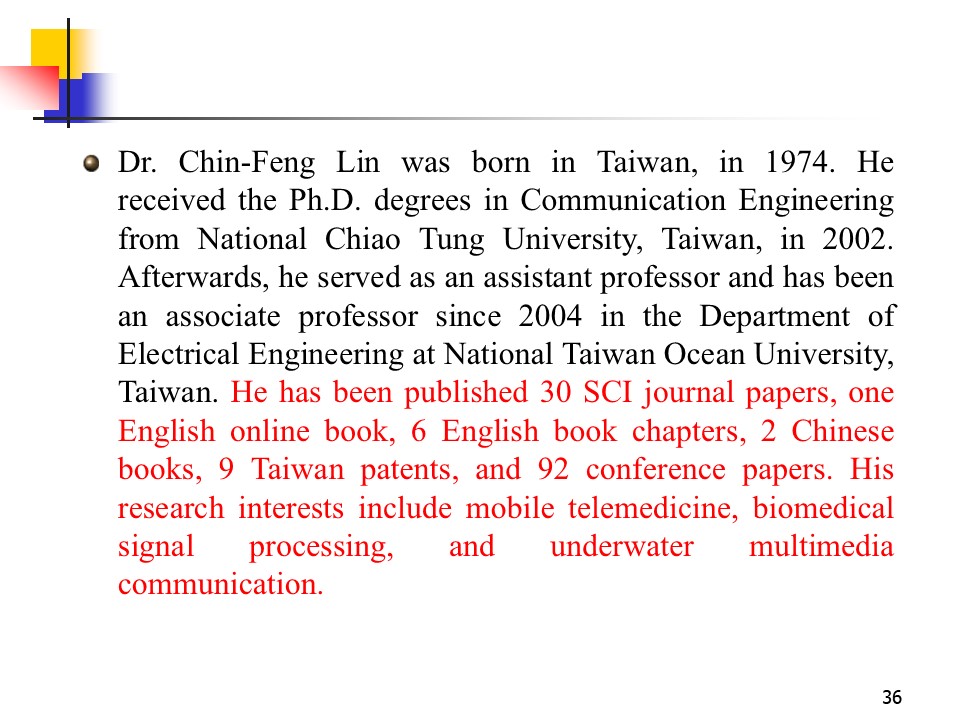 |
Dr. Chin-Feng Lin has been published 30 SCI journal papers,
and 92 conference papers. His research interests include mobile telemedicine, and biomedical signal processing.
|
| ICACT20250205 Slide.37
[Big Slide]
[YouTube] |
Chrome Click!! |
 |
Yan-Xuan Lin's research interests include biomedical signal processing, and mobile telemedicine.
|















