 ICACT20260040 Slide.01
[Big Slide] |
Chrome  Click!! |
 |
My research topic is "Modeling Spatiotemporal Patterns for Next-POI Recommendation: A Unified Approach Using Graph Embedding and Self-Attention" |
| ICACT20260040 Slide.02
[Big Slide]
|
Chrome Click!! |
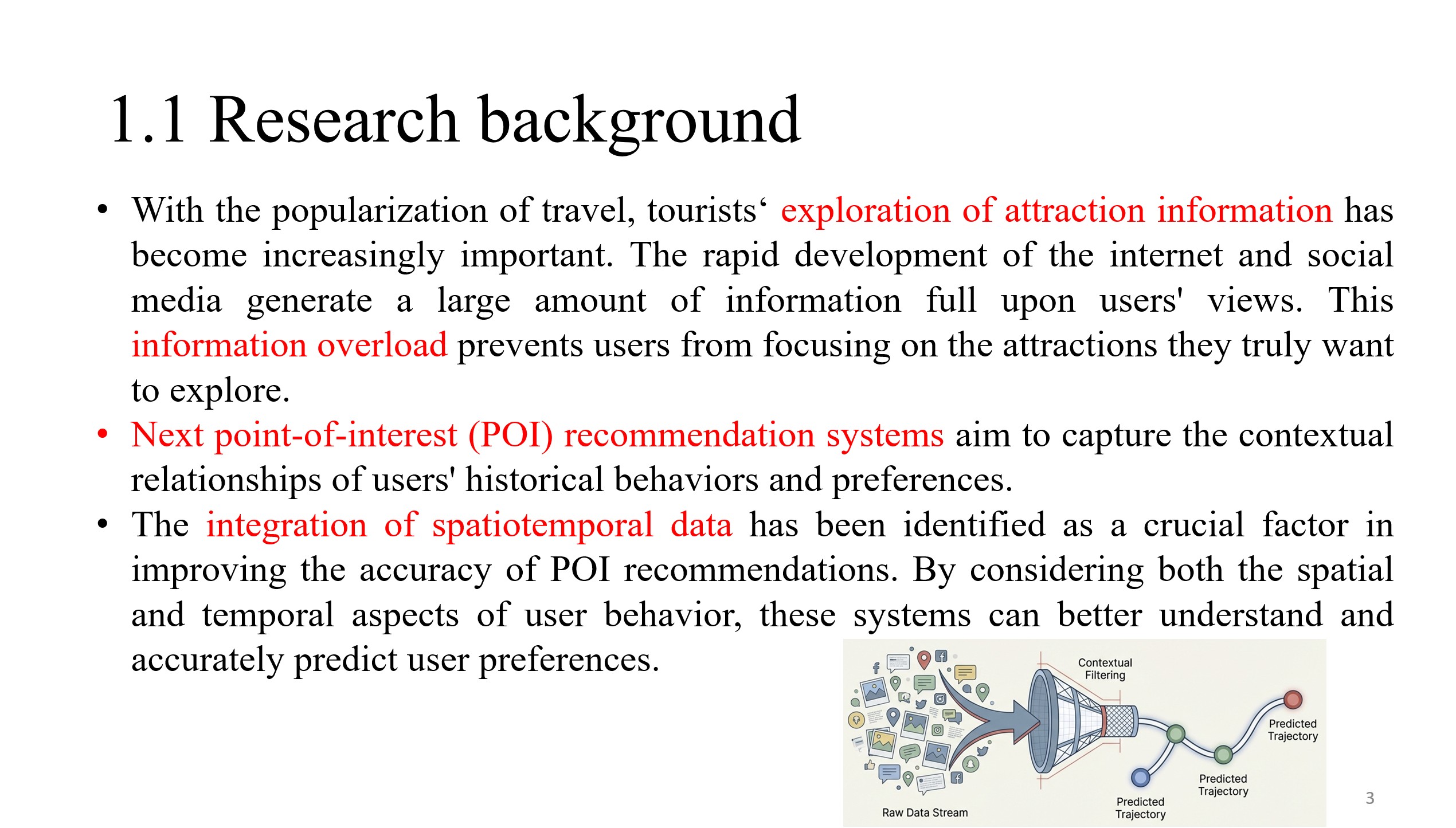 |
With the popularization of travel, tourists‘ exploration of attraction information has become increasingly important.
Next point-of-interest (POI) recommendation systems aim to capture the contextual relationships of users historical behaviors and preferences.
The integration of spatiotemporal data has been identified as a crucial factor in improving the accuracy of POI recommendations. By considering both the spatial and temporal aspects of user behavior, these systems can better understand and accurately predict user preferences.
|
| ICACT20260040 Slide.03
[Big Slide]
|
Chrome Click!! |
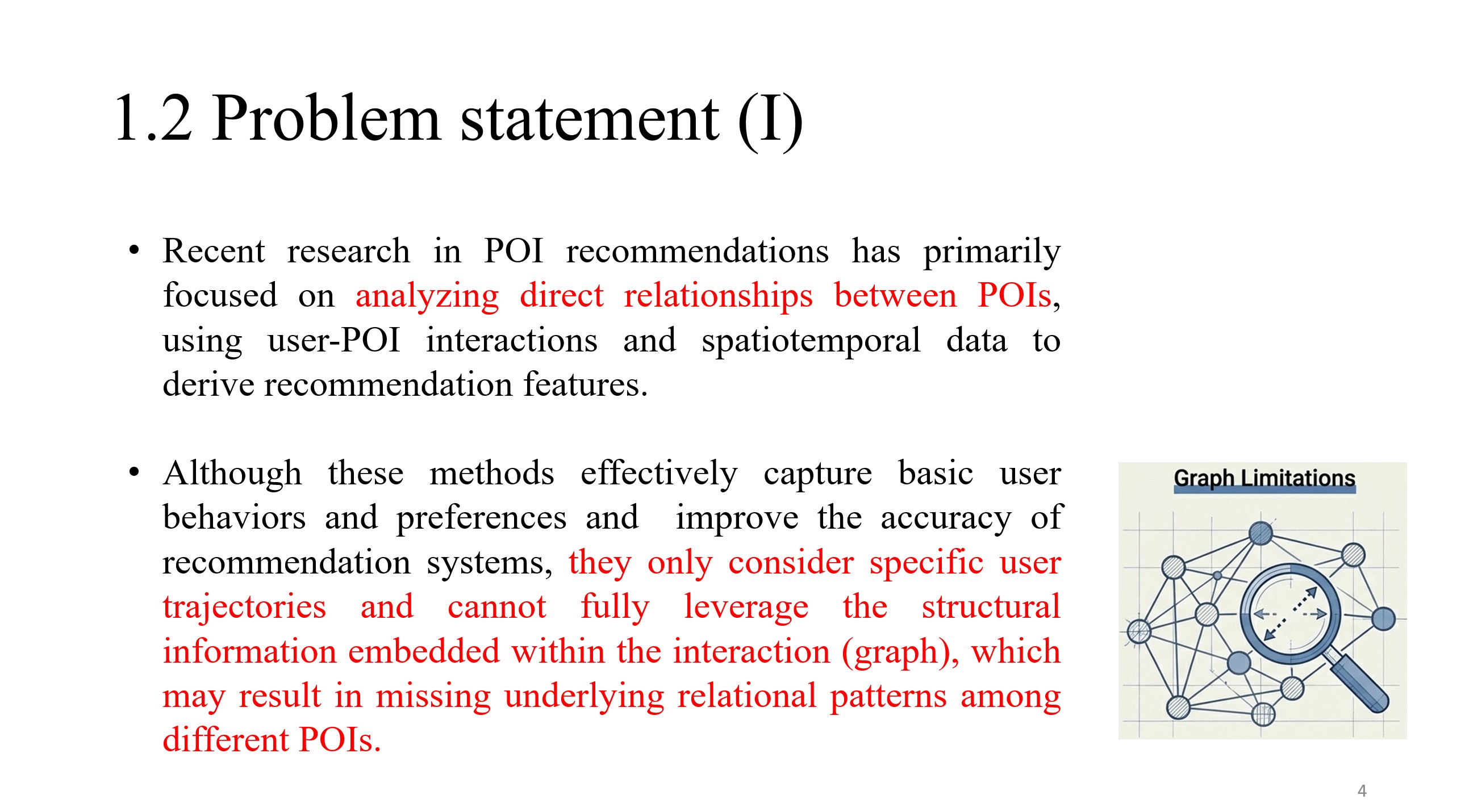 |
Although these methods effectively capture basic user behaviors and preferences and improve the accuracy of recommendation systems, they only consider specific user trajectories and cannot fully leverage the structural information embedded within the interaction (graph), which may result in missing underlying relational patterns among different POIs.
|
| ICACT20260040 Slide.04
[Big Slide]
|
Chrome Click!! |
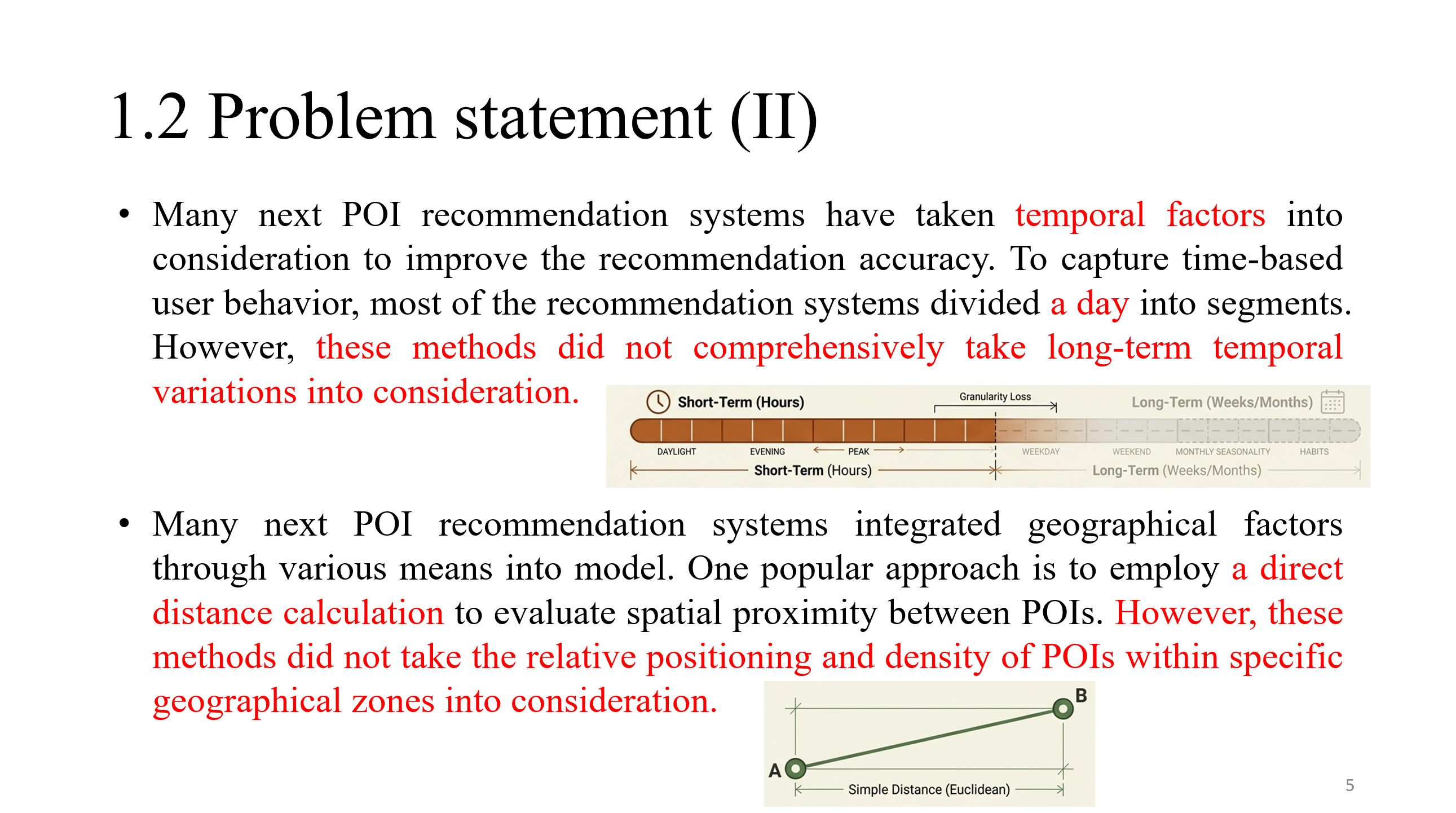 |
Many next POI recommendation systems have taken temporal factors into consideration to improve the recommendation accuracy. To capture time-based user behavior, most of the recommendation systems divided a day into segments. However, these methods did not comprehensively take long-term temporal variations into consideration.
Many next POI recommendation systems integrated geographical factors through various means into model. One popular approach is to employ a direct distance calculation to evaluate spatial proximity between POIs. However, these methods did not take the relative positioning and density of POIs within specific geographical zones into consideration.
|
| ICACT20260040 Slide.05
[Big Slide]
|
Chrome Click!! |
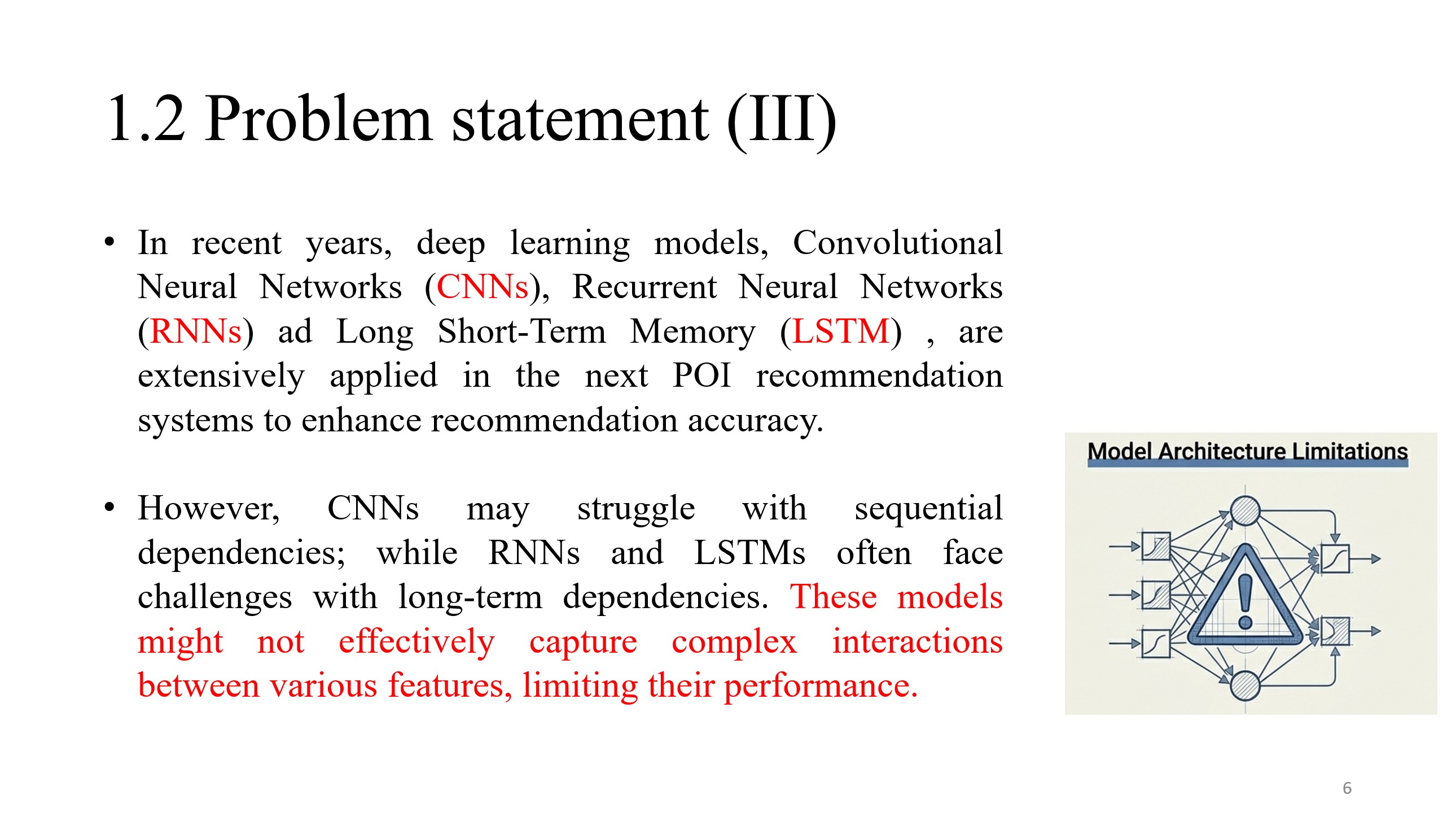 |
However, CNNs may struggle with sequential dependencies; while RNNs and LSTMs often face challenges with long-term dependencies. These models might not effectively capture complex interactions between various features, limiting their performance.
|
| ICACT20260040 Slide.06
[Big Slide]
|
Chrome Click!! |
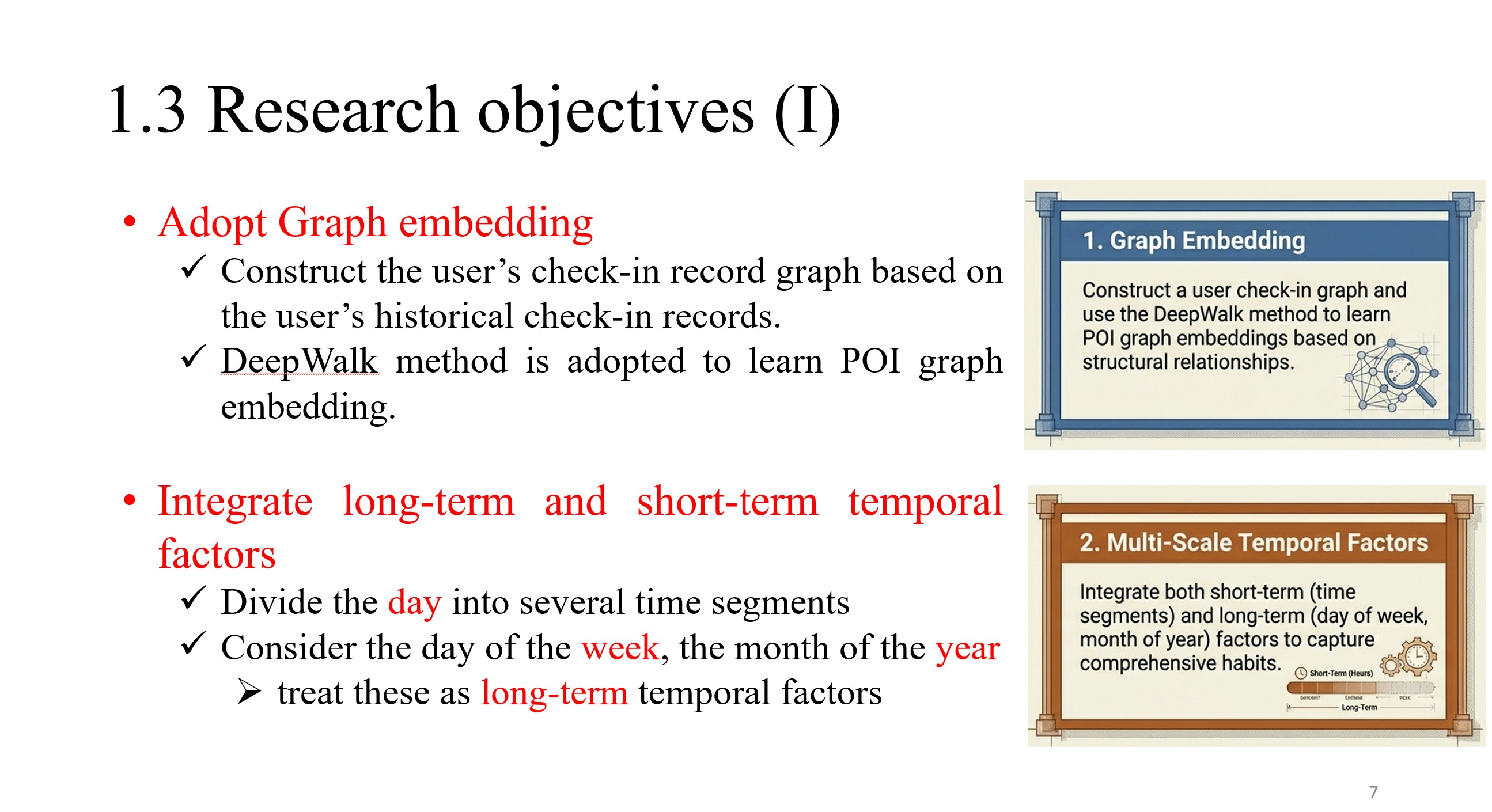 |
Adopt Graph embedding
Construct the user’s check-in record graph based on the user’s historical check-in records.
DeepWalk method is adopted to learn POI graph embedding.
Integrate long-term and short-term temporal factors
Divide the day into several time segments
Consider the day of the week, the month of the year
treat these as long-term temporal factors
|
| ICACT20260040 Slide.07
[Big Slide]
|
Chrome Click!! |
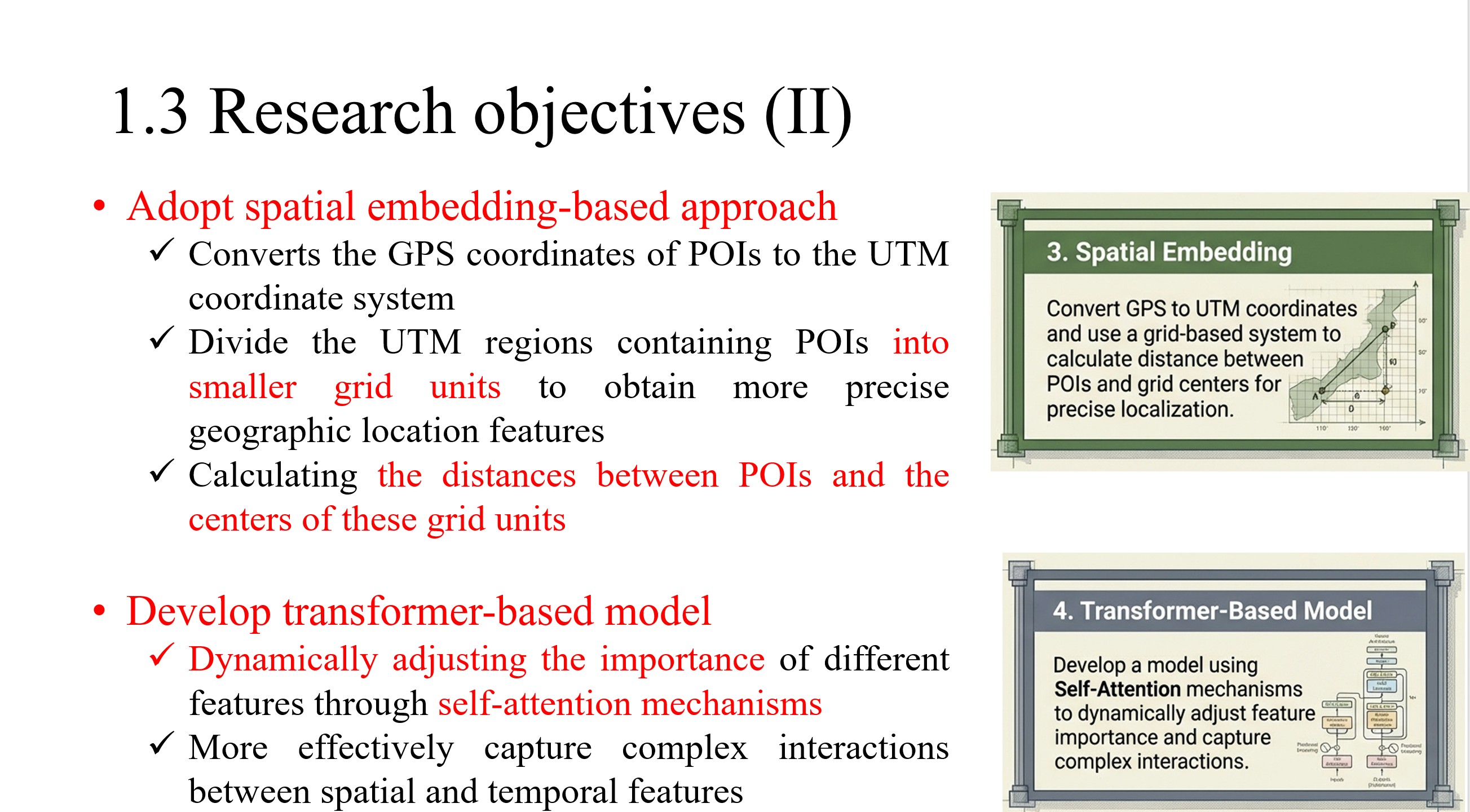 |
Adopt spatial embedding-based approach
Converts the GPS coordinates of POIs to the UTM coordinate system
Divide the UTM regions containing POIs into smaller grid units to obtain more precise geographic location features
Calculating the distances between POIs and the centers of these grid units
Develop transformer-based model
Dynamically adjusting the importance of different features through self-attention mechanisms
More effectively capture complex interactions between spatial and temporal features
|
| ICACT20260040 Slide.08
[Big Slide]
|
Chrome Click!! |
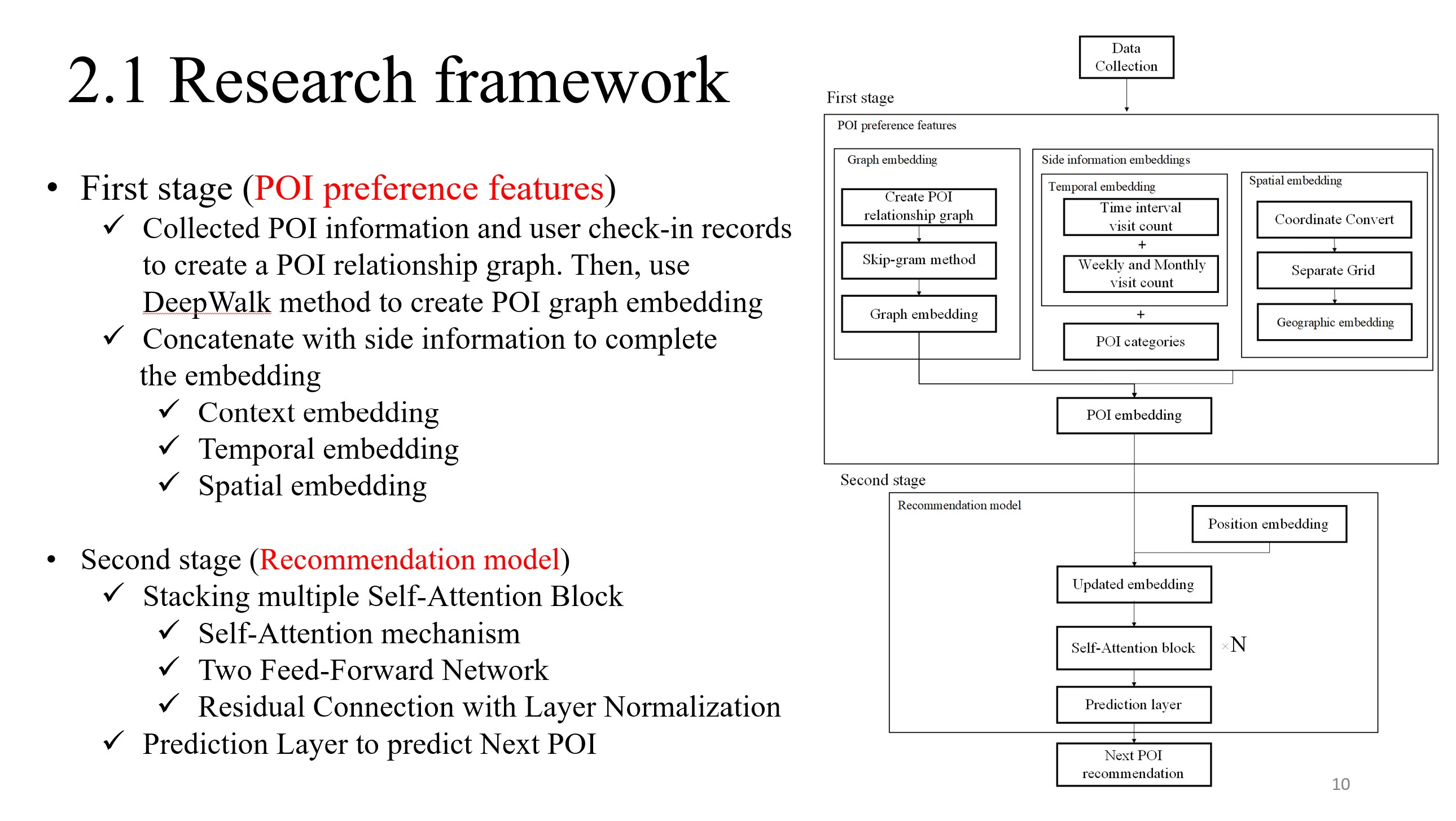 |
First stage (POI preference features)
Collected POI information and user check-in records to create a POI relationship graph. Then, use DeepWalk method to create POI graph embedding
Concatenate with side information to complete the embedding
Context embedding
Temporal embedding
Spatial embedding
Second stage (Recommendation model)
Stacking multiple Self-Attention Block
Self-Attention mechanism
Two Feed-Forward Network
Residual Connection with Layer Normalization
Prediction Layer to predict Next POI
|
| ICACT20260040 Slide.09
[Big Slide]
|
Chrome Click!! |
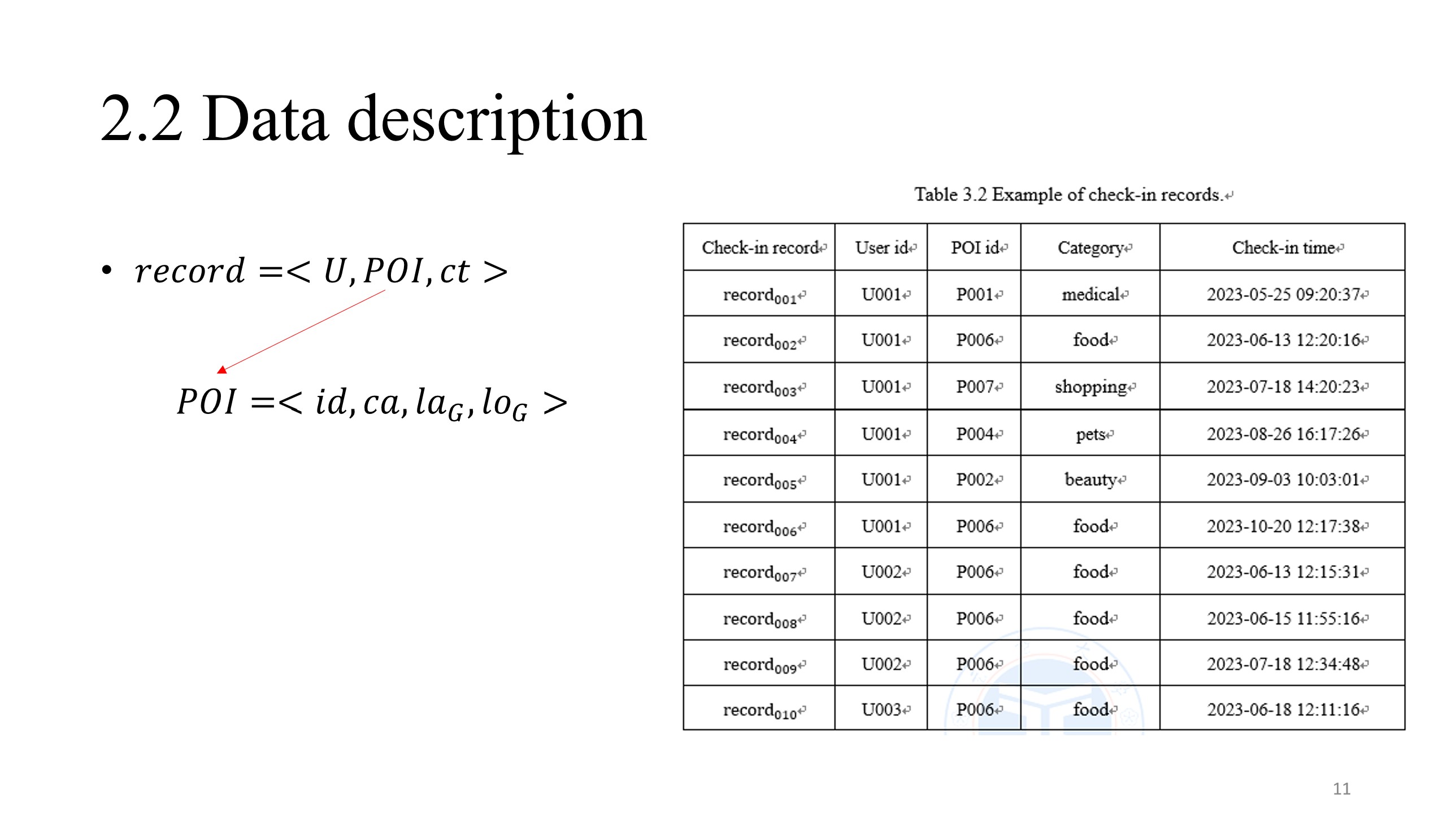 |
Data description |
| ICACT20260040 Slide.10
[Big Slide]
|
Chrome Click!! |
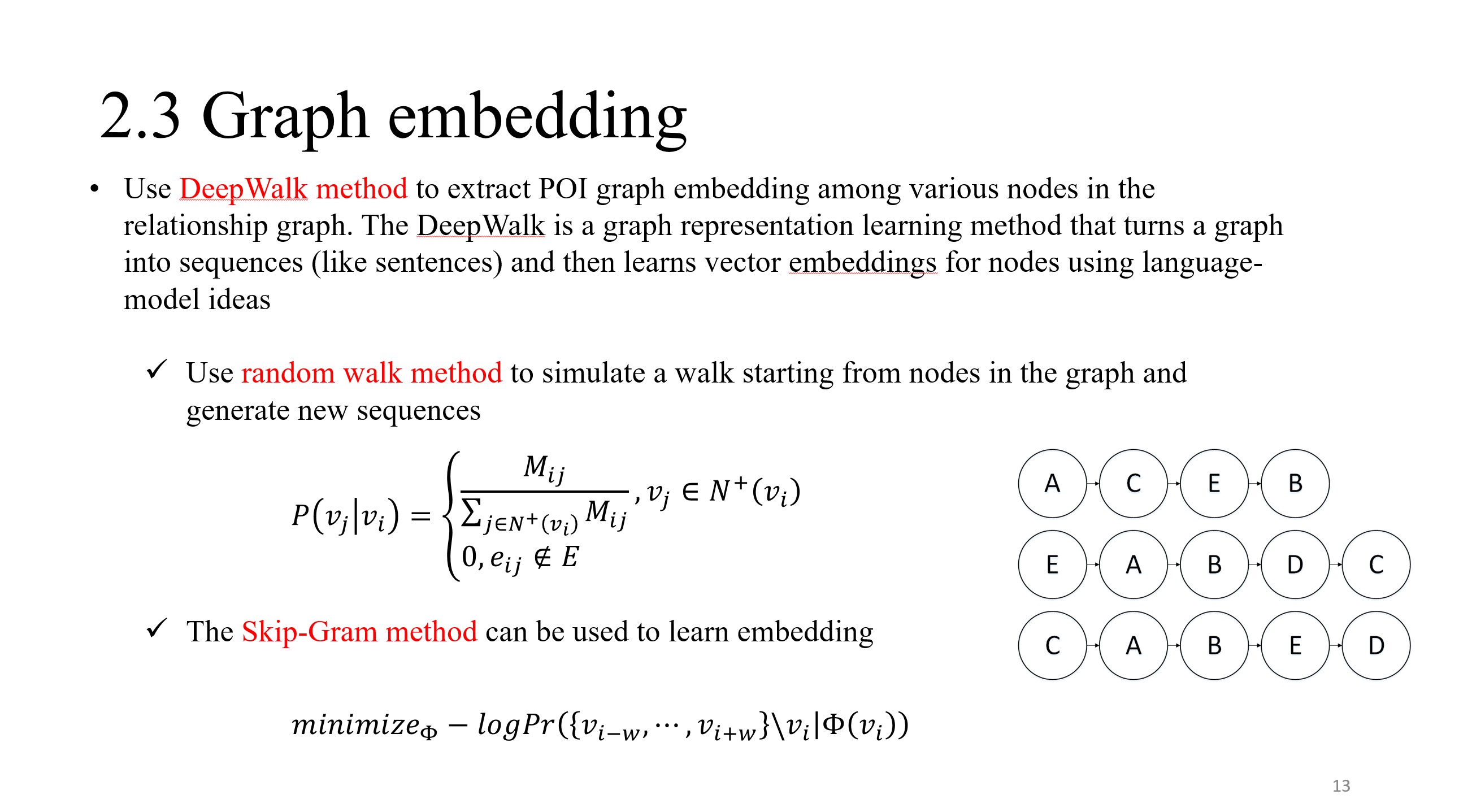 |
Use DeepWalk method to extract POI graph embedding among various nodes in the relationship graph. The DeepWalk is a graph representation learning method that turns a graph into sequences (like sentences) and then learns vector embeddings for nodes using language-model ideas
|
| ICACT20260040 Slide.11
[Big Slide]
|
Chrome Click!! |
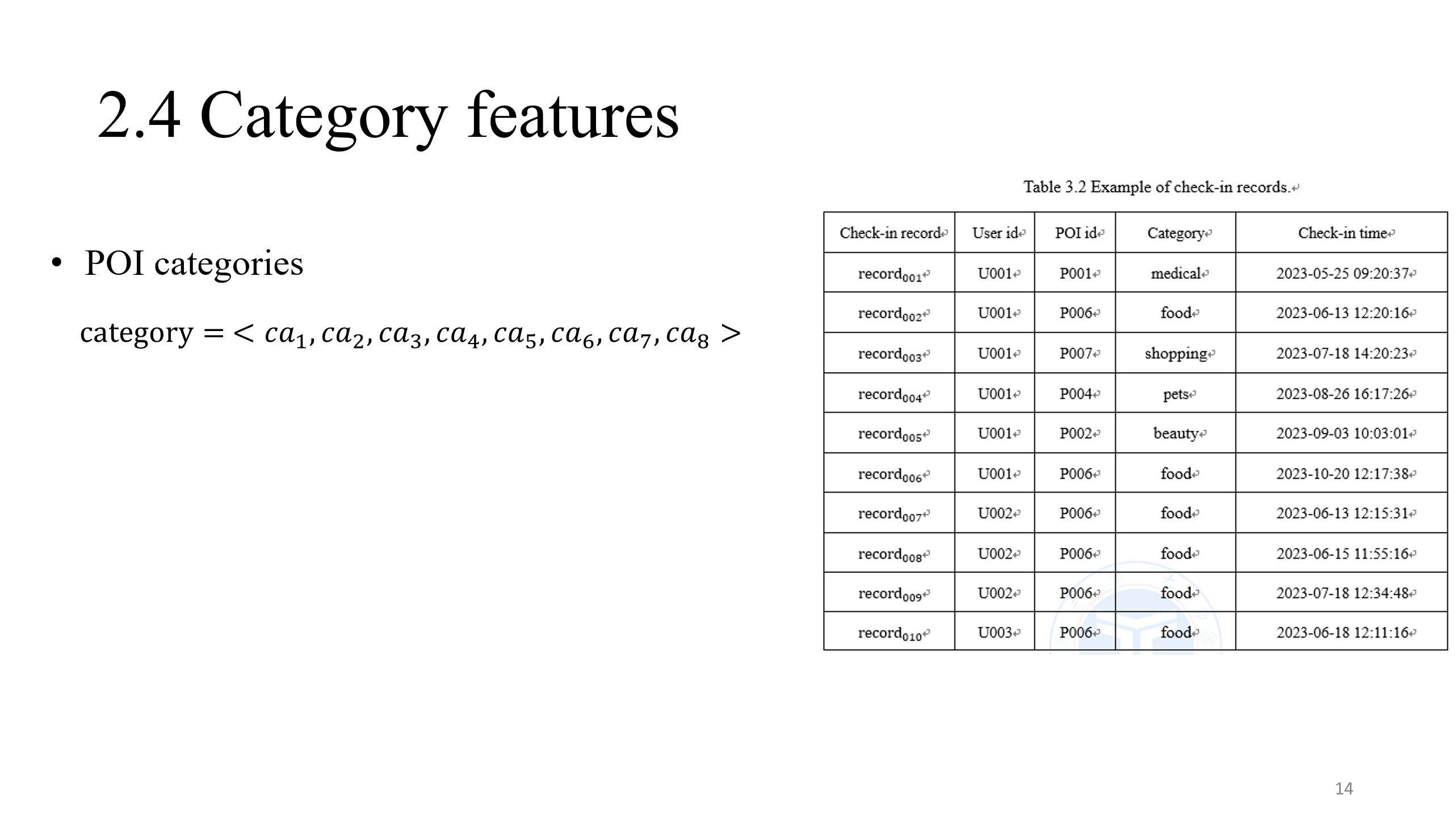 |
Category features |
| ICACT20260040 Slide.12
[Big Slide]
|
Chrome Click!! |
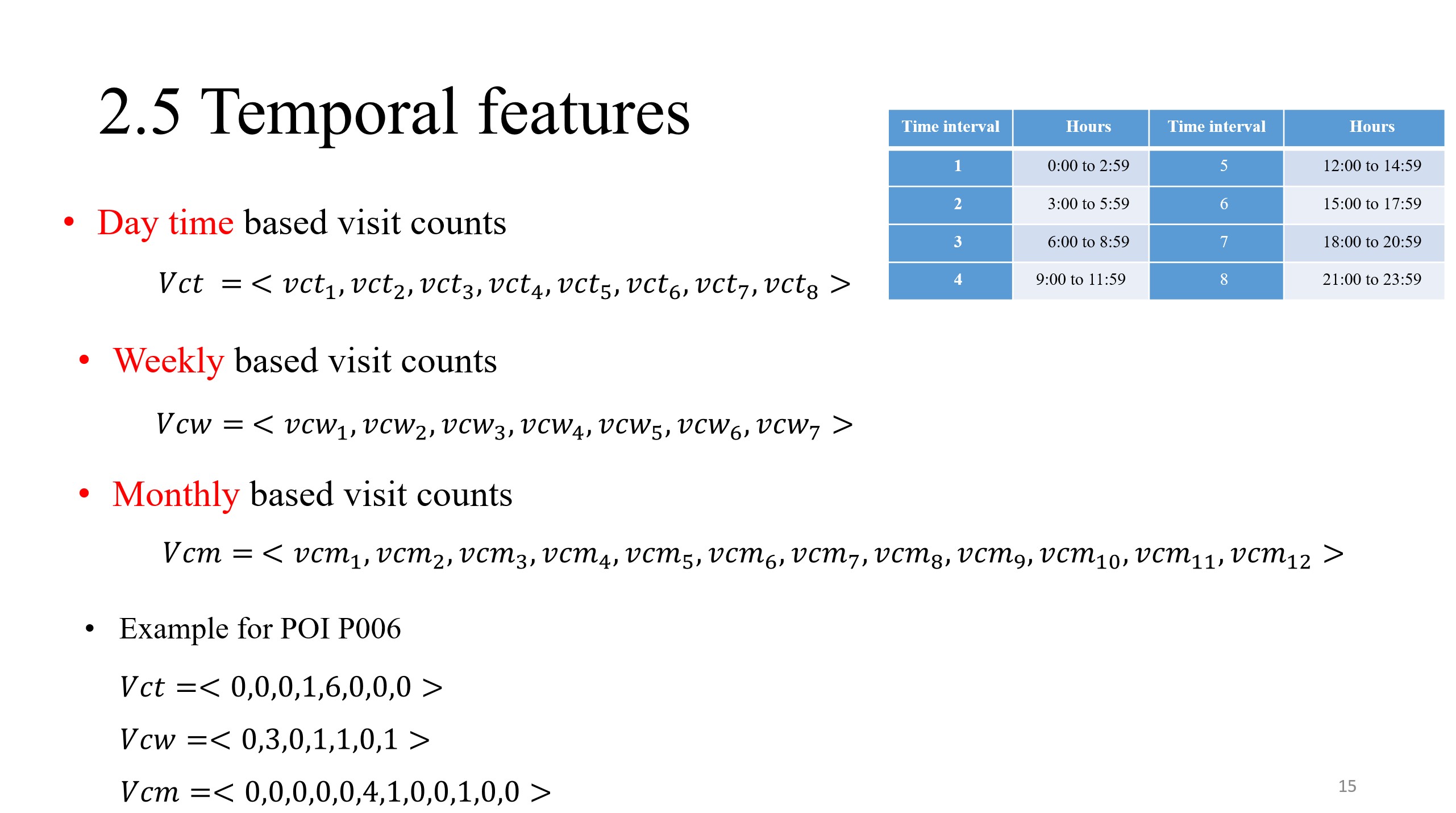 |
Temporal features |
| ICACT20260040 Slide.13
[Big Slide]
|
Chrome Click!! |
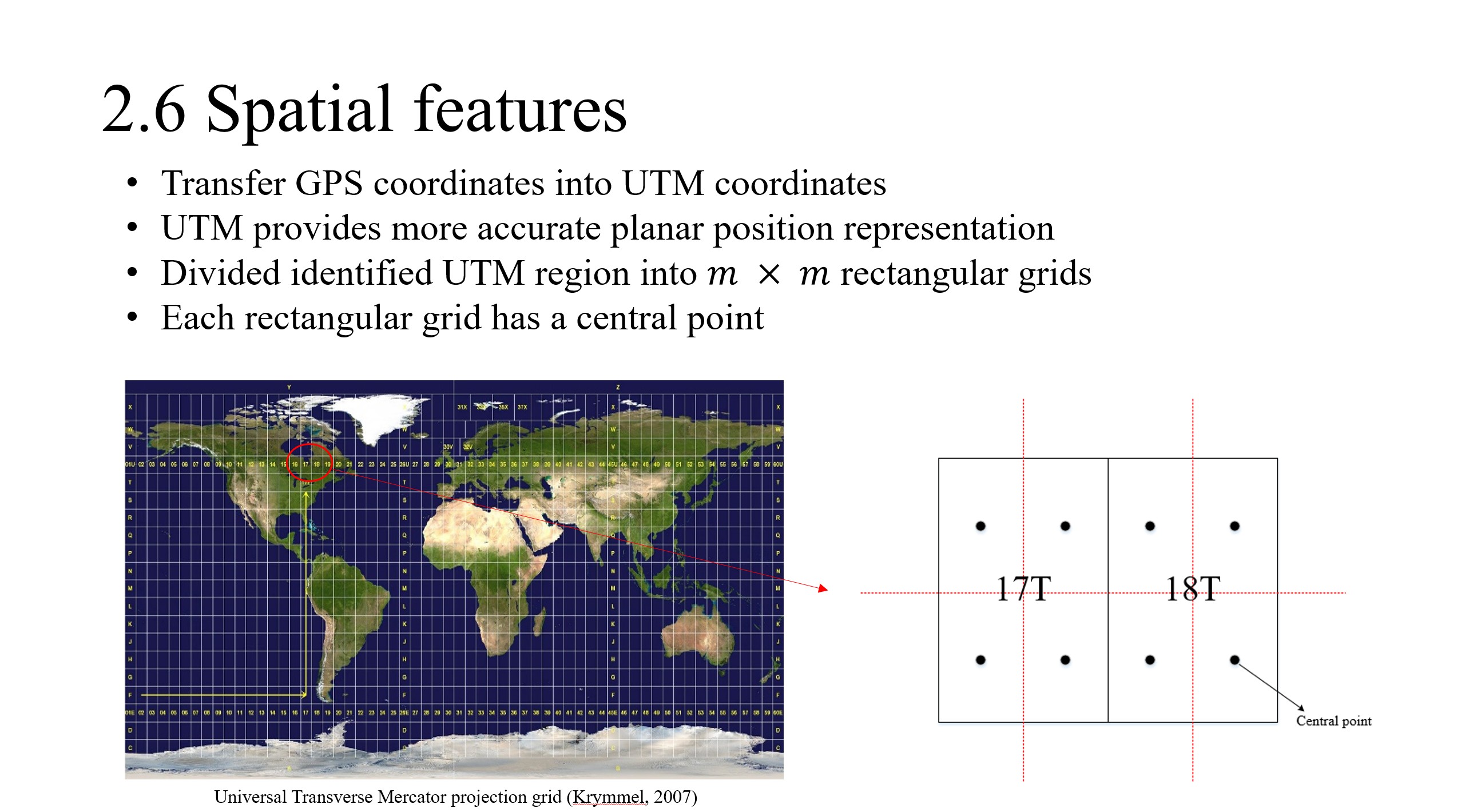 |
Transfer GPS coordinates into UTM coordinates
UTM provides more accurate planar position representation
Divided identified UTM region into 𝑚 × 𝑚 rectangular grids
Each rectangular grid has a central point
|
| ICACT20260040 Slide.14
[Big Slide]
|
Chrome Click!! |
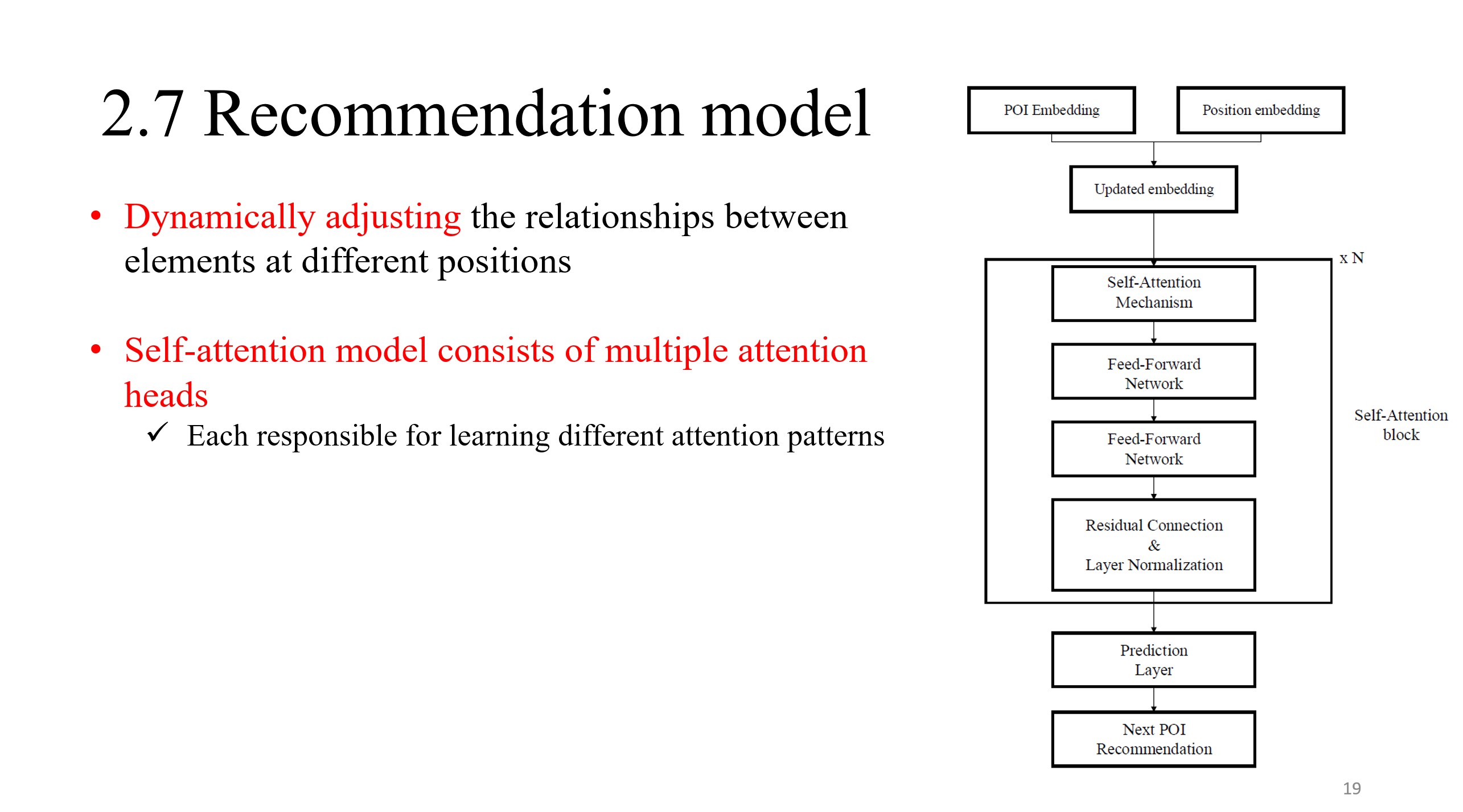 |
Dynamically adjusting the relationships between elements at different positions
Self-attention model consists of multiple attention heads
Each responsible for learning different attention patterns
|
| ICACT20260040 Slide.15
[Big Slide]
|
Chrome Click!! |
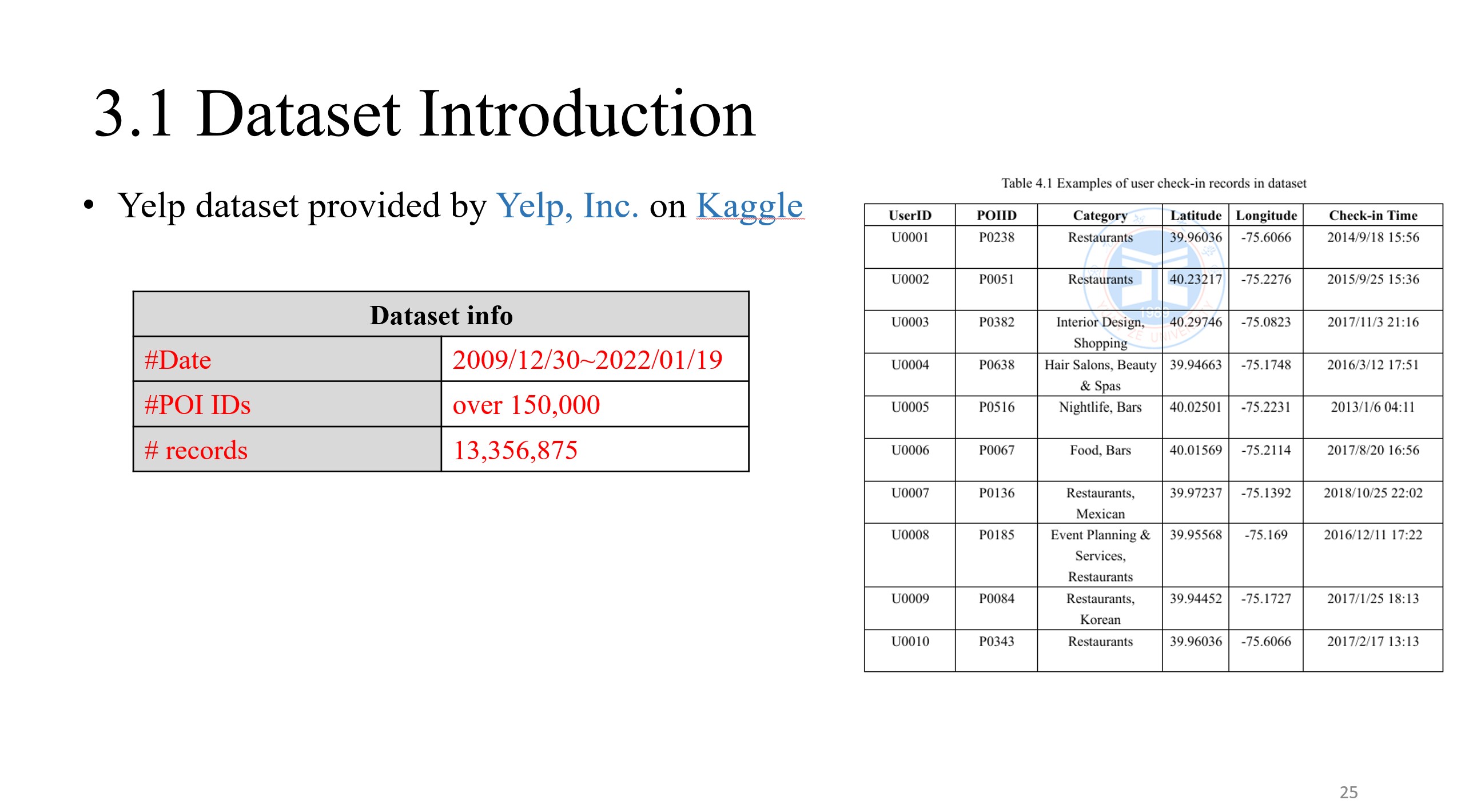 |
Yelp dataset provided by Yelp, Inc. on Kaggle
|
| ICACT20260040 Slide.16
[Big Slide]
|
Chrome Click!! |
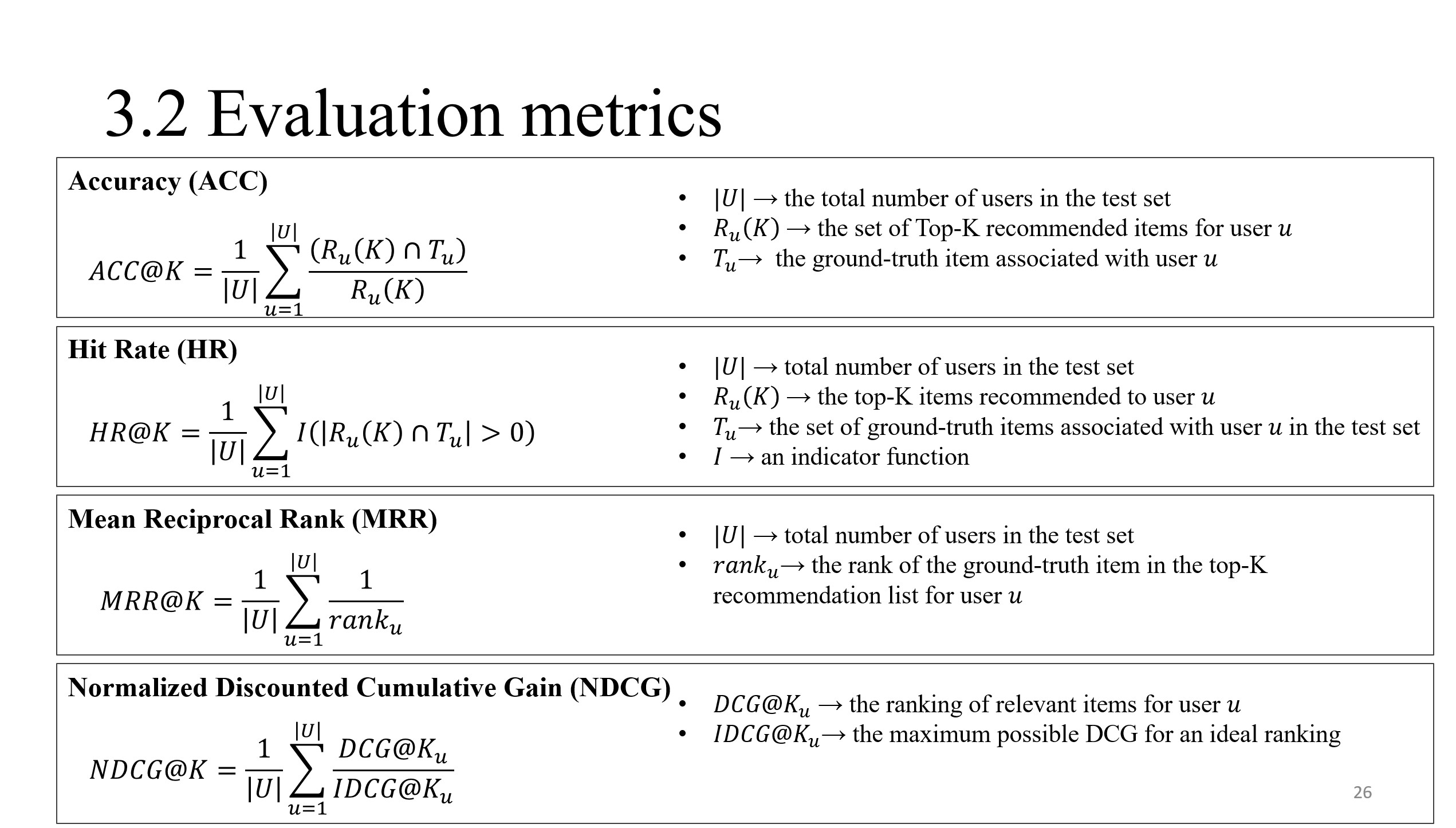 |
Evaluation metrics |
| ICACT20260040 Slide.17
[Big Slide]
|
Chrome Click!! |
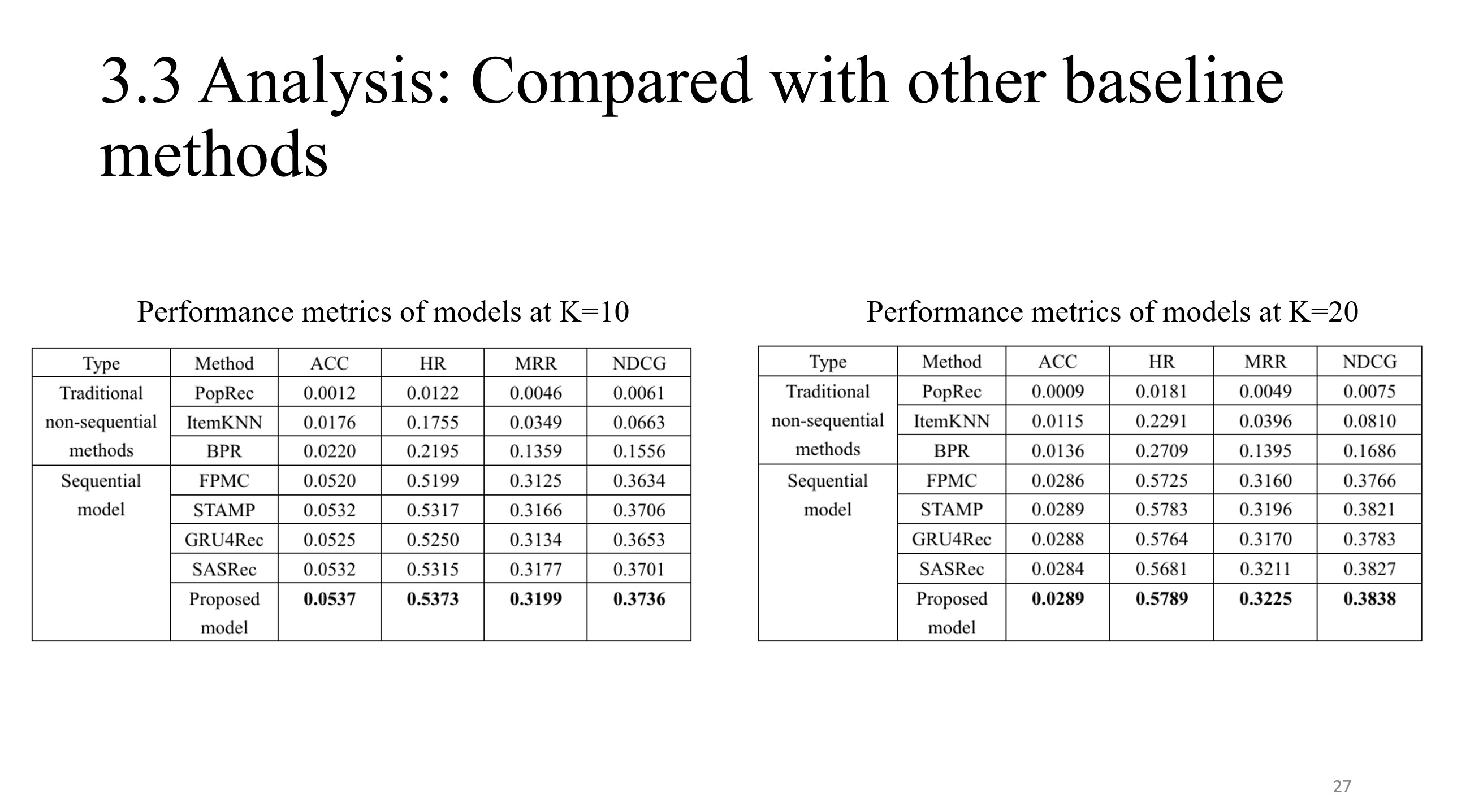 |
Analysis: Compared with other baseline methods |
| ICACT20260040 Slide.18
[Big Slide]
|
Chrome Click!! |
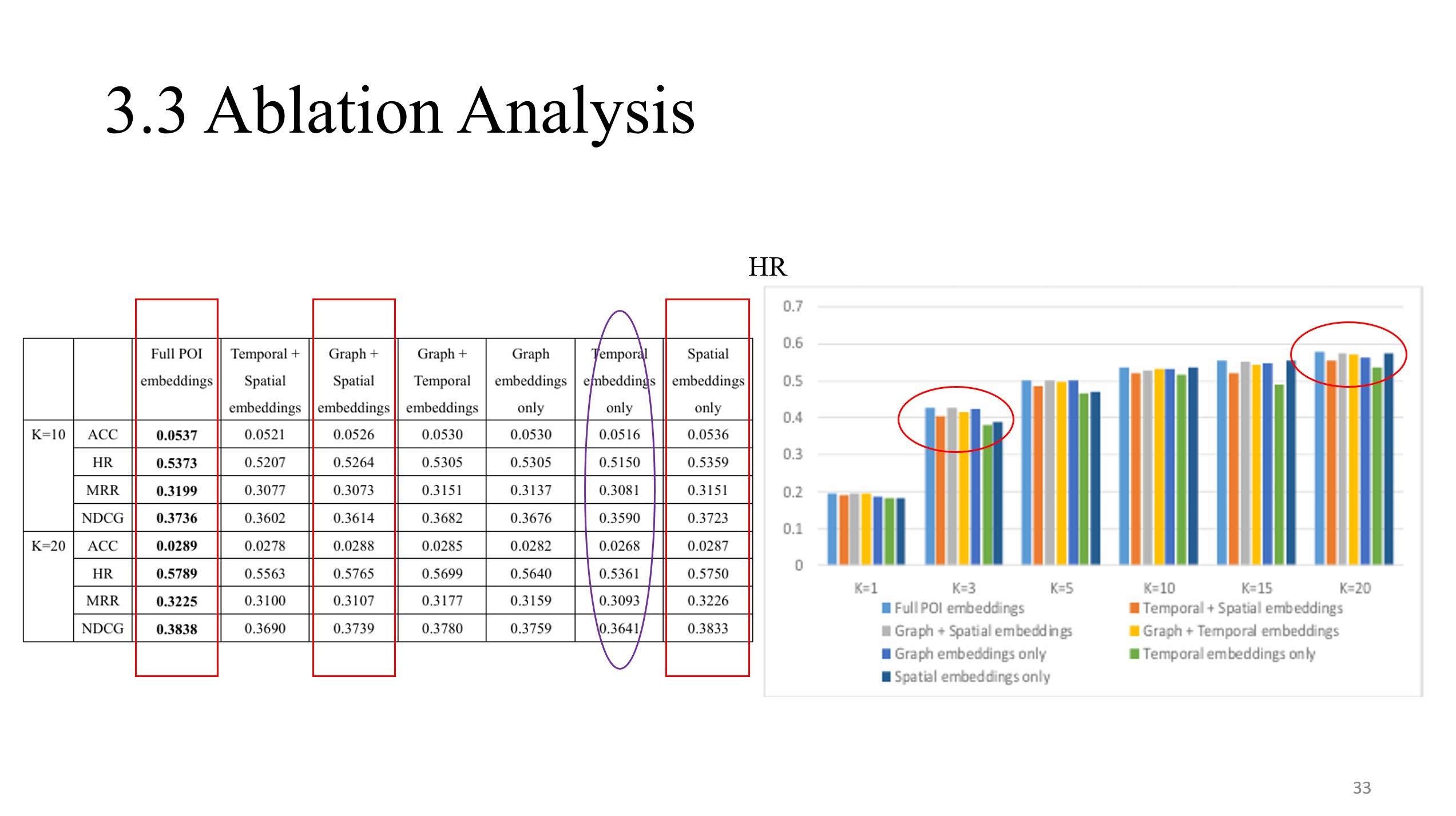 |
Ablation Analysis |
| ICACT20260040 Slide.19
[Big Slide]
|
Chrome Click!! |
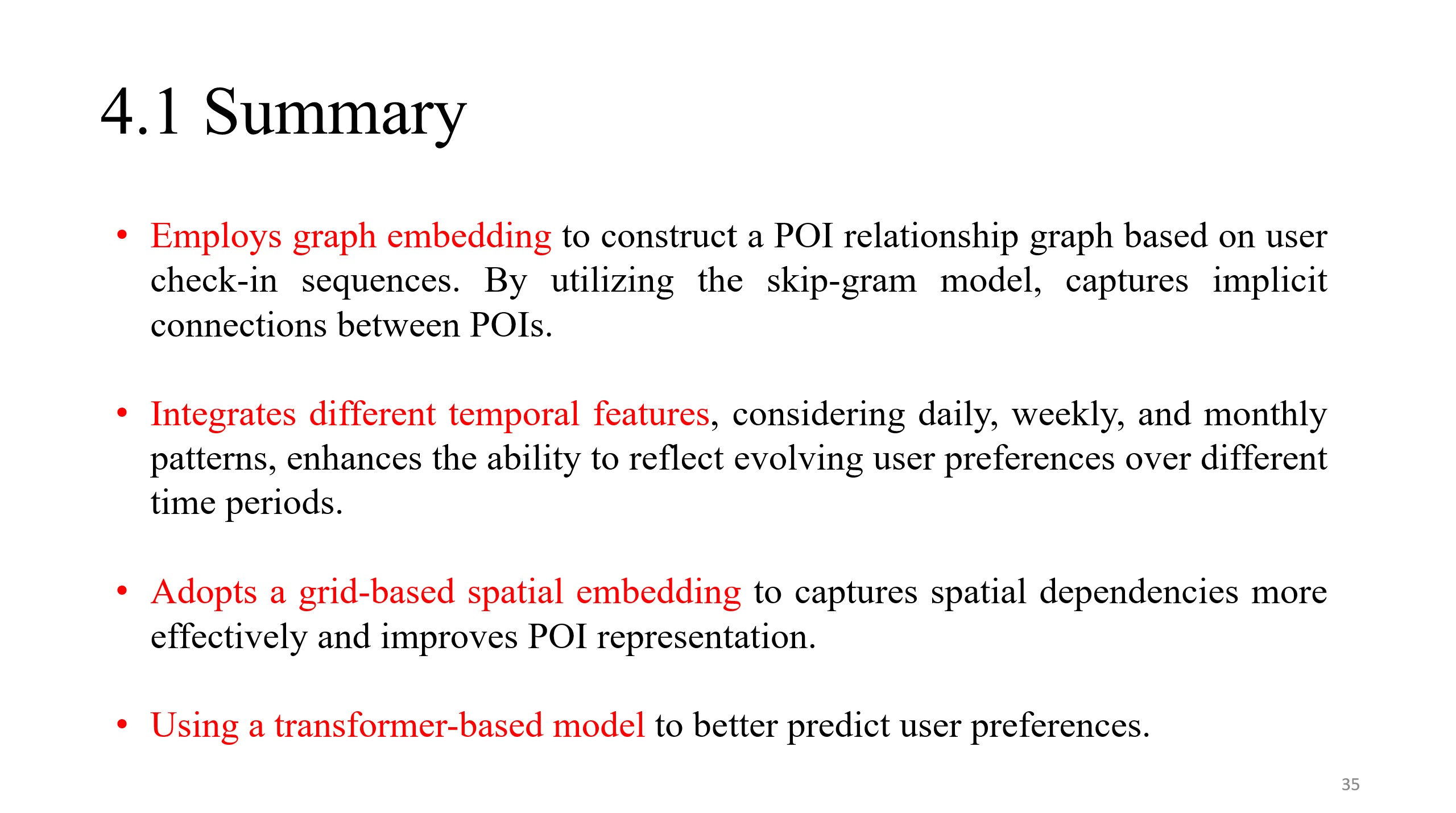 |
Employs graph embedding to construct a POI relationship graph based on user check-in sequences. By utilizing the skip-gram model, captures implicit connections between POIs.
Integrates different temporal features, considering daily, weekly, and monthly patterns, enhances the ability to reflect evolving user preferences over different time periods.
Adopts a grid-based spatial embedding to captures spatial dependencies more effectively and improves POI representation.
Using a transformer-based model to better predict user preferences.
|
| ICACT20260040 Slide.20
[Big Slide]
|
Chrome Click!! |
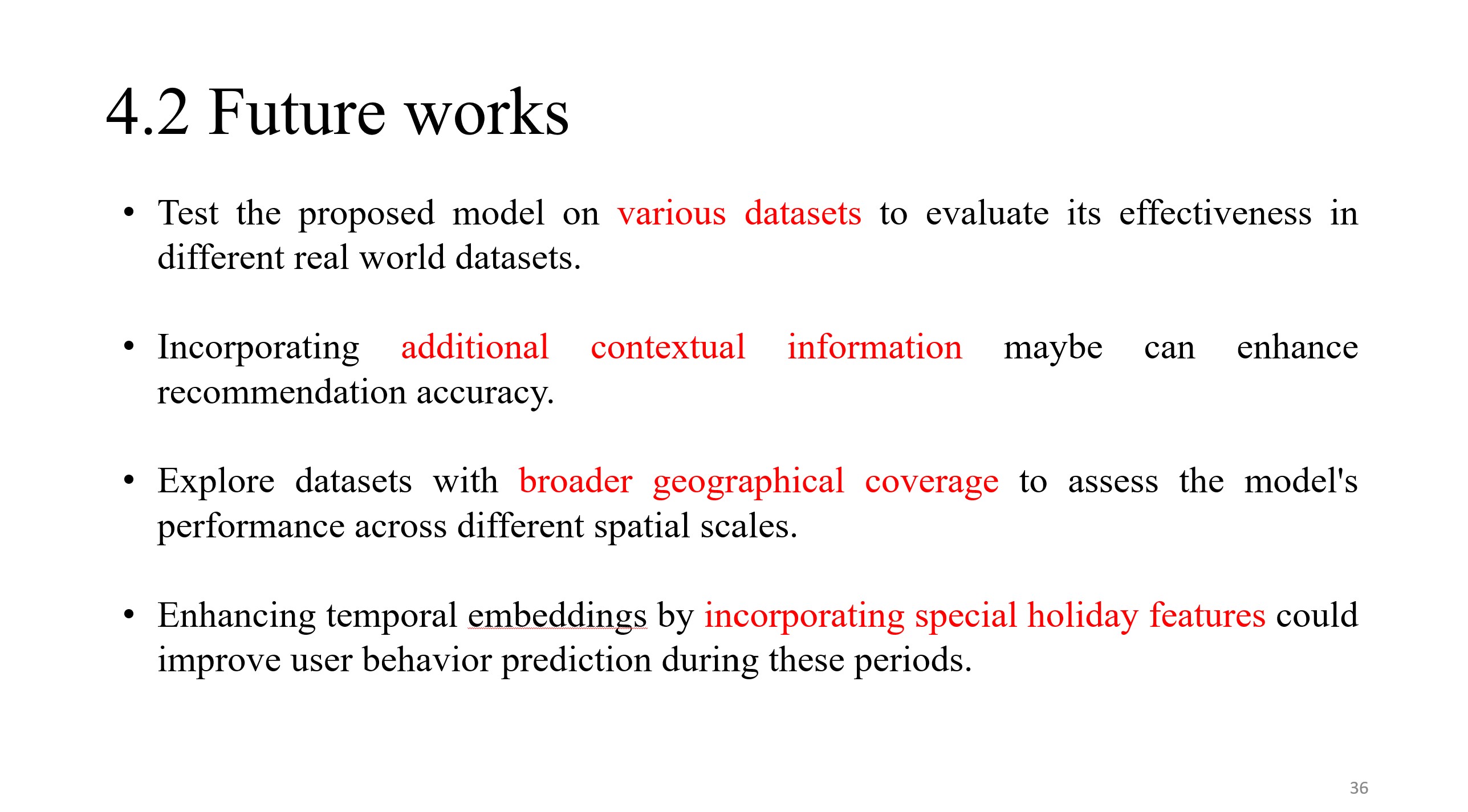 |
Test the proposed model on various datasets to evaluate its effectiveness in different real world datasets.
Incorporating additional contextual information maybe can enhance recommendation accuracy.
Explore datasets with broader geographical coverage to assess the models performance across different spatial scales.
Enhancing temporal embeddings by incorporating special holiday features could improve user behavior prediction during these periods.
|















