 ICACT20260058 Slide.01
[Big Slide]
[YouTube] |
Chrome  Click!! |
 |
this slide introduces the research work titled IoT-XPLAIN, presented at ICACT 2026. It provides the paper title, authors, institutional affiliations, and the conference identification details to establish the academic context of the study. |
| ICACT20260058 Slide.02
[Big Slide]
[YouTube] |
Chrome Click!! |
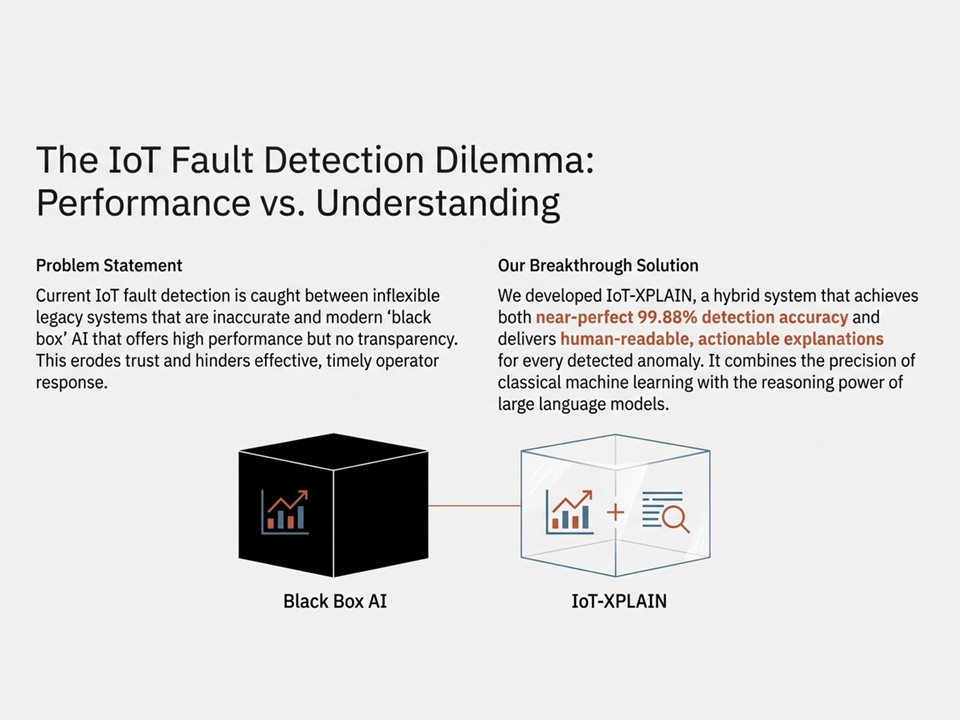 |
This slide explains the core problem in IoT fault detection, highlighting the trade-off between high-performance black-box models and the lack of interpretability. It contrasts traditional opaque AI systems with the proposed IoT-XPLAIN approach that balances accuracy and understanding. |
| ICACT20260058 Slide.03
[Big Slide]
[YouTube] |
Chrome Click!! |
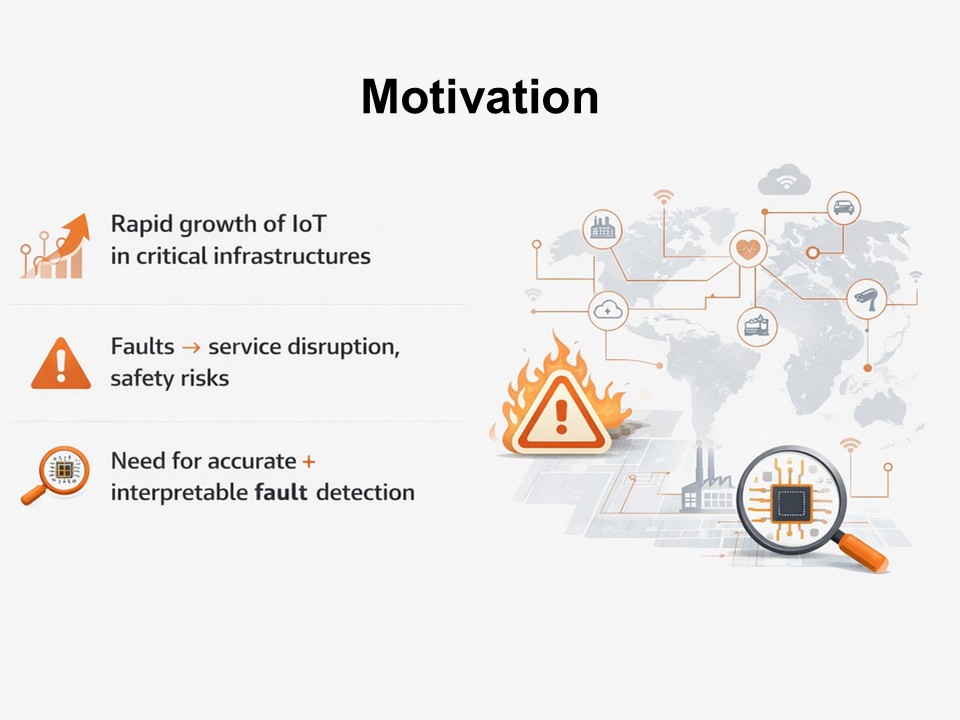 |
This slide motivates the research by emphasizing the rapid growth of IoT in critical infrastructures. It highlights how faults can cause service disruption and safety risks, underscoring the need for accurate yet interpretable fault detection mechanisms. |
| ICACT20260058 Slide.04
[Big Slide]
[YouTube] |
Chrome Click!! |
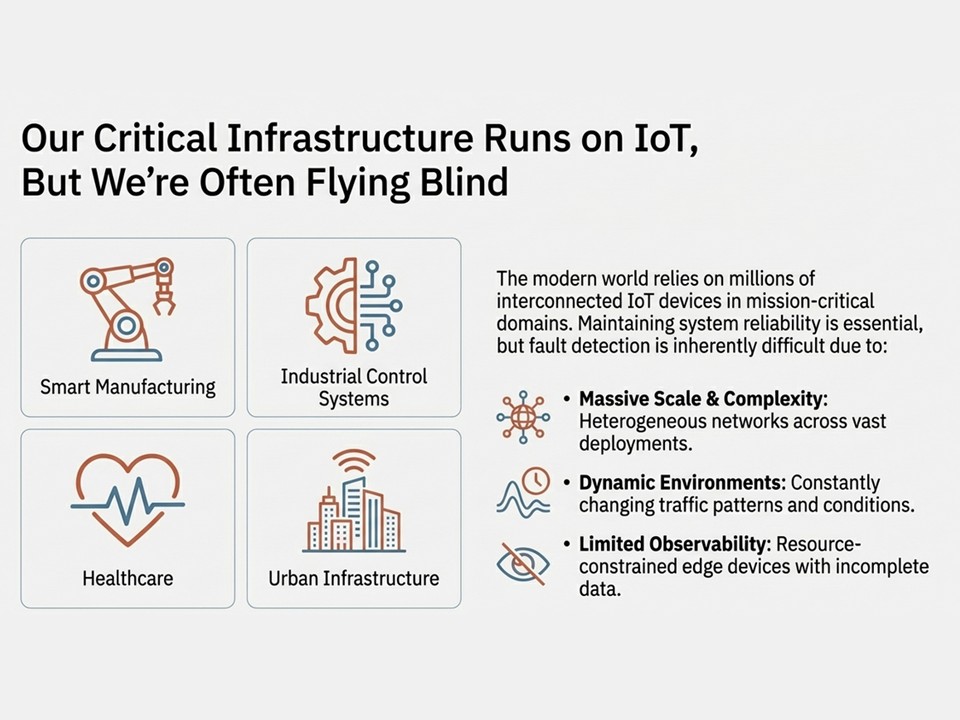 |
This slide illustrates the reliance of modern sectors such as smart manufacturing, healthcare, industrial control systems, and urban infrastructure on IoT. It explains challenges such as large-scale complexity, dynamic environments, and limited observability. |
| ICACT20260058 Slide.05
[Big Slide]
[YouTube] |
Chrome Click!! |
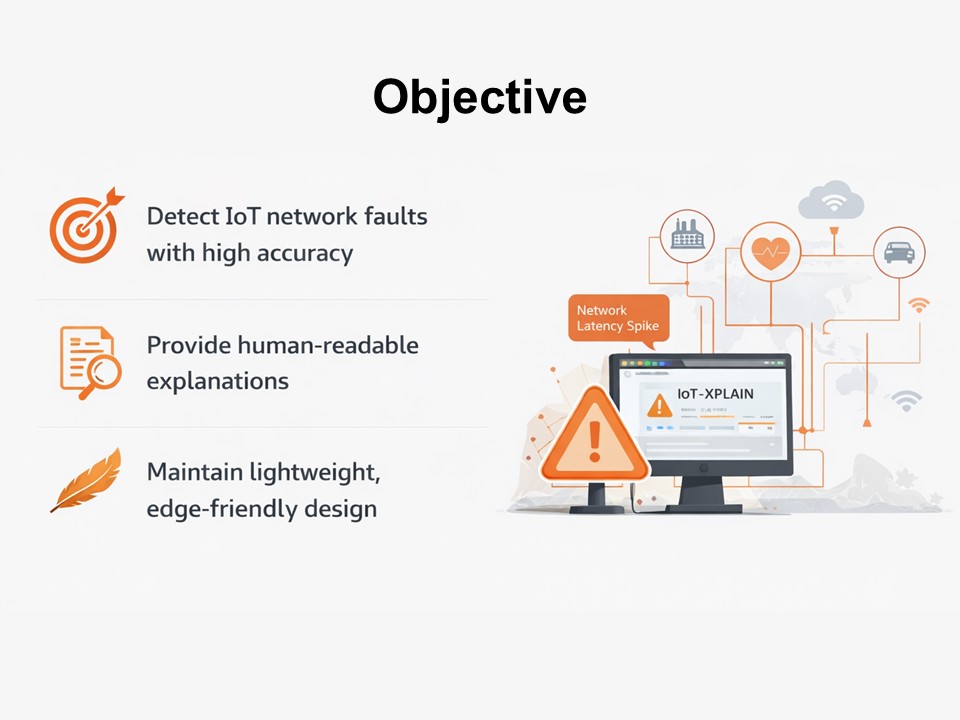 |
This slide outlines the key objectives of the work: achieving high-accuracy IoT fault detection, generating human-readable explanations, and maintaining a lightweight design suitable for edge deployment. |
| ICACT20260058 Slide.06
[Big Slide]
[YouTube] |
Chrome Click!! |
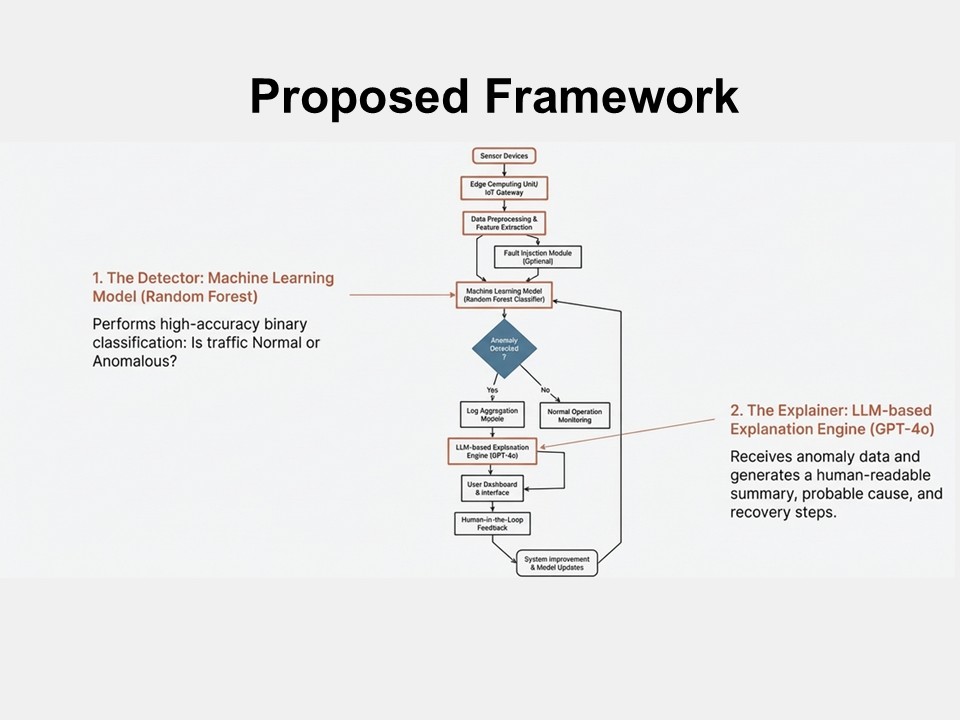 |
This slide presents the overall IoT-XPLAIN framework. It shows how sensor data flows through preprocessing, machine learning-based anomaly detection, and an LLM-based explanation engine to generate actionable insights with human-in-the-loop feedback. |
| ICACT20260058 Slide.07
[Big Slide]
[YouTube] |
Chrome Click!! |
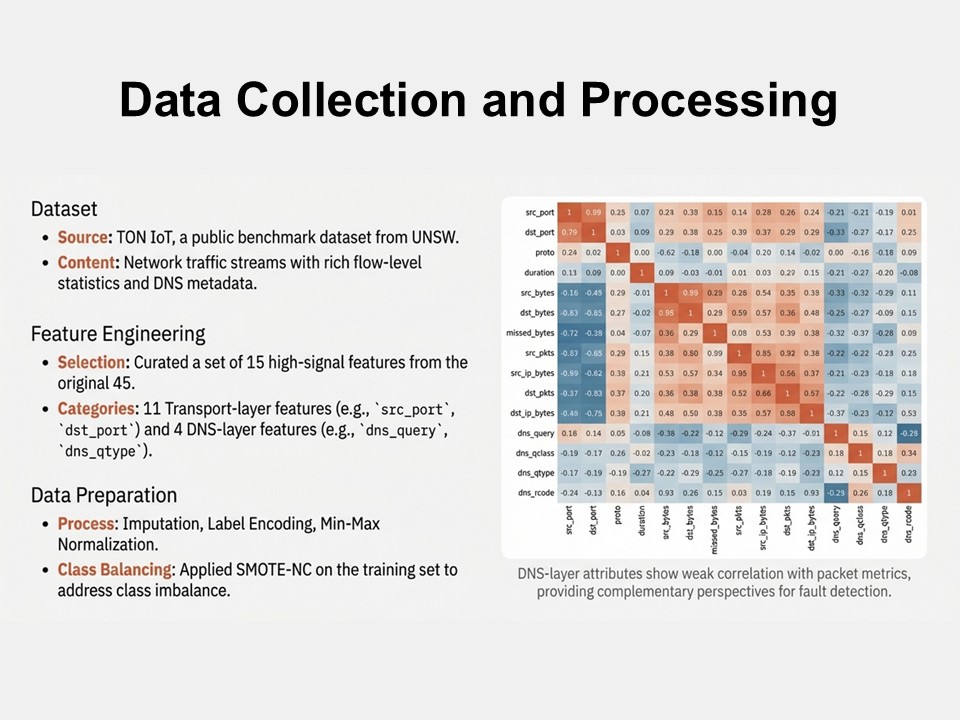 |
This slide describes the dataset used (TON IoT) and explains how network traffic and DNS metadata are collected and processed. It also highlights feature selection, preprocessing steps, and class balancing applied during training. |
| ICACT20260058 Slide.08
[Big Slide]
[YouTube] |
Chrome Click!! |
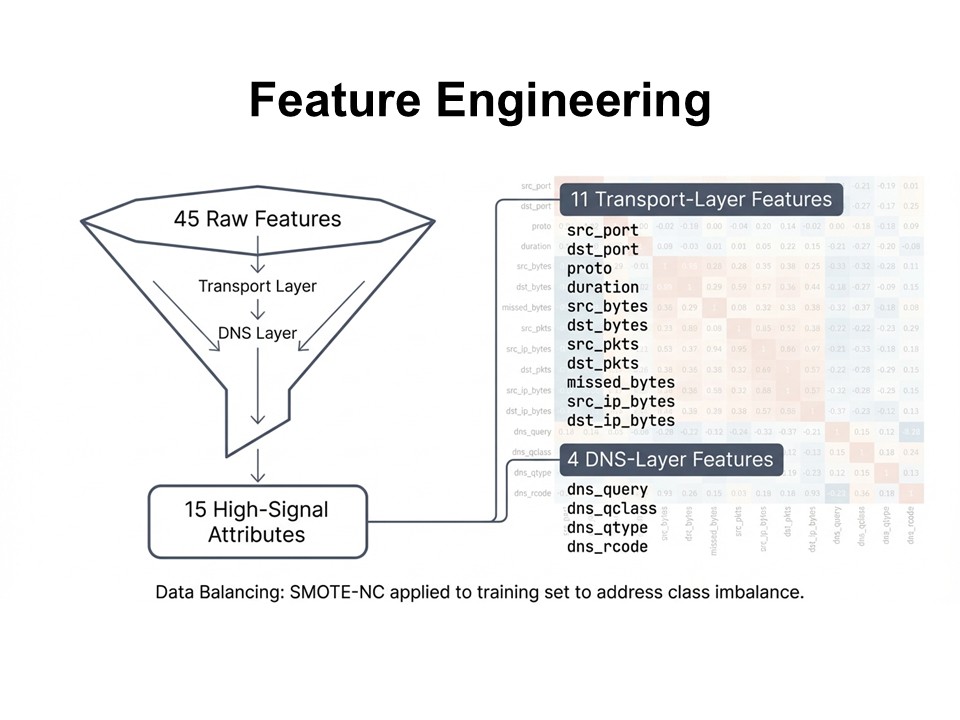 |
This slide explains the reduction of 45 raw features into 15 high-signal attributes. It distinguishes between transport-layer and DNS-layer features, emphasizing their relevance in detecting both volumetric and semantic anomalies. |
| ICACT20260058 Slide.09
[Big Slide]
[YouTube] |
Chrome Click!! |
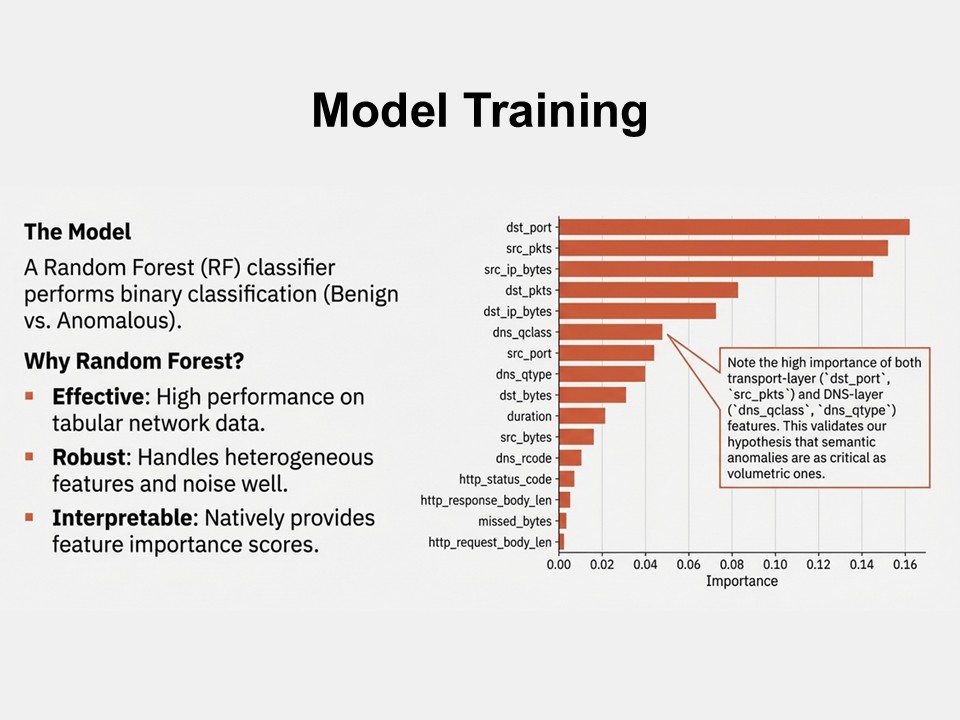 |
This slide describes the use of a Random Forest classifier for binary anomaly detection. It justifies the choice of Random Forest based on effectiveness, robustness, and inherent interpretability through feature importance analysis. |
| ICACT20260058 Slide.10
[Big Slide]
[YouTube] |
Chrome Click!! |
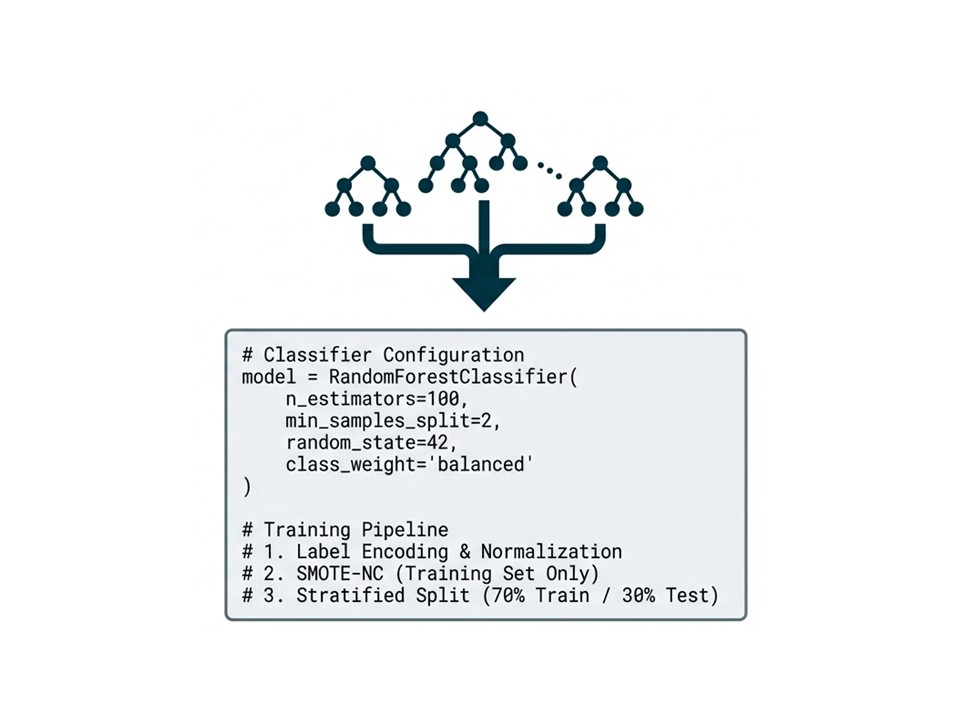 |
This slide details the model configuration and training pipeline, including hyperparameters, label encoding, normalization, SMOTE-NC for class balancing, and stratified train–test splitting to ensure reliable evaluation. |
| ICACT20260058 Slide.11
[Big Slide]
[YouTube] |
Chrome Click!! |
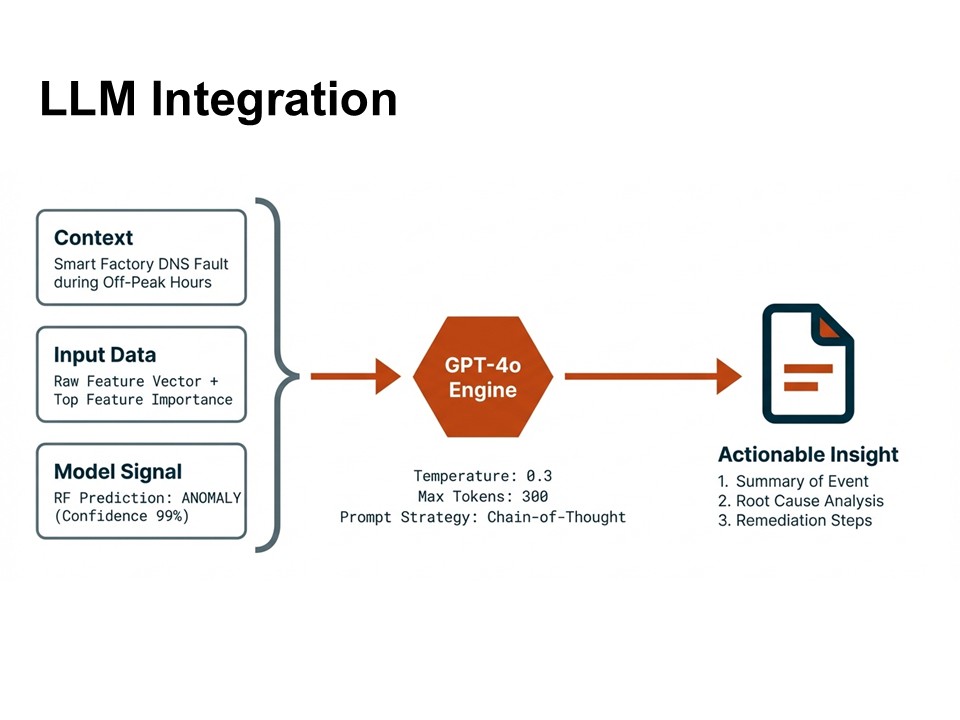 |
This slide illustrates how the large language model is integrated into the IoT-XPLAIN pipeline. It shows how contextual information, raw feature vectors, and machine learning predictions are passed to the GPT-4o engine to generate actionable insights. |
| ICACT20260058 Slide.12
[Big Slide]
[YouTube] |
Chrome Click!! |
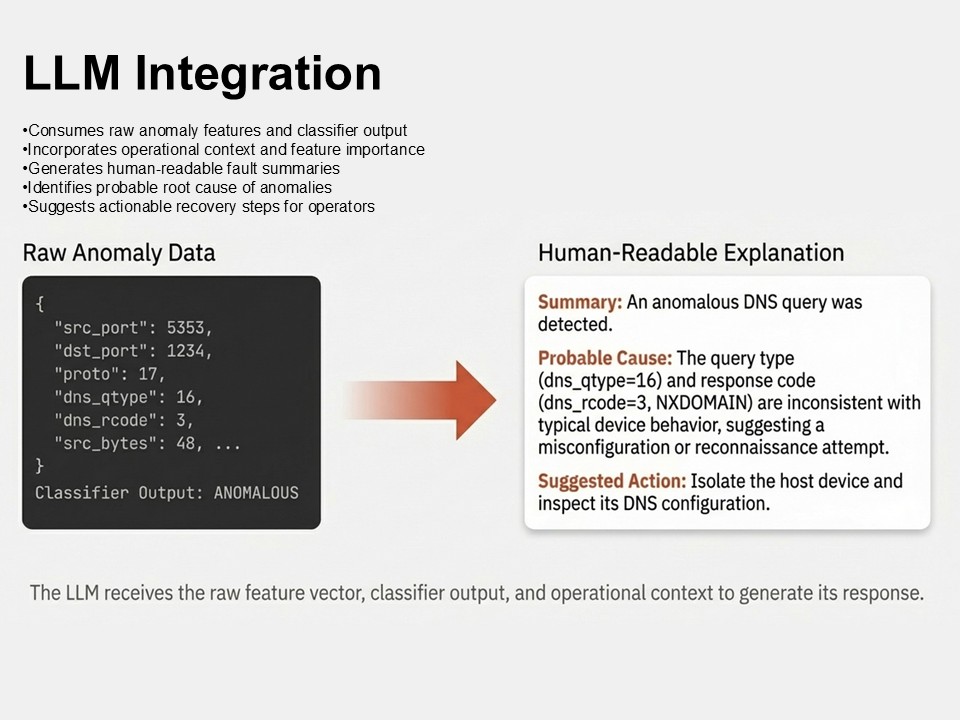 |
This slide demonstrates how raw anomaly data and classifier output are transformed into a human-readable explanation. It highlights the LLM¡¯s ability to summarize events, identify probable root causes, and suggest remediation actions. |
| ICACT20260058 Slide.13
[Big Slide]
[YouTube] |
Chrome Click!! |
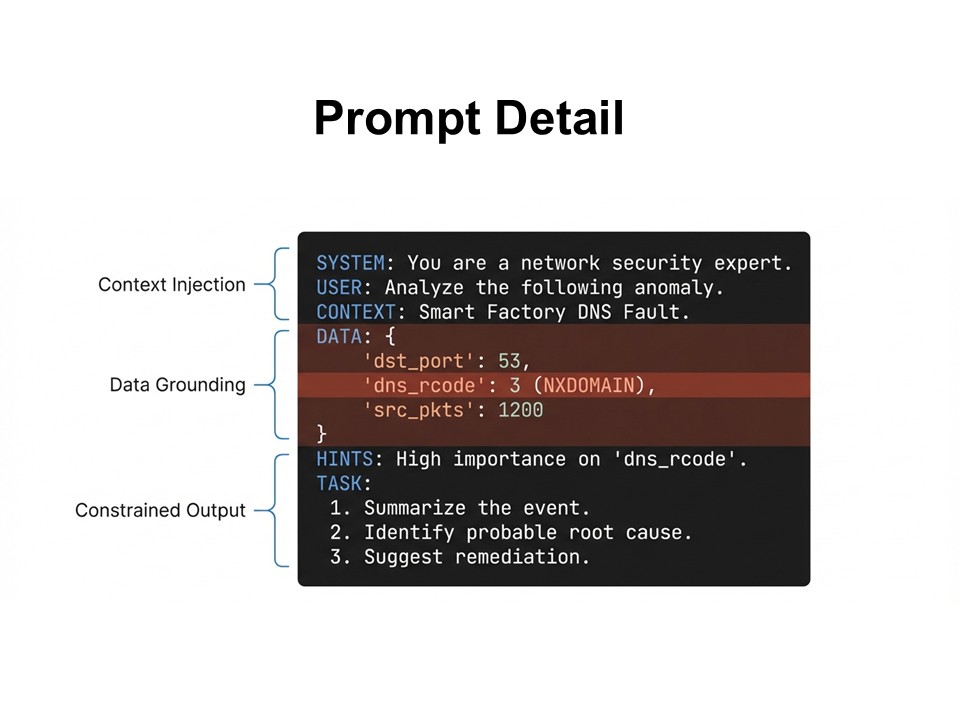 |
This slide explains the structured prompting strategy used for the LLM. It shows how context injection, data grounding, and constrained task instructions guide the model to produce focused, reliable, and domain-specific explanations. |
| ICACT20260058 Slide.14
[Big Slide]
[YouTube] |
Chrome Click!! |
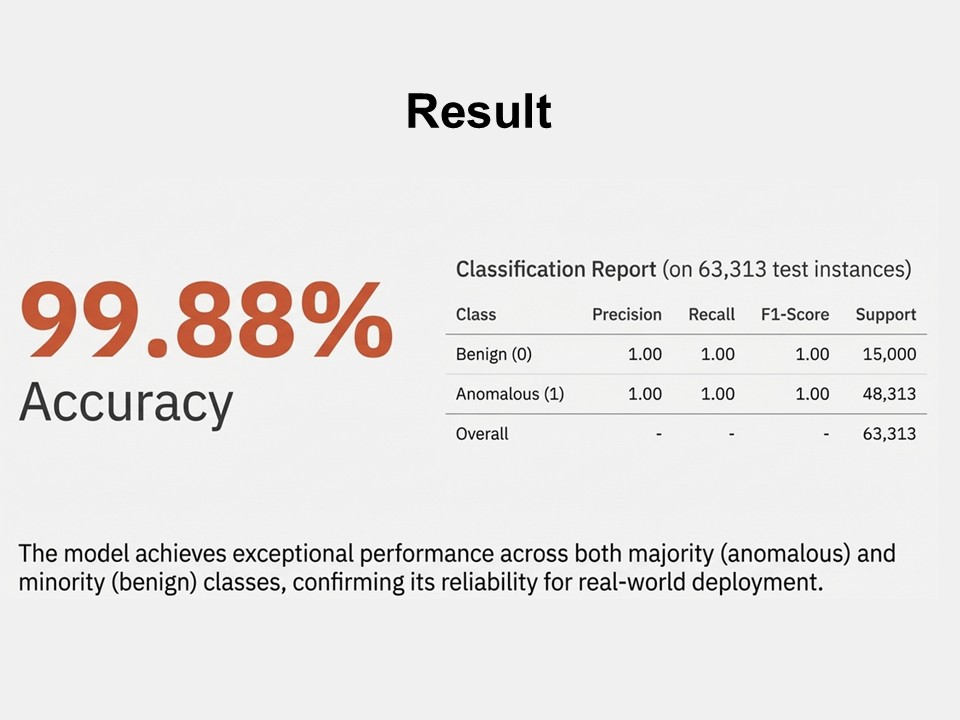 |
This slide presents the overall classification performance of the proposed system. It reports an accuracy of 99.88% on the TON IoT test dataset, along with precision, recall, and F1-score metrics for both benign and anomalous classes. |
| ICACT20260058 Slide.15
[Big Slide]
[YouTube] |
Chrome Click!! |
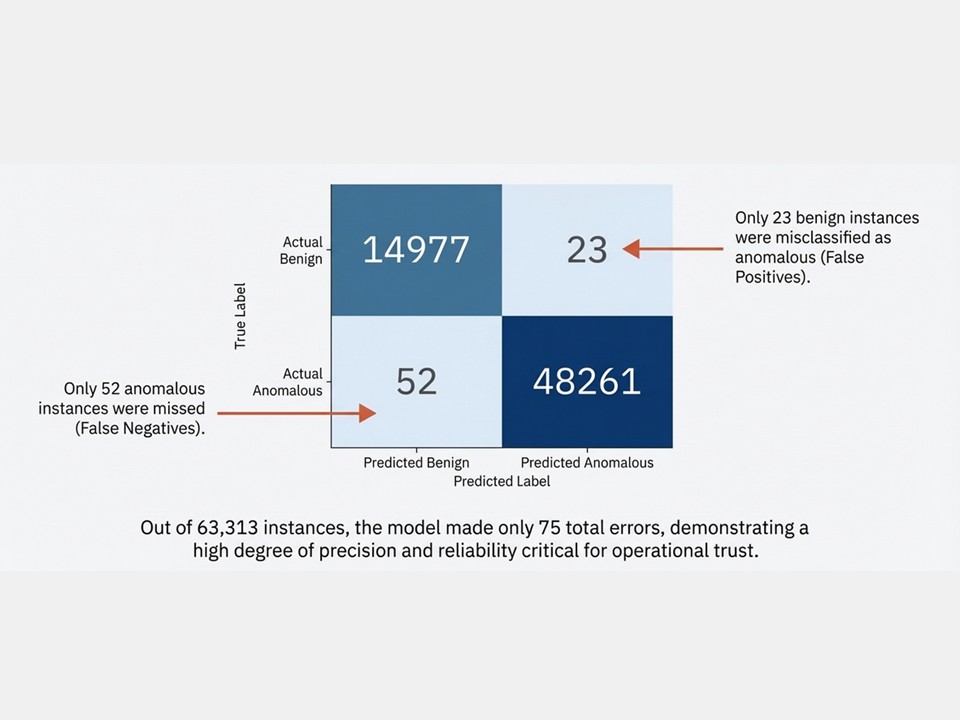 |
This slide provides a detailed confusion matrix analysis. It shows that only a small number of false positives and false negatives occurred, demonstrating the robustness and reliability of the model for operational IoT environments. |
| ICACT20260058 Slide.16
[Big Slide]
[YouTube] |
Chrome Click!! |
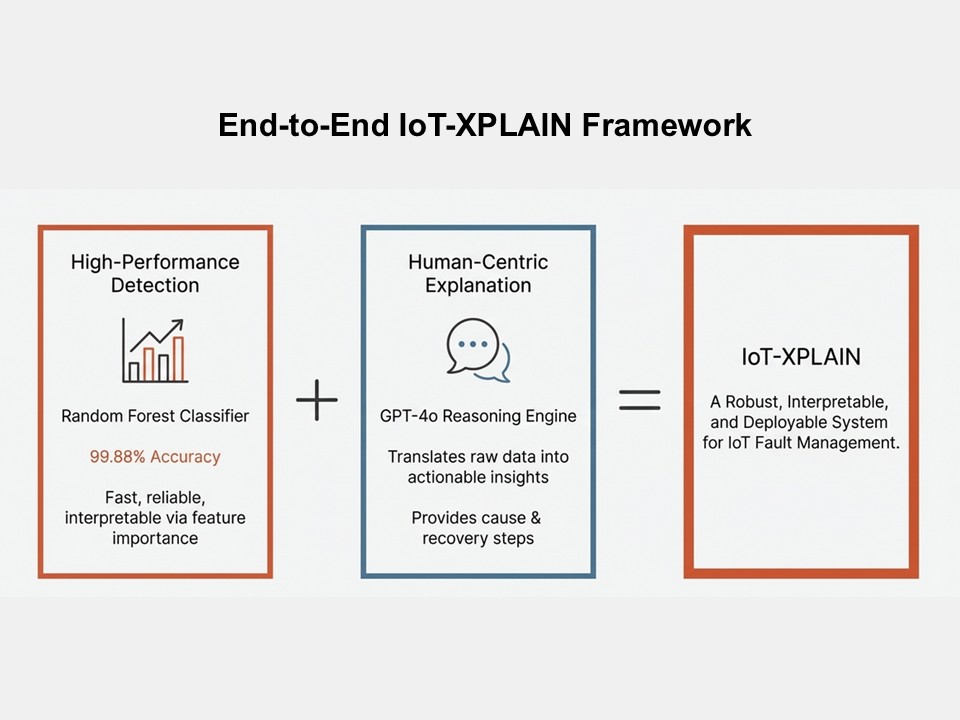 |
This slide summarizes the end-to-end design of IoT-XPLAIN. It highlights the combination of high-performance machine learning detection and human-centric LLM explanations to form a robust and deployable fault management system. |
| ICACT20260058 Slide.17
[Big Slide]
[YouTube] |
Chrome Click!! |
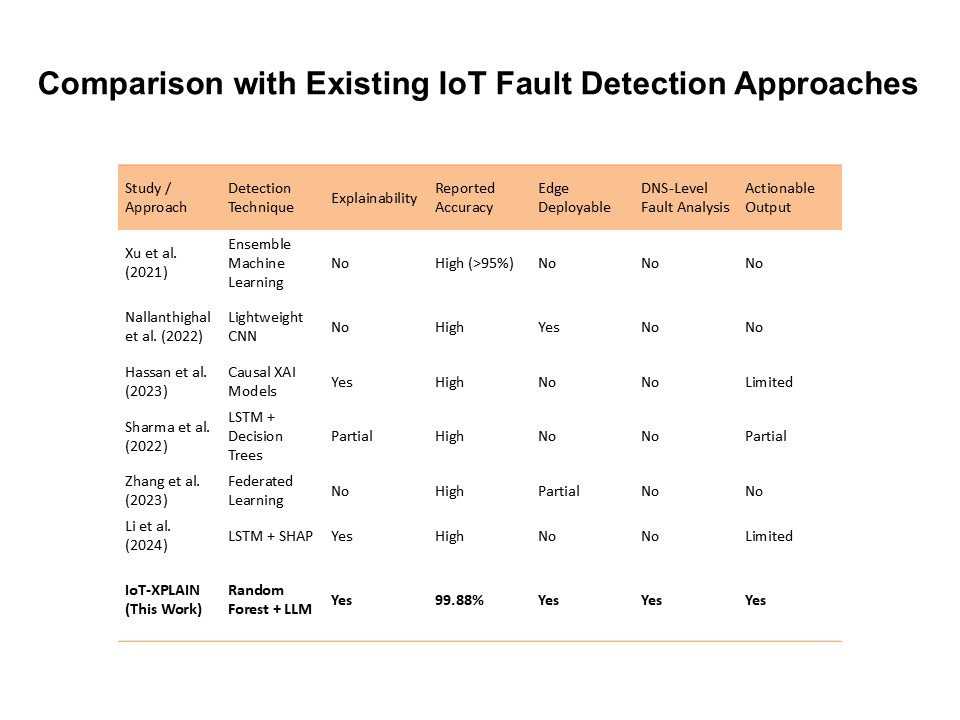 |
This slide compares IoT-XPLAIN with existing IoT fault detection methods. It shows that the proposed approach uniquely combines high accuracy, explainability, DNS-level fault analysis, edge deployability, and actionable outputs. |
| ICACT20260058 Slide.18
[Big Slide]
[YouTube] |
Chrome Click!! |
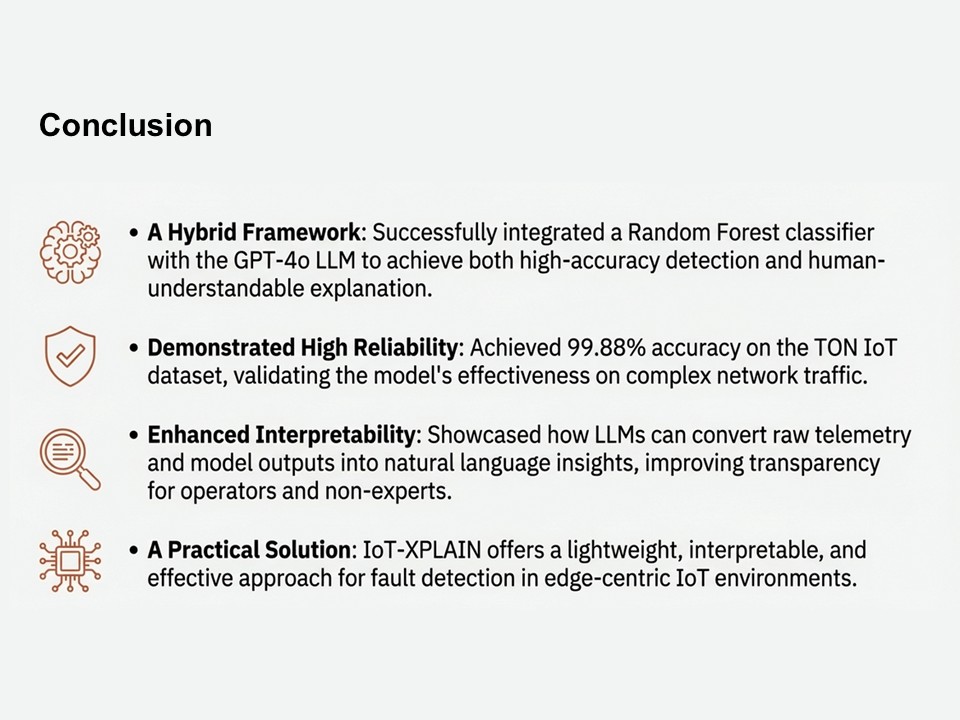 |
This slide concludes the presentation by summarizing the key contributions. It emphasizes the successful integration of Random Forest and LLMs, high detection accuracy, improved interpretability, and practical applicability in real-world IoT systems. |
| ICACT20260058 Slide.19
[Big Slide]
[YouTube] |
Chrome Click!! |
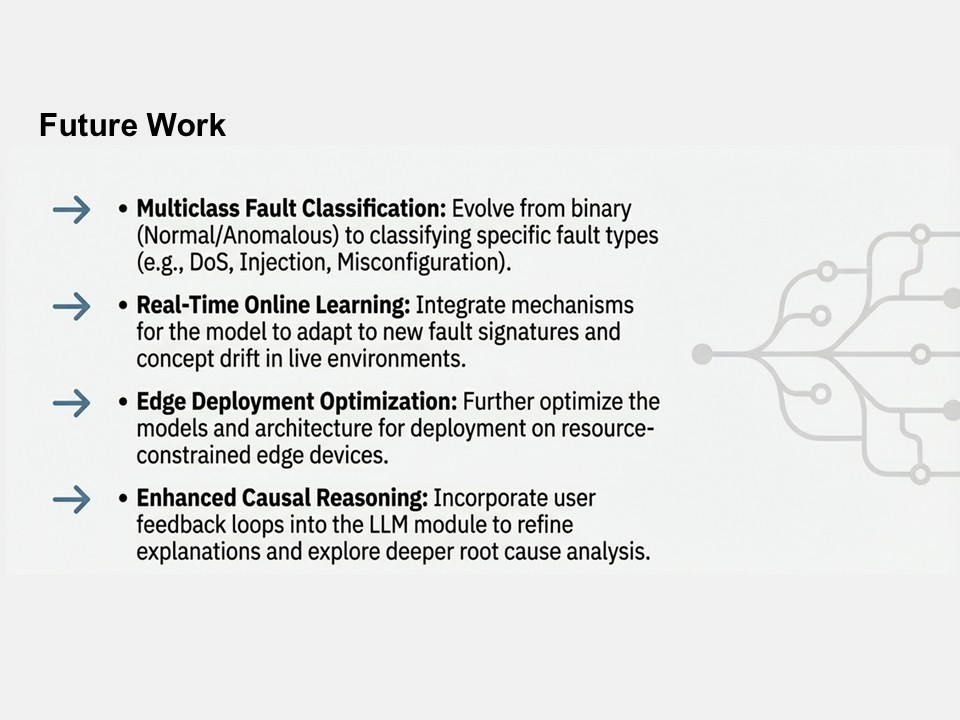 |
This slide outlines potential future research directions. These include multiclass fault classification, real-time online learning, optimization for edge deployment, and enhanced causal reasoning through feedback-driven explanation refinement. |
| ICACT20260058 Slide.20
[Big Slide]
[YouTube] |
Chrome Click!! |
 |
This slide acknowledges the funding and institutional support that enabled the research. It formally credits the National Science and Technology Council (NSTC), Taiwan, for supporting the presented work. |















