 ICACT20260088 Slide.01
[Big Slide]
[YouTube] |
Chrome  Click!! |
 |
Good afternoon. My name is Batshagai from the Mongolian University of Science and Technology. Today I will present our research work on developing interactive digital training content that combines VR and 3D/360° media. We propose a hybrid approach and demonstrate three deployment modes—a fully immersive Meta Quest 3 simulation, a web-based 3D interface with 360° environments, and a VR dome experience—as scalable and cost-effective alternatives to resource-intensive physical laboratories.
|
| ICACT20260088 Slide.02
[Big Slide]
[YouTube] |
Chrome Click!! |
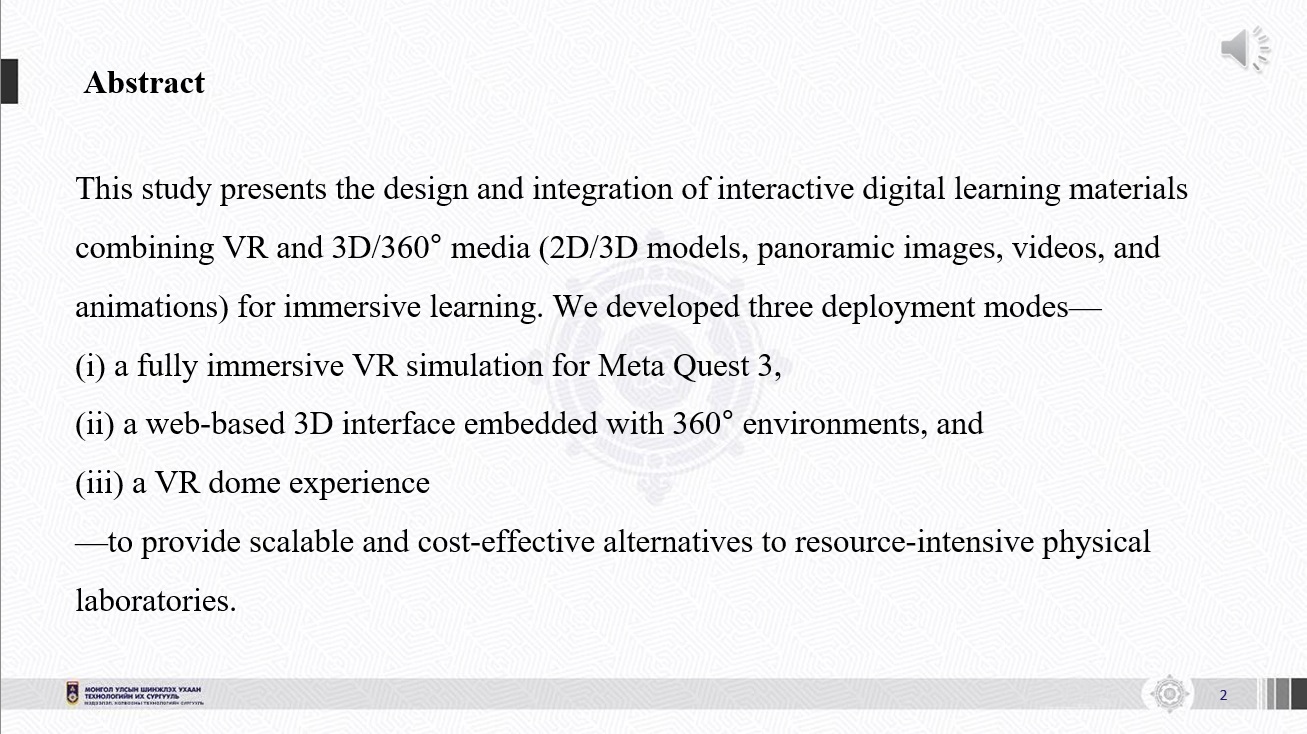 |
Our research work integrates VR with 3D and 360° educational media to deliver immersive learning at scale. We deploy the same content in three formats—Meta Quest 3, a web-based 3D+360° interface, and a VR dome so it can be accessed across different platforms. The goal is to reduce reliance on costly physical labs while keeping practice-based learning engaging and effective. |
| ICACT20260088 Slide.03
[Big Slide]
[YouTube] |
Chrome Click!! |
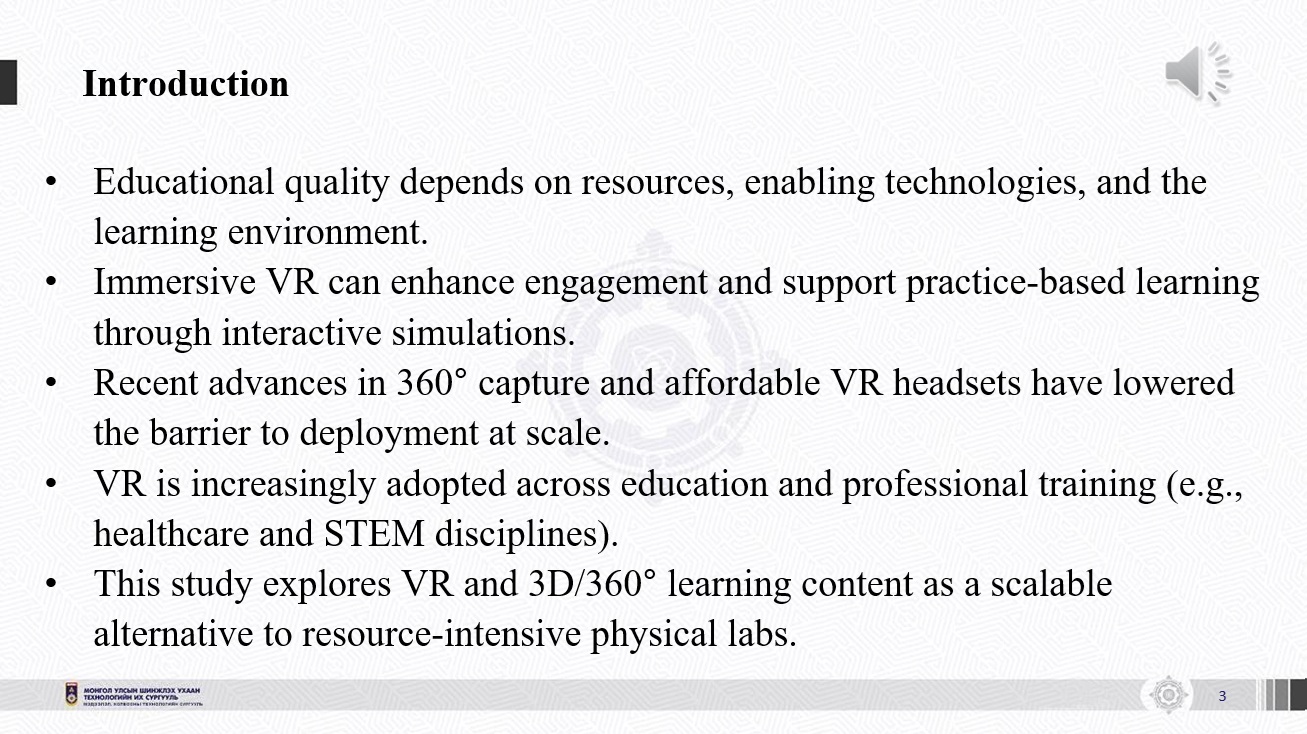 |
On this slide, I explain our motivation.
Learning quality depends on resources, technology, and the learning environment.
VR can increase engagement through interactive, hands-on simulations.
Today, 360° capture is easier and VR headsets are more affordable.
So, we explore VR with 3D and 360° content as a scalable, lower-cost alternative to physical labs. |
| ICACT20260088 Slide.04
[Big Slide]
[YouTube] |
Chrome Click!! |
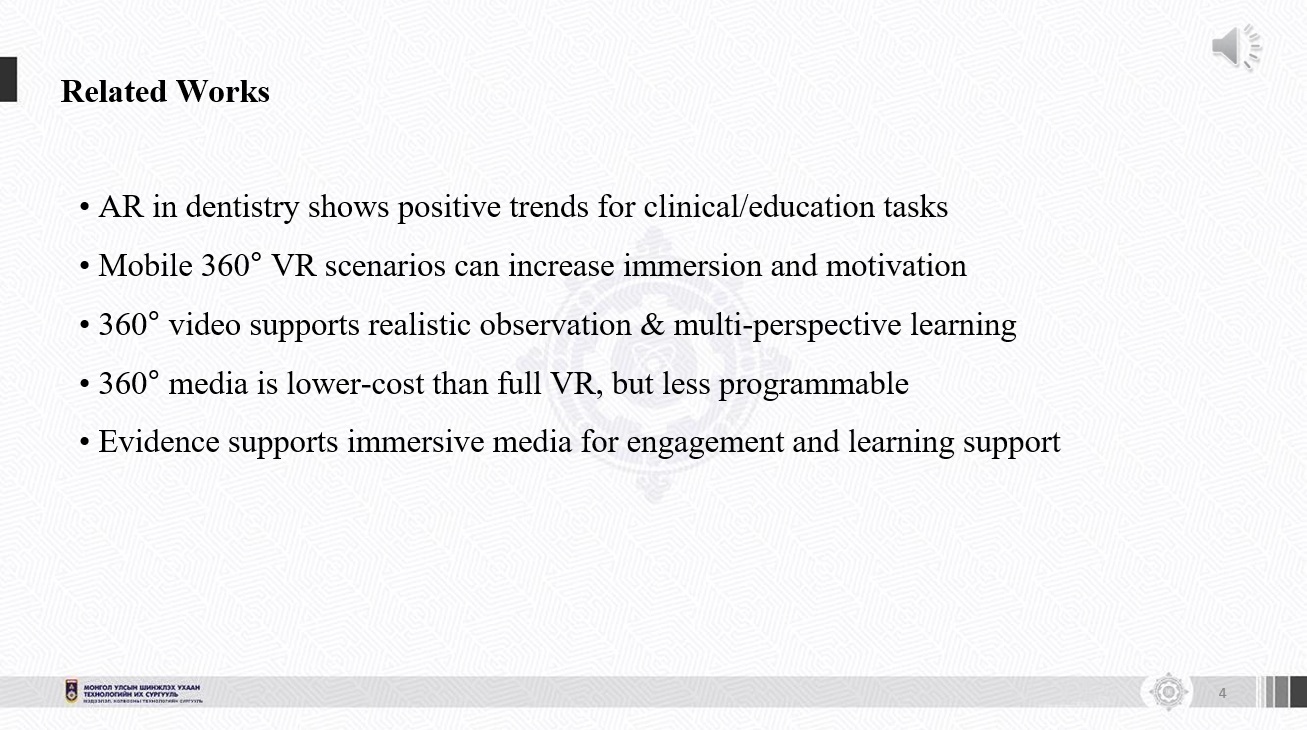 |
On this slide, I position our work within prior research on immersive learning. While previous studies show that VR and 360° content can improve engagement and realism, many solutions rely on a single modality and can be costly to build or deploy, with limited evaluation. To address this, we combine 360° contextual learning with interactive 3D/VR practice and use a structured evaluation approach to identify the most important quality factors for effective immersive education. |
| ICACT20260088 Slide.05
[Big Slide]
[YouTube] |
Chrome Click!! |
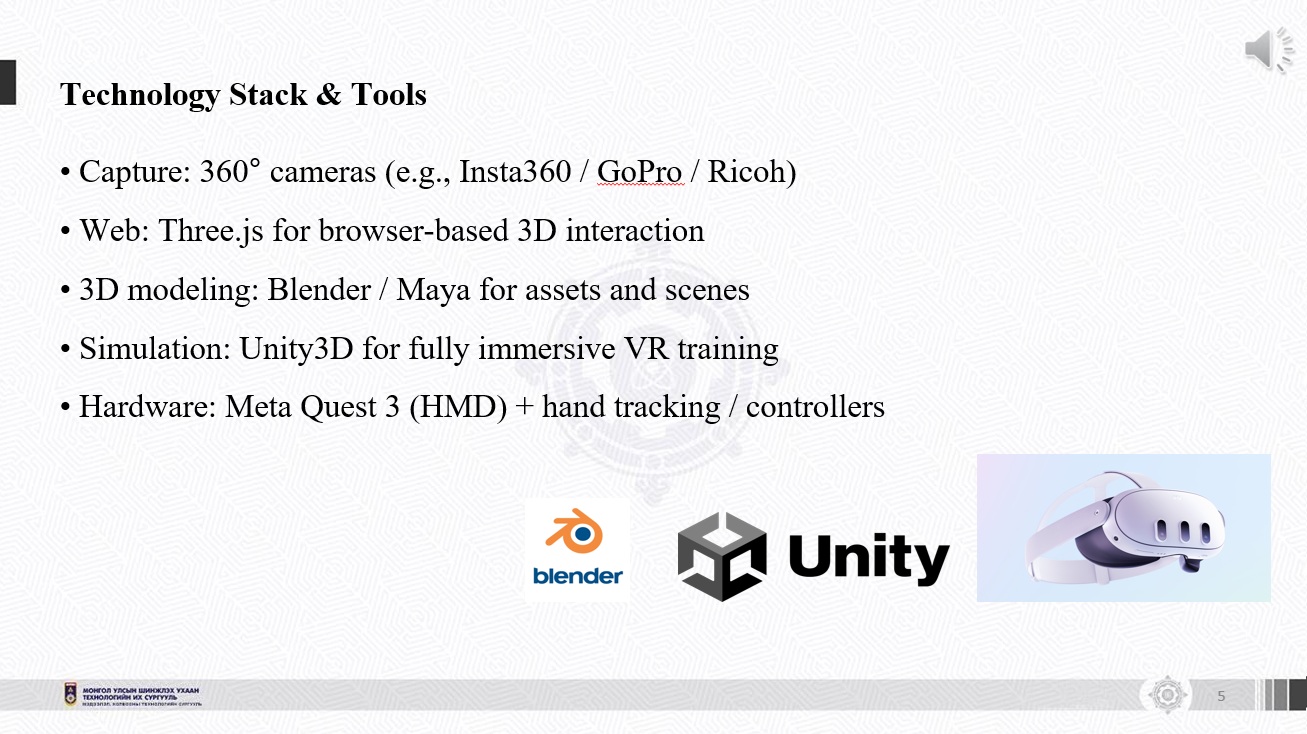 |
I summarize our development pipeline for delivering the same learning content on both web and VR. We created 3D assets and animations, captured real-world context using 360° photos and videos, and delivered browser-based experiences with WebGL/Three.js, while building the fully immersive simulation in Unity. Overall, we kept the pipeline modular so assets can be reused, updated easily, and run consistently across different devices. |
| ICACT20260088 Slide.06
[Big Slide]
[YouTube] |
Chrome Click!! |
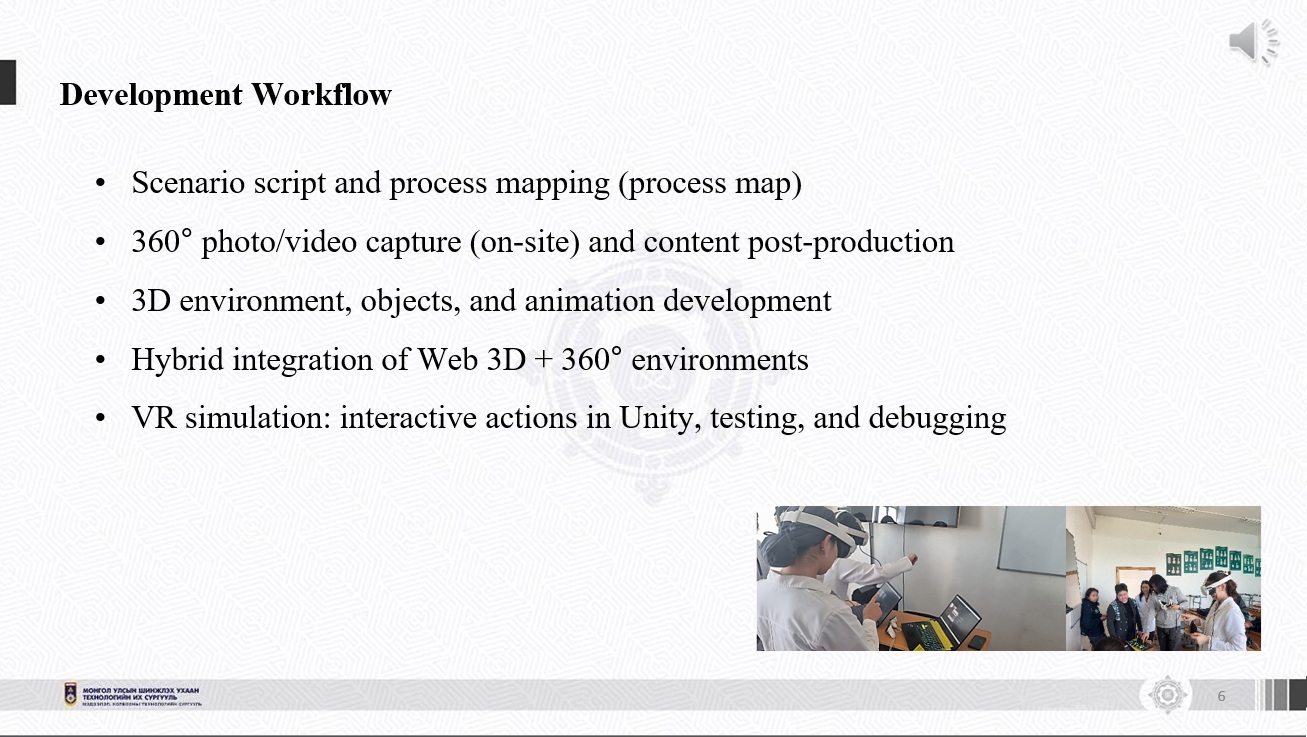 |
Now, Ill explain our end-to-end workflow. We begin by defining learning objectives and writing the scenario, then map the learner’s steps in a simple process flow. Next, we capture the real environment in 360, build the needed 3D assets and animations, integrate them into a web-based hybrid experience, and finally develop the full VR simulation in Unity with interactive tasks, assessments, and iterative testing. |
| ICACT20260088 Slide.07
[Big Slide]
[YouTube] |
Chrome Click!! |
 |
I explain the need for this work at MUST. Even though we have strong experience in digital learning, hands-on courses still face limited lab access due to equipment constraints, scheduling issues, and high costs, which reduces chances for repeated practice. To address this, we propose a hybrid approach that combines realistic 360° environments with interactive 3D and fully immersive VR simulations so students can practice more flexibly and at scale. |
| ICACT20260088 Slide.08
[Big Slide]
[YouTube] |
Chrome Click!! |
 |
Here, I summarize our objective and main contributions. Our goal is to integrate VR with 3D and 360° learning content so lab-style training can be delivered more flexibly and at lower cost. We contribute three deployment modes—a Meta Quest 3 VR simulation, a web-based 3D+360 experience, and a VR dome format—together providing a hybrid, cross-platform alternative to resource-intensive physical labs. |
| ICACT20260088 Slide.09
[Big Slide]
[YouTube] |
Chrome Click!! |
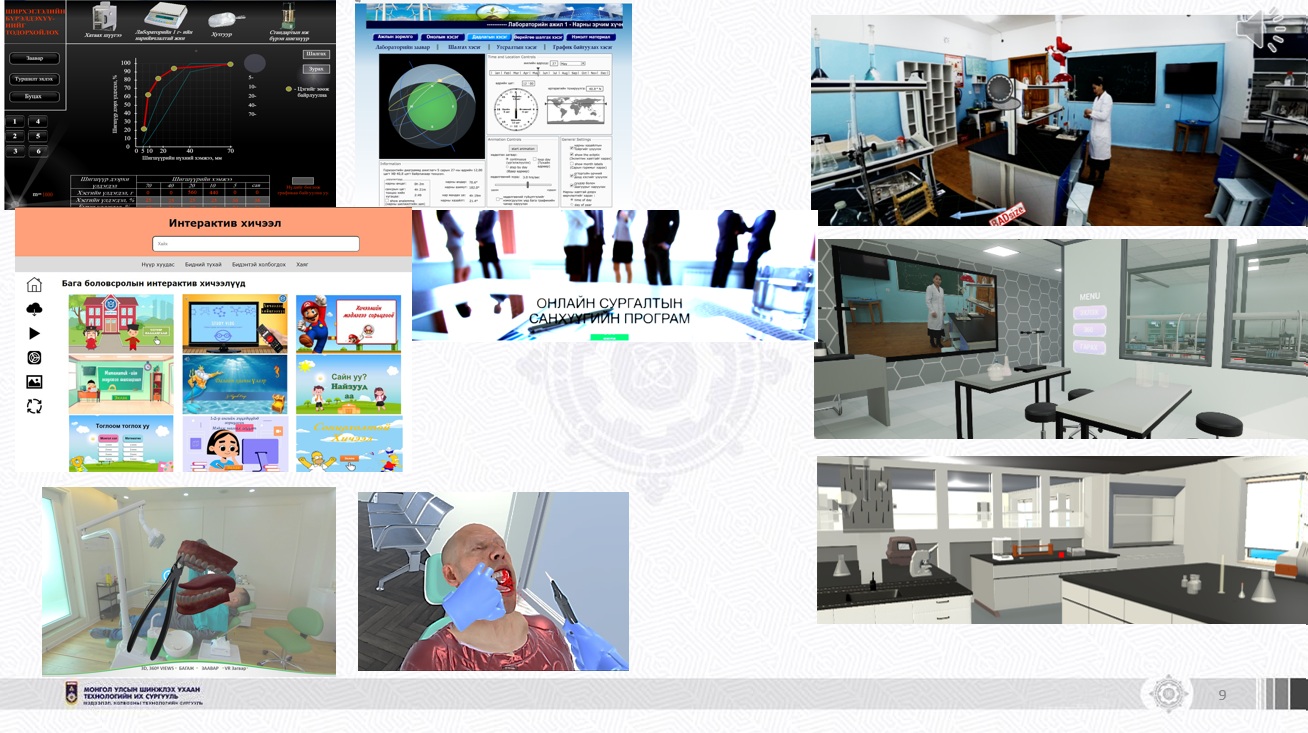 |
This slide shows visual examples of our developed content. You can see the 360 lab scenes, the 3D virtual labs, and the VR training prototypes. These examples demonstrate how one concept can be delivered in different formats for different learning contexts.
|
| ICACT20260088 Slide.10
[Big Slide]
[YouTube] |
Chrome Click!! |
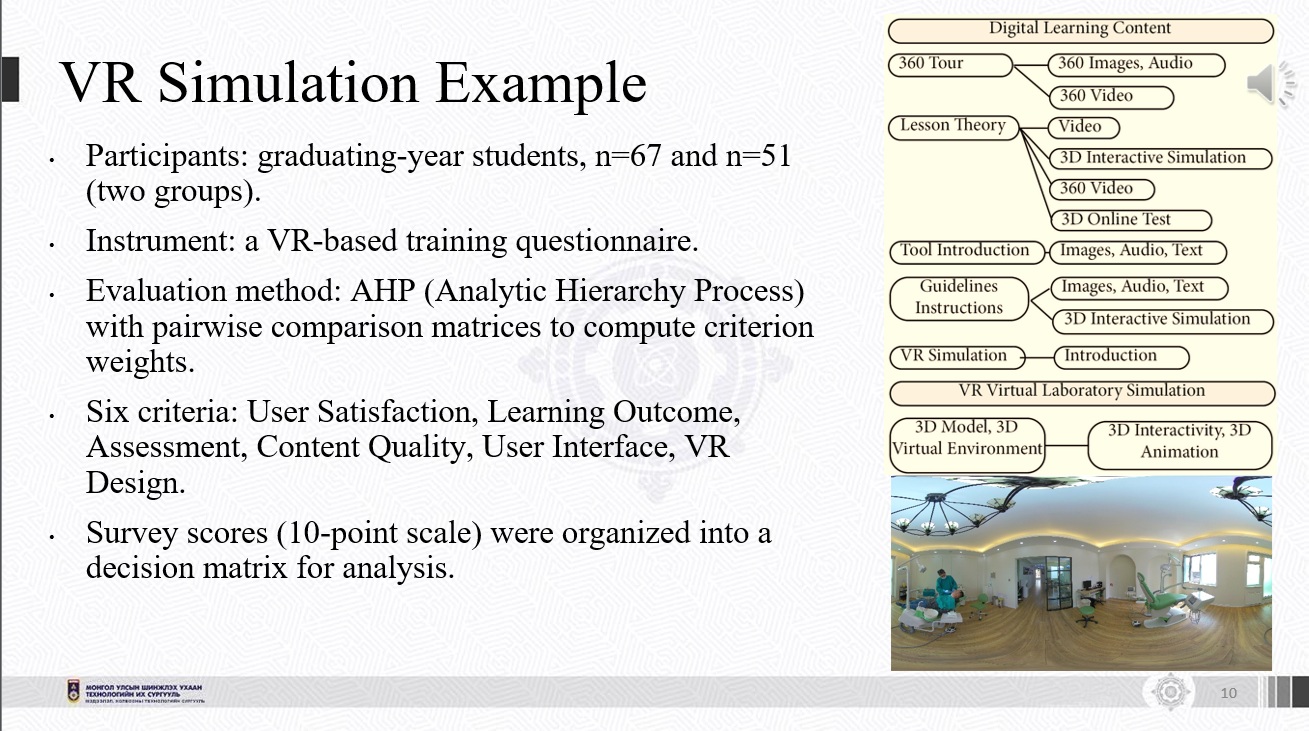 |
I show an example of our fully immersive VR simulation. It is a step-by-step procedural training module where learners use hand tracking to interact with tools and the environment. The system guides key actions and supports repeated practice, helping students build confidence before or alongside physical lab sessions. |
| ICACT20260088 Slide.11
[Big Slide]
[YouTube] |
Chrome Click!! |
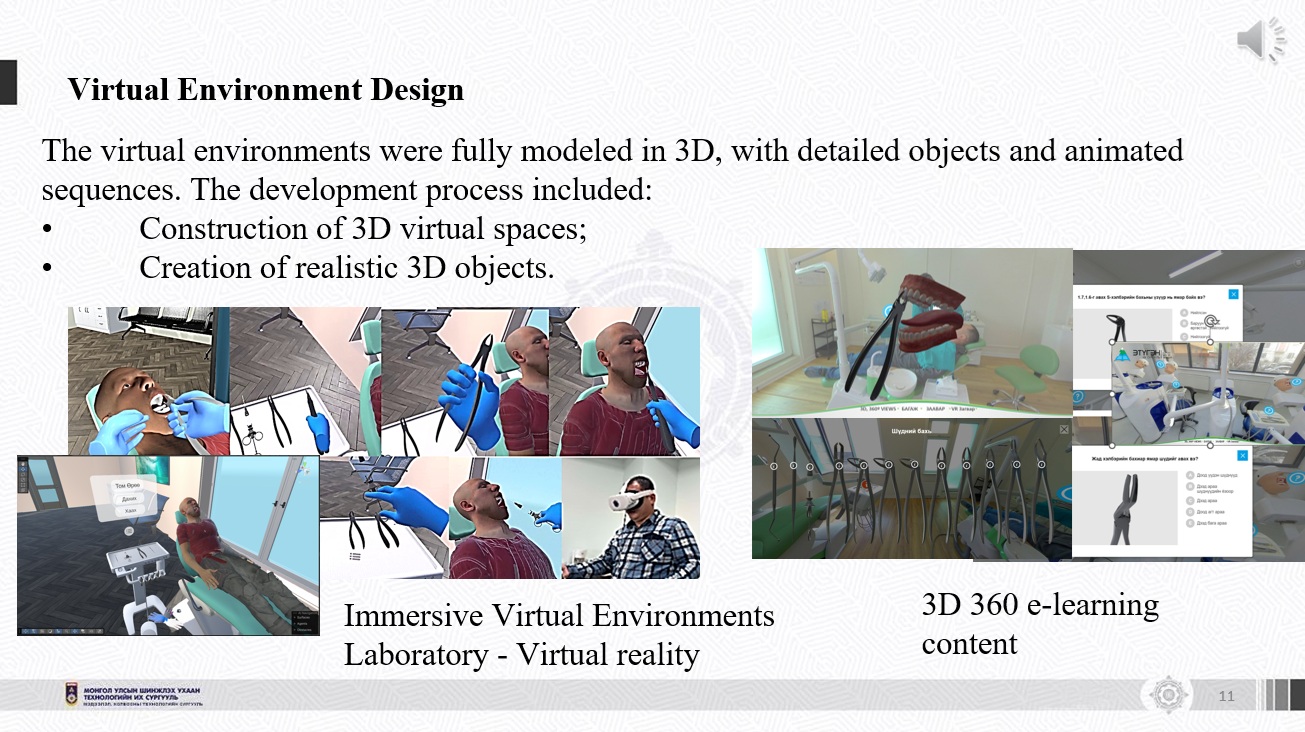 |
On this slide, I explain how we designed the virtual environment. We first built the overall 3D space and then modeled realistic objects that match the real lab or clinical setting, since immersion depends on accurate layout and recognizable tools. By designing the scene with interaction in mind, we enable procedural simulation and repeated practice in VR. |
| ICACT20260088 Slide.12
[Big Slide]
[YouTube] |
Chrome Click!! |
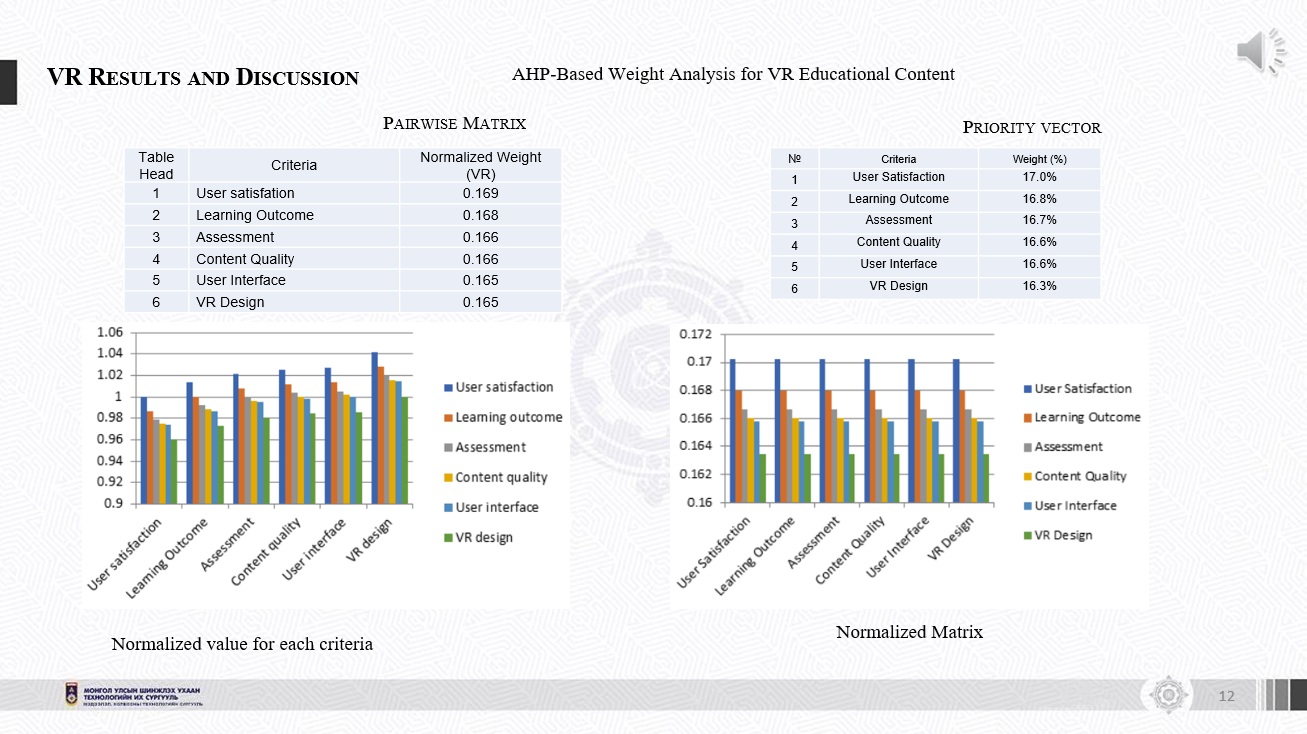 |
Looking at the weights, we see a very narrow spread—about 16.3% to 17.0%—which means all six criteria were judged to be similarly important, with no single factor dominating. Even so, the top priorities are clear: User Satisfaction (17.0%), Learning Outcome (16.8%), and Assessment (16.7%). Practically, this suggests our VR learning content should prioritize usability and engagement, while also making learning outcomes and assessment explicit and measurable. |
| ICACT20260088 Slide.13
[Big Slide]
[YouTube] |
Chrome Click!! |
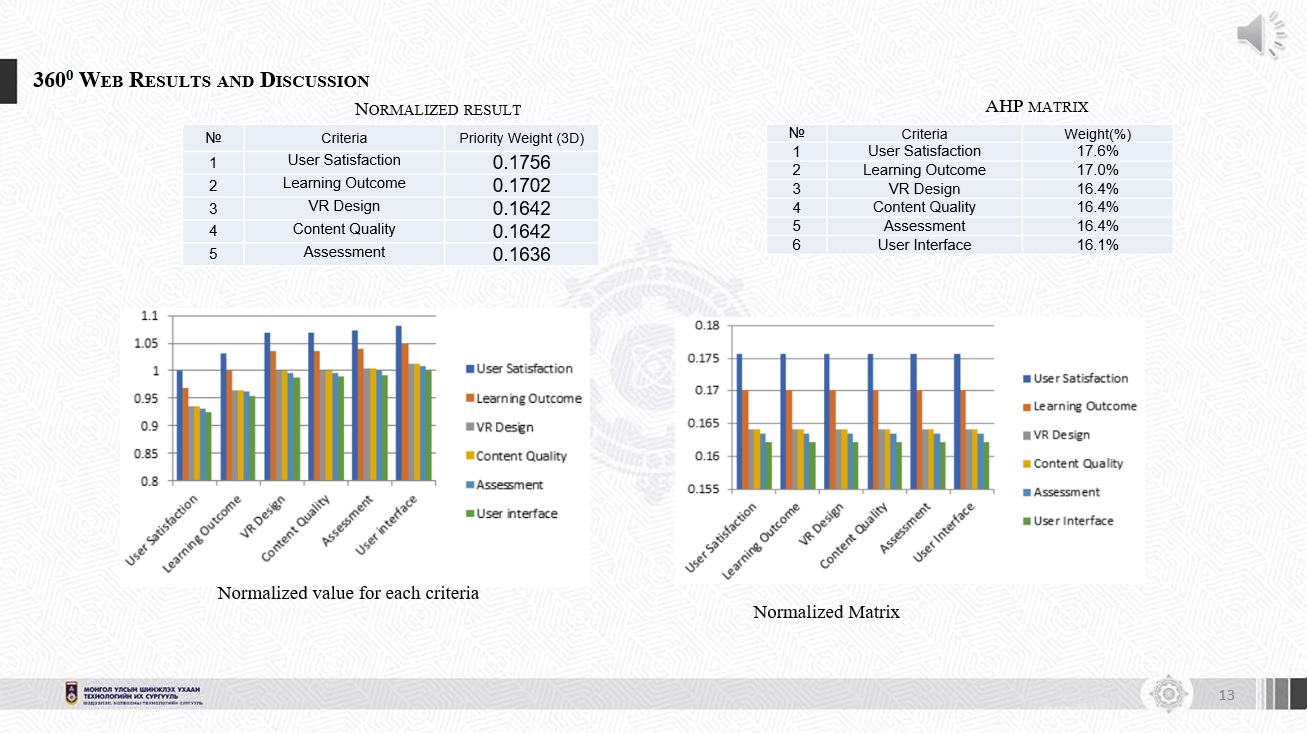 |
I summarize the AHP results for our 360° web-based learning content. The weights are very close, which shows a balanced evaluation across all criteria, but the top priorities are User Satisfaction (17.6%) and Learning Outcome (17.0%). The remaining criteria are also important VR Design, Content Quality, and Assessment (16.4% each), with User Interface (16.1%) suggesting learners value a good experience and clear learning gains most, while still expecting strong design, content quality, and assessment. |
| ICACT20260088 Slide.14
[Big Slide]
[YouTube] |
Chrome Click!! |
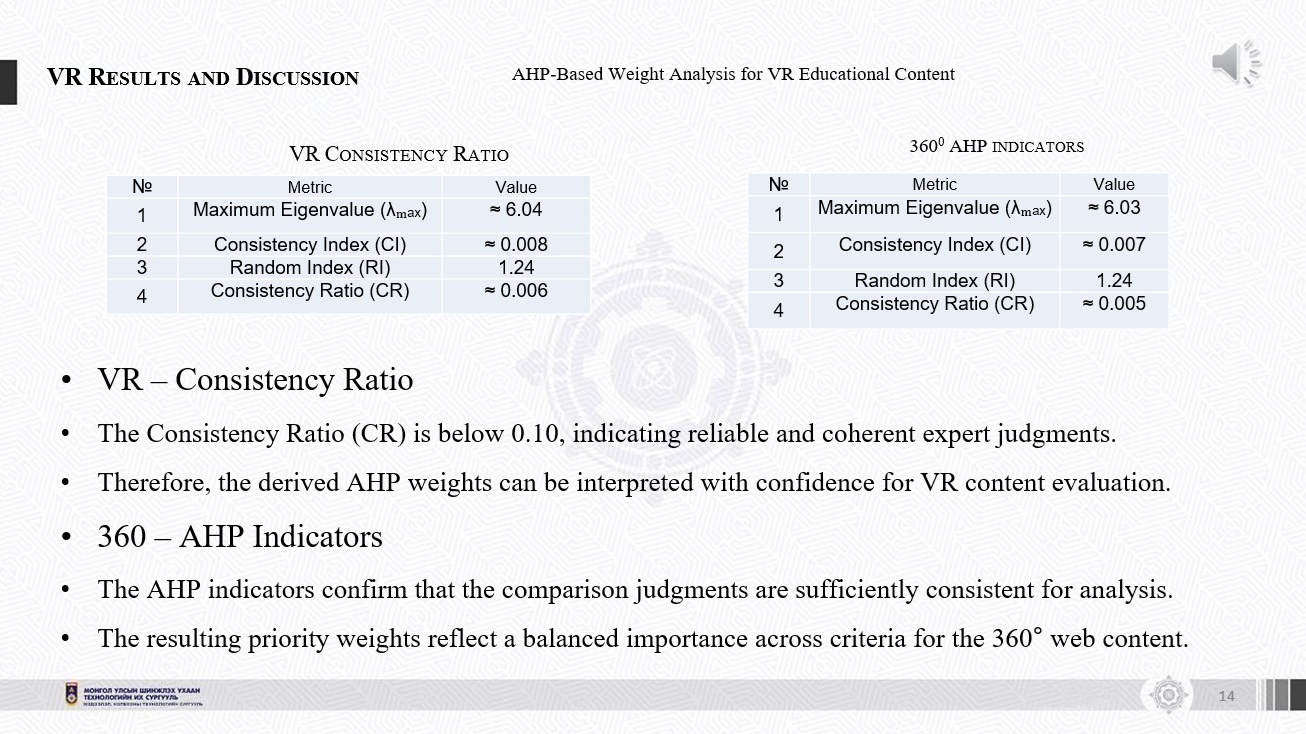 |
Before we interpret AHP weights, we must check reliability.
We report the Consistency Ratio (CR) based on λmax, CI, and RI.
In our results, CR is well below 0.10, which is the common acceptance threshold.
This means the expert comparisons are logically consistent, and the weights are trustworthy.
|
| ICACT20260088 Slide.15
[Big Slide]
[YouTube] |
Chrome Click!! |
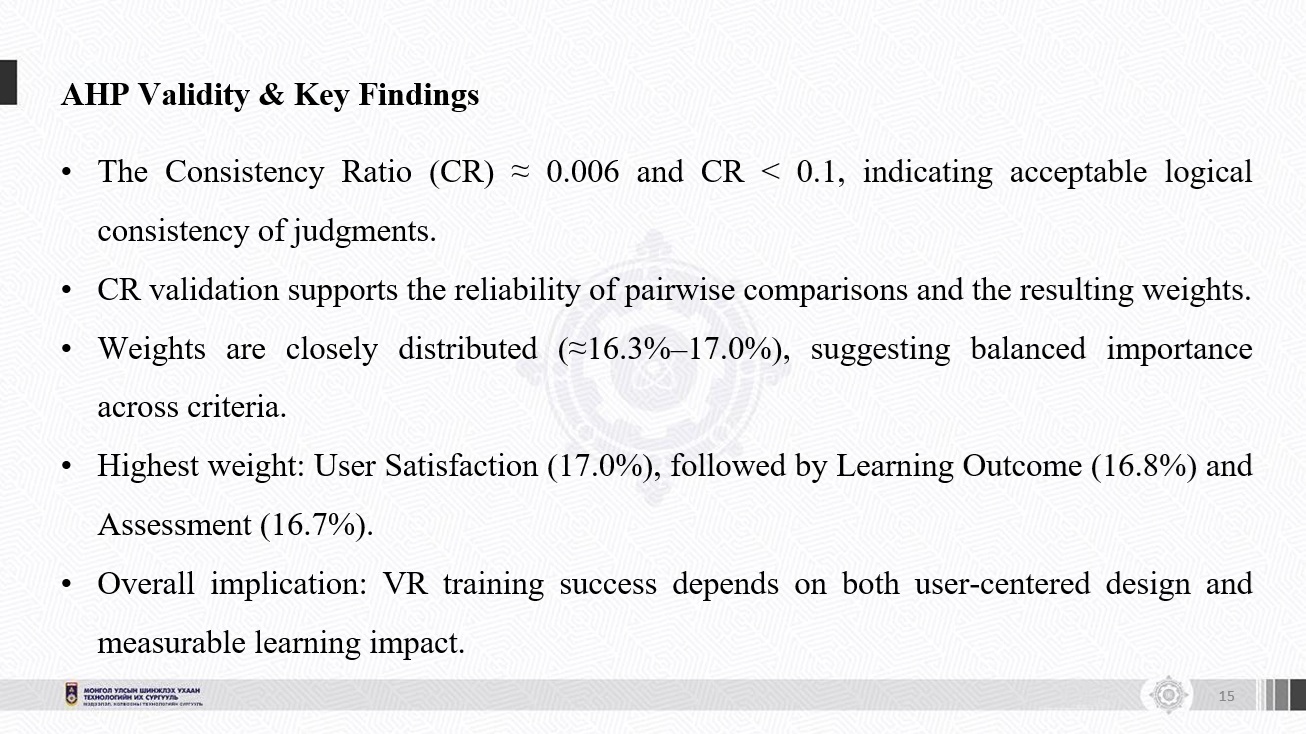 |
We first verify the reliability of the judgments using the Consistency Ratio, which is computed from λmax, CI, and RI; in our case, CR is well below 0.1, indicating acceptable logical consistency in the pairwise comparisons. |
| ICACT20260088 Slide.16
[Big Slide]
[YouTube] |
Chrome Click!! |
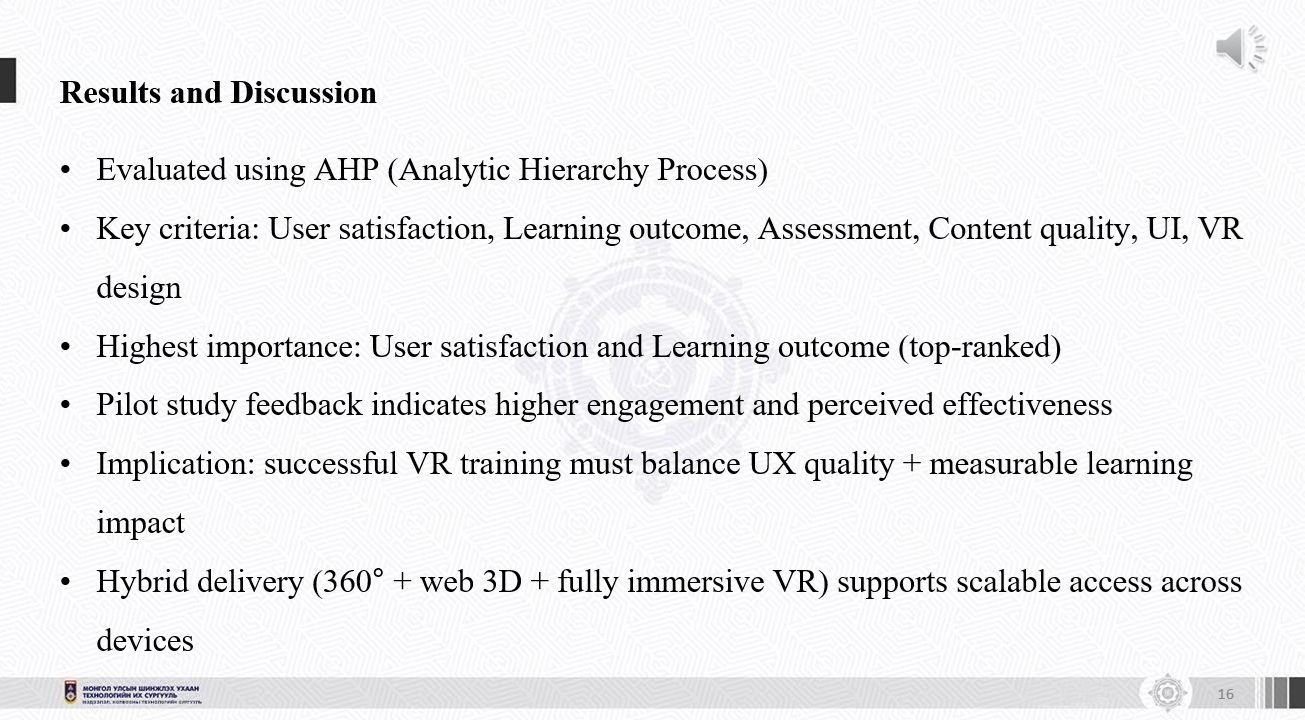 |
On this slide, I summarize what our results mean for designing immersive learning content. Our AHP analysis is reliable because the Consistency Ratio is well below 0.1, so we can trust the weights. The weights are close, showing that learners value multiple factors together—content quality, interface, assessment, and VR design—but the top priorities are still user satisfaction and learning outcomes. The key takeaway is that immersion alone is not enough: the system must be easy and enjoyable to use, and it must clearly support learning objectives and assessment, which is also consistent with our pilot feedback. |
| ICACT20260088 Slide.17
[Big Slide]
[YouTube] |
Chrome Click!! |
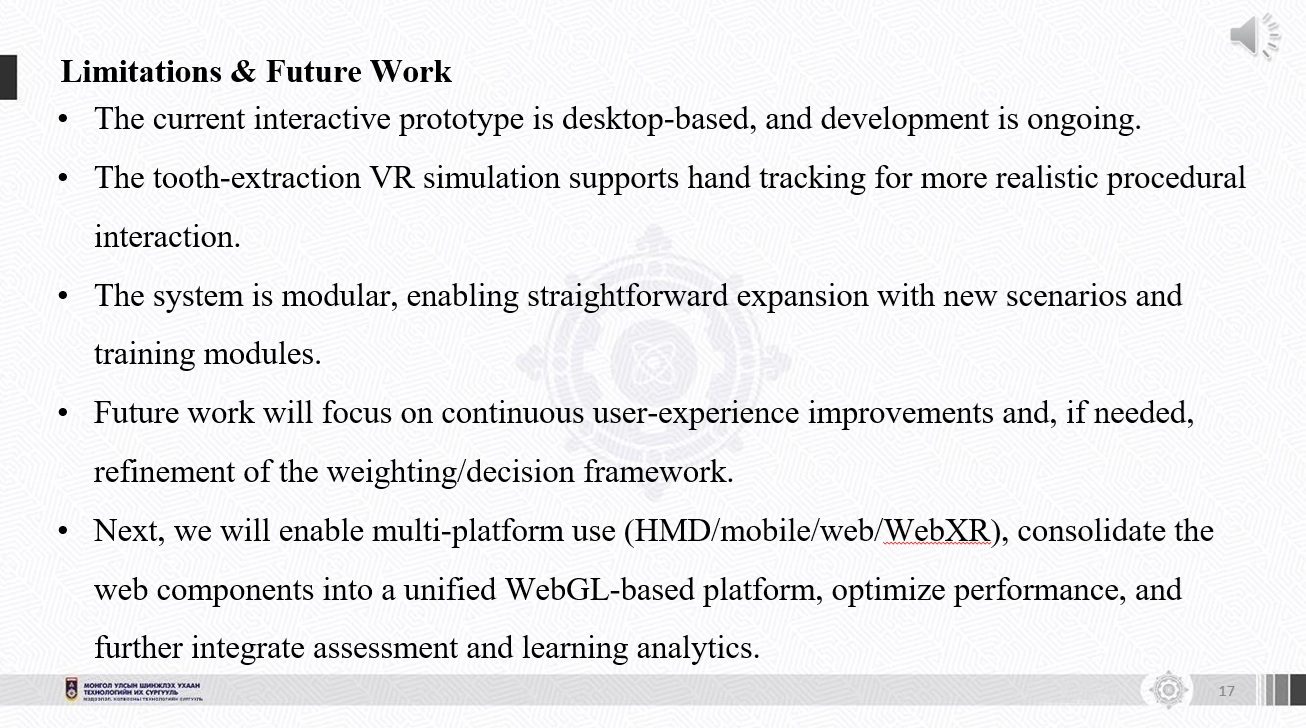 |
Our tooth-extraction VR simulation already supports hand tracking, enabling more realistic procedural interaction, and the modular architecture makes it easy to expand the system by adding new scenarios. Going forward, we plan to integrate our 3D/360 digital content with the VR simulation and develop a unified, WebGL-based web platform that supports multiple devices and platforms, including PC, HMD, mobile, and WebXR. We will also optimize performance and further enhance training, research, and assessment capabilities |
| ICACT20260088 Slide.18
[Big Slide]
[YouTube] |
Chrome Click!! |
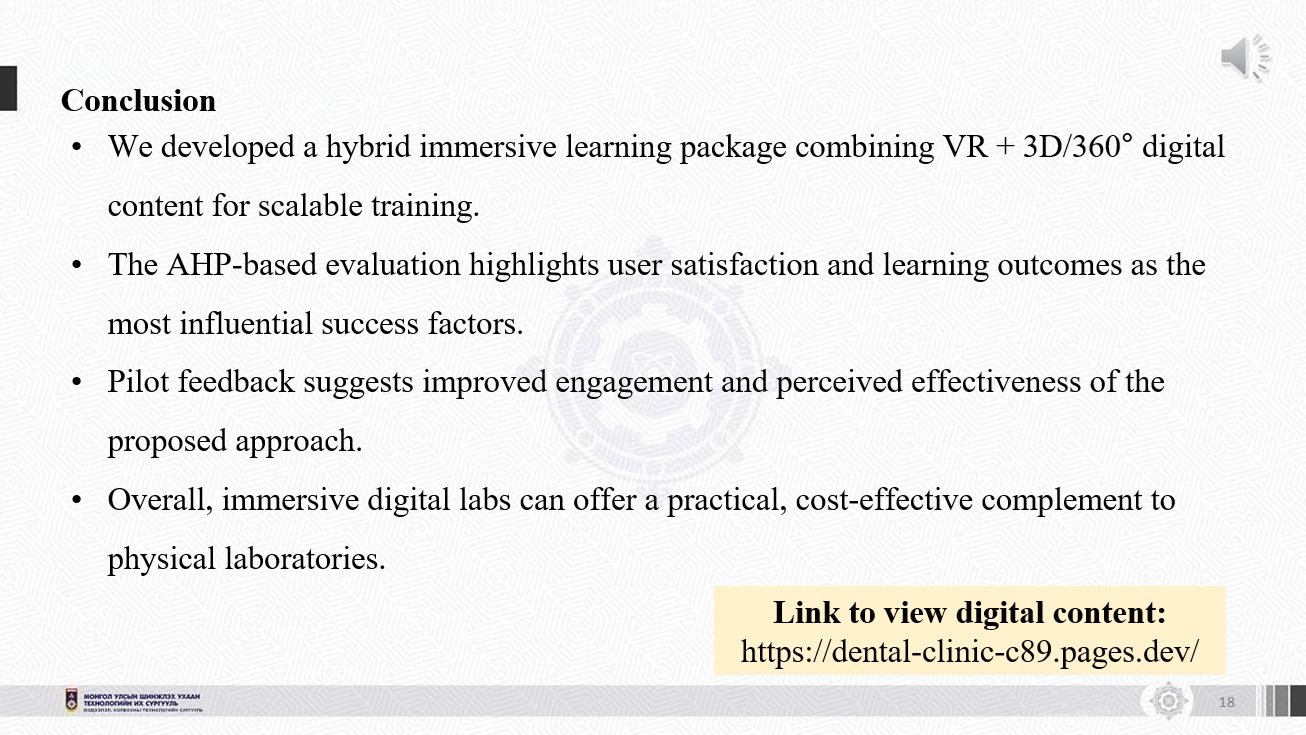 |
In conclusion, we addressed the challenge of scaling practice-based education by developing a hybrid solution that combines 360-degree contextual environments with interactive 3D and fully immersive VR simulation. We evaluated the content using an AHP-based framework and found that user satisfaction and learning outcomes are consistently the top priorities, which means immersive systems must be both engaging and instructionally effective. Overall, our work demonstrates that cross-platform immersive content—delivered via web and VR devices—can provide accessible, scalable support for laboratory-style learning, and offers a strong foundation for future expansion and broader evaluation. |
| ICACT20260088 Slide.19
[Big Slide]
|
Chrome Click!! |
 |
|
| ICACT20260088 Slide.20
[Big Slide]
|
Chrome Click!! |
 |
Thank you very much for your time and attention. |















