 ICACT20260094 Slide.01
[Big Slide]
[YouTube] |
Chrome  Click!! |
 |
Hello everyone, my name is Xinyuan Wang from Huawei Technologies. I am a technical expert at Huawei for more than ten years. My research work focuses on data communication network innovation, with special interests in Ethernet MAC and PHY technology. My presentation today is about the research on Analysis of High Efficiency Coding Scheme for PAM three Based Physical Link. |
| ICACT20260094 Slide.02
[Big Slide]
|
Chrome Click!! |
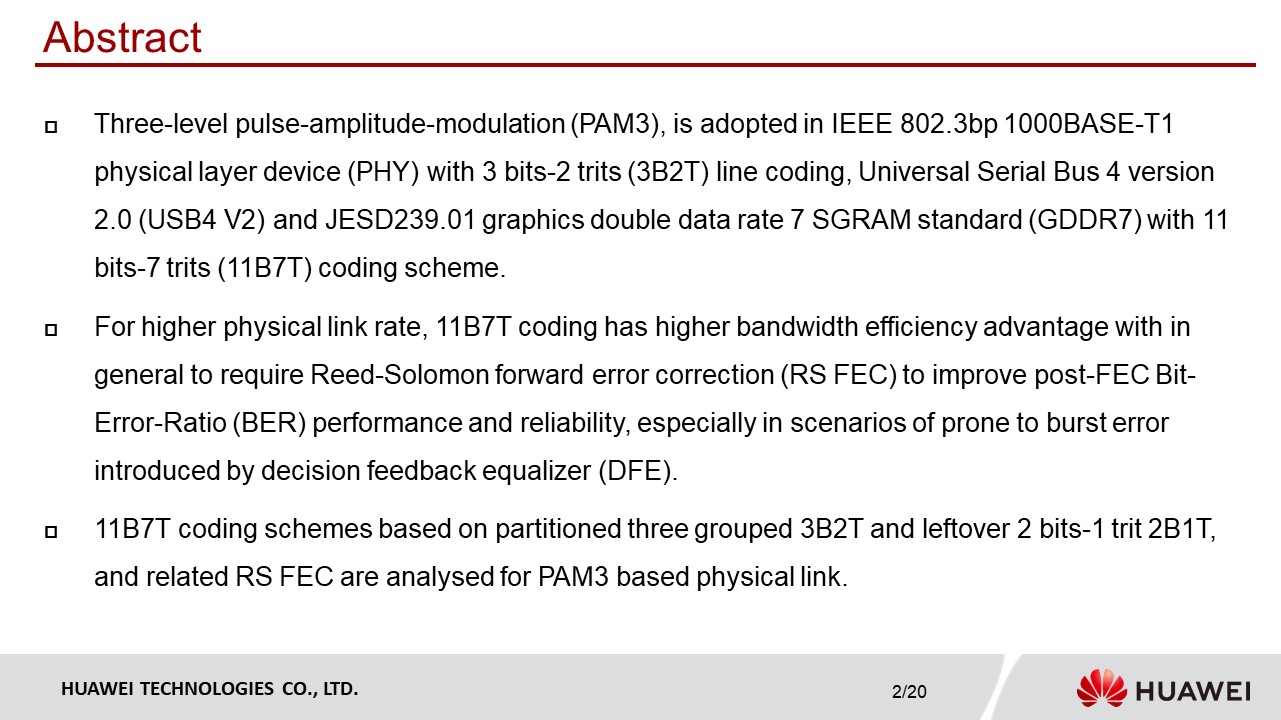 |
This slide is abstract about the work conducted in the paper.
First, three level pulse amplitude modulation, also known as PAM three, is adopted in I triple E eight two dot three bp one thousand BASE T one physical layer device with three bits to two trits, also known as three B two T, line coding.
USB four V two and GDDR seven adopt eleven bits to seven trits, also known as eleven B seven T, coding scheme.
For higher physical link rate, eleven B seven T coding has higher bandwidth efficiency advantage with in general to require Reed Solomon forward error correction to improve post FEC Bit Error Ratio performance and reliability, especially in scenarios of prone to burst error introduced by decision feedback equalizer, also known as DFE.
eleven B seven T coding schemes based on partitioned three grouped three B two T and leftover two bits to one trit two B one T, and related RS FEC are analyzed for PAM three based physical link in this paper. |
| ICACT20260094 Slide.03
[Big Slide]
|
Chrome Click!! |
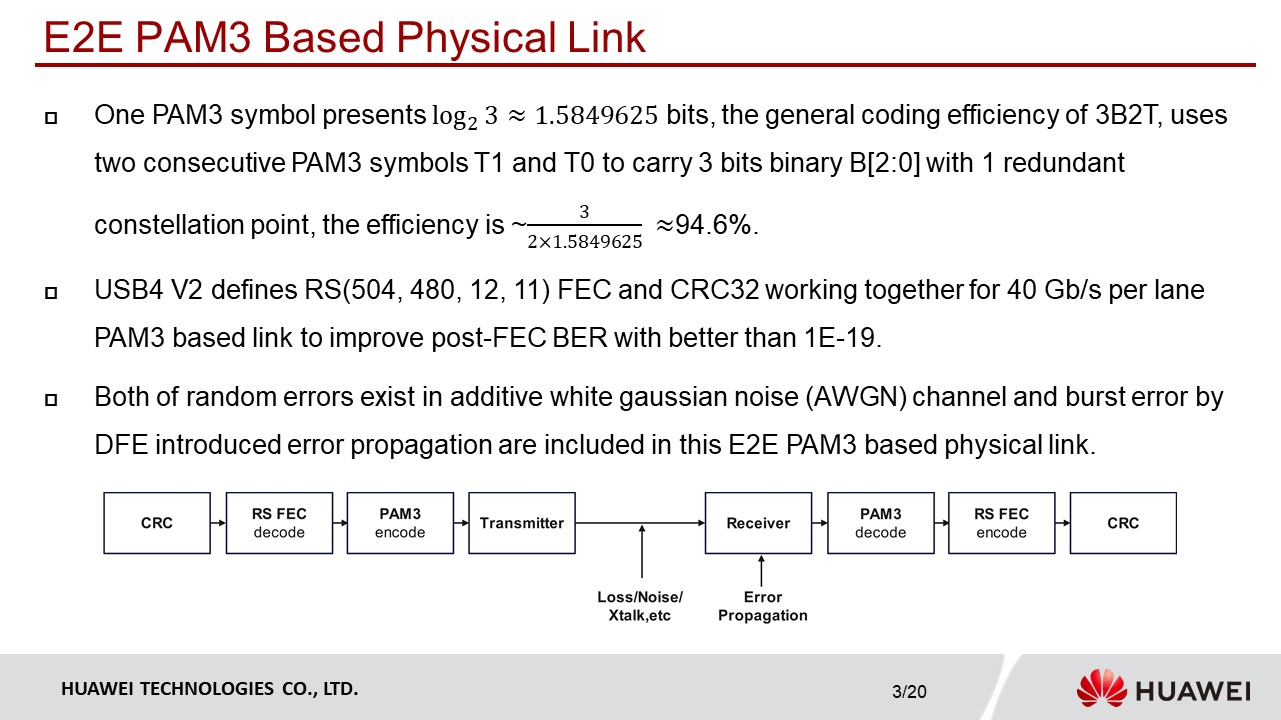 |
One PAM three symbol presents around 1.5849625 bits, the general coding efficiency of three B two T, uses two consecutive PAM three symbols T one and T zero to carry three bits binary B two to B zero with one redundant constellation point. The efficiency is around ninety four dot six percent.
USB four V two defines RS five zero four, four eight zero FEC and CRC thirty two working together for fourty Gbps per lane PAM three based link to improve post FEC BER with better than one E minus nineteen.
Both of random errors exist in additive white gaussian noise, AWGN, channel and burst error by DFE introduced error propagation are included in this End to End PAM three based physical link.
Our analysis is based on the link model in the following figure. |
| ICACT20260094 Slide.04
[Big Slide]
|
Chrome Click!! |
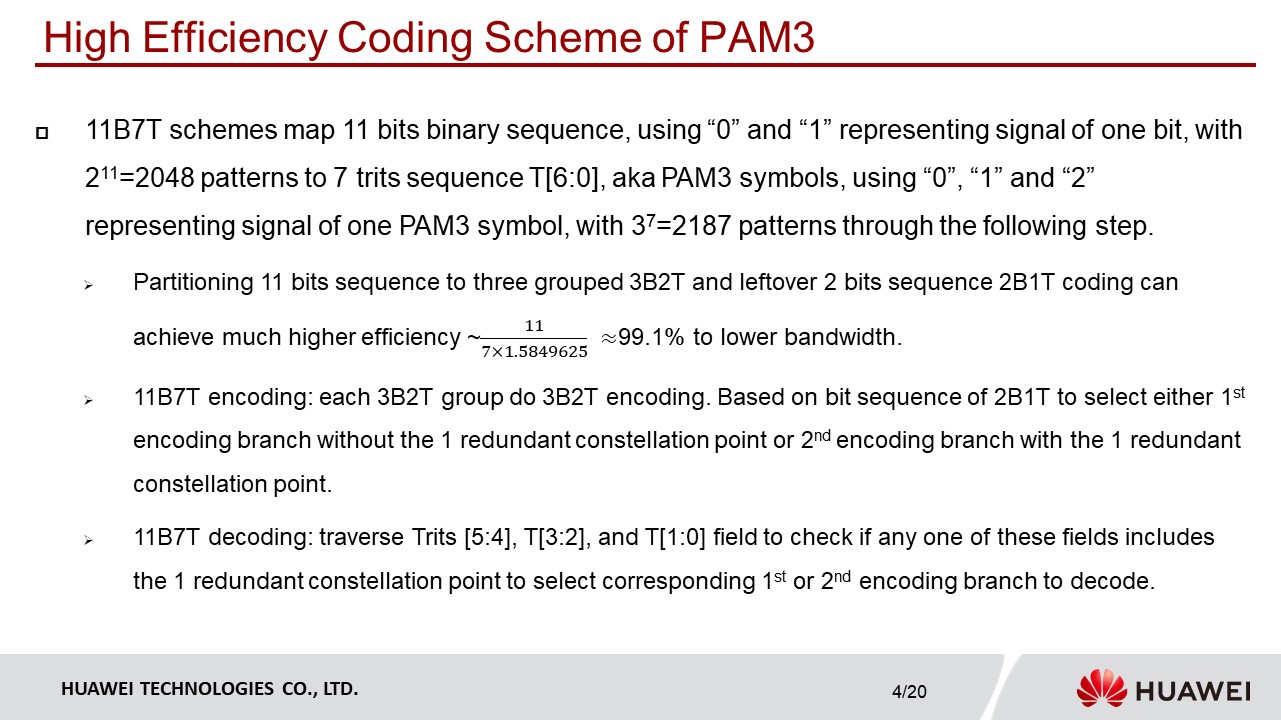 |
eleven B seven T schemes maps eleven bits binary sequence, using zero and one representing signal of one bit, with two to the power of eleven, equal to two thousands fourty eight patterns to seven trits sequence T six to zero, also known as PAM three symbols, using zero, one and two representing signal of one PAM three symbol, with three to the power of seven, equal to two thousands one hundred eighty seven patterns through the following step,
Partitioning eleven bits sequence to three grouped three B two T and leftover two bits sequence two B one T coding can achieve much higher efficiency around ninety nine dot one percent to lower bandwidth.
eleven B seven T encoding, each three B two T group do three B two T encoding. Based on bit sequence of two B one T to select either first encoding branch without the one redundant constellation point or second encoding branch with the one redundant constellation point.
eleven B seven T decoding, traverse Trits T five to T four, T three to T two, and T one to T zero field to check if any one of these fields includes the one redundant constellation point to select corresponding first or second encoding branch to decode. |
| ICACT20260094 Slide.05
[Big Slide]
|
Chrome Click!! |
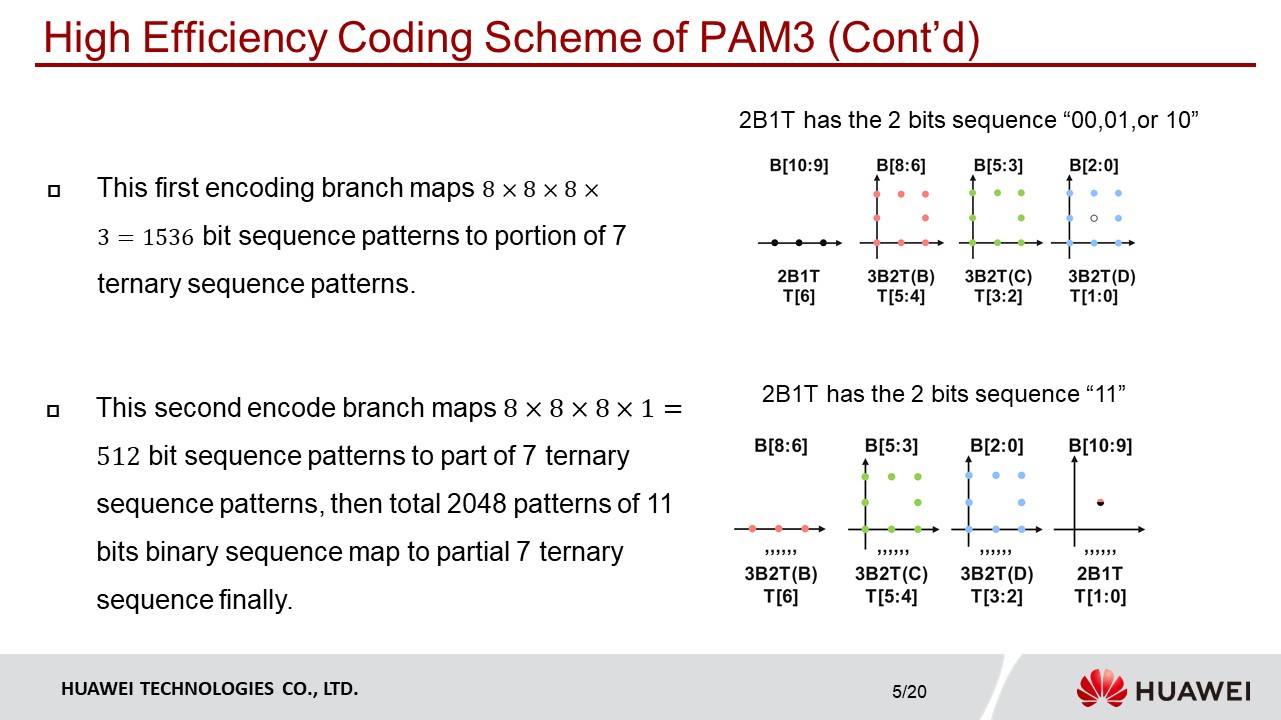 |
This first encoding branch maps eight times eight times eight times three, equal to one thousand five hundred thirty six bit sequence patterns to portion of seven ternary sequence patterns.
The figure at top right is for two B one T has the two bits sequence zero and zero, zero and one, or one and zero.
This second encode branch maps eight times eight times eight times one, equal to five hundred twelve bit sequence patterns to part of seven ternary sequence patterns, then total two thousands fourty eight patterns of eleven bits binary sequence map to partial seven ternary sequence finally.
The figure at bottom right is for two B one T has the two bits sequence one and one. The second encoding branch require to reshuffle the redundant constellation point at different ternary sequence field to mark one of encoded PAM three signal. |
| ICACT20260094 Slide.06
[Big Slide]
|
Chrome Click!! |
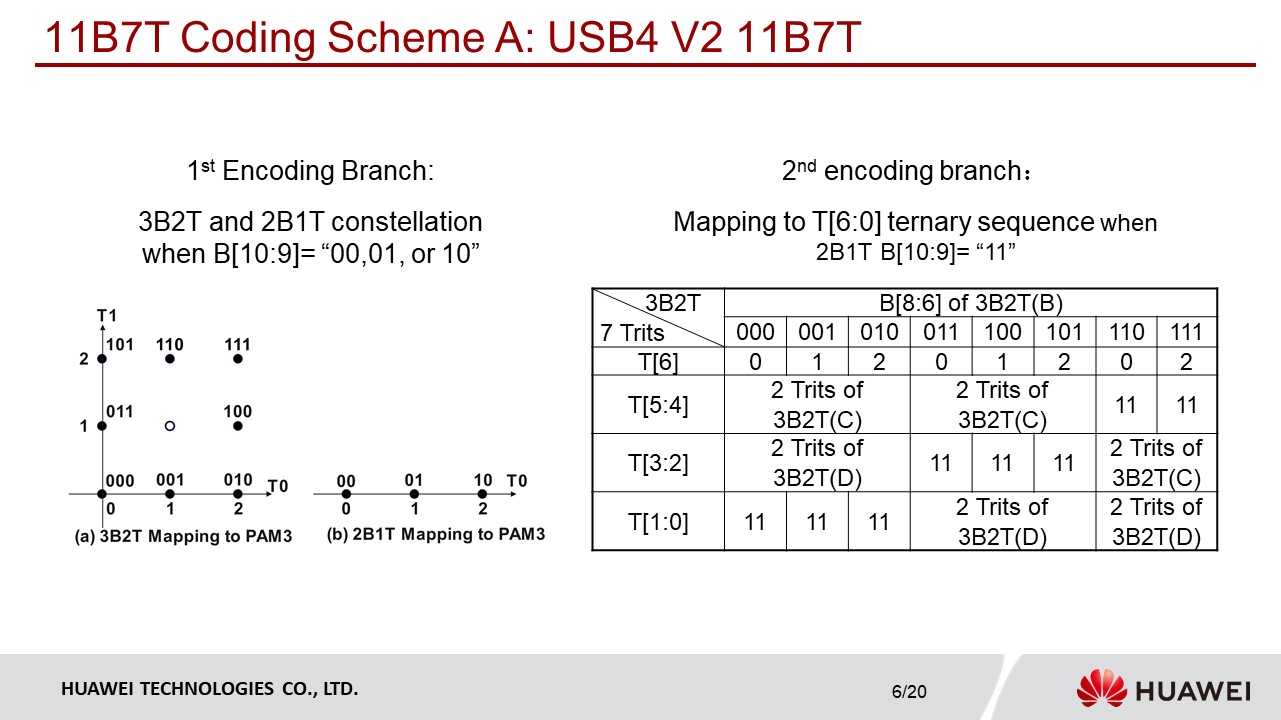 |
This coding scheme B is defined in USB four V two. The three B two T coding is present in bottom left figure a with one and one as redundant constellation point. The two B one T when B ten to nine is zero and zero, zero and one, or one and zero coding is presented in bottom left figure b. This is the first encoding branch.
The second encoding branch for two B one T when B ten to nine is one and one is presented in the bottom right table |
| ICACT20260094 Slide.07
[Big Slide]
|
Chrome Click!! |
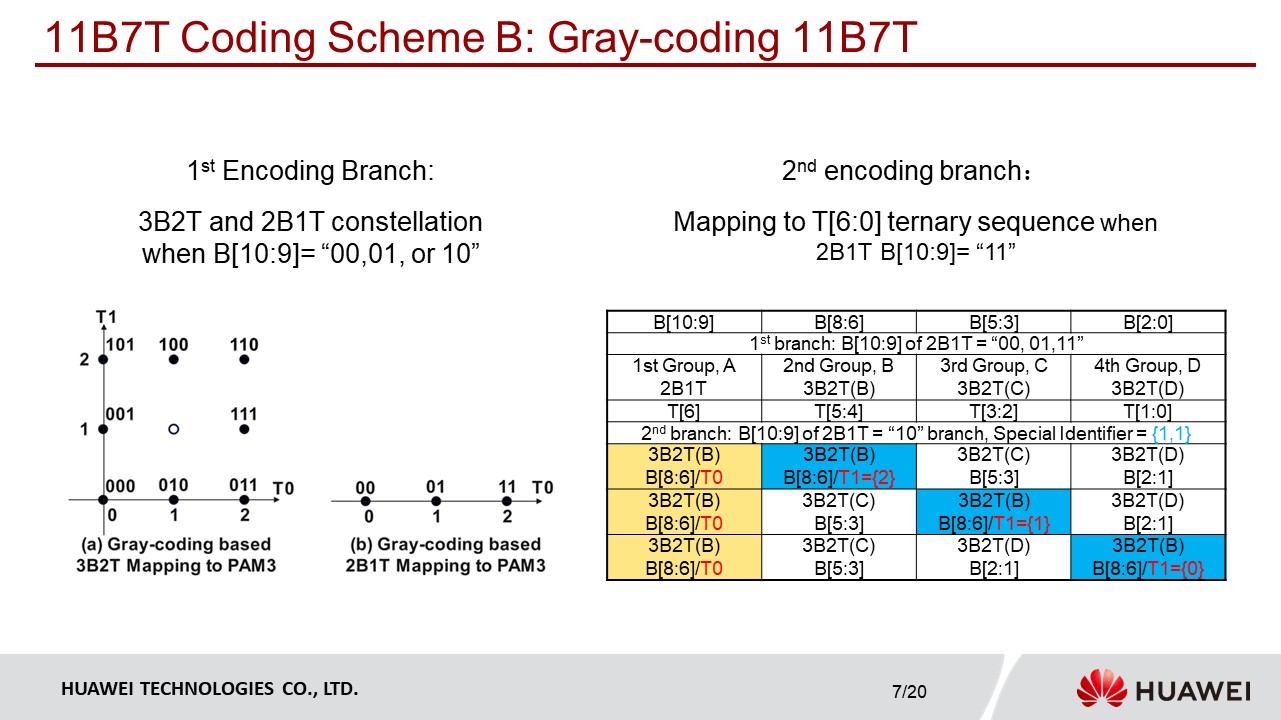 |
This coding scheme B is new proposal in my work.
For the first encoding branch, the three B two T and two B one T coding is optimized in bottom left figure a and b with Gray coding.
Furthermore, the table is summary of the first and second encoding branch which is similiar to the prior partationing.
For the second encoding branch, reshuffling the redundant constellation point, one and one, at different ternary sequence field T five to four, T three to two, T one to zero to represent the first Trit T one of encoded three bits two trits group B. |
| ICACT20260094 Slide.08
[Big Slide]
|
Chrome Click!! |
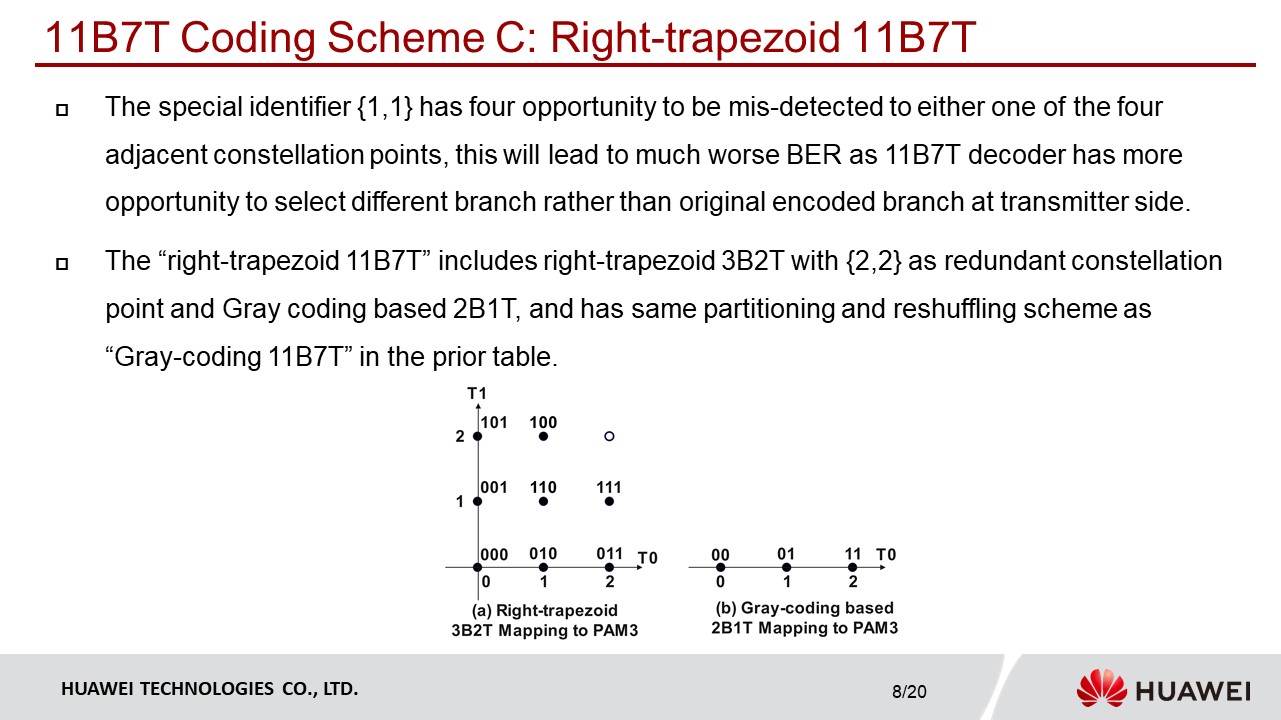 |
The special identifier one and one has four opportunity to be mis detected to either one of the four adjacent constellation points, this will lead to much worse BER as eleven B seven T decoder has more opportunity to select different branch rather than original encoded branch at transmitter side.
The right trapezoid eleven B seven T includes right trapezoid three B two T with two and two as redundant constellation point and Gray coding based two B one T.
This scheme has same partitioning and reshuffling scheme as Gray coding eleven B seven T scheme in the prior table. |
| ICACT20260094 Slide.09
[Big Slide]
|
Chrome Click!! |
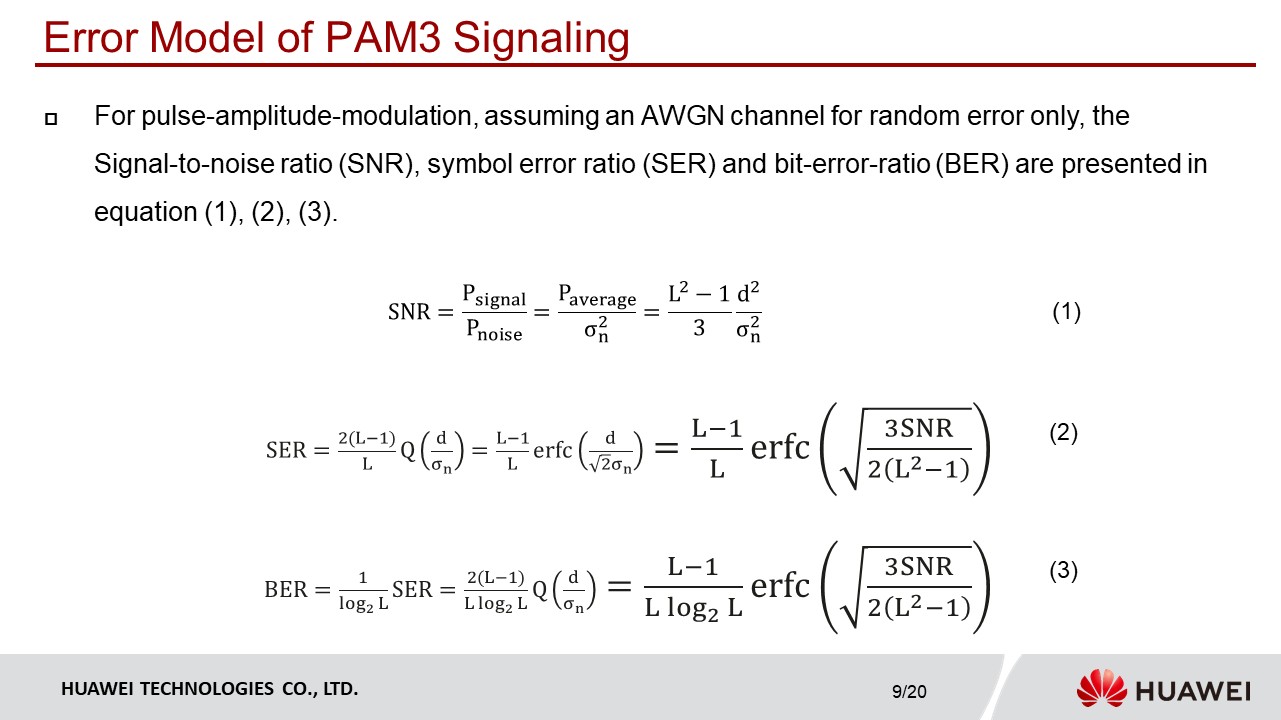 |
For pulse amplitude modulation, assuming an AWGN channel for random error only, the Signal to noise ratio, SNR, PAM three symbol error ratio, SER, and bit error ratio, BER are presented in equation one, two and three. |
| ICACT20260094 Slide.10
[Big Slide]
|
Chrome Click!! |
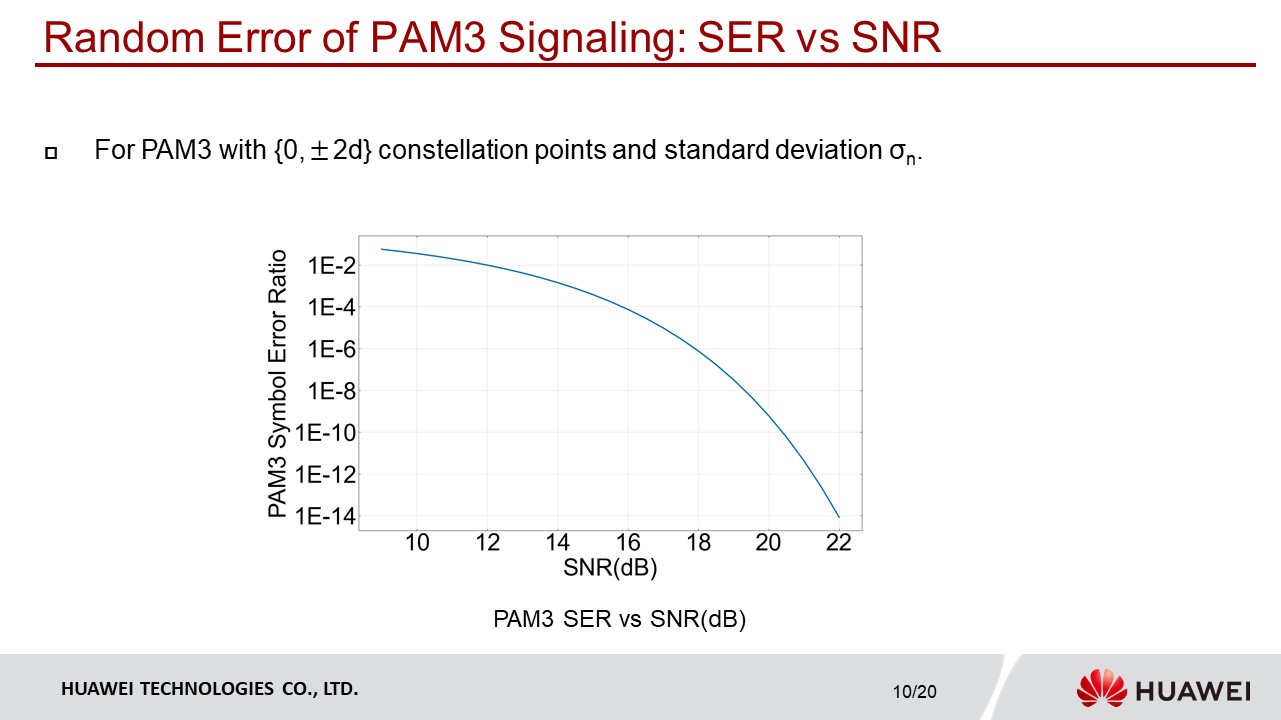 |
For conducting PAM three based link performance analysis, use negative two d, zero and positive two d to define PAM three constellation points and standard deviation sigma n.
Two d is the minimum distance between adjacent symbols in the constellation.
The PAM three symbol error ratio, SER versus SNR are presented in this figure. |
| ICACT20260094 Slide.11
[Big Slide]
|
Chrome Click!! |
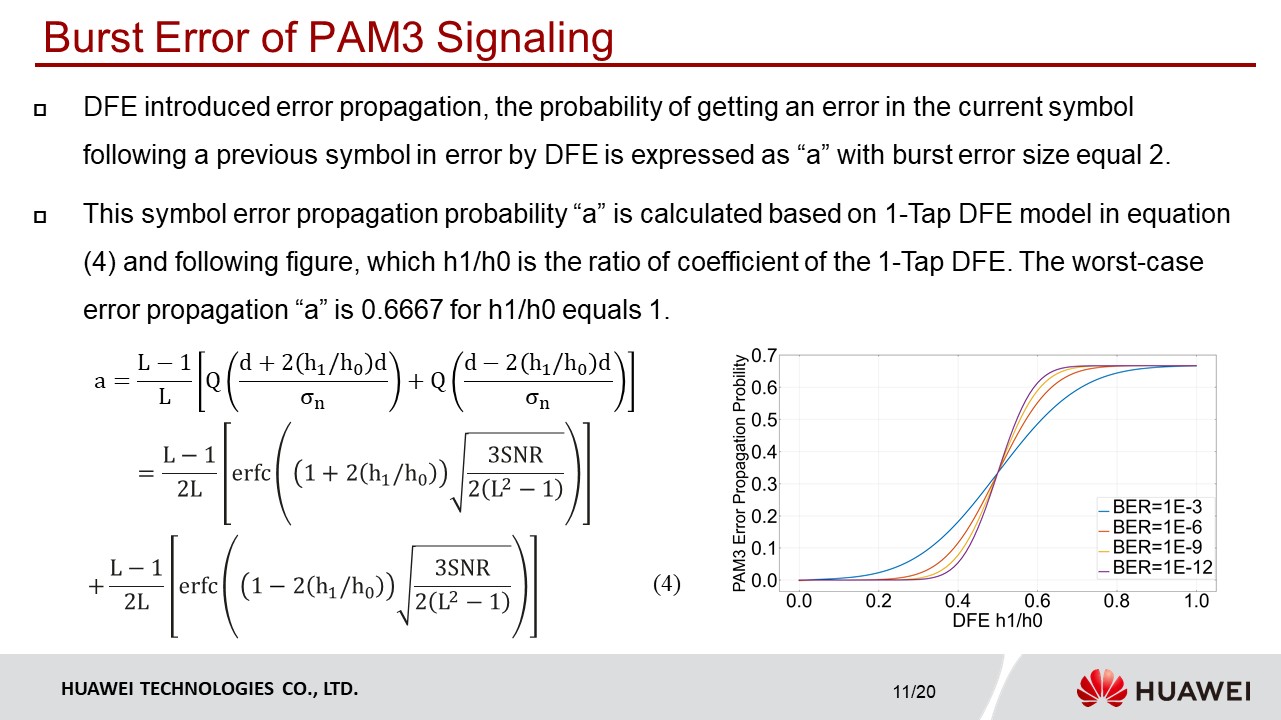 |
DFE introduced error propagation, the probability of getting an error in the current symbol following a previous symbol in error by DFE is expressed as a with burst error size equal two.
This symbol error propagation probability a is calculated based on one Tap DFE model in equation four and following figure, which h one over h zero is the ratio of coefficient of the one Tap DFE. The worst case error propagation a is 0.6667 for h one over h zero equal one. |
| ICACT20260094 Slide.12
[Big Slide]
|
Chrome Click!! |
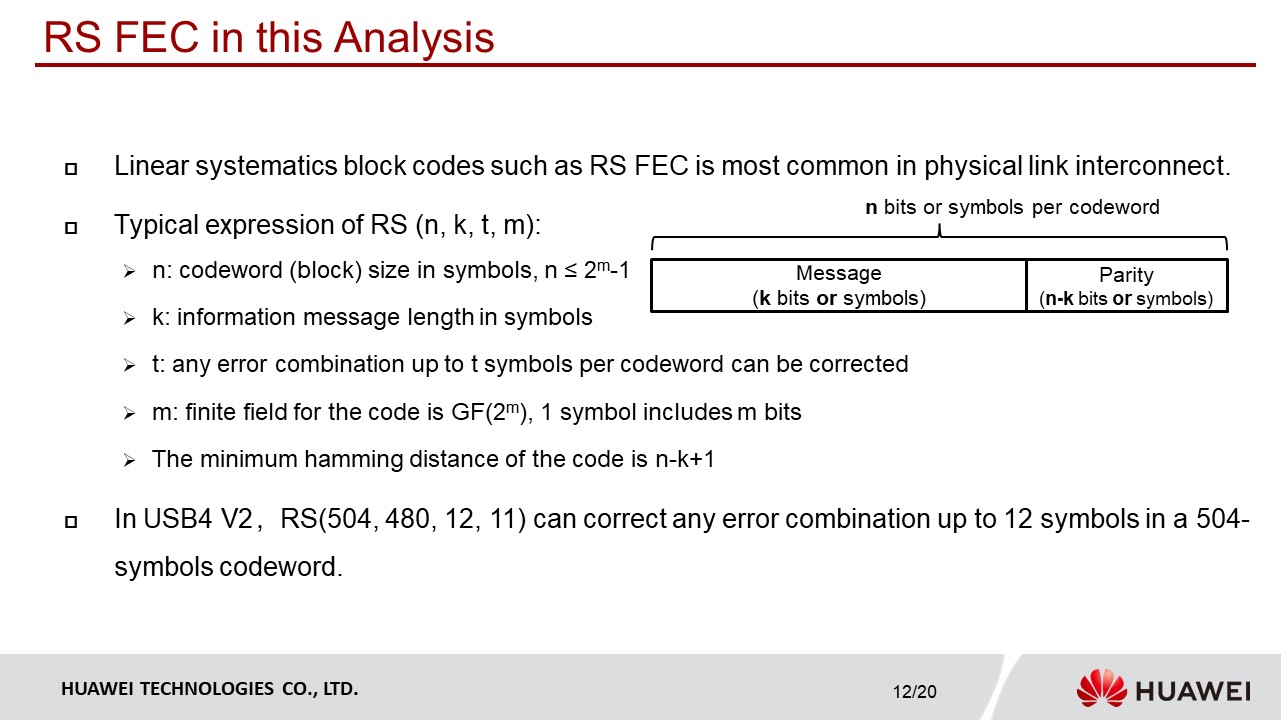 |
Linear systematics block codes such as RS FEC is most common in physical link interconnect.
Typical expression of RS FEC is n, k, t, m.
n is codeword size in symbols, n less than or equal to two power m minus one.
k is information message length in symbols.
t is any error combination up to t symbols per codeword can be corrected.
m is finite field for the code.
In USB four V two, RS five zero four, four eight zero can correct any error combination up to twelve symbols in a five zero four symbols codeword. |
| ICACT20260094 Slide.13
[Big Slide]
|
Chrome Click!! |
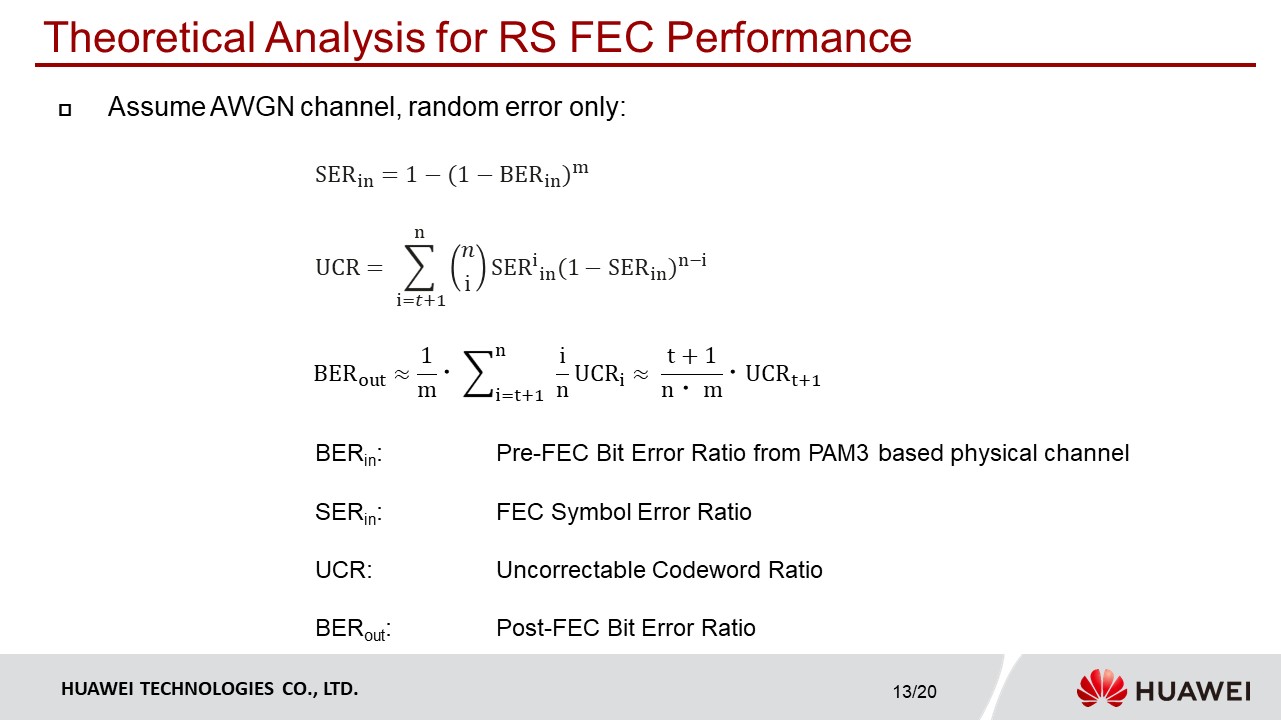 |
The following equations are used to calculate the BER out from RS FEC decode.
The BER in is identical to equation three. |
| ICACT20260094 Slide.14
[Big Slide]
|
Chrome Click!! |
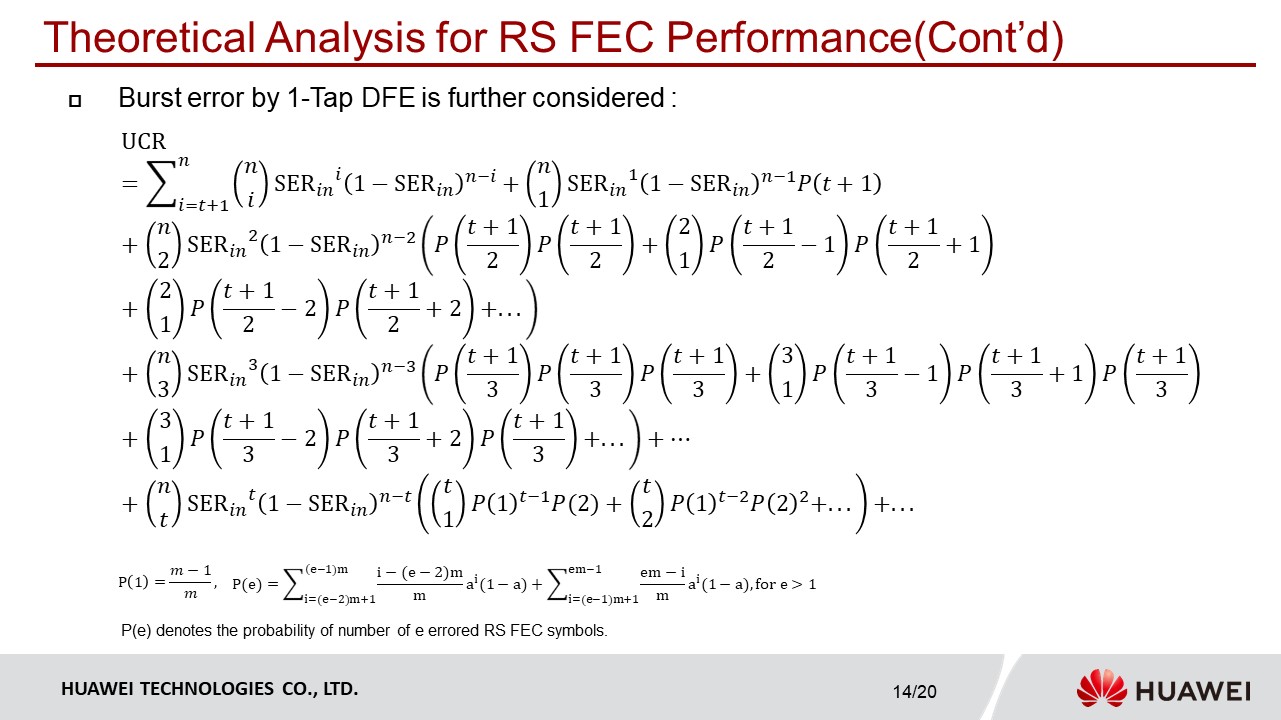 |
Burst error by DFE should be further considered.
one Tap DFE introduced burst error with error propagation probability a in slide eleven;
UCR should include burst error factor for any combination of great than t errored RS FEC symbol as the following equation. |
| ICACT20260094 Slide.15
[Big Slide]
|
Chrome Click!! |
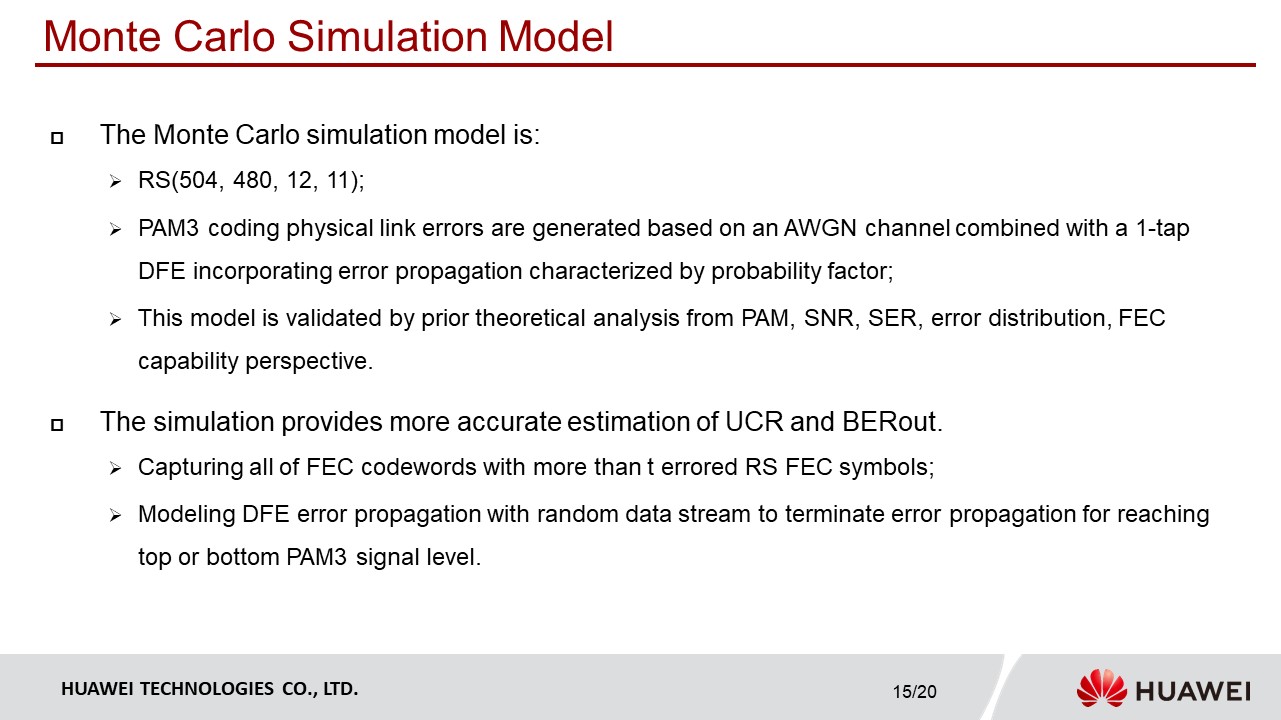 |
The Monte Carlo simulation model is based on RS five zero four, four eight zero.
PAM three coding physical link errors are generated based on an AWGN channel combined with a one tap DFE incorporating error propagation characterized by probability factor;
This model is validated by prior theoretical analysis from PAM, SNR, SER, error distribution, FEC capability perspective.
The simulation provides more accurate estimation of UCR and BERout.
Capturing all of FEC codewords with more than t errored RS FEC symbols;
Modeling DFE error propagation with random data stream to terminate error propagation for reaching top or bottom PAM three signal level. |
| ICACT20260094 Slide.16
[Big Slide]
|
Chrome Click!! |
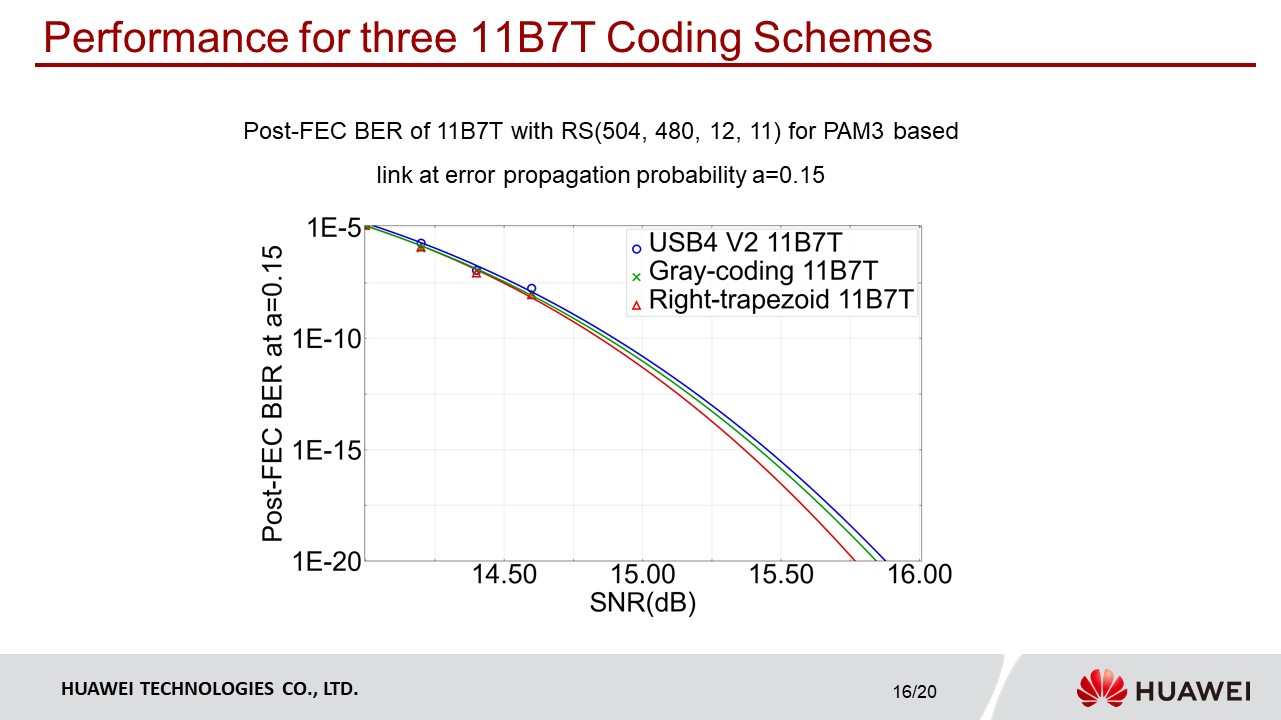 |
For all of three coding schemes, the achieved post FEC BER and SNR by simulation is fitting and prediction by polynomial as in the following Figure for a is 0.15 and the figure in next slide for a is 0.6667.
Even considering fitting precision, Right trapezoid eleven B seven T scheme still has best post FEC BER, USB four V two eleven B seven T scheme has worst post FEC BER in both a at 0.6667 and 0.15 scenarios. |
| ICACT20260094 Slide.17
[Big Slide]
|
Chrome Click!! |
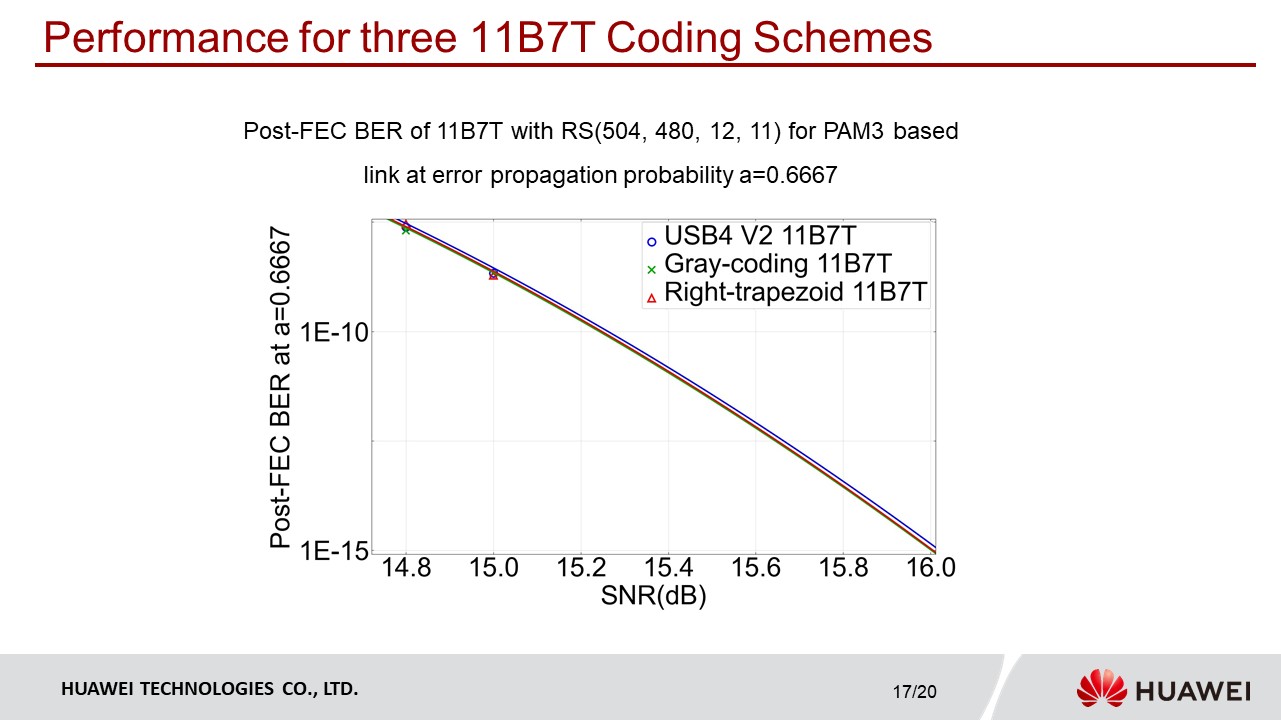 |
These slide is the post FEC BER for a is 0.6667. |
| ICACT20260094 Slide.18
[Big Slide]
|
Chrome Click!! |
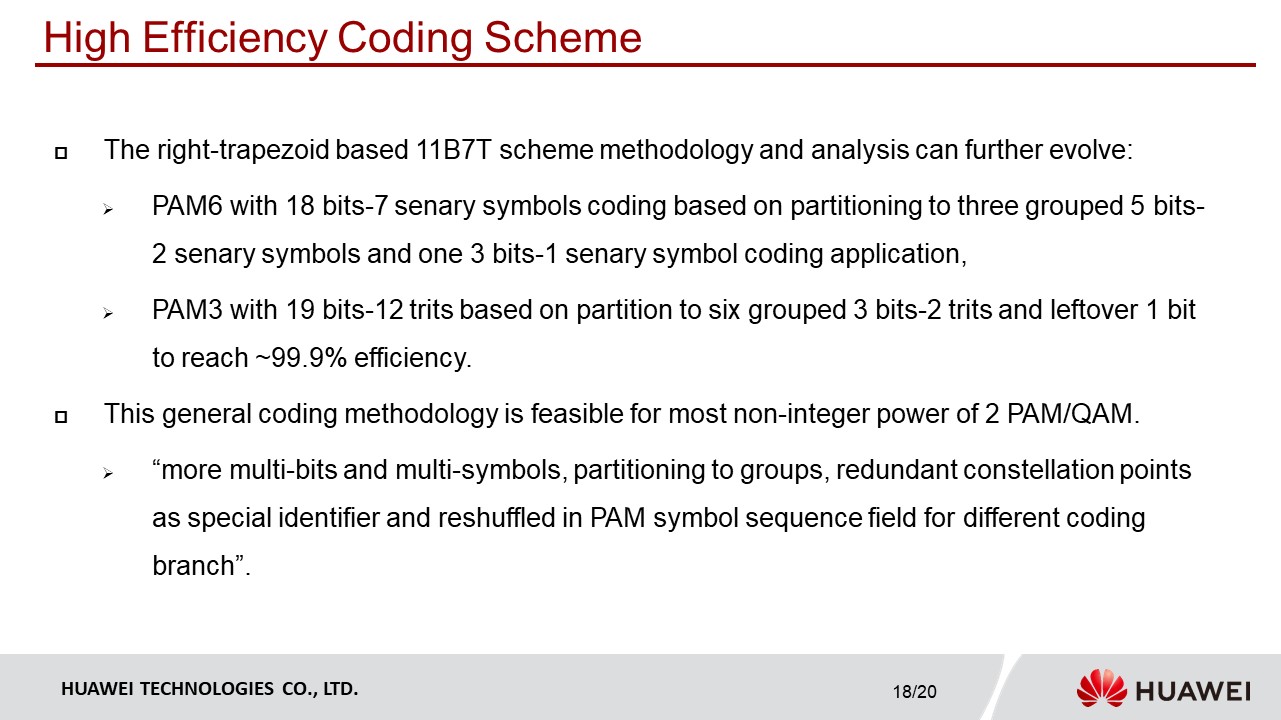 |
The right trapezoid based eleven B seven T scheme methodology and analysis can further evolve:
PAM six with eighteen bits to seven senary symbols coding based on partitioning to three grouped five bits to two senary symbols and one three bits to one senary symbol coding application,
PAM three with nineteen bits to twelve trits based on partition to six grouped three bits to two trits and leftover one bit to reach around ninety nine dot nine percent efficiency.
This general coding methodology is feasible for most non integer power of two PAM or QAM.
more multi bits and multi symbols, partitioning to groups, redundant constellation points as special identifier and reshuffled in PAM symbol sequence field for different coding branch. |
| ICACT20260094 Slide.19
[Big Slide]
|
Chrome Click!! |
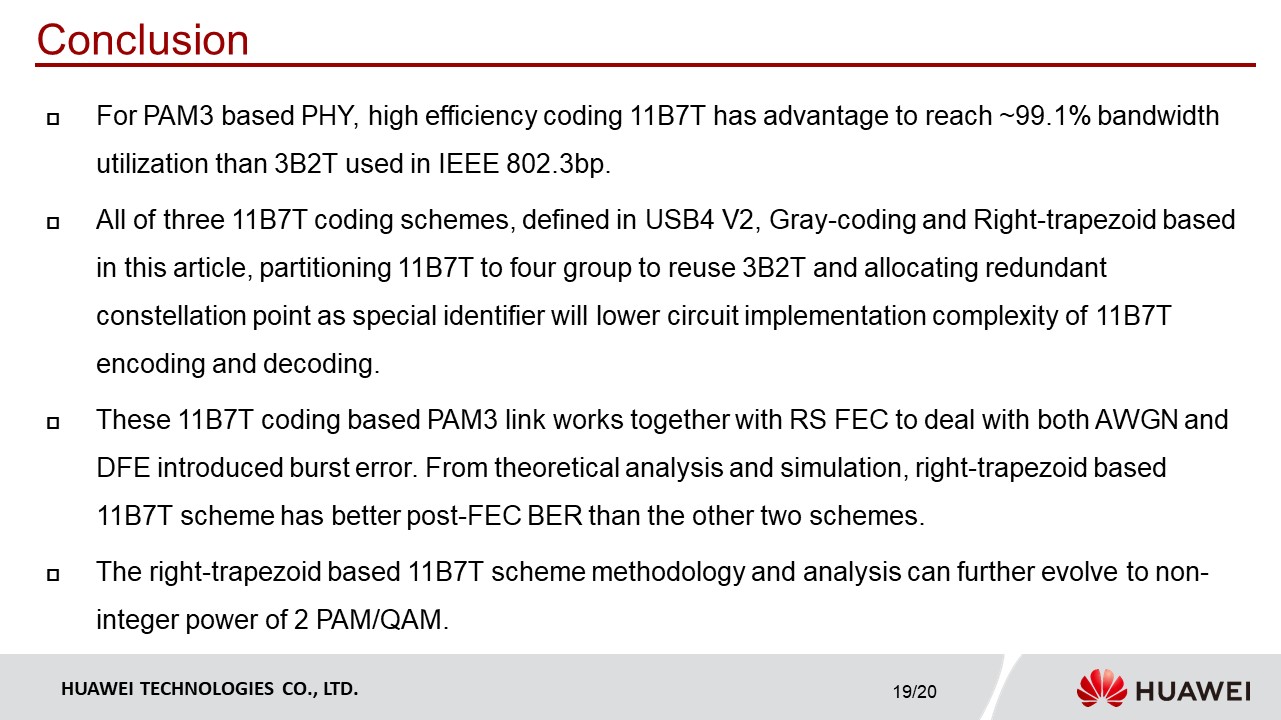 |
For PAM three based PHY, high efficiency coding eleven B seven T has advantage to reach around ninety nine dot one percent bandwidth utilization than three B two T used in I triple E eighty two dot three bp.
All of three eleven B seven T coding schemes, defined in USB four V two, Gray coding and Right trapezoid based in this article, partitioning eleven B seven T to four group to reuse three B two T and allocating redundant constellation point as special identifier will lower circuit implementation complexity of eleven B seven T encoding and decoding.
These eleven B seven T coding based PAM three link works together with RS FEC to deal with both AWGN and DFE introduced burst error. From theoretical analysis and simulation, right trapezoid based eleven B seven T scheme has better post FEC BER than the other two schemes.
The right trapezoid based eleven B seven T scheme methodology and analysis can further evolve to non integer power of two PAM or QAM. |
| ICACT20260094 Slide.20
[Big Slide]
|
Chrome Click!! |
 |
Thanks for your attention! Now! Floor is open for Q and A. Welcome any comment or question.
You can reach me after the conference by email. |















