 ICACT20260121 Slide.01
[Big Slide] |
Chrome  Click!! |
 |
The topic of my presentation is as follows: Mode Decompositions with Sample Entropy and Optimized Extreme Learning Machine for EEG Emotion Classification
|
| ICACT20260121 Slide.02
[Big Slide]
|
Chrome Click!! |
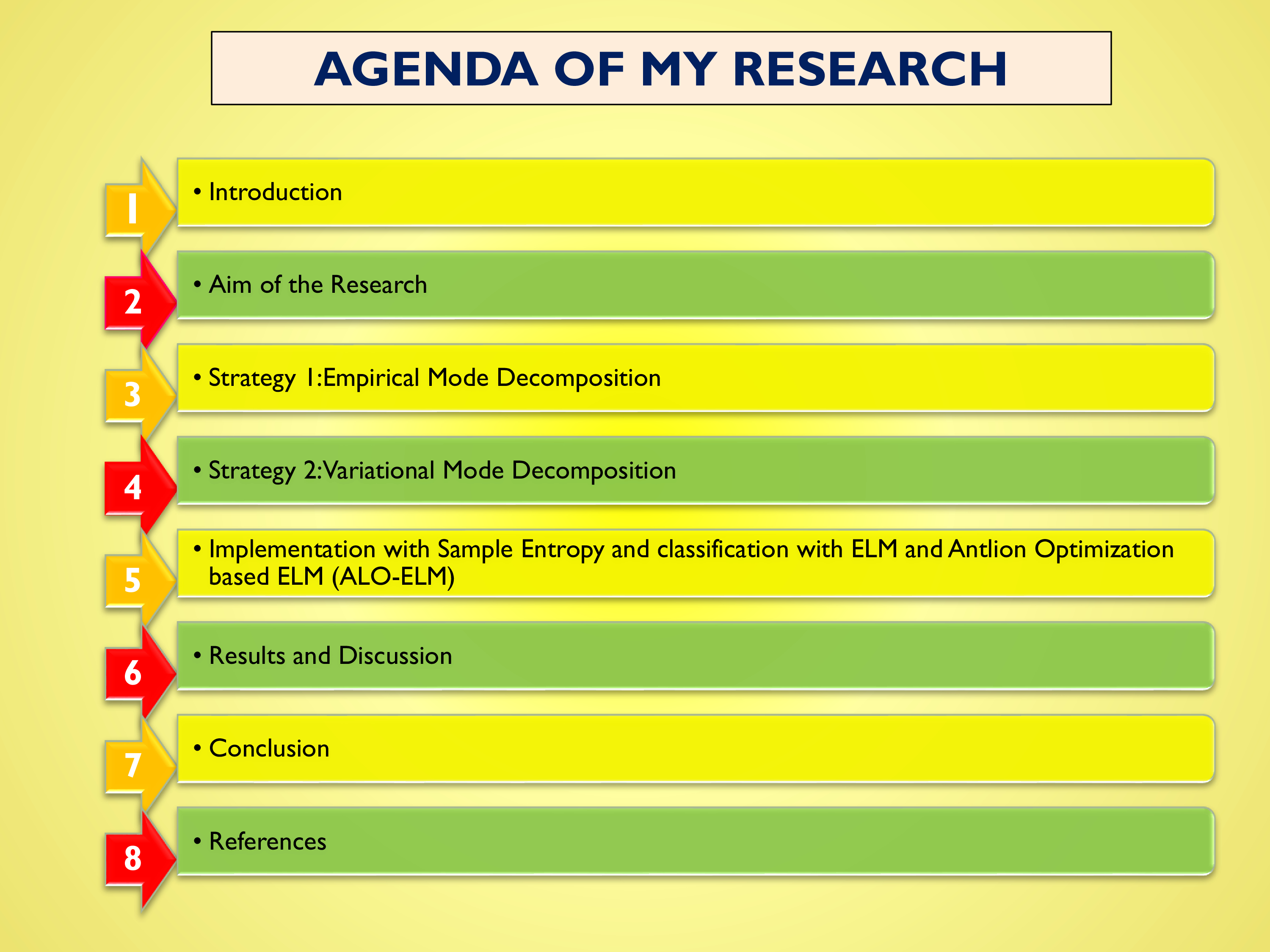 |
The presentation agenda is as follows: First I will discuss the introduction, followed by the aim, two strategies, computation of sample entropy and then classify it with ELM and Antlion based ELM. Finally the results and discussion are analyzed and the conclusion and potential future works will be discussed. |
| ICACT20260121 Slide.03
[Big Slide]
|
Chrome Click!! |
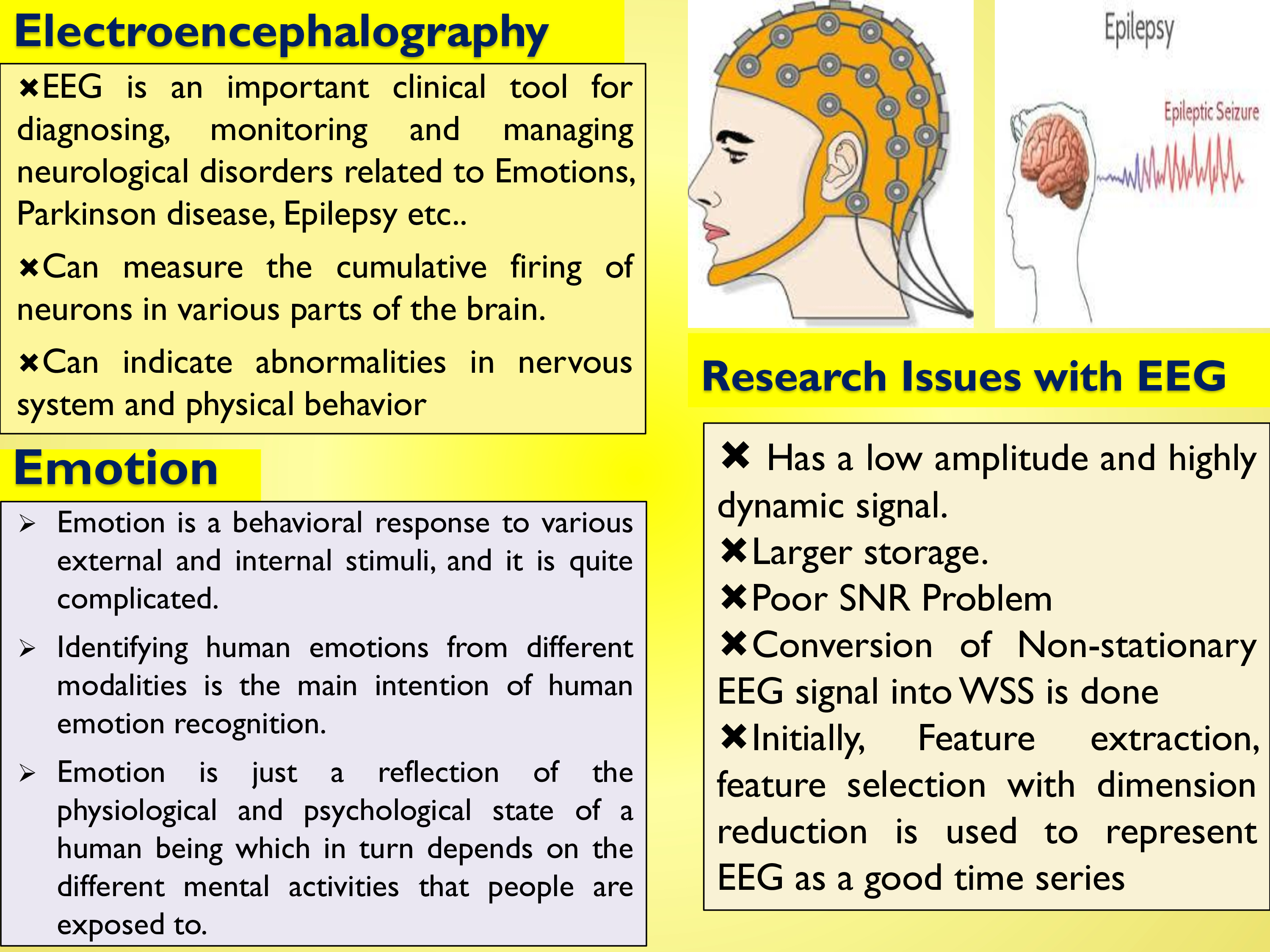 |
EEG is an important clinical tool for diagnosing, monitoring and managing neurological disorders related to Emotions, Parkinson disease, Epilepsy etc.. Can measure the cumulative firing of neurons in various parts of the brain. Emotion is a behavioral response to various external and internal stimuli, and it is quite complicated. Identifying human emotions from different modalities is the main intention of human emotion recognition. Emotion is just a reflection of the physiological and psychological state of a human being which in turn depends on the different mental activities that people are exposed to. |
| ICACT20260121 Slide.04
[Big Slide]
|
Chrome Click!! |
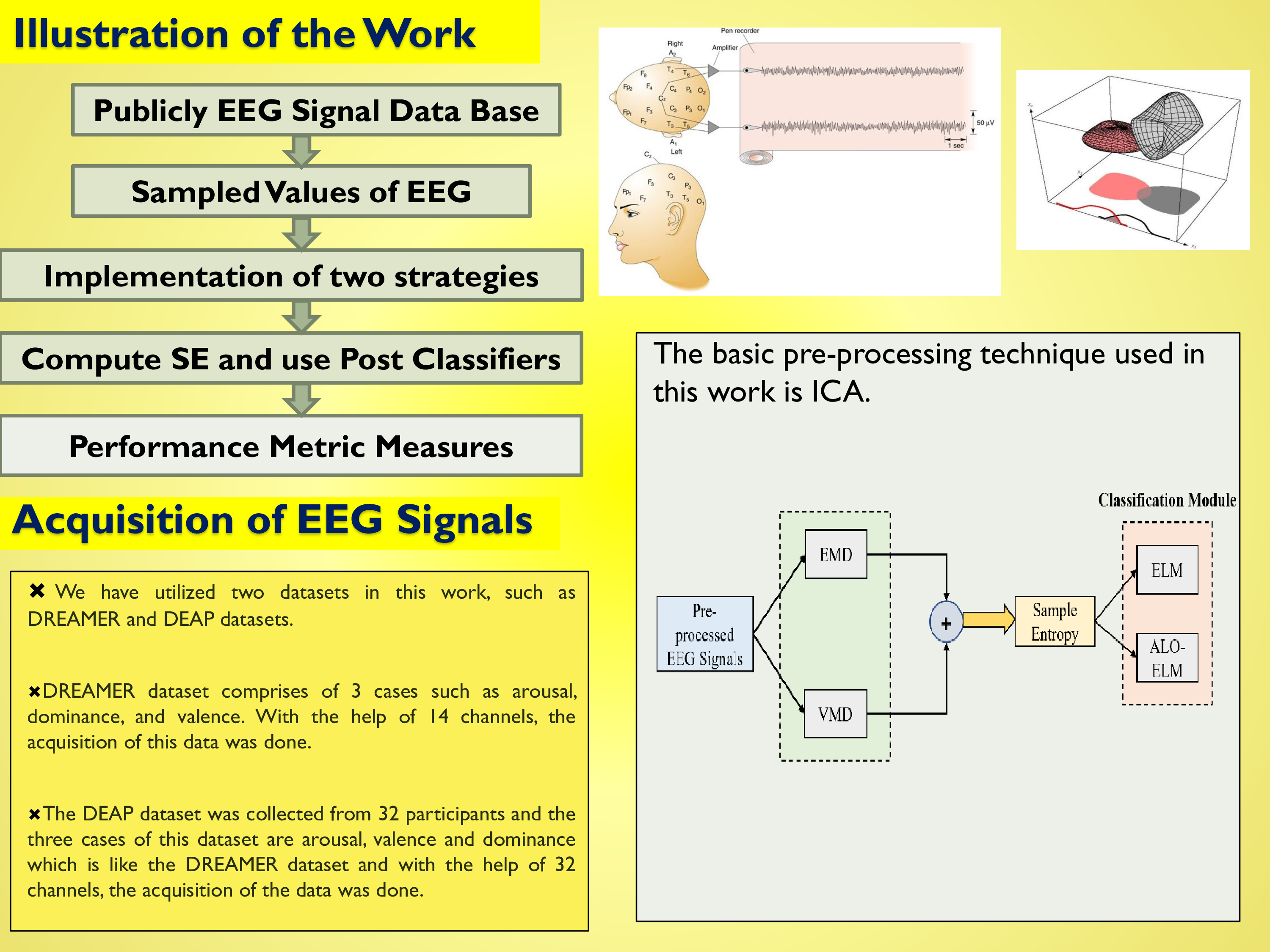 |
We have utilized two datasets in this work, such as DREAMER and DEAP datasets. DREAMER dataset comprises of 3 cases such as arousal, dominance, and valence. With the help of 14 channels, the acquisition of this data was done. The DEAP dataset was collected from 32 participants and the three cases of this dataset are arousal, valence and dominance which is like the DREAMER dataset and with the help of 32 channels, the acquisition of the data was done.
|
| ICACT20260121 Slide.05
[Big Slide]
|
Chrome Click!! |
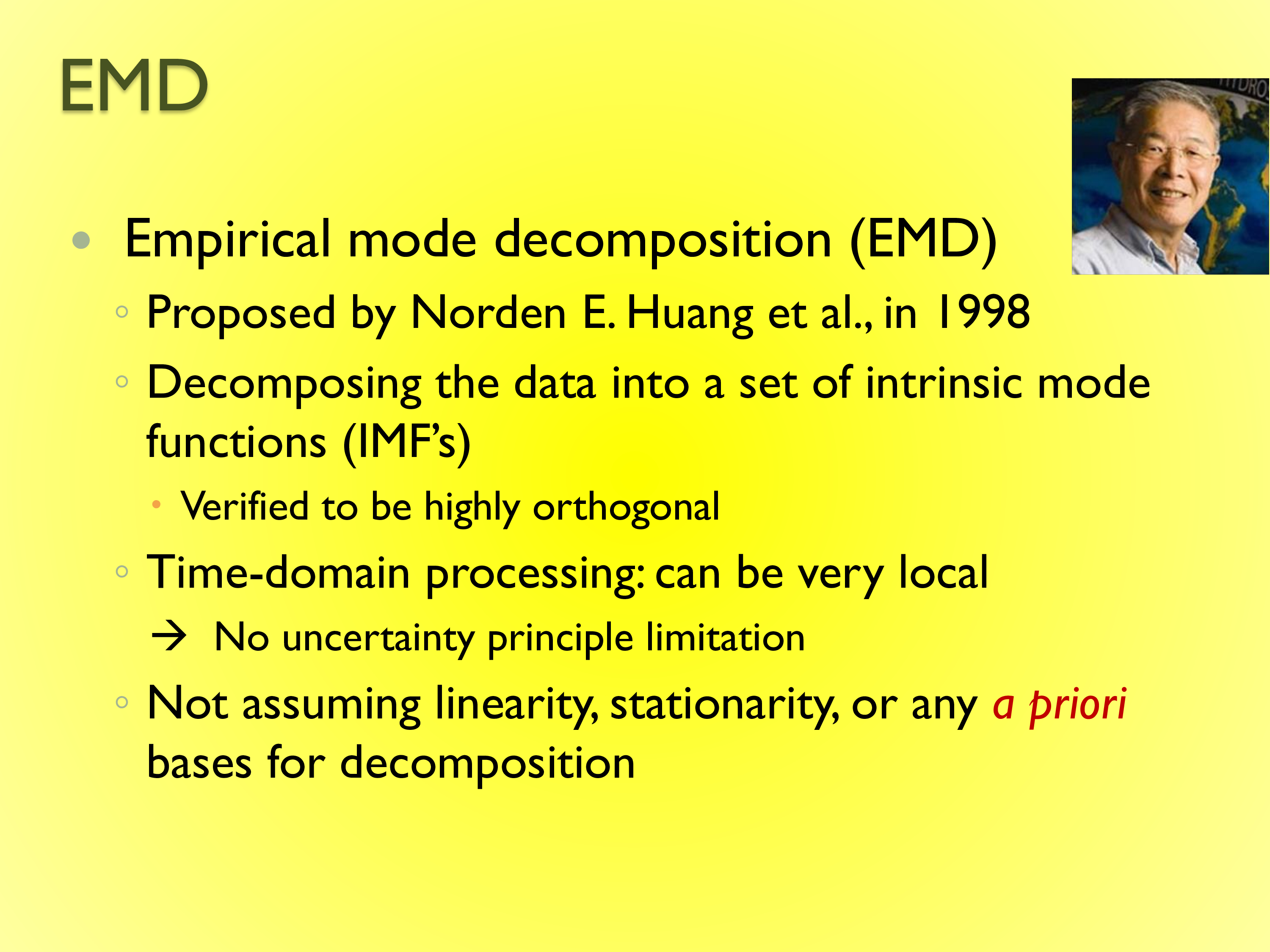 |
The Empirical Mode Decomposition for handling non-stationary data. Empirical Mode Decomposition (EMD) is a fully data-driven, adaptive method for analyzing non-linear and non-stationary time series data. It decomposes signals into a finite number of Intrinsic Mode Functions (IMFs)—oscillations ranging from high to low frequency—based on local characteristic time scales rather than predefined basis functions.
|
| ICACT20260121 Slide.06
[Big Slide]
|
Chrome Click!! |
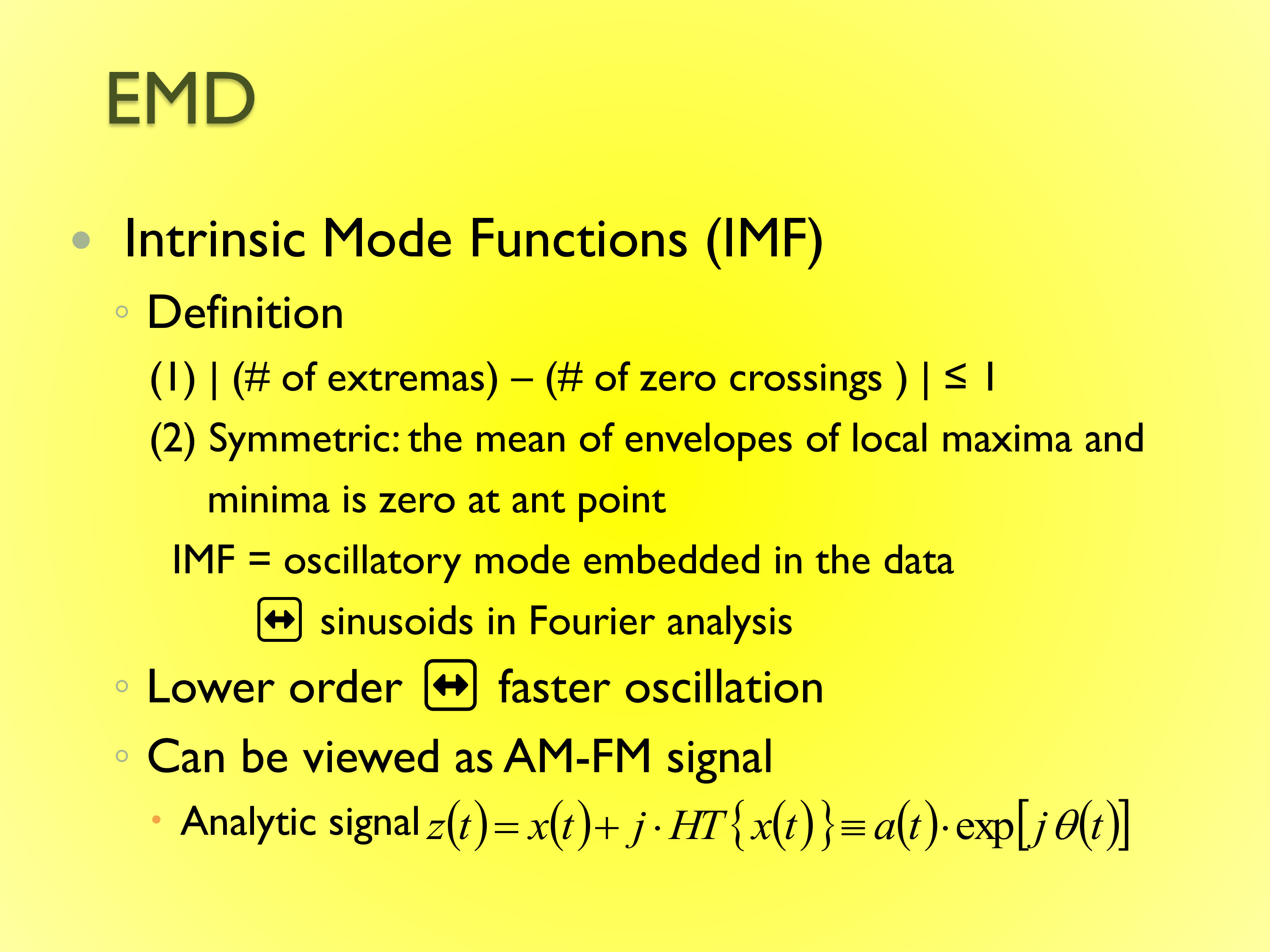 |
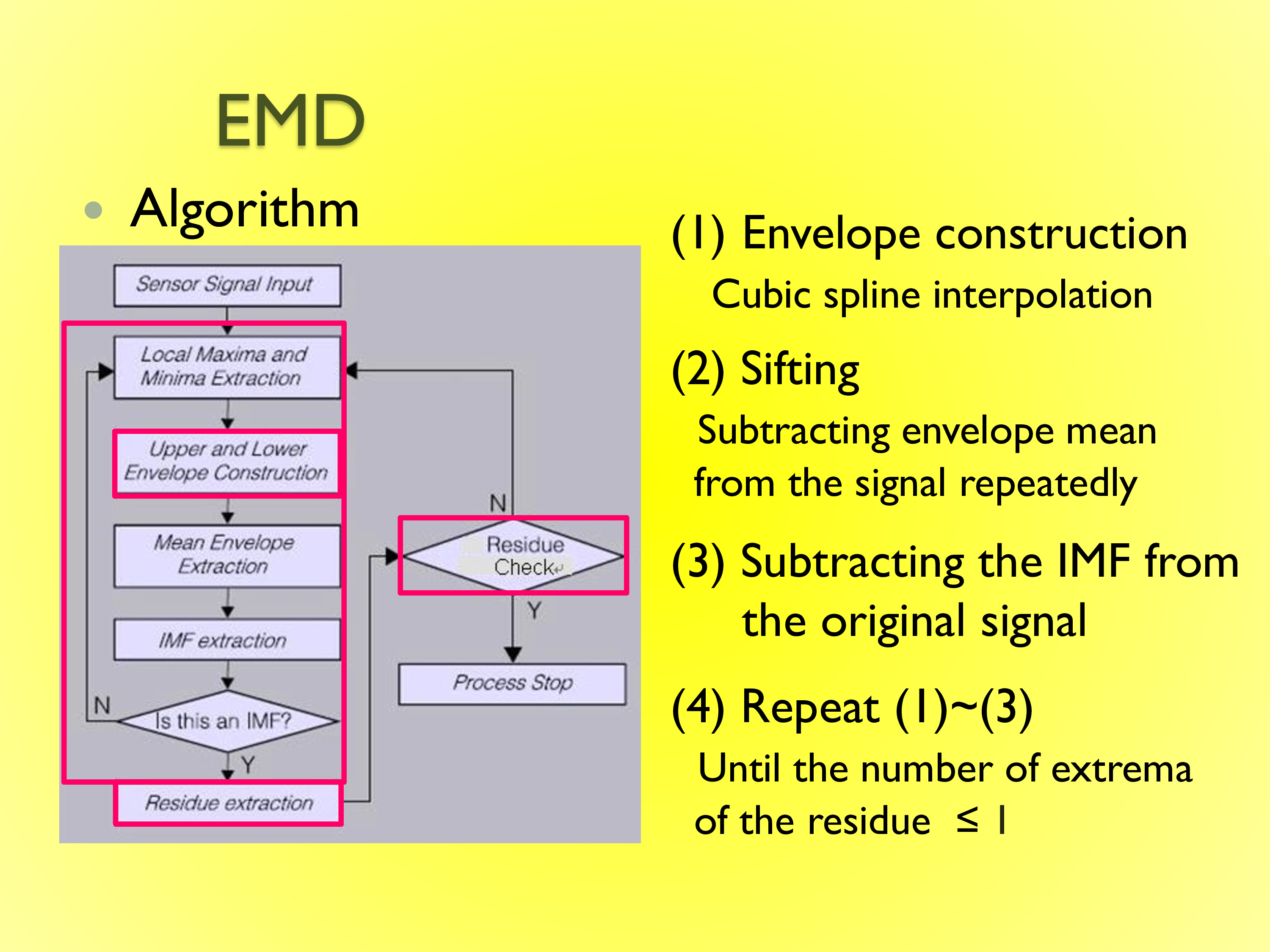
Intrinsic Mode Functions (IMFs): Functions that satisfy two conditions: 1) extrema and zero-crossings are equal or differ at most by one, and 2) the mean value of the envelope defined by local maxima and minima is zero. Sifting Process: The algorithm, which includes finding local extrema, generating upper/lower envelopes via cubic splines, calculating the mean, and subtracting it from the signal to extract IMFs. Residual: The final, monotonic trend left after all IMFs are extracted. Hilbert-Huang Transform (HHT): Often combined with EMD to provide accurate instantaneous frequency analysis. |
| ICACT20260121 Slide.07
[Big Slide]
|
Chrome Click!! |
 |
Advantage of this technique: Highly efficient for non-stationary data (e.g., EEG, seismic, financial), as it does not require stationarity or linearity assumptions. Mode Mixing Problem: A major limitation where a single IMF contains signals of widely disparate scales, or similar oscillations appear in different IMFs. EEMD (Ensemble EMD): A technique that adds white noise to the signal to mitigate mode mixing by forcing the algorithm to explore different scales. Applications: Commonly used in biomedical signal processing, seismic signal analysis, and financial data analysis.
|
| ICACT20260121 Slide.08
[Big Slide]
|
Chrome Click!! |
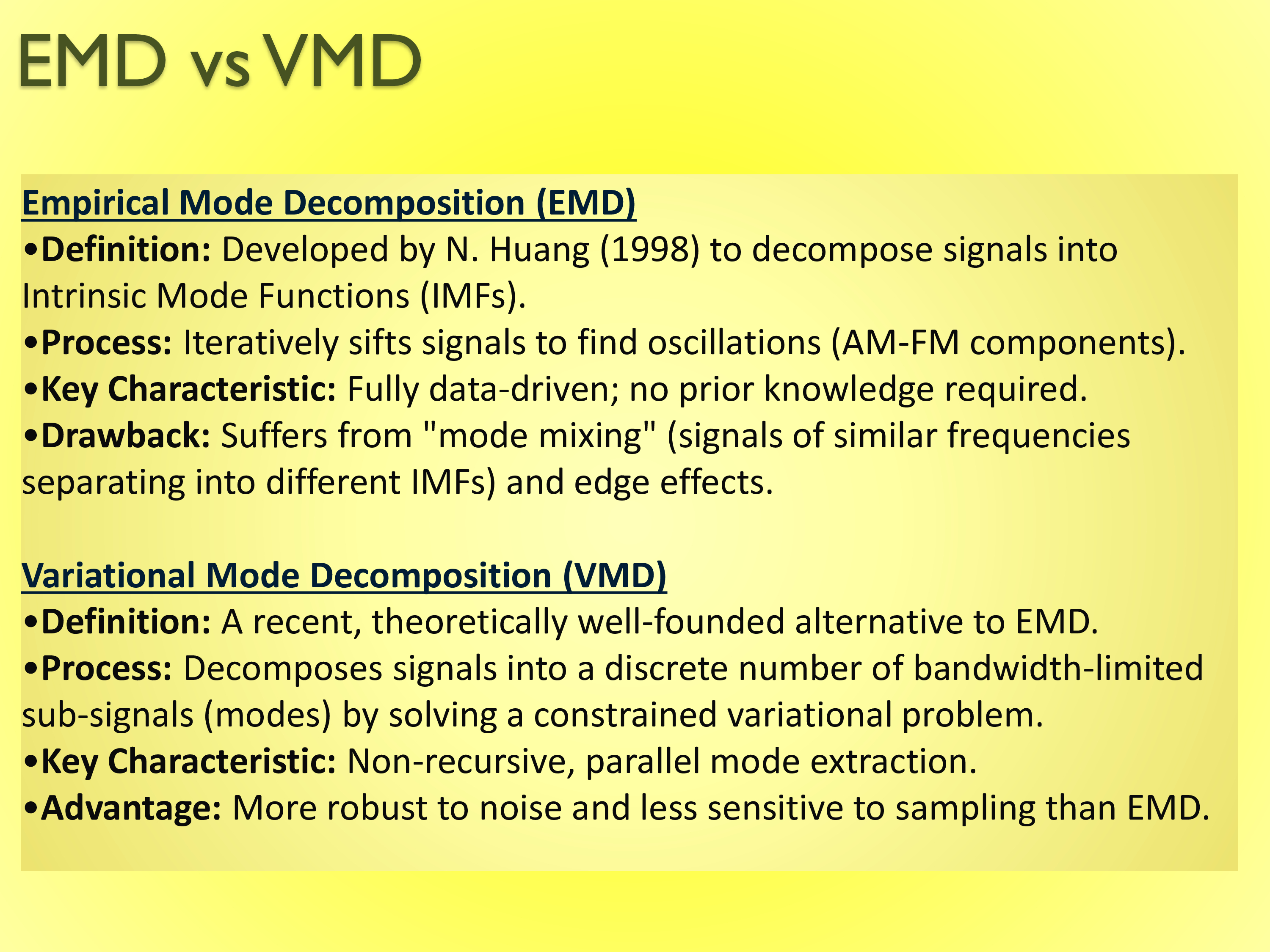 |
Empirical Mode Decomposition (EMD)
What it does: Decomposes a signal into a set of Intrinsic Mode Functions (IMFs).
Strengths: Fully adaptive, requires no prior knowledge of the signal frequency content.
Weaknesses:
Mode Mixing: Similar frequencies may exist in different modes, or a single mode may contain widely different frequencies.
Boundary Effects: The sifting process can produce artifacts at the beginning and end of the data.
Variational Mode Decomposition (VMD)
What it does: Decomposes a signal into a discrete number of band-limited Variational Mode Functions (VMFs) by solving a constrained optimization problem.
Strengths:
Robustness: Effectively handles noise and non-stationary characteristics, making it better for real-world signals.
Frequency Separation: Produces cleaner, more distinct frequency modes.
Weaknesses: Requires defining the number of modes (
) before decomposition. |
| ICACT20260121 Slide.09
[Big Slide]
|
Chrome Click!! |
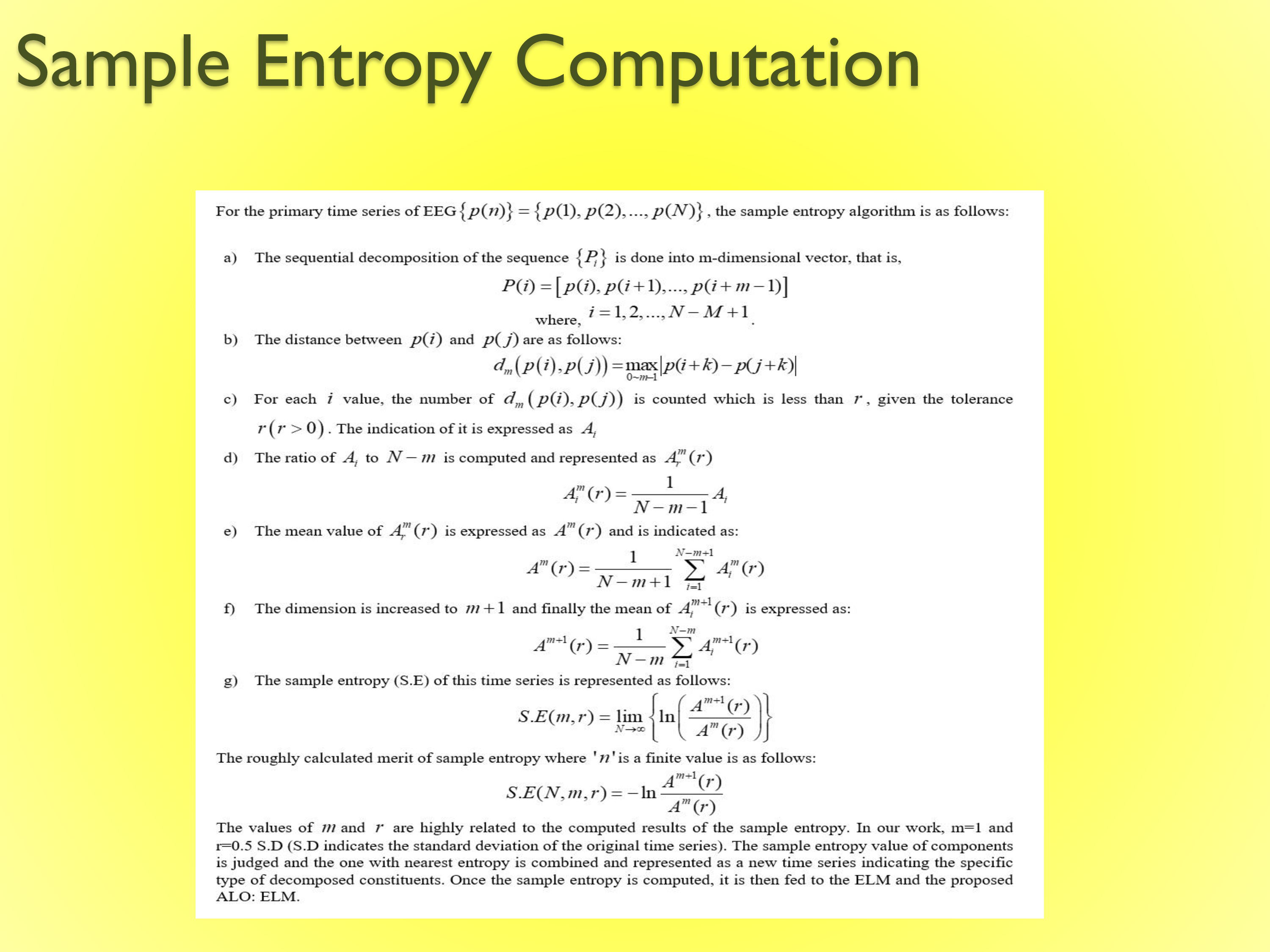 |
Sample entropy (SampEn; more appropriately K_2 entropy or Takens–Grassberger–Procaccia correlation entropy) is a modification of approximate entropy (ApEn; more appropriately "Procaccia–Cohen entropy"), used for assessing the complexity of physiological and other time-series signals, diagnosing e.g. diseased states. SampEn has two advantages over ApEn: data length independence and a relatively trouble-free implementation. Also, there is a small computational difference: In ApEn, the comparison between the template vector (see below) and the rest of the vectors also includes comparison with itself. Consequently, it is always possible to take a logarithm of probabilities. Because template comparisons with itself lower ApEn values, the signals are interpreted to be more regular than they actually are. These self-matches are not included in SampEn. |
| ICACT20260121 Slide.10
[Big Slide]
|
Chrome Click!! |
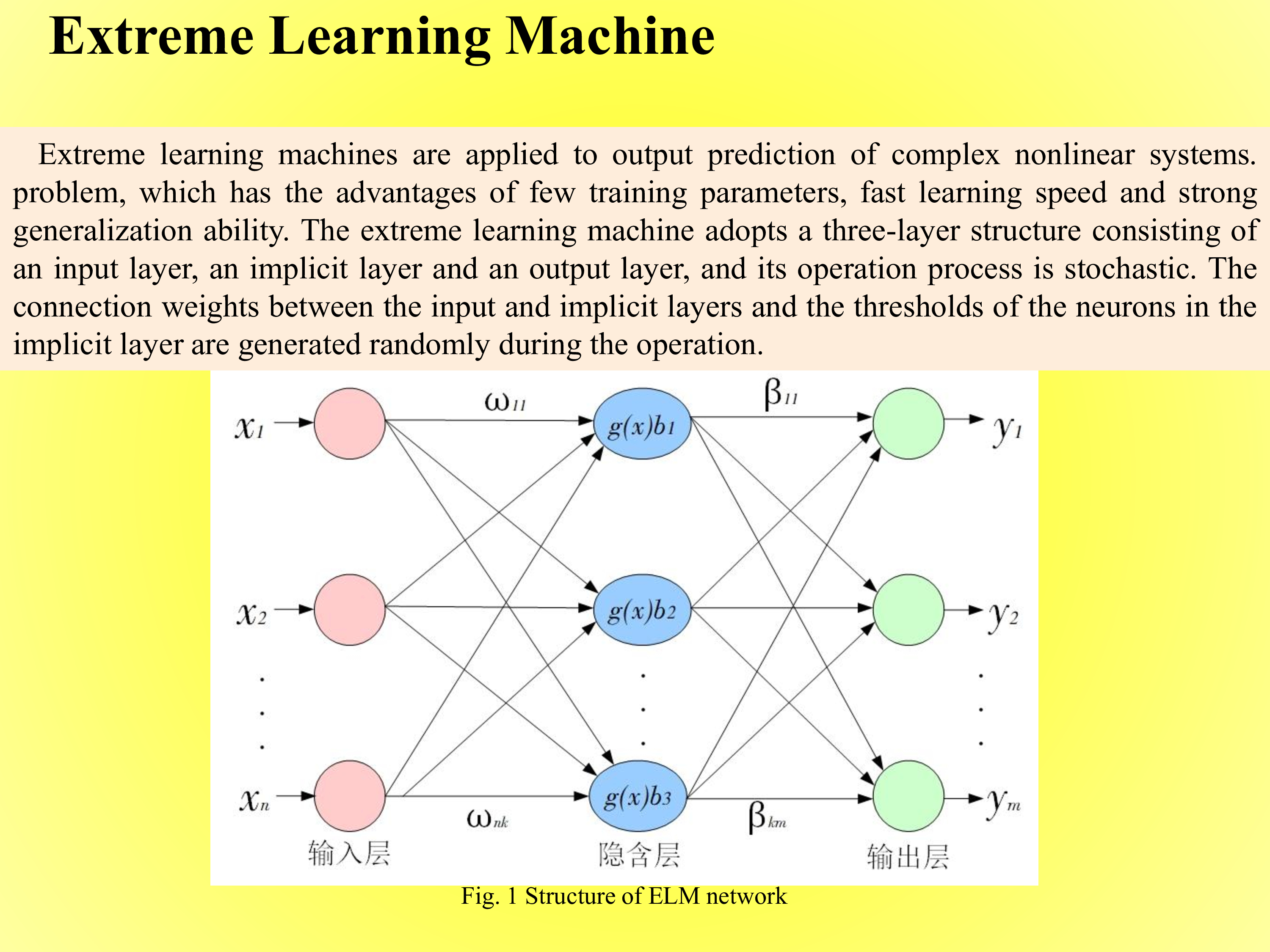 |
In most cases, ELM is used as a single hidden layer feedforward network (SLFN) including but not limited to sigmoid networks, RBF networks, threshold networks, fuzzy inference networks, complex neural networks, wavelet networks, Fourier transform, Laplacian transform, etc. Due to its different learning algorithm implementations for regression, classification, sparse coding, compression, feature learning and clustering, multi ELMs have been used to form multi hidden layer networks, deep learning or hierarchical networks. A hidden node in ELM is a computational element, which need not be considered as classical neuron. A hidden node in ELM can be classical artificial neurons, basis functions, or a subnetwork formed by some hidden nodes
|
| ICACT20260121 Slide.11
[Big Slide]
|
Chrome Click!! |
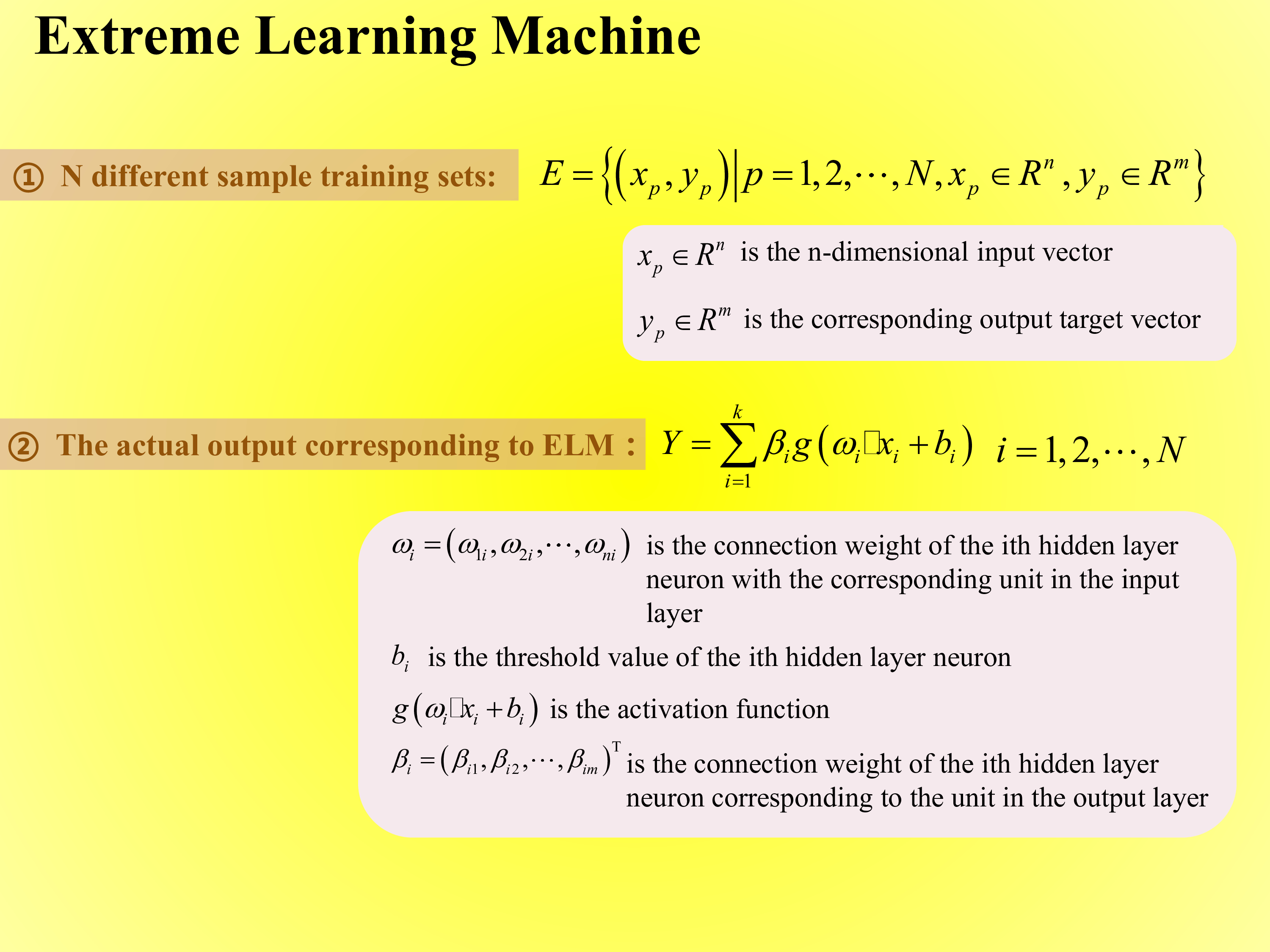 |
The name "extreme learning machine" (ELM) was given to such models by Guang-Bin Huang who originally proposed for the networks with any type of nonlinear piecewise continuous hidden nodes including biological neurons and different type of mathematical basis functions.
The idea for artificial neural networks goes back to Frank Rosenblatt, who not only published a single layer Perceptron in 1958,but also introduced a multilayer perceptron with 3 layers: an input layer, a hidden layer with randomized weights that did not learn, and a learning output layer. |
| ICACT20260121 Slide.12
[Big Slide]
|
Chrome Click!! |
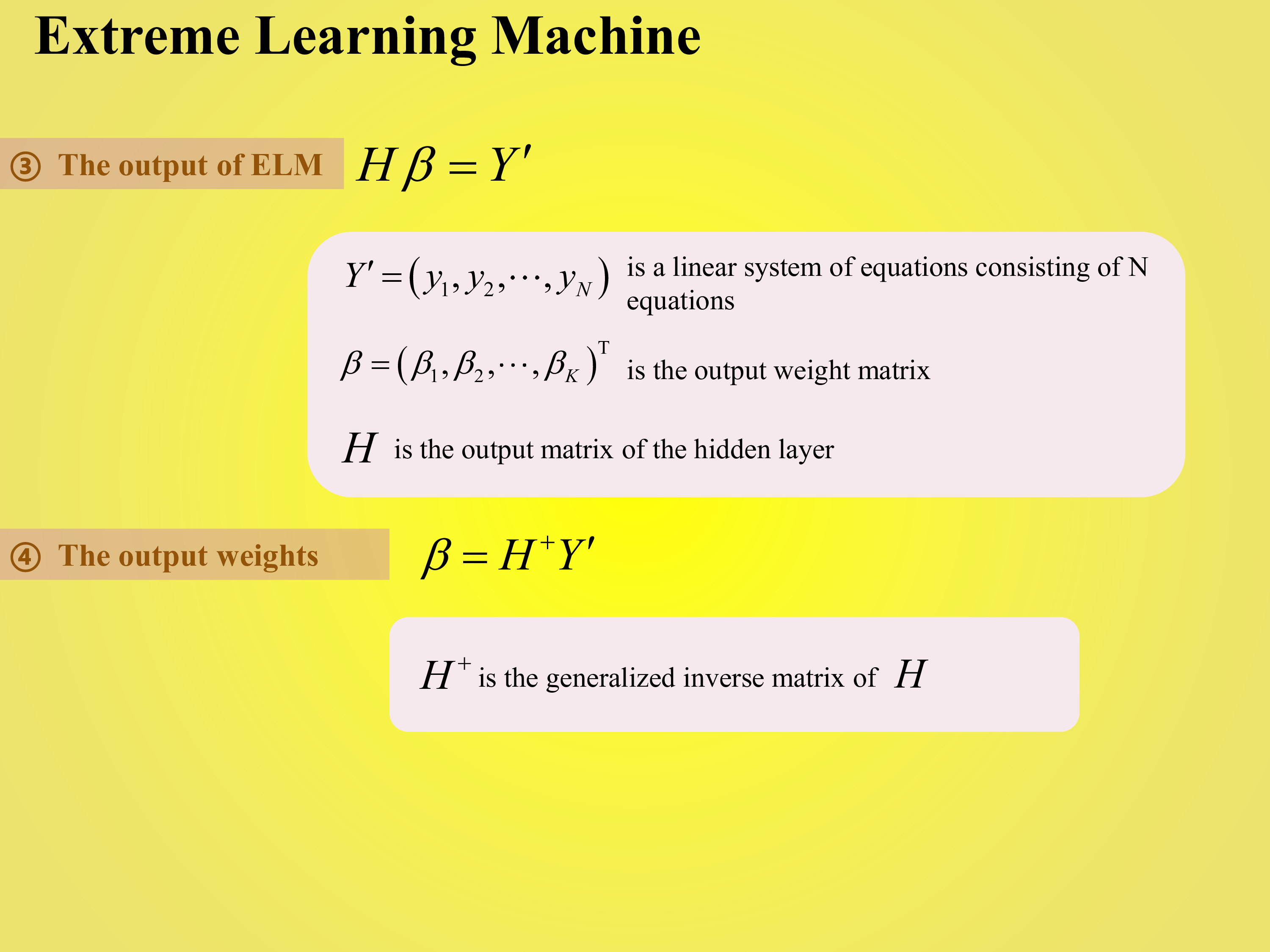 |
Extreme learning machines are feedforward neural networks for classification, regression, clustering, sparse approximation, compression and feature learning with a single layer or multiple layers of hidden nodes, where the parameters of hidden nodes (not just the weights connecting inputs to hidden nodes) need to be tuned. These hidden nodes can be randomly assigned and never updated (i.e. they are random projection but with nonlinear transforms), or can be inherited from their ancestors without being changed. In most cases, the output weights of hidden nodes are usually learned in a single step, which essentially amounts to learning a linear model. |
| ICACT20260121 Slide.13
[Big Slide]
|
Chrome Click!! |
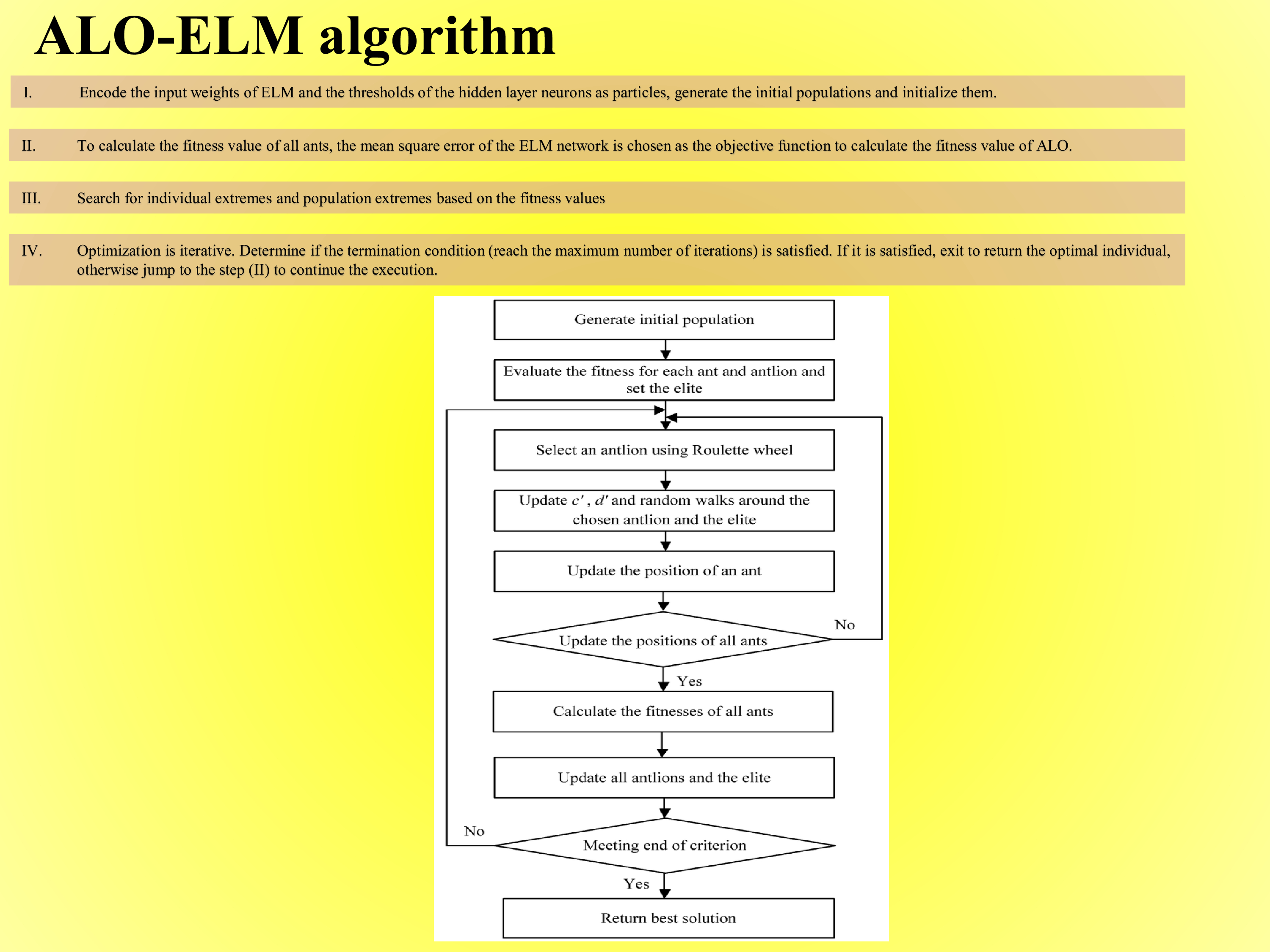 |
The Ant Lion Optimizer, known as ALO or Antlion Optimizer, is a recent meta-heuristic that mathematically models the interaction of ants and antlions in nature. An optimization algorithm has been developed to solve optimization problems considering random walk of ants, building traps, entrapment of ants in traps, catching preys, and re-building traps are implemented. The Ant Lion Optimizer, known as ALO or Antlion Optimizer, is a recent meta-heuristic that mathematically models the interaction of ants and antlions in nature. An optimization algorithm has been developed to solve optimization problems considering random walk of ants, building traps, entrapment of ants in traps, catching preys, and re-building traps are implemented.
|
| ICACT20260121 Slide.14
[Big Slide]
|
Chrome Click!! |
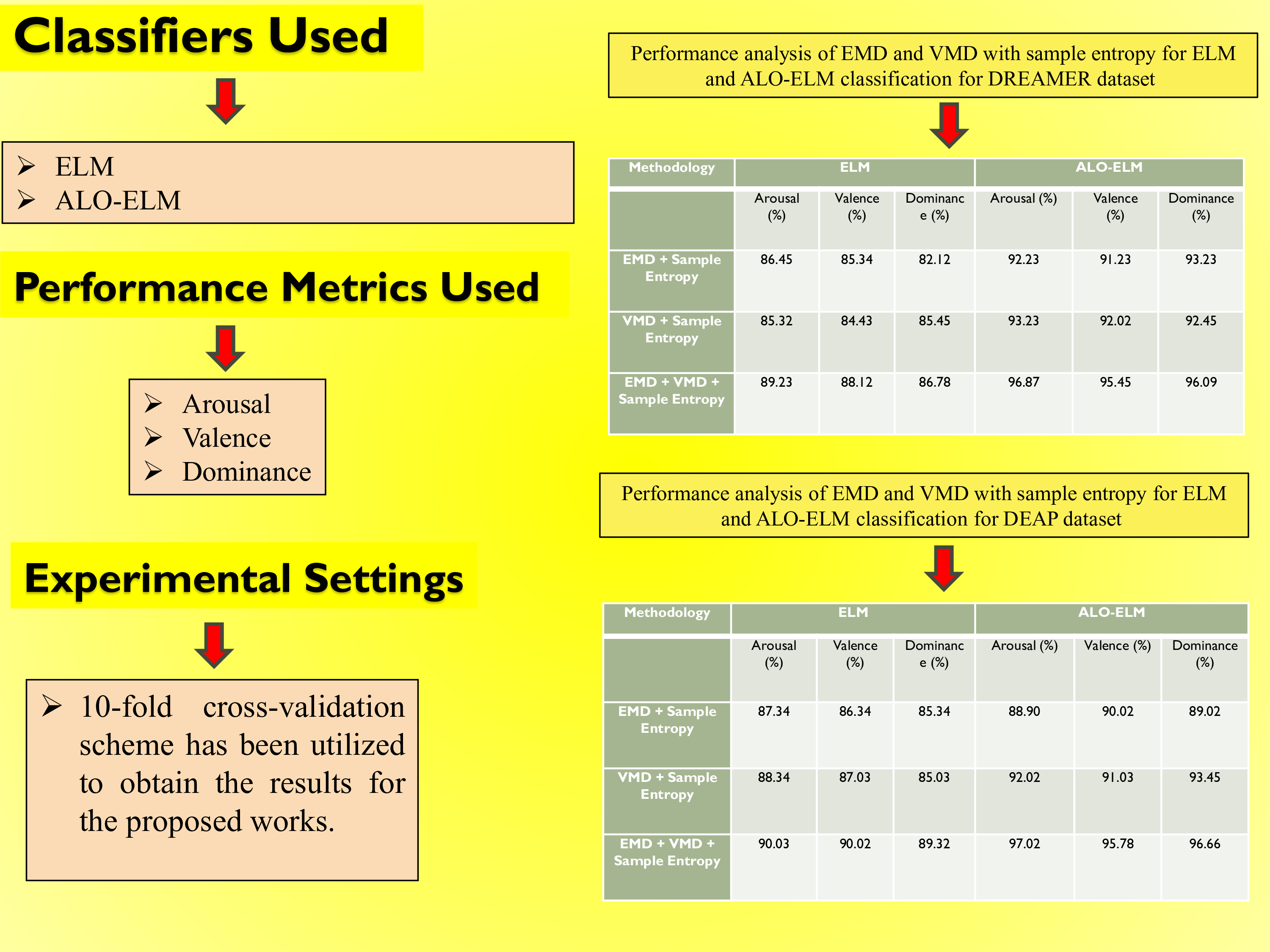 |
10-fold cross-validation scheme has been utilized to obtain the results for the proposed works |
| ICACT20260121 Slide.15
[Big Slide]
|
Chrome Click!! |
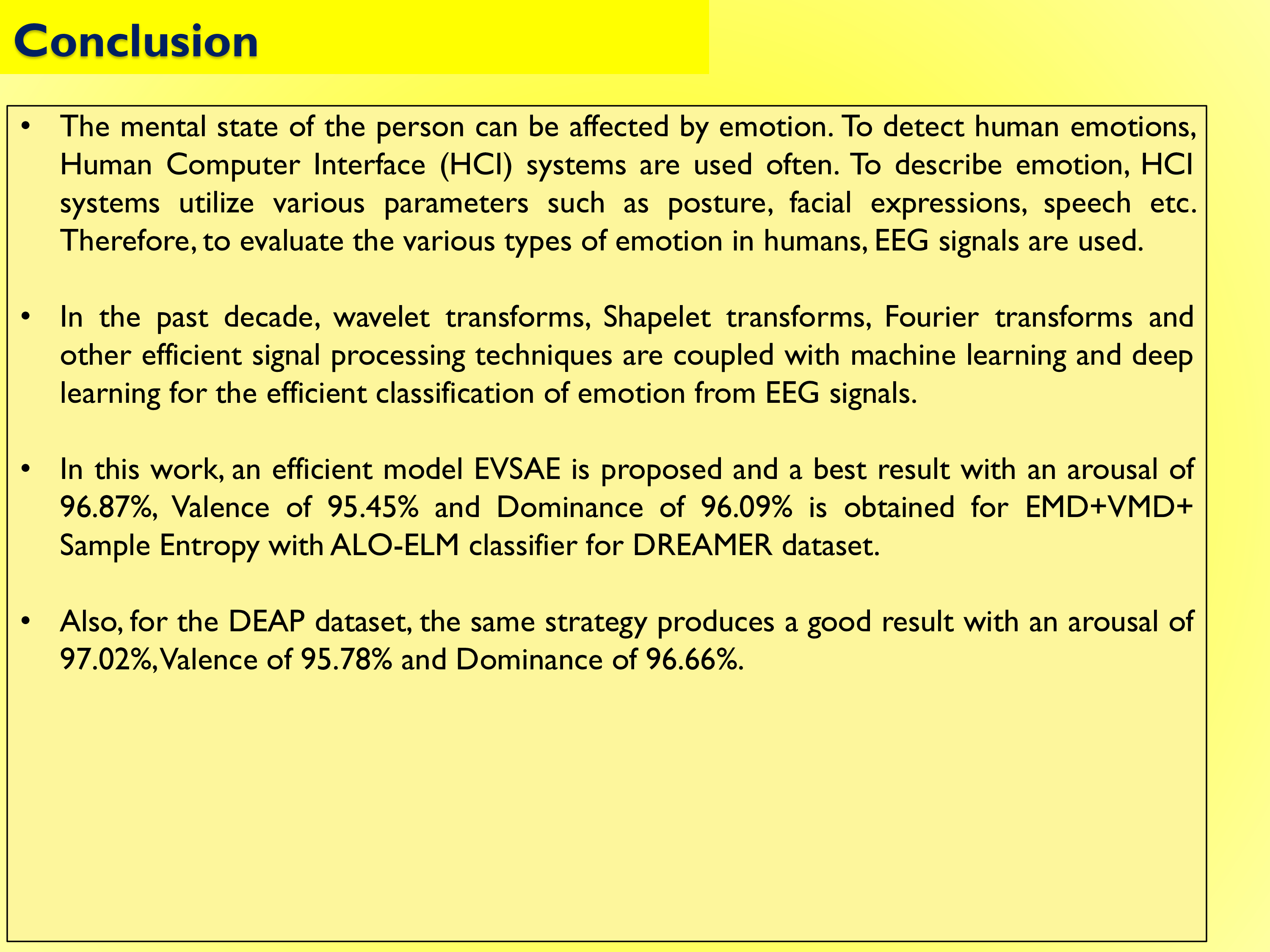 |
In the past decade, wavelet transforms, Shapelet transforms, Fourier transforms and other efficient signal processing techniques are coupled with machine learning and deep learning for the efficient classification of emotion from EEG signals.
In this work, an efficient model EVSAE is proposed and a best result with an arousal of 96.87%, Valence of 95.45% and Dominance of 96.09% is obtained for EMD+VMD+ Sample Entropy with ALO-ELM classifier for DREAMER dataset.
Also, for the DEAP dataset, the same strategy produces a good result with an arousal of 97.02%, Valence of 95.78% and Dominance of 96.66%.
|
| ICACT20260121 Slide.16
[Big Slide]
|
Chrome Click!! |
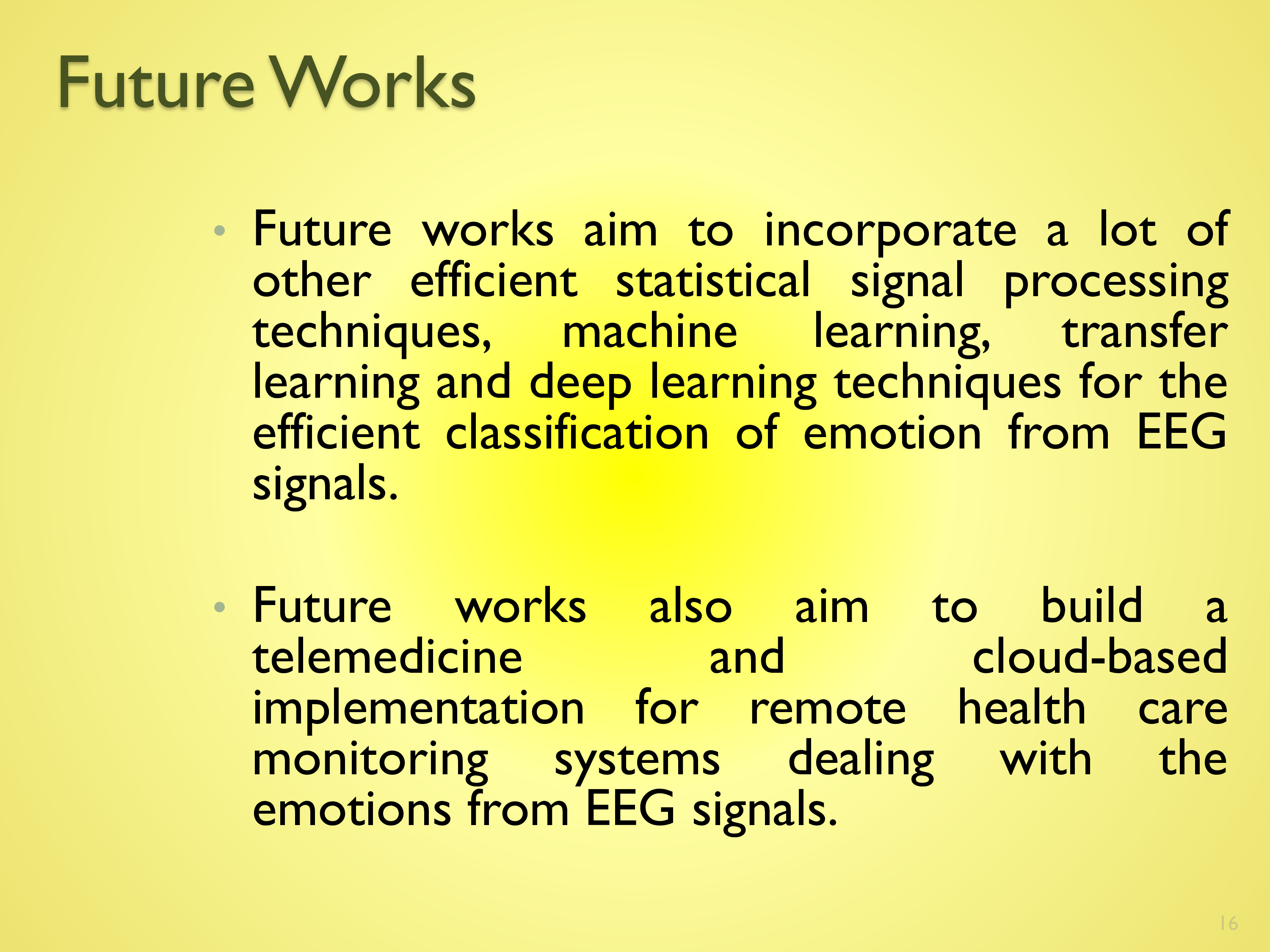 |
Future works aim to incorporate a lot of other efficient statistical signal processing techniques, machine learning, transfer learning and deep learning techniques for the efficient classification of emotion from EEG signals.
Future works also aim to build a telemedicine and cloud-based implementation for remote health care monitoring systems dealing with the emotions from EEG signals.
|
| ICACT20260121 Slide.17
[Big Slide]
|
Chrome Click!! |
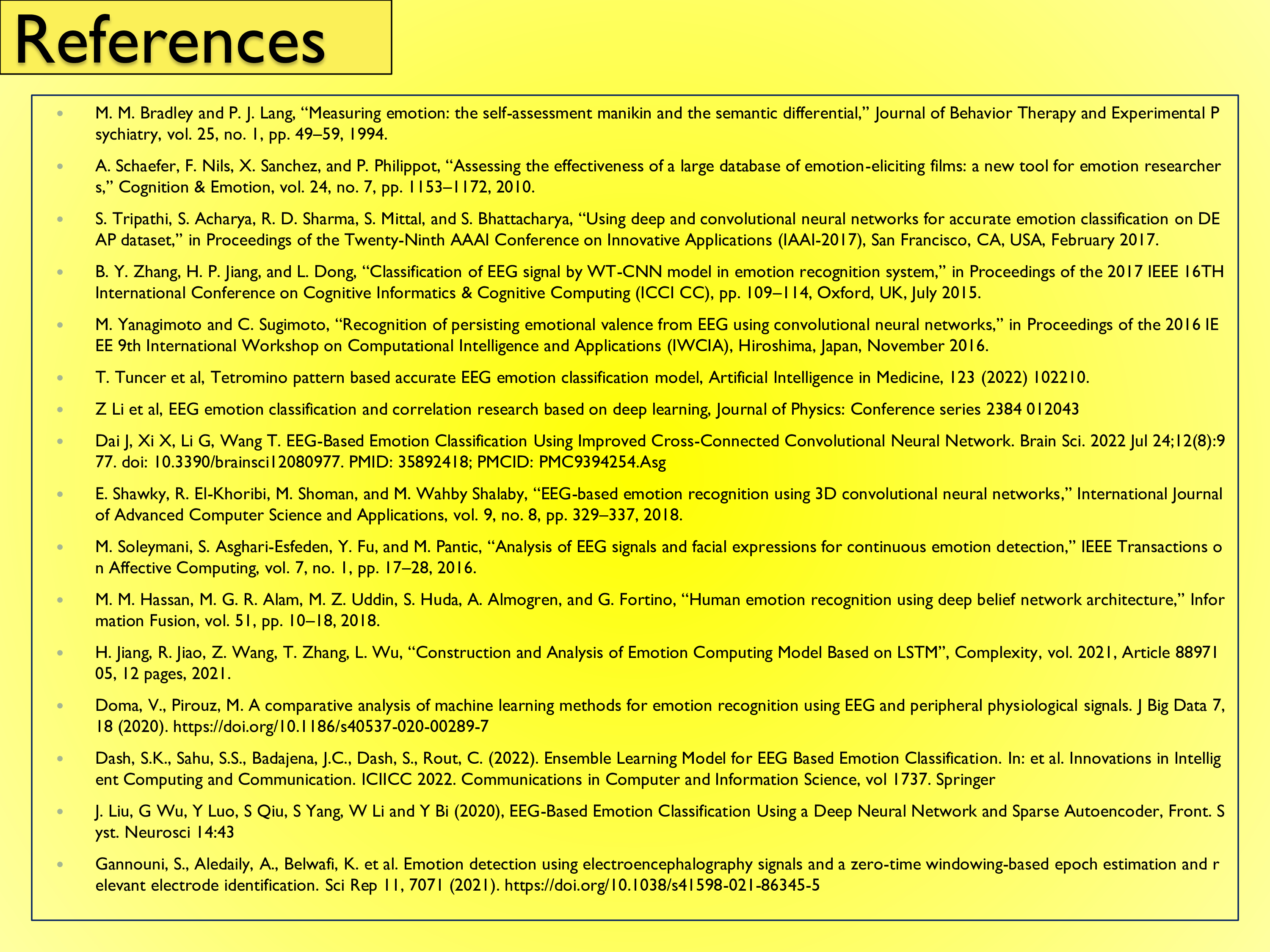 |
These are some of the references used in the work. |
| ICACT20260121 Slide.18
[Big Slide]
|
Chrome Click!! |
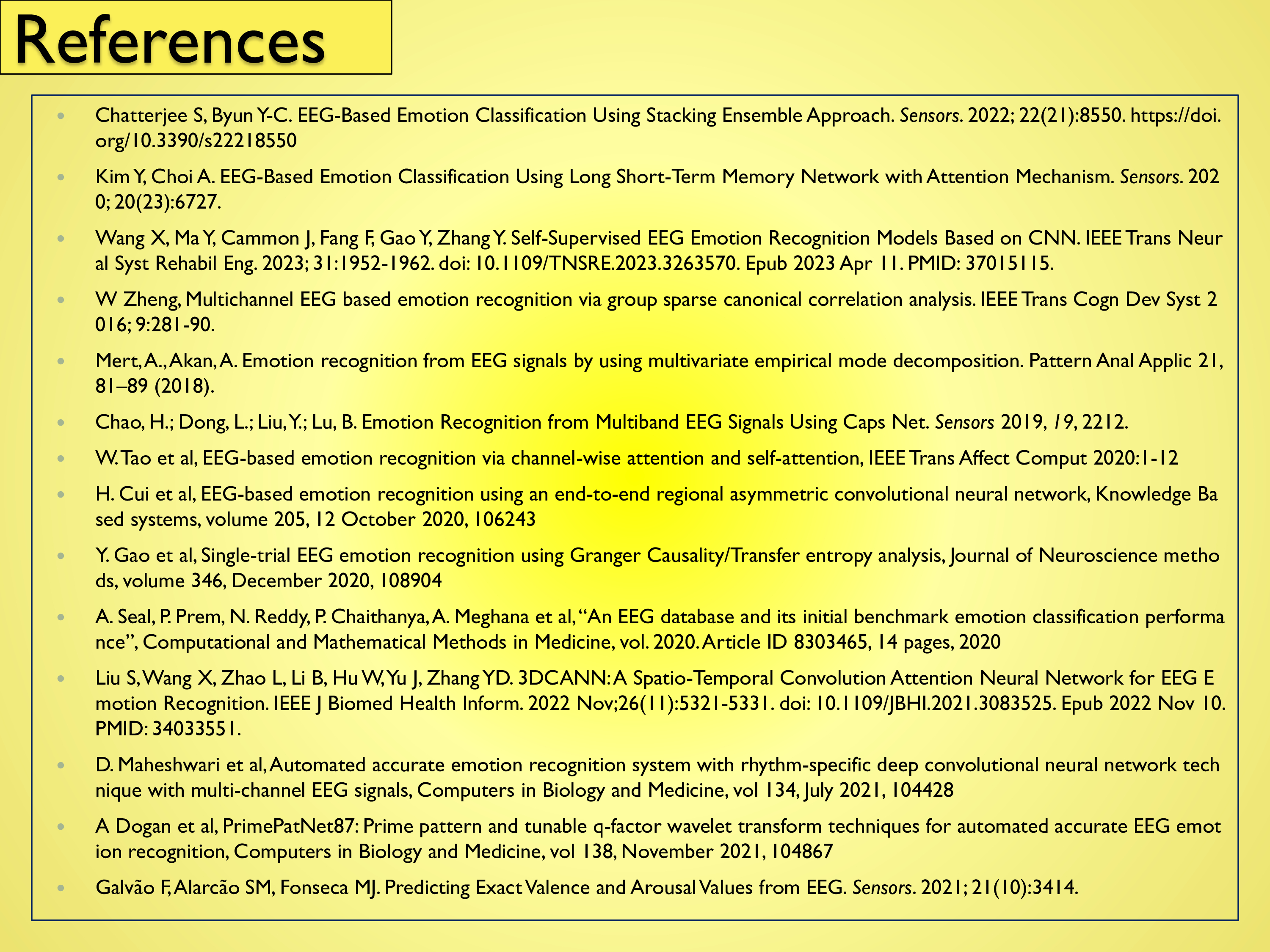 |
The references are continued in this slide. |
| ICACT20260121 Slide.19
[Big Slide]
|
Chrome Click!! |
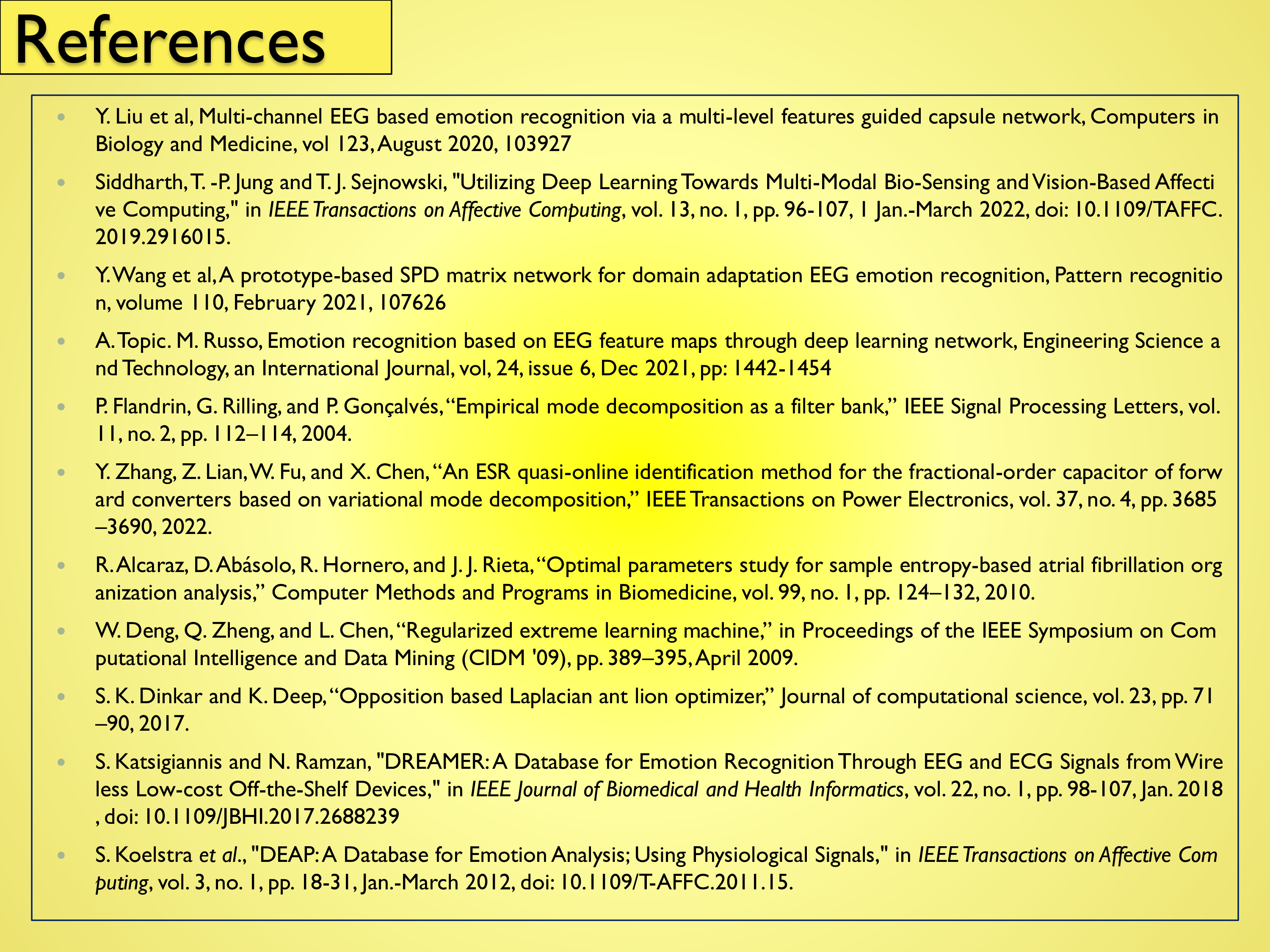 |
The final slides of references are given here. |
| ICACT20260121 Slide.20
[Big Slide]
|
Chrome Click!! |
 |
Thank you for the patience and time. |















